
Theories, Theoretical Framework, Variables,
LO
Published · 55 slides · 0 views

1 / 1










Description
Theories, Theoretical Framework, Variables, Hypothesis Development Zulkarnain Lubis Theories Theory A broad abstract characterization of phenomena, a generalization that presents a systematic explanation about the relationships among
Related Topics
Share
Embed code
Download this presentation From Below
"Theories, Theoretical Framework, Variables," is the property of its rightful owner. Permission is granted to download and print the materials on this website for personal, non-commercial use only, and to display it on your personal computer provided you do not modify the materials and that you retain all copyright notices contained in the materials. By downloading content from our website, you accept the terms of this agreement.
Presentation Transcript
01
Theories,
Theoretical Framework,
Variables,
Hypothesis Development Zulkarnain Lubis<br>
02
Theories<br>
03
Theory A broad abstract characterization of phenomena, a generalization that presents a systematic explanation about the relationships among phenomena. Its writings include terms such as propositions, premise, law and principles
An explanation establishes the substantive meaning of constructs, variables, and their linkages, while a prediction tests that substantive meaning by comparing it to empirical evidence
A theory is a system of constructs and variables in which the constructs or variables are related to each other by propositions or hypotheses, within the boundary that sets the limitations and assumptions in applying it (e.g., values, context, space, time)<br>
04
A set of interrelated constructs (concepts), definitions, and propositions that presents a systematic view of phenomena by specifying relations among variables, with the purpose of explaining and predicting the phenomena
It is a statement of relationship between two variables, one acting as the independent variable, another as the dependent variable
Theory is developed by which to explain and predict complex events, objects or phenomena. An explanation establishes the substantive meaning of constructs, variables, and their linkages, while a prediction tests that substantive meaning by comparing it to empirical evidence THEORY<br>
05
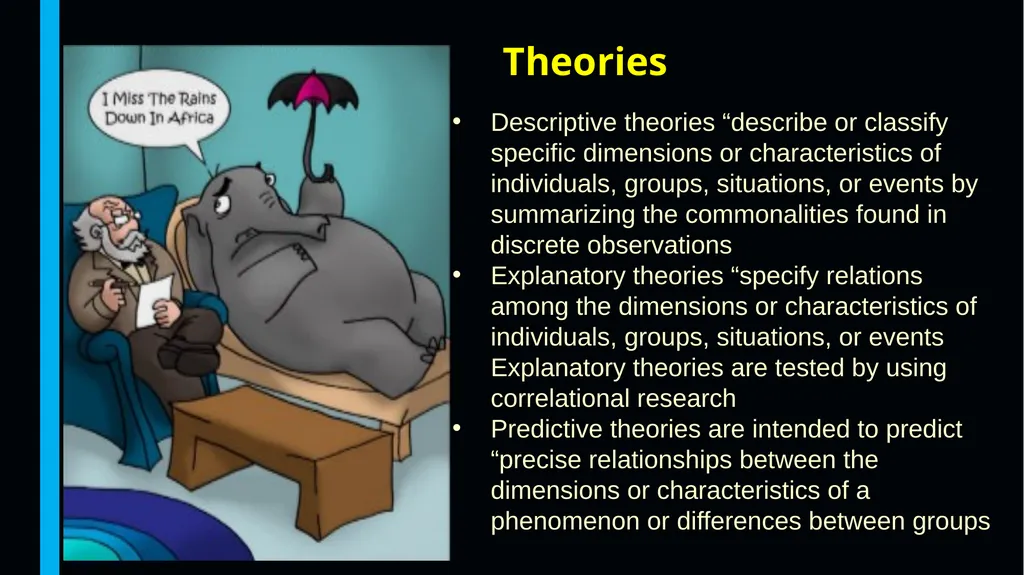
Descriptive theories “describe or classify specific dimensions or characteristics of individuals, groups, situations, or events by summarizing the commonalities found in discrete observations
Explanatory theories “specify relations among the dimensions or characteristics of individuals, groups, situations, or events Explanatory theories are tested by using correlational research
Predictive theories are intended to predict “precise relationships between the dimensions or characteristics of a phenomenon or differences between groups Theories<br>
06
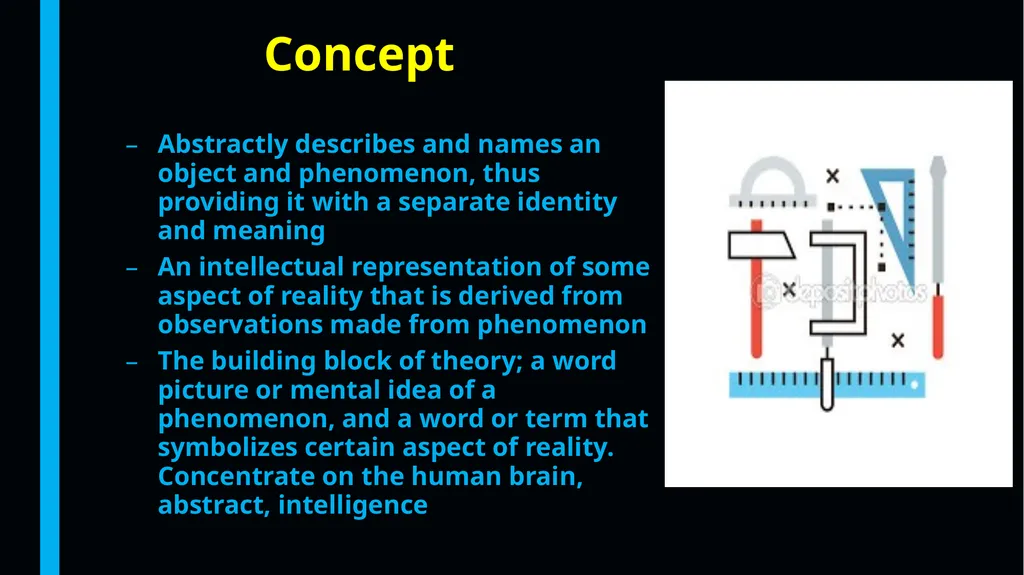
Concept Abstractly describes and names an object and phenomenon, thus providing it with a separate identity and meaning
An intellectual representation of some aspect of reality that is derived from observations made from phenomenon
The building block of theory; a word picture or mental idea of a phenomenon, and a word or term that symbolizes certain aspect of reality. Concentrate on the human brain, abstract, intelligence<br>
07
Concept The building block of theory; a word picture or mental idea of a phenomenon, and a word or term that symbolizes certain aspect of reality. Concentrate on the human brain, abstract, intelligence
Expresses an abstraction formed by generalization from particulars. E.g. "weight expresses numerous observations of things that are more or less "heavy or "light." Others: Mass, energy, force, achievement, intelligence, motivation, extraversion., aggressiveness, conformity.<br>
Expresses an abstraction formed by generalization from particulars. E.g. "weight expresses numerous observations of things that are more or less "heavy or "light." Others: Mass, energy, force, achievement, intelligence, motivation, extraversion., aggressiveness, conformity.<br>
08
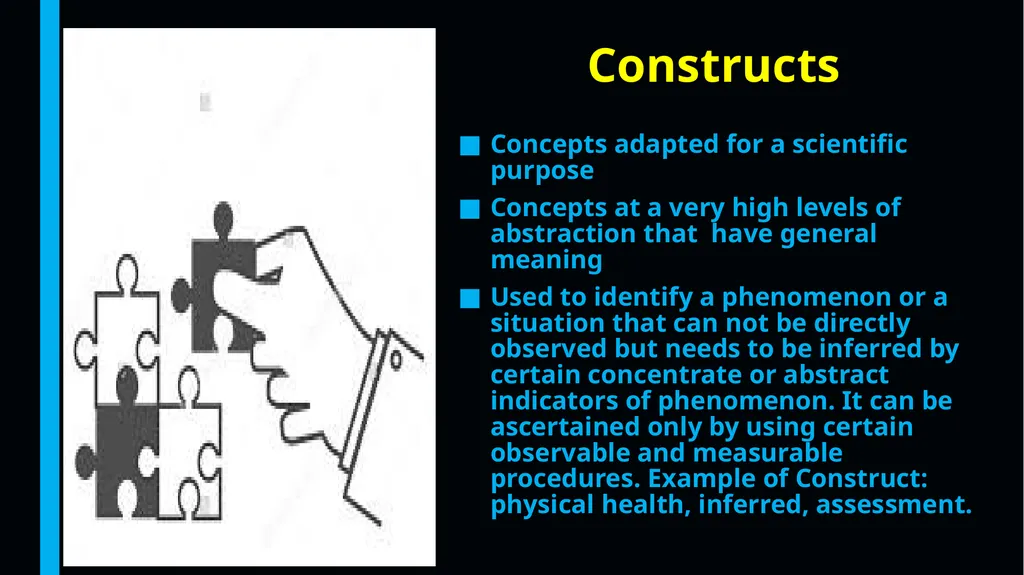
Constructs Concepts adapted for a scientific purpose
Concepts at a very high levels of abstraction that have general meaning
Used to identify a phenomenon or a situation that can not be directly observed but needs to be inferred by certain concentrate or abstract indicators of phenomenon. It can be ascertained only by using certain observable and measurable procedures. Example of Construct: physical health, inferred, assessment.<br>
09
Construct Used to identify a phenomenon or a situation that can not be directly observed but needs to be inferred by certain concentrate or abstract indicators of phenomenon. It can be ascertained only by using certain observable and measurable procedures. Example of Construct: physical health, inferred, assessment.
is a concept with added meaning, deliberately and consciously invented or adopted for a special scientific purpose." (p.29) E.g. intelligence – used for a special purpose to relate to school achievement and to other variables of interest.<br>
is a concept with added meaning, deliberately and consciously invented or adopted for a special scientific purpose." (p.29) E.g. intelligence – used for a special purpose to relate to school achievement and to other variables of interest.<br>
10
Proposition A statement or assertion of the relationship between concept derived from theories or generalizations based on empirical data
A statement or assertion of a relationship between concepts – theories or generalizations founded on empirical data are sources of proposition statements. A statement or assertion of a relationship between concepts – theories or generalizations founded on empirical data are sources of proposition statements.<br>
A statement or assertion of a relationship between concepts – theories or generalizations founded on empirical data are sources of proposition statements. A statement or assertion of a relationship between concepts – theories or generalizations founded on empirical data are sources of proposition statements.<br>
11
Conceptualization: The process of forming basic idea, designs, plans or strategies based on given facts, situations and examples Operational definition: Assigns a meaning to a construct or a variable by specifying the activities or ‘operations’ necessary to measure it<br>
12
Conceptualizing the Research Study The title itself is the objective/purpose
Purpose statement: a declarative statement that advances the overall direction or focus for the study
Research questions: interrogative statements that narrow the purpose statement to specific questions that researchers seek to answer in their study
Research hypotheses: declarative statements in quantitative research in which the investigator makes a prediction or conjecture about the outcomes relationship
Research objectives: statements of intent for the study that specifies specific goals that the investigator plans to achieve in a study<br>
13
Theoretical Framework<br>
14
Theoretical Framework A theoretical framework is a conceptual model of how one theorizes or makes logical sense of the relationships among the several factors that have been identified as important to the problem
Theoretical / conceptual framework – using material from the Literature Review, produce the working definition of the main concepts you will use in your study.
Integrating your logical beliefs with published research, taking into consideration the boundaries and constrains governing the situation
The theoretical framework discusses the interrelationships among the variables that are deemed to be integral to the dynamics of the situation being investigated<br>
15
A theoretical framework is a schematic diagram which able to help in deciding and explaining the route that we are interested to take.
From the theoretical framework,
a conceptual framework can be developed,
variables can be identified, and
hypotheses to be tested can be constructed
The theoretical framework provides a general representation of relationships between things in a given phenomenon, on the other hand, the conceptual framework, embodies the specific direction by which the research will have to be undertaken<br>
16
Statistically speaking, the conceptual framework describes the relationship between specific variables identified in the study. It also outlines the input, process and output of the whole investigation.
The conceptual framework is used in research to outline possible courses of action or to present a preferred approach to an idea or thought. The conceptual framework is also called the research paradigm.<br>
The conceptual framework is used in research to outline possible courses of action or to present a preferred approach to an idea or thought. The conceptual framework is also called the research paradigm.<br>
17
It provides the general framework which can guide the data analysis
It identifies the variables to be measured
It explains why one variable can possibly affect another or why the independent variable can possibly influence the dependent variable
It limits the scope of data relevant to the framework by focusing on specific variables
It stipulates…..in analyzing and interpreting data Functions of theoretical framework<br>
18
Developing Theoretical Framework Most studies do not generate new, novel theories from scratch. Instead, they generally work on improving what already exists
The additions or deletions of factors are not of sufficient magnitude to substantially alter the core logic of the existing theory. Relationships, not lists, are the domain of theory
Authors must be able to identify and delineate how proposed changes affect the accepted relationships between the factors and what contributions you will make
It is a common approach to explain why and strengthen logic by borrowing a perspective from other fields, which encourages an alternative explanation or challenge the underlying rationales of accepted theories. Theories are often challenged because their assumptions have been proven unrealistic (e.g., structuration theory and social exchange theory)<br>
19
Is the TF applicable to all research? Not all research need a theoretical framework, but correlational and causal studies do<br>
20
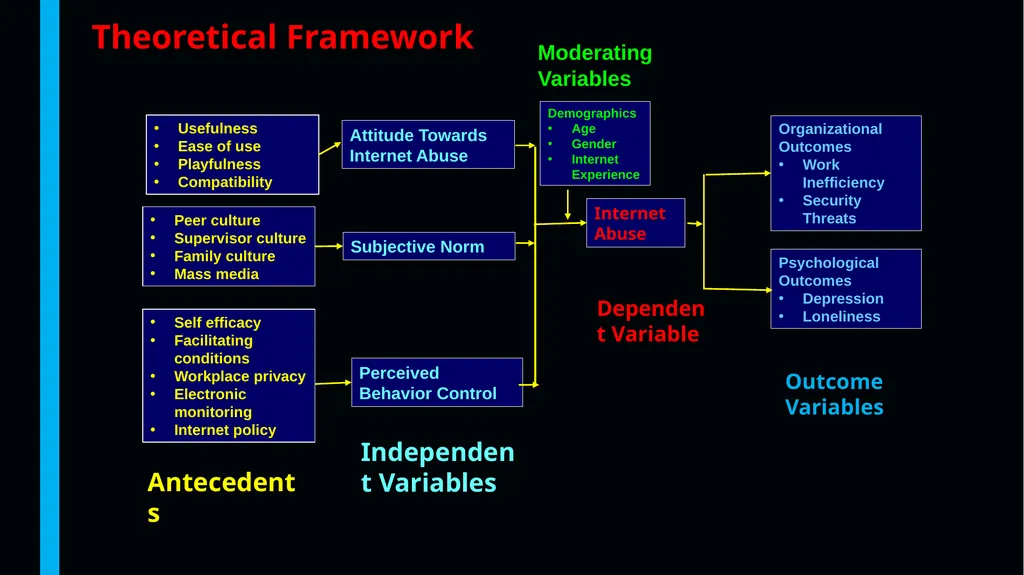
Theoretical Framework Subjective Norm Perceived Behavior Control Internet Abuse Independent Variables Dependent Variable Attitude Towards Internet Abuse Organizational Outcomes
Work Inefficiency
Security Threats Psychological Outcomes
Depression
Loneliness Outcome
Variables Usefulness
Ease of use
Playfulness
Compatibility Peer culture
Supervisor culture
Family culture
Mass media Self efficacy
Facilitating conditions
Workplace privacy
Electronic monitoring
Internet policy Antecedents Demographics
Age
Gender
Internet Experience Moderating Variables<br>
21
Variables<br>
22
Variables a measurable characteristic that varies. It may change from group to group, person to person, or even within one person over time.
a characteristic, number, or quantity that increases or decreases over time, or takes different values in different situations.<br>
a characteristic, number, or quantity that increases or decreases over time, or takes different values in different situations.<br>
23
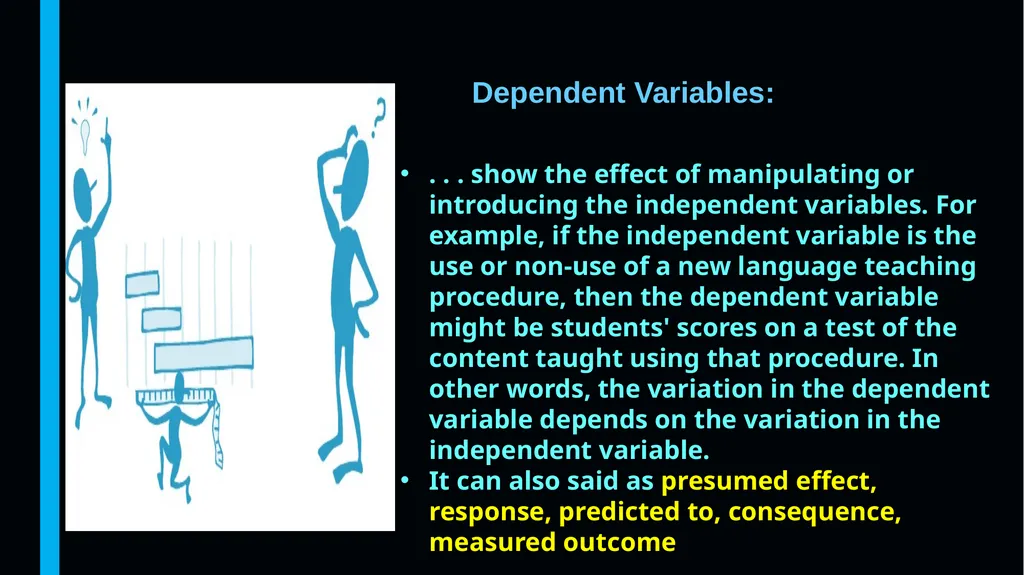
Dependent Variables: . . . show the effect of manipulating or introducing the independent variables. For example, if the independent variable is the use or non-use of a new language teaching procedure, then the dependent variable might be students' scores on a test of the content taught using that procedure. In other words, the variation in the dependent variable depends on the variation in the independent variable.
It can also said as presumed effect, response, predicted to, consequence, measured outcome<br>
It can also said as presumed effect, response, predicted to, consequence, measured outcome<br>
24
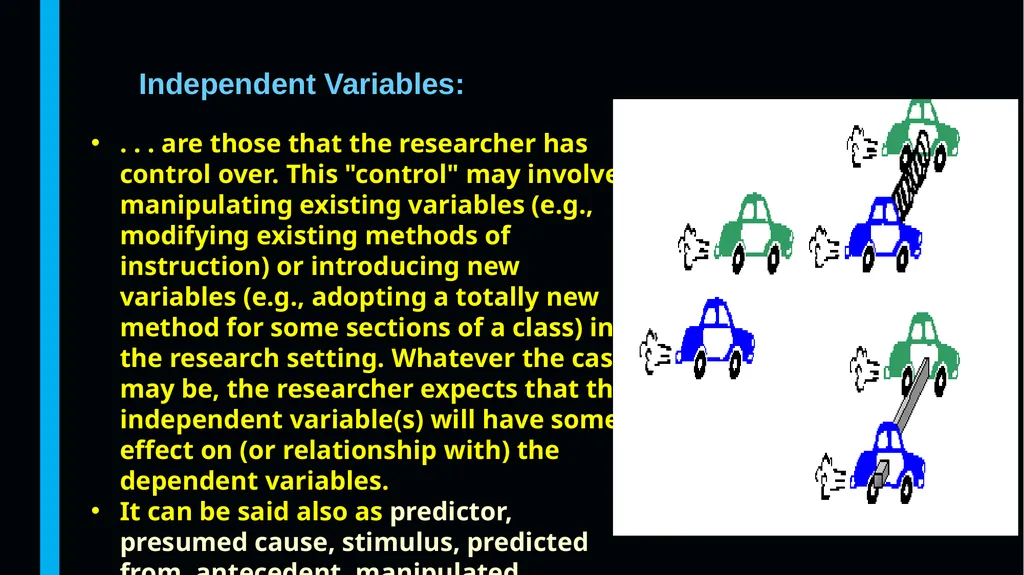
Independent Variables: . . . are those that the researcher has control over. This "control" may involve manipulating existing variables (e.g., modifying existing methods of instruction) or introducing new variables (e.g., adopting a totally new method for some sections of a class) in the research setting. Whatever the case may be, the researcher expects that the independent variable(s) will have some effect on (or relationship with) the dependent variables.
It can be said also as predictor, presumed cause, stimulus, predicted from, antecedent, manipulated<br>
It can be said also as predictor, presumed cause, stimulus, predicted from, antecedent, manipulated<br>
25
Intervening Variables: . . . refer to abstract processes that are not directly observable but that link the independent and dependent variables. In language learning and teaching, they are usually inside the subjects' heads, including various language learning processes which the researcher cannot observe. For example, if the use of a particular teaching technique is the independent variable and mastery of the objectives is the dependent variable, then the language learning processes used by the subjects are the intervening variables.<br>
26
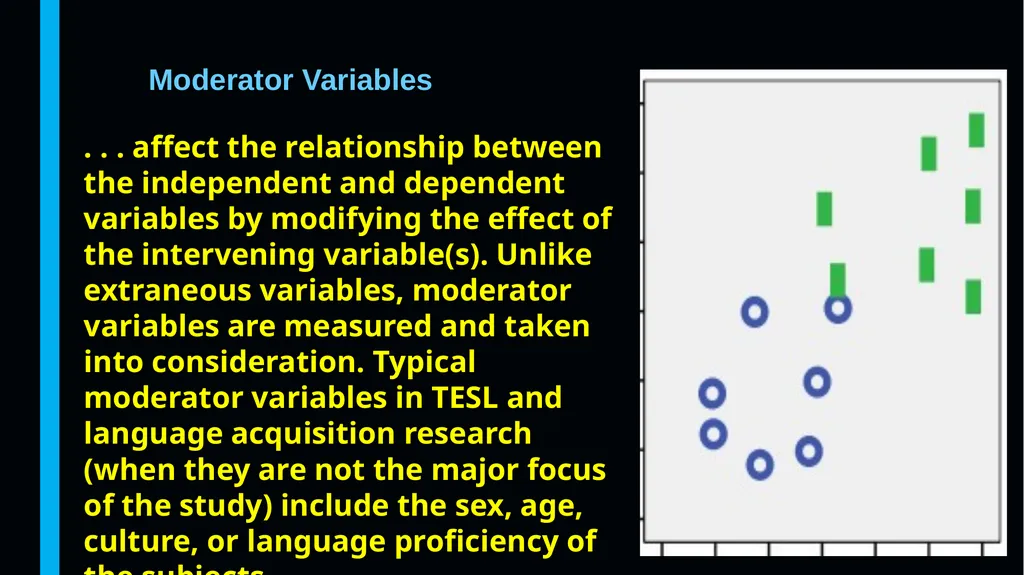
Moderator Variables . . . affect the relationship between the independent and dependent variables by modifying the effect of the intervening variable(s). Unlike extraneous variables, moderator variables are measured and taken into consideration. Typical moderator variables in TESL and language acquisition research (when they are not the major focus of the study) include the sex, age, culture, or language proficiency of the subjects.<br>
27
Control Variables Language learning and teaching are very complex processes. It is not possible to consider every variable in a single study. Therefore, the variables that are not measured in a particular study must be held constant, neutralized/balanced, or eliminated, so they will not have a biasing effect on the other variables. Variables that have been controlled in this way are called control variables.<br>
28
Extraneous Variables: . . . are those factors in the research environment which may have an effect on the dependent variable(s) but which are not controlled. Extraneous variables are dangerous. They may damage a study's validity, making it impossible to know whether the effects were caused by the independent and moderator variables or some extraneous factor. If they cannot be controlled, extraneous variables must at least be taken into consideration when interpreting results.<br>
29
Binary variable: Observations (i.e., dependent variables) that occur in one of two possible states, often labelled zero and one. E.g., “improved/not improved” and “completed task/failed to complete task.”
Categorical Variable: Usually an independent or predictor variable that contains values indicating membership in one of several possible categories. E.g., gender (male or female), marital status (married, single, divorced, widowed). The categories are often assigned numerical values used as lable, e.g., 0 = male; 1 = female. Synonym for nominal variable.<br>
Categorical Variable: Usually an independent or predictor variable that contains values indicating membership in one of several possible categories. E.g., gender (male or female), marital status (married, single, divorced, widowed). The categories are often assigned numerical values used as lable, e.g., 0 = male; 1 = female. Synonym for nominal variable.<br>
30
Confounding variable: A variable that obscures the effects of another variable. If one elementary read- ing teacher used a phonics textbook in her class and another instructor used a whole language textbook in his class, and students in the two classes were given achievement tests to see how well they read, the independent variables (teacher effectiveness and textbooks) would be confounded. There is no way to determine if differences in reading between the two classes were caused by either or both of the independent variables.
Continuous variable: A variable that is not restricted to particular values (other than limited by the accuracy of the measuring instrument). E.g., reaction time, neuroticism, IQ. Equal size intervals on different parts of the scale are assumed, if not demonstrated. Synonym for interval variable.<br>
Continuous variable: A variable that is not restricted to particular values (other than limited by the accuracy of the measuring instrument). E.g., reaction time, neuroticism, IQ. Equal size intervals on different parts of the scale are assumed, if not demonstrated. Synonym for interval variable.<br>
31
Control variable: An extraneous variable that an investigator does not wish to examine in a study. Thus the investigator controls this variable. Also called a covariate.
Criterion variable: The presumed effect in a non experimental study.
Dichotomous variable: Synonym for binary variable
Discrete variable : Variable having only integer values. For example, number of trials need by a student to learn a memorization task.<br>
Criterion variable: The presumed effect in a non experimental study.
Dichotomous variable: Synonym for binary variable
Discrete variable : Variable having only integer values. For example, number of trials need by a student to learn a memorization task.<br>
32
Dummy Variables: Created by recoding categorical variables that have more than two categories into a series of binary variables. E.g., Marital status, if originally labelled 1=married, 2=single, and 3=divorced, widowed, or separated, could be redefined in terms of two variables as follows: var_1: 1=single, 0=otherwise. Var_2: 1=divorced, widowed, or separated, 0=otherwise.
For a married person, both var_1 and var_2 would be zero. In general, a categorical variable with k categories would be recoded in terms of k - 1 dummy variables. Dummy variables are used in regression analysis to avoid the unreasonable assumption that the original numerical codes for the categories, i.e., the values 1, 2, ..., k, correspond to an interval scale. Use: to place cases in specific groups.<br>
For a married person, both var_1 and var_2 would be zero. In general, a categorical variable with k categories would be recoded in terms of k - 1 dummy variables. Dummy variables are used in regression analysis to avoid the unreasonable assumption that the original numerical codes for the categories, i.e., the values 1, 2, ..., k, correspond to an interval scale. Use: to place cases in specific groups.<br>
33
Endogenous variable : A variable that is an inherent part of the system being studied and that is deter- mined from within the system. A variable that is caused by other variables in a causal system.
Exogenous variable: A variable entering from and determined from outside of the system being studied. A causal system says nothing about its exogenous variables.
Interval variable: Synonym for continuous variable<br>
Exogenous variable: A variable entering from and determined from outside of the system being studied. A causal system says nothing about its exogenous variables.
Interval variable: Synonym for continuous variable<br>
34
Latent variable: An underlying variable that cannot be observed. It is hypothesized to exist in order to explain other variables, such as specific behaviors, that can be observed.
Example: if we observe the voting records of members of the House of Representatives on spending bills for the military, food stamps, law enforcement, and promoting business investment, we might find underlying patterns that could be explained by postulating latent variables such as conservatism and liberalism.<br>
Example: if we observe the voting records of members of the House of Representatives on spending bills for the military, food stamps, law enforcement, and promoting business investment, we might find underlying patterns that could be explained by postulating latent variables such as conservatism and liberalism.<br>
35
Manifest variable: An observed variable assumed to indicate the presence of a latent variable. Also known as an indicator variable. We cannot observe intelligence directly, for it is a latent variable. We can look at indicators such as vocabulary size, success in one’s occupation, IQ test score, ability to play complicated games (e.g., bridge) well, writing ability, and so on.
Manipulated variable: Synonym for independent variable.
Mediating variable: Synonym for intervening variable. Example: Parents transmit their social status to their children directly, but they also do so indirectly, through education: viz. Parent’s status ➛ child’s education ➛ child’s status<br>
Manipulated variable: Synonym for independent variable.
Mediating variable: Synonym for intervening variable. Example: Parents transmit their social status to their children directly, but they also do so indirectly, through education: viz. Parent’s status ➛ child’s education ➛ child’s status<br>
36
Nominal variable: Synonym for categorical variable.
Ordinal variable: A variable used to rank a sample of individuals with respect to some characteristics, but differences (i.e., intervals) and different points of the scale are not necessarily equivalent. Examples: anxiety might be rated on a scale “none,” “mild,” “moderate,” and “severe,” with numerical values of 0, 1, 2, 3. A patient with an anxiety score of 1 is ranked as less anxious than a patient with a score of 3, but patients with scores 0 and 2 do not necessarily have the same differences in anxiety as patients with scores of 1 and 3.
Outcome variable: The presumed effect in a non experimental study. Synonym for criterion variable.<br>
37
Polychotomous variables: Variables that can have more than two possible values. Strictly speaking, this includes all but binary variables. The usual reference is to categorical variables with more than two categories.
Predictor variable: The presumed “cause” on a non experimental study. Often used in correlational studies. For example, SAT scores predict first semester GPA. The SAT score is the predictor variable.
Treatment variable: Synonym for independent variable<br>
Predictor variable: The presumed “cause” on a non experimental study. Often used in correlational studies. For example, SAT scores predict first semester GPA. The SAT score is the predictor variable.
Treatment variable: Synonym for independent variable<br>
38
Hypothesis Development<br>
39
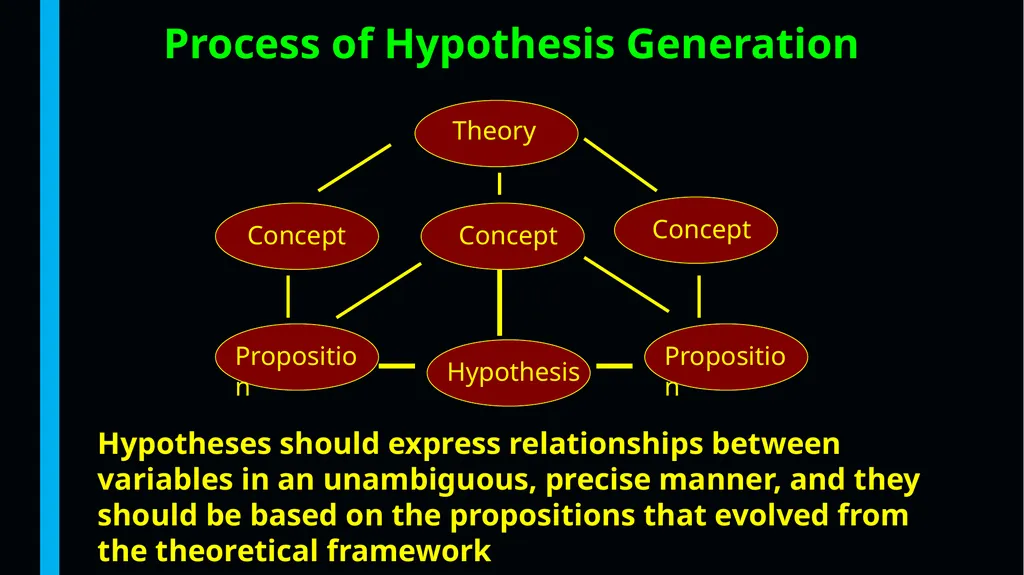
Process of Hypothesis Generation Hypotheses should express relationships between variables in an unambiguous, precise manner, and they should be based on the propositions that evolved from the theoretical framework<br>
40
Definition A statement logically formed an opinion on the basis of relationships between two or more variables.
An opinion is made on the basis of theoretical network.
A statement that shows a relationship between two or more variables in testable form.
A proposition formulated for empirical testing
a prediction for the outcome of an experiment
Explains facts and guides the research to possible outcomes<br>
An opinion is made on the basis of theoretical network.
A statement that shows a relationship between two or more variables in testable form.
A proposition formulated for empirical testing
a prediction for the outcome of an experiment
Explains facts and guides the research to possible outcomes<br>
41
It guides the direction of the study.
It identifies facts are relevant and those that are not.
It suggests which form of research design is likely to be most appropriate.
It provides a framework. The Roles of Hypotheses<br>
It identifies facts are relevant and those that are not.
It suggests which form of research design is likely to be most appropriate.
It provides a framework. The Roles of Hypotheses<br>
42
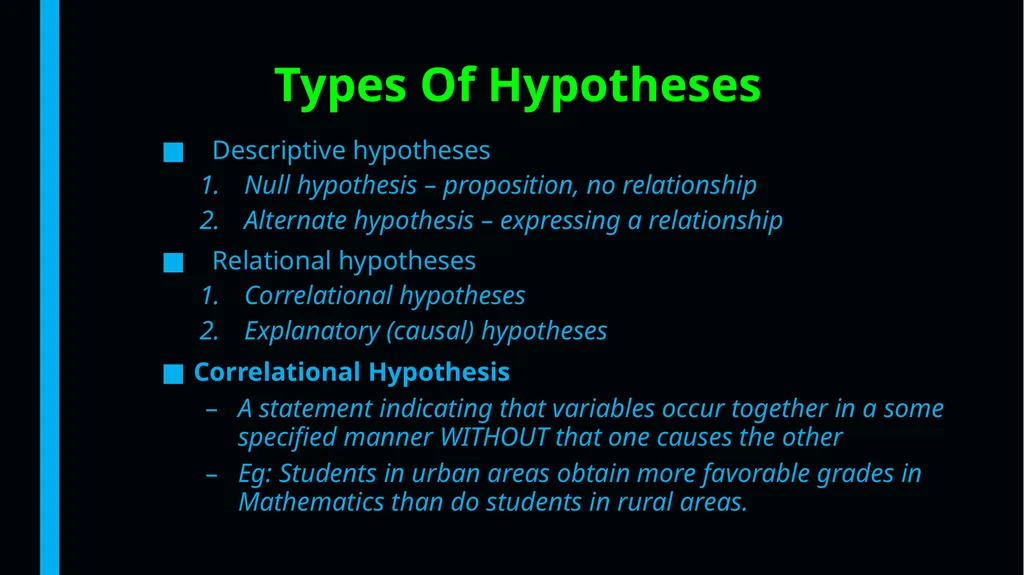
Types Of Hypotheses Descriptive hypotheses
Null hypothesis – proposition, no relationship
Alternate hypothesis – expressing a relationship
Relational hypotheses
Correlational hypotheses
Explanatory (causal) hypotheses
Correlational Hypothesis
A statement indicating that variables occur together in a some specified manner WITHOUT that one causes the other
Eg: Students in urban areas obtain more favorable grades in Mathematics than do students in rural areas.<br>
43
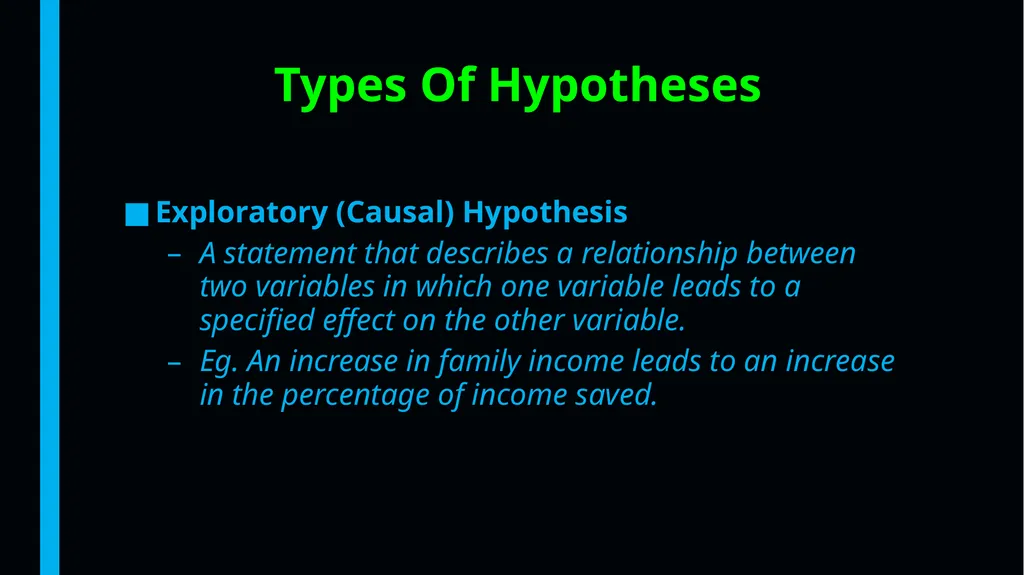
Exploratory (Causal) Hypothesis
A statement that describes a relationship between two variables in which one variable leads to a specified effect on the other variable.
Eg. An increase in family income leads to an increase in the percentage of income saved. Types Of Hypotheses<br>
A statement that describes a relationship between two variables in which one variable leads to a specified effect on the other variable.
Eg. An increase in family income leads to an increase in the percentage of income saved. Types Of Hypotheses<br>
44
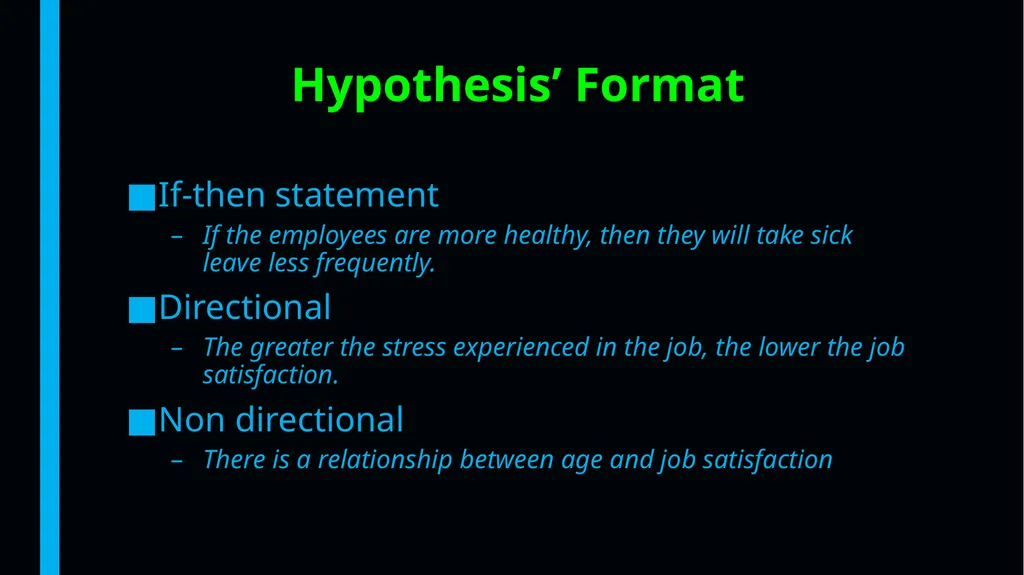
Hypothesis’ Format If-then statement
If the employees are more healthy, then they will take sick leave less frequently.
Directional
The greater the stress experienced in the job, the lower the job satisfaction.
Non directional
There is a relationship between age and job satisfaction<br>
If the employees are more healthy, then they will take sick leave less frequently.
Directional
The greater the stress experienced in the job, the lower the job satisfaction.
Non directional
There is a relationship between age and job satisfaction<br>
45
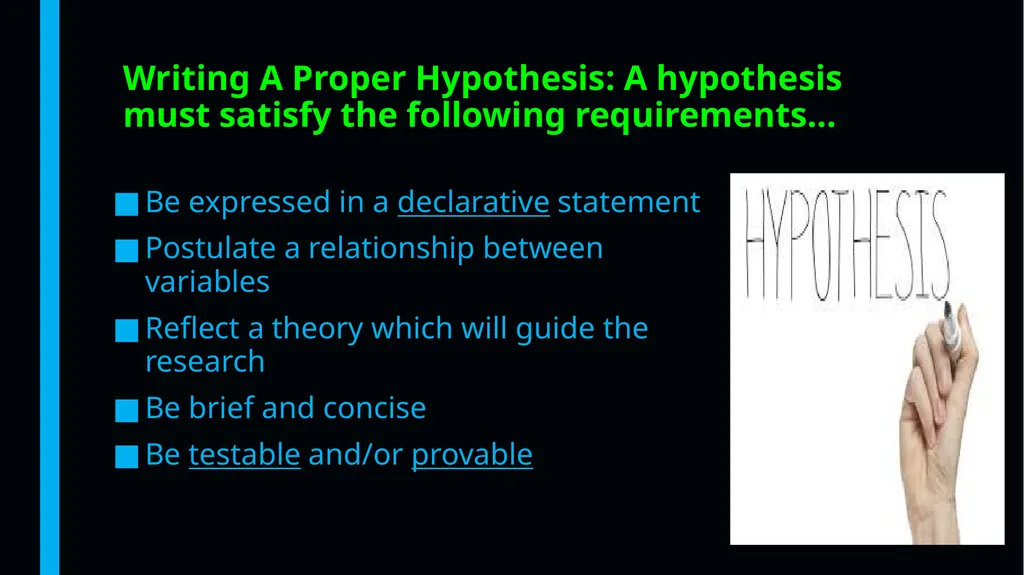
Writing A Proper Hypothesis: A hypothesis must satisfy the following requirements… Be expressed in a declarative statement
Postulate a relationship between variables
Reflect a theory which will guide the research
Be brief and concise
Be testable and/or provable<br>
Postulate a relationship between variables
Reflect a theory which will guide the research
Be brief and concise
Be testable and/or provable<br>
46
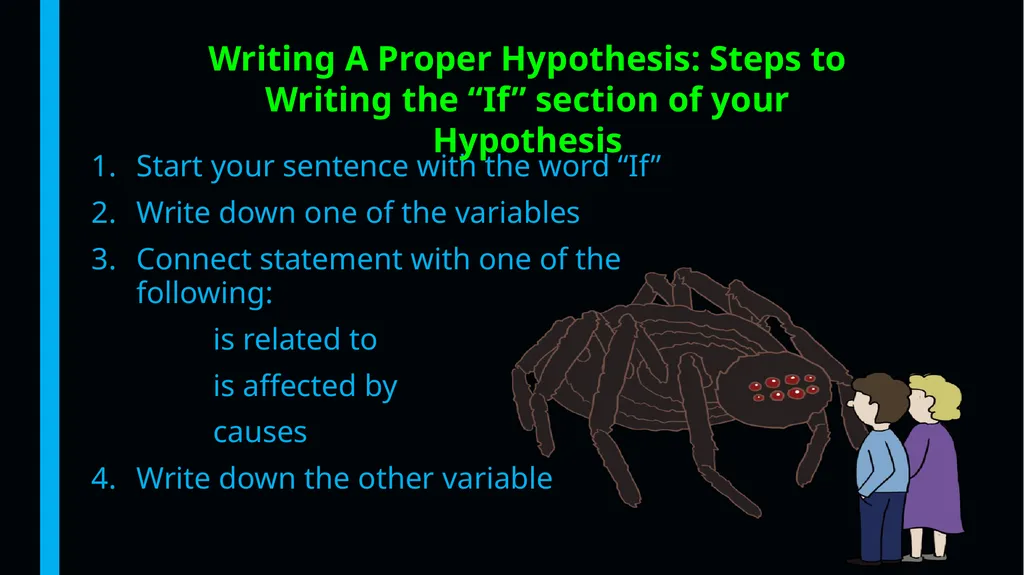
Start your sentence with the word “If”
Write down one of the variables
Connect statement with one of the following:
is related to
is affected by
causes
Write down the other variable Writing A Proper Hypothesis: Steps to Writing the “If” section of your Hypothesis<br>
Write down one of the variables
Connect statement with one of the following:
is related to
is affected by
causes
Write down the other variable Writing A Proper Hypothesis: Steps to Writing the “If” section of your Hypothesis<br>
47
Write the word then (following the “if” section)
Make a comment on the relationship between those two variables.
Ex. If section:
If water is related to plant growth,
Ex. Then section:
then the more you water plants, the bigger they will grow.
If water is related to plant growth, then the more you water plants, the bigger they will grow. Writing A Proper Hypothesis: Writing the “Then” section of your Hypothesis<br>
48
If, in stating the relationship between two variables or comparing two groups, terms such as positive, negative, more than, less than, and the like are used, then these hypotheses are directional because the direction of the relationship between the variables is indicated.
Example:
The greater the stress experienced in the job, the lower the job satisfaction of employee
Women are more motivated than men Directional and Non-directional Hypotheses<br>
Example:
The greater the stress experienced in the job, the lower the job satisfaction of employee
Women are more motivated than men Directional and Non-directional Hypotheses<br>
49
Non-directional hypotheses are formulated either because the relationships or differences have never been previously explored and hence there is no basis for indicating the direction, or because there have been conflicting findings in previous research studies on the variable.
Example:
There is a relationship between age and job satisfaction.
There is a difference between the work ethic values of American and Asian employees. Directional and Non-directional Hypotheses<br>
Example:
There is a relationship between age and job satisfaction.
There is a difference between the work ethic values of American and Asian employees. Directional and Non-directional Hypotheses<br>
50
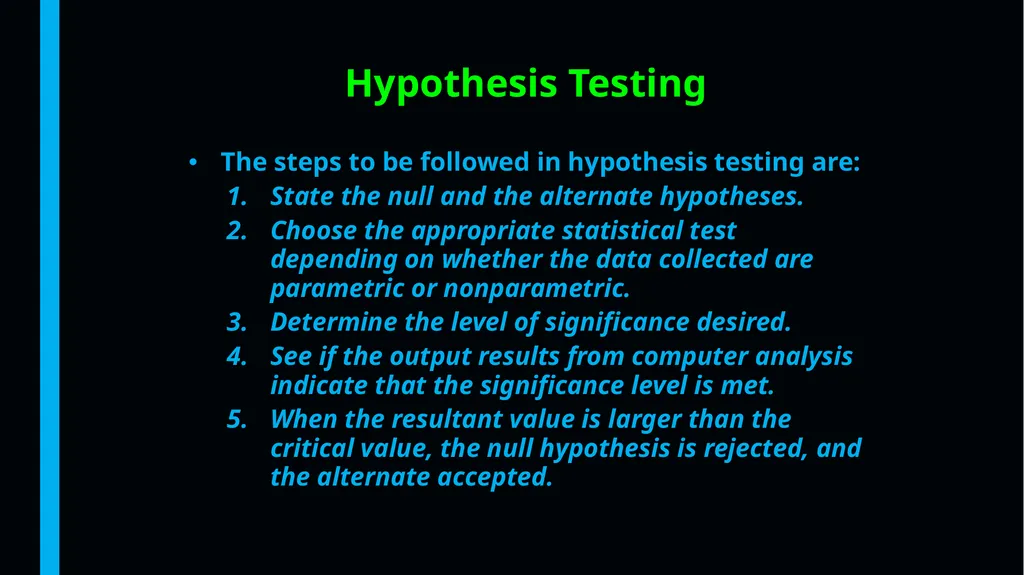
Hypothesis Testing The steps to be followed in hypothesis testing are:
State the null and the alternate hypotheses.
Choose the appropriate statistical test depending on whether the data collected are parametric or nonparametric.
Determine the level of significance desired.
See if the output results from computer analysis indicate that the significance level is met.
When the resultant value is larger than the critical value, the null hypothesis is rejected, and the alternate accepted.<br>
51
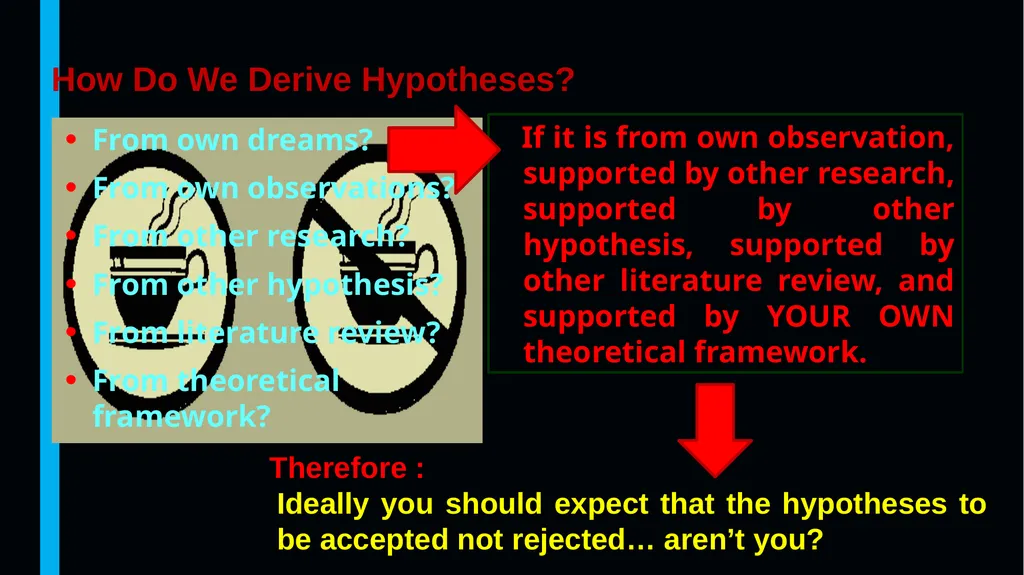
How Do We Derive Hypotheses? If it is from own observation, supported by other research, supported by other hypothesis, supported by other literature review, and supported by YOUR OWN theoretical framework. From own dreams?
From own observations?
From other research?
From other hypothesis?
From literature review?
From theoretical framework? Therefore :
Ideally you should expect that the hypotheses to be accepted not rejected… aren’t you?<br>
From own observations?
From other research?
From other hypothesis?
From literature review?
From theoretical framework? Therefore :
Ideally you should expect that the hypotheses to be accepted not rejected… aren’t you?<br>
52
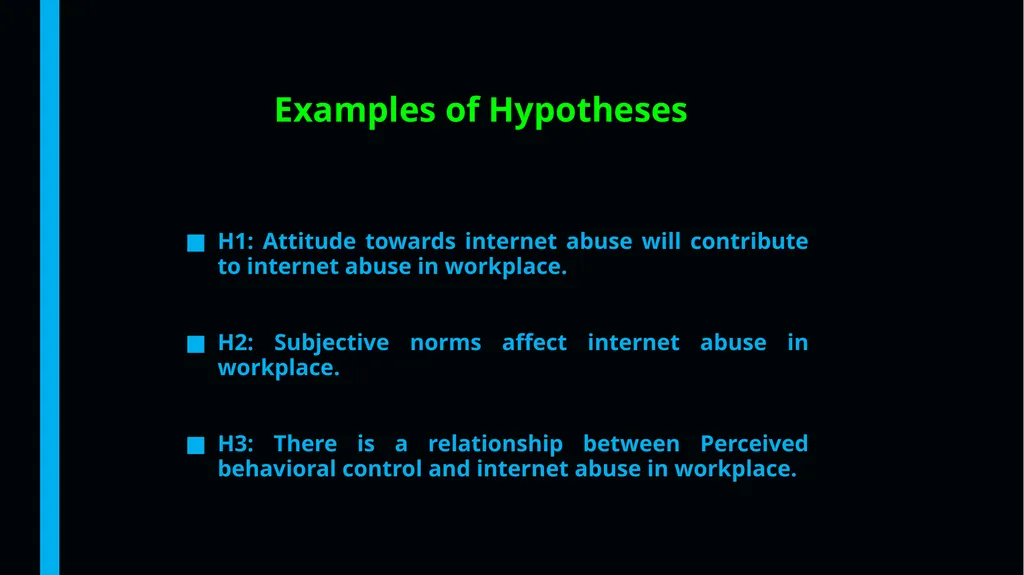
H1: Attitude towards internet abuse will contribute to internet abuse in workplace.
H2: Subjective norms affect internet abuse in workplace.
H3: There is a relationship between Perceived behavioral control and internet abuse in workplace. Examples of Hypotheses<br>
H2: Subjective norms affect internet abuse in workplace.
H3: There is a relationship between Perceived behavioral control and internet abuse in workplace. Examples of Hypotheses<br>
53
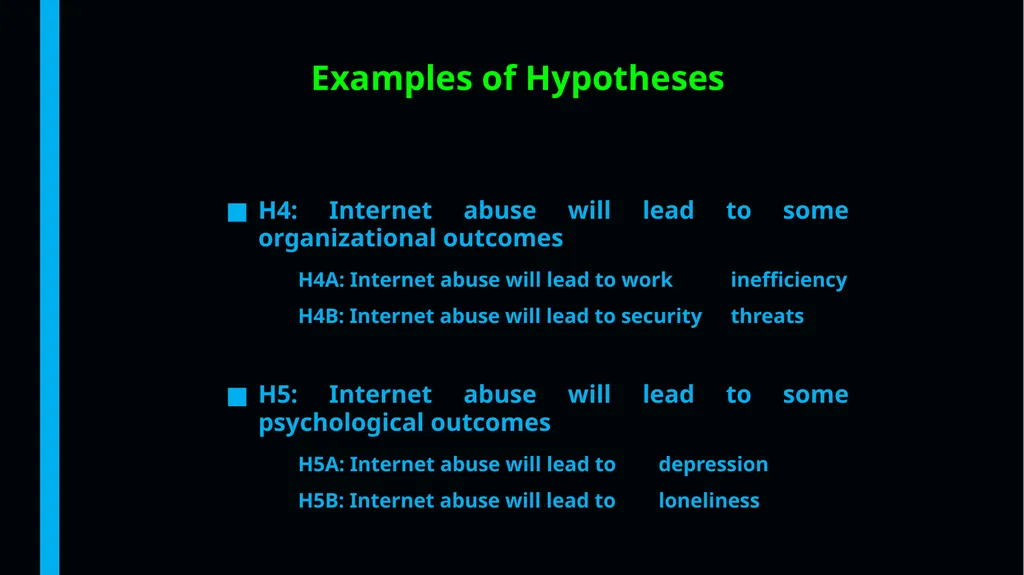
H4: Internet abuse will lead to some organizational outcomes
H4A: Internet abuse will lead to work inefficiency
H4B: Internet abuse will lead to security threats
H5: Internet abuse will lead to some psychological outcomes
H5A: Internet abuse will lead to depression
H5B: Internet abuse will lead to loneliness Examples of Hypotheses<br>
H4A: Internet abuse will lead to work inefficiency
H4B: Internet abuse will lead to security threats
H5: Internet abuse will lead to some psychological outcomes
H5A: Internet abuse will lead to depression
H5B: Internet abuse will lead to loneliness Examples of Hypotheses<br>
54
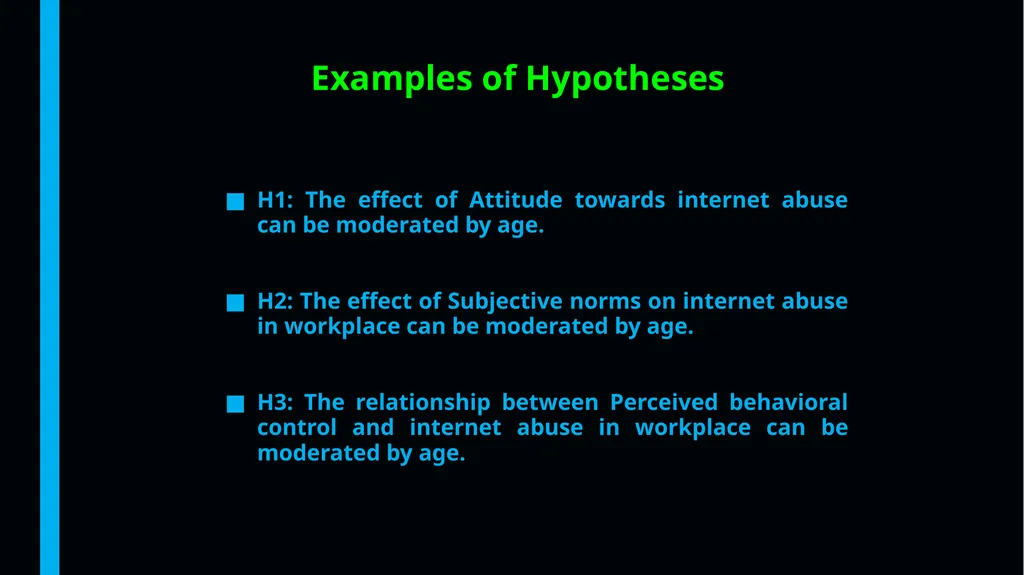
H1: The effect of Attitude towards internet abuse can be moderated by age.
H2: The effect of Subjective norms on internet abuse in workplace can be moderated by age.
H3: The relationship between Perceived behavioral control and internet abuse in workplace can be moderated by age. Examples of Hypotheses<br>
H2: The effect of Subjective norms on internet abuse in workplace can be moderated by age.
H3: The relationship between Perceived behavioral control and internet abuse in workplace can be moderated by age. Examples of Hypotheses<br>
55
H1: The effect of salary on Job Satisfaction can be mediated by motivation.
H2: The effect of leadership styles on job satisfaction can be mediated by motivation.
H3: The relationship between working conditions and job satisfaction can be mediated by motivation. Examples of Hypotheses<br>
H2: The effect of leadership styles on job satisfaction can be mediated by motivation.
H3: The relationship between working conditions and job satisfaction can be mediated by motivation. Examples of Hypotheses<br>