
These slides have been developed by the Genomics
SN
Published · 34 slides · 0 views

1 / 1



Description
These slides have been developed by the Genomics Education Programme and can be adapted and used for local education and training about the patient choice consent model being implemented for whole genome sequencing in the NHS Genomic
Related Topics
Share
Embed code
Download this presentation From Below
"These slides have been developed by the Genomics" is the property of its rightful owner. Permission is granted to download and print the materials on this website for personal, non-commercial use only, and to display it on your personal computer provided you do not modify the materials and that you retain all copyright notices contained in the materials. By downloading content from our website, you accept the terms of this agreement.
Presentation Transcript
01
These slides have been developed by the Genomics Education Programme and can be adapted and used for local education and training about the patient choice consent model being implemented for whole genome sequencing in the NHS Genomic Medicine Service.
Please note that this does not address National Genomic Informatics System (NGIS) training about patient choice.
With many thanks to:
Dr Gemma Chandratillake, Education and Training Lead, East Midlands & East of England NHS Genomic Laboratory Hub
NHS England Genomics Unit
Genomics England Patient Choice for Whole Genome Sequencing Slide deck for education and training<br>
Please note that this does not address National Genomic Informatics System (NGIS) training about patient choice.
With many thanks to:
Dr Gemma Chandratillake, Education and Training Lead, East Midlands & East of England NHS Genomic Laboratory Hub
NHS England Genomics Unit
Genomics England Patient Choice for Whole Genome Sequencing Slide deck for education and training<br>
02
Patient choice A model of consent that covers both the clinical implications of a test, as well as an offer within the clinical pathway to participate in the National Genomic Research Library.
Based on experience gained from the 100,000 Genomes Project.
Initially for whole genome sequencing indications only.
All other genomic and genetic tests to be requested via the same process as is done currently via Genomics Laboratory.
Expected to involve one or more conversations depending on the clinical context, supported by information for patients to make informed choices.
Choices captured by a nationally standardised Record of Discussion form.
Aims:
Set a clear and informed choice about having genomic testing in the NHS Genomic Medicine Service.
Clear and distinct choice to be part of a national database.
Ensure that the choice to undergo genomic testing is discussed in a safe and effective manner across specialties.<br>
Based on experience gained from the 100,000 Genomes Project.
Initially for whole genome sequencing indications only.
All other genomic and genetic tests to be requested via the same process as is done currently via Genomics Laboratory.
Expected to involve one or more conversations depending on the clinical context, supported by information for patients to make informed choices.
Choices captured by a nationally standardised Record of Discussion form.
Aims:
Set a clear and informed choice about having genomic testing in the NHS Genomic Medicine Service.
Clear and distinct choice to be part of a national database.
Ensure that the choice to undergo genomic testing is discussed in a safe and effective manner across specialties.<br>
03
To review before and/or after this session National Record of Discussion forms (NHS England and Genomics England):
Adults with capacity, parents of children and for deceased individuals
Assent for young persons*
Consultee for adults without capacity*
Withdrawal form*
*NGRL only
Annotated versions are available for all forms with guide for completion
Whole genome sequencing test order forms:
Rare disease proband
Rare disease family member
Cancer
Supporting materials for patients:
Having a Genomic Test information leaflet (NHS England)
NGRL Frequently Asked Questions (Genomics England)
Supporting materials for clinicians:
Guide for clinicians requesting whole genome sequencing (GEP)
Supplementary information for clinicians requesting WGS (GEP)
Infographic for genomic data in the NHS and NGRL (Genomics England)<br>
Adults with capacity, parents of children and for deceased individuals
Assent for young persons*
Consultee for adults without capacity*
Withdrawal form*
*NGRL only
Annotated versions are available for all forms with guide for completion
Whole genome sequencing test order forms:
Rare disease proband
Rare disease family member
Cancer
Supporting materials for patients:
Having a Genomic Test information leaflet (NHS England)
NGRL Frequently Asked Questions (Genomics England)
Supporting materials for clinicians:
Guide for clinicians requesting whole genome sequencing (GEP)
Supplementary information for clinicians requesting WGS (GEP)
Infographic for genomic data in the NHS and NGRL (Genomics England)<br>
04
Genomic testing: the current situation Genomic testing is increasingly taking place outside of specialist genetics clinics.
There is no national standard framework.
Conversations with patients vary depending on clinical context, clinician experience, location and specialty.
Genetic and other services use department-specific consent forms.
Access to genomic research is variable.
Discussions may take place within the same clinical episode to discussions about clinical genetic testing, or via a separate research appointment.<br>
There is no national standard framework.
Conversations with patients vary depending on clinical context, clinician experience, location and specialty.
Genetic and other services use department-specific consent forms.
Access to genomic research is variable.
Discussions may take place within the same clinical episode to discussions about clinical genetic testing, or via a separate research appointment.<br>
05
Key messages about consent Patient must have sufficient, appropriate information to make a decision (no ‘surprises’).
Person must be competent to make a decision.
Consent must be given voluntarily.
Documentation of clinical consent (i.e. using a form) is good clinical practice; however, a signature is not sufficient!<br>
Person must be competent to make a decision.
Consent must be given voluntarily.
Documentation of clinical consent (i.e. using a form) is good clinical practice; however, a signature is not sufficient!<br>
06
Considerations for consent in genomics While building on current medical practice, genomic medicine highlights unique considerations with regards to informed consent, including:
addressing the needs of the wider family;
complexity and uncertainty about genomic variation;
data and sample sharing protocols; and
returning results, including additional and/or incidental findings.
Support required may be determined by:
context and complexity of the test;
management of the condition;
potential for adverse psychological effects surrounding the test;
extent of appropriate information materials available; and
additional individual and family-specific factors.<br>
addressing the needs of the wider family;
complexity and uncertainty about genomic variation;
data and sample sharing protocols; and
returning results, including additional and/or incidental findings.
Support required may be determined by:
context and complexity of the test;
management of the condition;
potential for adverse psychological effects surrounding the test;
extent of appropriate information materials available; and
additional individual and family-specific factors.<br>
07
Patient choice: what is it? A model of consent that covers both the clinical implications of a test, as well as an offer within the clinical pathway to participate in the National Genomic Research Library.
Based on experience gained from the 100,000 Genomes Project.
Initially for whole genome sequencing indications only.
Expected to involve one or more conversations depending on the clinical context, supported by information for patients to make informed choices.
Choices captured by a nationally standardised Record of Discussion form.
Aims:
Set a clear and informed choice about having genomic testing in the NHS Genomic Medicine Service.
Clear and distinct choice to be part of a national database.
Ensure that the choice to undergo genomic testing is discussed in a safe and effective manner across specialties.<br>
Based on experience gained from the 100,000 Genomes Project.
Initially for whole genome sequencing indications only.
Expected to involve one or more conversations depending on the clinical context, supported by information for patients to make informed choices.
Choices captured by a nationally standardised Record of Discussion form.
Aims:
Set a clear and informed choice about having genomic testing in the NHS Genomic Medicine Service.
Clear and distinct choice to be part of a national database.
Ensure that the choice to undergo genomic testing is discussed in a safe and effective manner across specialties.<br>
08
The clinical choice Unchanged from current standards for a patient consenting to have a genomic test, apart from national and international comparison of data.
Key areas to cover:
Introduction and context of the test
What to expect from the results
Implications for the patient
Implications for family members
Use of samples
Use of data<br>
Key areas to cover:
Introduction and context of the test
What to expect from the results
Implications for the patient
Implications for family members
Use of samples
Use of data<br>
09
Before you start… Does the patient have capacity to consent?
Assess based on the Mental Capacity Act 2005 and/or Gillick test (for individuals <16 years).
If no, a parent, guardian, or patient representative/consultee must be available.
Where possible, the patient should be involved to provide assent.
Non-English speakers and those with a disability:
Additional materials and/or support may be required for patients who are non-English speaking, hearing impaired, visually impaired, or have learning disabilities.
Testing samples from deceased individuals:
Consent must be discussed with a relative or other relevant individual.<br>
Assess based on the Mental Capacity Act 2005 and/or Gillick test (for individuals <16 years).
If no, a parent, guardian, or patient representative/consultee must be available.
Where possible, the patient should be involved to provide assent.
Non-English speakers and those with a disability:
Additional materials and/or support may be required for patients who are non-English speaking, hearing impaired, visually impaired, or have learning disabilities.
Testing samples from deceased individuals:
Consent must be discussed with a relative or other relevant individual.<br>
10
Before you start… Is WGS the right test for my patient?
Check the National Genomic Test Directory
If you are uncertain, contact your GLH, as it is important to be able to manage patient expectations regarding results and research opportunities
Do I have the right clinical information?
Human Phenotype Ontology (HPO) terms
Family history information
Can I obtain the samples I need?
Ideally blood; can be saliva, tissue, or previously stored DNA
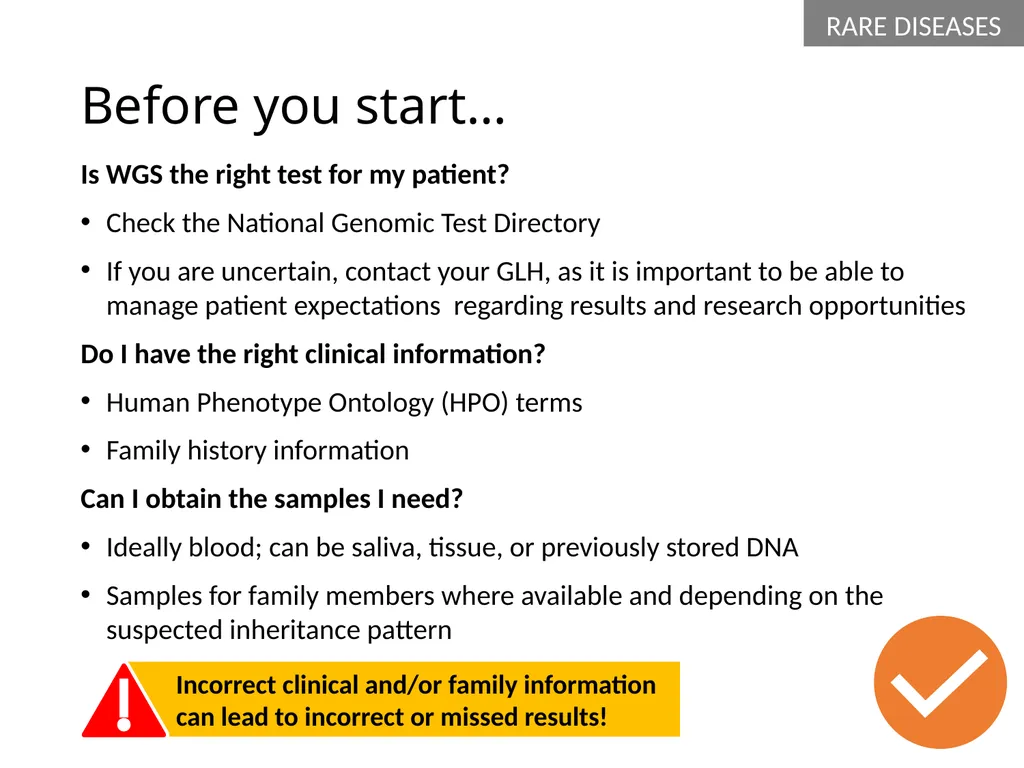
Samples for family members where available and depending on the suspected inheritance pattern Incorrect clinical and/or family information can lead to incorrect or missed results! RARE DISEASES<br>
Check the National Genomic Test Directory
If you are uncertain, contact your GLH, as it is important to be able to manage patient expectations regarding results and research opportunities
Do I have the right clinical information?
Human Phenotype Ontology (HPO) terms
Family history information
Can I obtain the samples I need?
Ideally blood; can be saliva, tissue, or previously stored DNA
Samples for family members where available and depending on the suspected inheritance pattern Incorrect clinical and/or family information can lead to incorrect or missed results! RARE DISEASES<br>
11
1. Introduction and context of the test The patient’s presenting condition is likely to be genetic (i.e. caused by alterations in the patient’s DNA).
The test is diagnostic (i.e. to determine an underlying genetic cause for the individual’s presenting condition).
Sequencing of the whole genome will take place, although analysis will initially focus on known genes associated with the clinical presentation.
It is often clinically useful to test family members’ samples along with the proband/index case, either up-front or pending results.
Consider family members’ availability for appointments, and/or ways to follow up to obtain samples. RARE DISEASES<br>
The test is diagnostic (i.e. to determine an underlying genetic cause for the individual’s presenting condition).
Sequencing of the whole genome will take place, although analysis will initially focus on known genes associated with the clinical presentation.
It is often clinically useful to test family members’ samples along with the proband/index case, either up-front or pending results.
Consider family members’ availability for appointments, and/or ways to follow up to obtain samples. RARE DISEASES<br>
12
2. What to expect from the results Possible results:
The test may not yield any significant findings
Main findings: Results in connection with the patient’s existing condition, which may or may not affect current/future care, or provide insight to prognosis or other health conditions.
Variant(s) of uncertain significance: Uncertain findings that may require following up, now or in the future.
Incidental findings: Unexpected results not related to the reason for testing
Confirm the communication process of how results will be fed back, when and by whom.
Results will not inform about all health conditions.
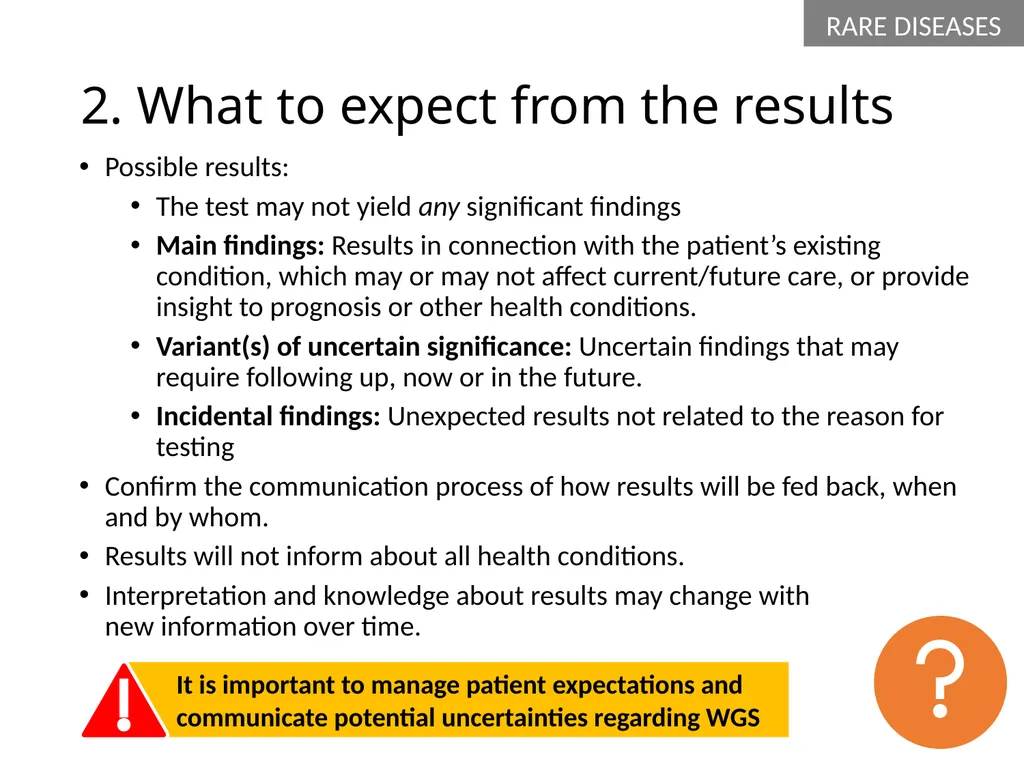
Interpretation and knowledge about results may change with new information over time. RARE DISEASES It is important to manage patient expectations and communicate potential uncertainties regarding WGS<br>
The test may not yield any significant findings
Main findings: Results in connection with the patient’s existing condition, which may or may not affect current/future care, or provide insight to prognosis or other health conditions.
Variant(s) of uncertain significance: Uncertain findings that may require following up, now or in the future.
Incidental findings: Unexpected results not related to the reason for testing
Confirm the communication process of how results will be fed back, when and by whom.
Results will not inform about all health conditions.
Interpretation and knowledge about results may change with new information over time. RARE DISEASES It is important to manage patient expectations and communicate potential uncertainties regarding WGS<br>
13
3. Implications for the patient Onward referrals may be made for screening or management, depending on the results.
Psychosocial impact (both positive and negative) of receiving results – support options available.
Potential implications for family planning and reproductive choices.
Association of British Insurers code for disclosing genetic test results. RARE DISEASES<br>
Psychosocial impact (both positive and negative) of receiving results – support options available.
Potential implications for family planning and reproductive choices.
Association of British Insurers code for disclosing genetic test results. RARE DISEASES<br>
14
4. Implications for family members Results may be relevant to certain blood relatives.
Relatives may be able to access preventative screening, predictive genetic testing, and/or information about reproductive choices.
Discuss the importance of sharing results with family members and strategies that may be used (i.e. ‘To whom it may concern’ letter).
If there are issues or concerns, consider referring for genetic counselling, either pre-test and/or following any results RARE DISEASES<br>
Relatives may be able to access preventative screening, predictive genetic testing, and/or information about reproductive choices.
Discuss the importance of sharing results with family members and strategies that may be used (i.e. ‘To whom it may concern’ letter).
If there are issues or concerns, consider referring for genetic counselling, either pre-test and/or following any results RARE DISEASES<br>
15
5. Use of samples Samples will be stored in local Genomic Laboratory Hub and can be accessed by other labs within the NHS Genomic Medicine Service.
Stored samples may be used for further genomic tests in the future with appropriate consent.
Sample can be used as a control for testing other individuals, including family members.
De-identified samples may be used for lab test development or quality control procedures. RARE DISEASES<br>
Stored samples may be used for further genomic tests in the future with appropriate consent.
Sample can be used as a control for testing other individuals, including family members.
De-identified samples may be used for lab test development or quality control procedures. RARE DISEASES<br>
16
6. Use of data Data includes both health and genomic information that can be securely accessed on an ongoing basis by NHS healthcare professionals.
National (identifiable) and international (not identifiable) comparison of data for greater understanding of significance of any results found.
Genetic variant(s) may be shared for relatives to access testing.
Genomic data may be reanalysed in future as new evidence can occasionally change results over time. RARE DISEASES<br>
National (identifiable) and international (not identifiable) comparison of data for greater understanding of significance of any results found.
Genetic variant(s) may be shared for relatives to access testing.
Genomic data may be reanalysed in future as new evidence can occasionally change results over time. RARE DISEASES<br>
17
Before you start… Is WGS the right test for my patient?
Check the National Genomic Test Directory
If you are uncertain, contact your GLH, as it is important to be able to manage patient expectations regarding results and research opportunities
Do I have the right clinical information?
Diagnostic details of tumour type based on histopathogy, genomic and other evaluations
Can I obtain the samples I need?
Cancer sample: tumour, blood or bone marrow depending on cancer type
Germline sample: blood or tissue CANCER<br>
Check the National Genomic Test Directory
If you are uncertain, contact your GLH, as it is important to be able to manage patient expectations regarding results and research opportunities
Do I have the right clinical information?
Diagnostic details of tumour type based on histopathogy, genomic and other evaluations
Can I obtain the samples I need?
Cancer sample: tumour, blood or bone marrow depending on cancer type
Germline sample: blood or tissue CANCER<br>
18
1. Introduction and context of the test All cancer is caused by changes in DNA; looking at these changes can help better understand the particular tumour in the patient.
The primary aim of whole genome sequencing is to provide additional information about the cancer diagnosis, including:
diagnostic information (determine the exact type of tumour a patient has);
prognostic information; and
treatment information (the most effective treatment strategy, or treatments to avoid).
Sequencing is done on the tumour genome and the patient’s germline (constitutional) genome for comparison.
Sequencing of the whole genome will take place, although analysis will initially focus on known genes that are associated with cancer and the overall ‘signature’ of genomic changes in the tumour.
In some cases, a patient may not yet have been diagnosed with cancer, so having initial conversations about testing their tumour may be challenging. CANCER CANCER<br>
The primary aim of whole genome sequencing is to provide additional information about the cancer diagnosis, including:
diagnostic information (determine the exact type of tumour a patient has);
prognostic information; and
treatment information (the most effective treatment strategy, or treatments to avoid).
Sequencing is done on the tumour genome and the patient’s germline (constitutional) genome for comparison.
Sequencing of the whole genome will take place, although analysis will initially focus on known genes that are associated with cancer and the overall ‘signature’ of genomic changes in the tumour.
In some cases, a patient may not yet have been diagnosed with cancer, so having initial conversations about testing their tumour may be challenging. CANCER CANCER<br>
19
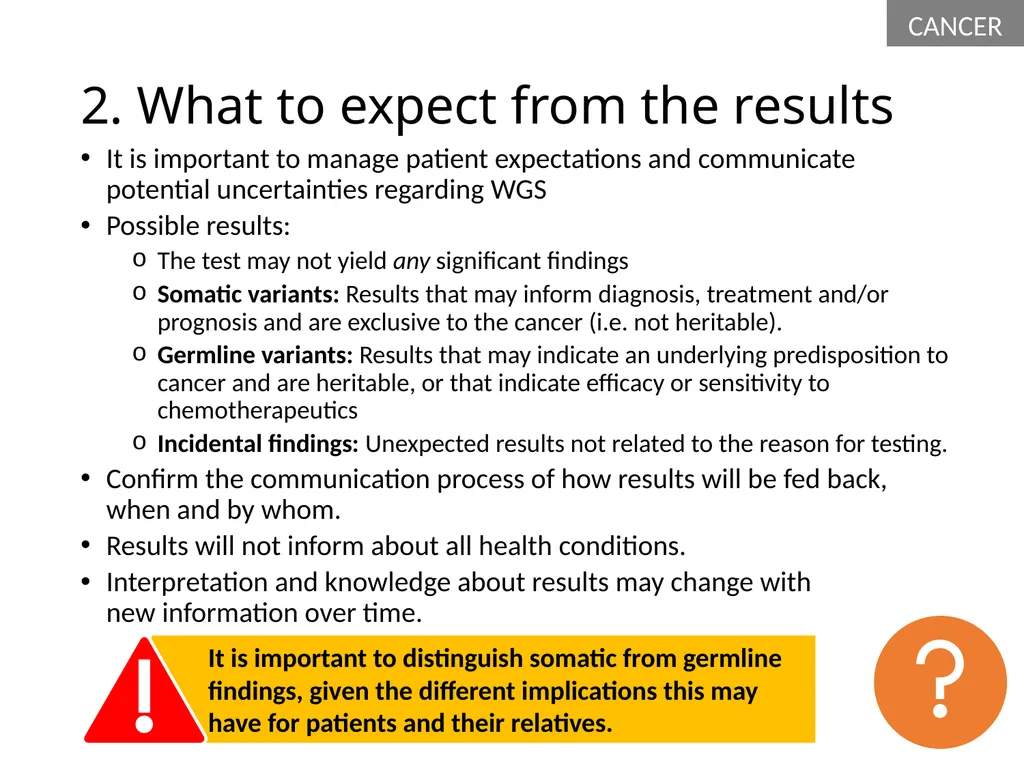
2. What to expect from the results CANCER It is important to manage patient expectations and communicate potential uncertainties regarding WGS
Possible results:
The test may not yield any significant findings
Somatic variants: Results that may inform diagnosis, treatment and/or prognosis and are exclusive to the cancer (i.e. not heritable).
Germline variants: Results that may indicate an underlying predisposition to cancer and are heritable, or that indicate efficacy or sensitivity to chemotherapeutics
Incidental findings: Unexpected results not related to the reason for testing.
Confirm the communication process of how results will be fed back, when and by whom.
Results will not inform about all health conditions.
Interpretation and knowledge about results may change with new information over time. It is important to distinguish somatic from germline findings, given the different implications this may have for patients and their relatives.<br>
Possible results:
The test may not yield any significant findings
Somatic variants: Results that may inform diagnosis, treatment and/or prognosis and are exclusive to the cancer (i.e. not heritable).
Germline variants: Results that may indicate an underlying predisposition to cancer and are heritable, or that indicate efficacy or sensitivity to chemotherapeutics
Incidental findings: Unexpected results not related to the reason for testing.
Confirm the communication process of how results will be fed back, when and by whom.
Results will not inform about all health conditions.
Interpretation and knowledge about results may change with new information over time. It is important to distinguish somatic from germline findings, given the different implications this may have for patients and their relatives.<br>
20
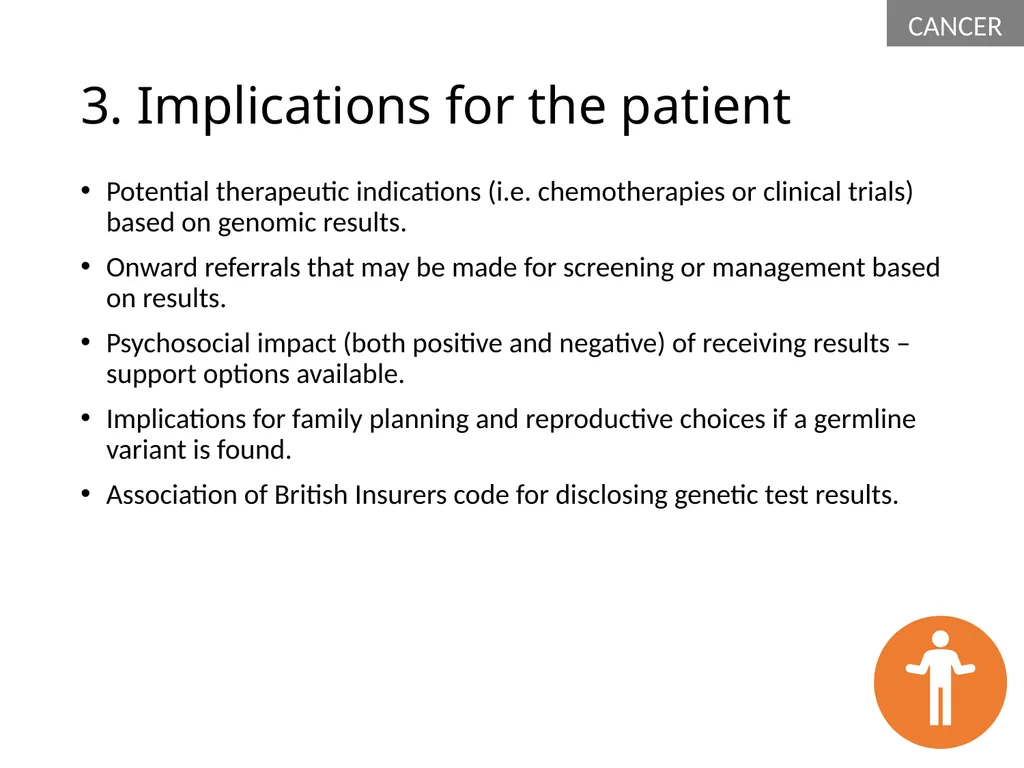
3. Implications for the patient Potential therapeutic indications (i.e. chemotherapies or clinical trials) based on genomic results.
Onward referrals that may be made for screening or management based on results.
Psychosocial impact (both positive and negative) of receiving results – support options available.
Implications for family planning and reproductive choices if a germline variant is found.
Association of British Insurers code for disclosing genetic test results. CANCER<br>
Onward referrals that may be made for screening or management based on results.
Psychosocial impact (both positive and negative) of receiving results – support options available.
Implications for family planning and reproductive choices if a germline variant is found.
Association of British Insurers code for disclosing genetic test results. CANCER<br>
21
4. Implications for family members Germline variants may be relevant to certain blood relatives.
Relatives may be able to access preventative screening, predictive genetic testing, and/or information about reproductive choices.
Discuss the importance of sharing results with family members and strategies that may be used (i.e. ‘To whom it may concern’ letter).
If there are issues or concerns, consider referring for genetic counselling, either pre-test and/or following any results CANCER<br>
Relatives may be able to access preventative screening, predictive genetic testing, and/or information about reproductive choices.
Discuss the importance of sharing results with family members and strategies that may be used (i.e. ‘To whom it may concern’ letter).
If there are issues or concerns, consider referring for genetic counselling, either pre-test and/or following any results CANCER<br>
22
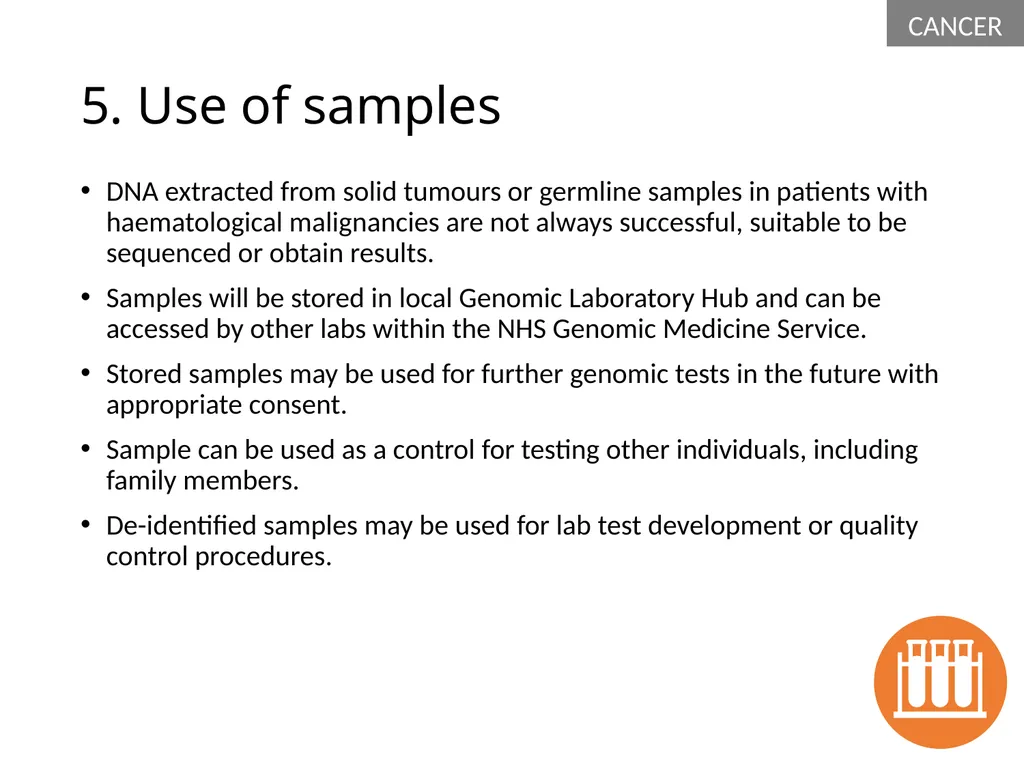
5. Use of samples DNA extracted from solid tumours or germline samples in patients with haematological malignancies are not always successful, suitable to be sequenced or obtain results.
Samples will be stored in local Genomic Laboratory Hub and can be accessed by other labs within the NHS Genomic Medicine Service.
Stored samples may be used for further genomic tests in the future with appropriate consent.
Sample can be used as a control for testing other individuals, including family members.
De-identified samples may be used for lab test development or quality control procedures. CANCER<br>
Samples will be stored in local Genomic Laboratory Hub and can be accessed by other labs within the NHS Genomic Medicine Service.
Stored samples may be used for further genomic tests in the future with appropriate consent.
Sample can be used as a control for testing other individuals, including family members.
De-identified samples may be used for lab test development or quality control procedures. CANCER<br>
23
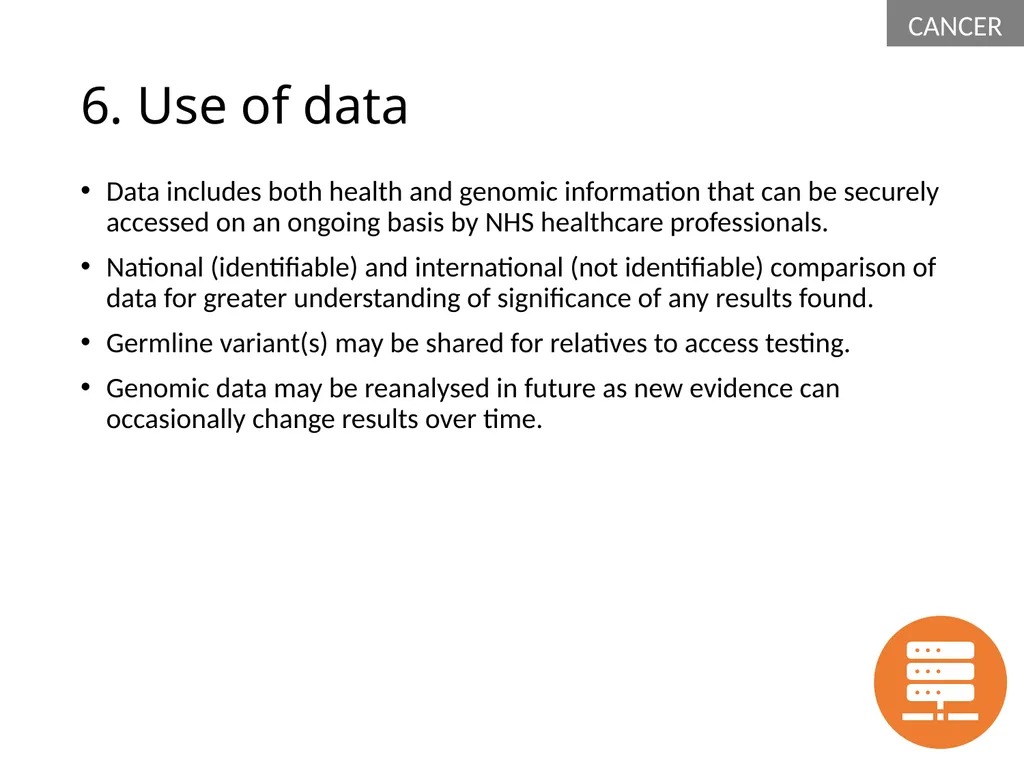
6. Use of data Data includes both health and genomic information that can be securely accessed on an ongoing basis by NHS healthcare professionals.
National (identifiable) and international (not identifiable) comparison of data for greater understanding of significance of any results found.
Germline variant(s) may be shared for relatives to access testing.
Genomic data may be reanalysed in future as new evidence can occasionally change results over time. CANCER<br>
National (identifiable) and international (not identifiable) comparison of data for greater understanding of significance of any results found.
Germline variant(s) may be shared for relatives to access testing.
Genomic data may be reanalysed in future as new evidence can occasionally change results over time. CANCER<br>
24
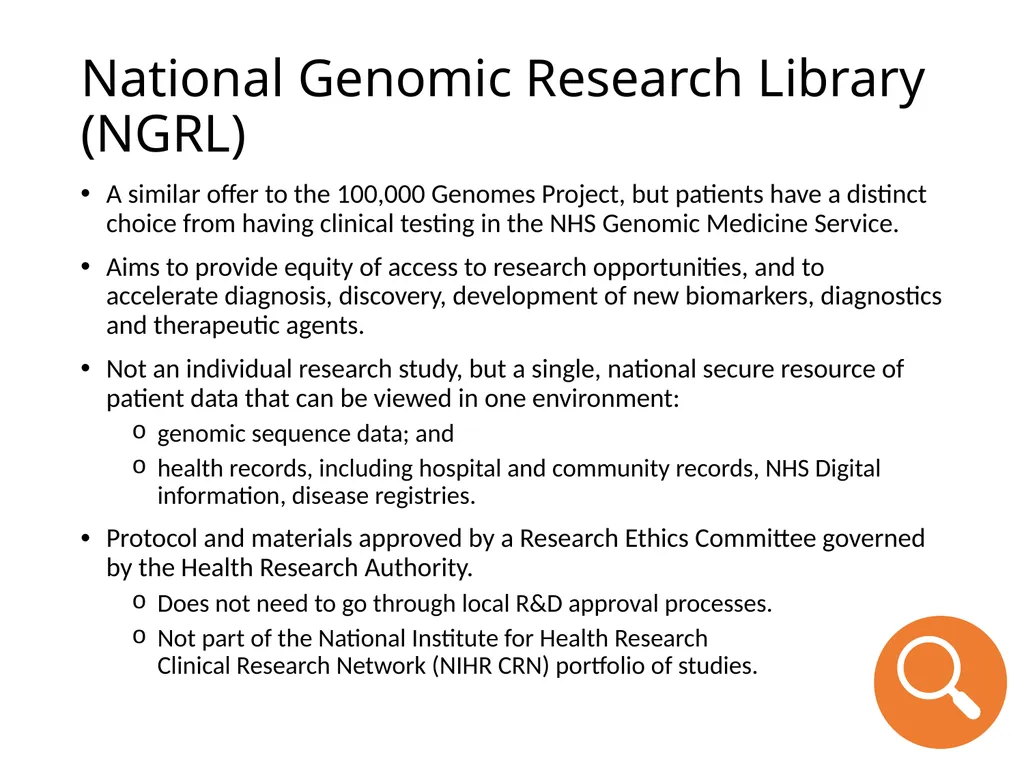
National Genomic Research Library (NGRL) A similar offer to the 100,000 Genomes Project, but patients have a distinct choice from having clinical testing in the NHS Genomic Medicine Service.
Aims to provide equity of access to research opportunities, and to accelerate diagnosis, discovery, development of new biomarkers, diagnostics and therapeutic agents.
Not an individual research study, but a single, national secure resource of patient data that can be viewed in one environment:
genomic sequence data; and
health records, including hospital and community records, NHS Digital information, disease registries.
Protocol and materials approved by a Research Ethics Committee governed by the Health Research Authority.
Does not need to go through local R&D approval processes.
Not part of the National Institute for Health Research Clinical Research Network (NIHR CRN) portfolio of studies.<br>
Aims to provide equity of access to research opportunities, and to accelerate diagnosis, discovery, development of new biomarkers, diagnostics and therapeutic agents.
Not an individual research study, but a single, national secure resource of patient data that can be viewed in one environment:
genomic sequence data; and
health records, including hospital and community records, NHS Digital information, disease registries.
Protocol and materials approved by a Research Ethics Committee governed by the Health Research Authority.
Does not need to go through local R&D approval processes.
Not part of the National Institute for Health Research Clinical Research Network (NIHR CRN) portfolio of studies.<br>
25
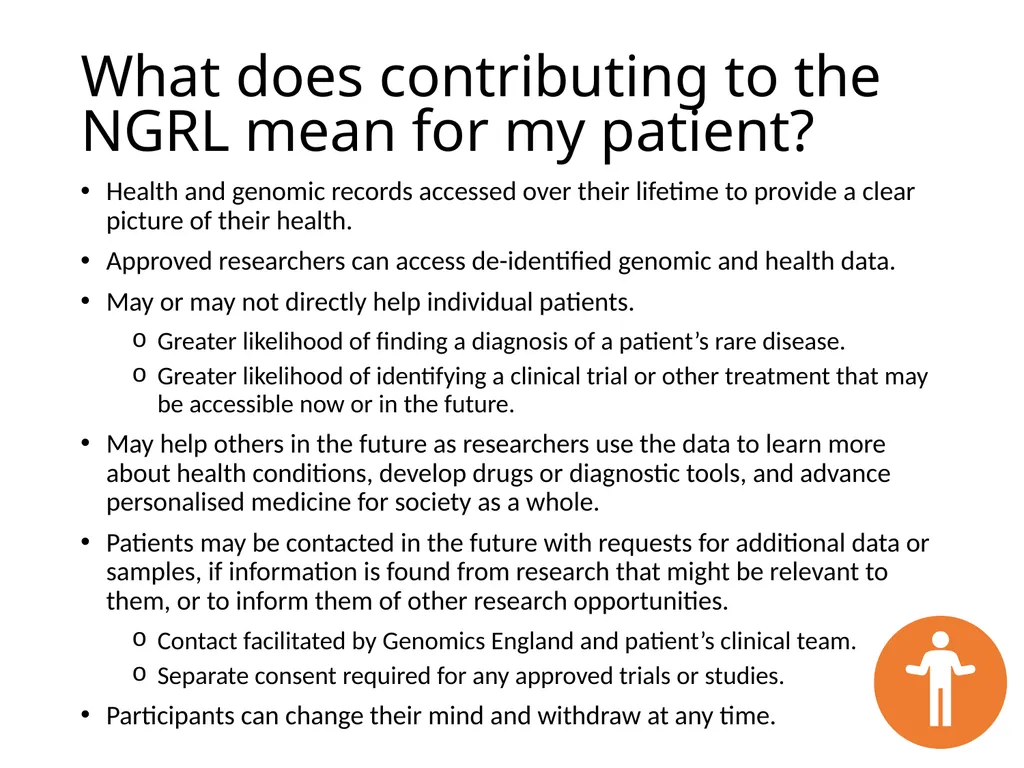
What does contributing to the NGRL mean for my patient? Health and genomic records accessed over their lifetime to provide a clear picture of their health.
Approved researchers can access de-identified genomic and health data.
May or may not directly help individual patients.
Greater likelihood of finding a diagnosis of a patient’s rare disease.
Greater likelihood of identifying a clinical trial or other treatment that may be accessible now or in the future.
May help others in the future as researchers use the data to learn more about health conditions, develop drugs or diagnostic tools, and advance personalised medicine for society as a whole.
Patients may be contacted in the future with requests for additional data or samples, if information is found from research that might be relevant to them, or to inform them of other research opportunities.
Contact facilitated by Genomics England and patient’s clinical team.
Separate consent required for any approved trials or studies.
Participants can change their mind and withdraw at any time.<br>
Approved researchers can access de-identified genomic and health data.
May or may not directly help individual patients.
Greater likelihood of finding a diagnosis of a patient’s rare disease.
Greater likelihood of identifying a clinical trial or other treatment that may be accessible now or in the future.
May help others in the future as researchers use the data to learn more about health conditions, develop drugs or diagnostic tools, and advance personalised medicine for society as a whole.
Patients may be contacted in the future with requests for additional data or samples, if information is found from research that might be relevant to them, or to inform them of other research opportunities.
Contact facilitated by Genomics England and patient’s clinical team.
Separate consent required for any approved trials or studies.
Participants can change their mind and withdraw at any time.<br>
26
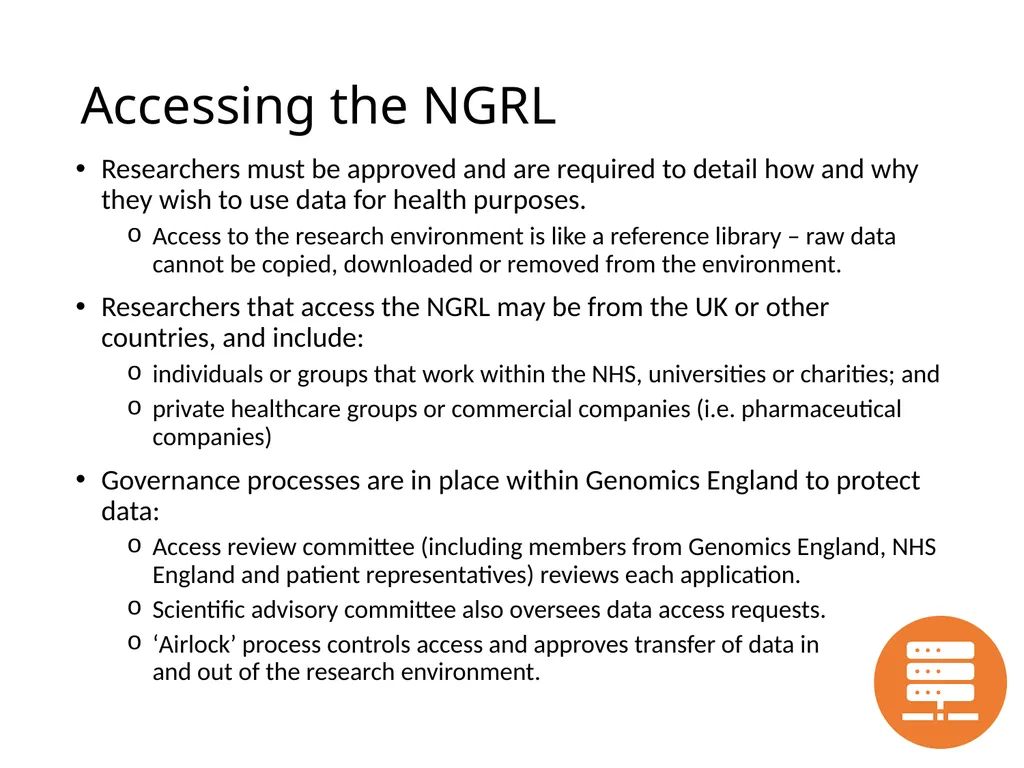
Accessing the NGRL Researchers must be approved and are required to detail how and why they wish to use data for health purposes.
Access to the research environment is like a reference library – raw data cannot be copied, downloaded or removed from the environment.
Researchers that access the NGRL may be from the UK or other countries, and include:
individuals or groups that work within the NHS, universities or charities; and
private healthcare groups or commercial companies (i.e. pharmaceutical companies)
Governance processes are in place within Genomics England to protect data:
Access review committee (including members from Genomics England, NHS England and patient representatives) reviews each application.
Scientific advisory committee also oversees data access requests.
‘Airlock’ process controls access and approves transfer of data in and out of the research environment.<br>
Access to the research environment is like a reference library – raw data cannot be copied, downloaded or removed from the environment.
Researchers that access the NGRL may be from the UK or other countries, and include:
individuals or groups that work within the NHS, universities or charities; and
private healthcare groups or commercial companies (i.e. pharmaceutical companies)
Governance processes are in place within Genomics England to protect data:
Access review committee (including members from Genomics England, NHS England and patient representatives) reviews each application.
Scientific advisory committee also oversees data access requests.
‘Airlock’ process controls access and approves transfer of data in and out of the research environment.<br>
27
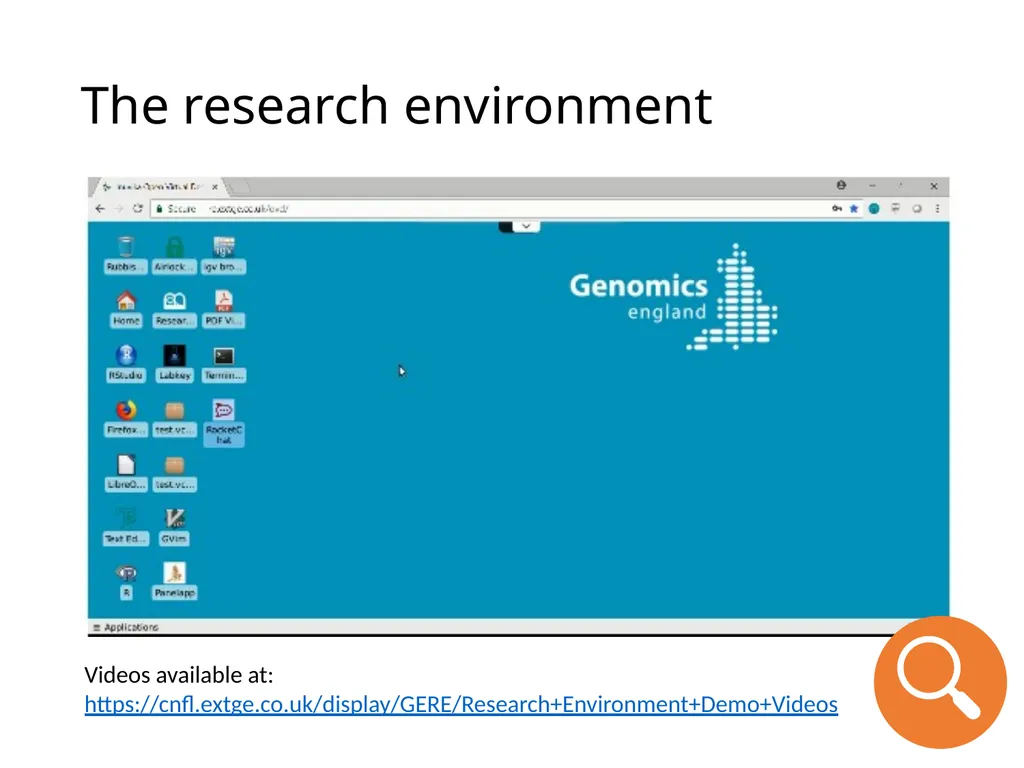
The research environment Videos available at:
https://cnfl.extge.co.uk/display/GERE/Research+Environment+Demo+Videos<br>
https://cnfl.extge.co.uk/display/GERE/Research+Environment+Demo+Videos<br>
28
How is clinical and research data managed? Holding slide – infographic to be included following approval by NHS England and Genomics England (expected Autumn 2019)<br>
29
Discussing the NGRL within the
clinical conversation All patients having WGS should be made aware of the NGRL at some point in their clinical pathway. Discussion can include face-to-face, telephone and/or email correspondence.
The clinician will need to explain that if the patient consents to having WGS, their clinical, sample and genomic sequencing data would be accessed by the lab and healthcare providers in the NHS. The optional opportunity to allow data to also be accessed through the NGRL can then be discussed.
The clinical test will go ahead regardless of the timing of the choice to contribute to the NGRL.
Some patients will want more time to decide, or delay the conversation to consider the NGRL choice at a later time.
Information will be made available online for clinicians and patients to support the conversation.<br>
The clinician will need to explain that if the patient consents to having WGS, their clinical, sample and genomic sequencing data would be accessed by the lab and healthcare providers in the NHS. The optional opportunity to allow data to also be accessed through the NGRL can then be discussed.
The clinical test will go ahead regardless of the timing of the choice to contribute to the NGRL.
Some patients will want more time to decide, or delay the conversation to consider the NGRL choice at a later time.
Information will be made available online for clinicians and patients to support the conversation.<br>
30
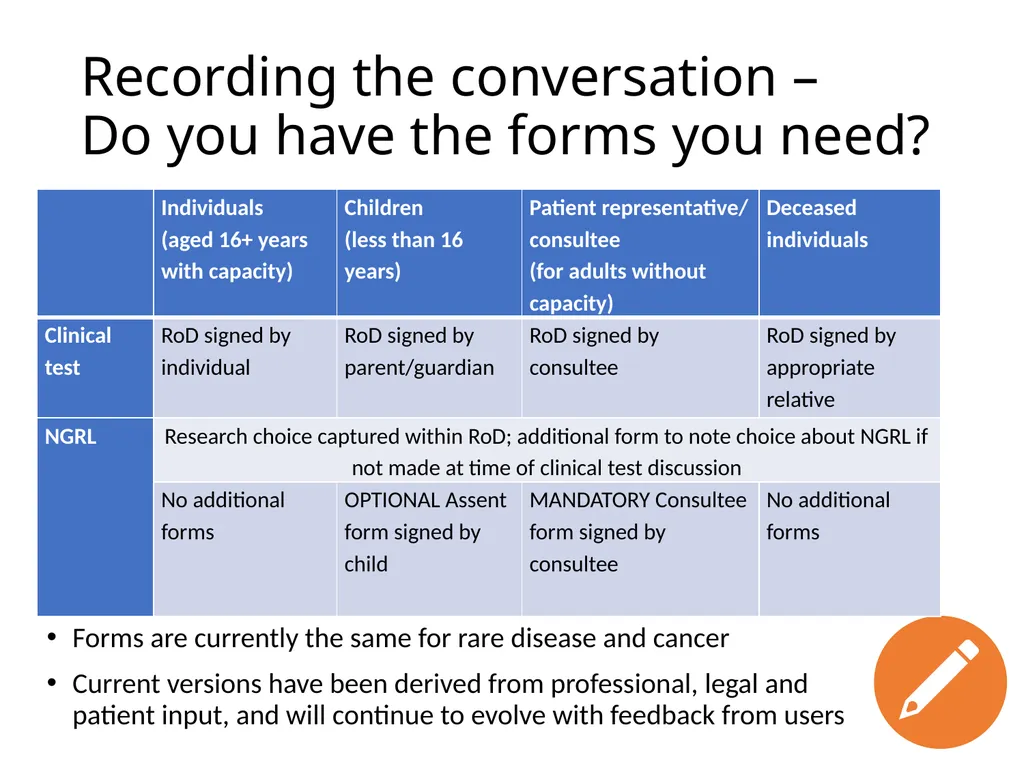
Recording the conversation –
Do you have the forms you need? Forms are currently the same for rare disease and cancer
Current versions have been derived from professional, legal and patient input, and will continue to evolve with feedback from users<br>
Current versions have been derived from professional, legal and patient input, and will continue to evolve with feedback from users<br>
31
Important to remember… The patient may decide not to proceed with the clinical test and/or NGRL, or wish to have more time to consider their choice.
Consider a referral for genetic counselling for further discussion regarding:
managing genetic risk and/or a diagnosis; and
complex social and/or communication issues.
Patient resources and support groups available (see links on later slide).<br>
Consider a referral for genetic counselling for further discussion regarding:
managing genetic risk and/or a diagnosis; and
complex social and/or communication issues.
Patient resources and support groups available (see links on later slide).<br>
32
References/for more information Genomics Education Programme Clinician Guides and Supplementary Information [links when available]
NHSE National Genomic Test Directories: www.england.nhs.uk/publication/national-genomic-test-directories/
GeneReviews: an international clinician resource providing information about inherited conditions: www.ncbi.nlm.nih.gov/books/NBK1116/
Joint Committee on Genomics in Medicine: Consent and Confidentiality in Genomic Medicine 2019 report: www.rcplondon.ac.uk/file/13314/download?token=D7KQOz1H
Code on Genetic Testing and Insurance: https://www.gov.uk/government/publications/code-on-genetic-testing-and-insurance and https://www.abi.org.uk/data-and-resources/tools-and-resources/genetics/genetics-faqs/
NHS Mental Capacity Act: www.nhs.uk/conditions/social-care-and-support-guide/making-decisions-for-someone-else/mental-capacity-act/
General Medical Council 0-18 years, Assessing the capacity to consent: www.gmc-uk.org/ethical-guidance/ethical-guidance-for-doctors/0-18-years/making-decisions
Care Quality Commission Gillick competency and Fraser guidelines: https://www.cqc.org.uk/guidance-providers/gps/nigels-surgery-8-gillick-competency-fraser-guidelines
Human Tissue Authority, Consent and DNA: www.hta.gov.uk/policies/about-dna-and-role-hta<br>
NHSE National Genomic Test Directories: www.england.nhs.uk/publication/national-genomic-test-directories/
GeneReviews: an international clinician resource providing information about inherited conditions: www.ncbi.nlm.nih.gov/books/NBK1116/
Joint Committee on Genomics in Medicine: Consent and Confidentiality in Genomic Medicine 2019 report: www.rcplondon.ac.uk/file/13314/download?token=D7KQOz1H
Code on Genetic Testing and Insurance: https://www.gov.uk/government/publications/code-on-genetic-testing-and-insurance and https://www.abi.org.uk/data-and-resources/tools-and-resources/genetics/genetics-faqs/
NHS Mental Capacity Act: www.nhs.uk/conditions/social-care-and-support-guide/making-decisions-for-someone-else/mental-capacity-act/
General Medical Council 0-18 years, Assessing the capacity to consent: www.gmc-uk.org/ethical-guidance/ethical-guidance-for-doctors/0-18-years/making-decisions
Care Quality Commission Gillick competency and Fraser guidelines: https://www.cqc.org.uk/guidance-providers/gps/nigels-surgery-8-gillick-competency-fraser-guidelines
Human Tissue Authority, Consent and DNA: www.hta.gov.uk/policies/about-dna-and-role-hta<br>
33
Patient support resources NHS Choices portal for GMS resources [awaiting link]
Genomics England portal for GMS resources [awaiting link]
Genetic Alliance UK: national charity for patients and families affected by genetic conditions: www.geneticalliance.org.uk/
SWAN UK: supporting families affected by a syndrome without a name: www.undiagnosed.org.uk/
Unique: understanding rare chromosome and gene disorders: www.rarechromo.org/
Macmillan Cancer Support: www.macmillan.org.uk/
Genetics Home Reference: patient and public-friendly information about genetics and genetic conditions from the U.S. National Library of Medicine: www.ghr.nlm.nih.gov/<br>
Genomics England portal for GMS resources [awaiting link]
Genetic Alliance UK: national charity for patients and families affected by genetic conditions: www.geneticalliance.org.uk/
SWAN UK: supporting families affected by a syndrome without a name: www.undiagnosed.org.uk/
Unique: understanding rare chromosome and gene disorders: www.rarechromo.org/
Macmillan Cancer Support: www.macmillan.org.uk/
Genetics Home Reference: patient and public-friendly information about genetics and genetic conditions from the U.S. National Library of Medicine: www.ghr.nlm.nih.gov/<br>
34
Local links and resources To be completed as per local needs<br>