
This chapter is designed to provide you with an


Description: This chapter is designed to provide you with an understanding of the American system of law, our tripartite system of government, and sources of law. Copyright 2021 Carol M. Bast. All rights reserved. Our Common-Law Heritage Common
Related Topics
Download Presentation
"This chapter is designed to provide you with an" is the property of its rightful owner. Permission is granted to download and print the materials on this website for personal, non-commercial use only, and to display it on your personal computer provided you do not modify the materials and that you retain all copyright notices contained in the materials. By downloading content from our website, you accept the terms of this agreement.
Presentation Transcript
slide1. This chapter is designed to provide you with an understanding of
the American system of law,
our tripartite system of government, and
sources of law. Copyright © 2021 Carol M. Bast. All rights reserved.<br>
slide2. Our Common-Law Heritage
● “Common law” is the system of law developed in England and transferred to most of the English- speaking world. Many other countries are civil law jurisdictions.
● Louisiana, with its French and Spanish heritage, is the only state in the U.S. that is a civil law jurisdiction. Copyright © 2021 Carol M. Bast. All rights reserved.<br>
slide3. Common Law
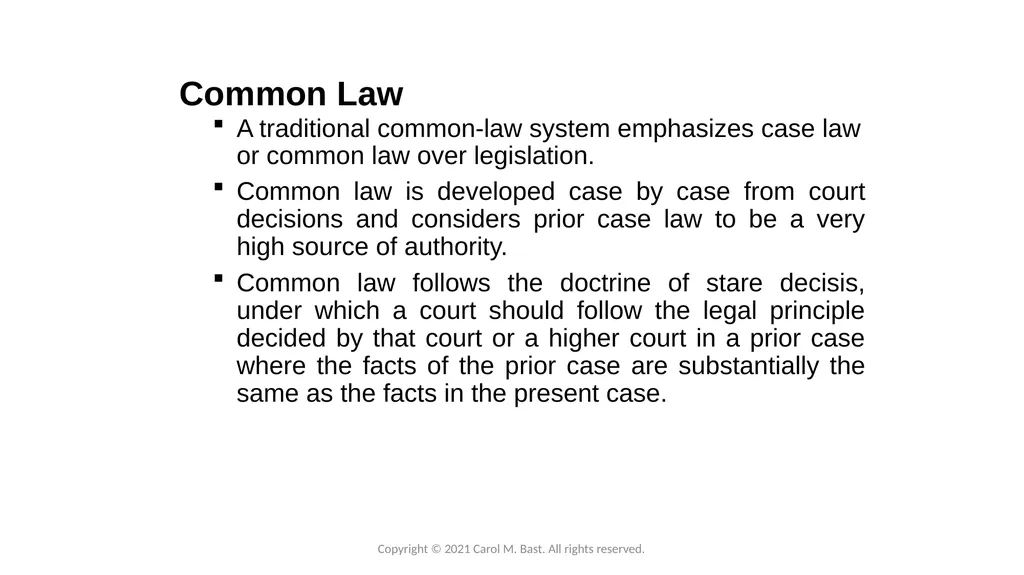
A traditional common-law system emphasizes case law or common law over legislation.
Common law is developed case by case from court decisions and considers prior case law to be a very high source of authority.
Common law follows the doctrine of stare decisis, under which a court should follow the legal principle decided by that court or a higher court in a prior case where the facts of the prior case are substantially the same as the facts in the present case. Copyright © 2021 Carol M. Bast. All rights reserved.<br>
slide4. Common Law (cont'd)
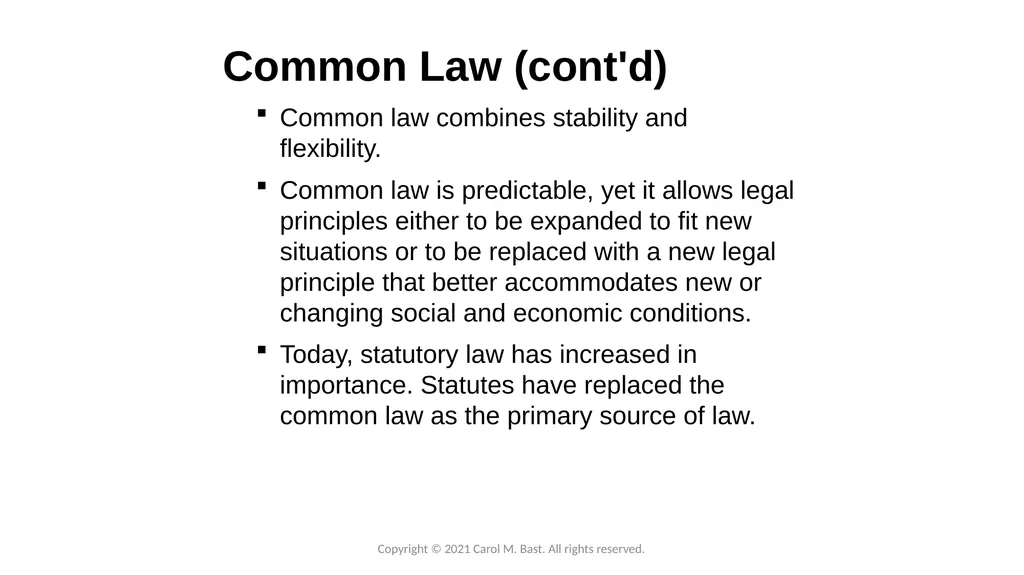
Common law combines stability and flexibility.
Common law is predictable, yet it allows legal principles either to be expanded to fit new situations or to be replaced with a new legal principle that better accommodates new or changing social and economic conditions.
Today, statutory law has increased in importance. Statutes have replaced the common law as the primary source of law. Copyright © 2021 Carol M. Bast. All rights reserved.<br>
slide5. Civil Law
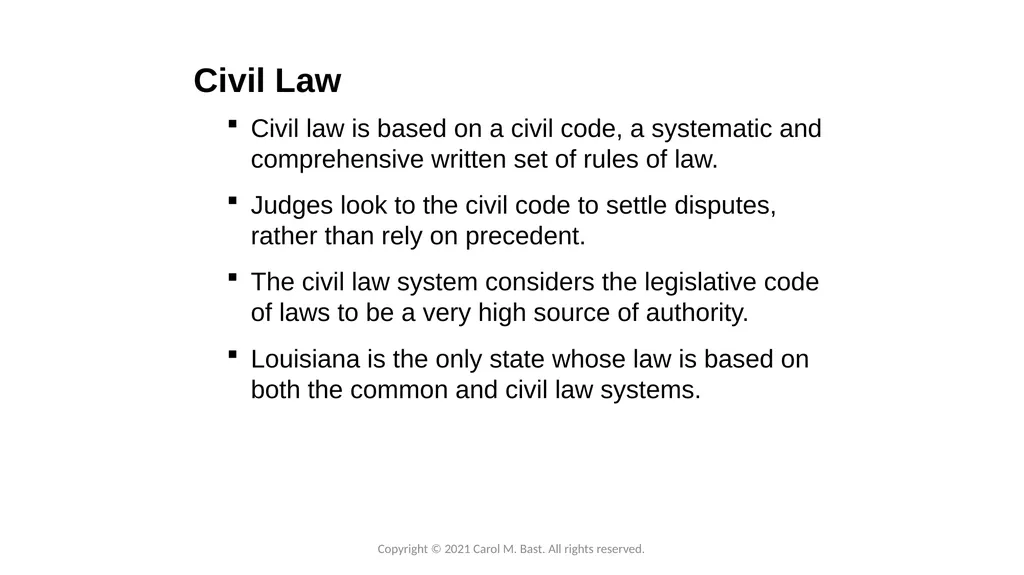
Civil law is based on a civil code, a systematic and comprehensive written set of rules of law.
Judges look to the civil code to settle disputes, rather than rely on precedent.
The civil law system considers the legislative code of laws to be a very high source of authority.
Louisiana is the only state whose law is based on both the common and civil law systems. Copyright © 2021 Carol M. Bast. All rights reserved.<br>
slide6. Federalism
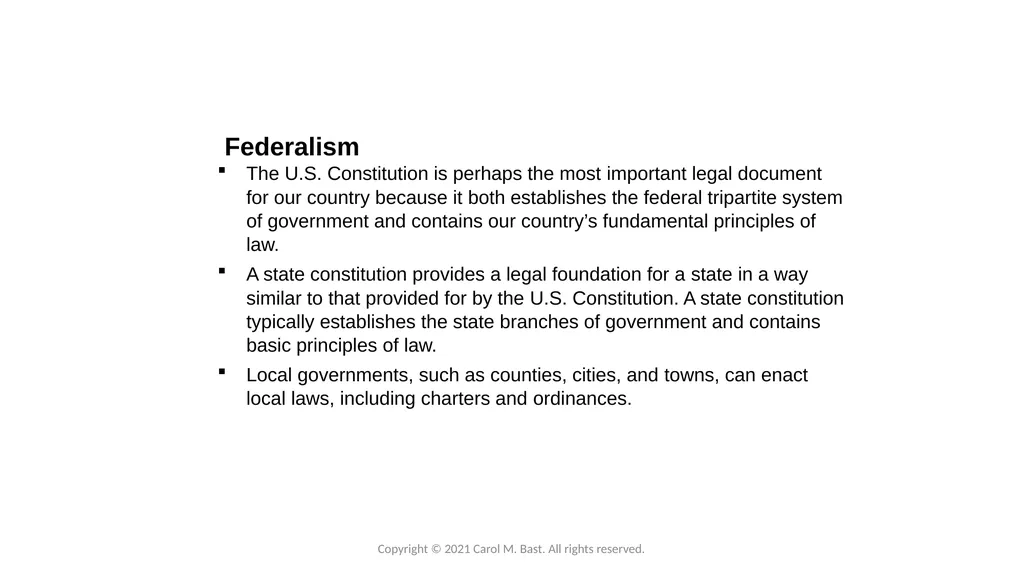
The U.S. Constitution is perhaps the most important legal document for our country because it both establishes the federal tripartite system of government and contains our country’s fundamental principles of law.
A state constitution provides a legal foundation for a state in a way similar to that provided for by the U.S. Constitution. A state constitution typically establishes the state branches of government and contains basic principles of law.
Local governments, such as counties, cities, and towns, can enact local laws, including charters and ordinances. Copyright © 2021 Carol M. Bast. All rights reserved.<br>
slide7. Federalism (cont'd)
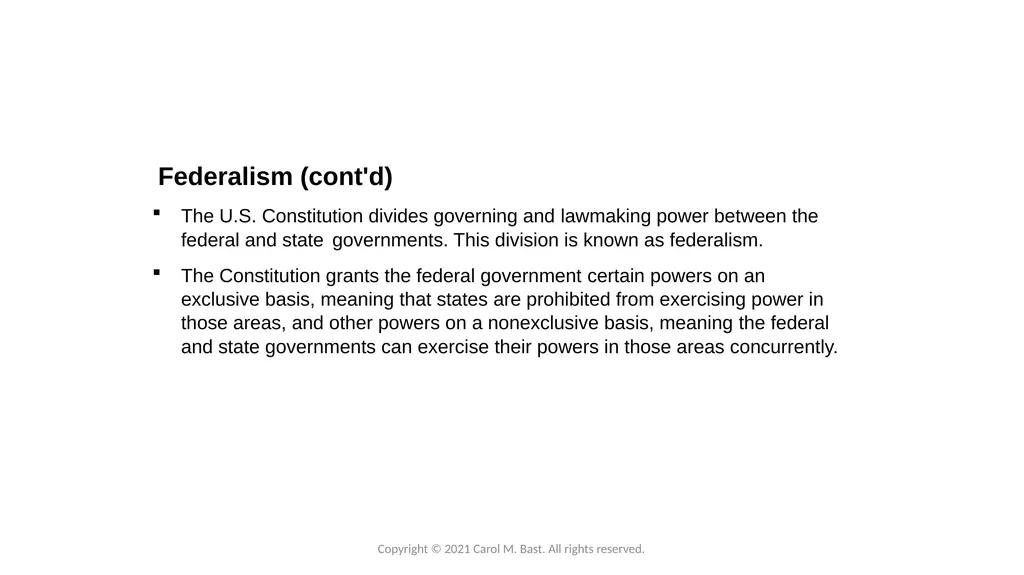
The U.S. Constitution divides governing and lawmaking power between the federal and state governments. This division is known as federalism.
The Constitution grants the federal government certain powers on an exclusive basis, meaning that states are prohibited from exercising power in those areas, and other powers on a nonexclusive basis, meaning the federal and state governments can exercise their powers in those areas concurrently. Copyright © 2021 Carol M. Bast. All rights reserved.<br>
slide8. Our Tripartite System
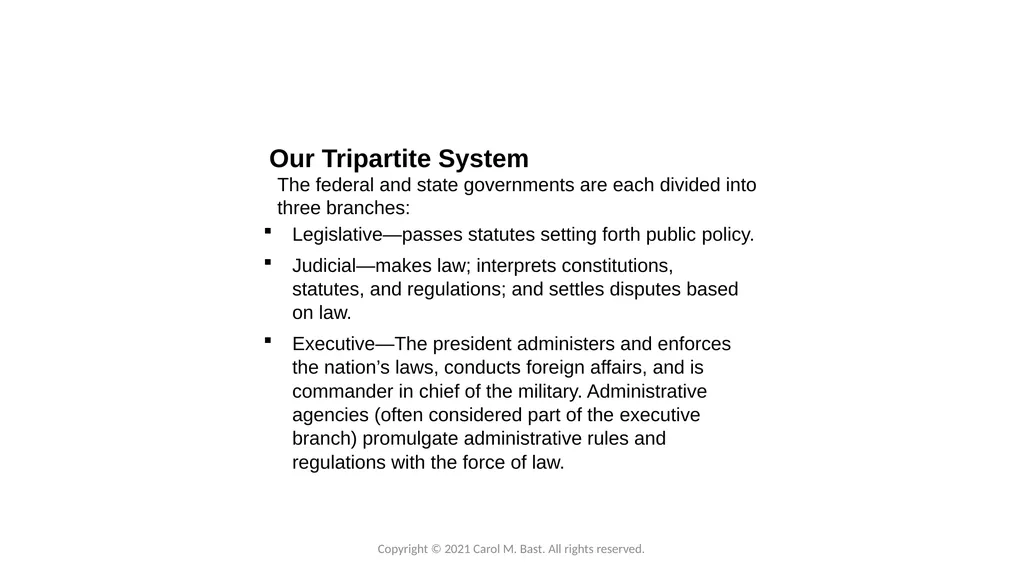
The federal and state governments are each divided into three branches:
Legislative—passes statutes setting forth public policy.
Judicial—makes law; interprets constitutions, statutes, and regulations; and settles disputes based on law.
Executive—The president administers and enforces the nation’s laws, conducts foreign affairs, and is commander in chief of the military. Administrative agencies (often considered part of the executive branch) promulgate administrative rules and regulations with the force of law. Copyright © 2021 Carol M. Bast. All rights reserved.<br>
slide9. The full set of 193 PowerPoint slides is available upon adoption. If you are a professor using this book for a class, please contact Rachael Meier at remeier@cap-press.com to request your slides. Copyright © 2021 Carol M. Bast. All rights reserved.<br>
the American system of law,
our tripartite system of government, and
sources of law. Copyright © 2021 Carol M. Bast. All rights reserved.<br>
slide2. Our Common-Law Heritage
● “Common law” is the system of law developed in England and transferred to most of the English- speaking world. Many other countries are civil law jurisdictions.
● Louisiana, with its French and Spanish heritage, is the only state in the U.S. that is a civil law jurisdiction. Copyright © 2021 Carol M. Bast. All rights reserved.<br>
slide3. Common Law
A traditional common-law system emphasizes case law or common law over legislation.
Common law is developed case by case from court decisions and considers prior case law to be a very high source of authority.
Common law follows the doctrine of stare decisis, under which a court should follow the legal principle decided by that court or a higher court in a prior case where the facts of the prior case are substantially the same as the facts in the present case. Copyright © 2021 Carol M. Bast. All rights reserved.<br>
slide4. Common Law (cont'd)
Common law combines stability and flexibility.
Common law is predictable, yet it allows legal principles either to be expanded to fit new situations or to be replaced with a new legal principle that better accommodates new or changing social and economic conditions.
Today, statutory law has increased in importance. Statutes have replaced the common law as the primary source of law. Copyright © 2021 Carol M. Bast. All rights reserved.<br>
slide5. Civil Law
Civil law is based on a civil code, a systematic and comprehensive written set of rules of law.
Judges look to the civil code to settle disputes, rather than rely on precedent.
The civil law system considers the legislative code of laws to be a very high source of authority.
Louisiana is the only state whose law is based on both the common and civil law systems. Copyright © 2021 Carol M. Bast. All rights reserved.<br>
slide6. Federalism
The U.S. Constitution is perhaps the most important legal document for our country because it both establishes the federal tripartite system of government and contains our country’s fundamental principles of law.
A state constitution provides a legal foundation for a state in a way similar to that provided for by the U.S. Constitution. A state constitution typically establishes the state branches of government and contains basic principles of law.
Local governments, such as counties, cities, and towns, can enact local laws, including charters and ordinances. Copyright © 2021 Carol M. Bast. All rights reserved.<br>
slide7. Federalism (cont'd)
The U.S. Constitution divides governing and lawmaking power between the federal and state governments. This division is known as federalism.
The Constitution grants the federal government certain powers on an exclusive basis, meaning that states are prohibited from exercising power in those areas, and other powers on a nonexclusive basis, meaning the federal and state governments can exercise their powers in those areas concurrently. Copyright © 2021 Carol M. Bast. All rights reserved.<br>
slide8. Our Tripartite System
The federal and state governments are each divided into three branches:
Legislative—passes statutes setting forth public policy.
Judicial—makes law; interprets constitutions, statutes, and regulations; and settles disputes based on law.
Executive—The president administers and enforces the nation’s laws, conducts foreign affairs, and is commander in chief of the military. Administrative agencies (often considered part of the executive branch) promulgate administrative rules and regulations with the force of law. Copyright © 2021 Carol M. Bast. All rights reserved.<br>
slide9. The full set of 193 PowerPoint slides is available upon adoption. If you are a professor using this book for a class, please contact Rachael Meier at remeier@cap-press.com to request your slides. Copyright © 2021 Carol M. Bast. All rights reserved.<br>