
This content may be used or adapted for
SB
Published · 33 slides · 0 views
1 / 1






Description
This content may be used or adapted for noncommercial, educational purposes only. Please use the following citation: George Washington University Cancer Center TAP. (2023). Sexual Health Cancer Survivorship PowerPoint Slides. GWU Cancer
Related Topics
Share
Embed code
Download this presentation From Below
"This content may be used or adapted for" is the property of its rightful owner. Permission is granted to download and print the materials on this website for personal, non-commercial use only, and to display it on your personal computer provided you do not modify the materials and that you retain all copyright notices contained in the materials. By downloading content from our website, you accept the terms of this agreement.
Presentation Transcript
01
This content may be used or adapted for noncommercial, educational purposes only. Please use the following citation:
George Washington University Cancer Center TAP. (2023). Sexual Health & Cancer Survivorship [PowerPoint Slides]. GWU Cancer Center TAP. https://cme.smhs.gwu.edu/gw-cancer-center-/content/sexual-health-and-cancer-survivorship#group-tabs-node-course-default1
This content was adapted from the GW Cancer Center the Oncology Patient Navigation Training: The Fundamentals (PI: Pratt-Chapman) developed and maintained by CDC cooperative agreements #NU38DP004972, #5NU58DP006461 and #NU58DP007539. The content added, changed, or adapted by our organization do not necessarily represent the views of the GW Cancer Center or the CDC.
If you have any questions about the following material or would like permission to use this material, please contact cancercontrol@gwu.edu<br>
George Washington University Cancer Center TAP. (2023). Sexual Health & Cancer Survivorship [PowerPoint Slides]. GWU Cancer Center TAP. https://cme.smhs.gwu.edu/gw-cancer-center-/content/sexual-health-and-cancer-survivorship#group-tabs-node-course-default1
This content was adapted from the GW Cancer Center the Oncology Patient Navigation Training: The Fundamentals (PI: Pratt-Chapman) developed and maintained by CDC cooperative agreements #NU38DP004972, #5NU58DP006461 and #NU58DP007539. The content added, changed, or adapted by our organization do not necessarily represent the views of the GW Cancer Center or the CDC.
If you have any questions about the following material or would like permission to use this material, please contact cancercontrol@gwu.edu<br>
02
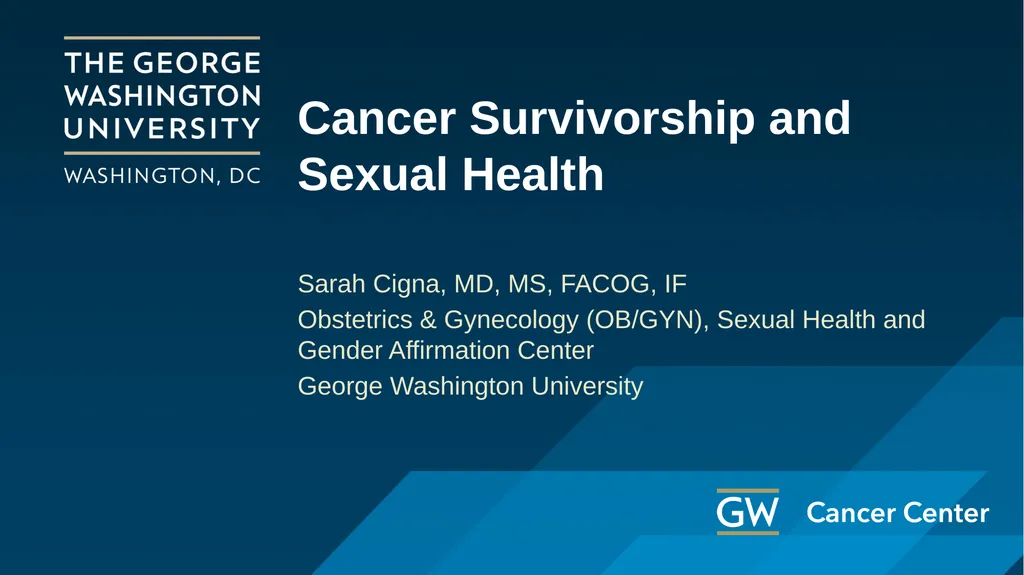
Sarah Cigna, MD, MS, FACOG, IF
Obstetrics & Gynecology (OB/GYN), Sexual Health and Gender Affirmation Center
George Washington University Cancer Survivorship and Sexual Health<br>
Obstetrics & Gynecology (OB/GYN), Sexual Health and Gender Affirmation Center
George Washington University Cancer Survivorship and Sexual Health<br>
03
Funding Support This work was supported by Cooperative Agreement #5NU58DP006461-05 from the Centers for Disease Control and Prevention (CDC). Its contents are solely the responsibility of the authors and do not necessarily represent the official views of CDC.<br>
04
Faculty Dr. Sarah Cigna is an academic OBGYN and Sexual Medicine specialist in Washington, DC. She is in her 5th year as an Assistant Professor at The George Washington University School of Medicine and Health Sciences where she provides comprehensive sexual health care and has developed curricula for medical student and resident learners. She currently serves as the Director of the SAGA Center (Sexual Health and Gender Affirmation Center) at GWU, and the first Sexual Medicine Fellowship for OBGYNs in the country. Her academic and research interests include sexual health and vulvovaginal conditions, particularly in the context of Diversity, Equity, and Inclusion. She is determined to improve access to evidence-based and affordable sexual healthcare.<br>
05
I have no financial disclosures relevant to the content of this presentation.
We will be focusing on sexual health and function of people with vulvas/ vaginas but recognize that not all individuals with these body parts identify as women. Disclosure<br>
We will be focusing on sexual health and function of people with vulvas/ vaginas but recognize that not all individuals with these body parts identify as women. Disclosure<br>
06
Learning Objectives Identify tools for sexual health evaluation in cancer patients
Describe how different cancer treatments can affect sexual health
Describe strategies to mitigate cancer treatment-related sexual health issues<br>
Describe how different cancer treatments can affect sexual health
Describe strategies to mitigate cancer treatment-related sexual health issues<br>
07
Cancer Treatment Effects The cancer treatments effects on sexual health vary widely depending on the treatment and body system being affected.<br>
08
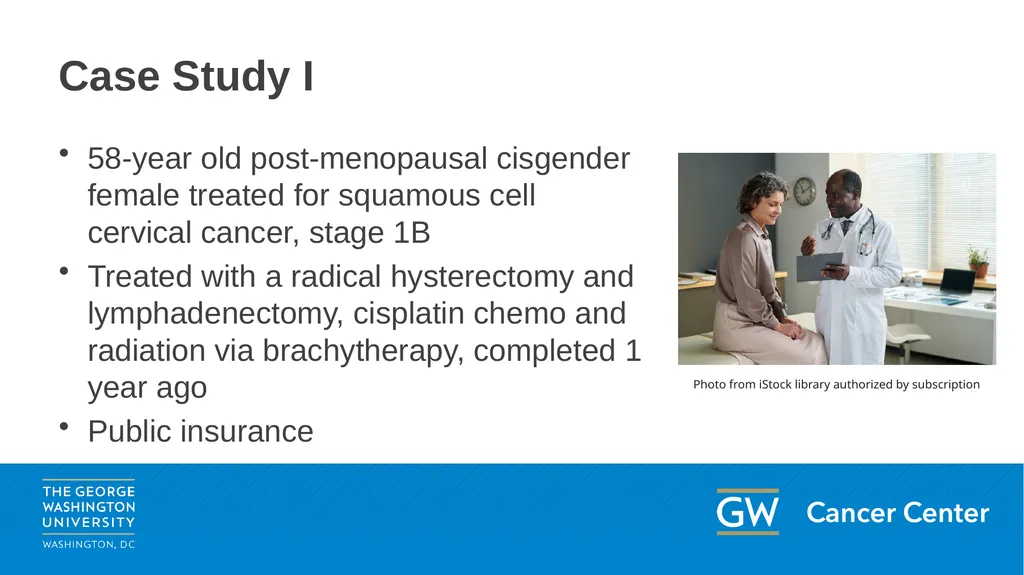
Case Study I 58-year old post-menopausal cisgender female treated for squamous cell cervical cancer, stage 1B
Treated with a radical hysterectomy and lymphadenectomy, cisplatin chemo and radiation via brachytherapy, completed 1 year ago
Public insurance Photo from iStock library authorized by subscription<br>
Treated with a radical hysterectomy and lymphadenectomy, cisplatin chemo and radiation via brachytherapy, completed 1 year ago
Public insurance Photo from iStock library authorized by subscription<br>
09
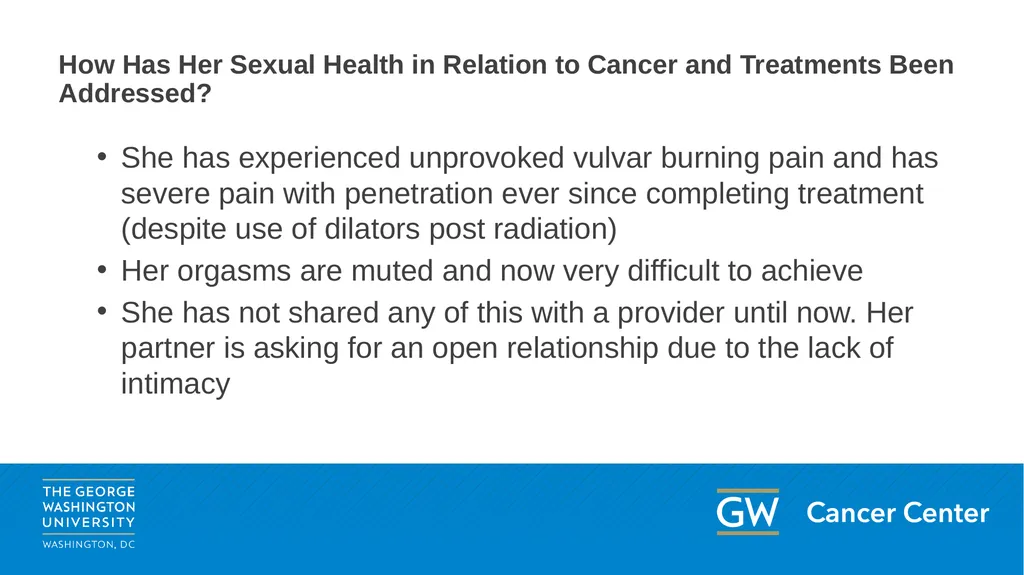
How Has Her Sexual Health in Relation to Cancer and Treatments Been Addressed? She has experienced unprovoked vulvar burning pain and has severe pain with penetration ever since completing treatment (despite use of dilators post radiation)
Her orgasms are muted and now very difficult to achieve
She has not shared any of this with a provider until now. Her partner is asking for an open relationship due to the lack of intimacy<br>
Her orgasms are muted and now very difficult to achieve
She has not shared any of this with a provider until now. Her partner is asking for an open relationship due to the lack of intimacy<br>
10
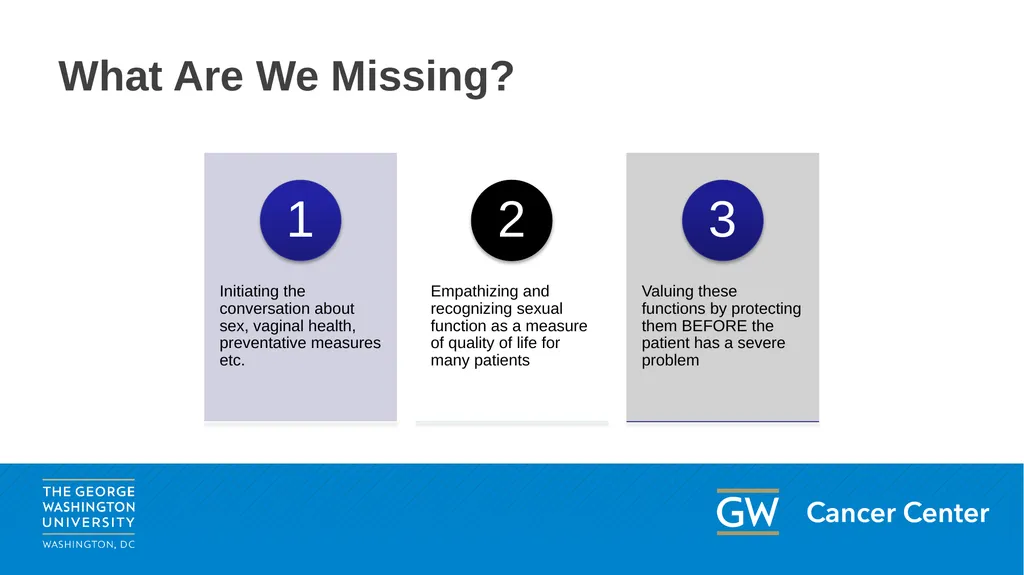
What Are We Missing?<br>
11
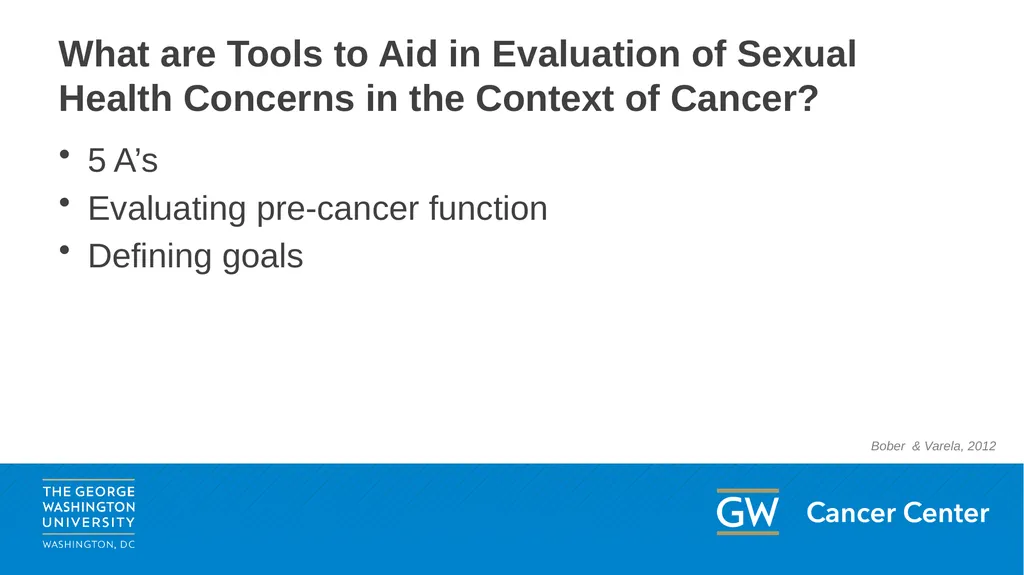
What are Tools to Aid in Evaluation of Sexual Health Concerns in the Context of Cancer? 5 A’s
Evaluating pre-cancer function
Defining goals Bober & Varela, 2012<br>
Evaluating pre-cancer function
Defining goals Bober & Varela, 2012<br>
12
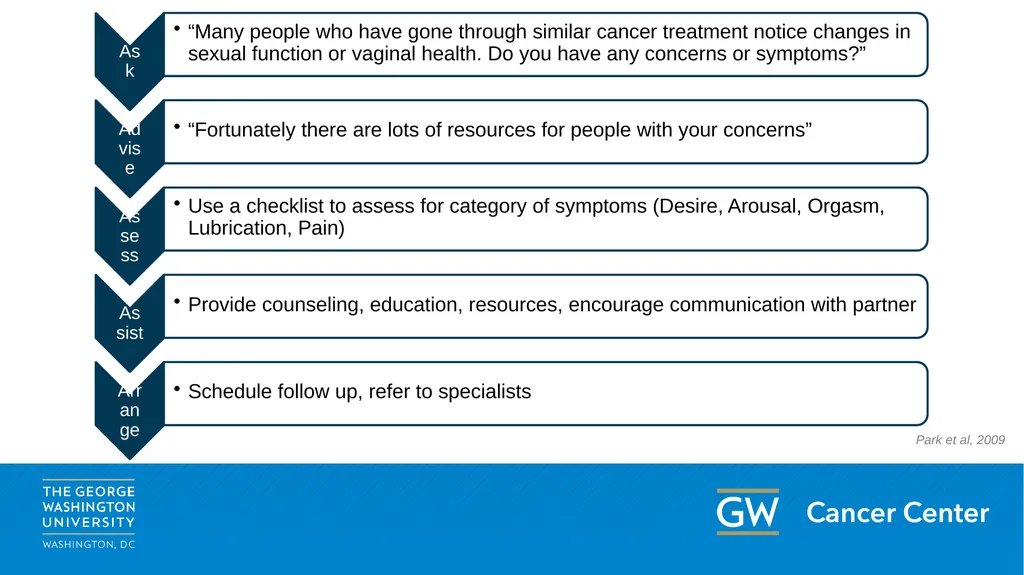
Park et al, 2009<br>
13
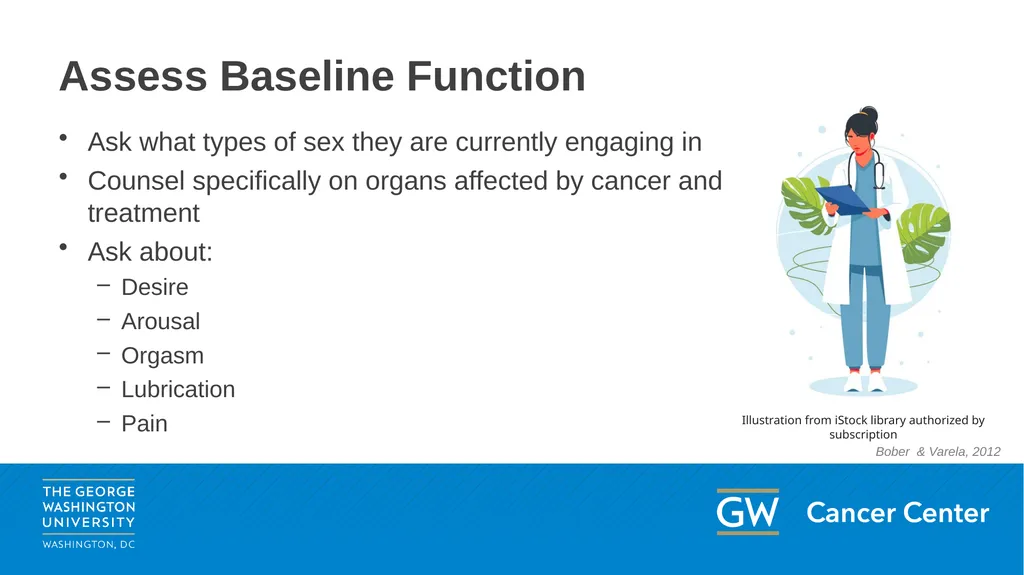
Assess Baseline Function Ask what types of sex they are currently engaging in
Counsel specifically on organs affected by cancer and treatment
Ask about:
Desire
Arousal
Orgasm
Lubrication
Pain Illustration from iStock library authorized by subscription Bober & Varela, 2012<br>
Counsel specifically on organs affected by cancer and treatment
Ask about:
Desire
Arousal
Orgasm
Lubrication
Pain Illustration from iStock library authorized by subscription Bober & Varela, 2012<br>
14
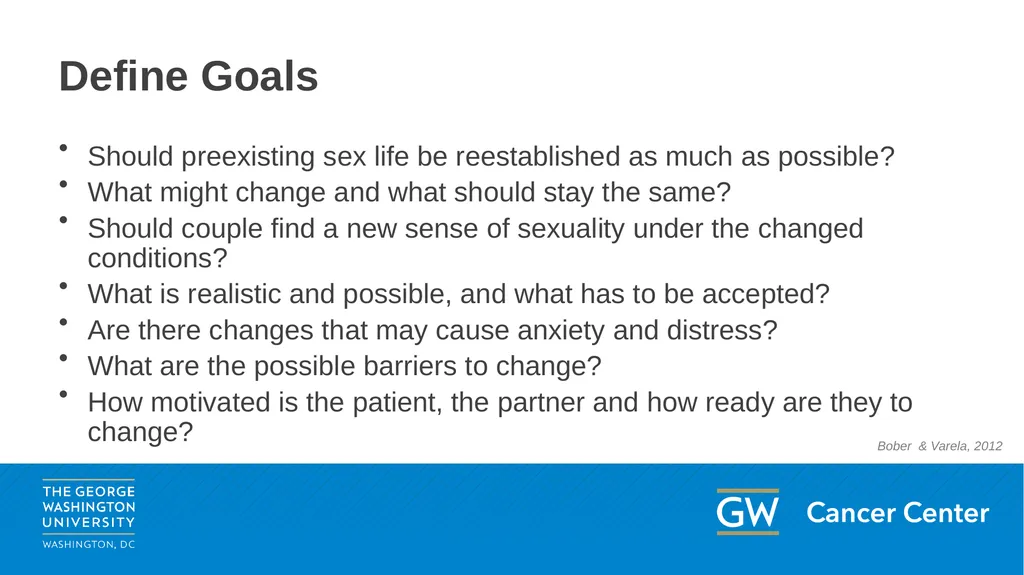
Define Goals Should preexisting sex life be reestablished as much as possible?
What might change and what should stay the same?
Should couple find a new sense of sexuality under the changed conditions?
What is realistic and possible, and what has to be accepted?
Are there changes that may cause anxiety and distress?
What are the possible barriers to change?
How motivated is the patient, the partner and how ready are they to change? Bober & Varela, 2012<br>
What might change and what should stay the same?
Should couple find a new sense of sexuality under the changed conditions?
What is realistic and possible, and what has to be accepted?
Are there changes that may cause anxiety and distress?
What are the possible barriers to change?
How motivated is the patient, the partner and how ready are they to change? Bober & Varela, 2012<br>
15
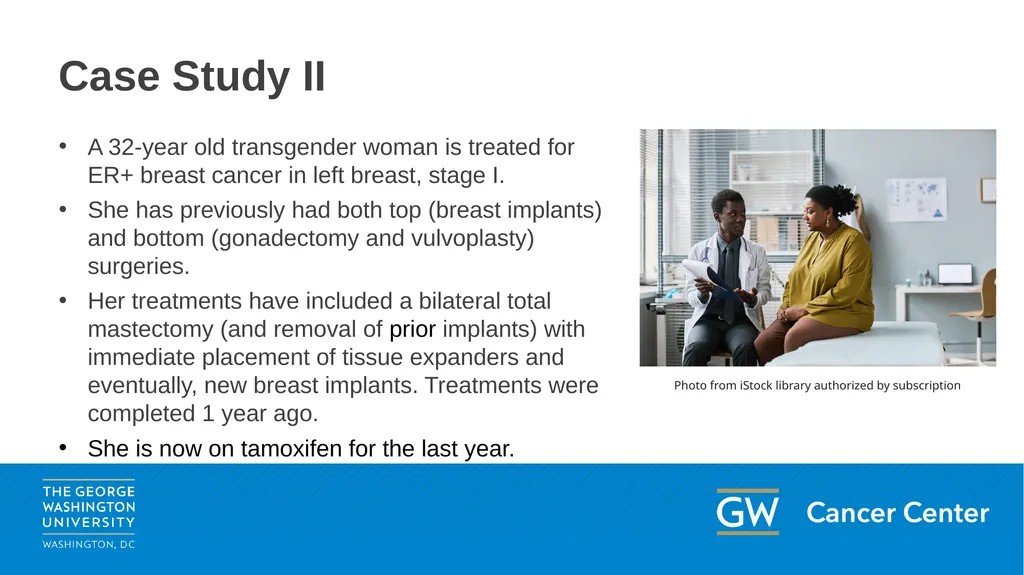
Case Study II A 32-year old transgender woman is treated for ER+ breast cancer in left breast, stage I.
She has previously had both top (breast implants) and bottom (gonadectomy and vulvoplasty) surgeries.
Her treatments have included a bilateral total mastectomy (and removal of prior implants) with immediate placement of tissue expanders and eventually, new breast implants. Treatments were completed 1 year ago.
She is now on tamoxifen for the last year. Photo from iStock library authorized by subscription<br>
She has previously had both top (breast implants) and bottom (gonadectomy and vulvoplasty) surgeries.
Her treatments have included a bilateral total mastectomy (and removal of prior implants) with immediate placement of tissue expanders and eventually, new breast implants. Treatments were completed 1 year ago.
She is now on tamoxifen for the last year. Photo from iStock library authorized by subscription<br>
16
What Effects Could Her Treatments Have Had on Her Sexual Function? She struggles with body image
Implants removed and reconstruction afterward
She experiences loss of nipple sensation and hot flashes
She wants to know if she can resume her gender affirming hormone therapy (estradiol patch) Braun et al, 2017<br>
Implants removed and reconstruction afterward
She experiences loss of nipple sensation and hot flashes
She wants to know if she can resume her gender affirming hormone therapy (estradiol patch) Braun et al, 2017<br>
17
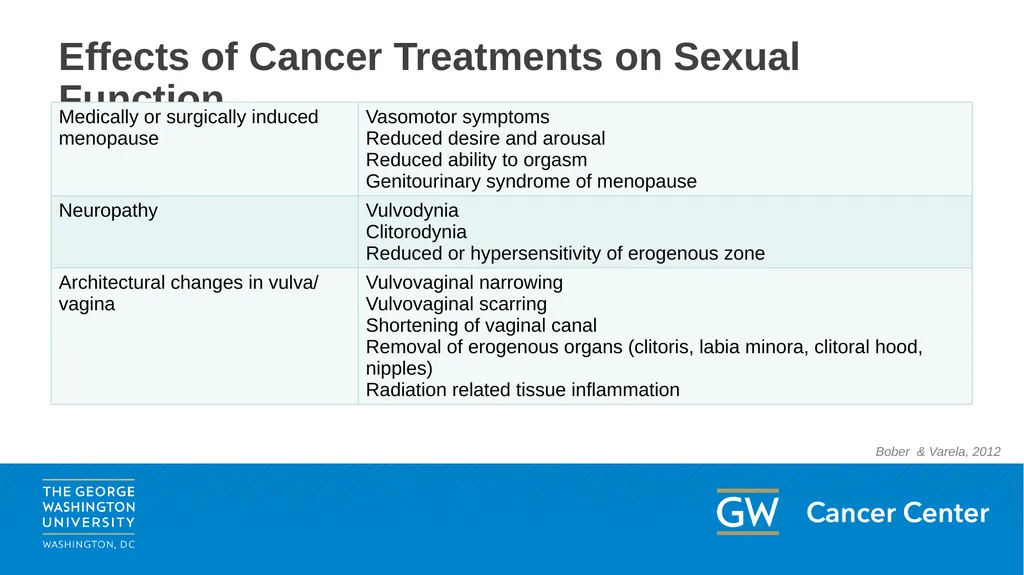
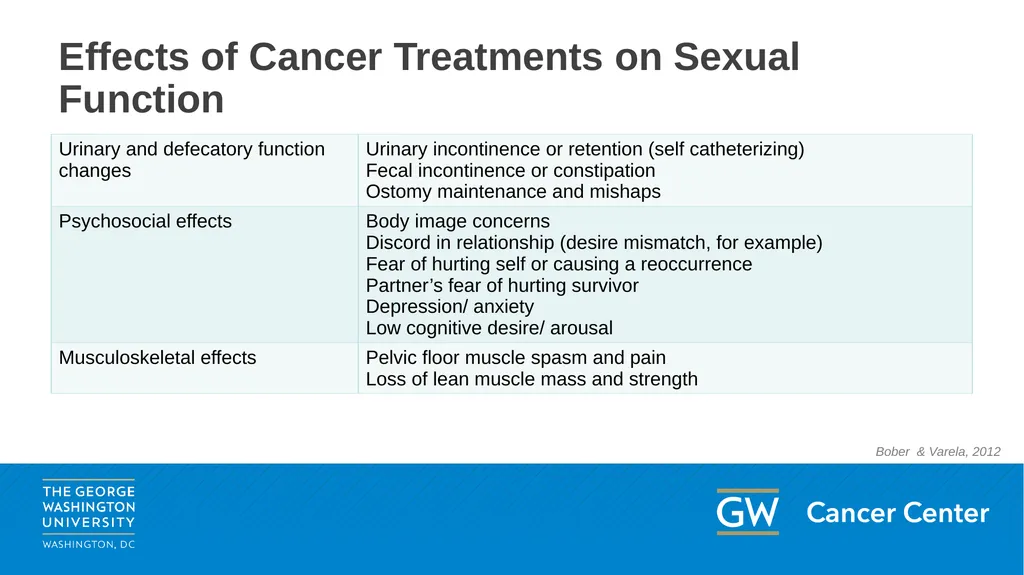
Effects of Cancer Treatments on Sexual Function Bober & Varela, 2012<br>
18
Effects of Cancer Treatments on Sexual Function Bober & Varela, 2012<br>
19
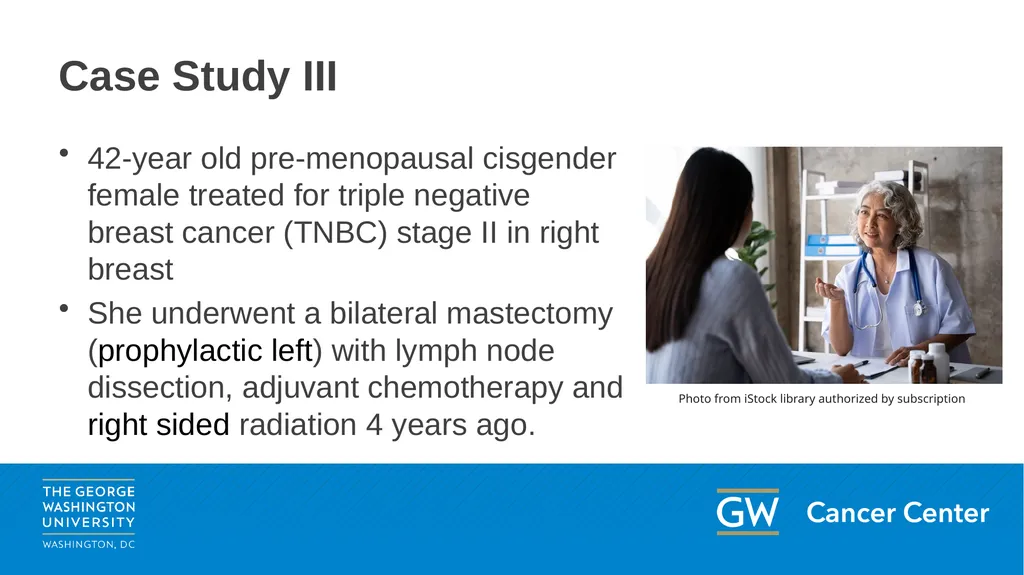
Case Study III 42-year old pre-menopausal cisgender female treated for triple negative breast cancer (TNBC) stage II in right breast
She underwent a bilateral mastectomy (prophylactic left) with lymph node dissection, adjuvant chemotherapy and right sided radiation 4 years ago. Photo from iStock library authorized by subscription<br>
She underwent a bilateral mastectomy (prophylactic left) with lymph node dissection, adjuvant chemotherapy and right sided radiation 4 years ago. Photo from iStock library authorized by subscription<br>
20
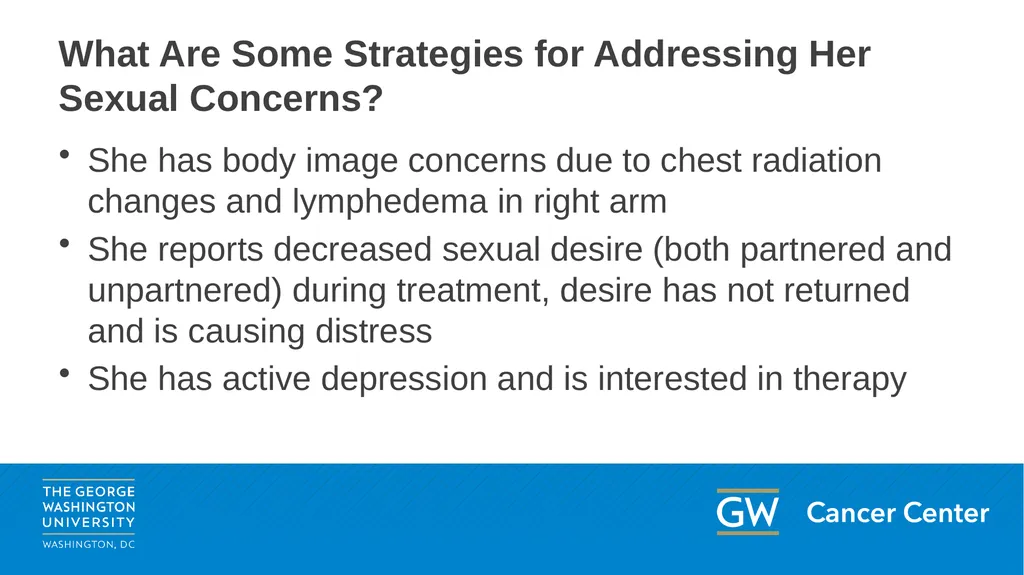
What Are Some Strategies for Addressing Her Sexual Concerns? She has body image concerns due to chest radiation changes and lymphedema in right arm
She reports decreased sexual desire (both partnered and unpartnered) during treatment, desire has not returned and is causing distress
She has active depression and is interested in therapy<br>
She reports decreased sexual desire (both partnered and unpartnered) during treatment, desire has not returned and is causing distress
She has active depression and is interested in therapy<br>
21
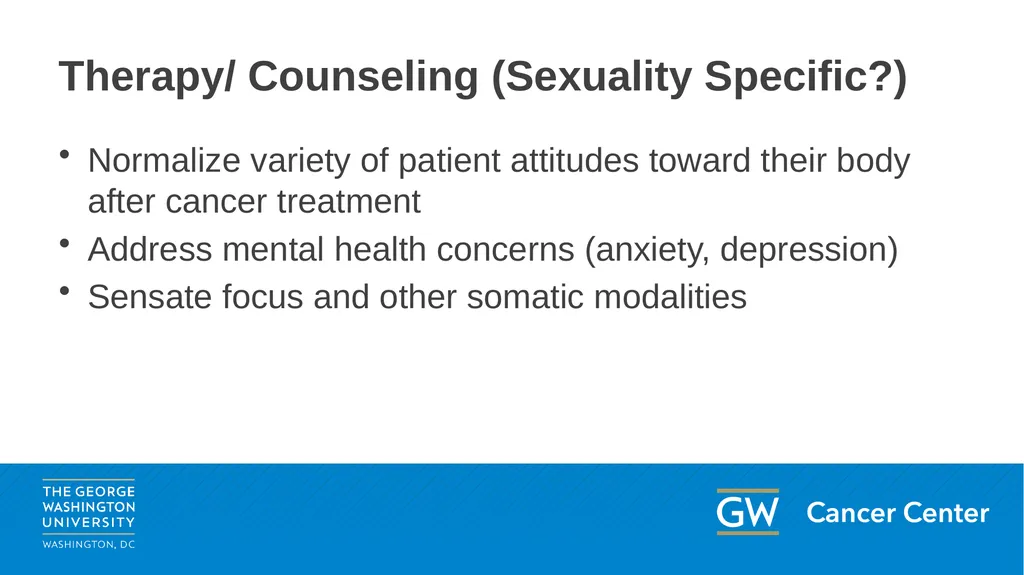
Therapy/ Counseling (Sexuality Specific?) Normalize variety of patient attitudes toward their body after cancer treatment
Address mental health concerns (anxiety, depression)
Sensate focus and other somatic modalities<br>
Address mental health concerns (anxiety, depression)
Sensate focus and other somatic modalities<br>
22
Medical Therapies for Central Pathology that Minimize Impact on (or Improve!) Sexual Function Higgins et al, 2010<br>
23
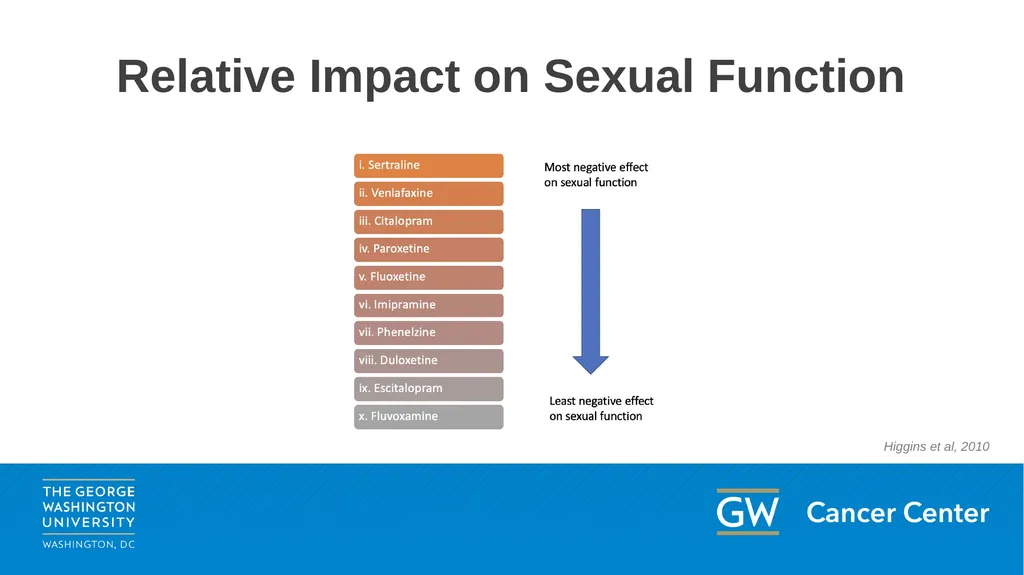
Relative Impact on Sexual Function Higgins et al, 2010<br>
24
Therapies for Hormone-Mediated Symptoms *Paroxetine may decrease efficacy of tamoxifen with long term use
**Anastrazole is CYP1a inhibitor, contraindicated with Fezolinetant Crean-Tate et al, 2020; Faubion et al, 2018<br>
**Anastrazole is CYP1a inhibitor, contraindicated with Fezolinetant Crean-Tate et al, 2020; Faubion et al, 2018<br>
25
Therapies for Radiation-Mediated Symptoms Carter et al, 2020; Dion et al, 1990; Safra et al, 2018; Sobotkowski et al, 2006; Williams et al, 1992<br>
26
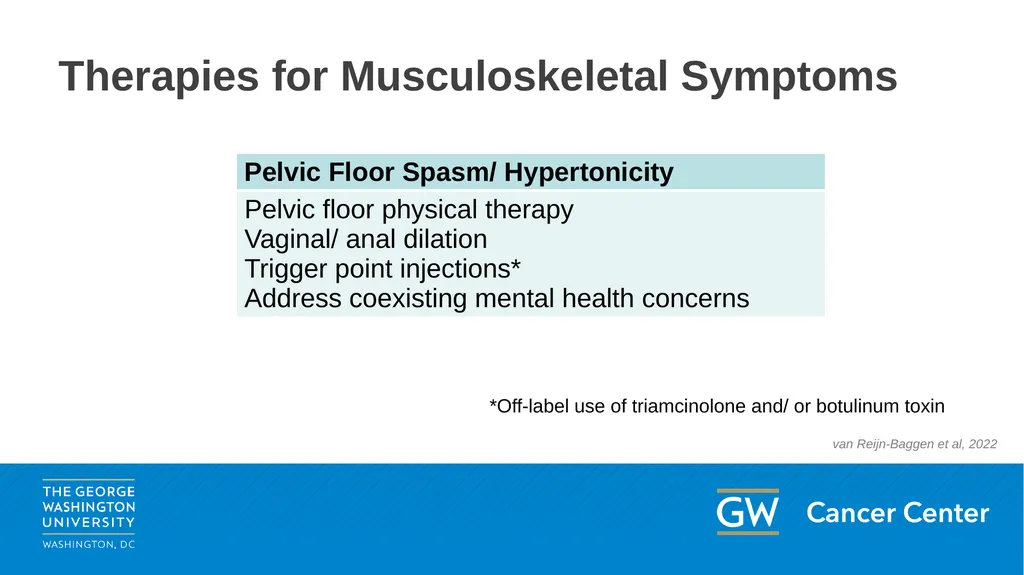
Therapies for Musculoskeletal Symptoms *Off-label use of triamcinolone and/ or botulinum toxin van Reijn-Baggen et al, 2022<br>
27
Therapies for Nerve-Mediated Symptoms Bober & Varela, 2012<br>
28
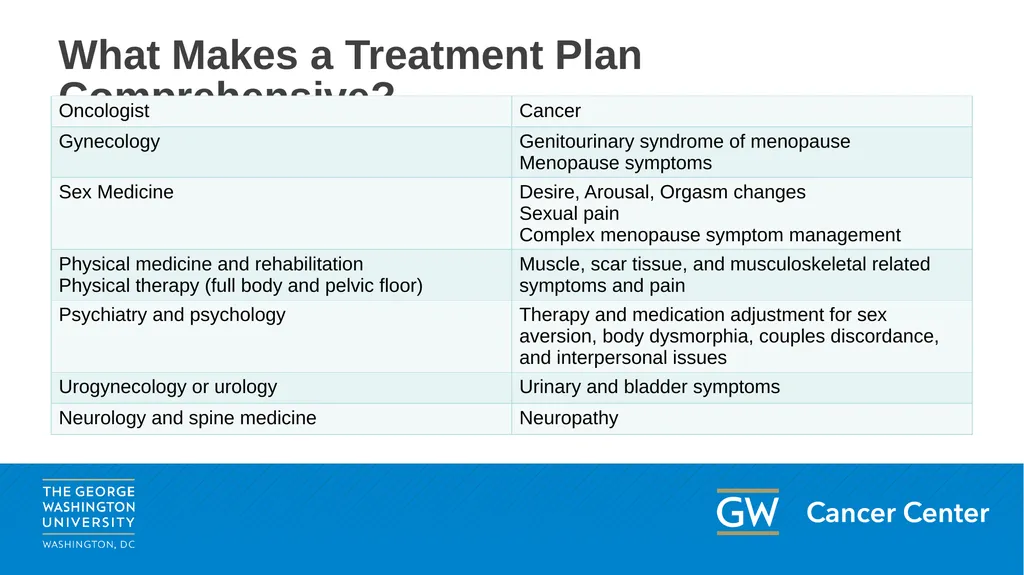
What Makes a Treatment Plan Comprehensive?<br>
29
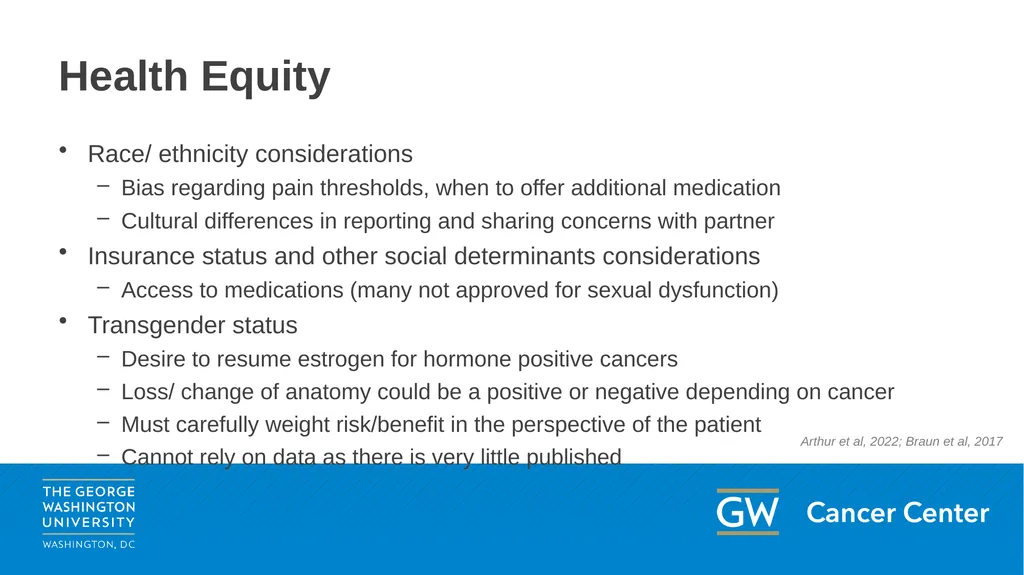
Health Equity Race/ ethnicity considerations
Bias regarding pain thresholds, when to offer additional medication
Cultural differences in reporting and sharing concerns with partner
Insurance status and other social determinants considerations
Access to medications (many not approved for sexual dysfunction)
Transgender status
Desire to resume estrogen for hormone positive cancers
Loss/ change of anatomy could be a positive or negative depending on cancer
Must carefully weight risk/benefit in the perspective of the patient
Cannot rely on data as there is very little published Arthur et al, 2022; Braun et al, 2017<br>
Bias regarding pain thresholds, when to offer additional medication
Cultural differences in reporting and sharing concerns with partner
Insurance status and other social determinants considerations
Access to medications (many not approved for sexual dysfunction)
Transgender status
Desire to resume estrogen for hormone positive cancers
Loss/ change of anatomy could be a positive or negative depending on cancer
Must carefully weight risk/benefit in the perspective of the patient
Cannot rely on data as there is very little published Arthur et al, 2022; Braun et al, 2017<br>
30
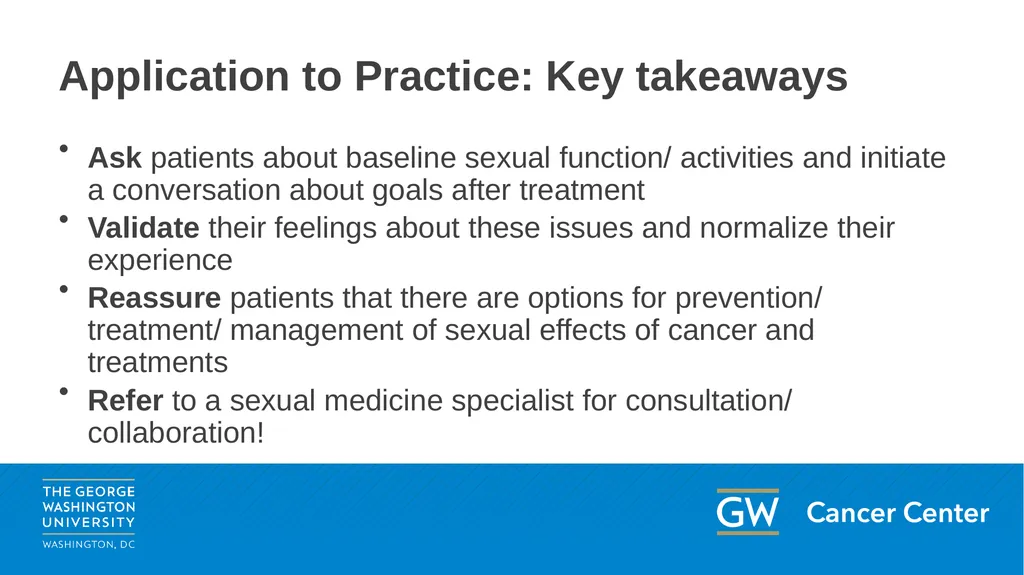
Application to Practice: Key takeaways Ask patients about baseline sexual function/ activities and initiate a conversation about goals after treatment
Validate their feelings about these issues and normalize their experience
Reassure patients that there are options for prevention/ treatment/ management of sexual effects of cancer and treatments
Refer to a sexual medicine specialist for consultation/ collaboration!<br>
Validate their feelings about these issues and normalize their experience
Reassure patients that there are options for prevention/ treatment/ management of sexual effects of cancer and treatments
Refer to a sexual medicine specialist for consultation/ collaboration!<br>
31
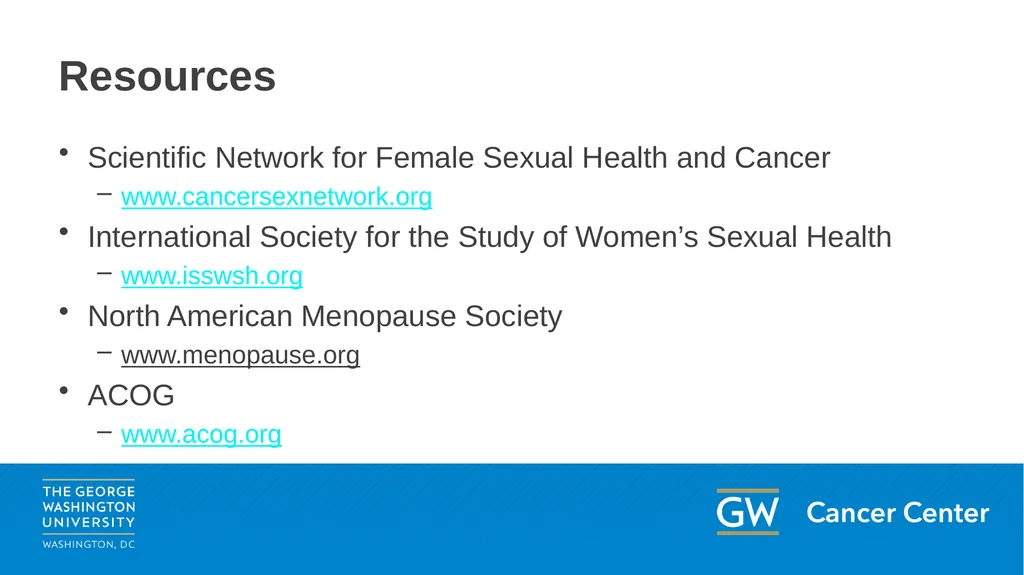
Resources Scientific Network for Female Sexual Health and Cancer
www.cancersexnetwork.org
International Society for the Study of Women’s Sexual Health
www.isswsh.org
North American Menopause Society
www.menopause.org
ACOG
www.acog.org<br>
www.cancersexnetwork.org
International Society for the Study of Women’s Sexual Health
www.isswsh.org
North American Menopause Society
www.menopause.org
ACOG
www.acog.org<br>
32
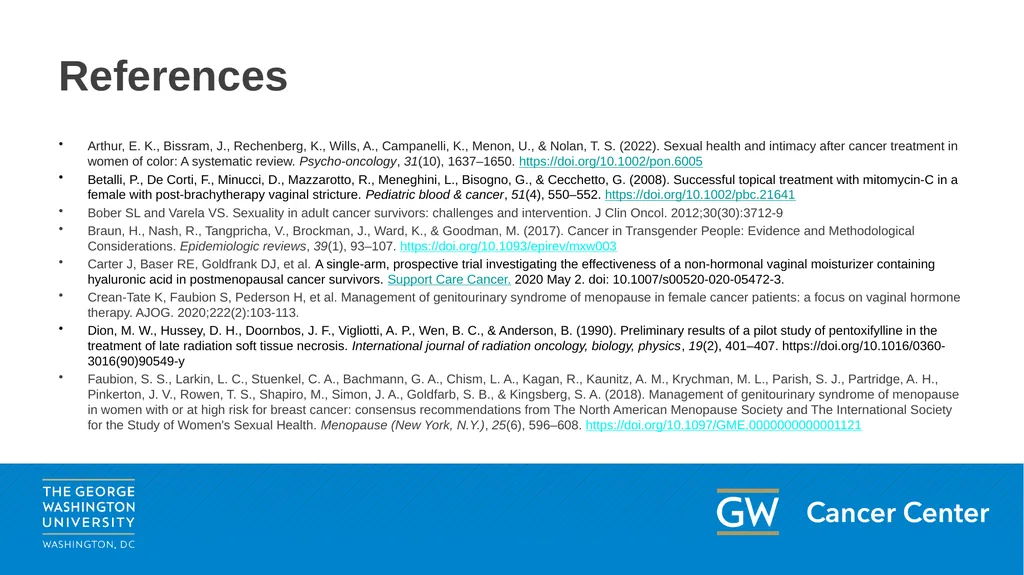
References Arthur, E. K., Bissram, J., Rechenberg, K., Wills, A., Campanelli, K., Menon, U., & Nolan, T. S. (2022). Sexual health and intimacy after cancer treatment in women of color: A systematic review. Psycho-oncology, 31(10), 1637–1650. https://doi.org/10.1002/pon.6005
Betalli, P., De Corti, F., Minucci, D., Mazzarotto, R., Meneghini, L., Bisogno, G., & Cecchetto, G. (2008). Successful topical treatment with mitomycin-C in a female with post-brachytherapy vaginal stricture. Pediatric blood & cancer, 51(4), 550–552. https://doi.org/10.1002/pbc.21641
Bober SL and Varela VS. Sexuality in adult cancer survivors: challenges and intervention. J Clin Oncol. 2012;30(30):3712-9
Braun, H., Nash, R., Tangpricha, V., Brockman, J., Ward, K., & Goodman, M. (2017). Cancer in Transgender People: Evidence and Methodological Considerations. Epidemiologic reviews, 39(1), 93–107. https://doi.org/10.1093/epirev/mxw003
Carter J, Baser RE, Goldfrank DJ, et al. A single-arm, prospective trial investigating the effectiveness of a non-hormonal vaginal moisturizer containing hyaluronic acid in postmenopausal cancer survivors. Support Care Cancer. 2020 May 2. doi: 10.1007/s00520-020-05472-3.
Crean-Tate K, Faubion S, Pederson H, et al. Management of genitourinary syndrome of menopause in female cancer patients: a focus on vaginal hormone therapy. AJOG. 2020;222(2):103-113.
Dion, M. W., Hussey, D. H., Doornbos, J. F., Vigliotti, A. P., Wen, B. C., & Anderson, B. (1990). Preliminary results of a pilot study of pentoxifylline in the treatment of late radiation soft tissue necrosis. International journal of radiation oncology, biology, physics, 19(2), 401–407. https://doi.org/10.1016/0360-3016(90)90549-y
Faubion, S. S., Larkin, L. C., Stuenkel, C. A., Bachmann, G. A., Chism, L. A., Kagan, R., Kaunitz, A. M., Krychman, M. L., Parish, S. J., Partridge, A. H., Pinkerton, J. V., Rowen, T. S., Shapiro, M., Simon, J. A., Goldfarb, S. B., & Kingsberg, S. A. (2018). Management of genitourinary syndrome of menopause in women with or at high risk for breast cancer: consensus recommendations from The North American Menopause Society and The International Society for the Study of Women's Sexual Health. Menopause (New York, N.Y.), 25(6), 596–608. https://doi.org/10.1097/GME.0000000000001121<br>
Betalli, P., De Corti, F., Minucci, D., Mazzarotto, R., Meneghini, L., Bisogno, G., & Cecchetto, G. (2008). Successful topical treatment with mitomycin-C in a female with post-brachytherapy vaginal stricture. Pediatric blood & cancer, 51(4), 550–552. https://doi.org/10.1002/pbc.21641
Bober SL and Varela VS. Sexuality in adult cancer survivors: challenges and intervention. J Clin Oncol. 2012;30(30):3712-9
Braun, H., Nash, R., Tangpricha, V., Brockman, J., Ward, K., & Goodman, M. (2017). Cancer in Transgender People: Evidence and Methodological Considerations. Epidemiologic reviews, 39(1), 93–107. https://doi.org/10.1093/epirev/mxw003
Carter J, Baser RE, Goldfrank DJ, et al. A single-arm, prospective trial investigating the effectiveness of a non-hormonal vaginal moisturizer containing hyaluronic acid in postmenopausal cancer survivors. Support Care Cancer. 2020 May 2. doi: 10.1007/s00520-020-05472-3.
Crean-Tate K, Faubion S, Pederson H, et al. Management of genitourinary syndrome of menopause in female cancer patients: a focus on vaginal hormone therapy. AJOG. 2020;222(2):103-113.
Dion, M. W., Hussey, D. H., Doornbos, J. F., Vigliotti, A. P., Wen, B. C., & Anderson, B. (1990). Preliminary results of a pilot study of pentoxifylline in the treatment of late radiation soft tissue necrosis. International journal of radiation oncology, biology, physics, 19(2), 401–407. https://doi.org/10.1016/0360-3016(90)90549-y
Faubion, S. S., Larkin, L. C., Stuenkel, C. A., Bachmann, G. A., Chism, L. A., Kagan, R., Kaunitz, A. M., Krychman, M. L., Parish, S. J., Partridge, A. H., Pinkerton, J. V., Rowen, T. S., Shapiro, M., Simon, J. A., Goldfarb, S. B., & Kingsberg, S. A. (2018). Management of genitourinary syndrome of menopause in women with or at high risk for breast cancer: consensus recommendations from The North American Menopause Society and The International Society for the Study of Women's Sexual Health. Menopause (New York, N.Y.), 25(6), 596–608. https://doi.org/10.1097/GME.0000000000001121<br>
33
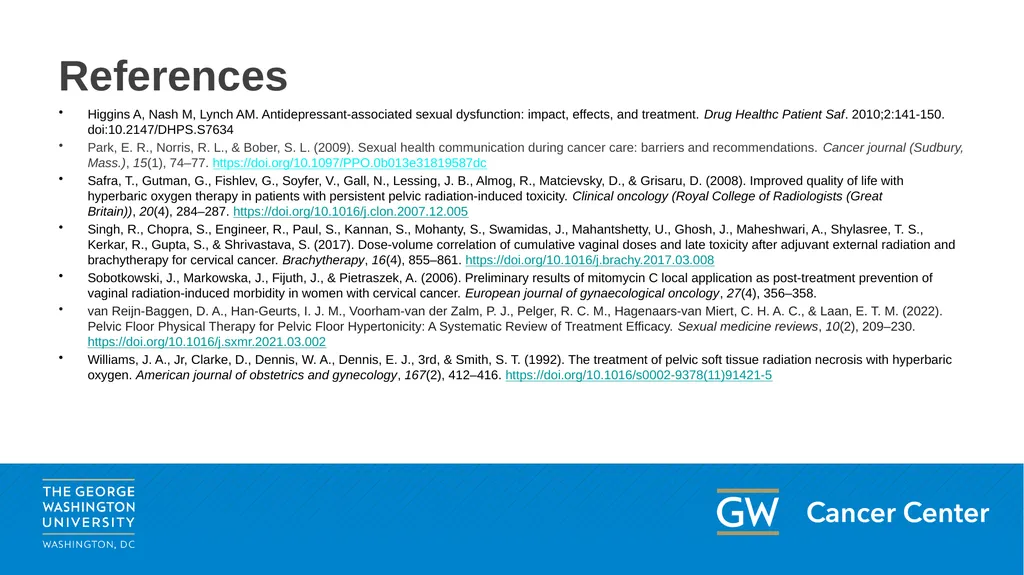
References Higgins A, Nash M, Lynch AM. Antidepressant-associated sexual dysfunction: impact, effects, and treatment. Drug Healthc Patient Saf. 2010;2:141-150. doi:10.2147/DHPS.S7634
Park, E. R., Norris, R. L., & Bober, S. L. (2009). Sexual health communication during cancer care: barriers and recommendations. Cancer journal (Sudbury, Mass.), 15(1), 74–77. https://doi.org/10.1097/PPO.0b013e31819587dc
Safra, T., Gutman, G., Fishlev, G., Soyfer, V., Gall, N., Lessing, J. B., Almog, R., Matcievsky, D., & Grisaru, D. (2008). Improved quality of life with hyperbaric oxygen therapy in patients with persistent pelvic radiation-induced toxicity. Clinical oncology (Royal College of Radiologists (Great Britain)), 20(4), 284–287. https://doi.org/10.1016/j.clon.2007.12.005
Singh, R., Chopra, S., Engineer, R., Paul, S., Kannan, S., Mohanty, S., Swamidas, J., Mahantshetty, U., Ghosh, J., Maheshwari, A., Shylasree, T. S., Kerkar, R., Gupta, S., & Shrivastava, S. (2017). Dose-volume correlation of cumulative vaginal doses and late toxicity after adjuvant external radiation and brachytherapy for cervical cancer. Brachytherapy, 16(4), 855–861. https://doi.org/10.1016/j.brachy.2017.03.008
Sobotkowski, J., Markowska, J., Fijuth, J., & Pietraszek, A. (2006). Preliminary results of mitomycin C local application as post-treatment prevention of vaginal radiation-induced morbidity in women with cervical cancer. European journal of gynaecological oncology, 27(4), 356–358.
van Reijn-Baggen, D. A., Han-Geurts, I. J. M., Voorham-van der Zalm, P. J., Pelger, R. C. M., Hagenaars-van Miert, C. H. A. C., & Laan, E. T. M. (2022). Pelvic Floor Physical Therapy for Pelvic Floor Hypertonicity: A Systematic Review of Treatment Efficacy. Sexual medicine reviews, 10(2), 209–230. https://doi.org/10.1016/j.sxmr.2021.03.002
Williams, J. A., Jr, Clarke, D., Dennis, W. A., Dennis, E. J., 3rd, & Smith, S. T. (1992). The treatment of pelvic soft tissue radiation necrosis with hyperbaric oxygen. American journal of obstetrics and gynecology, 167(2), 412–416. https://doi.org/10.1016/s0002-9378(11)91421-5<br>
Park, E. R., Norris, R. L., & Bober, S. L. (2009). Sexual health communication during cancer care: barriers and recommendations. Cancer journal (Sudbury, Mass.), 15(1), 74–77. https://doi.org/10.1097/PPO.0b013e31819587dc
Safra, T., Gutman, G., Fishlev, G., Soyfer, V., Gall, N., Lessing, J. B., Almog, R., Matcievsky, D., & Grisaru, D. (2008). Improved quality of life with hyperbaric oxygen therapy in patients with persistent pelvic radiation-induced toxicity. Clinical oncology (Royal College of Radiologists (Great Britain)), 20(4), 284–287. https://doi.org/10.1016/j.clon.2007.12.005
Singh, R., Chopra, S., Engineer, R., Paul, S., Kannan, S., Mohanty, S., Swamidas, J., Mahantshetty, U., Ghosh, J., Maheshwari, A., Shylasree, T. S., Kerkar, R., Gupta, S., & Shrivastava, S. (2017). Dose-volume correlation of cumulative vaginal doses and late toxicity after adjuvant external radiation and brachytherapy for cervical cancer. Brachytherapy, 16(4), 855–861. https://doi.org/10.1016/j.brachy.2017.03.008
Sobotkowski, J., Markowska, J., Fijuth, J., & Pietraszek, A. (2006). Preliminary results of mitomycin C local application as post-treatment prevention of vaginal radiation-induced morbidity in women with cervical cancer. European journal of gynaecological oncology, 27(4), 356–358.
van Reijn-Baggen, D. A., Han-Geurts, I. J. M., Voorham-van der Zalm, P. J., Pelger, R. C. M., Hagenaars-van Miert, C. H. A. C., & Laan, E. T. M. (2022). Pelvic Floor Physical Therapy for Pelvic Floor Hypertonicity: A Systematic Review of Treatment Efficacy. Sexual medicine reviews, 10(2), 209–230. https://doi.org/10.1016/j.sxmr.2021.03.002
Williams, J. A., Jr, Clarke, D., Dennis, W. A., Dennis, E. J., 3rd, & Smith, S. T. (1992). The treatment of pelvic soft tissue radiation necrosis with hyperbaric oxygen. American journal of obstetrics and gynecology, 167(2), 412–416. https://doi.org/10.1016/s0002-9378(11)91421-5<br>