
This lecture will criticize (extreme) Ergodic
DP
Published · 24 slides · 0 views

1 / 1




Description
This lecture will criticize (extreme) Ergodic Economics. Outline: 1. The Ubiquity Fallacy 2. EEEs Criticism of Expected Utility Criticized 3. EEEs Criticism of All of Economics Criticized 4. Further Criticisms of EEE 5. Citations from EEE
Related Topics
Share
Embed code
Download this presentation From Below
"This lecture will criticize (extreme) Ergodic" is the property of its rightful owner. Permission is granted to download and print the materials on this website for personal, non-commercial use only, and to display it on your personal computer provided you do not modify the materials and that you retain all copyright notices contained in the materials. By downloading content from our website, you accept the terms of this agreement.
Presentation Transcript
01
This lecture will criticize (extreme) Ergodic Economics.<br>
02
Outline:
1. The Ubiquity Fallacy
2. EEE’s Criticism of Expected Utility
Criticized
3. EEE’s Criticism of All of Economics
Criticized
4. Further Criticisms of EEE
5. Citations from EEE papers
6. Conclusion 2<br>
03
, e.g. from UK .
We are interested in properties of persons.
E.g., wealth . Elementary particles/systems/ …
E.g.: persons Imagine: you study a set (“ensemble”). 3<br>
We are interested in properties of persons.
E.g., wealth . Elementary particles/systems/ …
E.g.: persons Imagine: you study a set (“ensemble”). 3<br>
04
Everything progresses in time: The ergodic figure | 4<br>
05
5<br>
06
The ergodic figure is
ubiquitous:
can capture every situation. 6<br>
ubiquitous:
can capture every situation. 6<br>
07
Moderate ergodic economics:
ergodic theory can answer some questions in economics.
Extreme ergodic economics (EEE):
(Peters 2019, Nature Physics; Peters & Gell-Mann 2016, Chaos)
ergodic theory can answer all questions in economics.
??? But didn’t I claim ubiquity ??? 7<br>
ergodic theory can answer some questions in economics.
Extreme ergodic economics (EEE):
(Peters 2019, Nature Physics; Peters & Gell-Mann 2016, Chaos)
ergodic theory can answer all questions in economics.
??? But didn’t I claim ubiquity ??? 7<br>
08
EEE commits “ubiquity fallacy.” One way to see that EEE incorrect: A faster cure: showing similar ubiquity fallacies. 8 1ubfa<br>
09
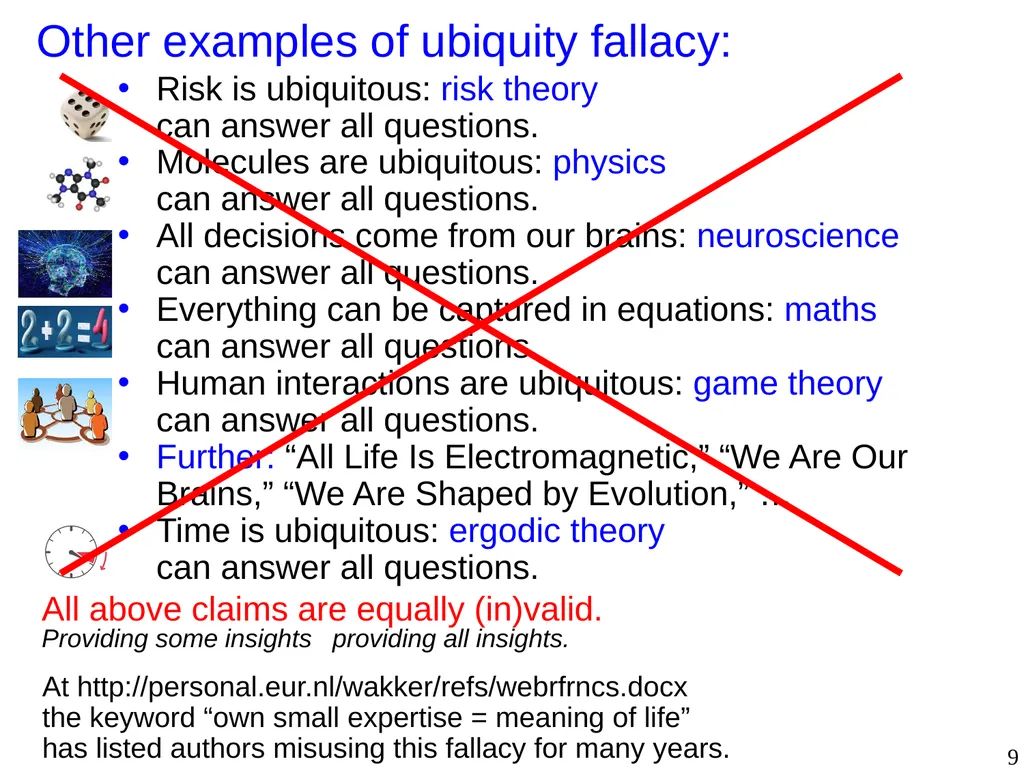
Risk is ubiquitous: risk theory
can answer all questions.
Molecules are ubiquitous: physics can answer all questions.
All decisions come from our brains: neuroscience can answer all questions.
Everything can be captured in equations: maths can answer all questions.
Human interactions are ubiquitous: game theory can answer all questions.
Further: “All Life Is Electromagnetic,” “We Are Our Brains,” “We Are Shaped by Evolution,” …
Time is ubiquitous: ergodic theory can answer all questions. At http://personal.eur.nl/wakker/refs/webrfrncs.docx the keyword “own small expertise = meaning of life” has listed authors misusing this fallacy for many years. All above claims are equally (in)valid.
Providing some insights providing all insights. Other examples of ubiquity fallacy: 9<br>
Molecules are ubiquitous: physics can answer all questions.
All decisions come from our brains: neuroscience can answer all questions.
Everything can be captured in equations: maths can answer all questions.
Human interactions are ubiquitous: game theory can answer all questions.
Further: “All Life Is Electromagnetic,” “We Are Our Brains,” “We Are Shaped by Evolution,” …
Time is ubiquitous: ergodic theory can answer all questions. At http://personal.eur.nl/wakker/refs/webrfrncs.docx the keyword “own small expertise = meaning of life” has listed authors misusing this fallacy for many years. All above claims are equally (in)valid.
Providing some insights providing all insights. Other examples of ubiquity fallacy: 9<br>
10
10<br>
11
Then wrongly thinks that 6 DMs must exist in some concrete physical sense4enco (as in UK example).
Mysterious EEE-ban on average-calculation for above puppet. Then wrongly criticizes EU for implicit ergodicity.3euer EEE: “EU is an average!!!??? Accept or reject? So, either or - Sometimes EEE wrongly assumes (1)2avti. But, EU is by (2), not by (1)! - Other times, EEE correctly assumes (2). Calculate (1) over time, (2) over ensemble.” 11<br>
Mysterious EEE-ban on average-calculation for above puppet. Then wrongly criticizes EU for implicit ergodicity.3euer EEE: “EU is an average!!!??? Accept or reject? So, either or - Sometimes EEE wrongly assumes (1)2avti. But, EU is by (2), not by (1)! - Other times, EEE correctly assumes (2). Calculate (1) over time, (2) over ensemble.” 11<br>
12
justify EU by preference axiomatizations
(von Neumann-Morgenstern ’47) & data fitting/predicting (Starmer ’00).
Also, many criticize EU!
All of this is ignored by EEE. We did calculate averages (EU) there.
We violated the EEE ban!?!?
I & 100s of colleagues in medical decision making in trouble.
EEE does not propose alternative calculations that would be allowed.
Confusing … Economists I worked 8 years in hospital (career award 2007 Medical Decision Making Society).
Many cases were individual & static (e.g., chronic health states). 12<br>
Also, many criticize EU!
All of this is ignored by EEE. We did calculate averages (EU) there.
We violated the EEE ban!?!?
I & 100s of colleagues in medical decision making in trouble.
EEE does not propose alternative calculations that would be allowed.
Confusing … Economists I worked 8 years in hospital (career award 2007 Medical Decision Making Society).
Many cases were individual & static (e.g., chronic health states). 12<br>
13
13<br>
14
EEE: “that provides new
insights” EEE:
“we found a problem
in EU” EEE:
“such insights refute
all of economics”5alec Many problems in EU are known! Economics is way broader!
Refuting one economic theory refuting all. 14<br>
Refuting one economic theory refuting all. 14<br>
15
15<br>
16
Further criticisms of EEE
EEE finds (useful!) isomorphisms with other fields
(technique not new: Keeney & Raiffa 1976 Ch. 9; Wakker 2010 Appendix D).
EEE: “Makes other fields redundant.”6isre
Providing some insights providing all.
In temporal growth, growth factor often not proper index7grfa:
Doctor, Wakker, & Wang (2020 Example 1) 16 Exponential growth bias (Levy & Tasoff 2020; Stango & Zinman 2009)<br>
EEE finds (useful!) isomorphisms with other fields
(technique not new: Keeney & Raiffa 1976 Ch. 9; Wakker 2010 Appendix D).
EEE: “Makes other fields redundant.”6isre
Providing some insights providing all.
In temporal growth, growth factor often not proper index7grfa:
Doctor, Wakker, & Wang (2020 Example 1) 16 Exponential growth bias (Levy & Tasoff 2020; Stango & Zinman 2009)<br>
17
17<br>
18
I repeat here the superscripts indicating my criticisms of EEE.
1ubfa: Ubiquity fallacy regarding time
2avti: EU is average over time
3euer: EU assumes ergodicity
4enco: All ensemble members must exist in some concrete physical sense
5alec: all of economics is invalidated
6isre: isomorphisms make other fields entirely redundant
7grfa: in intertemporal, growth factor should be maximized
8th criticism concerns an absence: absence of any mention of the arguments that economists provide to justify—and criticize—EU (preference axiomatizations and empirical performance). Similar for dynamic optimization.
On next slides follow citations from Peters (2019) and Peters & Gell-Mann (2016), with superscripts added to indicate my criticisms. (Superscripts for literature references in original have been dropped.) 18<br>
1ubfa: Ubiquity fallacy regarding time
2avti: EU is average over time
3euer: EU assumes ergodicity
4enco: All ensemble members must exist in some concrete physical sense
5alec: all of economics is invalidated
6isre: isomorphisms make other fields entirely redundant
7grfa: in intertemporal, growth factor should be maximized
8th criticism concerns an absence: absence of any mention of the arguments that economists provide to justify—and criticize—EU (preference axiomatizations and empirical performance). Similar for dynamic optimization.
On next slides follow citations from Peters (2019) and Peters & Gell-Mann (2016), with superscripts added to indicate my criticisms. (Superscripts for literature references in original have been dropped.) 18<br>
19
My criticisms of Peters (2019 Nature Physics)
Abstract: “It may therefore come as a surprise to learn that the prevailing formulations of economic theory5alec — expected utility theory and its descendants — make an indiscriminate assumption of ergodicity. 3euer”
P. 1216: “And it turns out a surprising reframing of economic theory5alec follows directly from asking the core ergodicity question1ubfa: … At a crucial place in the foundations of economics5alec, it is assumed that the answer is always yes3euer — a pernicious error”
P. 1216: “I stumbled on this error about a decade ago … If we pay close attention to the ergodicity problem1ubfa, natural solutions emerge. We therefore have reason to be optimistic about the future of economic theory5alec”
Pp. 1216-2017: “Placing considerations of time and ergodicity centre stage1ubfa, we will arrive at a clear interpretation both of discounting and of utility theory, without appealing to subjective psychology or indeed other forms of personalization6isre”
P. 1218: “in maximizing the expectation value — an ensemble average over all possible outcomes of the gamble — expected utility theory implicitly assumes that individuals can interact with copies of themselves4enco, effectively in parallel universes (the other members of the ensemble). An expectation value of a non-ergodic observable physically corresponds to pooling and sharing among many entities.4enco That may reflect what happens in a specially designed large collective, but it doesn’t reflect the situation of an individual decision-maker.4enco” Expected utility theory computes what happens to a loosely specified model of my psychology averaged across a multiverse. But I do not live spread out across a multiverse, let alone harvest the average psychological consequences of the actions of my multiverse clones.4enco”
P. 1218: “the equations that appear in the two frameworks can be very similar. … conceptually the two approaches couldn’t be more different.6isre”
P. 2018: “Perhaps people aren’t so different, but their circumstances are.6isre”
P. 2019: “For that to make any sense in the context of individuals making financial decisions, an ergodic observable had to be created. Expected utility theory — unknowingly, because ergodicity hadn’t been invented — did just that3euer But because of the lack of conceptual clarity, the entire field of economics5alec drifted in a direction that places too much emphasis on psychology.6isre”
P. 1220: “One has to relabel and rearrange some terms in the relevant equation, but eventually the ergodic growth rate is recovered as the fundamental concept that explains the phenomenon6isre; 7grfa. The same is true for expected utility theory.6isre; 7grfa”
P. 1220: “economics is firmly stuck in the wrong conceptual space ... it is also uplifting and scientifically exciting because of the many opportunities that have just opened up.5alec”
P. 1220: “Nor do we have to assume huge individual differences in psychology or skill to explain the huge observed differences in wealth: a trivial null model — though one that doesn’t blindly assume ergodicity — predicts the robust features of the wealth distribution6isre; 7grfa. A well-known measure of inequality turned out to be the time-integrated difference between ensemble and time-average growth rates in geometric Brownian motion.6isre”
P 1221: “We have reason to hope for a future economic science that is more parsimonious, conceptually clearer and less subjective. It will resemble reality more closely and be better aligned with our moral intuitions.5alec” 19<br>
Abstract: “It may therefore come as a surprise to learn that the prevailing formulations of economic theory5alec — expected utility theory and its descendants — make an indiscriminate assumption of ergodicity. 3euer”
P. 1216: “And it turns out a surprising reframing of economic theory5alec follows directly from asking the core ergodicity question1ubfa: … At a crucial place in the foundations of economics5alec, it is assumed that the answer is always yes3euer — a pernicious error”
P. 1216: “I stumbled on this error about a decade ago … If we pay close attention to the ergodicity problem1ubfa, natural solutions emerge. We therefore have reason to be optimistic about the future of economic theory5alec”
Pp. 1216-2017: “Placing considerations of time and ergodicity centre stage1ubfa, we will arrive at a clear interpretation both of discounting and of utility theory, without appealing to subjective psychology or indeed other forms of personalization6isre”
P. 1218: “in maximizing the expectation value — an ensemble average over all possible outcomes of the gamble — expected utility theory implicitly assumes that individuals can interact with copies of themselves4enco, effectively in parallel universes (the other members of the ensemble). An expectation value of a non-ergodic observable physically corresponds to pooling and sharing among many entities.4enco That may reflect what happens in a specially designed large collective, but it doesn’t reflect the situation of an individual decision-maker.4enco” Expected utility theory computes what happens to a loosely specified model of my psychology averaged across a multiverse. But I do not live spread out across a multiverse, let alone harvest the average psychological consequences of the actions of my multiverse clones.4enco”
P. 1218: “the equations that appear in the two frameworks can be very similar. … conceptually the two approaches couldn’t be more different.6isre”
P. 2018: “Perhaps people aren’t so different, but their circumstances are.6isre”
P. 2019: “For that to make any sense in the context of individuals making financial decisions, an ergodic observable had to be created. Expected utility theory — unknowingly, because ergodicity hadn’t been invented — did just that3euer But because of the lack of conceptual clarity, the entire field of economics5alec drifted in a direction that places too much emphasis on psychology.6isre”
P. 1220: “One has to relabel and rearrange some terms in the relevant equation, but eventually the ergodic growth rate is recovered as the fundamental concept that explains the phenomenon6isre; 7grfa. The same is true for expected utility theory.6isre; 7grfa”
P. 1220: “economics is firmly stuck in the wrong conceptual space ... it is also uplifting and scientifically exciting because of the many opportunities that have just opened up.5alec”
P. 1220: “Nor do we have to assume huge individual differences in psychology or skill to explain the huge observed differences in wealth: a trivial null model — though one that doesn’t blindly assume ergodicity — predicts the robust features of the wealth distribution6isre; 7grfa. A well-known measure of inequality turned out to be the time-integrated difference between ensemble and time-average growth rates in geometric Brownian motion.6isre”
P 1221: “We have reason to hope for a future economic science that is more parsimonious, conceptually clearer and less subjective. It will resemble reality more closely and be better aligned with our moral intuitions.5alec” 19<br>
20
20<br>
21
References
Barro, Robert J. & Xavier Sala-i-Martin (2004) “Economic Growth” (2nd ed.). McGraw-Hill, New York.
Browning, Martin & Thomas F. Crossley (2001) “The Life-Cycle Model of Consumption and Saving,” Journal of Economic Perspectives 15, 3–22.
Doctor, Jason N., Peter P. Wakker, & Tong V. Wang (2020) “Economists’ Views on the Ergodicity Problem,” Nature Physics 16, 1168 (2020). https://doi.org/10.1038/s41567-020-01106-x
Doctor, Jason N., Peter P. Wakker, & Tong V. Wang (2020) Supplementary Information on Doctor, Wakker, & Wang (2020, Nature Physics 16, 1168.
Kahneman, Daniel & Amos Tversky (1979) “Prospect Theory: An Analysis of Decision under Risk,” Econometrica 47, 263–291.
Keeney, Ralph L. & Howard Raiffa (1976) “Decisions with Multiple Objectives.” Wiley, New York (2nd edn. 1993, Cambridge University Press, Cambridge).
Levy, Matthew R. & Joshua Tasoff (2020) “Exponential‐Growth Bias in Experimental Consumption Decisions,” Economica 87, 52–80.
Peters, Ole (2019) “The Ergodicity Problem in Economics,” Nature Physics 15, 1216–1221.
Peters, Ole & Murray Gell-Mann (2016) “Evaluating Gambles Using Dynamics,” Chaos 26, https://doi.org/10.1063/1.4940236.
Savage, Leonard J. (1954) “The Foundations of Statistics.” Wiley, New York. (2nd edn. 1972, Dover Publications, New York.)
Stango, Victor & Jonathan Zinman (2009) “Exponential Growth Bias and Household Finance,” Journal of Finance 64, 2807–2849.
Starmer, Chris (2000) “Developments in Non-Expected Utility Theory: The Hunt for a Descriptive Theory of Choice under Risk,” Journal of Economic Literature 38, 332–382.
von Neumann, John & Oskar Morgenstern (1944, 1947, 1953) “Theory of Games and Economic Behavior.” Princeton University Press, Princeton NJ.
Wakker, Peter P. (2010) “Prospect Theory: For Risk and Ambiguity.” Cambridge University Press, Cambridge, UK.
Wakker, Peter .P. (2020) Annotated Bibliography. http://personal.eur.nl/wakker/refs/webrfrncs.docx (updated yearly March 16).
Wakker, Peter P. (2021), this powerpoint file: http://personal.eur.nl/wakker/lectures/wakker.erg.econ18jan2021.pptx 21<br>
Barro, Robert J. & Xavier Sala-i-Martin (2004) “Economic Growth” (2nd ed.). McGraw-Hill, New York.
Browning, Martin & Thomas F. Crossley (2001) “The Life-Cycle Model of Consumption and Saving,” Journal of Economic Perspectives 15, 3–22.
Doctor, Jason N., Peter P. Wakker, & Tong V. Wang (2020) “Economists’ Views on the Ergodicity Problem,” Nature Physics 16, 1168 (2020). https://doi.org/10.1038/s41567-020-01106-x
Doctor, Jason N., Peter P. Wakker, & Tong V. Wang (2020) Supplementary Information on Doctor, Wakker, & Wang (2020, Nature Physics 16, 1168.
Kahneman, Daniel & Amos Tversky (1979) “Prospect Theory: An Analysis of Decision under Risk,” Econometrica 47, 263–291.
Keeney, Ralph L. & Howard Raiffa (1976) “Decisions with Multiple Objectives.” Wiley, New York (2nd edn. 1993, Cambridge University Press, Cambridge).
Levy, Matthew R. & Joshua Tasoff (2020) “Exponential‐Growth Bias in Experimental Consumption Decisions,” Economica 87, 52–80.
Peters, Ole (2019) “The Ergodicity Problem in Economics,” Nature Physics 15, 1216–1221.
Peters, Ole & Murray Gell-Mann (2016) “Evaluating Gambles Using Dynamics,” Chaos 26, https://doi.org/10.1063/1.4940236.
Savage, Leonard J. (1954) “The Foundations of Statistics.” Wiley, New York. (2nd edn. 1972, Dover Publications, New York.)
Stango, Victor & Jonathan Zinman (2009) “Exponential Growth Bias and Household Finance,” Journal of Finance 64, 2807–2849.
Starmer, Chris (2000) “Developments in Non-Expected Utility Theory: The Hunt for a Descriptive Theory of Choice under Risk,” Journal of Economic Literature 38, 332–382.
von Neumann, John & Oskar Morgenstern (1944, 1947, 1953) “Theory of Games and Economic Behavior.” Princeton University Press, Princeton NJ.
Wakker, Peter P. (2010) “Prospect Theory: For Risk and Ambiguity.” Cambridge University Press, Cambridge, UK.
Wakker, Peter .P. (2020) Annotated Bibliography. http://personal.eur.nl/wakker/refs/webrfrncs.docx (updated yearly March 16).
Wakker, Peter P. (2021), this powerpoint file: http://personal.eur.nl/wakker/lectures/wakker.erg.econ18jan2021.pptx 21<br>
22
22<br>
23
EEE in prominent physics journal:
does not signal any problem in economics.
Does signal a problem in physics:
Some physicists are naïve & haughty. 23<br>
does not signal any problem in economics.
Does signal a problem in physics:
Some physicists are naïve & haughty. 23<br>
24
24<br>