
This material was produced under grant number
Description: This material was produced under grant number SH20844SH0 from the Occupational Safety and Health Administration, U.S. Department of Labor. It does not necessarily reflect the views or policies of the U.S. Department of Labor, nor does
Related Topics
Download Presentation
"This material was produced under grant number" is the property of its rightful owner. Permission is granted to download and print the materials on this website for personal, non-commercial use only, and to display it on your personal computer provided you do not modify the materials and that you retain all copyright notices contained in the materials. By downloading content from our website, you accept the terms of this agreement.
Presentation Transcript
slide1. This material was produced under grant number SH20844SH0 from the Occupational Safety and Health Administration, U.S. Department of Labor. It does not necessarily reflect the views or policies of the U.S. Department of Labor, nor does mention of trade names, commercial products, or organizations imply endorsement by the U.S. Government. Process Safety Management
Train-the-Trainer<br>
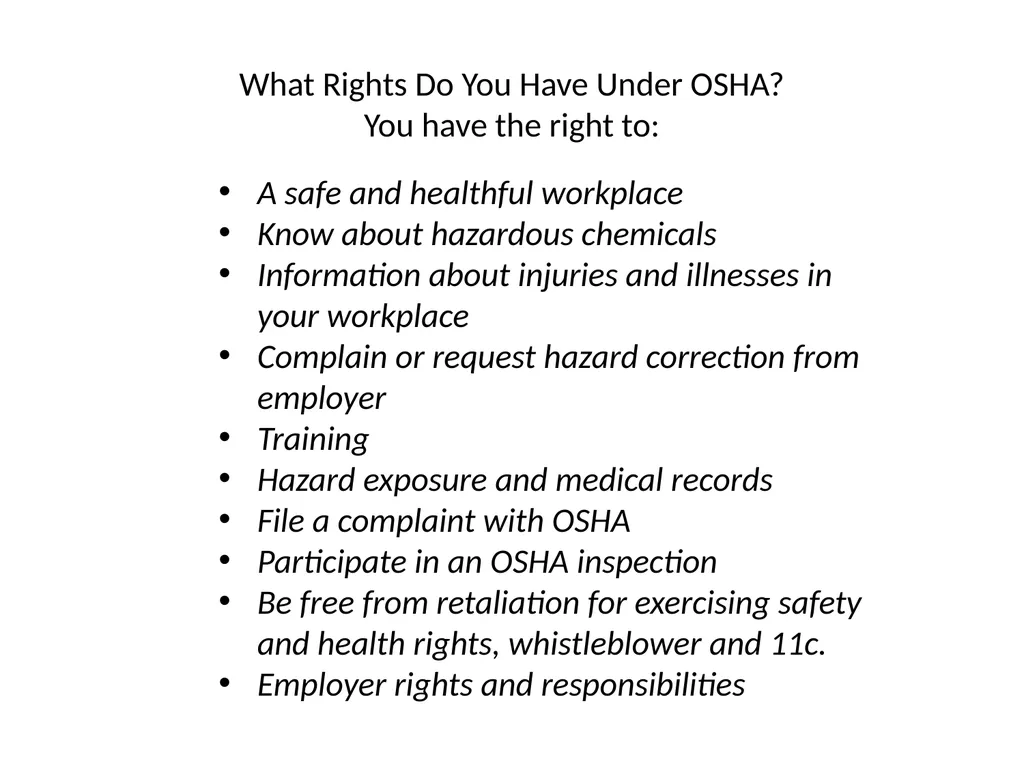
slide2. A safe and healthful workplace
Know about hazardous chemicals
Information about injuries and illnesses in your workplace
Complain or request hazard correction from employer
Training
Hazard exposure and medical records
File a complaint with OSHA
Participate in an OSHA inspection
Be free from retaliation for exercising safety and health rights, whistleblower and 11c.
Employer rights and responsibilities What Rights Do You Have Under OSHA? You have the right to:<br>
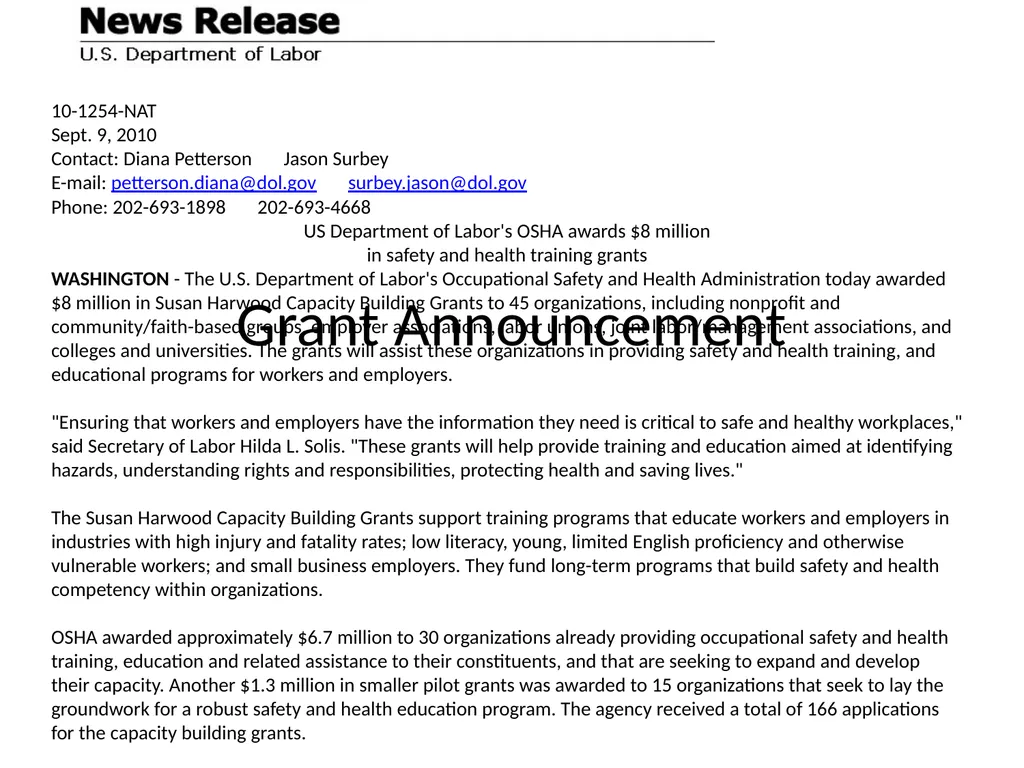
slide3. Grant Announcement 10-1254-NAT Sept. 9, 2010 Contact: Diana Petterson Jason Surbey E-mail: petterson.diana@dol.gov surbey.jason@dol.gov Phone: 202-693-1898 202-693-4668
US Department of Labor's OSHA awards $8 million in safety and health training grants
WASHINGTON - The U.S. Department of Labor's Occupational Safety and Health Administration today awarded $8 million in Susan Harwood Capacity Building Grants to 45 organizations, including nonprofit and community/faith-based groups, employer associations, labor unions, joint labor/management associations, and colleges and universities. The grants will assist these organizations in providing safety and health training, and educational programs for workers and employers. "Ensuring that workers and employers have the information they need is critical to safe and healthy workplaces," said Secretary of Labor Hilda L. Solis. "These grants will help provide training and education aimed at identifying hazards, understanding rights and responsibilities, protecting health and saving lives." The Susan Harwood Capacity Building Grants support training programs that educate workers and employers in industries with high injury and fatality rates; low literacy, young, limited English proficiency and otherwise vulnerable workers; and small business employers. They fund long-term programs that build safety and health competency within organizations. OSHA awarded approximately $6.7 million to 30 organizations already providing occupational safety and health training, education and related assistance to their constituents, and that are seeking to expand and develop their capacity. Another $1.3 million in smaller pilot grants was awarded to 15 organizations that seek to lay the groundwork for a robust safety and health education program. The agency received a total of 166 applications for the capacity building grants.<br>
slide4. Purpose This section contains requirements for preventing or minimizing the consequences of catastrophic releases of toxic, reactive, flammable, or explosive chemicals. These releases may result in toxic, fire or explosion hazards.<br>
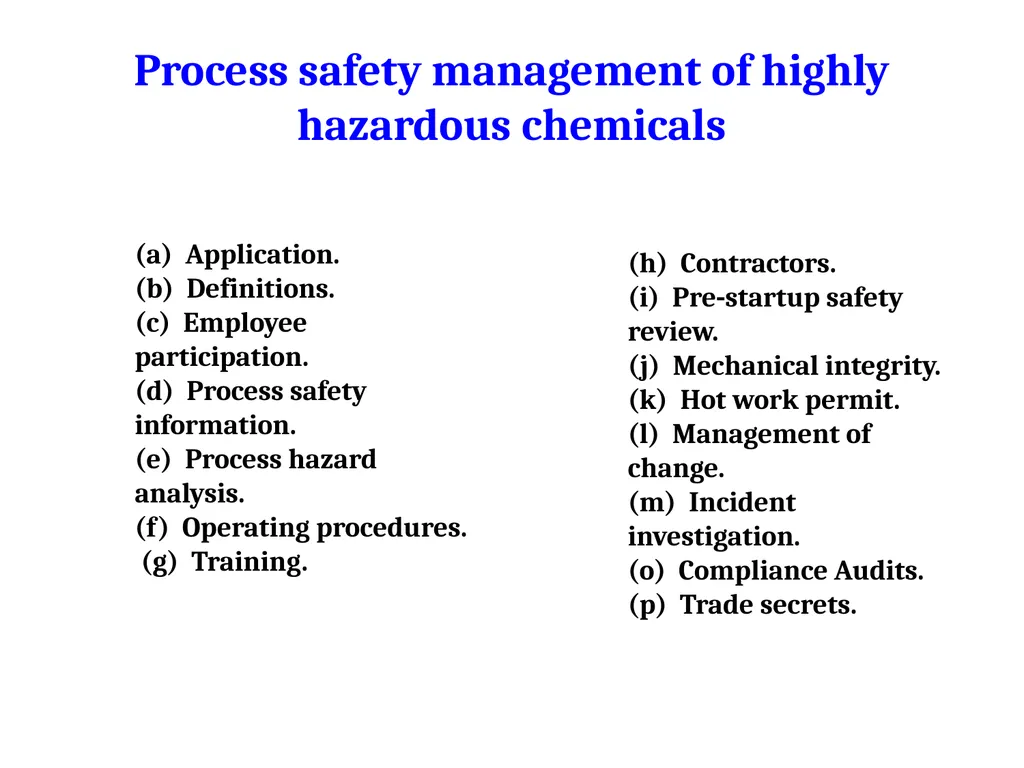
slide5. Process safety management of highly hazardous chemicals (a) Application.
(b) Definitions.
(c) Employee participation.
(d) Process safety information.
(e) Process hazard analysis.
(f) Operating procedures.
(g) Training. (h) Contractors.
(i) Pre‑startup safety review.
(j) Mechanical integrity.
(k) Hot work permit.
(l) Management of change.
(m) Incident investigation.
(o) Compliance Audits.
(p) Trade secrets.<br>
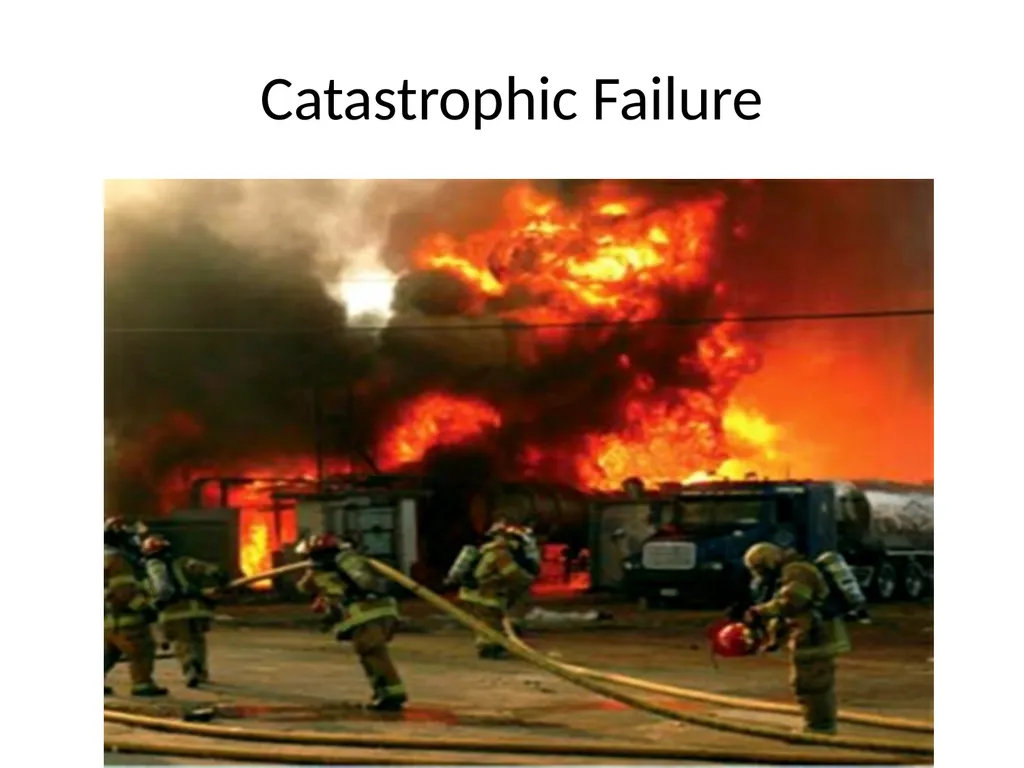
slide6. Catastrophic Failure<br>
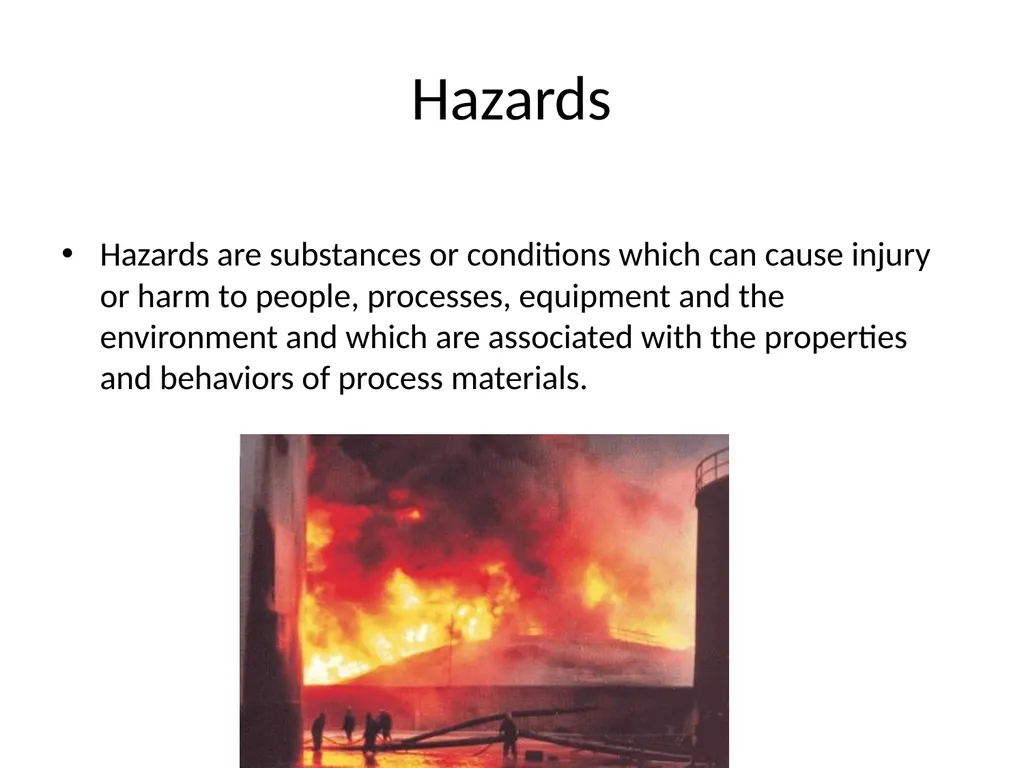
slide7. Hazards Hazards are substances or conditions which can cause injury or harm to people, processes, equipment and the environment and which are associated with the properties and behaviors of process materials.<br>
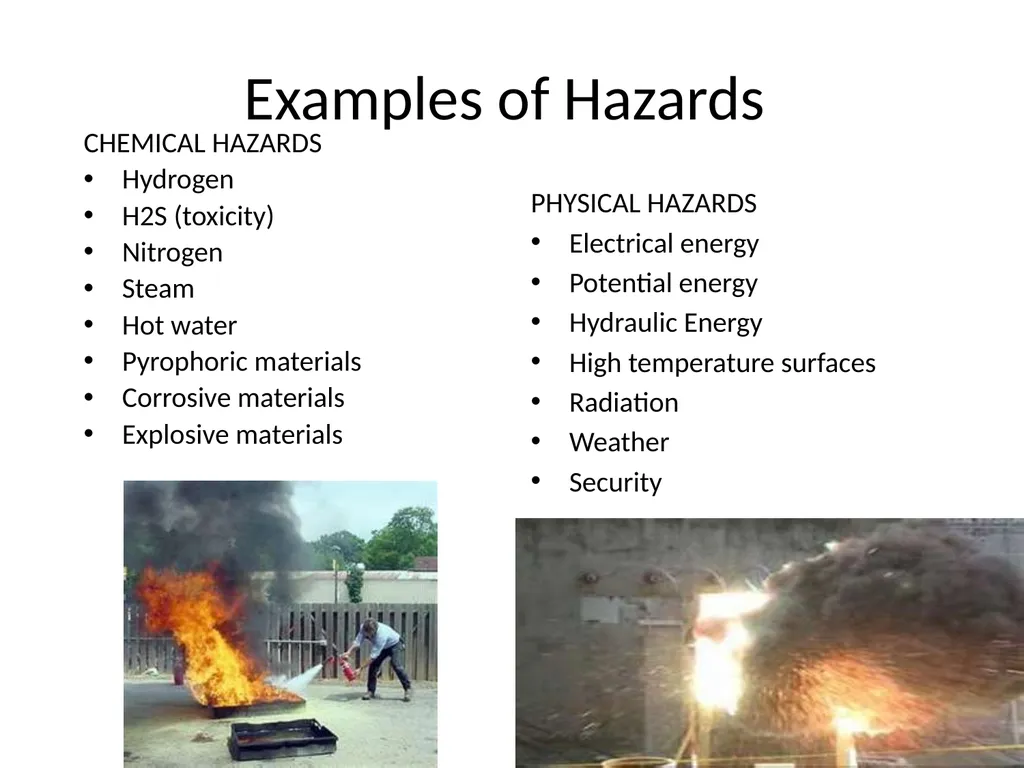
slide8. Examples of Hazards PHYSICAL HAZARDS
Electrical energy
Potential energy
Hydraulic Energy
High temperature surfaces
Radiation
Weather
Security CHEMICAL HAZARDS
Hydrogen
H2S (toxicity)
Nitrogen
Steam
Hot water
Pyrophoric materials
Corrosive materials
Explosive materials<br>
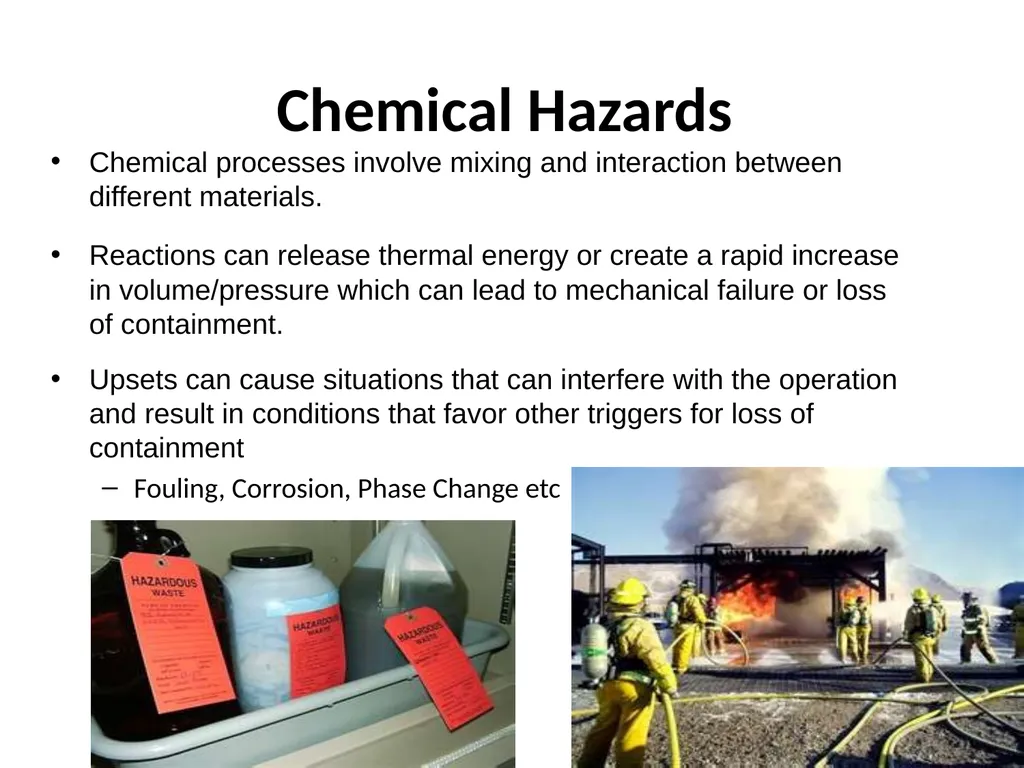
slide9. Chemical Hazards Chemical processes involve mixing and interaction between different materials.
Reactions can release thermal energy or create a rapid increase in volume/pressure which can lead to mechanical failure or loss of containment.
Upsets can cause situations that can interfere with the operation and result in conditions that favor other triggers for loss of containment
Fouling, Corrosion, Phase Change etc<br>
slide10. Definition of Process Safety Process Safety –
OSHA Definition:
“The Purpose of Process Safety is to Prevent or minimize the consequences of catastrophic releases of toxic, reactive, flammable or explosive chemicals that may result in toxic, fire or explosion hazards.”
Secondary Definition:
A set of principles and practices that deal with the integrity and operation of process plant equipment to prevent catastrophic release of highly hazardous chemicals.<br>
slide11. Did You Know? 1 kg of light hydrocarbon can:
- heat a small home for 2 hours
- heat 45 kettles of water (500 cups of coffee)
- produce enough heat to melt steel
- destroy a home or small office (explosion)
1 kg of toxic vapor can harm people several hundred meters away in 3-5 min
1 kg of toxic waste can contaminate several km of a major waterway.<br>
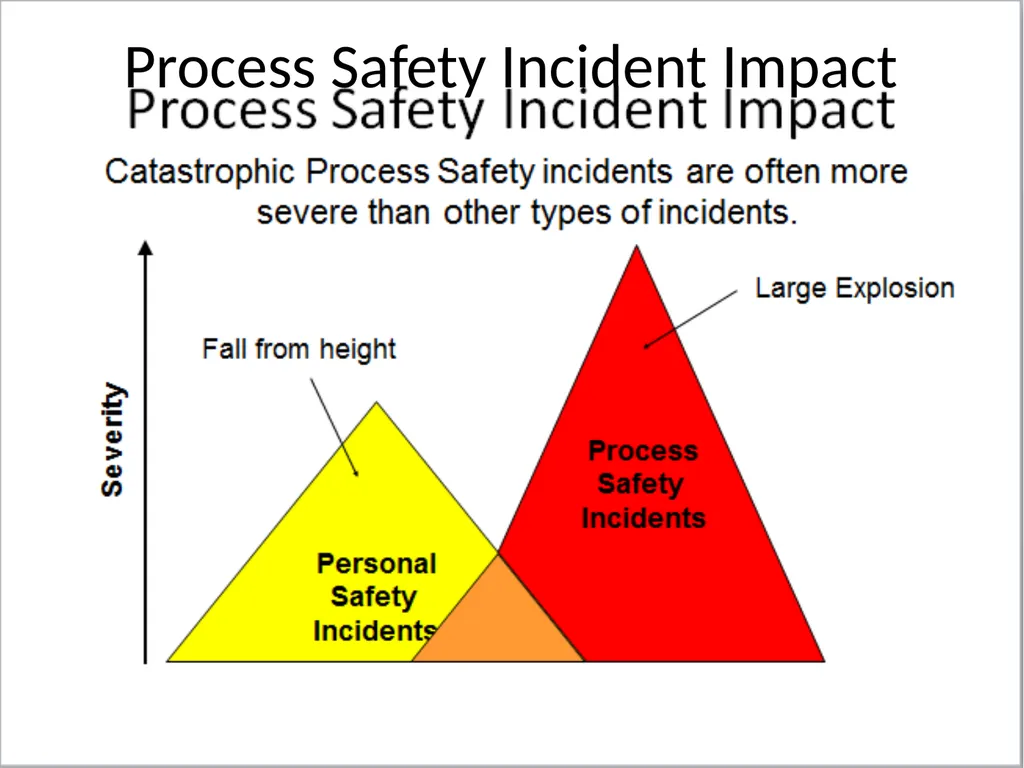
slide12. Process Safety Incident Impact<br>
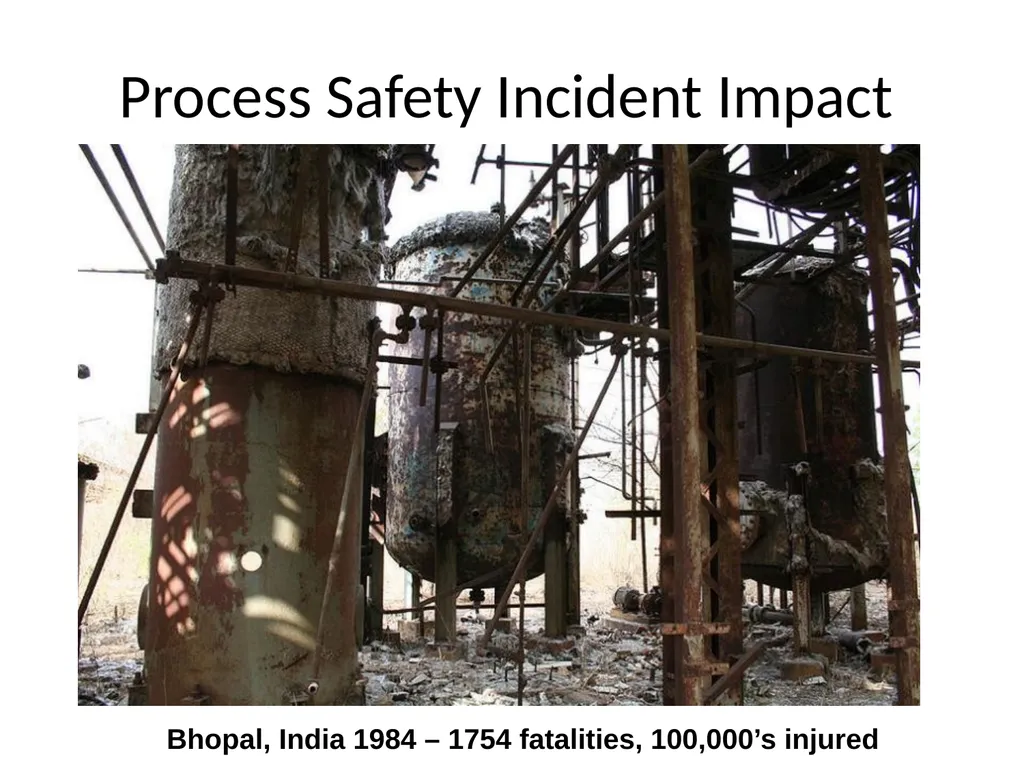
slide13. Process Safety Incident Impact Bhopal, India 1984 – 1754 fatalities, 100,000’s injured<br>
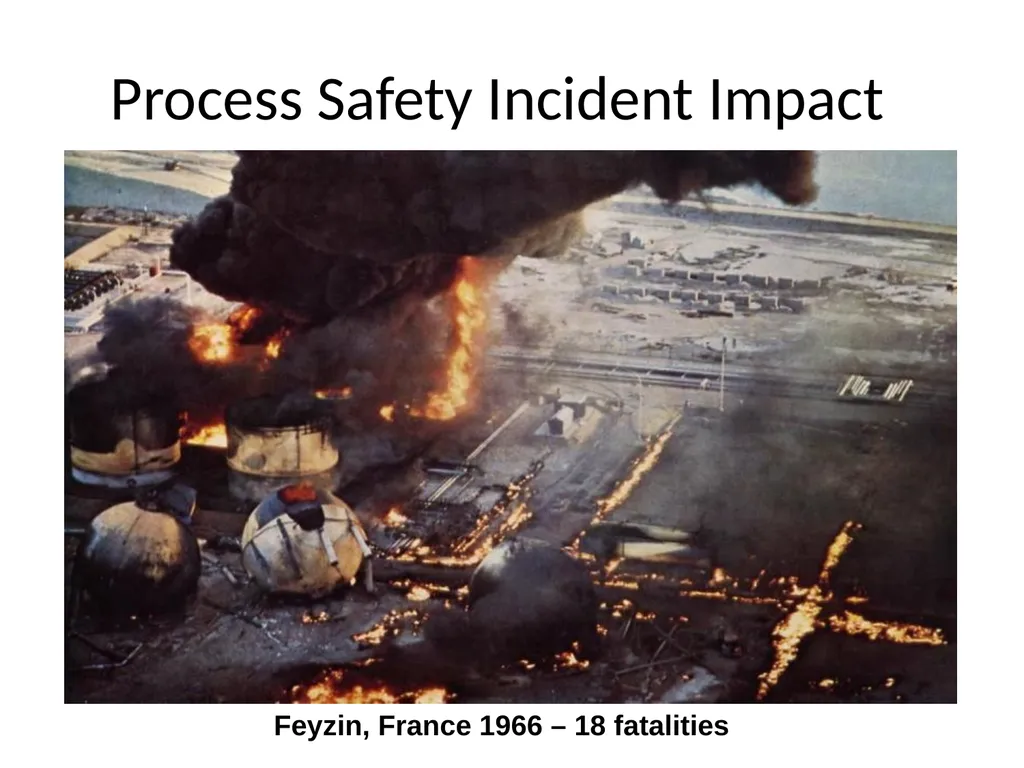
slide14. Process Safety Incident Impact Feyzin, France 1966 – 18 fatalities<br>
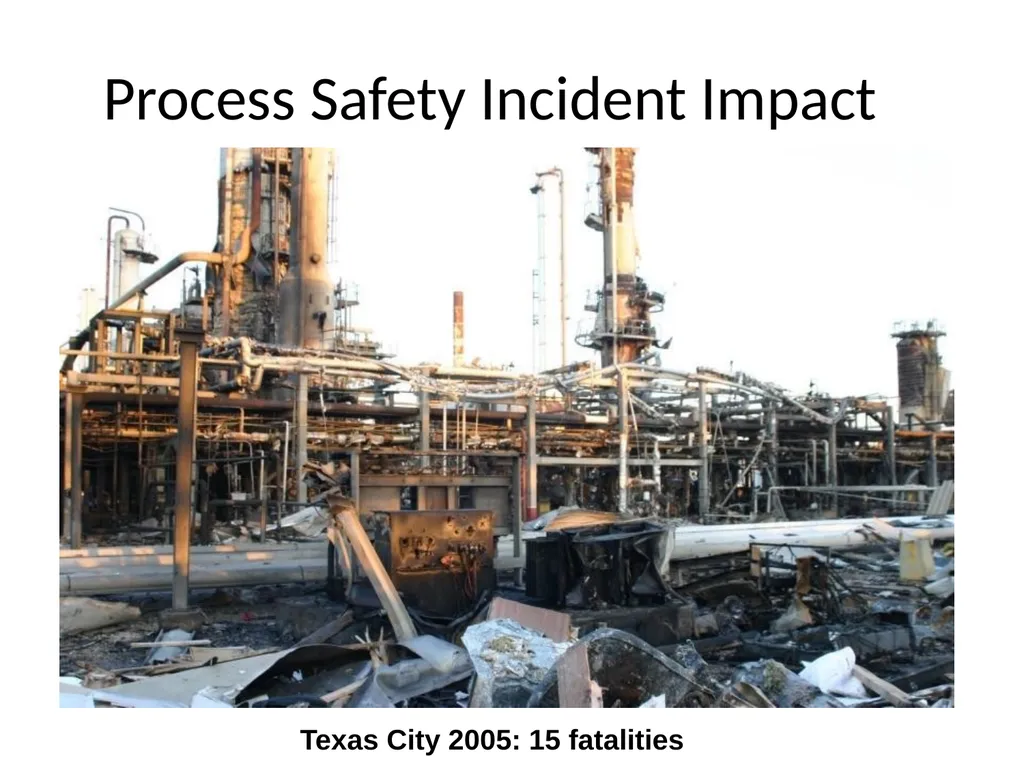
slide15. Process Safety Incident Impact Texas City 2005: 15 fatalities<br>
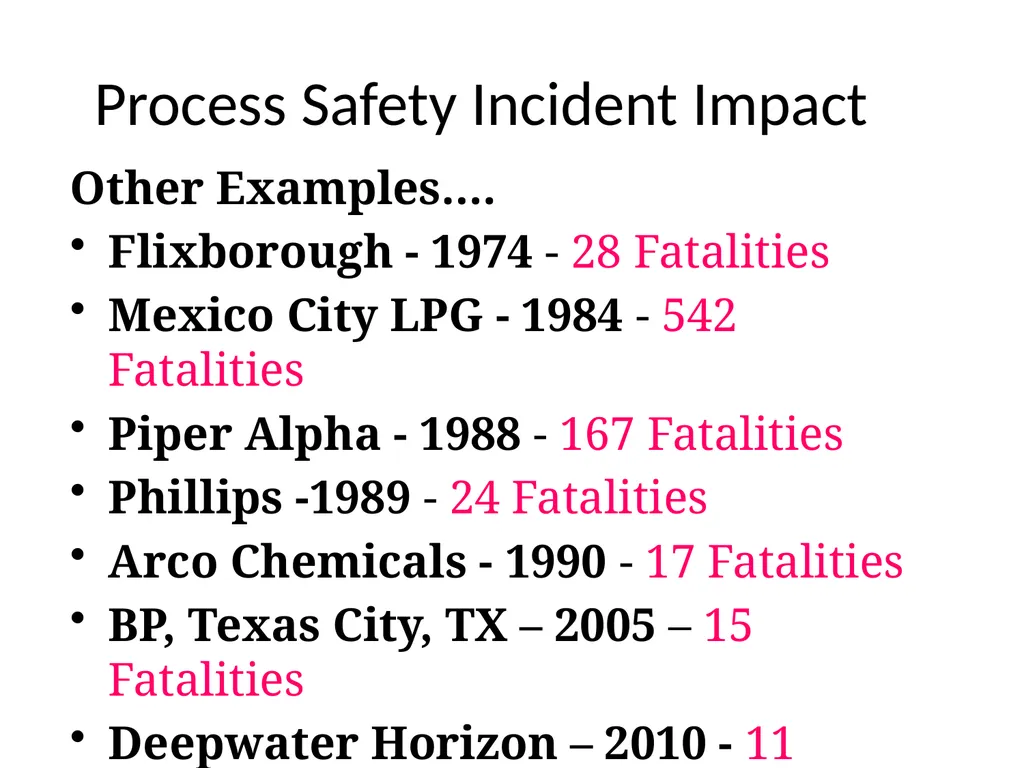
slide16. Process Safety Incident Impact Other Examples….
Flixborough - 1974 - 28 Fatalities
Mexico City LPG - 1984 - 542 Fatalities
Piper Alpha - 1988 - 167 Fatalities
Phillips -1989 - 24 Fatalities
Arco Chemicals - 1990 - 17 Fatalities
BP, Texas City, TX – 2005 – 15 Fatalities
Deepwater Horizon – 2010 - 11 Fatalities<br>
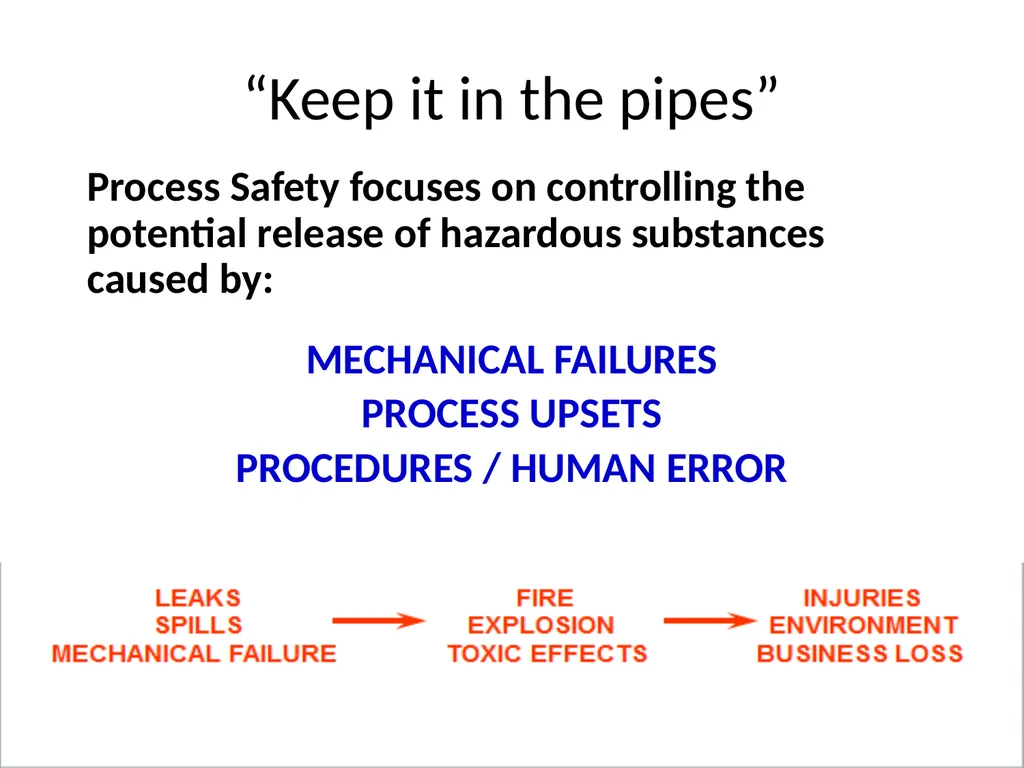
slide17. “Keep it in the pipes” Process Safety focuses on controlling the potential release of hazardous substances caused by:
MECHANICAL FAILURES
PROCESS UPSETS
PROCEDURES / HUMAN ERROR<br>
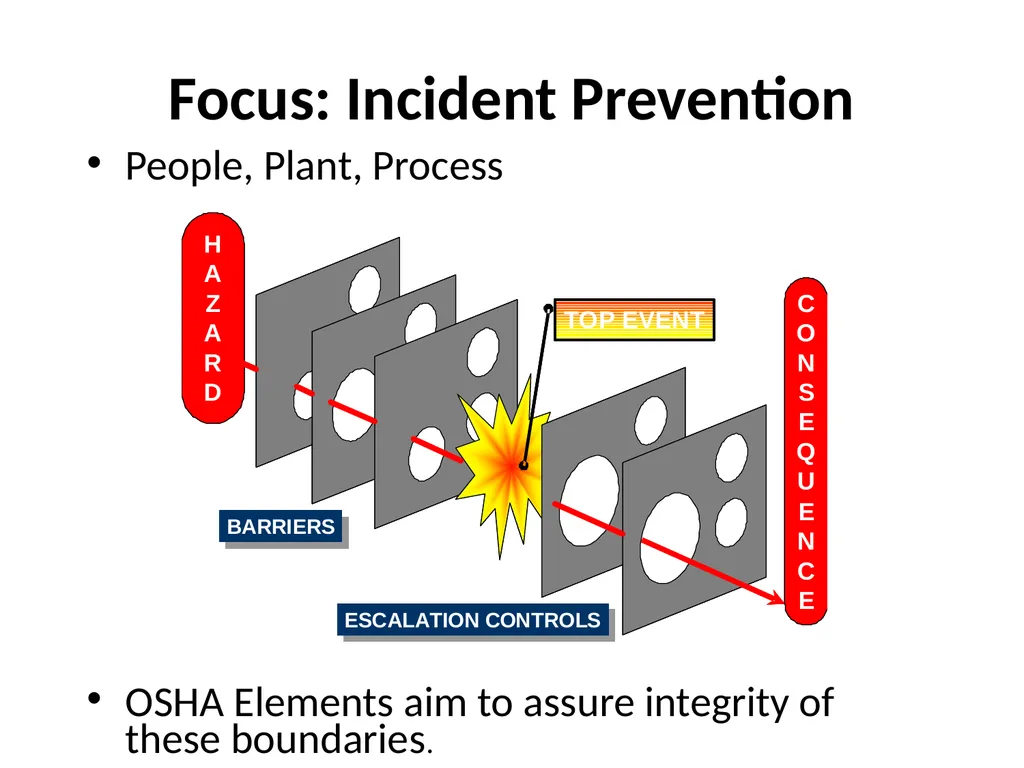
slide18. Focus: Incident Prevention People, Plant, Process
OSHA Elements aim to assure integrity of these boundaries.<br>
slide19. What is Covered Listed chemicals in Appendix A
> 10,000 pounds or 4535.6 kg of flammable liquids or gasses<br>
slide20. Process Safety Management OSHA 1910.119
Performance Based
14 Elements
List of Highly Hazardous Chemicals
Applies to Processes that Exceed the Total Quantity
Exemption for Remote, Um occupioed<br>
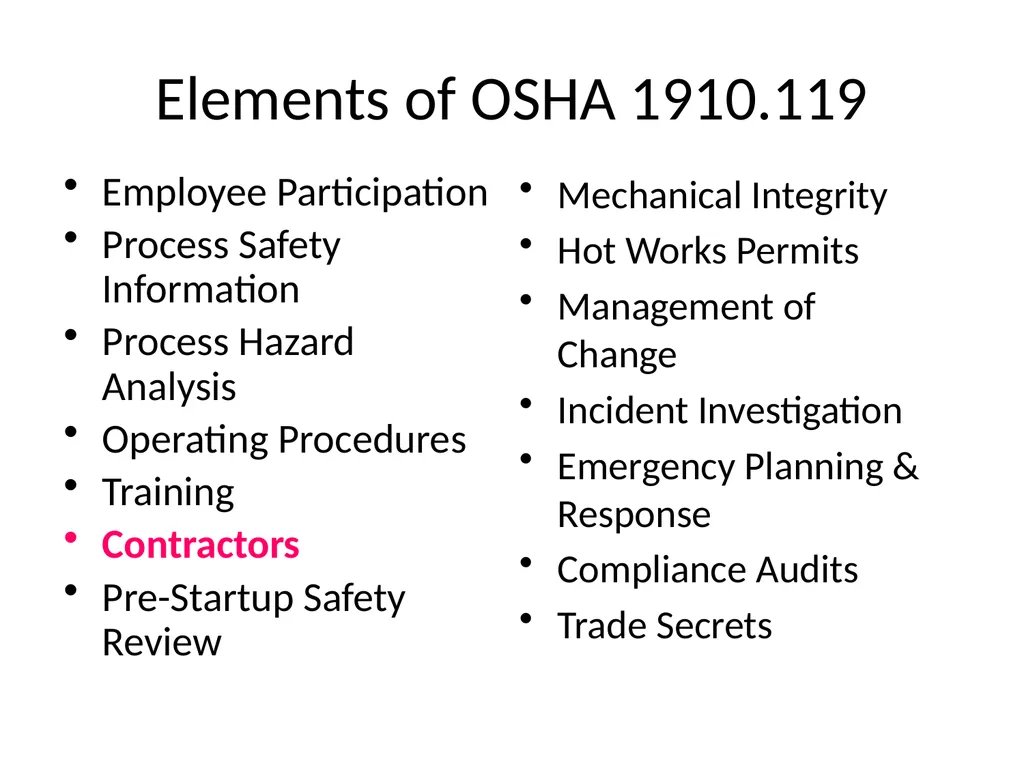
slide21. Elements of OSHA 1910.119 Employee Participation
Process Safety Information
Process Hazard Analysis
Operating Procedures
Training
Contractors
Pre-Startup Safety Review Mechanical Integrity
Hot Works Permits
Management of Change
Incident Investigation
Emergency Planning & Response
Compliance Audits
Trade Secrets<br>
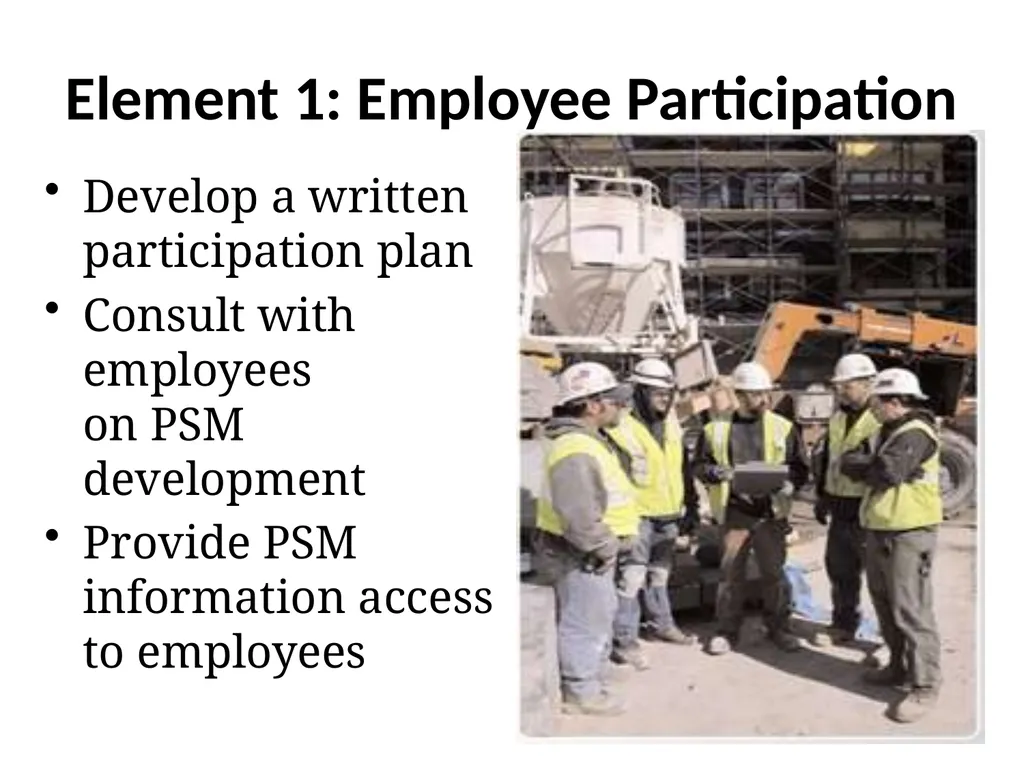
slide22. Element 1: Employee Participation Develop a written participation plan
Consult with employees on PSM development
Provide PSM information access to employees<br>
slide23. Element 2: Process Safety Information Information used by employees to identify and understand hazards of Process Equipment and Chemicals.
Must be compiled before a hazard analysis.
Includes:
MSDS’s, Process Chemistry, and Max Intended Inventory
PFD’s/P&ID’s
Safe Operating Limits
Material and energy balances
Materials of construction and design codes employed
(ie Electrical Classification, RV design, Ventilation design, safety system design)<br>
slide24. Element 3: Process Hazard Analysis Definition: Systematic way to identify potential hazards and recommend possible solutions
Techniques: HAZOP, FMEA, What-if, Checklist
Addresses: facility siting, human factors, previous incidents, control failures
Relies on: Proper team and Information (PSI)
Develops: Recommendations
Must: Revalidate every 5 years (Ensure hazards introduced by changes are sufficiently controlled)<br>
slide25. Element 4: Operating Procedures Written procedures for:
Startup/Shutdown
Normal operations
Temporary operations
Emergency operations
Must include:
Operating Limits and Deviations
Potential Hazards and Controls
(ie PPE, Safety Systems)
Certified annually<br>
slide26. Element 5: Training Must include:
Process Overview
Safety and Health Hazards
Procedures (emphasizing emergency)
Safe Work Practices
Initial training w/refresher at least every 3 years
Documented records and verification of qualification<br>
slide27. Element 6: Contractors Contractor definition:
An individual performing work on or adjacent to a covered process.
Does not apply to incidental services
Janitorial, Food and Drink, Mail, or Laundry service
Two Different sets of responsibilities:
Employer
Contract Employer<br>
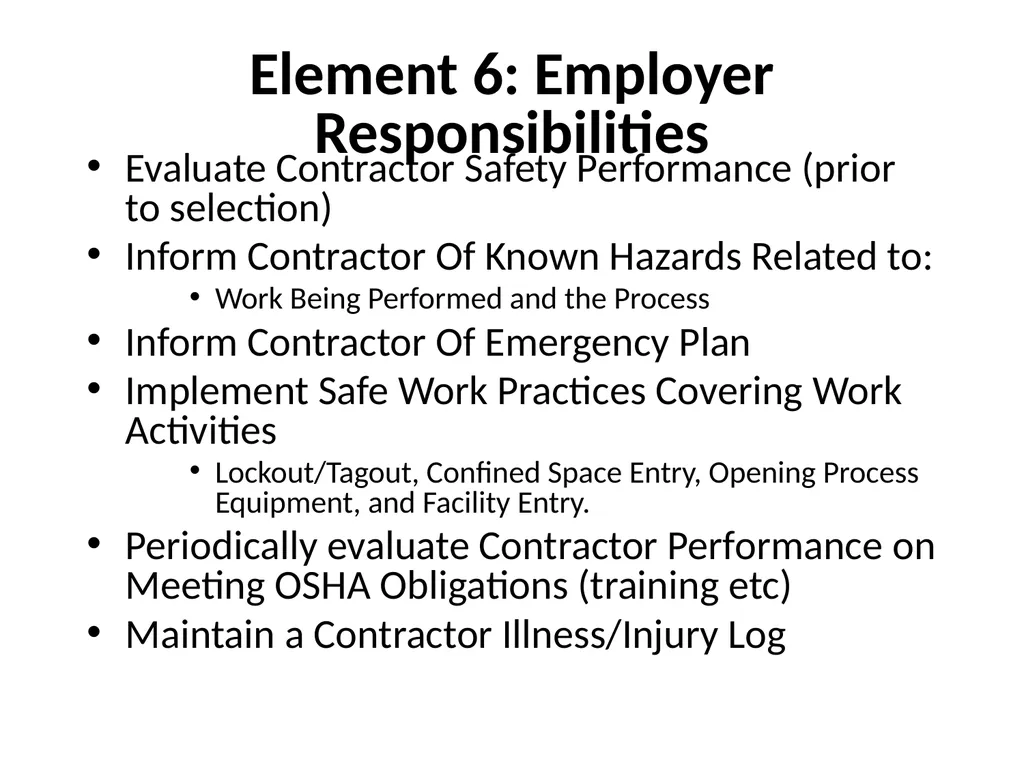
slide28. Element 6: Employer Responsibilities Evaluate Contractor Safety Performance (prior to selection)
Inform Contractor Of Known Hazards Related to:
Work Being Performed and the Process
Inform Contractor Of Emergency Plan
Implement Safe Work Practices Covering Work Activities
Lockout/Tagout, Confined Space Entry, Opening Process Equipment, and Facility Entry.
Periodically evaluate Contractor Performance on Meeting OSHA Obligations (training etc)
Maintain a Contractor Illness/Injury Log<br>
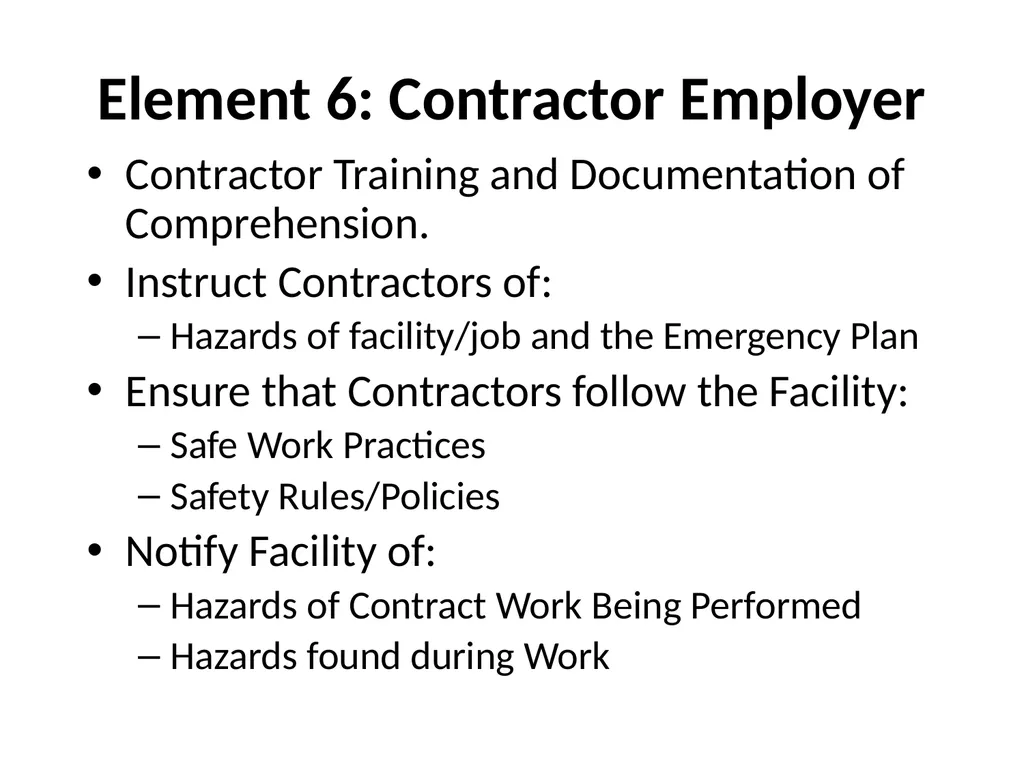
slide29. Element 6: Contractor Employer Contractor Training and Documentation of Comprehension.
Instruct Contractors of:
Hazards of facility/job and the Emergency Plan
Ensure that Contractors follow the Facility:
Safe Work Practices
Safety Rules/Policies
Notify Facility of:
Hazards of Contract Work Being Performed
Hazards found during Work<br>
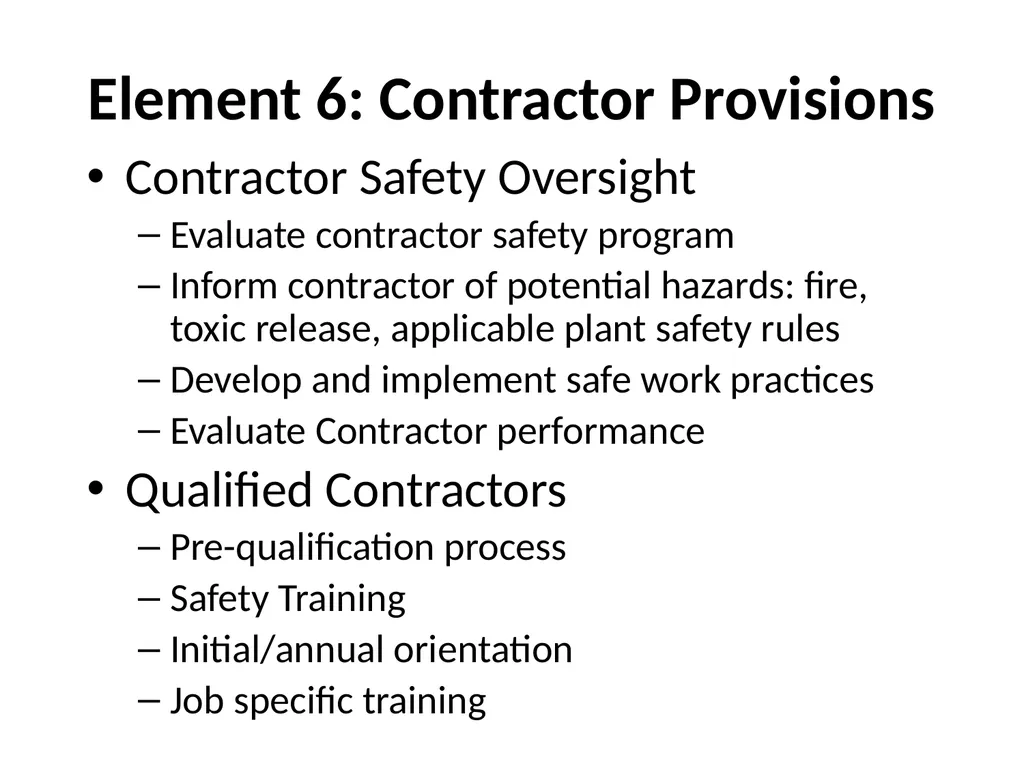
slide30. Element 6: Contractor Provisions Contractor Safety Oversight
Evaluate contractor safety program
Inform contractor of potential hazards: fire, toxic release, applicable plant safety rules
Develop and implement safe work practices
Evaluate Contractor performance
Qualified Contractors
Pre-qualification process
Safety Training
Initial/annual orientation
Job specific training<br>
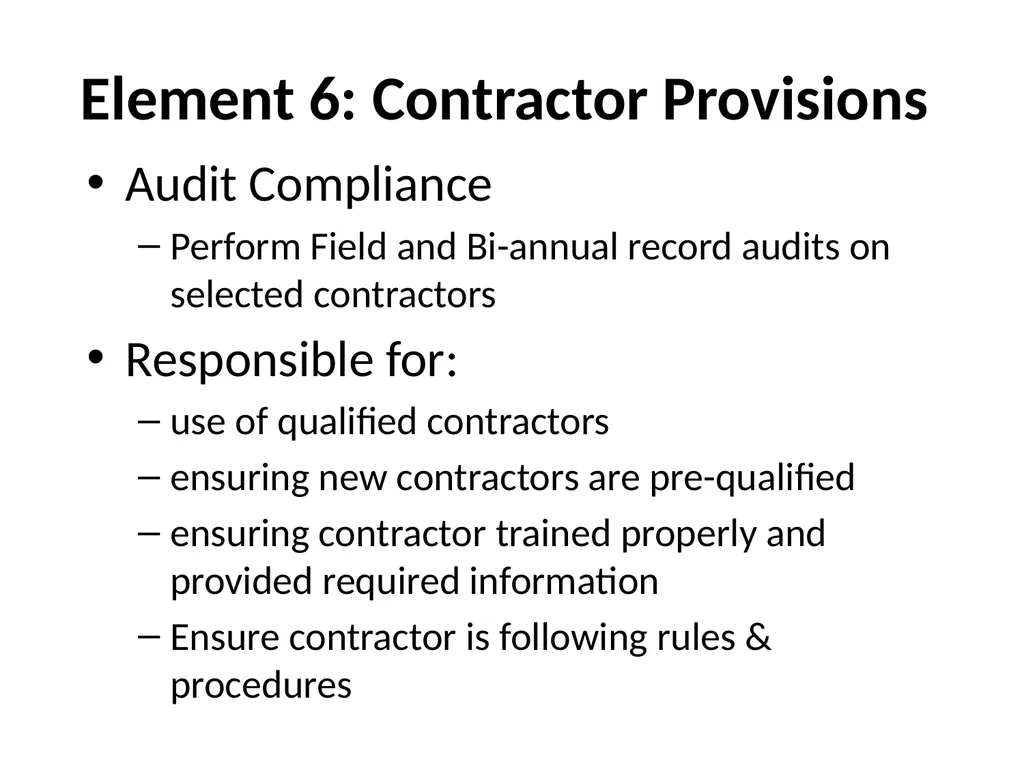
slide31. Element 6: Contractor Provisions Audit Compliance
Perform Field and Bi-annual record audits on selected contractors
Responsible for:
use of qualified contractors
ensuring new contractors are pre-qualified
ensuring contractor trained properly and provided required information
Ensure contractor is following rules & procedures<br>
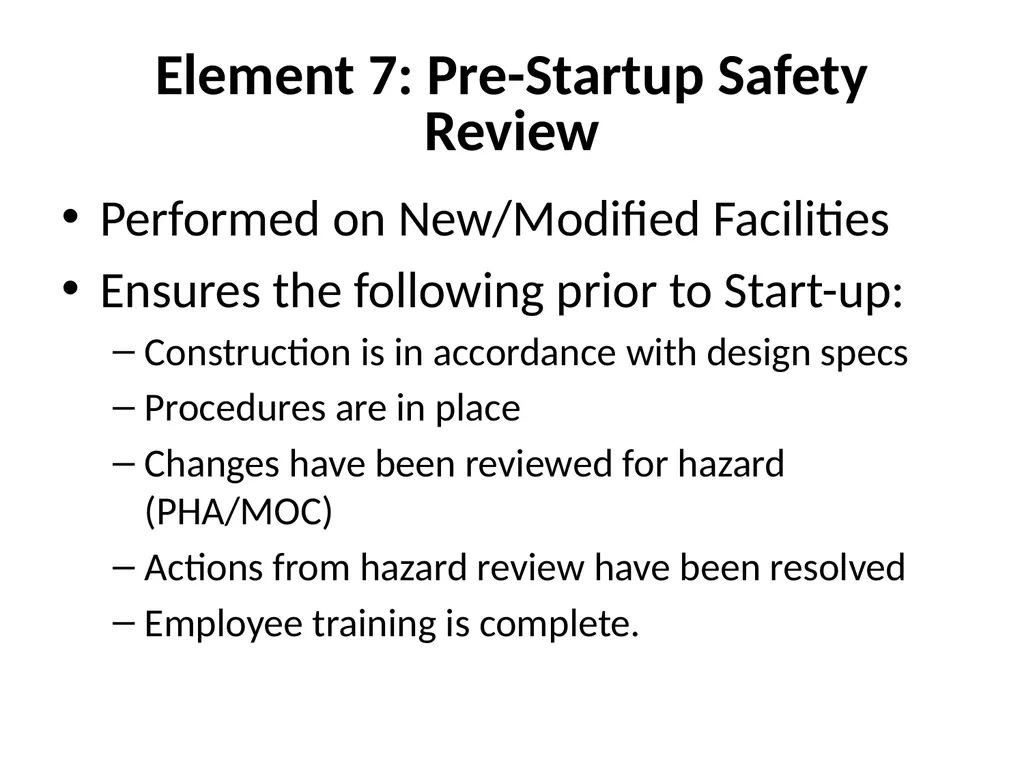
slide32. Element 7: Pre-Startup Safety Review Performed on New/Modified Facilities
Ensures the following prior to Start-up:
Construction is in accordance with design specs
Procedures are in place
Changes have been reviewed for hazard (PHA/MOC)
Actions from hazard review have been resolved
Employee training is complete.<br>
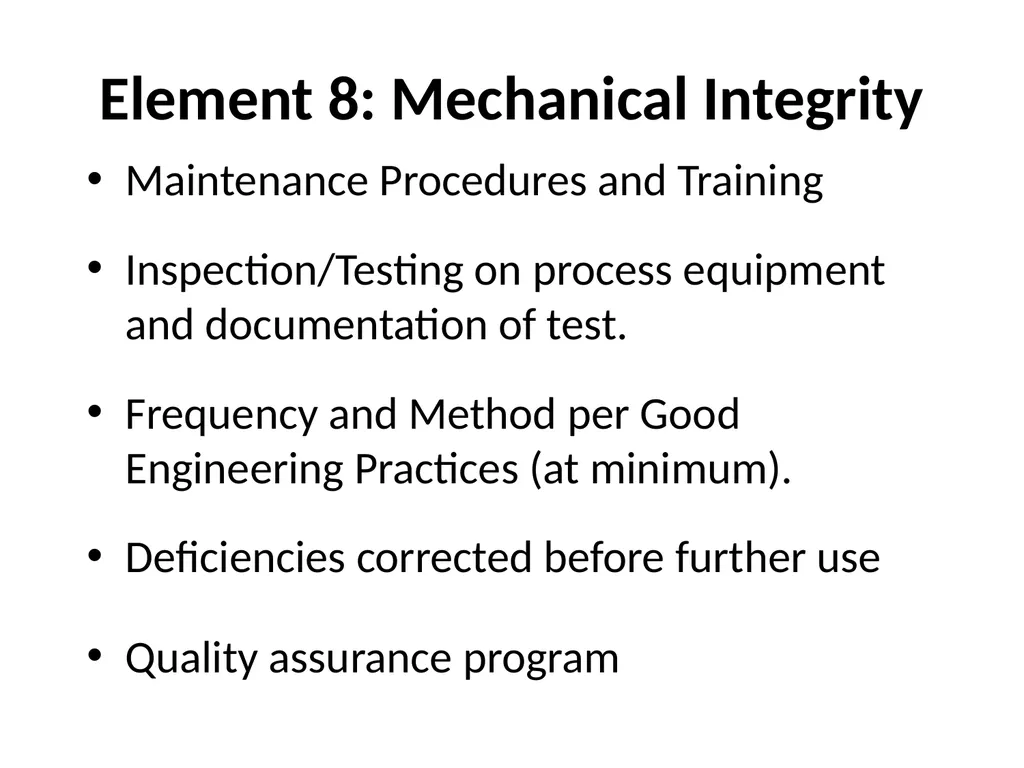
slide33. Element 8: Mechanical Integrity Maintenance Procedures and Training
Inspection/Testing on process equipment and documentation of test.
Frequency and Method per Good Engineering Practices (at minimum).
Deficiencies corrected before further use
Quality assurance program<br>
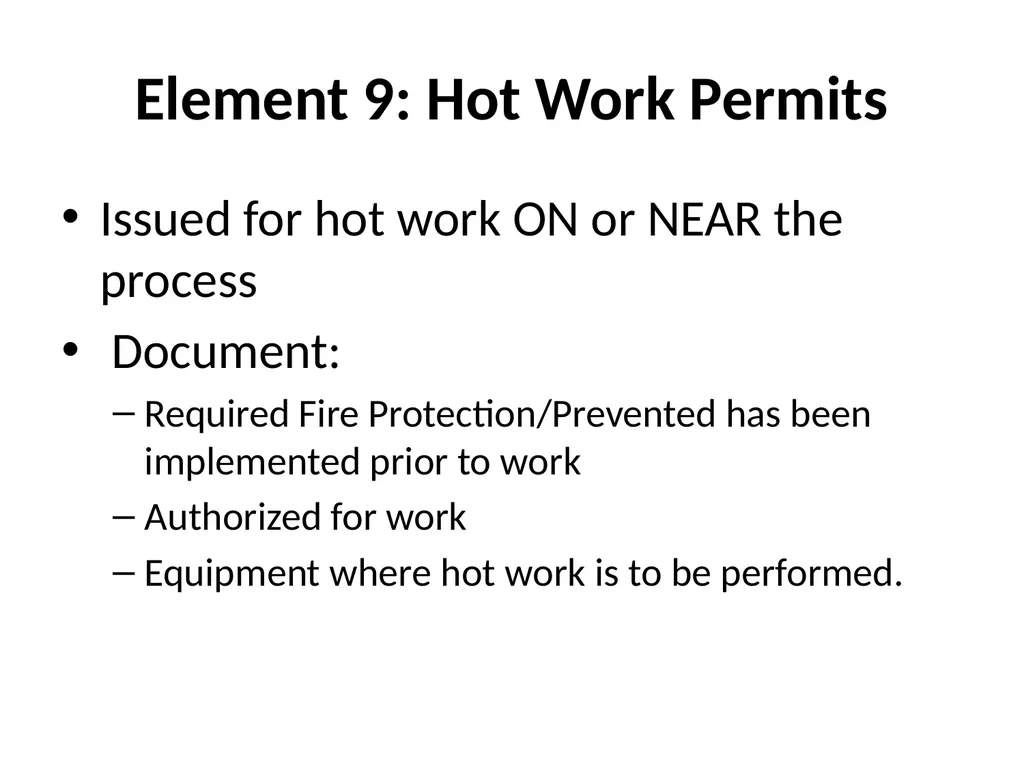
slide34. Element 9: Hot Work Permits Issued for hot work ON or NEAR the process
Document:
Required Fire Protection/Prevented has been implemented prior to work
Authorized for work
Equipment where hot work is to be performed.<br>
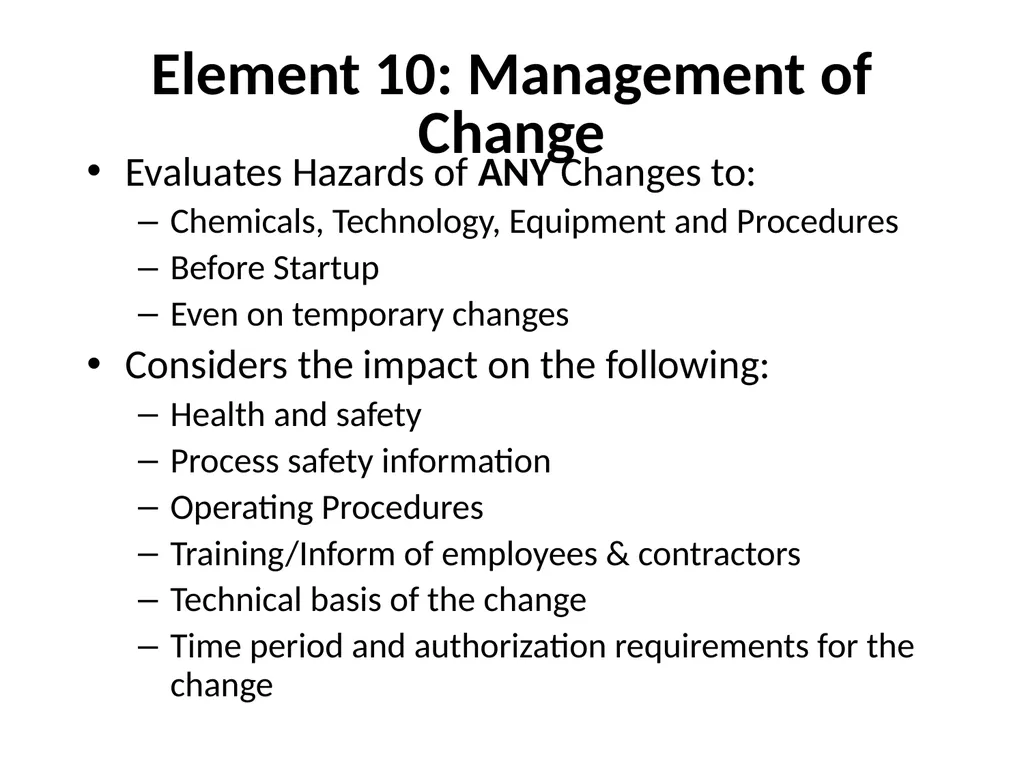
slide35. Element 10: Management of Change Evaluates Hazards of ANY Changes to:
Chemicals, Technology, Equipment and Procedures
Before Startup
Even on temporary changes
Considers the impact on the following:
Health and safety
Process safety information
Operating Procedures
Training/Inform of employees & contractors
Technical basis of the change
Time period and authorization requirements for the change<br>
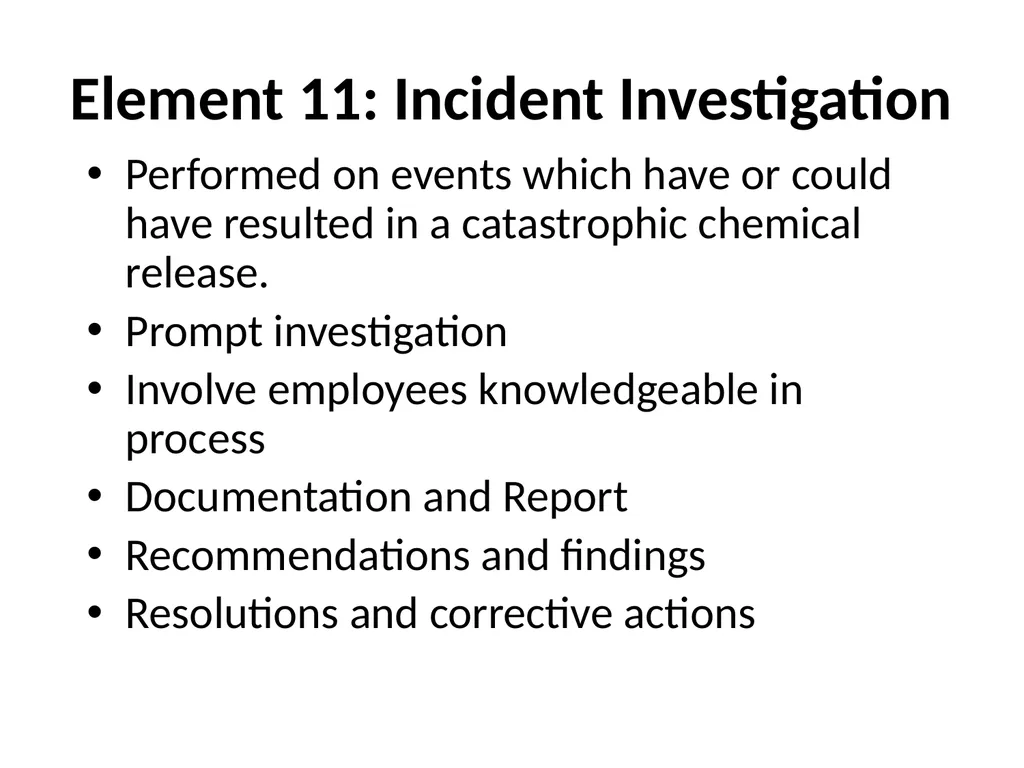
slide36. Element 11: Incident Investigation Performed on events which have or could have resulted in a catastrophic chemical release.
Prompt investigation
Involve employees knowledgeable in process
Documentation and Report
Recommendations and findings
Resolutions and corrective actions<br>
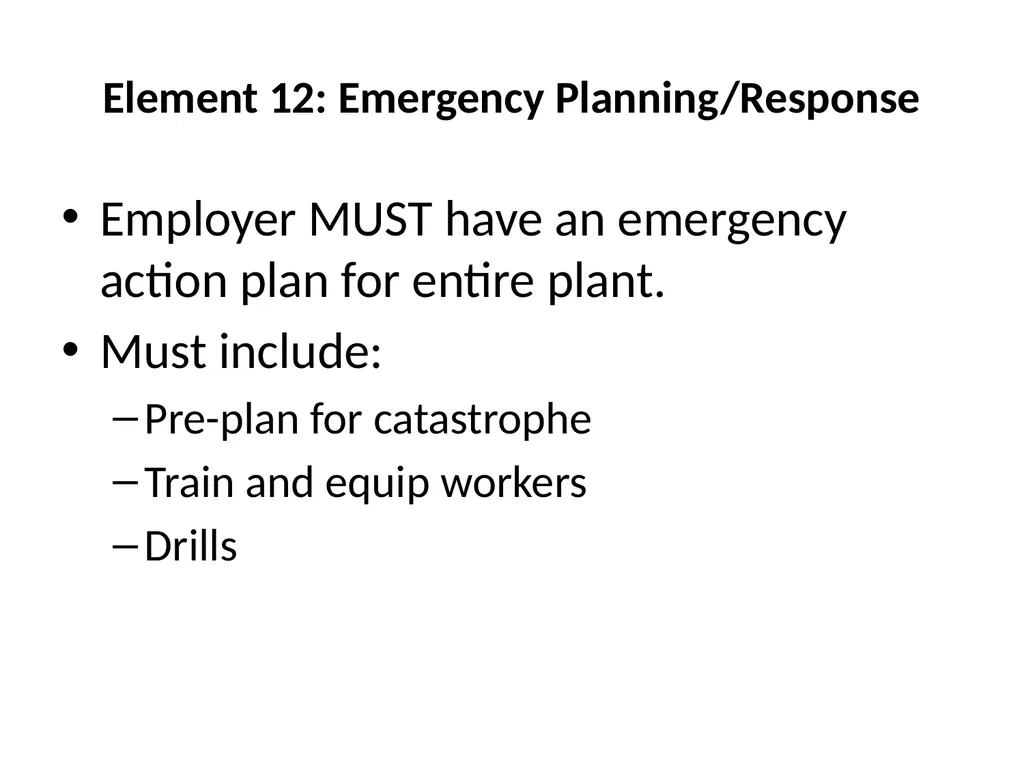
slide37. Element 12: Emergency Planning/Response Employer MUST have an emergency action plan for entire plant.
Must include:
Pre-plan for catastrophe
Train and equip workers
Drills<br>
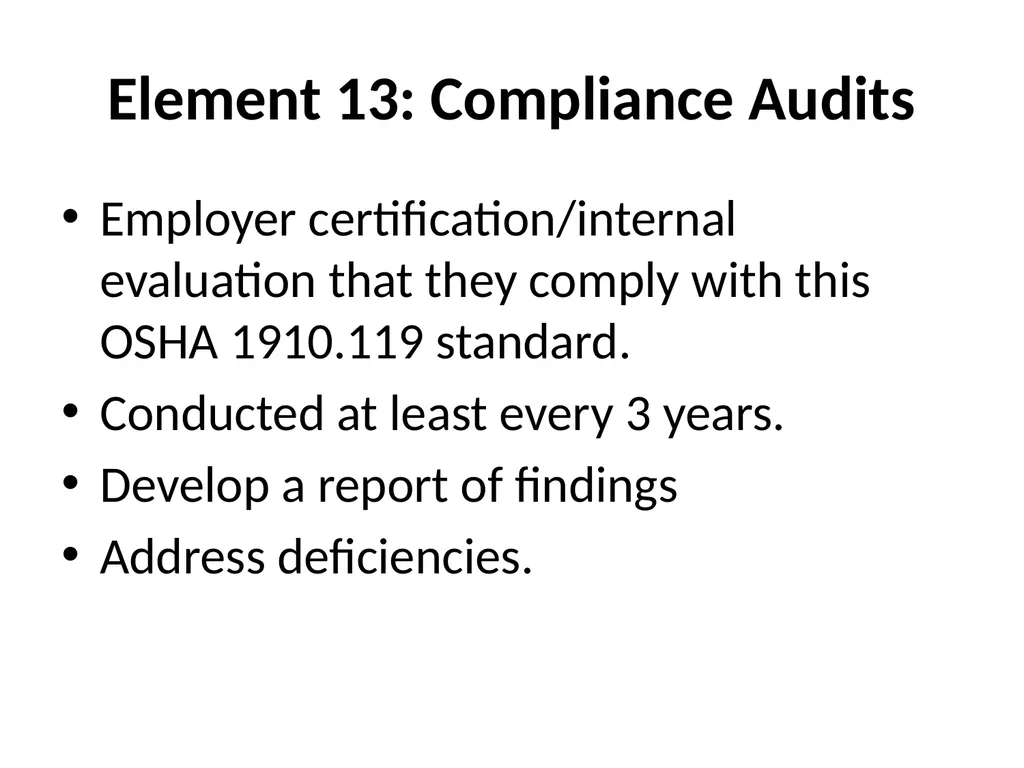
slide38. Element 13: Compliance Audits Employer certification/internal evaluation that they comply with this OSHA 1910.119 standard.
Conducted at least every 3 years.
Develop a report of findings
Address deficiencies.<br>
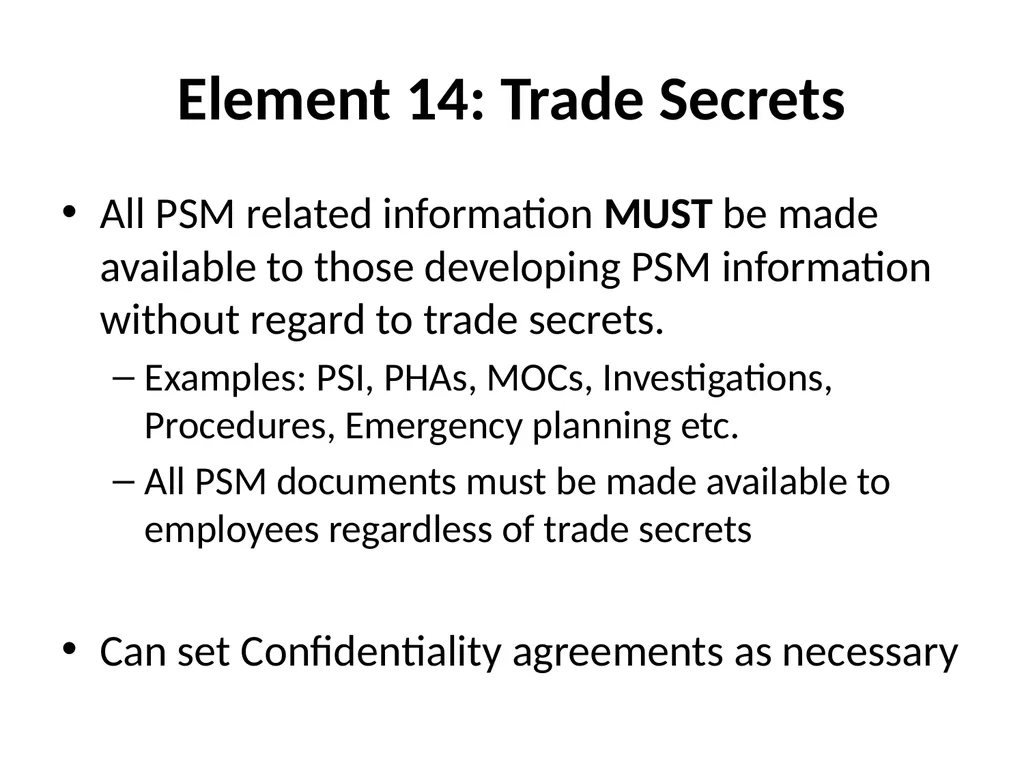
slide39. Element 14: Trade Secrets All PSM related information MUST be made available to those developing PSM information without regard to trade secrets.
Examples: PSI, PHAs, MOCs, Investigations, Procedures, Emergency planning etc.
All PSM documents must be made available to employees regardless of trade secrets
Can set Confidentiality agreements as necessary<br>
slide40. Process Safety In the Workplace Essential to preventing incidents as a result of the release of Highly Hazardous Chemicals.
Contractors play a key role by:
Knowing and following the PSM rules
Participating in the site safety culture
Incident Investigations/Shared Learnings
Raising concerns/Stopping work as necessary
Following the Facility Safe Work Practices
Fully understanding the hazards present and emergency action plan<br>
slide41. Training Techniques Objectives:
Understand the adult learner
Identify techniques to enhance adult learning
Plan a training session
Assess current skills and areas for improvement
Recognize effective and ineffective training methods<br>
slide42. Principles of Adult Education Treat learners as adults
Identify learner goals
Focus on the real world
Emphasize how training can be applied
Relate materials to their experiences
Listen and respect their opinions
Encourage discussion<br>
slide43. 5 Step Training Plan Review
Overview
Presentation
Exercise
Summary<br>
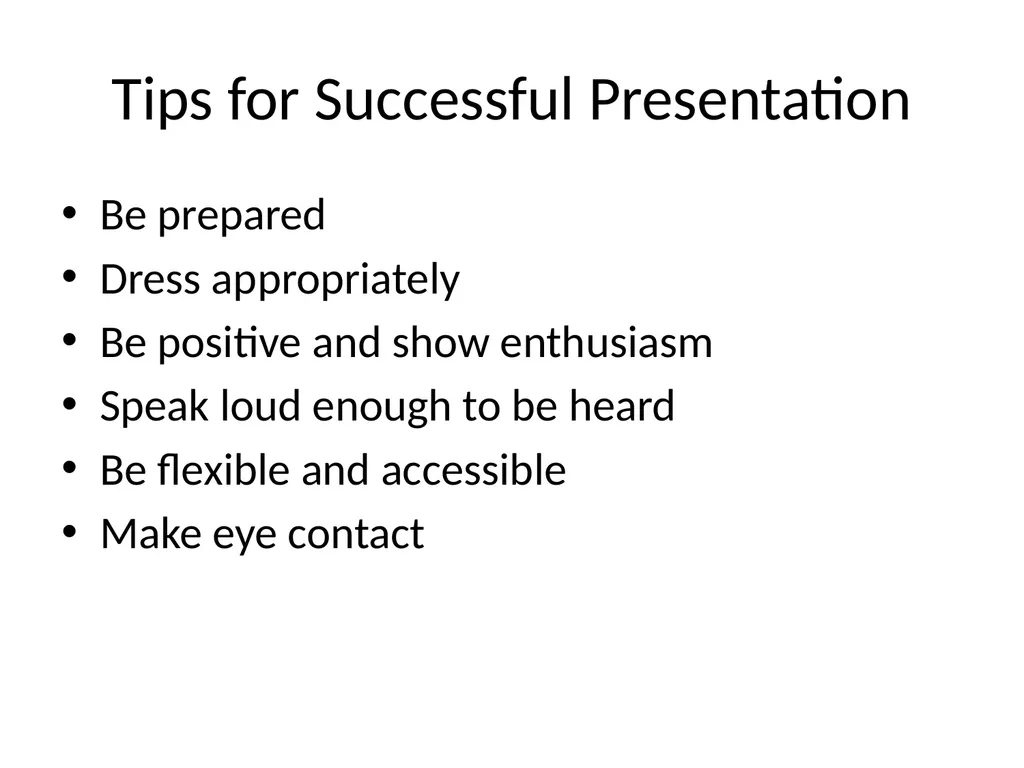
slide44. Tips for Successful Presentation Be prepared
Dress appropriately
Be positive and show enthusiasm
Speak loud enough to be heard
Be flexible and accessible
Make eye contact<br>
slide2. A safe and healthful workplace
Know about hazardous chemicals
Information about injuries and illnesses in your workplace
Complain or request hazard correction from employer
Training
Hazard exposure and medical records
File a complaint with OSHA
Participate in an OSHA inspection
Be free from retaliation for exercising safety and health rights, whistleblower and 11c.
Employer rights and responsibilities What Rights Do You Have Under OSHA? You have the right to:<br>
slide3. Grant Announcement 10-1254-NAT Sept. 9, 2010 Contact: Diana Petterson Jason Surbey E-mail: petterson.diana@dol.gov surbey.jason@dol.gov Phone: 202-693-1898 202-693-4668
US Department of Labor's OSHA awards $8 million in safety and health training grants
WASHINGTON - The U.S. Department of Labor's Occupational Safety and Health Administration today awarded $8 million in Susan Harwood Capacity Building Grants to 45 organizations, including nonprofit and community/faith-based groups, employer associations, labor unions, joint labor/management associations, and colleges and universities. The grants will assist these organizations in providing safety and health training, and educational programs for workers and employers. "Ensuring that workers and employers have the information they need is critical to safe and healthy workplaces," said Secretary of Labor Hilda L. Solis. "These grants will help provide training and education aimed at identifying hazards, understanding rights and responsibilities, protecting health and saving lives." The Susan Harwood Capacity Building Grants support training programs that educate workers and employers in industries with high injury and fatality rates; low literacy, young, limited English proficiency and otherwise vulnerable workers; and small business employers. They fund long-term programs that build safety and health competency within organizations. OSHA awarded approximately $6.7 million to 30 organizations already providing occupational safety and health training, education and related assistance to their constituents, and that are seeking to expand and develop their capacity. Another $1.3 million in smaller pilot grants was awarded to 15 organizations that seek to lay the groundwork for a robust safety and health education program. The agency received a total of 166 applications for the capacity building grants.<br>
slide4. Purpose This section contains requirements for preventing or minimizing the consequences of catastrophic releases of toxic, reactive, flammable, or explosive chemicals. These releases may result in toxic, fire or explosion hazards.<br>
slide5. Process safety management of highly hazardous chemicals (a) Application.
(b) Definitions.
(c) Employee participation.
(d) Process safety information.
(e) Process hazard analysis.
(f) Operating procedures.
(g) Training. (h) Contractors.
(i) Pre‑startup safety review.
(j) Mechanical integrity.
(k) Hot work permit.
(l) Management of change.
(m) Incident investigation.
(o) Compliance Audits.
(p) Trade secrets.<br>
slide6. Catastrophic Failure<br>
slide7. Hazards Hazards are substances or conditions which can cause injury or harm to people, processes, equipment and the environment and which are associated with the properties and behaviors of process materials.<br>
slide8. Examples of Hazards PHYSICAL HAZARDS
Electrical energy
Potential energy
Hydraulic Energy
High temperature surfaces
Radiation
Weather
Security CHEMICAL HAZARDS
Hydrogen
H2S (toxicity)
Nitrogen
Steam
Hot water
Pyrophoric materials
Corrosive materials
Explosive materials<br>
slide9. Chemical Hazards Chemical processes involve mixing and interaction between different materials.
Reactions can release thermal energy or create a rapid increase in volume/pressure which can lead to mechanical failure or loss of containment.
Upsets can cause situations that can interfere with the operation and result in conditions that favor other triggers for loss of containment
Fouling, Corrosion, Phase Change etc<br>
slide10. Definition of Process Safety Process Safety –
OSHA Definition:
“The Purpose of Process Safety is to Prevent or minimize the consequences of catastrophic releases of toxic, reactive, flammable or explosive chemicals that may result in toxic, fire or explosion hazards.”
Secondary Definition:
A set of principles and practices that deal with the integrity and operation of process plant equipment to prevent catastrophic release of highly hazardous chemicals.<br>
slide11. Did You Know? 1 kg of light hydrocarbon can:
- heat a small home for 2 hours
- heat 45 kettles of water (500 cups of coffee)
- produce enough heat to melt steel
- destroy a home or small office (explosion)
1 kg of toxic vapor can harm people several hundred meters away in 3-5 min
1 kg of toxic waste can contaminate several km of a major waterway.<br>
slide12. Process Safety Incident Impact<br>
slide13. Process Safety Incident Impact Bhopal, India 1984 – 1754 fatalities, 100,000’s injured<br>
slide14. Process Safety Incident Impact Feyzin, France 1966 – 18 fatalities<br>
slide15. Process Safety Incident Impact Texas City 2005: 15 fatalities<br>
slide16. Process Safety Incident Impact Other Examples….
Flixborough - 1974 - 28 Fatalities
Mexico City LPG - 1984 - 542 Fatalities
Piper Alpha - 1988 - 167 Fatalities
Phillips -1989 - 24 Fatalities
Arco Chemicals - 1990 - 17 Fatalities
BP, Texas City, TX – 2005 – 15 Fatalities
Deepwater Horizon – 2010 - 11 Fatalities<br>
slide17. “Keep it in the pipes” Process Safety focuses on controlling the potential release of hazardous substances caused by:
MECHANICAL FAILURES
PROCESS UPSETS
PROCEDURES / HUMAN ERROR<br>
slide18. Focus: Incident Prevention People, Plant, Process
OSHA Elements aim to assure integrity of these boundaries.<br>
slide19. What is Covered Listed chemicals in Appendix A
> 10,000 pounds or 4535.6 kg of flammable liquids or gasses<br>
slide20. Process Safety Management OSHA 1910.119
Performance Based
14 Elements
List of Highly Hazardous Chemicals
Applies to Processes that Exceed the Total Quantity
Exemption for Remote, Um occupioed<br>
slide21. Elements of OSHA 1910.119 Employee Participation
Process Safety Information
Process Hazard Analysis
Operating Procedures
Training
Contractors
Pre-Startup Safety Review Mechanical Integrity
Hot Works Permits
Management of Change
Incident Investigation
Emergency Planning & Response
Compliance Audits
Trade Secrets<br>
slide22. Element 1: Employee Participation Develop a written participation plan
Consult with employees on PSM development
Provide PSM information access to employees<br>
slide23. Element 2: Process Safety Information Information used by employees to identify and understand hazards of Process Equipment and Chemicals.
Must be compiled before a hazard analysis.
Includes:
MSDS’s, Process Chemistry, and Max Intended Inventory
PFD’s/P&ID’s
Safe Operating Limits
Material and energy balances
Materials of construction and design codes employed
(ie Electrical Classification, RV design, Ventilation design, safety system design)<br>
slide24. Element 3: Process Hazard Analysis Definition: Systematic way to identify potential hazards and recommend possible solutions
Techniques: HAZOP, FMEA, What-if, Checklist
Addresses: facility siting, human factors, previous incidents, control failures
Relies on: Proper team and Information (PSI)
Develops: Recommendations
Must: Revalidate every 5 years (Ensure hazards introduced by changes are sufficiently controlled)<br>
slide25. Element 4: Operating Procedures Written procedures for:
Startup/Shutdown
Normal operations
Temporary operations
Emergency operations
Must include:
Operating Limits and Deviations
Potential Hazards and Controls
(ie PPE, Safety Systems)
Certified annually<br>
slide26. Element 5: Training Must include:
Process Overview
Safety and Health Hazards
Procedures (emphasizing emergency)
Safe Work Practices
Initial training w/refresher at least every 3 years
Documented records and verification of qualification<br>
slide27. Element 6: Contractors Contractor definition:
An individual performing work on or adjacent to a covered process.
Does not apply to incidental services
Janitorial, Food and Drink, Mail, or Laundry service
Two Different sets of responsibilities:
Employer
Contract Employer<br>
slide28. Element 6: Employer Responsibilities Evaluate Contractor Safety Performance (prior to selection)
Inform Contractor Of Known Hazards Related to:
Work Being Performed and the Process
Inform Contractor Of Emergency Plan
Implement Safe Work Practices Covering Work Activities
Lockout/Tagout, Confined Space Entry, Opening Process Equipment, and Facility Entry.
Periodically evaluate Contractor Performance on Meeting OSHA Obligations (training etc)
Maintain a Contractor Illness/Injury Log<br>
slide29. Element 6: Contractor Employer Contractor Training and Documentation of Comprehension.
Instruct Contractors of:
Hazards of facility/job and the Emergency Plan
Ensure that Contractors follow the Facility:
Safe Work Practices
Safety Rules/Policies
Notify Facility of:
Hazards of Contract Work Being Performed
Hazards found during Work<br>
slide30. Element 6: Contractor Provisions Contractor Safety Oversight
Evaluate contractor safety program
Inform contractor of potential hazards: fire, toxic release, applicable plant safety rules
Develop and implement safe work practices
Evaluate Contractor performance
Qualified Contractors
Pre-qualification process
Safety Training
Initial/annual orientation
Job specific training<br>
slide31. Element 6: Contractor Provisions Audit Compliance
Perform Field and Bi-annual record audits on selected contractors
Responsible for:
use of qualified contractors
ensuring new contractors are pre-qualified
ensuring contractor trained properly and provided required information
Ensure contractor is following rules & procedures<br>
slide32. Element 7: Pre-Startup Safety Review Performed on New/Modified Facilities
Ensures the following prior to Start-up:
Construction is in accordance with design specs
Procedures are in place
Changes have been reviewed for hazard (PHA/MOC)
Actions from hazard review have been resolved
Employee training is complete.<br>
slide33. Element 8: Mechanical Integrity Maintenance Procedures and Training
Inspection/Testing on process equipment and documentation of test.
Frequency and Method per Good Engineering Practices (at minimum).
Deficiencies corrected before further use
Quality assurance program<br>
slide34. Element 9: Hot Work Permits Issued for hot work ON or NEAR the process
Document:
Required Fire Protection/Prevented has been implemented prior to work
Authorized for work
Equipment where hot work is to be performed.<br>
slide35. Element 10: Management of Change Evaluates Hazards of ANY Changes to:
Chemicals, Technology, Equipment and Procedures
Before Startup
Even on temporary changes
Considers the impact on the following:
Health and safety
Process safety information
Operating Procedures
Training/Inform of employees & contractors
Technical basis of the change
Time period and authorization requirements for the change<br>
slide36. Element 11: Incident Investigation Performed on events which have or could have resulted in a catastrophic chemical release.
Prompt investigation
Involve employees knowledgeable in process
Documentation and Report
Recommendations and findings
Resolutions and corrective actions<br>
slide37. Element 12: Emergency Planning/Response Employer MUST have an emergency action plan for entire plant.
Must include:
Pre-plan for catastrophe
Train and equip workers
Drills<br>
slide38. Element 13: Compliance Audits Employer certification/internal evaluation that they comply with this OSHA 1910.119 standard.
Conducted at least every 3 years.
Develop a report of findings
Address deficiencies.<br>
slide39. Element 14: Trade Secrets All PSM related information MUST be made available to those developing PSM information without regard to trade secrets.
Examples: PSI, PHAs, MOCs, Investigations, Procedures, Emergency planning etc.
All PSM documents must be made available to employees regardless of trade secrets
Can set Confidentiality agreements as necessary<br>
slide40. Process Safety In the Workplace Essential to preventing incidents as a result of the release of Highly Hazardous Chemicals.
Contractors play a key role by:
Knowing and following the PSM rules
Participating in the site safety culture
Incident Investigations/Shared Learnings
Raising concerns/Stopping work as necessary
Following the Facility Safe Work Practices
Fully understanding the hazards present and emergency action plan<br>
slide41. Training Techniques Objectives:
Understand the adult learner
Identify techniques to enhance adult learning
Plan a training session
Assess current skills and areas for improvement
Recognize effective and ineffective training methods<br>
slide42. Principles of Adult Education Treat learners as adults
Identify learner goals
Focus on the real world
Emphasize how training can be applied
Relate materials to their experiences
Listen and respect their opinions
Encourage discussion<br>
slide43. 5 Step Training Plan Review
Overview
Presentation
Exercise
Summary<br>
slide44. Tips for Successful Presentation Be prepared
Dress appropriately
Be positive and show enthusiasm
Speak loud enough to be heard
Be flexible and accessible
Make eye contact<br>