
This Photo by Unknown Author is licensed under CC
SB
Published · 32 slides · 0 views

1 / 1



Description
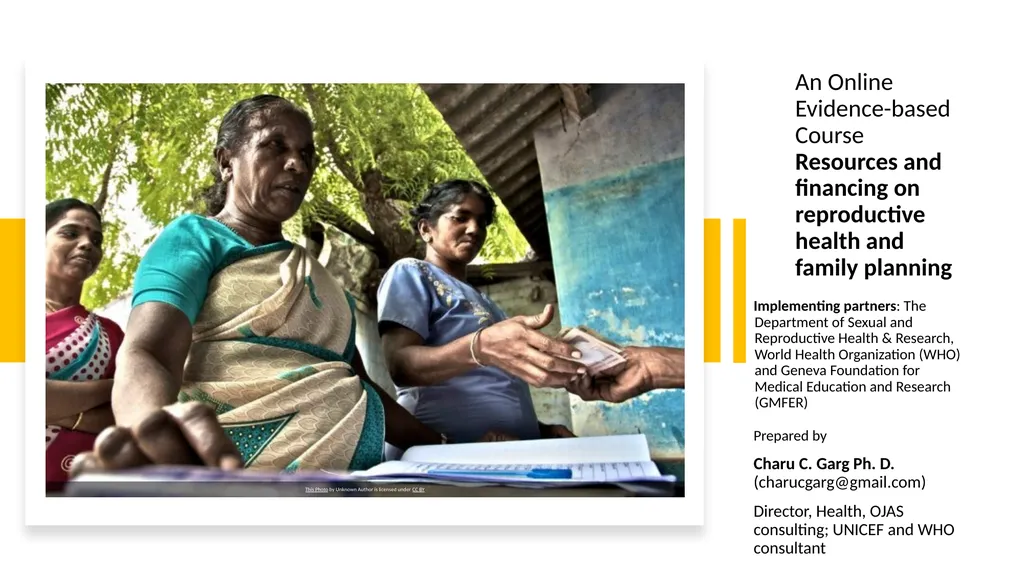
This Photo by Unknown Author is licensed under CC BY An Online Evidence-based Course Resources and financing on reproductive health and family planning Implementing partners: The Department of Sexual and Reproductive Health Research,
Related Topics
Share
Embed code
Download this presentation From Below
"This Photo by Unknown Author is licensed under CC" is the property of its rightful owner. Permission is granted to download and print the materials on this website for personal, non-commercial use only, and to display it on your personal computer provided you do not modify the materials and that you retain all copyright notices contained in the materials. By downloading content from our website, you accept the terms of this agreement.
Presentation Transcript
01
This Photo by Unknown Author is licensed under CC BY An Online Evidence-based Course
Resources and financing on reproductive health and family planning Implementing partners: The Department of Sexual and Reproductive Health & Research, World Health Organization (WHO) and Geneva Foundation for Medical Education and Research (GMFER)
Prepared by
Charu C. Garg Ph. D. (charucgarg@gmail.com)
Director, Health, OJAS consulting; UNICEF and WHO consultant<br>
Prepared by
Charu C. Garg Ph. D. (charucgarg@gmail.com)
Director, Health, OJAS consulting; UNICEF and WHO consultant<br>
02
Learning objectives Importance of understanding financing needs of SRH services including family planning in the context of international and domestic policy needs
Analytical framework for analyzing financing needs for SRH
Important health financing questions
Resource flows – Who finances, what services, how, by how much, and for whom
Costs and costs effectiveness analysis
Equity – Who pays how much for different services
Innovations in financing and sustainability<br>
Analytical framework for analyzing financing needs for SRH
Important health financing questions
Resource flows – Who finances, what services, how, by how much, and for whom
Costs and costs effectiveness analysis
Equity – Who pays how much for different services
Innovations in financing and sustainability<br>
03
International policy context Sustainable Development Goals
3, 4 and 5 – improved health, education and gender equality, respectively - depend on improvements in SRH and rights
include satisfying people’s needs for modern contraception and family planning, reducing maternal and newborn deaths, and ending the HIV epidemic.
3.1 - Reduction in maternal mortality ratio to less than 70 per live births
3.7 - Improved modern contraceptive prevalence rates and demand satisfied for FP ; declining adolescent birth rates and unmet needs for family planning,
5.6 - Universal access for SRH Adding It Up: Investing in Sexual and Reproductive Health 2019 | Guttmacher Institute<br>
3, 4 and 5 – improved health, education and gender equality, respectively - depend on improvements in SRH and rights
include satisfying people’s needs for modern contraception and family planning, reducing maternal and newborn deaths, and ending the HIV epidemic.
3.1 - Reduction in maternal mortality ratio to less than 70 per live births
3.7 - Improved modern contraceptive prevalence rates and demand satisfied for FP ; declining adolescent birth rates and unmet needs for family planning,
5.6 - Universal access for SRH Adding It Up: Investing in Sexual and Reproductive Health 2019 | Guttmacher Institute<br>
04
National policy context Assess national RH policies and goals overtime and current situation
Better availability and access to SRH leads to better outcomes (lower no. of unintended pregnancies and unplanned births, unsafe abortions, maternal and newborn deaths, HIV infections and infertility in untreated STIs) and use of resources
Assess keys indicators of outcomes, outputs in terms of unmet needs, inputs in terms of bottlenecks to access and allocation of financing
To increase access, analyze SRH services delivery through three tiers of government, donors, NGOs, private sectors and identify access barriers - Availability, accessibility (financial and physical), acceptability (cultural and behavioural), coverage and actual use
Research shows community-based distribution of services, provision of services by community-based workers, and mobilization of resources are required to increase access to and use of SRH and maternal health services
Analyze financing barriers to address the areas where bottlenecks exist Policy Considerations for Financing Sexual and Reproductive Health and Rights in the Post-2015 Era – High Level Task Force for International Conference for Population and Development (ICPD); Feb 2015.<br>
Better availability and access to SRH leads to better outcomes (lower no. of unintended pregnancies and unplanned births, unsafe abortions, maternal and newborn deaths, HIV infections and infertility in untreated STIs) and use of resources
Assess keys indicators of outcomes, outputs in terms of unmet needs, inputs in terms of bottlenecks to access and allocation of financing
To increase access, analyze SRH services delivery through three tiers of government, donors, NGOs, private sectors and identify access barriers - Availability, accessibility (financial and physical), acceptability (cultural and behavioural), coverage and actual use
Research shows community-based distribution of services, provision of services by community-based workers, and mobilization of resources are required to increase access to and use of SRH and maternal health services
Analyze financing barriers to address the areas where bottlenecks exist Policy Considerations for Financing Sexual and Reproductive Health and Rights in the Post-2015 Era – High Level Task Force for International Conference for Population and Development (ICPD); Feb 2015.<br>
05
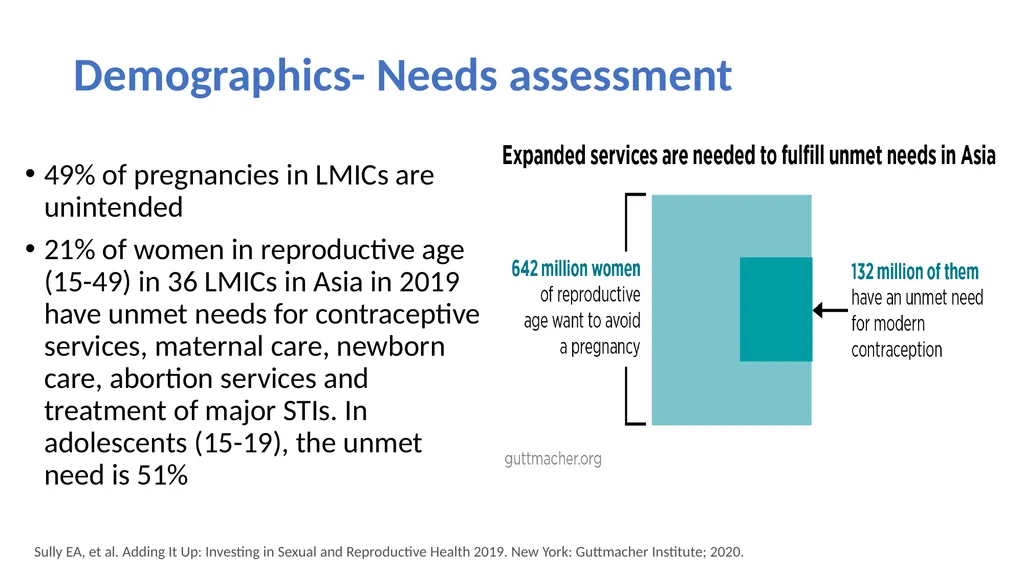
Demographics- Needs assessment 49% of pregnancies in LMICs are unintended
21% of women in reproductive age (15-49) in 36 LMICs in Asia in 2019 have unmet needs for contraceptive services, maternal care, newborn care, abortion services and treatment of major STIs. In adolescents (15-19), the unmet need is 51% Sully EA, et al. Adding It Up: Investing in Sexual and Reproductive Health 2019. New York: Guttmacher Institute; 2020.<br>
21% of women in reproductive age (15-49) in 36 LMICs in Asia in 2019 have unmet needs for contraceptive services, maternal care, newborn care, abortion services and treatment of major STIs. In adolescents (15-19), the unmet need is 51% Sully EA, et al. Adding It Up: Investing in Sexual and Reproductive Health 2019. New York: Guttmacher Institute; 2020.<br>
06
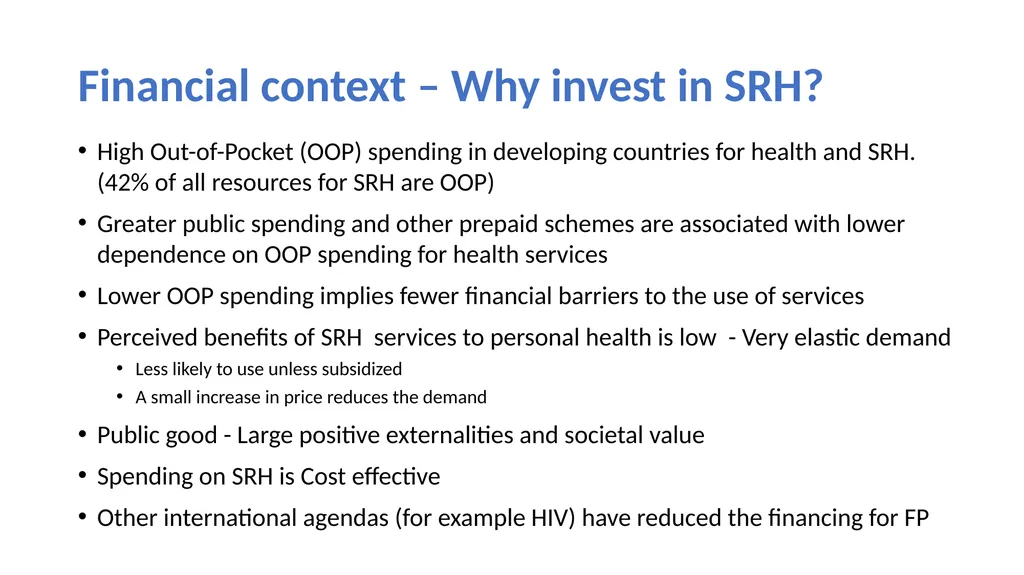
Financial context – Why invest in SRH? High Out-of-Pocket (OOP) spending in developing countries for health and SRH. (42% of all resources for SRH are OOP)
Greater public spending and other prepaid schemes are associated with lower dependence on OOP spending for health services
Lower OOP spending implies fewer financial barriers to the use of services
Perceived benefits of SRH services to personal health is low - Very elastic demand
Less likely to use unless subsidized
A small increase in price reduces the demand
Public good - Large positive externalities and societal value
Spending on SRH is Cost effective
Other international agendas (for example HIV) have reduced the financing for FP<br>
Greater public spending and other prepaid schemes are associated with lower dependence on OOP spending for health services
Lower OOP spending implies fewer financial barriers to the use of services
Perceived benefits of SRH services to personal health is low - Very elastic demand
Less likely to use unless subsidized
A small increase in price reduces the demand
Public good - Large positive externalities and societal value
Spending on SRH is Cost effective
Other international agendas (for example HIV) have reduced the financing for FP<br>
07
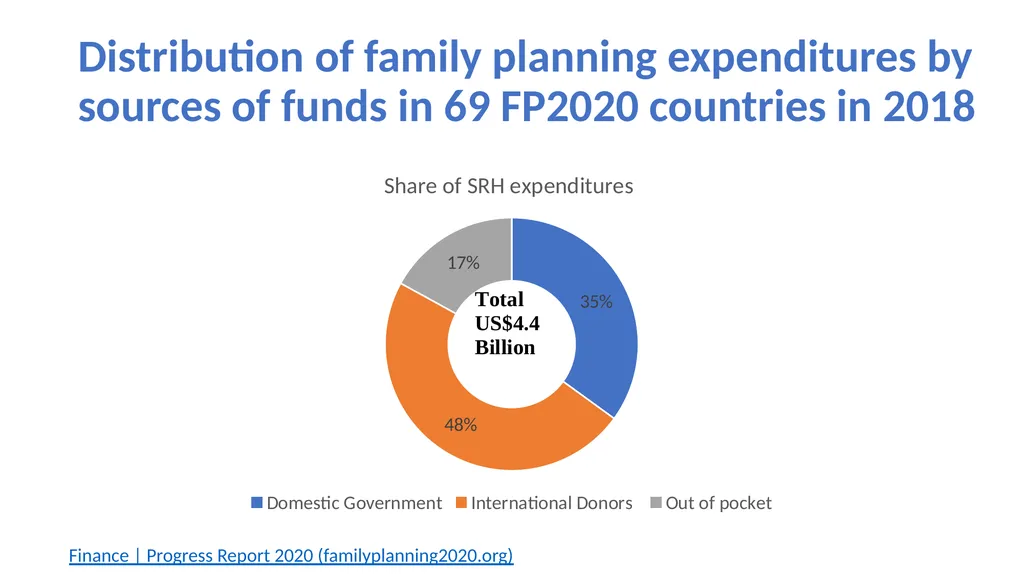
Distribution of family planning expenditures by sources of funds in 69 FP2020 countries in 2018 Finance | Progress Report 2020 (familyplanning2020.org)<br>
08
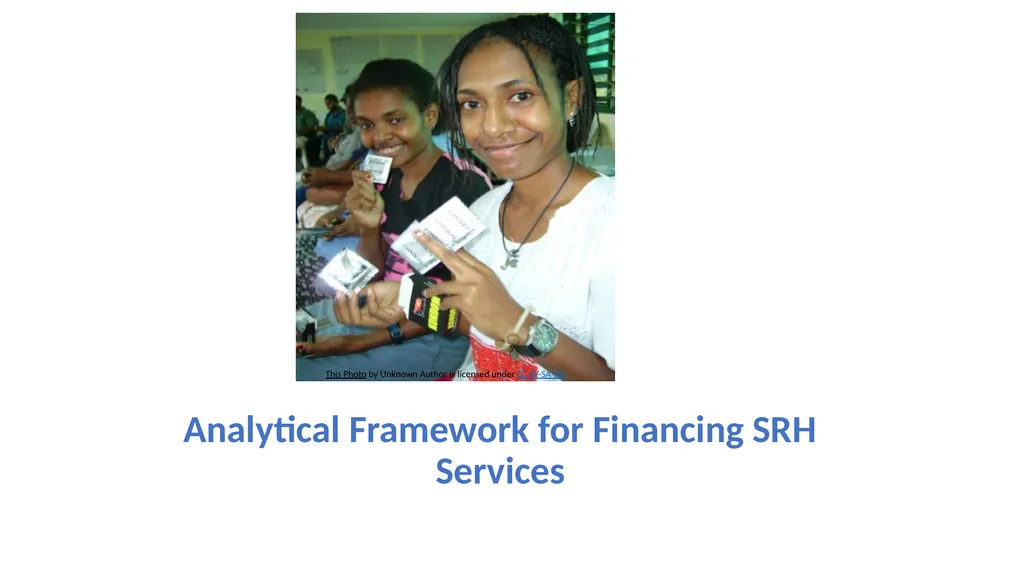
Analytical Framework for Financing SRH Services This Photo by Unknown Author is licensed under CC BY-SA-NC<br>
09
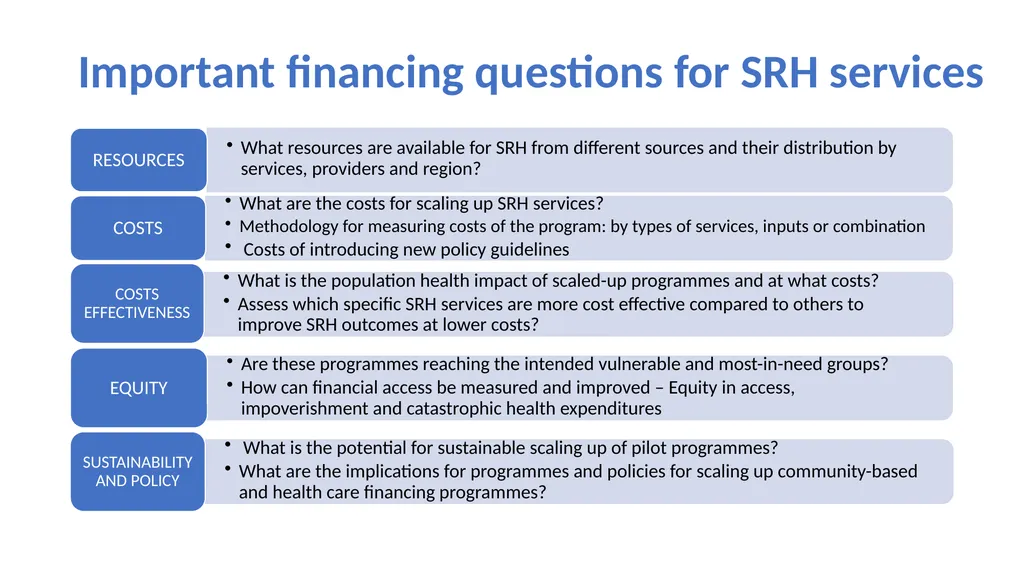
Important financing questions for SRH services<br>
10
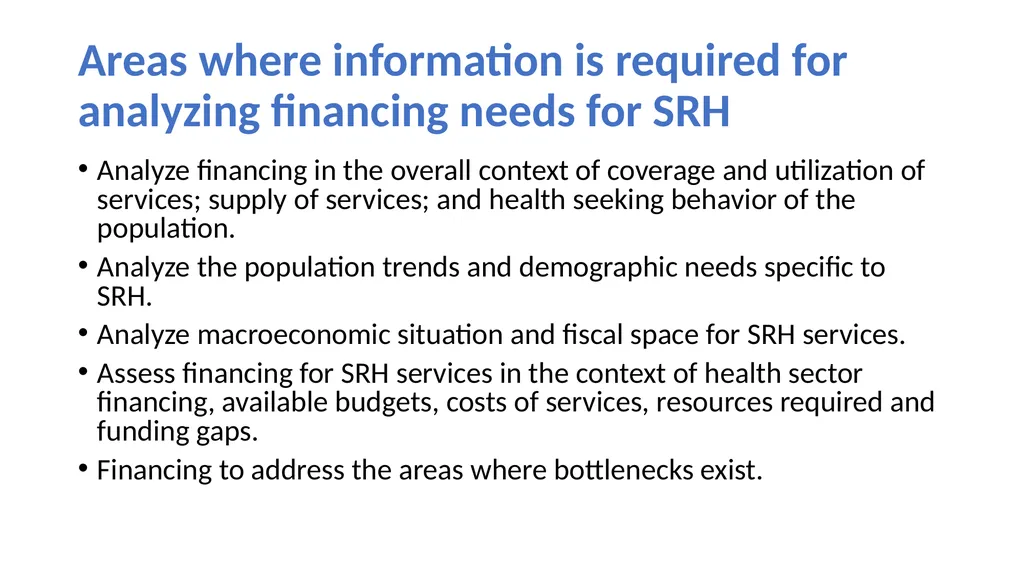
Areas where information is required for analyzing financing needs for SRH Analyze financing in the overall context of coverage and utilization of services; supply of services; and health seeking behavior of the population.
Analyze the population trends and demographic needs specific to SRH.
Analyze macroeconomic situation and fiscal space for SRH services.
Assess financing for SRH services in the context of health sector financing, available budgets, costs of services, resources required and funding gaps.
Financing to address the areas where bottlenecks exist.<br>
Analyze the population trends and demographic needs specific to SRH.
Analyze macroeconomic situation and fiscal space for SRH services.
Assess financing for SRH services in the context of health sector financing, available budgets, costs of services, resources required and funding gaps.
Financing to address the areas where bottlenecks exist.<br>
11
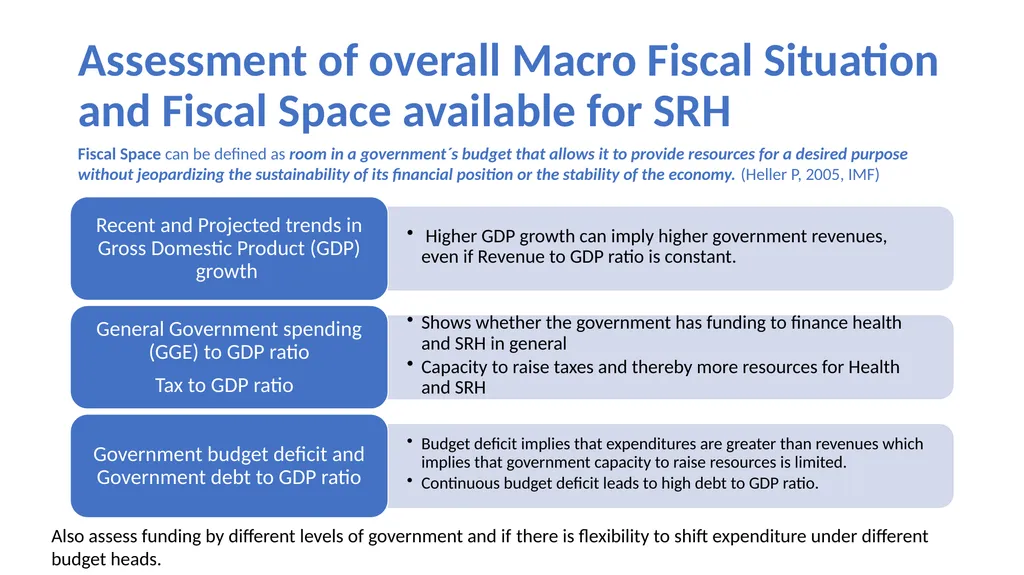
Assessment of overall Macro Fiscal Situation and Fiscal Space available for SRH Also assess funding by different levels of government and if there is flexibility to shift expenditure under different budget heads. Fiscal Space can be defined as room in a government´s budget that allows it to provide resources for a desired purpose without jeopardizing the sustainability of its financial position or the stability of the economy. (Heller P, 2005, IMF)<br>
12
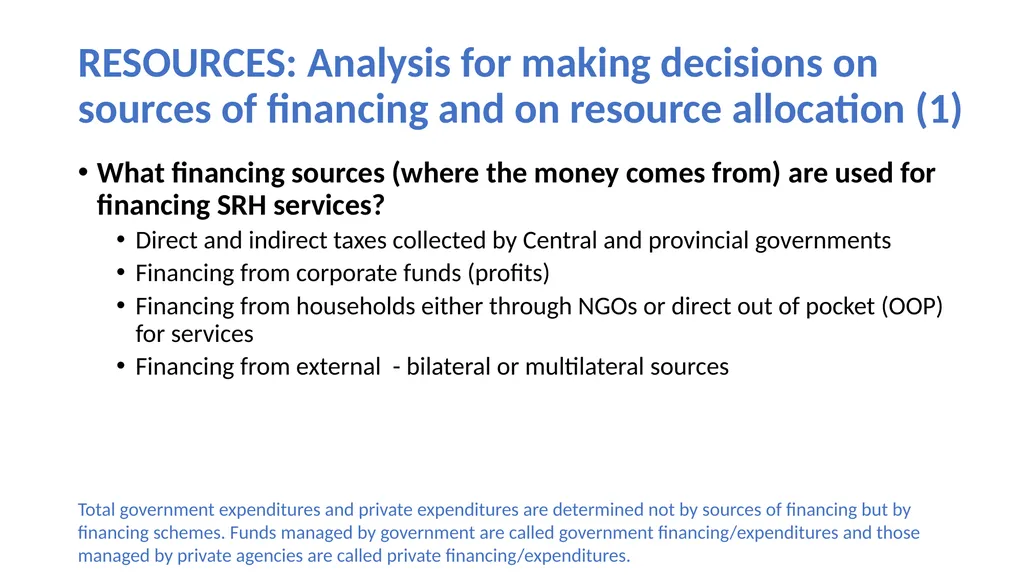
RESOURCES: Analysis for making decisions on sources of financing and on resource allocation (1) What financing sources (where the money comes from) are used for financing SRH services?
Direct and indirect taxes collected by Central and provincial governments
Financing from corporate funds (profits)
Financing from households either through NGOs or direct out of pocket (OOP) for services
Financing from external - bilateral or multilateral sources Total government expenditures and private expenditures are determined not by sources of financing but by financing schemes. Funds managed by government are called government financing/expenditures and those managed by private agencies are called private financing/expenditures.<br>
Direct and indirect taxes collected by Central and provincial governments
Financing from corporate funds (profits)
Financing from households either through NGOs or direct out of pocket (OOP) for services
Financing from external - bilateral or multilateral sources Total government expenditures and private expenditures are determined not by sources of financing but by financing schemes. Funds managed by government are called government financing/expenditures and those managed by private agencies are called private financing/expenditures.<br>
13
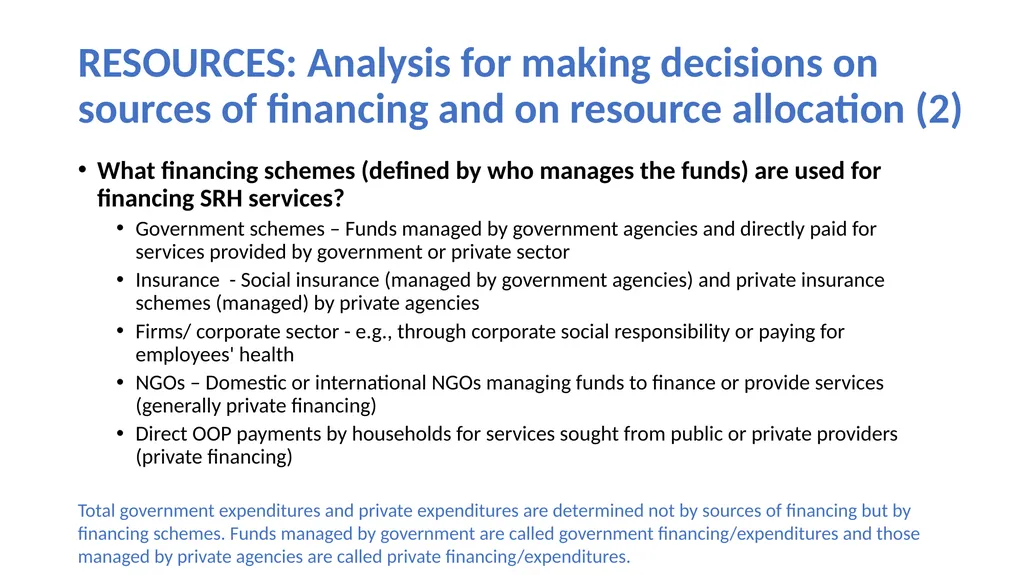
RESOURCES: Analysis for making decisions on sources of financing and on resource allocation (2) What financing schemes (defined by who manages the funds) are used for financing SRH services?
Government schemes – Funds managed by government agencies and directly paid for services provided by government or private sector
Insurance - Social insurance (managed by government agencies) and private insurance schemes (managed) by private agencies
Firms/ corporate sector - e.g., through corporate social responsibility or paying for employees' health
NGOs – Domestic or international NGOs managing funds to finance or provide services (generally private financing)
Direct OOP payments by households for services sought from public or private providers (private financing) Total government expenditures and private expenditures are determined not by sources of financing but by financing schemes. Funds managed by government are called government financing/expenditures and those managed by private agencies are called private financing/expenditures.<br>
Government schemes – Funds managed by government agencies and directly paid for services provided by government or private sector
Insurance - Social insurance (managed by government agencies) and private insurance schemes (managed) by private agencies
Firms/ corporate sector - e.g., through corporate social responsibility or paying for employees' health
NGOs – Domestic or international NGOs managing funds to finance or provide services (generally private financing)
Direct OOP payments by households for services sought from public or private providers (private financing) Total government expenditures and private expenditures are determined not by sources of financing but by financing schemes. Funds managed by government are called government financing/expenditures and those managed by private agencies are called private financing/expenditures.<br>
14
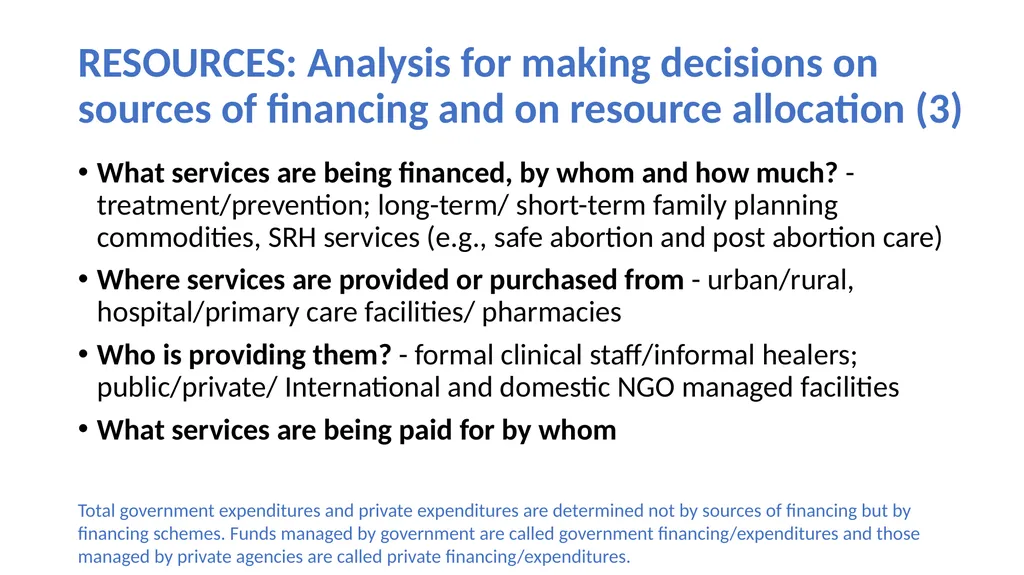
RESOURCES: Analysis for making decisions on sources of financing and on resource allocation (3) What services are being financed, by whom and how much? - treatment/prevention; long-term/ short-term family planning commodities, SRH services (e.g., safe abortion and post abortion care)
Where services are provided or purchased from - urban/rural, hospital/primary care facilities/ pharmacies
Who is providing them? - formal clinical staff/informal healers; public/private/ International and domestic NGO managed facilities
What services are being paid for by whom Total government expenditures and private expenditures are determined not by sources of financing but by financing schemes. Funds managed by government are called government financing/expenditures and those managed by private agencies are called private financing/expenditures.<br>
Where services are provided or purchased from - urban/rural, hospital/primary care facilities/ pharmacies
Who is providing them? - formal clinical staff/informal healers; public/private/ International and domestic NGO managed facilities
What services are being paid for by whom Total government expenditures and private expenditures are determined not by sources of financing but by financing schemes. Funds managed by government are called government financing/expenditures and those managed by private agencies are called private financing/expenditures.<br>
15
Analyzing health expenditure pattern for SRH Assess trends and composition. Assess different Supply side and demand side financing arrangements e.g. insurance, contracting, pay for performance, cash transfers and vouchers, etc.<br>
16
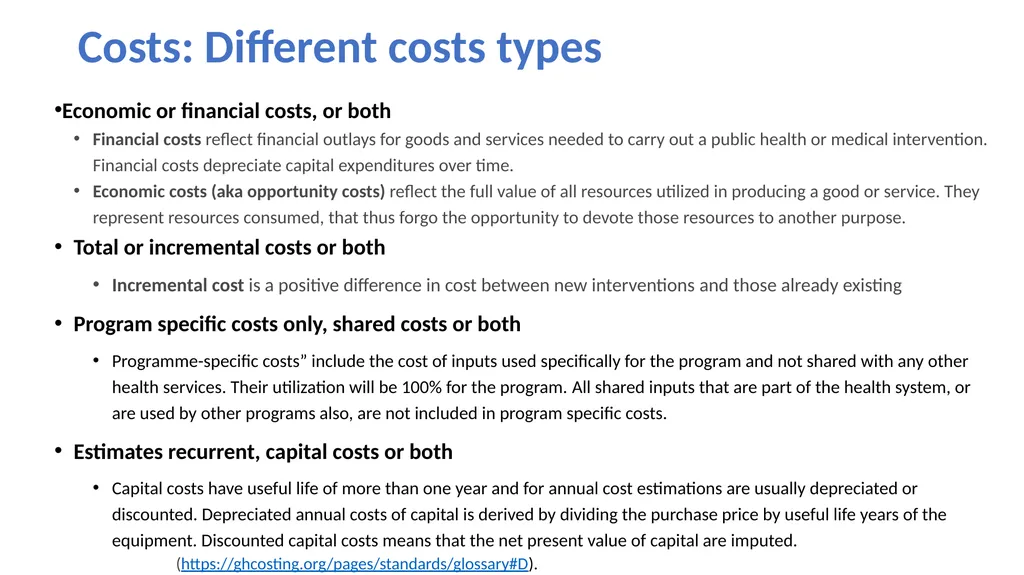
Costs: Different costs types Economic or financial costs, or both
Financial costs reflect financial outlays for goods and services needed to carry out a public health or medical intervention. Financial costs depreciate capital expenditures over time.
Economic costs (aka opportunity costs) reflect the full value of all resources utilized in producing a good or service. They represent resources consumed, that thus forgo the opportunity to devote those resources to another purpose.
Total or incremental costs or both
Incremental cost is a positive difference in cost between new interventions and those already existing
Program specific costs only, shared costs or both
Programme-specific costs” include the cost of inputs used specifically for the program and not shared with any other health services. Their utilization will be 100% for the program. All shared inputs that are part of the health system, or are used by other programs also, are not included in program specific costs.
Estimates recurrent, capital costs or both
Capital costs have useful life of more than one year and for annual cost estimations are usually depreciated or discounted. Depreciated annual costs of capital is derived by dividing the purchase price by useful life years of the equipment. Discounted capital costs means that the net present value of capital are imputed. (https://ghcosting.org/pages/standards/glossary#D).<br>
Financial costs reflect financial outlays for goods and services needed to carry out a public health or medical intervention. Financial costs depreciate capital expenditures over time.
Economic costs (aka opportunity costs) reflect the full value of all resources utilized in producing a good or service. They represent resources consumed, that thus forgo the opportunity to devote those resources to another purpose.
Total or incremental costs or both
Incremental cost is a positive difference in cost between new interventions and those already existing
Program specific costs only, shared costs or both
Programme-specific costs” include the cost of inputs used specifically for the program and not shared with any other health services. Their utilization will be 100% for the program. All shared inputs that are part of the health system, or are used by other programs also, are not included in program specific costs.
Estimates recurrent, capital costs or both
Capital costs have useful life of more than one year and for annual cost estimations are usually depreciated or discounted. Depreciated annual costs of capital is derived by dividing the purchase price by useful life years of the equipment. Discounted capital costs means that the net present value of capital are imputed. (https://ghcosting.org/pages/standards/glossary#D).<br>
17
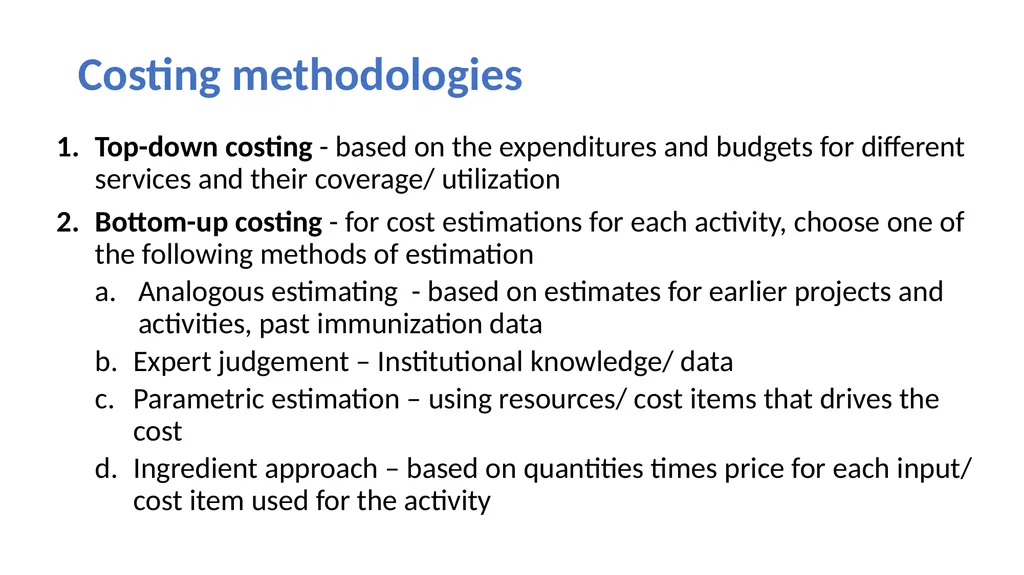
Costing methodologies Top-down costing - based on the expenditures and budgets for different services and their coverage/ utilization
Bottom-up costing - for cost estimations for each activity, choose one of the following methods of estimation
Analogous estimating - based on estimates for earlier projects and activities, past immunization data
Expert judgement – Institutional knowledge/ data
Parametric estimation – using resources/ cost items that drives the cost
Ingredient approach – based on quantities times price for each input/ cost item used for the activity<br>
Bottom-up costing - for cost estimations for each activity, choose one of the following methods of estimation
Analogous estimating - based on estimates for earlier projects and activities, past immunization data
Expert judgement – Institutional knowledge/ data
Parametric estimation – using resources/ cost items that drives the cost
Ingredient approach – based on quantities times price for each input/ cost item used for the activity<br>
18
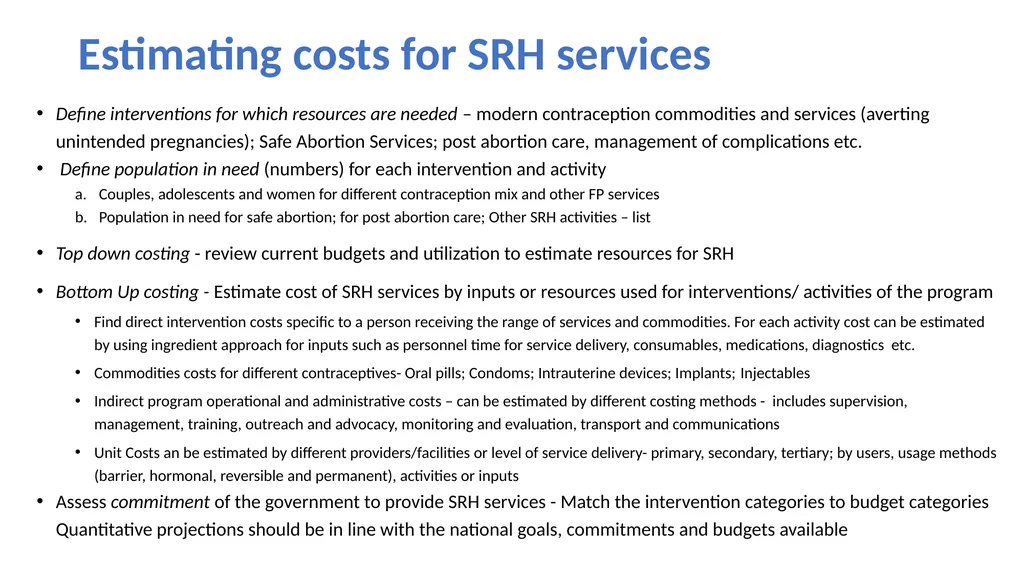
Estimating costs for SRH services Define interventions for which resources are needed – modern contraception commodities and services (averting unintended pregnancies); Safe Abortion Services; post abortion care, management of complications etc.
Define population in need (numbers) for each intervention and activity
Couples, adolescents and women for different contraception mix and other FP services
Population in need for safe abortion; for post abortion care; Other SRH activities – list
Top down costing - review current budgets and utilization to estimate resources for SRH
Bottom Up costing - Estimate cost of SRH services by inputs or resources used for interventions/ activities of the program
Find direct intervention costs specific to a person receiving the range of services and commodities. For each activity cost can be estimated by using ingredient approach for inputs such as personnel time for service delivery, consumables, medications, diagnostics etc.
Commodities costs for different contraceptives- Oral pills; Condoms; Intrauterine devices; Implants; Injectables
Indirect program operational and administrative costs – can be estimated by different costing methods - includes supervision, management, training, outreach and advocacy, monitoring and evaluation, transport and communications
Unit Costs an be estimated by different providers/facilities or level of service delivery- primary, secondary, tertiary; by users, usage methods (barrier, hormonal, reversible and permanent), activities or inputs
Assess commitment of the government to provide SRH services - Match the intervention categories to budget categories Quantitative projections should be in line with the national goals, commitments and budgets available<br>
Define population in need (numbers) for each intervention and activity
Couples, adolescents and women for different contraception mix and other FP services
Population in need for safe abortion; for post abortion care; Other SRH activities – list
Top down costing - review current budgets and utilization to estimate resources for SRH
Bottom Up costing - Estimate cost of SRH services by inputs or resources used for interventions/ activities of the program
Find direct intervention costs specific to a person receiving the range of services and commodities. For each activity cost can be estimated by using ingredient approach for inputs such as personnel time for service delivery, consumables, medications, diagnostics etc.
Commodities costs for different contraceptives- Oral pills; Condoms; Intrauterine devices; Implants; Injectables
Indirect program operational and administrative costs – can be estimated by different costing methods - includes supervision, management, training, outreach and advocacy, monitoring and evaluation, transport and communications
Unit Costs an be estimated by different providers/facilities or level of service delivery- primary, secondary, tertiary; by users, usage methods (barrier, hormonal, reversible and permanent), activities or inputs
Assess commitment of the government to provide SRH services - Match the intervention categories to budget categories Quantitative projections should be in line with the national goals, commitments and budgets available<br>
19
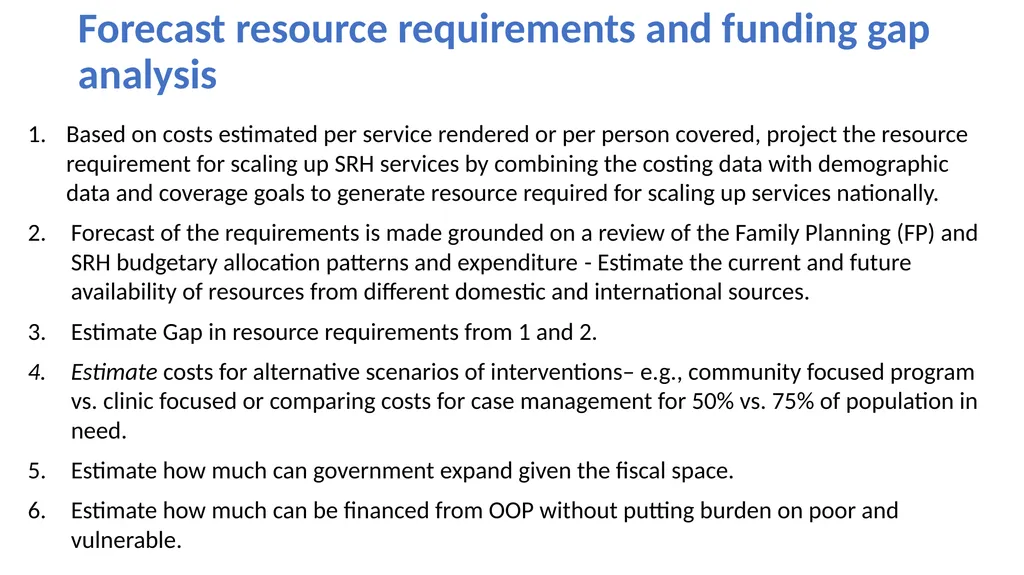
Forecast resource requirements and funding gap analysis Based on costs estimated per service rendered or per person covered, project the resource requirement for scaling up SRH services by combining the costing data with demographic data and coverage goals to generate resource required for scaling up services nationally.
Forecast of the requirements is made grounded on a review of the Family Planning (FP) and SRH budgetary allocation patterns and expenditure - Estimate the current and future availability of resources from different domestic and international sources.
Estimate Gap in resource requirements from 1 and 2.
Estimate costs for alternative scenarios of interventions– e.g., community focused program vs. clinic focused or comparing costs for case management for 50% vs. 75% of population in need.
Estimate how much can government expand given the fiscal space.
Estimate how much can be financed from OOP without putting burden on poor and vulnerable.<br>
Forecast of the requirements is made grounded on a review of the Family Planning (FP) and SRH budgetary allocation patterns and expenditure - Estimate the current and future availability of resources from different domestic and international sources.
Estimate Gap in resource requirements from 1 and 2.
Estimate costs for alternative scenarios of interventions– e.g., community focused program vs. clinic focused or comparing costs for case management for 50% vs. 75% of population in need.
Estimate how much can government expand given the fiscal space.
Estimate how much can be financed from OOP without putting burden on poor and vulnerable.<br>
20
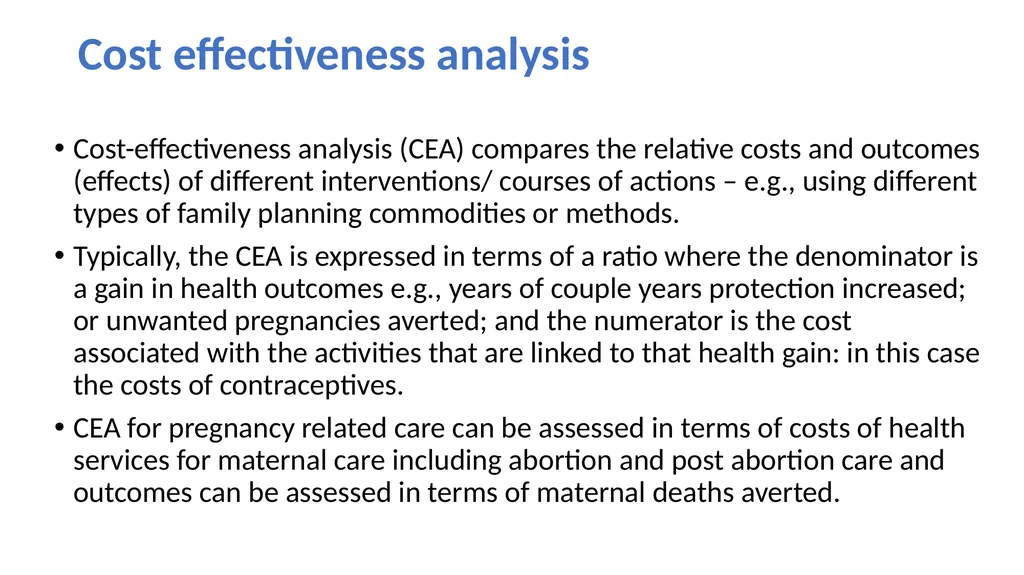
Cost effectiveness analysis Cost-effectiveness analysis (CEA) compares the relative costs and outcomes (effects) of different interventions/ courses of actions – e.g., using different types of family planning commodities or methods.
Typically, the CEA is expressed in terms of a ratio where the denominator is a gain in health outcomes e.g., years of couple years protection increased; or unwanted pregnancies averted; and the numerator is the cost associated with the activities that are linked to that health gain: in this case the costs of contraceptives.
CEA for pregnancy related care can be assessed in terms of costs of health services for maternal care including abortion and post abortion care and outcomes can be assessed in terms of maternal deaths averted.<br>
Typically, the CEA is expressed in terms of a ratio where the denominator is a gain in health outcomes e.g., years of couple years protection increased; or unwanted pregnancies averted; and the numerator is the cost associated with the activities that are linked to that health gain: in this case the costs of contraceptives.
CEA for pregnancy related care can be assessed in terms of costs of health services for maternal care including abortion and post abortion care and outcomes can be assessed in terms of maternal deaths averted.<br>
21
Investing in contraceptives and pregnancy related services is cost effective For 132 LMIC countries - $68.8 billion is required annually in 2019 U.S. dollars, or approximately $10.60 per capita (i.e., per total population in LMICs) to meet women’s need for modern contraception, pregnancy related maternal and newborn care and treatment of curable STIs
Sub-Saharan Africa requires largest boost in resources – an increase from $3.4 to $15.8 per capita annually because of largest unmet needs and poor health systems
Direct costs of providing contraceptive commodities for LMIC’s for 705 million was $3.5 billion and indirect costs of contraceptive services was $3.6 billion. Cost per user was $5.
Every $1 spent on contraceptive services beyond the current level would save $3.26 in pregnancy related and newborn care (which includes safe abortion and post abortion care) because contraception reduces the number of unintended pregnancies.
The direct cost of providing pregnancy-related and newborn care at current levels of coverage in LMICs was estimated at $30.3 billion for 2019 with 50% being indirect costs. These prevent 126,000 maternal deaths from 425,000 to 299,000. Adding it up: Investing in Sexual and reproductive Health 2019, Guttmacher.org<br>
Sub-Saharan Africa requires largest boost in resources – an increase from $3.4 to $15.8 per capita annually because of largest unmet needs and poor health systems
Direct costs of providing contraceptive commodities for LMIC’s for 705 million was $3.5 billion and indirect costs of contraceptive services was $3.6 billion. Cost per user was $5.
Every $1 spent on contraceptive services beyond the current level would save $3.26 in pregnancy related and newborn care (which includes safe abortion and post abortion care) because contraception reduces the number of unintended pregnancies.
The direct cost of providing pregnancy-related and newborn care at current levels of coverage in LMICs was estimated at $30.3 billion for 2019 with 50% being indirect costs. These prevent 126,000 maternal deaths from 425,000 to 299,000. Adding it up: Investing in Sexual and reproductive Health 2019, Guttmacher.org<br>
22
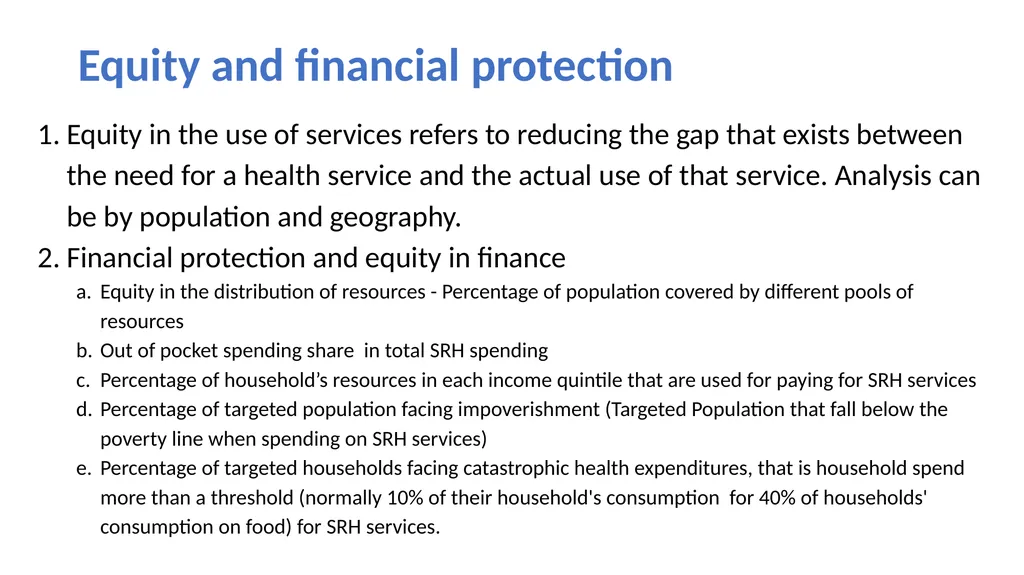
Equity and financial protection Equity in the use of services refers to reducing the gap that exists between the need for a health service and the actual use of that service. Analysis can be by population and geography.
Financial protection and equity in finance
Equity in the distribution of resources - Percentage of population covered by different pools of resources
Out of pocket spending share in total SRH spending
Percentage of household’s resources in each income quintile that are used for paying for SRH services
Percentage of targeted population facing impoverishment (Targeted Population that fall below the poverty line when spending on SRH services)
Percentage of targeted households facing catastrophic health expenditures, that is household spend more than a threshold (normally 10% of their household's consumption for 40% of households' consumption on food) for SRH services.<br>
Financial protection and equity in finance
Equity in the distribution of resources - Percentage of population covered by different pools of resources
Out of pocket spending share in total SRH spending
Percentage of household’s resources in each income quintile that are used for paying for SRH services
Percentage of targeted population facing impoverishment (Targeted Population that fall below the poverty line when spending on SRH services)
Percentage of targeted households facing catastrophic health expenditures, that is household spend more than a threshold (normally 10% of their household's consumption for 40% of households' consumption on food) for SRH services.<br>
23
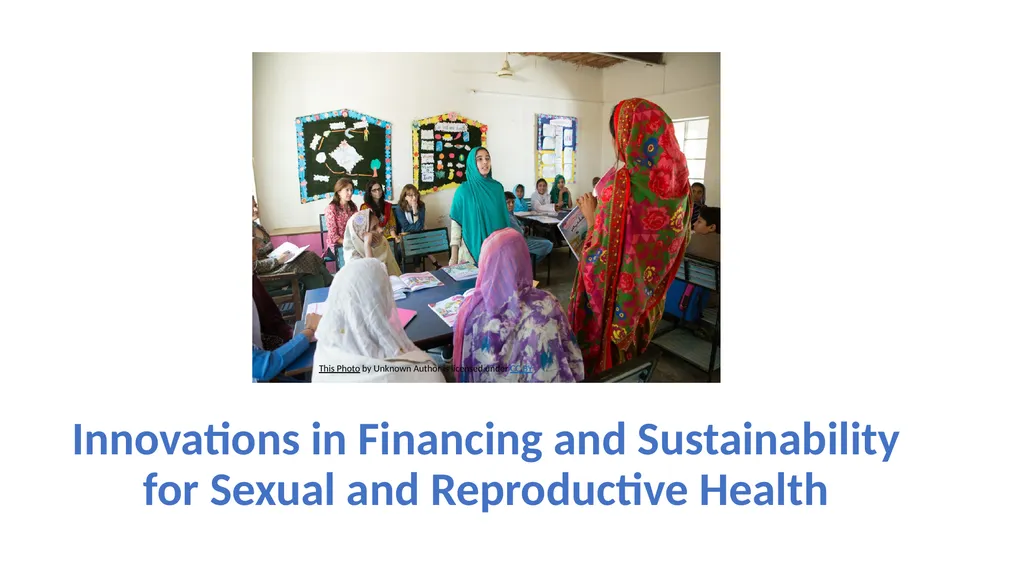
Innovations in Financing and Sustainability for Sexual and Reproductive Health This Photo by Unknown Author is licensed under CC BY<br>
24
Innovations in SRH Financing GOAL – Increased coverage, equity in physical and financial access and use of SRH services and improved quality of services
5 Areas to reach these goals
Targeting - Targeted Financing and policy – impacts access and quality of SRH services
Expansion of government services
Subsidy delivery - Demand side financing
Pay for Performance – Supply side financing
Sustainability<br>
5 Areas to reach these goals
Targeting - Targeted Financing and policy – impacts access and quality of SRH services
Expansion of government services
Subsidy delivery - Demand side financing
Pay for Performance – Supply side financing
Sustainability<br>
25
What national policies can reduce financial barriers? Reduced taxes on FP commodities such as condoms – can reduce prices and improve demand
Approval for specific drugs – e.g., Misoprostol (as alternative to oxytocin) for post partum hemorrhage (PPH) prevention and treatment. Is easily administrable, stable for long periods to reach the poor - has positive impact on RH of women – Tanzania, India and Nigeria (PPH accounts for 25% of MMR)
Need central decisions on what services to be financed by government, Where (rural/urban), How (what providers) and to whom
E.g., FP services that draws most of the OOP can be provided free at government facilities, or subsidized from government funds if utilized in private facilities, or have prepaid (insurance type) schemes where government can pay the premiums for the poor<br>
Approval for specific drugs – e.g., Misoprostol (as alternative to oxytocin) for post partum hemorrhage (PPH) prevention and treatment. Is easily administrable, stable for long periods to reach the poor - has positive impact on RH of women – Tanzania, India and Nigeria (PPH accounts for 25% of MMR)
Need central decisions on what services to be financed by government, Where (rural/urban), How (what providers) and to whom
E.g., FP services that draws most of the OOP can be provided free at government facilities, or subsidized from government funds if utilized in private facilities, or have prepaid (insurance type) schemes where government can pay the premiums for the poor<br>
26
Innovations in targeting - how financing reaches the disadvantaged Sustained accessibility and client-based programmes
Avoid barriers to access – distance, opening hours, stockouts, reducing/ abolishing user fees to overcome financial barrier.
Better identification of needs through community leaders and grassroot organizations e.g. Colombia health equity fund.
Using lower-level providers/ those used by poor for subsidized services (e.g., rural medical informal practitioners in India and Bangladesh or for-profit providers in Peru– franchising the network and financing their training, Supplies, advertising and managing them to provide services at low posted price to the poor).
Ensuring that vulnerable are aware and use the government subsidized health services – Counselling through Community based workers in India, Pakistan and Turkey showed positive impact.
Ensuring responsiveness and gender sensitiveness by providers at the service sites.<br>
Avoid barriers to access – distance, opening hours, stockouts, reducing/ abolishing user fees to overcome financial barrier.
Better identification of needs through community leaders and grassroot organizations e.g. Colombia health equity fund.
Using lower-level providers/ those used by poor for subsidized services (e.g., rural medical informal practitioners in India and Bangladesh or for-profit providers in Peru– franchising the network and financing their training, Supplies, advertising and managing them to provide services at low posted price to the poor).
Ensuring that vulnerable are aware and use the government subsidized health services – Counselling through Community based workers in India, Pakistan and Turkey showed positive impact.
Ensuring responsiveness and gender sensitiveness by providers at the service sites.<br>
27
Innovations through strategic purchasing and Public Private Partnership (PPP) Contracting NGOs and Faith Based organizations e.g., in Ghana Government provides training, supplies and other support. NGO work as branches of the Government.
Contracting specific services to private providers – flat rate reimbursements for specific services to poor – e.g., deliveries under Chiranjeevi program in Gujarat, India; FP services in Colombia and SRH services in Malawi. Also in US, UK and Germany.
Under National Health Insurance schemes contracting private providers and clinic groups e.g., India, Nigeria and Philippines.<br>
Contracting specific services to private providers – flat rate reimbursements for specific services to poor – e.g., deliveries under Chiranjeevi program in Gujarat, India; FP services in Colombia and SRH services in Malawi. Also in US, UK and Germany.
Under National Health Insurance schemes contracting private providers and clinic groups e.g., India, Nigeria and Philippines.<br>
28
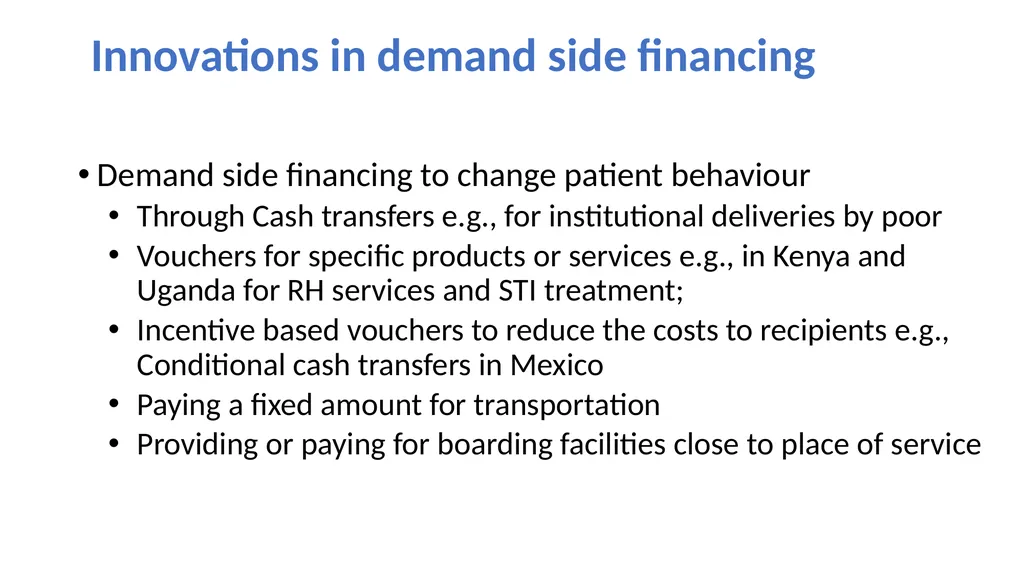
Innovations in demand side financing Demand side financing to change patient behaviour
Through Cash transfers e.g., for institutional deliveries by poor
Vouchers for specific products or services e.g., in Kenya and Uganda for RH services and STI treatment;
Incentive based vouchers to reduce the costs to recipients e.g., Conditional cash transfers in Mexico
Paying a fixed amount for transportation
Providing or paying for boarding facilities close to place of service<br>
Through Cash transfers e.g., for institutional deliveries by poor
Vouchers for specific products or services e.g., in Kenya and Uganda for RH services and STI treatment;
Incentive based vouchers to reduce the costs to recipients e.g., Conditional cash transfers in Mexico
Paying a fixed amount for transportation
Providing or paying for boarding facilities close to place of service<br>
29
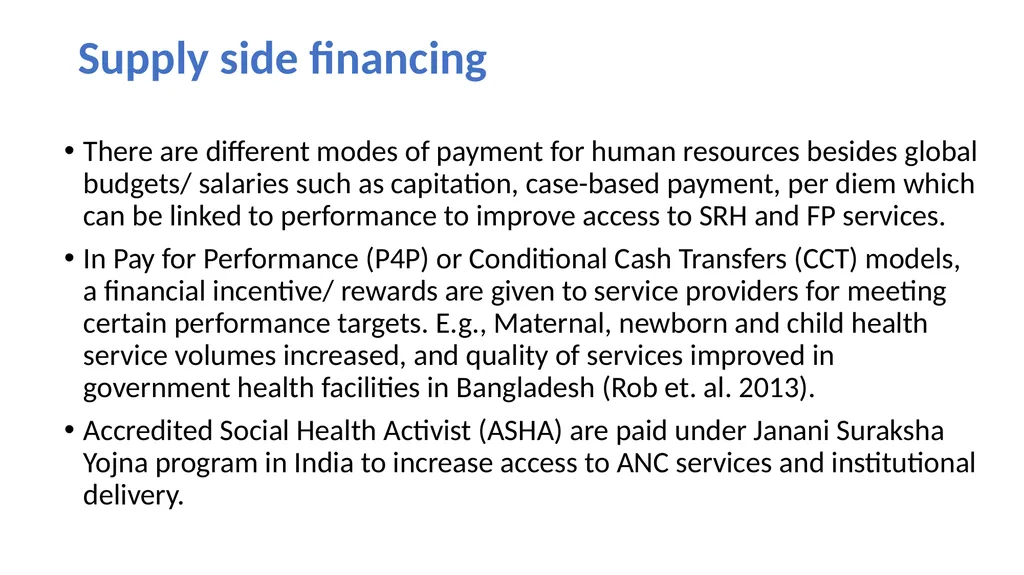
Supply side financing There are different modes of payment for human resources besides global budgets/ salaries such as capitation, case-based payment, per diem which can be linked to performance to improve access to SRH and FP services.
In Pay for Performance (P4P) or Conditional Cash Transfers (CCT) models, a financial incentive/ rewards are given to service providers for meeting certain performance targets. E.g., Maternal, newborn and child health service volumes increased, and quality of services improved in government health facilities in Bangladesh (Rob et. al. 2013).
Accredited Social Health Activist (ASHA) are paid under Janani Suraksha Yojna program in India to increase access to ANC services and institutional delivery.<br>
In Pay for Performance (P4P) or Conditional Cash Transfers (CCT) models, a financial incentive/ rewards are given to service providers for meeting certain performance targets. E.g., Maternal, newborn and child health service volumes increased, and quality of services improved in government health facilities in Bangladesh (Rob et. al. 2013).
Accredited Social Health Activist (ASHA) are paid under Janani Suraksha Yojna program in India to increase access to ANC services and institutional delivery.<br>
30
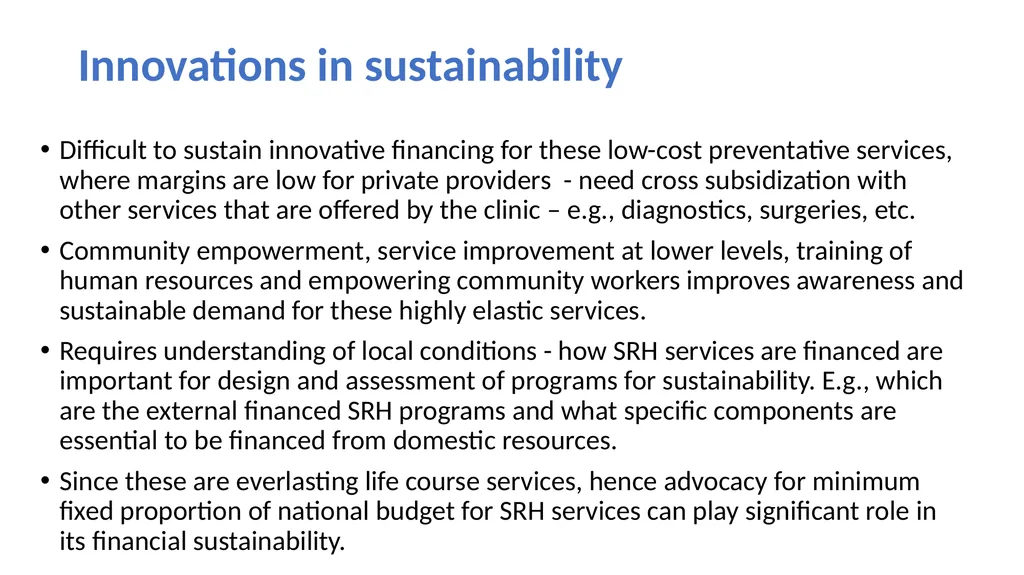
Innovations in sustainability Difficult to sustain innovative financing for these low-cost preventative services, where margins are low for private providers - need cross subsidization with other services that are offered by the clinic – e.g., diagnostics, surgeries, etc.
Community empowerment, service improvement at lower levels, training of human resources and empowering community workers improves awareness and sustainable demand for these highly elastic services.
Requires understanding of local conditions - how SRH services are financed are important for design and assessment of programs for sustainability. E.g., which are the external financed SRH programs and what specific components are essential to be financed from domestic resources.
Since these are everlasting life course services, hence advocacy for minimum fixed proportion of national budget for SRH services can play significant role in its financial sustainability.<br>
Community empowerment, service improvement at lower levels, training of human resources and empowering community workers improves awareness and sustainable demand for these highly elastic services.
Requires understanding of local conditions - how SRH services are financed are important for design and assessment of programs for sustainability. E.g., which are the external financed SRH programs and what specific components are essential to be financed from domestic resources.
Since these are everlasting life course services, hence advocacy for minimum fixed proportion of national budget for SRH services can play significant role in its financial sustainability.<br>
31
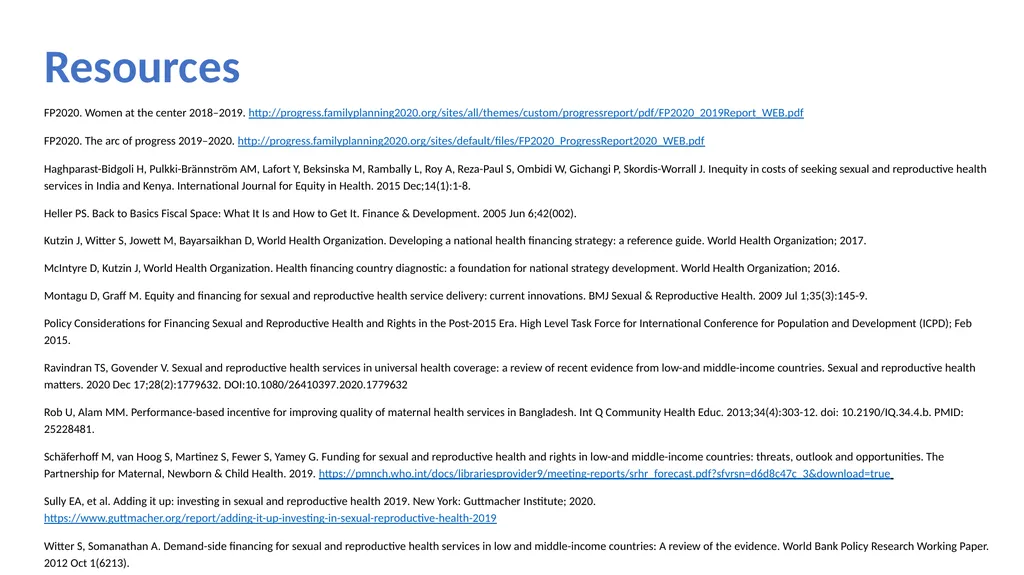
Resources FP2020. Women at the center 2018–2019. http://progress.familyplanning2020.org/sites/all/themes/custom/progressreport/pdf/FP2020_2019Report_WEB.pdf
FP2020. The arc of progress 2019–2020. http://progress.familyplanning2020.org/sites/default/files/FP2020_ProgressReport2020_WEB.pdf
Haghparast-Bidgoli H, Pulkki-Brännström AM, Lafort Y, Beksinska M, Rambally L, Roy A, Reza-Paul S, Ombidi W, Gichangi P, Skordis-Worrall J. Inequity in costs of seeking sexual and reproductive health services in India and Kenya. International Journal for Equity in Health. 2015 Dec;14(1):1-8.
Heller PS. Back to Basics Fiscal Space: What It Is and How to Get It. Finance & Development. 2005 Jun 6;42(002).
Kutzin J, Witter S, Jowett M, Bayarsaikhan D, World Health Organization. Developing a national health financing strategy: a reference guide. World Health Organization; 2017.
McIntyre D, Kutzin J, World Health Organization. Health financing country diagnostic: a foundation for national strategy development. World Health Organization; 2016.
Montagu D, Graff M. Equity and financing for sexual and reproductive health service delivery: current innovations. BMJ Sexual & Reproductive Health. 2009 Jul 1;35(3):145-9.
Policy Considerations for Financing Sexual and Reproductive Health and Rights in the Post-2015 Era. High Level Task Force for International Conference for Population and Development (ICPD); Feb 2015.
Ravindran TS, Govender V. Sexual and reproductive health services in universal health coverage: a review of recent evidence from low-and middle-income countries. Sexual and reproductive health matters. 2020 Dec 17;28(2):1779632. DOI:10.1080/26410397.2020.1779632
Rob U, Alam MM. Performance-based incentive for improving quality of maternal health services in Bangladesh. Int Q Community Health Educ. 2013;34(4):303-12. doi: 10.2190/IQ.34.4.b. PMID: 25228481.
Schäferhoff M, van Hoog S, Martinez S, Fewer S, Yamey G. Funding for sexual and reproductive health and rights in low-and middle-income countries: threats, outlook and opportunities. The Partnership for Maternal, Newborn & Child Health. 2019. https://pmnch.who.int/docs/librariesprovider9/meeting-reports/srhr_forecast.pdf?sfvrsn=d6d8c47c_3&download=true
Sully EA, et al. Adding it up: investing in sexual and reproductive health 2019. New York: Guttmacher Institute; 2020. https://www.guttmacher.org/report/adding-it-up-investing-in-sexual-reproductive-health-2019
Witter S, Somanathan A. Demand-side financing for sexual and reproductive health services in low and middle-income countries: A review of the evidence. World Bank Policy Research Working Paper. 2012 Oct 1(6213).<br>
FP2020. The arc of progress 2019–2020. http://progress.familyplanning2020.org/sites/default/files/FP2020_ProgressReport2020_WEB.pdf
Haghparast-Bidgoli H, Pulkki-Brännström AM, Lafort Y, Beksinska M, Rambally L, Roy A, Reza-Paul S, Ombidi W, Gichangi P, Skordis-Worrall J. Inequity in costs of seeking sexual and reproductive health services in India and Kenya. International Journal for Equity in Health. 2015 Dec;14(1):1-8.
Heller PS. Back to Basics Fiscal Space: What It Is and How to Get It. Finance & Development. 2005 Jun 6;42(002).
Kutzin J, Witter S, Jowett M, Bayarsaikhan D, World Health Organization. Developing a national health financing strategy: a reference guide. World Health Organization; 2017.
McIntyre D, Kutzin J, World Health Organization. Health financing country diagnostic: a foundation for national strategy development. World Health Organization; 2016.
Montagu D, Graff M. Equity and financing for sexual and reproductive health service delivery: current innovations. BMJ Sexual & Reproductive Health. 2009 Jul 1;35(3):145-9.
Policy Considerations for Financing Sexual and Reproductive Health and Rights in the Post-2015 Era. High Level Task Force for International Conference for Population and Development (ICPD); Feb 2015.
Ravindran TS, Govender V. Sexual and reproductive health services in universal health coverage: a review of recent evidence from low-and middle-income countries. Sexual and reproductive health matters. 2020 Dec 17;28(2):1779632. DOI:10.1080/26410397.2020.1779632
Rob U, Alam MM. Performance-based incentive for improving quality of maternal health services in Bangladesh. Int Q Community Health Educ. 2013;34(4):303-12. doi: 10.2190/IQ.34.4.b. PMID: 25228481.
Schäferhoff M, van Hoog S, Martinez S, Fewer S, Yamey G. Funding for sexual and reproductive health and rights in low-and middle-income countries: threats, outlook and opportunities. The Partnership for Maternal, Newborn & Child Health. 2019. https://pmnch.who.int/docs/librariesprovider9/meeting-reports/srhr_forecast.pdf?sfvrsn=d6d8c47c_3&download=true
Sully EA, et al. Adding it up: investing in sexual and reproductive health 2019. New York: Guttmacher Institute; 2020. https://www.guttmacher.org/report/adding-it-up-investing-in-sexual-reproductive-health-2019
Witter S, Somanathan A. Demand-side financing for sexual and reproductive health services in low and middle-income countries: A review of the evidence. World Bank Policy Research Working Paper. 2012 Oct 1(6213).<br>
32
THANK YOU This Photo by Unknown Author is licensed under CC BY-SA-NC<br>