
This Photo by Unknown Author is licensed under CC
MT
Published · 13 slides · 0 views
1 / 1
Description
This Photo by Unknown Author is licensed under CC BY CSI Unit Training Materials Power of Evidence T. Tomm Updated 2023 https:sciencespot.net Topics include types of evidence, including physical, testimonial, and circumstantial Teacher
Related Topics
Share
Embed code
Download this presentation From Below
"This Photo by Unknown Author is licensed under CC" is the property of its rightful owner. Permission is granted to download and print the materials on this website for personal, non-commercial use only, and to display it on your personal computer provided you do not modify the materials and that you retain all copyright notices contained in the materials. By downloading content from our website, you accept the terms of this agreement.
Presentation Transcript
01
This Photo by Unknown Author is licensed under CC BY CSI Unit Training Materials Power of Evidence T. Tomm Updated 2023
https://sciencespot.net Topics include types of evidence, including physical, testimonial, and circumstantial Teacher Notes:
The student digital slides for this unit (second part of the Crime Scenes Basics unit) are available at https://docs.google.com/presentation/d/14QpxIdbjv8hXIOGug5pkuWNbU6z8Hbq41-6q8DJACPs/edit?usp=sharing
IMPORTANT: Make a copy of the student notebook before you assign it on your LMS. It is view-only and I am not able to approve access for your students.
The FULL digital notebook (with all the slides for the digital lessons and activities) is available at https://docs.google.com/presentation/d/14eIEiGacRXMsDyuUxiEsSM2m4YOAtIlfmD4O4YsLdPI/edit?usp=sharing. It is set up for standard paper (8.5x11) in landscape mode for easier printing when needed. Paper versions are available for this unit on my Forensic Science page at https://sciencespot.net/Pages/classforsci.html
A DRAFT of the general outline of the digital lessons (with corresponding slide #s for the student notebook) is available at https://docs.google.com/document/d/15wxjmL-uHQPXDKOxmZXtU_gxy9dphEuyC1P4jzP-9mA/edit?usp=sharing . It is based on 44-minute class periods with 7th & 8th grade students.
Preview presentations before using with your classes as many slides have animations and links you will need to use.
I do Science Starters at the beginning of each class period. A collection of starters for Forensics is available on my lessons plans page at https://sciencespot.net/Pages/classforsci.html .<br>
02
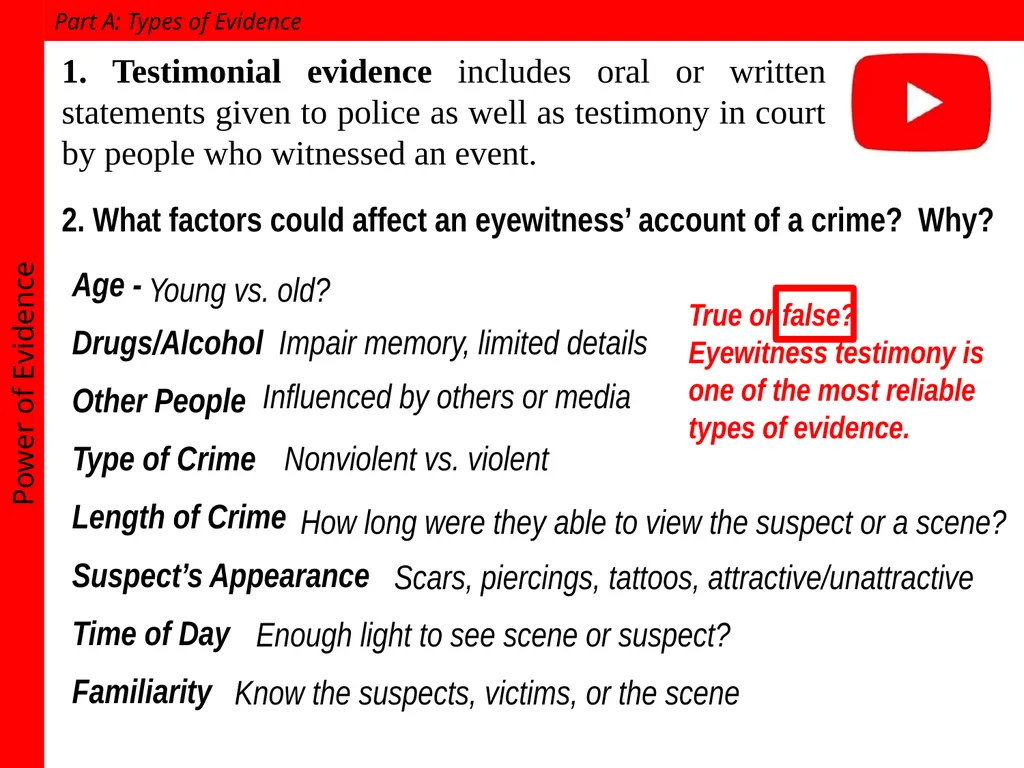
2. What factors could affect an eyewitness’ account of a crime? Why? Power of Evidence Part A: Types of Evidence Age -
Drugs/Alcohol
Other People
Type of Crime
Length of Crime
Suspect’s Appearance
Time of Day
Familiarity 1. Testimonial evidence includes oral or written statements given to police as well as testimony in court by people who witnessed an event. Young vs. old? Impair memory, limited details Influenced by others or media Nonviolent vs. violent How long were they able to view the suspect or a scene? Scars, piercings, tattoos, attractive/unattractive Enough light to see scene or suspect? Know the suspects, victims, or the scene True or false? Eyewitness testimony is one of the most reliable types of evidence.<br>
03
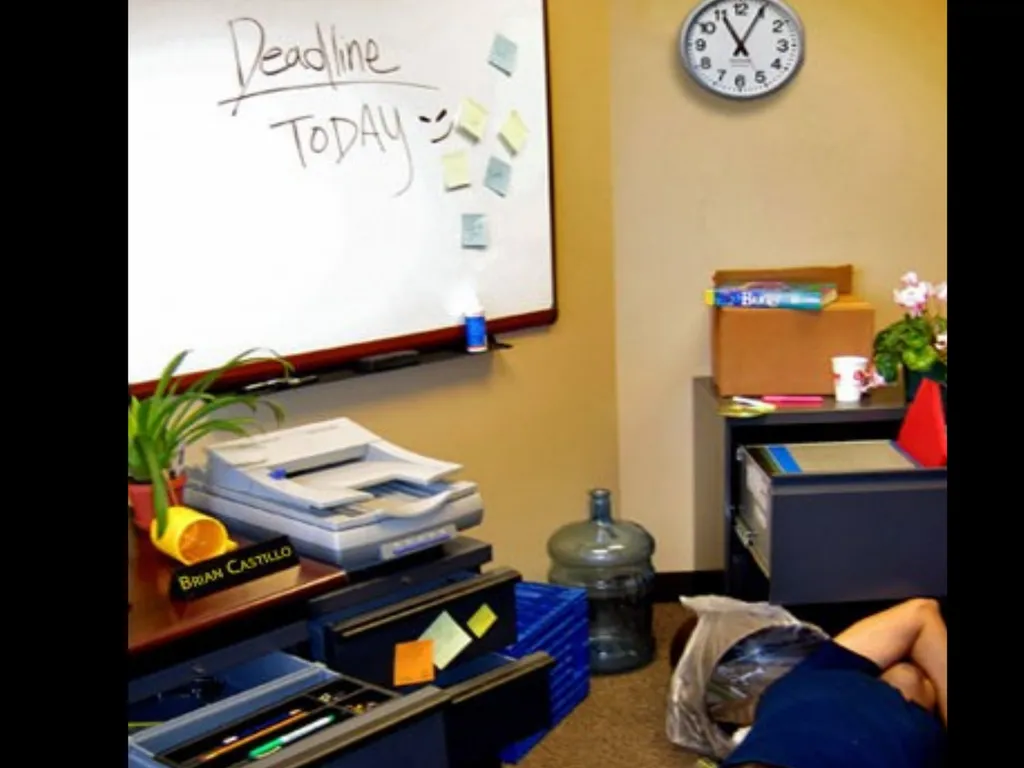
Eyewitness Challenge Let’s test your eyewitness skills!
You will have 1 minute to study the photograph of a crime scene on the next slide.
Try to pay attention to details as you will be asked 10 questions about the crime scene!
You are not allowed to write anything down until after the time is up.
Ready?<br>
You will have 1 minute to study the photograph of a crime scene on the next slide.
Try to pay attention to details as you will be asked 10 questions about the crime scene!
You are not allowed to write anything down until after the time is up.
Ready?<br>
04
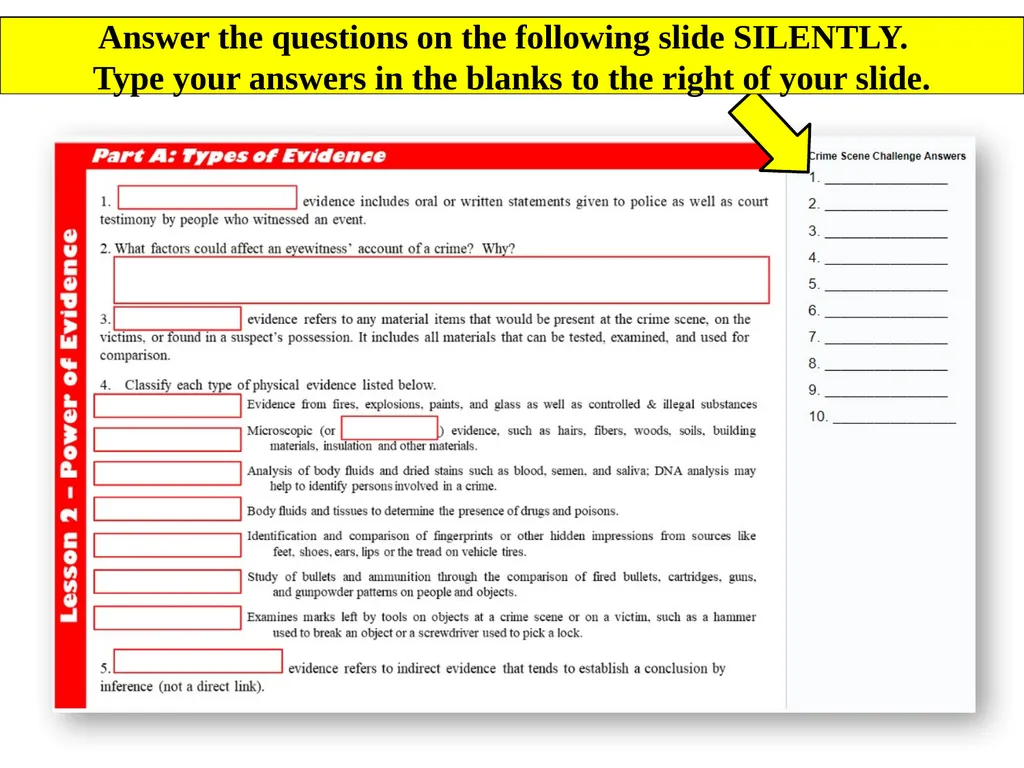
Answer the questions on the following slide SILENTLY.
Type your answers in the blanks to the right of your slide.<br>
05
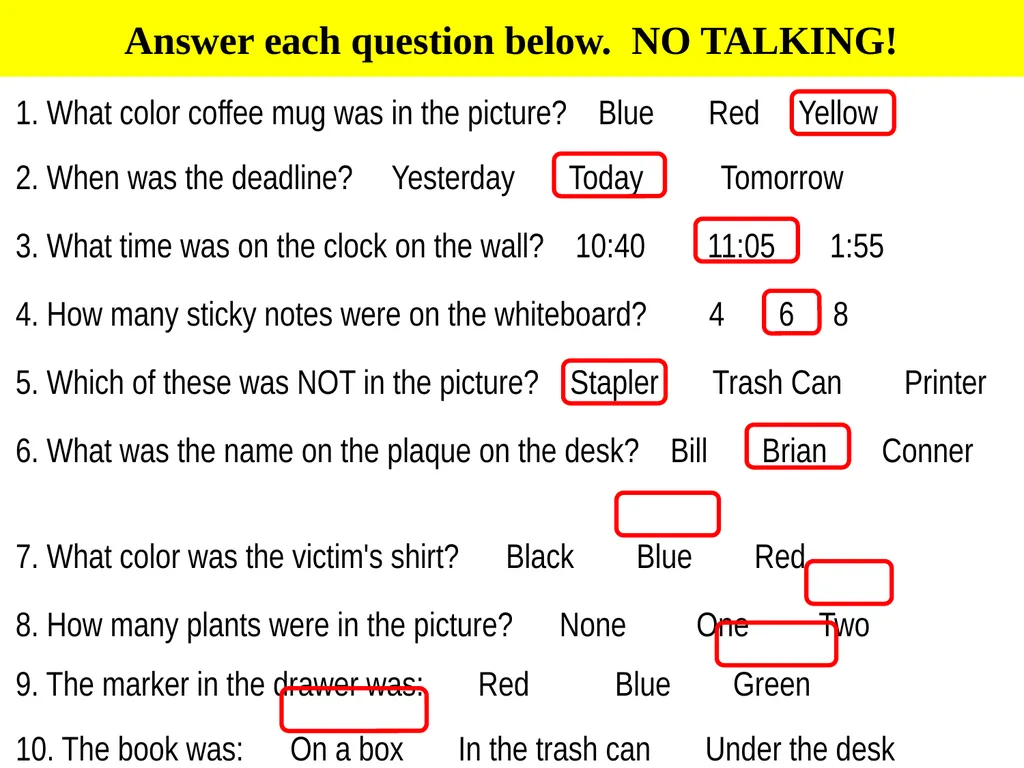
Answer each question below. NO TALKING! 1. What color coffee mug was in the picture? Blue Red Yellow
2. When was the deadline? Yesterday Today Tomorrow
3. What time was on the clock on the wall? 10:40 11:05 1:55
4. How many sticky notes were on the whiteboard? 4 6 8
5. Which of these was NOT in the picture? Stapler Trash Can Printer
6. What was the name on the plaque on the desk? Bill Brian Conner
7. What color was the victim's shirt? Black Blue Red
8. How many plants were in the picture? None One Two
9. The marker in the drawer was: Red Blue Green
10. The book was: On a box In the trash can Under the desk Source: http://forensics.rice.edu/html/picture_begin.html<br>
06
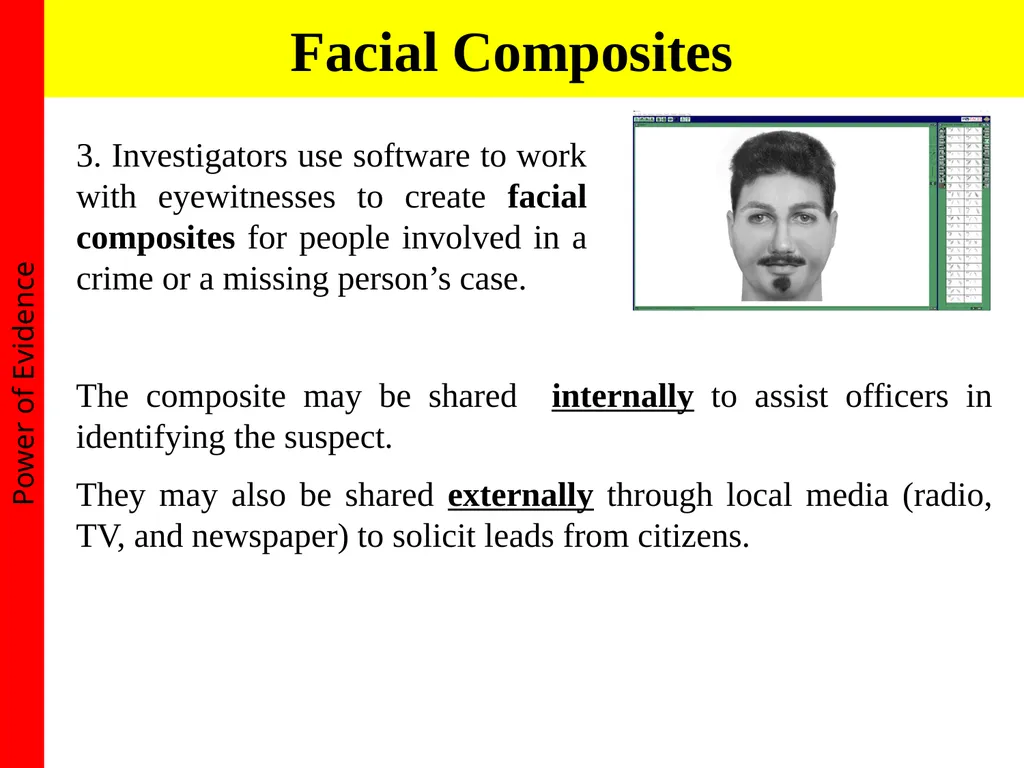
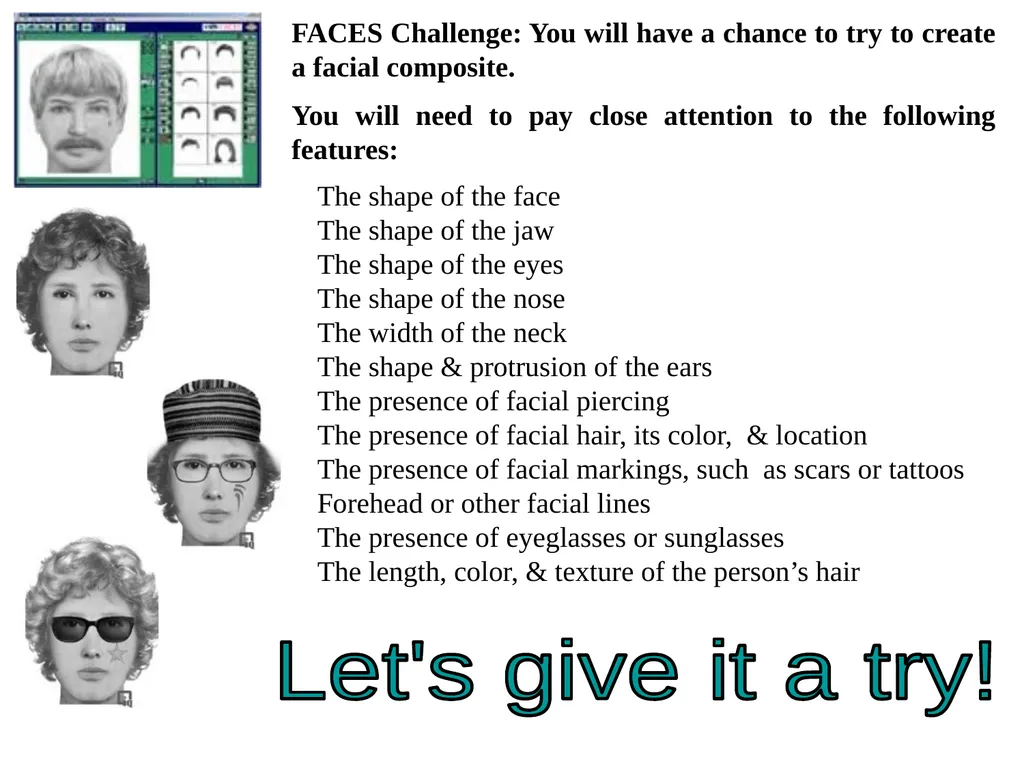
Facial Composites 3. Investigators use software to work with eyewitnesses to create facial composites for people involved in a crime or a missing person’s case. The composite may be shared internally to assist officers in identifying the suspect.
They may also be shared externally through local media (radio, TV, and newspaper) to solicit leads from citizens. Power of Evidence<br>
They may also be shared externally through local media (radio, TV, and newspaper) to solicit leads from citizens. Power of Evidence<br>
07
The shape of the face
The shape of the jaw
The shape of the eyes
The shape of the nose
The width of the neck
The shape & protrusion of the ears
The presence of facial piercing
The presence of facial hair, its color, & location
The presence of facial markings, such as scars or tattoos
Forehead or other facial lines
The presence of eyeglasses or sunglasses
The length, color, & texture of the person’s hair Let's give it a try! The FACES software is available for purchase from https://facialcomposites.com/ I use it as a whole-class activity. They have random options that will create a composite. You can customize the amount of time they get to view the “suspect” and how many different features you want to use, which can be used to challenge your class to pick the right parts to make a match. It is a bit pricy, but the students love this activity!<br>
08
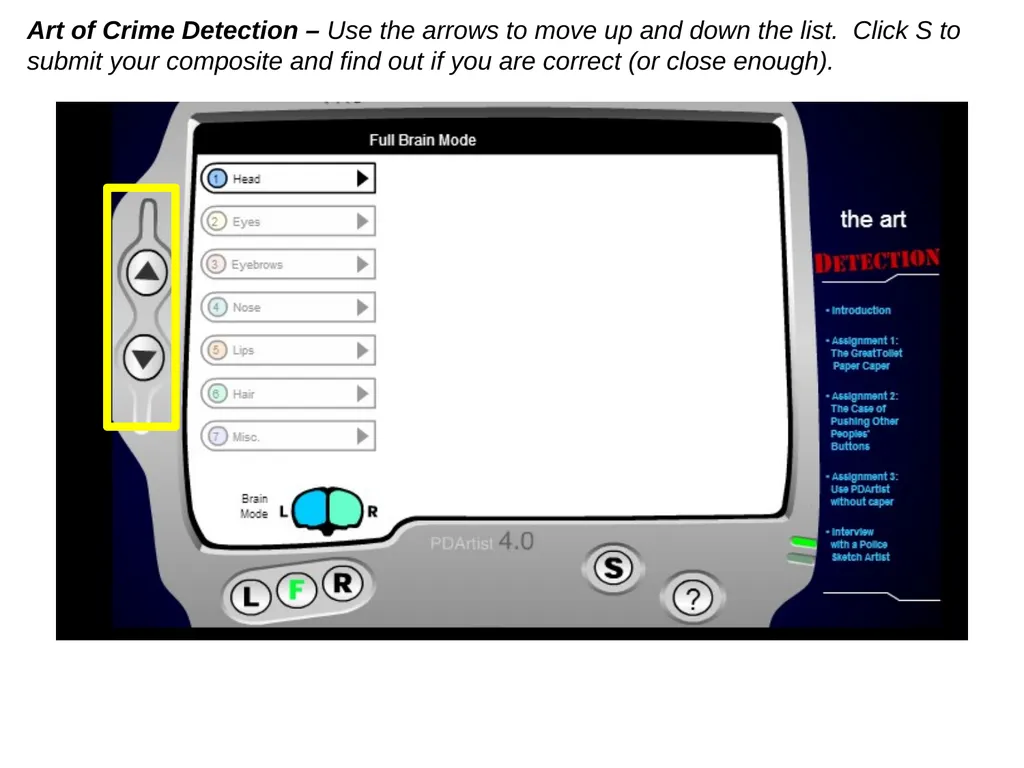
Art of Crime Detection – Use the arrows to move up and down the list. Click S to submit your composite and find out if you are correct (or close enough). The link for this activity is listed on my Forensic Science Links page at https://sciencespot.net/Pages/rdss_forsci.html
If you do not have access to FACES, this website is available online if your district allows the Ruffle extension for Chrome browsers at https://ruffle.rs/. The extension allows you to utilize flash-based programs from the past!
This activity does not have as many features as the pricy version, but it is great for exploring facial composites.<br>
09
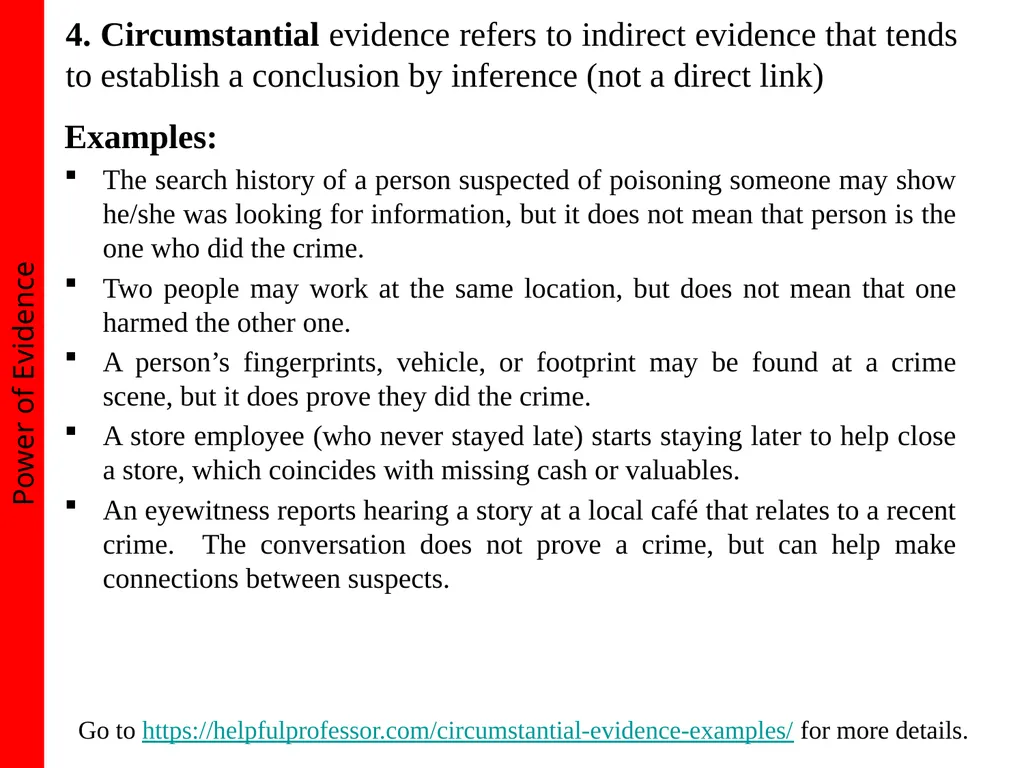
Power of Evidence 4. Circumstantial evidence refers to indirect evidence that tends to establish a conclusion by inference (not a direct link) Examples:
The search history of a person suspected of poisoning someone may show he/she was looking for information, but it does not mean that person is the one who did the crime.
Two people may work at the same location, but does not mean that one harmed the other one.
A person’s fingerprints, vehicle, or footprint may be found at a crime scene, but it does prove they did the crime.
A store employee (who never stayed late) starts staying later to help close a store, which coincides with missing cash or valuables.
An eyewitness reports hearing a story at a local café that relates to a recent crime. The conversation does not prove a crime, but can help make connections between suspects. Go to https://helpfulprofessor.com/circumstantial-evidence-examples/ for more details.<br>
10
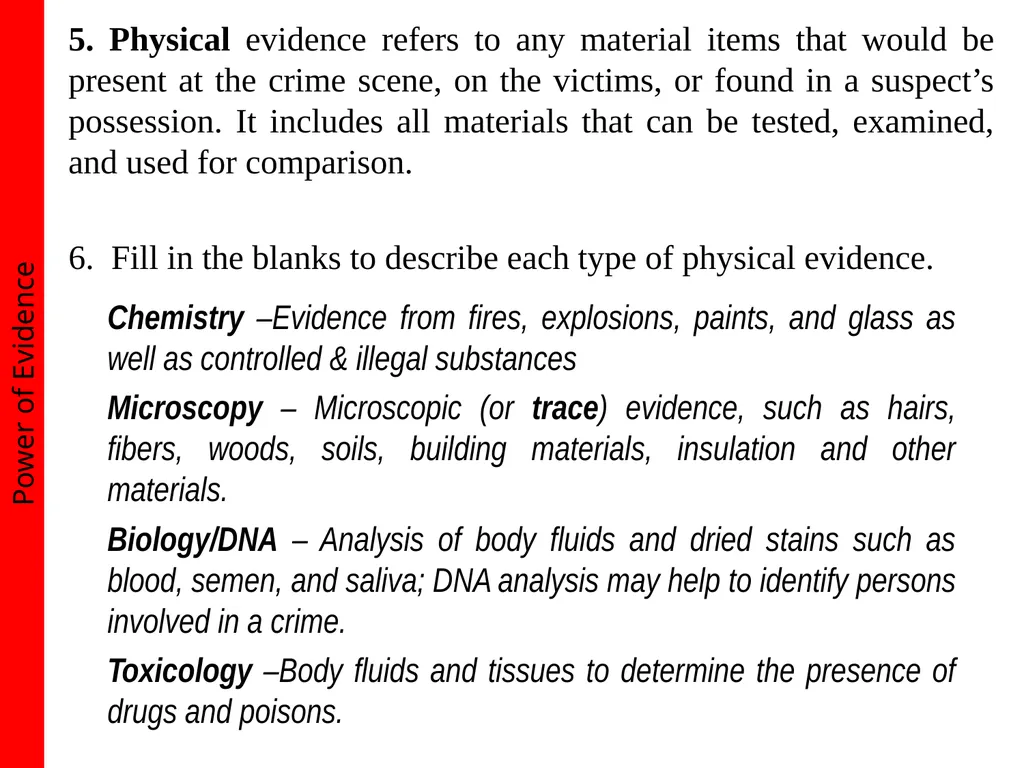
5. Physical evidence refers to any material items that would be present at the crime scene, on the victims, or found in a suspect’s possession. It includes all materials that can be tested, examined, and used for comparison.
6. Fill in the blanks to describe each type of physical evidence. Power of Evidence Chemistry –Evidence from fires, explosions, paints, and glass as well as controlled & illegal substances
Microscopy – Microscopic (or trace) evidence, such as hairs, fibers, woods, soils, building materials, insulation and other materials.
Biology/DNA – Analysis of body fluids and dried stains such as blood, semen, and saliva; DNA analysis may help to identify persons involved in a crime.
Toxicology –Body fluids and tissues to determine the presence of drugs and poisons.<br>
11
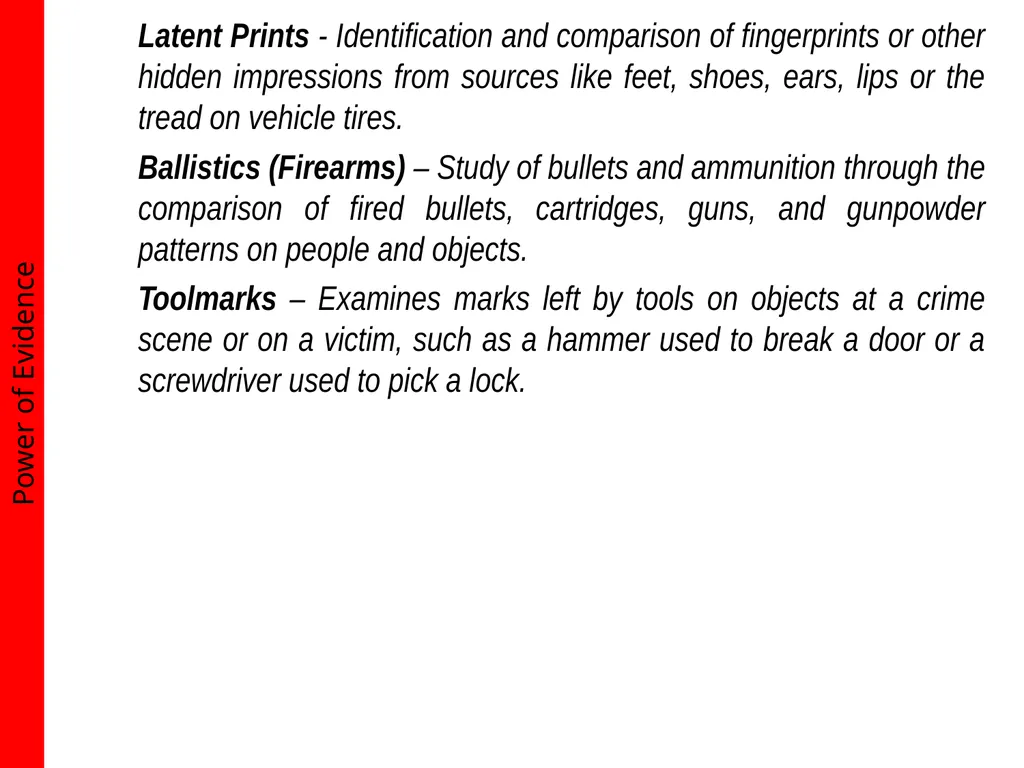
Power of Evidence Latent Prints - Identification and comparison of fingerprints or other hidden impressions from sources like feet, shoes, ears, lips or the tread on vehicle tires.
Ballistics (Firearms) – Study of bullets and ammunition through the comparison of fired bullets, cartridges, guns, and gunpowder patterns on people and objects.
Toolmarks – Examines marks left by tools on objects at a crime scene or on a victim, such as a hammer used to break a door or a screwdriver used to pick a lock.<br>
12
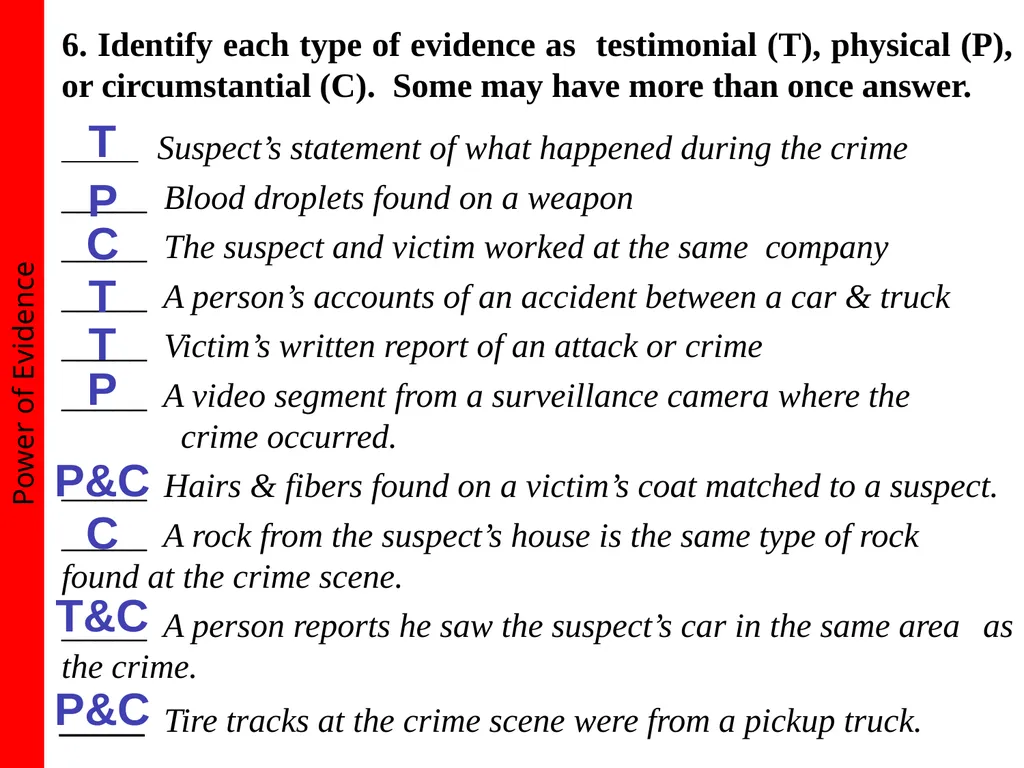
6. Identify each type of evidence as testimonial (T), physical (P), or circumstantial (C). Some may have more than once answer.
______ Suspect’s statement of what happened during the crime
_____ Blood droplets found on a weapon
_____ The suspect and victim worked at the same company
_____ A person’s accounts of an accident between a car & truck
_____ Victim’s written report of an attack or crime
_____ A video segment from a surveillance camera where the crime occurred.
_____ Hairs & fibers found on a victim’s coat matched to a suspect.
_____ A rock from the suspect’s house is the same type of rock found at the crime scene.
_____ A person reports he saw the suspect’s car in the same area as the crime.
_____ Tire tracks at the crime scene were from a pickup truck. Power of Evidence T P C T P P&C C T&C T P&C<br>