
This slide deck has been designed to be customised
Description: This slide deck has been designed to be customised by paediatric diabetes teams to: communicate the main national and unit level findings from the PREM audit facilitate interpretation of results use the data to stimulate quality improvement
Related Topics
Download Presentation
"This slide deck has been designed to be customised" is the property of its rightful owner. Permission is granted to download and print the materials on this website for personal, non-commercial use only, and to display it on your personal computer provided you do not modify the materials and that you retain all copyright notices contained in the materials. By downloading content from our website, you accept the terms of this agreement.
Presentation Transcript
slide1. This slide deck has been designed to be customised by paediatric diabetes teams to:
communicate the main national and unit level findings from the PREM audit
facilitate interpretation of results
use the data to stimulate quality improvement activity
All unit level graphs displayed are placeholders, and the next slide contains a link to a tutorial on using the snipping tool to copy and paste graphs. NPDA 2021/22 PREM results presentation template<br>
slide2. NPDA National PREM Report 2021
Appendix to the NPDA National PREM Report 2021
How to use the snipping tool to cut and paste graphs if preferred (please note the resolution will likely be higher if graphs are downloaded as jpegs from NPDA Results Online- click the bottom left hand square within each graph generated to do so)
Excel files of current and historical summary NPDA data NPDA PREM 2021 results presentation template:
Resources to support your presentation<br>
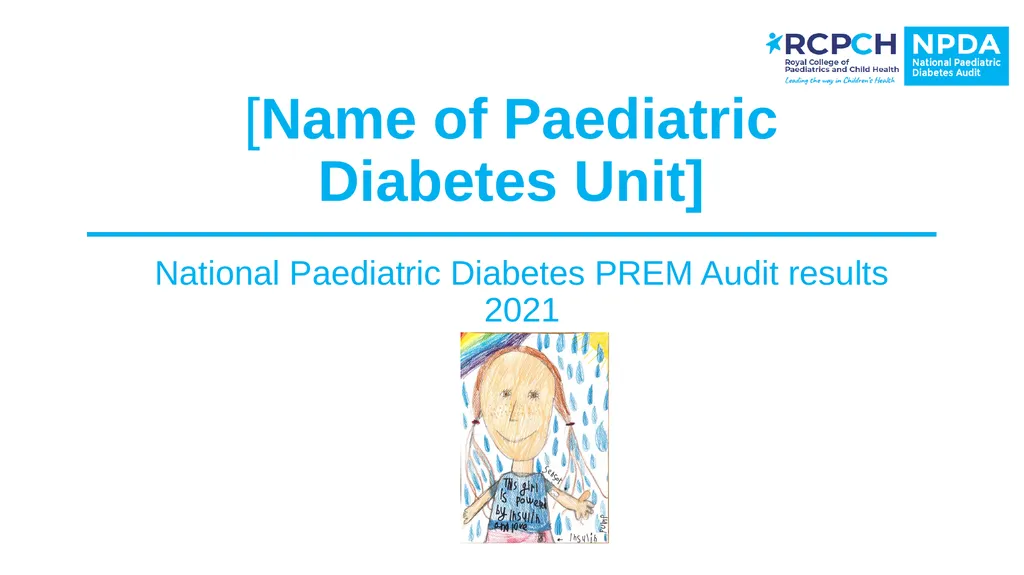
slide3. [Name of Paediatric Diabetes Unit] National Paediatric Diabetes PREM Audit results 2021<br>
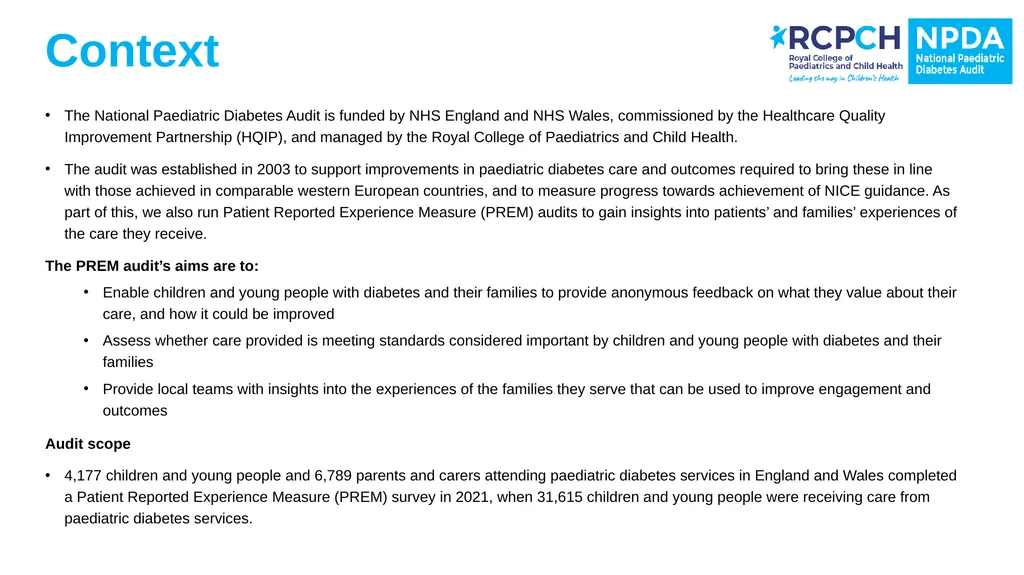
slide4. Context The National Paediatric Diabetes Audit is funded by NHS England and NHS Wales, commissioned by the Healthcare Quality Improvement Partnership (HQIP), and managed by the Royal College of Paediatrics and Child Health.
The audit was established in 2003 to support improvements in paediatric diabetes care and outcomes required to bring these in line with those achieved in comparable western European countries, and to measure progress towards achievement of NICE guidance. As part of this, we also run Patient Reported Experience Measure (PREM) audits to gain insights into patients’ and families’ experiences of the care they receive.
The PREM audit’s aims are to:
Enable children and young people with diabetes and their families to provide anonymous feedback on what they value about their care, and how it could be improved
Assess whether care provided is meeting standards considered important by children and young people with diabetes and their families
Provide local teams with insights into the experiences of the families they serve that can be used to improve engagement and outcomes
Audit scope
4,177 children and young people and 6,789 parents and carers attending paediatric diabetes services in England and Wales completed a Patient Reported Experience Measure (PREM) survey in 2021, when 31,615 children and young people were receiving care from paediatric diabetes services.<br>
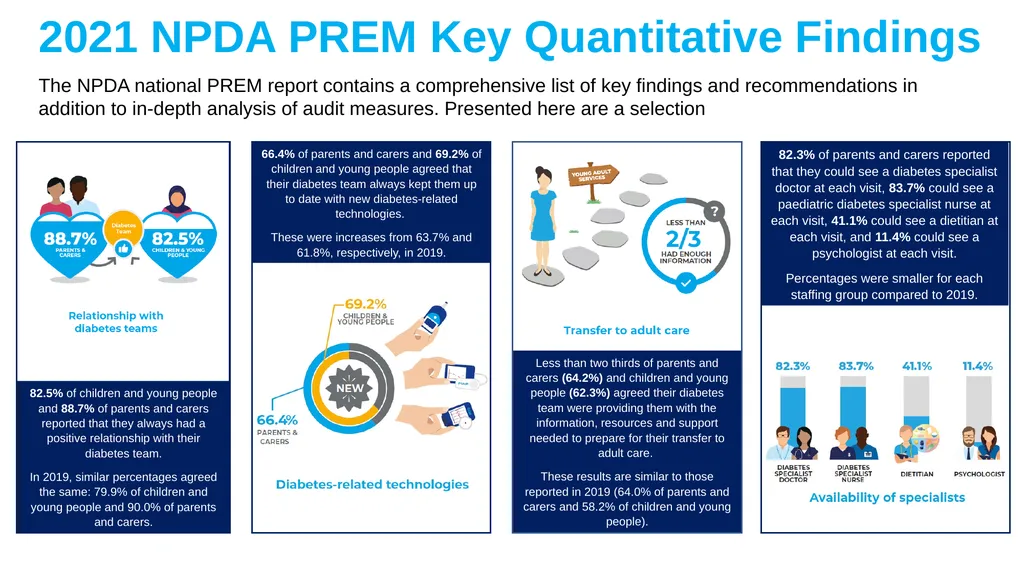
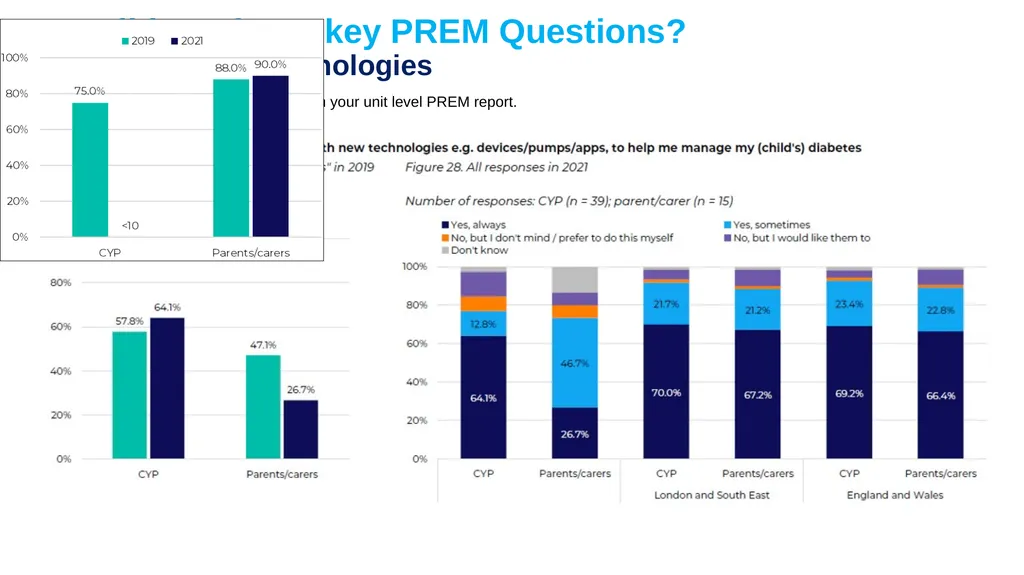
slide5. 2021 NPDA PREM Key Quantitative Findings The NPDA national PREM report contains a comprehensive list of key findings and recommendations in addition to in-depth analysis of audit measures. Presented here are a selection 66.4% of parents and carers and 69.2% of children and young people agreed that their diabetes team always kept them up to date with new diabetes-related technologies.
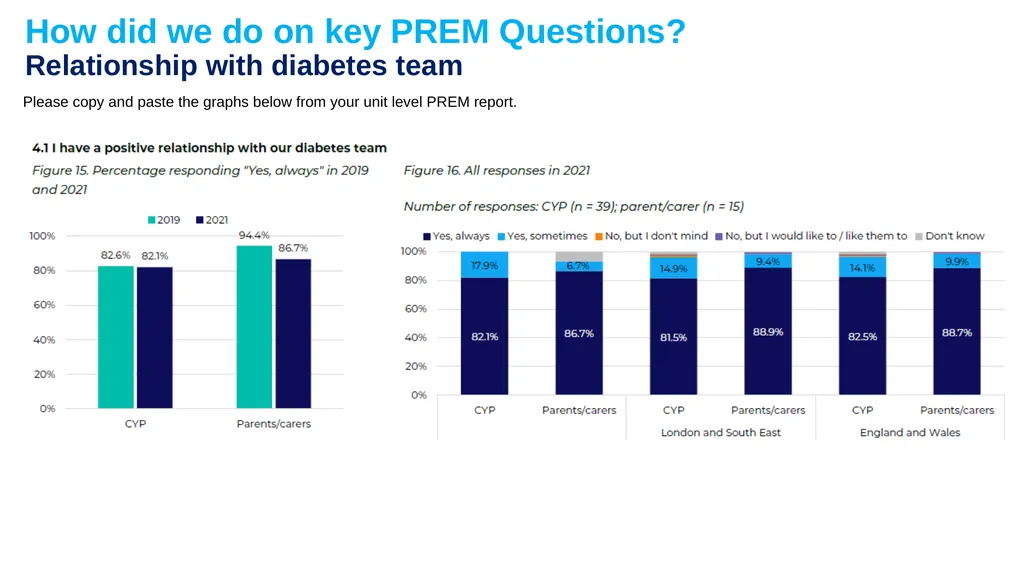
These were increases from 63.7% and 61.8%, respectively, in 2019. 82.5% of children and young people and 88.7% of parents and carers reported that they always had a positive relationship with their diabetes team.
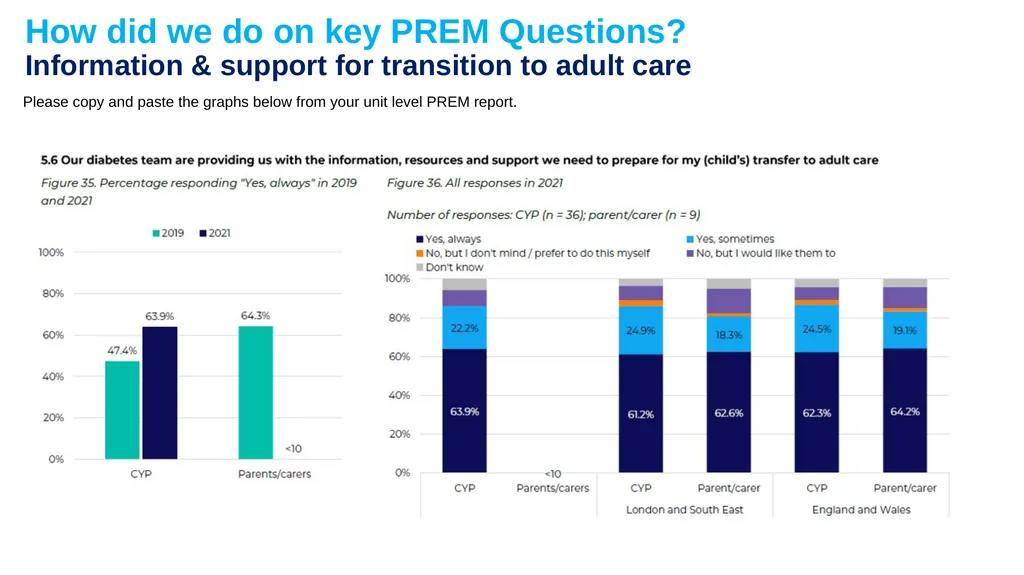
In 2019, similar percentages agreed the same: 79.9% of children and young people and 90.0% of parents and carers. Less than two thirds of parents and carers (64.2%) and children and young people (62.3%) agreed their diabetes team were providing them with the information, resources and support needed to prepare for their transfer to adult care.
These results are similar to those reported in 2019 (64.0% of parents and carers and 58.2% of children and young people). 82.3% of parents and carers reported that they could see a diabetes specialist doctor at each visit, 83.7% could see a paediatric diabetes specialist nurse at each visit, 41.1% could see a dietitian at each visit, and 11.4% could see a psychologist at each visit.
Percentages were smaller for each staffing group compared to 2019.<br>
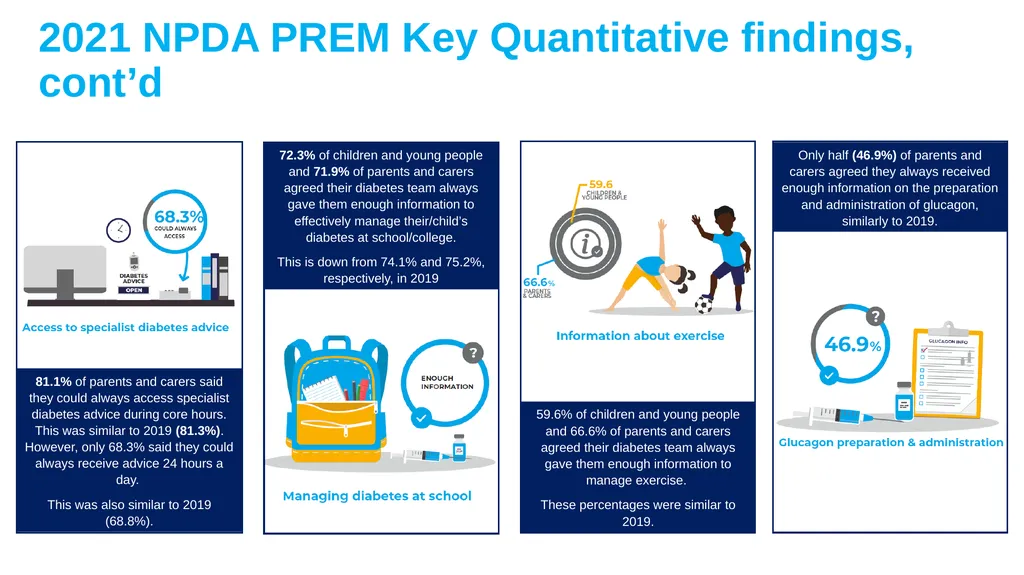
slide6. 2021 NPDA PREM Key Quantitative findings, cont’d 81.1% of parents and carers said they could always access specialist diabetes advice during core hours. This was similar to 2019 (81.3%). However, only 68.3% said they could always receive advice 24 hours a day.
This was also similar to 2019 (68.8%). 72.3% of children and young people and 71.9% of parents and carers agreed their diabetes team always gave them enough information to effectively manage their/child’s diabetes at school/college.
This is down from 74.1% and 75.2%, respectively, in 2019 59.6% of children and young people and 66.6% of parents and carers agreed their diabetes team always gave them enough information to manage exercise.
These percentages were similar to 2019. Only half (46.9%) of parents and carers agreed they always received enough information on the preparation and administration of glucagon, similarly to 2019.<br>
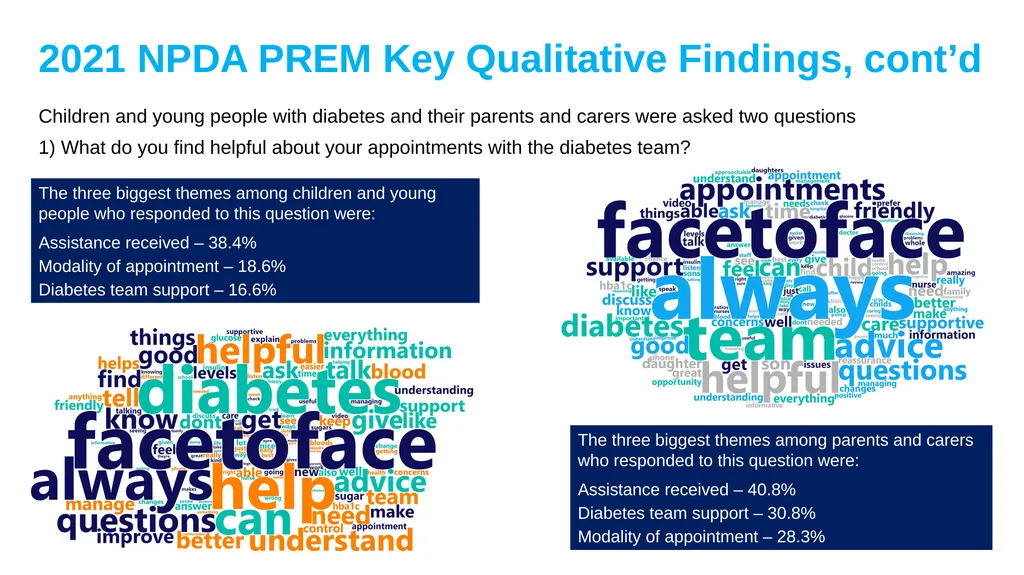
slide7. 2021 NPDA PREM Key Qualitative Findings, cont’d Children and young people with diabetes and their parents and carers were asked two questions
1) What do you find helpful about your appointments with the diabetes team? The three biggest themes among children and young people who responded to this question were:
Assistance received – 38.4%
Modality of appointment – 18.6%
Diabetes team support – 16.6% The three biggest themes among parents and carers who responded to this question were:
Assistance received – 40.8%
Diabetes team support – 30.8%
Modality of appointment – 28.3%<br>
slide8. 2021 NPDA PREM Key Qualitative Findings, cont’d Children and young people with diabetes and their parents and carers were asked two questions
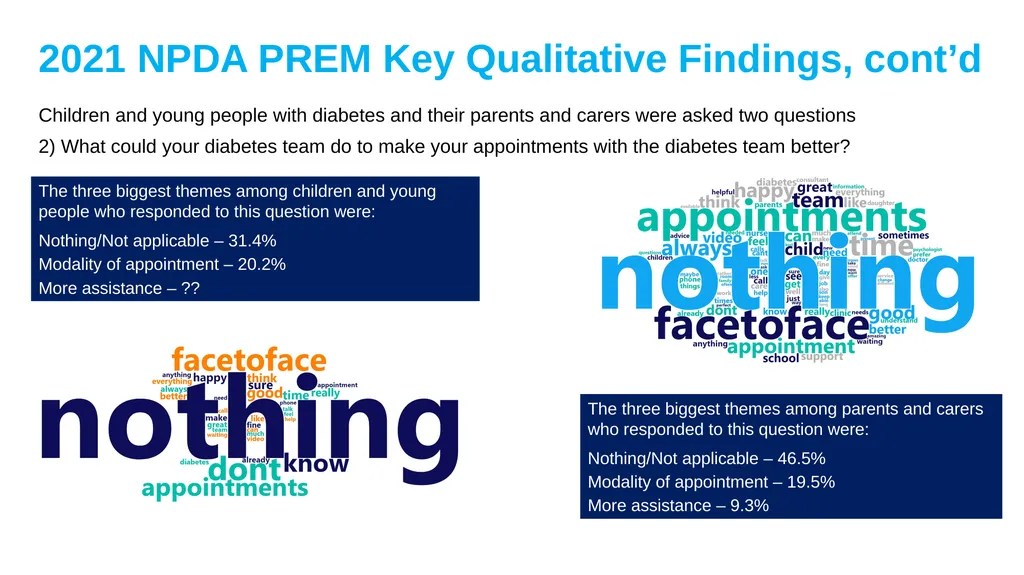
2) What could your diabetes team do to make your appointments with the diabetes team better? The three biggest themes among children and young people who responded to this question were:
Nothing/Not applicable – 31.4%
Modality of appointment – 20.2%
More assistance – ?? The three biggest themes among parents and carers who responded to this question were:
Nothing/Not applicable – 46.5%
Modality of appointment – 19.5%
More assistance – 9.3%<br>
slide9. How did we do on key PREM Questions? Relationship with diabetes team Please copy and paste the graphs below from your unit level PREM report.<br>
slide10. How did we do on key PREM Questions? Diabetes related technologies Please copy and paste the graphs below from your unit level PREM report.<br>
slide11. How did we do on key PREM Questions? Information & support for transition to adult care Please copy and paste the graphs below from your unit level PREM report.<br>
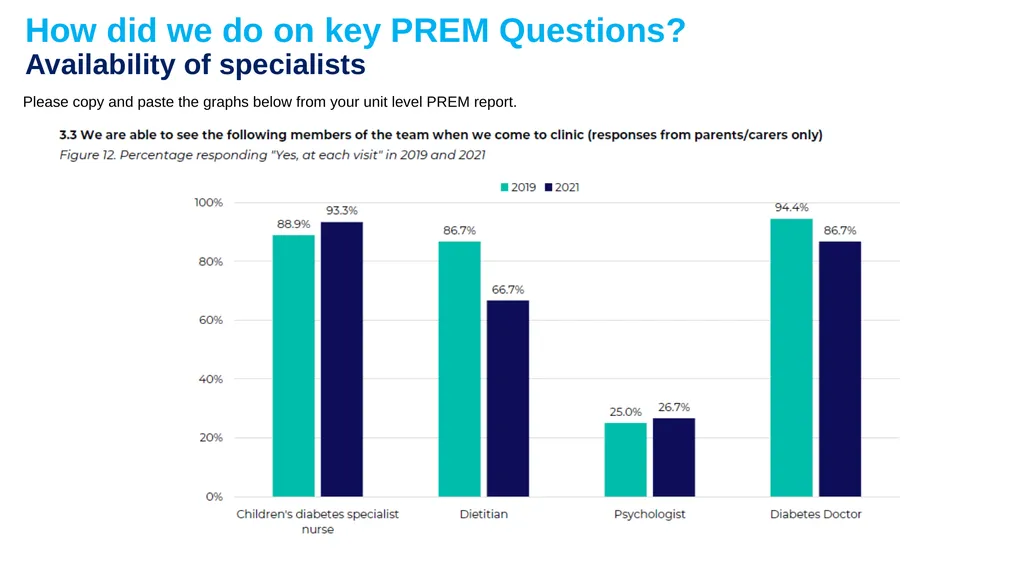
slide12. How did we do on key PREM Questions? Availability of specialists Please copy and paste the graphs below from your unit level PREM report.<br>
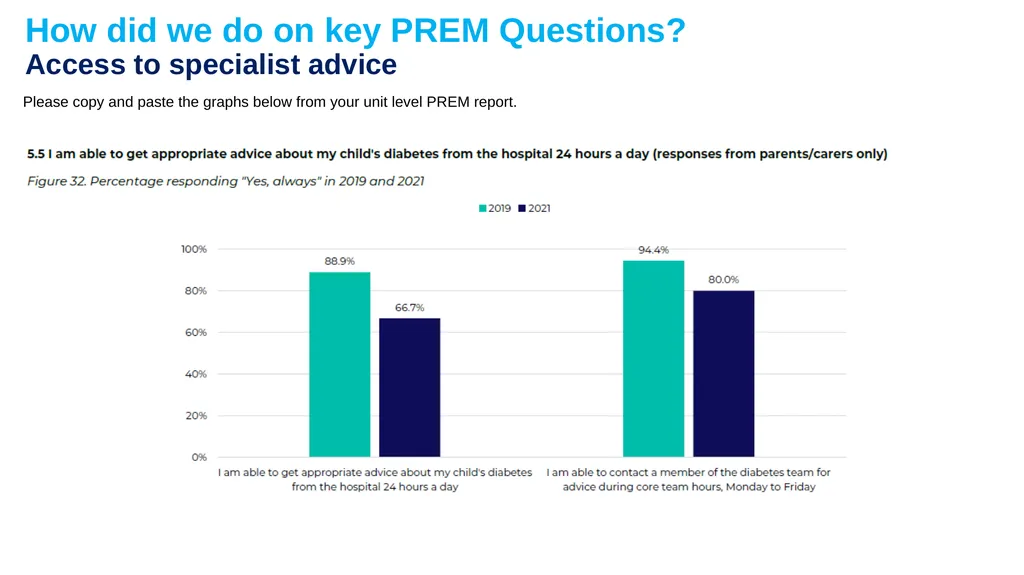
slide13. How did we do on key PREM Questions? Access to specialist advice Please copy and paste the graphs below from your unit level PREM report.<br>
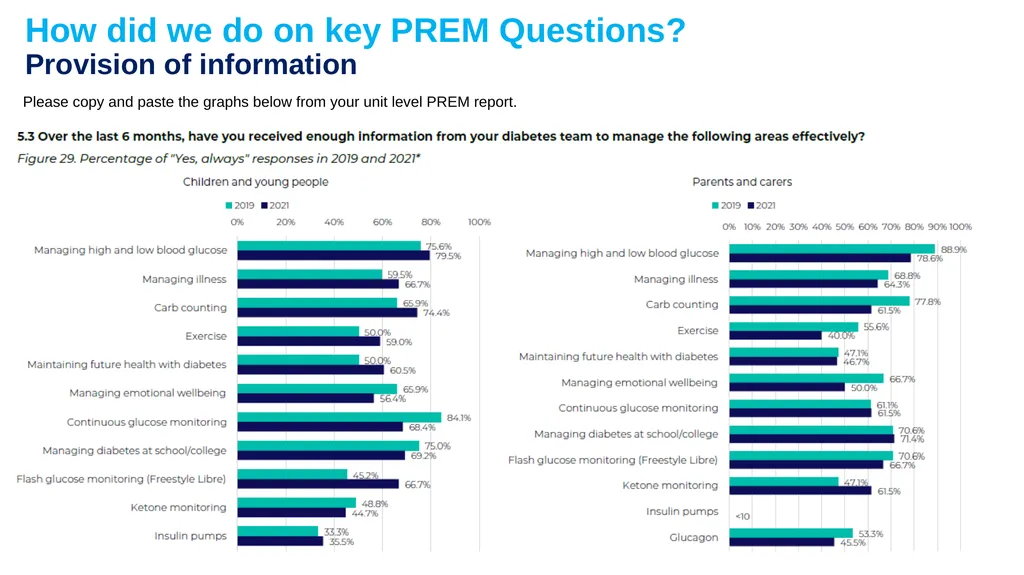
slide14. How did we do on key PREM Questions? Provision of information Please copy and paste the graphs below from your unit level PREM report.<br>
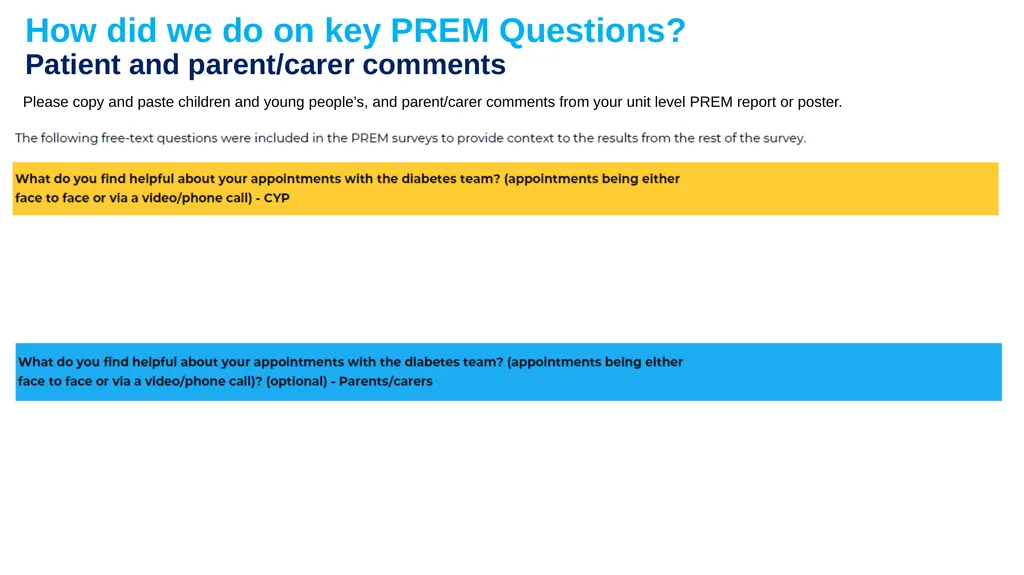
slide15. How did we do on key PREM Questions? Patient and parent/carer comments Please copy and paste children and young people’s, and parent/carer comments from your unit level PREM report or poster.<br>
slide16. How did we do on key PREM Questions? Patient and parent/carer comments Please copy and paste children and young people’s, and parent/carer comments from your unit level PREM report or poster.<br>
slide17. In what areas of patient experience are we doing well?
Could we share this with our local/regional network?
What areas of patient experience could we improve?
How can we involve patients in the improvement process?
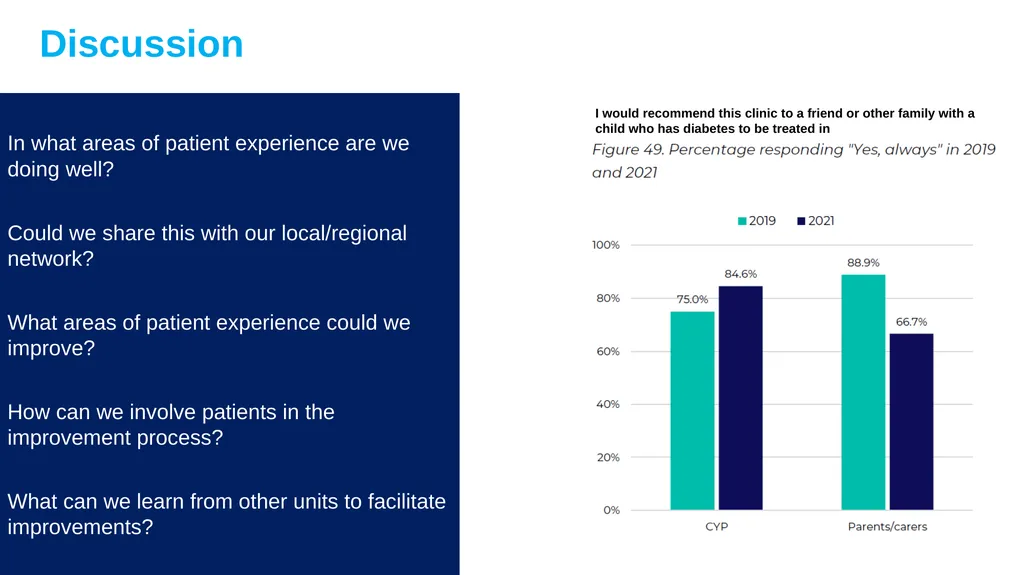
What can we learn from other units to facilitate improvements? Discussion I would recommend this clinic to a friend or other family with a child who has diabetes to be treated in<br>
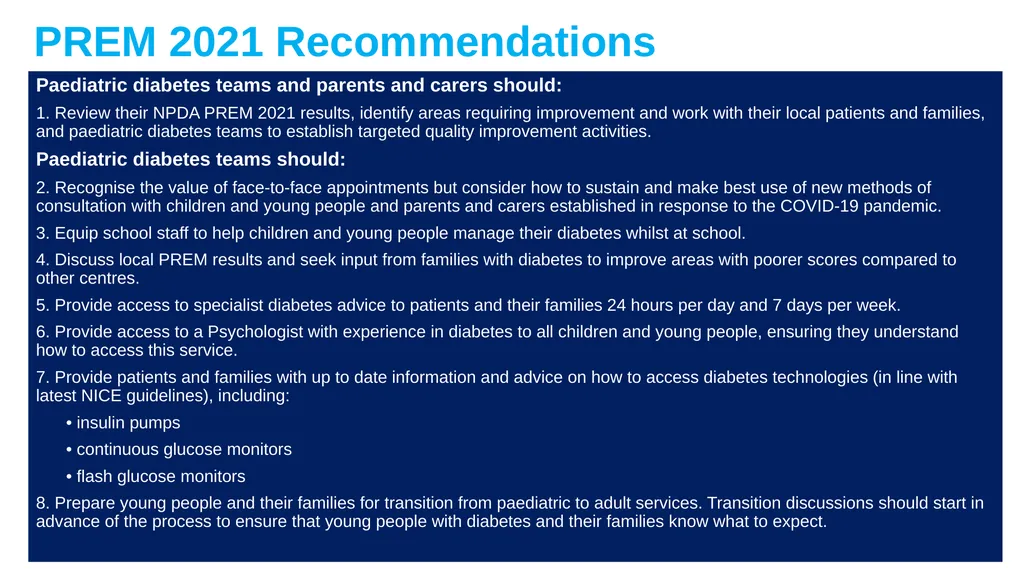
slide18. PREM 2021 Recommendations Paediatric diabetes teams and parents and carers should:
1. Review their NPDA PREM 2021 results, identify areas requiring improvement and work with their local patients and families, and paediatric diabetes teams to establish targeted quality improvement activities.
Paediatric diabetes teams should:
2. Recognise the value of face-to-face appointments but consider how to sustain and make best use of new methods of consultation with children and young people and parents and carers established in response to the COVID-19 pandemic.
3. Equip school staff to help children and young people manage their diabetes whilst at school.
4. Discuss local PREM results and seek input from families with diabetes to improve areas with poorer scores compared to other centres.
5. Provide access to specialist diabetes advice to patients and their families 24 hours per day and 7 days per week.
6. Provide access to a Psychologist with experience in diabetes to all children and young people, ensuring they understand how to access this service.
7. Provide patients and families with up to date information and advice on how to access diabetes technologies (in line with latest NICE guidelines), including:
• insulin pumps
• continuous glucose monitors
• flash glucose monitors
8. Prepare young people and their families for transition from paediatric to adult services. Transition discussions should start in advance of the process to ensure that young people with diabetes and their families know what to expect.<br>
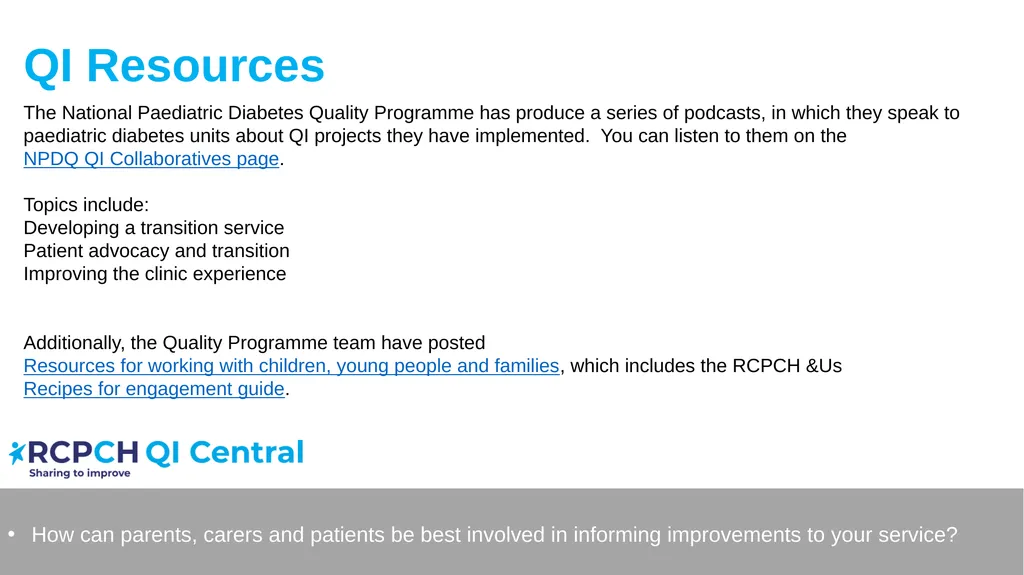
slide19. QI Resources How can parents, carers and patients be best involved in informing improvements to your service? The National Paediatric Diabetes Quality Programme has produce a series of podcasts, in which they speak to paediatric diabetes units about QI projects they have implemented. You can listen to them on the NPDQ QI Collaboratives page.
Topics include:
Developing a transition service
Patient advocacy and transition
Improving the clinic experience
Additionally, the Quality Programme team have posted Resources for working with children, young people and families, which includes the RCPCH &Us Recipes for engagement guide.<br>
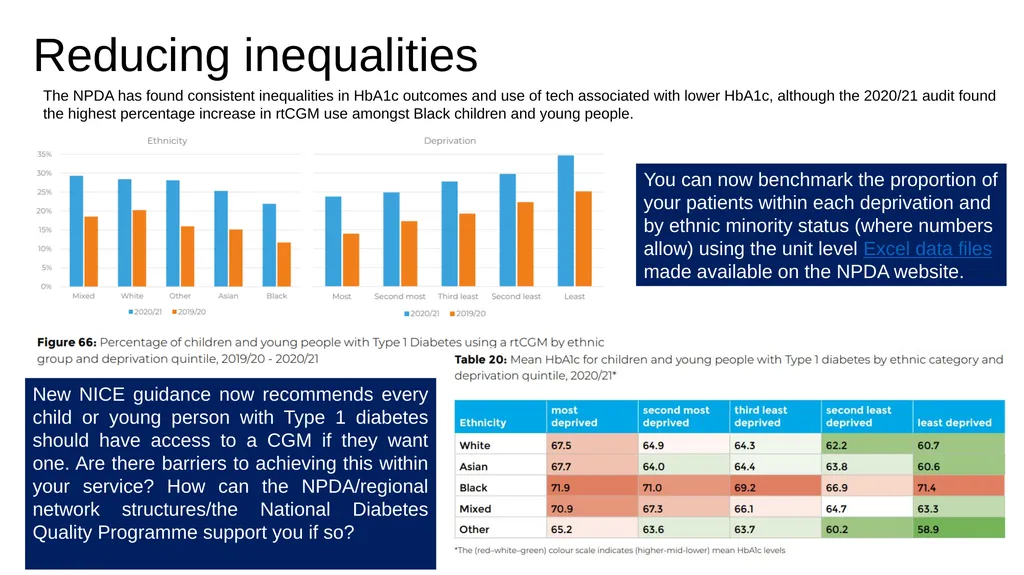
slide20. Reducing inequalities The NPDA has found consistent inequalities in HbA1c outcomes and use of tech associated with lower HbA1c, although the 2020/21 audit found the highest percentage increase in rtCGM use amongst Black children and young people. You can now benchmark the proportion of your patients within each deprivation and by ethnic minority status (where numbers allow) using the unit level Excel data files made available on the NPDA website. New NICE guidance now recommends every child or young person with Type 1 diabetes should have access to a CGM if they want one. Are there barriers to achieving this within your service? How can the NPDA/regional network structures/the National Diabetes Quality Programme support you if so?<br>
slide21. Thank you to everyone involved in supporting children and young people and their families to participate in the PREM audit, despite all the COVID-19 related pressures that coincided with this survey<br>
communicate the main national and unit level findings from the PREM audit
facilitate interpretation of results
use the data to stimulate quality improvement activity
All unit level graphs displayed are placeholders, and the next slide contains a link to a tutorial on using the snipping tool to copy and paste graphs. NPDA 2021/22 PREM results presentation template<br>
slide2. NPDA National PREM Report 2021
Appendix to the NPDA National PREM Report 2021
How to use the snipping tool to cut and paste graphs if preferred (please note the resolution will likely be higher if graphs are downloaded as jpegs from NPDA Results Online- click the bottom left hand square within each graph generated to do so)
Excel files of current and historical summary NPDA data NPDA PREM 2021 results presentation template:
Resources to support your presentation<br>
slide3. [Name of Paediatric Diabetes Unit] National Paediatric Diabetes PREM Audit results 2021<br>
slide4. Context The National Paediatric Diabetes Audit is funded by NHS England and NHS Wales, commissioned by the Healthcare Quality Improvement Partnership (HQIP), and managed by the Royal College of Paediatrics and Child Health.
The audit was established in 2003 to support improvements in paediatric diabetes care and outcomes required to bring these in line with those achieved in comparable western European countries, and to measure progress towards achievement of NICE guidance. As part of this, we also run Patient Reported Experience Measure (PREM) audits to gain insights into patients’ and families’ experiences of the care they receive.
The PREM audit’s aims are to:
Enable children and young people with diabetes and their families to provide anonymous feedback on what they value about their care, and how it could be improved
Assess whether care provided is meeting standards considered important by children and young people with diabetes and their families
Provide local teams with insights into the experiences of the families they serve that can be used to improve engagement and outcomes
Audit scope
4,177 children and young people and 6,789 parents and carers attending paediatric diabetes services in England and Wales completed a Patient Reported Experience Measure (PREM) survey in 2021, when 31,615 children and young people were receiving care from paediatric diabetes services.<br>
slide5. 2021 NPDA PREM Key Quantitative Findings The NPDA national PREM report contains a comprehensive list of key findings and recommendations in addition to in-depth analysis of audit measures. Presented here are a selection 66.4% of parents and carers and 69.2% of children and young people agreed that their diabetes team always kept them up to date with new diabetes-related technologies.
These were increases from 63.7% and 61.8%, respectively, in 2019. 82.5% of children and young people and 88.7% of parents and carers reported that they always had a positive relationship with their diabetes team.
In 2019, similar percentages agreed the same: 79.9% of children and young people and 90.0% of parents and carers. Less than two thirds of parents and carers (64.2%) and children and young people (62.3%) agreed their diabetes team were providing them with the information, resources and support needed to prepare for their transfer to adult care.
These results are similar to those reported in 2019 (64.0% of parents and carers and 58.2% of children and young people). 82.3% of parents and carers reported that they could see a diabetes specialist doctor at each visit, 83.7% could see a paediatric diabetes specialist nurse at each visit, 41.1% could see a dietitian at each visit, and 11.4% could see a psychologist at each visit.
Percentages were smaller for each staffing group compared to 2019.<br>
slide6. 2021 NPDA PREM Key Quantitative findings, cont’d 81.1% of parents and carers said they could always access specialist diabetes advice during core hours. This was similar to 2019 (81.3%). However, only 68.3% said they could always receive advice 24 hours a day.
This was also similar to 2019 (68.8%). 72.3% of children and young people and 71.9% of parents and carers agreed their diabetes team always gave them enough information to effectively manage their/child’s diabetes at school/college.
This is down from 74.1% and 75.2%, respectively, in 2019 59.6% of children and young people and 66.6% of parents and carers agreed their diabetes team always gave them enough information to manage exercise.
These percentages were similar to 2019. Only half (46.9%) of parents and carers agreed they always received enough information on the preparation and administration of glucagon, similarly to 2019.<br>
slide7. 2021 NPDA PREM Key Qualitative Findings, cont’d Children and young people with diabetes and their parents and carers were asked two questions
1) What do you find helpful about your appointments with the diabetes team? The three biggest themes among children and young people who responded to this question were:
Assistance received – 38.4%
Modality of appointment – 18.6%
Diabetes team support – 16.6% The three biggest themes among parents and carers who responded to this question were:
Assistance received – 40.8%
Diabetes team support – 30.8%
Modality of appointment – 28.3%<br>
slide8. 2021 NPDA PREM Key Qualitative Findings, cont’d Children and young people with diabetes and their parents and carers were asked two questions
2) What could your diabetes team do to make your appointments with the diabetes team better? The three biggest themes among children and young people who responded to this question were:
Nothing/Not applicable – 31.4%
Modality of appointment – 20.2%
More assistance – ?? The three biggest themes among parents and carers who responded to this question were:
Nothing/Not applicable – 46.5%
Modality of appointment – 19.5%
More assistance – 9.3%<br>
slide9. How did we do on key PREM Questions? Relationship with diabetes team Please copy and paste the graphs below from your unit level PREM report.<br>
slide10. How did we do on key PREM Questions? Diabetes related technologies Please copy and paste the graphs below from your unit level PREM report.<br>
slide11. How did we do on key PREM Questions? Information & support for transition to adult care Please copy and paste the graphs below from your unit level PREM report.<br>
slide12. How did we do on key PREM Questions? Availability of specialists Please copy and paste the graphs below from your unit level PREM report.<br>
slide13. How did we do on key PREM Questions? Access to specialist advice Please copy and paste the graphs below from your unit level PREM report.<br>
slide14. How did we do on key PREM Questions? Provision of information Please copy and paste the graphs below from your unit level PREM report.<br>
slide15. How did we do on key PREM Questions? Patient and parent/carer comments Please copy and paste children and young people’s, and parent/carer comments from your unit level PREM report or poster.<br>
slide16. How did we do on key PREM Questions? Patient and parent/carer comments Please copy and paste children and young people’s, and parent/carer comments from your unit level PREM report or poster.<br>
slide17. In what areas of patient experience are we doing well?
Could we share this with our local/regional network?
What areas of patient experience could we improve?
How can we involve patients in the improvement process?
What can we learn from other units to facilitate improvements? Discussion I would recommend this clinic to a friend or other family with a child who has diabetes to be treated in<br>
slide18. PREM 2021 Recommendations Paediatric diabetes teams and parents and carers should:
1. Review their NPDA PREM 2021 results, identify areas requiring improvement and work with their local patients and families, and paediatric diabetes teams to establish targeted quality improvement activities.
Paediatric diabetes teams should:
2. Recognise the value of face-to-face appointments but consider how to sustain and make best use of new methods of consultation with children and young people and parents and carers established in response to the COVID-19 pandemic.
3. Equip school staff to help children and young people manage their diabetes whilst at school.
4. Discuss local PREM results and seek input from families with diabetes to improve areas with poorer scores compared to other centres.
5. Provide access to specialist diabetes advice to patients and their families 24 hours per day and 7 days per week.
6. Provide access to a Psychologist with experience in diabetes to all children and young people, ensuring they understand how to access this service.
7. Provide patients and families with up to date information and advice on how to access diabetes technologies (in line with latest NICE guidelines), including:
• insulin pumps
• continuous glucose monitors
• flash glucose monitors
8. Prepare young people and their families for transition from paediatric to adult services. Transition discussions should start in advance of the process to ensure that young people with diabetes and their families know what to expect.<br>
slide19. QI Resources How can parents, carers and patients be best involved in informing improvements to your service? The National Paediatric Diabetes Quality Programme has produce a series of podcasts, in which they speak to paediatric diabetes units about QI projects they have implemented. You can listen to them on the NPDQ QI Collaboratives page.
Topics include:
Developing a transition service
Patient advocacy and transition
Improving the clinic experience
Additionally, the Quality Programme team have posted Resources for working with children, young people and families, which includes the RCPCH &Us Recipes for engagement guide.<br>
slide20. Reducing inequalities The NPDA has found consistent inequalities in HbA1c outcomes and use of tech associated with lower HbA1c, although the 2020/21 audit found the highest percentage increase in rtCGM use amongst Black children and young people. You can now benchmark the proportion of your patients within each deprivation and by ethnic minority status (where numbers allow) using the unit level Excel data files made available on the NPDA website. New NICE guidance now recommends every child or young person with Type 1 diabetes should have access to a CGM if they want one. Are there barriers to achieving this within your service? How can the NPDA/regional network structures/the National Diabetes Quality Programme support you if so?<br>
slide21. Thank you to everyone involved in supporting children and young people and their families to participate in the PREM audit, despite all the COVID-19 related pressures that coincided with this survey<br>