This slide package is provided by the Scholarly Integrity Initiative. Thank you for promoting conversations about, and raising awareness of, the responsible conduct of research. We hope that by facilitating group discussions though these
"This slide package is provided by the Scholarly" is the property of its rightful owner. Permission is granted to
download and print the materials on this website for personal, non-commercial use only, and to display it
on your personal computer provided you do not modify the materials and that you retain all copyright
notices contained in the materials. By downloading content from our website, you accept the terms of this
agreement.
Presentation Transcript
01
This slide package is provided by the Scholarly Integrity Initiative. Thank you for promoting conversations about, and raising awareness of, the responsible conduct of research.
We hope that by facilitating group discussions though these materials, we can better understand our research and scholarly practices, identify best practices, and foster a strong and diverse research culture that embraces integrity, collegiality and service at UBC.
In an effort to continuously improve, we would appreciate a few minutes of your time to provide feedback on this resource after you have used it. Please share your thoughts by completing this short survey. INSTRUCTIONS FOR CONTENT FACILITATORS<br>
02
How to use this resource There are two sections to this slide deck resource.
The first section is a core slide presentation. Use this to introduce concepts, discuss terminology, and generate discussion with your audience.
The second section includes additional slides that you can add to the core presentation, depending on the needs of your audience.
Facilitator notes are provided with each slide. Before delivering this material, you should familiarize yourself with the Scholarly Integrity Policy and the relevant scholarly standards within your discipline. If you need additional support, please contact the Scholarly Integrity Initiative.<br>
03
ADAPTING AND SHARING THIS RESOURCE This introductory slide deck is licensed under the Creative Commons Attribution 4.0 International License, which allows you to share and adapt this resource as long as you give appropriate credit, provide a link to the license and indicate if changes were made to the content. For more information about this license, please visit: http://creativecommons.org/licenses/by/4.0/
Please attribute to the Scholarly Integrity Initiative, Office of the Vice-President, Research & Innovation, The University of British Columbia.<br>
04
Responsible Authorship &
Credit Attribution The Scholarly Integrity Initiative https://Responsible.research.ubc.ca<br>
05
What is authorship?
Who is an author?
How should we assign authorship?
What about the order of authors?
How does authorship relate to scholarly integrity? Introduction<br>
06
When we appropriately assign authorship, we are support scholarly integrity by:
Crediting researchers for their intellectual contributions
Designating responsibility for the accuracy and quality of research<br>
07
Who might the authorship criteria exclude, despite having contributed to the research?
What are some considerations when acknowledging contributors?
How does this relate to scholarly integrity? Contributors<br>
08
Accurate acknowledgements uphold scholarly integrity by: Recognizing those who made the research possible
Encouraging continued research collaboration<br>
09
What does This mean for US? As research becomes more collaborative and interdisciplinary, we need to ensure we are accurately assigning credit and responsibility for our work. Doing so can also foster collegiality, collaboration and accountability.<br>
10
What does This mean for US? Be aware of relevant disciplinary authorship guidelines and expectations of different publications
Clarify and establish authorship criteria prior to starting a project
Document our intellectual contributions throughout the research lifecycle
Engage in ongoing dialogue regarding authorship assignment
Others?<br>
11
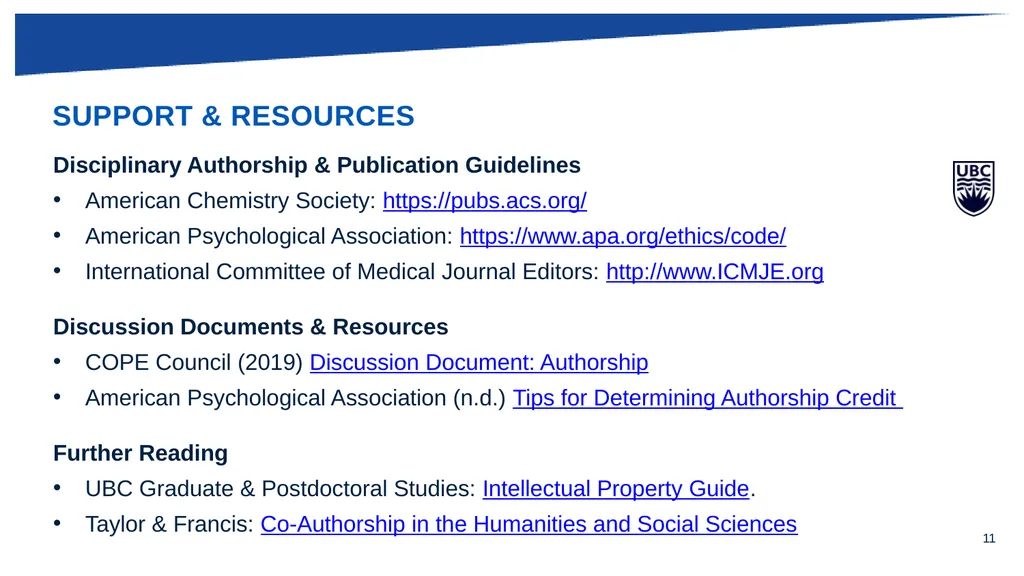
Disciplinary Authorship & Publication Guidelines
American Chemistry Society: https://pubs.acs.org/
American Psychological Association: https://www.apa.org/ethics/code/
International Committee of Medical Journal Editors: http://www.ICMJE.org
Discussion Documents & Resources
COPE Council (2019) Discussion Document: Authorship
American Psychological Association (n.d.) Tips for Determining Authorship Credit
Further Reading
UBC Graduate & Postdoctoral Studies: Intellectual Property Guide.
Taylor & Francis: Co-Authorship in the Humanities and Social Sciences SUPPORT & RESOURCES<br>
12
Additional content<br>
13
refers to being the creator or originator of an idea or the individual or individuals who develop and bring to fruition the product that disseminates intellectual or creative works.
- Committee on Publication Ethics Authorship “<br>
14
Gift Authorship refers to the practice of offering authorship to a senior or junior colleague in the blatant or surreptitious hope that they will return the favor.
- Harvey, L. (2018) Gift, honorary or guest authorship. Spinal Cord 56, 91 “<br>
15
HonoUrary Authorship refers to those who are named as authors merely because they hold senior positions within the service or facility where the research occurred and may have helped secure funding.
- Harvey, L. (2018) Gift, honorary or guest authorship. Spinal Cord 56, 91 “<br>
16
Guest Authorship refers to senior authors who are included because of their respect or influence in the hope that this will increase the likelihood of publication and/or the impact of the paper once published.
- Harvey, L. (2018) Gift, honorary or guest authorship. Spinal Cord 56, 91 “<br>
17
Ghost Authorship occurs when an individual who contributed substantially to a manuscript is not named in the byline or acknowledgments.
- Ngai S, et al. (2005) Accountability in Research, 12:2, 103-114 “<br>
18
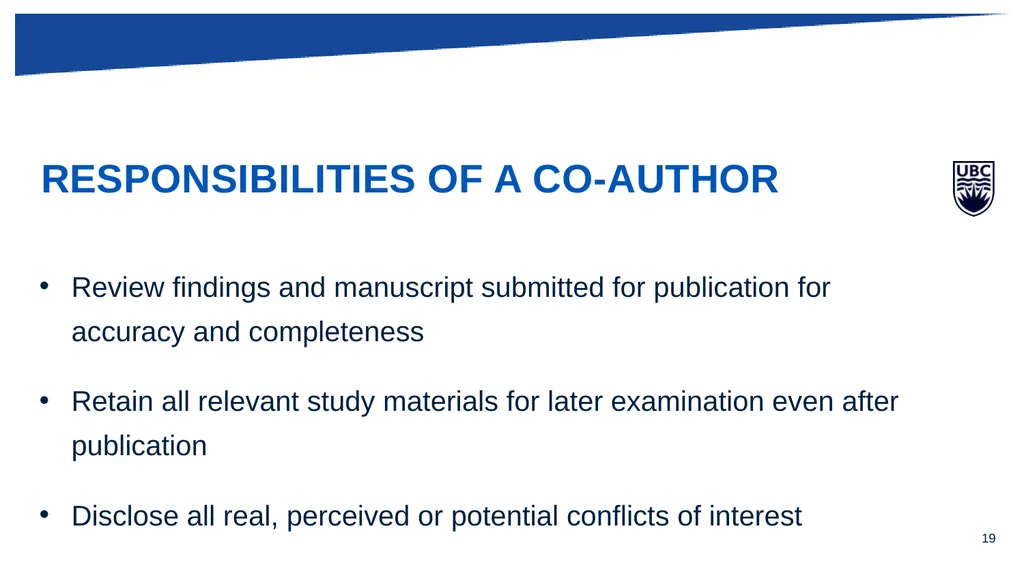
Responsibilities of a co-author Review findings and manuscript submitted for publication for accuracy and completeness
Retain all relevant study materials for later examination even after publication
Disclose all real, perceived or potential conflicts of interest<br>
19
Case Studies<br>
20
Kim helped to set-up the spectrometer that was used for collecting data that was presented in the paper.
Should Kim be a co-author on the paper?<br>
21
Jan collected, analyzed and interpreted half of the data that is in the paper but does not want to be listed as a co-author.
Is it okay to remove them and publish the paper anyway?<br>