
This training is funded under the COMCEC Project
JO
Published · 34 slides · 0 views
1 / 1
Description
This training is funded under the COMCEC Project Funding Implementation and Fulfillment of International Maritime Agreements Virtual Training 8-10 September 2021 1 This training is funded under the COMCEC Project Funding COMPULSORY CODES
Related Topics
Share
Embed code
Download this presentation From Below
"This training is funded under the COMCEC Project" is the property of its rightful owner. Permission is granted to download and print the materials on this website for personal, non-commercial use only, and to display it on your personal computer provided you do not modify the materials and that you retain all copyright notices contained in the materials. By downloading content from our website, you accept the terms of this agreement.
Presentation Transcript
01
This training is funded under the COMCEC Project Funding Implementation and Fulfillment of International Maritime Agreements Virtual Training
8-10 September 2021 1<br>
8-10 September 2021 1<br>
02
This training is funded under the COMCEC Project Funding COMPULSORY CODES UNDER THE SOLAS CONVENTION Dr Tamer Yalçın,
Asst. Prof of Maritime Transportation, Piri Reis University 10 Sep 2021, Friday 2<br>
Asst. Prof of Maritime Transportation, Piri Reis University 10 Sep 2021, Friday 2<br>
03
This training is funded under the COMCEC Project Funding 3 COMPULSORY CODES UNDER THE SOLAS CONVENTION
International Code for Application of Fire Test Procedures
(FTP Code)
Amendments to the International Convention for the Safety of Life at Sea (SOLAS) to make mandatory the International Code for the Application of Fire Test Procedures (2010 FTP Code) came into force on 1 July 2012, thereby enhancing the fire safety provisions onboard all ships.<br>
International Code for Application of Fire Test Procedures
(FTP Code)
Amendments to the International Convention for the Safety of Life at Sea (SOLAS) to make mandatory the International Code for the Application of Fire Test Procedures (2010 FTP Code) came into force on 1 July 2012, thereby enhancing the fire safety provisions onboard all ships.<br>
04
This training is funded under the COMCEC Project Funding 4 Scope
This Code is intended for use by the Administration and the competent authority of the flag State when approving products for installation in ships flying the flag of the flag State in accordance with the fire safety requirements of the International Convention for the Safety of Life at Sea, 1974, as amended. This Code shall be used by testing laboratories when testing and evaluating products under this Code.
Application
This Code is applicable for products which are required to be tested, evaluated and approved in accordance with the Fire Test Procedures Code as referenced in the Convention.<br>
This Code is intended for use by the Administration and the competent authority of the flag State when approving products for installation in ships flying the flag of the flag State in accordance with the fire safety requirements of the International Convention for the Safety of Life at Sea, 1974, as amended. This Code shall be used by testing laboratories when testing and evaluating products under this Code.
Application
This Code is applicable for products which are required to be tested, evaluated and approved in accordance with the Fire Test Procedures Code as referenced in the Convention.<br>
05
This training is funded under the COMCEC Project Funding 5 The 2010 FTP Code includes the following: test for non-combustibility; test for smoke and toxicity; test for “A”, “B” and “F” class divisions; test for fire door control systems; test for surface flammability (surface materials and primary deck coverings); test for vertically supported textiles and films; test for upholstered furniture; test for bedding components; test for fire-restricting materials for high-speed craft; and test for fire-resisting divisions of high-speed craft.<br>
06
This training is funded under the COMCEC Project Funding 6 International Code for Fire Safety Systems (FSS Code)
The Safety system on chapter II-2 of SOLAS is known as Fire Safety System Code (FSS code), which came into force on July 2002 after Marine Safety Committee (MSC) adopted it in 73 session and became mandatory by resolution MSC 99(73).
The main purpose of FSS code is to provide specific standards of engineering specification for fire safety system present onboard. It includes total of 15 chapters.<br>
The Safety system on chapter II-2 of SOLAS is known as Fire Safety System Code (FSS code), which came into force on July 2002 after Marine Safety Committee (MSC) adopted it in 73 session and became mandatory by resolution MSC 99(73).
The main purpose of FSS code is to provide specific standards of engineering specification for fire safety system present onboard. It includes total of 15 chapters.<br>
07
This training is funded under the COMCEC Project Funding 7 The 15 chapters are as follows:
Chapter 1-General definitions
Chapter 2-International shore connection
Chapter 3– Personal protection
Chapter 4– Fire Extinguisher
Chapter 5– Fixed gas fire extinguishing system<br>
Chapter 1-General definitions
Chapter 2-International shore connection
Chapter 3– Personal protection
Chapter 4– Fire Extinguisher
Chapter 5– Fixed gas fire extinguishing system<br>
08
This training is funded under the COMCEC Project Funding 8 Chapter 6– Fixed foam fire extinguishing system
Chapter 7– Fixed pressure water and water spraying system
Chapter 8– Auto sprinkler, fire detection and fire alarm system
Chapter 9– Fixed fire detection and alarm system
Chapter 10– Sample extraction smoke detection system<br>
Chapter 7– Fixed pressure water and water spraying system
Chapter 8– Auto sprinkler, fire detection and fire alarm system
Chapter 9– Fixed fire detection and alarm system
Chapter 10– Sample extraction smoke detection system<br>
09
This training is funded under the COMCEC Project Funding 9 Chapter 11– Low Location Lighting system
Chapter 12– Fixed Emergency fire pumps
Chapter 13– Means of Escape
Chapter 14– Fixed deck foam system
Chapter 15– Inert gas system<br>
Chapter 12– Fixed Emergency fire pumps
Chapter 13– Means of Escape
Chapter 14– Fixed deck foam system
Chapter 15– Inert gas system<br>
10
This training is funded under the COMCEC Project Funding 10 International Intact Stability Code (IS Code 2008)
The revised and renamed Intact Stability Code (IS Code). The 2008 IS Code consists of two different parts: Part A which include the mandatory stability criteria; and Part B which provides guidance and recommendations. It is due to come into force for ships constructed on or after 1st July 2010.
This Code prescribes general intact stability criteria for different types of ships and special criteria for certain types of ships (passenger ships, oil tankers of 5000tdw and above, cargo ships carrying timber deck cargoes, cargo ships carrying grain in bulk and High Speed Crafts).<br>
The revised and renamed Intact Stability Code (IS Code). The 2008 IS Code consists of two different parts: Part A which include the mandatory stability criteria; and Part B which provides guidance and recommendations. It is due to come into force for ships constructed on or after 1st July 2010.
This Code prescribes general intact stability criteria for different types of ships and special criteria for certain types of ships (passenger ships, oil tankers of 5000tdw and above, cargo ships carrying timber deck cargoes, cargo ships carrying grain in bulk and High Speed Crafts).<br>
11
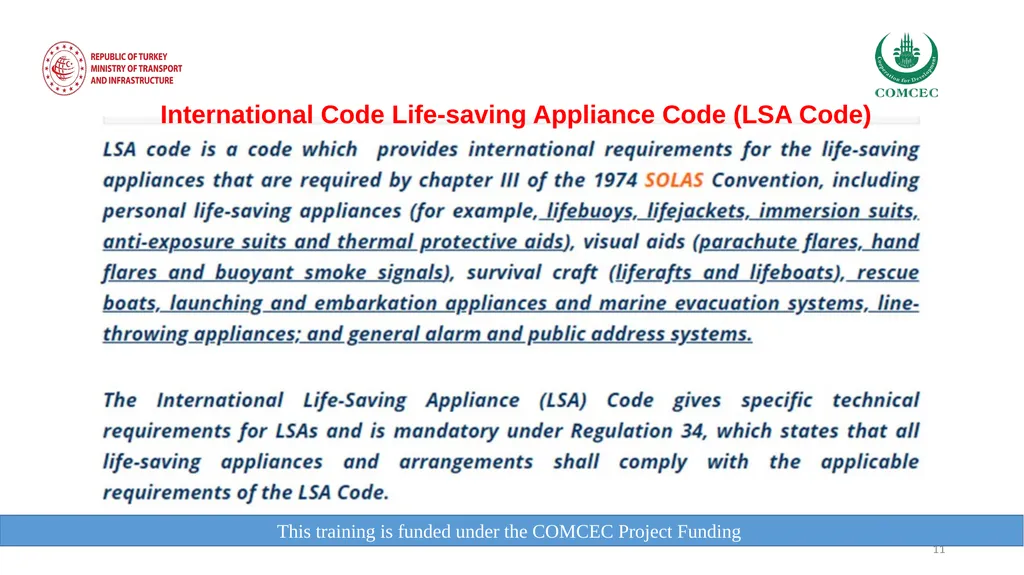
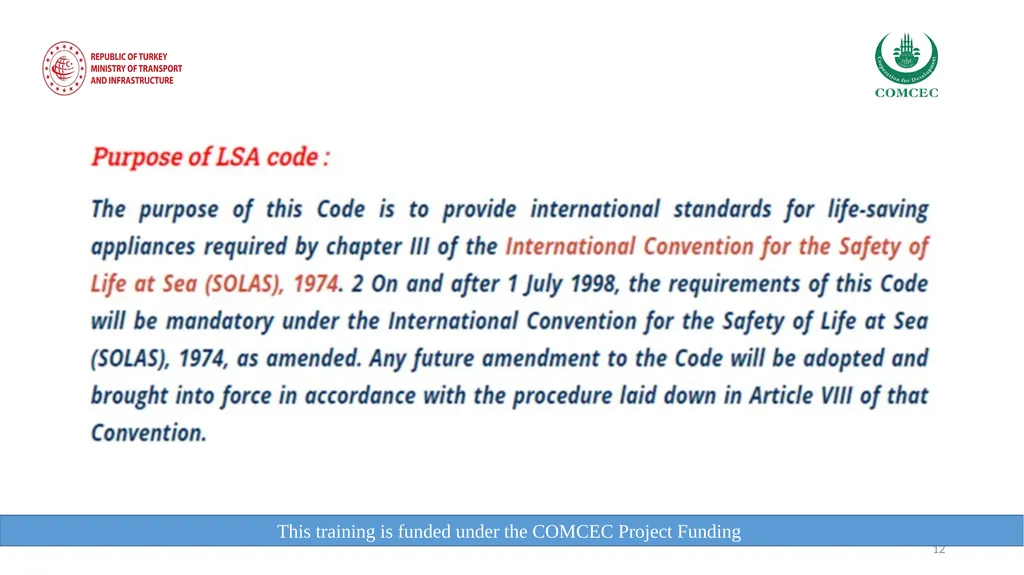
This training is funded under the COMCEC Project Funding 11 International Code Life-saving Appliance Code (LSA Code)<br>
12
This training is funded under the COMCEC Project Funding 12<br>
13
This training is funded under the COMCEC Project Funding 13 International Maritime Code for Dry Bulk Cargoes (IMSBC Code)
The main aim of the International Maritime Solid Bulk Cargoes Code (IMSBC Code), which replaces the Code of Safe Practice for Solid Bulk Cargoes (BC Code), is to assist the safe stowage & shipment of solid bulk cargoes by giving information on the dangers associated with the shipment of certain types of solid bulk cargoes & instructions on the procedures to be accepted when the shipment of solid bulk cargoes is inspected.<br>
The main aim of the International Maritime Solid Bulk Cargoes Code (IMSBC Code), which replaces the Code of Safe Practice for Solid Bulk Cargoes (BC Code), is to assist the safe stowage & shipment of solid bulk cargoes by giving information on the dangers associated with the shipment of certain types of solid bulk cargoes & instructions on the procedures to be accepted when the shipment of solid bulk cargoes is inspected.<br>
14
This training is funded under the COMCEC Project Funding 14 The IMSBC Code was accepted on 4th dec. 2008, by resolution MSC.268(85), & enforced on 1st Jan. 2011, from which date it was made compulsory under the provisions of the SOLAS Convention.
It is worth noting that the IMSBC Code does not cover the carriage of grain in bulk. The particular requirements for the transportation of grain are covered by the International Code for the Safe Carriage of Grain in Bulk (International Grain Code, 1991).<br>
It is worth noting that the IMSBC Code does not cover the carriage of grain in bulk. The particular requirements for the transportation of grain are covered by the International Code for the Safe Carriage of Grain in Bulk (International Grain Code, 1991).<br>
15
This training is funded under the COMCEC Project Funding 15 The IMSBC Code categorises cargoes into three groups:
Group A – cargoes which may liquefy if shipped at a moisture content exceeding their Transportable Moisture Limit (TML)
Group B – cargoes which possess a chemical hazard which could give rise to a dangerous situation on a ship.
Group C – cargoes which are neither liable to liquefy (Group A) nor possess
chemical hazards (Group B). Cargoes in this group can still be hazardous<br>
Group A – cargoes which may liquefy if shipped at a moisture content exceeding their Transportable Moisture Limit (TML)
Group B – cargoes which possess a chemical hazard which could give rise to a dangerous situation on a ship.
Group C – cargoes which are neither liable to liquefy (Group A) nor possess
chemical hazards (Group B). Cargoes in this group can still be hazardous<br>
16
This training is funded under the COMCEC Project Funding 16 International Code for the Construction and Equipment of Ships Carrying Dangerous Chemicals in Bulk (IBC Code)
The International Code for the Construction and Equipment of Ships Carrying Dangerous Chemicals in Bulk. The IBC Code contains the IMO regulations that govern the design, construction, and outfitting of new built or converted chemical tankers. The IBC Code replaced the Code for the Construction and Equipment of Ships Carrying Dangerous Chemical in Bulk, which applies to chemical tankers built or converted before 1 July 1986.<br>
The International Code for the Construction and Equipment of Ships Carrying Dangerous Chemicals in Bulk. The IBC Code contains the IMO regulations that govern the design, construction, and outfitting of new built or converted chemical tankers. The IBC Code replaced the Code for the Construction and Equipment of Ships Carrying Dangerous Chemical in Bulk, which applies to chemical tankers built or converted before 1 July 1986.<br>
17
This training is funded under the COMCEC Project Funding 17 The "International Code for the Construction and Equipment of Ships carrying Dangerous Chemicals in Bulk (IBC code) contains requirements for the carriage of dangerous chemicals and noxious liquid substances in bulk by sea.
The purpose of the IBC Code is to provide an international standard for the safe carriage, in bulk by sea, of dangerous chemicals and noxious liquid substances. The code prescribes the design, construction and equipment standards of ships, especially of chemical tankers.<br>
The purpose of the IBC Code is to provide an international standard for the safe carriage, in bulk by sea, of dangerous chemicals and noxious liquid substances. The code prescribes the design, construction and equipment standards of ships, especially of chemical tankers.<br>
18
This training is funded under the COMCEC Project Funding 18 International Code for the Construction and Equipment of Ships Carrying Liquefied Gases Bulk (IGC Code)
The purpose of this Code is to provide an international standard for the safe carriage, by sea in bulk,of liquefied gases and certain other substances.
The Code primarily deals with ship design and equipment. To ensure the safe transport of the products the total system must, however, be appraised.<br>
The purpose of this Code is to provide an international standard for the safe carriage, by sea in bulk,of liquefied gases and certain other substances.
The Code primarily deals with ship design and equipment. To ensure the safe transport of the products the total system must, however, be appraised.<br>
19
This training is funded under the COMCEC Project Funding 19 The Code applies to ships regardless of their size, including those of less than 500 gross tonnage, engaged in the carriage of liquefied gases having a vapour pressure exceeding 0.28 MPa absolute at a temperature of 37.8°C and other products, as shown in chapter 19, when carried in bulk.
The Code looks at how ships can be designed and constructed to withstand the hazardous properties of liquefied gases in bulk.<br>
The Code looks at how ships can be designed and constructed to withstand the hazardous properties of liquefied gases in bulk.<br>
20
This training is funded under the COMCEC Project Funding 20 International Maritime Code for Carriage of Dangerous Goods (IMDG Code)
The International Maritime Dangerous Goods or IMDG Code was adopted in 1965 as per the SOLAS (Safety for Life at Sea) Convention of 1960 under the IMO.
The IMDG code also ensures that the goods transported through seaways are packaged in such a way that they can be safely transported. The dangerous goods code is a uniform code.<br>
The International Maritime Dangerous Goods or IMDG Code was adopted in 1965 as per the SOLAS (Safety for Life at Sea) Convention of 1960 under the IMO.
The IMDG code also ensures that the goods transported through seaways are packaged in such a way that they can be safely transported. The dangerous goods code is a uniform code.<br>
21
This training is funded under the COMCEC Project Funding 21 There are nine clauses in which the dangerous goods are classified. The dangerous goods labels and dangerous goods certificate for the cargo are issued as per the nine clauses which are explained as follows:
Classification 1 is for explosives.
Classification 2 is for gases.
Classification 3 is for liquids and has no sub-divisions.
Classification 4 is for solids.<br>
Classification 1 is for explosives.
Classification 2 is for gases.
Classification 3 is for liquids and has no sub-divisions.
Classification 4 is for solids.<br>
22
This training is funded under the COMCEC Project Funding 22 Classification 5 is for substances that have the chances of oxidisation
Classification 6 is for all kinds of substances that are toxic and that could prove to be infective
Classification 7 is specifically for materials that are radioactive
Classification 8 is for materials that face the threat of corrosion and erosion
Classification 9 is for those substances that cannot be classified under any of the above heads but still are dangerous goods<br>
Classification 6 is for all kinds of substances that are toxic and that could prove to be infective
Classification 7 is specifically for materials that are radioactive
Classification 8 is for materials that face the threat of corrosion and erosion
Classification 9 is for those substances that cannot be classified under any of the above heads but still are dangerous goods<br>
23
This training is funded under the COMCEC Project Funding 23 At present, the reach of the IMDG Code extends to about 150 countries around the world with around 98% ships following the requirements of the code. This figure helps us to understand the effectiveness of the code with respect to shipping dangerous goods across the oceans and the marine life-forms that exist therein.<br>
24
This training is funded under the COMCEC Project Funding 24 Code for the Safe Carriage of Irradiated Nuclear Fuel, Plutonium and High-Level Radioactive Wastes in Flasks on board Ships (INF Code)
This Code applies to new and existing ships regardless of size, including cargo ships of less than 500 tons gross tonnage, engaged in the carriage of irradiated nuclear fuel, plutonium and high-level radioactive wastes in flasks approved in accordance with the applicable Regulations for the Safe Transport of Radioactive Material adopted by the International Atomic Energy Agency and carried in accordance with class 7 of the International Maritime Dangerous Goods (IMDG) Code, schedules 10, 11, 12 or 13.<br>
This Code applies to new and existing ships regardless of size, including cargo ships of less than 500 tons gross tonnage, engaged in the carriage of irradiated nuclear fuel, plutonium and high-level radioactive wastes in flasks approved in accordance with the applicable Regulations for the Safe Transport of Radioactive Material adopted by the International Atomic Energy Agency and carried in accordance with class 7 of the International Maritime Dangerous Goods (IMDG) Code, schedules 10, 11, 12 or 13.<br>
25
This training is funded under the COMCEC Project Funding 25 For the purposes of this Code:
1. Irradiated nuclear fuel means material containing uranium, thorium and/or plutonium isotopes which has been used to maintain a self-sustaining nuclear chain reaction.
2. Plutonium means the resultant mixture of isotopes of that material extracted from irradiated nuclear fuel from reprocessing.
3. High-level radioactive wastes means liquid wastes resulting from the operation of the first stage extraction system or the concentrated wastes from subsequent extraction stages, in a facility for reprocessing irradiated nuclear fuel, or solids into which such liquid wastes have been converted.<br>
1. Irradiated nuclear fuel means material containing uranium, thorium and/or plutonium isotopes which has been used to maintain a self-sustaining nuclear chain reaction.
2. Plutonium means the resultant mixture of isotopes of that material extracted from irradiated nuclear fuel from reprocessing.
3. High-level radioactive wastes means liquid wastes resulting from the operation of the first stage extraction system or the concentrated wastes from subsequent extraction stages, in a facility for reprocessing irradiated nuclear fuel, or solids into which such liquid wastes have been converted.<br>
26
This training is funded under the COMCEC Project Funding 26 For the purposes of this Code, ships carrying materials covered by this Code in flasks have been assigned to three classes, depending on the total radioactive quantity which may be carried on board.<br>
27
This training is funded under the COMCEC Project Funding 27 International Code for the Safety of High Speed Craft
(HSC Code 1994)
The High-Speed Craft Code 1994 (1994 HSC Code) was derived from the previous Code of Safety for Dynamically Supported Craft (DSC Code) adopted by IMO in 1977, recognizing that safety levels can be significantly enhanced by the infrastructure associated with regular service on a particular route, whereas the conventional ship safety philosophy relies on the ship being self-sustaining with all necessary emergency equipment being carried on board.<br>
(HSC Code 1994)
The High-Speed Craft Code 1994 (1994 HSC Code) was derived from the previous Code of Safety for Dynamically Supported Craft (DSC Code) adopted by IMO in 1977, recognizing that safety levels can be significantly enhanced by the infrastructure associated with regular service on a particular route, whereas the conventional ship safety philosophy relies on the ship being self-sustaining with all necessary emergency equipment being carried on board.<br>
28
This training is funded under the COMCEC Project Funding 28 The safety philosophy of this Code is based on the management and reduction of risk as well as the traditional philosophy of passive protection in the event of an accident.
Management of risk through accommodation arrangement, active safety systems, restricted operation, quality management and human factors engineering should be considered in evaluating safety equivalent to current conventions.<br>
Management of risk through accommodation arrangement, active safety systems, restricted operation, quality management and human factors engineering should be considered in evaluating safety equivalent to current conventions.<br>
29
This training is funded under the COMCEC Project Funding 29 With the development of many new types of HSC in the 1980s and 1990s, IMO decided to adopt new international regulations dealing with the special needs of this type of vessel.
Also in 1994, IMO adopted a new SOLAS chapter X – Safety measures for high-speed craft, which makes the HSC Code mandatory high-speed craft built on or after 1 January 1996. The Chapter was adopted in May 1994 and entered into force on 1 January 1996.<br>
Also in 1994, IMO adopted a new SOLAS chapter X – Safety measures for high-speed craft, which makes the HSC Code mandatory high-speed craft built on or after 1 January 1996. The Chapter was adopted in May 1994 and entered into force on 1 January 1996.<br>
30
This training is funded under the COMCEC Project Funding 30 The HSC Code applies to high-speed craft engaged on international voyages, including passenger craft which do not proceed for more than four hours at operational speed from a place of refuge when fully laden and cargo craft of 500 gross tonnage and above which do not go more than eight hours from a port of refuge.
The Code is intended to be a complete set of comprehensive requirements for high-speed craft, including equipment and conditions for operation and maintenance.<br>
The Code is intended to be a complete set of comprehensive requirements for high-speed craft, including equipment and conditions for operation and maintenance.<br>
31
This training is funded under the COMCEC Project Funding 31 International Code for the Safety of High Speed Craft
(HSC Code 2000)
Due to rapid pace of development in the HSC sector, in December 2000, the Maritime Safety Committee adopted amendments to SOLAS chapter X to make mandatory for new ships the High-Speed Craft Code 2000.
The 2000 HSC Code updates the 1994 HSC Code and applies to all HSC built after the date of entry into force, 1 July 2002. The original Code will continue to apply to high-speed craft built before that date.<br>
(HSC Code 2000)
Due to rapid pace of development in the HSC sector, in December 2000, the Maritime Safety Committee adopted amendments to SOLAS chapter X to make mandatory for new ships the High-Speed Craft Code 2000.
The 2000 HSC Code updates the 1994 HSC Code and applies to all HSC built after the date of entry into force, 1 July 2002. The original Code will continue to apply to high-speed craft built before that date.<br>
32
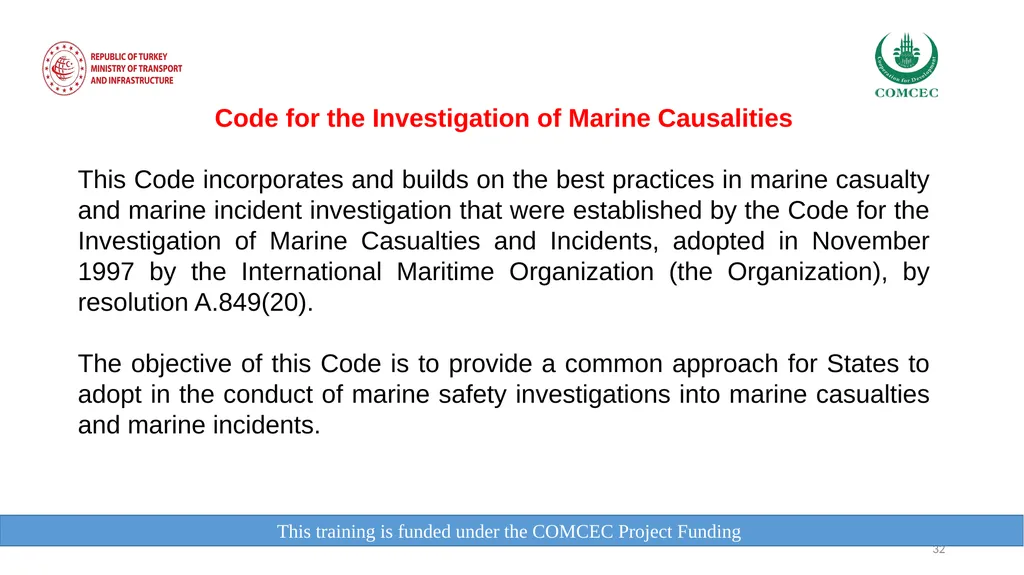
This training is funded under the COMCEC Project Funding 32 Code for the Investigation of Marine Causalities
This Code incorporates and builds on the best practices in marine casualty and marine incident investigation that were established by the Code for the Investigation of Marine Casualties and Incidents, adopted in November 1997 by the International Maritime Organization (the Organization), by resolution A.849(20).
The objective of this Code is to provide a common approach for States to adopt in the conduct of marine safety investigations into marine casualties and marine incidents.<br>
This Code incorporates and builds on the best practices in marine casualty and marine incident investigation that were established by the Code for the Investigation of Marine Casualties and Incidents, adopted in November 1997 by the International Maritime Organization (the Organization), by resolution A.849(20).
The objective of this Code is to provide a common approach for States to adopt in the conduct of marine safety investigations into marine casualties and marine incidents.<br>
33
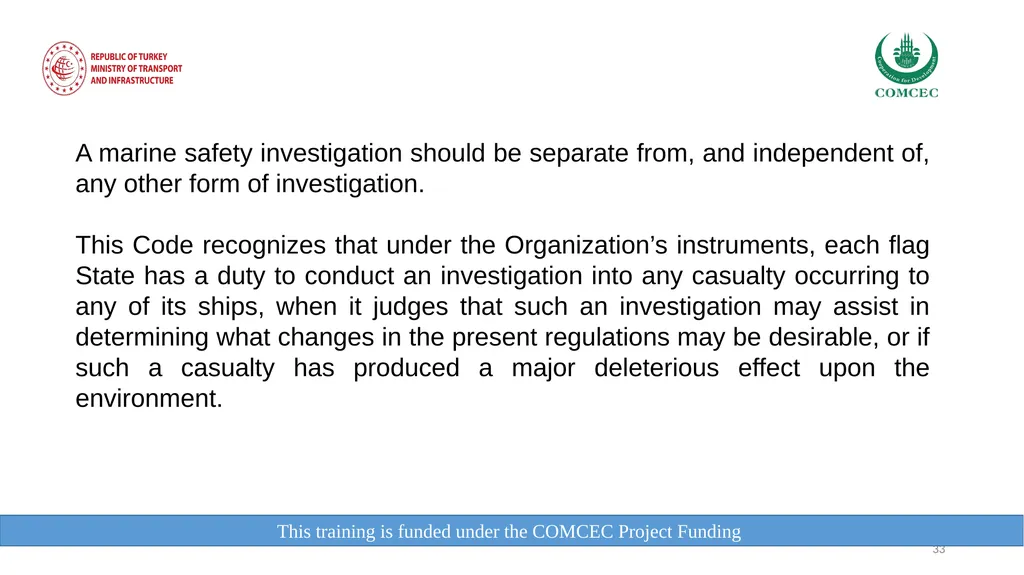
This training is funded under the COMCEC Project Funding 33 A marine safety investigation should be separate from, and independent of, any other form of investigation.
This Code recognizes that under the Organization’s instruments, each flag State has a duty to conduct an investigation into any casualty occurring to any of its ships, when it judges that such an investigation may assist in determining what changes in the present regulations may be desirable, or if such a casualty has produced a major deleterious effect upon the environment.<br>
This Code recognizes that under the Organization’s instruments, each flag State has a duty to conduct an investigation into any casualty occurring to any of its ships, when it judges that such an investigation may assist in determining what changes in the present regulations may be desirable, or if such a casualty has produced a major deleterious effect upon the environment.<br>
34
This training is funded under the COMCEC Project Funding 34 THANK YOU VERY MUCH.<br>