
This webinar is being recorded and will be

Description: This webinar is being recorded and will be published on the EERE Program Information Center website If you do not wish to have your voice recorded, please do not speak during the call If you do not wish to have your image recorded, please
Related Topics
Download Presentation
"This webinar is being recorded and will be" is the property of its rightful owner. Permission is granted to download and print the materials on this website for personal, non-commercial use only, and to display it on your personal computer provided you do not modify the materials and that you retain all copyright notices contained in the materials. By downloading content from our website, you accept the terms of this agreement.
Presentation Transcript
slide1. This webinar is being recorded and will be published on the EERE Program Information Center website If you do not wish to have your voice recorded, please do not speak during the call
If you do not wish to have your image recorded, please turn off your camera or participate by phone
If you speak during the call or use a video connection, you are presumed to consent to recording and use of your voice or image Please mute your phones and we’ll begin momentarily Welcome<br>
slide2. OPTIMA Funding Opportunity Announcement Webinar DE-FOA-0003034 SETO.OPTIMA.FOA@ee.doe.gov
May 4, 2023<br>
slide3. Notice NO NEW INFORMATION OTHER THAN THAT PROVIDED IN THE FOA WILL BE DISCUSSED IN THE WEBINAR.
There are no particular advantages or disadvantages to the application evaluation process with respect to participating on the webinar today.
Your participation is completely voluntary.<br>
slide4. Notice All applicants are strongly encouraged to carefully read the Funding Opportunity Announcement DE-FOA-0003034 (“FOA”) and adhere to the stated submission requirements.
This presentation summarizes the contents of FOA. If there are any inconsistencies between the FOA and this presentation or statements from DOE personnel, the FOA is the controlling document and applicants should rely on the FOA language, reference section VII, and seek clarification by submitting a question to SETO.OPTIMA.FOA@ee.doe.gov<br>
slide5. DE-FOA-0003034 Operation and Planning Tools for Inverter-Based Resource Management and Availability for Future Power Systems (OPTIMA) Anticipated Schedule:<br>
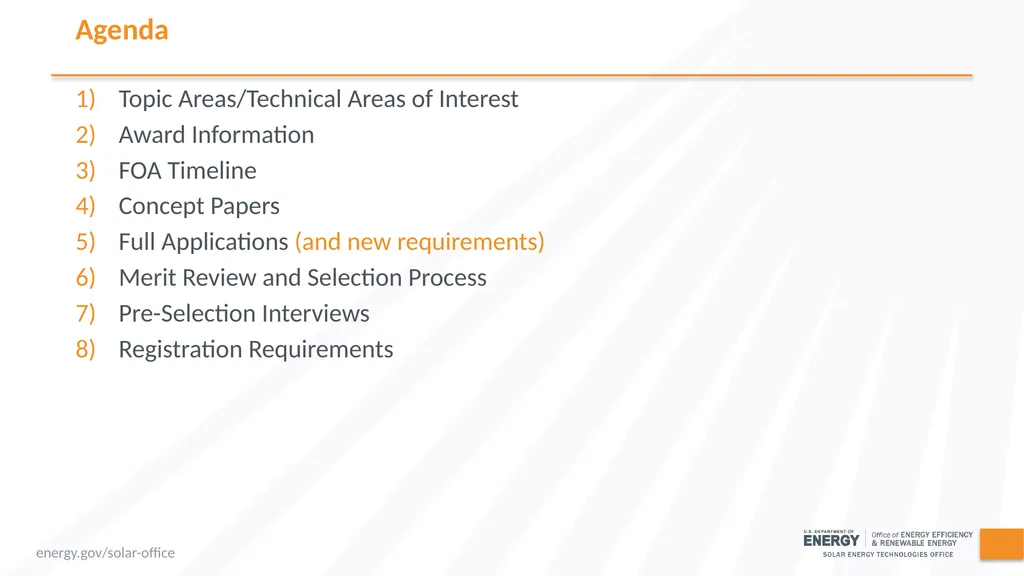
slide6. Agenda Topic Areas/Technical Areas of Interest
Award Information
FOA Timeline
Concept Papers
Full Applications (and new requirements)
Merit Review and Selection Process
Pre-Selection Interviews
Registration Requirements<br>
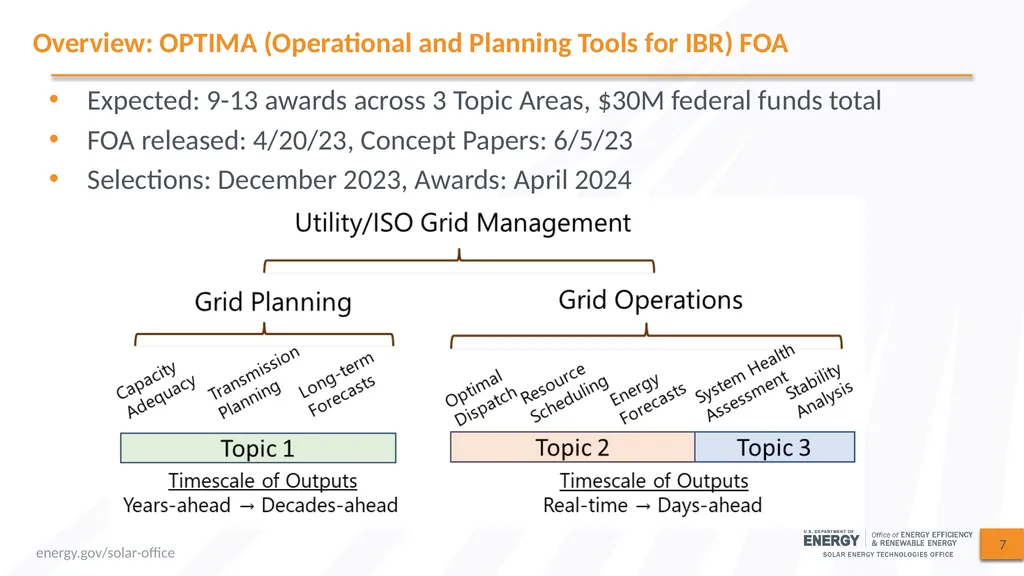
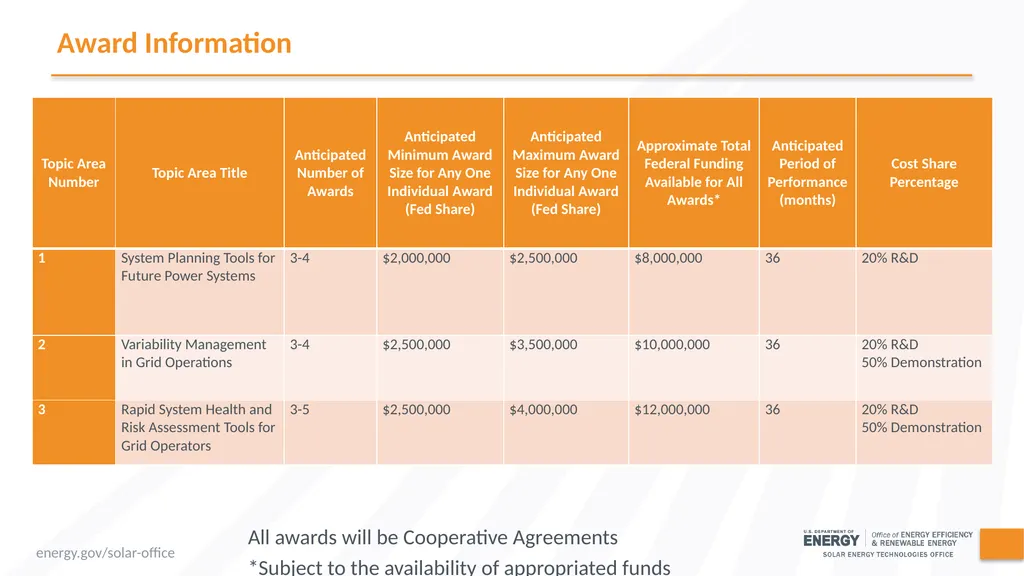
slide7. Expected: 9-13 awards across 3 Topic Areas, $30M federal funds total
FOA released: 4/20/23, Concept Papers: 6/5/23
Selections: December 2023, Awards: April 2024 Overview: OPTIMA (Operational and Planning Tools for IBR) FOA 7<br>
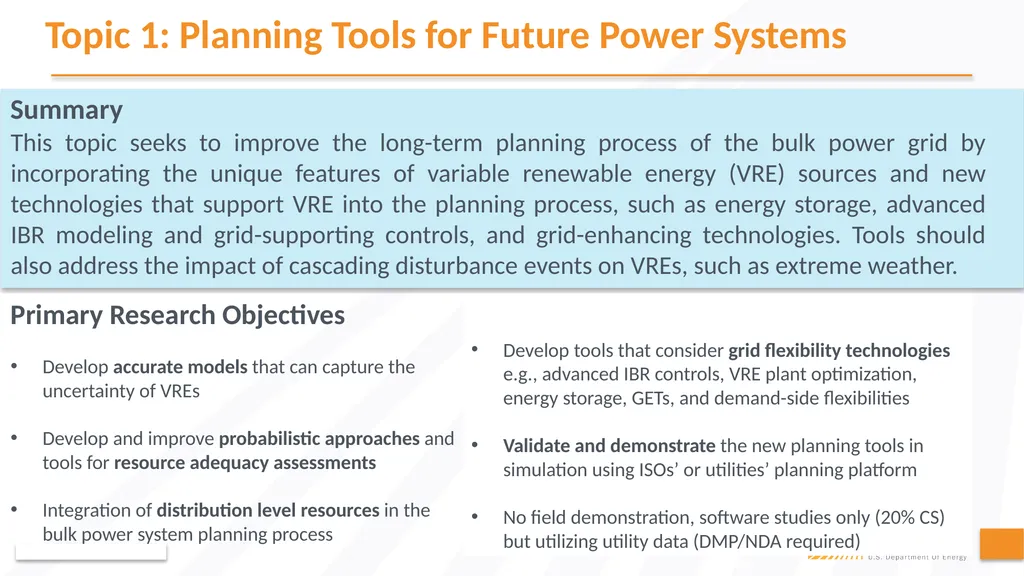
slide8. Develop tools that consider grid flexibility technologies e.g., advanced IBR controls, VRE plant optimization, energy storage, GETs, and demand-side flexibilities
Validate and demonstrate the new planning tools in simulation using ISOs’ or utilities’ planning platform
No field demonstration, software studies only (20% CS) but utilizing utility data (DMP/NDA required) Summary Topic 1: Planning Tools for Future Power Systems This topic seeks to improve the long-term planning process of the bulk power grid by incorporating the unique features of variable renewable energy (VRE) sources and new technologies that support VRE into the planning process, such as energy storage, advanced IBR modeling and grid-supporting controls, and grid-enhancing technologies. Tools should also address the impact of cascading disturbance events on VREs, such as extreme weather. nrel.gov Primary Research Objectives
Develop accurate models that can capture the uncertainty of VREs
Develop and improve probabilistic approaches and tools for resource adequacy assessments
Integration of distribution level resources in the bulk power system planning process<br>
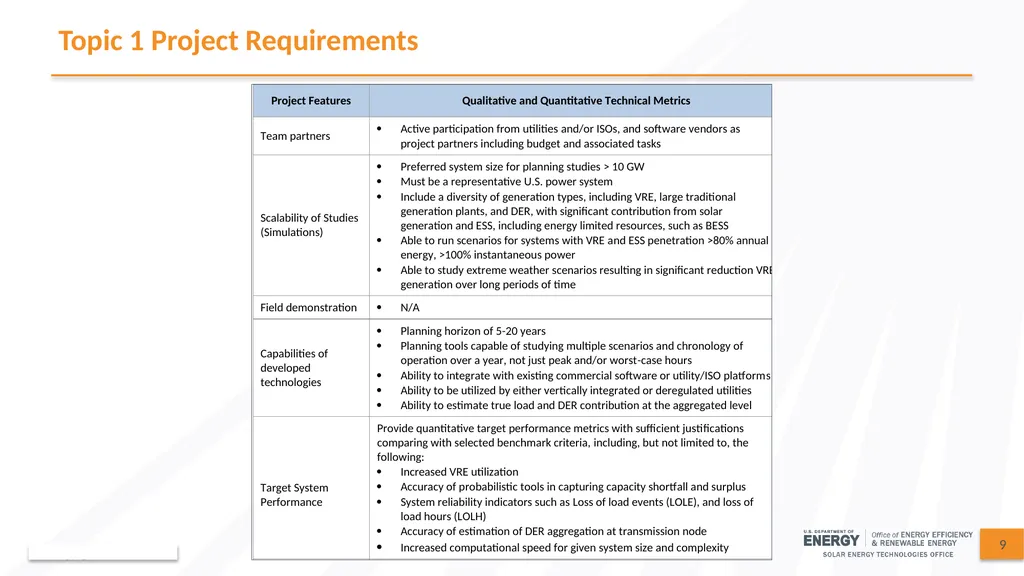
slide9. Topic 1 Project Requirements 9<br>
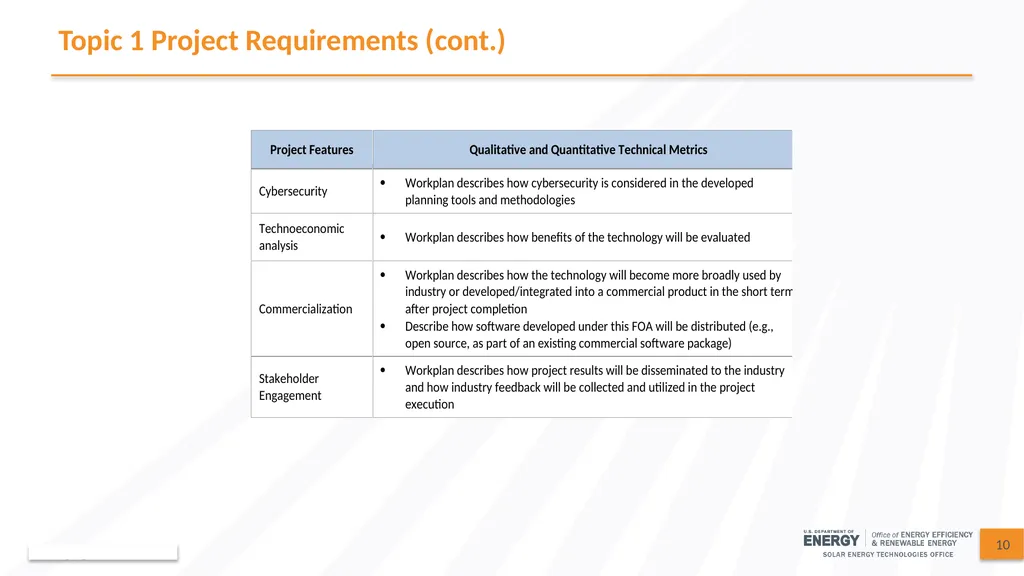
slide10. Topic 1 Project Requirements (cont.) 10<br>
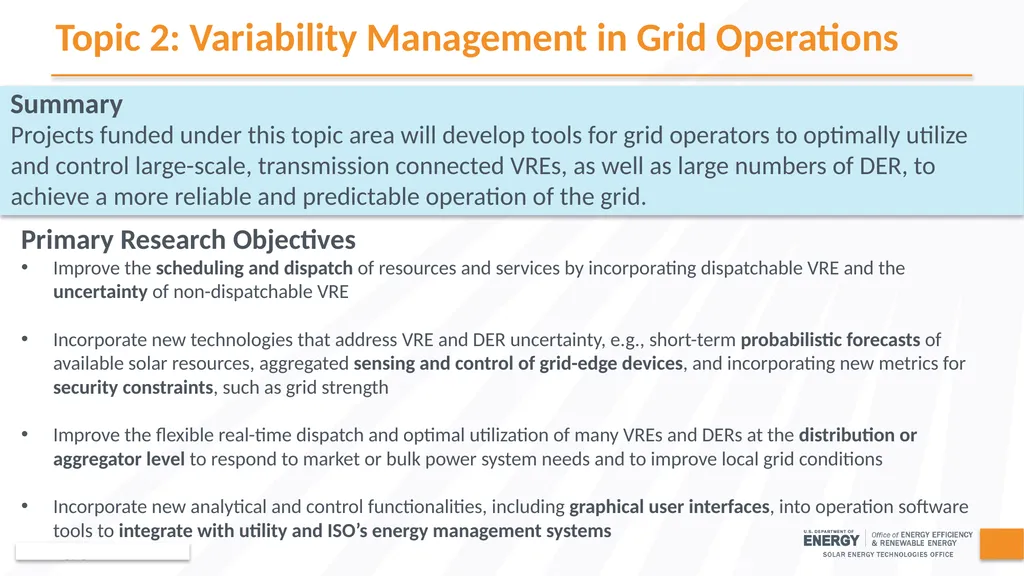
slide11. Summary Topic 2: Variability Management in Grid Operations Projects funded under this topic area will develop tools for grid operators to optimally utilize and control large-scale, transmission connected VREs, as well as large numbers of DER, to achieve a more reliable and predictable operation of the grid. nrel.gov Primary Research Objectives
Improve the scheduling and dispatch of resources and services by incorporating dispatchable VRE and the uncertainty of non-dispatchable VRE
Incorporate new technologies that address VRE and DER uncertainty, e.g., short-term probabilistic forecasts of available solar resources, aggregated sensing and control of grid-edge devices, and incorporating new metrics for security constraints, such as grid strength
Improve the flexible real-time dispatch and optimal utilization of many VREs and DERs at the distribution or aggregator level to respond to market or bulk power system needs and to improve local grid conditions
Incorporate new analytical and control functionalities, including graphical user interfaces, into operation software tools to integrate with utility and ISO’s energy management systems<br>
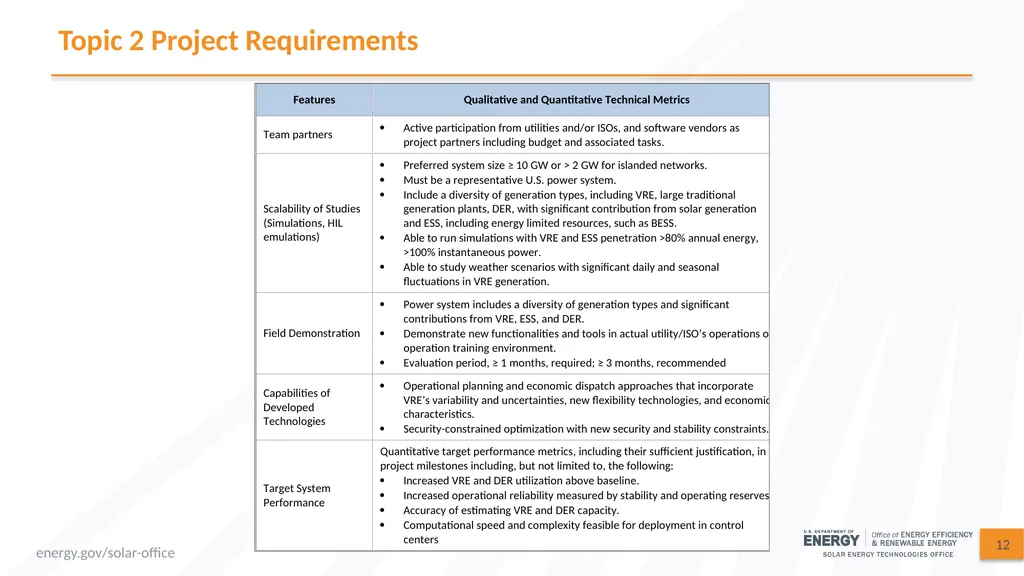
slide12. Topic 2 Project Requirements 12<br>
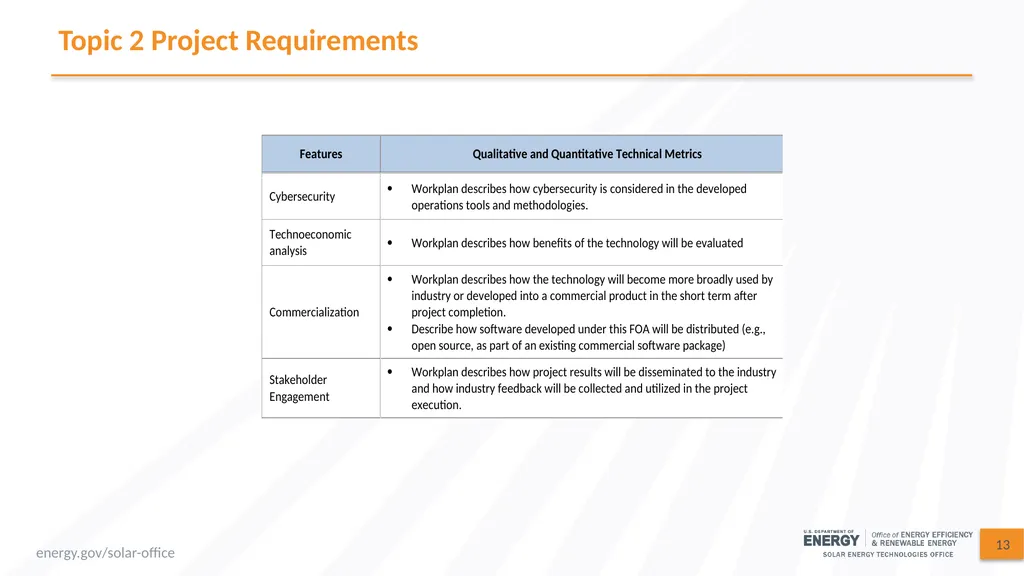
slide13. Topic 2 Project Requirements 13<br>
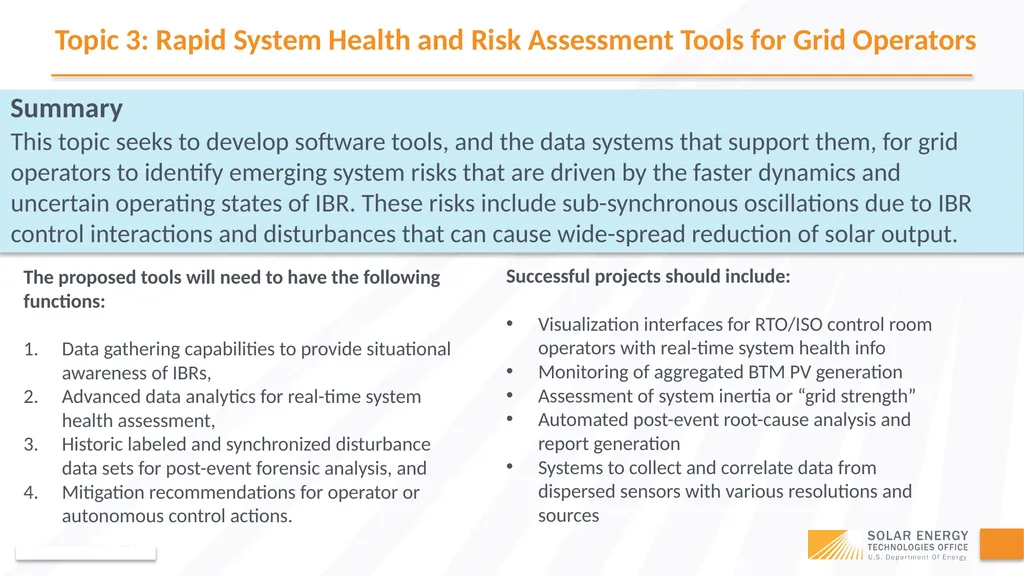
slide14. Summary Topic 3: Rapid System Health and Risk Assessment Tools for Grid Operators This topic seeks to develop software tools, and the data systems that support them, for grid operators to identify emerging system risks that are driven by the faster dynamics and uncertain operating states of IBR. These risks include sub-synchronous oscillations due to IBR control interactions and disturbances that can cause wide-spread reduction of solar output. nrel.gov The proposed tools will need to have the following functions:
Data gathering capabilities to provide situational awareness of IBRs,
Advanced data analytics for real-time system health assessment,
Historic labeled and synchronized disturbance data sets for post-event forensic analysis, and
Mitigation recommendations for operator or autonomous control actions. Successful projects should include:
Visualization interfaces for RTO/ISO control room operators with real-time system health info
Monitoring of aggregated BTM PV generation
Assessment of system inertia or “grid strength”
Automated post-event root-cause analysis and report generation
Systems to collect and correlate data from dispersed sensors with various resolutions and sources<br>
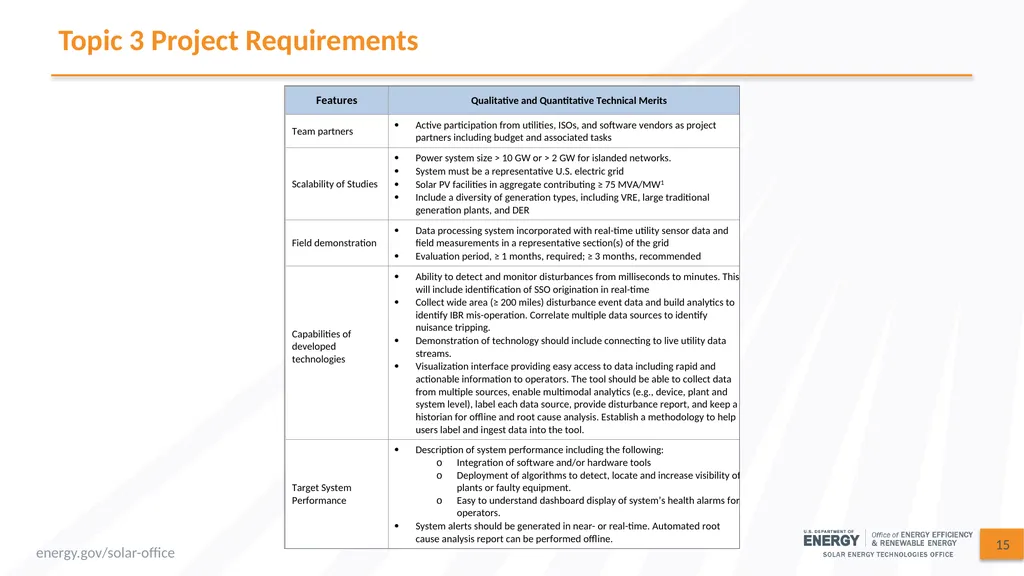
slide15. Topic 3 Project Requirements 15<br>
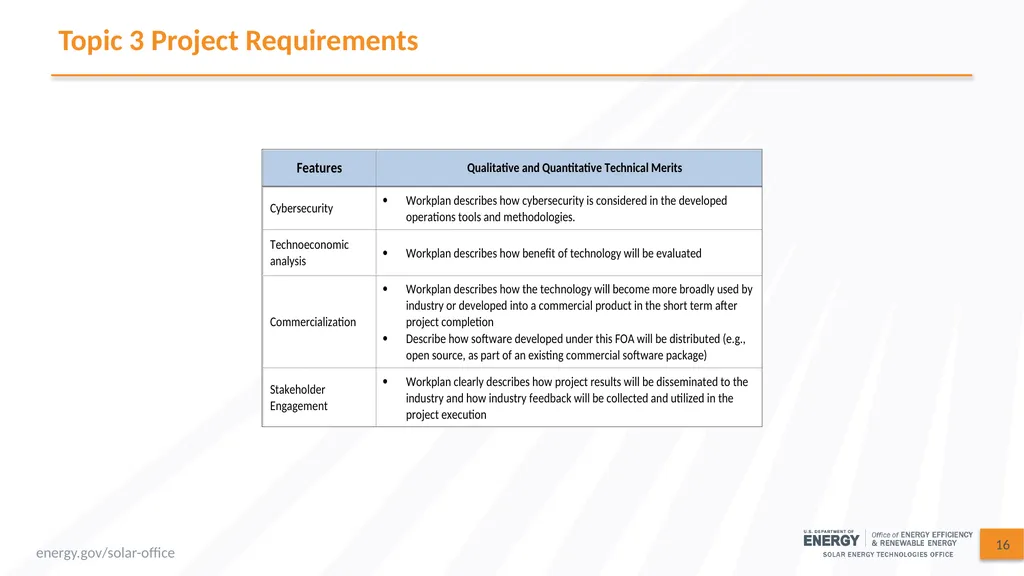
slide16. Topic 3 Project Requirements 16<br>
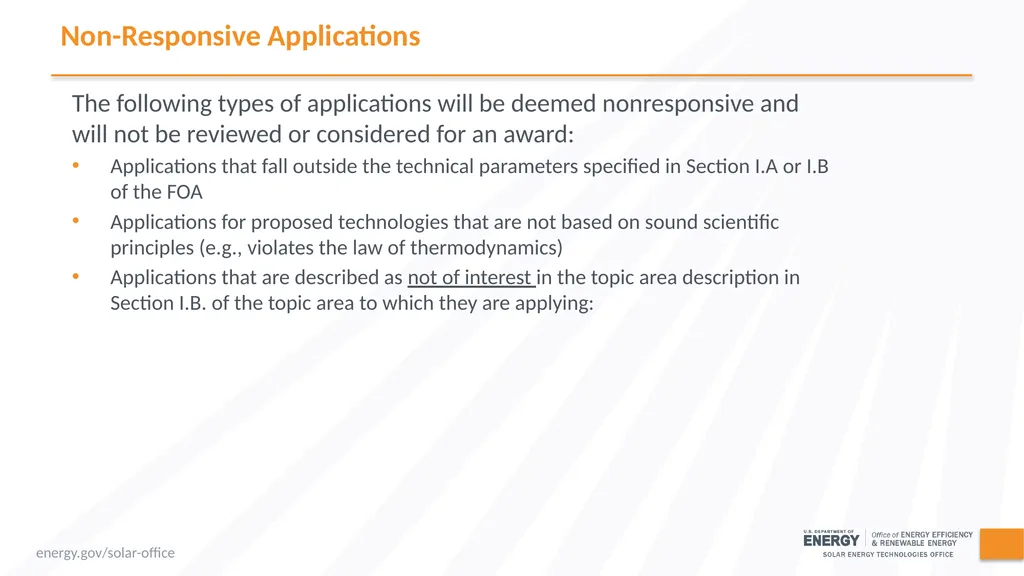
slide17. Non-Responsive Applications The following types of applications will be deemed nonresponsive and will not be reviewed or considered for an award:
Applications that fall outside the technical parameters specified in Section I.A or I.B of the FOA
Applications for proposed technologies that are not based on sound scientific principles (e.g., violates the law of thermodynamics)
Applications that are described as not of interest in the topic area description in Section I.B. of the topic area to which they are applying:<br>
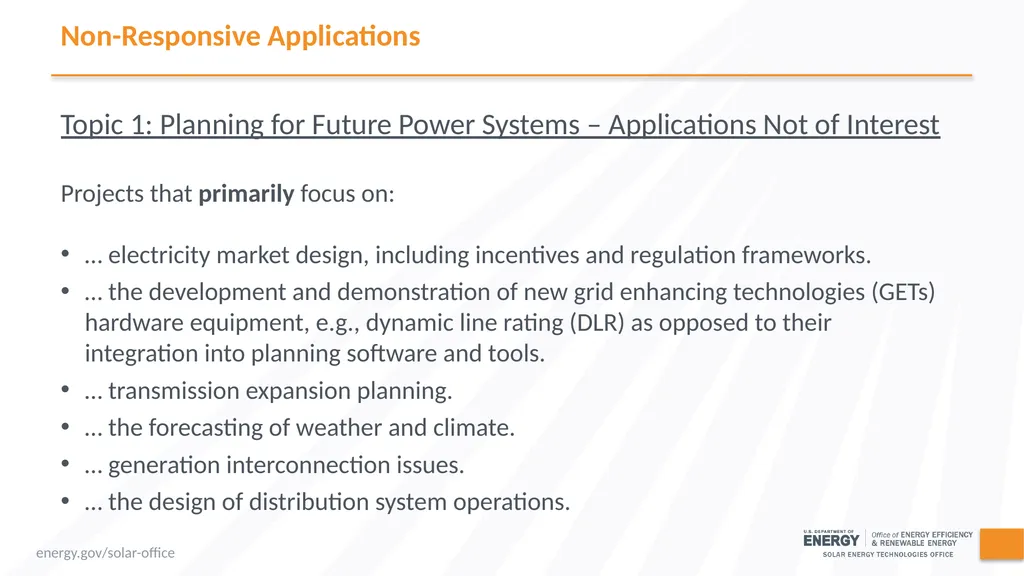
slide18. Non-Responsive Applications Topic 1: Planning for Future Power Systems – Applications Not of Interest
Projects that primarily focus on:
… electricity market design, including incentives and regulation frameworks.
… the development and demonstration of new grid enhancing technologies (GETs) hardware equipment, e.g., dynamic line rating (DLR) as opposed to their integration into planning software and tools.
… transmission expansion planning.
… the forecasting of weather and climate.
… generation interconnection issues.
… the design of distribution system operations.<br>
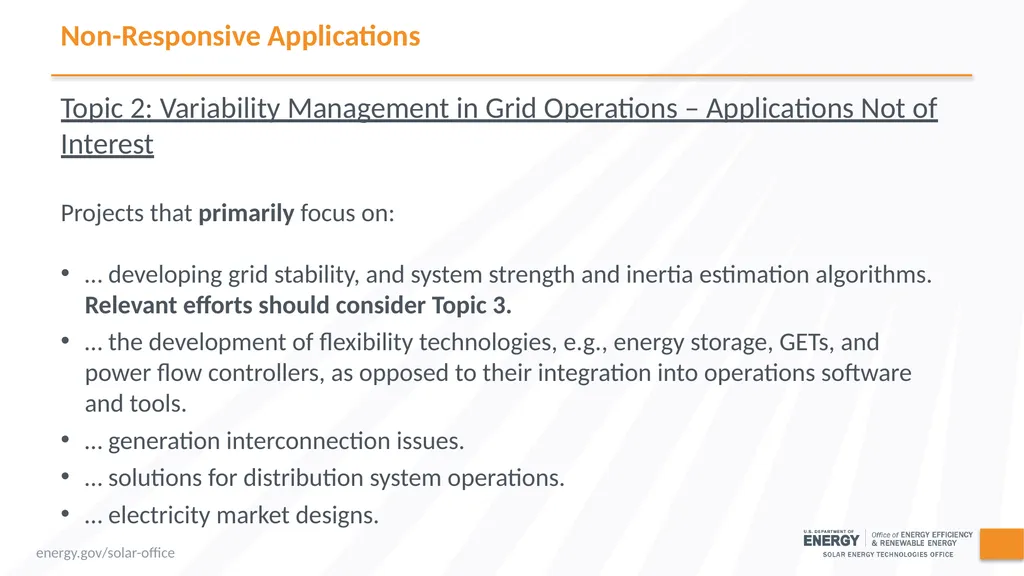
slide19. Non-Responsive Applications Topic 2: Variability Management in Grid Operations – Applications Not of Interest
Projects that primarily focus on:
… developing grid stability, and system strength and inertia estimation algorithms. Relevant efforts should consider Topic 3.
… the development of flexibility technologies, e.g., energy storage, GETs, and power flow controllers, as opposed to their integration into operations software and tools.
… generation interconnection issues.
… solutions for distribution system operations.
… electricity market designs.<br>
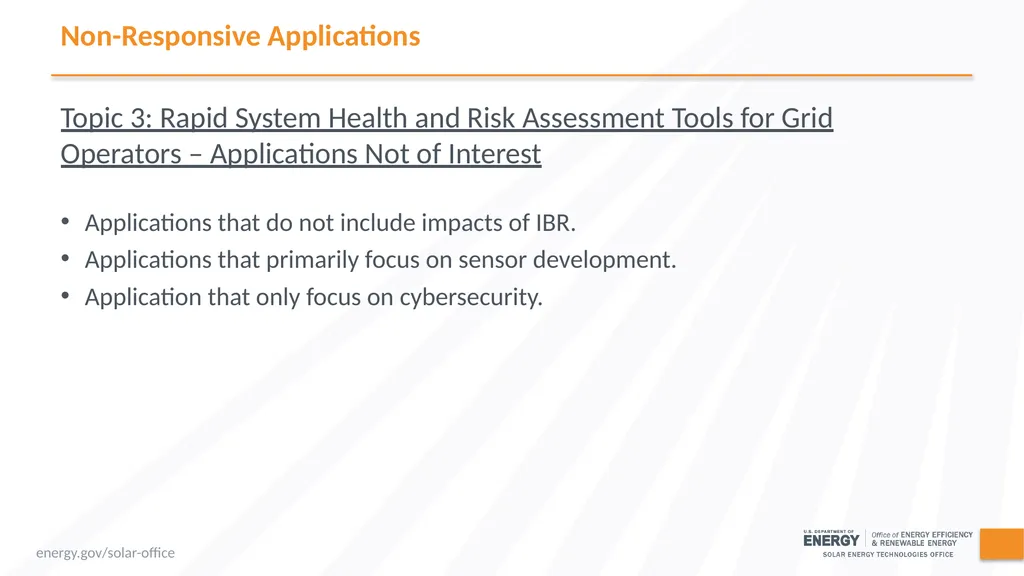
slide20. Non-Responsive Applications Topic 3: Rapid System Health and Risk Assessment Tools for Grid Operators – Applications Not of Interest
Applications that do not include impacts of IBR.
Applications that primarily focus on sensor development.
Application that only focus on cybersecurity.<br>
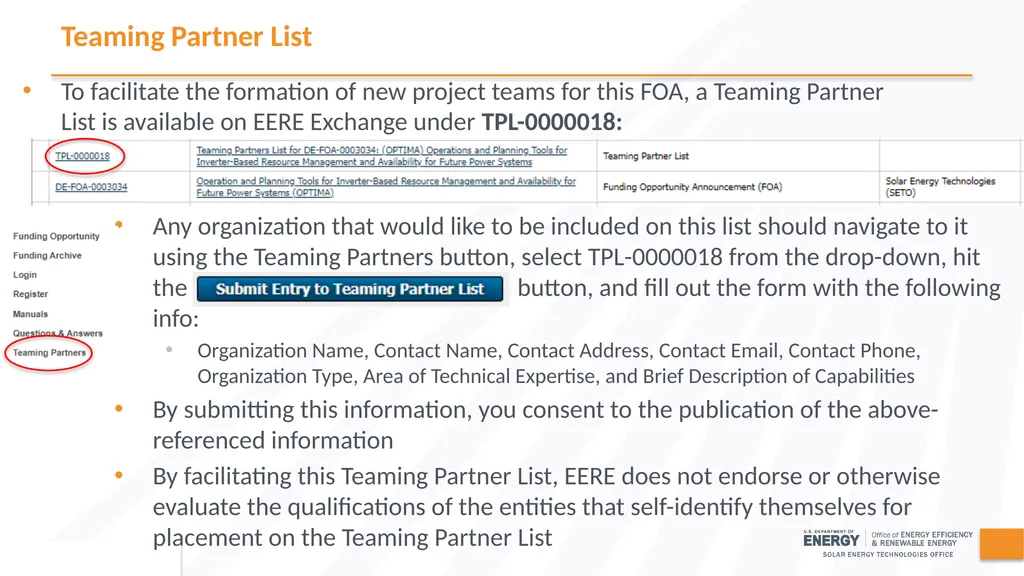
slide21. Any organization that would like to be included on this list should navigate to it using the Teaming Partners button, select TPL-0000018 from the drop-down, hit the <placeholder text for space> button, and fill out the form with the following info:
Organization Name, Contact Name, Contact Address, Contact Email, Contact Phone, Organization Type, Area of Technical Expertise, and Brief Description of Capabilities
By submitting this information, you consent to the publication of the above-referenced information
By facilitating this Teaming Partner List, EERE does not endorse or otherwise evaluate the qualifications of the entities that self-identify themselves for placement on the Teaming Partner List To facilitate the formation of new project teams for this FOA, a Teaming Partner List is available on EERE Exchange under TPL-0000018: Teaming Partner List<br>
slide22. Award Information All awards will be Cooperative Agreements
*Subject to the availability of appropriated funds<br>
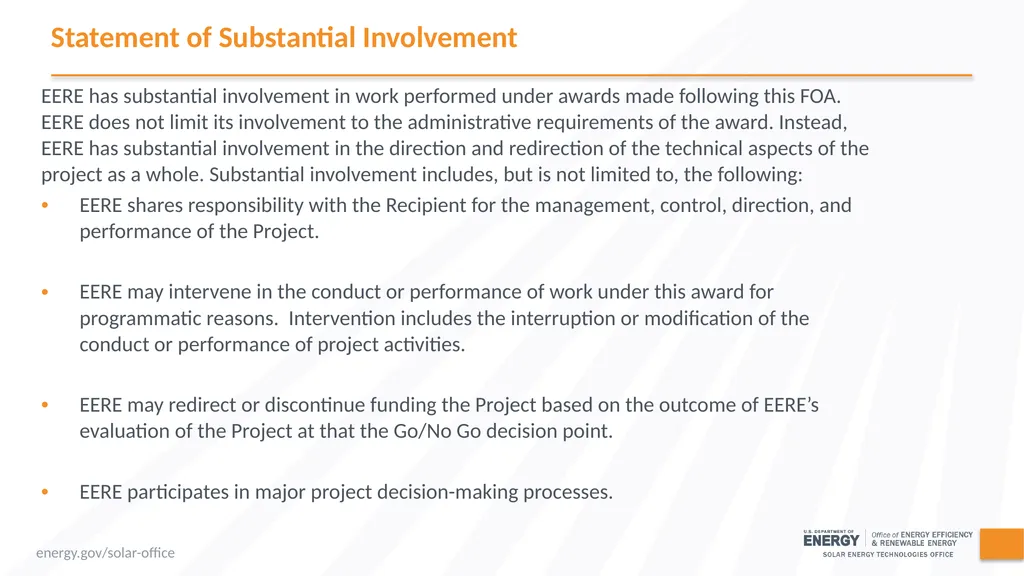
slide23. Statement of Substantial Involvement EERE has substantial involvement in work performed under awards made following this FOA. EERE does not limit its involvement to the administrative requirements of the award. Instead, EERE has substantial involvement in the direction and redirection of the technical aspects of the project as a whole. Substantial involvement includes, but is not limited to, the following:
EERE shares responsibility with the Recipient for the management, control, direction, and performance of the Project.
EERE may intervene in the conduct or performance of work under this award for programmatic reasons. Intervention includes the interruption or modification of the conduct or performance of project activities.
EERE may redirect or discontinue funding the Project based on the outcome of EERE’s evaluation of the Project at that the Go/No Go decision point.
EERE participates in major project decision-making processes.<br>
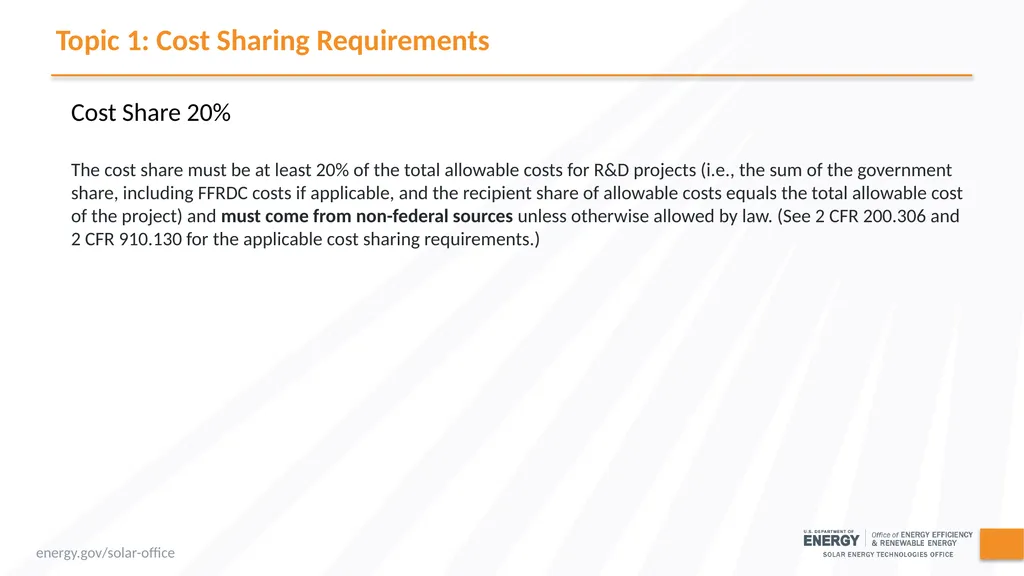
slide24. Topic 1: Cost Sharing Requirements Cost Share 20%
The cost share must be at least 20% of the total allowable costs for R&D projects (i.e., the sum of the government share, including FFRDC costs if applicable, and the recipient share of allowable costs equals the total allowable cost of the project) and must come from non-federal sources unless otherwise allowed by law. (See 2 CFR 200.306 and 2 CFR 910.130 for the applicable cost sharing requirements.)<br>
slide25. Topics 2 and 3: Cost Sharing Requirements Cost Share 20% and 50%
The cost share must be at least 20% of the total allowable costs (i.e., the sum of the government share, including FFRDC costs if applicable, and the recipient share of allowable costs equals the total allowable cost of the project) for research and development projects and 50% of the total allowable costs for demonstration and commercial application projects and must come from non-federal sources unless otherwise allowed by law. (See 2 CFR 200.306 and 2 CFR 910.130 for the applicable cost sharing requirements.)
Examples of activities that would be considered demonstrations under Topics 2 and 3 include upgrading fielded controllers, such as IBR firmware or hardware, installing new sensors and communication equipment in solar facilities or on the electric grid, operating and monitoring fielded equipment during a pilot test phase, or testing how software responds to real-time data from field measurements.
To assist applicants in calculating proper cost share amounts, EERE has included a cost share information sheet and sample cost share calculation as Appendices A and B to the FOA document.<br>
slide26. Cost Share Contributions Contributions must be:
Specified in the project budget
Verifiable from the Prime Recipient’s records
Necessary and reasonable for proper and efficient accomplishment of the project
If you are selected for award negotiations, every cost share contribution must be reviewed and approved in advance by the Contracting Officer and incorporated into the project budget before the expenditures are incurred
Please note, vendors/contractors may NOT provide cost share. Any partial donation of goods or services is considered a discount and is not allowable.<br>
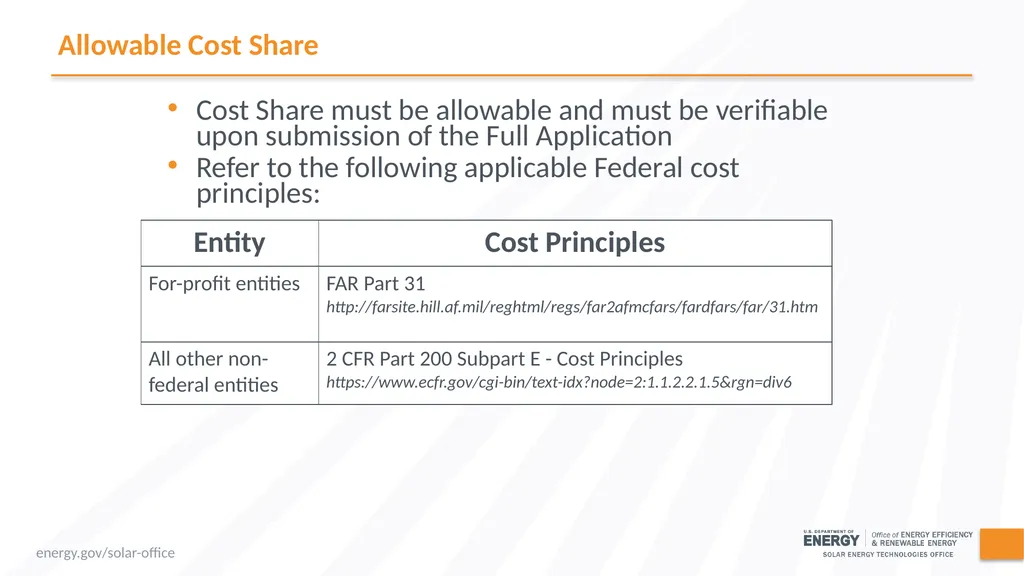
slide27. Allowable Cost Share Cost Share must be allowable and must be verifiable upon submission of the Full Application
Refer to the following applicable Federal cost principles:<br>
slide28. Allowable Cost Share Cash Contributions
May be provided by the Prime Recipient, Subrecipients, or a Third Party (may not be provided by vendors/contractors)
In-Kind Contributions
Can include, but are not limited to: the donation of space or use of equipment.
For more information, see the Cost Share Appendix A in the FOA<br>
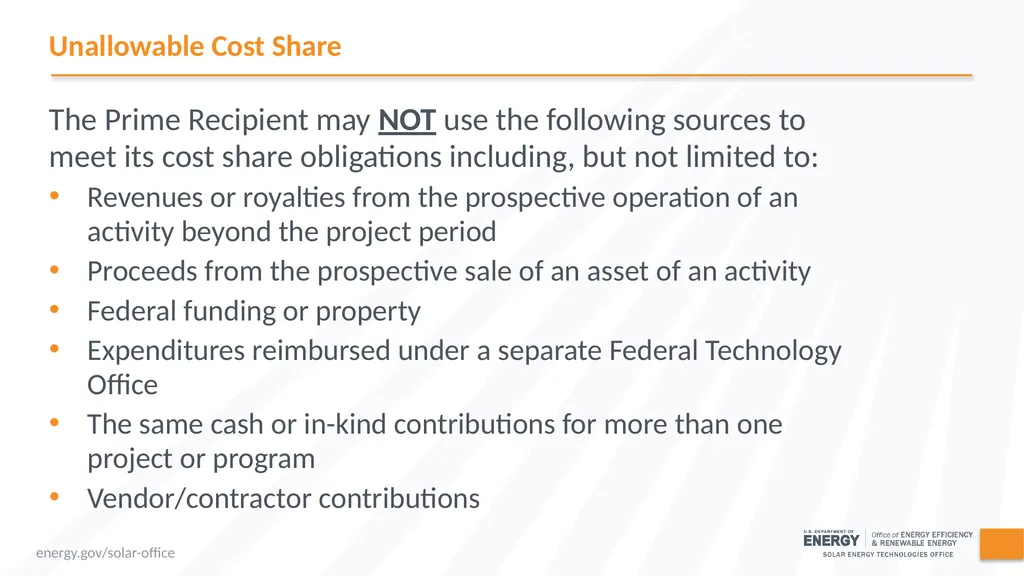
slide29. Unallowable Cost Share The Prime Recipient may NOT use the following sources to meet its cost share obligations including, but not limited to:
Revenues or royalties from the prospective operation of an activity beyond the project period
Proceeds from the prospective sale of an asset of an activity
Federal funding or property
Expenditures reimbursed under a separate Federal Technology Office
The same cash or in-kind contributions for more than one project or program
Vendor/contractor contributions<br>
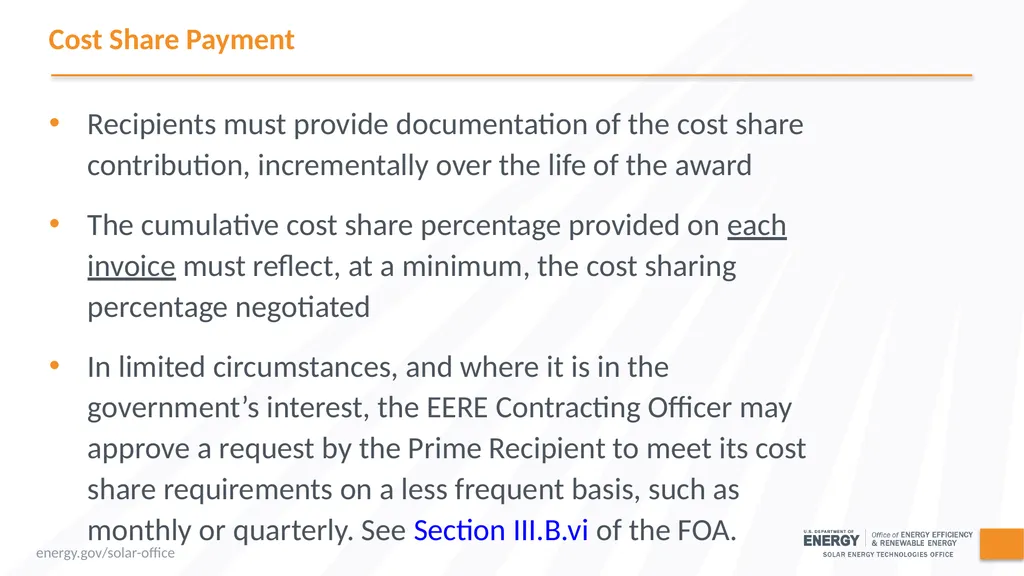
slide30. Cost Share Payment Recipients must provide documentation of the cost share contribution, incrementally over the life of the award
The cumulative cost share percentage provided on each invoice must reflect, at a minimum, the cost sharing percentage negotiated
In limited circumstances, and where it is in the government’s interest, the EERE Contracting Officer may approve a request by the Prime Recipient to meet its cost share requirements on a less frequent basis, such as monthly or quarterly. See Section III.B.vi of the FOA.<br>
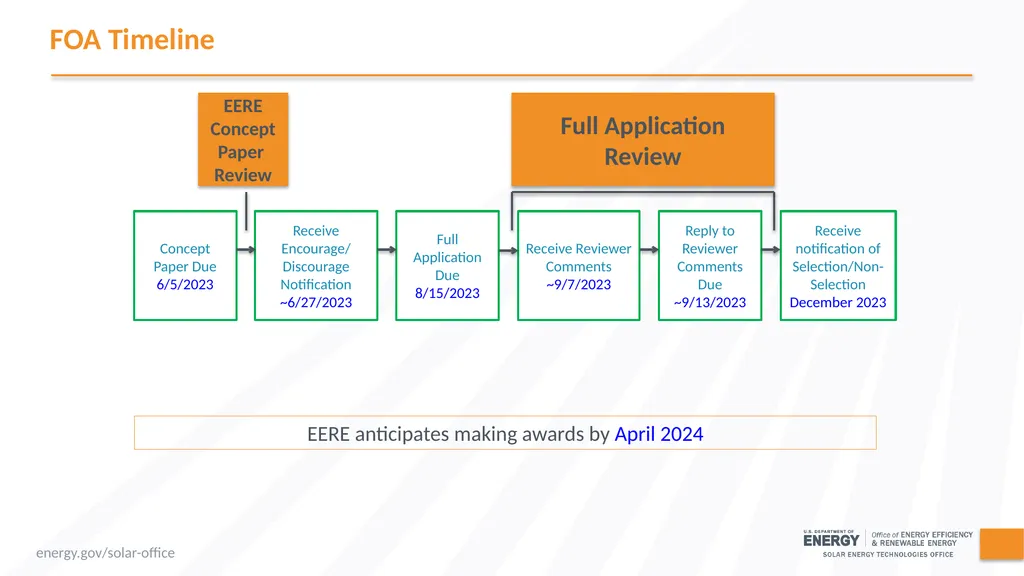
slide31. FOA Timeline Concept Paper Due
6/5/2023 Receive Encourage/ Discourage Notification
~6/27/2023 Full Application Due
8/15/2023 Receive Reviewer Comments
~9/7/2023 Reply to Reviewer Comments
Due
~9/13/2023 Receive notification of Selection/Non-Selection
December 2023 EERE
Concept Paper Review Full Application Review EERE anticipates making awards by April 2024<br>
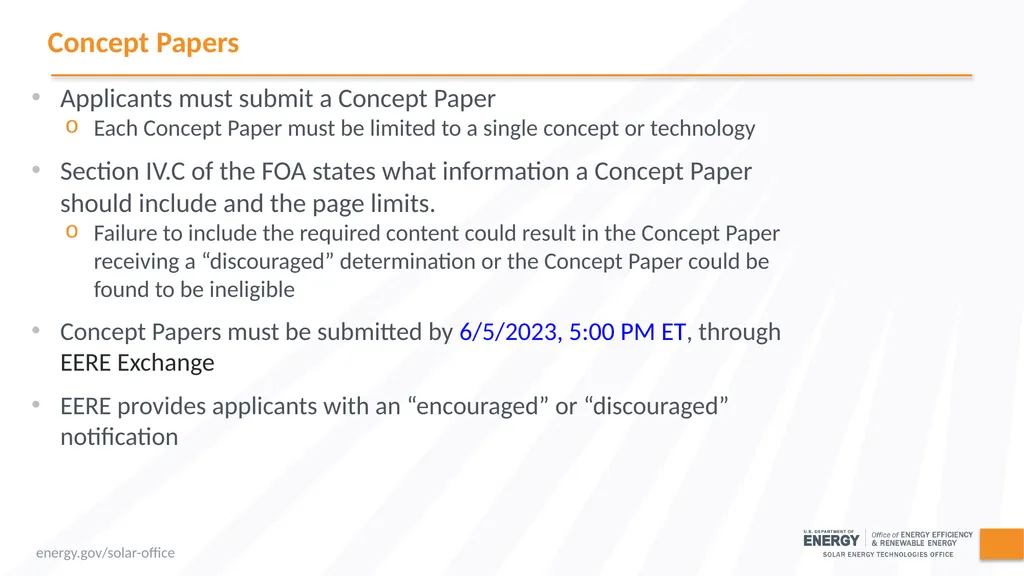
slide32. Concept Papers Applicants must submit a Concept Paper
Each Concept Paper must be limited to a single concept or technology
Section IV.C of the FOA states what information a Concept Paper should include and the page limits.
Failure to include the required content could result in the Concept Paper receiving a “discouraged” determination or the Concept Paper could be found to be ineligible
Concept Papers must be submitted by 6/5/2023, 5:00 PM ET, through EERE Exchange
EERE provides applicants with an “encouraged” or “discouraged” notification<br>
slide33. Concept Paper Review Overall FOA Responsiveness and Viability of the Project (Weight: 100%)
This criterion involves consideration of the following factors:
• The applicant clearly describes the proposed technology, describes how the technology is unique and innovative, and how the technology will advance the current state-of-the-art;
• The applicant has identified risks and challenges, including possible mitigation strategies, and has shown the impact that EERE funding and the proposed project would have on the relevant field and application;
• The applicant has the qualifications, experience, capabilities and other resources necessary to complete the proposed project; and
• The proposed work, if successfully accomplished, would clearly meet the objectives as stated in the FOA.<br>
slide34. The Full Application includes:
Technical Volume: The key technical submission - describe technology, team, and resources
Resumes: 3 pages max. each, additional pages will not be read
Letters of Commitment: 1 page max. each, additional pages will not be read
Statement of Project Objectives: Use to further describe your workplan outside of Technical Volume, describe Tasks to be completed and project Milestones
NEW Community Benefits Plan: Replaces former DEI Plan, 5 pages max.
Summary for Public Release: How you would briefly describe the project on a website or newsletter
Summary Slide: Highlight key project goals and talking points, e.g. community benefits Full Applications<br>
slide35. The Full Application includes:
SF-424 Application for Federal Assistance: The formal application signed by the authorized representative of the applicant
Budget Justification Workbook: a detailed budget and spend plan for the project
Subrecipient Budget Justification: applicable over $250,000 or 25% of work effort
DOE Work Proposal for FFRDC (if applicable)
Authorization from cognizant Contracting Officer for FFRDC (if applicable)
SF-LLL Disclosure of Lobbying Activities: for both the Prime applicant and Subrecipients Full Applications<br>
slide36. The Full Application includes:
NEW Current and Pending Support: See Section IV.D.xv for newly added definitions
NEW Potential Duplicative Funding Notice: If applicant has other active federal awards that may be viewed as potentially overlapping funds, they must submit a notice to state how project funds will not be used for identical cost items
NEW Foreign Entity Waiver Requests and Foreign Work Waiver Requests: All recipients and subrecipients must be domestic entities a physical location for business operations in the U.S.
NEW Transparency of Foreign Connections: For each recipient and subrecipient, applicants must submit responses to the questionnaire in Section IV.D.xvi Full Applications<br>
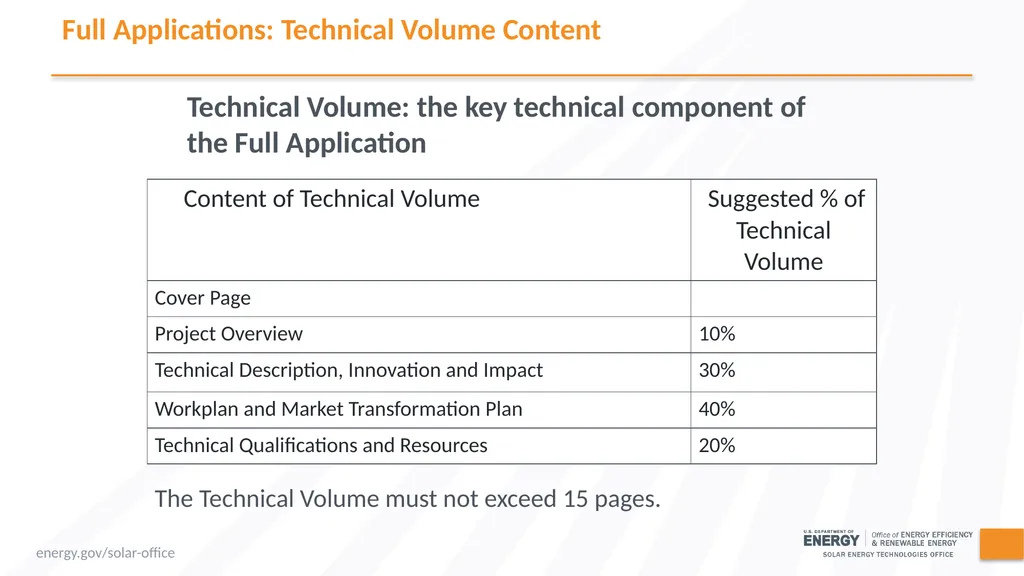
slide37. Full Applications: Technical Volume Content Technical Volume: the key technical component of the Full Application
(1) Cover Page The Technical Volume must not exceed 15 pages.<br>
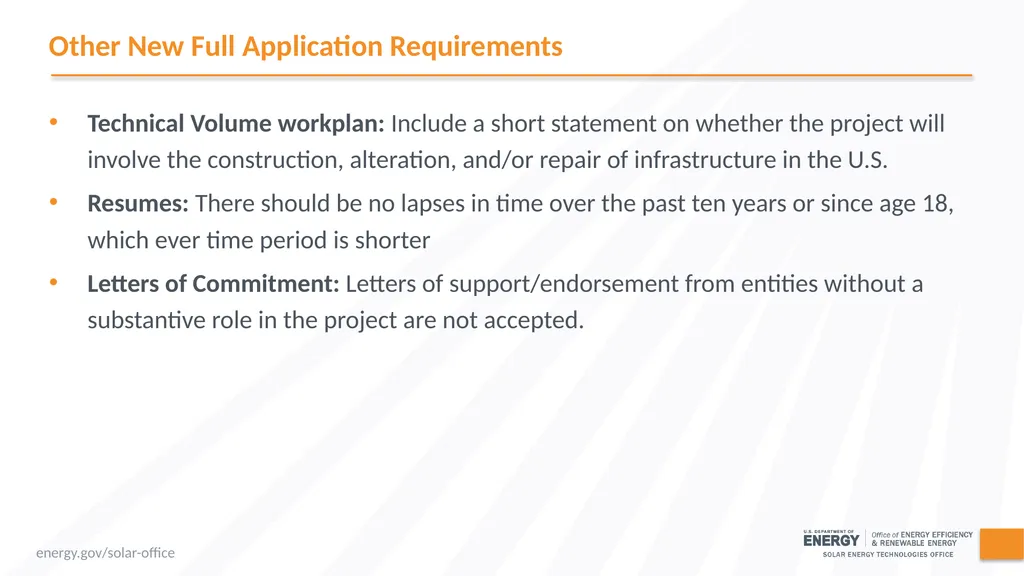
slide38. Other New Full Application Requirements Technical Volume workplan: Include a short statement on whether the project will involve the construction, alteration, and/or repair of infrastructure in the U.S.
Resumes: There should be no lapses in time over the past ten years or since age 18, which ever time period is shorter
Letters of Commitment: Letters of support/endorsement from entities without a substantive role in the project are not accepted.<br>
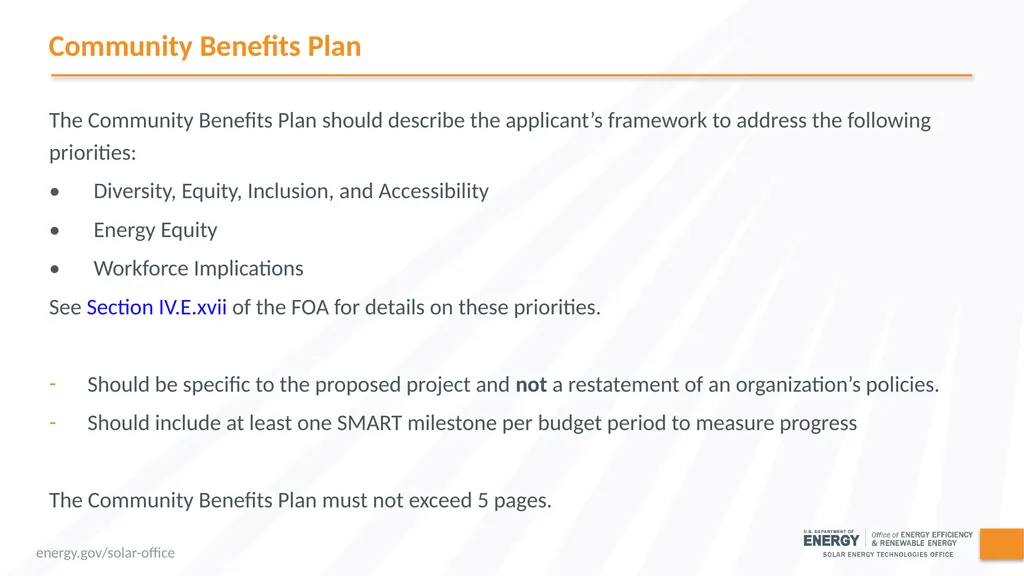
slide39. Community Benefits Plan The Community Benefits Plan should describe the applicant’s framework to address the following priorities:
• Diversity, Equity, Inclusion, and Accessibility
• Energy Equity
• Workforce Implications
See Section IV.E.xvii of the FOA for details on these priorities.
Should be specific to the proposed project and not a restatement of an organization’s policies.
Should include at least one SMART milestone per budget period to measure progress
The Community Benefits Plan must not exceed 5 pages.<br>
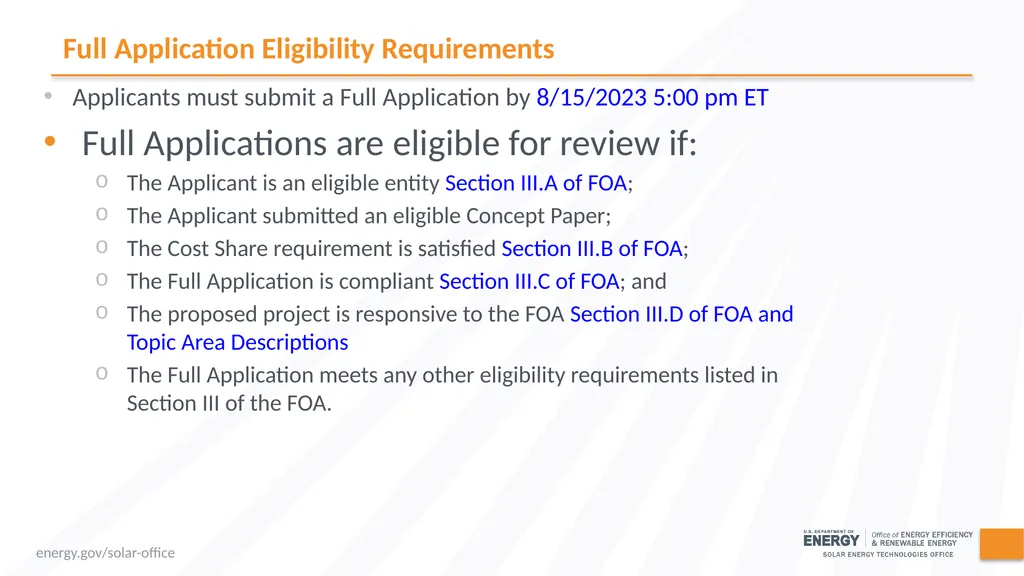
slide40. Full Application Eligibility Requirements Applicants must submit a Full Application by 8/15/2023 5:00 pm ET
Full Applications are eligible for review if:
The Applicant is an eligible entity Section III.A of FOA;
The Applicant submitted an eligible Concept Paper;
The Cost Share requirement is satisfied Section III.B of FOA;
The Full Application is compliant Section III.C of FOA; and
The proposed project is responsive to the FOA Section III.D of FOA and Topic Area Descriptions
The Full Application meets any other eligibility requirements listed in Section III of the FOA.<br>
slide41. Who is Eligible to Apply? Eligible applicants for this FOA include:
U.S. citizens and lawful U.S. permanent residents
For-profit entities
Educational institutions
Nonprofits
State, local, and tribal government entities
DOE/NNSA FFRDCs
For more detail about eligible applicants, please see Section III.A of the FOA
Nonprofit organizations described in Section 501(c)(4) of the Internal Revenue Code of 1986 that engaged in lobbying activities after December 31, 1995, are not eligible to apply for funding.
Prime Recipients and all subrecipients must be in must be incorporated (or otherwise formed) under the laws of a State or territory of the United States and have a physical location for business operations in the United States. See Section III.A.ii for requirements applicable to foreign entities applying under this FOA.<br>
slide42. Multiple Applications An entity may submit more than one Concept Paper and Full Application to this FOA, provided that each application describes a unique, scientifically distinct project and provided that an eligible Concept Paper was submitted for each Full Application.<br>
slide43. Merit Review and Selection Process (Full Applications) The Merit Review process consists of multiple phases that each include an eligibility review and a thorough technical review
Rigorous technical reviews are conducted by reviewers that are experts in the subject matter of the FOA
Ultimately, the Selection Official considers the recommendations of the reviewers, along with other considerations such as program policy factors, to make the selection decisions<br>
slide44. Criterion 1: Technical Merit, Innovation, and Impact (50%)
This criterion involves consideration of the following factors:
Technical Merit and Innovation
• Extent to which the proposed technology or process is innovative;
• Degree to which the current state of the technology and the proposed advancement are clearly described;
• Extent to which the application specifically and convincingly demonstrates how the applicant will move the state-of-the-art to the proposed advancement; and
• Sufficiency of technical detail in the application to assess whether the proposed work is scientifically meritorious and revolutionary, including relevant data, calculations and discussion of prior work in the literature with analyses that support the viability of the proposed work.
• Extent to which project has buy-in from needed stakeholders to ensure success;
• Degree to which key manufacturing and supply chain challenges are considered, as applicable, for viable scale-up in this and future demonstrations;
• Degree to which siting and environmental constraints are considered for deployment;
• Extent to which project has the potential to reduce emissions and provide clean energy acceleration benefits for a community or region; and
• Sufficiency of existing infrastructure to support addition of proposed demonstration. Technical Merit Review Criteria<br>
slide45. Criterion 1: Technical Merit, Innovation, and Impact (50%) (cont.)
This criterion involves consideration of the following factors:
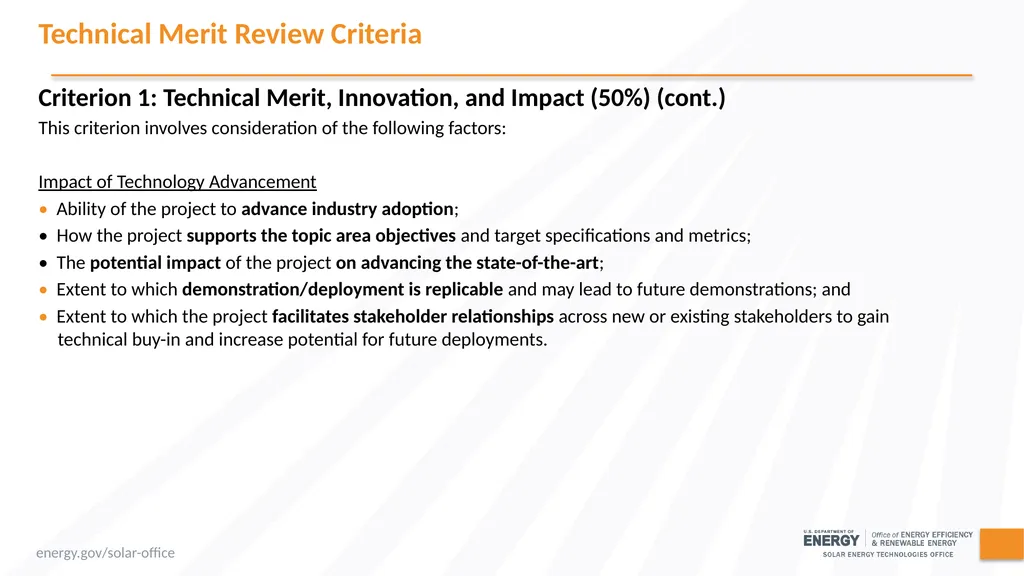
Impact of Technology Advancement
• Ability of the project to advance industry adoption;
• How the project supports the topic area objectives and target specifications and metrics;
• The potential impact of the project on advancing the state-of-the-art;
• Extent to which demonstration/deployment is replicable and may lead to future demonstrations; and
• Extent to which the project facilitates stakeholder relationships across new or existing stakeholders to gain technical buy-in and increase potential for future deployments. Technical Merit Review Criteria<br>
slide46. Criterion 1: Technical Merit, Innovation, and Impact (50%) (cont.)
This criterion involves consideration of the following factors:
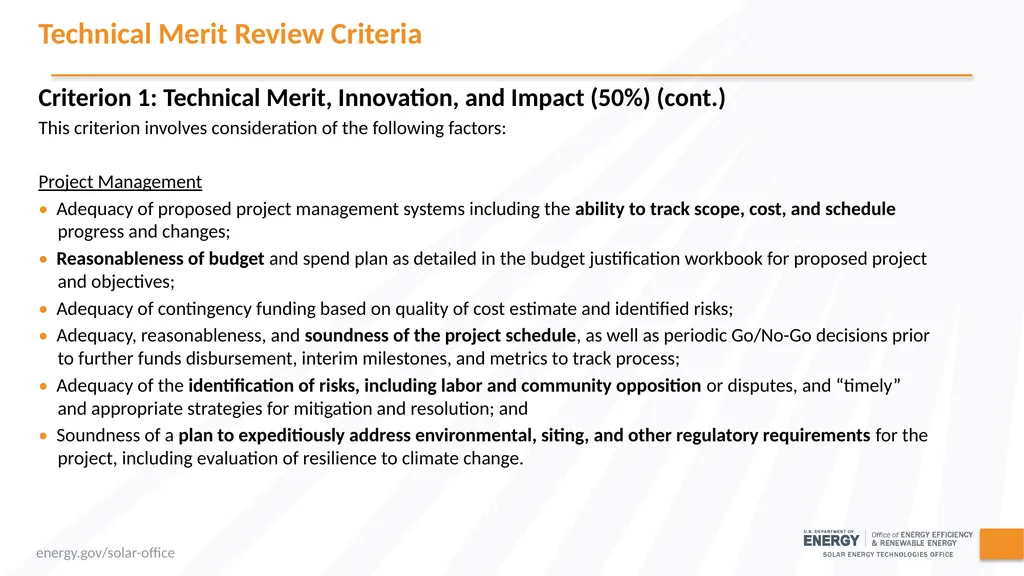
Project Management
• Adequacy of proposed project management systems including the ability to track scope, cost, and schedule progress and changes;
• Reasonableness of budget and spend plan as detailed in the budget justification workbook for proposed project and objectives;
• Adequacy of contingency funding based on quality of cost estimate and identified risks;
• Adequacy, reasonableness, and soundness of the project schedule, as well as periodic Go/No-Go decisions prior to further funds disbursement, interim milestones, and metrics to track process;
• Adequacy of the identification of risks, including labor and community opposition or disputes, and “timely” and appropriate strategies for mitigation and resolution; and
• Soundness of a plan to expeditiously address environmental, siting, and other regulatory requirements for the project, including evaluation of resilience to climate change. Technical Merit Review Criteria<br>
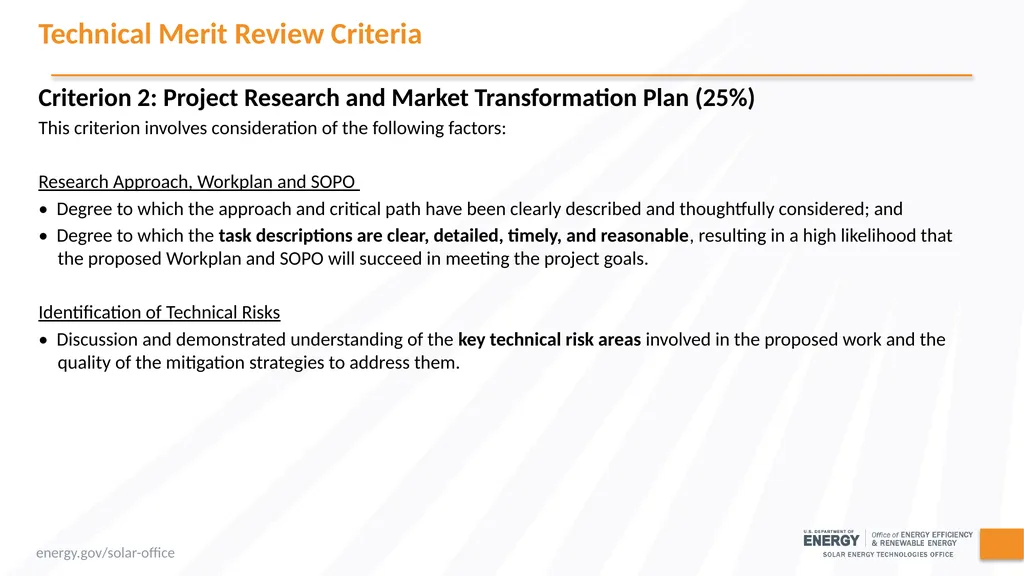
slide47. Criterion 2: Project Research and Market Transformation Plan (25%)
This criterion involves consideration of the following factors:
Research Approach, Workplan and SOPO
• Degree to which the approach and critical path have been clearly described and thoughtfully considered; and
• Degree to which the task descriptions are clear, detailed, timely, and reasonable, resulting in a high likelihood that the proposed Workplan and SOPO will succeed in meeting the project goals.
Identification of Technical Risks
• Discussion and demonstrated understanding of the key technical risk areas involved in the proposed work and the quality of the mitigation strategies to address them. Technical Merit Review Criteria<br>
slide48. Criterion 2: Project Research and Market Transformation Plan (25%) (cont.)
This criterion involves consideration of the following factors:
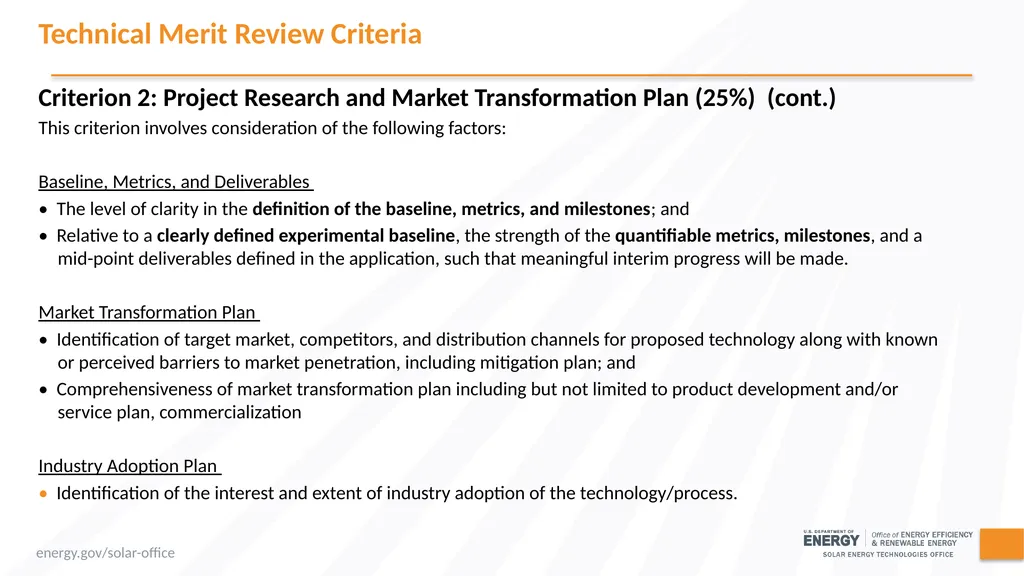
Baseline, Metrics, and Deliverables
• The level of clarity in the definition of the baseline, metrics, and milestones; and
• Relative to a clearly defined experimental baseline, the strength of the quantifiable metrics, milestones, and a mid-point deliverables defined in the application, such that meaningful interim progress will be made.
Market Transformation Plan
• Identification of target market, competitors, and distribution channels for proposed technology along with known or perceived barriers to market penetration, including mitigation plan; and
• Comprehensiveness of market transformation plan including but not limited to product development and/or service plan, commercialization
Industry Adoption Plan
• Identification of the interest and extent of industry adoption of the technology/process. Technical Merit Review Criteria<br>
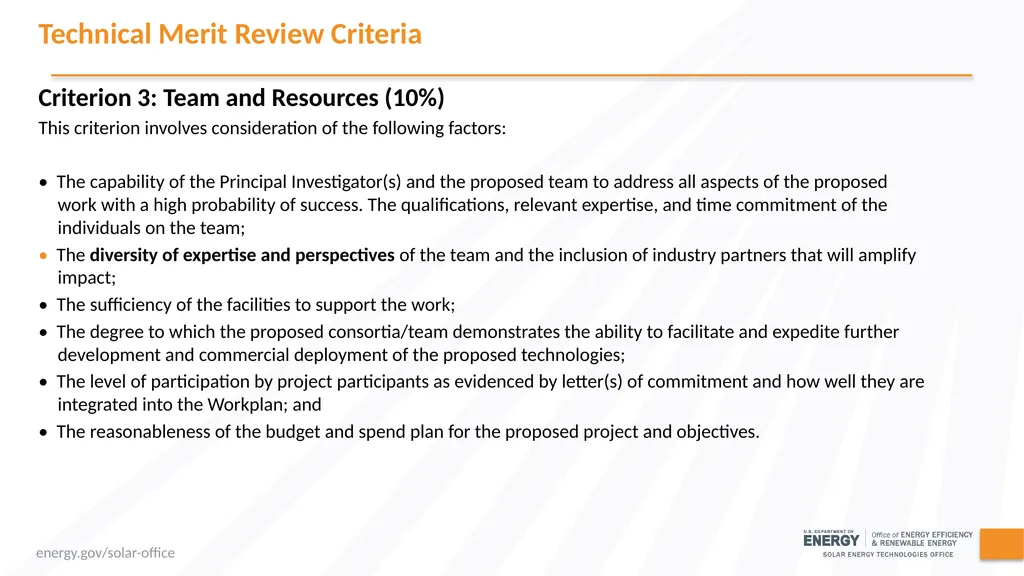
slide49. Criterion 3: Team and Resources (10%)
This criterion involves consideration of the following factors:
• The capability of the Principal Investigator(s) and the proposed team to address all aspects of the proposed work with a high probability of success. The qualifications, relevant expertise, and time commitment of the individuals on the team;
• The diversity of expertise and perspectives of the team and the inclusion of industry partners that will amplify impact;
• The sufficiency of the facilities to support the work;
• The degree to which the proposed consortia/team demonstrates the ability to facilitate and expedite further development and commercial deployment of the proposed technologies;
• The level of participation by project participants as evidenced by letter(s) of commitment and how well they are integrated into the Workplan; and
• The reasonableness of the budget and spend plan for the proposed project and objectives. Technical Merit Review Criteria<br>
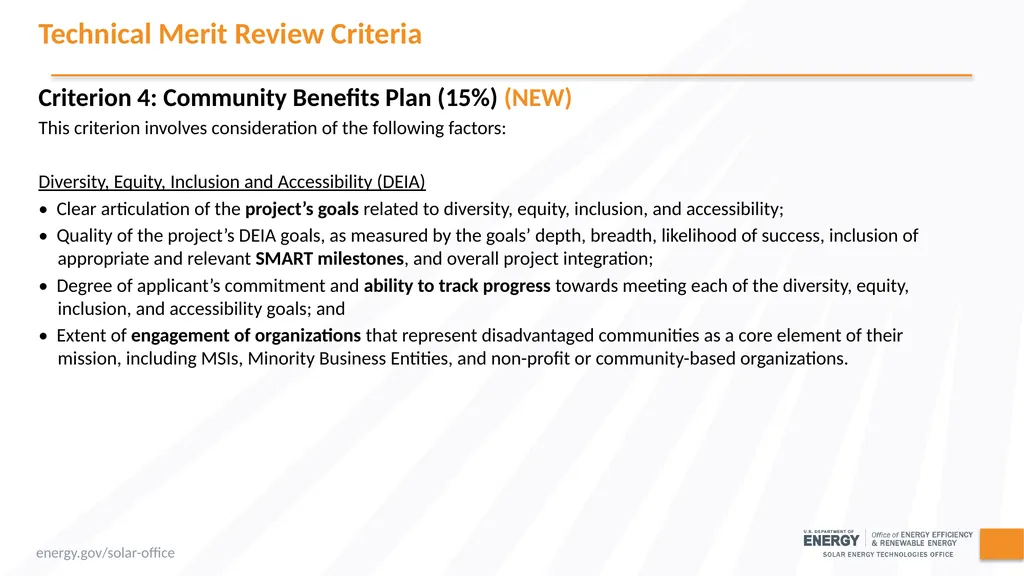
slide50. Criterion 4: Community Benefits Plan (15%) (NEW)
This criterion involves consideration of the following factors:
Diversity, Equity, Inclusion and Accessibility (DEIA)
• Clear articulation of the project’s goals related to diversity, equity, inclusion, and accessibility;
• Quality of the project’s DEIA goals, as measured by the goals’ depth, breadth, likelihood of success, inclusion of appropriate and relevant SMART milestones, and overall project integration;
• Degree of applicant’s commitment and ability to track progress towards meeting each of the diversity, equity, inclusion, and accessibility goals; and
• Extent of engagement of organizations that represent disadvantaged communities as a core element of their mission, including MSIs, Minority Business Entities, and non-profit or community-based organizations. Technical Merit Review Criteria<br>
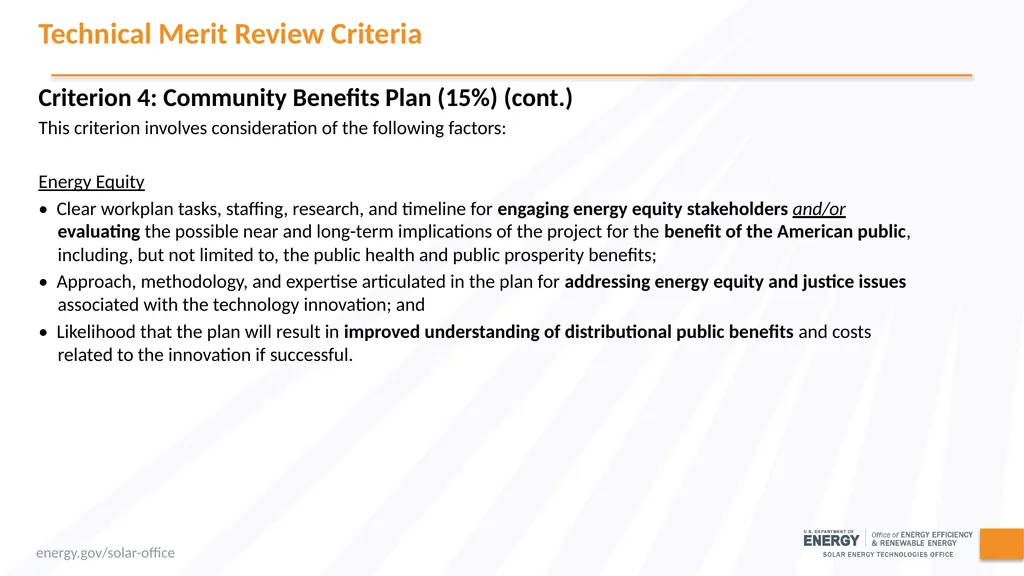
slide51. Criterion 4: Community Benefits Plan (15%) (cont.)
This criterion involves consideration of the following factors:
Energy Equity
• Clear workplan tasks, staffing, research, and timeline for engaging energy equity stakeholders and/or evaluating the possible near and long-term implications of the project for the benefit of the American public, including, but not limited to, the public health and public prosperity benefits;
• Approach, methodology, and expertise articulated in the plan for addressing energy equity and justice issues associated with the technology innovation; and
• Likelihood that the plan will result in improved understanding of distributional public benefits and costs related to the innovation if successful. Technical Merit Review Criteria<br>
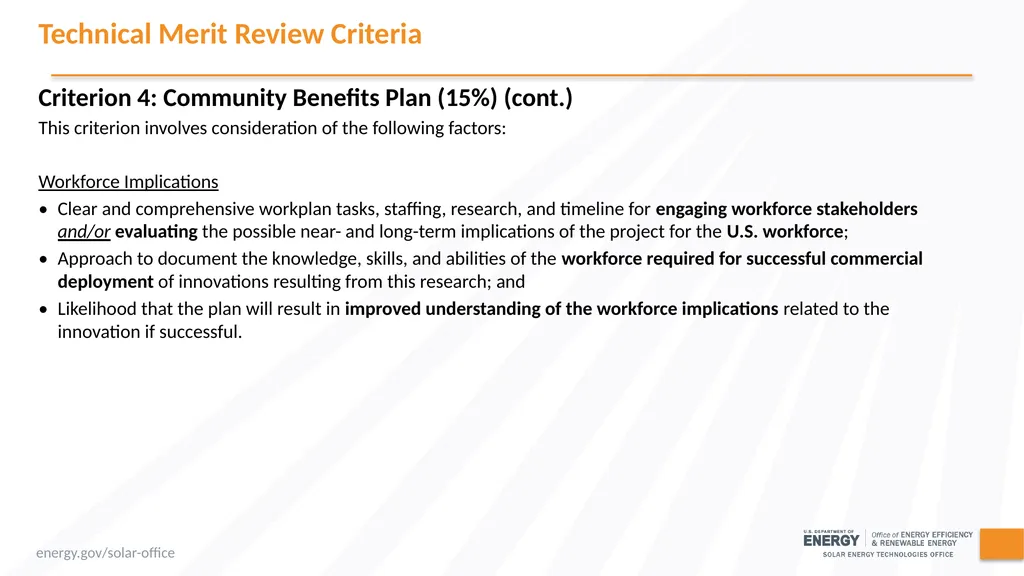
slide52. Criterion 4: Community Benefits Plan (15%) (cont.)
This criterion involves consideration of the following factors:
Workforce Implications
• Clear and comprehensive workplan tasks, staffing, research, and timeline for engaging workforce stakeholders and/or evaluating the possible near- and long-term implications of the project for the U.S. workforce;
• Approach to document the knowledge, skills, and abilities of the workforce required for successful commercial deployment of innovations resulting from this research; and
• Likelihood that the plan will result in improved understanding of the workforce implications related to the innovation if successful. Technical Merit Review Criteria<br>
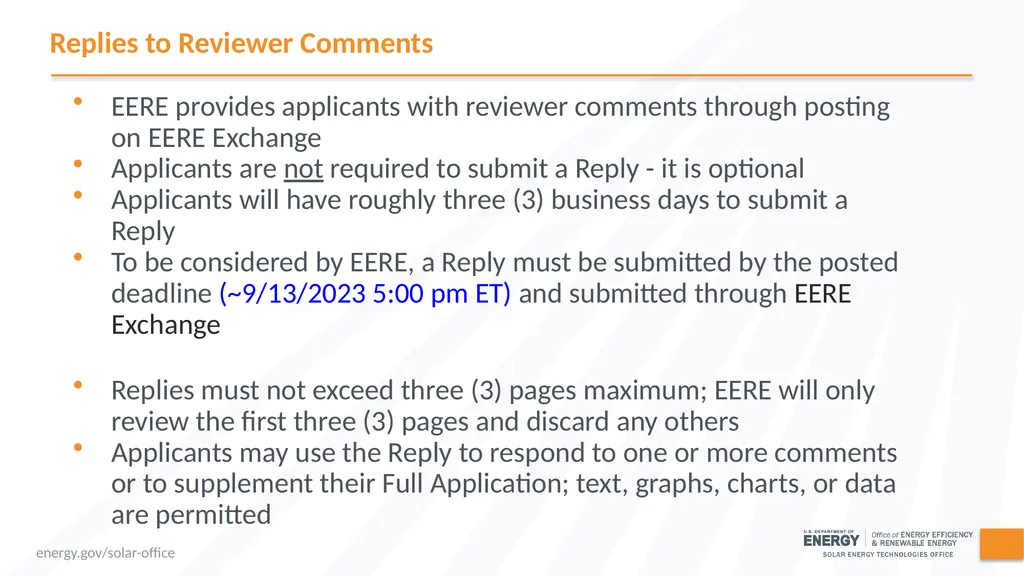
slide53. Replies to Reviewer Comments EERE provides applicants with reviewer comments through posting on EERE Exchange
Applicants are not required to submit a Reply - it is optional
Applicants will have roughly three (3) business days to submit a Reply
To be considered by EERE, a Reply must be submitted by the posted deadline (~9/13/2023 5:00 pm ET) and submitted through EERE Exchange
Replies must not exceed three (3) pages maximum; EERE will only review the first three (3) pages and discard any others
Applicants may use the Reply to respond to one or more comments or to supplement their Full Application; text, graphs, charts, or data are permitted<br>
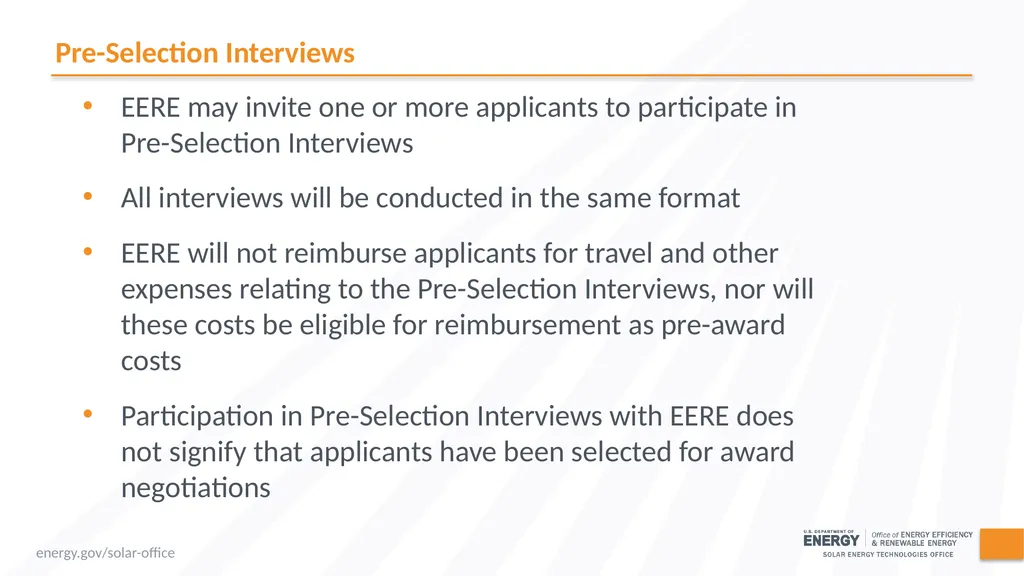
slide54. EERE may invite one or more applicants to participate in Pre-Selection Interviews
All interviews will be conducted in the same format
EERE will not reimburse applicants for travel and other expenses relating to the Pre-Selection Interviews, nor will these costs be eligible for reimbursement as pre-award costs
Participation in Pre-Selection Interviews with EERE does not signify that applicants have been selected for award negotiations Pre-Selection Interviews<br>
slide55. Selection Factors The Selection Official may consider the merit review recommendation, program policy factors, and the amount of funds available in arriving at selections for this FOA<br>
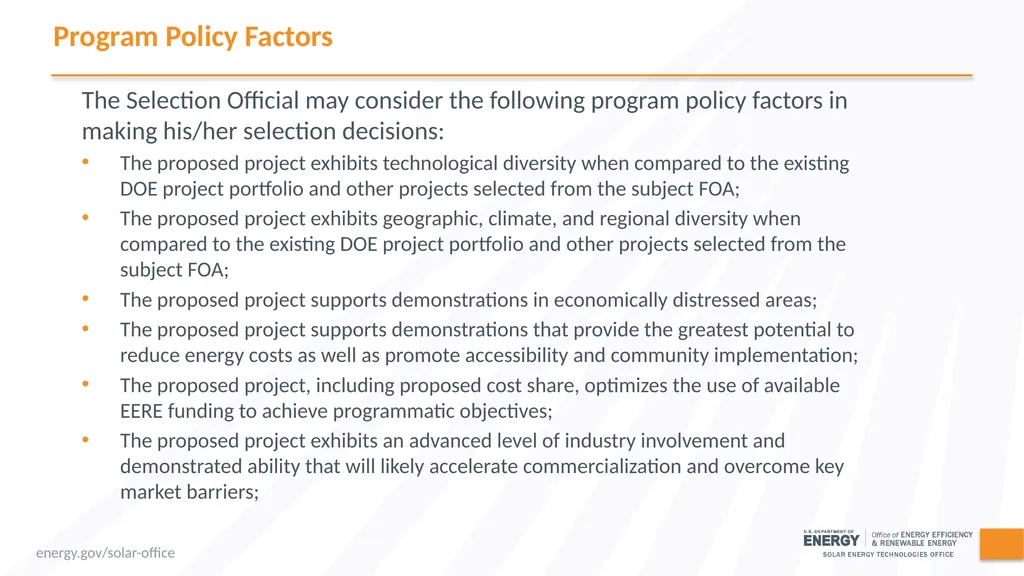
slide56. Program Policy Factors The Selection Official may consider the following program policy factors in making his/her selection decisions:
The proposed project exhibits technological diversity when compared to the existing DOE project portfolio and other projects selected from the subject FOA;
The proposed project exhibits geographic, climate, and regional diversity when compared to the existing DOE project portfolio and other projects selected from the subject FOA;
The proposed project supports demonstrations in economically distressed areas;
The proposed project supports demonstrations that provide the greatest potential to reduce energy costs as well as promote accessibility and community implementation;
The proposed project, including proposed cost share, optimizes the use of available EERE funding to achieve programmatic objectives;
The proposed project exhibits an advanced level of industry involvement and demonstrated ability that will likely accelerate commercialization and overcome key market barriers;<br>
slide57. Program Policy Factors (Con’t) The Selection Official may consider the following program policy factors in making his/her selection decisions:
The proposed project is likely to lead to increased employment and manufacturing in the United States;
The proposed project will accelerate transformational technological advances in areas that industry by itself is not likely to undertake because of technical and financial uncertainty;
The proposed project incorporates diversity, equity, and inclusion elements, including but not limited to team members from Minority Serving Institutions (e.g., Historically Black Colleges and Universities (HBCUs)/Other Minority Institutions), and team members that include Minority Business Enterprises, Minority Owned Businesses, Woman Owned Businesses, Veteran Owned Businesses, Tribal Nations, or members within disadvantaged communities;
The proposed project maximizes benefits to disadvantaged communities; and
The proposed project minimizes environmental impacts to disadvantaged communities.<br>
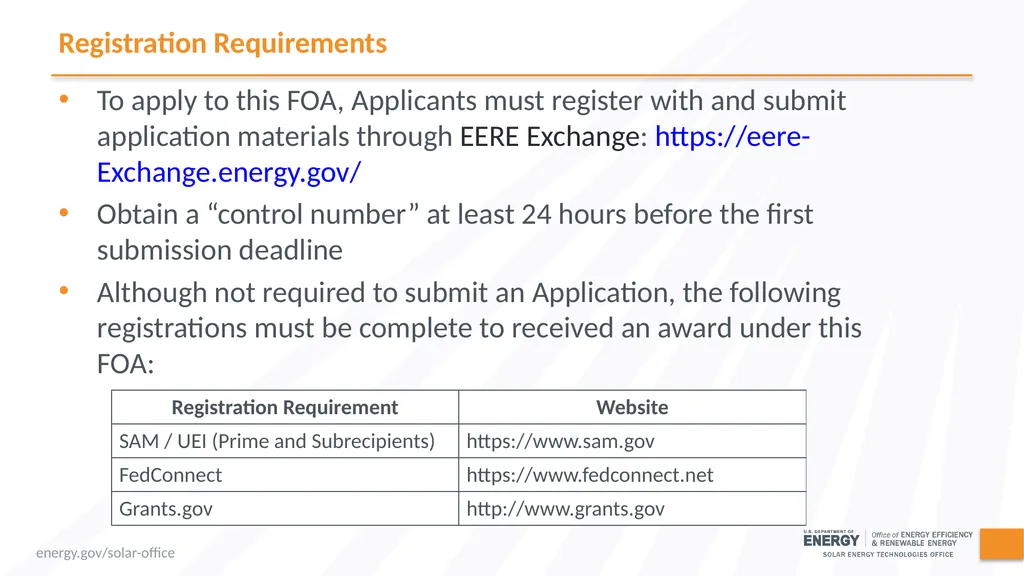
slide58. Registration Requirements To apply to this FOA, Applicants must register with and submit application materials through EERE Exchange: https://eere-Exchange.energy.gov/
Obtain a “control number” at least 24 hours before the first submission deadline
Although not required to submit an Application, the following registrations must be complete to received an award under this FOA:<br>
slide59. Means of Submission Concept Papers, Full Applications, and Replies to Reviewer Comments must be submitted through EERE Exchange at
https://eere-Exchange.energy.gov
EERE will not review or consider applications submitted through other means
The Users’ Guide for Applying to the Department of Energy EERE Funding Opportunity Announcements can be found at https://eere-Exchange.energy.gov/Manuals.aspx<br>
slide60. Key Submission Points Check entries in EERE Exchange
Submissions could be deemed ineligible due to an incorrect entry
EERE strongly encourages Applicants to submit 1-2 days prior to the deadline to allow for full upload of application documents and to avoid any potential technical glitches with EERE Exchange
Make sure you hit the submit button
Any changes made after you hit submit will un-submit your application and you will need to hit the submit button again
For your records, print out the EERE Exchange page at each step, which contains the application’s Control Number<br>
slide61. Applicants must designate primary and backup points-of-contact in EERE Exchange with whom EERE will communicate to conduct award negotiations
It is imperative that the Applicant/Selectee be responsive during award negotiations and meet negotiation deadlines
Failure to do so may result in cancellation of further award negotiations and rescission of the Selection Applicant Points-of-Contact<br>
slide62. Questions Questions about this FOA? Email SETO.OPTIMA.FOA@ee.doe.gov
All Q&As related to this FOA will be posted on EERE Exchange
You must select this specific FOA Number in order to view the Q&As
EERE will attempt to respond to a question within 3 business days, unless a similar Q&A has already been posted on the website
Problems logging into EERE Exchange or uploading and submitting application documents with EERE Exchange? Email EERE-ExchangeSupport@hq.doe.gov.
Include FOA name and number in subject line
All questions asked during this presentation will be posted on EERE Exchange<br>
If you do not wish to have your image recorded, please turn off your camera or participate by phone
If you speak during the call or use a video connection, you are presumed to consent to recording and use of your voice or image Please mute your phones and we’ll begin momentarily Welcome<br>
slide2. OPTIMA Funding Opportunity Announcement Webinar DE-FOA-0003034 SETO.OPTIMA.FOA@ee.doe.gov
May 4, 2023<br>
slide3. Notice NO NEW INFORMATION OTHER THAN THAT PROVIDED IN THE FOA WILL BE DISCUSSED IN THE WEBINAR.
There are no particular advantages or disadvantages to the application evaluation process with respect to participating on the webinar today.
Your participation is completely voluntary.<br>
slide4. Notice All applicants are strongly encouraged to carefully read the Funding Opportunity Announcement DE-FOA-0003034 (“FOA”) and adhere to the stated submission requirements.
This presentation summarizes the contents of FOA. If there are any inconsistencies between the FOA and this presentation or statements from DOE personnel, the FOA is the controlling document and applicants should rely on the FOA language, reference section VII, and seek clarification by submitting a question to SETO.OPTIMA.FOA@ee.doe.gov<br>
slide5. DE-FOA-0003034 Operation and Planning Tools for Inverter-Based Resource Management and Availability for Future Power Systems (OPTIMA) Anticipated Schedule:<br>
slide6. Agenda Topic Areas/Technical Areas of Interest
Award Information
FOA Timeline
Concept Papers
Full Applications (and new requirements)
Merit Review and Selection Process
Pre-Selection Interviews
Registration Requirements<br>
slide7. Expected: 9-13 awards across 3 Topic Areas, $30M federal funds total
FOA released: 4/20/23, Concept Papers: 6/5/23
Selections: December 2023, Awards: April 2024 Overview: OPTIMA (Operational and Planning Tools for IBR) FOA 7<br>
slide8. Develop tools that consider grid flexibility technologies e.g., advanced IBR controls, VRE plant optimization, energy storage, GETs, and demand-side flexibilities
Validate and demonstrate the new planning tools in simulation using ISOs’ or utilities’ planning platform
No field demonstration, software studies only (20% CS) but utilizing utility data (DMP/NDA required) Summary Topic 1: Planning Tools for Future Power Systems This topic seeks to improve the long-term planning process of the bulk power grid by incorporating the unique features of variable renewable energy (VRE) sources and new technologies that support VRE into the planning process, such as energy storage, advanced IBR modeling and grid-supporting controls, and grid-enhancing technologies. Tools should also address the impact of cascading disturbance events on VREs, such as extreme weather. nrel.gov Primary Research Objectives
Develop accurate models that can capture the uncertainty of VREs
Develop and improve probabilistic approaches and tools for resource adequacy assessments
Integration of distribution level resources in the bulk power system planning process<br>
slide9. Topic 1 Project Requirements 9<br>
slide10. Topic 1 Project Requirements (cont.) 10<br>
slide11. Summary Topic 2: Variability Management in Grid Operations Projects funded under this topic area will develop tools for grid operators to optimally utilize and control large-scale, transmission connected VREs, as well as large numbers of DER, to achieve a more reliable and predictable operation of the grid. nrel.gov Primary Research Objectives
Improve the scheduling and dispatch of resources and services by incorporating dispatchable VRE and the uncertainty of non-dispatchable VRE
Incorporate new technologies that address VRE and DER uncertainty, e.g., short-term probabilistic forecasts of available solar resources, aggregated sensing and control of grid-edge devices, and incorporating new metrics for security constraints, such as grid strength
Improve the flexible real-time dispatch and optimal utilization of many VREs and DERs at the distribution or aggregator level to respond to market or bulk power system needs and to improve local grid conditions
Incorporate new analytical and control functionalities, including graphical user interfaces, into operation software tools to integrate with utility and ISO’s energy management systems<br>
slide12. Topic 2 Project Requirements 12<br>
slide13. Topic 2 Project Requirements 13<br>
slide14. Summary Topic 3: Rapid System Health and Risk Assessment Tools for Grid Operators This topic seeks to develop software tools, and the data systems that support them, for grid operators to identify emerging system risks that are driven by the faster dynamics and uncertain operating states of IBR. These risks include sub-synchronous oscillations due to IBR control interactions and disturbances that can cause wide-spread reduction of solar output. nrel.gov The proposed tools will need to have the following functions:
Data gathering capabilities to provide situational awareness of IBRs,
Advanced data analytics for real-time system health assessment,
Historic labeled and synchronized disturbance data sets for post-event forensic analysis, and
Mitigation recommendations for operator or autonomous control actions. Successful projects should include:
Visualization interfaces for RTO/ISO control room operators with real-time system health info
Monitoring of aggregated BTM PV generation
Assessment of system inertia or “grid strength”
Automated post-event root-cause analysis and report generation
Systems to collect and correlate data from dispersed sensors with various resolutions and sources<br>
slide15. Topic 3 Project Requirements 15<br>
slide16. Topic 3 Project Requirements 16<br>
slide17. Non-Responsive Applications The following types of applications will be deemed nonresponsive and will not be reviewed or considered for an award:
Applications that fall outside the technical parameters specified in Section I.A or I.B of the FOA
Applications for proposed technologies that are not based on sound scientific principles (e.g., violates the law of thermodynamics)
Applications that are described as not of interest in the topic area description in Section I.B. of the topic area to which they are applying:<br>
slide18. Non-Responsive Applications Topic 1: Planning for Future Power Systems – Applications Not of Interest
Projects that primarily focus on:
… electricity market design, including incentives and regulation frameworks.
… the development and demonstration of new grid enhancing technologies (GETs) hardware equipment, e.g., dynamic line rating (DLR) as opposed to their integration into planning software and tools.
… transmission expansion planning.
… the forecasting of weather and climate.
… generation interconnection issues.
… the design of distribution system operations.<br>
slide19. Non-Responsive Applications Topic 2: Variability Management in Grid Operations – Applications Not of Interest
Projects that primarily focus on:
… developing grid stability, and system strength and inertia estimation algorithms. Relevant efforts should consider Topic 3.
… the development of flexibility technologies, e.g., energy storage, GETs, and power flow controllers, as opposed to their integration into operations software and tools.
… generation interconnection issues.
… solutions for distribution system operations.
… electricity market designs.<br>
slide20. Non-Responsive Applications Topic 3: Rapid System Health and Risk Assessment Tools for Grid Operators – Applications Not of Interest
Applications that do not include impacts of IBR.
Applications that primarily focus on sensor development.
Application that only focus on cybersecurity.<br>
slide21. Any organization that would like to be included on this list should navigate to it using the Teaming Partners button, select TPL-0000018 from the drop-down, hit the <placeholder text for space> button, and fill out the form with the following info:
Organization Name, Contact Name, Contact Address, Contact Email, Contact Phone, Organization Type, Area of Technical Expertise, and Brief Description of Capabilities
By submitting this information, you consent to the publication of the above-referenced information
By facilitating this Teaming Partner List, EERE does not endorse or otherwise evaluate the qualifications of the entities that self-identify themselves for placement on the Teaming Partner List To facilitate the formation of new project teams for this FOA, a Teaming Partner List is available on EERE Exchange under TPL-0000018: Teaming Partner List<br>
slide22. Award Information All awards will be Cooperative Agreements
*Subject to the availability of appropriated funds<br>
slide23. Statement of Substantial Involvement EERE has substantial involvement in work performed under awards made following this FOA. EERE does not limit its involvement to the administrative requirements of the award. Instead, EERE has substantial involvement in the direction and redirection of the technical aspects of the project as a whole. Substantial involvement includes, but is not limited to, the following:
EERE shares responsibility with the Recipient for the management, control, direction, and performance of the Project.
EERE may intervene in the conduct or performance of work under this award for programmatic reasons. Intervention includes the interruption or modification of the conduct or performance of project activities.
EERE may redirect or discontinue funding the Project based on the outcome of EERE’s evaluation of the Project at that the Go/No Go decision point.
EERE participates in major project decision-making processes.<br>
slide24. Topic 1: Cost Sharing Requirements Cost Share 20%
The cost share must be at least 20% of the total allowable costs for R&D projects (i.e., the sum of the government share, including FFRDC costs if applicable, and the recipient share of allowable costs equals the total allowable cost of the project) and must come from non-federal sources unless otherwise allowed by law. (See 2 CFR 200.306 and 2 CFR 910.130 for the applicable cost sharing requirements.)<br>
slide25. Topics 2 and 3: Cost Sharing Requirements Cost Share 20% and 50%
The cost share must be at least 20% of the total allowable costs (i.e., the sum of the government share, including FFRDC costs if applicable, and the recipient share of allowable costs equals the total allowable cost of the project) for research and development projects and 50% of the total allowable costs for demonstration and commercial application projects and must come from non-federal sources unless otherwise allowed by law. (See 2 CFR 200.306 and 2 CFR 910.130 for the applicable cost sharing requirements.)
Examples of activities that would be considered demonstrations under Topics 2 and 3 include upgrading fielded controllers, such as IBR firmware or hardware, installing new sensors and communication equipment in solar facilities or on the electric grid, operating and monitoring fielded equipment during a pilot test phase, or testing how software responds to real-time data from field measurements.
To assist applicants in calculating proper cost share amounts, EERE has included a cost share information sheet and sample cost share calculation as Appendices A and B to the FOA document.<br>
slide26. Cost Share Contributions Contributions must be:
Specified in the project budget
Verifiable from the Prime Recipient’s records
Necessary and reasonable for proper and efficient accomplishment of the project
If you are selected for award negotiations, every cost share contribution must be reviewed and approved in advance by the Contracting Officer and incorporated into the project budget before the expenditures are incurred
Please note, vendors/contractors may NOT provide cost share. Any partial donation of goods or services is considered a discount and is not allowable.<br>
slide27. Allowable Cost Share Cost Share must be allowable and must be verifiable upon submission of the Full Application
Refer to the following applicable Federal cost principles:<br>
slide28. Allowable Cost Share Cash Contributions
May be provided by the Prime Recipient, Subrecipients, or a Third Party (may not be provided by vendors/contractors)
In-Kind Contributions
Can include, but are not limited to: the donation of space or use of equipment.
For more information, see the Cost Share Appendix A in the FOA<br>
slide29. Unallowable Cost Share The Prime Recipient may NOT use the following sources to meet its cost share obligations including, but not limited to:
Revenues or royalties from the prospective operation of an activity beyond the project period
Proceeds from the prospective sale of an asset of an activity
Federal funding or property
Expenditures reimbursed under a separate Federal Technology Office
The same cash or in-kind contributions for more than one project or program
Vendor/contractor contributions<br>
slide30. Cost Share Payment Recipients must provide documentation of the cost share contribution, incrementally over the life of the award
The cumulative cost share percentage provided on each invoice must reflect, at a minimum, the cost sharing percentage negotiated
In limited circumstances, and where it is in the government’s interest, the EERE Contracting Officer may approve a request by the Prime Recipient to meet its cost share requirements on a less frequent basis, such as monthly or quarterly. See Section III.B.vi of the FOA.<br>
slide31. FOA Timeline Concept Paper Due
6/5/2023 Receive Encourage/ Discourage Notification
~6/27/2023 Full Application Due
8/15/2023 Receive Reviewer Comments
~9/7/2023 Reply to Reviewer Comments
Due
~9/13/2023 Receive notification of Selection/Non-Selection
December 2023 EERE
Concept Paper Review Full Application Review EERE anticipates making awards by April 2024<br>
slide32. Concept Papers Applicants must submit a Concept Paper
Each Concept Paper must be limited to a single concept or technology
Section IV.C of the FOA states what information a Concept Paper should include and the page limits.
Failure to include the required content could result in the Concept Paper receiving a “discouraged” determination or the Concept Paper could be found to be ineligible
Concept Papers must be submitted by 6/5/2023, 5:00 PM ET, through EERE Exchange
EERE provides applicants with an “encouraged” or “discouraged” notification<br>
slide33. Concept Paper Review Overall FOA Responsiveness and Viability of the Project (Weight: 100%)
This criterion involves consideration of the following factors:
• The applicant clearly describes the proposed technology, describes how the technology is unique and innovative, and how the technology will advance the current state-of-the-art;
• The applicant has identified risks and challenges, including possible mitigation strategies, and has shown the impact that EERE funding and the proposed project would have on the relevant field and application;
• The applicant has the qualifications, experience, capabilities and other resources necessary to complete the proposed project; and
• The proposed work, if successfully accomplished, would clearly meet the objectives as stated in the FOA.<br>
slide34. The Full Application includes:
Technical Volume: The key technical submission - describe technology, team, and resources
Resumes: 3 pages max. each, additional pages will not be read
Letters of Commitment: 1 page max. each, additional pages will not be read
Statement of Project Objectives: Use to further describe your workplan outside of Technical Volume, describe Tasks to be completed and project Milestones
NEW Community Benefits Plan: Replaces former DEI Plan, 5 pages max.
Summary for Public Release: How you would briefly describe the project on a website or newsletter
Summary Slide: Highlight key project goals and talking points, e.g. community benefits Full Applications<br>
slide35. The Full Application includes:
SF-424 Application for Federal Assistance: The formal application signed by the authorized representative of the applicant
Budget Justification Workbook: a detailed budget and spend plan for the project
Subrecipient Budget Justification: applicable over $250,000 or 25% of work effort
DOE Work Proposal for FFRDC (if applicable)
Authorization from cognizant Contracting Officer for FFRDC (if applicable)
SF-LLL Disclosure of Lobbying Activities: for both the Prime applicant and Subrecipients Full Applications<br>
slide36. The Full Application includes:
NEW Current and Pending Support: See Section IV.D.xv for newly added definitions
NEW Potential Duplicative Funding Notice: If applicant has other active federal awards that may be viewed as potentially overlapping funds, they must submit a notice to state how project funds will not be used for identical cost items
NEW Foreign Entity Waiver Requests and Foreign Work Waiver Requests: All recipients and subrecipients must be domestic entities a physical location for business operations in the U.S.
NEW Transparency of Foreign Connections: For each recipient and subrecipient, applicants must submit responses to the questionnaire in Section IV.D.xvi Full Applications<br>
slide37. Full Applications: Technical Volume Content Technical Volume: the key technical component of the Full Application
(1) Cover Page The Technical Volume must not exceed 15 pages.<br>
slide38. Other New Full Application Requirements Technical Volume workplan: Include a short statement on whether the project will involve the construction, alteration, and/or repair of infrastructure in the U.S.
Resumes: There should be no lapses in time over the past ten years or since age 18, which ever time period is shorter
Letters of Commitment: Letters of support/endorsement from entities without a substantive role in the project are not accepted.<br>
slide39. Community Benefits Plan The Community Benefits Plan should describe the applicant’s framework to address the following priorities:
• Diversity, Equity, Inclusion, and Accessibility
• Energy Equity
• Workforce Implications
See Section IV.E.xvii of the FOA for details on these priorities.
Should be specific to the proposed project and not a restatement of an organization’s policies.
Should include at least one SMART milestone per budget period to measure progress
The Community Benefits Plan must not exceed 5 pages.<br>
slide40. Full Application Eligibility Requirements Applicants must submit a Full Application by 8/15/2023 5:00 pm ET
Full Applications are eligible for review if:
The Applicant is an eligible entity Section III.A of FOA;
The Applicant submitted an eligible Concept Paper;
The Cost Share requirement is satisfied Section III.B of FOA;
The Full Application is compliant Section III.C of FOA; and
The proposed project is responsive to the FOA Section III.D of FOA and Topic Area Descriptions
The Full Application meets any other eligibility requirements listed in Section III of the FOA.<br>
slide41. Who is Eligible to Apply? Eligible applicants for this FOA include:
U.S. citizens and lawful U.S. permanent residents
For-profit entities
Educational institutions
Nonprofits
State, local, and tribal government entities
DOE/NNSA FFRDCs
For more detail about eligible applicants, please see Section III.A of the FOA
Nonprofit organizations described in Section 501(c)(4) of the Internal Revenue Code of 1986 that engaged in lobbying activities after December 31, 1995, are not eligible to apply for funding.
Prime Recipients and all subrecipients must be in must be incorporated (or otherwise formed) under the laws of a State or territory of the United States and have a physical location for business operations in the United States. See Section III.A.ii for requirements applicable to foreign entities applying under this FOA.<br>
slide42. Multiple Applications An entity may submit more than one Concept Paper and Full Application to this FOA, provided that each application describes a unique, scientifically distinct project and provided that an eligible Concept Paper was submitted for each Full Application.<br>
slide43. Merit Review and Selection Process (Full Applications) The Merit Review process consists of multiple phases that each include an eligibility review and a thorough technical review
Rigorous technical reviews are conducted by reviewers that are experts in the subject matter of the FOA
Ultimately, the Selection Official considers the recommendations of the reviewers, along with other considerations such as program policy factors, to make the selection decisions<br>
slide44. Criterion 1: Technical Merit, Innovation, and Impact (50%)
This criterion involves consideration of the following factors:
Technical Merit and Innovation
• Extent to which the proposed technology or process is innovative;
• Degree to which the current state of the technology and the proposed advancement are clearly described;
• Extent to which the application specifically and convincingly demonstrates how the applicant will move the state-of-the-art to the proposed advancement; and
• Sufficiency of technical detail in the application to assess whether the proposed work is scientifically meritorious and revolutionary, including relevant data, calculations and discussion of prior work in the literature with analyses that support the viability of the proposed work.
• Extent to which project has buy-in from needed stakeholders to ensure success;
• Degree to which key manufacturing and supply chain challenges are considered, as applicable, for viable scale-up in this and future demonstrations;
• Degree to which siting and environmental constraints are considered for deployment;
• Extent to which project has the potential to reduce emissions and provide clean energy acceleration benefits for a community or region; and
• Sufficiency of existing infrastructure to support addition of proposed demonstration. Technical Merit Review Criteria<br>
slide45. Criterion 1: Technical Merit, Innovation, and Impact (50%) (cont.)
This criterion involves consideration of the following factors:
Impact of Technology Advancement
• Ability of the project to advance industry adoption;
• How the project supports the topic area objectives and target specifications and metrics;
• The potential impact of the project on advancing the state-of-the-art;
• Extent to which demonstration/deployment is replicable and may lead to future demonstrations; and
• Extent to which the project facilitates stakeholder relationships across new or existing stakeholders to gain technical buy-in and increase potential for future deployments. Technical Merit Review Criteria<br>
slide46. Criterion 1: Technical Merit, Innovation, and Impact (50%) (cont.)
This criterion involves consideration of the following factors:
Project Management
• Adequacy of proposed project management systems including the ability to track scope, cost, and schedule progress and changes;
• Reasonableness of budget and spend plan as detailed in the budget justification workbook for proposed project and objectives;
• Adequacy of contingency funding based on quality of cost estimate and identified risks;
• Adequacy, reasonableness, and soundness of the project schedule, as well as periodic Go/No-Go decisions prior to further funds disbursement, interim milestones, and metrics to track process;
• Adequacy of the identification of risks, including labor and community opposition or disputes, and “timely” and appropriate strategies for mitigation and resolution; and
• Soundness of a plan to expeditiously address environmental, siting, and other regulatory requirements for the project, including evaluation of resilience to climate change. Technical Merit Review Criteria<br>
slide47. Criterion 2: Project Research and Market Transformation Plan (25%)
This criterion involves consideration of the following factors:
Research Approach, Workplan and SOPO
• Degree to which the approach and critical path have been clearly described and thoughtfully considered; and
• Degree to which the task descriptions are clear, detailed, timely, and reasonable, resulting in a high likelihood that the proposed Workplan and SOPO will succeed in meeting the project goals.
Identification of Technical Risks
• Discussion and demonstrated understanding of the key technical risk areas involved in the proposed work and the quality of the mitigation strategies to address them. Technical Merit Review Criteria<br>
slide48. Criterion 2: Project Research and Market Transformation Plan (25%) (cont.)
This criterion involves consideration of the following factors:
Baseline, Metrics, and Deliverables
• The level of clarity in the definition of the baseline, metrics, and milestones; and
• Relative to a clearly defined experimental baseline, the strength of the quantifiable metrics, milestones, and a mid-point deliverables defined in the application, such that meaningful interim progress will be made.
Market Transformation Plan
• Identification of target market, competitors, and distribution channels for proposed technology along with known or perceived barriers to market penetration, including mitigation plan; and
• Comprehensiveness of market transformation plan including but not limited to product development and/or service plan, commercialization
Industry Adoption Plan
• Identification of the interest and extent of industry adoption of the technology/process. Technical Merit Review Criteria<br>
slide49. Criterion 3: Team and Resources (10%)
This criterion involves consideration of the following factors:
• The capability of the Principal Investigator(s) and the proposed team to address all aspects of the proposed work with a high probability of success. The qualifications, relevant expertise, and time commitment of the individuals on the team;
• The diversity of expertise and perspectives of the team and the inclusion of industry partners that will amplify impact;
• The sufficiency of the facilities to support the work;
• The degree to which the proposed consortia/team demonstrates the ability to facilitate and expedite further development and commercial deployment of the proposed technologies;
• The level of participation by project participants as evidenced by letter(s) of commitment and how well they are integrated into the Workplan; and
• The reasonableness of the budget and spend plan for the proposed project and objectives. Technical Merit Review Criteria<br>
slide50. Criterion 4: Community Benefits Plan (15%) (NEW)
This criterion involves consideration of the following factors:
Diversity, Equity, Inclusion and Accessibility (DEIA)
• Clear articulation of the project’s goals related to diversity, equity, inclusion, and accessibility;
• Quality of the project’s DEIA goals, as measured by the goals’ depth, breadth, likelihood of success, inclusion of appropriate and relevant SMART milestones, and overall project integration;
• Degree of applicant’s commitment and ability to track progress towards meeting each of the diversity, equity, inclusion, and accessibility goals; and
• Extent of engagement of organizations that represent disadvantaged communities as a core element of their mission, including MSIs, Minority Business Entities, and non-profit or community-based organizations. Technical Merit Review Criteria<br>
slide51. Criterion 4: Community Benefits Plan (15%) (cont.)
This criterion involves consideration of the following factors:
Energy Equity
• Clear workplan tasks, staffing, research, and timeline for engaging energy equity stakeholders and/or evaluating the possible near and long-term implications of the project for the benefit of the American public, including, but not limited to, the public health and public prosperity benefits;
• Approach, methodology, and expertise articulated in the plan for addressing energy equity and justice issues associated with the technology innovation; and
• Likelihood that the plan will result in improved understanding of distributional public benefits and costs related to the innovation if successful. Technical Merit Review Criteria<br>
slide52. Criterion 4: Community Benefits Plan (15%) (cont.)
This criterion involves consideration of the following factors:
Workforce Implications
• Clear and comprehensive workplan tasks, staffing, research, and timeline for engaging workforce stakeholders and/or evaluating the possible near- and long-term implications of the project for the U.S. workforce;
• Approach to document the knowledge, skills, and abilities of the workforce required for successful commercial deployment of innovations resulting from this research; and
• Likelihood that the plan will result in improved understanding of the workforce implications related to the innovation if successful. Technical Merit Review Criteria<br>
slide53. Replies to Reviewer Comments EERE provides applicants with reviewer comments through posting on EERE Exchange
Applicants are not required to submit a Reply - it is optional
Applicants will have roughly three (3) business days to submit a Reply
To be considered by EERE, a Reply must be submitted by the posted deadline (~9/13/2023 5:00 pm ET) and submitted through EERE Exchange
Replies must not exceed three (3) pages maximum; EERE will only review the first three (3) pages and discard any others
Applicants may use the Reply to respond to one or more comments or to supplement their Full Application; text, graphs, charts, or data are permitted<br>
slide54. EERE may invite one or more applicants to participate in Pre-Selection Interviews
All interviews will be conducted in the same format
EERE will not reimburse applicants for travel and other expenses relating to the Pre-Selection Interviews, nor will these costs be eligible for reimbursement as pre-award costs
Participation in Pre-Selection Interviews with EERE does not signify that applicants have been selected for award negotiations Pre-Selection Interviews<br>
slide55. Selection Factors The Selection Official may consider the merit review recommendation, program policy factors, and the amount of funds available in arriving at selections for this FOA<br>
slide56. Program Policy Factors The Selection Official may consider the following program policy factors in making his/her selection decisions:
The proposed project exhibits technological diversity when compared to the existing DOE project portfolio and other projects selected from the subject FOA;
The proposed project exhibits geographic, climate, and regional diversity when compared to the existing DOE project portfolio and other projects selected from the subject FOA;
The proposed project supports demonstrations in economically distressed areas;
The proposed project supports demonstrations that provide the greatest potential to reduce energy costs as well as promote accessibility and community implementation;
The proposed project, including proposed cost share, optimizes the use of available EERE funding to achieve programmatic objectives;
The proposed project exhibits an advanced level of industry involvement and demonstrated ability that will likely accelerate commercialization and overcome key market barriers;<br>
slide57. Program Policy Factors (Con’t) The Selection Official may consider the following program policy factors in making his/her selection decisions:
The proposed project is likely to lead to increased employment and manufacturing in the United States;
The proposed project will accelerate transformational technological advances in areas that industry by itself is not likely to undertake because of technical and financial uncertainty;
The proposed project incorporates diversity, equity, and inclusion elements, including but not limited to team members from Minority Serving Institutions (e.g., Historically Black Colleges and Universities (HBCUs)/Other Minority Institutions), and team members that include Minority Business Enterprises, Minority Owned Businesses, Woman Owned Businesses, Veteran Owned Businesses, Tribal Nations, or members within disadvantaged communities;
The proposed project maximizes benefits to disadvantaged communities; and
The proposed project minimizes environmental impacts to disadvantaged communities.<br>
slide58. Registration Requirements To apply to this FOA, Applicants must register with and submit application materials through EERE Exchange: https://eere-Exchange.energy.gov/
Obtain a “control number” at least 24 hours before the first submission deadline
Although not required to submit an Application, the following registrations must be complete to received an award under this FOA:<br>
slide59. Means of Submission Concept Papers, Full Applications, and Replies to Reviewer Comments must be submitted through EERE Exchange at
https://eere-Exchange.energy.gov
EERE will not review or consider applications submitted through other means
The Users’ Guide for Applying to the Department of Energy EERE Funding Opportunity Announcements can be found at https://eere-Exchange.energy.gov/Manuals.aspx<br>
slide60. Key Submission Points Check entries in EERE Exchange
Submissions could be deemed ineligible due to an incorrect entry
EERE strongly encourages Applicants to submit 1-2 days prior to the deadline to allow for full upload of application documents and to avoid any potential technical glitches with EERE Exchange
Make sure you hit the submit button
Any changes made after you hit submit will un-submit your application and you will need to hit the submit button again
For your records, print out the EERE Exchange page at each step, which contains the application’s Control Number<br>
slide61. Applicants must designate primary and backup points-of-contact in EERE Exchange with whom EERE will communicate to conduct award negotiations
It is imperative that the Applicant/Selectee be responsive during award negotiations and meet negotiation deadlines
Failure to do so may result in cancellation of further award negotiations and rescission of the Selection Applicant Points-of-Contact<br>
slide62. Questions Questions about this FOA? Email SETO.OPTIMA.FOA@ee.doe.gov
All Q&As related to this FOA will be posted on EERE Exchange
You must select this specific FOA Number in order to view the Q&As
EERE will attempt to respond to a question within 3 business days, unless a similar Q&A has already been posted on the website
Problems logging into EERE Exchange or uploading and submitting application documents with EERE Exchange? Email EERE-ExchangeSupport@hq.doe.gov.
Include FOA name and number in subject line
All questions asked during this presentation will be posted on EERE Exchange<br>