
Three issues for Kantian deontology Michael

Description: Three issues for Kantian deontology Michael Lacewing enquiriesalevelphilosophy.co.uk Michael Lacewing Kants deontology Maxim: personal principle that guides decisions (intention) Morality: a set of principles that are the same for
Related Topics
Download Presentation
"Three issues for Kantian deontology Michael" is the property of its rightful owner. Permission is granted to download and print the materials on this website for personal, non-commercial use only, and to display it on your personal computer provided you do not modify the materials and that you retain all copyright notices contained in the materials. By downloading content from our website, you accept the terms of this agreement.
Presentation Transcript
slide1. Three issues for Kantian deontology Michael Lacewing
enquiries@alevelphilosophy.co.uk © Michael Lacewing<br>
slide2. Kant’s deontology Maxim: personal principle that guides decisions (intention)
Morality: a set of principles that are the same for everyone and that apply to everyone
The will: our ability to make choices and decisions. We can make choices on the basis of reasons, so our wills are rational.
‘Act only on that maxim through which you can at the same time will that it should become a universal law’ © Michael Lacewing<br>
slide3. Conflicts between duties Kant argues that our moral duties are absolute.
A duty is absolute if it permits no exceptions.
Nothing can override a moral duty, because it is categorical.
Can’t two absolute duties conflict, e.g. should I break a promise or tell a lie?
Reply: there can be no real conflict of duties
Perhaps our duty is not ‘don’t lie’, but ‘don’t lie except to save a life’ © Michael Lacewing<br>
slide4. Conflicts between duties Are duties absolute? Can ‘less important’ duties give way to more important ones?
But Kant’s analysis of morality as categorical and rationally required doesn’t easily allow this © Michael Lacewing<br>
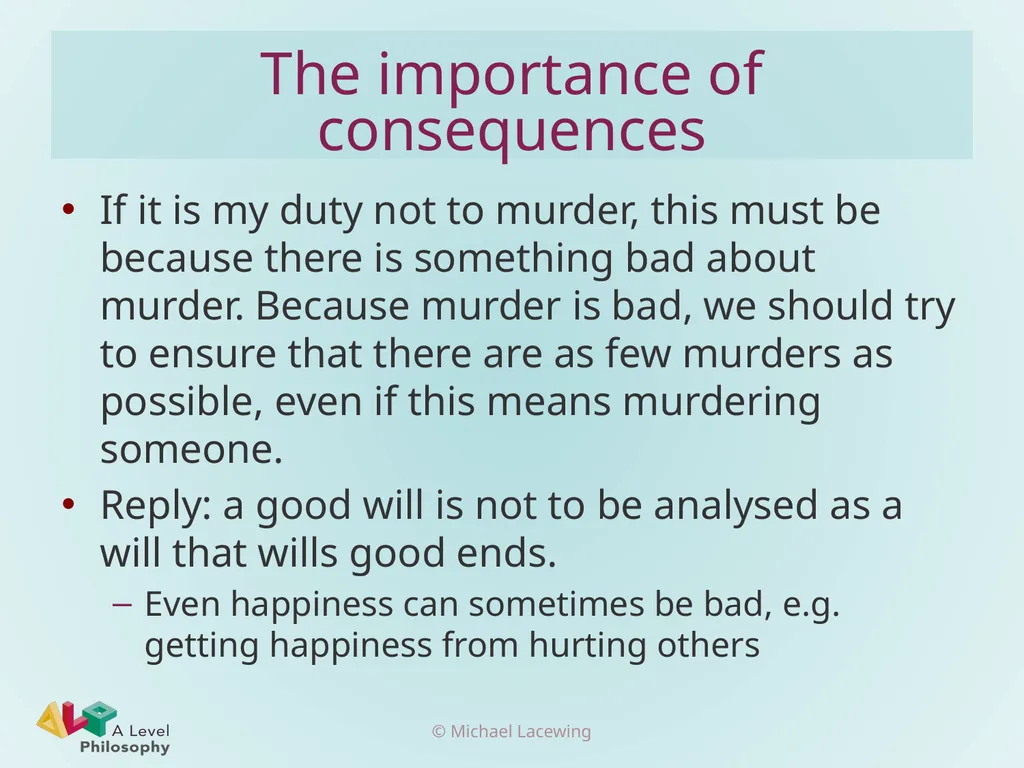
slide5. The importance of consequences If it is my duty not to murder, this must be because there is something bad about murder. Because murder is bad, we should try to ensure that there are as few murders as possible, even if this means murdering someone.
Reply: a good will is not to be analysed as a will that wills good ends.
Even happiness can sometimes be bad, e.g. getting happiness from hurting others © Michael Lacewing<br>
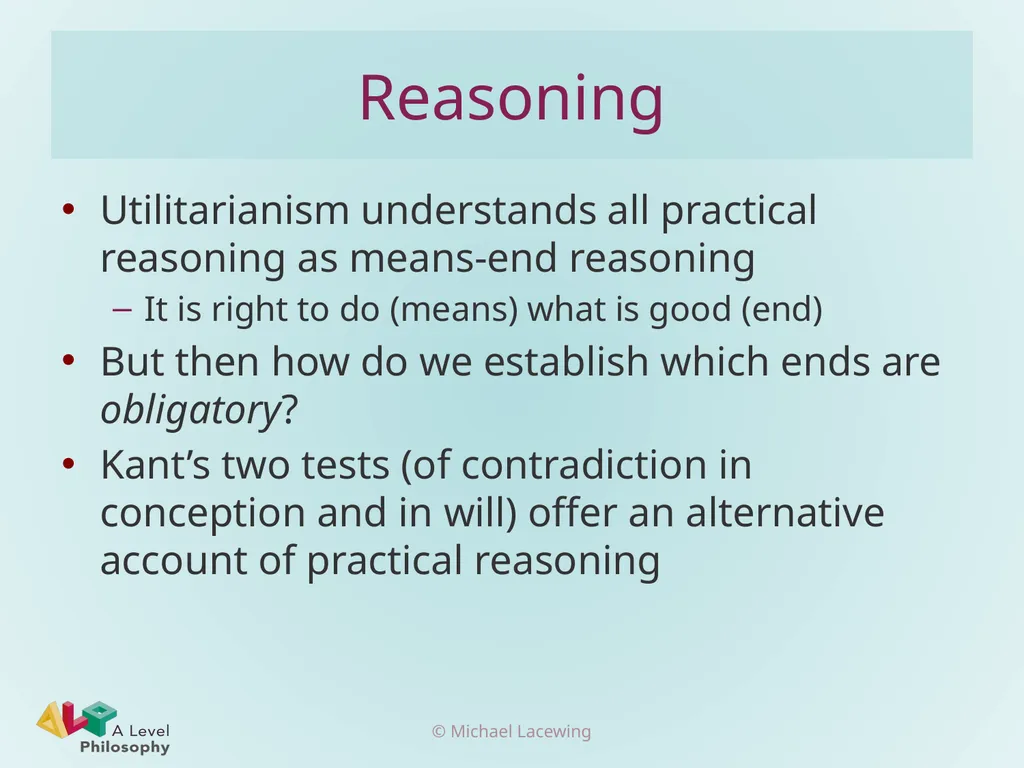
slide6. Reasoning Utilitarianism understands all practical reasoning as means-end reasoning
It is right to do (means) what is good (end)
But then how do we establish which ends are obligatory?
Kant’s two tests (of contradiction in conception and in will) offer an alternative account of practical reasoning © Michael Lacewing<br>
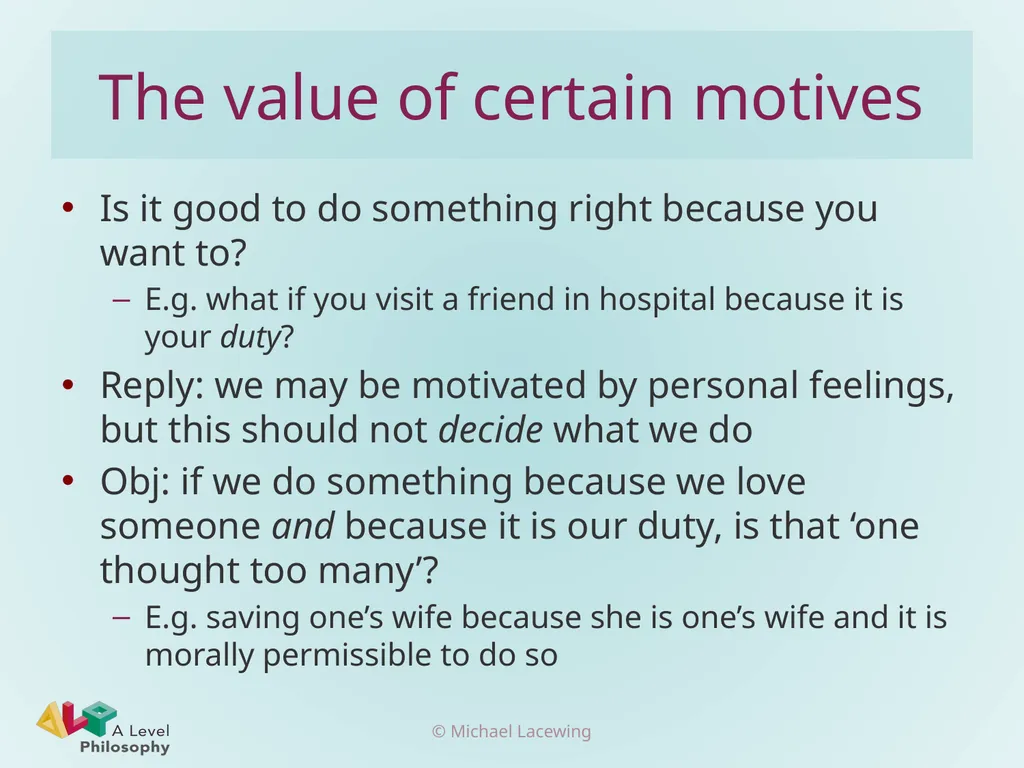
slide7. The value of certain motives Is it good to do something right because you want to?
E.g. what if you visit a friend in hospital because it is your duty?
Reply: we may be motivated by personal feelings, but this should not decide what we do
Obj: if we do something because we love someone and because it is our duty, is that ‘one thought too many’?
E.g. saving one’s wife because she is one’s wife and it is morally permissible to do so © Michael Lacewing<br>
enquiries@alevelphilosophy.co.uk © Michael Lacewing<br>
slide2. Kant’s deontology Maxim: personal principle that guides decisions (intention)
Morality: a set of principles that are the same for everyone and that apply to everyone
The will: our ability to make choices and decisions. We can make choices on the basis of reasons, so our wills are rational.
‘Act only on that maxim through which you can at the same time will that it should become a universal law’ © Michael Lacewing<br>
slide3. Conflicts between duties Kant argues that our moral duties are absolute.
A duty is absolute if it permits no exceptions.
Nothing can override a moral duty, because it is categorical.
Can’t two absolute duties conflict, e.g. should I break a promise or tell a lie?
Reply: there can be no real conflict of duties
Perhaps our duty is not ‘don’t lie’, but ‘don’t lie except to save a life’ © Michael Lacewing<br>
slide4. Conflicts between duties Are duties absolute? Can ‘less important’ duties give way to more important ones?
But Kant’s analysis of morality as categorical and rationally required doesn’t easily allow this © Michael Lacewing<br>
slide5. The importance of consequences If it is my duty not to murder, this must be because there is something bad about murder. Because murder is bad, we should try to ensure that there are as few murders as possible, even if this means murdering someone.
Reply: a good will is not to be analysed as a will that wills good ends.
Even happiness can sometimes be bad, e.g. getting happiness from hurting others © Michael Lacewing<br>
slide6. Reasoning Utilitarianism understands all practical reasoning as means-end reasoning
It is right to do (means) what is good (end)
But then how do we establish which ends are obligatory?
Kant’s two tests (of contradiction in conception and in will) offer an alternative account of practical reasoning © Michael Lacewing<br>
slide7. The value of certain motives Is it good to do something right because you want to?
E.g. what if you visit a friend in hospital because it is your duty?
Reply: we may be motivated by personal feelings, but this should not decide what we do
Obj: if we do something because we love someone and because it is our duty, is that ‘one thought too many’?
E.g. saving one’s wife because she is one’s wife and it is morally permissible to do so © Michael Lacewing<br>