
Three Year Review 2009-2011
LS
Published · 35 slides · 0 views
1 / 1



Description
Three Year Review 2009-2011 http:InternationalOffice.berkeley.edu Contents Berkeley International Office: Vision, Mission and Services Organizational Chart Key Stakeholders Statistical Data - Students and Scholars Regulatory Update
Related Topics
Share
Embed code
Download this presentation From Below
"Three Year Review 2009-2011" is the property of its rightful owner. Permission is granted to download and print the materials on this website for personal, non-commercial use only, and to display it on your personal computer provided you do not modify the materials and that you retain all copyright notices contained in the materials. By downloading content from our website, you accept the terms of this agreement.
Presentation Transcript
01
Three Year Review
2009-2011 http://InternationalOffice.berkeley.edu<br>
2009-2011 http://InternationalOffice.berkeley.edu<br>
02
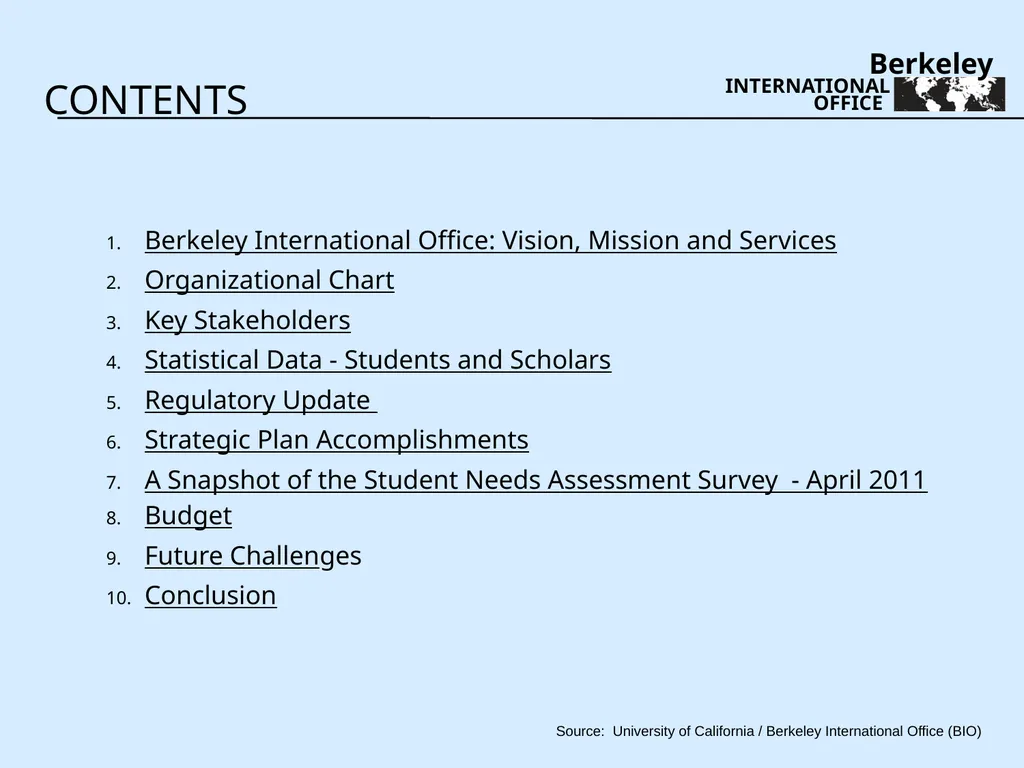
Contents Berkeley International Office: Vision, Mission and Services
Organizational Chart
Key Stakeholders
Statistical Data - Students and Scholars
Regulatory Update
Strategic Plan Accomplishments
A Snapshot of the Student Needs Assessment Survey - April 2011
Budget
Future Challenges
Conclusion Source: University of California / Berkeley International Office (BIO)<br>
Organizational Chart
Key Stakeholders
Statistical Data - Students and Scholars
Regulatory Update
Strategic Plan Accomplishments
A Snapshot of the Student Needs Assessment Survey - April 2011
Budget
Future Challenges
Conclusion Source: University of California / Berkeley International Office (BIO)<br>
03
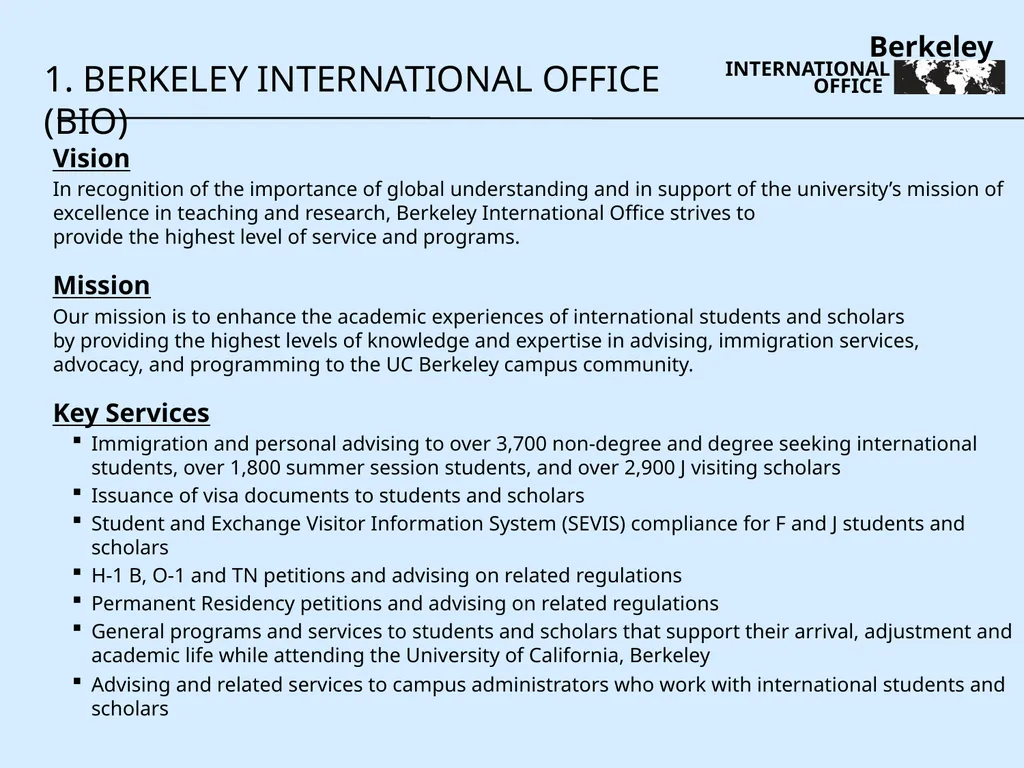
1. Berkeley International Office (BIO) Vision
In recognition of the importance of global understanding and in support of the university’s mission of excellence in teaching and research, Berkeley International Office strives to provide the highest level of service and programs.
Mission
Our mission is to enhance the academic experiences of international students and scholars by providing the highest levels of knowledge and expertise in advising, immigration services, advocacy, and programming to the UC Berkeley campus community.
Key Services
Immigration and personal advising to over 3,700 non-degree and degree seeking international students, over 1,800 summer session students, and over 2,900 J visiting scholars
Issuance of visa documents to students and scholars
Student and Exchange Visitor Information System (SEVIS) compliance for F and J students and scholars
H-1 B, O-1 and TN petitions and advising on related regulations
Permanent Residency petitions and advising on related regulations
General programs and services to students and scholars that support their arrival, adjustment and academic life while attending the University of California, Berkeley
Advising and related services to campus administrators who work with international students and scholars<br>
In recognition of the importance of global understanding and in support of the university’s mission of excellence in teaching and research, Berkeley International Office strives to provide the highest level of service and programs.
Mission
Our mission is to enhance the academic experiences of international students and scholars by providing the highest levels of knowledge and expertise in advising, immigration services, advocacy, and programming to the UC Berkeley campus community.
Key Services
Immigration and personal advising to over 3,700 non-degree and degree seeking international students, over 1,800 summer session students, and over 2,900 J visiting scholars
Issuance of visa documents to students and scholars
Student and Exchange Visitor Information System (SEVIS) compliance for F and J students and scholars
H-1 B, O-1 and TN petitions and advising on related regulations
Permanent Residency petitions and advising on related regulations
General programs and services to students and scholars that support their arrival, adjustment and academic life while attending the University of California, Berkeley
Advising and related services to campus administrators who work with international students and scholars<br>
04
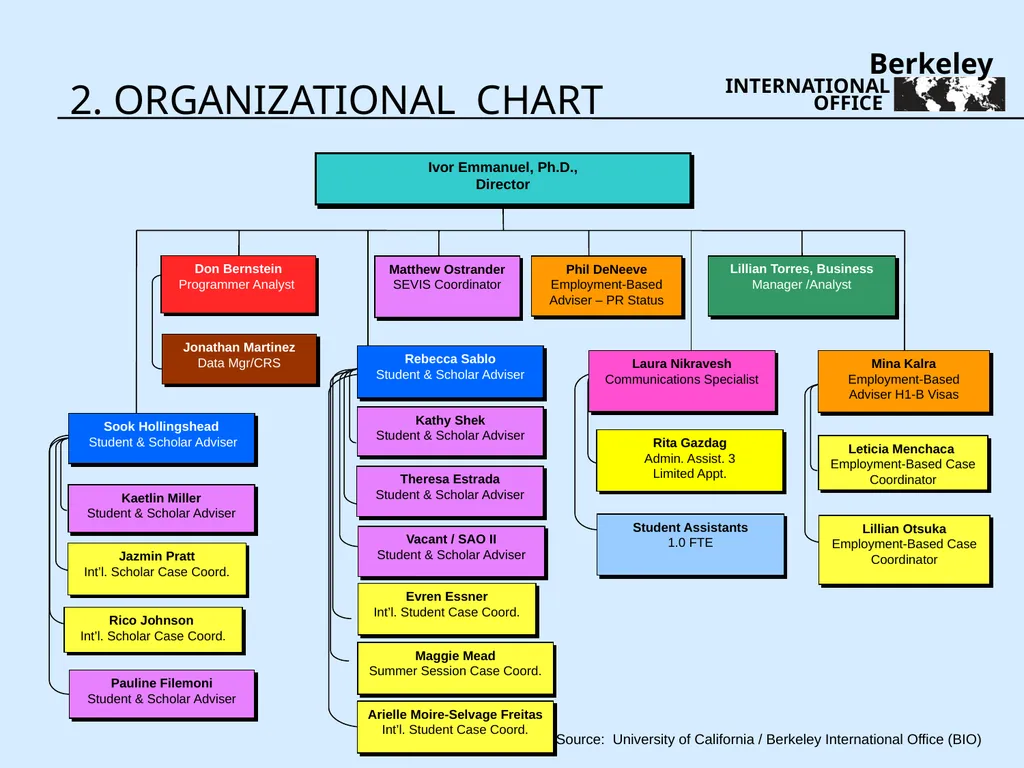
2. Organizational Chart Ivor Emmanuel, Ph.D.,
Director Jonathan Martinez Data Mgr/CRS Lillian Torres, Business
Manager /Analyst Phil DeNeeve
Employment-Based
Adviser – PR Status Matthew Ostrander
SEVIS Coordinator Don Bernstein
Programmer Analyst Laura Nikravesh
Communications Specialist Source: University of California / Berkeley International Office (BIO) Pauline Filemoni
Student & Scholar Adviser Evren Essner
Int’l. Student Case Coord. Maggie Mead
Summer Session Case Coord. Vacant / SAO II
Student & Scholar Adviser Arielle Moire-Selvage Freitas
Int’l. Student Case Coord.<br>
Director Jonathan Martinez Data Mgr/CRS Lillian Torres, Business
Manager /Analyst Phil DeNeeve
Employment-Based
Adviser – PR Status Matthew Ostrander
SEVIS Coordinator Don Bernstein
Programmer Analyst Laura Nikravesh
Communications Specialist Source: University of California / Berkeley International Office (BIO) Pauline Filemoni
Student & Scholar Adviser Evren Essner
Int’l. Student Case Coord. Maggie Mead
Summer Session Case Coord. Vacant / SAO II
Student & Scholar Adviser Arielle Moire-Selvage Freitas
Int’l. Student Case Coord.<br>
05
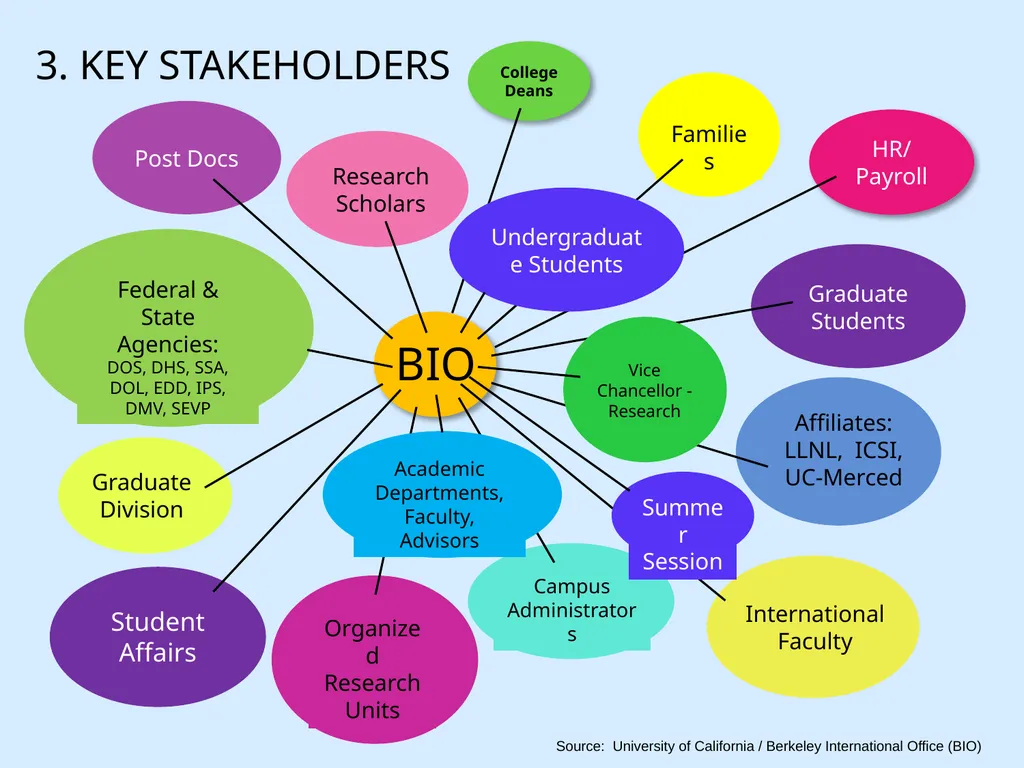
3. KEY Stakeholders BIO College Deans HR/
Payroll Source: University of California / Berkeley International Office (BIO)<br>
Payroll Source: University of California / Berkeley International Office (BIO)<br>
06
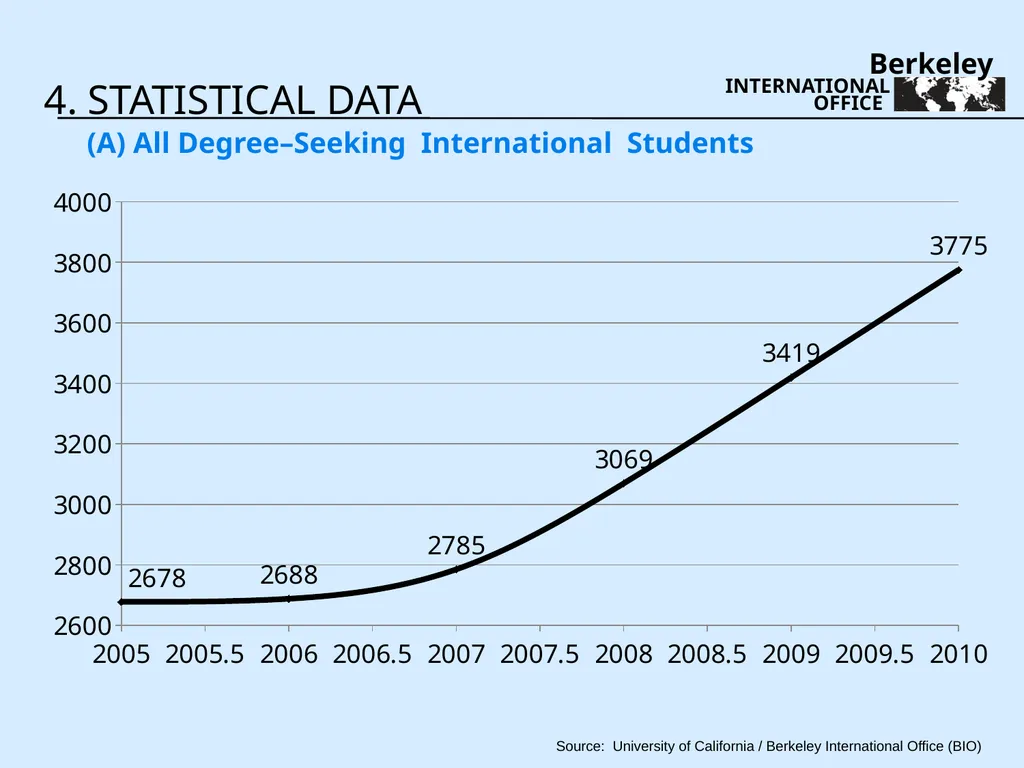
(A) All Degree–Seeking International Students Source: University of California / Berkeley International Office (BIO) 4. Statistical Data<br>
07
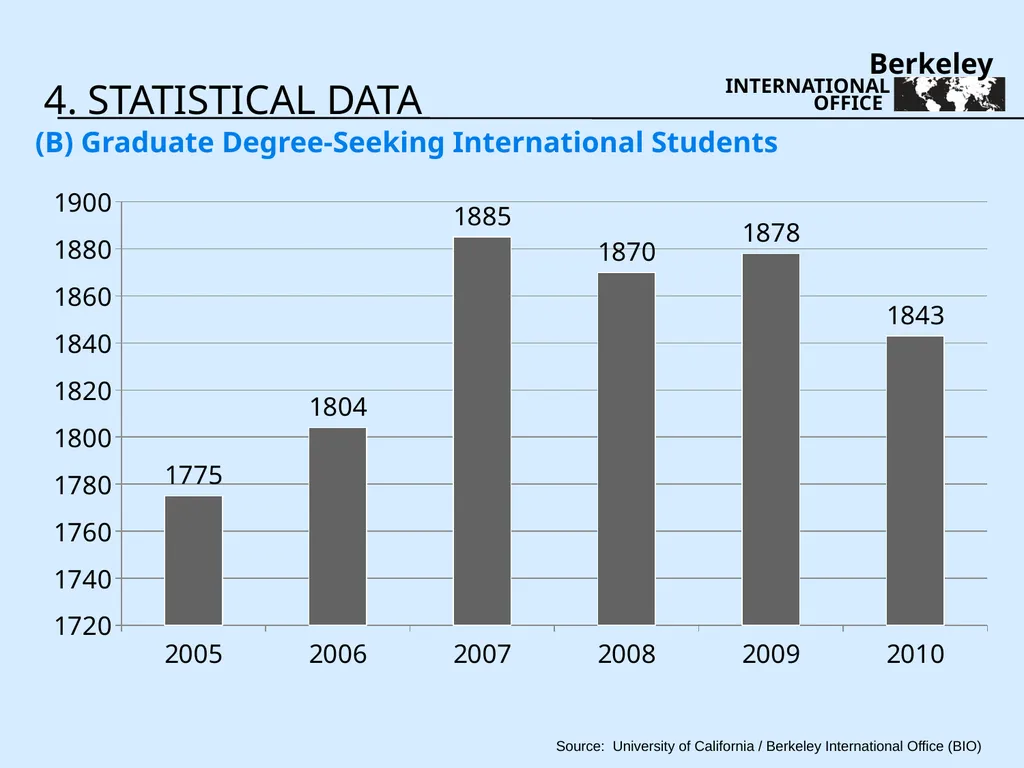
(B) Graduate Degree-Seeking International Students Source: University of California / Berkeley International Office (BIO) 4. Statistical Data<br>
08
(C) Undergraduate Degree-Seeking International Students Source: University of California / Berkeley International Office (BIO) 4. Statistical Data<br>
09
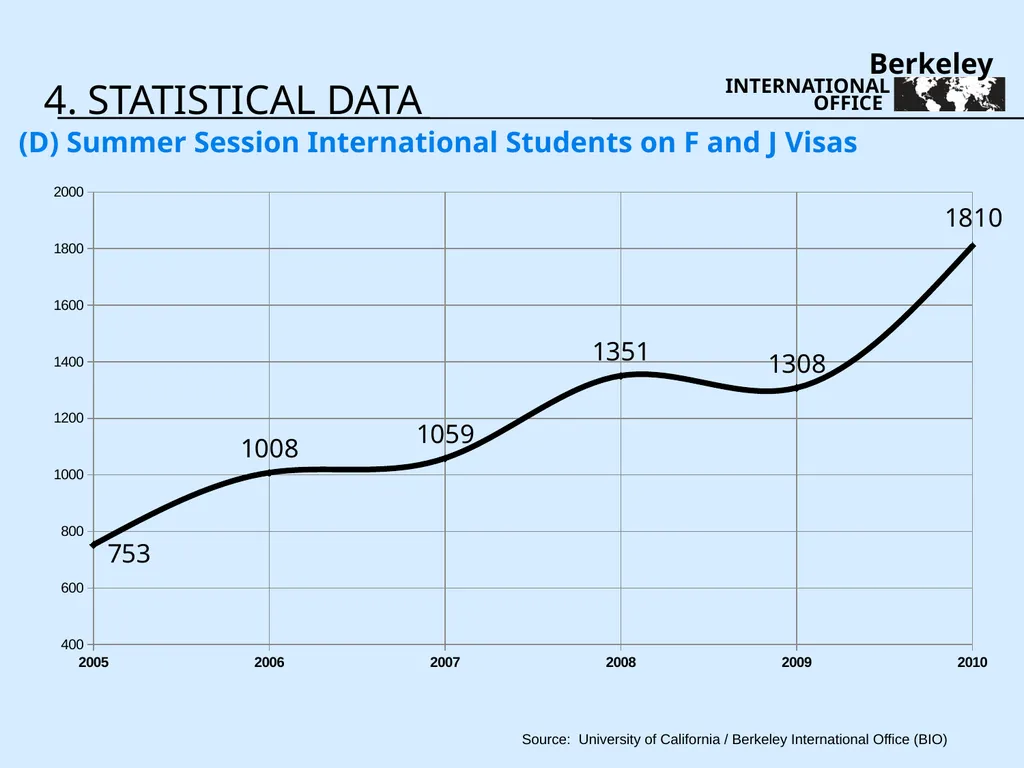
(D) Summer Session International Students on F and J Visas Source: University of California / Berkeley International Office (BIO) 4. Statistical Data<br>
10
(E) International Scholars (J 1, H1B, TN, O visas) Source: University of California / Berkeley International Office (BIO) 4. Statistical Data<br>
11
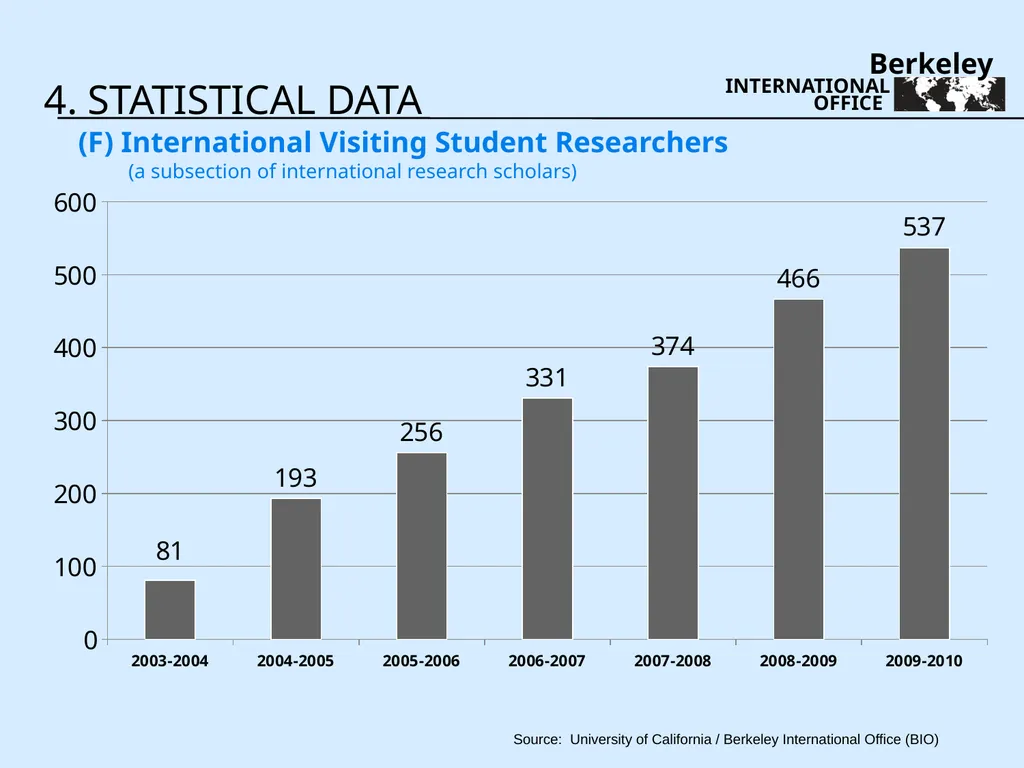
(F) International Visiting Student Researchers (a subsection of international research scholars) Source: University of California / Berkeley International Office (BIO) 4. Statistical Data<br>
12
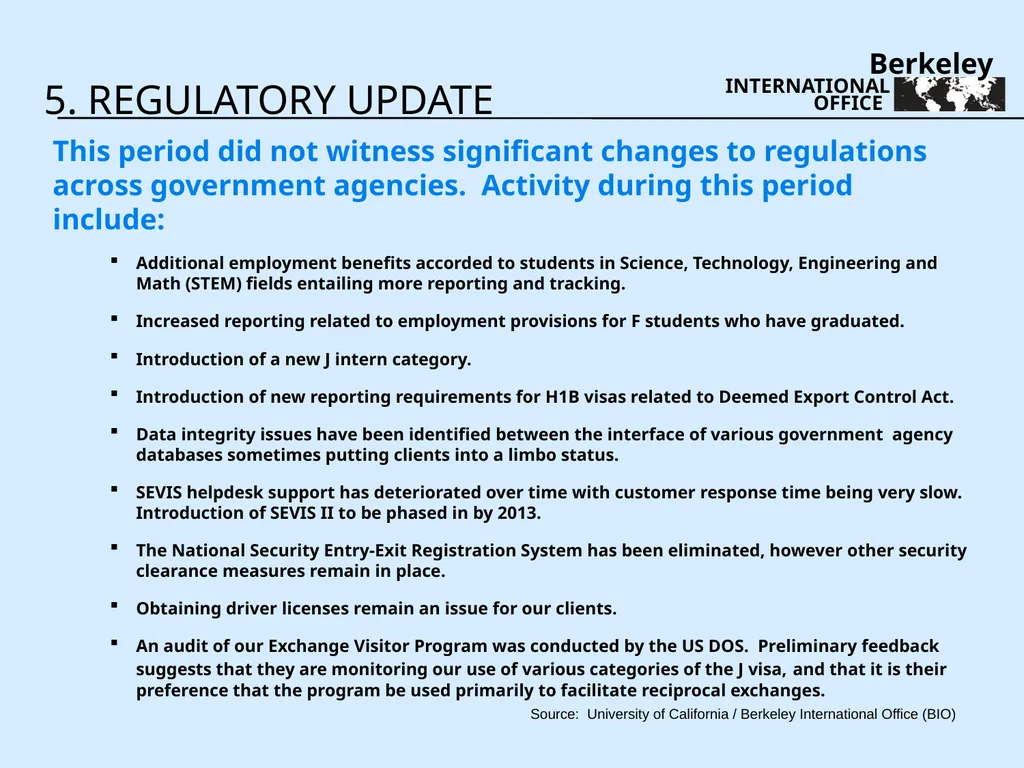
5. Regulatory Update Additional employment benefits accorded to students in Science, Technology, Engineering and Math (STEM) fields entailing more reporting and tracking.
Increased reporting related to employment provisions for F students who have graduated.
Introduction of a new J intern category.
Introduction of new reporting requirements for H1B visas related to Deemed Export Control Act.
Data integrity issues have been identified between the interface of various government agency databases sometimes putting clients into a limbo status.
SEVIS helpdesk support has deteriorated over time with customer response time being very slow. Introduction of SEVIS II to be phased in by 2013.
The National Security Entry-Exit Registration System has been eliminated, however other security clearance measures remain in place.
Obtaining driver licenses remain an issue for our clients.
An audit of our Exchange Visitor Program was conducted by the US DOS. Preliminary feedback suggests that they are monitoring our use of various categories of the J visa, and that it is their preference that the program be used primarily to facilitate reciprocal exchanges. Source: University of California / Berkeley International Office (BIO) This period did not witness significant changes to regulations across government agencies. Activity during this period include:<br>
Increased reporting related to employment provisions for F students who have graduated.
Introduction of a new J intern category.
Introduction of new reporting requirements for H1B visas related to Deemed Export Control Act.
Data integrity issues have been identified between the interface of various government agency databases sometimes putting clients into a limbo status.
SEVIS helpdesk support has deteriorated over time with customer response time being very slow. Introduction of SEVIS II to be phased in by 2013.
The National Security Entry-Exit Registration System has been eliminated, however other security clearance measures remain in place.
Obtaining driver licenses remain an issue for our clients.
An audit of our Exchange Visitor Program was conducted by the US DOS. Preliminary feedback suggests that they are monitoring our use of various categories of the J visa, and that it is their preference that the program be used primarily to facilitate reciprocal exchanges. Source: University of California / Berkeley International Office (BIO) This period did not witness significant changes to regulations across government agencies. Activity during this period include:<br>
13
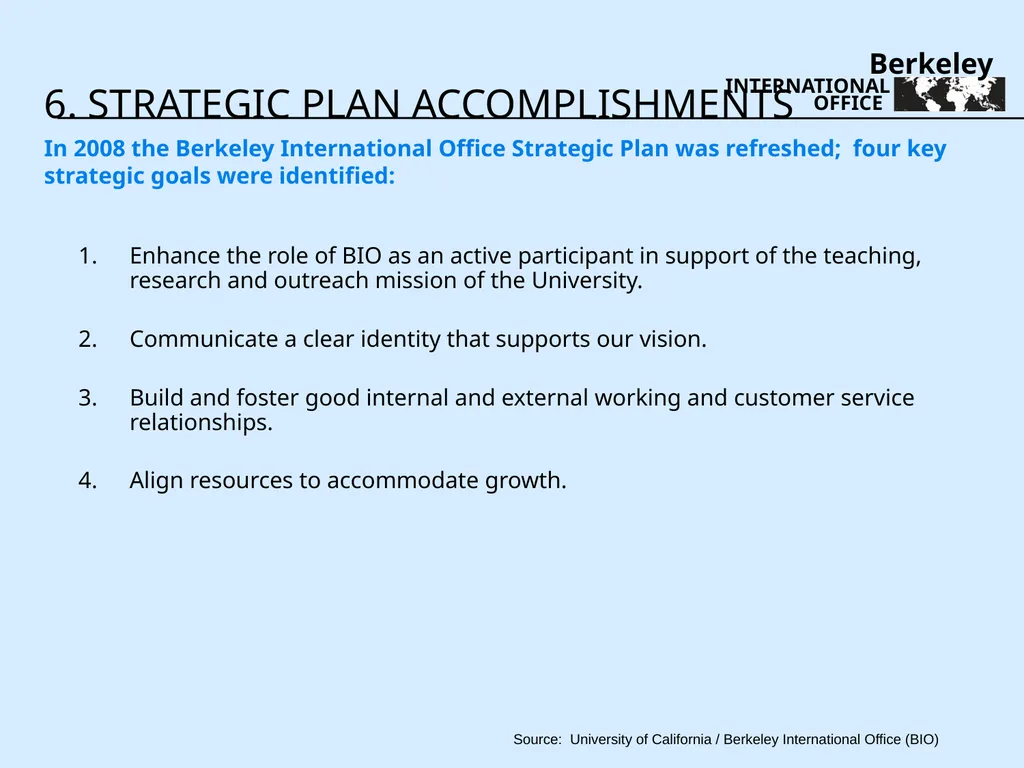
6. Strategic Plan Accomplishments Enhance the role of BIO as an active participant in support of the teaching, research and outreach mission of the University.
Communicate a clear identity that supports our vision.
Build and foster good internal and external working and customer service relationships.
Align resources to accommodate growth. In 2008 the Berkeley International Office Strategic Plan was refreshed; four key strategic goals were identified: Source: University of California / Berkeley International Office (BIO)<br>
Communicate a clear identity that supports our vision.
Build and foster good internal and external working and customer service relationships.
Align resources to accommodate growth. In 2008 the Berkeley International Office Strategic Plan was refreshed; four key strategic goals were identified: Source: University of California / Berkeley International Office (BIO)<br>
14
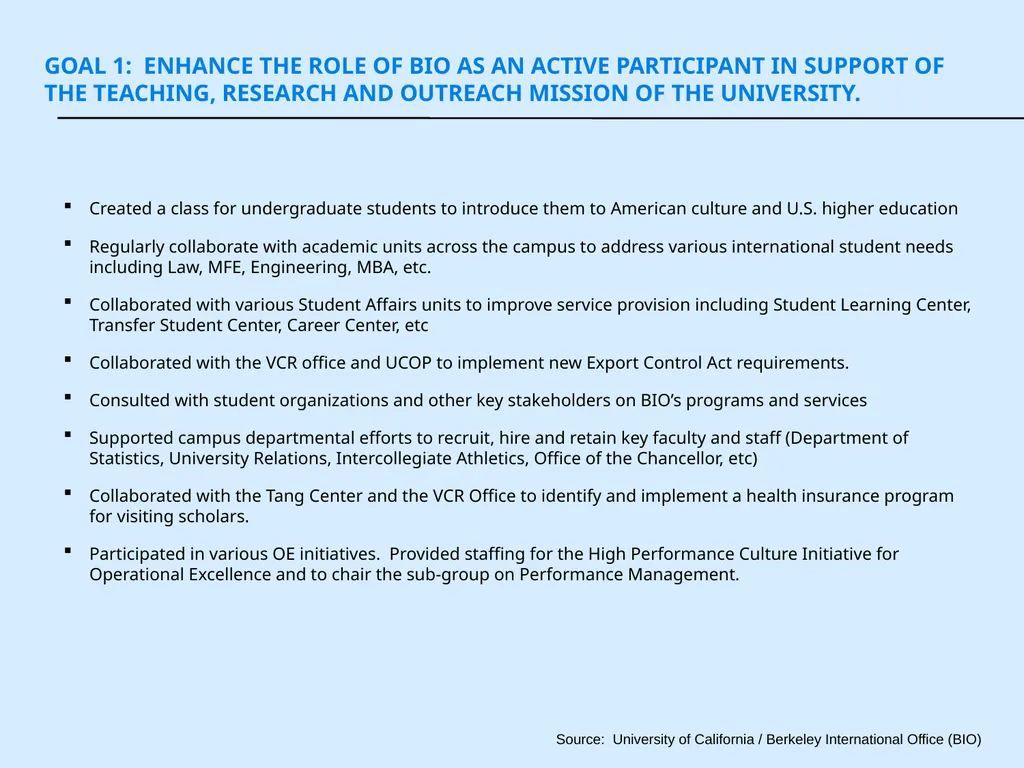
Goal 1: Enhance the role of BIO as an active participant in support of the teaching, research and outreach mission of the University. Created a class for undergraduate students to introduce them to American culture and U.S. higher education
Regularly collaborate with academic units across the campus to address various international student needs including Law, MFE, Engineering, MBA, etc.
Collaborated with various Student Affairs units to improve service provision including Student Learning Center, Transfer Student Center, Career Center, etc
Collaborated with the VCR office and UCOP to implement new Export Control Act requirements.
Consulted with student organizations and other key stakeholders on BIO’s programs and services
Supported campus departmental efforts to recruit, hire and retain key faculty and staff (Department of Statistics, University Relations, Intercollegiate Athletics, Office of the Chancellor, etc)
Collaborated with the Tang Center and the VCR Office to identify and implement a health insurance program for visiting scholars.
Participated in various OE initiatives. Provided staffing for the High Performance Culture Initiative for Operational Excellence and to chair the sub-group on Performance Management. Source: University of California / Berkeley International Office (BIO)<br>
Regularly collaborate with academic units across the campus to address various international student needs including Law, MFE, Engineering, MBA, etc.
Collaborated with various Student Affairs units to improve service provision including Student Learning Center, Transfer Student Center, Career Center, etc
Collaborated with the VCR office and UCOP to implement new Export Control Act requirements.
Consulted with student organizations and other key stakeholders on BIO’s programs and services
Supported campus departmental efforts to recruit, hire and retain key faculty and staff (Department of Statistics, University Relations, Intercollegiate Athletics, Office of the Chancellor, etc)
Collaborated with the Tang Center and the VCR Office to identify and implement a health insurance program for visiting scholars.
Participated in various OE initiatives. Provided staffing for the High Performance Culture Initiative for Operational Excellence and to chair the sub-group on Performance Management. Source: University of California / Berkeley International Office (BIO)<br>
15
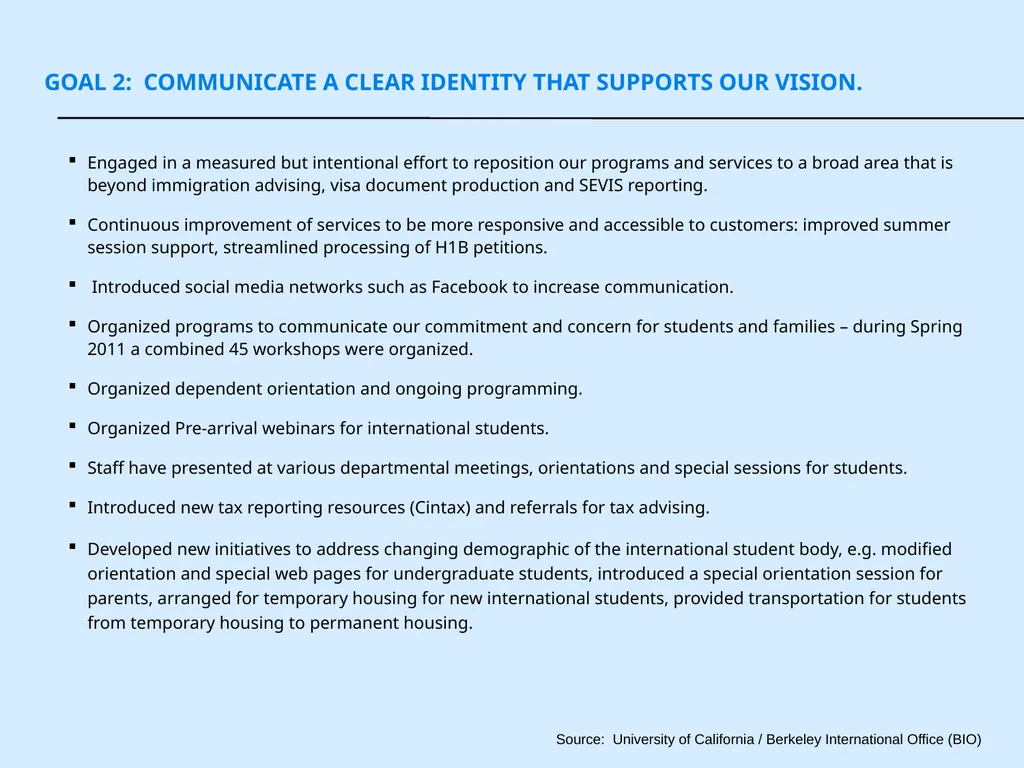
Goal 2: Communicate a clear identity that supports our vision. Engaged in a measured but intentional effort to reposition our programs and services to a broad area that is beyond immigration advising, visa document production and SEVIS reporting.
Continuous improvement of services to be more responsive and accessible to customers: improved summer session support, streamlined processing of H1B petitions.
Introduced social media networks such as Facebook to increase communication.
Organized programs to communicate our commitment and concern for students and families – during Spring 2011 a combined 45 workshops were organized.
Organized dependent orientation and ongoing programming.
Organized Pre-arrival webinars for international students.
Staff have presented at various departmental meetings, orientations and special sessions for students.
Introduced new tax reporting resources (Cintax) and referrals for tax advising.
Developed new initiatives to address changing demographic of the international student body, e.g. modified orientation and special web pages for undergraduate students, introduced a special orientation session for parents, arranged for temporary housing for new international students, provided transportation for students from temporary housing to permanent housing. Source: University of California / Berkeley International Office (BIO)<br>
Continuous improvement of services to be more responsive and accessible to customers: improved summer session support, streamlined processing of H1B petitions.
Introduced social media networks such as Facebook to increase communication.
Organized programs to communicate our commitment and concern for students and families – during Spring 2011 a combined 45 workshops were organized.
Organized dependent orientation and ongoing programming.
Organized Pre-arrival webinars for international students.
Staff have presented at various departmental meetings, orientations and special sessions for students.
Introduced new tax reporting resources (Cintax) and referrals for tax advising.
Developed new initiatives to address changing demographic of the international student body, e.g. modified orientation and special web pages for undergraduate students, introduced a special orientation session for parents, arranged for temporary housing for new international students, provided transportation for students from temporary housing to permanent housing. Source: University of California / Berkeley International Office (BIO)<br>
16
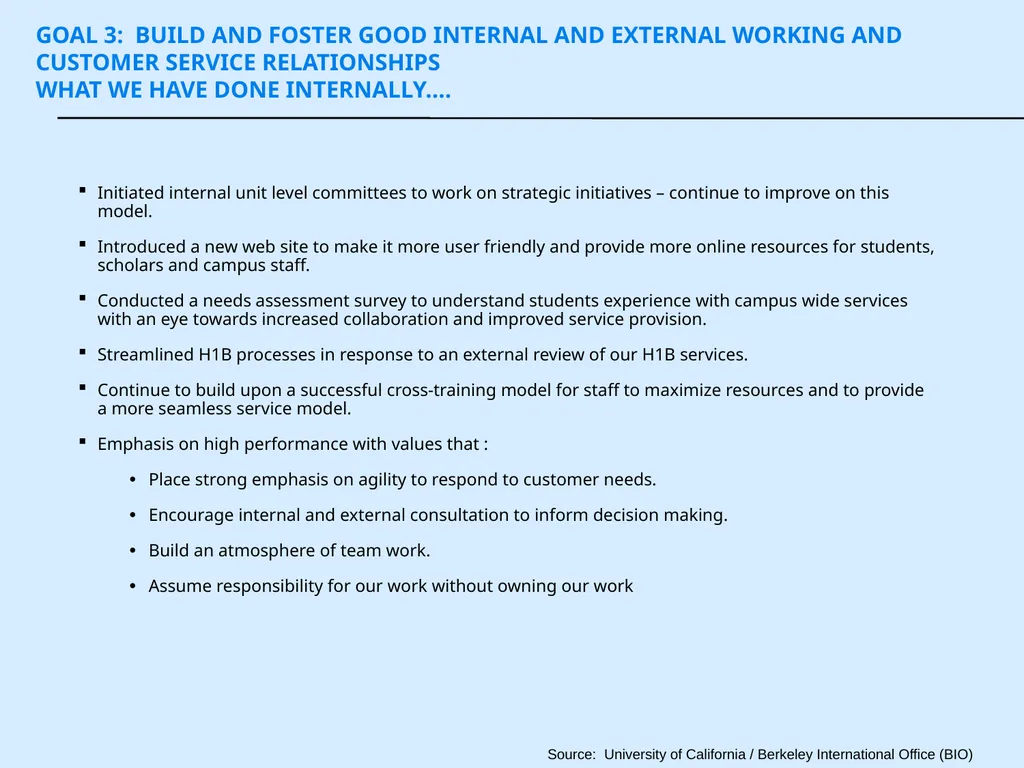
Goal 3: Build and foster good internal and external working and customer service relationships
What we have done InternallY…. Source: University of California / Berkeley International Office (BIO) Initiated internal unit level committees to work on strategic initiatives – continue to improve on this model.
Introduced a new web site to make it more user friendly and provide more online resources for students, scholars and campus staff.
Conducted a needs assessment survey to understand students experience with campus wide services with an eye towards increased collaboration and improved service provision.
Streamlined H1B processes in response to an external review of our H1B services.
Continue to build upon a successful cross-training model for staff to maximize resources and to provide a more seamless service model.
Emphasis on high performance with values that :
Place strong emphasis on agility to respond to customer needs.
Encourage internal and external consultation to inform decision making.
Build an atmosphere of team work.
Assume responsibility for our work without owning our work<br>
Introduced a new web site to make it more user friendly and provide more online resources for students, scholars and campus staff.
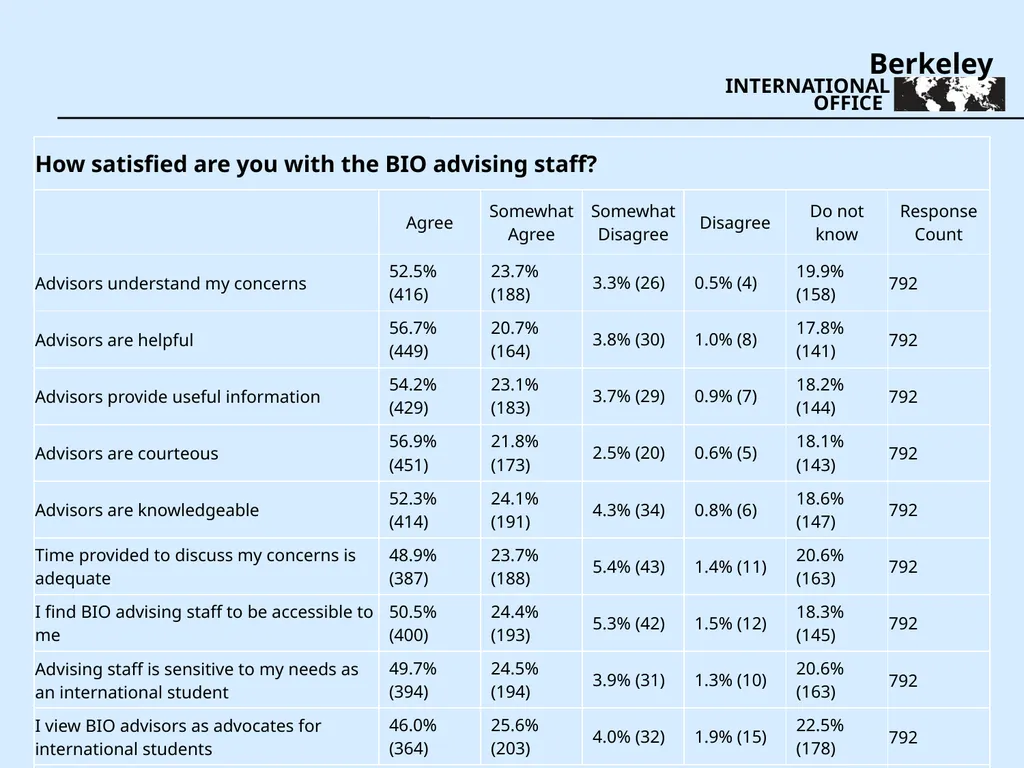
Conducted a needs assessment survey to understand students experience with campus wide services with an eye towards increased collaboration and improved service provision.
Streamlined H1B processes in response to an external review of our H1B services.
Continue to build upon a successful cross-training model for staff to maximize resources and to provide a more seamless service model.
Emphasis on high performance with values that :
Place strong emphasis on agility to respond to customer needs.
Encourage internal and external consultation to inform decision making.
Build an atmosphere of team work.
Assume responsibility for our work without owning our work<br>
17
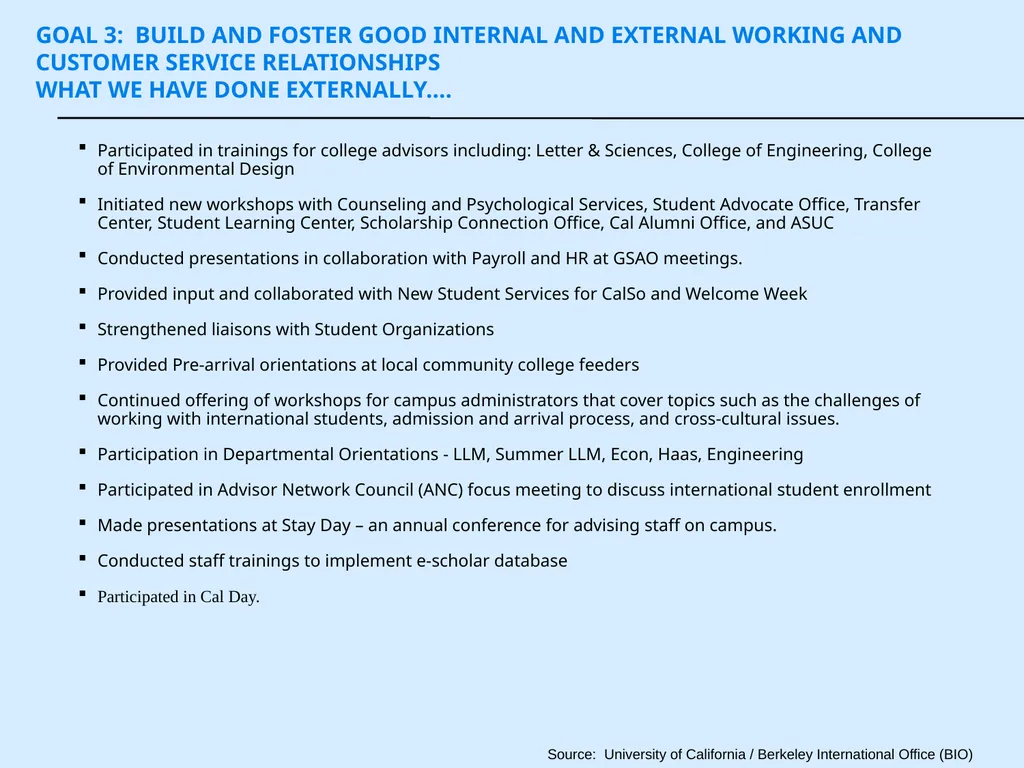
Goal 3: Build and foster good internal and external working and customer service relationships
What we have done Externally…. Source: University of California / Berkeley International Office (BIO) Participated in trainings for college advisors including: Letter & Sciences, College of Engineering, College of Environmental Design
Initiated new workshops with Counseling and Psychological Services, Student Advocate Office, Transfer Center, Student Learning Center, Scholarship Connection Office, Cal Alumni Office, and ASUC
Conducted presentations in collaboration with Payroll and HR at GSAO meetings.
Provided input and collaborated with New Student Services for CalSo and Welcome Week
Strengthened liaisons with Student Organizations
Provided Pre-arrival orientations at local community college feeders
Continued offering of workshops for campus administrators that cover topics such as the challenges of working with international students, admission and arrival process, and cross-cultural issues.
Participation in Departmental Orientations - LLM, Summer LLM, Econ, Haas, Engineering
Participated in Advisor Network Council (ANC) focus meeting to discuss international student enrollment
Made presentations at Stay Day – an annual conference for advising staff on campus.
Conducted staff trainings to implement e-scholar database
Participated in Cal Day.<br>
Initiated new workshops with Counseling and Psychological Services, Student Advocate Office, Transfer Center, Student Learning Center, Scholarship Connection Office, Cal Alumni Office, and ASUC
Conducted presentations in collaboration with Payroll and HR at GSAO meetings.
Provided input and collaborated with New Student Services for CalSo and Welcome Week
Strengthened liaisons with Student Organizations
Provided Pre-arrival orientations at local community college feeders
Continued offering of workshops for campus administrators that cover topics such as the challenges of working with international students, admission and arrival process, and cross-cultural issues.
Participation in Departmental Orientations - LLM, Summer LLM, Econ, Haas, Engineering
Participated in Advisor Network Council (ANC) focus meeting to discuss international student enrollment
Made presentations at Stay Day – an annual conference for advising staff on campus.
Conducted staff trainings to implement e-scholar database
Participated in Cal Day.<br>
18
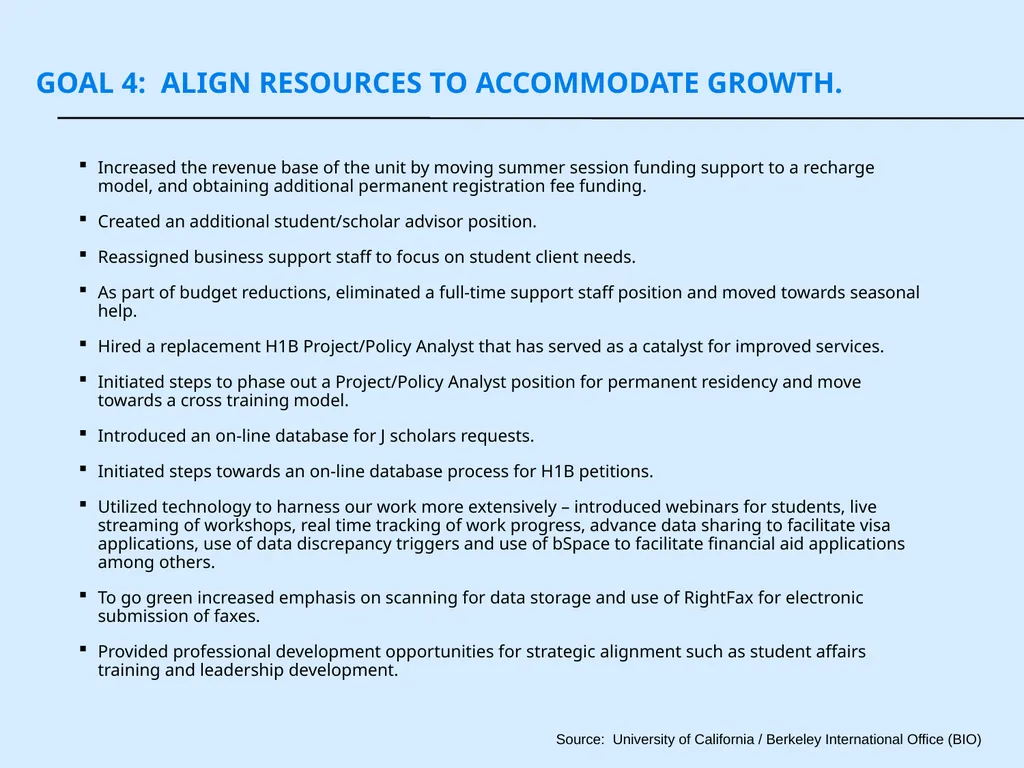
Goal 4: Align resources to accommodate growth. Increased the revenue base of the unit by moving summer session funding support to a recharge model, and obtaining additional permanent registration fee funding.
Created an additional student/scholar advisor position.
Reassigned business support staff to focus on student client needs.
As part of budget reductions, eliminated a full-time support staff position and moved towards seasonal help.
Hired a replacement H1B Project/Policy Analyst that has served as a catalyst for improved services.
Initiated steps to phase out a Project/Policy Analyst position for permanent residency and move towards a cross training model.
Introduced an on-line database for J scholars requests.
Initiated steps towards an on-line database process for H1B petitions.
Utilized technology to harness our work more extensively – introduced webinars for students, live streaming of workshops, real time tracking of work progress, advance data sharing to facilitate visa applications, use of data discrepancy triggers and use of bSpace to facilitate financial aid applications among others.
To go green increased emphasis on scanning for data storage and use of RightFax for electronic submission of faxes.
Provided professional development opportunities for strategic alignment such as student affairs training and leadership development. Source: University of California / Berkeley International Office (BIO)<br>
Created an additional student/scholar advisor position.
Reassigned business support staff to focus on student client needs.
As part of budget reductions, eliminated a full-time support staff position and moved towards seasonal help.
Hired a replacement H1B Project/Policy Analyst that has served as a catalyst for improved services.
Initiated steps to phase out a Project/Policy Analyst position for permanent residency and move towards a cross training model.
Introduced an on-line database for J scholars requests.
Initiated steps towards an on-line database process for H1B petitions.
Utilized technology to harness our work more extensively – introduced webinars for students, live streaming of workshops, real time tracking of work progress, advance data sharing to facilitate visa applications, use of data discrepancy triggers and use of bSpace to facilitate financial aid applications among others.
To go green increased emphasis on scanning for data storage and use of RightFax for electronic submission of faxes.
Provided professional development opportunities for strategic alignment such as student affairs training and leadership development. Source: University of California / Berkeley International Office (BIO)<br>
19
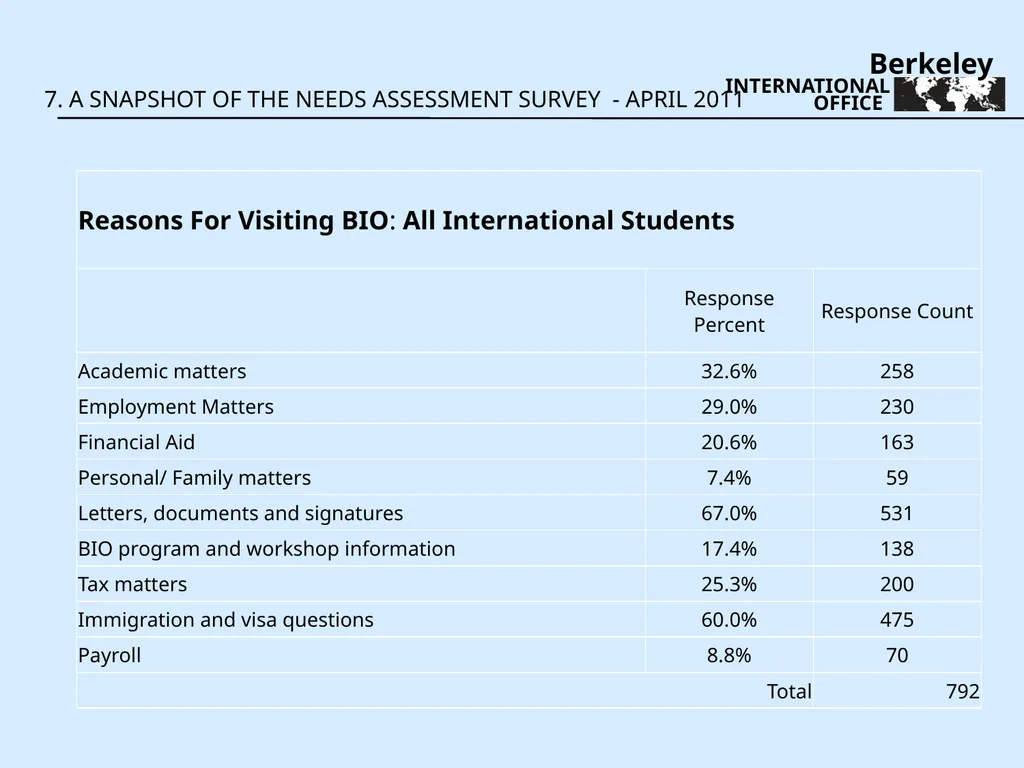
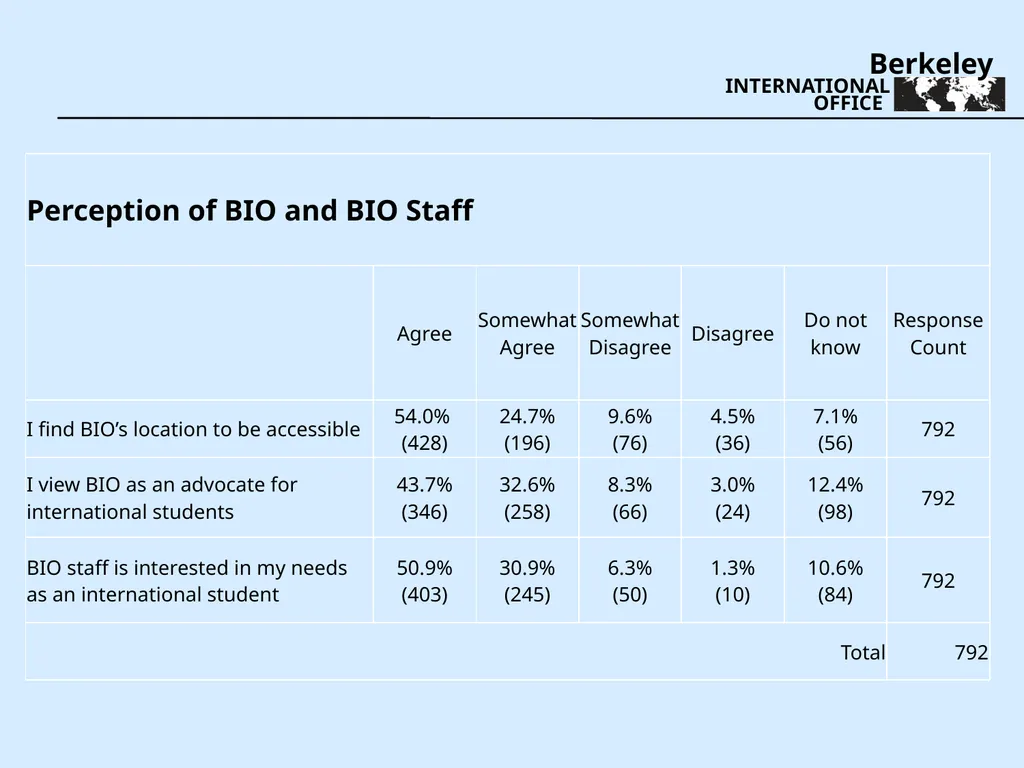
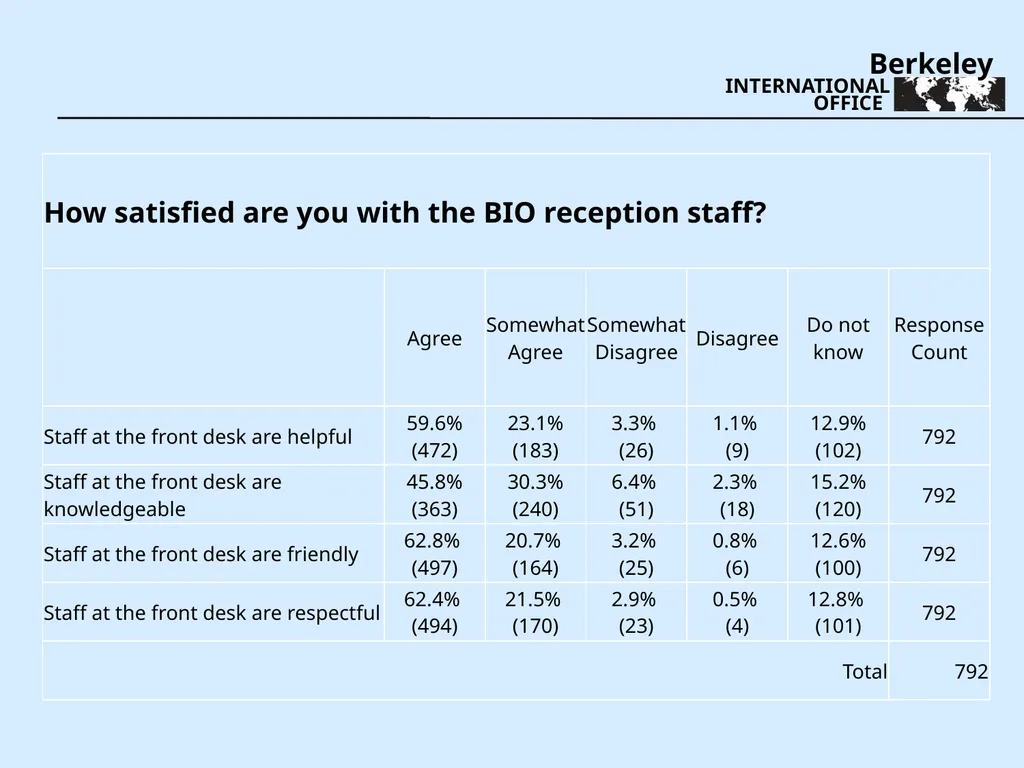
7. A Snapshot of the needs assessment survey - April 2011<br>
20
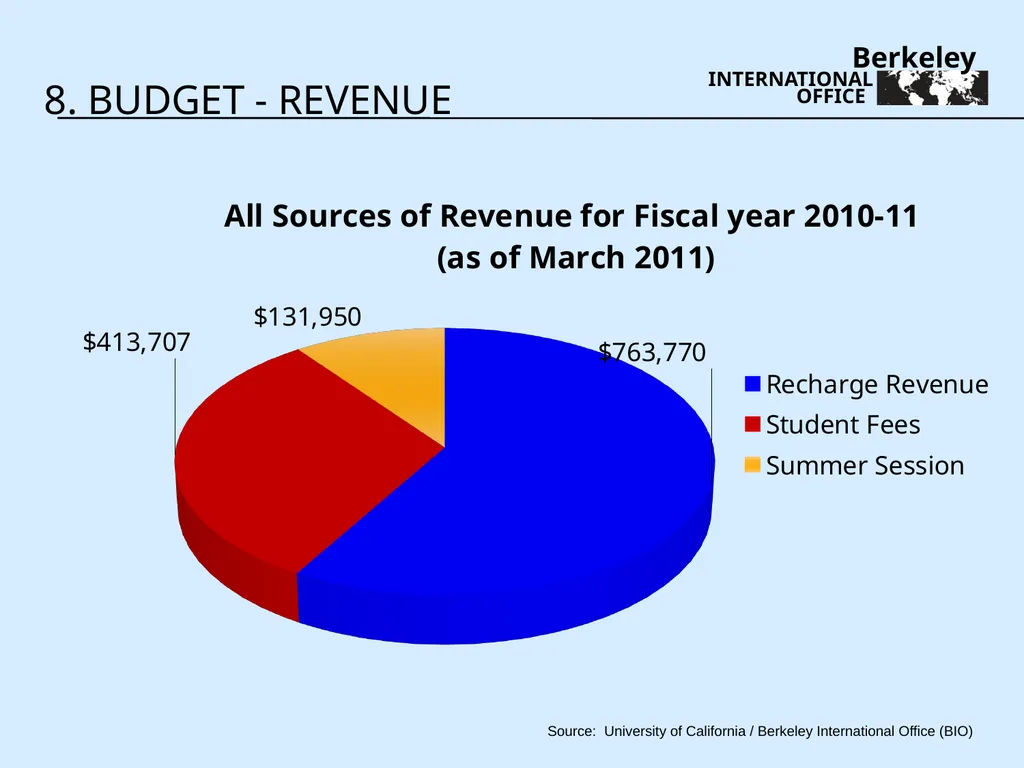
8. Budget - Revenue Source: University of California / Berkeley International Office (BIO)<br>
21
8. (A) Budget- Fund 20000 – Reg Fees through March 2011 Source: University of California / Berkeley International Office (BIO)<br>
22
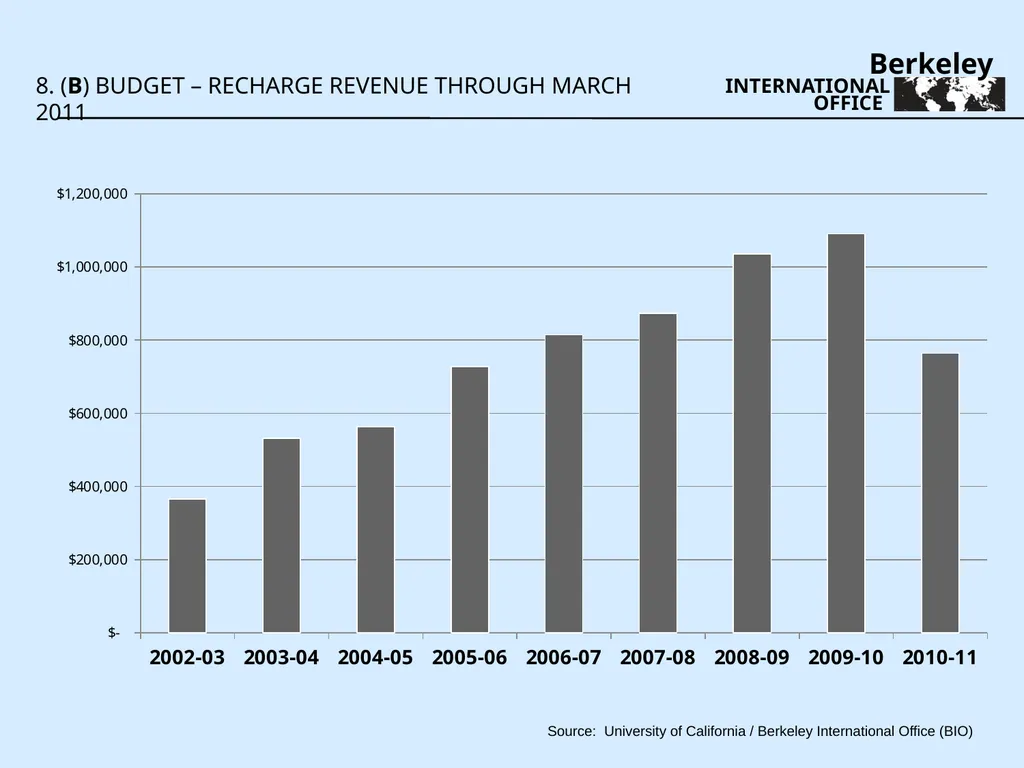
8. (B) Budget – Recharge Revenue through March 2011 Source: University of California / Berkeley International Office (BIO)<br>
23
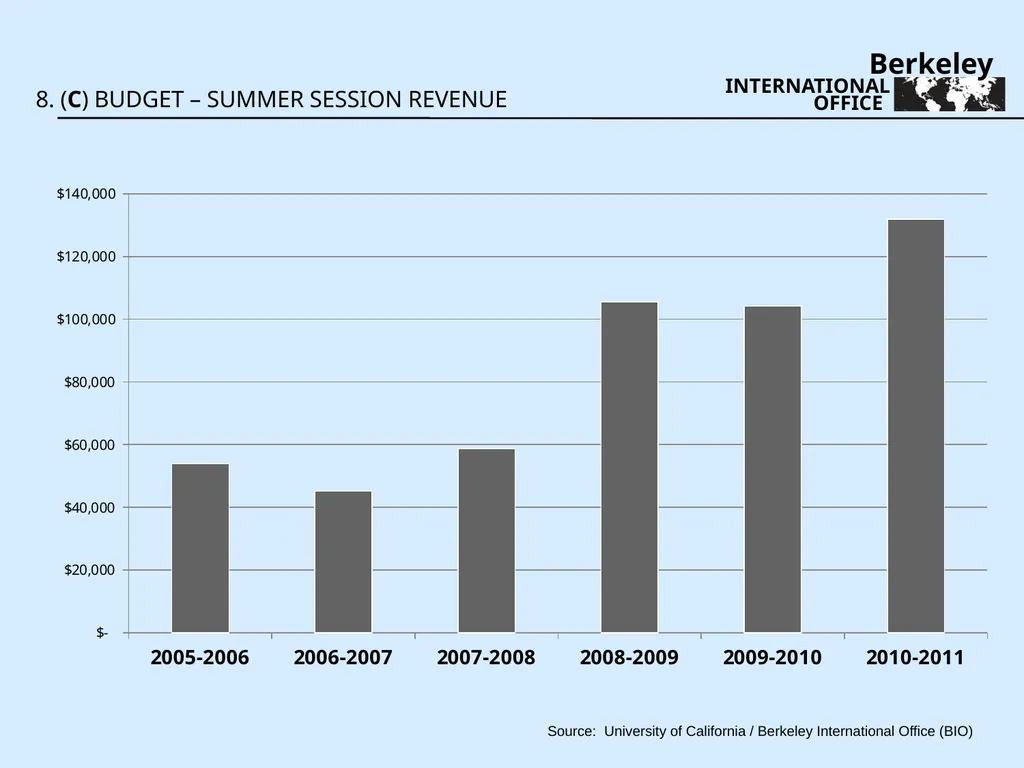
8. (C) Budget – Summer Session Revenue Source: University of California / Berkeley International Office (BIO)<br>
24
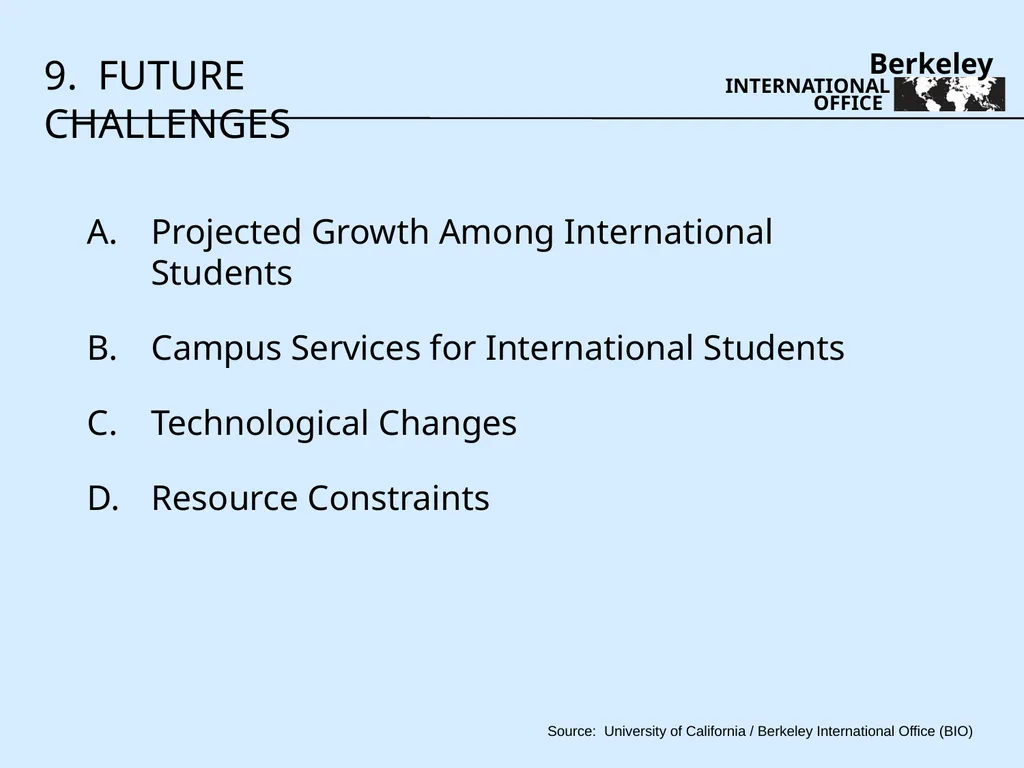
9. Future Challenges Projected Growth Among International
Students
Campus Services for International Students
Technological Changes
Resource Constraints Source: University of California / Berkeley International Office (BIO)<br>
Campus Services for International Students
Technological Changes
Resource Constraints Source: University of California / Berkeley International Office (BIO)<br>
25
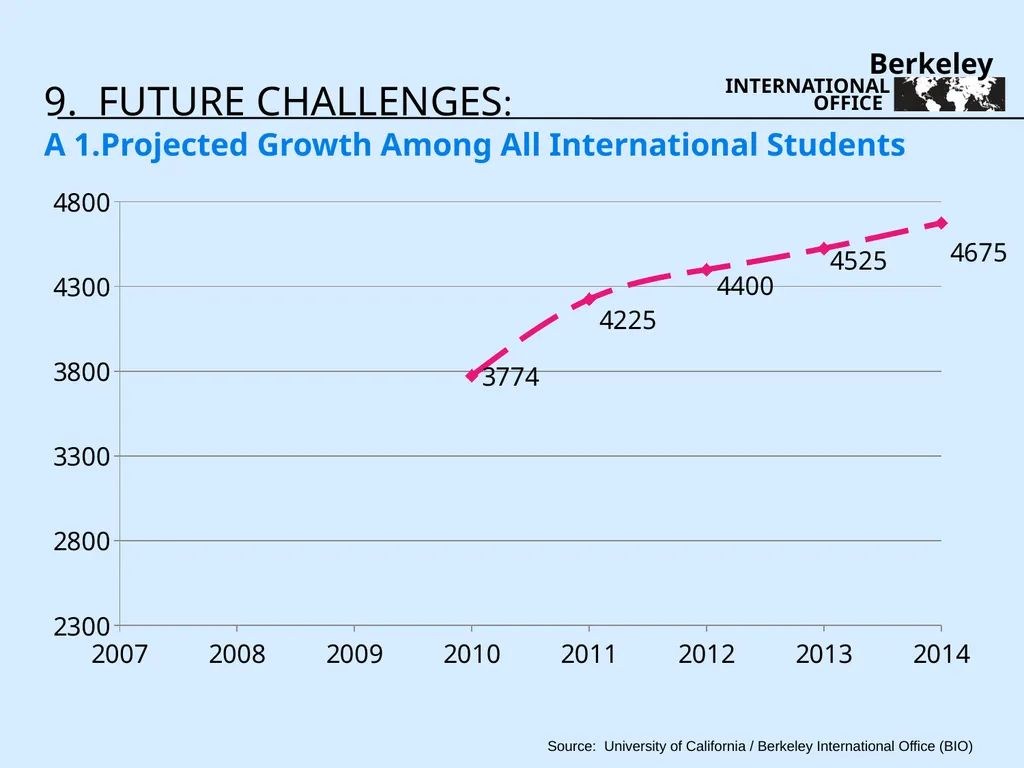
9. Future challenges: Source: University of California / Berkeley International Office (BIO) A 1.Projected Growth Among All International Students<br>
26
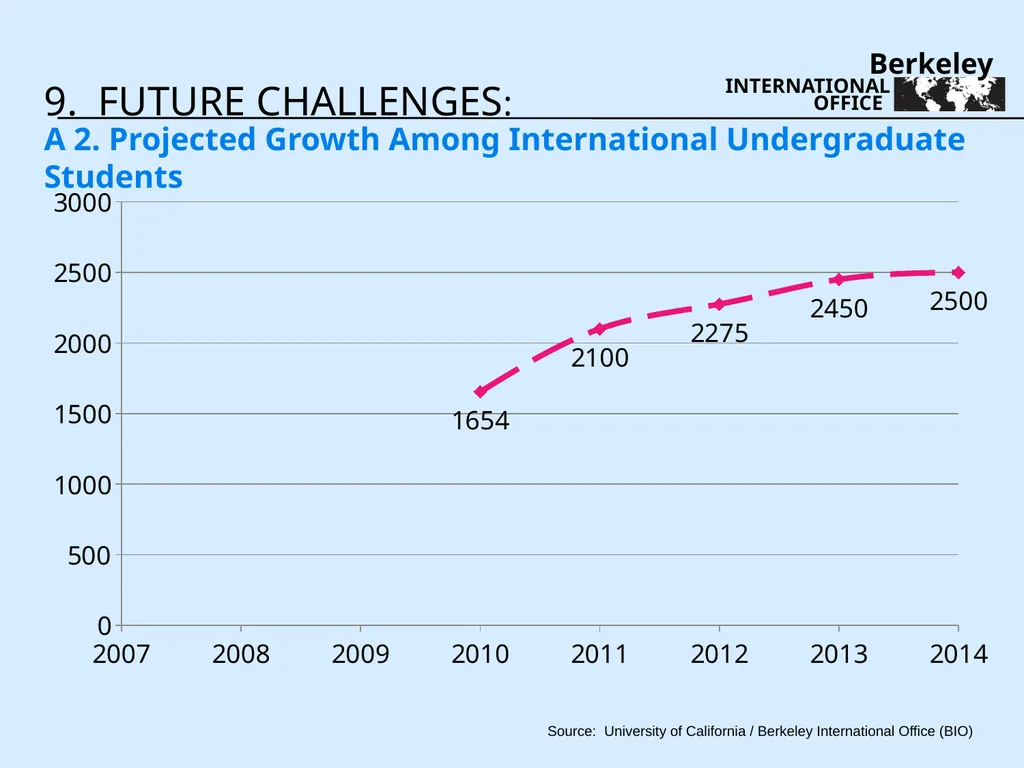
Source: University of California / Berkeley International Office (BIO) 9. Future challenges: A 2. Projected Growth Among International Undergraduate Students<br>
27
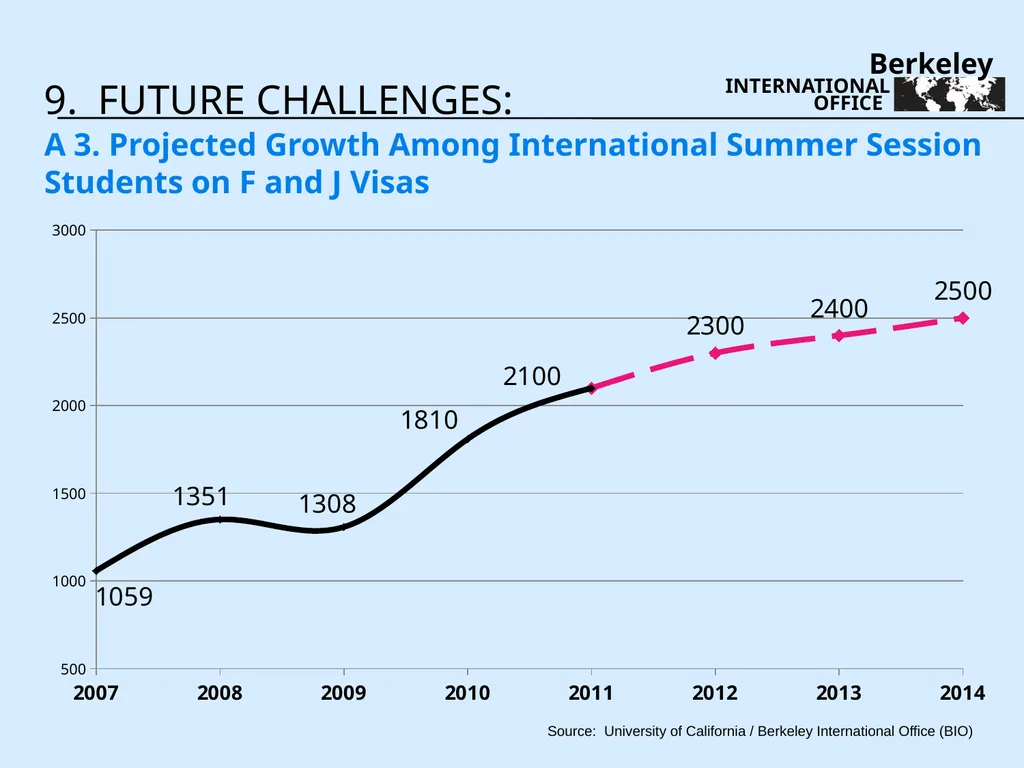
9. Future challenges: A 3. Projected Growth Among International Summer Session Students on F and J Visas Source: University of California / Berkeley International Office (BIO)<br>
28
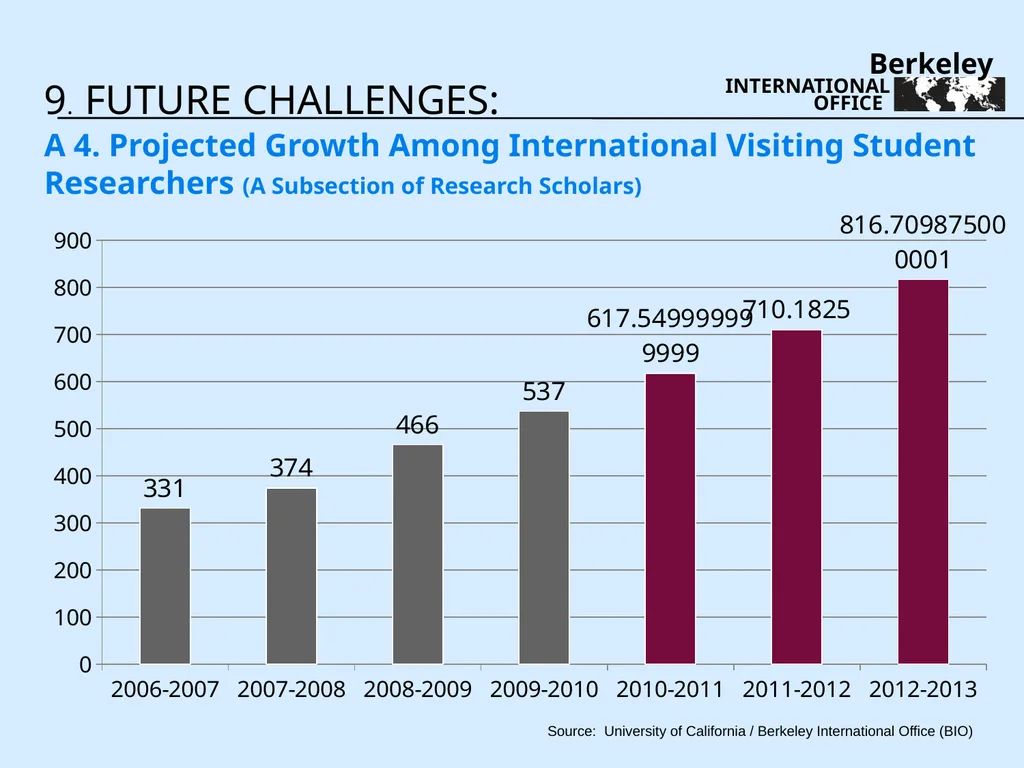
9. Future challenges: Source: University of California / Berkeley International Office (BIO) A 4. Projected Growth Among International Visiting Student Researchers (A Subsection of Research Scholars)<br>
29
Future Challenges:
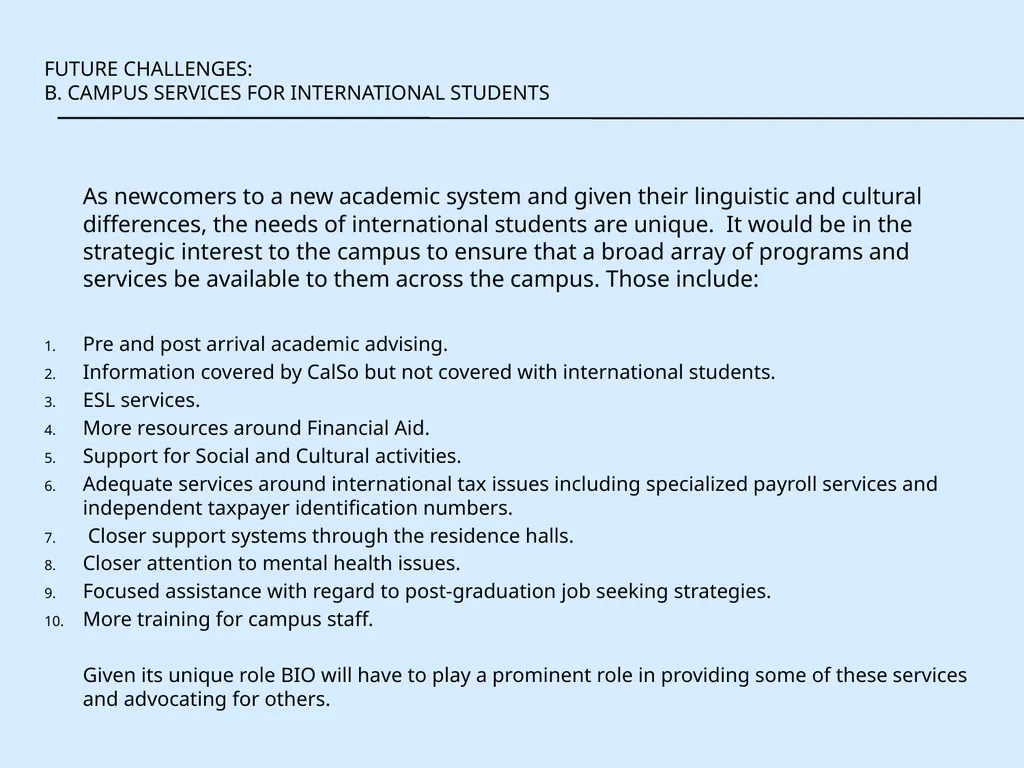
B. Campus Services for International Students As newcomers to a new academic system and given their linguistic and cultural differences, the needs of international students are unique. It would be in the strategic interest to the campus to ensure that a broad array of programs and services be available to them across the campus. Those include:
Pre and post arrival academic advising.
Information covered by CalSo but not covered with international students.
ESL services.
More resources around Financial Aid.
Support for Social and Cultural activities.
Adequate services around international tax issues including specialized payroll services and independent taxpayer identification numbers.
Closer support systems through the residence halls.
Closer attention to mental health issues.
Focused assistance with regard to post-graduation job seeking strategies.
More training for campus staff.
Given its unique role BIO will have to play a prominent role in providing some of these services and advocating for others.<br>
Pre and post arrival academic advising.
Information covered by CalSo but not covered with international students.
ESL services.
More resources around Financial Aid.
Support for Social and Cultural activities.
Adequate services around international tax issues including specialized payroll services and independent taxpayer identification numbers.
Closer support systems through the residence halls.
Closer attention to mental health issues.
Focused assistance with regard to post-graduation job seeking strategies.
More training for campus staff.
Given its unique role BIO will have to play a prominent role in providing some of these services and advocating for others.<br>
30
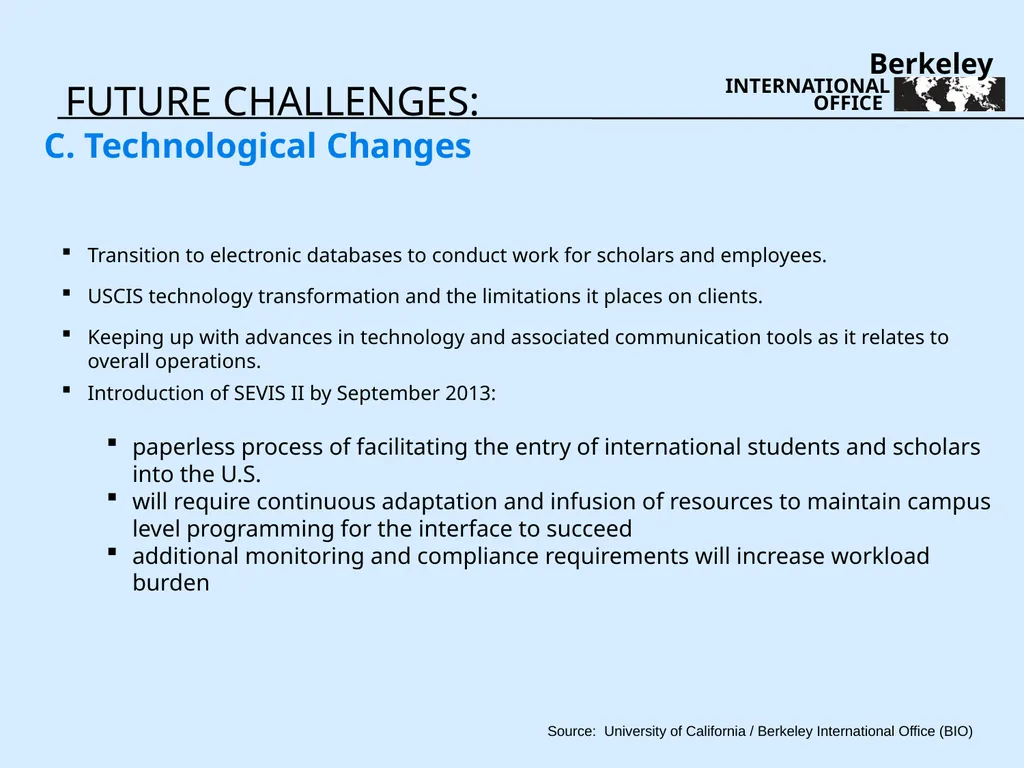
Future challenges: Transition to electronic databases to conduct work for scholars and employees.
USCIS technology transformation and the limitations it places on clients.
Keeping up with advances in technology and associated communication tools as it relates to overall operations.
Introduction of SEVIS II by September 2013:
paperless process of facilitating the entry of international students and scholars into the U.S.
will require continuous adaptation and infusion of resources to maintain campus level programming for the interface to succeed
additional monitoring and compliance requirements will increase workload burden Source: University of California / Berkeley International Office (BIO) C. Technological Changes<br>
USCIS technology transformation and the limitations it places on clients.
Keeping up with advances in technology and associated communication tools as it relates to overall operations.
Introduction of SEVIS II by September 2013:
paperless process of facilitating the entry of international students and scholars into the U.S.
will require continuous adaptation and infusion of resources to maintain campus level programming for the interface to succeed
additional monitoring and compliance requirements will increase workload burden Source: University of California / Berkeley International Office (BIO) C. Technological Changes<br>
31
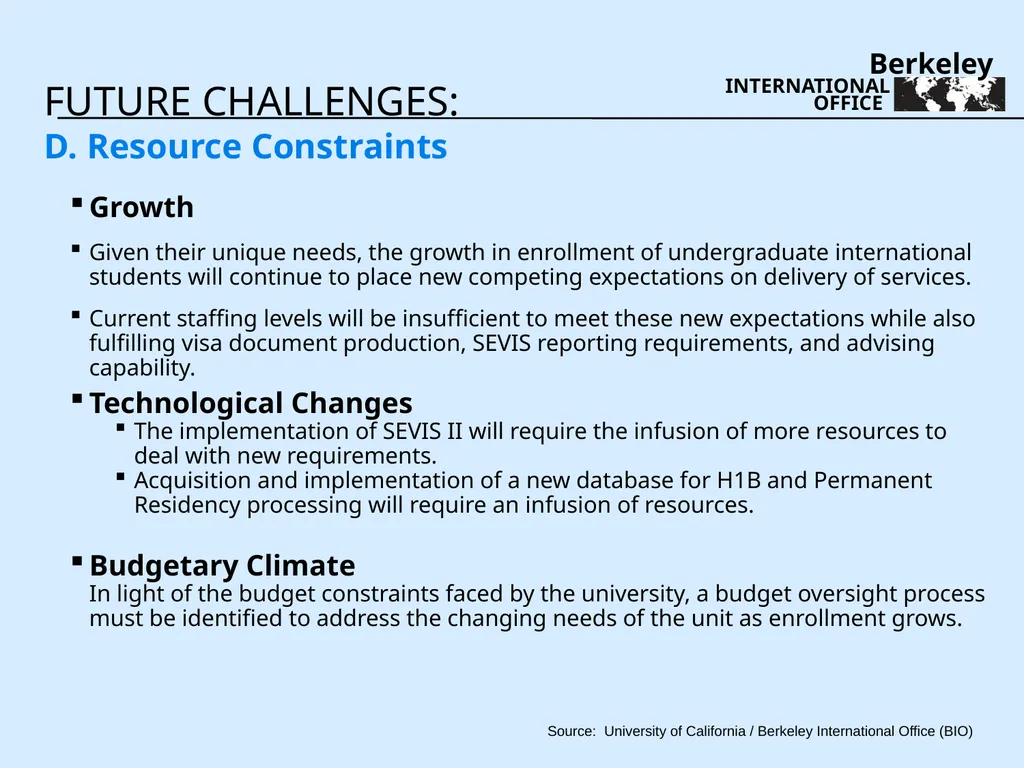
Future challenges: Growth
Given their unique needs, the growth in enrollment of undergraduate international students will continue to place new competing expectations on delivery of services.
Current staffing levels will be insufficient to meet these new expectations while also fulfilling visa document production, SEVIS reporting requirements, and advising capability.
Technological Changes
The implementation of SEVIS II will require the infusion of more resources to deal with new requirements.
Acquisition and implementation of a new database for H1B and Permanent Residency processing will require an infusion of resources.
Budgetary Climate In light of the budget constraints faced by the university, a budget oversight process must be identified to address the changing needs of the unit as enrollment grows. Source: University of California / Berkeley International Office (BIO) D. Resource Constraints<br>
Given their unique needs, the growth in enrollment of undergraduate international students will continue to place new competing expectations on delivery of services.
Current staffing levels will be insufficient to meet these new expectations while also fulfilling visa document production, SEVIS reporting requirements, and advising capability.
Technological Changes
The implementation of SEVIS II will require the infusion of more resources to deal with new requirements.
Acquisition and implementation of a new database for H1B and Permanent Residency processing will require an infusion of resources.
Budgetary Climate In light of the budget constraints faced by the university, a budget oversight process must be identified to address the changing needs of the unit as enrollment grows. Source: University of California / Berkeley International Office (BIO) D. Resource Constraints<br>
32
10. Conclusion The growth among international students at UC Berkeley has been a challenge to the international office in a very limited resource environment. Nevertheless, as results to a comprehensive needs assessment survey suggest, the unit has been successful in adapting to these changes in recent years.
At the same time, the many competing demands placed on the unit because of the unique needs of undergraduate international students will continue to place a resource burden on the unit if we were to attempt to meet all of these needs. This is heightened by the perception of students that BIO should be providing services generally undertaken in the academic domain such as academic advising when in fact those services are better provided by the colleges.
It would behoove the campus, therefore, that steps be undertaken to address the critical needs of international students. This will position BIO to focus on mandated services and to assist students to acclimate to campus and community life. This approach will likely reduce the exposure of the university to risk that is harmful to our teaching and research mission. Accordingly, if future trends are to be realized, UC-Berkeley campus decision makers must consider this larger context in addressing the resource needs of key service units on campus that support the presence of international students. Source: University of California / Berkeley International Office (BIO)<br>
At the same time, the many competing demands placed on the unit because of the unique needs of undergraduate international students will continue to place a resource burden on the unit if we were to attempt to meet all of these needs. This is heightened by the perception of students that BIO should be providing services generally undertaken in the academic domain such as academic advising when in fact those services are better provided by the colleges.
It would behoove the campus, therefore, that steps be undertaken to address the critical needs of international students. This will position BIO to focus on mandated services and to assist students to acclimate to campus and community life. This approach will likely reduce the exposure of the university to risk that is harmful to our teaching and research mission. Accordingly, if future trends are to be realized, UC-Berkeley campus decision makers must consider this larger context in addressing the resource needs of key service units on campus that support the presence of international students. Source: University of California / Berkeley International Office (BIO)<br>