
THRIP & Intellectual Property Dr Andrew Bailey IP
Description: THRIP Intellectual Property Dr Andrew Bailey IP Manager Industry Partner Information Information sheet for Industry Partners sent out with the call Provides simple details around: Intellectual Property Rights from Publicly Financed RD
Related Topics
Download Presentation
"THRIP & Intellectual Property Dr Andrew Bailey IP" is the property of its rightful owner. Permission is granted to download and print the materials on this website for personal, non-commercial use only, and to display it on your personal computer provided you do not modify the materials and that you retain all copyright notices contained in the materials. By downloading content from our website, you accept the terms of this agreement.
Presentation Transcript
slide1. THRIP & Intellectual Property Dr Andrew Bailey
IP Manager<br>
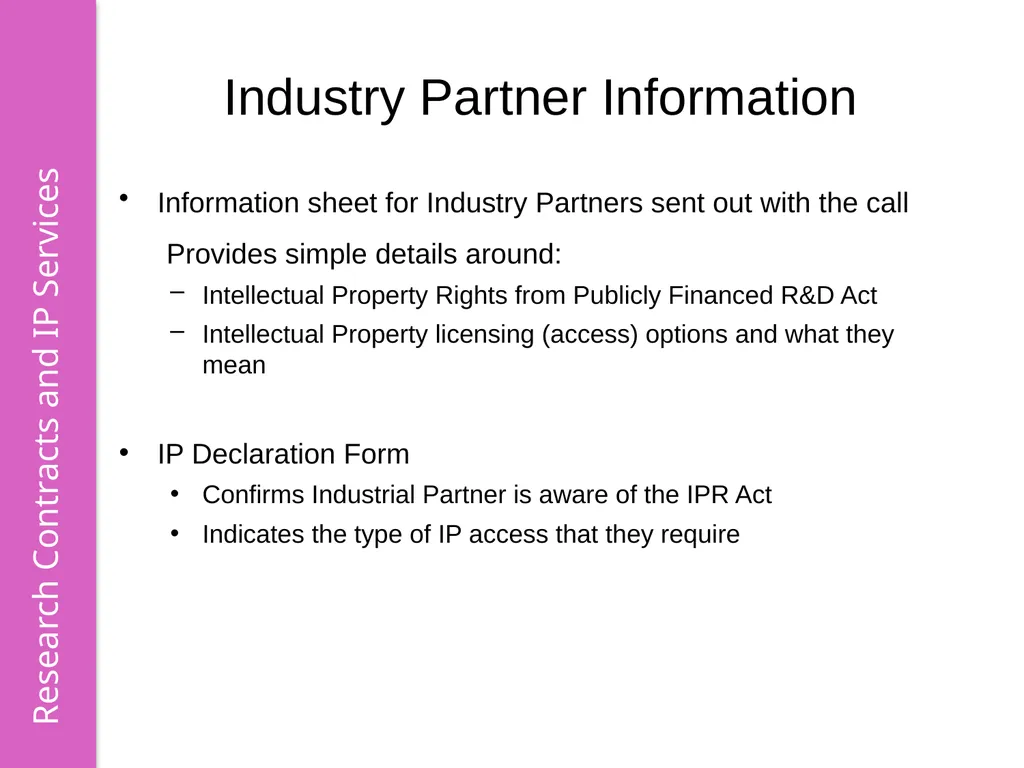
slide2. Industry Partner Information Information sheet for Industry Partners sent out with the call
Provides simple details around:
Intellectual Property Rights from Publicly Financed R&D Act
Intellectual Property licensing (access) options and what they mean
IP Declaration Form
Confirms Industrial Partner is aware of the IPR Act
Indicates the type of IP access that they require<br>
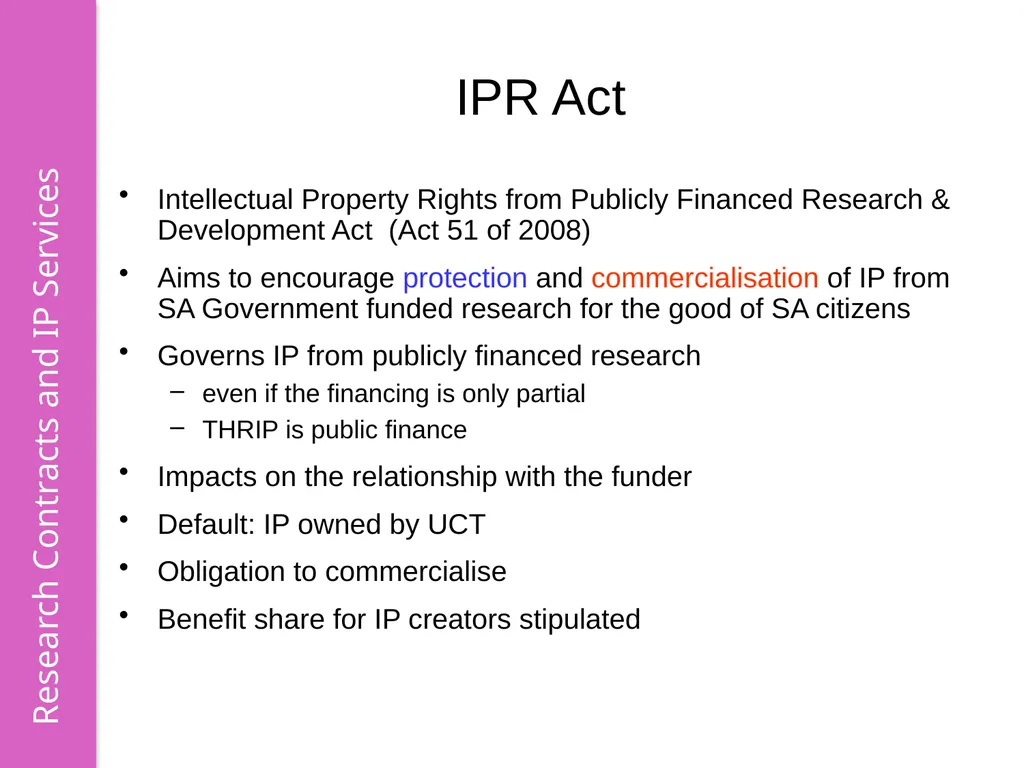
slide3. IPR Act Intellectual Property Rights from Publicly Financed Research & Development Act (Act 51 of 2008)
Aims to encourage protection and commercialisation of IP from SA Government funded research for the good of SA citizens
Governs IP from publicly financed research
even if the financing is only partial
THRIP is public finance
Impacts on the relationship with the funder
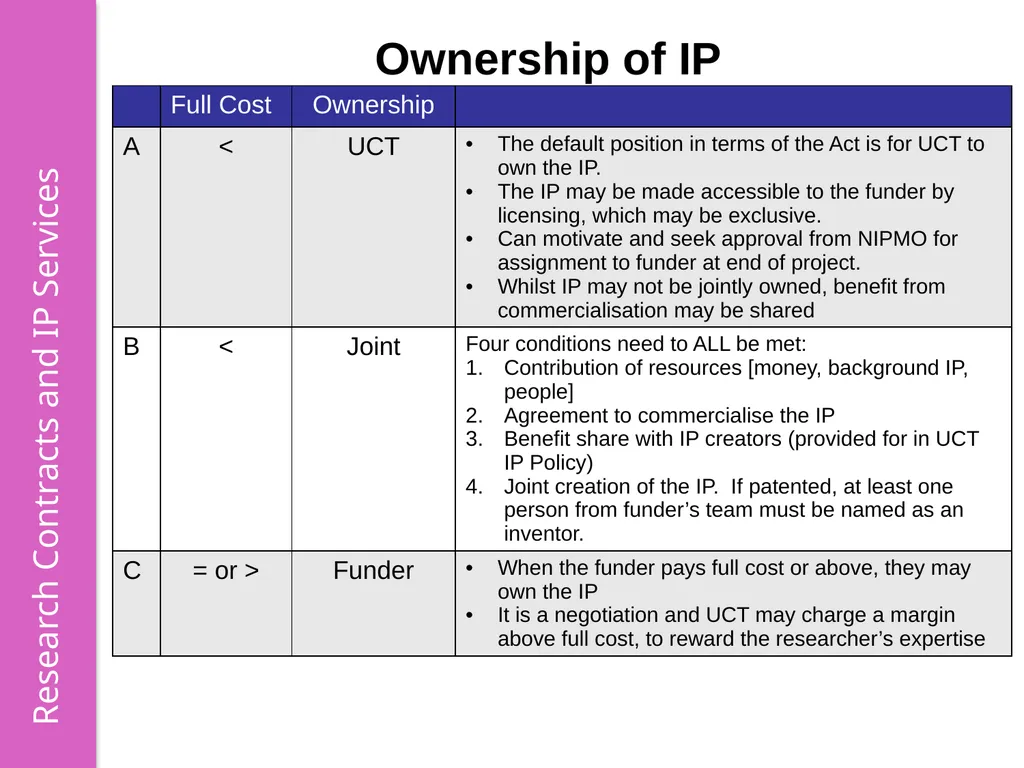
Default: IP owned by UCT
Obligation to commercialise
Benefit share for IP creators stipulated<br>
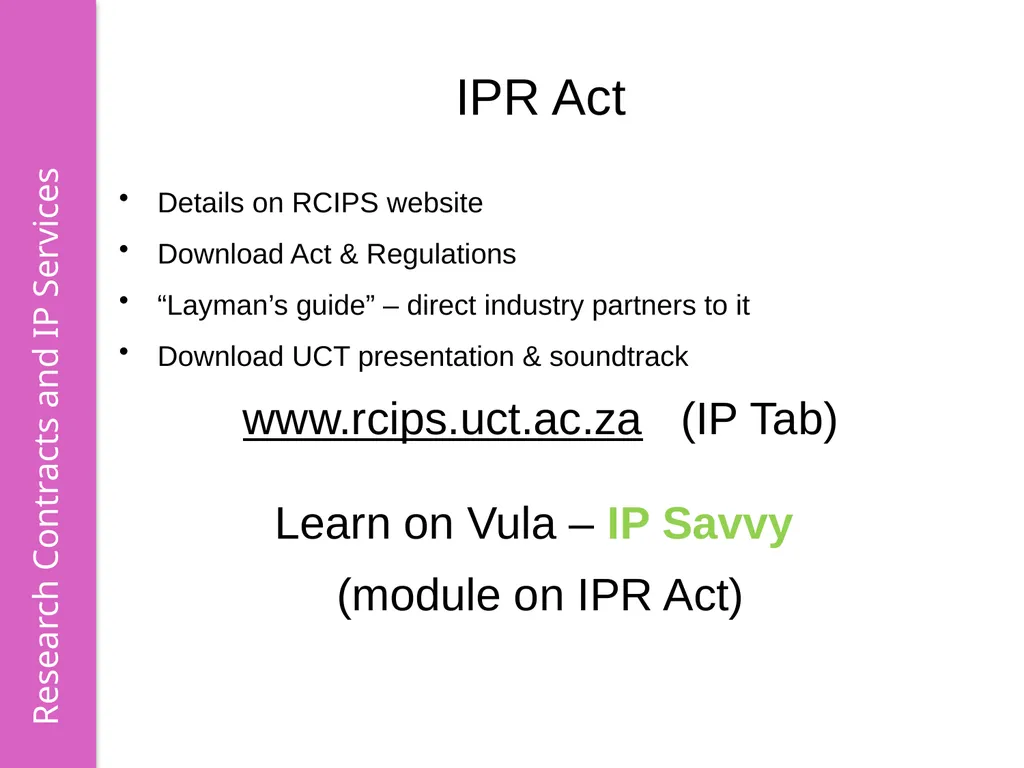
slide4. IPR Act Details on RCIPS website
Download Act & Regulations
“Layman’s guide” – direct industry partners to it
Download UCT presentation & soundtrack
www.rcips.uct.ac.za (IP Tab)
Learn on Vula – IP Savvy
(module on IPR Act)<br>
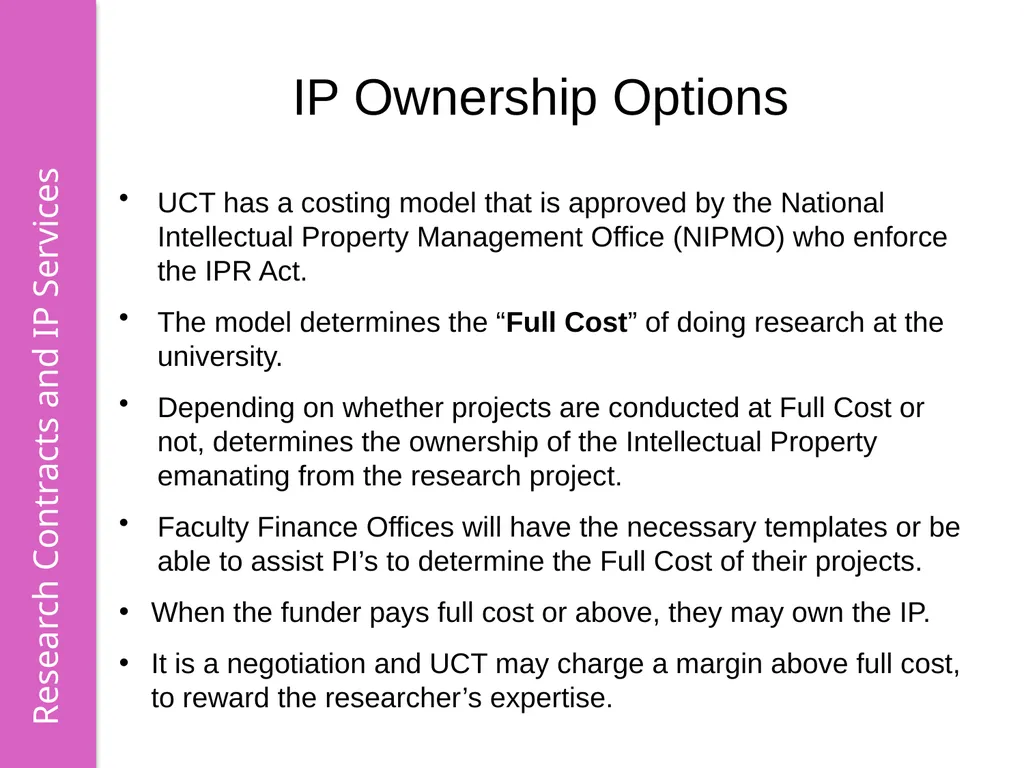
slide5. IP Ownership Options UCT has a costing model that is approved by the National Intellectual Property Management Office (NIPMO) who enforce the IPR Act.
The model determines the “Full Cost” of doing research at the university.
Depending on whether projects are conducted at Full Cost or not, determines the ownership of the Intellectual Property emanating from the research project.
Faculty Finance Offices will have the necessary templates or be able to assist PI’s to determine the Full Cost of their projects.
When the funder pays full cost or above, they may own the IP.
It is a negotiation and UCT may charge a margin above full cost, to reward the researcher’s expertise.<br>
slide6. Ownership of IP<br>
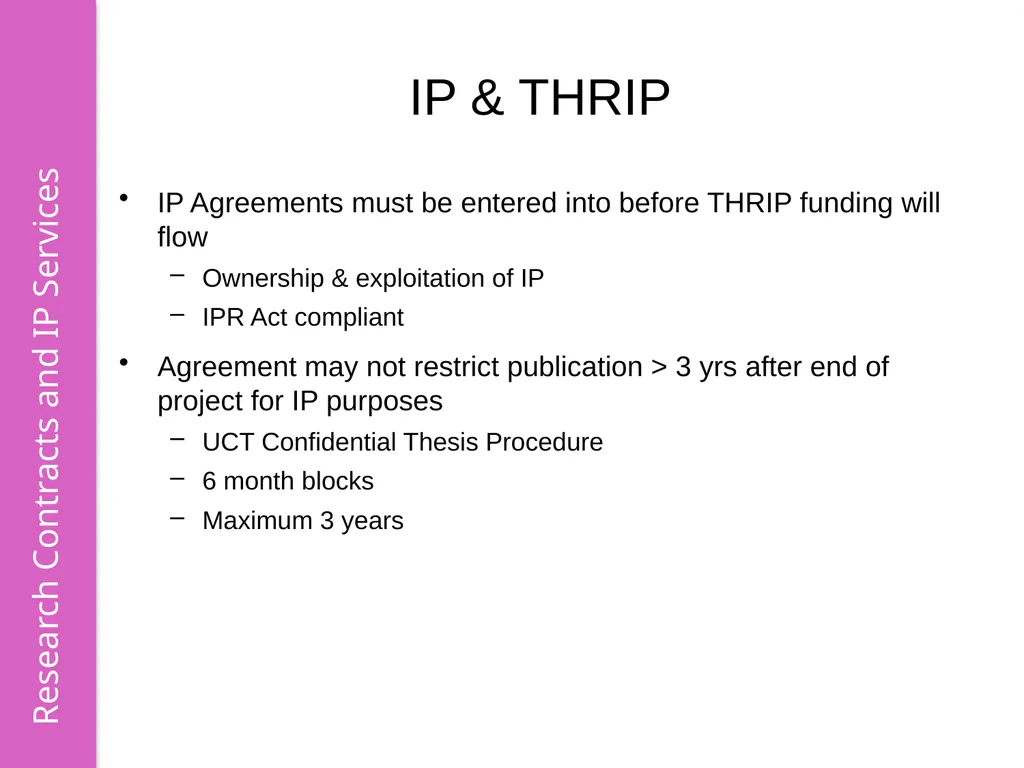
slide7. IP & THRIP IP Agreements must be entered into before THRIP funding will flow
Ownership & exploitation of IP
IPR Act compliant
Agreement may not restrict publication > 3 yrs after end of project for IP purposes
UCT Confidential Thesis Procedure
6 month blocks
Maximum 3 years<br>
slide8. IP Agreements Background IP – work that has been done previously (could have been patented)
Project or “Foreground” IP – created during the course of the THRIP project<br>
slide9. Access to the IP (Below Full Cost Projects) Ownership is not necessarily everything! Its about access.
Exclusive license may achieve essentially same effect as ownership. They are the only party permitted to exploit the IP commercially
IPR Act requires Exclusive Licence to be on market-related terms
Need to acknowledge contribution towards the creation of IP
Does not need permission from NIPMO (South African partners only)
Can build access to an Exclusive Licence into funding agreement / research contract
first right of refusal / option agreement<br>
slide10. Access to the IP Non-exclusive licenses are also possible
The university would be able to license to third parties. Likely that the rate would be higher though to parties who had not funded the research
Can at UCT’s discretion be offered on a royalty-free basis to the funder for their (or their subsidiaries) own internal commercial use. NIPMO will approve this arrangement
Not included in the Industry info pack
Assessed on a case-by-case basis
Influenced by amount of “background” IP that is drawn on
RCIPS needs to report on any royalty-free licences that are granted New<br>
slide11. Access to the IP Assignment of IP = transfer of ownership
Can refer to NIPMO to seek permission for assignment of the IP to the company
Need to motivate why an exclusive license will not be adequate = “best mode of commercialisation”
Often a requirement of investors (Venture Capital)
Can only be done at the end of the project once IP has been created (risk for funder that it will not be approved)<br>
slide12. Walk-in Rights Government may step in, in terms of the IPR Act
Lack of commercialisation
Consultative process
For emergency, health or security issues
Act of Parliament
Will come to licensee first to see if they can fulfill the need<br>
slide13. Fundable Activities Legal Costs (IP Agreements)
Could be useful to Funder
R50k per project (plus R50k per SMME participating)
RCIPS has standard contract that will be used as a basis
Costs for patent registration (need to clarify ‘THRIP Applicant’)
Patent litigation costs – capped at R1m<br>
slide14. Fundable Activities Patents
Funding available to commercial partner to support patenting related to the project
RCIPS must be advised of any patent application and the patent must be filed by UCT<br>
slide15. HEI Ownership of Spin-Outs Non-Qualifying Costs (Section 8)
Contributions from companies owned wholly or partly (≥ 25%) by UCT when the research is done at UCT NEW<br>
slide16. Reporting Information regarding pending / secured patents - RCIPS can provide the patenting info for reporting purposes
Must alert dti if they are not permitted to disclose information to the public if IP has not been protected. Else it will be assumed that they may communicate freely<br>
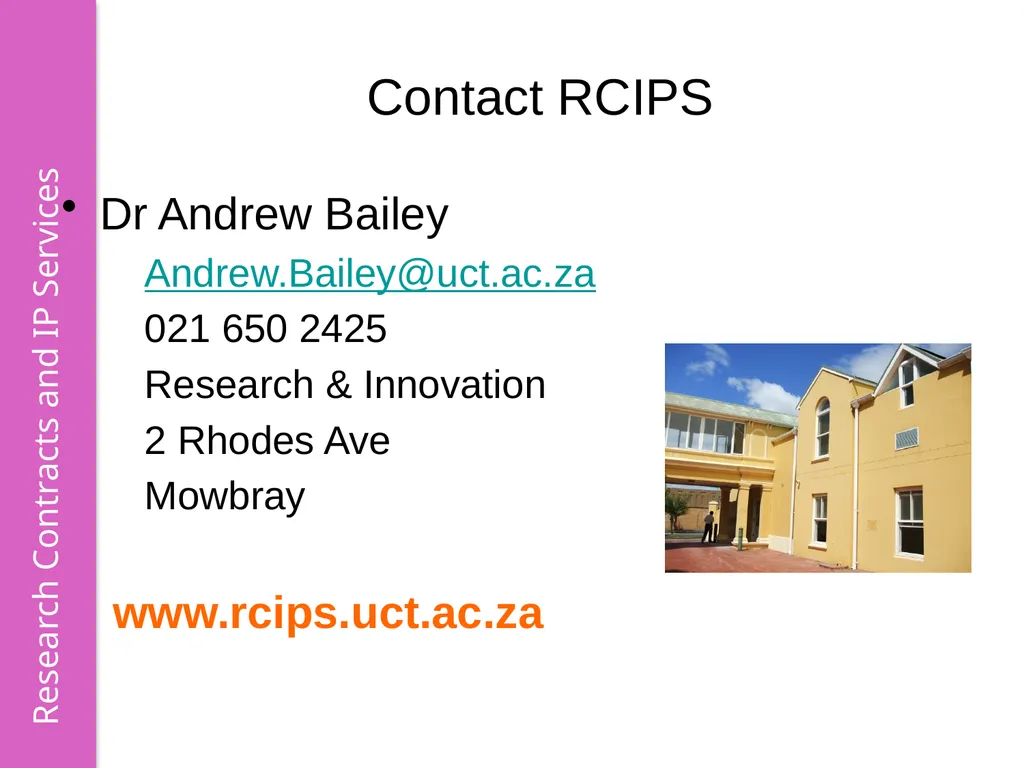
slide17. Contact RCIPS Dr Andrew Bailey
Andrew.Bailey@uct.ac.za
021 650 2425
Research & Innovation
2 Rhodes Ave
Mowbray
www.rcips.uct.ac.za<br>
IP Manager<br>
slide2. Industry Partner Information Information sheet for Industry Partners sent out with the call
Provides simple details around:
Intellectual Property Rights from Publicly Financed R&D Act
Intellectual Property licensing (access) options and what they mean
IP Declaration Form
Confirms Industrial Partner is aware of the IPR Act
Indicates the type of IP access that they require<br>
slide3. IPR Act Intellectual Property Rights from Publicly Financed Research & Development Act (Act 51 of 2008)
Aims to encourage protection and commercialisation of IP from SA Government funded research for the good of SA citizens
Governs IP from publicly financed research
even if the financing is only partial
THRIP is public finance
Impacts on the relationship with the funder
Default: IP owned by UCT
Obligation to commercialise
Benefit share for IP creators stipulated<br>
slide4. IPR Act Details on RCIPS website
Download Act & Regulations
“Layman’s guide” – direct industry partners to it
Download UCT presentation & soundtrack
www.rcips.uct.ac.za (IP Tab)
Learn on Vula – IP Savvy
(module on IPR Act)<br>
slide5. IP Ownership Options UCT has a costing model that is approved by the National Intellectual Property Management Office (NIPMO) who enforce the IPR Act.
The model determines the “Full Cost” of doing research at the university.
Depending on whether projects are conducted at Full Cost or not, determines the ownership of the Intellectual Property emanating from the research project.
Faculty Finance Offices will have the necessary templates or be able to assist PI’s to determine the Full Cost of their projects.
When the funder pays full cost or above, they may own the IP.
It is a negotiation and UCT may charge a margin above full cost, to reward the researcher’s expertise.<br>
slide6. Ownership of IP<br>
slide7. IP & THRIP IP Agreements must be entered into before THRIP funding will flow
Ownership & exploitation of IP
IPR Act compliant
Agreement may not restrict publication > 3 yrs after end of project for IP purposes
UCT Confidential Thesis Procedure
6 month blocks
Maximum 3 years<br>
slide8. IP Agreements Background IP – work that has been done previously (could have been patented)
Project or “Foreground” IP – created during the course of the THRIP project<br>
slide9. Access to the IP (Below Full Cost Projects) Ownership is not necessarily everything! Its about access.
Exclusive license may achieve essentially same effect as ownership. They are the only party permitted to exploit the IP commercially
IPR Act requires Exclusive Licence to be on market-related terms
Need to acknowledge contribution towards the creation of IP
Does not need permission from NIPMO (South African partners only)
Can build access to an Exclusive Licence into funding agreement / research contract
first right of refusal / option agreement<br>
slide10. Access to the IP Non-exclusive licenses are also possible
The university would be able to license to third parties. Likely that the rate would be higher though to parties who had not funded the research
Can at UCT’s discretion be offered on a royalty-free basis to the funder for their (or their subsidiaries) own internal commercial use. NIPMO will approve this arrangement
Not included in the Industry info pack
Assessed on a case-by-case basis
Influenced by amount of “background” IP that is drawn on
RCIPS needs to report on any royalty-free licences that are granted New<br>
slide11. Access to the IP Assignment of IP = transfer of ownership
Can refer to NIPMO to seek permission for assignment of the IP to the company
Need to motivate why an exclusive license will not be adequate = “best mode of commercialisation”
Often a requirement of investors (Venture Capital)
Can only be done at the end of the project once IP has been created (risk for funder that it will not be approved)<br>
slide12. Walk-in Rights Government may step in, in terms of the IPR Act
Lack of commercialisation
Consultative process
For emergency, health or security issues
Act of Parliament
Will come to licensee first to see if they can fulfill the need<br>
slide13. Fundable Activities Legal Costs (IP Agreements)
Could be useful to Funder
R50k per project (plus R50k per SMME participating)
RCIPS has standard contract that will be used as a basis
Costs for patent registration (need to clarify ‘THRIP Applicant’)
Patent litigation costs – capped at R1m<br>
slide14. Fundable Activities Patents
Funding available to commercial partner to support patenting related to the project
RCIPS must be advised of any patent application and the patent must be filed by UCT<br>
slide15. HEI Ownership of Spin-Outs Non-Qualifying Costs (Section 8)
Contributions from companies owned wholly or partly (≥ 25%) by UCT when the research is done at UCT NEW<br>
slide16. Reporting Information regarding pending / secured patents - RCIPS can provide the patenting info for reporting purposes
Must alert dti if they are not permitted to disclose information to the public if IP has not been protected. Else it will be assumed that they may communicate freely<br>
slide17. Contact RCIPS Dr Andrew Bailey
Andrew.Bailey@uct.ac.za
021 650 2425
Research & Innovation
2 Rhodes Ave
Mowbray
www.rcips.uct.ac.za<br>