
Thyroid Disorders Chandler Craft, Pharm.D.
MJ
Published · 19 slides · 0 views
1 / 1


Description
Thyroid Disorders Chandler Craft, Pharm.D. Lieutenant- U.S. Public Health Service corps PGY-1 Resident pharmacist- Choctaw Nation Health Services Authority Objectives Explain the basic physiology of the thyroid gland. Identify causes,
Related Topics
Share
Embed code
Download this presentation From Below
"Thyroid Disorders Chandler Craft, Pharm.D." is the property of its rightful owner. Permission is granted to download and print the materials on this website for personal, non-commercial use only, and to display it on your personal computer provided you do not modify the materials and that you retain all copyright notices contained in the materials. By downloading content from our website, you accept the terms of this agreement.
Presentation Transcript
01
Thyroid Disorders Chandler Craft, Pharm.D.
Lieutenant- U.S. Public Health Service corps
PGY-1 Resident pharmacist- Choctaw Nation Health Services Authority<br>
Lieutenant- U.S. Public Health Service corps
PGY-1 Resident pharmacist- Choctaw Nation Health Services Authority<br>
02
Objectives Explain the basic physiology of the thyroid gland.
Identify causes, signs, and symptoms of hyperthyroidism and hypothyroidism.
Discuss appropriate diagnoses and potential treatments for thyroid disorders.
Identify correct dosing, monitoring, and counseling for hyperthyroidism and hypothyroidism medications.<br>
Identify causes, signs, and symptoms of hyperthyroidism and hypothyroidism.
Discuss appropriate diagnoses and potential treatments for thyroid disorders.
Identify correct dosing, monitoring, and counseling for hyperthyroidism and hypothyroidism medications.<br>
03
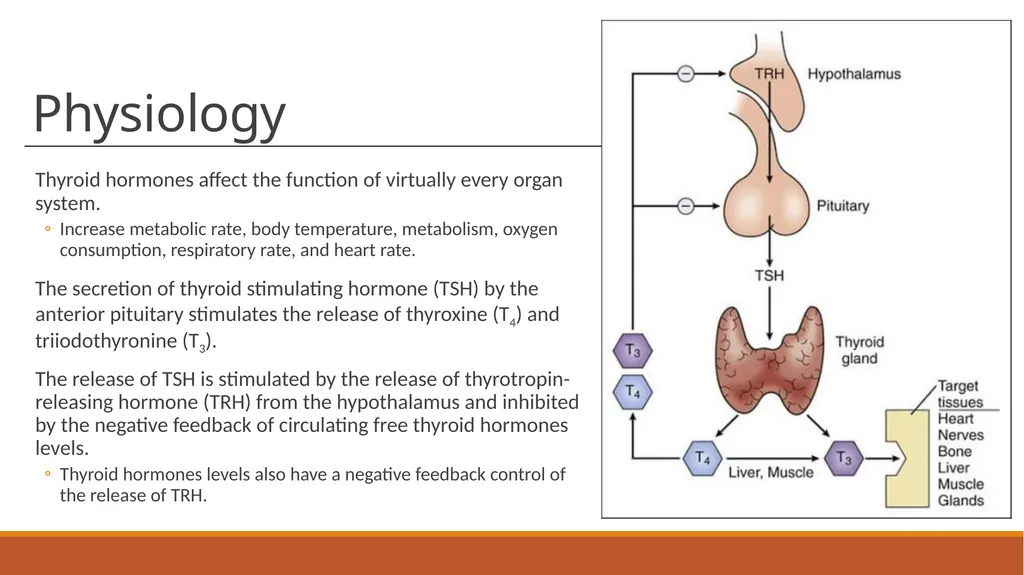
Physiology Thyroid hormones affect the function of virtually every organ system.
Increase metabolic rate, body temperature, metabolism, oxygen consumption, respiratory rate, and heart rate.
The secretion of thyroid stimulating hormone (TSH) by the anterior pituitary stimulates the release of thyroxine (T4) and triiodothyronine (T3).
The release of TSH is stimulated by the release of thyrotropin-releasing hormone (TRH) from the hypothalamus and inhibited by the negative feedback of circulating free thyroid hormones levels.
Thyroid hormones levels also have a negative feedback control of the release of TRH.<br>
Increase metabolic rate, body temperature, metabolism, oxygen consumption, respiratory rate, and heart rate.
The secretion of thyroid stimulating hormone (TSH) by the anterior pituitary stimulates the release of thyroxine (T4) and triiodothyronine (T3).
The release of TSH is stimulated by the release of thyrotropin-releasing hormone (TRH) from the hypothalamus and inhibited by the negative feedback of circulating free thyroid hormones levels.
Thyroid hormones levels also have a negative feedback control of the release of TRH.<br>
04
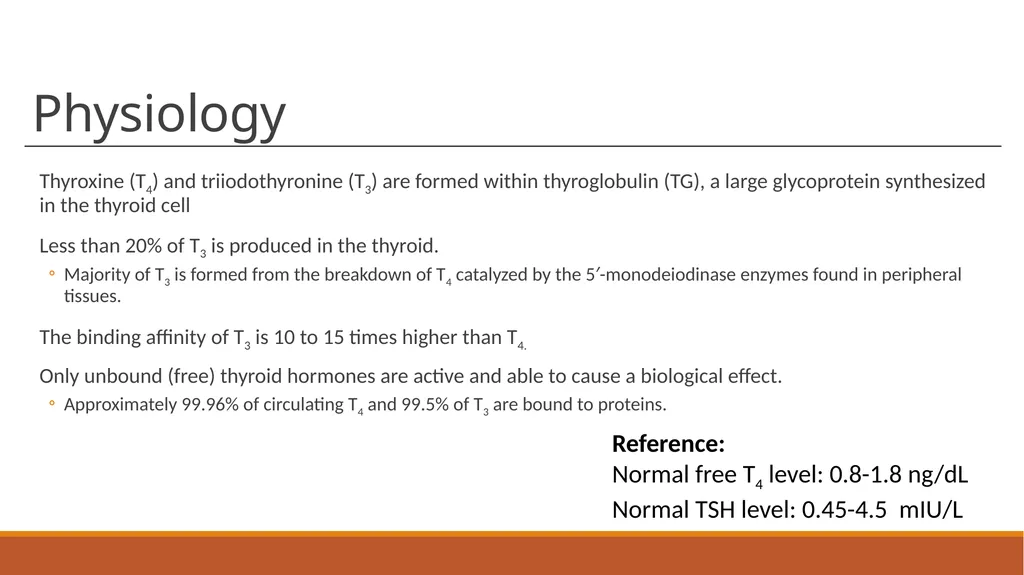
Physiology Thyroxine (T4) and triiodothyronine (T3) are formed within thyroglobulin (TG), a large glycoprotein synthesized in the thyroid cell
Less than 20% of T3 is produced in the thyroid.
Majority of T3 is formed from the breakdown of T4 catalyzed by the 5′-monodeiodinase enzymes found in peripheral tissues.
The binding affinity of T3 is 10 to 15 times higher than T4.
Only unbound (free) thyroid hormones are active and able to cause a biological effect.
Approximately 99.96% of circulating T4 and 99.5% of T3 are bound to proteins. Reference:
Normal free T4 level: 0.8-1.8 ng/dL
Normal TSH level: 0.45-4.5 mIU/L<br>
Less than 20% of T3 is produced in the thyroid.
Majority of T3 is formed from the breakdown of T4 catalyzed by the 5′-monodeiodinase enzymes found in peripheral tissues.
The binding affinity of T3 is 10 to 15 times higher than T4.
Only unbound (free) thyroid hormones are active and able to cause a biological effect.
Approximately 99.96% of circulating T4 and 99.5% of T3 are bound to proteins. Reference:
Normal free T4 level: 0.8-1.8 ng/dL
Normal TSH level: 0.45-4.5 mIU/L<br>
05
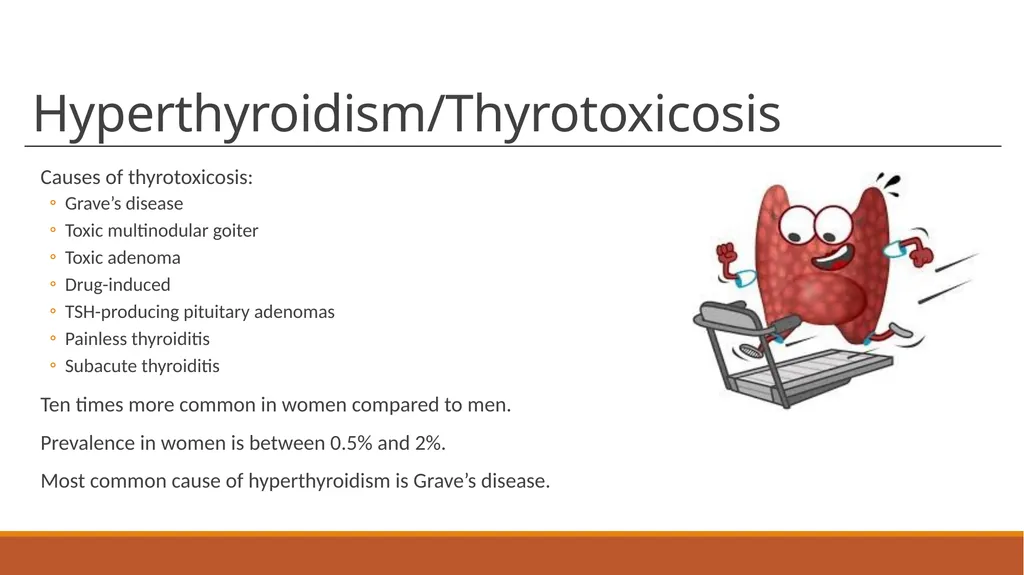
Hyperthyroidism/Thyrotoxicosis Causes of thyrotoxicosis:
Grave’s disease
Toxic multinodular goiter
Toxic adenoma
Drug-induced
TSH-producing pituitary adenomas
Painless thyroiditis
Subacute thyroiditis
Ten times more common in women compared to men.
Prevalence in women is between 0.5% and 2%.
Most common cause of hyperthyroidism is Grave’s disease.<br>
Grave’s disease
Toxic multinodular goiter
Toxic adenoma
Drug-induced
TSH-producing pituitary adenomas
Painless thyroiditis
Subacute thyroiditis
Ten times more common in women compared to men.
Prevalence in women is between 0.5% and 2%.
Most common cause of hyperthyroidism is Grave’s disease.<br>
06
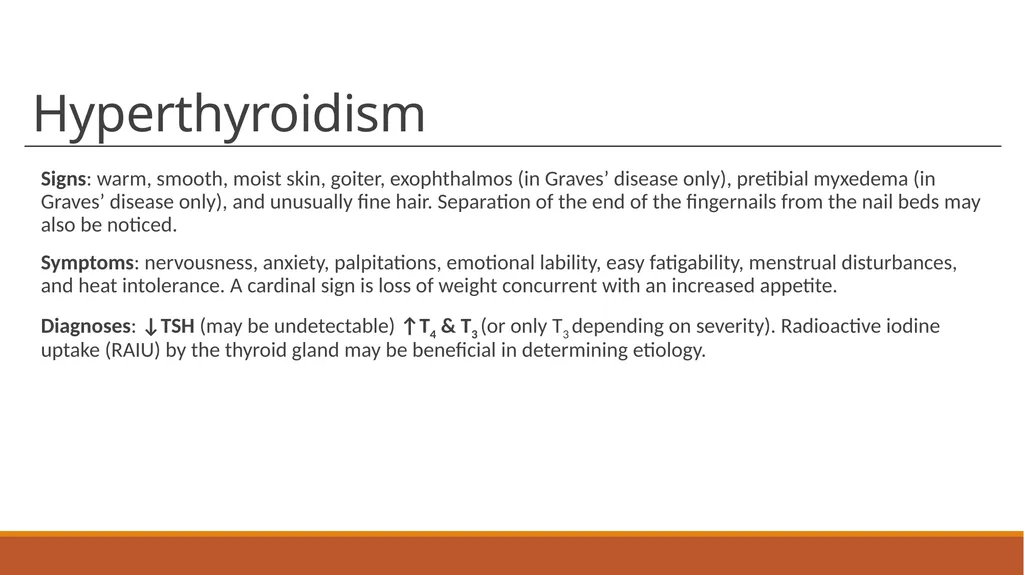
Hyperthyroidism Signs: warm, smooth, moist skin, goiter, exophthalmos (in Graves’ disease only), pretibial myxedema (in Graves’ disease only), and unusually fine hair. Separation of the end of the fingernails from the nail beds may also be noticed.
Symptoms: nervousness, anxiety, palpitations, emotional lability, easy fatigability, menstrual disturbances, and heat intolerance. A cardinal sign is loss of weight concurrent with an increased appetite.
Diagnoses: ↓TSH (may be undetectable) ↑T4 & T3 (or only T3 depending on severity). Radioactive iodine uptake (RAIU) by the thyroid gland may be beneficial in determining etiology.<br>
Symptoms: nervousness, anxiety, palpitations, emotional lability, easy fatigability, menstrual disturbances, and heat intolerance. A cardinal sign is loss of weight concurrent with an increased appetite.
Diagnoses: ↓TSH (may be undetectable) ↑T4 & T3 (or only T3 depending on severity). Radioactive iodine uptake (RAIU) by the thyroid gland may be beneficial in determining etiology.<br>
07
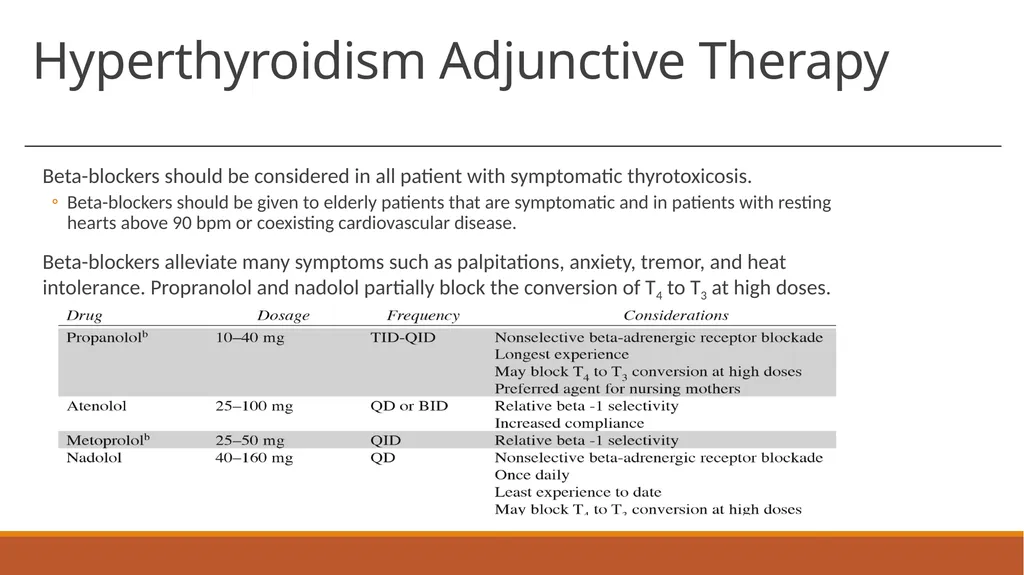
Hyperthyroidism Adjunctive Therapy Beta-blockers should be considered in all patient with symptomatic thyrotoxicosis.
Beta-blockers should be given to elderly patients that are symptomatic and in patients with resting hearts above 90 bpm or coexisting cardiovascular disease.
Beta-blockers alleviate many symptoms such as palpitations, anxiety, tremor, and heat intolerance. Propranolol and nadolol partially block the conversion of T4 to T3 at high doses.<br>
Beta-blockers should be given to elderly patients that are symptomatic and in patients with resting hearts above 90 bpm or coexisting cardiovascular disease.
Beta-blockers alleviate many symptoms such as palpitations, anxiety, tremor, and heat intolerance. Propranolol and nadolol partially block the conversion of T4 to T3 at high doses.<br>
08
Grave’s Disease Treatment There are 3 treatment modalities:
131I therapy
Contraindicated if planning to become pregnant in 4-6 months, pregnant, breastfeeding, or coexisting thyroid cancer. May be preferable in patients with comorbidities that increase surgical risks.
Antithyroid medication
Preferable in patients with high likelihood of remission or limited life expectancy.
Thyroidectomy
Preferred in documented or suspected thyroid malignance, planning to become pregnancy within 4 months, severe ophthalmopathy, or large goiter (>80g). Should be avoid in patients with cardiopulmonary disease, end-stage cancer, or patients that are within 1st or 3rd trimester of pregnancy.<br>
131I therapy
Contraindicated if planning to become pregnant in 4-6 months, pregnant, breastfeeding, or coexisting thyroid cancer. May be preferable in patients with comorbidities that increase surgical risks.
Antithyroid medication
Preferable in patients with high likelihood of remission or limited life expectancy.
Thyroidectomy
Preferred in documented or suspected thyroid malignance, planning to become pregnancy within 4 months, severe ophthalmopathy, or large goiter (>80g). Should be avoid in patients with cardiopulmonary disease, end-stage cancer, or patients that are within 1st or 3rd trimester of pregnancy.<br>
09
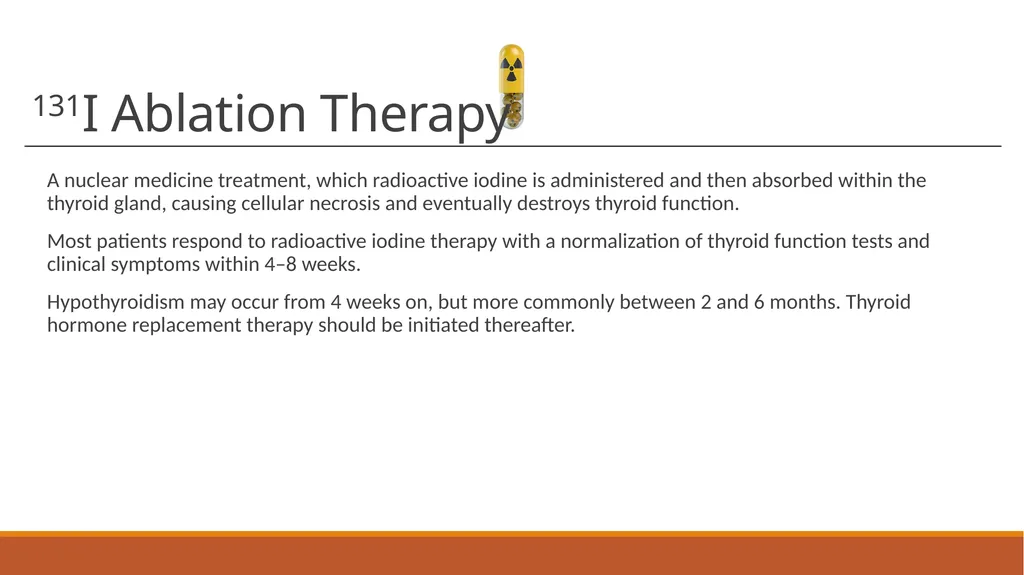
131I Ablation Therapy A nuclear medicine treatment, which radioactive iodine is administered and then absorbed within the thyroid gland, causing cellular necrosis and eventually destroys thyroid function.
Most patients respond to radioactive iodine therapy with a normalization of thyroid function tests and clinical symptoms within 4–8 weeks.
Hypothyroidism may occur from 4 weeks on, but more commonly between 2 and 6 months. Thyroid hormone replacement therapy should be initiated thereafter.<br>
Most patients respond to radioactive iodine therapy with a normalization of thyroid function tests and clinical symptoms within 4–8 weeks.
Hypothyroidism may occur from 4 weeks on, but more commonly between 2 and 6 months. Thyroid hormone replacement therapy should be initiated thereafter.<br>
10
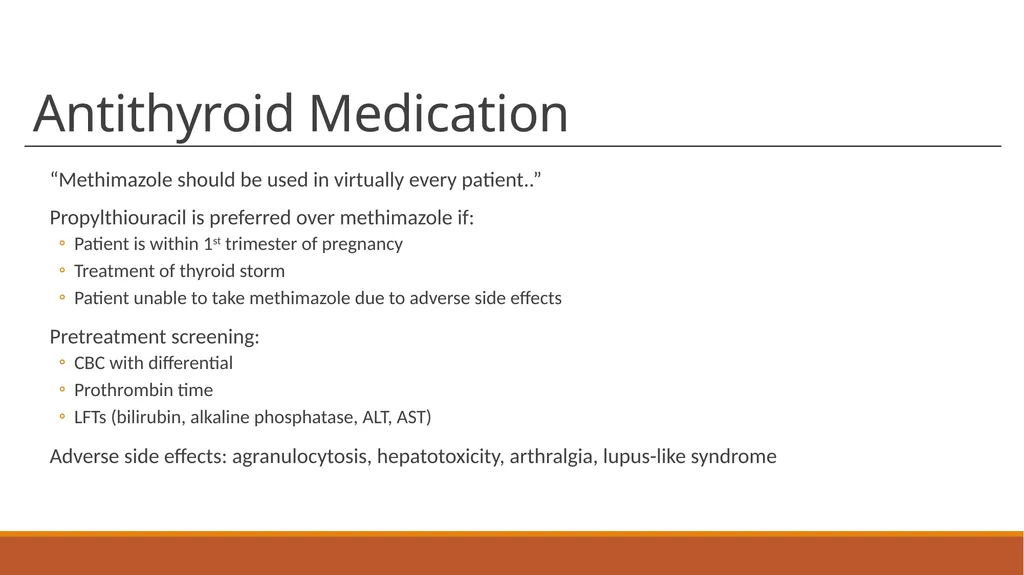
Antithyroid Medication “Methimazole should be used in virtually every patient..”
Propylthiouracil is preferred over methimazole if:
Patient is within 1st trimester of pregnancy
Treatment of thyroid storm
Patient unable to take methimazole due to adverse side effects
Pretreatment screening:
CBC with differential
Prothrombin time
LFTs (bilirubin, alkaline phosphatase, ALT, AST)
Adverse side effects: agranulocytosis, hepatotoxicity, arthralgia, lupus-like syndrome<br>
Propylthiouracil is preferred over methimazole if:
Patient is within 1st trimester of pregnancy
Treatment of thyroid storm
Patient unable to take methimazole due to adverse side effects
Pretreatment screening:
CBC with differential
Prothrombin time
LFTs (bilirubin, alkaline phosphatase, ALT, AST)
Adverse side effects: agranulocytosis, hepatotoxicity, arthralgia, lupus-like syndrome<br>
11
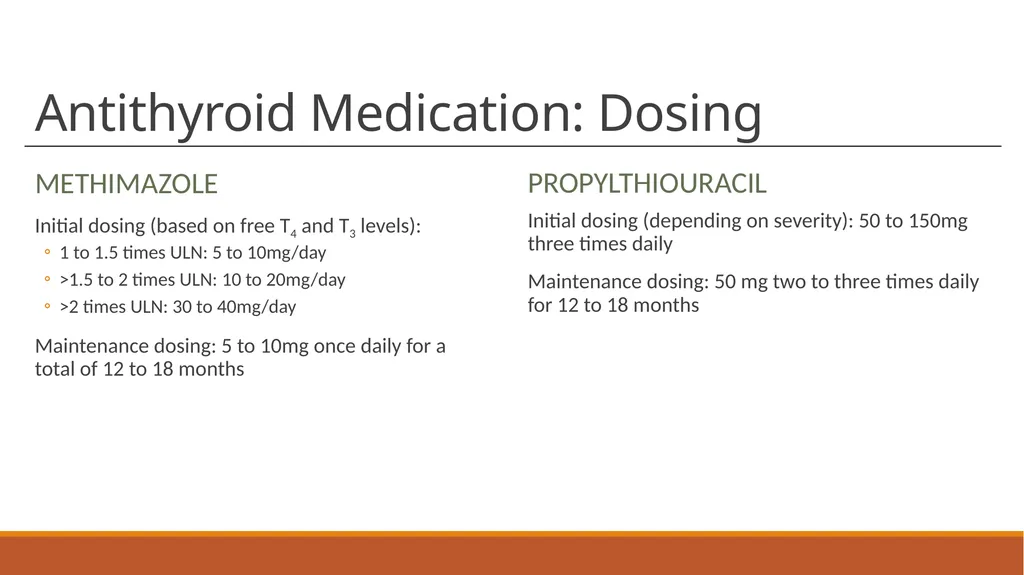
Antithyroid Medication: Dosing Methimazole Initial dosing (based on free T4 and T3 levels):
1 to 1.5 times ULN: 5 to 10mg/day
>1.5 to 2 times ULN: 10 to 20mg/day
>2 times ULN: 30 to 40mg/day
Maintenance dosing: 5 to 10mg once daily for a total of 12 to 18 months Propylthiouracil Initial dosing (depending on severity): 50 to 150mg three times daily
Maintenance dosing: 50 mg two to three times daily for 12 to 18 months<br>
1 to 1.5 times ULN: 5 to 10mg/day
>1.5 to 2 times ULN: 10 to 20mg/day
>2 times ULN: 30 to 40mg/day
Maintenance dosing: 5 to 10mg once daily for a total of 12 to 18 months Propylthiouracil Initial dosing (depending on severity): 50 to 150mg three times daily
Maintenance dosing: 50 mg two to three times daily for 12 to 18 months<br>
12
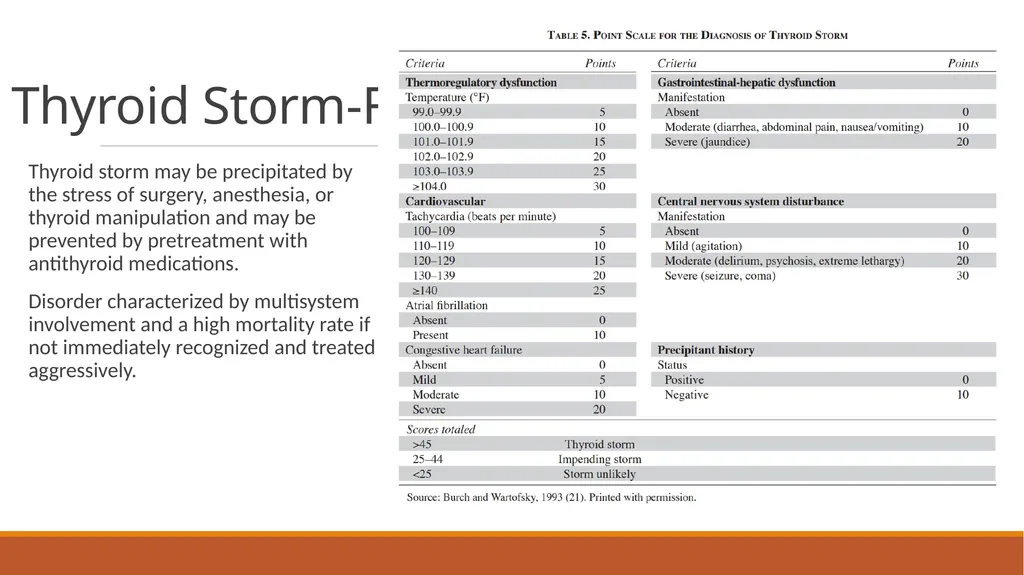
Thyroid Storm-FYI Thyroid storm may be precipitated by the stress of surgery, anesthesia, or thyroid manipulation and may be prevented by pretreatment with antithyroid medications.
Disorder characterized by multisystem involvement and a high mortality rate if not immediately recognized and treated aggressively.<br>
Disorder characterized by multisystem involvement and a high mortality rate if not immediately recognized and treated aggressively.<br>
13
Hypothyroidism In areas of iodine sufficiency, such as the United States, the most common cause of hypothyroidism is chronic autoimmune thyroiditis (Hashimoto’s disease).
Autoimmune thyroid diseases have been estimated to be 5-10 times more common in women than in men.
Hypothyroidism may also occur as a result of radioiodine or surgical treatment for hyperthyroidism, thyroid cancer, or drug induced.
More common in older women and 10 times more common in women compared to men.
Prevalence of spontaneous hypothyroidism is between 1% and 2%.<br>
Autoimmune thyroid diseases have been estimated to be 5-10 times more common in women than in men.
Hypothyroidism may also occur as a result of radioiodine or surgical treatment for hyperthyroidism, thyroid cancer, or drug induced.
More common in older women and 10 times more common in women compared to men.
Prevalence of spontaneous hypothyroidism is between 1% and 2%.<br>
14
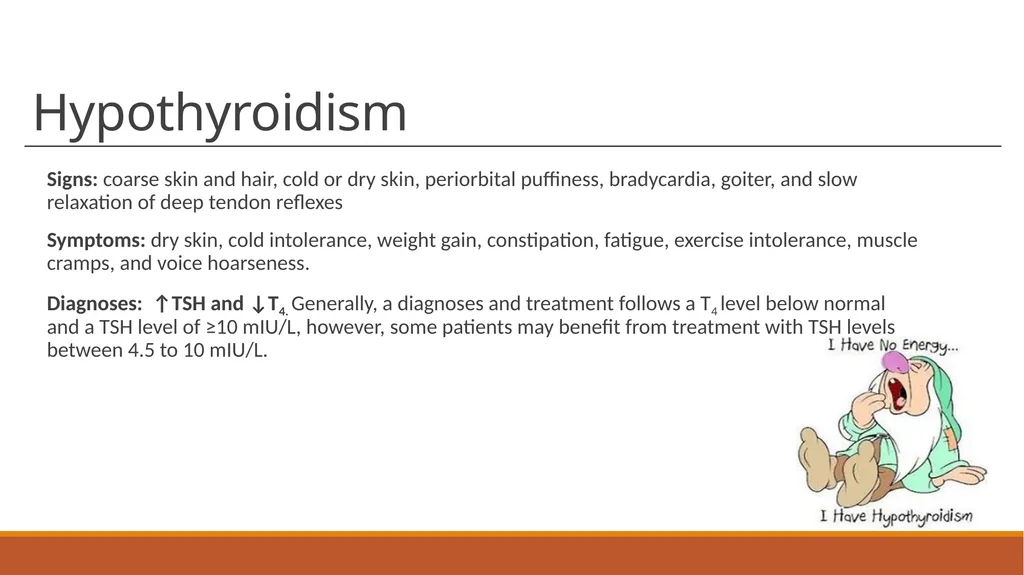
Hypothyroidism Signs: coarse skin and hair, cold or dry skin, periorbital puffiness, bradycardia, goiter, and slow relaxation of deep tendon reflexes
Symptoms: dry skin, cold intolerance, weight gain, constipation, fatigue, exercise intolerance, muscle cramps, and voice hoarseness.
Diagnoses: ↑TSH and ↓T4. Generally, a diagnoses and treatment follows a T4 level below normal and a TSH level of ≥10 mIU/L, however, some patients may benefit from treatment with TSH levels between 4.5 to 10 mIU/L.<br>
Symptoms: dry skin, cold intolerance, weight gain, constipation, fatigue, exercise intolerance, muscle cramps, and voice hoarseness.
Diagnoses: ↑TSH and ↓T4. Generally, a diagnoses and treatment follows a T4 level below normal and a TSH level of ≥10 mIU/L, however, some patients may benefit from treatment with TSH levels between 4.5 to 10 mIU/L.<br>
15
Treatment of Hypothyroidism Levothyroxine is drug of choice.
Average dosing of approximately 1.6mcg/kg/day.
Doses vary from 50 to ≥200mcg/day depending on clinical response
Elderly patients often require 20-25% less per kilogram daily than younger patients, due to decreased lean body mass. Consider initial dose of 50mcg/day.
Levothyroxine/levotriiodothyronine combination products (Armour Thyroid, Nature Thyroid, NP Thyroid) are not recommended over levothyroxine.
If a patient is pregnant or plans to become pregnant while taking a levothyroxine/levotriiodothyronine combination products they should be switched to levothyroxine.<br>
Average dosing of approximately 1.6mcg/kg/day.
Doses vary from 50 to ≥200mcg/day depending on clinical response
Elderly patients often require 20-25% less per kilogram daily than younger patients, due to decreased lean body mass. Consider initial dose of 50mcg/day.
Levothyroxine/levotriiodothyronine combination products (Armour Thyroid, Nature Thyroid, NP Thyroid) are not recommended over levothyroxine.
If a patient is pregnant or plans to become pregnant while taking a levothyroxine/levotriiodothyronine combination products they should be switched to levothyroxine.<br>
16
Levothyroxine Counseling Should be taken with water 60 minutes before breakfast or at bedtime 4 hours after the last meal on an empty stomach
Must separate aluminum, magnesium, calcium, iron, or bile acid sequestrants by 4 hours from taking levothyroxine.
May enhance the anticoagulant effects of warfarin.<br>
Must separate aluminum, magnesium, calcium, iron, or bile acid sequestrants by 4 hours from taking levothyroxine.
May enhance the anticoagulant effects of warfarin.<br>
17
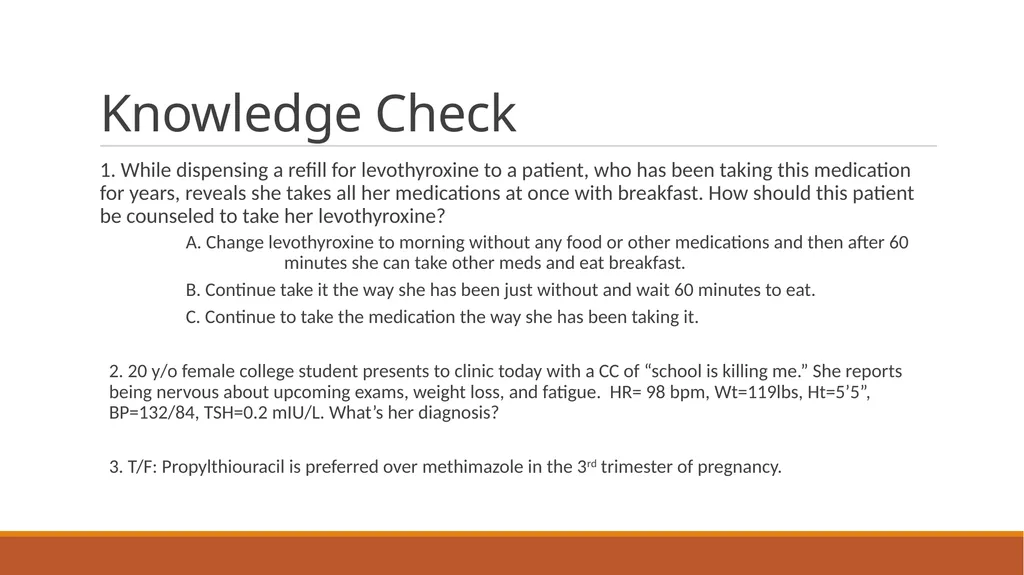
Knowledge Check 1. While dispensing a refill for levothyroxine to a patient, who has been taking this medication for years, reveals she takes all her medications at once with breakfast. How should this patient be counseled to take her levothyroxine?
A. Change levothyroxine to morning without any food or other medications and then after 60 minutes she can take other meds and eat breakfast.
B. Continue take it the way she has been just without and wait 60 minutes to eat.
C. Continue to take the medication the way she has been taking it.
2. 20 y/o female college student presents to clinic today with a CC of “school is killing me.” She reports being nervous about upcoming exams, weight loss, and fatigue. HR= 98 bpm, Wt=119lbs, Ht=5’5”, BP=132/84, TSH=0.2 mIU/L. What’s her diagnosis?
3. T/F: Propylthiouracil is preferred over methimazole in the 3rd trimester of pregnancy.<br>
A. Change levothyroxine to morning without any food or other medications and then after 60 minutes she can take other meds and eat breakfast.
B. Continue take it the way she has been just without and wait 60 minutes to eat.
C. Continue to take the medication the way she has been taking it.
2. 20 y/o female college student presents to clinic today with a CC of “school is killing me.” She reports being nervous about upcoming exams, weight loss, and fatigue. HR= 98 bpm, Wt=119lbs, Ht=5’5”, BP=132/84, TSH=0.2 mIU/L. What’s her diagnosis?
3. T/F: Propylthiouracil is preferred over methimazole in the 3rd trimester of pregnancy.<br>
18
Questions?<br>
19
References Mark P. J. Vanderpump, The epidemiology of thyroid disease, British Medical Bulletin, Volume 99, Issue 1, September 2011, Pages 39–51, https://doi.org/10.1093/bmb/ldr030
Jonklaas J, Kane MP. Thyroid Disorders. In: DiPiro JT, Talbert RL, Yee GC, Matzke GR, Wells BG, Posey L. eds. Pharmacotherapy: A Pathophysiologic Approach, 10e New York, NY: McGraw-Hill; . http://accesspharmacy.mhmedical.com.libproxy.uams.edu/content.aspx?bookid=1861§ionid=146066204. Accessed March 21, 2021.
Garber JR, Cobin RH, Gharib H, et al. Clinical Practice Guidelines for Hypothyroidism in Adults: Cosponsored by the American Association of Clinical Endocrinologists and the American Thyroid Association. Thyroid. 2012;22(12):1200-1235. doi:10.1089/thy.2012.0205
Fadeyev VV, Karseladse EA. Hyperthyroidism and Other Causes of Thyrotoxicosis: Management Guidelines of the American Thyroid Association and American Association of Clinical Endocrinologists. Clinical and experimental thyroidology. 2011;7(4):8. doi:10.14341/ket2011748-18
Online-lexi.com<br>
Jonklaas J, Kane MP. Thyroid Disorders. In: DiPiro JT, Talbert RL, Yee GC, Matzke GR, Wells BG, Posey L. eds. Pharmacotherapy: A Pathophysiologic Approach, 10e New York, NY: McGraw-Hill; . http://accesspharmacy.mhmedical.com.libproxy.uams.edu/content.aspx?bookid=1861§ionid=146066204. Accessed March 21, 2021.
Garber JR, Cobin RH, Gharib H, et al. Clinical Practice Guidelines for Hypothyroidism in Adults: Cosponsored by the American Association of Clinical Endocrinologists and the American Thyroid Association. Thyroid. 2012;22(12):1200-1235. doi:10.1089/thy.2012.0205
Fadeyev VV, Karseladse EA. Hyperthyroidism and Other Causes of Thyrotoxicosis: Management Guidelines of the American Thyroid Association and American Association of Clinical Endocrinologists. Clinical and experimental thyroidology. 2011;7(4):8. doi:10.14341/ket2011748-18
Online-lexi.com<br>