
Tips for a Successful Job Search How to Evaluate
DP
Published · 88 slides · 0 views

1 / 1

































Description
Tips for a Successful Job Search How to Evaluate Orthopaedic Practice Opportunities Ryan M. Dopirak, M.D. AAOS Annual Meeting March 2017 Disclosures I have no potential conflicts with this presentation Introduction The average orthopaedist
Related Topics
Share
Embed code
Download this presentation From Below
"Tips for a Successful Job Search How to Evaluate" is the property of its rightful owner. Permission is granted to download and print the materials on this website for personal, non-commercial use only, and to display it on your personal computer provided you do not modify the materials and that you retain all copyright notices contained in the materials. By downloading content from our website, you accept the terms of this agreement.
Presentation Transcript
01
Tips for a Successful Job Search
How to Evaluate Orthopaedic
Practice Opportunities Ryan M. Dopirak, M.D.
AAOS Annual Meeting
March 2017<br>
AAOS Annual Meeting
March 2017<br>
02
Disclosures I have no potential conflicts with this presentation<br>
03
Introduction The average orthopaedist will make 2-3 practice changes over the course of their career
Up to 50% of orthopaedists will make a change within the first 2 years<br>
Up to 50% of orthopaedists will make a change within the first 2 years<br>
04
Introduction Changing jobs can result in a great deal of stress and significant financial losses
Lost income
Moving expenses
Malpractice tails
Repayment of signing bonuses<br>
Lost income
Moving expenses
Malpractice tails
Repayment of signing bonuses<br>
05
Purpose Teach residents/fellows how to critically evaluate orthopaedic practice opportunities
Learn more about what you are actually signing up for (before you sign a contract)
Decrease likelihood that you end up unhappy
Nobody cares about your well-being or your contract more than you do!!!<br>
Learn more about what you are actually signing up for (before you sign a contract)
Decrease likelihood that you end up unhappy
Nobody cares about your well-being or your contract more than you do!!!<br>
06
Format List of simple questions to ask each potential employer<br>
07
Why are they recruiting a new orthopaedic surgeon?<br>
08
Why are they recruiting a new orthopaedic surgeon? They must demonstrate they have a need for your services
Impending retirement of partner
Desire to add new subspecialty area to practice
Need to accommodate increasing patient volumes (population growth)<br>
Impending retirement of partner
Desire to add new subspecialty area to practice
Need to accommodate increasing patient volumes (population growth)<br>
09
Why are they recruiting a new orthopaedic surgeon? There are numerous groups who are looking to hire for reasons that benefit the group more than the candidate
Trying to decompress call schedule
Trying to dilute overhead
Your buy-in will be a buy-out for a senior partner
Attempt to increase group size to compete against other groups in their market (“nuclear arms race”)<br>
Trying to decompress call schedule
Trying to dilute overhead
Your buy-in will be a buy-out for a senior partner
Attempt to increase group size to compete against other groups in their market (“nuclear arms race”)<br>
10
What is the practice setting?<br>
11
What is the practice setting? Single Specialty Orthopaedic Group
Multispecialty Group
Academic / University-Based
Hospital Employment<br>
Multispecialty Group
Academic / University-Based
Hospital Employment<br>
12
Single Specialty Group (SSG) Advantages
Autonomy
Ancillary opportunities
Usually “eat what you kill”
The classic “gold standard” Disadvantages
Referrals not guaranteed
Modest guarantee
May require buy-in<br>
Autonomy
Ancillary opportunities
Usually “eat what you kill”
The classic “gold standard” Disadvantages
Referrals not guaranteed
Modest guarantee
May require buy-in<br>
13
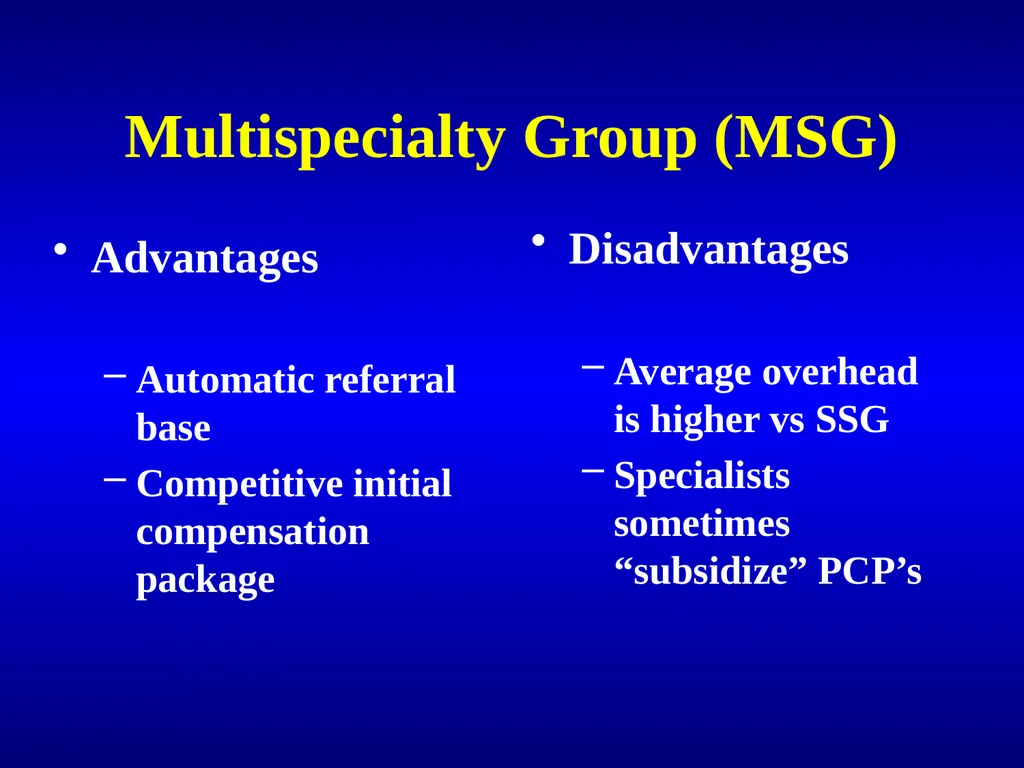
Multispecialty Group (MSG) Advantages
Automatic referral base
Competitive initial compensation package Disadvantages
Average overhead is higher vs SSG
Specialists sometimes “subsidize” PCP’s<br>
Automatic referral base
Competitive initial compensation package Disadvantages
Average overhead is higher vs SSG
Specialists sometimes “subsidize” PCP’s<br>
14
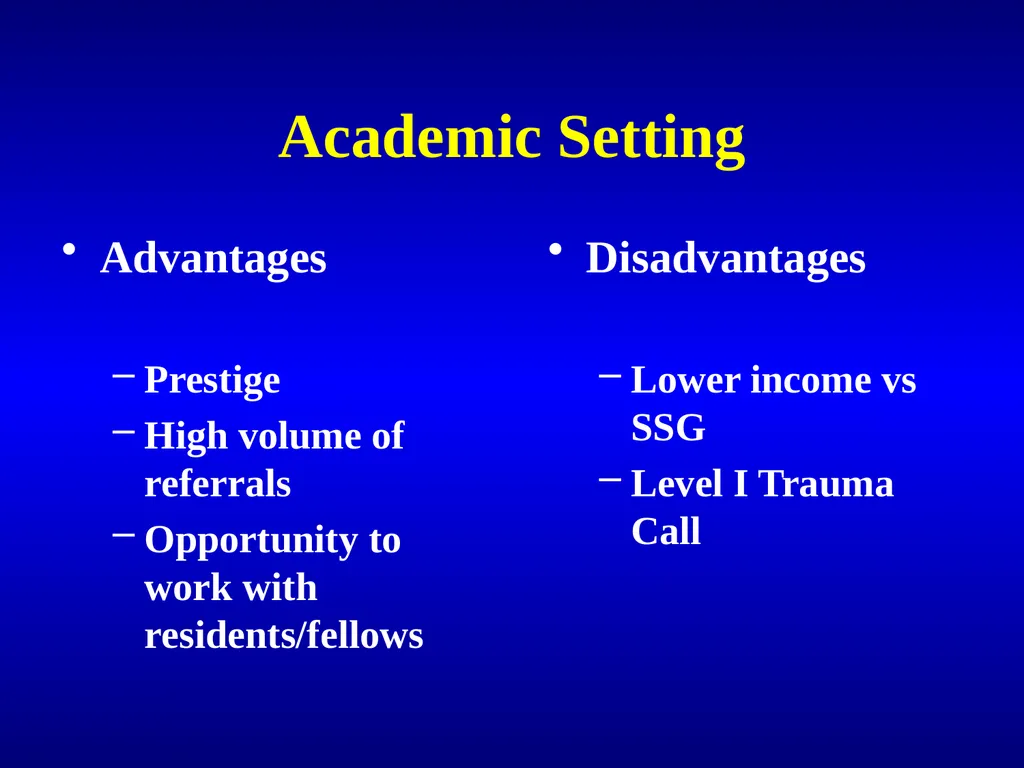
Academic Setting Advantages
Prestige
High volume of referrals
Opportunity to work with residents/fellows Disadvantages
Lower income vs SSG
Level I Trauma Call<br>
Prestige
High volume of referrals
Opportunity to work with residents/fellows Disadvantages
Lower income vs SSG
Level I Trauma Call<br>
15
Hospital Employment Advantages
Competitive initial compensation package
Guaranteed referrals
Less administrative responsibilities, able to focus on your practice Disadvantages
Limited autonomy
Less opportunity for ancillaries vs SSG<br>
Competitive initial compensation package
Guaranteed referrals
Less administrative responsibilities, able to focus on your practice Disadvantages
Limited autonomy
Less opportunity for ancillaries vs SSG<br>
16
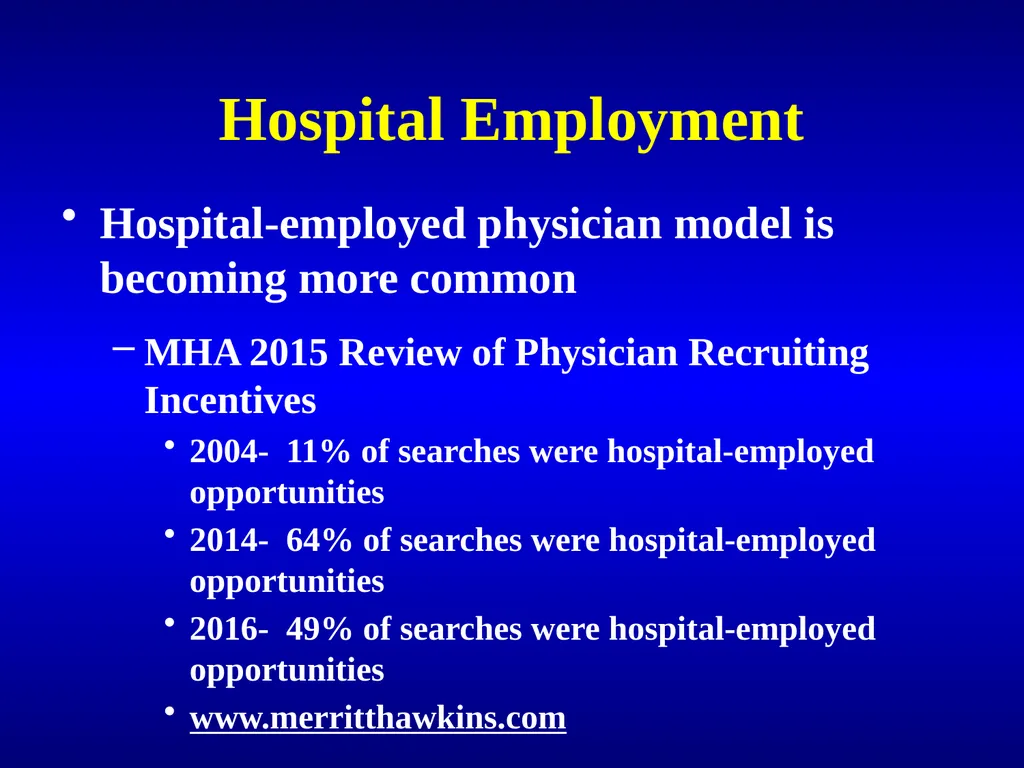
Hospital Employment Hospital-employed physician model is becoming more common
MHA 2015 Review of Physician Recruiting Incentives
2004- 11% of searches were hospital-employed opportunities
2014- 64% of searches were hospital-employed opportunities
2016- 49% of searches were hospital-employed opportunities
www.merritthawkins.com
AAOS OPUS
Percent of orthopaedists who are hospital-employed
2012: 9%
2014: 15%<br>
MHA 2015 Review of Physician Recruiting Incentives
2004- 11% of searches were hospital-employed opportunities
2014- 64% of searches were hospital-employed opportunities
2016- 49% of searches were hospital-employed opportunities
www.merritthawkins.com
AAOS OPUS
Percent of orthopaedists who are hospital-employed
2012: 9%
2014: 15%<br>
17
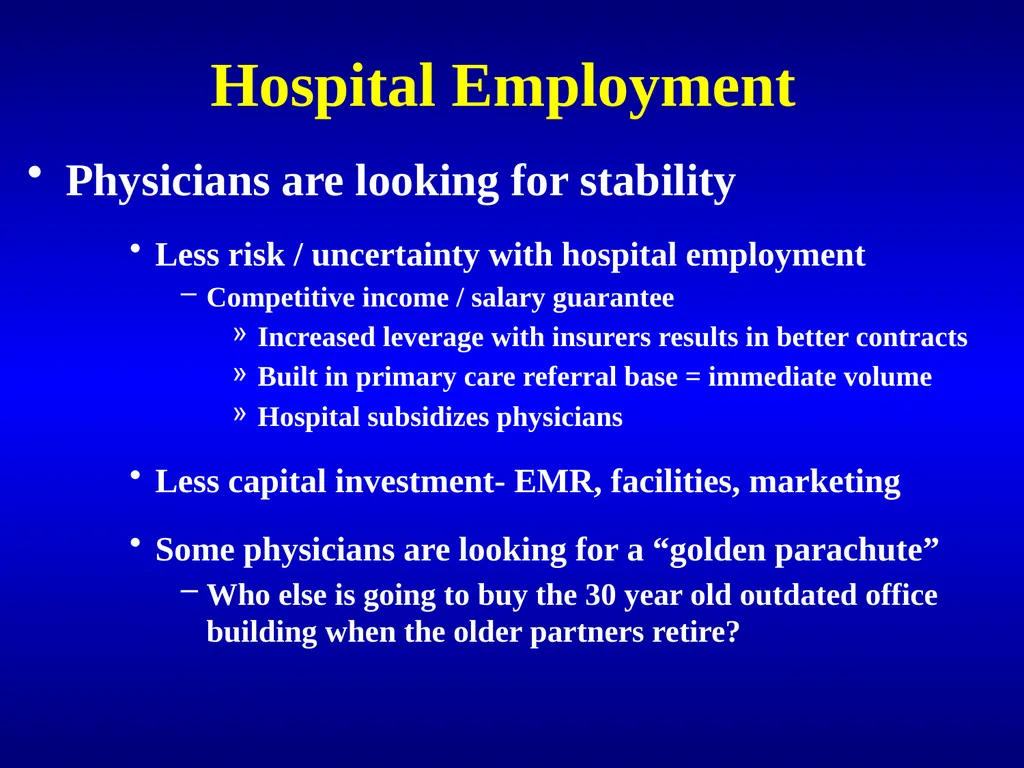
Hospital Employment Physicians are looking for stability
Less risk / uncertainty with hospital employment
Competitive income / salary guarantee
Increased leverage with insurers results in better contracts
Built in primary care referral base = immediate volume
Hospital subsidizes physicians
Less capital investment- EMR, facilities, marketing
Some physicians are looking for a “golden parachute”
Who else is going to buy the 30 year old outdated office building when the older partners retire?<br>
Less risk / uncertainty with hospital employment
Competitive income / salary guarantee
Increased leverage with insurers results in better contracts
Built in primary care referral base = immediate volume
Hospital subsidizes physicians
Less capital investment- EMR, facilities, marketing
Some physicians are looking for a “golden parachute”
Who else is going to buy the 30 year old outdated office building when the older partners retire?<br>
18
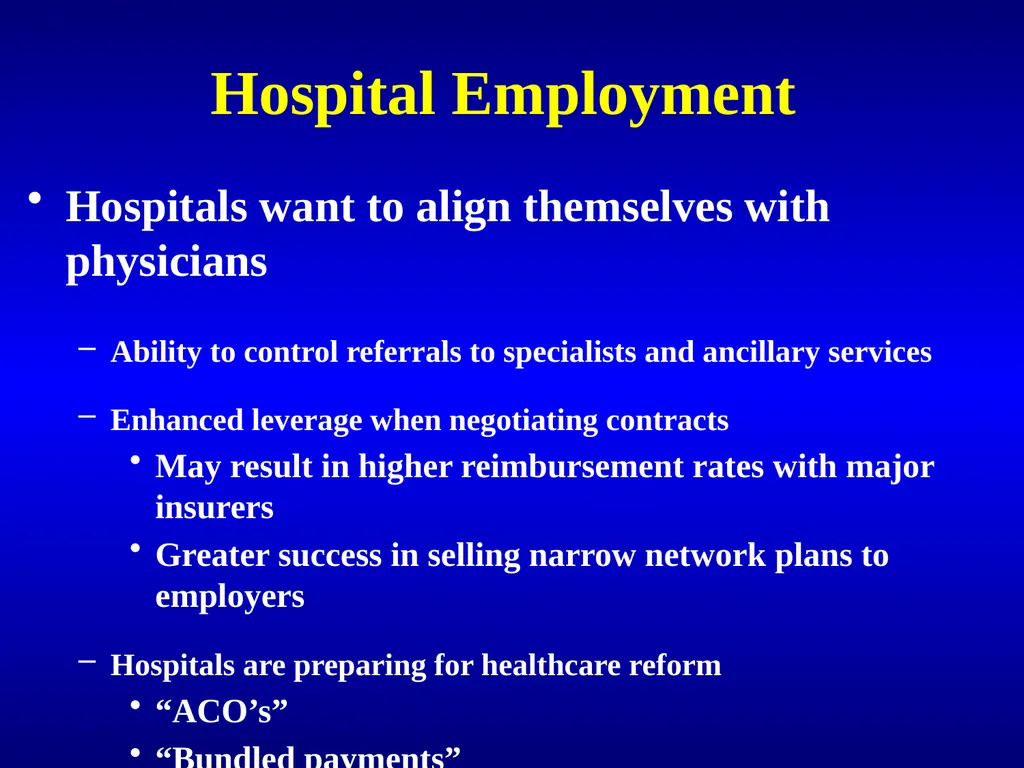
Hospital Employment Hospitals want to align themselves with physicians
Ability to control referrals to specialists and ancillary services
Enhanced leverage when negotiating contracts
May result in higher reimbursement rates with major insurers
Greater success in selling narrow network plans to employers
Hospitals are preparing for healthcare reform
“ACO’s”
“Bundled payments”
“Pay for performance”
Implementing changes will be smoother if physician alignment exists<br>
Ability to control referrals to specialists and ancillary services
Enhanced leverage when negotiating contracts
May result in higher reimbursement rates with major insurers
Greater success in selling narrow network plans to employers
Hospitals are preparing for healthcare reform
“ACO’s”
“Bundled payments”
“Pay for performance”
Implementing changes will be smoother if physician alignment exists<br>
19
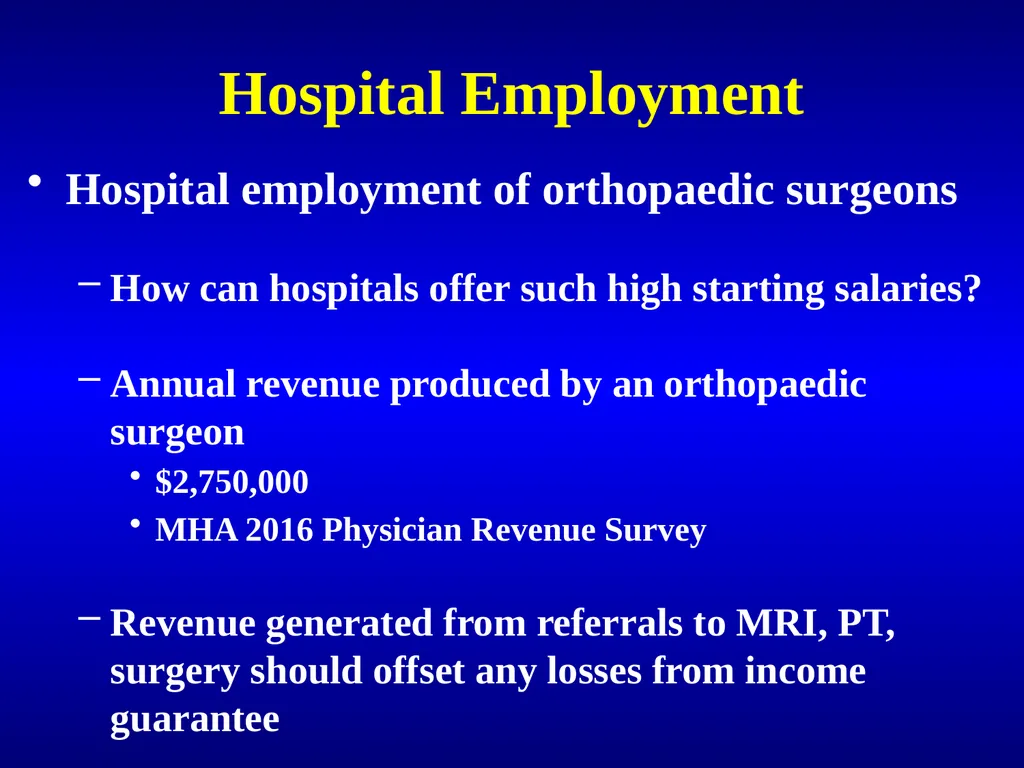
Hospital Employment Hospital employment of orthopaedic surgeons
How can hospitals offer such high starting salaries?
Annual revenue produced by an orthopaedic surgeon
$2,750,000
MHA 2016 Physician Revenue Survey
Revenue generated from referrals to MRI, PT, surgery should offset any losses from income guarantee<br>
How can hospitals offer such high starting salaries?
Annual revenue produced by an orthopaedic surgeon
$2,750,000
MHA 2016 Physician Revenue Survey
Revenue generated from referrals to MRI, PT, surgery should offset any losses from income guarantee<br>
20
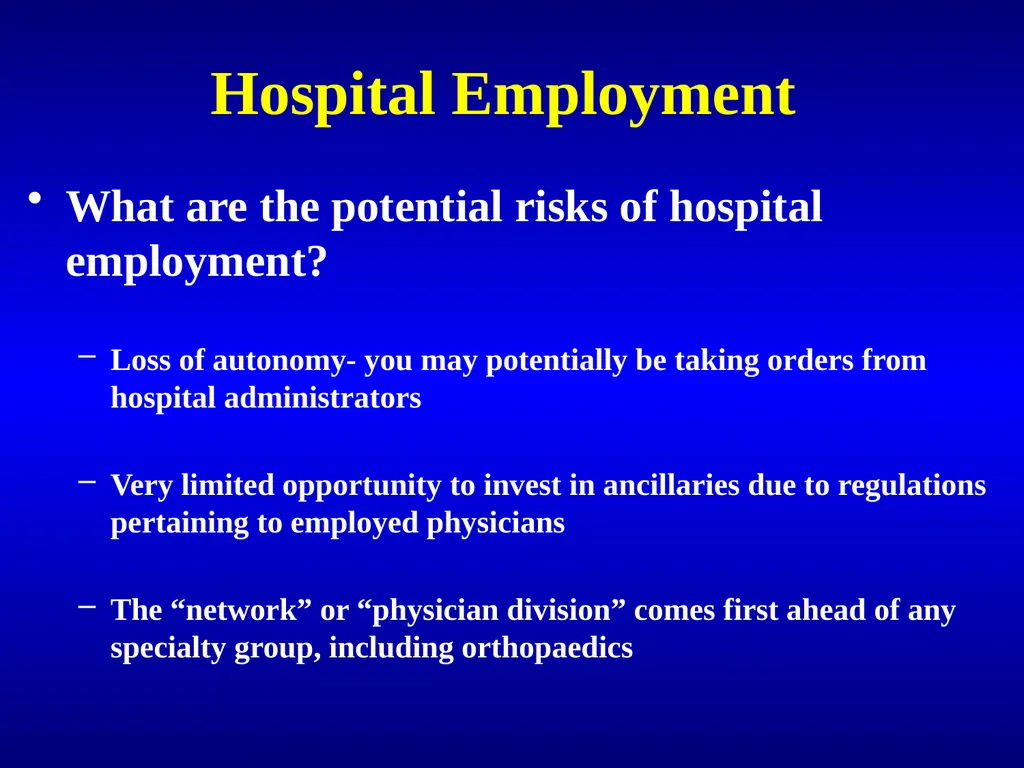
Hospital Employment What are the potential risks of hospital employment?
Loss of autonomy- you may potentially be taking orders from hospital administrators
Very limited opportunity to invest in ancillaries due to regulations pertaining to employed physicians
The “network” or “physician division” comes first ahead of any specialty group, including orthopaedics<br>
Loss of autonomy- you may potentially be taking orders from hospital administrators
Very limited opportunity to invest in ancillaries due to regulations pertaining to employed physicians
The “network” or “physician division” comes first ahead of any specialty group, including orthopaedics<br>
21
Hospital Employment What are the potential risks of hospital employment?
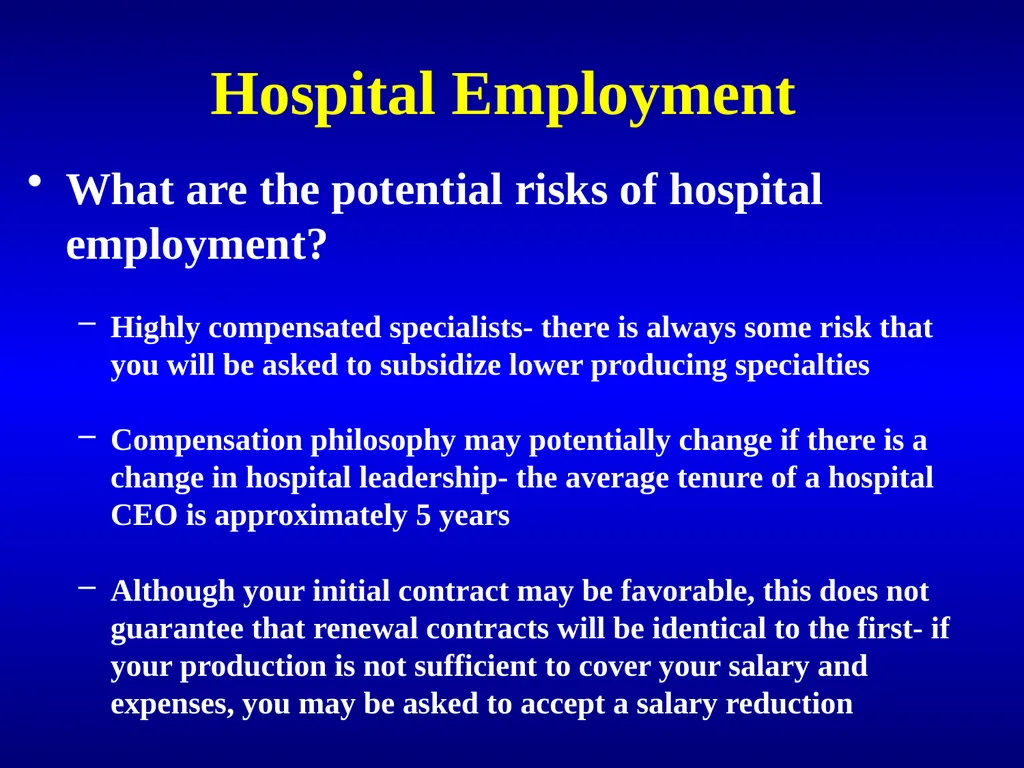
Highly compensated specialists- there is always some risk that you will be asked to subsidize lower producing specialties
Compensation philosophy may potentially change if there is a change in hospital leadership- the average tenure of a hospital CEO is approximately 5 years
Although your initial contract may be favorable, this does not guarantee that renewal contracts will be identical to the first- if your production is not sufficient to cover your salary and expenses, you may be asked to accept a salary reduction<br>
Highly compensated specialists- there is always some risk that you will be asked to subsidize lower producing specialties
Compensation philosophy may potentially change if there is a change in hospital leadership- the average tenure of a hospital CEO is approximately 5 years
Although your initial contract may be favorable, this does not guarantee that renewal contracts will be identical to the first- if your production is not sufficient to cover your salary and expenses, you may be asked to accept a salary reduction<br>
22
Which Practice Setting is Best? These are my personal opinions only!
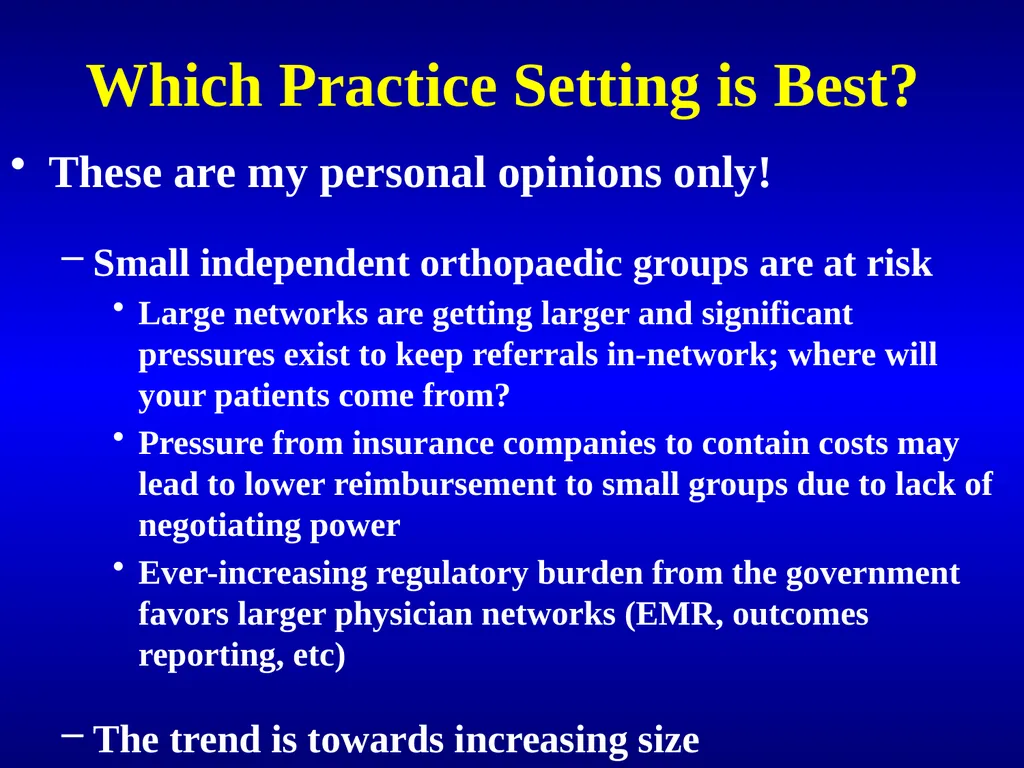
Small independent orthopaedic groups are at risk
Large networks are getting larger and significant pressures exist to keep referrals in-network; where will your patients come from?
Pressure from insurance companies to contain costs may lead to lower reimbursement to small groups due to lack of negotiating power
Ever-increasing regulatory burden from the government favors larger physician networks (EMR, outcomes reporting, etc)
The trend is towards increasing size
Large single specialty groups
Large independent multispecialty groups
Large hospital-employed physician networks<br>
Small independent orthopaedic groups are at risk
Large networks are getting larger and significant pressures exist to keep referrals in-network; where will your patients come from?
Pressure from insurance companies to contain costs may lead to lower reimbursement to small groups due to lack of negotiating power
Ever-increasing regulatory burden from the government favors larger physician networks (EMR, outcomes reporting, etc)
The trend is towards increasing size
Large single specialty groups
Large independent multispecialty groups
Large hospital-employed physician networks<br>
23
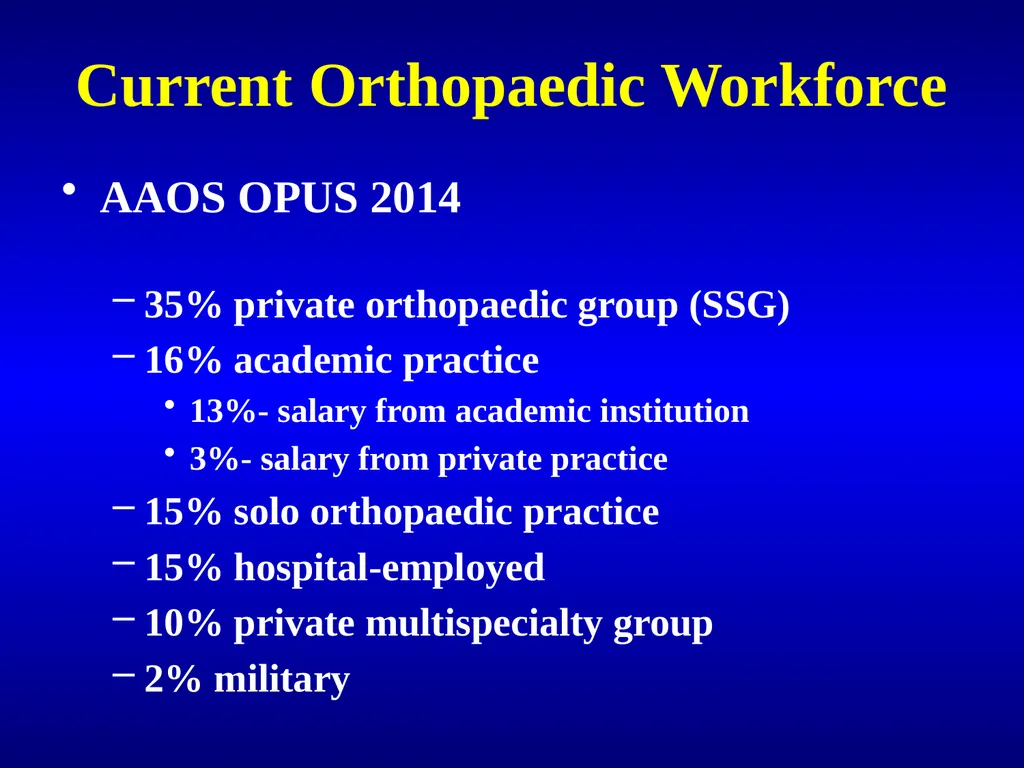
Current Orthopaedic Workforce AAOS OPUS 2014
35% private orthopaedic group (SSG)
16% academic practice
13%- salary from academic institution
3%- salary from private practice
15% solo orthopaedic practice
15% hospital-employed
10% private multispecialty group
2% military<br>
35% private orthopaedic group (SSG)
16% academic practice
13%- salary from academic institution
3%- salary from private practice
15% solo orthopaedic practice
15% hospital-employed
10% private multispecialty group
2% military<br>
24
What is the surgeon density?<br>
25
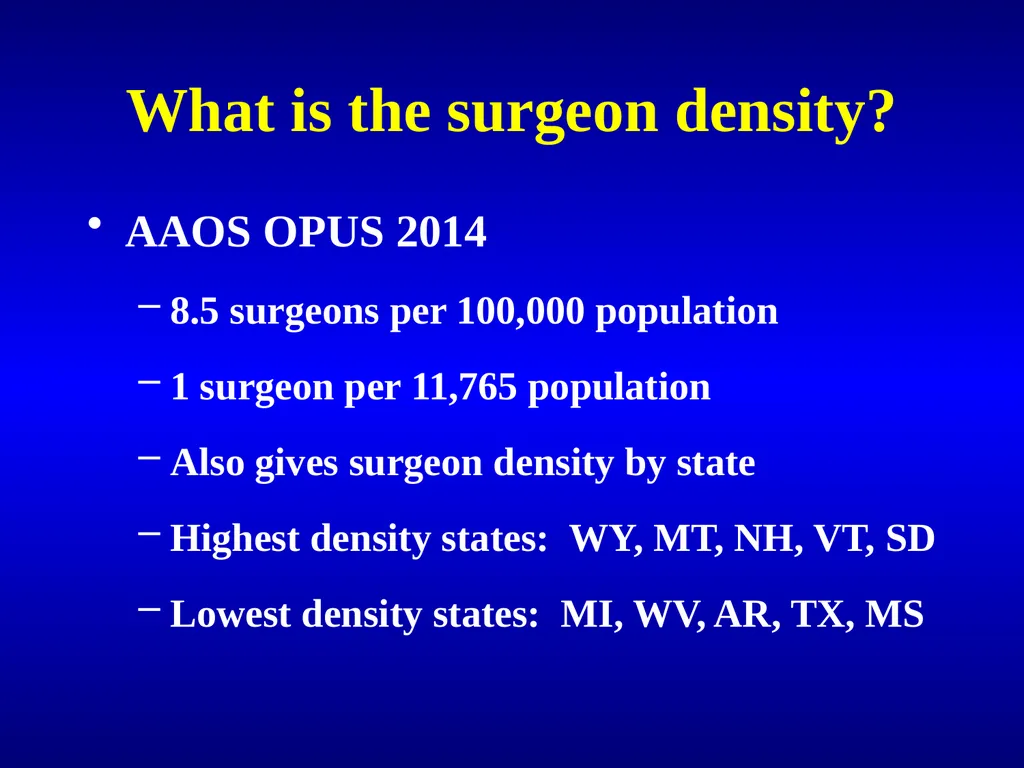
What is the surgeon density? AAOS OPUS 2014
8.5 surgeons per 100,000 population
1 surgeon per 11,765 population
Also gives surgeon density by state
Highest density states: WY, MT, NH, VT, SD
Lowest density states: MI, WV, AR, TX, MS<br>
8.5 surgeons per 100,000 population
1 surgeon per 11,765 population
Also gives surgeon density by state
Highest density states: WY, MT, NH, VT, SD
Lowest density states: MI, WV, AR, TX, MS<br>
26
What is the surgeon density? AAOS OPUS 2014
Use these statistics to gauge surgeon saturation in the market you are considering, BUT…
Don’t write off a highly saturated market if you bring a new skill or unique subspecialty training to the market
Success isn’t guaranteed in a low density market, as groups in neighboring communities may draw from your area<br>
Use these statistics to gauge surgeon saturation in the market you are considering, BUT…
Don’t write off a highly saturated market if you bring a new skill or unique subspecialty training to the market
Success isn’t guaranteed in a low density market, as groups in neighboring communities may draw from your area<br>
27
Will I be able to develop an elective practice in my subspecialty area?<br>
28
Will I be able to develop an elective practice in my subspecialty area? Over 90% of graduating residents pursue fellowship training*
93% of surgeons under age 40 consider themselves either a specialist or a generalist with a specialty interest (AAOS OPUS 2014)
You need to decide how important specialization is to you
*AAOS data, published February 2006<br>
93% of surgeons under age 40 consider themselves either a specialist or a generalist with a specialty interest (AAOS OPUS 2014)
You need to decide how important specialization is to you
*AAOS data, published February 2006<br>
29
Will I be able to develop an elective practice in my subspecialty area? Do you want to develop a 100% subspecialty practice from the start?
Are you willing to do a considerable amount of general orthopaedics / trauma in order to find a job in a competitive market?<br>
Are you willing to do a considerable amount of general orthopaedics / trauma in order to find a job in a competitive market?<br>
30
Will I be able to develop an elective practice in my subspecialty area? Determine if the community can support a busy practice in your subspecialty area
Look at the number of partners in the group with the same practice focus as you
Also consider demographics of other groups in the market- they will be competing for the same patients<br>
Look at the number of partners in the group with the same practice focus as you
Also consider demographics of other groups in the market- they will be competing for the same patients<br>
31
Will I be able to develop an elective practice in my subspecialty area? There should be a need for your specific area of specialization, so that you will have the opportunity to develop a busy elective practice
Certain subspecialty areas are very competitive, especially in larger metropolitan areas
Location vs. Professional Satisfaction!!!<br>
Certain subspecialty areas are very competitive, especially in larger metropolitan areas
Location vs. Professional Satisfaction!!!<br>
32
Is there a “restrictive covenant”?<br>
33
Is there a “restrictive covenant”? A “noncompete clause” states that if you leave the group, you agree not to practice in a certain geographic area for a specified period of time
You must determine if the terms of this provision are acceptable to you
If you have community ties, you may wish to negotiate the terms of this clause<br>
You must determine if the terms of this provision are acceptable to you
If you have community ties, you may wish to negotiate the terms of this clause<br>
34
Is there a “recapture clause”?<br>
35
Is there a “recapture clause”? Some compensation packages include large income guarantees, signing bonuses, and loan repayment
These are often contractually structured as “forgivable loans”- a percentage of this amount is forgiven each year over a set number of years<br>
These are often contractually structured as “forgivable loans”- a percentage of this amount is forgiven each year over a set number of years<br>
36
Is there a “recapture clause”? If you leave before fulfilling the contract, you may have to repay a portion of the money
There is no such thing as a “free lunch”<br>
There is no such thing as a “free lunch”<br>
37
What is the caseload of each partner over the past few years?<br>
38
What is the caseload of each partner over the past few years? Income is directly related to surgical volume
Compare volumes to national benchmarks
AAOS OPUS 2014
Average FT orthopaedist - 32 cases/month
MGMA
Provides total encounters and RVU’s<br>
Compare volumes to national benchmarks
AAOS OPUS 2014
Average FT orthopaedist - 32 cases/month
MGMA
Provides total encounters and RVU’s<br>
39
Has anyone left the group in the past 10 years and why?<br>
40
Has anyone left the group in the past 10 years and why? The group will point out its positive attributes during the recruitment process
A high rate of turnover may indicate underlying problems with the group and may be a red flag
Contact the people who have left, as they may provide you with a different perspective on the group<br>
A high rate of turnover may indicate underlying problems with the group and may be a red flag
Contact the people who have left, as they may provide you with a different perspective on the group<br>
41
ER Call<br>
42
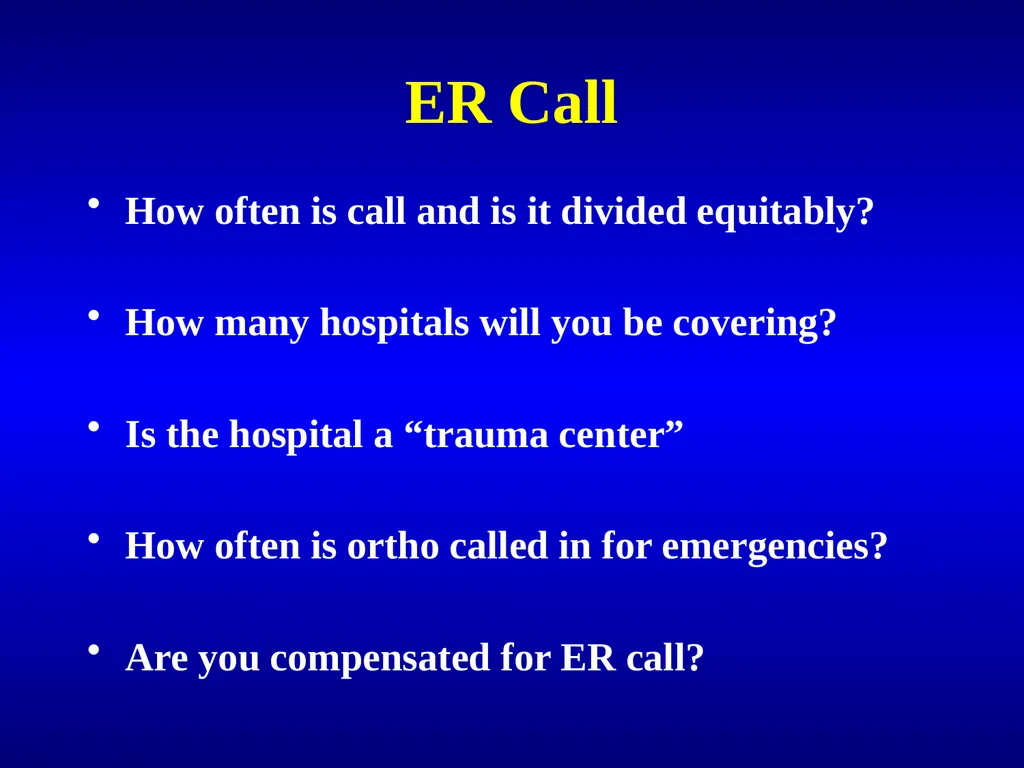
ER Call How often is call and is it divided equitably?
How many hospitals will you be covering?
Is the hospital a “trauma center”
How often is ortho called in for emergencies?
Are you compensated for ER call?<br>
How many hospitals will you be covering?
Is the hospital a “trauma center”
How often is ortho called in for emergencies?
Are you compensated for ER call?<br>
43
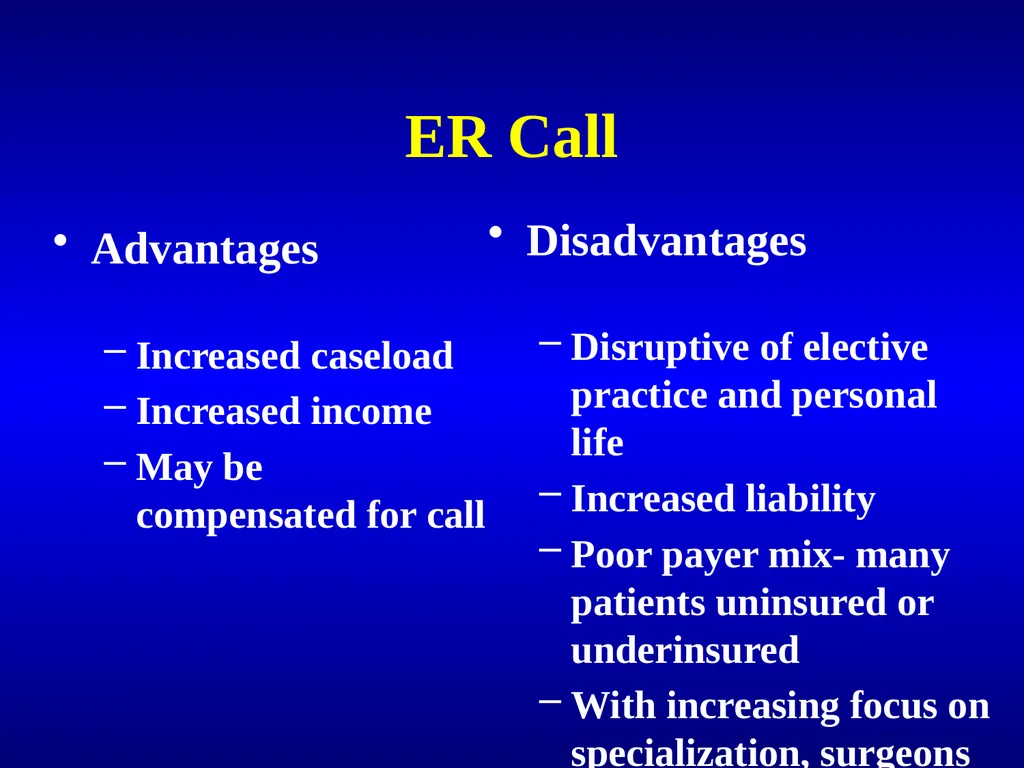
ER Call Advantages
Increased caseload
Increased income
May be compensated for call Disadvantages
Disruptive of elective practice and personal life
Increased liability
Poor payer mix- many patients uninsured or underinsured
With increasing focus on specialization, surgeons less comfortable with trauma<br>
Increased caseload
Increased income
May be compensated for call Disadvantages
Disruptive of elective practice and personal life
Increased liability
Poor payer mix- many patients uninsured or underinsured
With increasing focus on specialization, surgeons less comfortable with trauma<br>
44
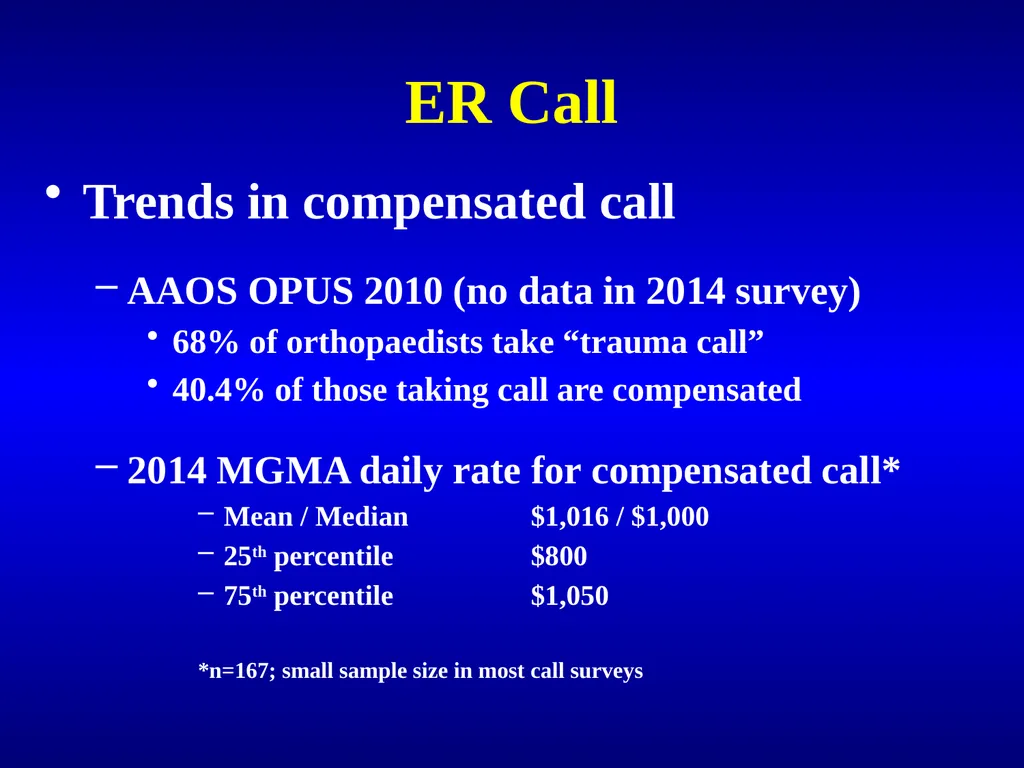
ER Call Trends in compensated call
AAOS OPUS 2010 (no data in 2014 survey)
68% of orthopaedists take “trauma call”
40.4% of those taking call are compensated
2014 MGMA daily rate for compensated call*
Mean / Median $1,016 / $1,000
25th percentile $800
75th percentile $1,050
*n=167; small sample size in most call surveys<br>
AAOS OPUS 2010 (no data in 2014 survey)
68% of orthopaedists take “trauma call”
40.4% of those taking call are compensated
2014 MGMA daily rate for compensated call*
Mean / Median $1,016 / $1,000
25th percentile $800
75th percentile $1,050
*n=167; small sample size in most call surveys<br>
45
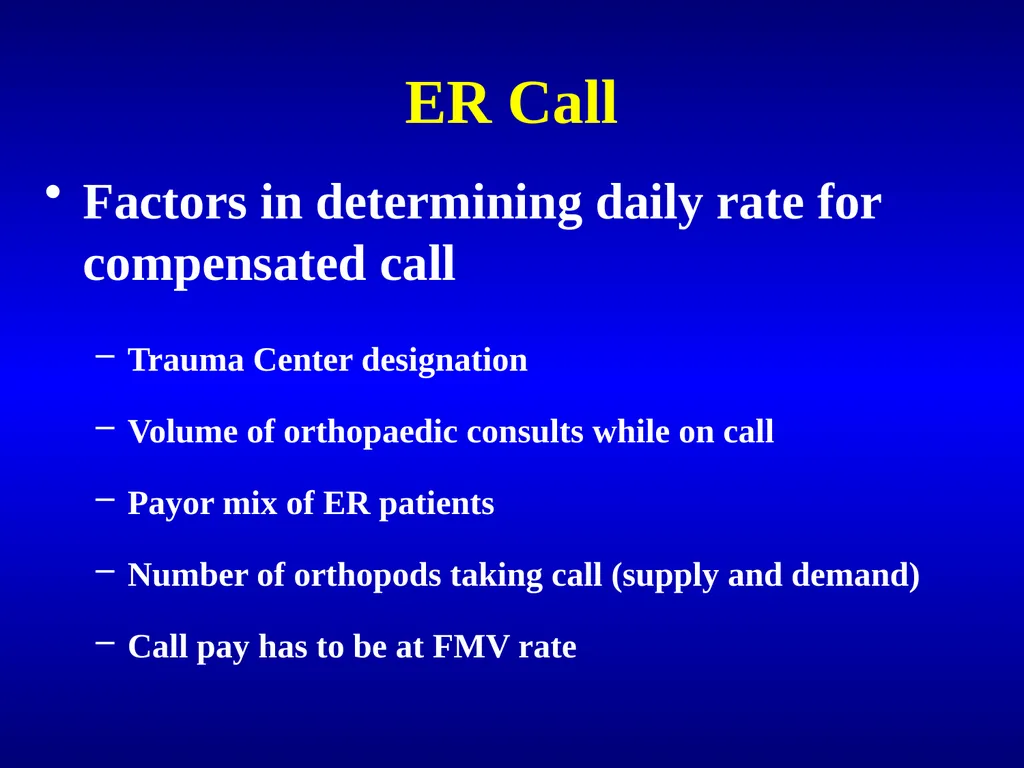
ER Call Factors in determining daily rate for compensated call
Trauma Center designation
Volume of orthopaedic consults while on call
Payor mix of ER patients
Number of orthopods taking call (supply and demand)
Call pay has to be at FMV rate<br>
Trauma Center designation
Volume of orthopaedic consults while on call
Payor mix of ER patients
Number of orthopods taking call (supply and demand)
Call pay has to be at FMV rate<br>
46
Financial Considerations<br>
47
What is the income guarantee?<br>
48
What is the income guarantee? Step 1: Clarify if it is a “gross” or “net” income guarantee
Gross income: money is used to run your practice (overhead) and pay salary
Net income: actual income or salary independent of overhead<br>
Gross income: money is used to run your practice (overhead) and pay salary
Net income: actual income or salary independent of overhead<br>
49
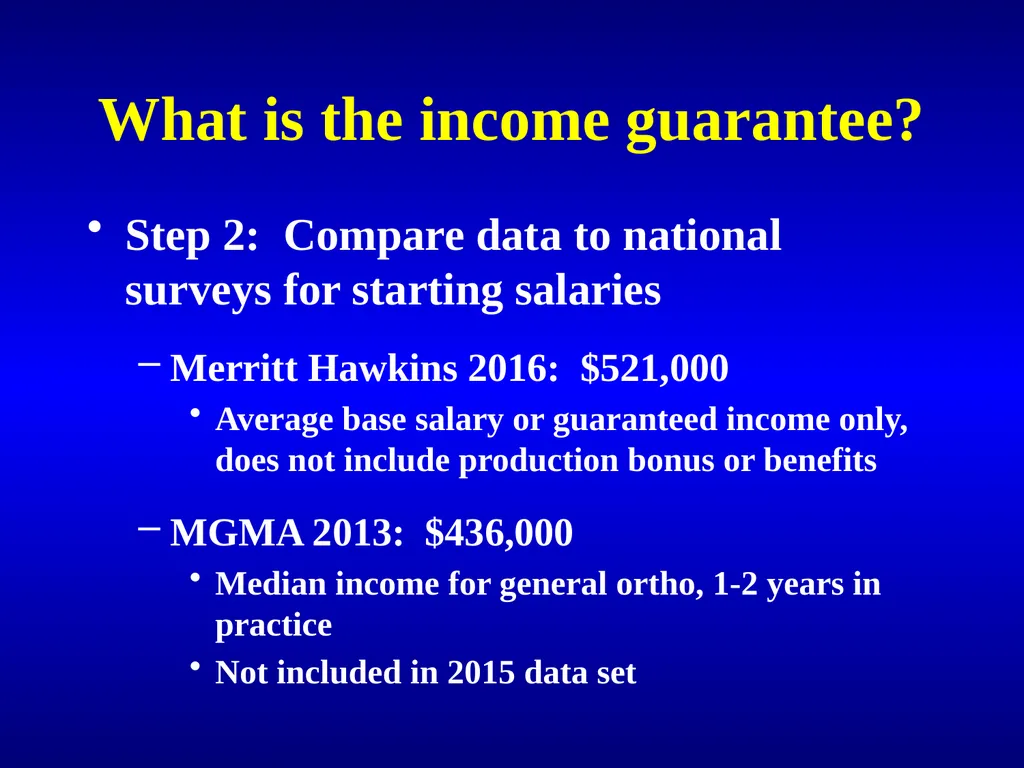
What is the income guarantee? Step 2: Compare data to national surveys for starting salaries
Merritt Hawkins 2016: $521,000
Average base salary or guaranteed income only, does not include production bonus or benefits
MGMA 2013: $436,000
Median income for general ortho, 1-2 years in practice
Not included in 2015 data set<br>
Merritt Hawkins 2016: $521,000
Average base salary or guaranteed income only, does not include production bonus or benefits
MGMA 2013: $436,000
Median income for general ortho, 1-2 years in practice
Not included in 2015 data set<br>
50
What is the income guarantee? Step 3: Identify stipulations attached to guarantee
What happens if collections don’t cover salary, benefits, and overhead???<br>
What happens if collections don’t cover salary, benefits, and overhead???<br>
51
What is the income guarantee? What happens if collections don’t cover salary, benefits, and overhead???
Hospital or group eats losses (least likely)
Deficit is “forgiven” over a period of years
Future bonuses used to offset prior deficits
Salary reduction for subsequent years<br>
Hospital or group eats losses (least likely)
Deficit is “forgiven” over a period of years
Future bonuses used to offset prior deficits
Salary reduction for subsequent years<br>
52
What is my projected peak income potential with this group?<br>
53
What is my projected peak income potential with this group? Your ultimate income potential is far more important than your initial guarantee!
Awkward to ask “how much money do you make?”
I would suggest asking “what is the approximate income range of the partners over the past few years?”<br>
Awkward to ask “how much money do you make?”
I would suggest asking “what is the approximate income range of the partners over the past few years?”<br>
54
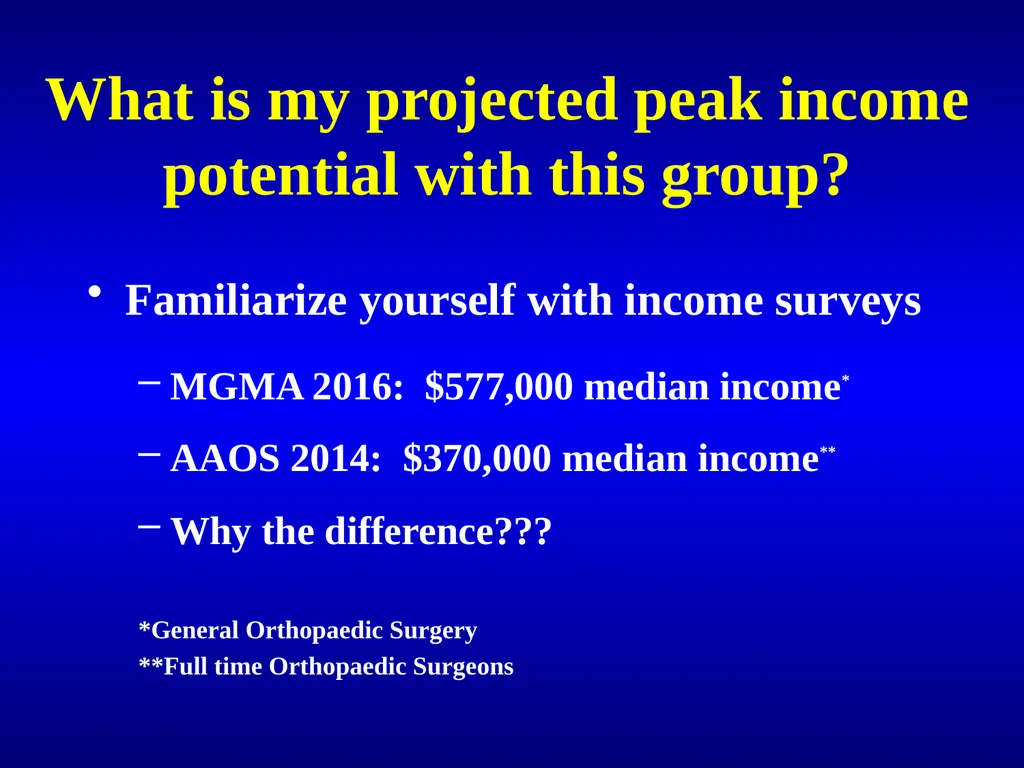
What is my projected peak income potential with this group? Familiarize yourself with income surveys
MGMA 2016: $577,000 median income*
AAOS 2014: $370,000 median income**
Why the difference???
*General Orthopaedic Surgery
**Full time Orthopaedic Surgeons<br>
MGMA 2016: $577,000 median income*
AAOS 2014: $370,000 median income**
Why the difference???
*General Orthopaedic Surgery
**Full time Orthopaedic Surgeons<br>
55
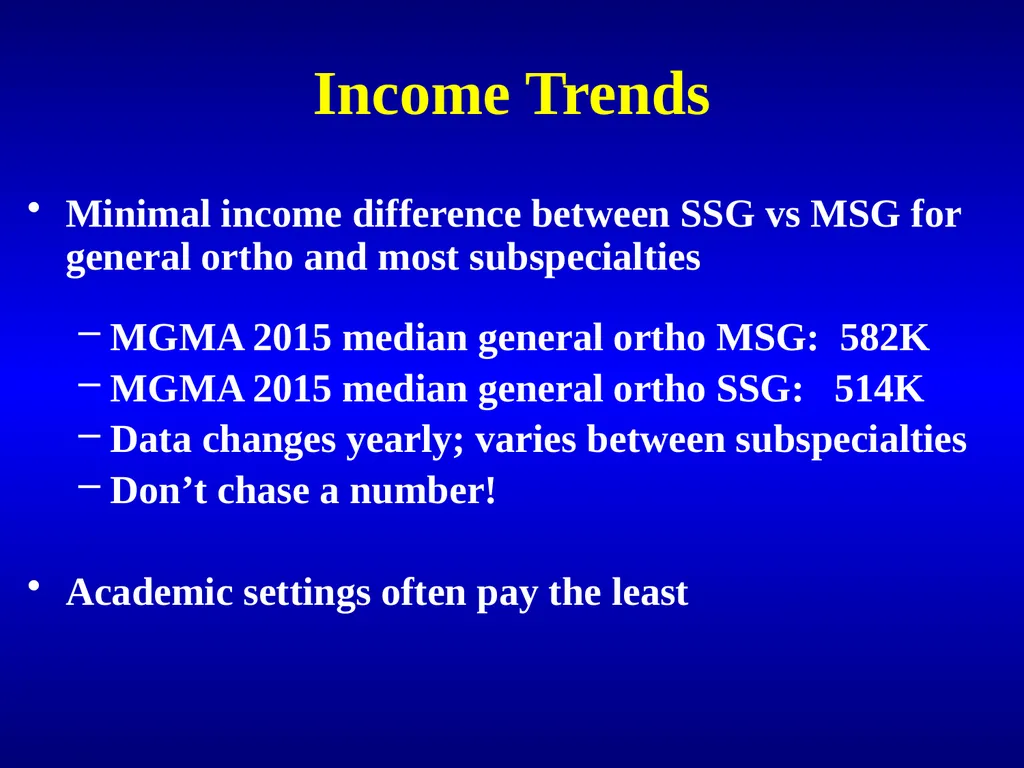
Income Trends Minimal income difference between SSG vs MSG for general ortho and most subspecialties
MGMA 2015 median general ortho MSG: 582K
MGMA 2015 median general ortho SSG: 514K
Data changes yearly; varies between subspecialties
Don’t chase a number!
Academic settings often pay the least<br>
MGMA 2015 median general ortho MSG: 582K
MGMA 2015 median general ortho SSG: 514K
Data changes yearly; varies between subspecialties
Don’t chase a number!
Academic settings often pay the least<br>
56
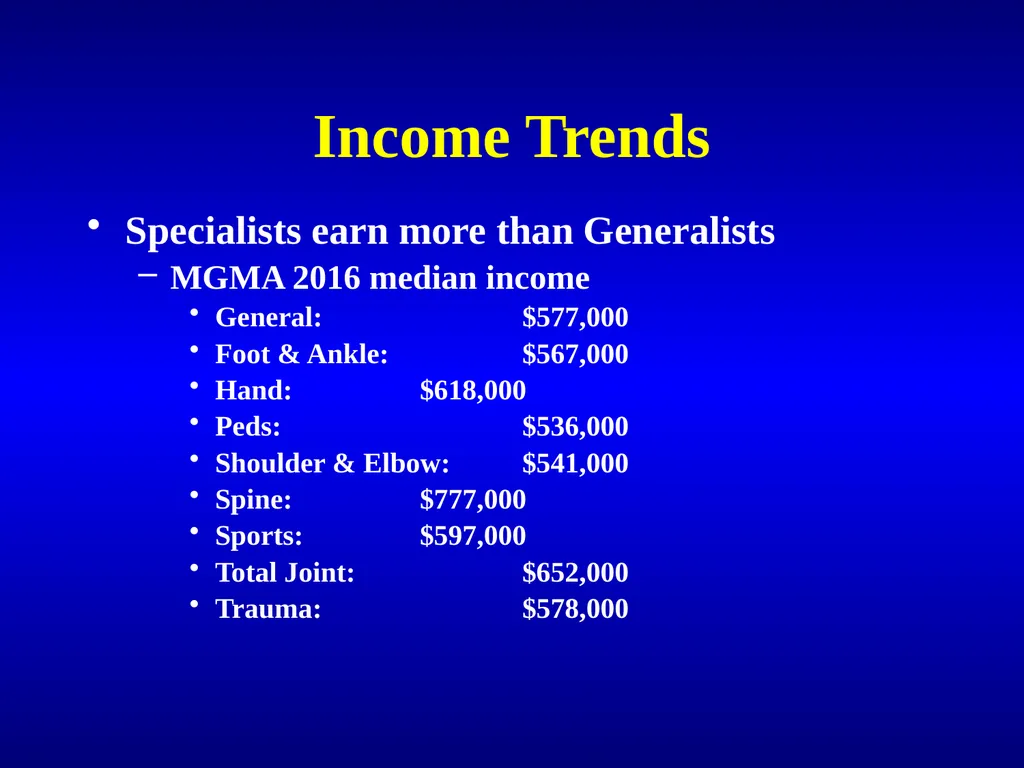
Income Trends Specialists earn more than Generalists
MGMA 2016 median income
General: $577,000
Foot & Ankle: $567,000
Hand: $618,000
Peds: $536,000
Shoulder & Elbow: $541,000
Spine: $777,000
Sports: $597,000
Total Joint: $652,000
Trauma: $578,000<br>
MGMA 2016 median income
General: $577,000
Foot & Ankle: $567,000
Hand: $618,000
Peds: $536,000
Shoulder & Elbow: $541,000
Spine: $777,000
Sports: $597,000
Total Joint: $652,000
Trauma: $578,000<br>
57
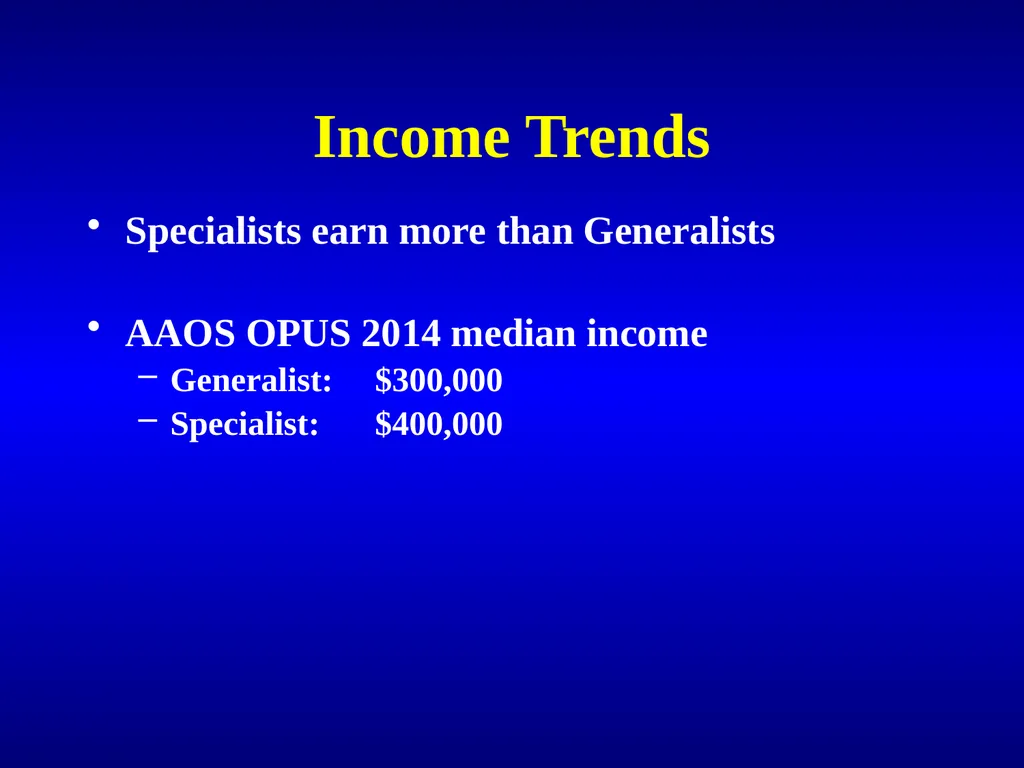
Income Trends Specialists earn more than Generalists
AAOS OPUS 2014 median income
Generalist: $300,000
Specialist: $400,000<br>
AAOS OPUS 2014 median income
Generalist: $300,000
Specialist: $400,000<br>
58
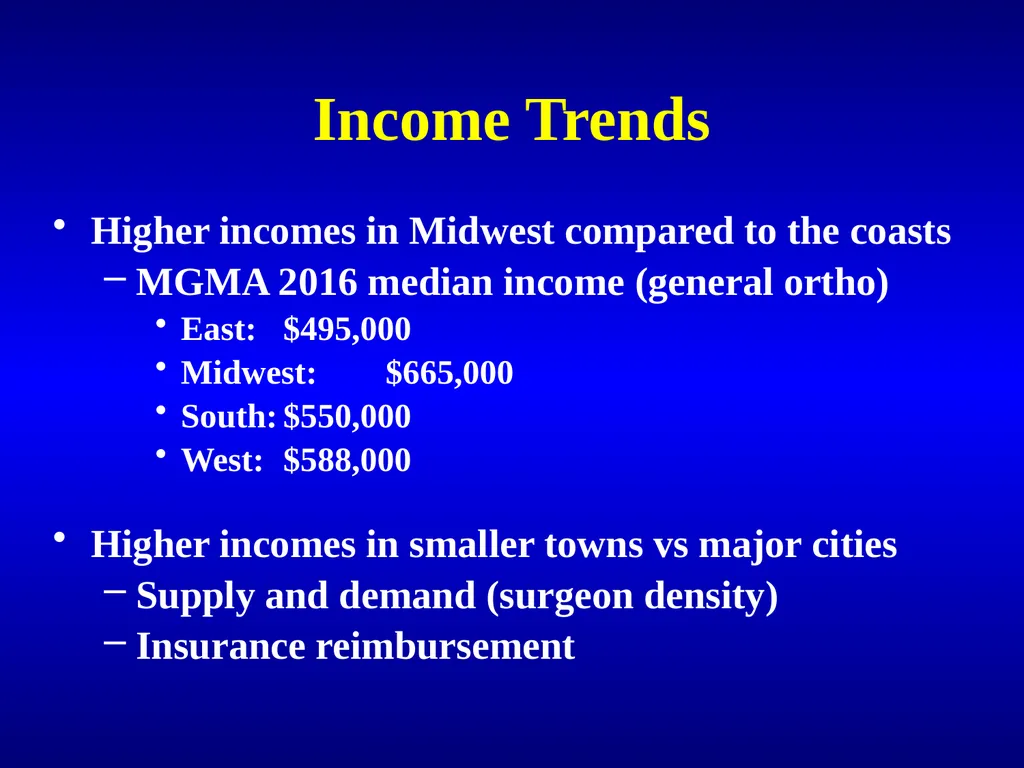
Income Trends Higher incomes in Midwest compared to the coasts
MGMA 2016 median income (general ortho)
East: $495,000
Midwest: $665,000
South: $550,000
West: $588,000
Higher incomes in smaller towns vs major cities
Supply and demand (surgeon density)
Insurance reimbursement<br>
MGMA 2016 median income (general ortho)
East: $495,000
Midwest: $665,000
South: $550,000
West: $588,000
Higher incomes in smaller towns vs major cities
Supply and demand (surgeon density)
Insurance reimbursement<br>
59
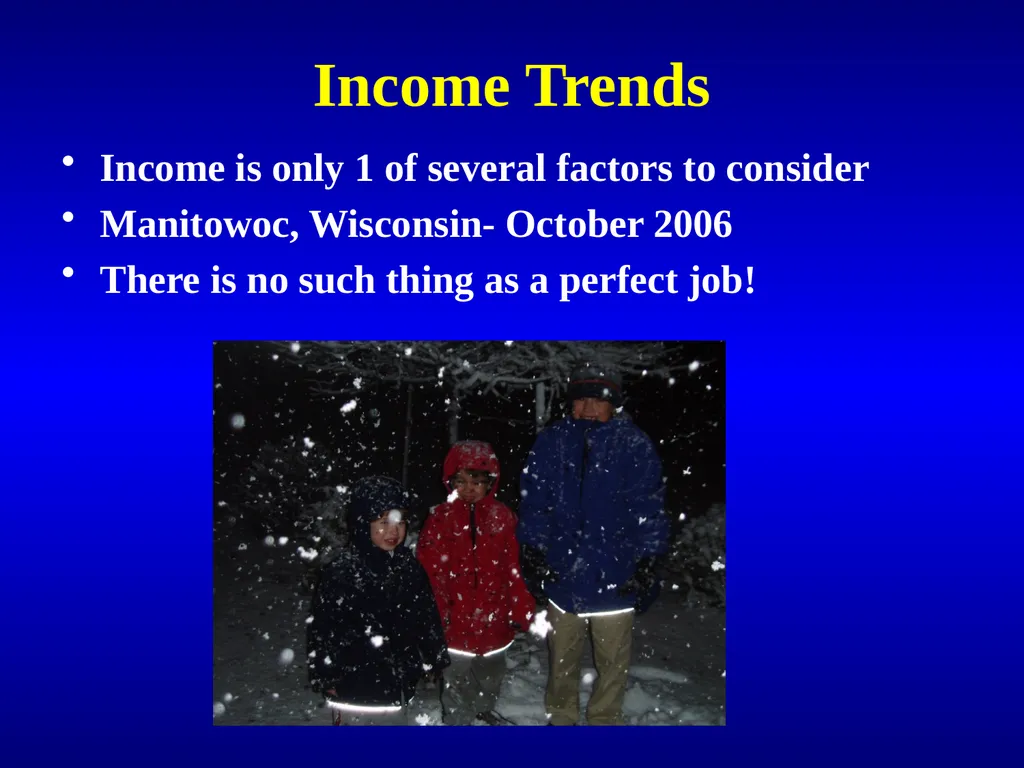
Income Trends Income is only 1 of several factors to consider
Manitowoc, Wisconsin- October 2006
There is no such thing as a perfect job!<br>
Manitowoc, Wisconsin- October 2006
There is no such thing as a perfect job!<br>
60
Am I eligible for a production bonus in first 1-2 years?<br>
61
Am I eligible for a production bonus in first 1-2 years? Some offers are straight salary to start- without any opportunity for bonus
Senior partners may pass work on you with no financial reward- they keep the extra revenue you generate
This may create an unpleasant work environment<br>
Senior partners may pass work on you with no financial reward- they keep the extra revenue you generate
This may create an unpleasant work environment<br>
62
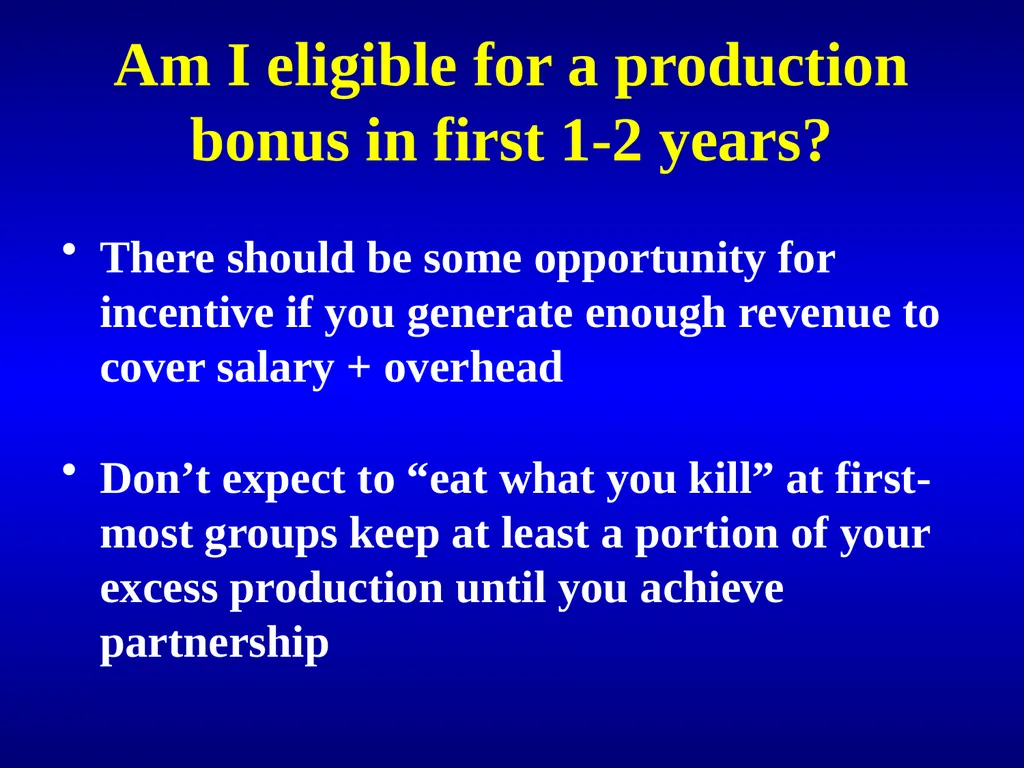
Am I eligible for a production bonus in first 1-2 years? There should be some opportunity for incentive if you generate enough revenue to cover salary + overhead
Don’t expect to “eat what you kill” at first- most groups keep at least a portion of your excess production until you achieve partnership<br>
Don’t expect to “eat what you kill” at first- most groups keep at least a portion of your excess production until you achieve partnership<br>
63
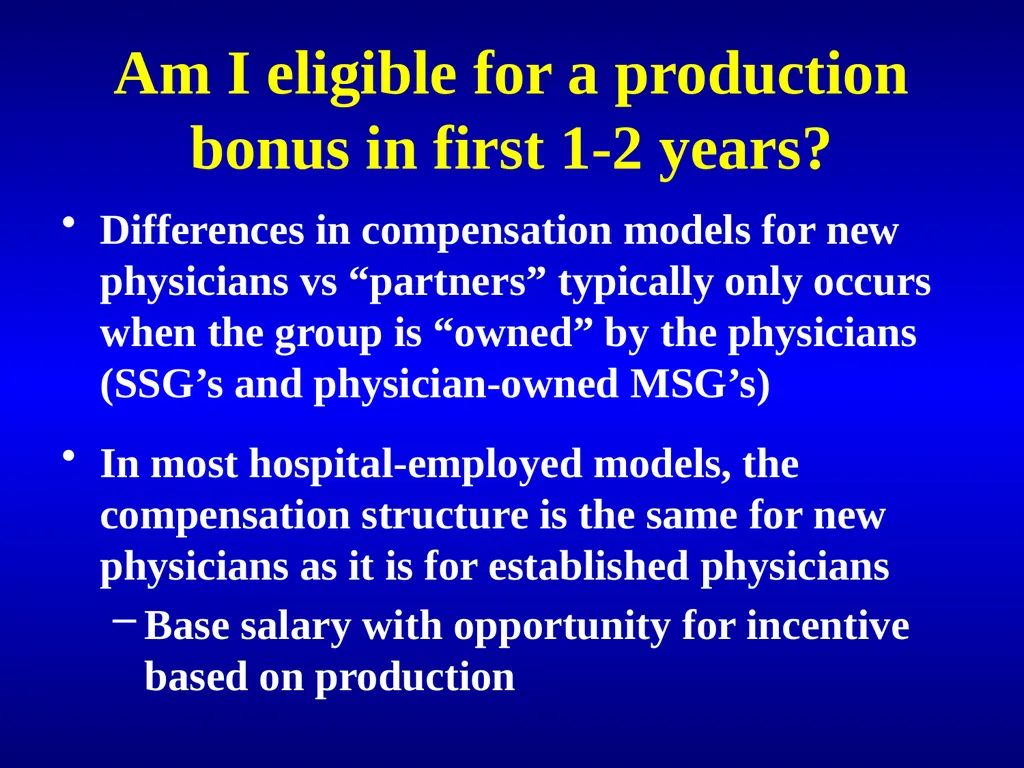
Am I eligible for a production bonus in first 1-2 years? Differences in compensation models for new physicians vs “partners” typically only occurs when the group is “owned” by the physicians (SSG’s and physician-owned MSG’s)
In most hospital-employed models, the compensation structure is the same for new physicians as it is for established physicians
Base salary with opportunity for incentive based on production<br>
In most hospital-employed models, the compensation structure is the same for new physicians as it is for established physicians
Base salary with opportunity for incentive based on production<br>
64
Are there other financial perks?<br>
65
Are there other financial perks? Signing bonus, student loan repayment, relocation expenses
Remember that any money you receive is considered taxable income
Look for the “recapture clause”- free money is usually structured as a forgivable loan<br>
Remember that any money you receive is considered taxable income
Look for the “recapture clause”- free money is usually structured as a forgivable loan<br>
66
What is the group’s overhead?<br>
67
What is the group’s overhead? “Gross production” (total billings, charges)
The amount a group bills insurance companies and individuals for medical services performed<br>
The amount a group bills insurance companies and individuals for medical services performed<br>
68
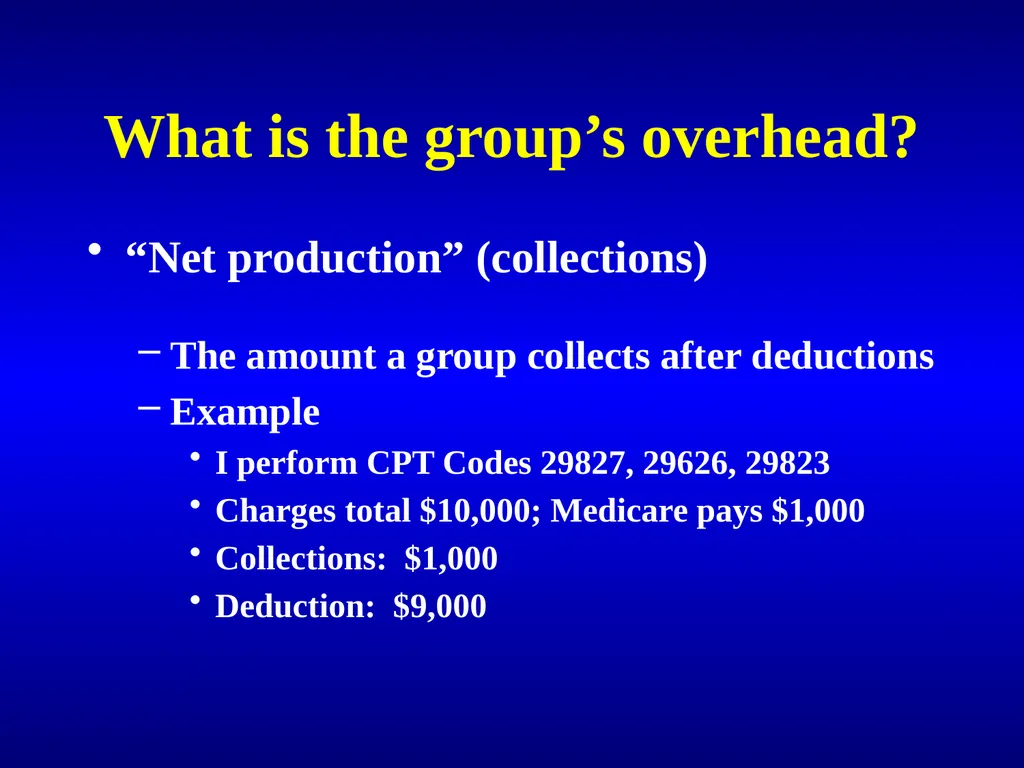
What is the group’s overhead? “Net production” (collections)
The amount a group collects after deductions
Example
I perform CPT Codes 29827, 29626, 29823
Charges total $10,000; Medicare pays $1,000
Collections: $1,000
Deduction: $9,000<br>
The amount a group collects after deductions
Example
I perform CPT Codes 29827, 29626, 29823
Charges total $10,000; Medicare pays $1,000
Collections: $1,000
Deduction: $9,000<br>
69
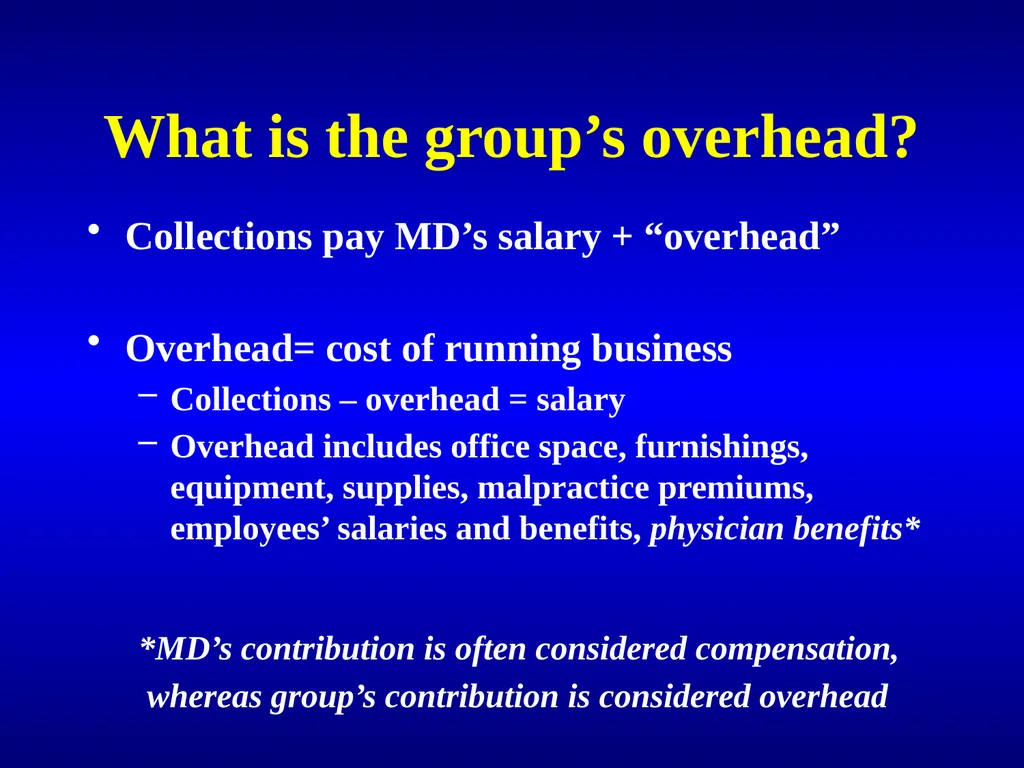
What is the group’s overhead? Collections pay MD’s salary + “overhead”
Overhead= cost of running business
Collections – overhead = salary
Overhead includes office space, furnishings, equipment, supplies, malpractice premiums, employees’ salaries and benefits, physician benefits*
*MD’s contribution is often considered compensation,
whereas group’s contribution is considered overhead<br>
Overhead= cost of running business
Collections – overhead = salary
Overhead includes office space, furnishings, equipment, supplies, malpractice premiums, employees’ salaries and benefits, physician benefits*
*MD’s contribution is often considered compensation,
whereas group’s contribution is considered overhead<br>
70
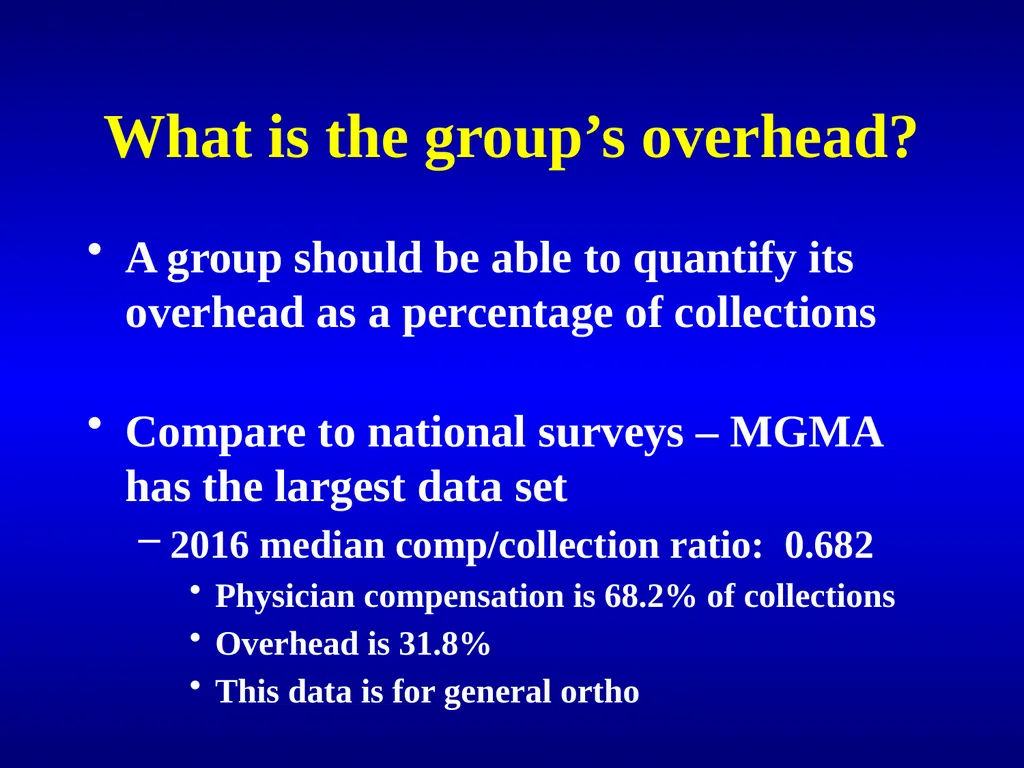
What is the group’s overhead? A group should be able to quantify its overhead as a percentage of collections
Compare to national surveys – MGMA has the largest data set
2016 median comp/collection ratio: 0.682
Physician compensation is 68.2% of collections
Overhead is 31.8%
This data is for general ortho<br>
Compare to national surveys – MGMA has the largest data set
2016 median comp/collection ratio: 0.682
Physician compensation is 68.2% of collections
Overhead is 31.8%
This data is for general ortho<br>
71
What is the group’s overhead? Difficult to define what constitutes a “good” overhead percentage
Overhead is dependent on cost of living, payer mix, number of satellite offices, use of physician extenders
Look at the big picture!<br>
Overhead is dependent on cost of living, payer mix, number of satellite offices, use of physician extenders
Look at the big picture!<br>
72
What are the terms of partnership?<br>
73
What are the terms of partnership? Partnership is typically offered to new members after a specified period of time
The criteria to achieve partnership must be explicitly stated in the employment contract<br>
The criteria to achieve partnership must be explicitly stated in the employment contract<br>
74
What are the terms of partnership? Many SSG’s and some MSG’s require a buy-in
A large buy-in is reasonable if it provides you with ownership in something of value (ASC, MRI, PT)
Beware of buying into “hard assets”, as they are usually depreciated
The days of buying into “goodwill” of the group are over<br>
A large buy-in is reasonable if it provides you with ownership in something of value (ASC, MRI, PT)
Beware of buying into “hard assets”, as they are usually depreciated
The days of buying into “goodwill” of the group are over<br>
75
Are there opportunities for investment in ancillary services?<br>
76
Are there opportunities for investment in ancillary services? In order to offset decreasing reimbursement and increasing overhead costs, many groups have invested in ancillary ventures
ASC
Imaging centers
PT
DME<br>
ASC
Imaging centers
PT
DME<br>
77
Are there opportunities for investment in ancillary services? Clarify if the group offers ancillary services and if there is an opportunity for new partners to invest in these ancillaries
Greater opportunity for ancillary investments in SSGs and physician owned MSG; opportunities are limited for hospital-employed physicians<br>
Greater opportunity for ancillary investments in SSGs and physician owned MSG; opportunities are limited for hospital-employed physicians<br>
78
Dopirak’s Golden Rules
Top 5 Points for Being a Successful Negotiator<br>
79
Dopirak’s Golden Rules
Top 5 Points for Being a Successful Negotiator Understand supply and demand in the market you are considering
Surgeon density
Saturation in your subspecialty area
Primary and secondary service areas<br>
Surgeon density
Saturation in your subspecialty area
Primary and secondary service areas<br>
80
Dopirak’s Golden Rules
Top 5 Points for Being a Successful Negotiator Know your strengths, especially as they pertain to the market you are considering
What do you bring to the group/community that is different or better?
How can you enhance the group or increase market share?<br>
What do you bring to the group/community that is different or better?
How can you enhance the group or increase market share?<br>
81
Dopirak’s Golden Rules
Top 5 Points for Being a Successful Negotiator Know your market value
Come to the table knowing what a fair compensation package is for your subspecialty area in that market
Familiarize yourself with income surveys
MGMA
AAOS
MHA<br>
Come to the table knowing what a fair compensation package is for your subspecialty area in that market
Familiarize yourself with income surveys
MGMA
AAOS
MHA<br>
82
Dopirak’s Golden Rules
Top 5 Points for Being a Successful Negotiator The best negotiators are always willing to walk away from the table
Before you enter negotiations, decide what you are willing to accept and what is your break point
It is a buyer’s market- don’t settle!
Don’t make any decisions that day!<br>
Before you enter negotiations, decide what you are willing to accept and what is your break point
It is a buyer’s market- don’t settle!
Don’t make any decisions that day!<br>
83
Dopirak’s Golden Rules
Top 5 Points for Being a Successful Negotiator Just like Mikey and T taught us…
“Don’t call them back for at least 2 days”<br>
“Don’t call them back for at least 2 days”<br>
84
Dopirak’s Golden Rules
Top 5 Points for Being a Successful Negotiator Don’t be a “Bull in a China Shop”
The first goal is to sell yourself to the employer, and everything else will fall into place
Don’t talk numbers on the first interview
Don’t start making demands or negotiating until you sense the group is “sold” on you!<br>
The first goal is to sell yourself to the employer, and everything else will fall into place
Don’t talk numbers on the first interview
Don’t start making demands or negotiating until you sense the group is “sold” on you!<br>
85
Last But Not Least!!! You can never have too much detail in a contract. It is the only thing that will protect you when things fall apart
You must use an experienced contract attorney- it is the best investment you will ever make!!!<br>
You must use an experienced contract attorney- it is the best investment you will ever make!!!<br>
86
Thank You
rdopirak@msn.com<br>
87
References AAOS Orthopaedic Practice in the US 2014
Evaluating Orthopaedic Practice Opportunities. Dopirak RM. Available online at the AAOS PMC
Evaluating Practice Opportunities. Part I. Dopirak RM. AAOS Bulletin 2006;54(1):19-20.
Evaluating Practice Opportunities. Part II. Dopirak RM. AAOS Bulletin 2006;54(2):12-13.<br>
Evaluating Orthopaedic Practice Opportunities. Dopirak RM. Available online at the AAOS PMC
Evaluating Practice Opportunities. Part I. Dopirak RM. AAOS Bulletin 2006;54(1):19-20.
Evaluating Practice Opportunities. Part II. Dopirak RM. AAOS Bulletin 2006;54(2):12-13.<br>
88
References MGMA Medical Directorship and On-Call Compensation Survey: 2014 Report Based on 2013 Data
MGMA Physician Compensation and Production Survey: 2016 Report Based on 2015 Data
Merritt Hawkins and Associates 2016 Review of Physician and Advanced Practitioner Recruiting Incentives
Merritt Hawkins and Associates 2016 Physician Inpatient/Outpatient Revenue Survey<br>
MGMA Physician Compensation and Production Survey: 2016 Report Based on 2015 Data
Merritt Hawkins and Associates 2016 Review of Physician and Advanced Practitioner Recruiting Incentives
Merritt Hawkins and Associates 2016 Physician Inpatient/Outpatient Revenue Survey<br>