Tishk International University Pharmacy Faculty Pharmaceutics II Third Grade- Spring Semester 2023-2024 Pharmaceutical Aerosols Instructor: Dr. Rozhan Arif 1 2 Aerosols Factors affecting the deposition of drug inside lungs are: drug-related
"Tishk International University Pharmacy Faculty" is the property of its rightful owner. Permission is granted to
download and print the materials on this website for personal, non-commercial use only, and to display it
on your personal computer provided you do not modify the materials and that you retain all copyright
notices contained in the materials. By downloading content from our website, you accept the terms of this
agreement.
Presentation Transcript
01
Tishk International University
Pharmacy Faculty Pharmaceutics II Third Grade- Spring Semester 2023-2024 Pharmaceutical Aerosols Instructor: Dr. Rozhan Arif 1<br>
02
2 Aerosols<br>
03
Factors affecting the deposition of drug inside lungs are: drug-related (particle size, shape, density , charge, hygroscopicity ),
device-related
In addition to the physiological factors like the thickness of absorption barriers, muco-cilliary clearance, breathing pattern, presence of macrophages and blood supply. 3<br>
04
Advantages less contamination upon doses application
More stability
Proper delivery of medication with less irritation problems.
Disadvantages
Are mainly related to manufacturing difficulty and cost. 4<br>
05
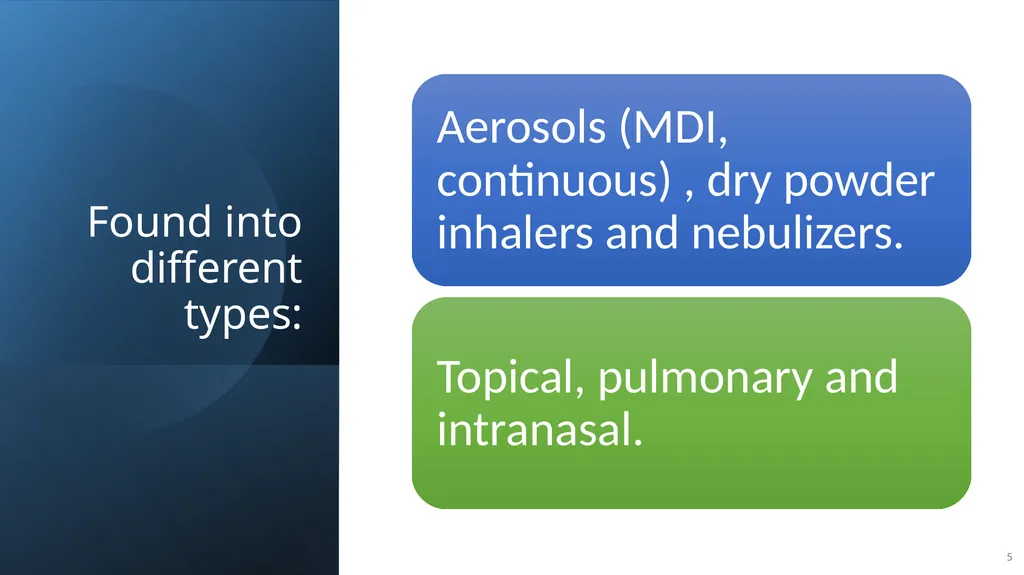
Found into different types: 5<br>
06
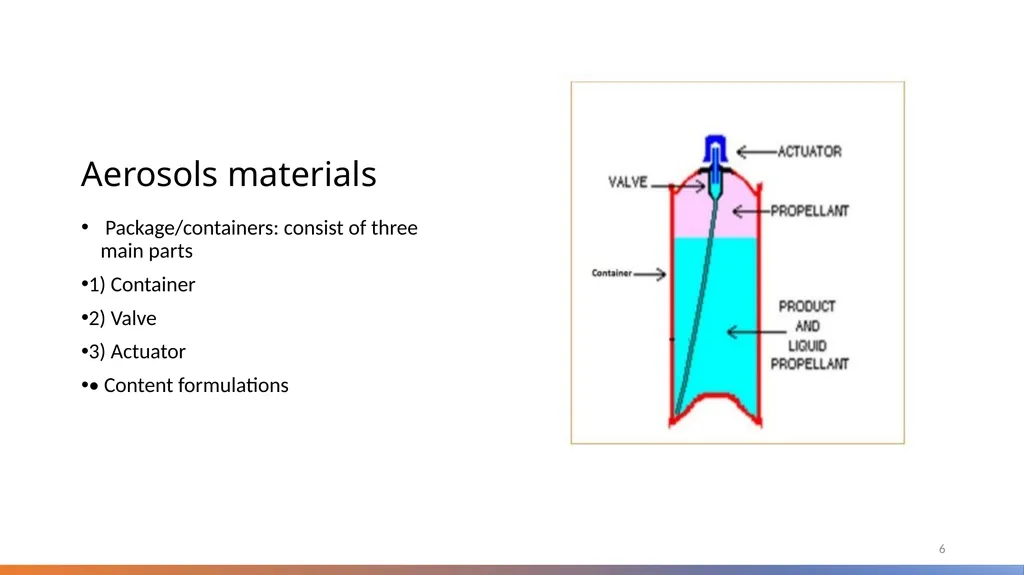
Aerosols materials Package/containers: consist of three main parts
1) Container
2) Valve
3) Actuator
• Content formulations 6<br>
07
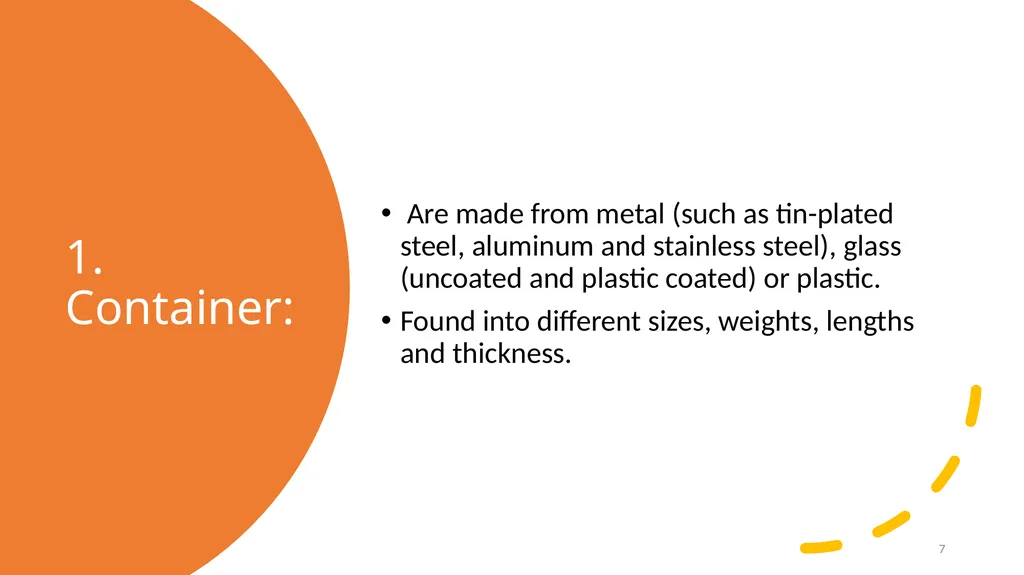
1. Container: Are made from metal (such as tin-plated steel, aluminum and stainless steel), glass (uncoated and plastic coated) or plastic.
Found into different sizes, weights, lengths and thickness. 7<br>
08
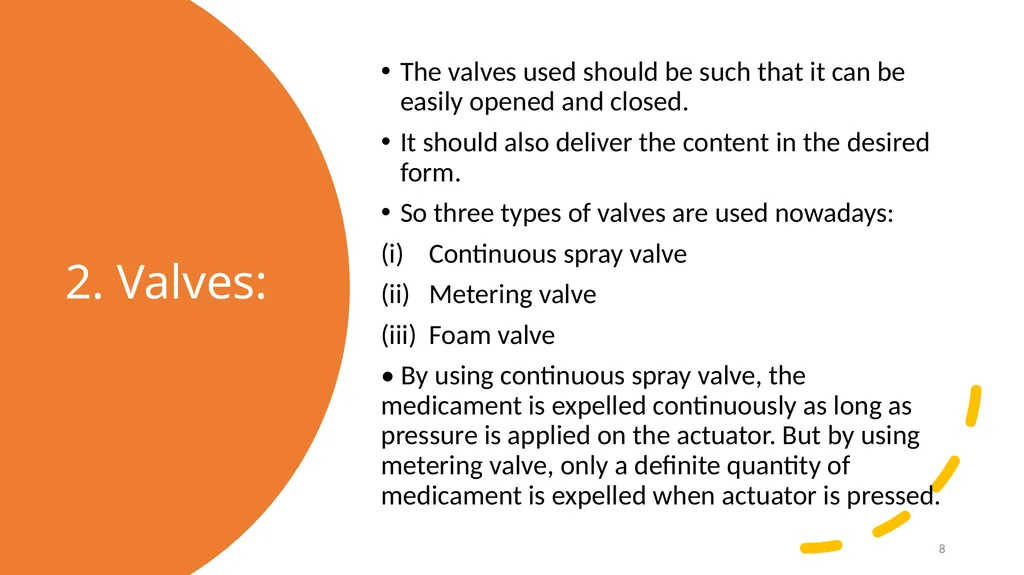
2. Valves: The valves used should be such that it can be easily opened and closed.
It should also deliver the content in the desired form.
So three types of valves are used nowadays:
Continuous spray valve
Metering valve
Foam valve
• By using continuous spray valve, the medicament is expelled continuously as long as pressure is applied on the actuator. But by using metering valve, only a definite quantity of medicament is expelled when actuator is pressed. 8<br>
09
Metering valves Are applicable to the dispensing of potent medication, using a chamber whose size determines the amount of medication dispensed. 9<br>
10
3. Actuator: Used to ensure that the aerosol product is delivered in the proper and desired form.
It is fitted on the valve stem.
It helps in the easy opening and closing of the valve, whenever it is required. 10<br>
11
There are various types of actuators: Spray: can be used for topical aerosols
Foam: larger orifices, topical
Solid stream : large orifice, for semisolid
Special actuator: Medicinal aerosols, deliver the drug to nose, eye, throat and other routes 11<br>
12
Aerosol Content formulation Propellant :(one or mixture)
Product concentrate: to be propelled and expelled, contains active medication (one or more) and other materials.
Propellant: - Is regarded as the heart of the aerosol package. It supplies the necessary force to expel the product. Act as solvent and diluent (The medication may be soluble or in insoluble in the propellant).
• Various additives such as solvents, antioxidants, surface active agents and flavoring agents are also included in the formulation. • The propellants, medicaments and additives are filled into an aerosol container. 12<br>
13
Types of propellants Liquefied gases: Hydrocarbons and Chlorofluorocarbons
Compressed gases: Such as nitrogen, nitrous oxide and carbon dioxide. 13<br>
14
Product concentrate We have different formulations or systems with different dispensing forms and selected depending on:
1) The physical, chemical and pharmacologic properties of active ingredients.
2) Site of application 14<br>
15
Product concentrate have: (2-phase or 3-phase systems. 1- Solution system: (two-phase system)
2- Water based system: (three phase system)
3- Suspension or dispersion systems: (three phase system)
4- Foam systems: (three phase system) 15<br>
16
Filling aerosol products The aerosol products can be filled into several ways depending on the nature of the product concentrate :
Cold-fill process.
Pressure-fill process
Compressed gas filling process 16<br>
17
1. Cold-fill process This process is used to fill metered aerosol products using a fluorocarbon propellant.
By lowering the temperature of a propellant below its boiling point, the propellant becomes liquid at atmospheric pressure.
The active ingredients or concentrate and propellant is cooled to a low temperature of about -300 to 400F.
The concentrate is generally cooled to below 0 in order to reduce loss of propellant during the filling operation.
The chilled concentrate is poured (metered) into the equally chilled container and propellant is added.
Because of the low temperatures required, aqueous systems cannot be filled by this process, since the water turns to ice. In the process, some of the propellant vapors are also lost. 17<br>
18
2. Pressure-fill process This process is used for filling aerosols containing hydrocarbon propellant using pressure filler.
The product concentrate is placed into the container and the valve is sealed.
The propellant is forced through the valve under pressure at room temperature followed by leakage test as before.
It is essential that the air present in the container must be expelled before filling the contents into the aerosol container.
It has the advantage over the cold filling method in that there is less danger of moisture contamination of the product, and also less propellant is lost in the process. 18<br>
19
19 3- Compressed gas filling process<br>
20
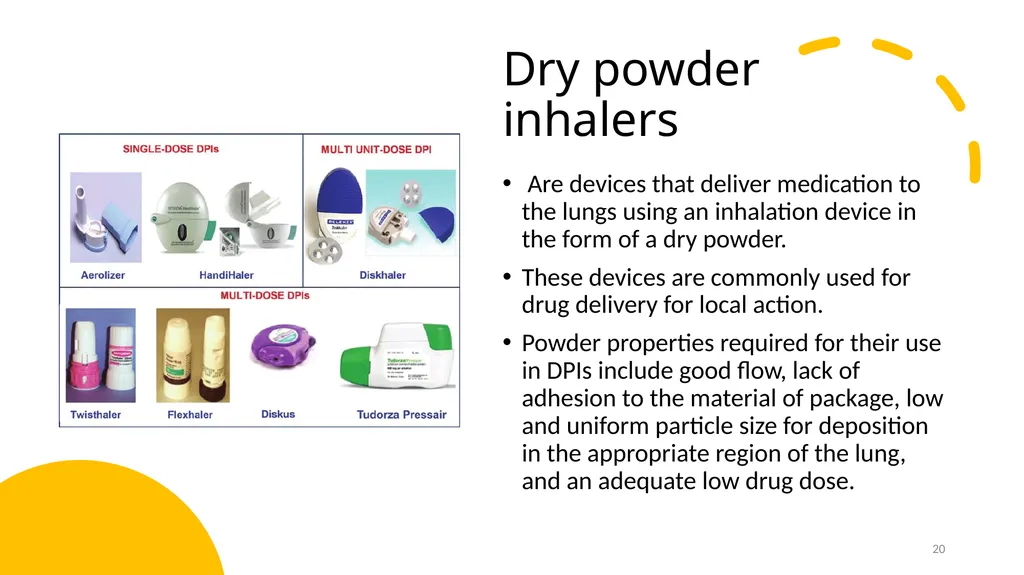
Dry powder inhalers Are devices that deliver medication to the lungs using an inhalation device in the form of a dry powder.
These devices are commonly used for drug delivery for local action.
Powder properties required for their use in DPIs include good flow, lack of adhesion to the material of package, low and uniform particle size for deposition in the appropriate region of the lung, and an adequate low drug dose. 20<br>
21
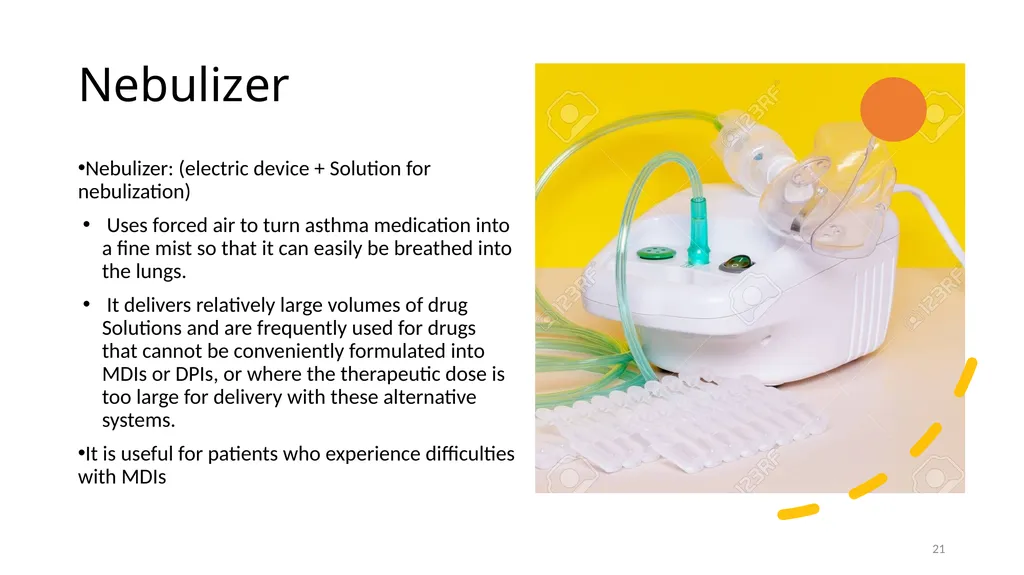
Nebulizer Nebulizer: (electric device + Solution for nebulization)
Uses forced air to turn asthma medication into a fine mist so that it can easily be breathed into the lungs.
It delivers relatively large volumes of drug Solutions and are frequently used for drugs that cannot be conveniently formulated into MDIs or DPIs, or where the therapeutic dose is too large for delivery with these alternative systems.
It is useful for patients who experience difficulties with MDIs 21<br>