Title: How do we learn? Date 09092021 Todays Lesson: To consider why memory is so important to our success To know how our memory works To establish ways to improve memory KEYWORDS Memory Recall Working memory Long term memory Encode
"Title: How do we learn? Date 09/09/2021 Today’s" is the property of its rightful owner. Permission is granted to
download and print the materials on this website for personal, non-commercial use only, and to display it
on your personal computer provided you do not modify the materials and that you retain all copyright
notices contained in the materials. By downloading content from our website, you accept the terms of this
agreement.
Presentation Transcript
01
Title: How do we learn? Date 09/09/2021<br>
02
Today’s Lesson:
To consider why memory is so important to our success
To know how our memory works
To establish ways to improve memory KEYWORDS
Memory
Recall
Working memory
Long term memory
Encode
Retrieval
Storage
Biblioklept Prior Learning
Mental Health
Wellbeing
Sleep
Diet Thinking Ahead:
Living in the wider world- my qualities CC: science, psychology, English Careers: social worker, counsellor, nurse, emergency services<br>
03
Why is memory important? What happens to our memory over time? How can you protect your memory?<br>
04
As soon as the video clip finishes, write down all the items from the conveyor belt that you can remember.<br>
05
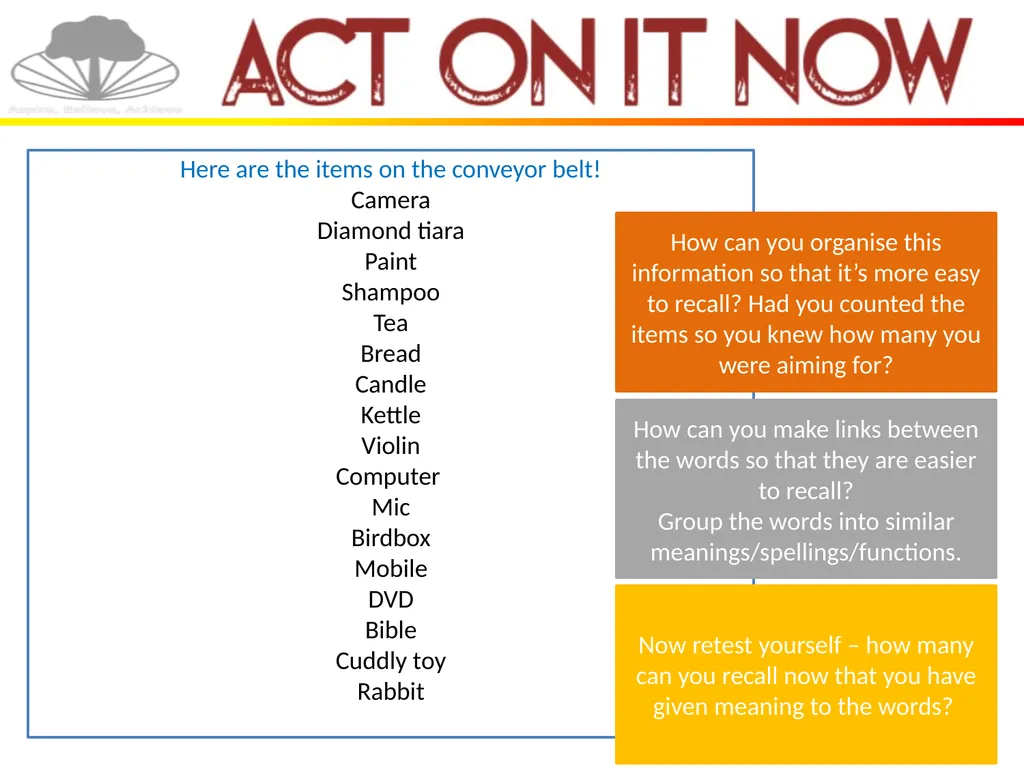
Here are the items on the conveyor belt!
Camera
Diamond tiara
Paint
Shampoo
Tea
Bread
Candle
Kettle
Violin
Computer
Mic
Birdbox
Mobile
DVD
Bible
Cuddly toy
Rabbit How can you organise this information so that it’s more easy to recall? Had you counted the items so you knew how many you were aiming for? How can you make links between the words so that they are easier to recall?
Group the words into similar meanings/spellings/functions. Now retest yourself – how many can you recall now that you have given meaning to the words?<br>
06
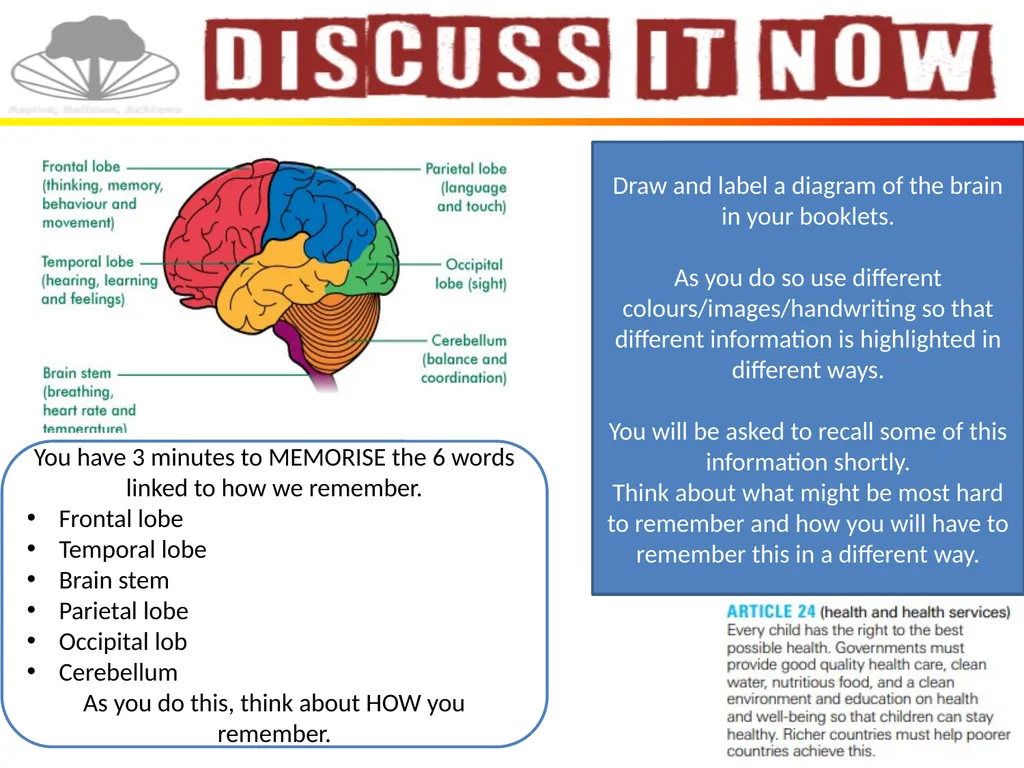
You have 3 minutes to MEMORISE the 6 words linked to how we remember.
Frontal lobe
Temporal lobe
Brain stem
Parietal lobe
Occipital lob
Cerebellum
As you do this, think about HOW you remember. Draw and label a diagram of the brain in your booklets.
As you do so use different colours/images/handwriting so that different information is highlighted in different ways.
You will be asked to recall some of this information shortly.
Think about what might be most hard to remember and how you will have to remember this in a different way.<br>
07
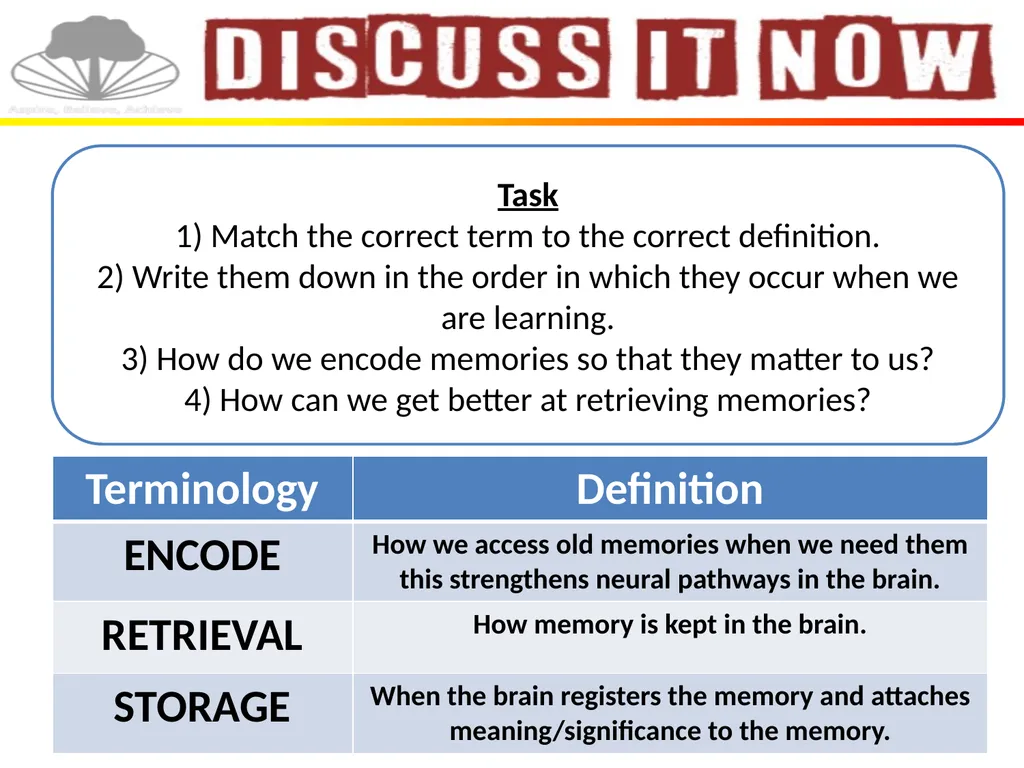
Task
1) Match the correct term to the correct definition.
2) Write them down in the order in which they occur when we are learning.
3) How do we encode memories so that they matter to us?
4) How can we get better at retrieving memories?<br>
08
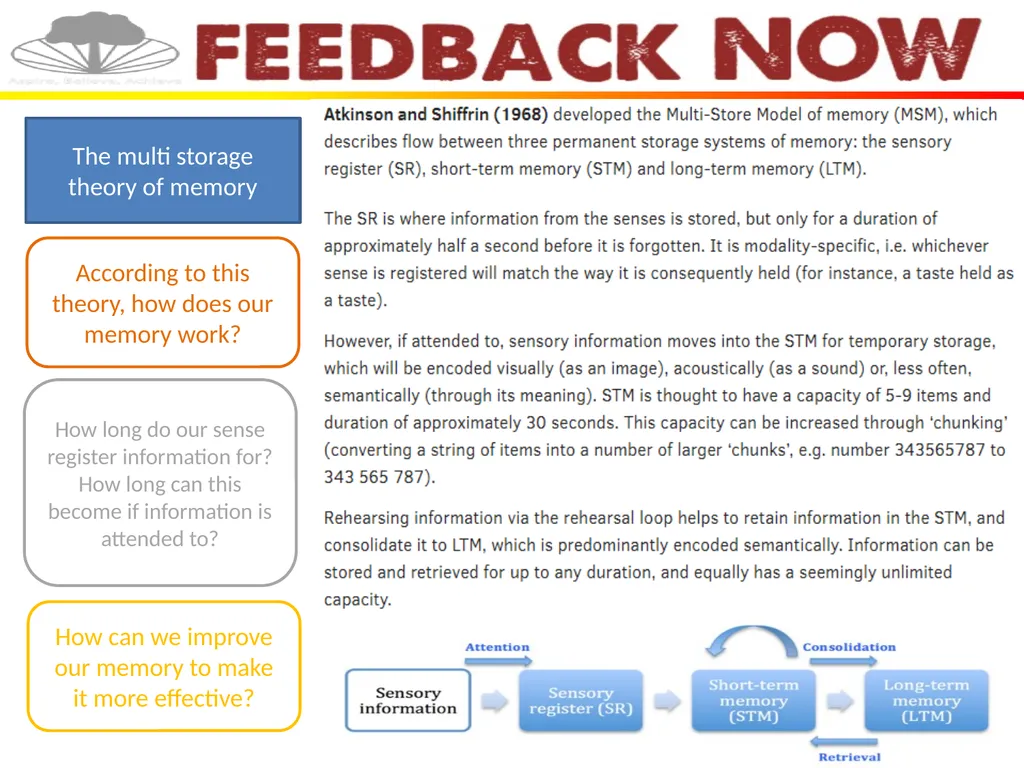
The multi storage theory of memory According to this theory, how does our memory work? How long do our sense register information for?
How long can this become if information is attended to? How can we improve our memory to make it more effective?<br>
09
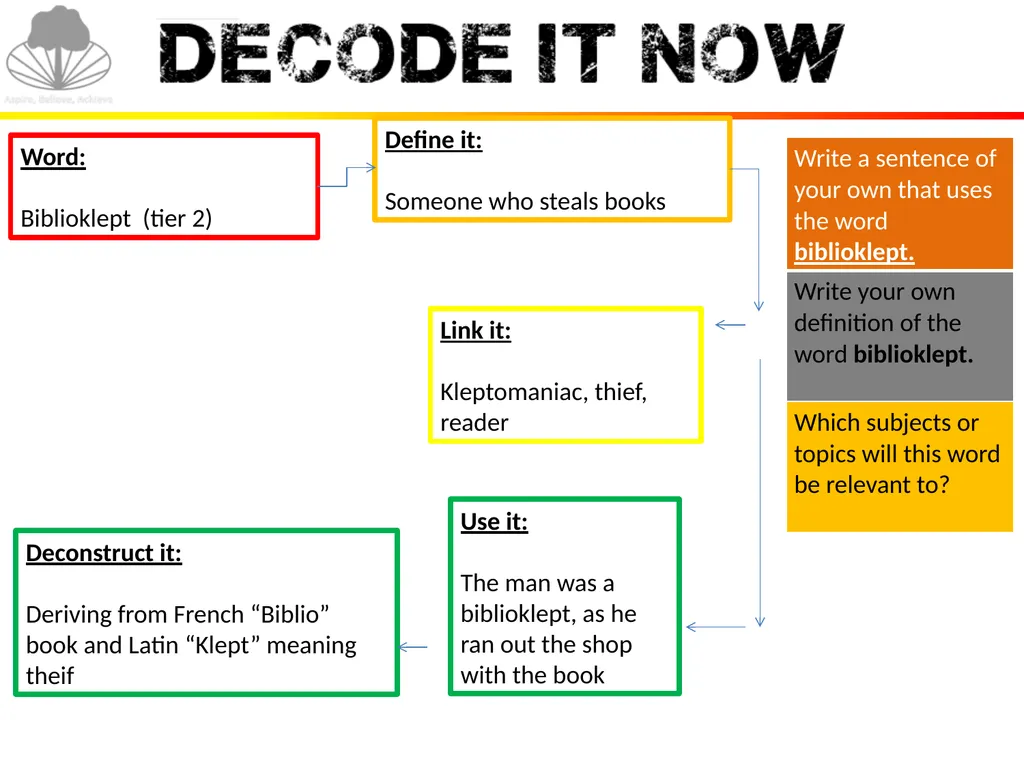
Word:
Biblioklept (tier 2) Define it:
Someone who steals books Link it:
Kleptomaniac, thief, reader Deconstruct it:
Deriving from French “Biblio” book and Latin “Klept” meaning theif Use it:
The man was a biblioklept, as he ran out the shop with the book<br>
10
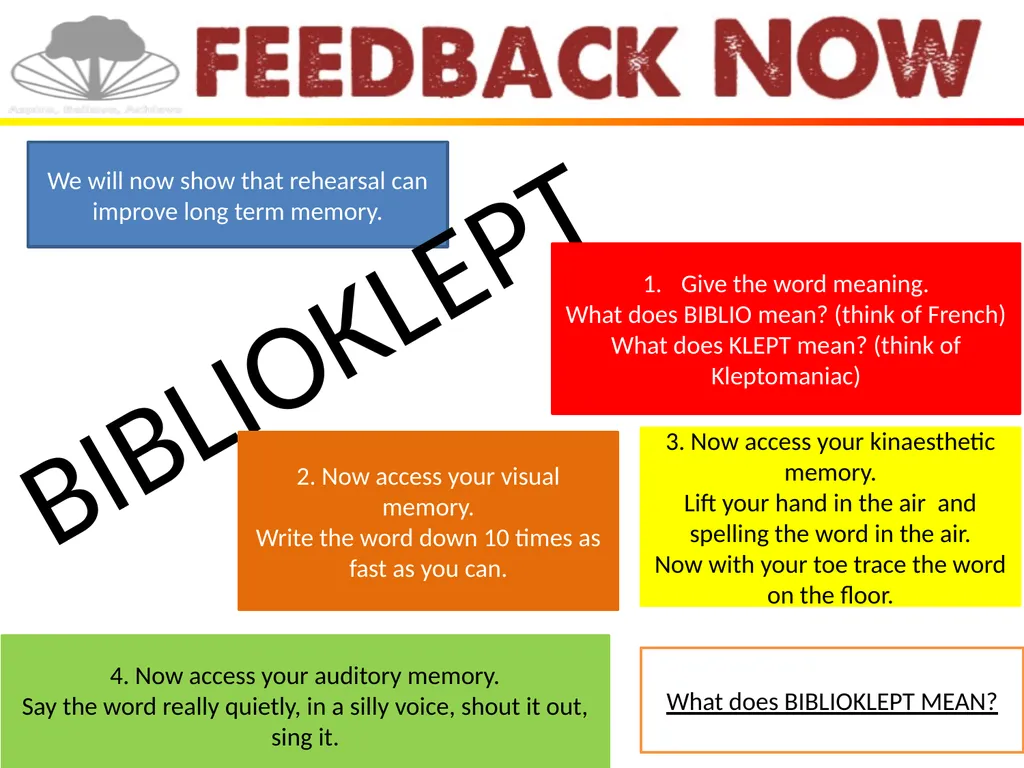
We will now show that rehearsal can improve long term memory. BIBLIOKLEPT Give the word meaning.
What does BIBLIO mean? (think of French) What does KLEPT mean? (think of Kleptomaniac) 2. Now access your visual memory.
Write the word down 10 times as fast as you can. 3. Now access your kinaesthetic memory.
Lift your hand in the air and spelling the word in the air.
Now with your toe trace the word on the floor. 4. Now access your auditory memory.
Say the word really quietly, in a silly voice, shout it out, sing it. What does BIBLIOKLEPT MEAN?<br>
11
In green pen write down 5 ways you can improve your memory storage, encoding and retrieval.
HP if you can correctly write the definition of BIBLIOKLEPT.<br>