
Title IX training for SUNY Cobleskill Student
DP
Published · 36 slides · 0 views
1 / 1


Description
Title IX training for SUNY Cobleskill Student Leaders August 2017 Preventing Sexual Violence, Harassment and Discrimination Why Are We Here? As student leaders, you play a key role in keeping students safe on campus A new law in New York
Related Topics
Share
Embed code
Download this presentation From Below
"Title IX training for SUNY Cobleskill Student" is the property of its rightful owner. Permission is granted to download and print the materials on this website for personal, non-commercial use only, and to display it on your personal computer provided you do not modify the materials and that you retain all copyright notices contained in the materials. By downloading content from our website, you accept the terms of this agreement.
Presentation Transcript
01
Title IX training
for SUNY Cobleskill Student Leaders
August 2017 Preventing Sexual Violence, Harassment and Discrimination<br>
for SUNY Cobleskill Student Leaders
August 2017 Preventing Sexual Violence, Harassment and Discrimination<br>
02
Why Are We Here? As student leaders, you play a key role in keeping students safe on campus
A new law in New York State has changed the rules for sexual interactions on campus
Today’s training will help you understand the law, the College’s obligations, and your role<br>
A new law in New York State has changed the rules for sexual interactions on campus
Today’s training will help you understand the law, the College’s obligations, and your role<br>
03
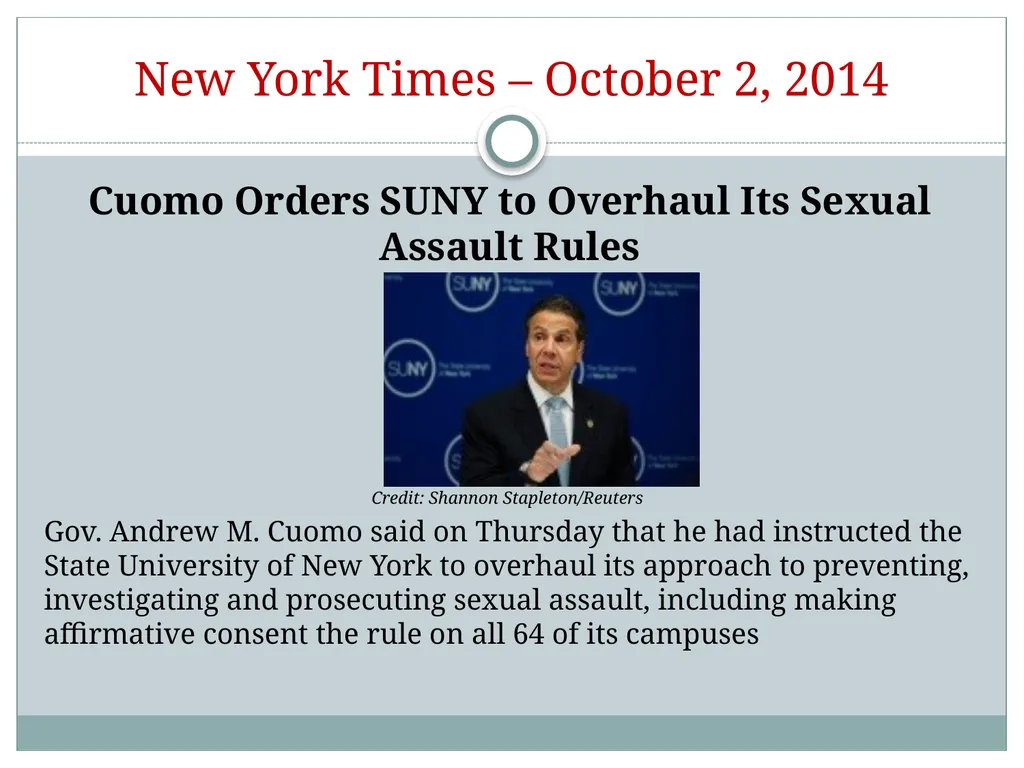
New York Times – October 2, 2014 Cuomo Orders SUNY to Overhaul Its Sexual Assault Rules
Credit: Shannon Stapleton/Reuters
Gov. Andrew M. Cuomo said on Thursday that he had instructed the State University of New York to overhaul its approach to preventing, investigating and prosecuting sexual assault, including making affirmative consent the rule on all 64 of its campuses<br>
Credit: Shannon Stapleton/Reuters
Gov. Andrew M. Cuomo said on Thursday that he had instructed the State University of New York to overhaul its approach to preventing, investigating and prosecuting sexual assault, including making affirmative consent the rule on all 64 of its campuses<br>
04
New York Times – July 8, 2015 All NY Colleges to Adopt 'Yes Means Yes' Sex Assault Policy
Legislation requiring universities in New York state to adopt a uniform affirmative sexual consent policy was signed by Governor Andrew Cuomo on Tuesday.
The so-called "yes means yes" standard defines sexual consent between people as an affirmative, conscious and voluntary understanding to engage in sexual activity. It is part of a nationwide movement aimed at curbing sexual assaults on college campuses.<br>
Legislation requiring universities in New York state to adopt a uniform affirmative sexual consent policy was signed by Governor Andrew Cuomo on Tuesday.
The so-called "yes means yes" standard defines sexual consent between people as an affirmative, conscious and voluntary understanding to engage in sexual activity. It is part of a nationwide movement aimed at curbing sexual assaults on college campuses.<br>
05
What is Title IX? Title IX of the Education Amendments of 1972 prohibits sex discrimination in educational programs and activities
“No person in the United States shall, on the basis of sex, be excluded from participation in, be denied the benefits of, or be subjected to discrimination under any education program or activity receiving Federal financial assistance”<br>
“No person in the United States shall, on the basis of sex, be excluded from participation in, be denied the benefits of, or be subjected to discrimination under any education program or activity receiving Federal financial assistance”<br>
06
What Does Title IX Address? Sex discrimination
Unequal pay based on gender
Discrimination on the basis of pregnancy
Unequal distribution of athletic funds
Unequal admissions and financial aid practices
All forms of sexual harassment, including verbal sexual harassment, and sexual violence by employees, students, or third parties against employees, students, or third parties
Whether or not the incidents of harassment occur on the College campus and whether or not the incidents occur during working hours<br>
Unequal pay based on gender
Discrimination on the basis of pregnancy
Unequal distribution of athletic funds
Unequal admissions and financial aid practices
All forms of sexual harassment, including verbal sexual harassment, and sexual violence by employees, students, or third parties against employees, students, or third parties
Whether or not the incidents of harassment occur on the College campus and whether or not the incidents occur during working hours<br>
07
What Does This Mean for Us? The College has a duty to promptly respond to complaints of sexual harassment and sexual violence in a way that limits its effects and prevents its recurrence
Victims of sexual harassment or sexual violence might be faculty, staff, students, or third parties
Similarly, the accused may be from any of those groups
Victims and alleged perpetrators can be male or female
Harassment can take place between two individuals of the same sex<br>
Victims of sexual harassment or sexual violence might be faculty, staff, students, or third parties
Similarly, the accused may be from any of those groups
Victims and alleged perpetrators can be male or female
Harassment can take place between two individuals of the same sex<br>
08
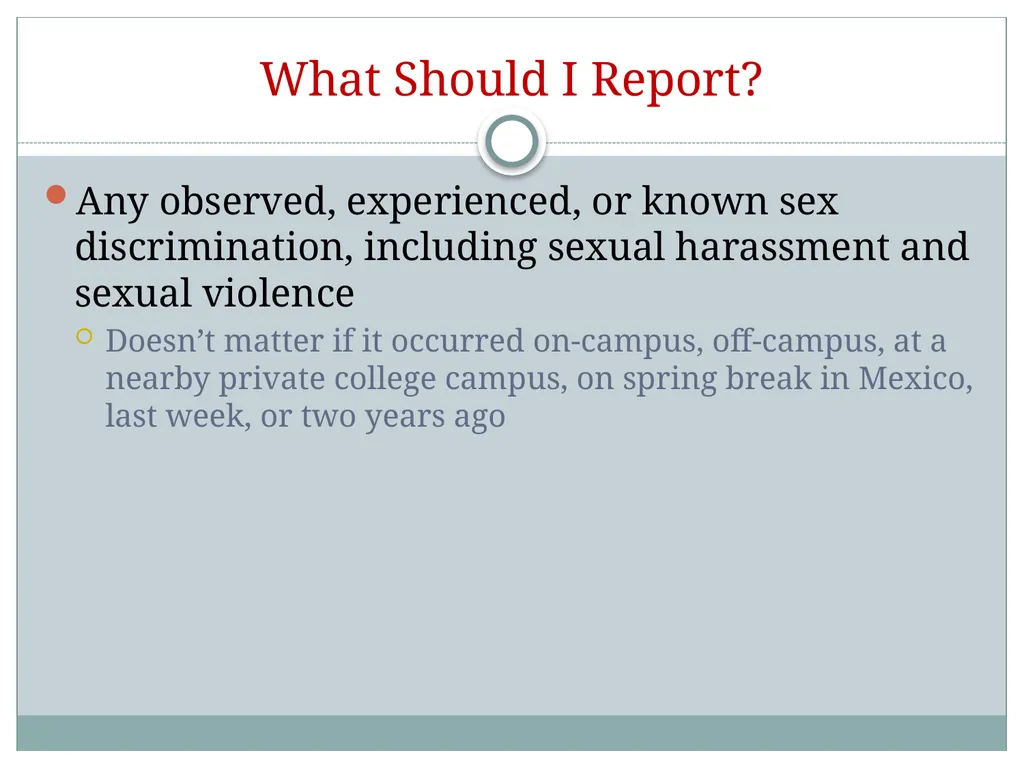
What Should I Report? Any observed, experienced, or known sex discrimination, including sexual harassment and sexual violence
Doesn’t matter if it occurred on-campus, off-campus, at a nearby private college campus, on spring break in Mexico, last week, or two years ago<br>
Doesn’t matter if it occurred on-campus, off-campus, at a nearby private college campus, on spring break in Mexico, last week, or two years ago<br>
09
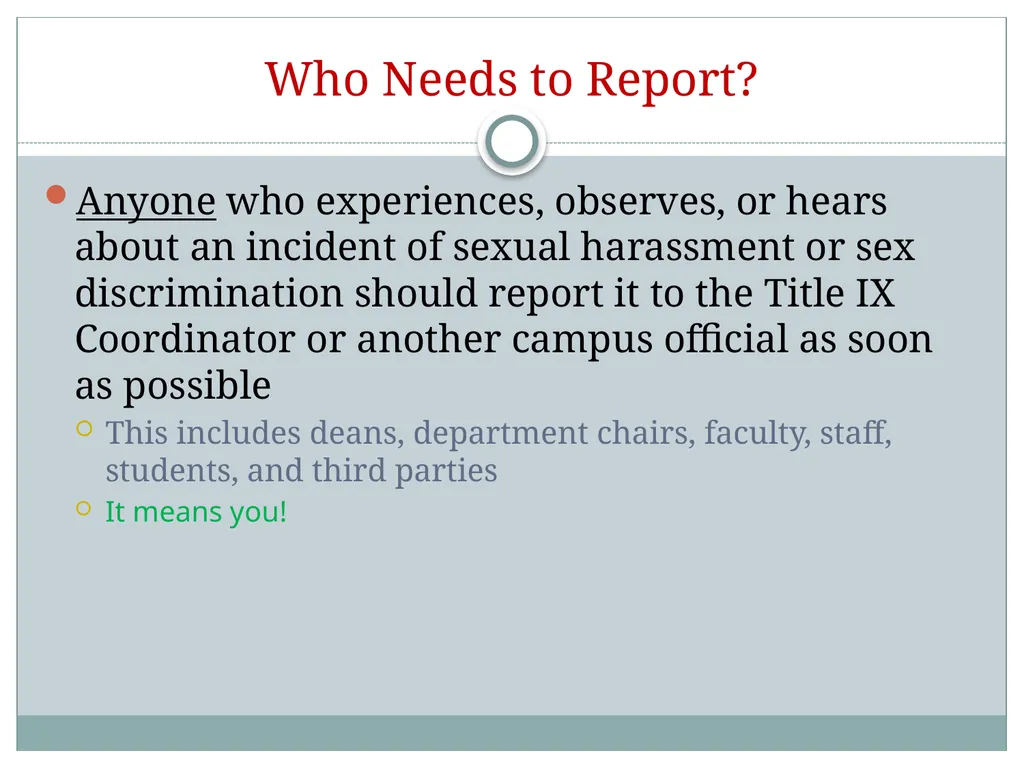
Who Needs to Report? Anyone who experiences, observes, or hears about an incident of sexual harassment or sex discrimination should report it to the Title IX Coordinator or another campus official as soon as possible
This includes deans, department chairs, faculty, staff, students, and third parties
It means you!<br>
This includes deans, department chairs, faculty, staff, students, and third parties
It means you!<br>
10
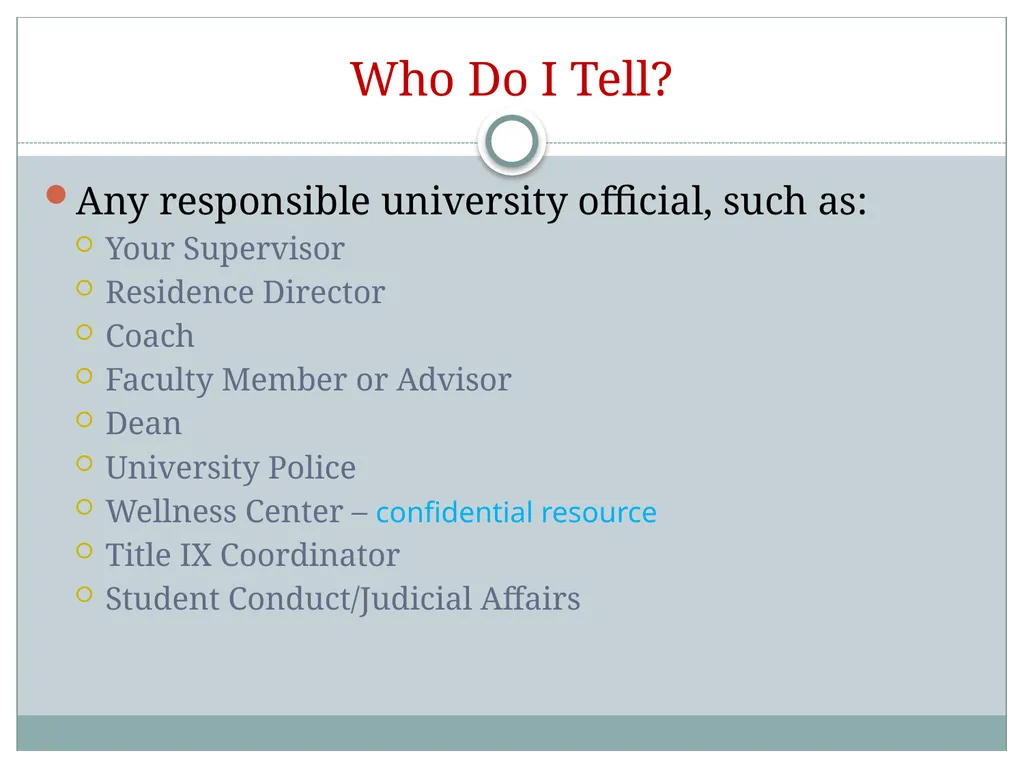
Who Do I Tell? Any responsible university official, such as:
Your Supervisor
Residence Director
Coach
Faculty Member or Advisor
Dean
University Police
Wellness Center – confidential resource
Title IX Coordinator
Student Conduct/Judicial Affairs<br>
Your Supervisor
Residence Director
Coach
Faculty Member or Advisor
Dean
University Police
Wellness Center – confidential resource
Title IX Coordinator
Student Conduct/Judicial Affairs<br>
11
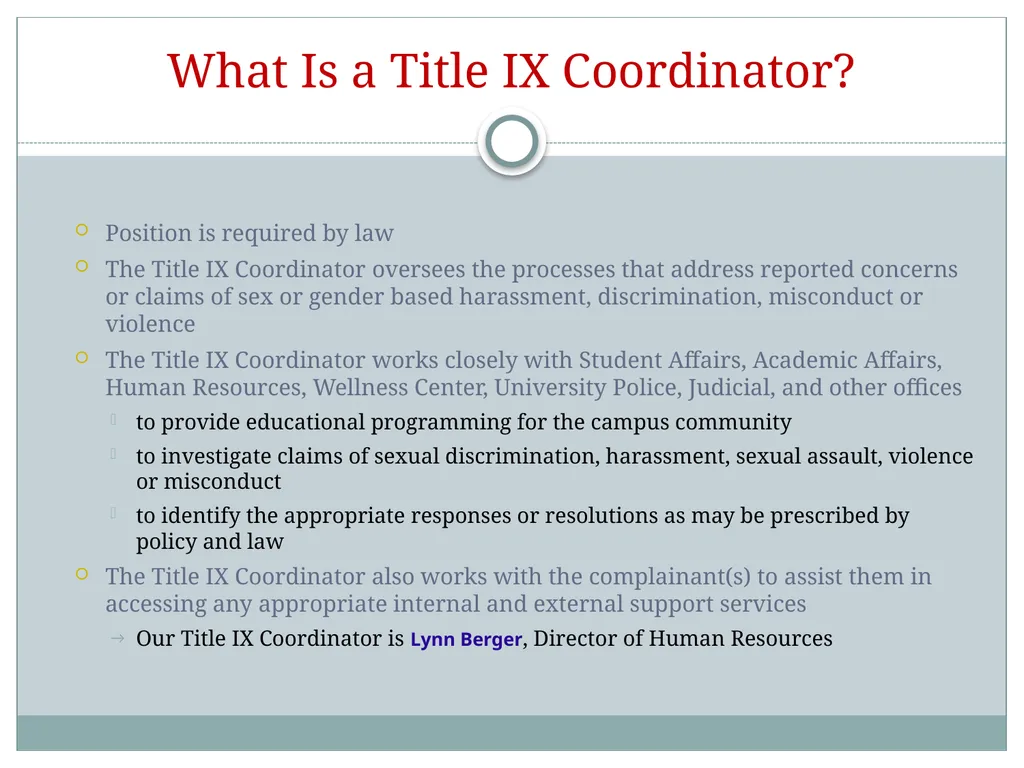
What Is a Title IX Coordinator? Position is required by law
The Title IX Coordinator oversees the processes that address reported concerns or claims of sex or gender based harassment, discrimination, misconduct or violence
The Title IX Coordinator works closely with Student Affairs, Academic Affairs, Human Resources, Wellness Center, University Police, Judicial, and other offices
to provide educational programming for the campus community
to investigate claims of sexual discrimination, harassment, sexual assault, violence or misconduct
to identify the appropriate responses or resolutions as may be prescribed by policy and law
The Title IX Coordinator also works with the complainant(s) to assist them in accessing any appropriate internal and external support services
Our Title IX Coordinator is Lynn Berger, Director of Human Resources<br>
The Title IX Coordinator oversees the processes that address reported concerns or claims of sex or gender based harassment, discrimination, misconduct or violence
The Title IX Coordinator works closely with Student Affairs, Academic Affairs, Human Resources, Wellness Center, University Police, Judicial, and other offices
to provide educational programming for the campus community
to investigate claims of sexual discrimination, harassment, sexual assault, violence or misconduct
to identify the appropriate responses or resolutions as may be prescribed by policy and law
The Title IX Coordinator also works with the complainant(s) to assist them in accessing any appropriate internal and external support services
Our Title IX Coordinator is Lynn Berger, Director of Human Resources<br>
12
What Is Sexual Harassment? Nonverbal – May include staring at someone (i.e. “undressing someone with one’s eyes”); blowing kisses; winking; or licking of one’s lips in a suggestive manner; displaying sexually oriented pictures or cartoons; using sexually oriented screen savers; viewing pornographic web sites
Verbal – May include telling jokes; using sexually explicit profanity or threats; describing sexual encounters with others; suggesting sexual activity; whistling in a sexually suggestive manner; using terms such as “honey”, “babe”, “sweetheart”, “dear”; repeated requests for dates, etc.
Physical Contact – May include touching, patting, pinching, bumping, grabbing, cornering or blocking a passageway, kissing, providing unsolicited back or neck rubs
Bottom line: If someone thinks you are harassing them, you ARE harassing them!<br>
Verbal – May include telling jokes; using sexually explicit profanity or threats; describing sexual encounters with others; suggesting sexual activity; whistling in a sexually suggestive manner; using terms such as “honey”, “babe”, “sweetheart”, “dear”; repeated requests for dates, etc.
Physical Contact – May include touching, patting, pinching, bumping, grabbing, cornering or blocking a passageway, kissing, providing unsolicited back or neck rubs
Bottom line: If someone thinks you are harassing them, you ARE harassing them!<br>
13
Why Can’t the Supervisor or Professor or RA Just “Handle It”? Penn State example:
15 years of non-compliance with Title IX
Title IX protects anyone with a nexus to the college including visitors
Coaches and senior administrators had personal knowledge which equals college knowledge
Fear of retaliation<br>
15 years of non-compliance with Title IX
Title IX protects anyone with a nexus to the college including visitors
Coaches and senior administrators had personal knowledge which equals college knowledge
Fear of retaliation<br>
14
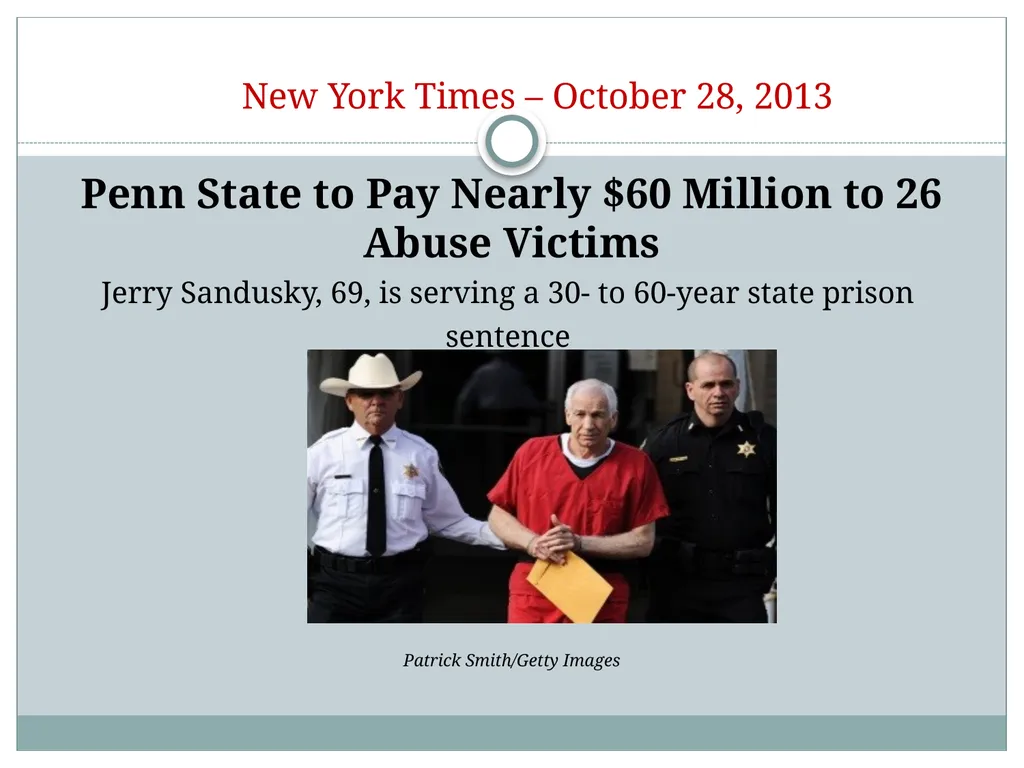
New York Times – October 28, 2013 Penn State to Pay Nearly $60 Million to 26 Abuse Victims
Jerry Sandusky, 69, is serving a 30- to 60-year state prison
sentence
Patrick Smith/Getty Images<br>
Jerry Sandusky, 69, is serving a 30- to 60-year state prison
sentence
Patrick Smith/Getty Images<br>
15
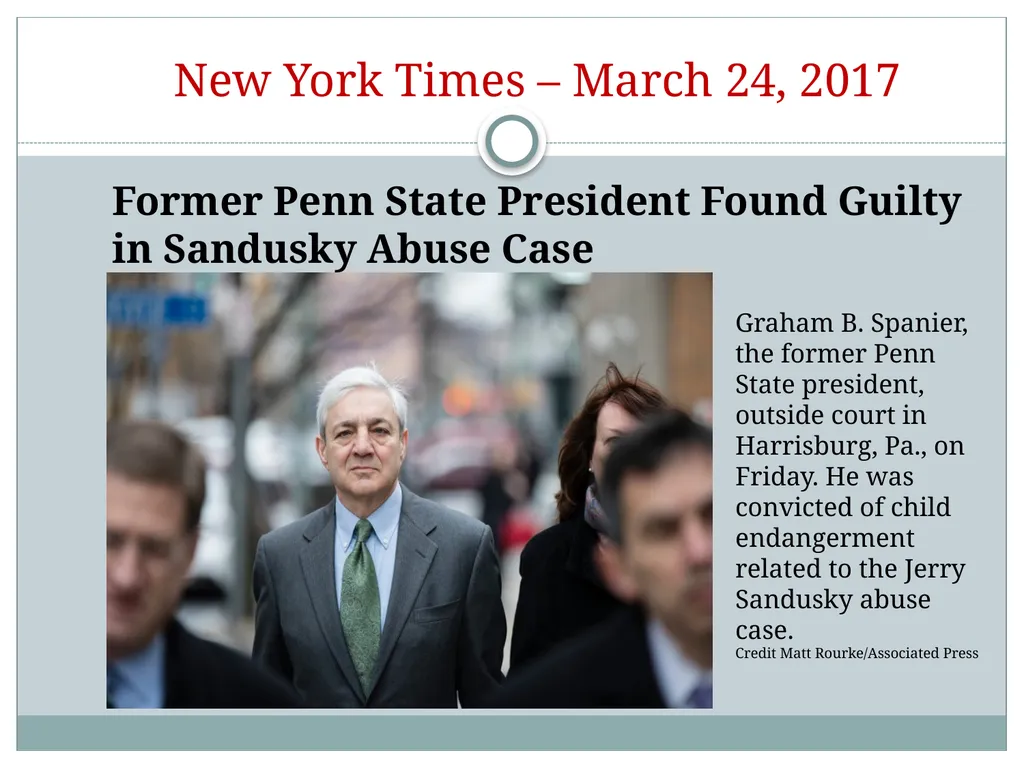
New York Times – March 24, 2017 Former Penn State President Found Guilty in Sandusky Abuse Case Graham B. Spanier, the former Penn State president, outside court in Harrisburg, Pa., on Friday. He was convicted of child endangerment related to the Jerry Sandusky abuse case.
Credit Matt Rourke/Associated Press<br>
Credit Matt Rourke/Associated Press<br>
16
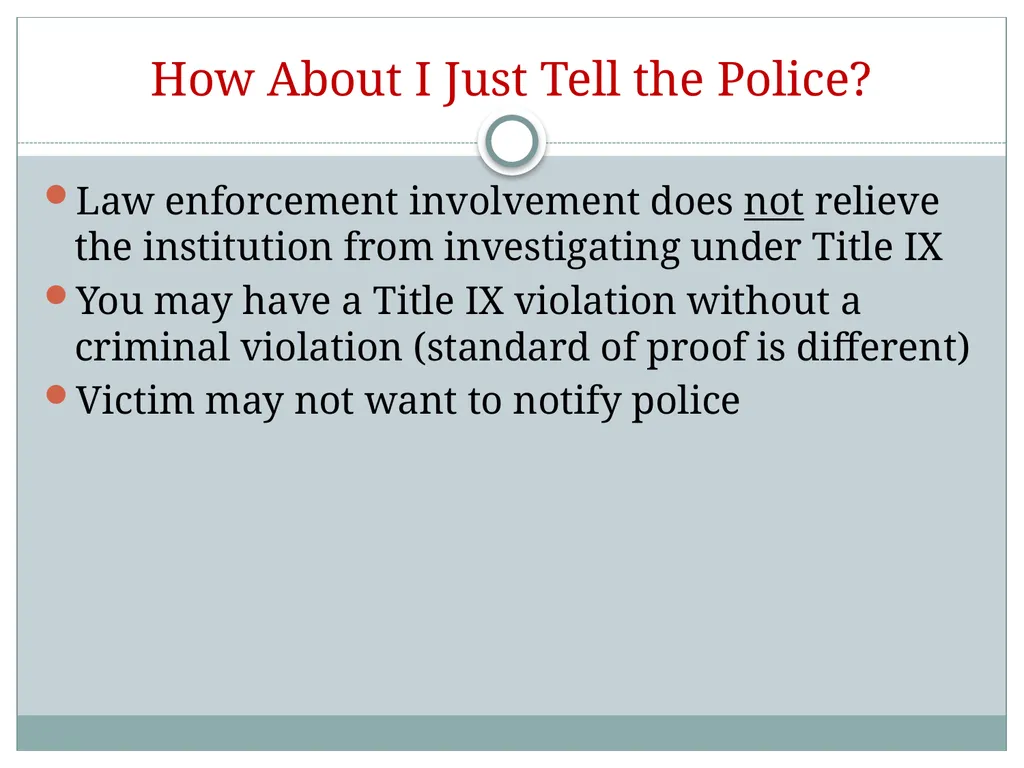
How About I Just Tell the Police? Law enforcement involvement does not relieve the institution from investigating under Title IX
You may have a Title IX violation without a criminal violation (standard of proof is different)
Victim may not want to notify police<br>
You may have a Title IX violation without a criminal violation (standard of proof is different)
Victim may not want to notify police<br>
17
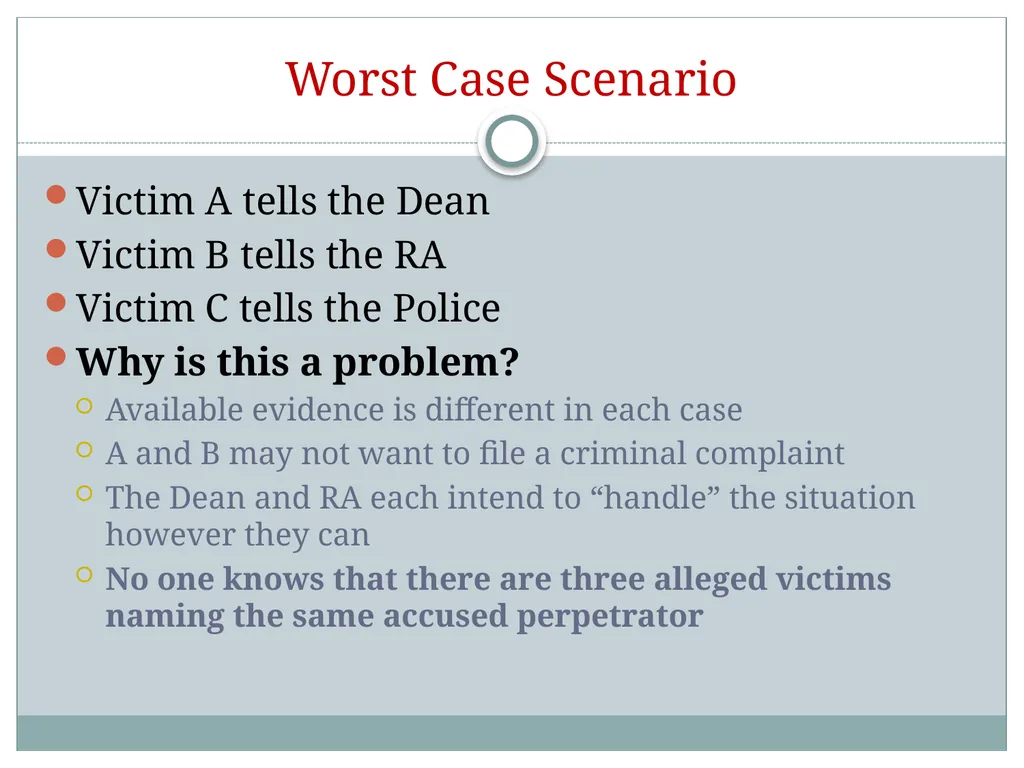
Worst Case Scenario Victim A tells the Dean
Victim B tells the RA
Victim C tells the Police
Why is this a problem?
Available evidence is different in each case
A and B may not want to file a criminal complaint
The Dean and RA each intend to “handle” the situation however they can
No one knows that there are three alleged victims naming the same accused perpetrator<br>
Victim B tells the RA
Victim C tells the Police
Why is this a problem?
Available evidence is different in each case
A and B may not want to file a criminal complaint
The Dean and RA each intend to “handle” the situation however they can
No one knows that there are three alleged victims naming the same accused perpetrator<br>
18
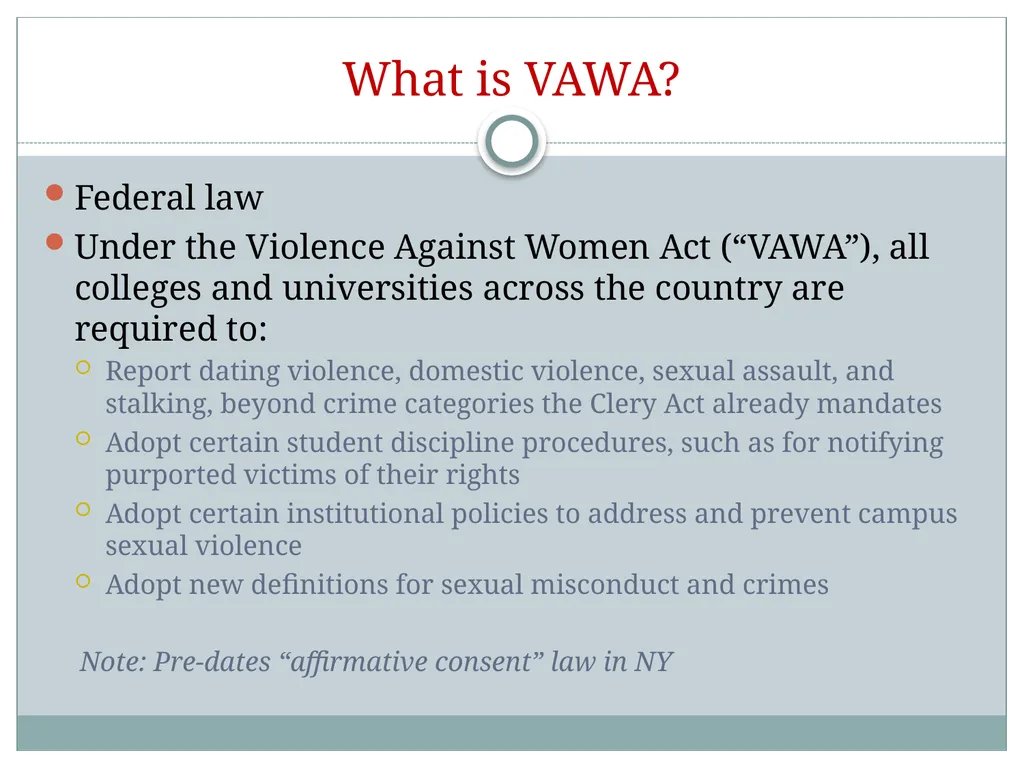
What is VAWA? Federal law
Under the Violence Against Women Act (“VAWA”), all colleges and universities across the country are required to:
Report dating violence, domestic violence, sexual assault, and stalking, beyond crime categories the Clery Act already mandates
Adopt certain student discipline procedures, such as for notifying purported victims of their rights
Adopt certain institutional policies to address and prevent campus sexual violence
Adopt new definitions for sexual misconduct and crimes
Note: Pre-dates “affirmative consent” law in NY<br>
Under the Violence Against Women Act (“VAWA”), all colleges and universities across the country are required to:
Report dating violence, domestic violence, sexual assault, and stalking, beyond crime categories the Clery Act already mandates
Adopt certain student discipline procedures, such as for notifying purported victims of their rights
Adopt certain institutional policies to address and prevent campus sexual violence
Adopt new definitions for sexual misconduct and crimes
Note: Pre-dates “affirmative consent” law in NY<br>
19
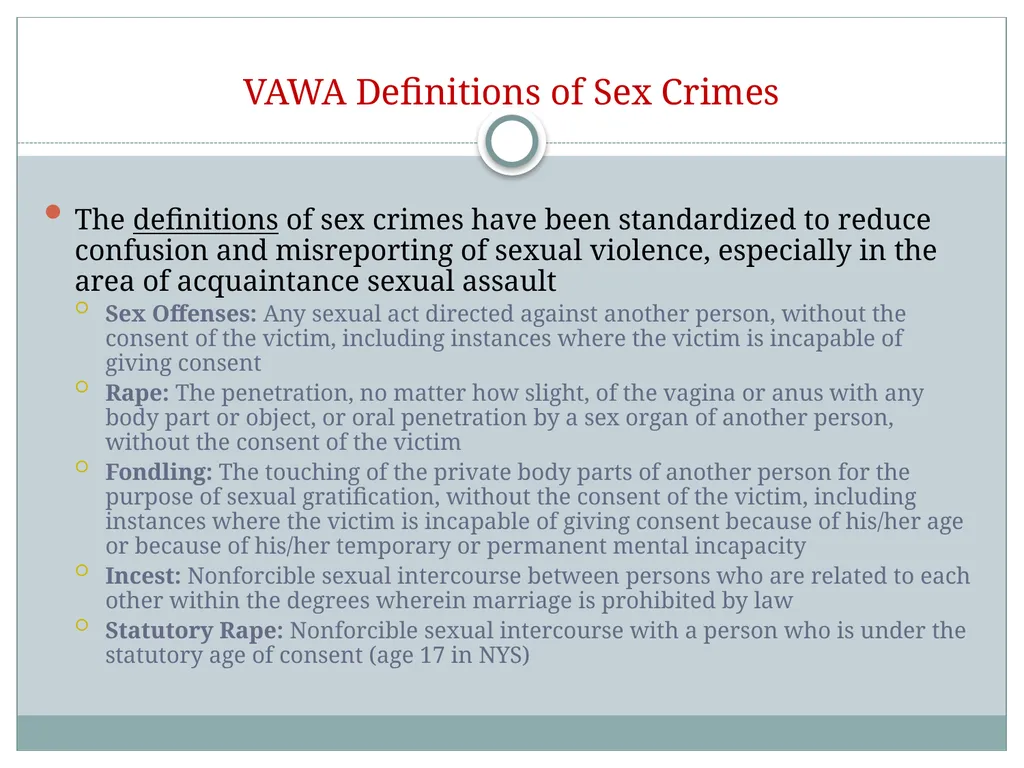
VAWA Definitions of Sex Crimes The definitions of sex crimes have been standardized to reduce confusion and misreporting of sexual violence, especially in the area of acquaintance sexual assault
Sex Offenses: Any sexual act directed against another person, without the consent of the victim, including instances where the victim is incapable of giving consent
Rape: The penetration, no matter how slight, of the vagina or anus with any body part or object, or oral penetration by a sex organ of another person, without the consent of the victim
Fondling: The touching of the private body parts of another person for the purpose of sexual gratification, without the consent of the victim, including instances where the victim is incapable of giving consent because of his/her age or because of his/her temporary or permanent mental incapacity
Incest: Nonforcible sexual intercourse between persons who are related to each other within the degrees wherein marriage is prohibited by law
Statutory Rape: Nonforcible sexual intercourse with a person who is under the statutory age of consent (age 17 in NYS)<br>
Sex Offenses: Any sexual act directed against another person, without the consent of the victim, including instances where the victim is incapable of giving consent
Rape: The penetration, no matter how slight, of the vagina or anus with any body part or object, or oral penetration by a sex organ of another person, without the consent of the victim
Fondling: The touching of the private body parts of another person for the purpose of sexual gratification, without the consent of the victim, including instances where the victim is incapable of giving consent because of his/her age or because of his/her temporary or permanent mental incapacity
Incest: Nonforcible sexual intercourse between persons who are related to each other within the degrees wherein marriage is prohibited by law
Statutory Rape: Nonforcible sexual intercourse with a person who is under the statutory age of consent (age 17 in NYS)<br>
20
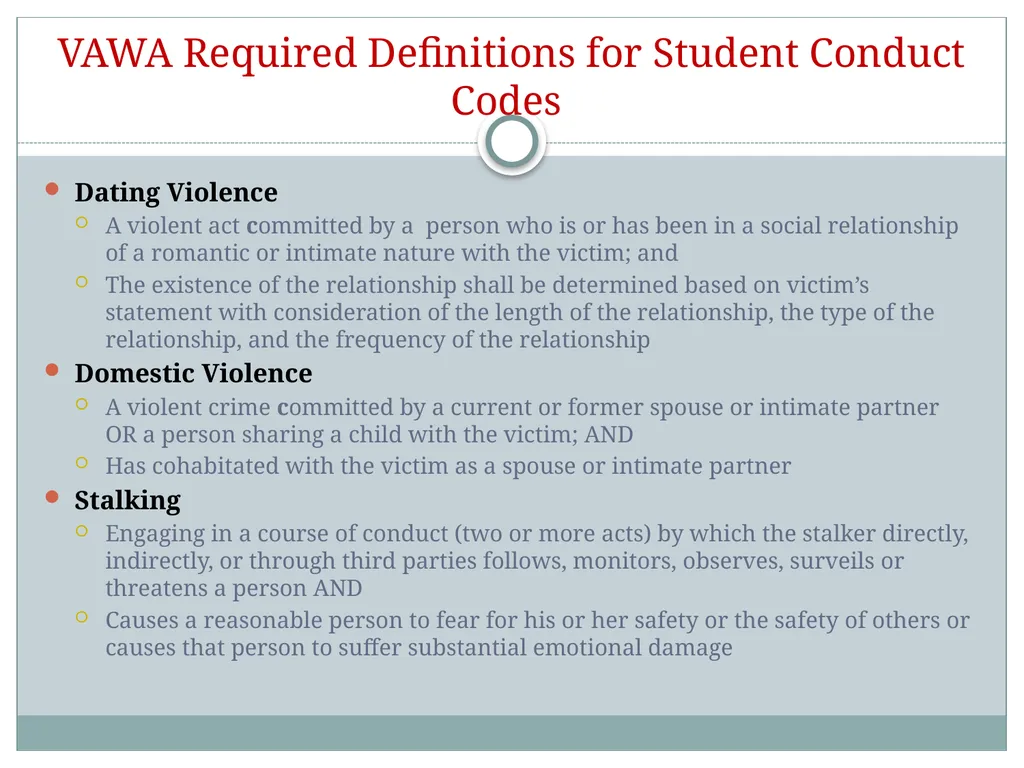
VAWA Required Definitions for Student Conduct Codes Dating Violence
A violent act committed by a person who is or has been in a social relationship of a romantic or intimate nature with the victim; and
The existence of the relationship shall be determined based on victim’s statement with consideration of the length of the relationship, the type of the relationship, and the frequency of the relationship
Domestic Violence
A violent crime committed by a current or former spouse or intimate partner OR a person sharing a child with the victim; AND
Has cohabitated with the victim as a spouse or intimate partner
Stalking
Engaging in a course of conduct (two or more acts) by which the stalker directly, indirectly, or through third parties follows, monitors, observes, surveils or threatens a person AND
Causes a reasonable person to fear for his or her safety or the safety of others or causes that person to suffer substantial emotional damage<br>
A violent act committed by a person who is or has been in a social relationship of a romantic or intimate nature with the victim; and
The existence of the relationship shall be determined based on victim’s statement with consideration of the length of the relationship, the type of the relationship, and the frequency of the relationship
Domestic Violence
A violent crime committed by a current or former spouse or intimate partner OR a person sharing a child with the victim; AND
Has cohabitated with the victim as a spouse or intimate partner
Stalking
Engaging in a course of conduct (two or more acts) by which the stalker directly, indirectly, or through third parties follows, monitors, observes, surveils or threatens a person AND
Causes a reasonable person to fear for his or her safety or the safety of others or causes that person to suffer substantial emotional damage<br>
21
Washington Post – August 30, 2012 George Huguely V sentenced to 23 years for Yeardley Love murder George Hughely V found guilty of second degree murder: A jury convicted the former U-Va. lacrosse player in the 2011 death of his onetime girlfriend Yeardley Love<br>
22
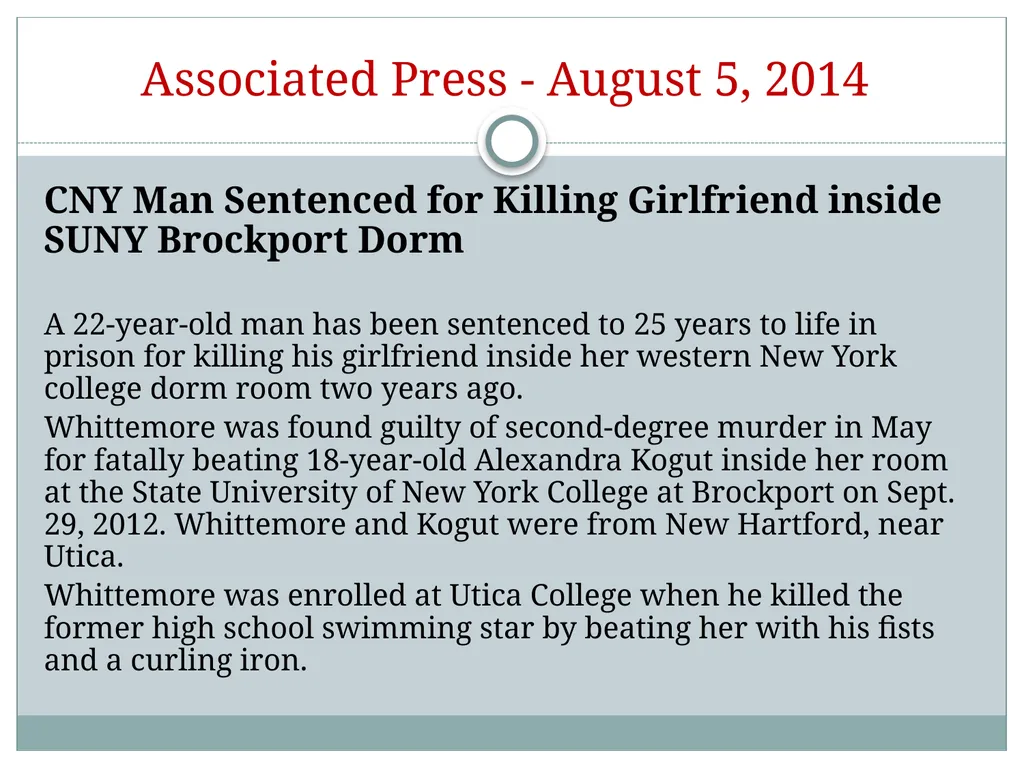
Associated Press - August 5, 2014 CNY Man Sentenced for Killing Girlfriend inside SUNY Brockport Dorm
A 22-year-old man has been sentenced to 25 years to life in prison for killing his girlfriend inside her western New York college dorm room two years ago.
Whittemore was found guilty of second-degree murder in May for fatally beating 18-year-old Alexandra Kogut inside her room at the State University of New York College at Brockport on Sept. 29, 2012. Whittemore and Kogut were from New Hartford, near Utica.
Whittemore was enrolled at Utica College when he killed the former high school swimming star by beating her with his fists and a curling iron.<br>
A 22-year-old man has been sentenced to 25 years to life in prison for killing his girlfriend inside her western New York college dorm room two years ago.
Whittemore was found guilty of second-degree murder in May for fatally beating 18-year-old Alexandra Kogut inside her room at the State University of New York College at Brockport on Sept. 29, 2012. Whittemore and Kogut were from New Hartford, near Utica.
Whittemore was enrolled at Utica College when he killed the former high school swimming star by beating her with his fists and a curling iron.<br>
23
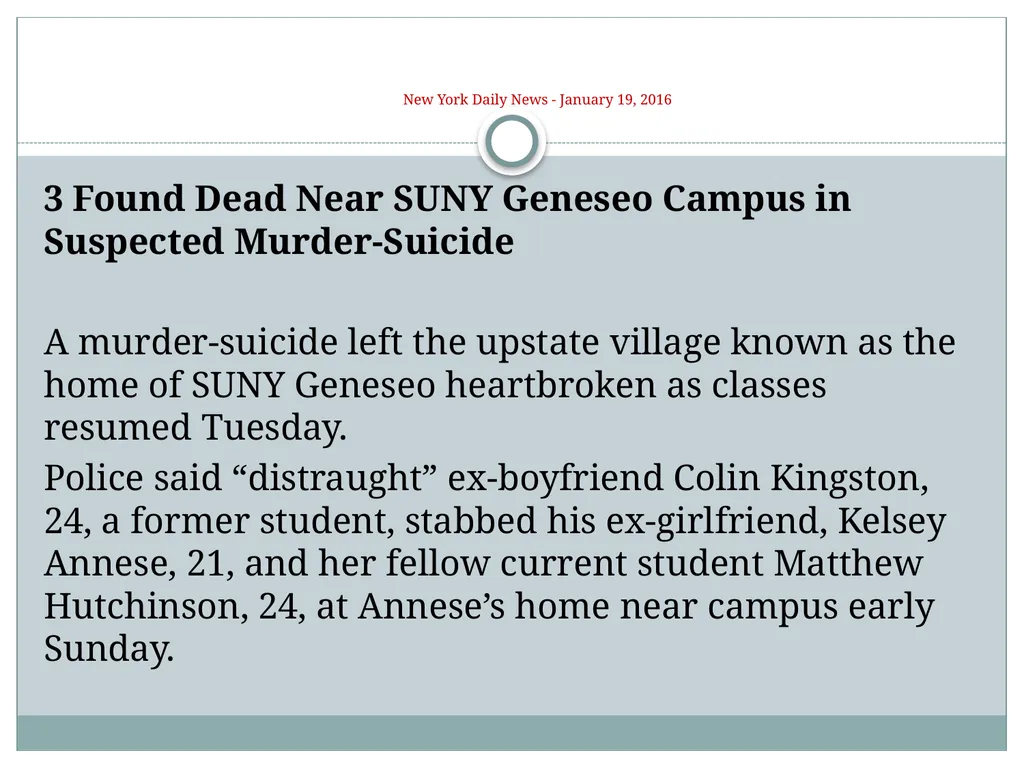
New York Daily News - January 19, 2016 3 Found Dead Near SUNY Geneseo Campus in Suspected Murder-Suicide
A murder-suicide left the upstate village known as the home of SUNY Geneseo heartbroken as classes resumed Tuesday.
Police said “distraught” ex-boyfriend Colin Kingston, 24, a former student, stabbed his ex-girlfriend, Kelsey Annese, 21, and her fellow current student Matthew Hutchinson, 24, at Annese’s home near campus early Sunday.<br>
A murder-suicide left the upstate village known as the home of SUNY Geneseo heartbroken as classes resumed Tuesday.
Police said “distraught” ex-boyfriend Colin Kingston, 24, a former student, stabbed his ex-girlfriend, Kelsey Annese, 21, and her fellow current student Matthew Hutchinson, 24, at Annese’s home near campus early Sunday.<br>
24
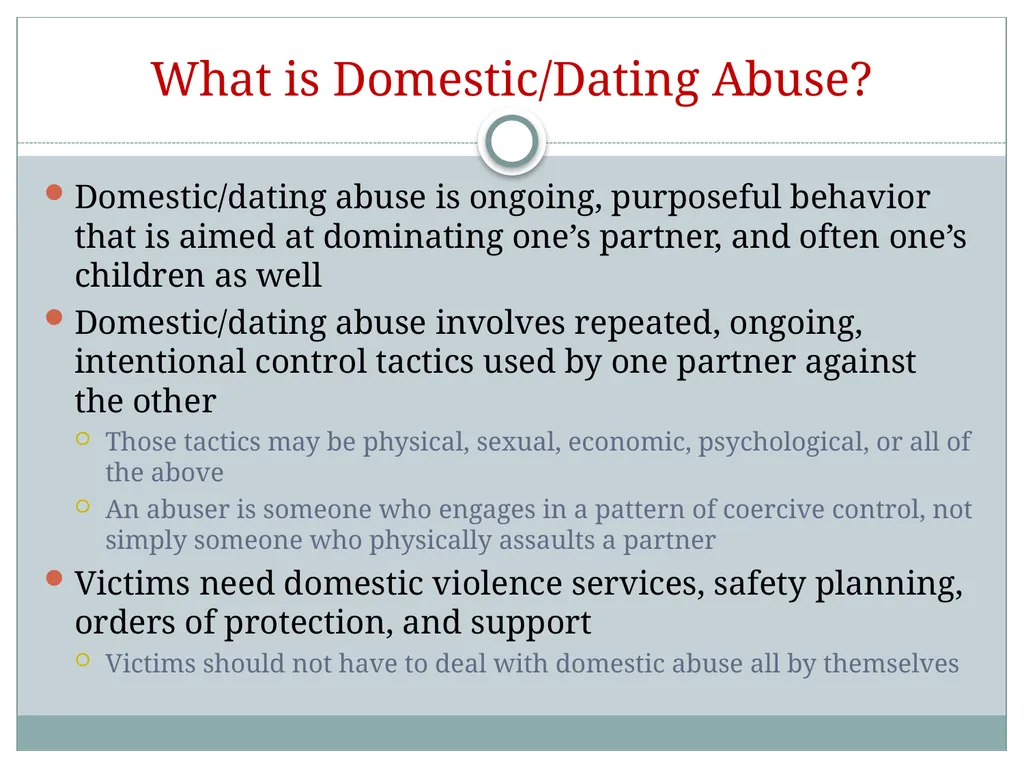
What is Domestic/Dating Abuse? Domestic/dating abuse is ongoing, purposeful behavior that is aimed at dominating one’s partner, and often one’s children as well
Domestic/dating abuse involves repeated, ongoing, intentional control tactics used by one partner against the other
Those tactics may be physical, sexual, economic, psychological, or all of the above
An abuser is someone who engages in a pattern of coercive control, not simply someone who physically assaults a partner
Victims need domestic violence services, safety planning, orders of protection, and support
Victims should not have to deal with domestic abuse all by themselves<br>
Domestic/dating abuse involves repeated, ongoing, intentional control tactics used by one partner against the other
Those tactics may be physical, sexual, economic, psychological, or all of the above
An abuser is someone who engages in a pattern of coercive control, not simply someone who physically assaults a partner
Victims need domestic violence services, safety planning, orders of protection, and support
Victims should not have to deal with domestic abuse all by themselves<br>
25
“Yes! Yes! Oh, yes!” Affirmative Consent –
“You Know It When You Hear It!”<br>
26
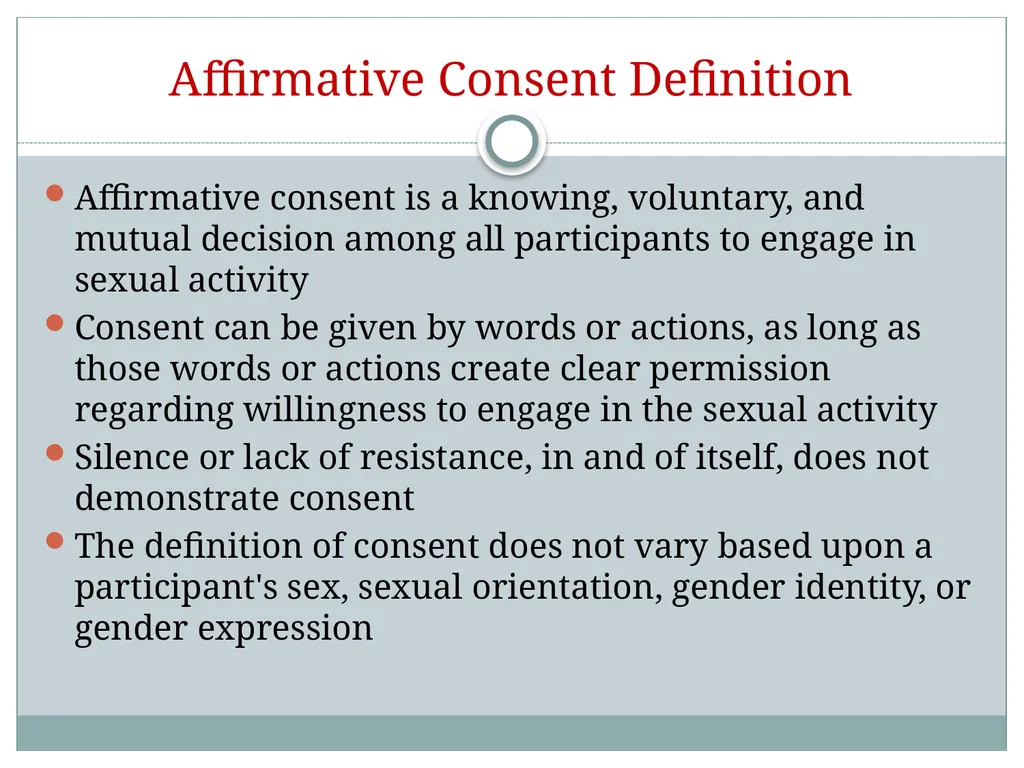
Affirmative Consent Definition Affirmative consent is a knowing, voluntary, and mutual decision among all participants to engage in sexual activity
Consent can be given by words or actions, as long as those words or actions create clear permission regarding willingness to engage in the sexual activity
Silence or lack of resistance, in and of itself, does not demonstrate consent
The definition of consent does not vary based upon a participant's sex, sexual orientation, gender identity, or gender expression<br>
Consent can be given by words or actions, as long as those words or actions create clear permission regarding willingness to engage in the sexual activity
Silence or lack of resistance, in and of itself, does not demonstrate consent
The definition of consent does not vary based upon a participant's sex, sexual orientation, gender identity, or gender expression<br>
27
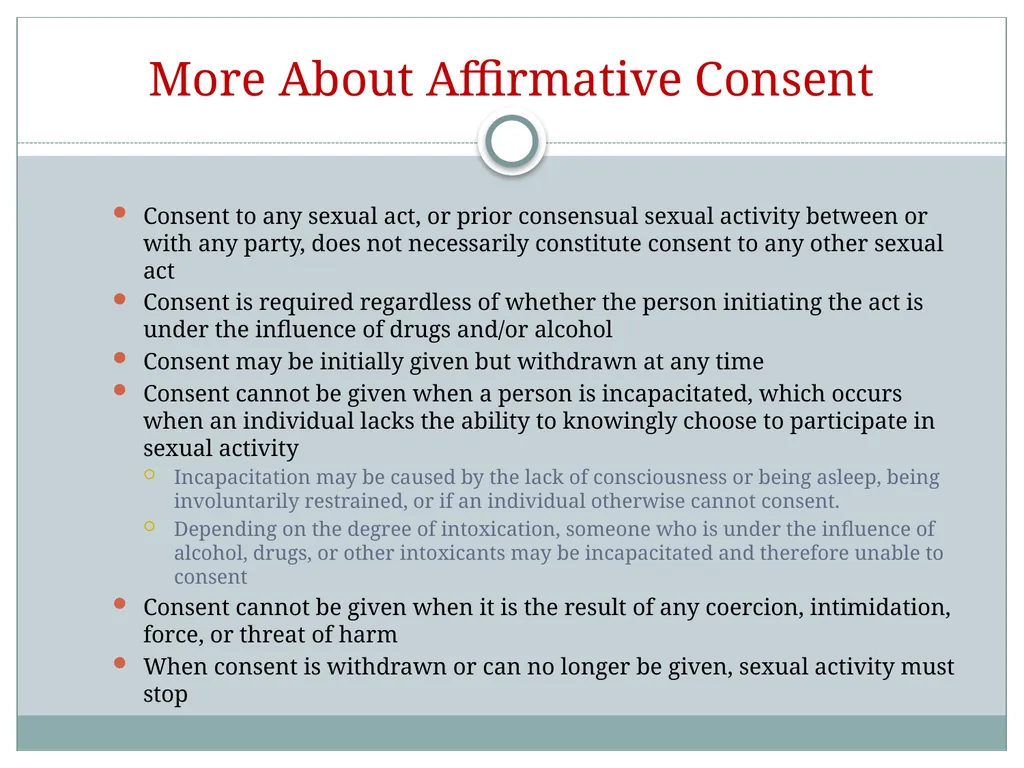
More About Affirmative Consent Consent to any sexual act, or prior consensual sexual activity between or with any party, does not necessarily constitute consent to any other sexual act
Consent is required regardless of whether the person initiating the act is under the influence of drugs and/or alcohol
Consent may be initially given but withdrawn at any time
Consent cannot be given when a person is incapacitated, which occurs when an individual lacks the ability to knowingly choose to participate in sexual activity
Incapacitation may be caused by the lack of consciousness or being asleep, being involuntarily restrained, or if an individual otherwise cannot consent.
Depending on the degree of intoxication, someone who is under the influence of alcohol, drugs, or other intoxicants may be incapacitated and therefore unable to consent
Consent cannot be given when it is the result of any coercion, intimidation, force, or threat of harm
When consent is withdrawn or can no longer be given, sexual activity must stop<br>
Consent is required regardless of whether the person initiating the act is under the influence of drugs and/or alcohol
Consent may be initially given but withdrawn at any time
Consent cannot be given when a person is incapacitated, which occurs when an individual lacks the ability to knowingly choose to participate in sexual activity
Incapacitation may be caused by the lack of consciousness or being asleep, being involuntarily restrained, or if an individual otherwise cannot consent.
Depending on the degree of intoxication, someone who is under the influence of alcohol, drugs, or other intoxicants may be incapacitated and therefore unable to consent
Consent cannot be given when it is the result of any coercion, intimidation, force, or threat of harm
When consent is withdrawn or can no longer be given, sexual activity must stop<br>
28
Tea Analogy Video:
https://www.youtube.com/watch?v=oQbei5JGiT8<br>
https://www.youtube.com/watch?v=oQbei5JGiT8<br>
29
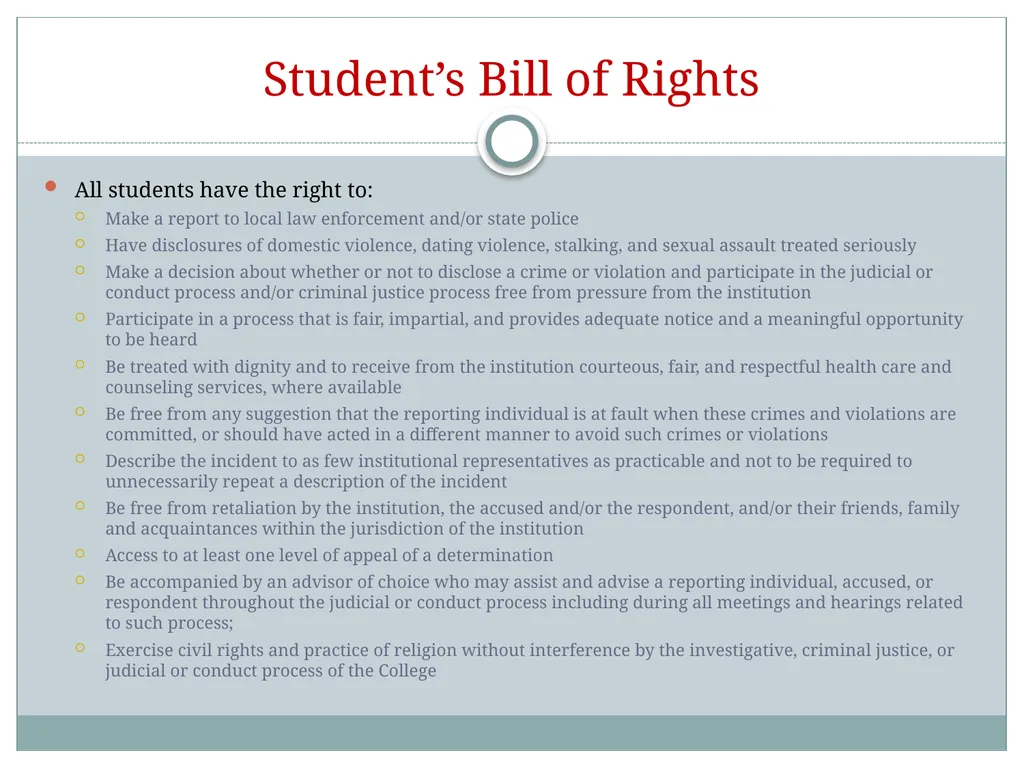
Student’s Bill of Rights All students have the right to:
Make a report to local law enforcement and/or state police
Have disclosures of domestic violence, dating violence, stalking, and sexual assault treated seriously
Make a decision about whether or not to disclose a crime or violation and participate in the judicial or conduct process and/or criminal justice process free from pressure from the institution
Participate in a process that is fair, impartial, and provides adequate notice and a meaningful opportunity to be heard
Be treated with dignity and to receive from the institution courteous, fair, and respectful health care and counseling services, where available
Be free from any suggestion that the reporting individual is at fault when these crimes and violations are committed, or should have acted in a different manner to avoid such crimes or violations
Describe the incident to as few institutional representatives as practicable and not to be required to unnecessarily repeat a description of the incident
Be free from retaliation by the institution, the accused and/or the respondent, and/or their friends, family and acquaintances within the jurisdiction of the institution
Access to at least one level of appeal of a determination
Be accompanied by an advisor of choice who may assist and advise a reporting individual, accused, or respondent throughout the judicial or conduct process including during all meetings and hearings related to such process;
Exercise civil rights and practice of religion without interference by the investigative, criminal justice, or judicial or conduct process of the College<br>
Make a report to local law enforcement and/or state police
Have disclosures of domestic violence, dating violence, stalking, and sexual assault treated seriously
Make a decision about whether or not to disclose a crime or violation and participate in the judicial or conduct process and/or criminal justice process free from pressure from the institution
Participate in a process that is fair, impartial, and provides adequate notice and a meaningful opportunity to be heard
Be treated with dignity and to receive from the institution courteous, fair, and respectful health care and counseling services, where available
Be free from any suggestion that the reporting individual is at fault when these crimes and violations are committed, or should have acted in a different manner to avoid such crimes or violations
Describe the incident to as few institutional representatives as practicable and not to be required to unnecessarily repeat a description of the incident
Be free from retaliation by the institution, the accused and/or the respondent, and/or their friends, family and acquaintances within the jurisdiction of the institution
Access to at least one level of appeal of a determination
Be accompanied by an advisor of choice who may assist and advise a reporting individual, accused, or respondent throughout the judicial or conduct process including during all meetings and hearings related to such process;
Exercise civil rights and practice of religion without interference by the investigative, criminal justice, or judicial or conduct process of the College<br>
30
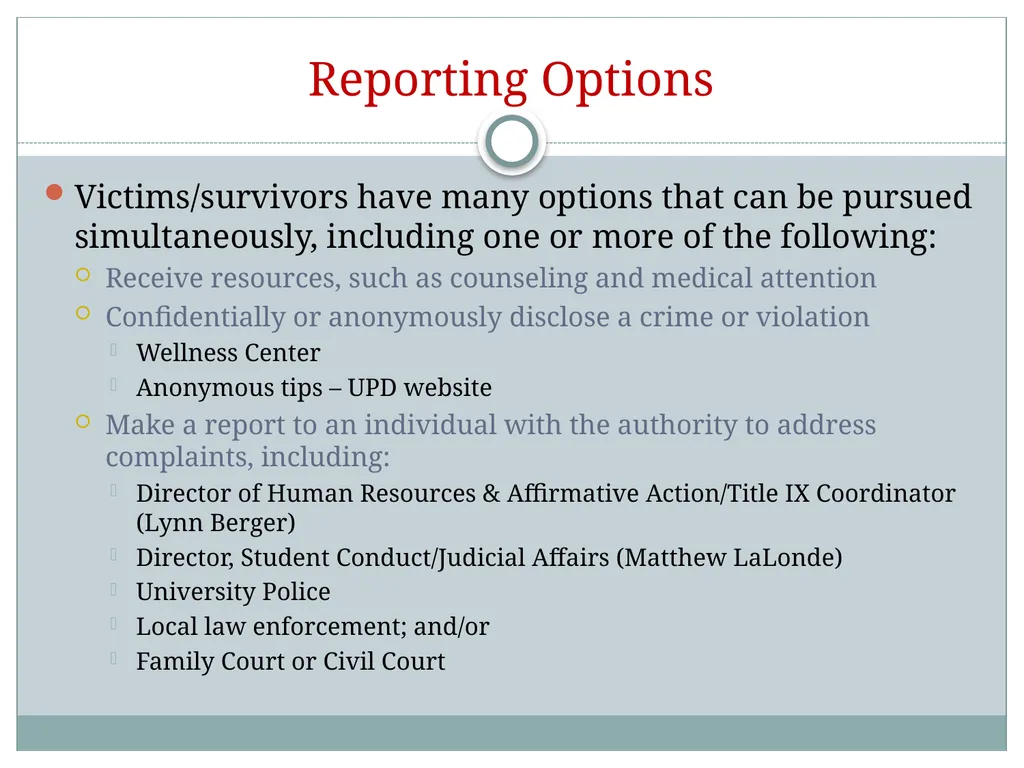
Reporting Options Victims/survivors have many options that can be pursued simultaneously, including one or more of the following:
Receive resources, such as counseling and medical attention
Confidentially or anonymously disclose a crime or violation
Wellness Center
Anonymous tips – UPD website
Make a report to an individual with the authority to address complaints, including:
Director of Human Resources & Affirmative Action/Title IX Coordinator (Lynn Berger)
Director, Student Conduct/Judicial Affairs (Matthew LaLonde)
University Police
Local law enforcement; and/or
Family Court or Civil Court<br>
Receive resources, such as counseling and medical attention
Confidentially or anonymously disclose a crime or violation
Wellness Center
Anonymous tips – UPD website
Make a report to an individual with the authority to address complaints, including:
Director of Human Resources & Affirmative Action/Title IX Coordinator (Lynn Berger)
Director, Student Conduct/Judicial Affairs (Matthew LaLonde)
University Police
Local law enforcement; and/or
Family Court or Civil Court<br>
31
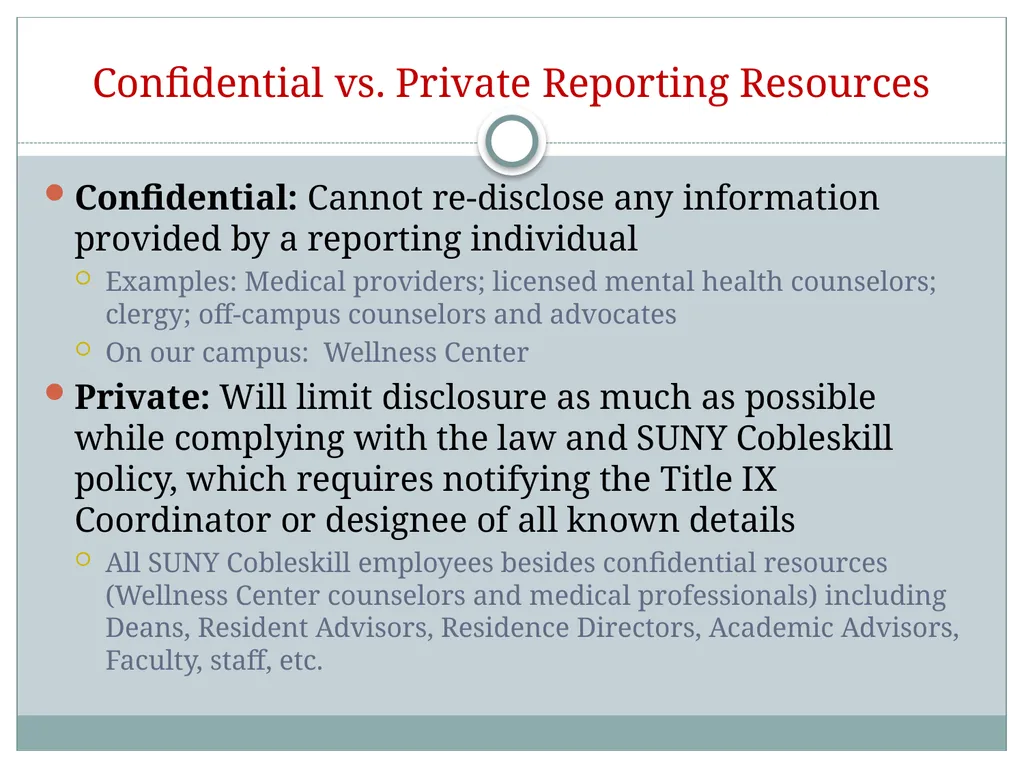
Confidential vs. Private Reporting Resources Confidential: Cannot re-disclose any information provided by a reporting individual
Examples: Medical providers; licensed mental health counselors; clergy; off-campus counselors and advocates
On our campus: Wellness Center
Private: Will limit disclosure as much as possible while complying with the law and SUNY Cobleskill policy, which requires notifying the Title IX Coordinator or designee of all known details
All SUNY Cobleskill employees besides confidential resources (Wellness Center counselors and medical professionals) including Deans, Resident Advisors, Residence Directors, Academic Advisors, Faculty, staff, etc.<br>
Examples: Medical providers; licensed mental health counselors; clergy; off-campus counselors and advocates
On our campus: Wellness Center
Private: Will limit disclosure as much as possible while complying with the law and SUNY Cobleskill policy, which requires notifying the Title IX Coordinator or designee of all known details
All SUNY Cobleskill employees besides confidential resources (Wellness Center counselors and medical professionals) including Deans, Resident Advisors, Residence Directors, Academic Advisors, Faculty, staff, etc.<br>
32
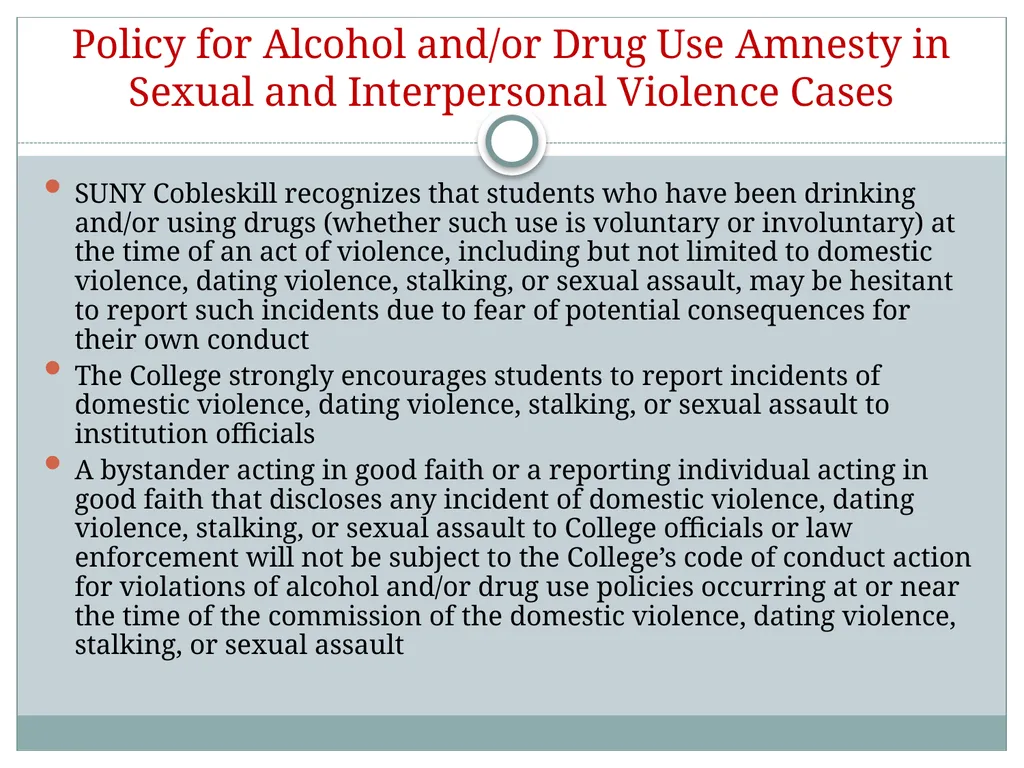
Policy for Alcohol and/or Drug Use Amnesty in Sexual and Interpersonal Violence Cases SUNY Cobleskill recognizes that students who have been drinking and/or using drugs (whether such use is voluntary or involuntary) at the time of an act of violence, including but not limited to domestic violence, dating violence, stalking, or sexual assault, may be hesitant to report such incidents due to fear of potential consequences for their own conduct
The College strongly encourages students to report incidents of domestic violence, dating violence, stalking, or sexual assault to institution officials
A bystander acting in good faith or a reporting individual acting in good faith that discloses any incident of domestic violence, dating violence, stalking, or sexual assault to College officials or law enforcement will not be subject to the College’s code of conduct action for violations of alcohol and/or drug use policies occurring at or near the time of the commission of the domestic violence, dating violence, stalking, or sexual assault<br>
The College strongly encourages students to report incidents of domestic violence, dating violence, stalking, or sexual assault to institution officials
A bystander acting in good faith or a reporting individual acting in good faith that discloses any incident of domestic violence, dating violence, stalking, or sexual assault to College officials or law enforcement will not be subject to the College’s code of conduct action for violations of alcohol and/or drug use policies occurring at or near the time of the commission of the domestic violence, dating violence, stalking, or sexual assault<br>
33
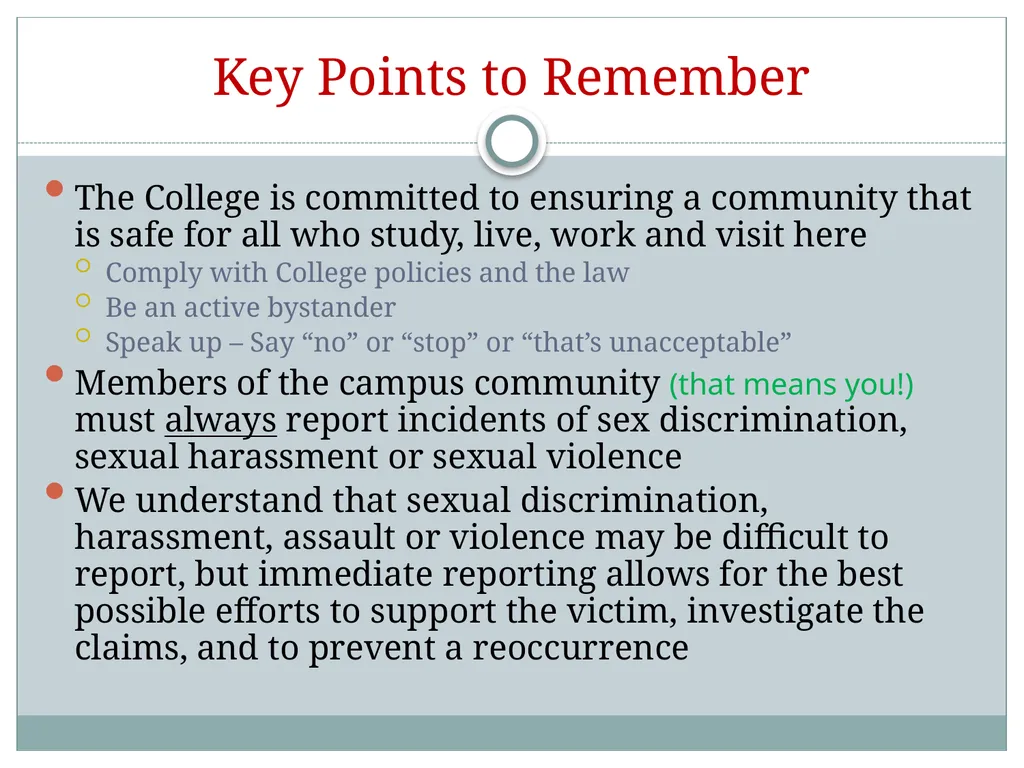
Key Points to Remember The College is committed to ensuring a community that is safe for all who study, live, work and visit here
Comply with College policies and the law
Be an active bystander
Speak up – Say “no” or “stop” or “that’s unacceptable”
Members of the campus community (that means you!) must always report incidents of sex discrimination, sexual harassment or sexual violence
We understand that sexual discrimination, harassment, assault or violence may be difficult to report, but immediate reporting allows for the best possible efforts to support the victim, investigate the claims, and to prevent a reoccurrence<br>
Comply with College policies and the law
Be an active bystander
Speak up – Say “no” or “stop” or “that’s unacceptable”
Members of the campus community (that means you!) must always report incidents of sex discrimination, sexual harassment or sexual violence
We understand that sexual discrimination, harassment, assault or violence may be difficult to report, but immediate reporting allows for the best possible efforts to support the victim, investigate the claims, and to prevent a reoccurrence<br>
34
For More Information… Extensive resources are available at: www.cobleskill.edu/titleix<br>
35
SUNY Cobleskill
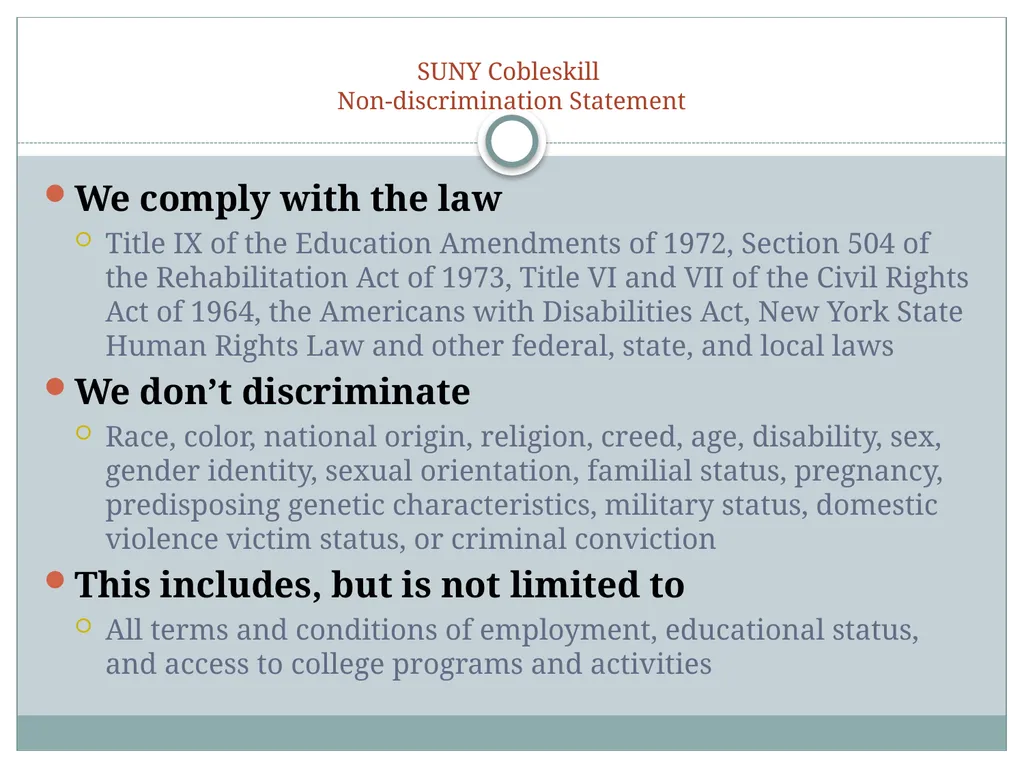
Non-discrimination Statement We comply with the law
Title IX of the Education Amendments of 1972, Section 504 of the Rehabilitation Act of 1973, Title VI and VII of the Civil Rights Act of 1964, the Americans with Disabilities Act, New York State Human Rights Law and other federal, state, and local laws
We don’t discriminate
Race, color, national origin, religion, creed, age, disability, sex, gender identity, sexual orientation, familial status, pregnancy, predisposing genetic characteristics, military status, domestic violence victim status, or criminal conviction
This includes, but is not limited to
All terms and conditions of employment, educational status, and access to college programs and activities<br>
Title IX of the Education Amendments of 1972, Section 504 of the Rehabilitation Act of 1973, Title VI and VII of the Civil Rights Act of 1964, the Americans with Disabilities Act, New York State Human Rights Law and other federal, state, and local laws
We don’t discriminate
Race, color, national origin, religion, creed, age, disability, sex, gender identity, sexual orientation, familial status, pregnancy, predisposing genetic characteristics, military status, domestic violence victim status, or criminal conviction
This includes, but is not limited to
All terms and conditions of employment, educational status, and access to college programs and activities<br>
36
Contact Information Questions or concerns regarding Title IX or any other aspects of SUNY Cobleskill's non-discrimination policies:
Lynn Berger, Director of Human Resources and Affirmative Action (Title IX Coordinator)
Knapp Hall 123 / 518-255-5465 / bergerla@cobleskill.edu<br>
Lynn Berger, Director of Human Resources and Affirmative Action (Title IX Coordinator)
Knapp Hall 123 / 518-255-5465 / bergerla@cobleskill.edu<br>