TITLE Retrieval DNA Brainstorm as many things as you can remember about the context of AIC Make a list of characters and add one word to describe what they represent about society. Lesson 1: Charge of the Light Brigade Learning Objective:
"TITLE = Retrieval DNA Brainstorm as many things as" is the property of its rightful owner. Permission is granted to
download and print the materials on this website for personal, non-commercial use only, and to display it
on your personal computer provided you do not modify the materials and that you retain all copyright
notices contained in the materials. By downloading content from our website, you accept the terms of this
agreement.
Presentation Transcript
01
TITLE = Retrieval DNA Brainstorm as many things as you can remember about the context of AIC
Make a list of characters and add one word to describe what they represent about society.<br>
02
Lesson 1: Charge of the Light Brigade Learning Objective: To begin to explore the poem<br>
03
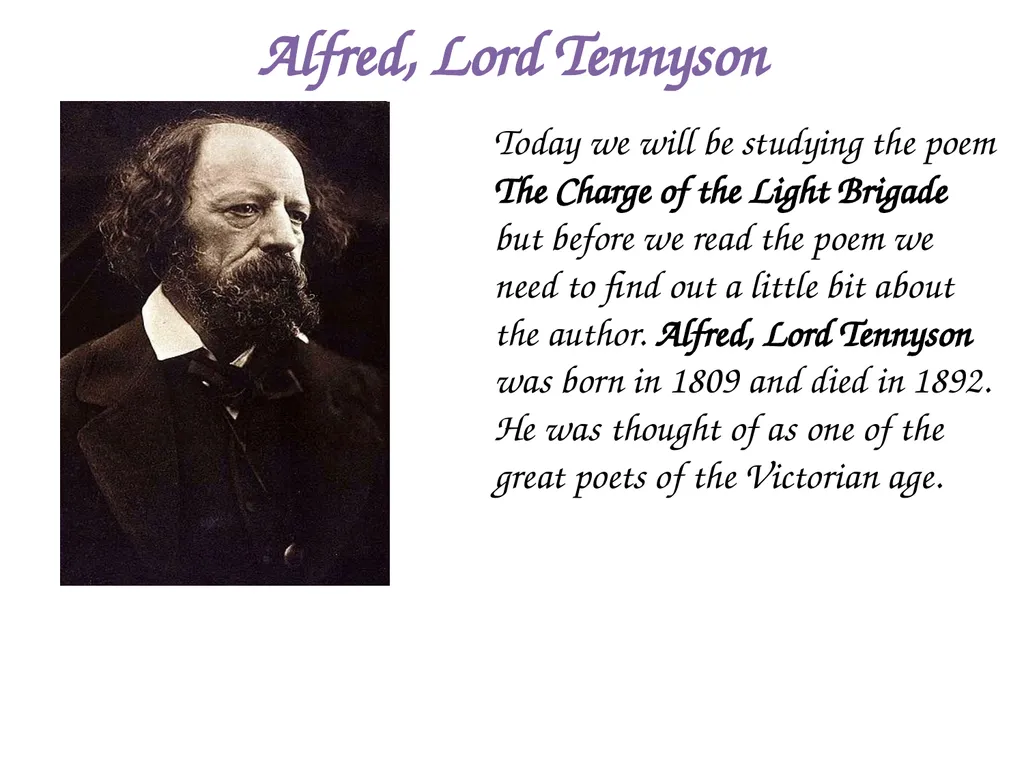
Alfred, Lord Tennyson Today we will be studying the poem The Charge of the Light Brigade but before we read the poem we need to find out a little bit about the author. Alfred, Lord Tennyson was born in 1809 and died in 1892. He was thought of as one of the great poets of the Victorian age.<br>
04
Social and Historical Context The poem is based on an actual historical event. It is set in 1854 during the Crimean War.
It describes a terrible battle, the Battle of Balaclava, in which a mistake made by the commanding officer led to the deaths of many soldiers.
Tennyson wrote the poem after reading about the battle in a newspaper.<br>
05
“The Charge of the Light Brigade” recalls a disastrous military situation that took place during the initial phase of the Crimean War fought between Turkey and Russia (1854-56).
Under the command of Lord Raglan, British forces entered the war in September 1854 to stop the Russians.
From the beginning, the war was plagued by a series of misunderstandings and errors, one of which serves as the subject of this poem
On October 25, 1854, Lord Raglan sent desperate orders to his Light Cavalry Brigade to fend off the Russians.
The brigade began charging—but in the wrong direction! Over 650 men rushed forward, and well over 100 died within the next few minutes.
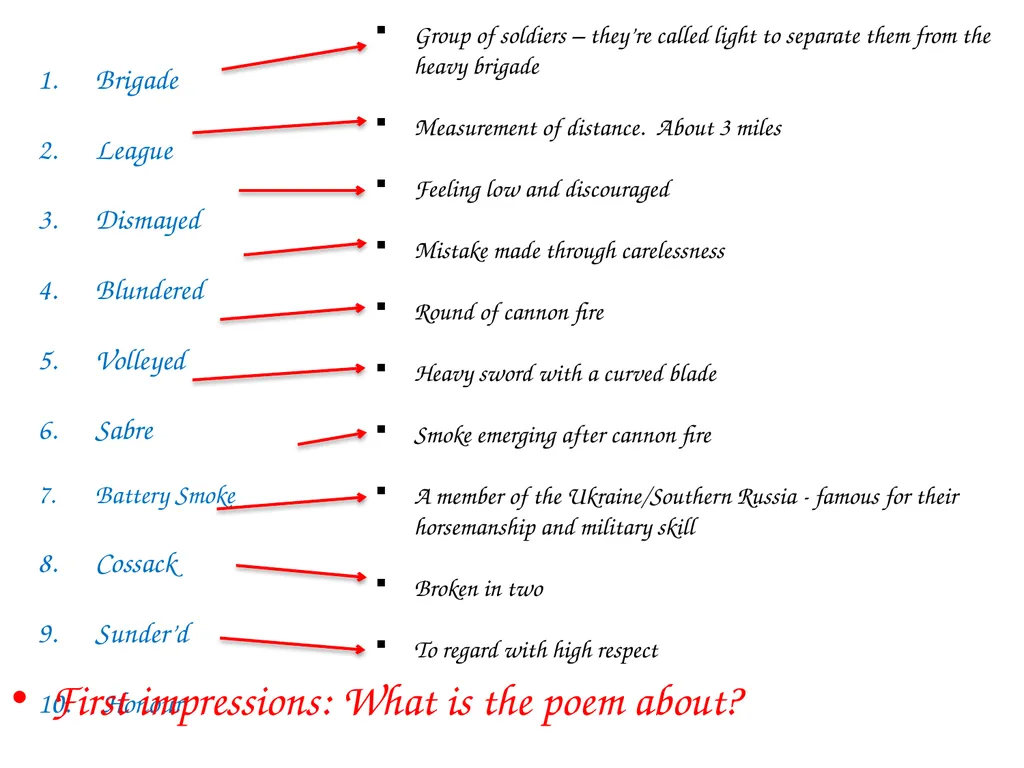
Brigade
League
Dismayed
Blundered
Volleyed
Sabre
Battery Smoke
Cossack
Sunder’d
Honour Group of soldiers – they’re called light to separate them from the heavy brigade
Measurement of distance. About 3 miles
Feeling low and discouraged
Mistake made through carelessness
Round of cannon fire
Heavy sword with a curved blade
Smoke emerging after cannon fire
A member of the Ukraine/Southern Russia - famous for their horsemanship and military skill
Broken in two
To regard with high respect First impressions: What is the poem about?<br>
07
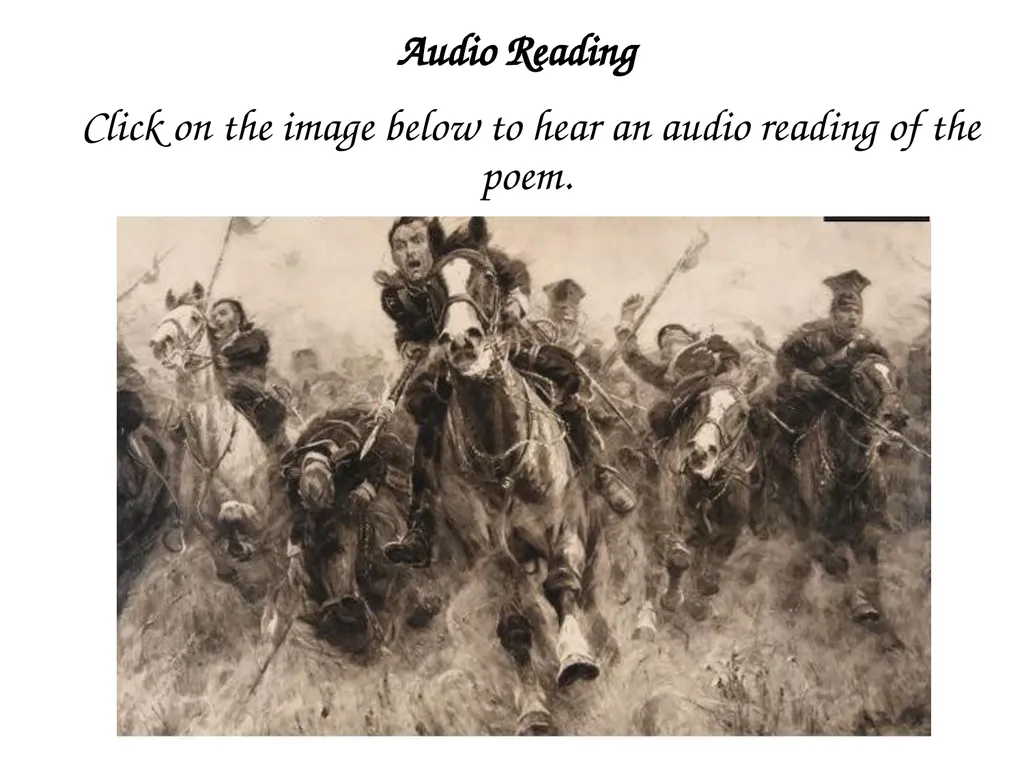
Audio Reading Click on the image below to hear an audio reading of the poem.<br>
08
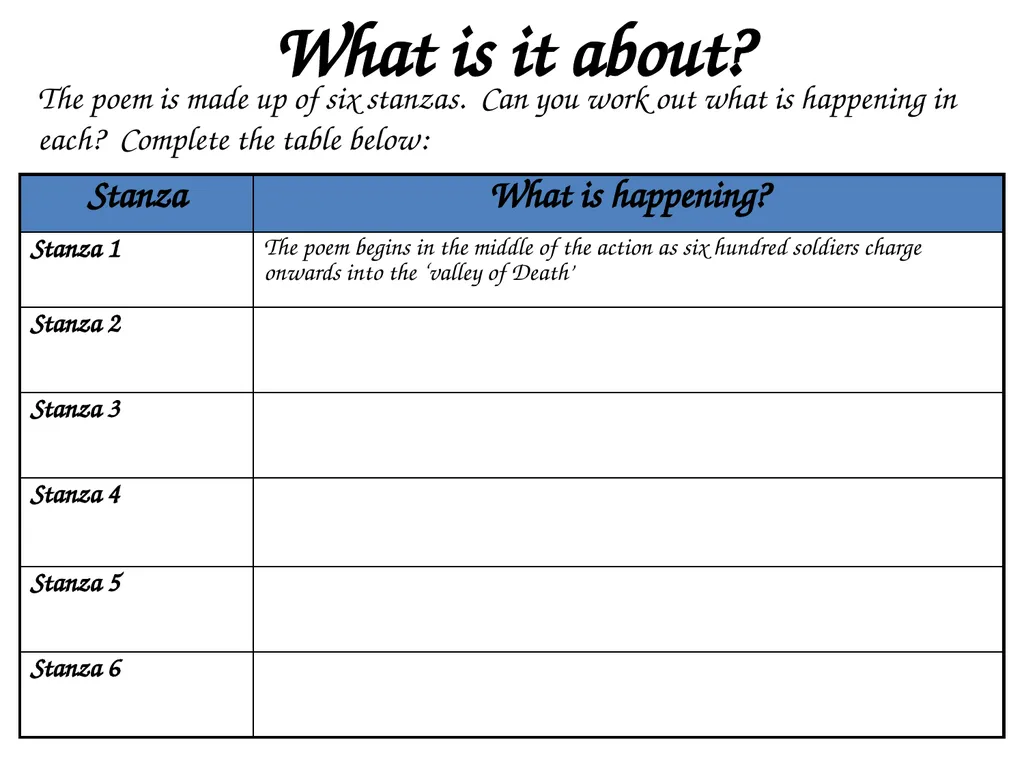
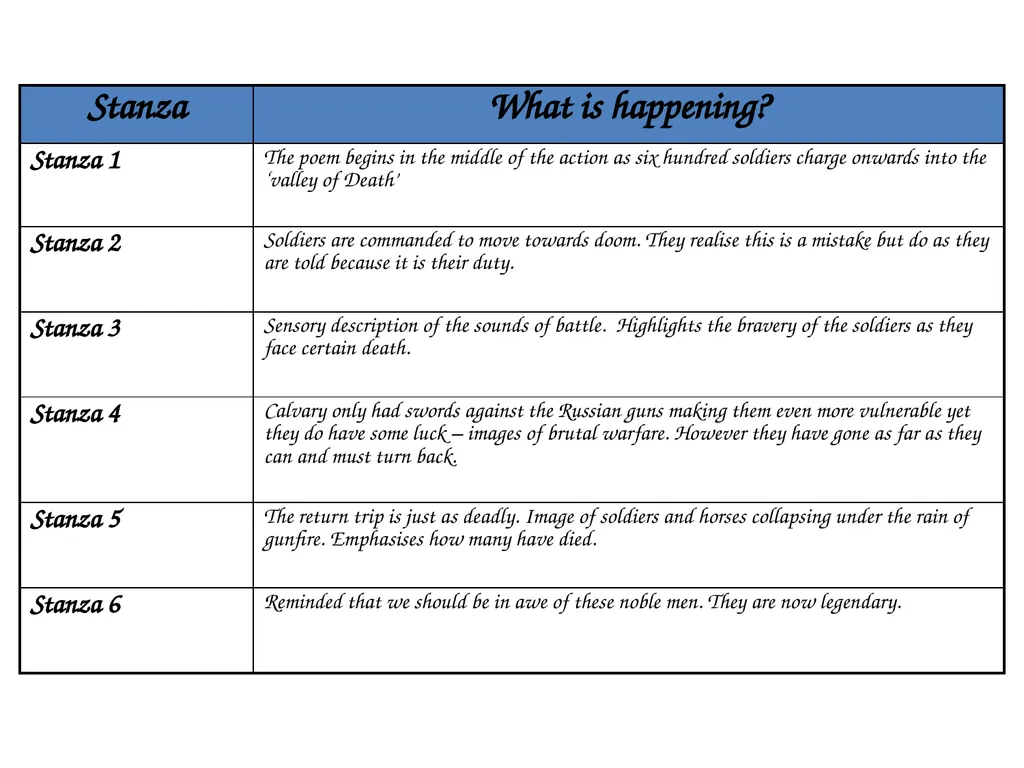
What is it about? The poem is made up of six stanzas. Can you work out what is happening in each? Complete the table below:<br>
09
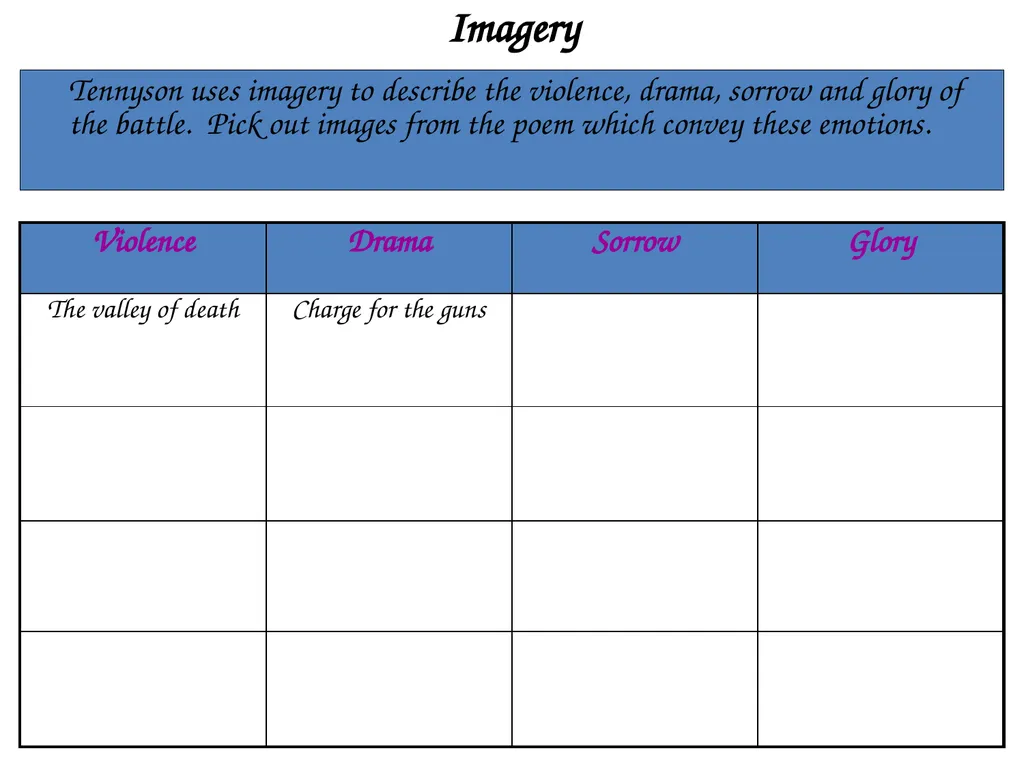
Imagery Tennyson uses imagery to describe the violence, drama, sorrow and glory of the battle. Pick out images from the poem which convey these emotions.<br>
10
Learning Objective: To explore the finer details of the poem Lesson 2: Charge of the Light Brigade<br>
11
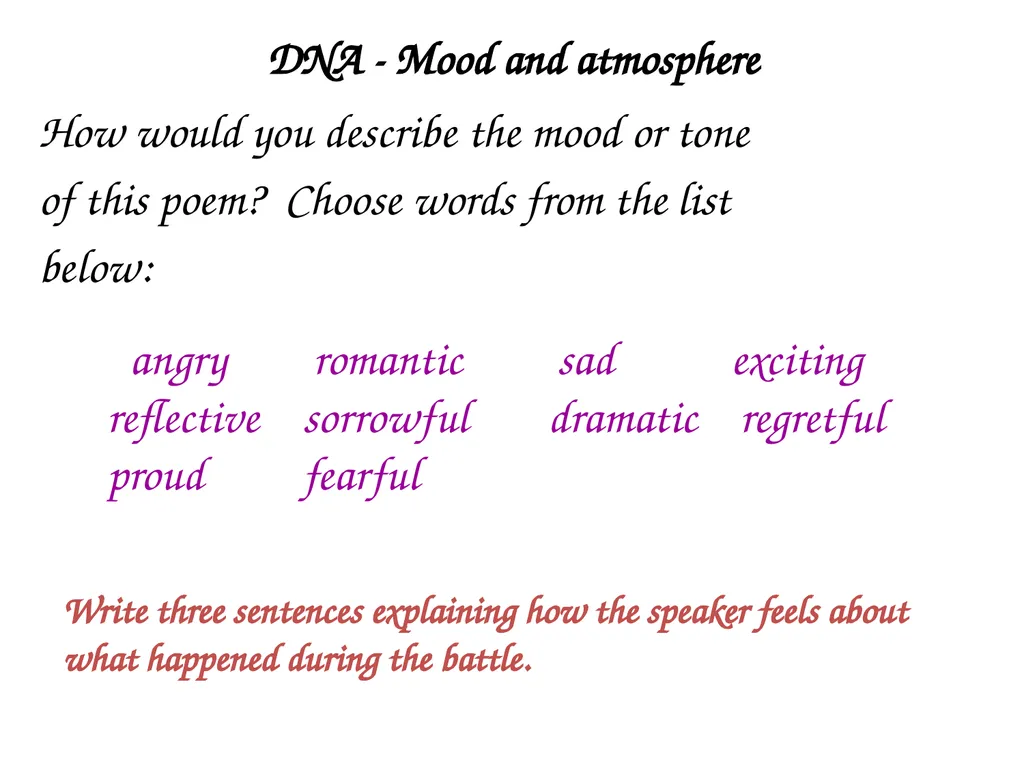
DNA - Mood and atmosphere How would you describe the mood or tone
of this poem? Choose words from the list
below:
angry romantic sad exciting reflective sorrowful dramatic regretful proud fearful Write three sentences explaining how the speaker feels about what happened during the battle.<br>
12
Group Work You have 5 mins only to analyse your stanza. Use the guided questions to support your annotations.
You will then present your findings to the rest of the class who will annotate their own copy of the poem.<br>
13
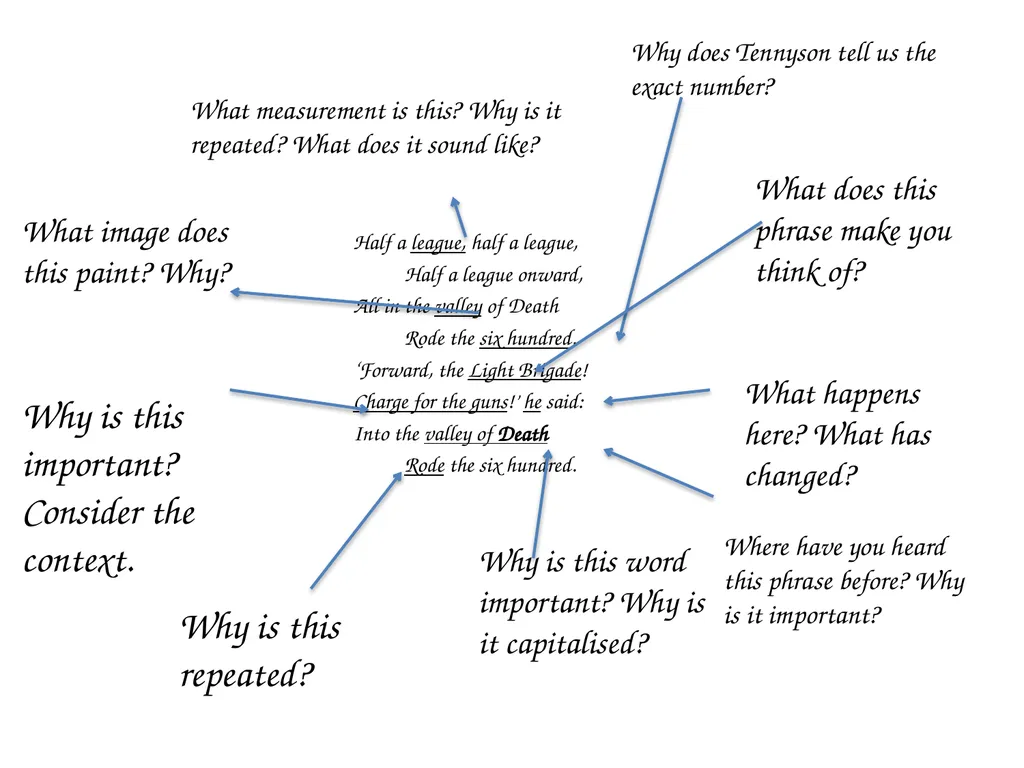
Half a league, half a league,
Half a league onward,
All in the valley of Death
Rode the six hundred.
‘Forward, the Light Brigade!
Charge for the guns!’ he said:
Into the valley of Death
Rode the six hundred. What measurement is this? Why is it repeated? What does it sound like? What image does this paint? Why? Why does Tennyson tell us the exact number? What does this phrase make you think of? What happens here? What has changed? Why is this important? Consider the context. Where have you heard this phrase before? Why is it important? Why is this repeated? Why is this word important? Why is it capitalised?<br>
14
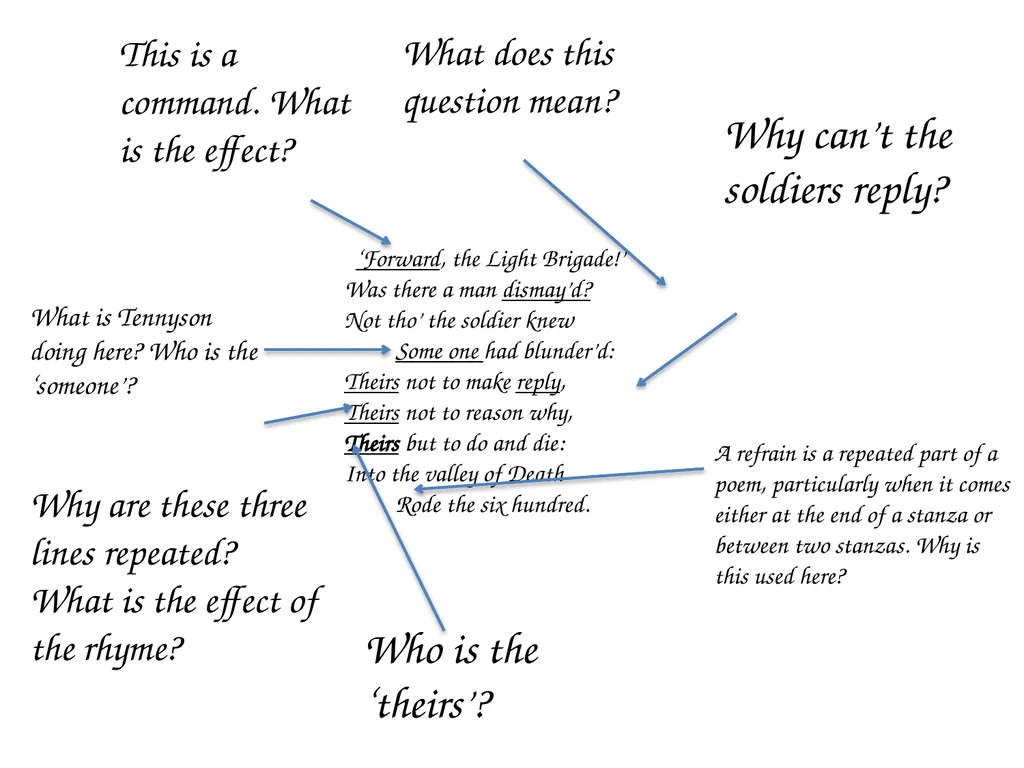
‘Forward, the Light Brigade!’
Was there a man dismay’d?
Not tho’ the soldier knew
Some one had blunder’d:
Theirs not to make reply,
Theirs not to reason why,
Theirs but to do and die:
Into the valley of Death
Rode the six hundred. This is a command. What is the effect? What does this question mean? What is Tennyson doing here? Who is the ‘someone’? Why are these three lines repeated? What is the effect of the rhyme? Why can’t the soldiers reply? A refrain is a repeated part of a poem, particularly when it comes either at the end of a stanza or between two stanzas. Why is this used here? Who is the ‘theirs’?<br>
15
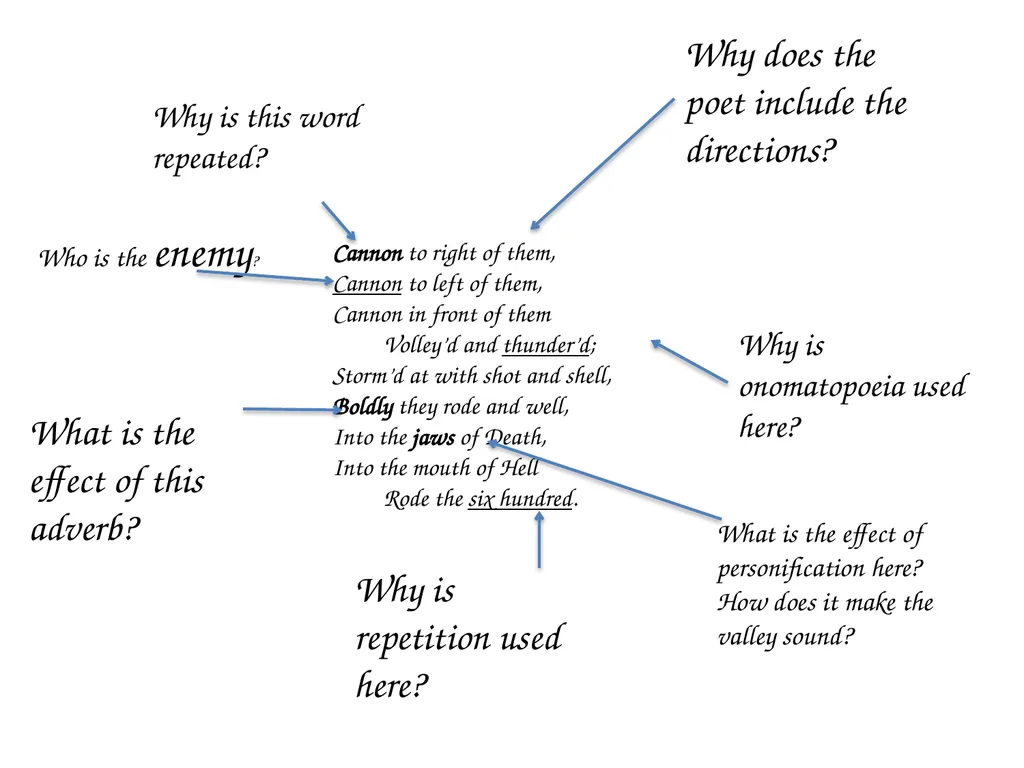
Cannon to right of them,
Cannon to left of them,
Cannon in front of them
Volley’d and thunder’d;
Storm’d at with shot and shell,
Boldly they rode and well,
Into the jaws of Death,
Into the mouth of Hell
Rode the six hundred. Why is this word repeated? Who is the enemy? Why does the poet include the directions? Why is onomatopoeia used here? What is the effect of this adverb? What is the effect of personification here? How does it make the valley sound? Why is repetition used here?<br>
16
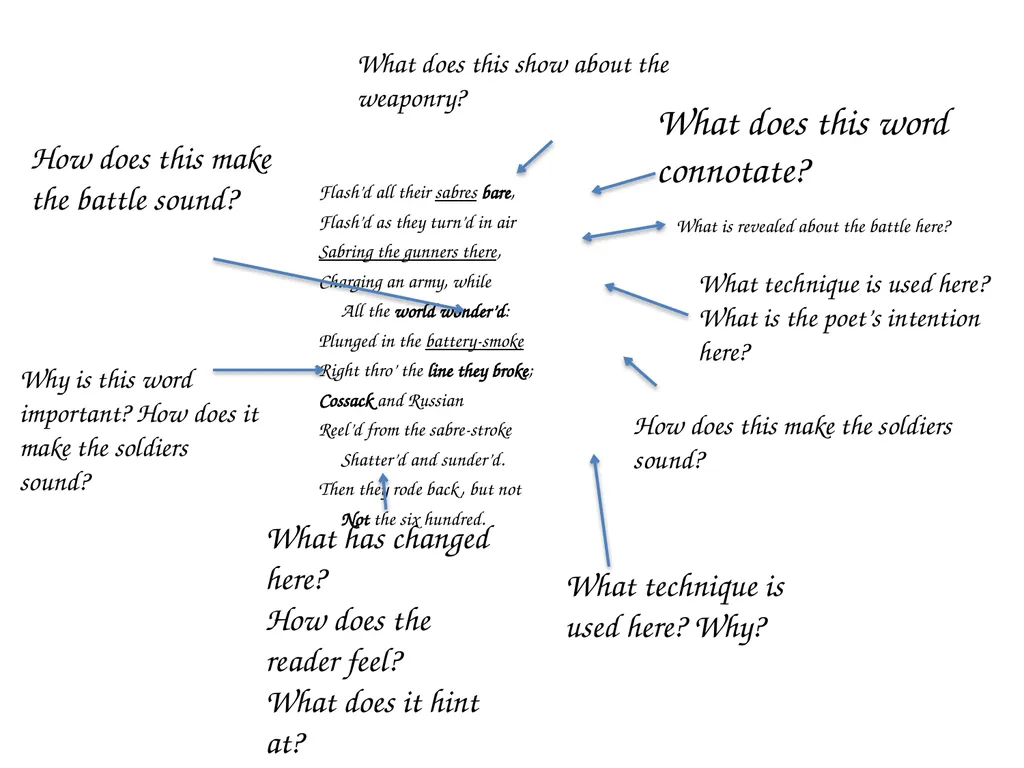
Flash’d all their sabres bare,
Flash’d as they turn’d in air
Sabring the gunners there,
Charging an army, while
All the world wonder’d:
Plunged in the battery-smoke
Right thro’ the line they broke;
Cossack and Russian
Reel’d from the sabre-stroke
Shatter’d and sunder’d.
Then they rode back, but not
Not the six hundred. What does this show about the weaponry? What does this word connotate? What is revealed about the battle here? What technique is used here? What is the poet’s intention here? How does this make the battle sound? How does this make the soldiers sound? Why is this word important? How does it make the soldiers sound? What technique is used here? Why? What has changed here?
How does the reader feel?
What does it hint at?<br>
17
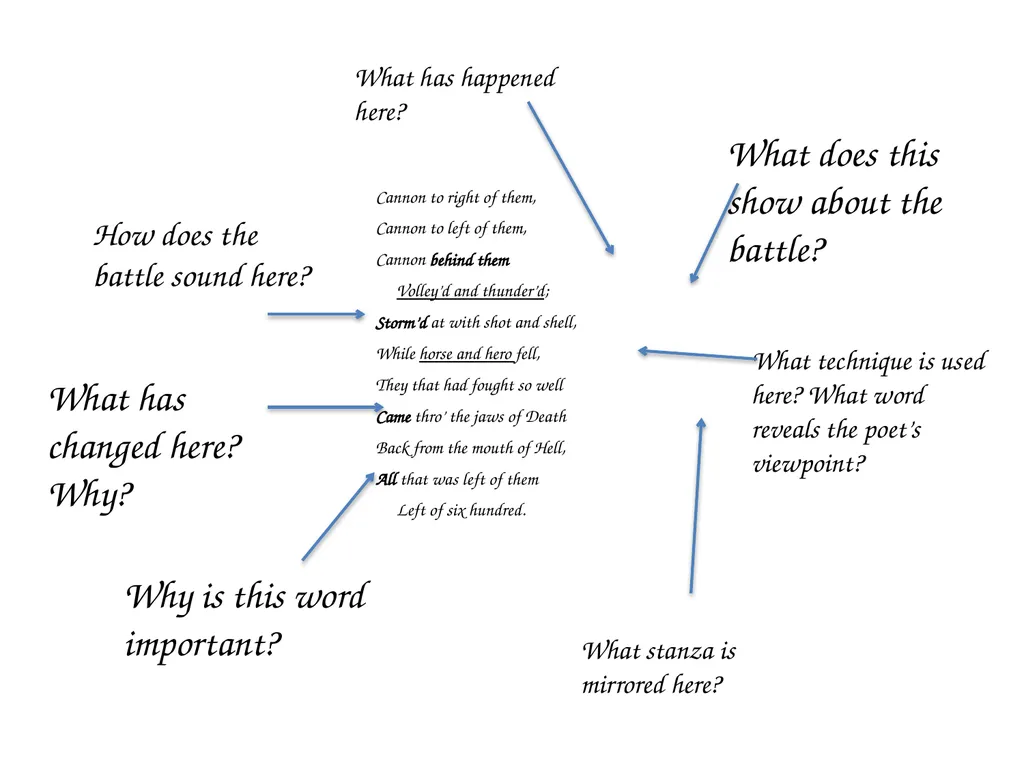
Cannon to right of them,
Cannon to left of them,
Cannon behind them
Volley’d and thunder’d;
Storm’d at with shot and shell,
While horse and hero fell,
They that had fought so well
Came thro’ the jaws of Death
Back from the mouth of Hell,
All that was left of them
Left of six hundred. What has happened here? What does this show about the battle? How does the battle sound here? What technique is used here? What word reveals the poet’s viewpoint? What has changed here? Why? What stanza is mirrored here? Why is this word important?<br>
18
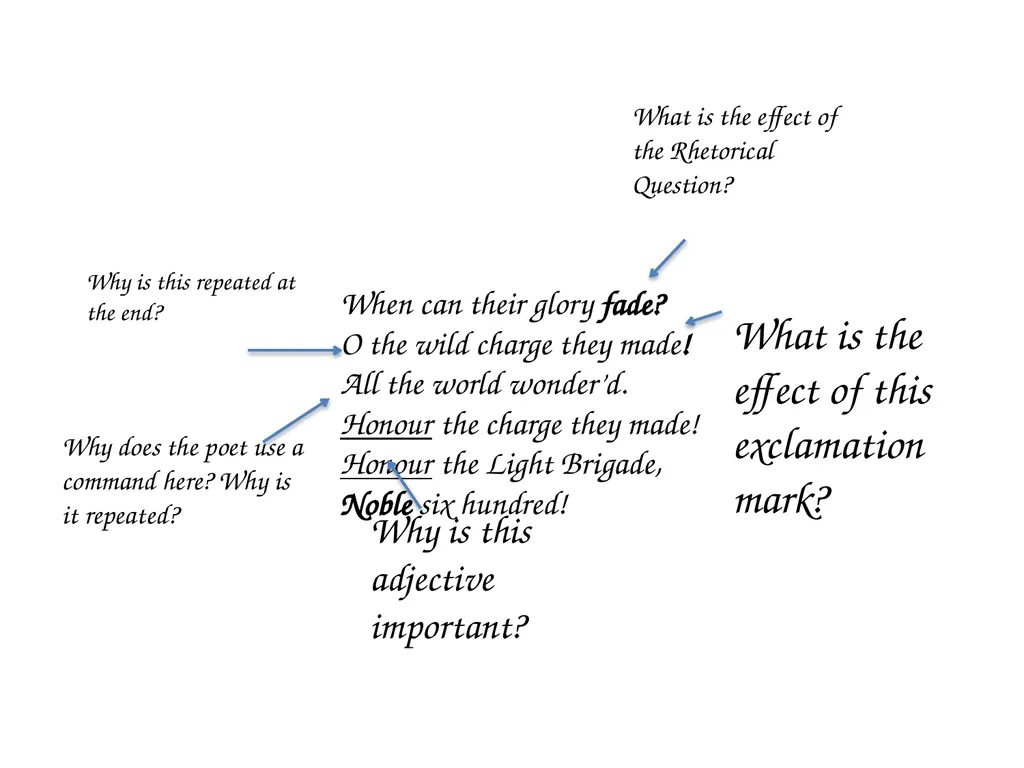
When can their glory fade?
O the wild charge they made!
All the world wonder’d.
Honour the charge they made!
Honour the Light Brigade,
Noble six hundred! What is the effect of the Rhetorical Question? What is the effect of this exclamation mark? Why is this repeated at the end? Why does the poet use a command here? Why is it repeated? Why is this adjective important?<br>
19
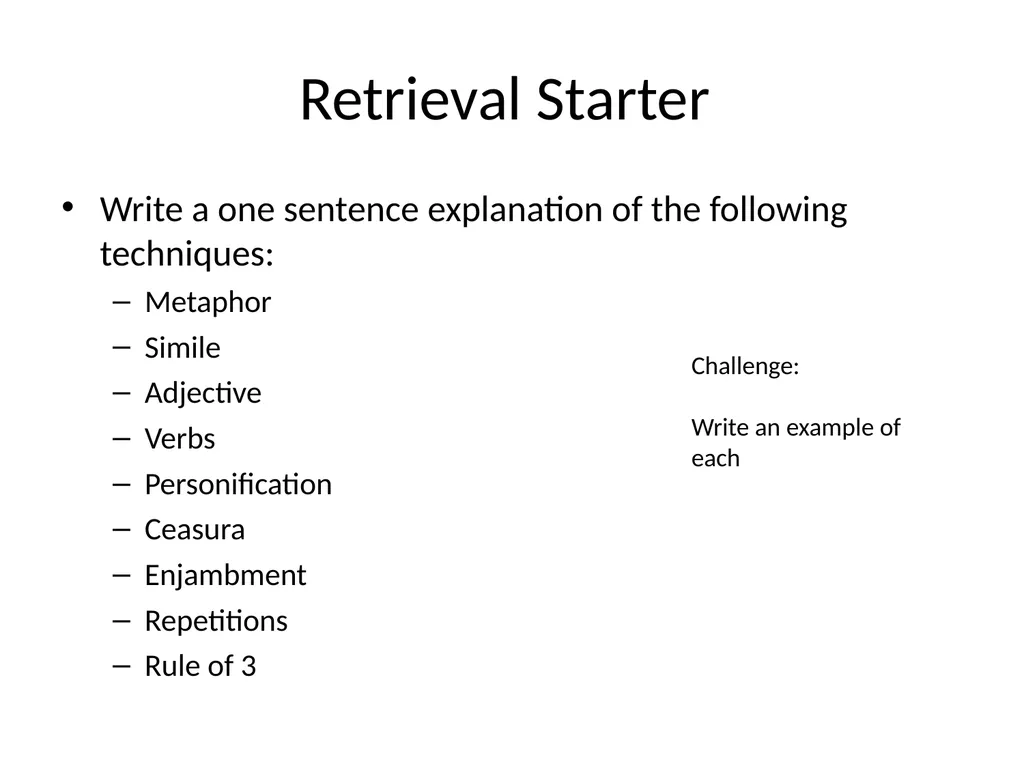
Retrieval Starter Write a one sentence explanation of the following techniques:
Metaphor
Simile
Adjective
Verbs
Personification
Ceasura
Enjambment
Repetitions
Rule of 3 Challenge: