
Today’s Content Session (2-5-19): Live Case


Description: Todays Content Session (2-5-19): Live Case Interview John S. Kirks Sr. Lecturer Strategy Innovation Todays agenda (Re)Introduction Case Interview Principles MA Case Todays agenda (Re)Introduction Case Interview Principles MA Case Who
Related Topics
Download Presentation
"Today’s Content Session (2-5-19): Live Case" is the property of its rightful owner. Permission is granted to download and print the materials on this website for personal, non-commercial use only, and to display it on your personal computer provided you do not modify the materials and that you retain all copyright notices contained in the materials. By downloading content from our website, you accept the terms of this agreement.
Presentation Transcript
slide1. Today’s Content Session (2-5-19):
Live Case Interview
John S. Kirks
Sr. Lecturer
Strategy & Innovation<br>
slide2. Today’s agenda (Re)Introduction
Case Interview Principles
M&A Case<br>
slide3. Today’s agenda (Re)Introduction
Case Interview Principles
M&A Case<br>
slide4. Who am I? Contact information
name: John Kirks
office: Questrom – Room #620A
email: jkirks@bu.edu
phone: 978-886-7518
Office hours
THURSDAY, 1.00 p.m. to 2.00 p.m. (official hours)
Also by appointment!
My teaching schedule (Questrom UG juniors & seniors)
All classes on Tues/Thurs:
SI422 ‘F1’: 11.00am-12.15pm (Room 322)
SI432 ‘A1’: 3.30pm-4.45pm (Room 322)
MSMS Consulting Team Advisor: 9.00-10.30am (Room 620A)
Other roles
Head of Undergraduate Strategy & Innovation concentration (Prof. McManus’s counterpart)
Faculty Advisor to BU Consulting Group (BUCG)
SI422 Course Coordinator (S18- 10 sections)
Previously taught SI751 to FTMBA & PTMBA sections<br>
slide5. Who am I? (Education) Undergraduate studies
Stanford University (B.S., Industrial Engineering) (Honors in Humanities)
Graduate School
Harvard Business School
Additional study- one year
Cambridge University- St. Edmund’s College
(Philosophy)<br>
slide6. Who am I? (Business Career) Investment Banking
Robertson, Stephens & Company
Dain Rauscher Wessels
RBC Capital Markets
Management Consulting
Bain & Company
Independent Consulting
Marmot Mountain
Community Day Charter Public Schools
Subordinated Debt Investing
Sirrom Capital
Summer
Walt Disney Company<br>
slide7. Today’s agenda (Re)Introduction
Case Interview Principles
M&A Case<br>
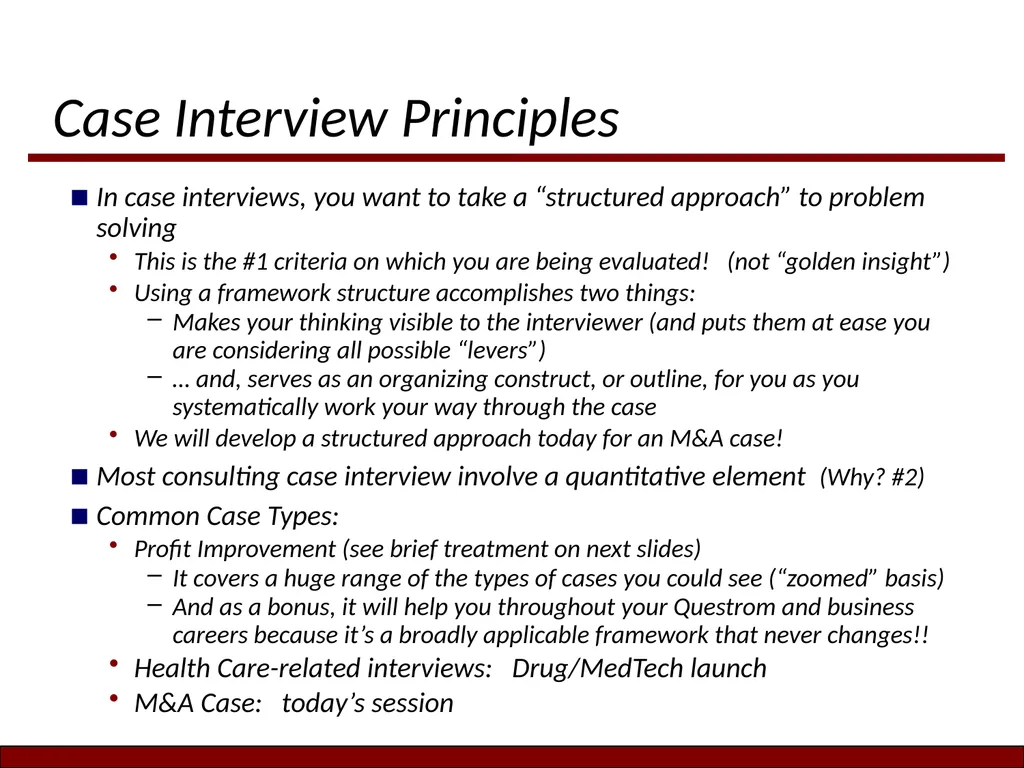
slide8. Case Interview Principles In case interviews, you want to take a “structured approach” to problem solving
This is the #1 criteria on which you are being evaluated! (not “golden insight”)
Using a framework structure accomplishes two things:
Makes your thinking visible to the interviewer (and puts them at ease you are considering all possible “levers”)
… and, serves as an organizing construct, or outline, for you as you systematically work your way through the case
We will develop a structured approach today for an M&A case!
Most consulting case interview involve a quantitative element (Why? #2)
Common Case Types:
Profit Improvement (see brief treatment on next slides)
It covers a huge range of the types of cases you could see (“zoomed” basis)
And as a bonus, it will help you throughout your Questrom and business careers because it’s a broadly applicable framework that never changes!!
Health Care-related interviews: Drug/MedTech launch
M&A Case: today’s session<br>
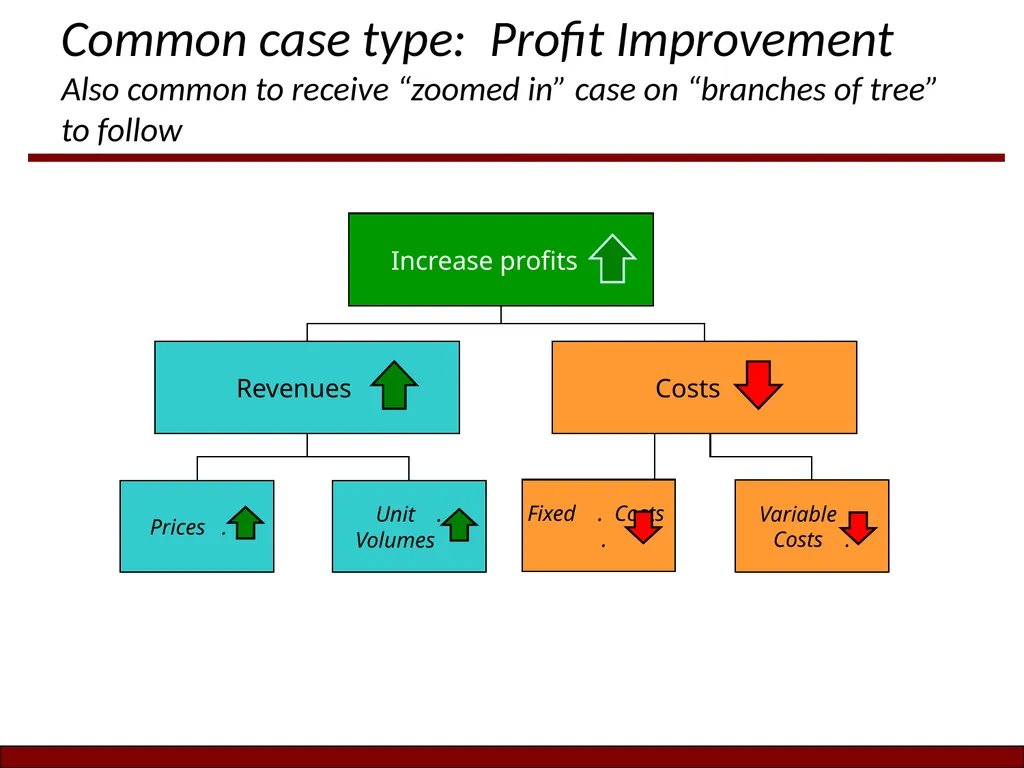
slide9. Fixed . Costs . Increase profits Revenues Prices . Unit . Volumes . Costs Common case type: Profit Improvement
Also common to receive “zoomed in” case on “branches of tree” to follow Variable . Costs .<br>
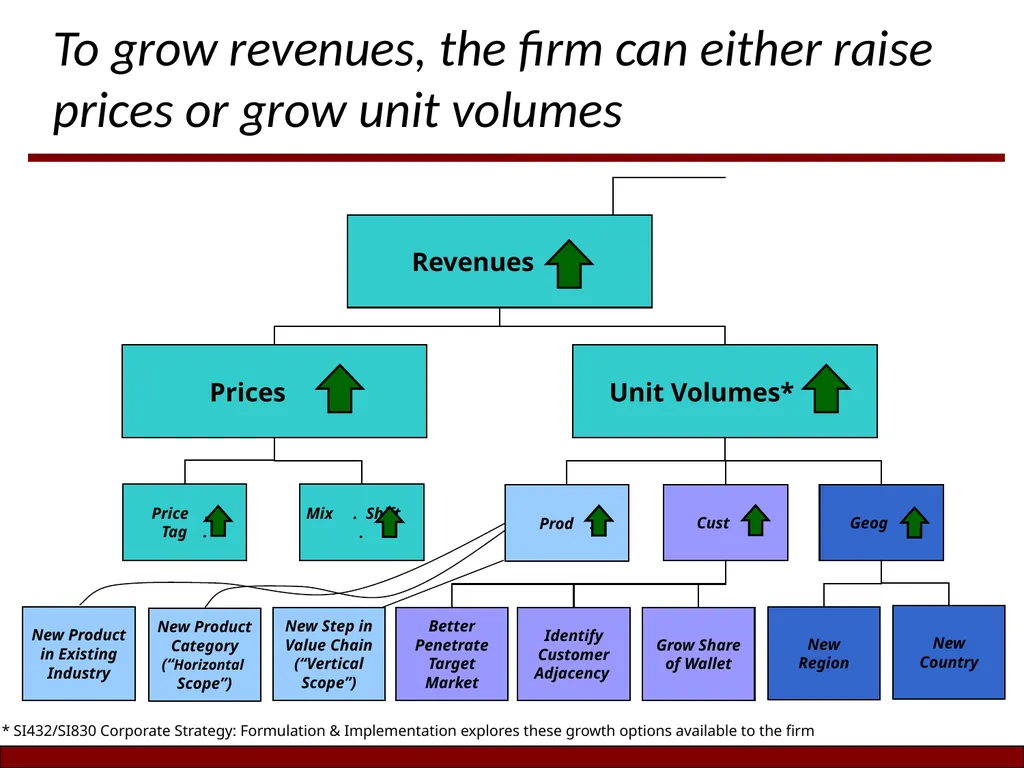
slide10. Price . Tag . Prices Unit Volumes* Mix . Shift . Revenues Prod . Geog . Cust . Identify Customer Adjacency Better Penetrate Target Market Grow Share of Wallet New Step in Value Chain
(“Vertical Scope”) New Product in Existing Industry New
Country New
Region New Product Category
(“Horizontal Scope”) To grow revenues, the firm can either raise prices or grow unit volumes * SI432/SI830 Corporate Strategy: Formulation & Implementation explores these growth options available to the firm<br>
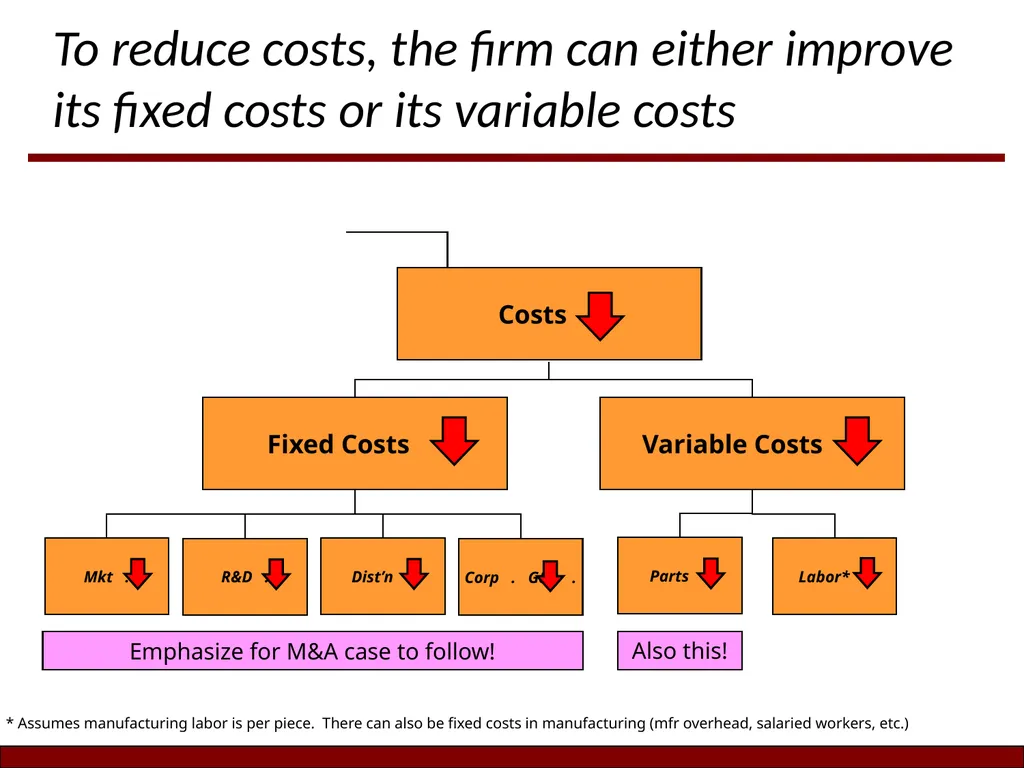
slide11. Parts . Fixed Costs Variable Costs To reduce costs, the firm can either improve its fixed costs or its variable costs Labor* . Costs R&D . Corp . G&A . Mkt . Dist’n . * Assumes manufacturing labor is per piece. There can also be fixed costs in manufacturing (mfr overhead, salaried workers, etc.) Emphasize for M&A case to follow! Also this!<br>
slide12. Next step: you should be prepared for a deeper dive at the bottom of each branch Recommended approach: walk through the general profit-improvement structure first (in ~2 minutes). This is called “making your thinking visible”
Then work your way through each branch (or perhaps the interviewer will guide you). Example- Pricing Branch:
“OK, now let’s consider that possibility of raising prices (changing the price tag!). What analysis would you conduct to see if a price increase might work?”
Sample Analysis:
Not: “I would do a pilot”… that might be the first step of the “how”
Pricing relative to our competition
Pricing trends (for us/ industry)
If past increases, effects on volume? (Price elasticity)
Customer survey work:
Not: “What would you pay?” (customers can’t answer this directly)
Gather customer purchase criteria… looking for relative importance of price to our customers…. if #1 most important, they are “price sensitive”)
Then gather customer satisfaction data (relative to competition) on each criteria
Implications: if price is customers’ #1 most important criteria, and they are relatively dissatisfied with our prices, price increase NOT a good idea
If price not very important, and they are relatively satisfied with our prices, perhaps we could boost our prices<br>
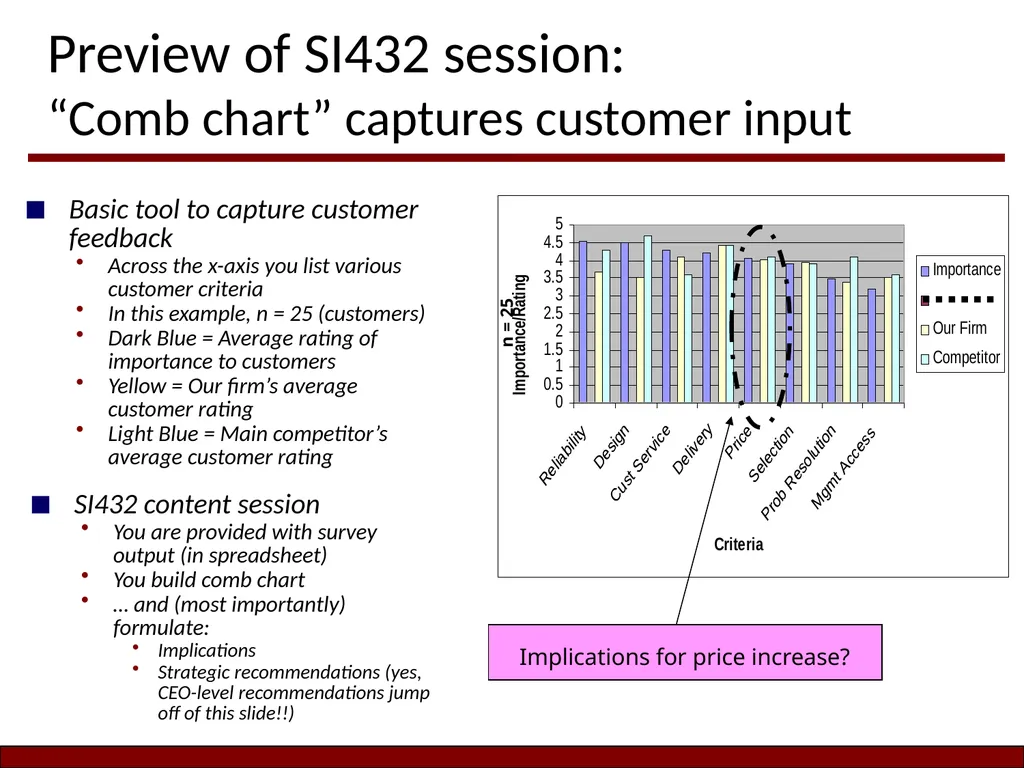
slide13. Preview of SI432 session: “Comb chart” captures customer input Basic tool to capture customer feedback
Across the x-axis you list various customer criteria
In this example, n = 25 (customers)
Dark Blue = Average rating of importance to customers
Yellow = Our firm’s average customer rating
Light Blue = Main competitor’s average customer rating n = 25 Implications for price increase? SI432 content session
You are provided with survey output (in spreadsheet)
You build comb chart
… and (most importantly) formulate:
Implications
Strategic recommendations (yes, CEO-level recommendations jump off of this slide!!)<br>
slide14. Today’s agenda (Re)Introduction
Case Interview Principles
M&A Case<br>
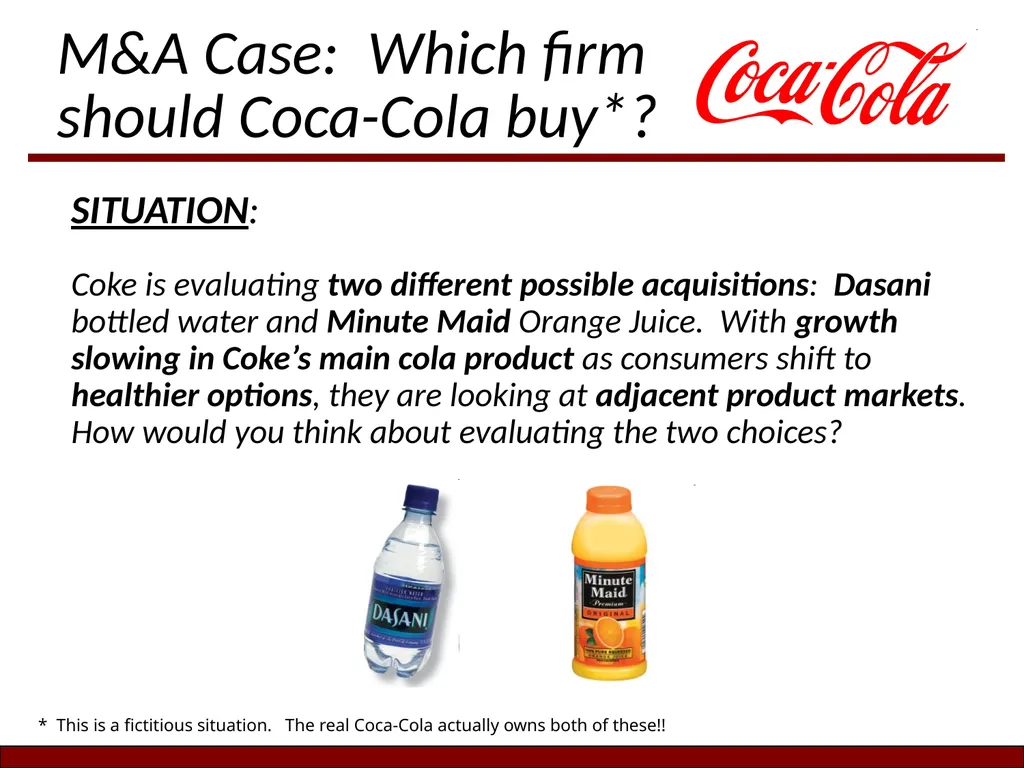
slide15. M&A Case: Which firm should Coca-Cola buy*? SITUATION:
Coke is evaluating two different possible acquisitions: Dasani bottled water and Minute Maid Orange Juice. With growth slowing in Coke’s main cola product as consumers shift to healthier options, they are looking at adjacent product markets. How would you think about evaluating the two choices? * This is a fictitious situation. The real Coca-Cola actually owns both of these!!<br>
slide16. For an M&A Case, what considerations should we take into account? Talk to your neighbor Assume we only have enough capital to buy ONE of the two options
What criteria could be use to evaluate/ compare the two options?<br>
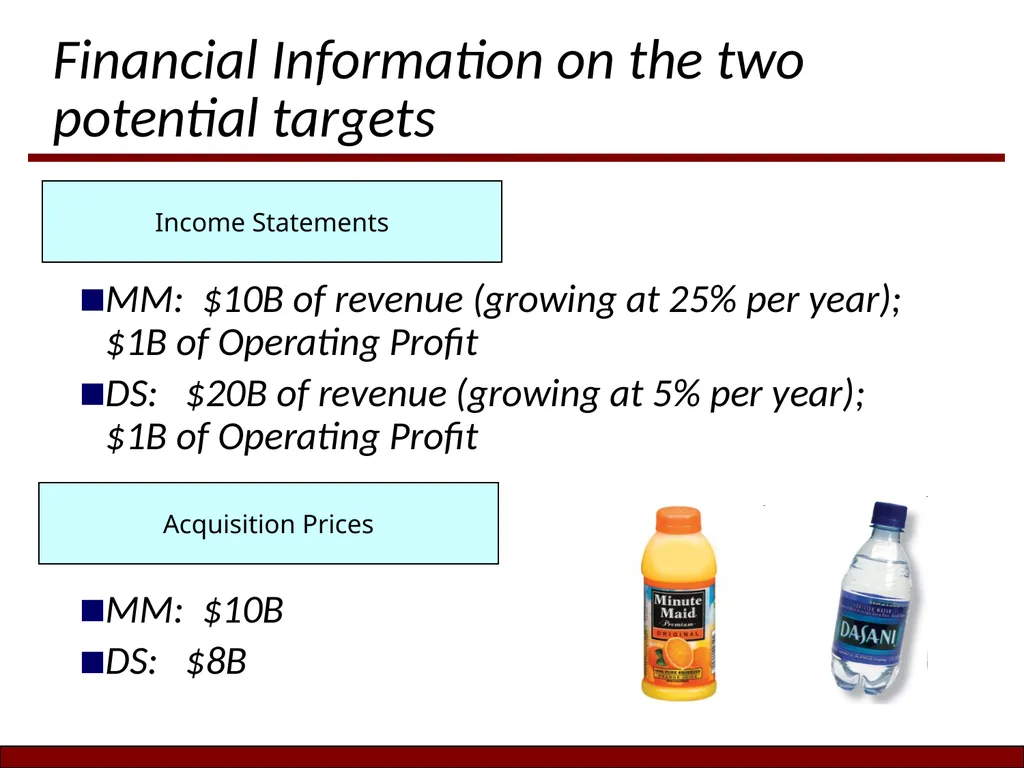
slide17. Financial Information on the two potential targets MM: $10B of revenue (growing at 25% per year); $1B of Operating Profit
DS: $20B of revenue (growing at 5% per year); $1B of Operating Profit
MM: $10B
DS: $8B Income Statements Acquisition Prices<br>
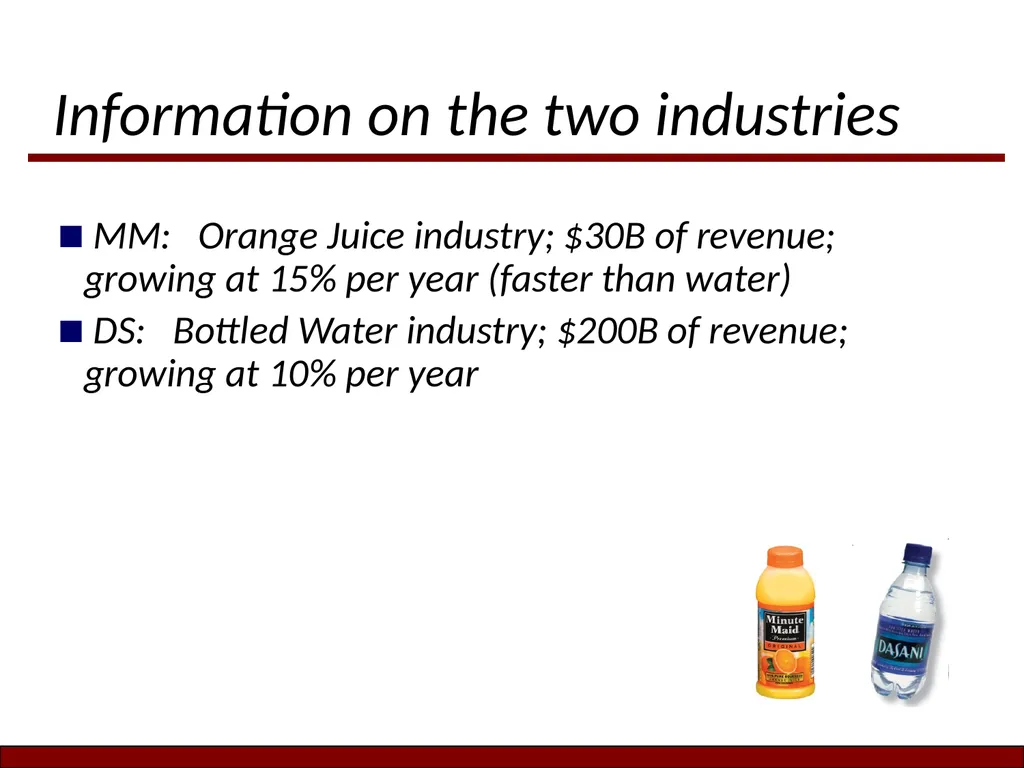
slide18. Information on the two industries MM: Orange Juice industry; $30B of revenue; growing at 15% per year (faster than water)
DS: Bottled Water industry; $200B of revenue; growing at 10% per year<br>
slide19. What do we know thus far? Early hypotheses? Not common to be asked for hypothesis this soon
Just for our discussion purposes….
BUT you should already have some preliminary thoughts on:
Industry growth
Firm growth (and whether gaining share)
Market Share
Relative valuation as multiple of Op Income Talk to your neighbor<br>
slide20. Synergies are the result of good “Strategic Fit” (leads into quantitative element of this case) How would each prospective target co. “fit” with the Coca Cola Co.?
What types of synergies might we expect in these acquisitions?
Hint: common synergy is better spreading fixed costs across business units (recall classic fixed-cost buckets from profit-improvement tree!)<br>
slide21. Synergies are the result of good “Strategic Fit” (leads into quantitative element of this case) MM: Cost synergies in distribution to grocery ($100M per year)…. NOT in marketing
DS: Cost synergies in distribution to grocery AND convenience stores ($200M per year)….. NOT in marketing<br>
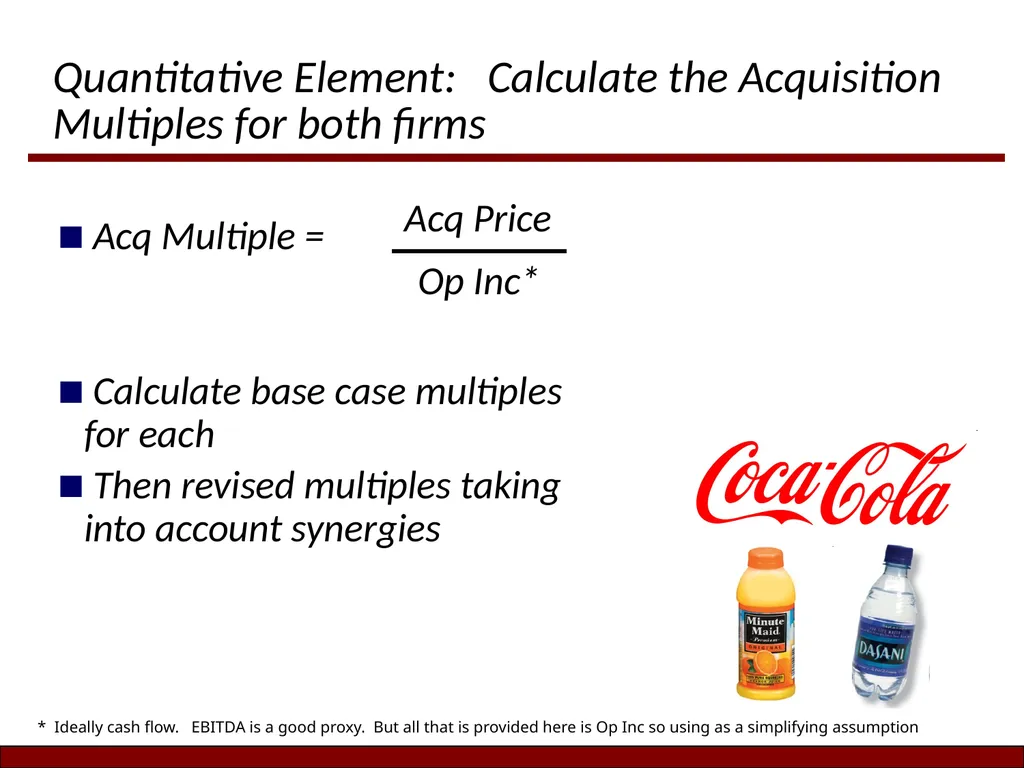
slide22. Quantitative Element: Calculate the Acquisition Multiples for both firms Acq Multiple =
Calculate base case multiples for each
Then revised multiples taking into account synergies Acq Price Op Inc* * Ideally cash flow. EBITDA is a good proxy. But all that is provided here is Op Inc so using as a simplifying assumption<br>
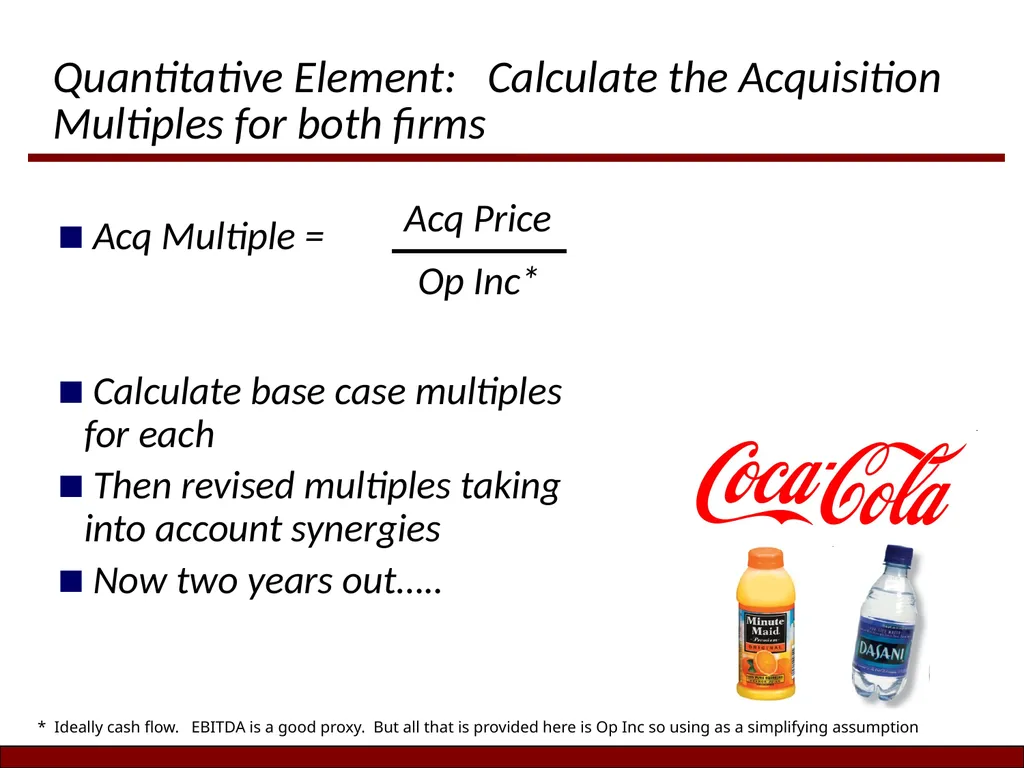
slide23. Quantitative Element: Calculate the Acquisition Multiples for both firms Acq Multiple =
Calculate base case multiples for each
Then revised multiples taking into account synergies
Now two years out….. Acq Price Op Inc* * Ideally cash flow. EBITDA is a good proxy. But all that is provided here is Op Inc so using as a simplifying assumption<br>
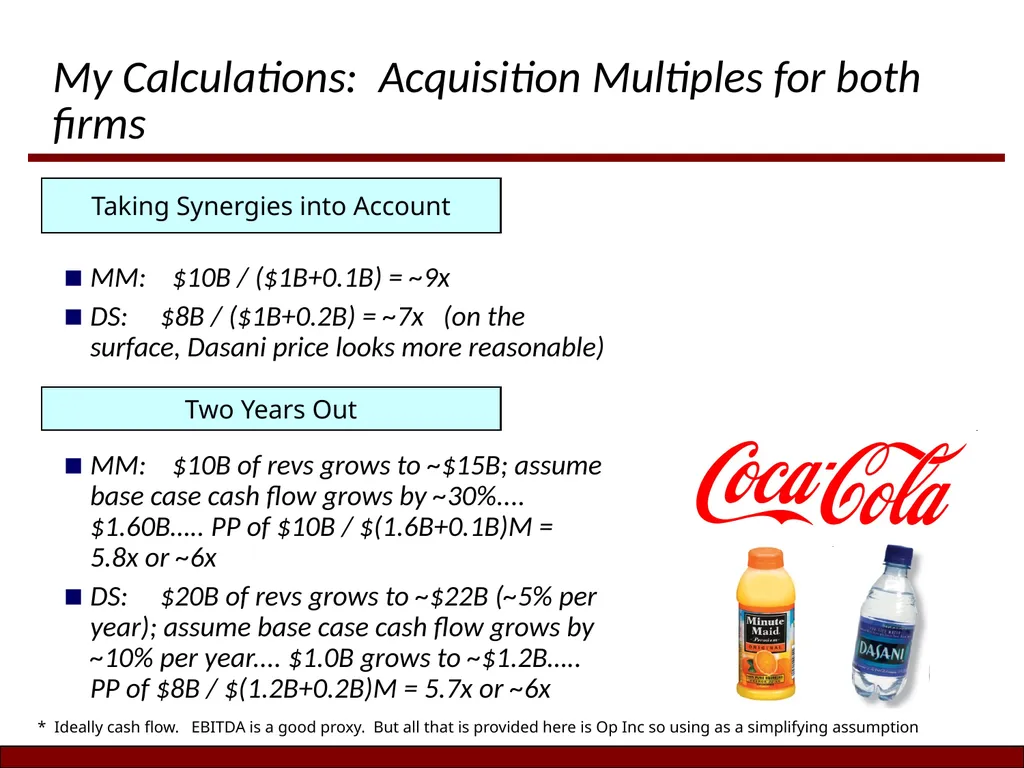
slide24. My Calculations: Acquisition Multiples for both firms MM: $10B / ($1B+0.1B) = ~9x
DS: $8B / ($1B+0.2B) = ~7x (on the surface, Dasani price looks more reasonable)
MM: $10B of revs grows to ~$15B; assume base case cash flow grows by ~30%.... $1.60B….. PP of $10B / $(1.6B+0.1B)M = 5.8x or ~6x
DS: $20B of revs grows to ~$22B (~5% per year); assume base case cash flow grows by ~10% per year.... $1.0B grows to ~$1.2B….. PP of $8B / $(1.2B+0.2B)M = 5.7x or ~6x * Ideally cash flow. EBITDA is a good proxy. But all that is provided here is Op Inc so using as a simplifying assumption Taking Synergies into Account Two Years Out<br>
slide25. Competitive Positioning tells us which firm is winning (in its respective industry) How can we determine this? Talk to your neighbor<br>
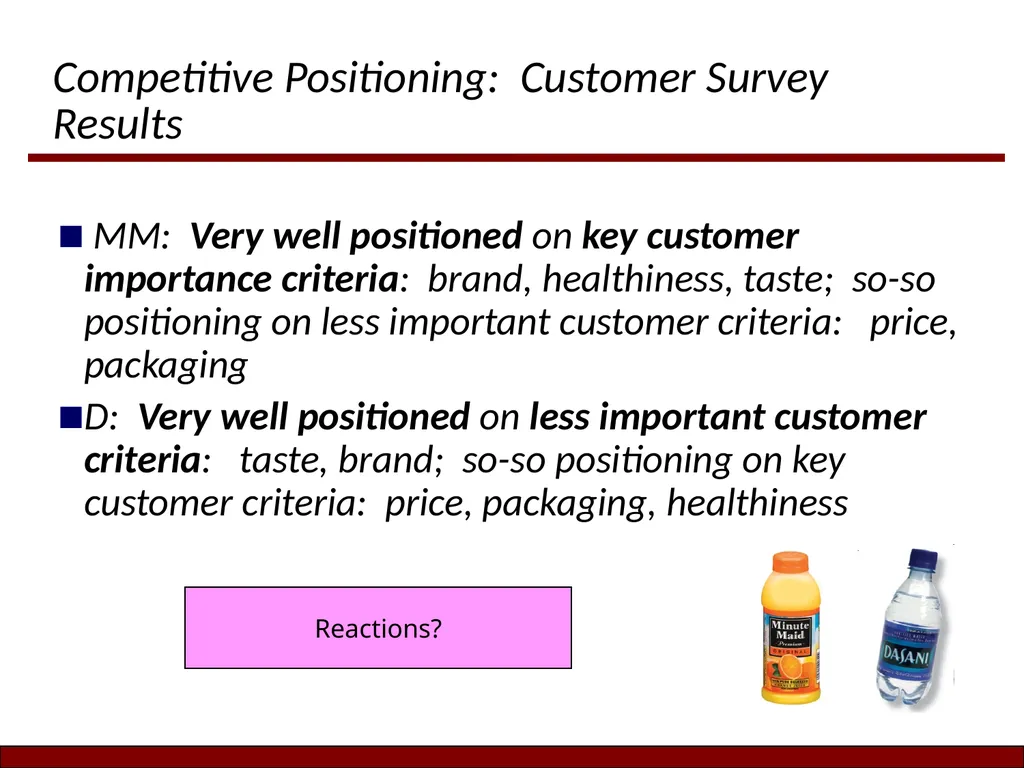
slide26. Competitive Positioning: Customer Survey Results MM: Very well positioned on key customer importance criteria: brand, healthiness, taste; so-so positioning on less important customer criteria: price, packaging
D: Very well positioned on less important customer criteria: taste, brand; so-so positioning on key customer criteria: price, packaging, healthiness Reactions?<br>
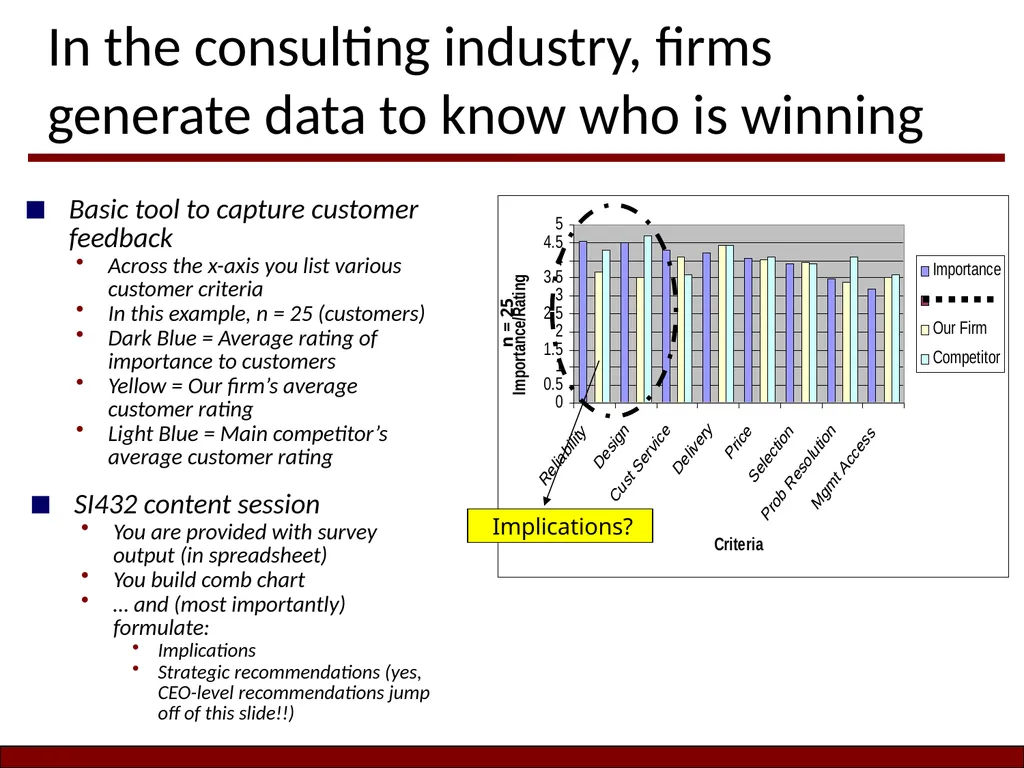
slide27. In the consulting industry, firms generate data to know who is winning Basic tool to capture customer feedback
Across the x-axis you list various customer criteria
In this example, n = 25 (customers)
Dark Blue = Average rating of importance to customers
Yellow = Our firm’s average customer rating
Light Blue = Main competitor’s average customer rating Implications? n = 25 SI432 content session
You are provided with survey output (in spreadsheet)
You build comb chart
… and (most importantly) formulate:
Implications
Strategic recommendations (yes, CEO-level recommendations jump off of this slide!!)<br>
slide28. M&A Case: Which firm should Coca-Cola buy* Final Answer? * This is a fictitious situation. The real Coca-Cola actually owns both of these!!<br>
slide29. In SI432 we use the following M&A case framework (also helpful for consulting case interviews!) How attractive is the industry? (SI422/SI750)
Is it structurally attractive today? (5F) Nice profits for incumbent firms?
Will it be more attractive in the future? Growth in revenues and profits?
Are there barriers to entry? (and is “build” an option for us?)
Is this Target Co. well positioned?
Does the firm have competitive advantage? (SI422/SI750)
Will it sustain its competitive advantage? (SI422/SI750)
Will it gain market share, thus outgrowing the market?
Is the acquisition price attractive?
What is the purchase price?
What are the base case cash flows?
What is the NPV (or in SI432, what is the payback period)?
Time-honored acquisition metric in traditional businesses:
5-6x cash flow = inexpensive; 9-10x cash flow = getting expensive
These numbers also equate to payback period!!!
Is the picture improved by Strategic Fit (SI432/SI830)
Is there WTP boosting? (i.e., green ink on the BO Test)
Are there cost synergies or economies of scope? (i.e., green ink on the BO Test)
What are the resulting enhanced cash flows, and the revised payback period? Industry
Attractiveness Target Co.
Competitive
Positioning Base Case
Cash Flow &
Payback Strategic Fit:
Enhanced Case
Cash Flow &
Payback<br>
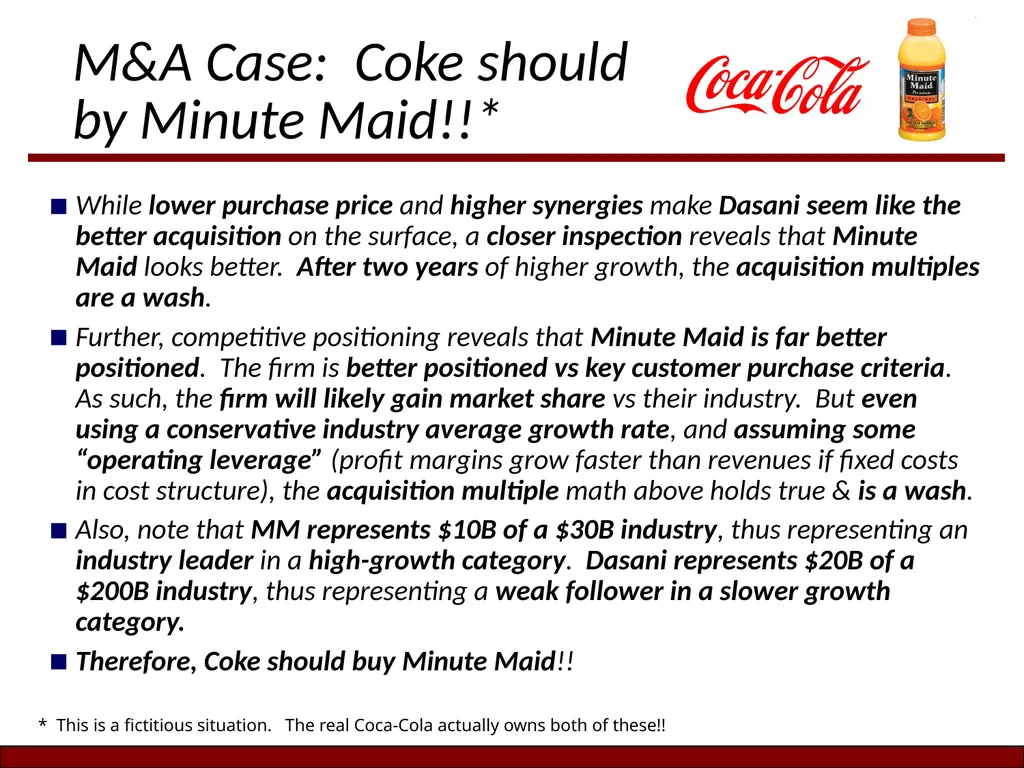
slide30. M&A Case: Coke should by Minute Maid!!* * This is a fictitious situation. The real Coca-Cola actually owns both of these!! While lower purchase price and higher synergies make Dasani seem like the better acquisition on the surface, a closer inspection reveals that Minute Maid looks better. After two years of higher growth, the acquisition multiples are a wash.
Further, competitive positioning reveals that Minute Maid is far better positioned. The firm is better positioned vs key customer purchase criteria. As such, the firm will likely gain market share vs their industry. But even using a conservative industry average growth rate, and assuming some “operating leverage” (profit margins grow faster than revenues if fixed costs in cost structure), the acquisition multiple math above holds true & is a wash.
Also, note that MM represents $10B of a $30B industry, thus representing an industry leader in a high-growth category. Dasani represents $20B of a $200B industry, thus representing a weak follower in a slower growth category.
Therefore, Coke should buy Minute Maid!!<br>
slide31. Wrap-Ups and Takeaways In case interviews, you want to take a “structured approach” to problem solving
Be advised: recommendations to “take a hypothesis-driven approach” can lead candidates astray— they run the risk of going too far down one branch and missing other important areas
Students with upcoming case interviews should begin their preparation by reviewing some common case types
Profit-Improvement Cases (and also covers a huge range of the types of cases you could encounter on a “zoomed in” basis)
Drug/MedTech launch cases (for health care contexts)
M&A Cases– today’s session<br>
Live Case Interview
John S. Kirks
Sr. Lecturer
Strategy & Innovation<br>
slide2. Today’s agenda (Re)Introduction
Case Interview Principles
M&A Case<br>
slide3. Today’s agenda (Re)Introduction
Case Interview Principles
M&A Case<br>
slide4. Who am I? Contact information
name: John Kirks
office: Questrom – Room #620A
email: jkirks@bu.edu
phone: 978-886-7518
Office hours
THURSDAY, 1.00 p.m. to 2.00 p.m. (official hours)
Also by appointment!
My teaching schedule (Questrom UG juniors & seniors)
All classes on Tues/Thurs:
SI422 ‘F1’: 11.00am-12.15pm (Room 322)
SI432 ‘A1’: 3.30pm-4.45pm (Room 322)
MSMS Consulting Team Advisor: 9.00-10.30am (Room 620A)
Other roles
Head of Undergraduate Strategy & Innovation concentration (Prof. McManus’s counterpart)
Faculty Advisor to BU Consulting Group (BUCG)
SI422 Course Coordinator (S18- 10 sections)
Previously taught SI751 to FTMBA & PTMBA sections<br>
slide5. Who am I? (Education) Undergraduate studies
Stanford University (B.S., Industrial Engineering) (Honors in Humanities)
Graduate School
Harvard Business School
Additional study- one year
Cambridge University- St. Edmund’s College
(Philosophy)<br>
slide6. Who am I? (Business Career) Investment Banking
Robertson, Stephens & Company
Dain Rauscher Wessels
RBC Capital Markets
Management Consulting
Bain & Company
Independent Consulting
Marmot Mountain
Community Day Charter Public Schools
Subordinated Debt Investing
Sirrom Capital
Summer
Walt Disney Company<br>
slide7. Today’s agenda (Re)Introduction
Case Interview Principles
M&A Case<br>
slide8. Case Interview Principles In case interviews, you want to take a “structured approach” to problem solving
This is the #1 criteria on which you are being evaluated! (not “golden insight”)
Using a framework structure accomplishes two things:
Makes your thinking visible to the interviewer (and puts them at ease you are considering all possible “levers”)
… and, serves as an organizing construct, or outline, for you as you systematically work your way through the case
We will develop a structured approach today for an M&A case!
Most consulting case interview involve a quantitative element (Why? #2)
Common Case Types:
Profit Improvement (see brief treatment on next slides)
It covers a huge range of the types of cases you could see (“zoomed” basis)
And as a bonus, it will help you throughout your Questrom and business careers because it’s a broadly applicable framework that never changes!!
Health Care-related interviews: Drug/MedTech launch
M&A Case: today’s session<br>
slide9. Fixed . Costs . Increase profits Revenues Prices . Unit . Volumes . Costs Common case type: Profit Improvement
Also common to receive “zoomed in” case on “branches of tree” to follow Variable . Costs .<br>
slide10. Price . Tag . Prices Unit Volumes* Mix . Shift . Revenues Prod . Geog . Cust . Identify Customer Adjacency Better Penetrate Target Market Grow Share of Wallet New Step in Value Chain
(“Vertical Scope”) New Product in Existing Industry New
Country New
Region New Product Category
(“Horizontal Scope”) To grow revenues, the firm can either raise prices or grow unit volumes * SI432/SI830 Corporate Strategy: Formulation & Implementation explores these growth options available to the firm<br>
slide11. Parts . Fixed Costs Variable Costs To reduce costs, the firm can either improve its fixed costs or its variable costs Labor* . Costs R&D . Corp . G&A . Mkt . Dist’n . * Assumes manufacturing labor is per piece. There can also be fixed costs in manufacturing (mfr overhead, salaried workers, etc.) Emphasize for M&A case to follow! Also this!<br>
slide12. Next step: you should be prepared for a deeper dive at the bottom of each branch Recommended approach: walk through the general profit-improvement structure first (in ~2 minutes). This is called “making your thinking visible”
Then work your way through each branch (or perhaps the interviewer will guide you). Example- Pricing Branch:
“OK, now let’s consider that possibility of raising prices (changing the price tag!). What analysis would you conduct to see if a price increase might work?”
Sample Analysis:
Not: “I would do a pilot”… that might be the first step of the “how”
Pricing relative to our competition
Pricing trends (for us/ industry)
If past increases, effects on volume? (Price elasticity)
Customer survey work:
Not: “What would you pay?” (customers can’t answer this directly)
Gather customer purchase criteria… looking for relative importance of price to our customers…. if #1 most important, they are “price sensitive”)
Then gather customer satisfaction data (relative to competition) on each criteria
Implications: if price is customers’ #1 most important criteria, and they are relatively dissatisfied with our prices, price increase NOT a good idea
If price not very important, and they are relatively satisfied with our prices, perhaps we could boost our prices<br>
slide13. Preview of SI432 session: “Comb chart” captures customer input Basic tool to capture customer feedback
Across the x-axis you list various customer criteria
In this example, n = 25 (customers)
Dark Blue = Average rating of importance to customers
Yellow = Our firm’s average customer rating
Light Blue = Main competitor’s average customer rating n = 25 Implications for price increase? SI432 content session
You are provided with survey output (in spreadsheet)
You build comb chart
… and (most importantly) formulate:
Implications
Strategic recommendations (yes, CEO-level recommendations jump off of this slide!!)<br>
slide14. Today’s agenda (Re)Introduction
Case Interview Principles
M&A Case<br>
slide15. M&A Case: Which firm should Coca-Cola buy*? SITUATION:
Coke is evaluating two different possible acquisitions: Dasani bottled water and Minute Maid Orange Juice. With growth slowing in Coke’s main cola product as consumers shift to healthier options, they are looking at adjacent product markets. How would you think about evaluating the two choices? * This is a fictitious situation. The real Coca-Cola actually owns both of these!!<br>
slide16. For an M&A Case, what considerations should we take into account? Talk to your neighbor Assume we only have enough capital to buy ONE of the two options
What criteria could be use to evaluate/ compare the two options?<br>
slide17. Financial Information on the two potential targets MM: $10B of revenue (growing at 25% per year); $1B of Operating Profit
DS: $20B of revenue (growing at 5% per year); $1B of Operating Profit
MM: $10B
DS: $8B Income Statements Acquisition Prices<br>
slide18. Information on the two industries MM: Orange Juice industry; $30B of revenue; growing at 15% per year (faster than water)
DS: Bottled Water industry; $200B of revenue; growing at 10% per year<br>
slide19. What do we know thus far? Early hypotheses? Not common to be asked for hypothesis this soon
Just for our discussion purposes….
BUT you should already have some preliminary thoughts on:
Industry growth
Firm growth (and whether gaining share)
Market Share
Relative valuation as multiple of Op Income Talk to your neighbor<br>
slide20. Synergies are the result of good “Strategic Fit” (leads into quantitative element of this case) How would each prospective target co. “fit” with the Coca Cola Co.?
What types of synergies might we expect in these acquisitions?
Hint: common synergy is better spreading fixed costs across business units (recall classic fixed-cost buckets from profit-improvement tree!)<br>
slide21. Synergies are the result of good “Strategic Fit” (leads into quantitative element of this case) MM: Cost synergies in distribution to grocery ($100M per year)…. NOT in marketing
DS: Cost synergies in distribution to grocery AND convenience stores ($200M per year)….. NOT in marketing<br>
slide22. Quantitative Element: Calculate the Acquisition Multiples for both firms Acq Multiple =
Calculate base case multiples for each
Then revised multiples taking into account synergies Acq Price Op Inc* * Ideally cash flow. EBITDA is a good proxy. But all that is provided here is Op Inc so using as a simplifying assumption<br>
slide23. Quantitative Element: Calculate the Acquisition Multiples for both firms Acq Multiple =
Calculate base case multiples for each
Then revised multiples taking into account synergies
Now two years out….. Acq Price Op Inc* * Ideally cash flow. EBITDA is a good proxy. But all that is provided here is Op Inc so using as a simplifying assumption<br>
slide24. My Calculations: Acquisition Multiples for both firms MM: $10B / ($1B+0.1B) = ~9x
DS: $8B / ($1B+0.2B) = ~7x (on the surface, Dasani price looks more reasonable)
MM: $10B of revs grows to ~$15B; assume base case cash flow grows by ~30%.... $1.60B….. PP of $10B / $(1.6B+0.1B)M = 5.8x or ~6x
DS: $20B of revs grows to ~$22B (~5% per year); assume base case cash flow grows by ~10% per year.... $1.0B grows to ~$1.2B….. PP of $8B / $(1.2B+0.2B)M = 5.7x or ~6x * Ideally cash flow. EBITDA is a good proxy. But all that is provided here is Op Inc so using as a simplifying assumption Taking Synergies into Account Two Years Out<br>
slide25. Competitive Positioning tells us which firm is winning (in its respective industry) How can we determine this? Talk to your neighbor<br>
slide26. Competitive Positioning: Customer Survey Results MM: Very well positioned on key customer importance criteria: brand, healthiness, taste; so-so positioning on less important customer criteria: price, packaging
D: Very well positioned on less important customer criteria: taste, brand; so-so positioning on key customer criteria: price, packaging, healthiness Reactions?<br>
slide27. In the consulting industry, firms generate data to know who is winning Basic tool to capture customer feedback
Across the x-axis you list various customer criteria
In this example, n = 25 (customers)
Dark Blue = Average rating of importance to customers
Yellow = Our firm’s average customer rating
Light Blue = Main competitor’s average customer rating Implications? n = 25 SI432 content session
You are provided with survey output (in spreadsheet)
You build comb chart
… and (most importantly) formulate:
Implications
Strategic recommendations (yes, CEO-level recommendations jump off of this slide!!)<br>
slide28. M&A Case: Which firm should Coca-Cola buy* Final Answer? * This is a fictitious situation. The real Coca-Cola actually owns both of these!!<br>
slide29. In SI432 we use the following M&A case framework (also helpful for consulting case interviews!) How attractive is the industry? (SI422/SI750)
Is it structurally attractive today? (5F) Nice profits for incumbent firms?
Will it be more attractive in the future? Growth in revenues and profits?
Are there barriers to entry? (and is “build” an option for us?)
Is this Target Co. well positioned?
Does the firm have competitive advantage? (SI422/SI750)
Will it sustain its competitive advantage? (SI422/SI750)
Will it gain market share, thus outgrowing the market?
Is the acquisition price attractive?
What is the purchase price?
What are the base case cash flows?
What is the NPV (or in SI432, what is the payback period)?
Time-honored acquisition metric in traditional businesses:
5-6x cash flow = inexpensive; 9-10x cash flow = getting expensive
These numbers also equate to payback period!!!
Is the picture improved by Strategic Fit (SI432/SI830)
Is there WTP boosting? (i.e., green ink on the BO Test)
Are there cost synergies or economies of scope? (i.e., green ink on the BO Test)
What are the resulting enhanced cash flows, and the revised payback period? Industry
Attractiveness Target Co.
Competitive
Positioning Base Case
Cash Flow &
Payback Strategic Fit:
Enhanced Case
Cash Flow &
Payback<br>
slide30. M&A Case: Coke should by Minute Maid!!* * This is a fictitious situation. The real Coca-Cola actually owns both of these!! While lower purchase price and higher synergies make Dasani seem like the better acquisition on the surface, a closer inspection reveals that Minute Maid looks better. After two years of higher growth, the acquisition multiples are a wash.
Further, competitive positioning reveals that Minute Maid is far better positioned. The firm is better positioned vs key customer purchase criteria. As such, the firm will likely gain market share vs their industry. But even using a conservative industry average growth rate, and assuming some “operating leverage” (profit margins grow faster than revenues if fixed costs in cost structure), the acquisition multiple math above holds true & is a wash.
Also, note that MM represents $10B of a $30B industry, thus representing an industry leader in a high-growth category. Dasani represents $20B of a $200B industry, thus representing a weak follower in a slower growth category.
Therefore, Coke should buy Minute Maid!!<br>
slide31. Wrap-Ups and Takeaways In case interviews, you want to take a “structured approach” to problem solving
Be advised: recommendations to “take a hypothesis-driven approach” can lead candidates astray— they run the risk of going too far down one branch and missing other important areas
Students with upcoming case interviews should begin their preparation by reviewing some common case types
Profit-Improvement Cases (and also covers a huge range of the types of cases you could encounter on a “zoomed in” basis)
Drug/MedTech launch cases (for health care contexts)
M&A Cases– today’s session<br>