
Tools and Techniques Module 3 Ms. Deepti Madhura

Description: Tools and Techniques Module 3 Ms. Deepti Madhura Research Tools for Data Collection Meaning of Research Tools Tools are the instruments used to collect information for performance assessments, self evaluations and external evaluations. It
Related Topics
Download Presentation
"Tools and Techniques Module 3 Ms. Deepti Madhura" is the property of its rightful owner. Permission is granted to download and print the materials on this website for personal, non-commercial use only, and to display it on your personal computer provided you do not modify the materials and that you retain all copyright notices contained in the materials. By downloading content from our website, you accept the terms of this agreement.
Presentation Transcript
slide1. Tools and Techniques
Module 3 Ms. Deepti Madhura<br>
slide2. Research Tools for Data Collection Meaning of Research Tools
Tools are the instruments used to collect information for performance assessments, self evaluations and external evaluations.
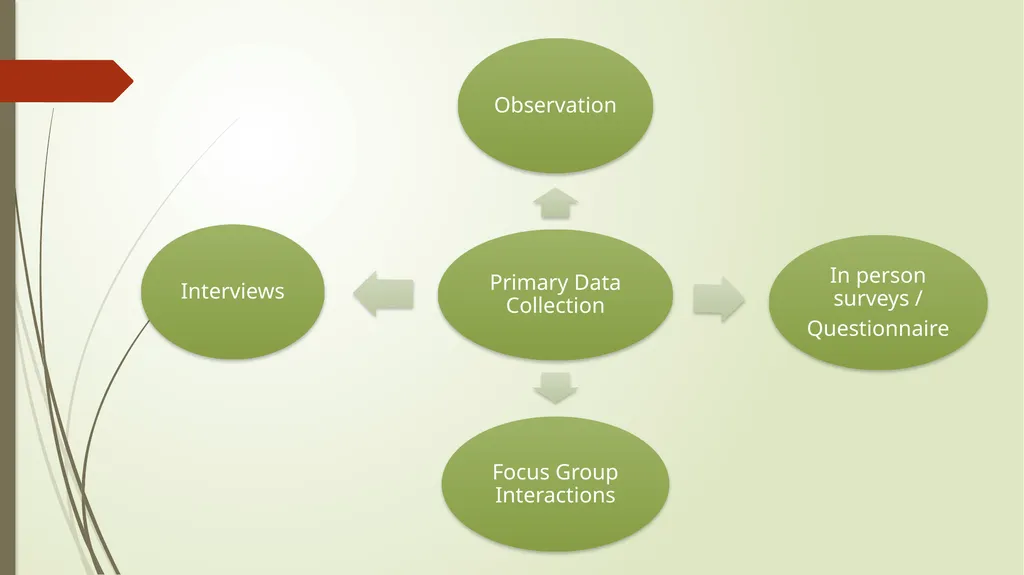
It is defined as a testing device for measuring a given event. For e.g. : Questionnaire, Observation, Interviews etc.
These tools can be prepared by the researcher according to the objectives of research.
Importance of Research Tools
It is important to decide the tools for data collection because research is carried out in different ways and for different purposes.
The objective behind choosing the right data collection tool is to capture quality evidence that allows analysis to lead to the formulation of convincing and credible answers to the questions that have been posed in research.
It allows others to verify and or follow on with reported results due to standardization of measurements.
Tools of measurement and it guides the researcher in data collection and in evaluation.<br>
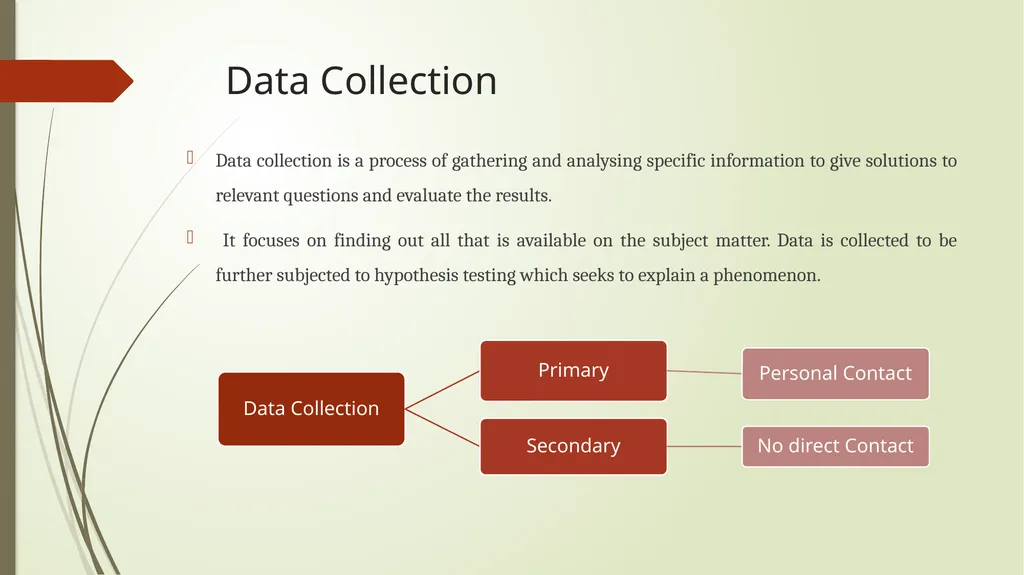
slide3. Data Collection Data collection is a process of gathering and analysing specific information to give solutions to relevant questions and evaluate the results.
It focuses on finding out all that is available on the subject matter. Data is collected to be further subjected to hypothesis testing which seeks to explain a phenomenon.<br>
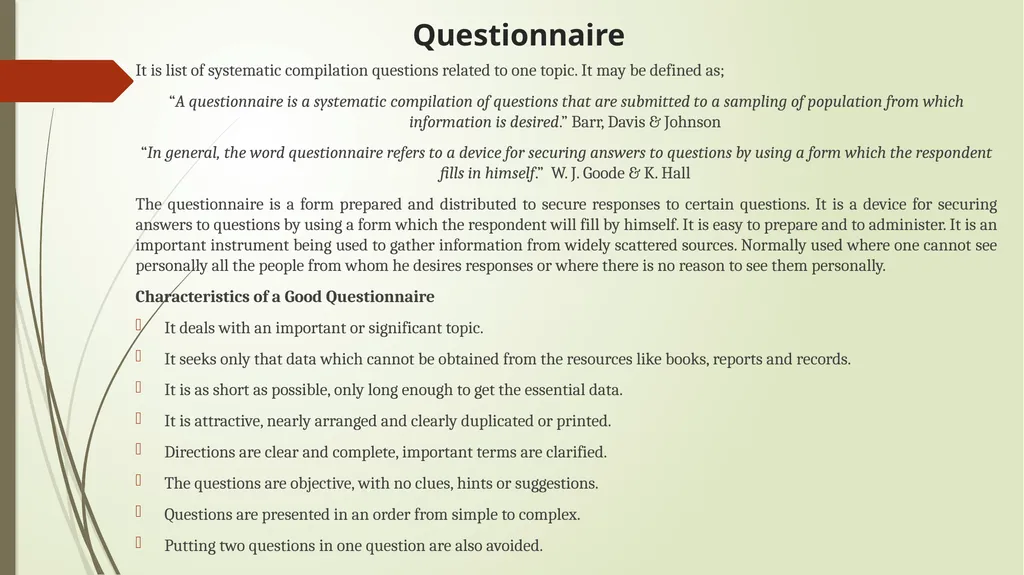
slide6. Questionnaire It is list of systematic compilation questions related to one topic. It may be defined as;
“A questionnaire is a systematic compilation of questions that are submitted to a sampling of population from which information is desired.” Barr, Davis & Johnson
“In general, the word questionnaire refers to a device for securing answers to questions by using a form which the respondent fills in himself.” W. J. Goode & K. Hall
The questionnaire is a form prepared and distributed to secure responses to certain questions. It is a device for securing answers to questions by using a form which the respondent will fill by himself. It is easy to prepare and to administer. It is an important instrument being used to gather information from widely scattered sources. Normally used where one cannot see personally all the people from whom he desires responses or where there is no reason to see them personally.
Characteristics of a Good Questionnaire
It deals with an important or significant topic.
It seeks only that data which cannot be obtained from the resources like books, reports and records.
It is as short as possible, only long enough to get the essential data.
It is attractive, nearly arranged and clearly duplicated or printed.
Directions are clear and complete, important terms are clarified.
The questions are objective, with no clues, hints or suggestions.
Questions are presented in an order from simple to complex.
Putting two questions in one question are also avoided.<br>
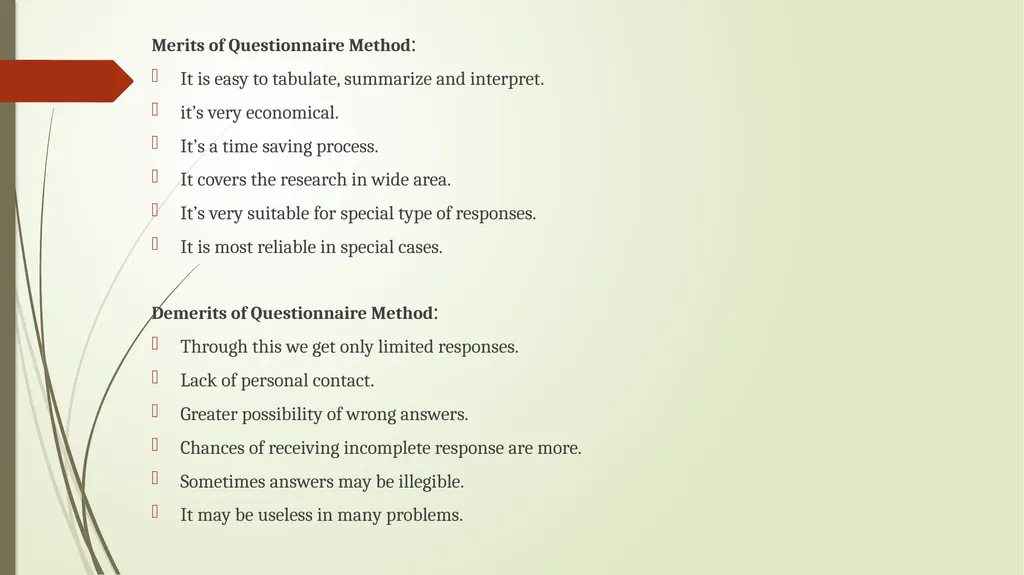
slide7. Merits of Questionnaire Method:
It is easy to tabulate, summarize and interpret.
it’s very economical.
It’s a time saving process.
It covers the research in wide area.
It’s very suitable for special type of responses.
It is most reliable in special cases.
Demerits of Questionnaire Method:
Through this we get only limited responses.
Lack of personal contact.
Greater possibility of wrong answers.
Chances of receiving incomplete response are more.
Sometimes answers may be illegible.
It may be useless in many problems.<br>
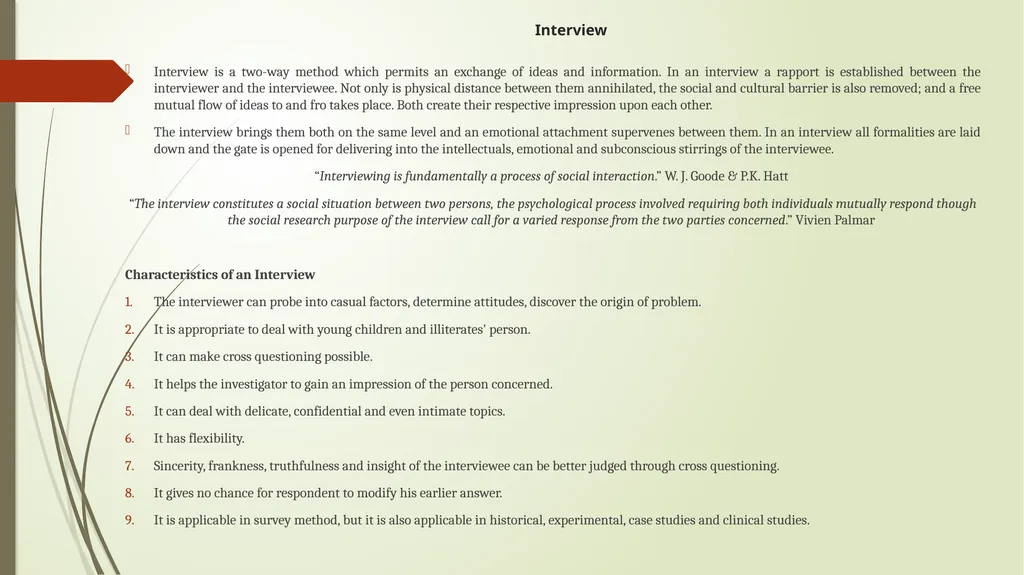
slide8. Interview Interview is a two-way method which permits an exchange of ideas and information. In an interview a rapport is established between the interviewer and the interviewee. Not only is physical distance between them annihilated, the social and cultural barrier is also removed; and a free mutual flow of ideas to and fro takes place. Both create their respective impression upon each other.
The interview brings them both on the same level and an emotional attachment supervenes between them. In an interview all formalities are laid down and the gate is opened for delivering into the intellectuals, emotional and subconscious stirrings of the interviewee.
“Interviewing is fundamentally a process of social interaction.” W. J. Goode & P.K. Hatt
“The interview constitutes a social situation between two persons, the psychological process involved requiring both individuals mutually respond though the social research purpose of the interview call for a varied response from the two parties concerned.” Vivien Palmar
Characteristics of an Interview
The interviewer can probe into casual factors, determine attitudes, discover the origin of problem.
It is appropriate to deal with young children and illiterates' person.
It can make cross questioning possible.
It helps the investigator to gain an impression of the person concerned.
It can deal with delicate, confidential and even intimate topics.
It has flexibility.
Sincerity, frankness, truthfulness and insight of the interviewee can be better judged through cross questioning.
It gives no chance for respondent to modify his earlier answer.
It is applicable in survey method, but it is also applicable in historical, experimental, case studies and clinical studies.<br>
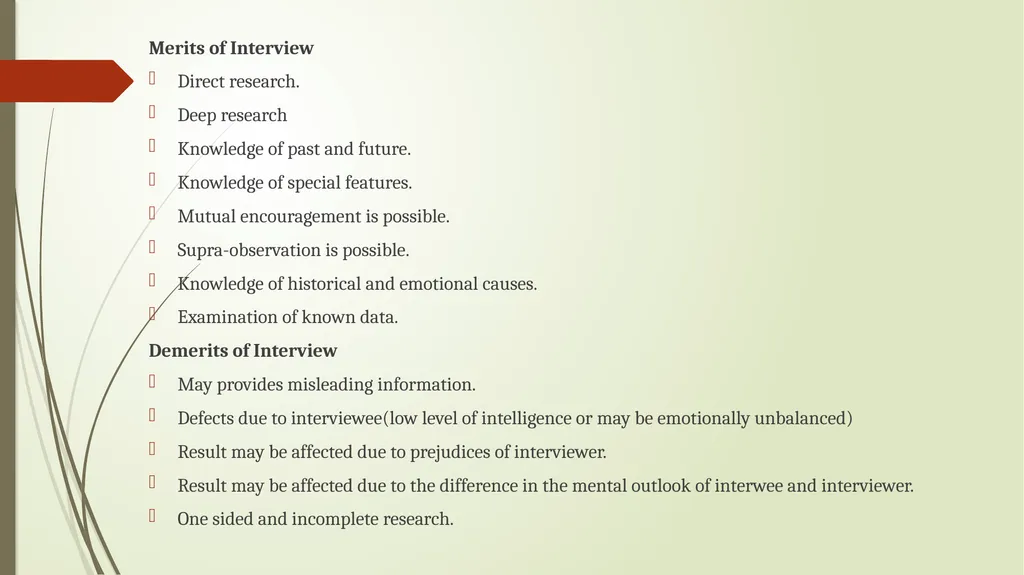
slide9. Merits of Interview
Direct research.
Deep research
Knowledge of past and future.
Knowledge of special features.
Mutual encouragement is possible.
Supra-observation is possible.
Knowledge of historical and emotional causes.
Examination of known data.
Demerits of Interview
May provides misleading information.
Defects due to interviewee(low level of intelligence or may be emotionally unbalanced)
Result may be affected due to prejudices of interviewer.
Result may be affected due to the difference in the mental outlook of interwee and interviewer.
One sided and incomplete research.<br>
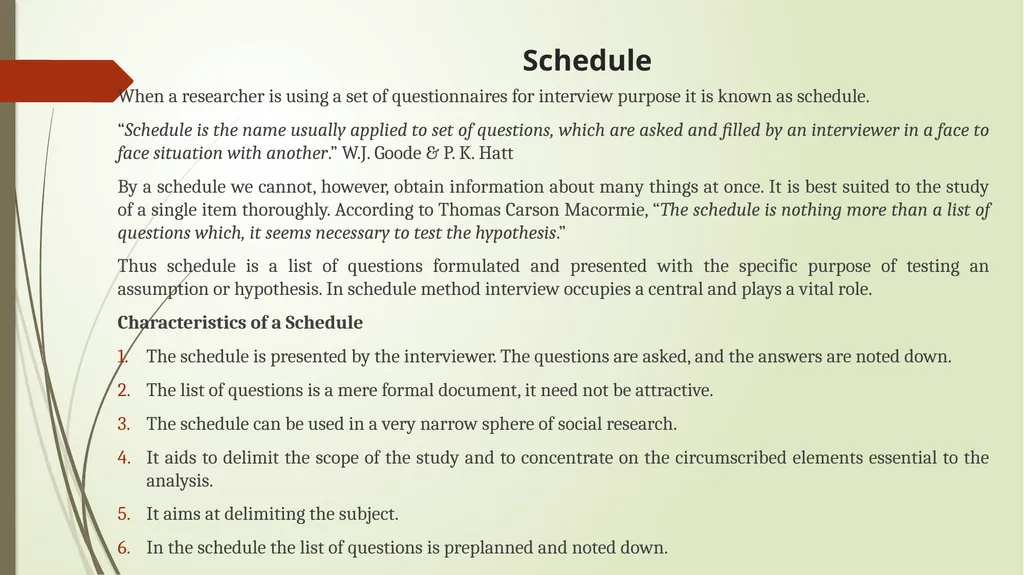
slide10. Schedule When a researcher is using a set of questionnaires for interview purpose it is known as schedule.
“Schedule is the name usually applied to set of questions, which are asked and filled by an interviewer in a face to face situation with another.” W.J. Goode & P. K. Hatt
By a schedule we cannot, however, obtain information about many things at once. It is best suited to the study of a single item thoroughly. According to Thomas Carson Macormie, “The schedule is nothing more than a list of questions which, it seems necessary to test the hypothesis.”
Thus schedule is a list of questions formulated and presented with the specific purpose of testing an assumption or hypothesis. In schedule method interview occupies a central and plays a vital role.
Characteristics of a Schedule
The schedule is presented by the interviewer. The questions are asked, and the answers are noted down.
The list of questions is a mere formal document, it need not be attractive.
The schedule can be used in a very narrow sphere of social research.
It aids to delimit the scope of the study and to concentrate on the circumscribed elements essential to the analysis.
It aims at delimiting the subject.
In the schedule the list of questions is preplanned and noted down.<br>
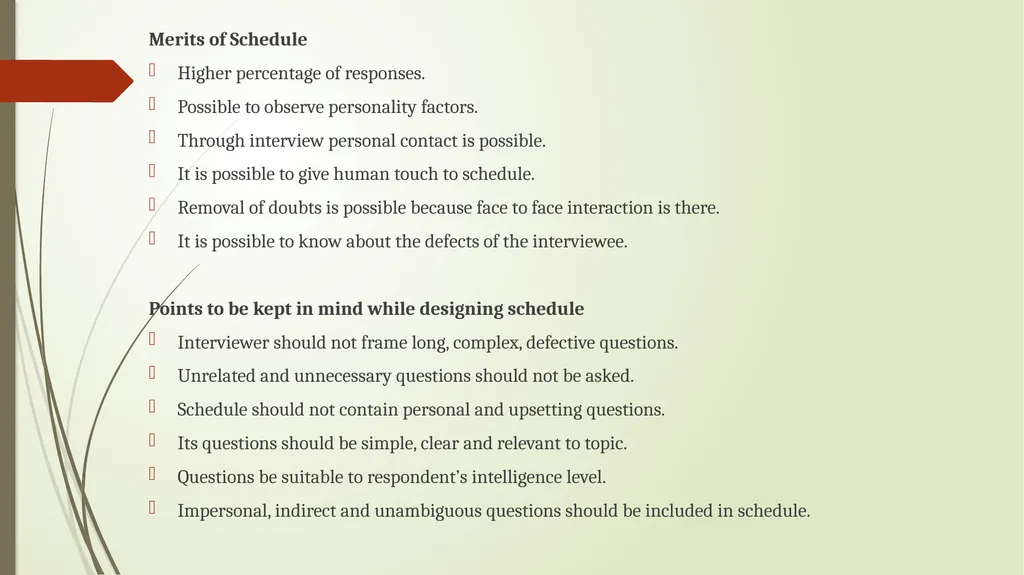
slide11. Merits of Schedule
Higher percentage of responses.
Possible to observe personality factors.
Through interview personal contact is possible.
It is possible to give human touch to schedule.
Removal of doubts is possible because face to face interaction is there.
It is possible to know about the defects of the interviewee.
Points to be kept in mind while designing schedule
Interviewer should not frame long, complex, defective questions.
Unrelated and unnecessary questions should not be asked.
Schedule should not contain personal and upsetting questions.
Its questions should be simple, clear and relevant to topic.
Questions be suitable to respondent’s intelligence level.
Impersonal, indirect and unambiguous questions should be included in schedule.<br>
slide12. Rating Scale Ratting is term applied to express opinion or judgment regarding some situation, object or character. Opinions are usually expressed on a scale of values; rating techniques are devices by which such judgments may be quantified.
“Rating is an essence and direct observation.” Ruth Strong
“A rating scale ascertains the degree, intensity and frequency of a variable.” Von Dallen
Rating techniques are more commonly used in scaling traits and attributes. A rating method is a method by which one systematizes, the expression of opinion concerning a trait. The rating is done by parents, teachers, a board of interviewers and judges and even by the self as well. The special feature of rating scale is that the attitudes are evaluated not based on the opinions of the subjects but based on the opinions and judgments of the experimenter himself.
In rating scale data are collected by
Verbal behavior
Facial expression
Personal documents
Clinical type interview
Projective techniques
Immediate experiences as emotions, thoughts and perceptions.<br>
slide13. Merits of Rating Scale
Helpful for Writing reports to parents.
Filling out admission forms for colleges.
Finding out students’ needs.
Making recommendations to employers.
Supplementing other sources of undertaking about child.
Stimulating effect upon the rates.
Demerits of Rating Scale
Difference in rating abilities.
Difference in reliability as subjects for rating.
Agreement among raters of one type of contact only.
Impact on emotions.
Limits of self-rating.
Over rating.
Limits of rating of specific qualities.
Limits of justifications.<br>
slide14. Observation “It is thorough study based on visual observation. Under this technique group behaviours and social institutions problems are evaluated.” C. Y. Younge
“Observation employs relatively more visual and senses than audio and vocal organs.” C.A. Mourse
The cause- effect relationship and study of events in original form, is known as observation. Observation seeks to ascertain what people think and do by watching them in action as they express themselves in various situations and activities. Observation is recognized as the most direct means of studying people when one is interested in their overt behaviour. It is technique of evaluation in which behaviour are observed in a natural situations. The nature of the observation could be accomplished either as a complete observer, an observer as a participant, a participant as an observer or as a complete participant. This method is a key base of formulating a hypothesis.
Characteristics of Observation
It is planned systematically rather than occurring haphazardly.
It is systematically recorded and related to more general propositions.
It is subjected to checks and controls with respect to validity , reliability and precision.
It is a direct technique to study an object, an event or a problem.
It is based mainly on visual –audio scene.
It employs own experiences.
It establishes cause-effect relationship.
It is an objective technique of data collection.
It is both objective and subjective evaluation technique.
It is formal as well as informal technique.
It is quantitative as well as qualitative technique for data collection.<br>
slide15. Merits of Observation
It is reliable and valid technique of collecting data and information.
We get first-hand data through this method.
Record of observation is also available immediately.
It is simple, broad and comprehensive method.
It is an oldest technique of data collection and getting direct information.
Demerits of Observation
It has a limited scope for its use because all the events cannot be observed directly.
It is subjective method.
It is very time-consuming process.
Presence of observer influences the behaviour of the person i.e. subject becomes conscious.
In case covert behaviour, which can’t be observed, it is not useful.
Observer should be trained and experienced.<br>
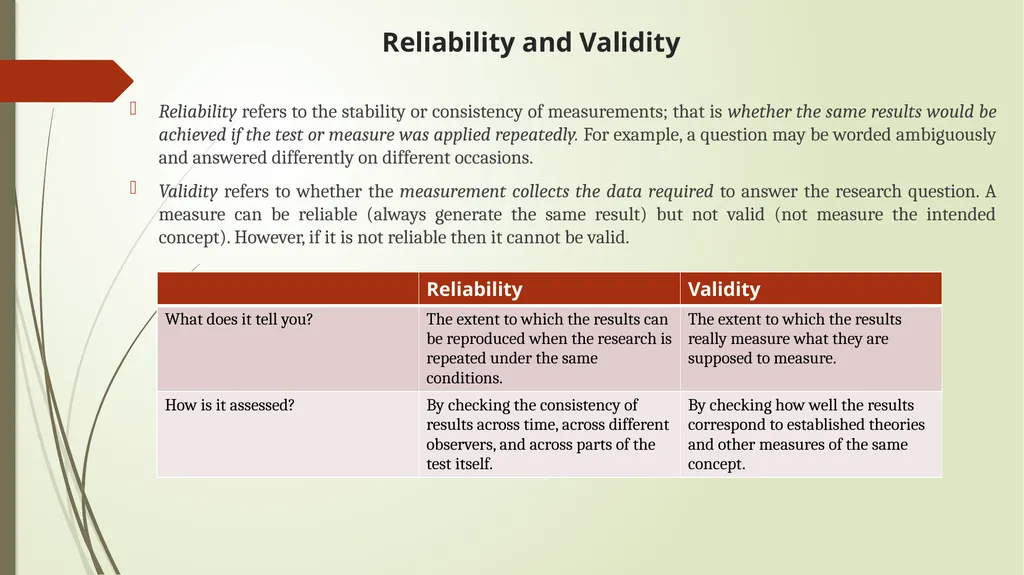
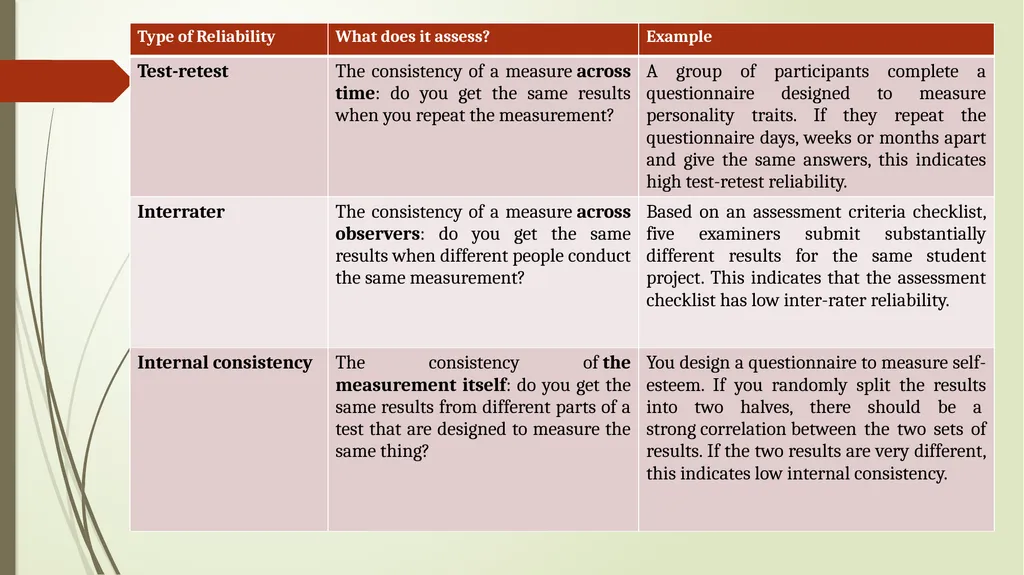
slide16. Reliability and Validity Reliability refers to the stability or consistency of measurements; that is whether the same results would be achieved if the test or measure was applied repeatedly. For example, a question may be worded ambiguously and answered differently on different occasions.
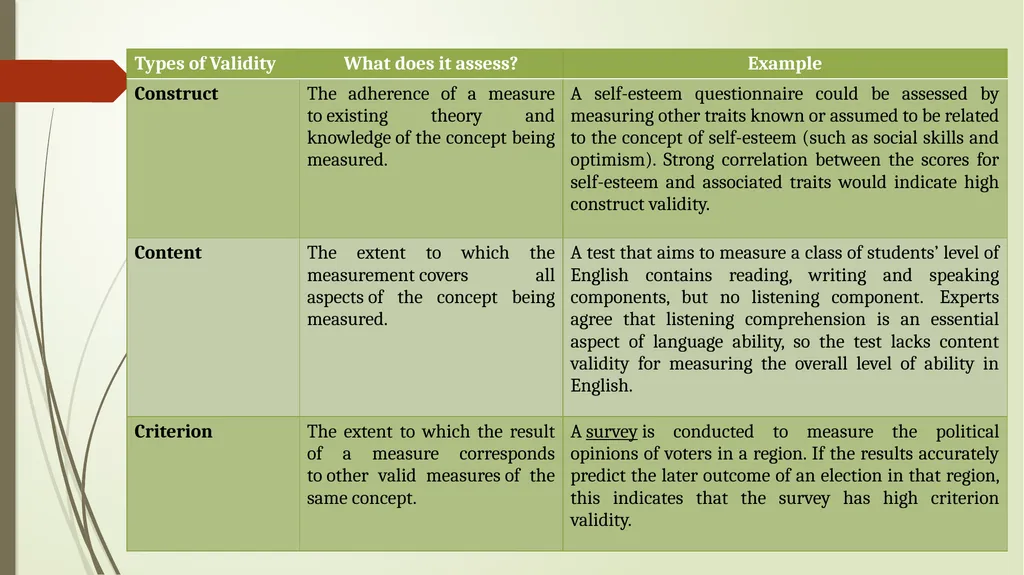
Validity refers to whether the measurement collects the data required to answer the research question. A measure can be reliable (always generate the same result) but not valid (not measure the intended concept). However, if it is not reliable then it cannot be valid.<br>
slide2. Research Tools for Data Collection Meaning of Research Tools
Tools are the instruments used to collect information for performance assessments, self evaluations and external evaluations.
It is defined as a testing device for measuring a given event. For e.g. : Questionnaire, Observation, Interviews etc.
These tools can be prepared by the researcher according to the objectives of research.
Importance of Research Tools
It is important to decide the tools for data collection because research is carried out in different ways and for different purposes.
The objective behind choosing the right data collection tool is to capture quality evidence that allows analysis to lead to the formulation of convincing and credible answers to the questions that have been posed in research.
It allows others to verify and or follow on with reported results due to standardization of measurements.
Tools of measurement and it guides the researcher in data collection and in evaluation.<br>
slide3. Data Collection Data collection is a process of gathering and analysing specific information to give solutions to relevant questions and evaluate the results.
It focuses on finding out all that is available on the subject matter. Data is collected to be further subjected to hypothesis testing which seeks to explain a phenomenon.<br>
slide6. Questionnaire It is list of systematic compilation questions related to one topic. It may be defined as;
“A questionnaire is a systematic compilation of questions that are submitted to a sampling of population from which information is desired.” Barr, Davis & Johnson
“In general, the word questionnaire refers to a device for securing answers to questions by using a form which the respondent fills in himself.” W. J. Goode & K. Hall
The questionnaire is a form prepared and distributed to secure responses to certain questions. It is a device for securing answers to questions by using a form which the respondent will fill by himself. It is easy to prepare and to administer. It is an important instrument being used to gather information from widely scattered sources. Normally used where one cannot see personally all the people from whom he desires responses or where there is no reason to see them personally.
Characteristics of a Good Questionnaire
It deals with an important or significant topic.
It seeks only that data which cannot be obtained from the resources like books, reports and records.
It is as short as possible, only long enough to get the essential data.
It is attractive, nearly arranged and clearly duplicated or printed.
Directions are clear and complete, important terms are clarified.
The questions are objective, with no clues, hints or suggestions.
Questions are presented in an order from simple to complex.
Putting two questions in one question are also avoided.<br>
slide7. Merits of Questionnaire Method:
It is easy to tabulate, summarize and interpret.
it’s very economical.
It’s a time saving process.
It covers the research in wide area.
It’s very suitable for special type of responses.
It is most reliable in special cases.
Demerits of Questionnaire Method:
Through this we get only limited responses.
Lack of personal contact.
Greater possibility of wrong answers.
Chances of receiving incomplete response are more.
Sometimes answers may be illegible.
It may be useless in many problems.<br>
slide8. Interview Interview is a two-way method which permits an exchange of ideas and information. In an interview a rapport is established between the interviewer and the interviewee. Not only is physical distance between them annihilated, the social and cultural barrier is also removed; and a free mutual flow of ideas to and fro takes place. Both create their respective impression upon each other.
The interview brings them both on the same level and an emotional attachment supervenes between them. In an interview all formalities are laid down and the gate is opened for delivering into the intellectuals, emotional and subconscious stirrings of the interviewee.
“Interviewing is fundamentally a process of social interaction.” W. J. Goode & P.K. Hatt
“The interview constitutes a social situation between two persons, the psychological process involved requiring both individuals mutually respond though the social research purpose of the interview call for a varied response from the two parties concerned.” Vivien Palmar
Characteristics of an Interview
The interviewer can probe into casual factors, determine attitudes, discover the origin of problem.
It is appropriate to deal with young children and illiterates' person.
It can make cross questioning possible.
It helps the investigator to gain an impression of the person concerned.
It can deal with delicate, confidential and even intimate topics.
It has flexibility.
Sincerity, frankness, truthfulness and insight of the interviewee can be better judged through cross questioning.
It gives no chance for respondent to modify his earlier answer.
It is applicable in survey method, but it is also applicable in historical, experimental, case studies and clinical studies.<br>
slide9. Merits of Interview
Direct research.
Deep research
Knowledge of past and future.
Knowledge of special features.
Mutual encouragement is possible.
Supra-observation is possible.
Knowledge of historical and emotional causes.
Examination of known data.
Demerits of Interview
May provides misleading information.
Defects due to interviewee(low level of intelligence or may be emotionally unbalanced)
Result may be affected due to prejudices of interviewer.
Result may be affected due to the difference in the mental outlook of interwee and interviewer.
One sided and incomplete research.<br>
slide10. Schedule When a researcher is using a set of questionnaires for interview purpose it is known as schedule.
“Schedule is the name usually applied to set of questions, which are asked and filled by an interviewer in a face to face situation with another.” W.J. Goode & P. K. Hatt
By a schedule we cannot, however, obtain information about many things at once. It is best suited to the study of a single item thoroughly. According to Thomas Carson Macormie, “The schedule is nothing more than a list of questions which, it seems necessary to test the hypothesis.”
Thus schedule is a list of questions formulated and presented with the specific purpose of testing an assumption or hypothesis. In schedule method interview occupies a central and plays a vital role.
Characteristics of a Schedule
The schedule is presented by the interviewer. The questions are asked, and the answers are noted down.
The list of questions is a mere formal document, it need not be attractive.
The schedule can be used in a very narrow sphere of social research.
It aids to delimit the scope of the study and to concentrate on the circumscribed elements essential to the analysis.
It aims at delimiting the subject.
In the schedule the list of questions is preplanned and noted down.<br>
slide11. Merits of Schedule
Higher percentage of responses.
Possible to observe personality factors.
Through interview personal contact is possible.
It is possible to give human touch to schedule.
Removal of doubts is possible because face to face interaction is there.
It is possible to know about the defects of the interviewee.
Points to be kept in mind while designing schedule
Interviewer should not frame long, complex, defective questions.
Unrelated and unnecessary questions should not be asked.
Schedule should not contain personal and upsetting questions.
Its questions should be simple, clear and relevant to topic.
Questions be suitable to respondent’s intelligence level.
Impersonal, indirect and unambiguous questions should be included in schedule.<br>
slide12. Rating Scale Ratting is term applied to express opinion or judgment regarding some situation, object or character. Opinions are usually expressed on a scale of values; rating techniques are devices by which such judgments may be quantified.
“Rating is an essence and direct observation.” Ruth Strong
“A rating scale ascertains the degree, intensity and frequency of a variable.” Von Dallen
Rating techniques are more commonly used in scaling traits and attributes. A rating method is a method by which one systematizes, the expression of opinion concerning a trait. The rating is done by parents, teachers, a board of interviewers and judges and even by the self as well. The special feature of rating scale is that the attitudes are evaluated not based on the opinions of the subjects but based on the opinions and judgments of the experimenter himself.
In rating scale data are collected by
Verbal behavior
Facial expression
Personal documents
Clinical type interview
Projective techniques
Immediate experiences as emotions, thoughts and perceptions.<br>
slide13. Merits of Rating Scale
Helpful for Writing reports to parents.
Filling out admission forms for colleges.
Finding out students’ needs.
Making recommendations to employers.
Supplementing other sources of undertaking about child.
Stimulating effect upon the rates.
Demerits of Rating Scale
Difference in rating abilities.
Difference in reliability as subjects for rating.
Agreement among raters of one type of contact only.
Impact on emotions.
Limits of self-rating.
Over rating.
Limits of rating of specific qualities.
Limits of justifications.<br>
slide14. Observation “It is thorough study based on visual observation. Under this technique group behaviours and social institutions problems are evaluated.” C. Y. Younge
“Observation employs relatively more visual and senses than audio and vocal organs.” C.A. Mourse
The cause- effect relationship and study of events in original form, is known as observation. Observation seeks to ascertain what people think and do by watching them in action as they express themselves in various situations and activities. Observation is recognized as the most direct means of studying people when one is interested in their overt behaviour. It is technique of evaluation in which behaviour are observed in a natural situations. The nature of the observation could be accomplished either as a complete observer, an observer as a participant, a participant as an observer or as a complete participant. This method is a key base of formulating a hypothesis.
Characteristics of Observation
It is planned systematically rather than occurring haphazardly.
It is systematically recorded and related to more general propositions.
It is subjected to checks and controls with respect to validity , reliability and precision.
It is a direct technique to study an object, an event or a problem.
It is based mainly on visual –audio scene.
It employs own experiences.
It establishes cause-effect relationship.
It is an objective technique of data collection.
It is both objective and subjective evaluation technique.
It is formal as well as informal technique.
It is quantitative as well as qualitative technique for data collection.<br>
slide15. Merits of Observation
It is reliable and valid technique of collecting data and information.
We get first-hand data through this method.
Record of observation is also available immediately.
It is simple, broad and comprehensive method.
It is an oldest technique of data collection and getting direct information.
Demerits of Observation
It has a limited scope for its use because all the events cannot be observed directly.
It is subjective method.
It is very time-consuming process.
Presence of observer influences the behaviour of the person i.e. subject becomes conscious.
In case covert behaviour, which can’t be observed, it is not useful.
Observer should be trained and experienced.<br>
slide16. Reliability and Validity Reliability refers to the stability or consistency of measurements; that is whether the same results would be achieved if the test or measure was applied repeatedly. For example, a question may be worded ambiguously and answered differently on different occasions.
Validity refers to whether the measurement collects the data required to answer the research question. A measure can be reliable (always generate the same result) but not valid (not measure the intended concept). However, if it is not reliable then it cannot be valid.<br>