
TOOLS Sociodemographic Data Collection IN A
DP
Published · 36 slides · 0 views
1 / 1



Description
TOOLS Sociodemographic Data Collection IN A NUTSHELL Researchers and advocates have long emphasized the need for collection of sociodemographic and race-based data in the health sector to be able to better understand health inequities at
Related Topics
Share
Embed code
Download this presentation From Below
"TOOLS Sociodemographic Data Collection IN A" is the property of its rightful owner. Permission is granted to download and print the materials on this website for personal, non-commercial use only, and to display it on your personal computer provided you do not modify the materials and that you retain all copyright notices contained in the materials. By downloading content from our website, you accept the terms of this agreement.
Presentation Transcript
01
TOOLS Sociodemographic Data Collection<br>
02
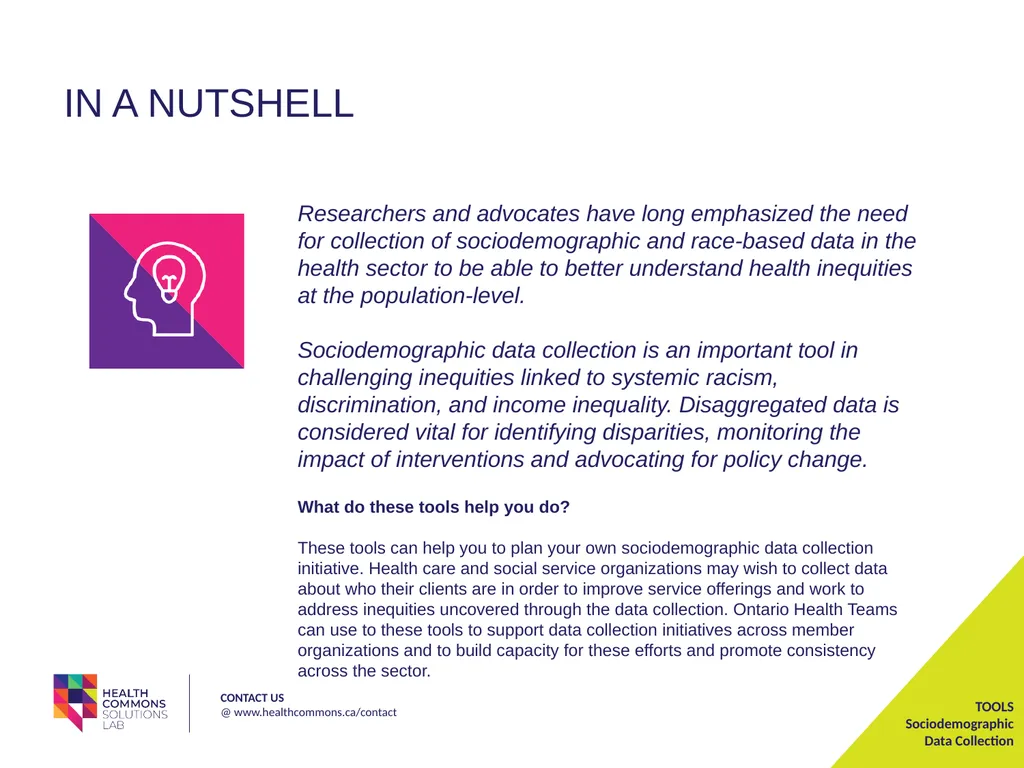
IN A NUTSHELL Researchers and advocates have long emphasized the need for collection of sociodemographic and race-based data in the health sector to be able to better understand health inequities at the population-level.
Sociodemographic data collection is an important tool in challenging inequities linked to systemic racism, discrimination, and income inequality. Disaggregated data is considered vital for identifying disparities, monitoring the impact of interventions and advocating for policy change.
What do these tools help you do?
These tools can help you to plan your own sociodemographic data collection initiative. Health care and social service organizations may wish to collect data about who their clients are in order to improve service offerings and work to address inequities uncovered through the data collection. Ontario Health Teams can use to these tools to support data collection initiatives across member organizations and to build capacity for these efforts and promote consistency across the sector.<br>
Sociodemographic data collection is an important tool in challenging inequities linked to systemic racism, discrimination, and income inequality. Disaggregated data is considered vital for identifying disparities, monitoring the impact of interventions and advocating for policy change.
What do these tools help you do?
These tools can help you to plan your own sociodemographic data collection initiative. Health care and social service organizations may wish to collect data about who their clients are in order to improve service offerings and work to address inequities uncovered through the data collection. Ontario Health Teams can use to these tools to support data collection initiatives across member organizations and to build capacity for these efforts and promote consistency across the sector.<br>
03
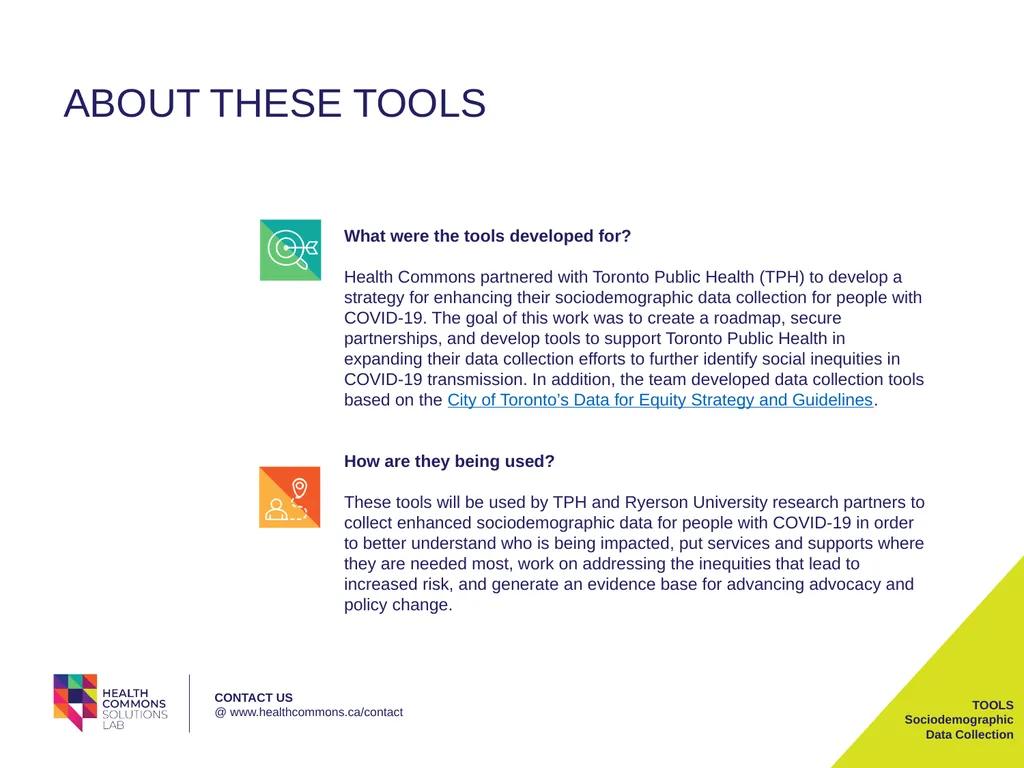
ABOUT THESE TOOLS What were the tools developed for?
Health Commons partnered with Toronto Public Health (TPH) to develop a strategy for enhancing their sociodemographic data collection for people with COVID-19. The goal of this work was to create a roadmap, secure partnerships, and develop tools to support Toronto Public Health in expanding their data collection efforts to further identify social inequities in COVID-19 transmission. In addition, the team developed data collection tools based on the City of Toronto’s Data for Equity Strategy and Guidelines.
How are they being used?
These tools will be used by TPH and Ryerson University research partners to collect enhanced sociodemographic data for people with COVID-19 in order to better understand who is being impacted, put services and supports where they are needed most, work on addressing the inequities that lead to increased risk, and generate an evidence base for advancing advocacy and policy change.<br>
Health Commons partnered with Toronto Public Health (TPH) to develop a strategy for enhancing their sociodemographic data collection for people with COVID-19. The goal of this work was to create a roadmap, secure partnerships, and develop tools to support Toronto Public Health in expanding their data collection efforts to further identify social inequities in COVID-19 transmission. In addition, the team developed data collection tools based on the City of Toronto’s Data for Equity Strategy and Guidelines.
How are they being used?
These tools will be used by TPH and Ryerson University research partners to collect enhanced sociodemographic data for people with COVID-19 in order to better understand who is being impacted, put services and supports where they are needed most, work on addressing the inequities that lead to increased risk, and generate an evidence base for advancing advocacy and policy change.<br>
04
Developing your data collection tool
Collecting sociodemographic data
Potential sociodemographic questions
Sample consent script
Sample FAQs
Testing your questions
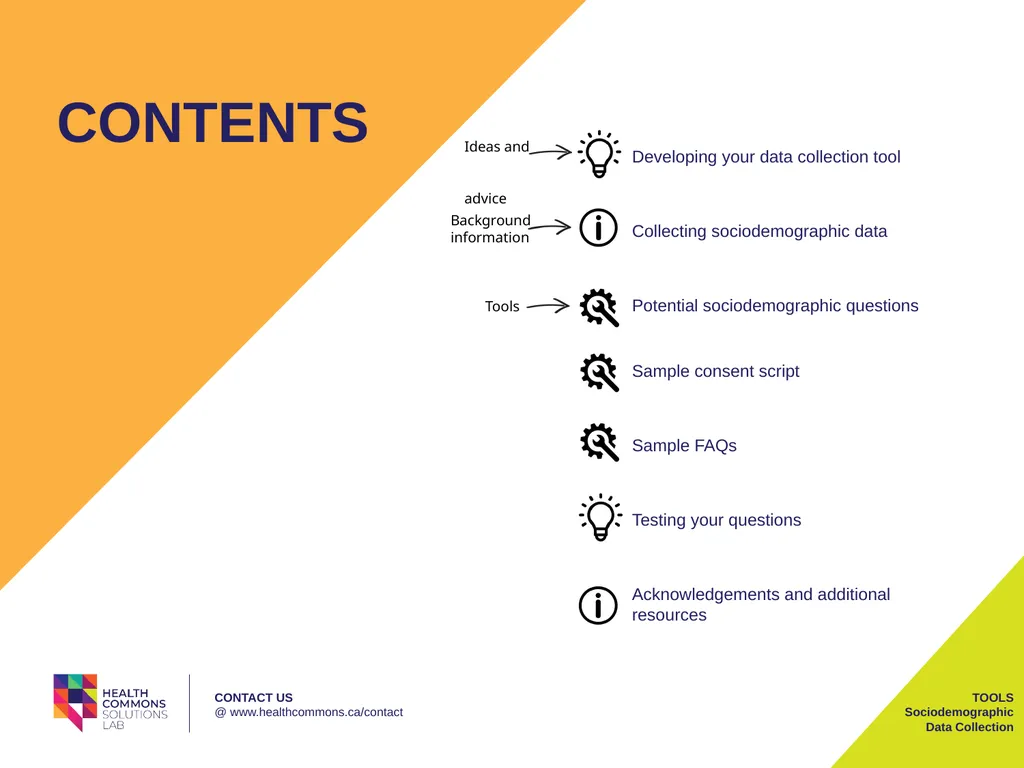
Acknowledgements and additional resources CONTENTS Tools Background information Ideas and advice<br>
Collecting sociodemographic data
Potential sociodemographic questions
Sample consent script
Sample FAQs
Testing your questions
Acknowledgements and additional resources CONTENTS Tools Background information Ideas and advice<br>
05
DEVELOPING YOUR DATA COLLECTION TOOL<br>
06
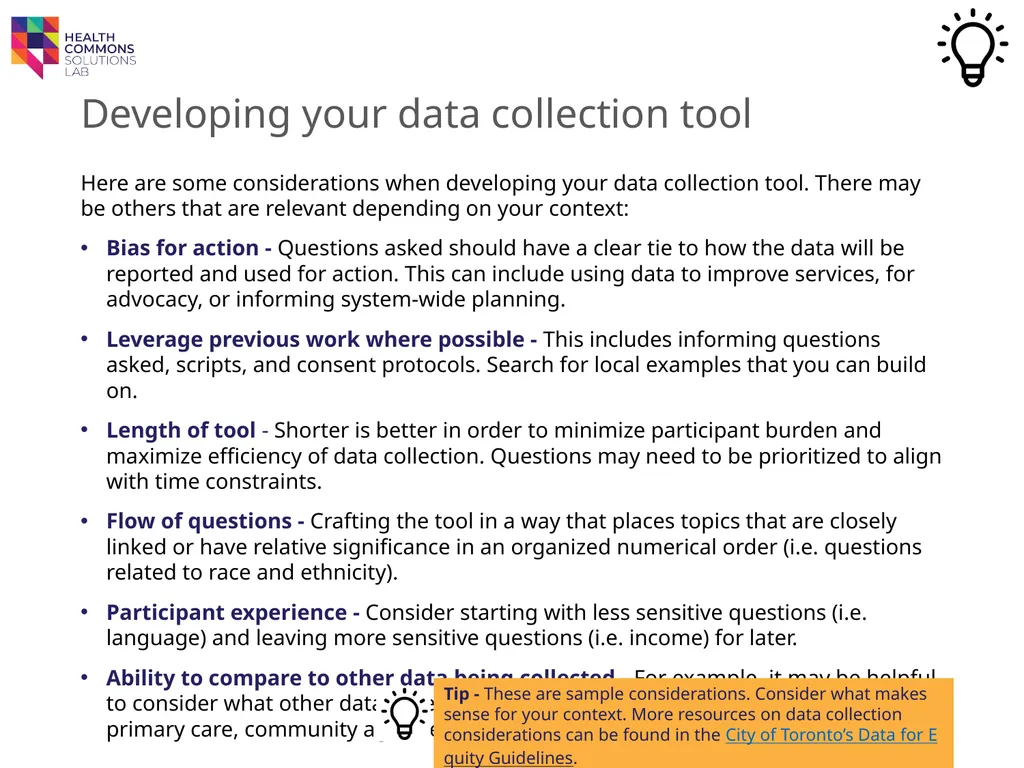
Developing your data collection tool Here are some considerations when developing your data collection tool. There may be others that are relevant depending on your context:
Bias for action - Questions asked should have a clear tie to how the data will be reported and used for action. This can include using data to improve services, for advocacy, or informing system-wide planning.
Leverage previous work where possible - This includes informing questions asked, scripts, and consent protocols. Search for local examples that you can build on.
Length of tool - Shorter is better in order to minimize participant burden and maximize efficiency of data collection. Questions may need to be prioritized to align with time constraints.
Flow of questions - Crafting the tool in a way that places topics that are closely linked or have relative significance in an organized numerical order (i.e. questions related to race and ethnicity).
Participant experience - Consider starting with less sensitive questions (i.e. language) and leaving more sensitive questions (i.e. income) for later.
Ability to compare to other data being collected - For example, it may be helpful to consider what other data is being collected by your partners (i.e. hospitals, primary care, community agencies) for consistency purposes. Tip - These are sample considerations. Consider what makes sense for your context. More resources on data collection considerations can be found in the City of Toronto’s Data for Equity Guidelines.<br>
Bias for action - Questions asked should have a clear tie to how the data will be reported and used for action. This can include using data to improve services, for advocacy, or informing system-wide planning.
Leverage previous work where possible - This includes informing questions asked, scripts, and consent protocols. Search for local examples that you can build on.
Length of tool - Shorter is better in order to minimize participant burden and maximize efficiency of data collection. Questions may need to be prioritized to align with time constraints.
Flow of questions - Crafting the tool in a way that places topics that are closely linked or have relative significance in an organized numerical order (i.e. questions related to race and ethnicity).
Participant experience - Consider starting with less sensitive questions (i.e. language) and leaving more sensitive questions (i.e. income) for later.
Ability to compare to other data being collected - For example, it may be helpful to consider what other data is being collected by your partners (i.e. hospitals, primary care, community agencies) for consistency purposes. Tip - These are sample considerations. Consider what makes sense for your context. More resources on data collection considerations can be found in the City of Toronto’s Data for Equity Guidelines.<br>
07
COLLECTING SOCIODEMOGRAPHIC DATA<br>
08
Collecting sociodemographic data Sociodemographic information describes personal characteristics and social identity. There are a number of questions you might ask to collect data about these characteristics.
The City of Toronto recently approved the Data for Equity Strategy which includes a set of guidelines on why, when and how to collect and manage sociodemographic data. The questions on the following slides were derived from these guidelines and represent potential questions you may wish to adapt for your own data collection initiative.
Questions can be adapted depending on organizational needs. Some questions may not fit your needs and there may be additional sociodemographic questions you want to add depending on your context. For example, through their COVID-19 data collection initiative, TPH plans to ask about how participants’ employment status has been impacted by COVID-19. Any question adaptations that TPH made are indicated.
When developing these questions, the City of Toronto conducted research, consultations with a variety of groups, including stakeholders from Indigenous, Black, disability, and LGBTQ2S+ communities. Engagement focused on what questions to ask and how.
We recommend thinking about community engagement early on in your data collection initiative, including what level of engagement you can commit to for each stakeholder at each stage. Engagement with Indigenous partners is important to ensure that the collection, use, sharing and knowledge translation of Indigenous data incorporate Indigenous data governance principles such as OCAP (Ownership, Control, Access, and Possession).
Beyond data collection, it is important to think about how data will be reported and used. Learn more about engaging communities in your data collection initiative here. Questions from City of Toronto. (2020). Data for Equity Strategy: Supporting Equitable Services, Equity Priorities, Performance Measurement and Accountability.<br>
The City of Toronto recently approved the Data for Equity Strategy which includes a set of guidelines on why, when and how to collect and manage sociodemographic data. The questions on the following slides were derived from these guidelines and represent potential questions you may wish to adapt for your own data collection initiative.
Questions can be adapted depending on organizational needs. Some questions may not fit your needs and there may be additional sociodemographic questions you want to add depending on your context. For example, through their COVID-19 data collection initiative, TPH plans to ask about how participants’ employment status has been impacted by COVID-19. Any question adaptations that TPH made are indicated.
When developing these questions, the City of Toronto conducted research, consultations with a variety of groups, including stakeholders from Indigenous, Black, disability, and LGBTQ2S+ communities. Engagement focused on what questions to ask and how.
We recommend thinking about community engagement early on in your data collection initiative, including what level of engagement you can commit to for each stakeholder at each stage. Engagement with Indigenous partners is important to ensure that the collection, use, sharing and knowledge translation of Indigenous data incorporate Indigenous data governance principles such as OCAP (Ownership, Control, Access, and Possession).
Beyond data collection, it is important to think about how data will be reported and used. Learn more about engaging communities in your data collection initiative here. Questions from City of Toronto. (2020). Data for Equity Strategy: Supporting Equitable Services, Equity Priorities, Performance Measurement and Accountability.<br>
09
POTENTIAL SOCIODEMOGRAPHIC QUESTIONS<br>
10
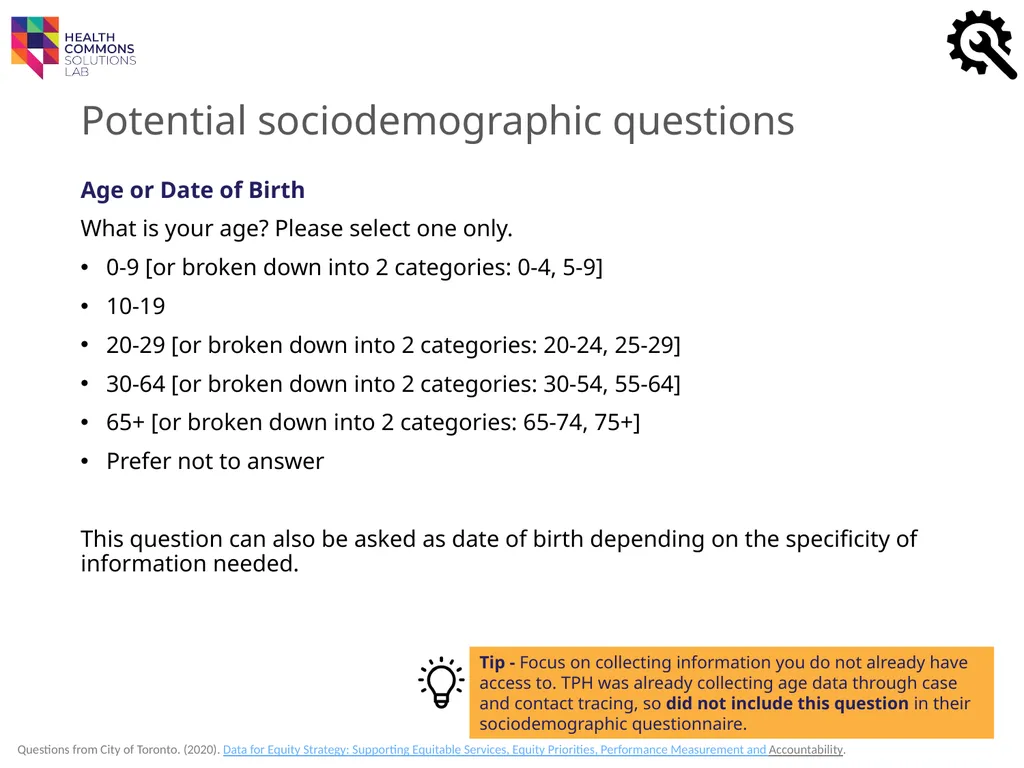
Potential sociodemographic questions Age or Date of Birth
What is your age? Please select one only.
0-9 [or broken down into 2 categories: 0-4, 5-9]
10-19
20-29 [or broken down into 2 categories: 20-24, 25-29]
30-64 [or broken down into 2 categories: 30-54, 55-64]
65+ [or broken down into 2 categories: 65-74, 75+]
Prefer not to answer
This question can also be asked as date of birth depending on the specificity of information needed. Questions from City of Toronto. (2020). Data for Equity Strategy: Supporting Equitable Services, Equity Priorities, Performance Measurement and Accountability. Tip - Focus on collecting information you do not already have access to. TPH was already collecting age data through case and contact tracing, so did not include this question in their sociodemographic questionnaire.<br>
What is your age? Please select one only.
0-9 [or broken down into 2 categories: 0-4, 5-9]
10-19
20-29 [or broken down into 2 categories: 20-24, 25-29]
30-64 [or broken down into 2 categories: 30-54, 55-64]
65+ [or broken down into 2 categories: 65-74, 75+]
Prefer not to answer
This question can also be asked as date of birth depending on the specificity of information needed. Questions from City of Toronto. (2020). Data for Equity Strategy: Supporting Equitable Services, Equity Priorities, Performance Measurement and Accountability. Tip - Focus on collecting information you do not already have access to. TPH was already collecting age data through case and contact tracing, so did not include this question in their sociodemographic questionnaire.<br>
11
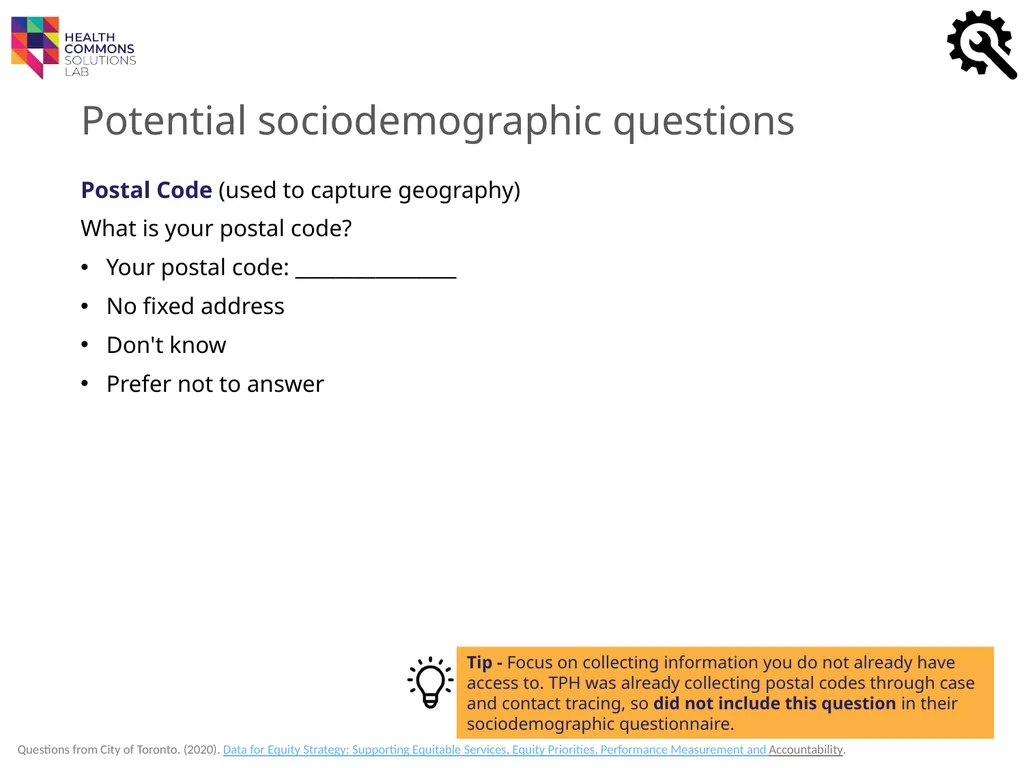
Potential sociodemographic questions Postal Code (used to capture geography)
What is your postal code?
Your postal code: ________________
No fixed address
Don't know
Prefer not to answer Questions from City of Toronto. (2020). Data for Equity Strategy: Supporting Equitable Services, Equity Priorities, Performance Measurement and Accountability. Tip - Focus on collecting information you do not already have access to. TPH was already collecting postal codes through case and contact tracing, so did not include this question in their sociodemographic questionnaire.<br>
What is your postal code?
Your postal code: ________________
No fixed address
Don't know
Prefer not to answer Questions from City of Toronto. (2020). Data for Equity Strategy: Supporting Equitable Services, Equity Priorities, Performance Measurement and Accountability. Tip - Focus on collecting information you do not already have access to. TPH was already collecting postal codes through case and contact tracing, so did not include this question in their sociodemographic questionnaire.<br>
12
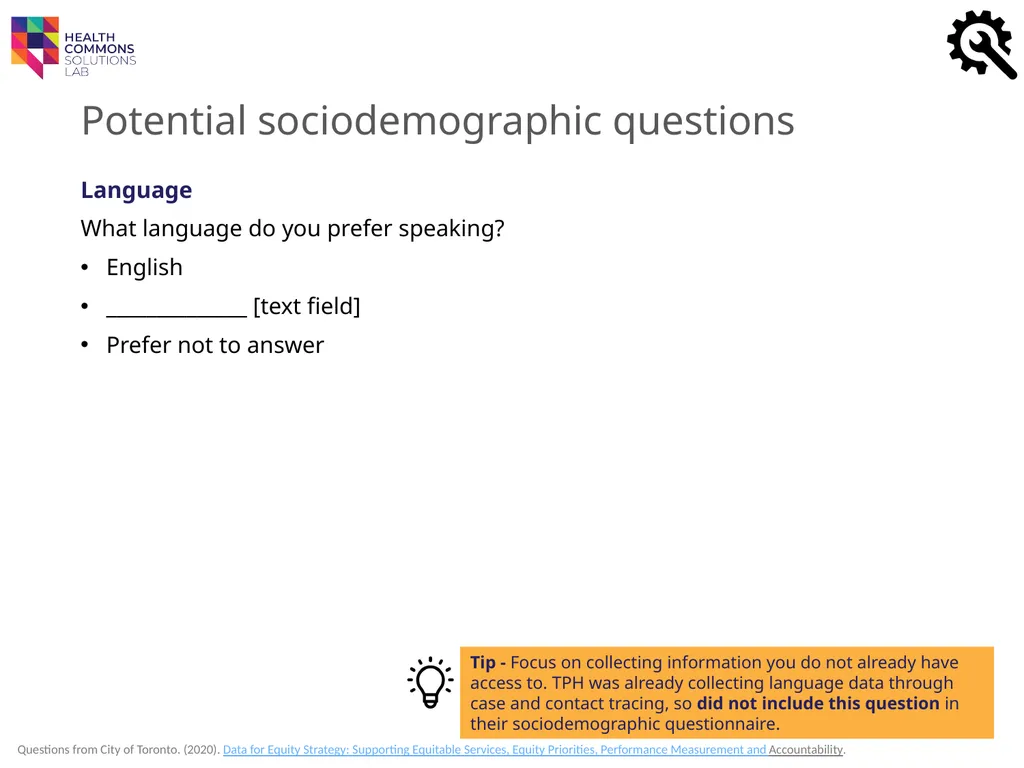
Potential sociodemographic questions Language
What language do you prefer speaking?
English
______________ [text field]
Prefer not to answer Questions from City of Toronto. (2020). Data for Equity Strategy: Supporting Equitable Services, Equity Priorities, Performance Measurement and Accountability. Tip - Focus on collecting information you do not already have access to. TPH was already collecting language data through case and contact tracing, so did not include this question in their sociodemographic questionnaire.<br>
What language do you prefer speaking?
English
______________ [text field]
Prefer not to answer Questions from City of Toronto. (2020). Data for Equity Strategy: Supporting Equitable Services, Equity Priorities, Performance Measurement and Accountability. Tip - Focus on collecting information you do not already have access to. TPH was already collecting language data through case and contact tracing, so did not include this question in their sociodemographic questionnaire.<br>
13
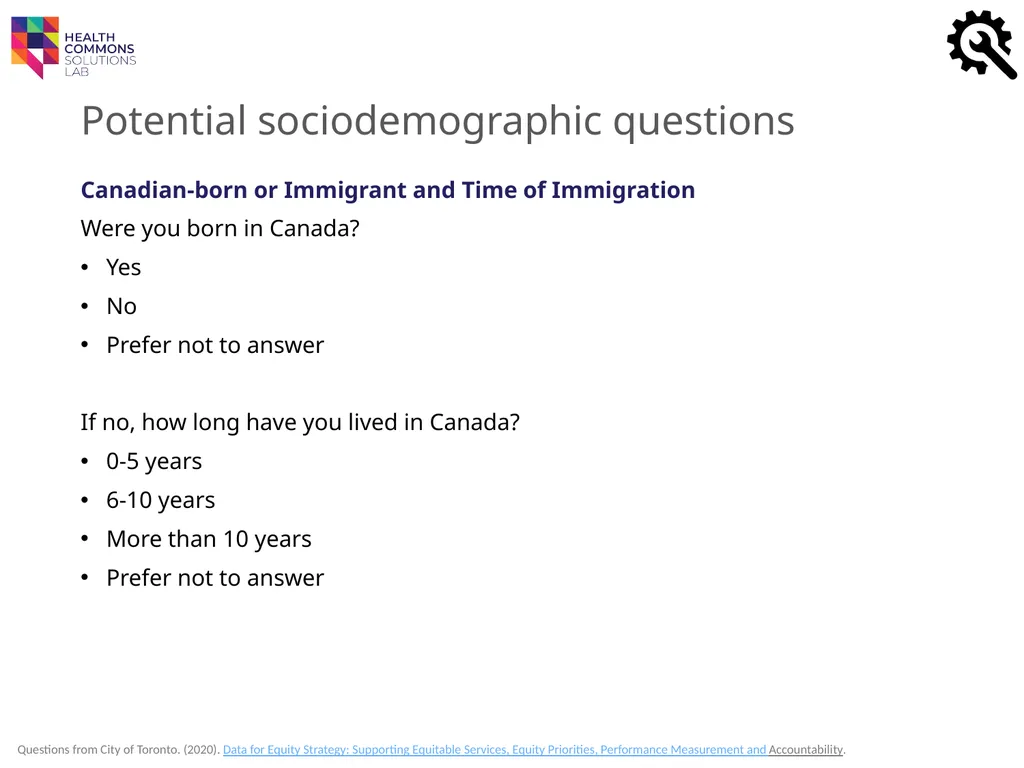
Potential sociodemographic questions Canadian-born or Immigrant and Time of Immigration
Were you born in Canada?
Yes
No
Prefer not to answer
If no, how long have you lived in Canada?
0-5 years
6-10 years
More than 10 years
Prefer not to answer Questions from City of Toronto. (2020). Data for Equity Strategy: Supporting Equitable Services, Equity Priorities, Performance Measurement and Accountability.<br>
Were you born in Canada?
Yes
No
Prefer not to answer
If no, how long have you lived in Canada?
0-5 years
6-10 years
More than 10 years
Prefer not to answer Questions from City of Toronto. (2020). Data for Equity Strategy: Supporting Equitable Services, Equity Priorities, Performance Measurement and Accountability.<br>
14
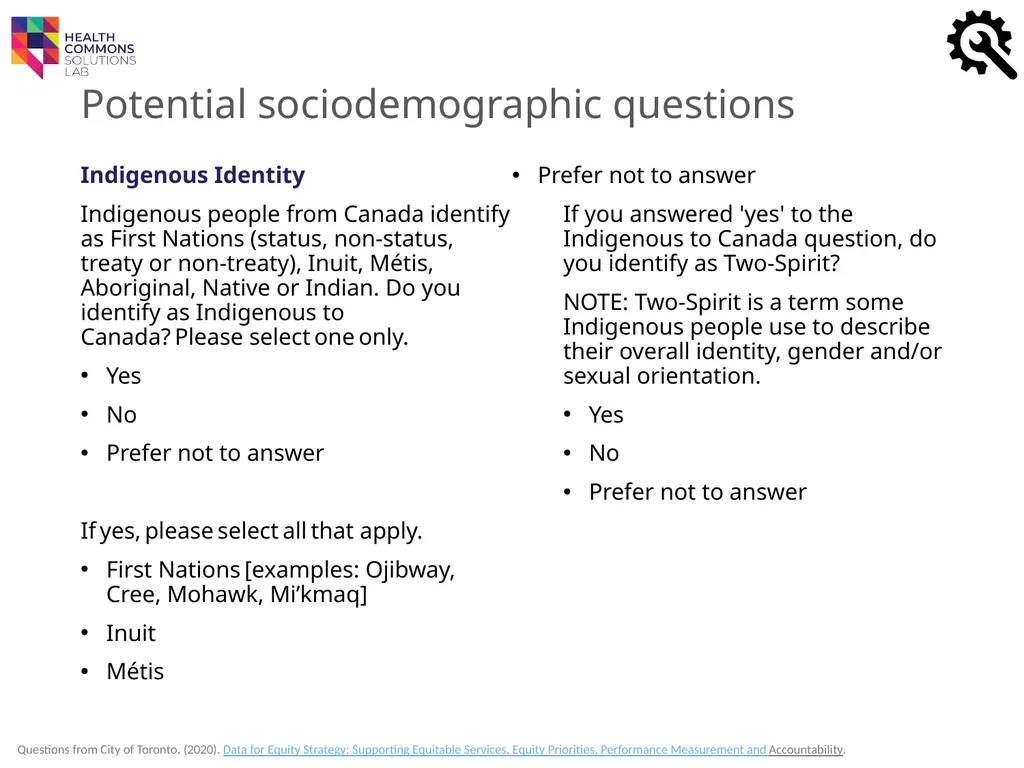
Potential sociodemographic questions Indigenous Identity
Indigenous people from Canada identify as First Nations (status, non-status, treaty or non-treaty), Inuit, Métis, Aboriginal, Native or Indian. Do you identify as Indigenous to Canada? Please select one only.
Yes
No
Prefer not to answer
If yes, please select all that apply.
First Nations [examples: Ojibway, Cree, Mohawk, Mi’kmaq]
Inuit
Métis
Prefer not to answer
If you answered 'yes' to the Indigenous to Canada question, do you identify as Two-Spirit?
NOTE: Two-Spirit is a term some Indigenous people use to describe their overall identity, gender and/or sexual orientation.
Yes
No
Prefer not to answer Questions from City of Toronto. (2020). Data for Equity Strategy: Supporting Equitable Services, Equity Priorities, Performance Measurement and Accountability.<br>
Indigenous people from Canada identify as First Nations (status, non-status, treaty or non-treaty), Inuit, Métis, Aboriginal, Native or Indian. Do you identify as Indigenous to Canada? Please select one only.
Yes
No
Prefer not to answer
If yes, please select all that apply.
First Nations [examples: Ojibway, Cree, Mohawk, Mi’kmaq]
Inuit
Métis
Prefer not to answer
If you answered 'yes' to the Indigenous to Canada question, do you identify as Two-Spirit?
NOTE: Two-Spirit is a term some Indigenous people use to describe their overall identity, gender and/or sexual orientation.
Yes
No
Prefer not to answer Questions from City of Toronto. (2020). Data for Equity Strategy: Supporting Equitable Services, Equity Priorities, Performance Measurement and Accountability.<br>
15
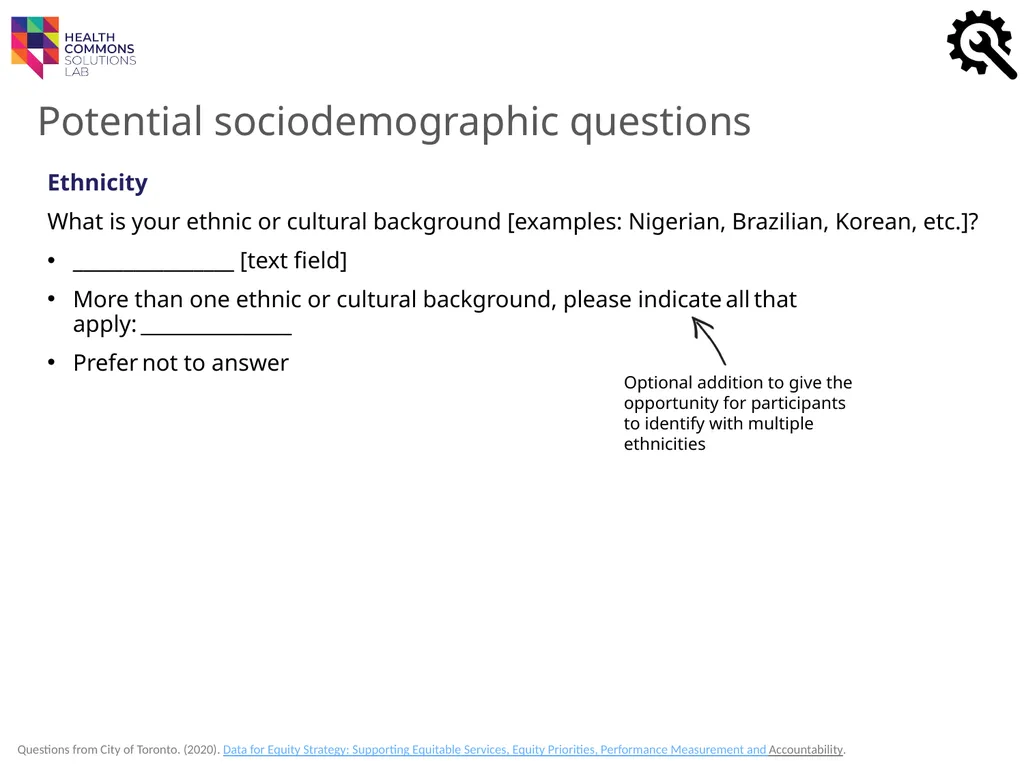
Potential sociodemographic questions Ethnicity
What is your ethnic or cultural background [examples: Nigerian, Brazilian, Korean, etc.]?
________________ [text field]
More than one ethnic or cultural background, please indicate all that apply: _______________
Prefer not to answer Questions from City of Toronto. (2020). Data for Equity Strategy: Supporting Equitable Services, Equity Priorities, Performance Measurement and Accountability. Optional addition to give the opportunity for participants to identify with multiple ethnicities<br>
What is your ethnic or cultural background [examples: Nigerian, Brazilian, Korean, etc.]?
________________ [text field]
More than one ethnic or cultural background, please indicate all that apply: _______________
Prefer not to answer Questions from City of Toronto. (2020). Data for Equity Strategy: Supporting Equitable Services, Equity Priorities, Performance Measurement and Accountability. Optional addition to give the opportunity for participants to identify with multiple ethnicities<br>
16
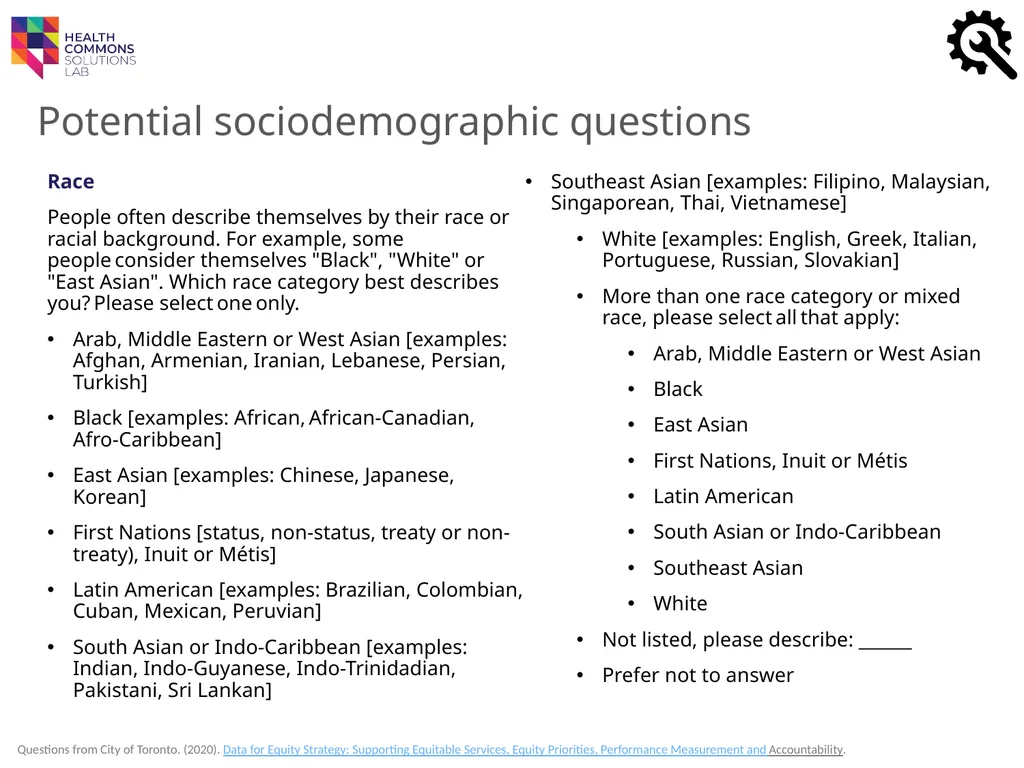
Potential sociodemographic questions Race
People often describe themselves by their race or racial background. For example, some people consider themselves "Black", "White" or "East Asian". Which race category best describes you? Please select one only.
Arab, Middle Eastern or West Asian [examples: Afghan, Armenian, Iranian, Lebanese, Persian, Turkish]
Black [examples: African, African-Canadian, Afro-Caribbean]
East Asian [examples: Chinese, Japanese, Korean]
First Nations [status, non-status, treaty or non-treaty), Inuit or Métis]
Latin American [examples: Brazilian, Colombian, Cuban, Mexican, Peruvian]
South Asian or Indo-Caribbean [examples: Indian, Indo-Guyanese, Indo-Trinidadian, Pakistani, Sri Lankan]
Southeast Asian [examples: Filipino, Malaysian, Singaporean, Thai, Vietnamese]
White [examples: English, Greek, Italian, Portuguese, Russian, Slovakian]
More than one race category or mixed race, please select all that apply:
Arab, Middle Eastern or West Asian
Black
East Asian
First Nations, Inuit or Métis
Latin American
South Asian or Indo-Caribbean
Southeast Asian
White
Not listed, please describe: ______
Prefer not to answer Questions from City of Toronto. (2020). Data for Equity Strategy: Supporting Equitable Services, Equity Priorities, Performance Measurement and Accountability.<br>
People often describe themselves by their race or racial background. For example, some people consider themselves "Black", "White" or "East Asian". Which race category best describes you? Please select one only.
Arab, Middle Eastern or West Asian [examples: Afghan, Armenian, Iranian, Lebanese, Persian, Turkish]
Black [examples: African, African-Canadian, Afro-Caribbean]
East Asian [examples: Chinese, Japanese, Korean]
First Nations [status, non-status, treaty or non-treaty), Inuit or Métis]
Latin American [examples: Brazilian, Colombian, Cuban, Mexican, Peruvian]
South Asian or Indo-Caribbean [examples: Indian, Indo-Guyanese, Indo-Trinidadian, Pakistani, Sri Lankan]
Southeast Asian [examples: Filipino, Malaysian, Singaporean, Thai, Vietnamese]
White [examples: English, Greek, Italian, Portuguese, Russian, Slovakian]
More than one race category or mixed race, please select all that apply:
Arab, Middle Eastern or West Asian
Black
East Asian
First Nations, Inuit or Métis
Latin American
South Asian or Indo-Caribbean
Southeast Asian
White
Not listed, please describe: ______
Prefer not to answer Questions from City of Toronto. (2020). Data for Equity Strategy: Supporting Equitable Services, Equity Priorities, Performance Measurement and Accountability.<br>
17
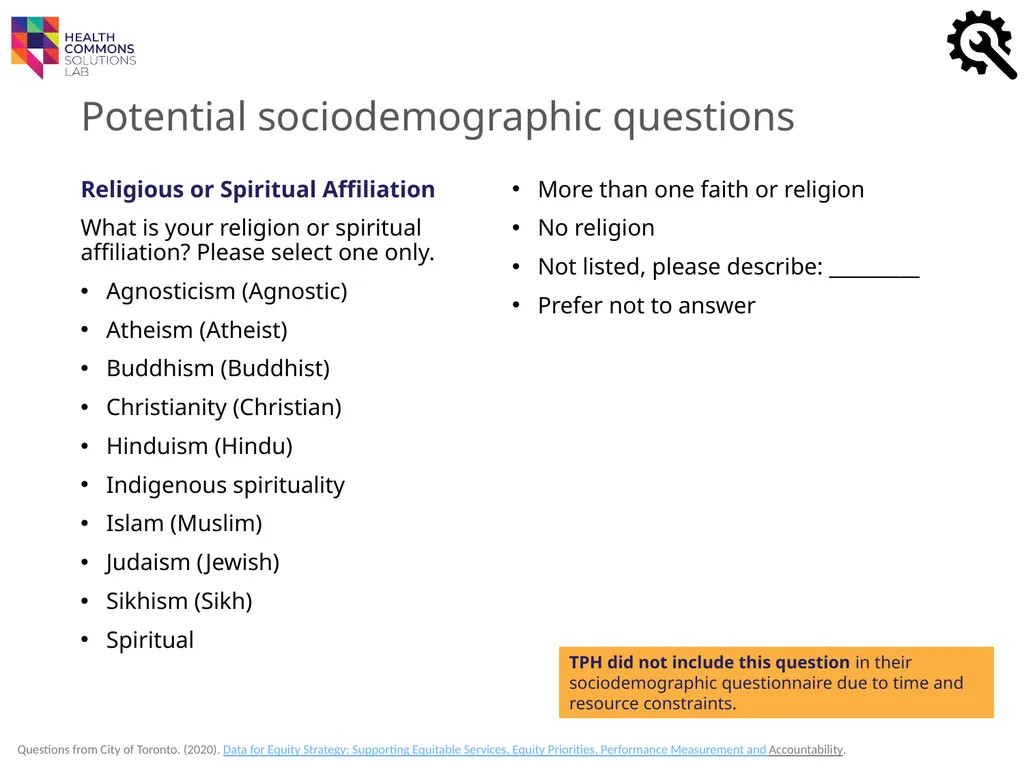
Potential sociodemographic questions Religious or Spiritual Affiliation
What is your religion or spiritual affiliation? Please select one only.
Agnosticism (Agnostic)
Atheism (Atheist)
Buddhism (Buddhist)
Christianity (Christian)
Hinduism (Hindu)
Indigenous spirituality
Islam (Muslim)
Judaism (Jewish)
Sikhism (Sikh)
Spiritual
More than one faith or religion
No religion
Not listed, please describe: _________
Prefer not to answer Questions from City of Toronto. (2020). Data for Equity Strategy: Supporting Equitable Services, Equity Priorities, Performance Measurement and Accountability. TPH did not include this question in their sociodemographic questionnaire due to time and resource constraints.<br>
What is your religion or spiritual affiliation? Please select one only.
Agnosticism (Agnostic)
Atheism (Atheist)
Buddhism (Buddhist)
Christianity (Christian)
Hinduism (Hindu)
Indigenous spirituality
Islam (Muslim)
Judaism (Jewish)
Sikhism (Sikh)
Spiritual
More than one faith or religion
No religion
Not listed, please describe: _________
Prefer not to answer Questions from City of Toronto. (2020). Data for Equity Strategy: Supporting Equitable Services, Equity Priorities, Performance Measurement and Accountability. TPH did not include this question in their sociodemographic questionnaire due to time and resource constraints.<br>
18
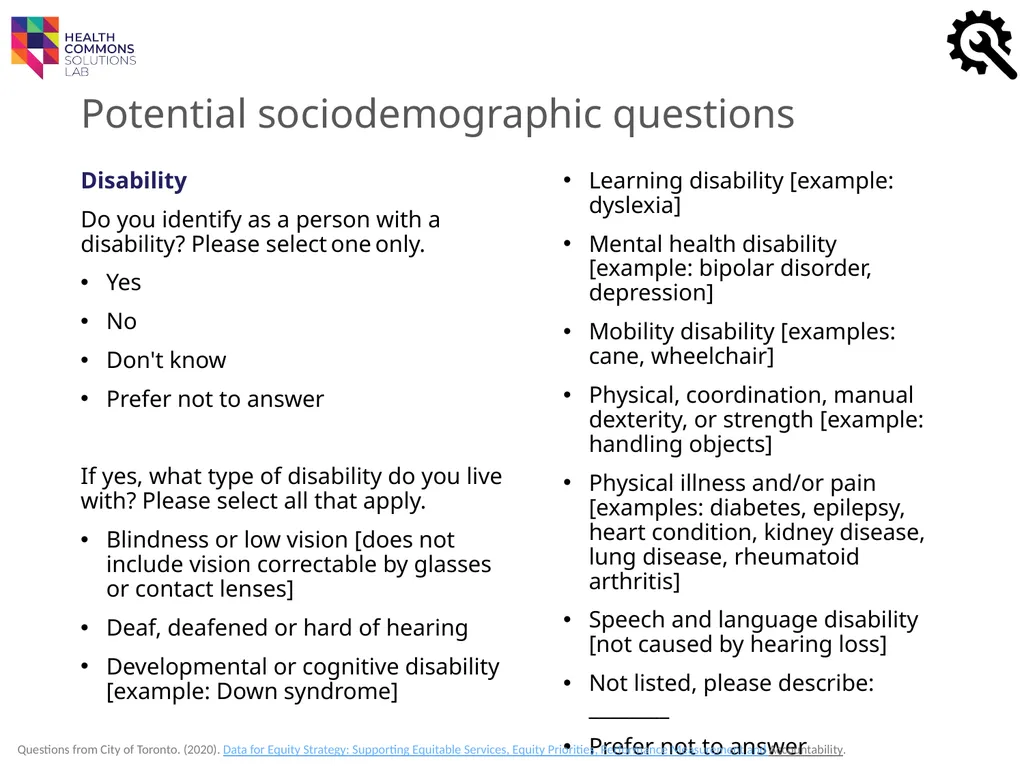
Potential sociodemographic questions Disability
Do you identify as a person with a disability? Please select one only.
Yes
No
Don't know
Prefer not to answer
If yes, what type of disability do you live with? Please select all that apply.
Blindness or low vision [does not include vision correctable by glasses or contact lenses]
Deaf, deafened or hard of hearing
Developmental or cognitive disability [example: Down syndrome]
Learning disability [example: dyslexia]
Mental health disability [example: bipolar disorder, depression]
Mobility disability [examples: cane, wheelchair]
Physical, coordination, manual dexterity, or strength [example: handling objects]
Physical illness and/or pain [examples: diabetes, epilepsy, heart condition, kidney disease, lung disease, rheumatoid arthritis]
Speech and language disability [not caused by hearing loss]
Not listed, please describe: ________
Prefer not to answer Questions from City of Toronto. (2020). Data for Equity Strategy: Supporting Equitable Services, Equity Priorities, Performance Measurement and Accountability.<br>
Do you identify as a person with a disability? Please select one only.
Yes
No
Don't know
Prefer not to answer
If yes, what type of disability do you live with? Please select all that apply.
Blindness or low vision [does not include vision correctable by glasses or contact lenses]
Deaf, deafened or hard of hearing
Developmental or cognitive disability [example: Down syndrome]
Learning disability [example: dyslexia]
Mental health disability [example: bipolar disorder, depression]
Mobility disability [examples: cane, wheelchair]
Physical, coordination, manual dexterity, or strength [example: handling objects]
Physical illness and/or pain [examples: diabetes, epilepsy, heart condition, kidney disease, lung disease, rheumatoid arthritis]
Speech and language disability [not caused by hearing loss]
Not listed, please describe: ________
Prefer not to answer Questions from City of Toronto. (2020). Data for Equity Strategy: Supporting Equitable Services, Equity Priorities, Performance Measurement and Accountability.<br>
19
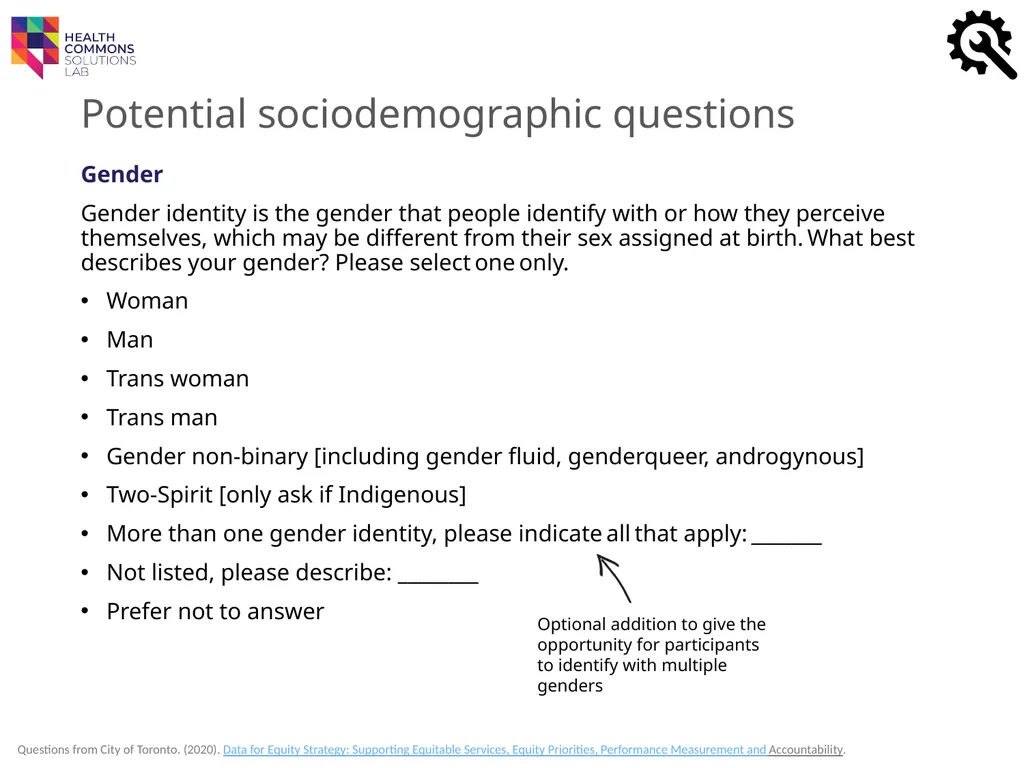
Potential sociodemographic questions Gender
Gender identity is the gender that people identify with or how they perceive themselves, which may be different from their sex assigned at birth. What best describes your gender? Please select one only.
Woman
Man
Trans woman
Trans man
Gender non-binary [including gender fluid, genderqueer, androgynous]
Two-Spirit [only ask if Indigenous]
More than one gender identity, please indicate all that apply: _______
Not listed, please describe: ________
Prefer not to answer Questions from City of Toronto. (2020). Data for Equity Strategy: Supporting Equitable Services, Equity Priorities, Performance Measurement and Accountability. Optional addition to give the opportunity for participants to identify with multiple genders<br>
Gender identity is the gender that people identify with or how they perceive themselves, which may be different from their sex assigned at birth. What best describes your gender? Please select one only.
Woman
Man
Trans woman
Trans man
Gender non-binary [including gender fluid, genderqueer, androgynous]
Two-Spirit [only ask if Indigenous]
More than one gender identity, please indicate all that apply: _______
Not listed, please describe: ________
Prefer not to answer Questions from City of Toronto. (2020). Data for Equity Strategy: Supporting Equitable Services, Equity Priorities, Performance Measurement and Accountability. Optional addition to give the opportunity for participants to identify with multiple genders<br>
20
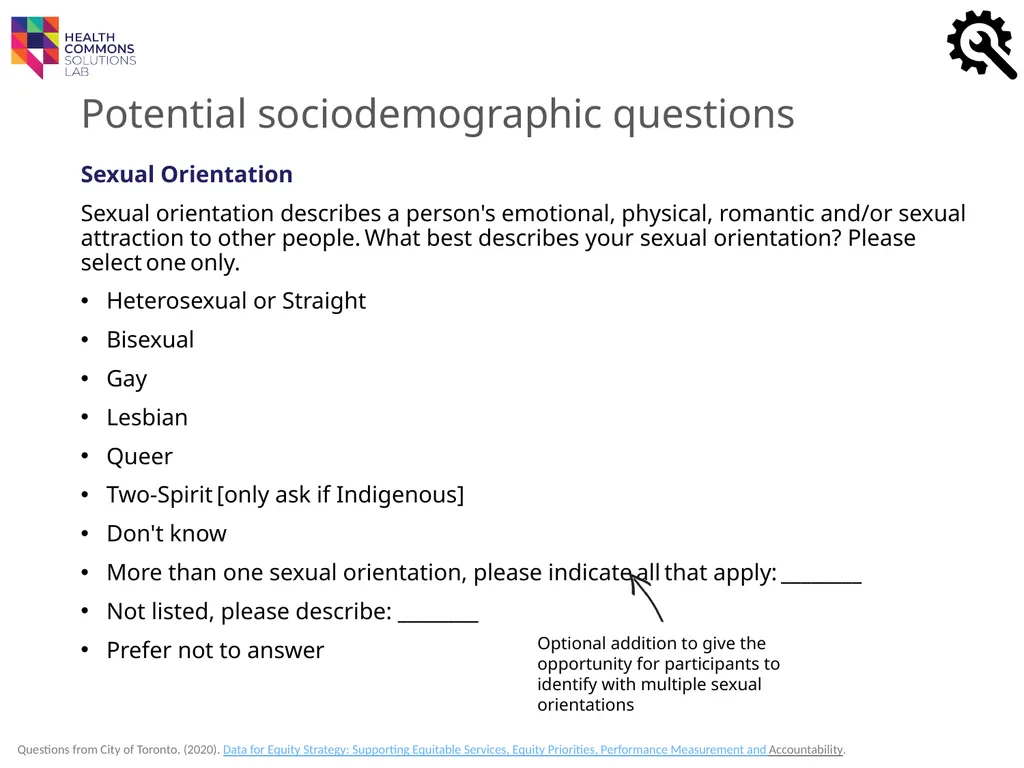
Potential sociodemographic questions Sexual Orientation
Sexual orientation describes a person's emotional, physical, romantic and/or sexual attraction to other people. What best describes your sexual orientation? Please select one only.
Heterosexual or Straight
Bisexual
Gay
Lesbian
Queer
Two-Spirit [only ask if Indigenous]
Don't know
More than one sexual orientation, please indicate all that apply: ________
Not listed, please describe: ________
Prefer not to answer Questions from City of Toronto. (2020). Data for Equity Strategy: Supporting Equitable Services, Equity Priorities, Performance Measurement and Accountability. Optional addition to give the opportunity for participants to identify with multiple sexual orientations<br>
Sexual orientation describes a person's emotional, physical, romantic and/or sexual attraction to other people. What best describes your sexual orientation? Please select one only.
Heterosexual or Straight
Bisexual
Gay
Lesbian
Queer
Two-Spirit [only ask if Indigenous]
Don't know
More than one sexual orientation, please indicate all that apply: ________
Not listed, please describe: ________
Prefer not to answer Questions from City of Toronto. (2020). Data for Equity Strategy: Supporting Equitable Services, Equity Priorities, Performance Measurement and Accountability. Optional addition to give the opportunity for participants to identify with multiple sexual orientations<br>
21
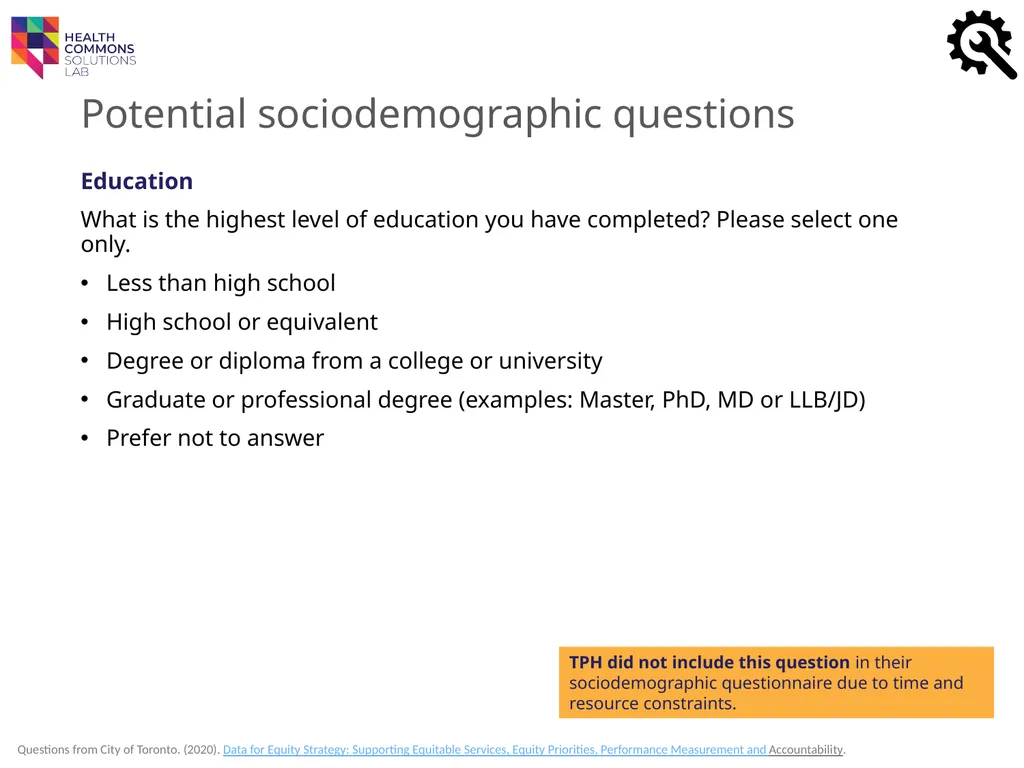
Potential sociodemographic questions Education
What is the highest level of education you have completed? Please select one only.
Less than high school
High school or equivalent
Degree or diploma from a college or university
Graduate or professional degree (examples: Master, PhD, MD or LLB/JD)
Prefer not to answer Questions from City of Toronto. (2020). Data for Equity Strategy: Supporting Equitable Services, Equity Priorities, Performance Measurement and Accountability. TPH did not include this question in their sociodemographic questionnaire due to time and resource constraints.<br>
What is the highest level of education you have completed? Please select one only.
Less than high school
High school or equivalent
Degree or diploma from a college or university
Graduate or professional degree (examples: Master, PhD, MD or LLB/JD)
Prefer not to answer Questions from City of Toronto. (2020). Data for Equity Strategy: Supporting Equitable Services, Equity Priorities, Performance Measurement and Accountability. TPH did not include this question in their sociodemographic questionnaire due to time and resource constraints.<br>
22
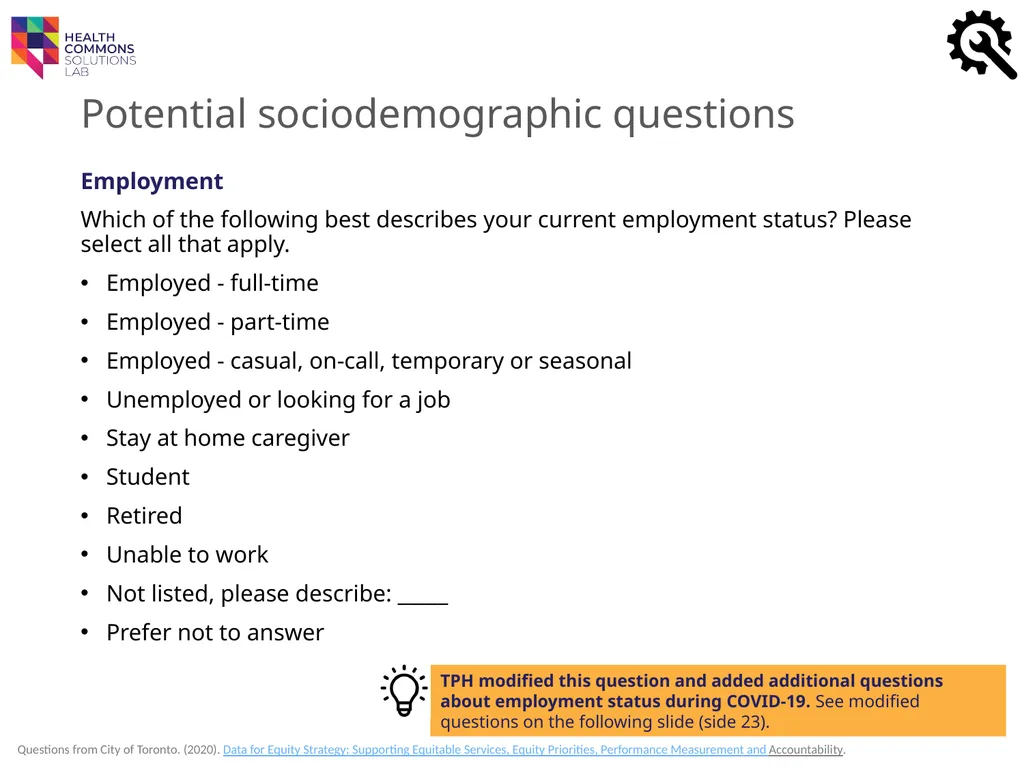
Potential sociodemographic questions Employment
Which of the following best describes your current employment status? Please select all that apply.
Employed - full-time
Employed - part-time
Employed - casual, on-call, temporary or seasonal
Unemployed or looking for a job
Stay at home caregiver
Student
Retired
Unable to work
Not listed, please describe: _____
Prefer not to answer Questions from City of Toronto. (2020). Data for Equity Strategy: Supporting Equitable Services, Equity Priorities, Performance Measurement and Accountability. TPH modified this question and added additional questions about employment status during COVID-19. See modified questions on the following slide (side 23).<br>
Which of the following best describes your current employment status? Please select all that apply.
Employed - full-time
Employed - part-time
Employed - casual, on-call, temporary or seasonal
Unemployed or looking for a job
Stay at home caregiver
Student
Retired
Unable to work
Not listed, please describe: _____
Prefer not to answer Questions from City of Toronto. (2020). Data for Equity Strategy: Supporting Equitable Services, Equity Priorities, Performance Measurement and Accountability. TPH modified this question and added additional questions about employment status during COVID-19. See modified questions on the following slide (side 23).<br>
23
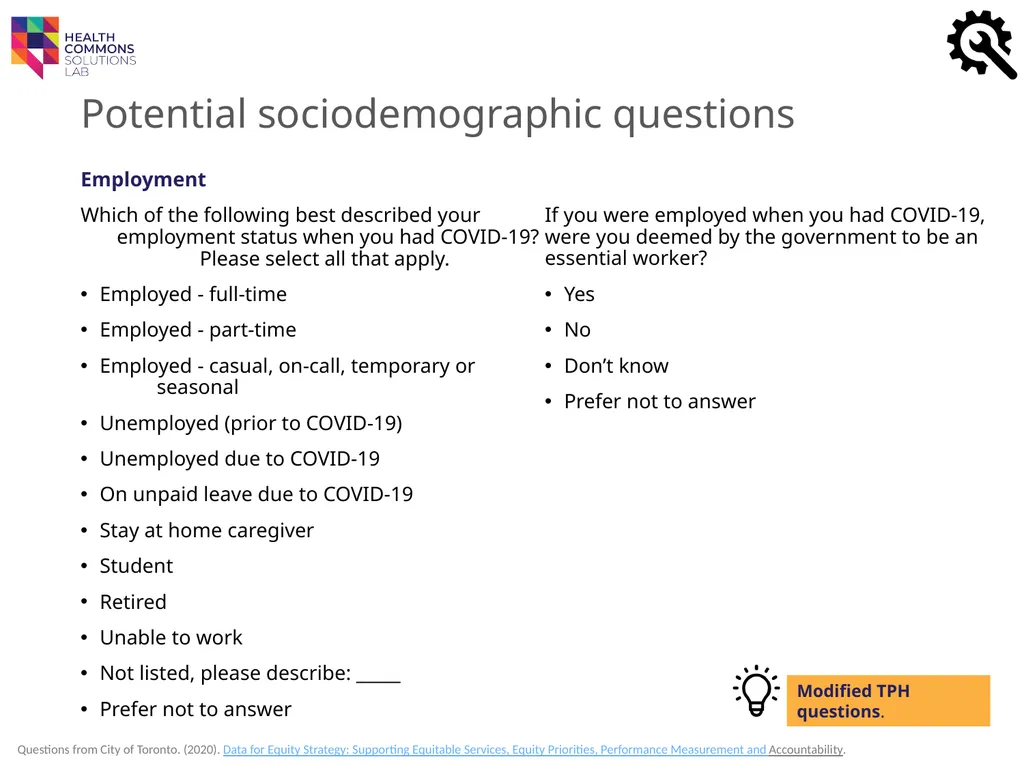
Potential sociodemographic questions Employment
Which of the following best described your employment status when you had COVID-19? Please select all that apply.
Employed - full-time
Employed - part-time
Employed - casual, on-call, temporary or seasonal
Unemployed (prior to COVID-19)
Unemployed due to COVID-19
On unpaid leave due to COVID-19
Stay at home caregiver
Student
Retired
Unable to work
Not listed, please describe: _____
Prefer not to answer
If you were employed when you had COVID-19, were you deemed by the government to be an essential worker?
Yes
No
Don’t know
Prefer not to answer Questions from City of Toronto. (2020). Data for Equity Strategy: Supporting Equitable Services, Equity Priorities, Performance Measurement and Accountability. Modified TPH questions.<br>
Which of the following best described your employment status when you had COVID-19? Please select all that apply.
Employed - full-time
Employed - part-time
Employed - casual, on-call, temporary or seasonal
Unemployed (prior to COVID-19)
Unemployed due to COVID-19
On unpaid leave due to COVID-19
Stay at home caregiver
Student
Retired
Unable to work
Not listed, please describe: _____
Prefer not to answer
If you were employed when you had COVID-19, were you deemed by the government to be an essential worker?
Yes
No
Don’t know
Prefer not to answer Questions from City of Toronto. (2020). Data for Equity Strategy: Supporting Equitable Services, Equity Priorities, Performance Measurement and Accountability. Modified TPH questions.<br>
24
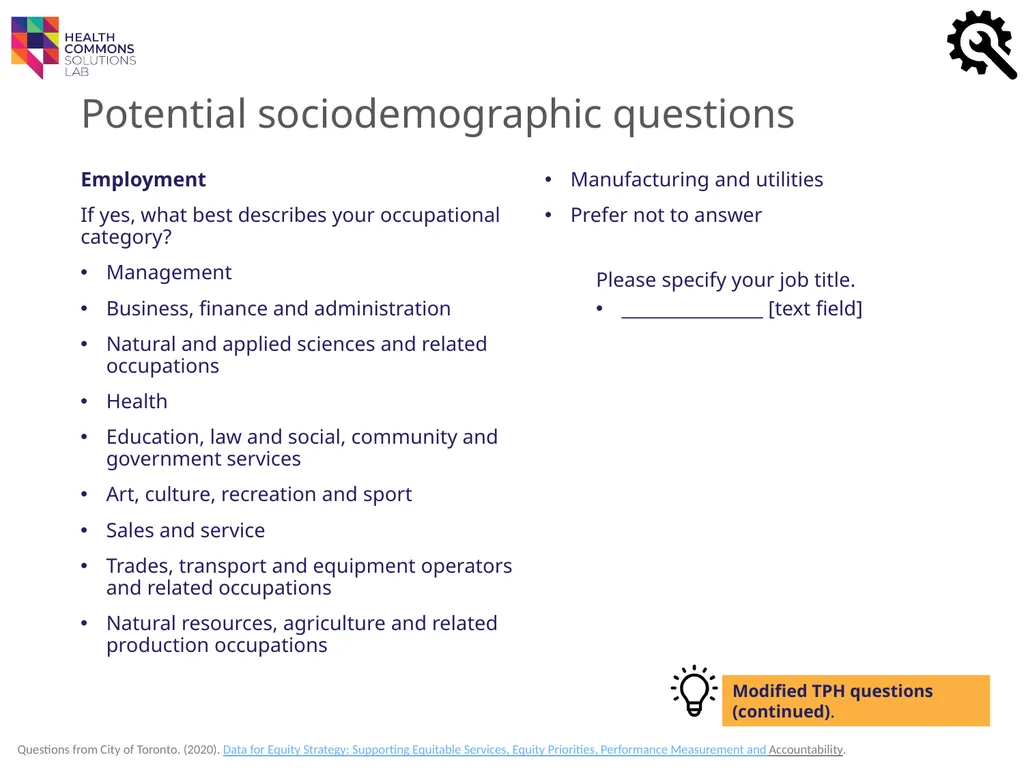
Potential sociodemographic questions Employment
If yes, what best describes your occupational category?
Management
Business, finance and administration
Natural and applied sciences and related occupations
Health
Education, law and social, community and government services
Art, culture, recreation and sport
Sales and service
Trades, transport and equipment operators and related occupations
Natural resources, agriculture and related production occupations
Manufacturing and utilities
Prefer not to answer
Please specify your job title.
________________ [text field] Questions from City of Toronto. (2020). Data for Equity Strategy: Supporting Equitable Services, Equity Priorities, Performance Measurement and Accountability. Modified TPH questions (continued).<br>
If yes, what best describes your occupational category?
Management
Business, finance and administration
Natural and applied sciences and related occupations
Health
Education, law and social, community and government services
Art, culture, recreation and sport
Sales and service
Trades, transport and equipment operators and related occupations
Natural resources, agriculture and related production occupations
Manufacturing and utilities
Prefer not to answer
Please specify your job title.
________________ [text field] Questions from City of Toronto. (2020). Data for Equity Strategy: Supporting Equitable Services, Equity Priorities, Performance Measurement and Accountability. Modified TPH questions (continued).<br>
25
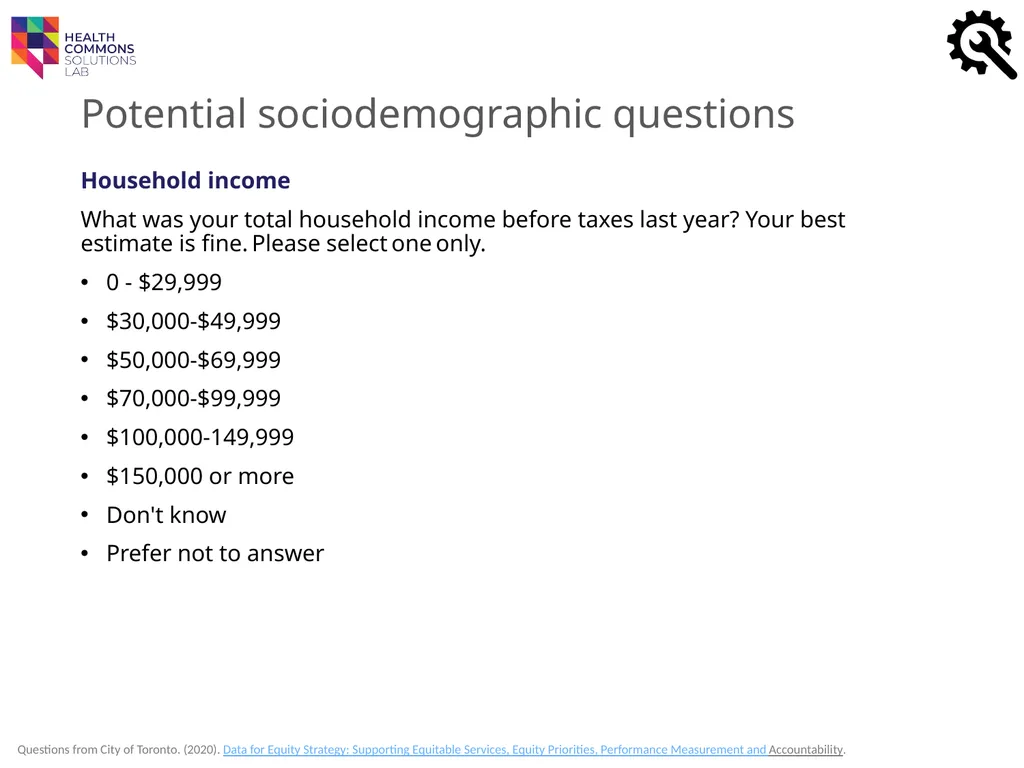
Potential sociodemographic questions Household income
What was your total household income before taxes last year? Your best estimate is fine. Please select one only.
0 - $29,999
$30,000-$49,999
$50,000-$69,999
$70,000-$99,999
$100,000-149,999
$150,000 or more
Don't know
Prefer not to answer Questions from City of Toronto. (2020). Data for Equity Strategy: Supporting Equitable Services, Equity Priorities, Performance Measurement and Accountability.<br>
What was your total household income before taxes last year? Your best estimate is fine. Please select one only.
0 - $29,999
$30,000-$49,999
$50,000-$69,999
$70,000-$99,999
$100,000-149,999
$150,000 or more
Don't know
Prefer not to answer Questions from City of Toronto. (2020). Data for Equity Strategy: Supporting Equitable Services, Equity Priorities, Performance Measurement and Accountability.<br>
26
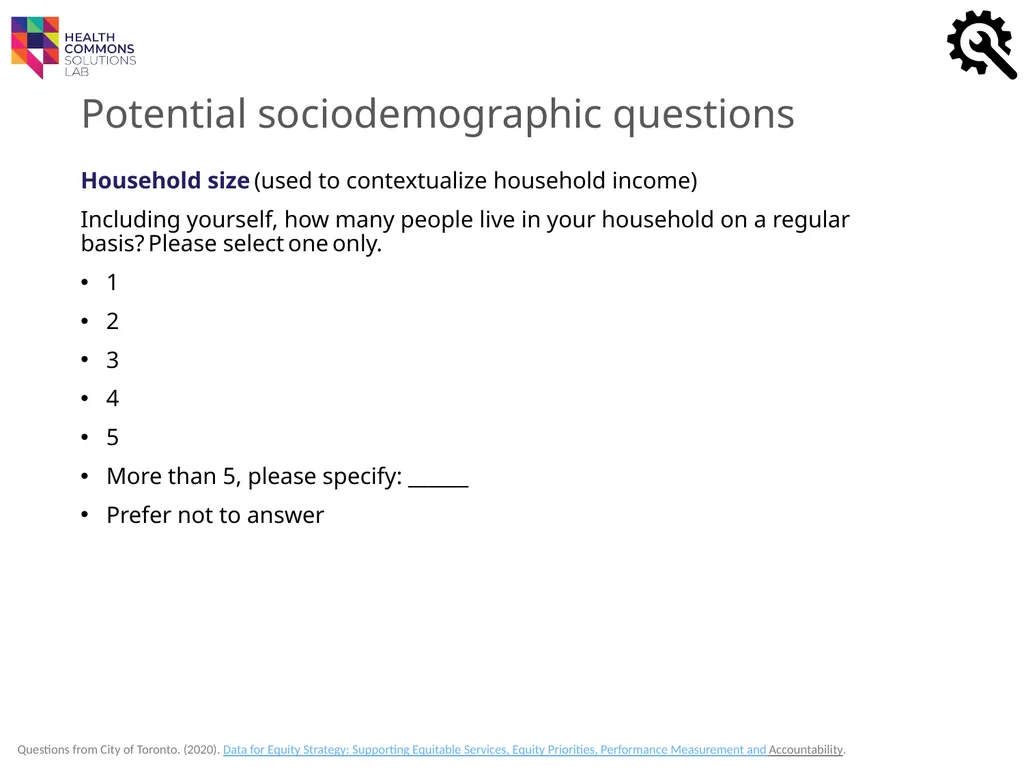
Potential sociodemographic questions Household size (used to contextualize household income)
Including yourself, how many people live in your household on a regular basis? Please select one only.
1
2
3
4
5
More than 5, please specify: ______
Prefer not to answer Questions from City of Toronto. (2020). Data for Equity Strategy: Supporting Equitable Services, Equity Priorities, Performance Measurement and Accountability.<br>
Including yourself, how many people live in your household on a regular basis? Please select one only.
1
2
3
4
5
More than 5, please specify: ______
Prefer not to answer Questions from City of Toronto. (2020). Data for Equity Strategy: Supporting Equitable Services, Equity Priorities, Performance Measurement and Accountability.<br>
27
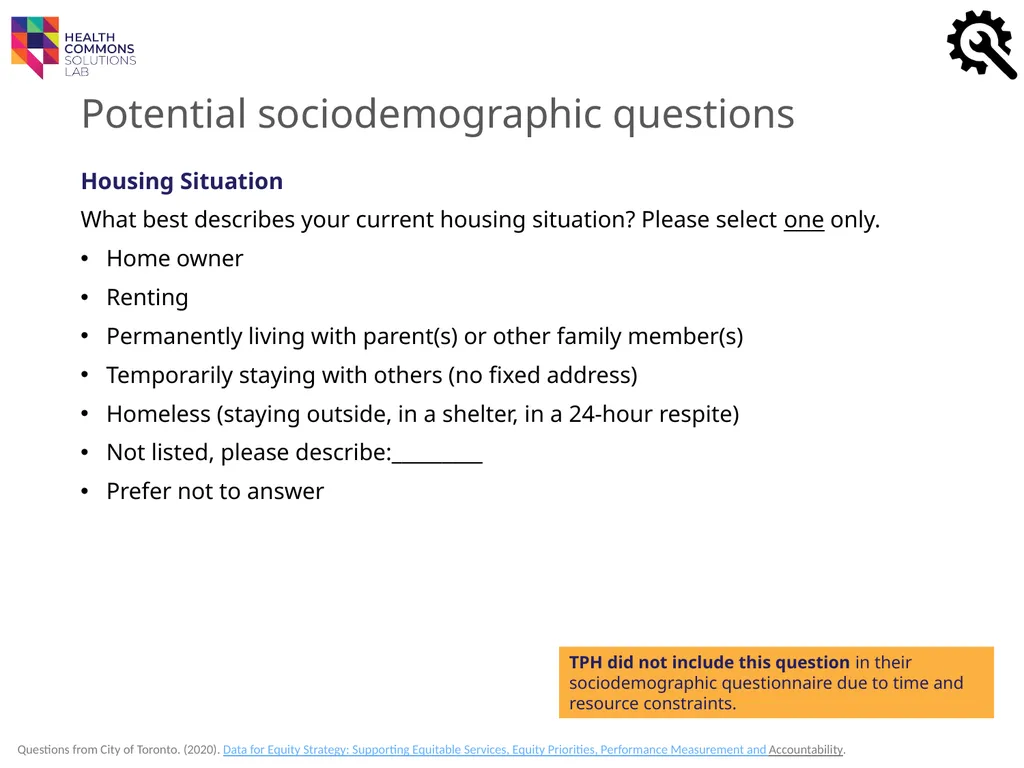
Potential sociodemographic questions Housing Situation
What best describes your current housing situation? Please select one only.
Home owner
Renting
Permanently living with parent(s) or other family member(s)
Temporarily staying with others (no fixed address)
Homeless (staying outside, in a shelter, in a 24-hour respite)
Not listed, please describe:_________
Prefer not to answer Questions from City of Toronto. (2020). Data for Equity Strategy: Supporting Equitable Services, Equity Priorities, Performance Measurement and Accountability. TPH did not include this question in their sociodemographic questionnaire due to time and resource constraints.<br>
What best describes your current housing situation? Please select one only.
Home owner
Renting
Permanently living with parent(s) or other family member(s)
Temporarily staying with others (no fixed address)
Homeless (staying outside, in a shelter, in a 24-hour respite)
Not listed, please describe:_________
Prefer not to answer Questions from City of Toronto. (2020). Data for Equity Strategy: Supporting Equitable Services, Equity Priorities, Performance Measurement and Accountability. TPH did not include this question in their sociodemographic questionnaire due to time and resource constraints.<br>
28
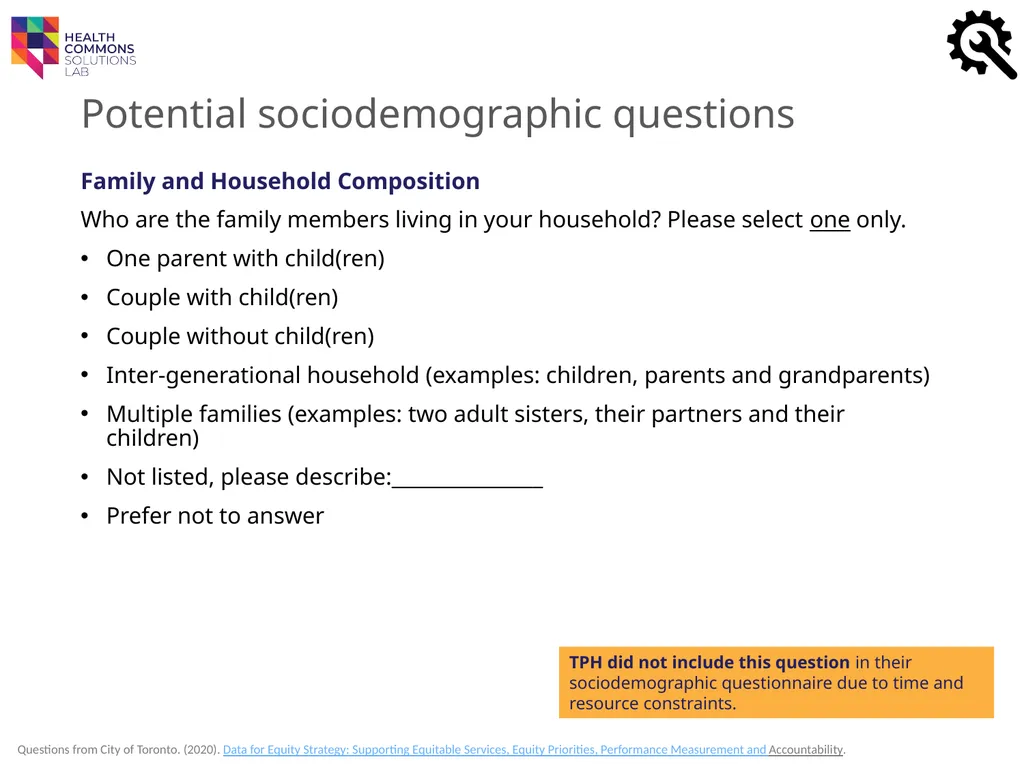
Questions from City of Toronto. (2020). Data for Equity Strategy: Supporting Equitable Services, Equity Priorities, Performance Measurement and Accountability. Potential sociodemographic questions Family and Household Composition
Who are the family members living in your household? Please select one only.
One parent with child(ren)
Couple with child(ren)
Couple without child(ren)
Inter-generational household (examples: children, parents and grandparents)
Multiple families (examples: two adult sisters, their partners and their children)
Not listed, please describe:_______________
Prefer not to answer TPH did not include this question in their sociodemographic questionnaire due to time and resource constraints.<br>
Who are the family members living in your household? Please select one only.
One parent with child(ren)
Couple with child(ren)
Couple without child(ren)
Inter-generational household (examples: children, parents and grandparents)
Multiple families (examples: two adult sisters, their partners and their children)
Not listed, please describe:_______________
Prefer not to answer TPH did not include this question in their sociodemographic questionnaire due to time and resource constraints.<br>
29
SAMPLE CONSENT SCRIPT<br>
30
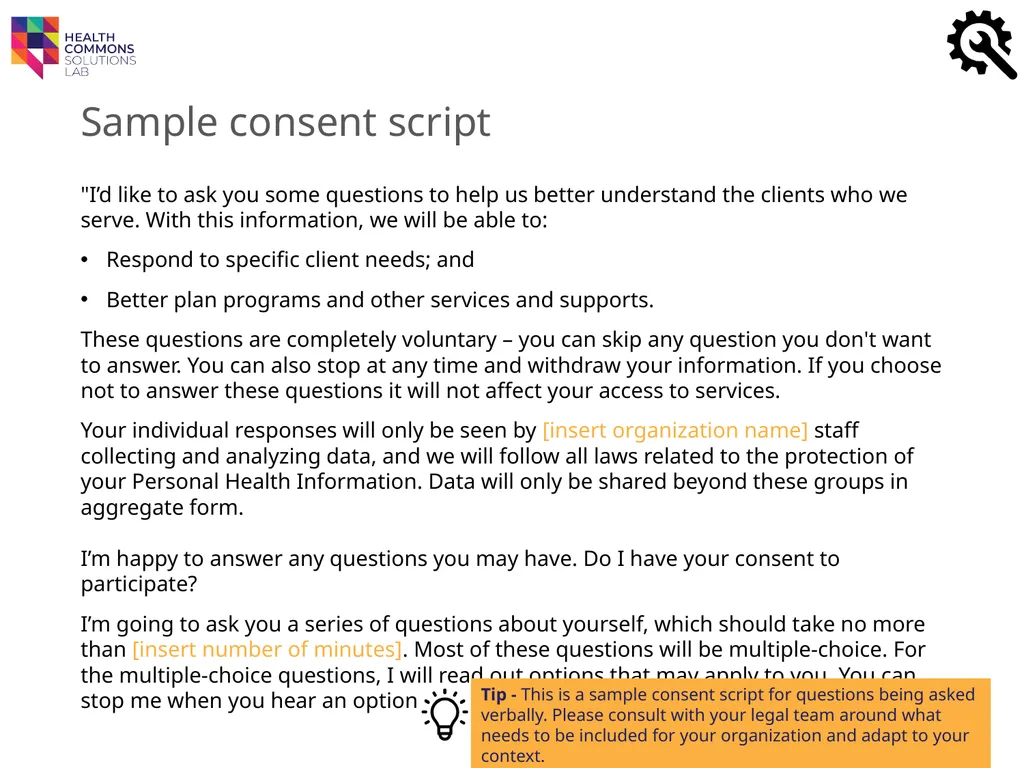
Sample consent script "I’d like to ask you some questions to help us better understand the clients who we serve. With this information, we will be able to:
Respond to specific client needs; and
Better plan programs and other services and supports.
These questions are completely voluntary – you can skip any question you don't want to answer. You can also stop at any time and withdraw your information. If you choose not to answer these questions it will not affect your access to services.
Your individual responses will only be seen by [insert organization name] staff collecting and analyzing data, and we will follow all laws related to the protection of your Personal Health Information. Data will only be shared beyond these groups in aggregate form. I’m happy to answer any questions you may have. Do I have your consent to participate?
I’m going to ask you a series of questions about yourself, which should take no more than [insert number of minutes]. Most of these questions will be multiple-choice. For the multiple-choice questions, I will read out options that may apply to you. You can stop me when you hear an option that applies to you, or you can tell me at the end. " Tip - This is a sample consent script for questions being asked verbally. Please consult with your legal team around what needs to be included for your organization and adapt to your context.<br>
Respond to specific client needs; and
Better plan programs and other services and supports.
These questions are completely voluntary – you can skip any question you don't want to answer. You can also stop at any time and withdraw your information. If you choose not to answer these questions it will not affect your access to services.
Your individual responses will only be seen by [insert organization name] staff collecting and analyzing data, and we will follow all laws related to the protection of your Personal Health Information. Data will only be shared beyond these groups in aggregate form. I’m happy to answer any questions you may have. Do I have your consent to participate?
I’m going to ask you a series of questions about yourself, which should take no more than [insert number of minutes]. Most of these questions will be multiple-choice. For the multiple-choice questions, I will read out options that may apply to you. You can stop me when you hear an option that applies to you, or you can tell me at the end. " Tip - This is a sample consent script for questions being asked verbally. Please consult with your legal team around what needs to be included for your organization and adapt to your context.<br>
31
SAMPLE GENERAL FAQs<br>
32
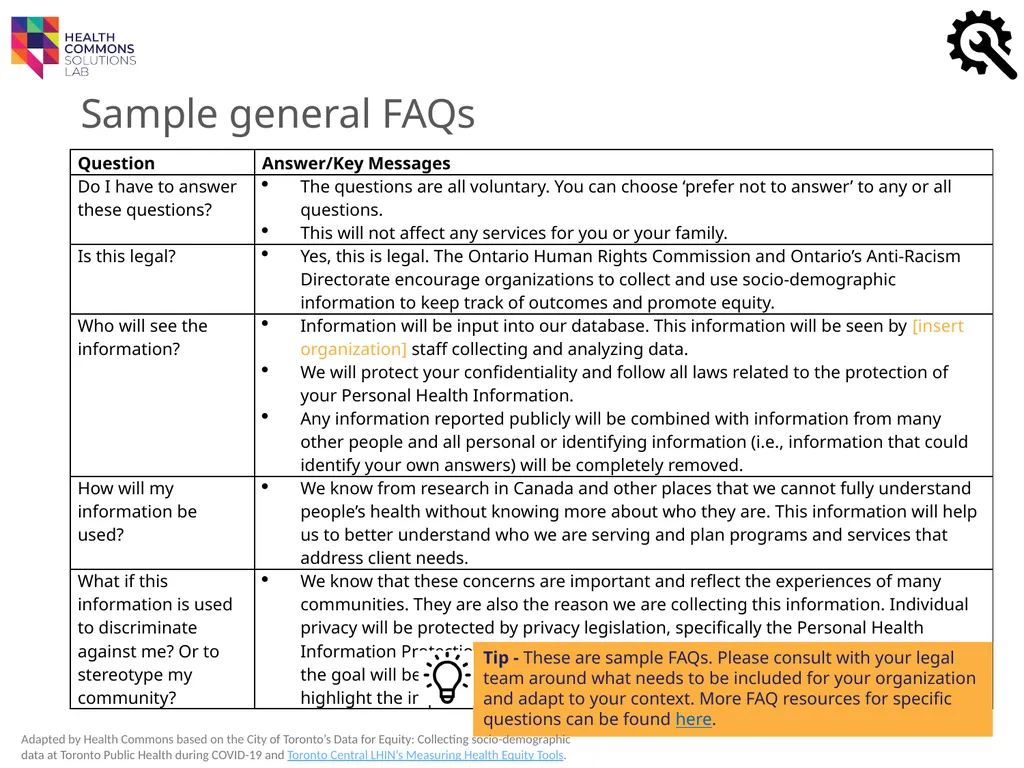
Sample general FAQs Tip - These are sample FAQs. Please consult with your legal team around what needs to be included for your organization and adapt to your context. More FAQ resources for specific questions can be found here. Adapted by Health Commons based on the City of Toronto’s Data for Equity: Collecting socio-demographic data at Toronto Public Health during COVID-19 and Toronto Central LHIN’s Measuring Health Equity Tools.<br>
33
TESTING YOUR QUESTIONS<br>
34
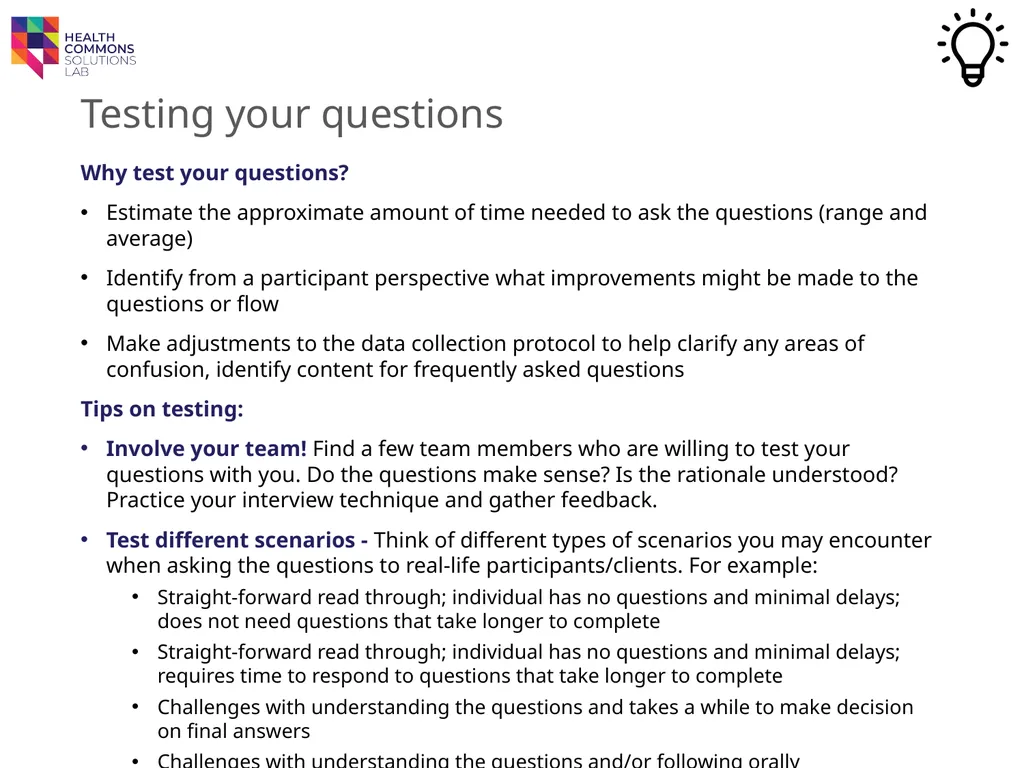
Testing your questions Why test your questions?
Estimate the approximate amount of time needed to ask the questions (range and average)
Identify from a participant perspective what improvements might be made to the questions or flow
Make adjustments to the data collection protocol to help clarify any areas of confusion, identify content for frequently asked questions
Tips on testing:
Involve your team! Find a few team members who are willing to test your questions with you. Do the questions make sense? Is the rationale understood? Practice your interview technique and gather feedback.
Test different scenarios - Think of different types of scenarios you may encounter when asking the questions to real-life participants/clients. For example:
Straight-forward read through; individual has no questions and minimal delays; does not need questions that take longer to complete
Straight-forward read through; individual has no questions and minimal delays; requires time to respond to questions that take longer to complete
Challenges with understanding the questions and takes a while to make decision on final answers
Challenges with understanding the questions and/or following orally<br>
Estimate the approximate amount of time needed to ask the questions (range and average)
Identify from a participant perspective what improvements might be made to the questions or flow
Make adjustments to the data collection protocol to help clarify any areas of confusion, identify content for frequently asked questions
Tips on testing:
Involve your team! Find a few team members who are willing to test your questions with you. Do the questions make sense? Is the rationale understood? Practice your interview technique and gather feedback.
Test different scenarios - Think of different types of scenarios you may encounter when asking the questions to real-life participants/clients. For example:
Straight-forward read through; individual has no questions and minimal delays; does not need questions that take longer to complete
Straight-forward read through; individual has no questions and minimal delays; requires time to respond to questions that take longer to complete
Challenges with understanding the questions and takes a while to make decision on final answers
Challenges with understanding the questions and/or following orally<br>
35
ACKNOWLEDGEMENTS AND ADDITIONAL RESOURCES<br>
36
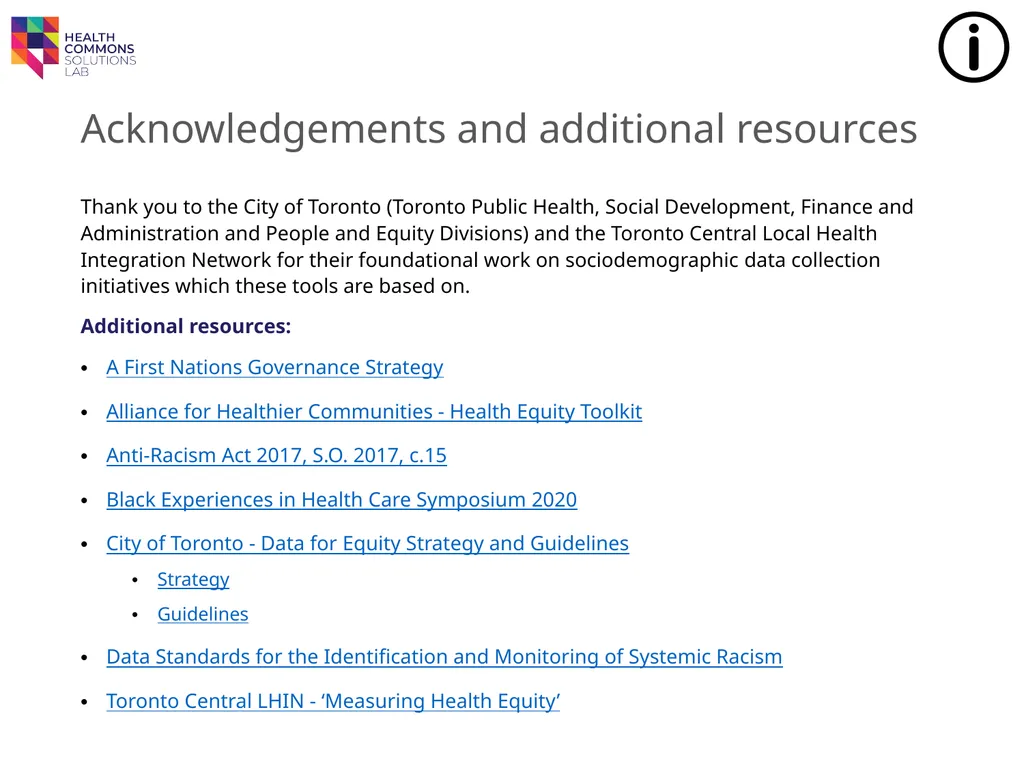
Acknowledgements and additional resources Thank you to the City of Toronto (Toronto Public Health, Social Development, Finance and Administration and People and Equity Divisions) and the Toronto Central Local Health Integration Network for their foundational work on sociodemographic data collection initiatives which these tools are based on.
Additional resources:
A First Nations Governance Strategy
Alliance for Healthier Communities - Health Equity Toolkit
Anti-Racism Act 2017, S.O. 2017, c.15
Black Experiences in Health Care Symposium 2020
City of Toronto - Data for Equity Strategy and Guidelines
Strategy
Guidelines
Data Standards for the Identification and Monitoring of Systemic Racism
Toronto Central LHIN - ‘Measuring Health Equity’<br>
Additional resources:
A First Nations Governance Strategy
Alliance for Healthier Communities - Health Equity Toolkit
Anti-Racism Act 2017, S.O. 2017, c.15
Black Experiences in Health Care Symposium 2020
City of Toronto - Data for Equity Strategy and Guidelines
Strategy
Guidelines
Data Standards for the Identification and Monitoring of Systemic Racism
Toronto Central LHIN - ‘Measuring Health Equity’<br>