
Topic 1 - Introduction to the European Union Data
MS
Published · 68 slides · 0 views

1 / 1












Description
Topic 1 - Introduction to the European Union Data Protection Regime Guidance for using these slides (remove before delivering) These slides are meant to be easily adaptable to different audiences. To facilitate this, each slide is assigned
Related Topics
Share
Embed code
Download this presentation From Below
"Topic 1 - Introduction to the European Union Data" is the property of its rightful owner. Permission is granted to download and print the materials on this website for personal, non-commercial use only, and to display it on your personal computer provided you do not modify the materials and that you retain all copyright notices contained in the materials. By downloading content from our website, you accept the terms of this agreement.
Presentation Transcript
01
Topic 1 - Introduction to the European Union Data Protection Regime<br>
02
Guidance for using these slides (remove before delivering) These slides are meant to be easily adaptable to different audiences. To facilitate this, each slide is assigned to a specific audience (see „relevant for:” in the notes).
In the notes-section below each slide, you find an indication of the slide’s degree of difficulty [i.e. whether it is suited for data protection beginners or not], its target audience [everyone vs authorities, lawyers, data protection officers, etc.], and its degree of importance [whether it is essential that you deliver it, or if it can be removed without impacting the effectiveness of the training].
Prior to training delivery, please:
Read the slides and the notes thoroughly
Take a look at the reading materials – they also serve to assist you in your preparation
Remove/hide the slides that you consider unnecessary [right click on the slide miniature on the left and click ‘hide slide’]. A provisional categorisation has been made based on the depth and importance of the respective content
Adjust slides to national or sectoral requirements
Add content that you consider essential for your particular audience
Feel free to replace the default layout with your organisation’s layout<br>
In the notes-section below each slide, you find an indication of the slide’s degree of difficulty [i.e. whether it is suited for data protection beginners or not], its target audience [everyone vs authorities, lawyers, data protection officers, etc.], and its degree of importance [whether it is essential that you deliver it, or if it can be removed without impacting the effectiveness of the training].
Prior to training delivery, please:
Read the slides and the notes thoroughly
Take a look at the reading materials – they also serve to assist you in your preparation
Remove/hide the slides that you consider unnecessary [right click on the slide miniature on the left and click ‘hide slide’]. A provisional categorisation has been made based on the depth and importance of the respective content
Adjust slides to national or sectoral requirements
Add content that you consider essential for your particular audience
Feel free to replace the default layout with your organisation’s layout<br>
03
How to Read The Slides’ Colour Frames
[Remove Before Delivering] Green – Is a basic slide: we encourage you to keep it
Yellow – is a medium level slide: it is important, but does not jeopardise effectiveness if removed
Red – is an advanced slide: consider adapting it to your audience, preparing your audience for it, or removing it if you deem it unnecessary
Purple – advised adaptation: this slide should contain information regarding the national legislation complementing the EU Regulations; if the content regards a different Member State, we advise you replace it with the national, relevant content 3<br>
Yellow – is a medium level slide: it is important, but does not jeopardise effectiveness if removed
Red – is an advanced slide: consider adapting it to your audience, preparing your audience for it, or removing it if you deem it unnecessary
Purple – advised adaptation: this slide should contain information regarding the national legislation complementing the EU Regulations; if the content regards a different Member State, we advise you replace it with the national, relevant content 3<br>
04
Speaker Name
Title
Department
Contact details<br>
Title
Department
Contact details<br>
05
These slides serve as an introduction to EU Data Protection focused around the GDPR, assuming that recipients have no previous knowledge in this area. It provides a general overview of the field and introduce key legislation, definitions, as well as an overview of the GDPR concepts and its compliance requirements in terms of actions to be undertaken.<br>
06
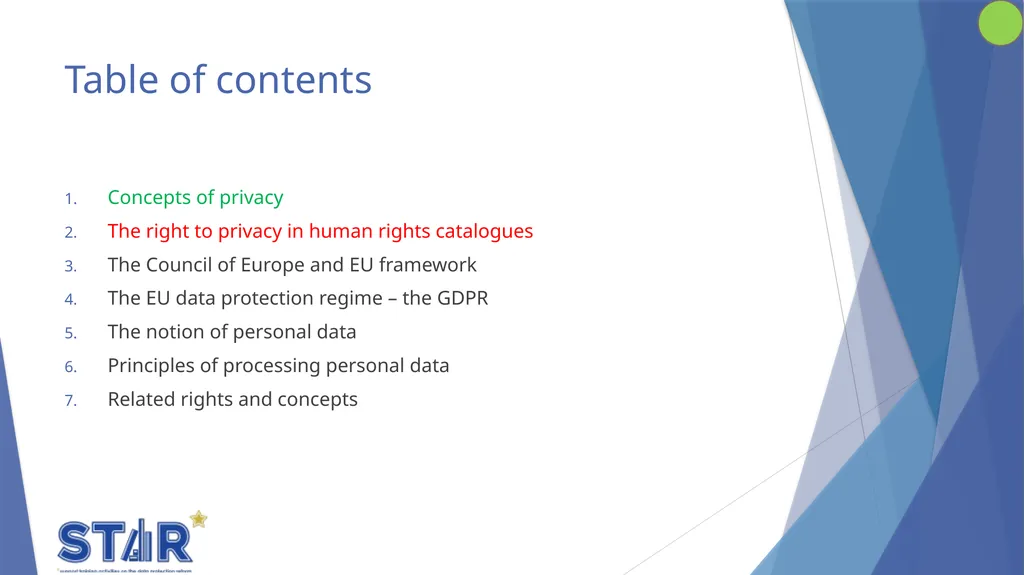
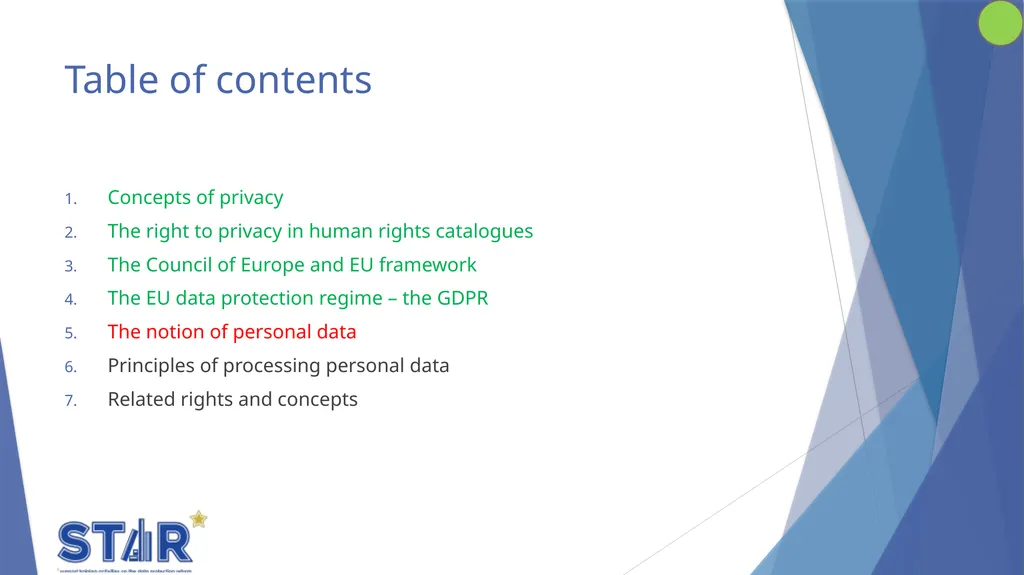
Table of contents Concepts of privacy
The right to privacy in human rights catalogues
The Council of Europe and EU framework
The EU data protection regime – the GDPR
The notion of personal data
Principles of processing personal data
Related rights and concepts<br>
The right to privacy in human rights catalogues
The Council of Europe and EU framework
The EU data protection regime – the GDPR
The notion of personal data
Principles of processing personal data
Related rights and concepts<br>
07
1. Concepts of privacy<br>
08
Concepts of privacy (1) 19th century
New technology – instant photography
New concepts in media: tabloids, gossip press, ambush journalism
1879 - U.S. Judge, Thomas Cooley spoke of “the right to be let alone” as a matter of personal security
1890 - Samuel Warren’s and Louis Brandeis’ infamous article on the individual’s right to privacy, coined as “the right to be let alone” /Harvard Law Review/
Strong relationship with human dignity and other personality rights
Reflection to technological developments<br>
New technology – instant photography
New concepts in media: tabloids, gossip press, ambush journalism
1879 - U.S. Judge, Thomas Cooley spoke of “the right to be let alone” as a matter of personal security
1890 - Samuel Warren’s and Louis Brandeis’ infamous article on the individual’s right to privacy, coined as “the right to be let alone” /Harvard Law Review/
Strong relationship with human dignity and other personality rights
Reflection to technological developments<br>
09
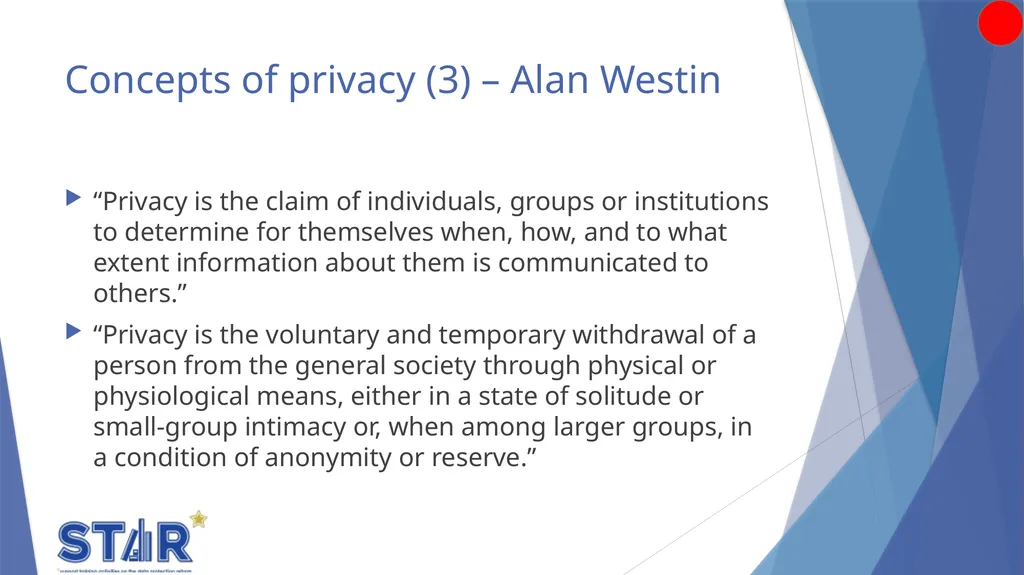
Concepts of privacy (3) – Alan Westin “Privacy is the claim of individuals, groups or institutions to determine for themselves when, how, and to what extent information about them is communicated to others.”
“Privacy is the voluntary and temporary withdrawal of a person from the general society through physical or physiological means, either in a state of solitude or small-group intimacy or, when among larger groups, in a condition of anonymity or reserve.”<br>
“Privacy is the voluntary and temporary withdrawal of a person from the general society through physical or physiological means, either in a state of solitude or small-group intimacy or, when among larger groups, in a condition of anonymity or reserve.”<br>
10
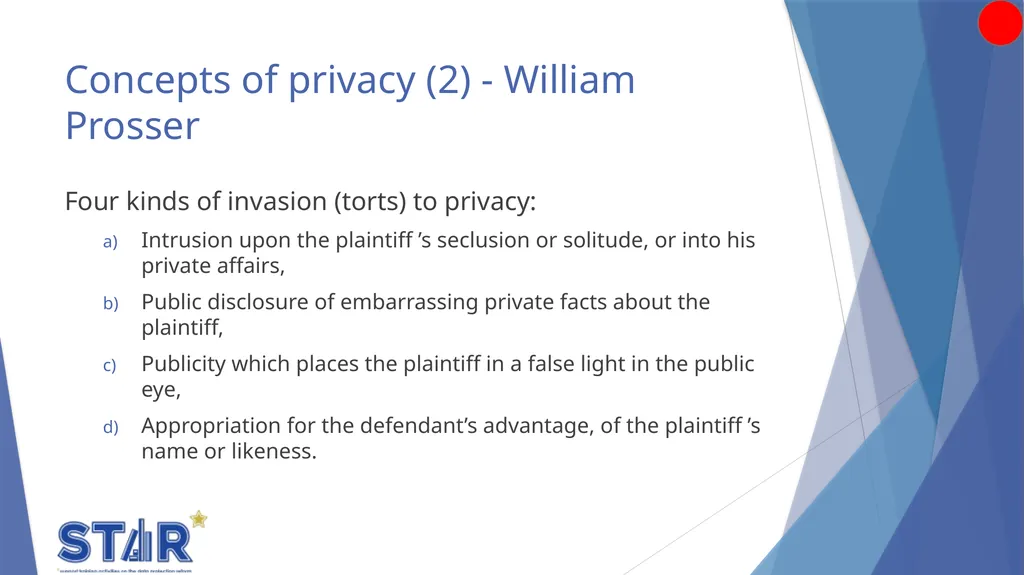
Concepts of privacy (2) - William Prosser Four kinds of invasion (torts) to privacy:
Intrusion upon the plaintiff ’s seclusion or solitude, or into his private affairs,
Public disclosure of embarrassing private facts about the plaintiff,
Publicity which places the plaintiff in a false light in the public eye,
Appropriation for the defendant’s advantage, of the plaintiff ’s name or likeness.<br>
Intrusion upon the plaintiff ’s seclusion or solitude, or into his private affairs,
Public disclosure of embarrassing private facts about the plaintiff,
Publicity which places the plaintiff in a false light in the public eye,
Appropriation for the defendant’s advantage, of the plaintiff ’s name or likeness.<br>
11
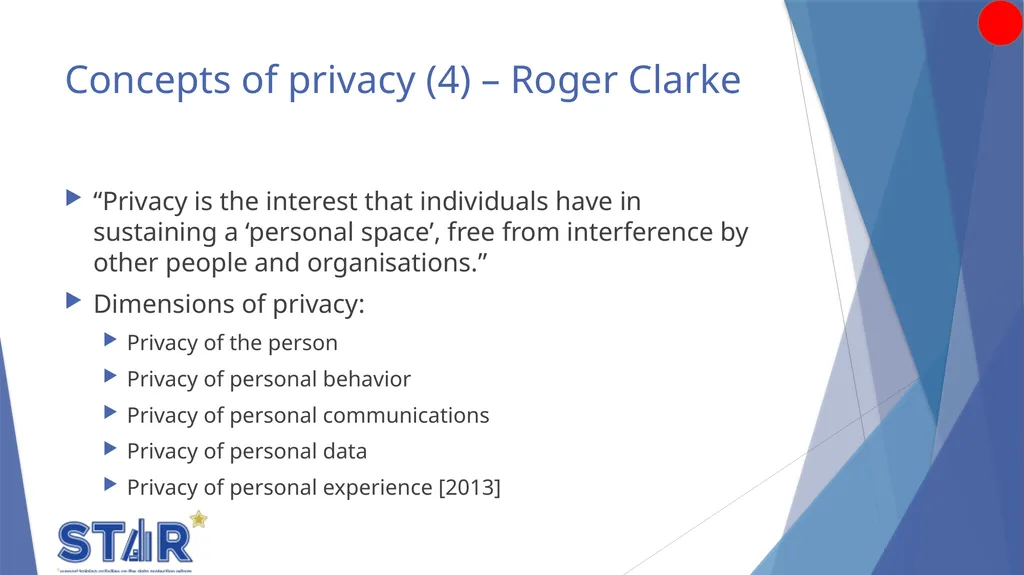
Concepts of privacy (4) – Roger Clarke “Privacy is the interest that individuals have in sustaining a ‘personal space’, free from interference by other people and organisations.”
Dimensions of privacy:
Privacy of the person
Privacy of personal behavior
Privacy of personal communications
Privacy of personal data
Privacy of personal experience [2013]<br>
Dimensions of privacy:
Privacy of the person
Privacy of personal behavior
Privacy of personal communications
Privacy of personal data
Privacy of personal experience [2013]<br>
12
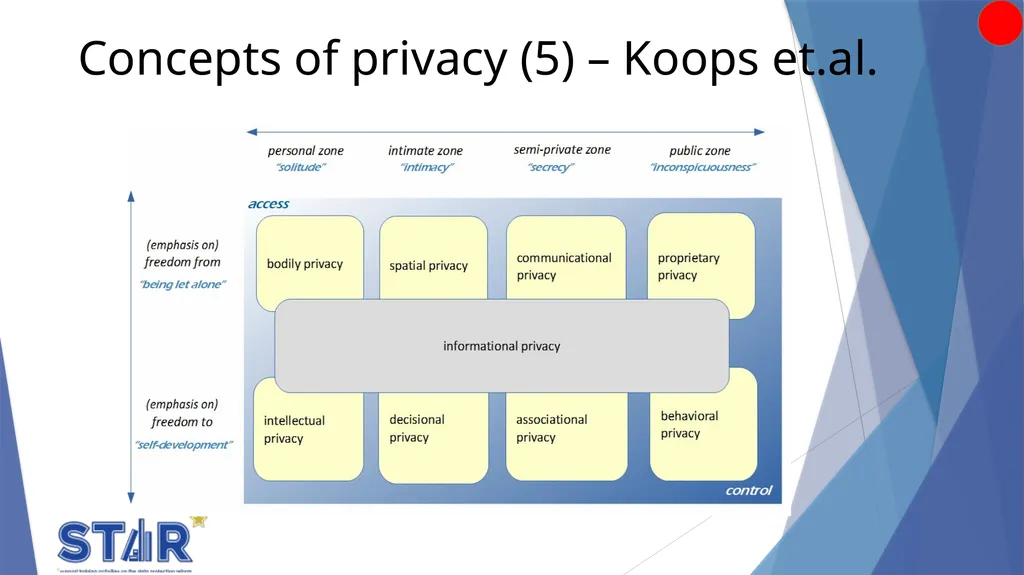
Concepts of privacy (5) – Koops et.al.<br>
13
Questions?<br>
14
Table of contents Concepts of privacy
The right to privacy in human rights catalogues
The Council of Europe and EU framework
The EU data protection regime – the GDPR
The notion of personal data
Principles of processing personal data
Related rights and concepts<br>
The right to privacy in human rights catalogues
The Council of Europe and EU framework
The EU data protection regime – the GDPR
The notion of personal data
Principles of processing personal data
Related rights and concepts<br>
15
2. The right to privacy in human rights catalogues<br>
16
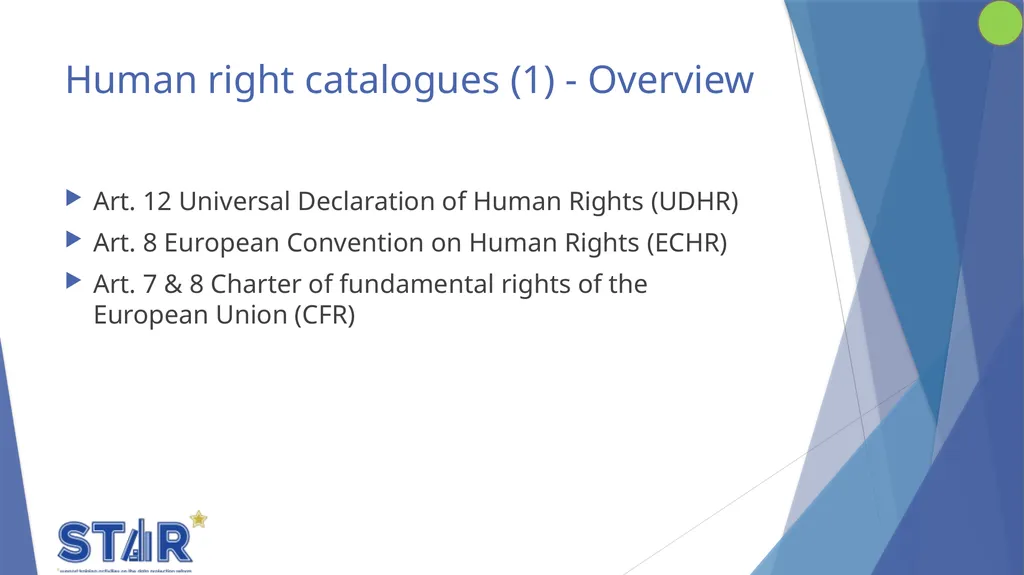
Human right catalogues (1) - Overview Art. 12 Universal Declaration of Human Rights (UDHR)
Art. 8 European Convention on Human Rights (ECHR)
Art. 7 & 8 Charter of fundamental rights of the European Union (CFR)<br>
Art. 8 European Convention on Human Rights (ECHR)
Art. 7 & 8 Charter of fundamental rights of the European Union (CFR)<br>
17
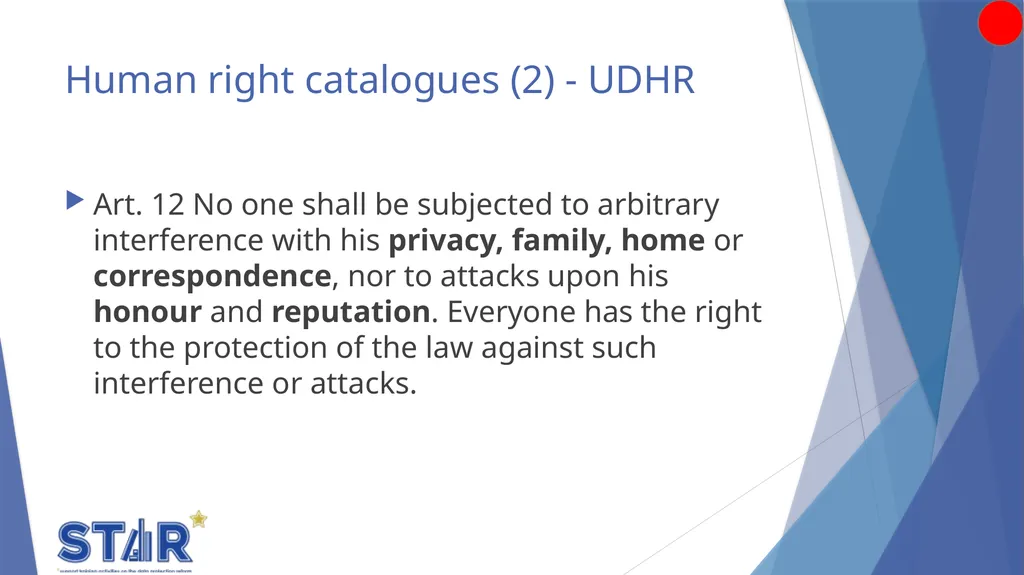
Human right catalogues (2) - UDHR Art. 12 No one shall be subjected to arbitrary interference with his privacy, family, home or correspondence, nor to attacks upon his honour and reputation. Everyone has the right to the protection of the law against such interference or attacks.<br>
18
Human right catalogues (3) - ECHR Art. 8 (1) Everyone has the right to respect for his private and family life, his home and his correspondence.
(2)There shall be no interference by a public authority with the exercise of this right except such as is in accordance with the law and is necessary in a democratic society in the interests of national security, public safety or the economic well-being of the country, for the prevention of disorder or crime, for the protection of health or morals, or for the protection of the rights and freedoms of others.<br>
(2)There shall be no interference by a public authority with the exercise of this right except such as is in accordance with the law and is necessary in a democratic society in the interests of national security, public safety or the economic well-being of the country, for the prevention of disorder or crime, for the protection of health or morals, or for the protection of the rights and freedoms of others.<br>
19
Human right catalogues (4) - CFR Art. 7 Everyone has the right to respect for his or her private and family life, home and communications.<br>
20
Human right catalogues (5) - CFR Art. 8 (1) Everyone has the right to the protection of personal data concerning him or her.
(2) Such data must be processed fairly for specified purposes and on the basis of the consent of the person concerned or some other legitimate basis laid down by law. Everyone has the right of access to data which has been collected concerning him or her, and the right to have it rectified.
(3) Compliance with these rules shall be subject to control by an independent authority.<br>
(2) Such data must be processed fairly for specified purposes and on the basis of the consent of the person concerned or some other legitimate basis laid down by law. Everyone has the right of access to data which has been collected concerning him or her, and the right to have it rectified.
(3) Compliance with these rules shall be subject to control by an independent authority.<br>
21
Human right catalogues (6) ECHR and the CFR Art. 52 (3) CFR „In so far as this Charter contains rights which correspond to rights guaranteed by the Convention for the Protection of Human Rights and Fundamental Freedoms, the meaning and scope of those rights shall be the same as those laid down by the said Convention. This provision shall not prevent Union law providing more extensive protection.”<br>
22
Human rights catalogues (7) - national legal framework Constitution
Data protection framework
Sectoral regulations<br>
Data protection framework
Sectoral regulations<br>
23
Questions?<br>
24
Table of contents Concepts of privacy
The right to privacy in human rights catalogues
The Council of Europe and EU framework
The EU data protection regime – the GDPR
The notion of personal data
Principles of processing personal data
Related rights and concepts<br>
The right to privacy in human rights catalogues
The Council of Europe and EU framework
The EU data protection regime – the GDPR
The notion of personal data
Principles of processing personal data
Related rights and concepts<br>
25
3. The Council of Europe and EU framework<br>
26
Council of Europe 1949 Strasbourg, FR
47 member countries
1950 European Convention on Human Rights art. 8
1959 European Court of Human Rights
1981 ETS No. 108 - Convention for the Protection of Individuals with regard to Automatic Processing of Personal Data
2001 ETS No. 181 - Additional Protocol to the Convention for the Protection of Individuals with regard to Automatic Processing of Personal Data regarding supervisory authorities and transborder data flows
2018 Modernised Convention of the Council of Europe Nr. 108 for the protection of individuals with regard to automatic processing of personal data<br>
47 member countries
1950 European Convention on Human Rights art. 8
1959 European Court of Human Rights
1981 ETS No. 108 - Convention for the Protection of Individuals with regard to Automatic Processing of Personal Data
2001 ETS No. 181 - Additional Protocol to the Convention for the Protection of Individuals with regard to Automatic Processing of Personal Data regarding supervisory authorities and transborder data flows
2018 Modernised Convention of the Council of Europe Nr. 108 for the protection of individuals with regard to automatic processing of personal data<br>
27
Sectoral documents of Council of Europe Recommendation No. R (81) 1 on regulations for automated medical data banks (23 January 1981);
Recommendation No. R (83) 10 on the protection of personal data used for scientific research and statistics (23 September 1983);
Recommendation No. R (85) 20 on the protection of personal data used for the purposes of direct marketing (25 October 1985);
Recommendation No. R (86) 1 on the protection of personal data used for social security purposes (23 January 1986);
Recommendation No. R (87) 15 regulating the use of personal data in the police sector (17 September 1987)
Recommendation No R (86) 1 on the protection of personal data used for social security purposes
Recommendation No. R (89) 2 on the protection of personal data used for employment purposes
Recommendation No R (97) 5 on the protection of data of a medical nature<br>
Recommendation No. R (83) 10 on the protection of personal data used for scientific research and statistics (23 September 1983);
Recommendation No. R (85) 20 on the protection of personal data used for the purposes of direct marketing (25 October 1985);
Recommendation No. R (86) 1 on the protection of personal data used for social security purposes (23 January 1986);
Recommendation No. R (87) 15 regulating the use of personal data in the police sector (17 September 1987)
Recommendation No R (86) 1 on the protection of personal data used for social security purposes
Recommendation No. R (89) 2 on the protection of personal data used for employment purposes
Recommendation No R (97) 5 on the protection of data of a medical nature<br>
28
European Union est. 1952/1993 – Brussels, BE
28 Member States
1952/2009 Court of Justice of the European Union, lu
1995 95/46/EC Data Protection Directive
1998 Council Framework Decision 2008/977/JHA
2000 Charter of the Fundamental Rights of the European Union art. 7-8
2001 45/2001 EU Data Protection Regulation
2016 2016/679 General Data Protection Regulation
2016 2016/680/EU Police and Criminal Justice Data Protection Directive
multiple leges speciales [Schengen, Prüm, etc.]
multiple international treaties [PNR, Umbrella Agreement, etc.]<br>
28 Member States
1952/2009 Court of Justice of the European Union, lu
1995 95/46/EC Data Protection Directive
1998 Council Framework Decision 2008/977/JHA
2000 Charter of the Fundamental Rights of the European Union art. 7-8
2001 45/2001 EU Data Protection Regulation
2016 2016/679 General Data Protection Regulation
2016 2016/680/EU Police and Criminal Justice Data Protection Directive
multiple leges speciales [Schengen, Prüm, etc.]
multiple international treaties [PNR, Umbrella Agreement, etc.]<br>
29
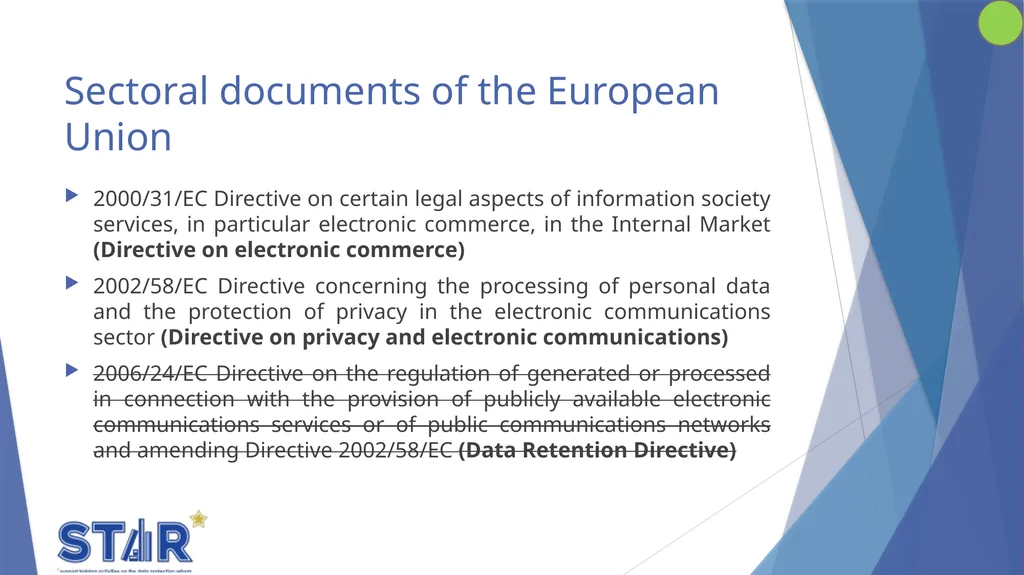
Sectoral documents of the European Union 2000/31/EC Directive on certain legal aspects of information society services, in particular electronic commerce, in the Internal Market (Directive on electronic commerce)
2002/58/EC Directive concerning the processing of personal data and the protection of privacy in the electronic communications sector (Directive on privacy and electronic communications)
2006/24/EC Directive on the regulation of generated or processed in connection with the provision of publicly available electronic communications services or of public communications networks and amending Directive 2002/58/EC (Data Retention Directive)<br>
2002/58/EC Directive concerning the processing of personal data and the protection of privacy in the electronic communications sector (Directive on privacy and electronic communications)
2006/24/EC Directive on the regulation of generated or processed in connection with the provision of publicly available electronic communications services or of public communications networks and amending Directive 2002/58/EC (Data Retention Directive)<br>
30
Questions?<br>
31
Table of contents Concepts of privacy
The right to privacy in human rights catalogues
The Council of Europe and EU framework
The EU data protection regime – the GDPR
The notion of personal data
Principles of processing personal data
Related rights and concepts<br>
The right to privacy in human rights catalogues
The Council of Europe and EU framework
The EU data protection regime – the GDPR
The notion of personal data
Principles of processing personal data
Related rights and concepts<br>
32
4. The EU data protection regime – the GDPR<br>
33
4. The EU data protection regime – the GDPR<br>
34
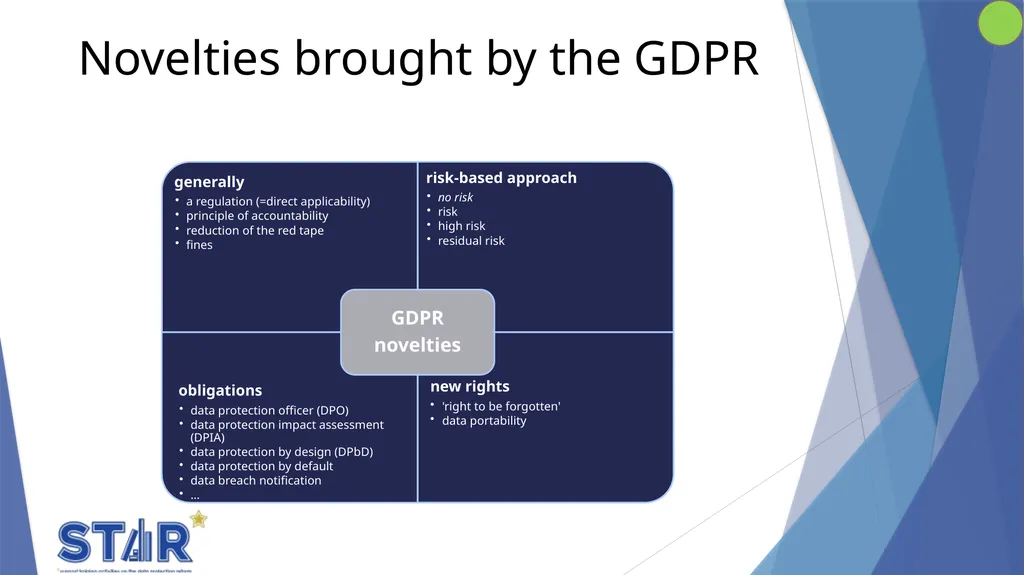
Novelties brought by the GDPR<br>
35
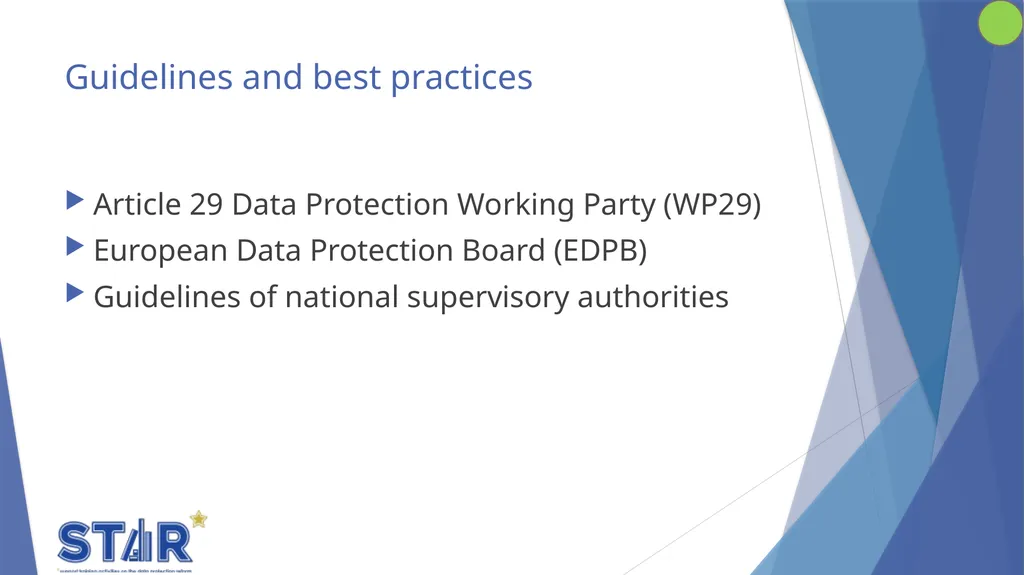
Guidelines and best practices Article 29 Data Protection Working Party (WP29)
European Data Protection Board (EDPB)
Guidelines of national supervisory authorities<br>
European Data Protection Board (EDPB)
Guidelines of national supervisory authorities<br>
36
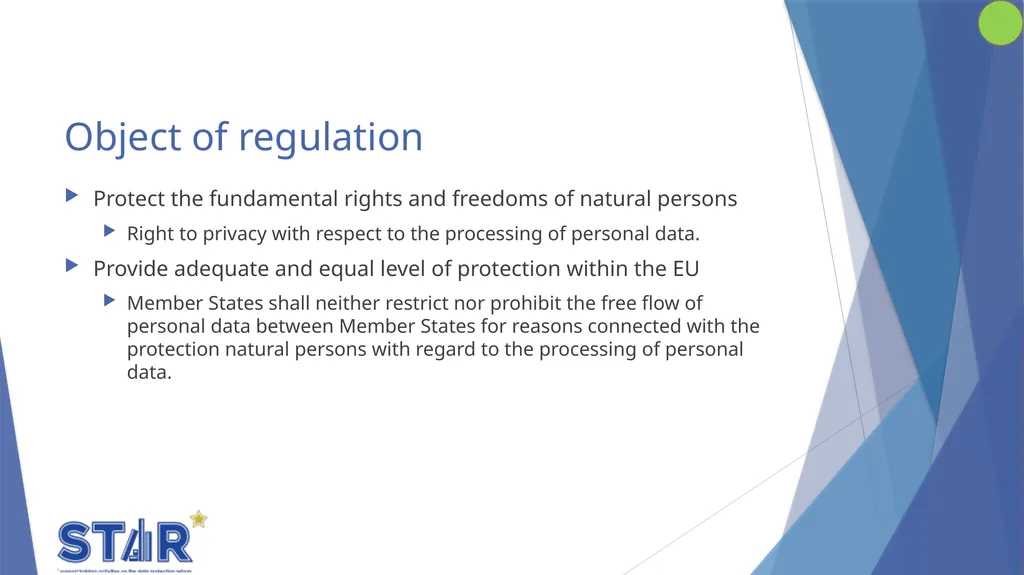
Object of regulation Protect the fundamental rights and freedoms of natural persons
Right to privacy with respect to the processing of personal data.
Provide adequate and equal level of protection within the EU
Member States shall neither restrict nor prohibit the free flow of personal data between Member States for reasons connected with the protection natural persons with regard to the processing of personal data.<br>
Right to privacy with respect to the processing of personal data.
Provide adequate and equal level of protection within the EU
Member States shall neither restrict nor prohibit the free flow of personal data between Member States for reasons connected with the protection natural persons with regard to the processing of personal data.<br>
37
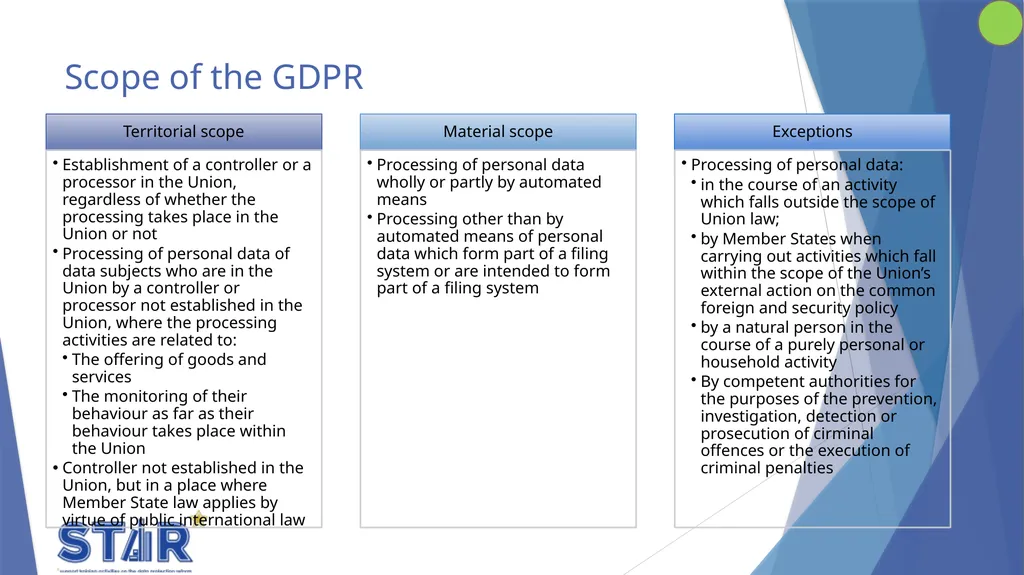
Scope of the GDPR<br>
38
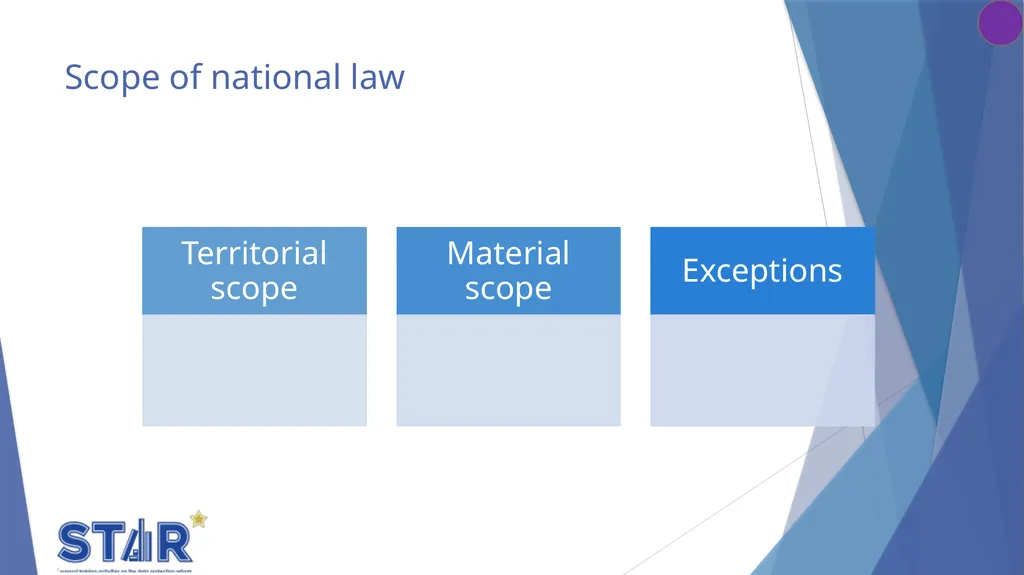
Scope of national law<br>
39
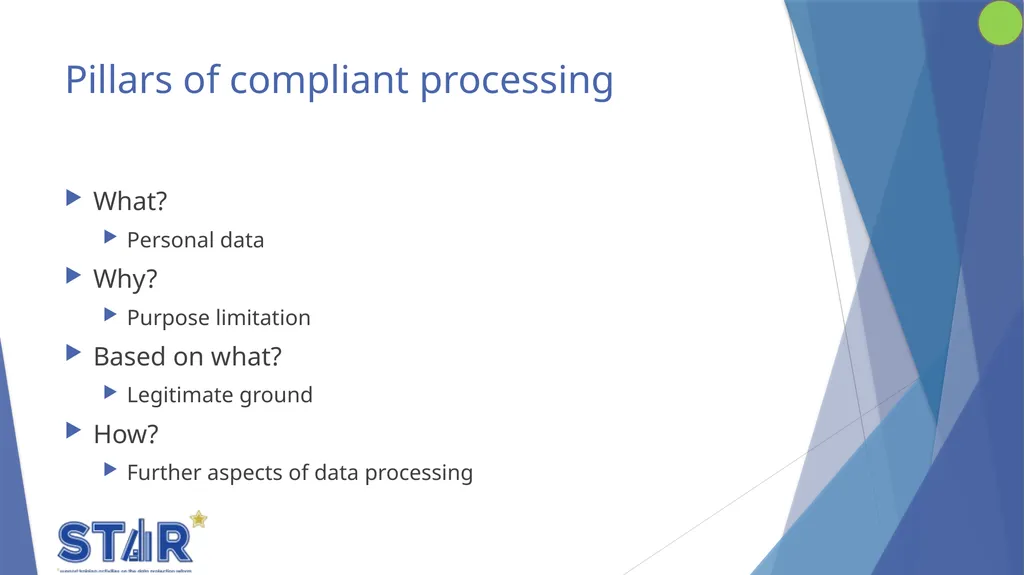
Pillars of compliant processing What?
Personal data
Why?
Purpose limitation
Based on what?
Legitimate ground
How?
Further aspects of data processing<br>
Personal data
Why?
Purpose limitation
Based on what?
Legitimate ground
How?
Further aspects of data processing<br>
40
Questions?<br>
41
Table of contents Concepts of privacy
The right to privacy in human rights catalogues
The Council of Europe and EU framework
The EU data protection regime – the GDPR
The notion of personal data
Principles of processing personal data
Related rights and concepts<br>
The right to privacy in human rights catalogues
The Council of Europe and EU framework
The EU data protection regime – the GDPR
The notion of personal data
Principles of processing personal data
Related rights and concepts<br>
42
5. The notion of personal data<br>
43
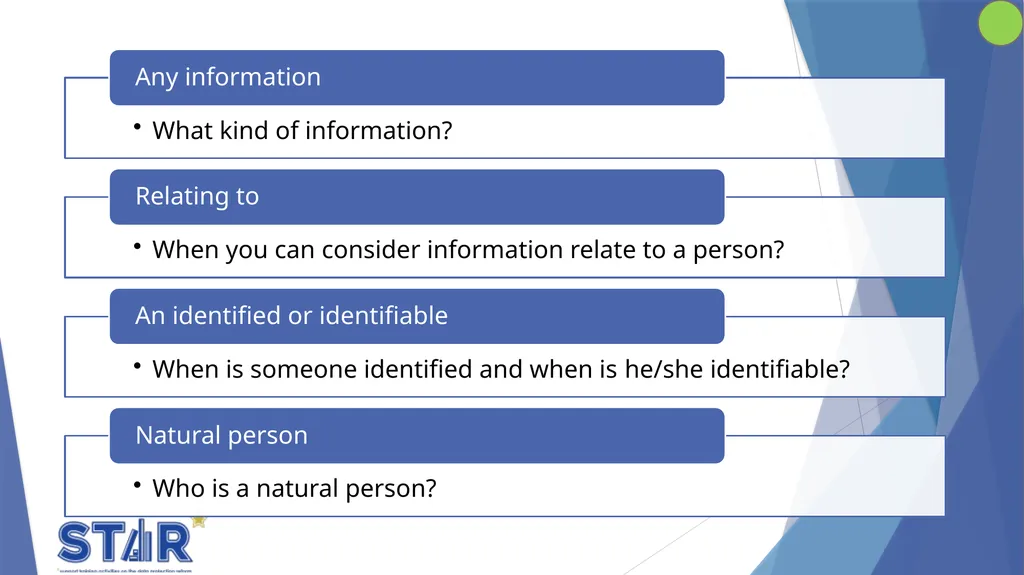
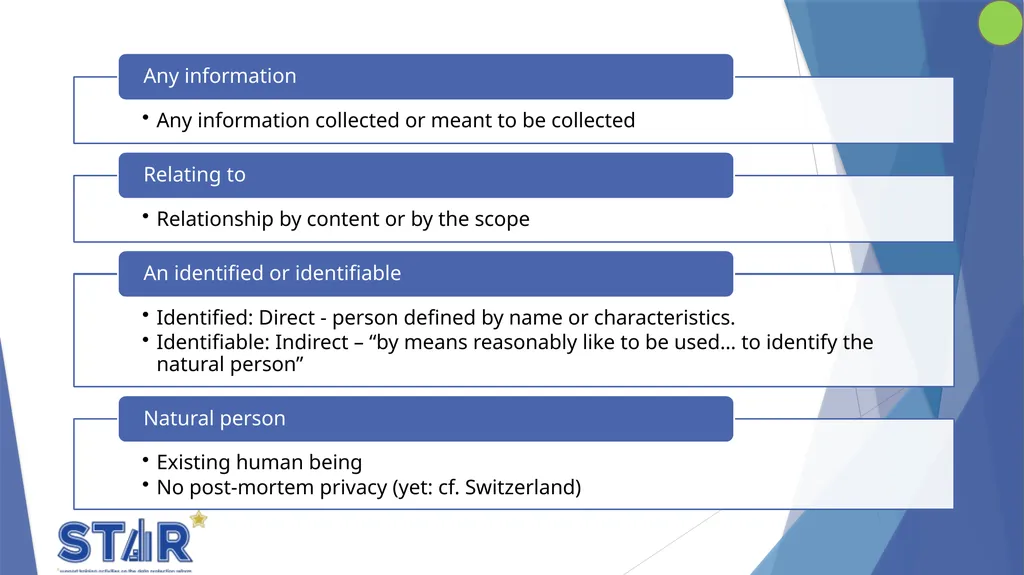
What is “personal data”? “any information relating to an identified or identifiable natural person”<br>
44
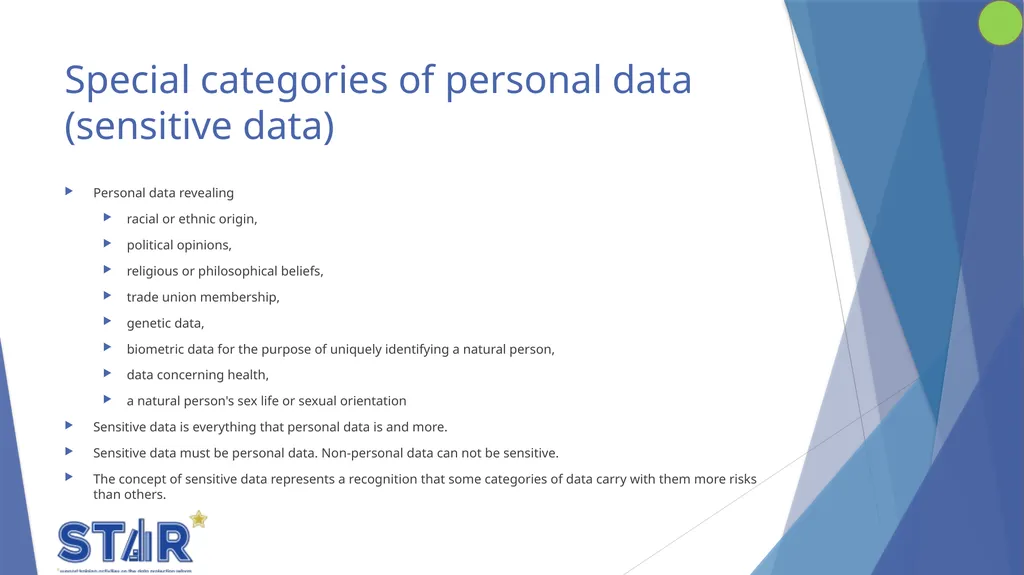
Special categories of personal data (sensitive data) Personal data revealing
racial or ethnic origin,
political opinions,
religious or philosophical beliefs,
trade union membership,
genetic data,
biometric data for the purpose of uniquely identifying a natural person,
data concerning health,
a natural person's sex life or sexual orientation
Sensitive data is everything that personal data is and more.
Sensitive data must be personal data. Non-personal data can not be sensitive.
The concept of sensitive data represents a recognition that some categories of data carry with them more risks than others.<br>
racial or ethnic origin,
political opinions,
religious or philosophical beliefs,
trade union membership,
genetic data,
biometric data for the purpose of uniquely identifying a natural person,
data concerning health,
a natural person's sex life or sexual orientation
Sensitive data is everything that personal data is and more.
Sensitive data must be personal data. Non-personal data can not be sensitive.
The concept of sensitive data represents a recognition that some categories of data carry with them more risks than others.<br>
45
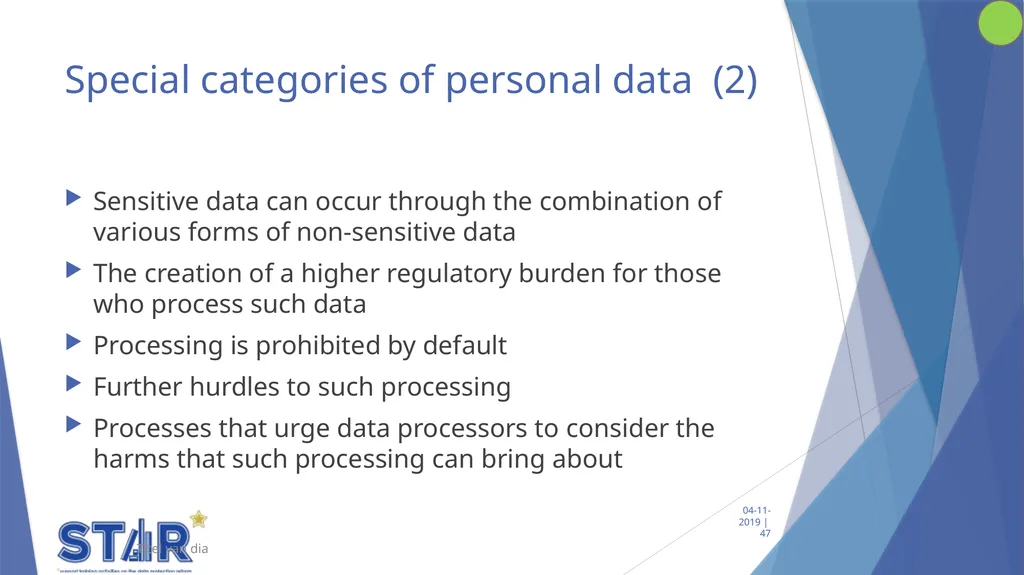
Special categories of personal data (2) Sensitive data can occur through the combination of various forms of non-sensitive data
The creation of a higher regulatory burden for those who process such data
Processing is prohibited by default
Further hurdles to such processing
Processes that urge data processors to consider the harms that such processing can bring about 04-11-2019 | 47 Titel van dia<br>
The creation of a higher regulatory burden for those who process such data
Processing is prohibited by default
Further hurdles to such processing
Processes that urge data processors to consider the harms that such processing can bring about 04-11-2019 | 47 Titel van dia<br>
46
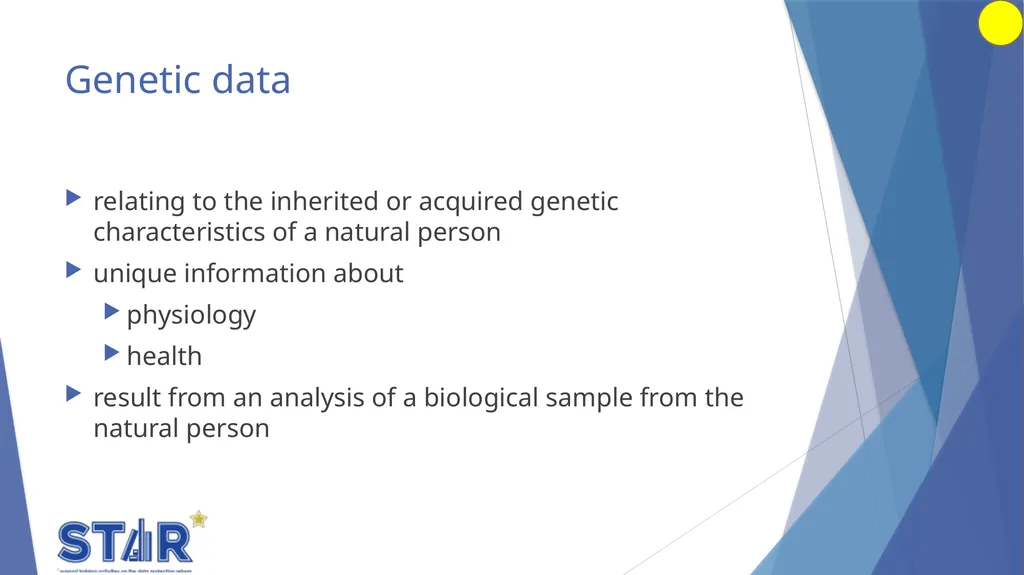
Genetic data relating to the inherited or acquired genetic characteristics of a natural person
unique information about
physiology
health
result from an analysis of a biological sample from the natural person<br>
unique information about
physiology
health
result from an analysis of a biological sample from the natural person<br>
47
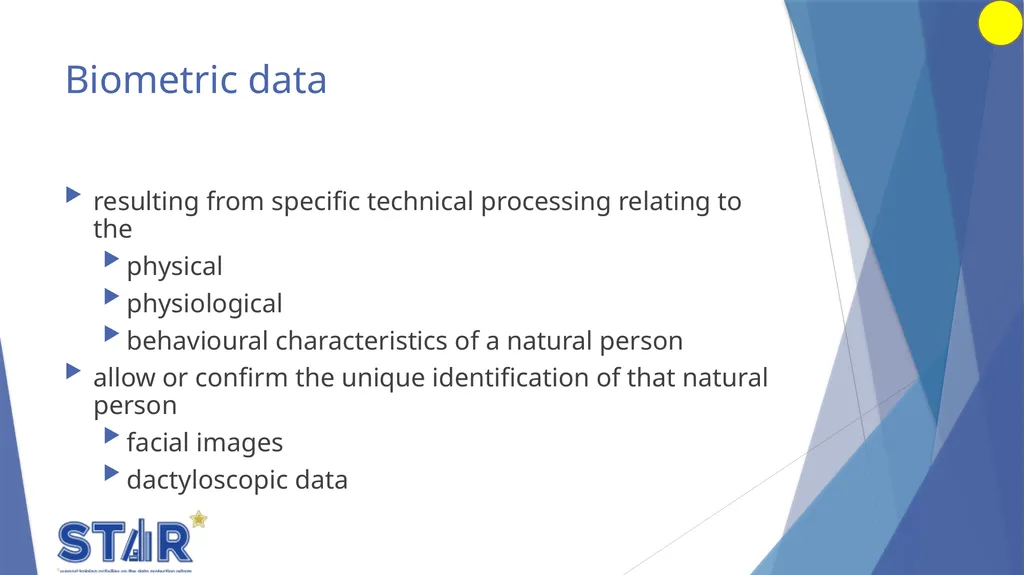
Biometric data resulting from specific technical processing relating to the
physical
physiological
behavioural characteristics of a natural person
allow or confirm the unique identification of that natural person
facial images
dactyloscopic data<br>
physical
physiological
behavioural characteristics of a natural person
allow or confirm the unique identification of that natural person
facial images
dactyloscopic data<br>
48
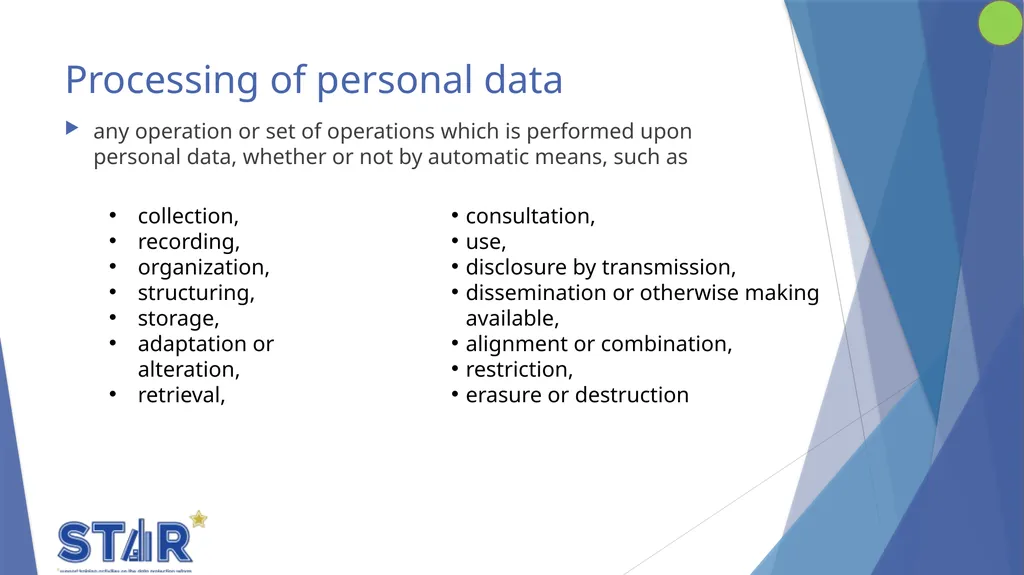
Processing of personal data any operation or set of operations which is performed upon personal data, whether or not by automatic means, such as collection,
recording,
organization,
structuring,
storage,
adaptation or alteration,
retrieval, consultation,
use,
disclosure by transmission,
dissemination or otherwise making available,
alignment or combination,
restriction,
erasure or destruction<br>
recording,
organization,
structuring,
storage,
adaptation or alteration,
retrieval, consultation,
use,
disclosure by transmission,
dissemination or otherwise making available,
alignment or combination,
restriction,
erasure or destruction<br>
49
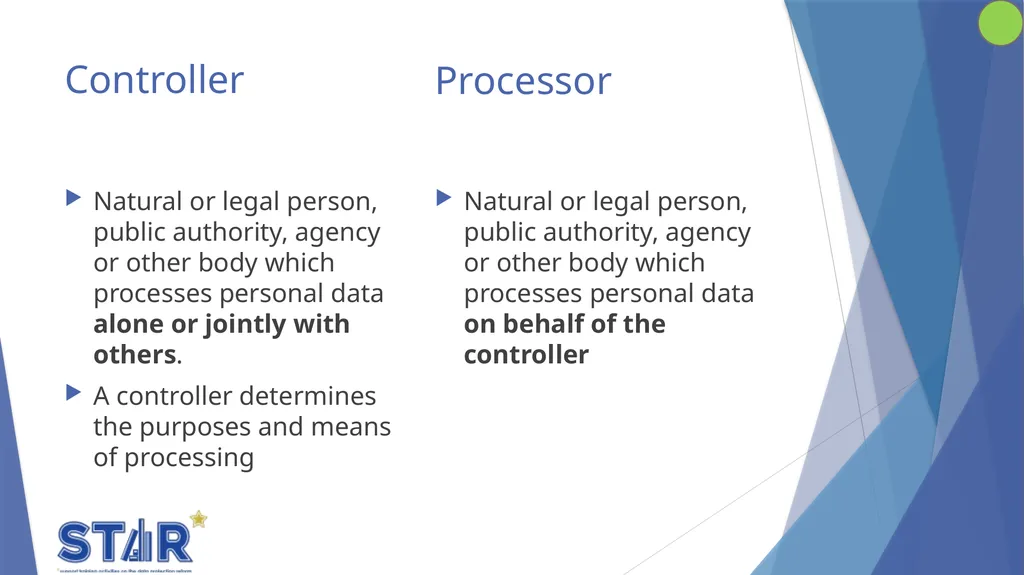
Controller Natural or legal person, public authority, agency or other body which processes personal data alone or jointly with others.
A controller determines the purposes and means of processing Natural or legal person, public authority, agency or other body which processes personal data on behalf of the controller Processor<br>
A controller determines the purposes and means of processing Natural or legal person, public authority, agency or other body which processes personal data on behalf of the controller Processor<br>
50
Questions?<br>
51
Table of contents Concepts of privacy
The right to privacy in human rights catalogues
The Council of Europe and EU framework
The EU data protection regime – the GDPR
The notion of personal data
Principles of processing personal data
Related rights and concepts<br>
The right to privacy in human rights catalogues
The Council of Europe and EU framework
The EU data protection regime – the GDPR
The notion of personal data
Principles of processing personal data
Related rights and concepts<br>
52
6. Principles of processing personal data<br>
53
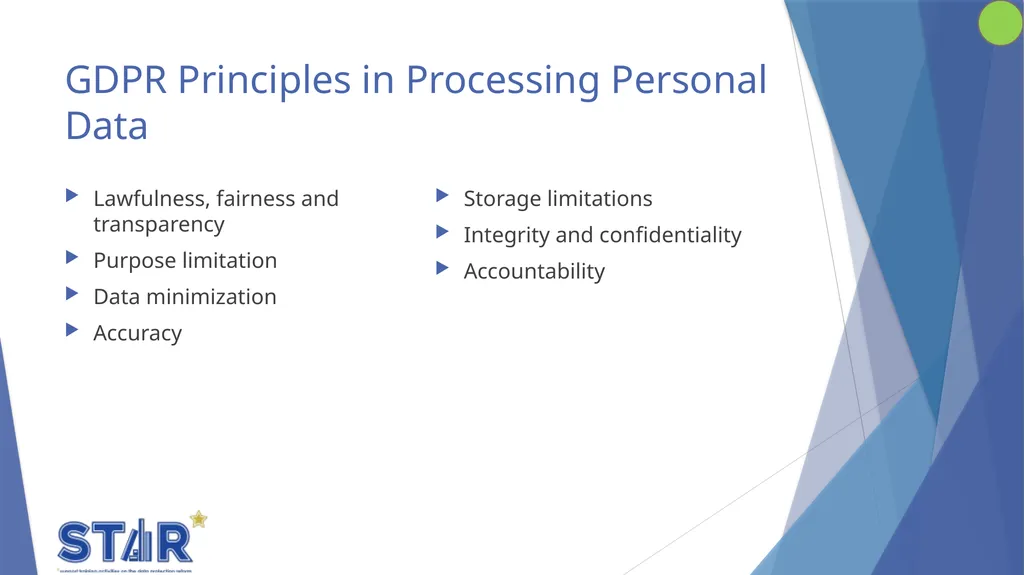
GDPR Principles in Processing Personal Data Lawfulness, fairness and transparency
Purpose limitation
Data minimization
Accuracy Storage limitations
Integrity and confidentiality
Accountability<br>
Purpose limitation
Data minimization
Accuracy Storage limitations
Integrity and confidentiality
Accountability<br>
54
lawfulness, fairness and transparency
processed lawfully, fairly and in a transparent manner in relation to the data subject
purpose limitation
collected for specified, explicit and legitimate purposes
not further processed in a manner that is incompatible with those purposes
except for archiving
data minimization
adequate, relevant and limited to what is necessary in relation to the purposes for which they are processed
accuracy
accurate and kept up to date
inaccurate data shall be erased or rectified without delay<br>
processed lawfully, fairly and in a transparent manner in relation to the data subject
purpose limitation
collected for specified, explicit and legitimate purposes
not further processed in a manner that is incompatible with those purposes
except for archiving
data minimization
adequate, relevant and limited to what is necessary in relation to the purposes for which they are processed
accuracy
accurate and kept up to date
inaccurate data shall be erased or rectified without delay<br>
55
storage limitation
kept in a form which permits identification of data subjects for no longer than is necessary
except for archiving
public interest
scientific or historical research purposes
statistical purposes
integrity and confidentiality
appropriate technical or organisational measures
that ensures appropriate security of the personal data
protection against
unauthorised or unlawful processing
accidental loss, destruction or damage
accountability
The controller shall be responsible for, and be able to demonstrate compliance with lawfulness, fairness and transparency<br>
kept in a form which permits identification of data subjects for no longer than is necessary
except for archiving
public interest
scientific or historical research purposes
statistical purposes
integrity and confidentiality
appropriate technical or organisational measures
that ensures appropriate security of the personal data
protection against
unauthorised or unlawful processing
accidental loss, destruction or damage
accountability
The controller shall be responsible for, and be able to demonstrate compliance with lawfulness, fairness and transparency<br>
56
Questions?<br>
57
Table of contents Concepts of privacy
The right to privacy in human rights catalogues
The Council of Europe and EU framework
The EU data protection regime – the GDPR
The notion of personal data
Principles of processing personal data
Related rights and concepts<br>
The right to privacy in human rights catalogues
The Council of Europe and EU framework
The EU data protection regime – the GDPR
The notion of personal data
Principles of processing personal data
Related rights and concepts<br>
58
7. Related rights and concepts<br>
59
Related rights and concepts - freedom of expression In Axel Springer AG v. Germany the ECtHR held that a ban imposed by a domestic court on the owner of a newspaper who wanted to publish an article on the arrest and conviction of a well-known actor violated Article 10 of the ECHR.
In Mosley v. UK a national weekly newspaper published intimate photographs of the applicant. He then alleged a violation of Article 8 of the ECHR because he had been unable to seek an injunction before the publication of the photos in question due to the absence of any pre-notification requirement for the newspaper in case of publication of material capable of violating one’s right to privacy. Although the dissemination of such material was generally for the purposes of entertainment rather than education, it undoubtedly benefited from the protection of Article 10 of the ECHR, which might yield to the requirements of Article 8 of the ECHR where the information was of a private and intimate nature and there was no public interest in its dissemination.<br>
In Mosley v. UK a national weekly newspaper published intimate photographs of the applicant. He then alleged a violation of Article 8 of the ECHR because he had been unable to seek an injunction before the publication of the photos in question due to the absence of any pre-notification requirement for the newspaper in case of publication of material capable of violating one’s right to privacy. Although the dissemination of such material was generally for the purposes of entertainment rather than education, it undoubtedly benefited from the protection of Article 10 of the ECHR, which might yield to the requirements of Article 8 of the ECHR where the information was of a private and intimate nature and there was no public interest in its dissemination.<br>
60
Related rights and concepts - freedom of expression In Tietosuojavaltuutettu v. Satakunnan Markkinapörssi Oy and Satamedia Oy the CJEU was asked to interpret Article 9 of the Data Protection Directive and to define the relationship between data protection and the freedom of the press. The Court had to verify whether the processing of personal data, which the tax authorities made available, in order to allow mobile telephone users to receive tax data relating to other natural persons must be considered as an activity carried out solely for journalistic purposes.
In Google Spain SL, Google Inc. v. Agencia Española de Protección de Datos (AEPD) CJEU considered whether Google was obliged to delete outdated information about the applicant’s financial difficulties from its search list results. When a search was undertaken on the Google search engine using the applicant’s name, the results of the search provided links to old newspaper articles mentioning his connection with bankruptcy proceedings.<br>
In Google Spain SL, Google Inc. v. Agencia Española de Protección de Datos (AEPD) CJEU considered whether Google was obliged to delete outdated information about the applicant’s financial difficulties from its search list results. When a search was undertaken on the Google search engine using the applicant’s name, the results of the search provided links to old newspaper articles mentioning his connection with bankruptcy proceedings.<br>
61
Related rights and concepts – access to documents In the European Commission v. The Bavarian Lager Co. Ltd the CJEU defined the scope of the protection of personal data in the context of access to documents of EU institutions and the relationship between Regulations Nos. 1049/2001 (Access to Documents Regulation) and 45/2001 (Data Protection Regulation).
In Magyar Helsinki Bizottság v. Hungary the applicant, a human rights NGO, requested information from the police relating to the work of ex officio defence counsel, to complete a study on the functioning of the public defenders’ system in Hungary. The police refused to provide the information, arguing that it constituted personal data not subject to disclosure.<br>
In Magyar Helsinki Bizottság v. Hungary the applicant, a human rights NGO, requested information from the police relating to the work of ex officio defence counsel, to complete a study on the functioning of the public defenders’ system in Hungary. The police refused to provide the information, arguing that it constituted personal data not subject to disclosure.<br>
62
Related rights and concepts – freedom of arts and sciences In Vereinigung bildender Künstler v. Austria the Austrian courts prohibited the applicant association from continuing to exhibit a painting that contained photos of the heads of various public figures in sexual positions<br>
63
Related rights and concepts – Protection of property Promusicae v. Telefonica concerned the refusal of a Spanish internet access provider, Telefónica, to disclose to Promusicae, a non-profit organisation of music producers and publishers of musical and audio-visual recordings, the personal data of certain persons whom it provided with internet access services.<br>
64
Questions?<br>
65
Evaluation and feedback Evaluation forms
Attendance sheet 67<br>
Attendance sheet 67<br>
66
Credits These training materials are based on standard training materials developed in the context of the project “Supporting Training Activities on the Data Protection Reform” – STAR (http://www.project-star.eu/).
This project as funded by the European Union’s Rights, Equality and Citizenship Programme (2014-2020) under Grant Agreement No 769138.
The default version of training materials are available free-of-charge on the STAR project website.
The content of this project represents the views of the authors only and is their sole responsibility. The European Commission does not accept any responsibility for use that may be made of the information it contains. 68<br>
This project as funded by the European Union’s Rights, Equality and Citizenship Programme (2014-2020) under Grant Agreement No 769138.
The default version of training materials are available free-of-charge on the STAR project website.
The content of this project represents the views of the authors only and is their sole responsibility. The European Commission does not accept any responsibility for use that may be made of the information it contains. 68<br>