
Topic 18 Binary Trees "A tree may grow a thousand
CB
Published · 50 slides · 0 views
1 / 1
Description
Topic 18 Binary Trees A tree may grow a thousand feet tall, but its leaves will return to its roots. -Chinese Proverb 2 Definitions A tree data structure one entry point, the root Each node is either a leaf or an internal node An internal
Related Topics
Share
Embed code
Download this presentation From Below
"Topic 18 Binary Trees "A tree may grow a thousand" is the property of its rightful owner. Permission is granted to download and print the materials on this website for personal, non-commercial use only, and to display it on your personal computer provided you do not modify the materials and that you retain all copyright notices contained in the materials. By downloading content from our website, you accept the terms of this agreement.
Presentation Transcript
01
Topic 18
Binary Trees "A tree may grow a thousand feet tall, but its leaves will return to its roots."
-Chinese Proverb<br>
-Chinese Proverb<br>
02
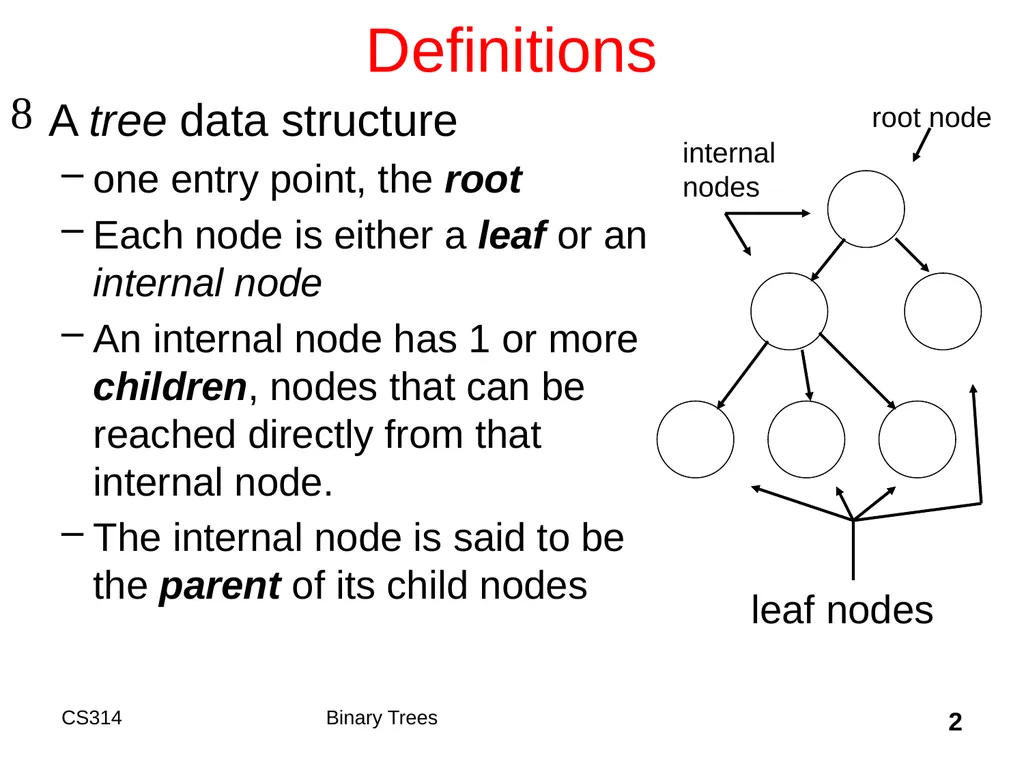
2 Definitions A tree data structure
one entry point, the root
Each node is either a leaf or an internal node
An internal node has 1 or more children, nodes that can be reached directly from that internal node.
The internal node is said to be the parent of its child nodes root node leaf nodes internal nodes Binary Trees CS314<br>
one entry point, the root
Each node is either a leaf or an internal node
An internal node has 1 or more children, nodes that can be reached directly from that internal node.
The internal node is said to be the parent of its child nodes root node leaf nodes internal nodes Binary Trees CS314<br>
03
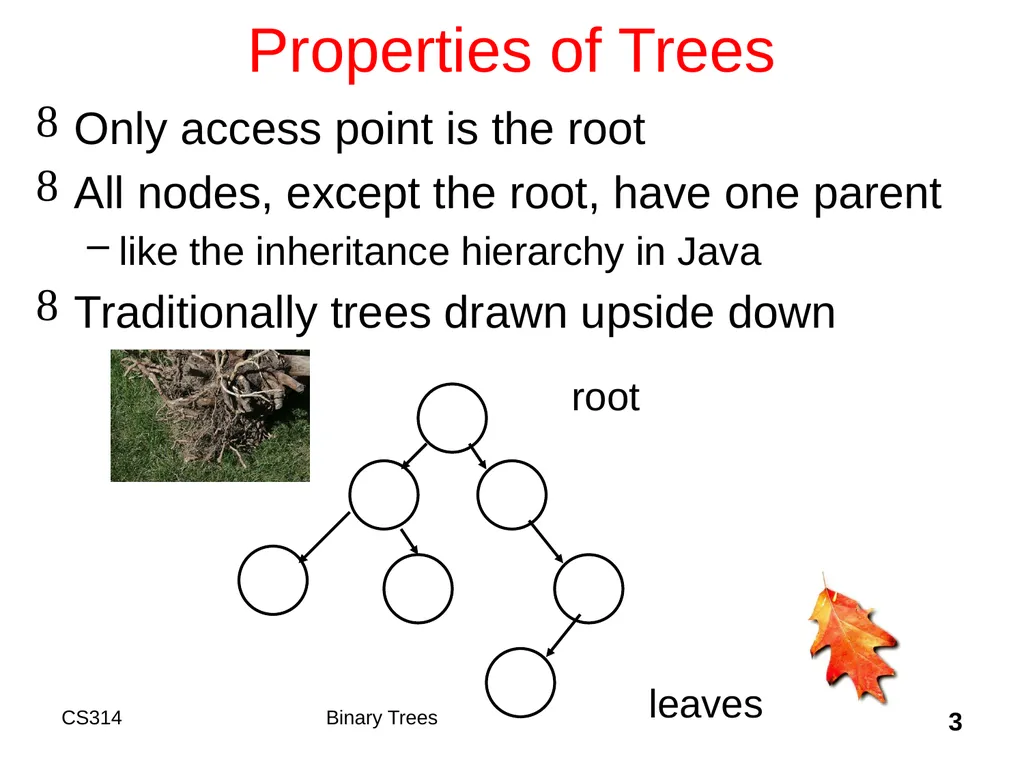
3 Properties of Trees Only access point is the root
All nodes, except the root, have one parent
like the inheritance hierarchy in Java
Traditionally trees drawn upside down root leaves Binary Trees CS314<br>
All nodes, except the root, have one parent
like the inheritance hierarchy in Java
Traditionally trees drawn upside down root leaves Binary Trees CS314<br>
04
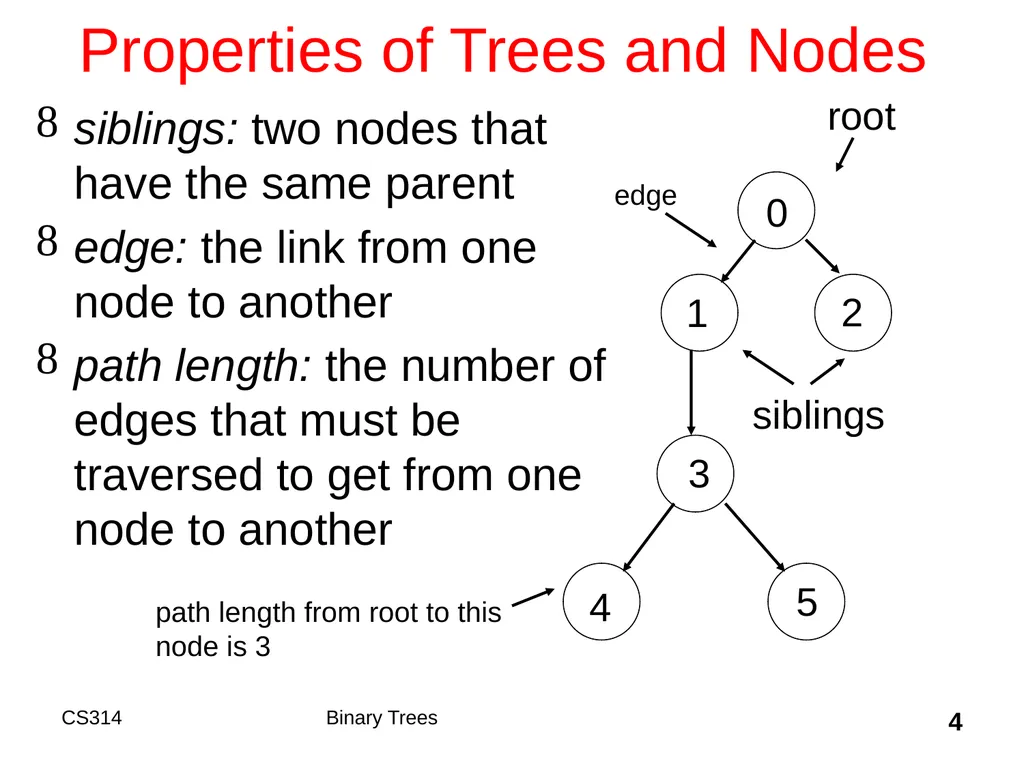
4 Properties of Trees and Nodes siblings: two nodes that have the same parent
edge: the link from one node to another
path length: the number of edges that must be traversed to get from one node to another root siblings edge path length from root to this node is 3 Binary Trees CS314 0 1 2 3 4 5<br>
edge: the link from one node to another
path length: the number of edges that must be traversed to get from one node to another root siblings edge path length from root to this node is 3 Binary Trees CS314 0 1 2 3 4 5<br>
05
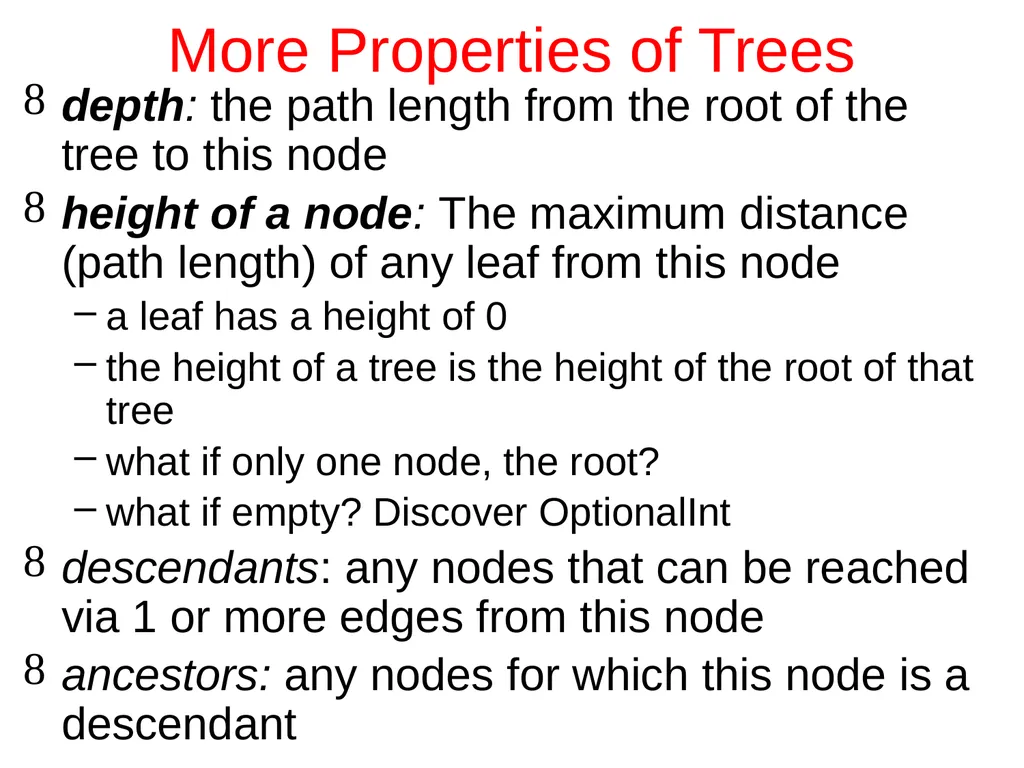
More Properties of Trees depth: the path length from the root of the tree to this node
height of a node: The maximum distance (path length) of any leaf from this node
a leaf has a height of 0
the height of a tree is the height of the root of that tree
what if only one node, the root?
what if empty? Discover OptionalInt
descendants: any nodes that can be reached via 1 or more edges from this node
ancestors: any nodes for which this node is a descendant<br>
height of a node: The maximum distance (path length) of any leaf from this node
a leaf has a height of 0
the height of a tree is the height of the root of that tree
what if only one node, the root?
what if empty? Discover OptionalInt
descendants: any nodes that can be reached via 1 or more edges from this node
ancestors: any nodes for which this node is a descendant<br>
06
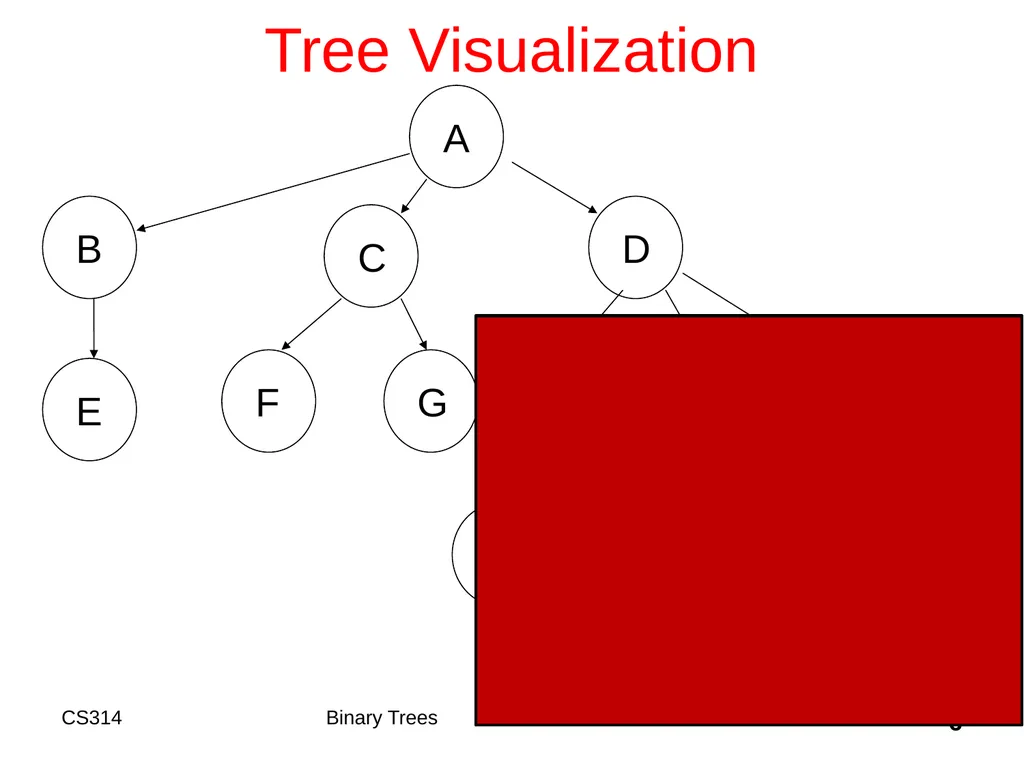
6 Tree Visualization Binary Trees CS314<br>
07
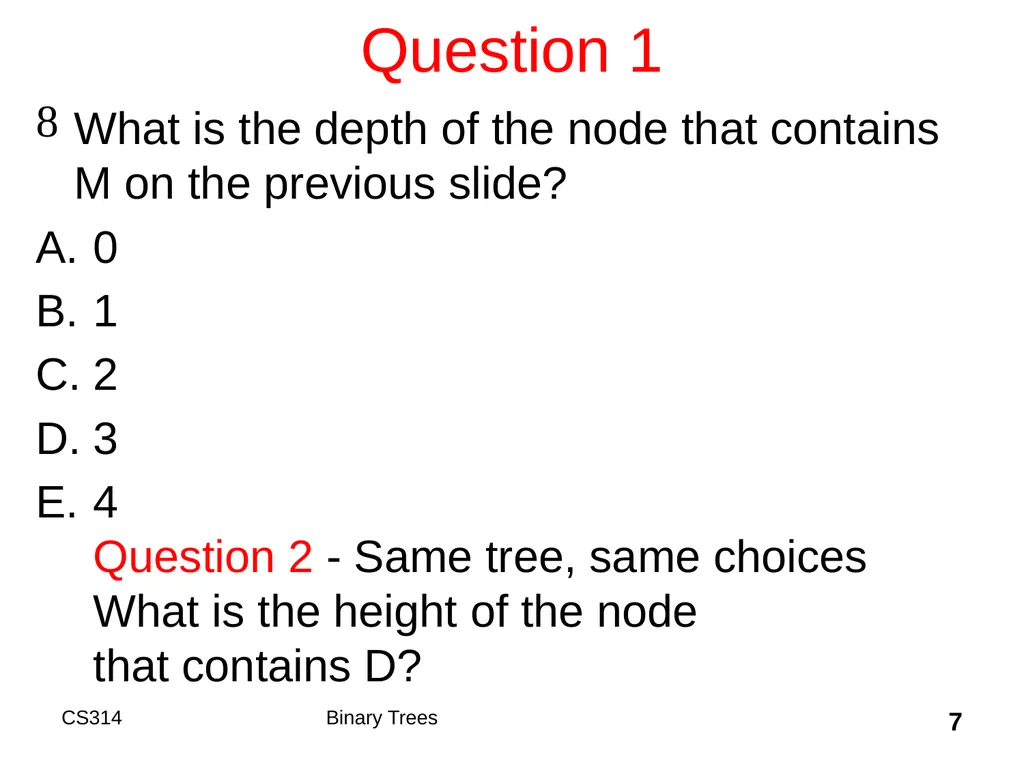
Question 1 What is the depth of the node that contains M on the previous slide?
0
1
2
3
4 Question 2 - Same tree, same choices What is the height of the node that contains D? 7 Binary Trees CS314<br>
0
1
2
3
4 Question 2 - Same tree, same choices What is the height of the node that contains D? 7 Binary Trees CS314<br>
08
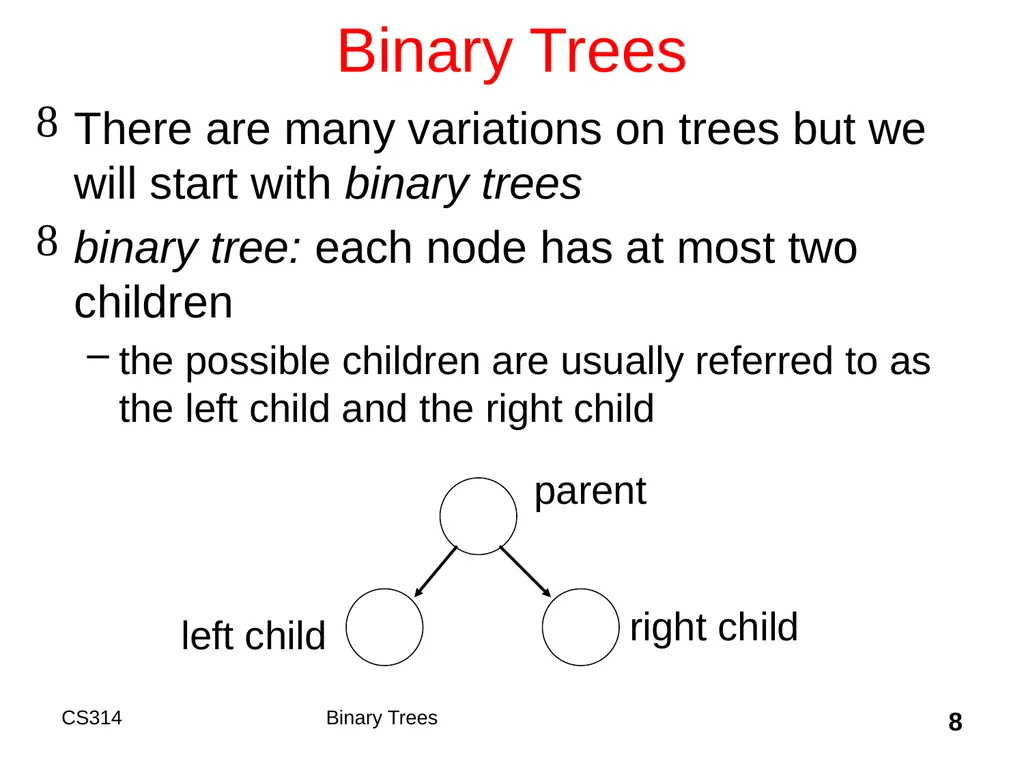
8 Binary Trees There are many variations on trees but we will start with binary trees
binary tree: each node has at most two children
the possible children are usually referred to as the left child and the right child parent left child right child Binary Trees CS314<br>
binary tree: each node has at most two children
the possible children are usually referred to as the left child and the right child parent left child right child Binary Trees CS314<br>
09
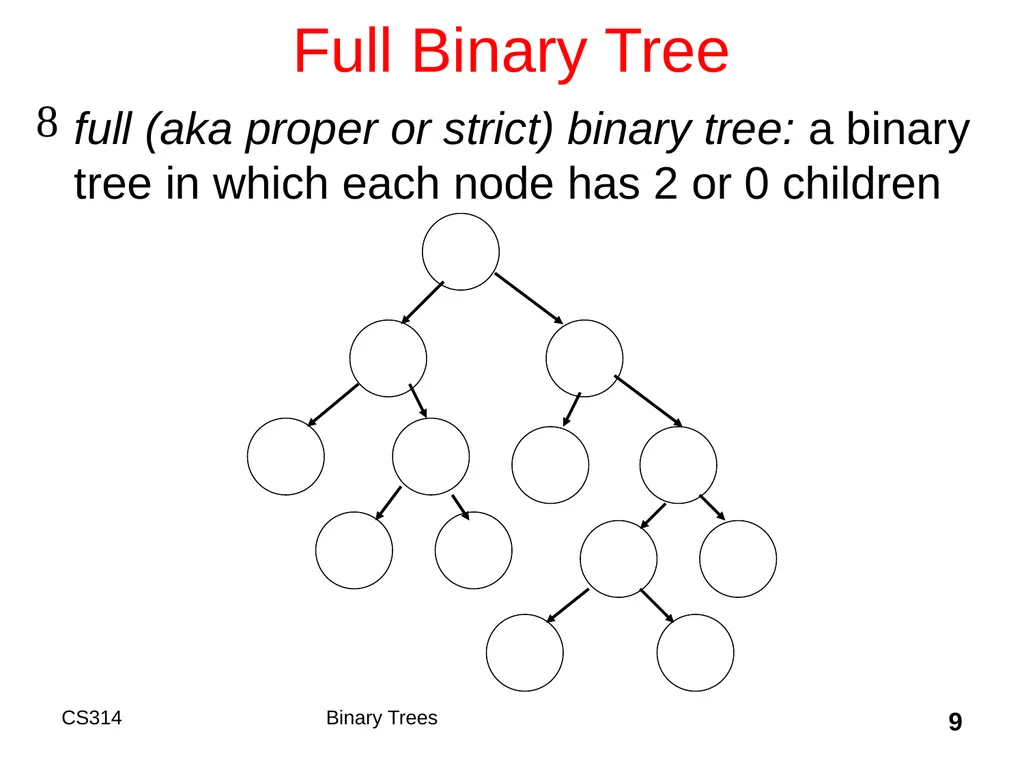
9 Full Binary Tree full (aka proper or strict) binary tree: a binary tree in which each node has 2 or 0 children Binary Trees CS314<br>
10
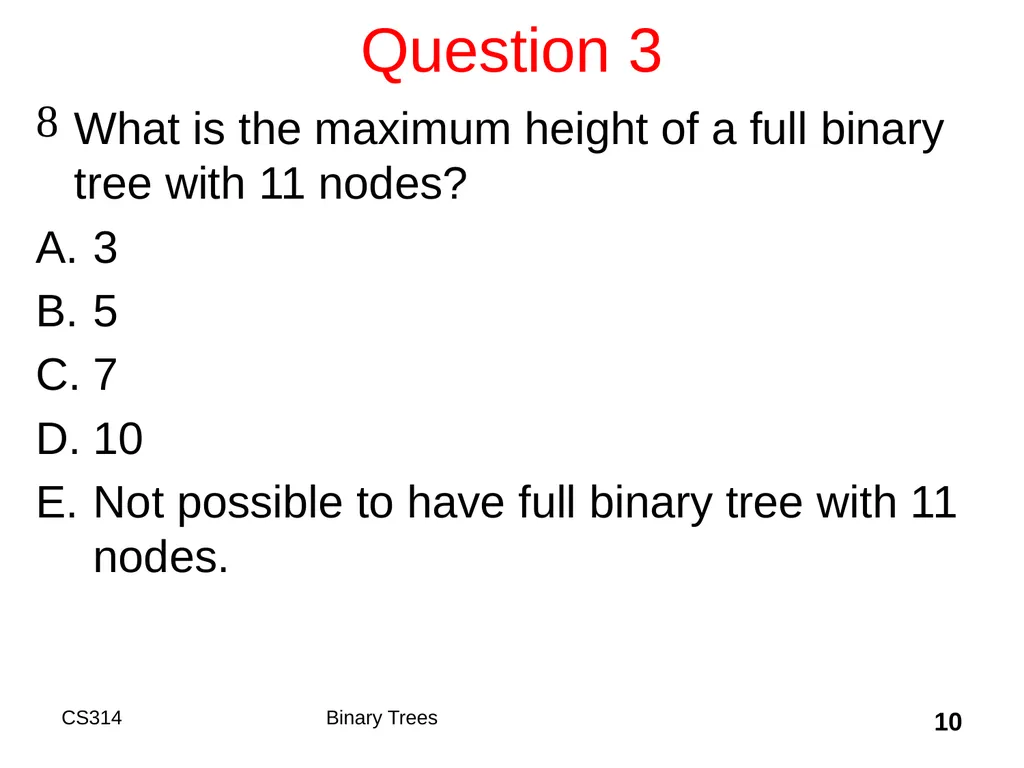
Question 3 What is the maximum height of a full binary tree with 11 nodes?
3
5
7
10
Not possible to have full binary tree with 11 nodes. CS314 Binary Trees 10<br>
3
5
7
10
Not possible to have full binary tree with 11 nodes. CS314 Binary Trees 10<br>
11
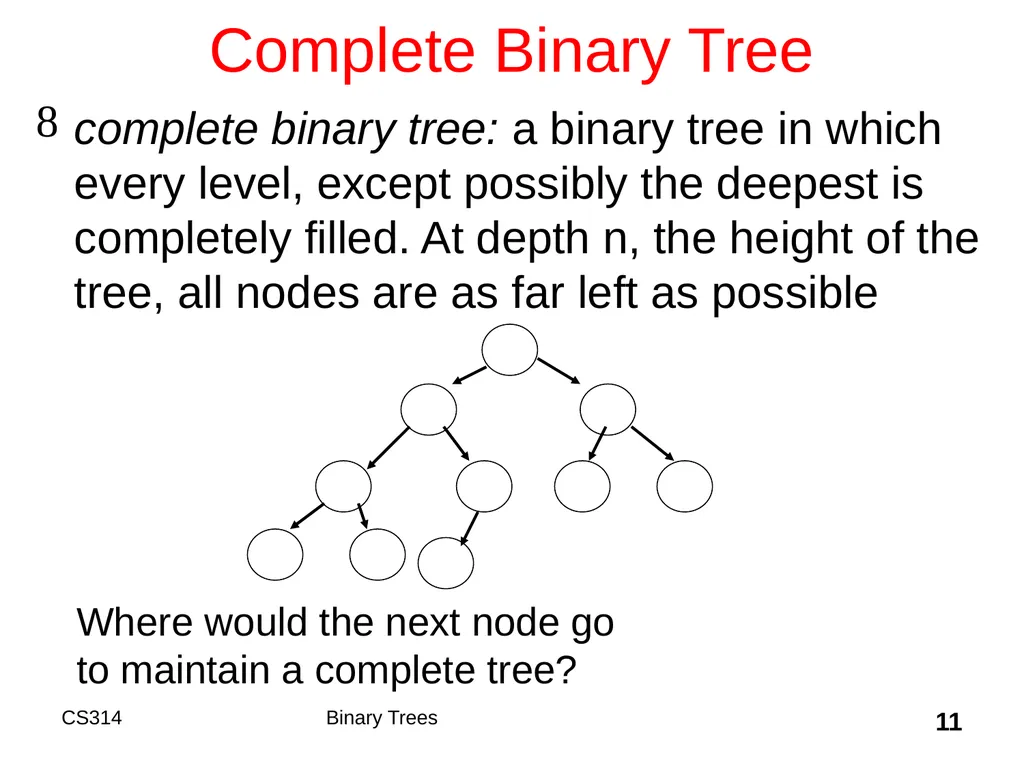
11 Complete Binary Tree complete binary tree: a binary tree in which every level, except possibly the deepest is completely filled. At depth n, the height of the tree, all nodes are as far left as possible Where would the next node go
to maintain a complete tree? Binary Trees CS314<br>
12
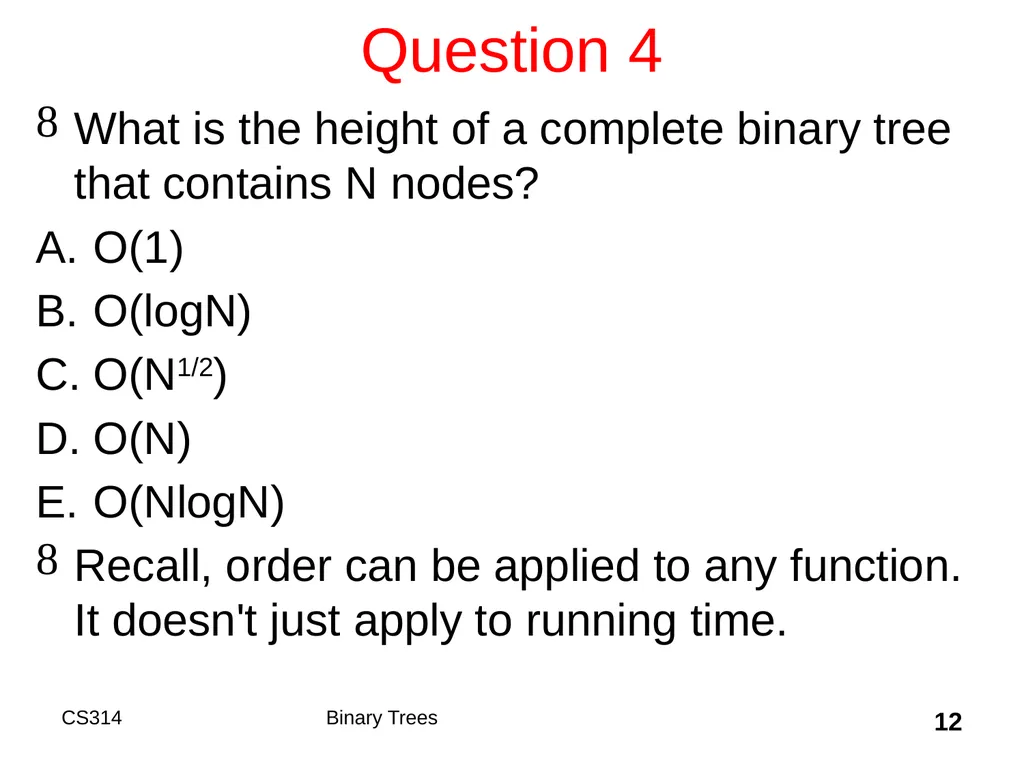
Question 4 What is the height of a complete binary tree that contains N nodes?
O(1)
O(logN)
O(N1/2)
O(N)
O(NlogN)
Recall, order can be applied to any function. It doesn't just apply to running time. CS314 Binary Trees 12<br>
O(1)
O(logN)
O(N1/2)
O(N)
O(NlogN)
Recall, order can be applied to any function. It doesn't just apply to running time. CS314 Binary Trees 12<br>
13
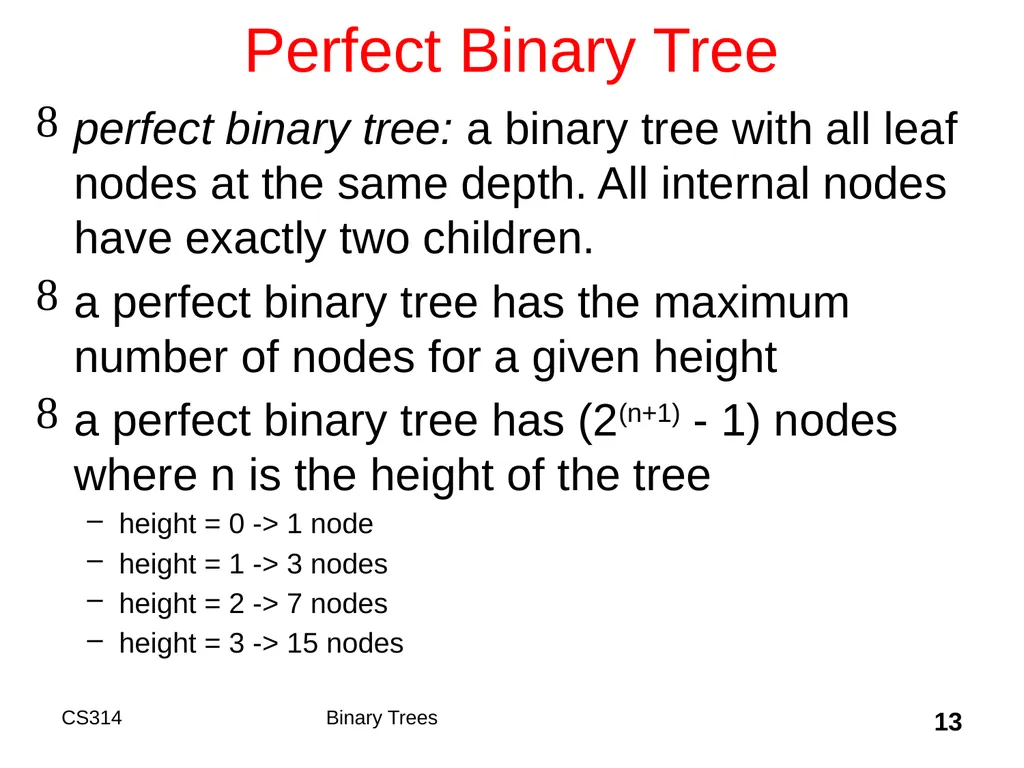
13 Perfect Binary Tree perfect binary tree: a binary tree with all leaf nodes at the same depth. All internal nodes have exactly two children.
a perfect binary tree has the maximum number of nodes for a given height
a perfect binary tree has (2(n+1) - 1) nodes where n is the height of the tree
height = 0 -> 1 node
height = 1 -> 3 nodes
height = 2 -> 7 nodes
height = 3 -> 15 nodes Binary Trees CS314<br>
a perfect binary tree has the maximum number of nodes for a given height
a perfect binary tree has (2(n+1) - 1) nodes where n is the height of the tree
height = 0 -> 1 node
height = 1 -> 3 nodes
height = 2 -> 7 nodes
height = 3 -> 15 nodes Binary Trees CS314<br>
14
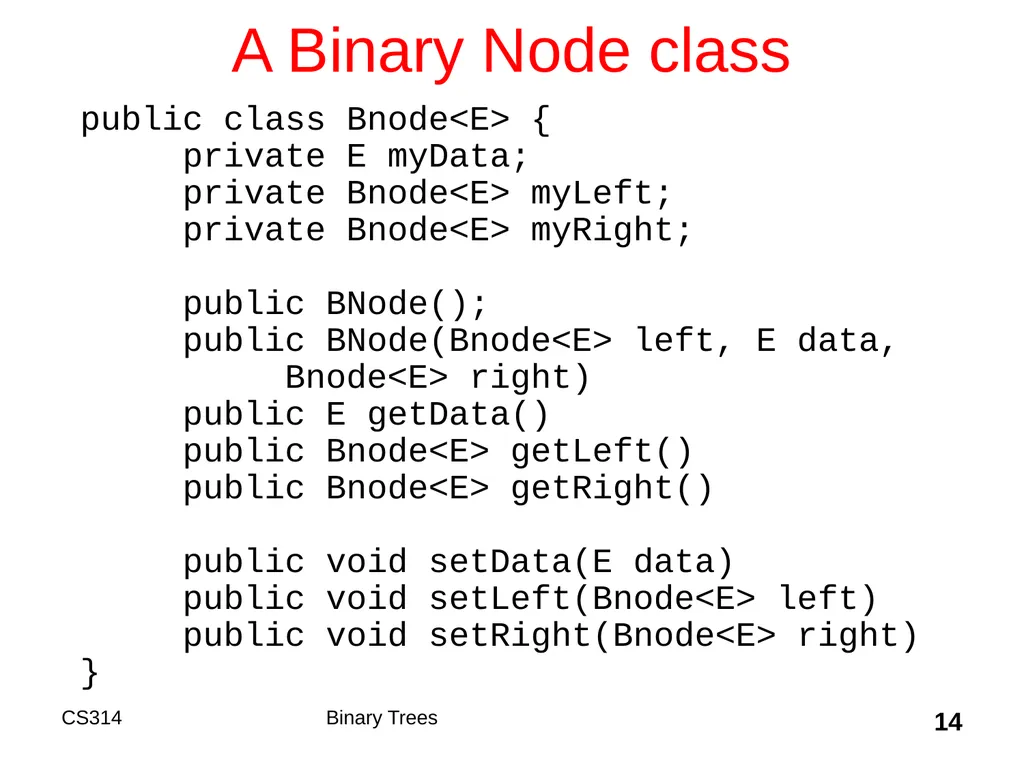
14 A Binary Node class public class Bnode<E> {
private E myData;
private Bnode<E> myLeft;
private Bnode<E> myRight;
public BNode();
public BNode(Bnode<E> left, E data, Bnode<E> right) public E getData()
public Bnode<E> getLeft()
public Bnode<E> getRight()
public void setData(E data)
public void setLeft(Bnode<E> left)
public void setRight(Bnode<E> right)
} Binary Trees CS314<br>
private E myData;
private Bnode<E> myLeft;
private Bnode<E> myRight;
public BNode();
public BNode(Bnode<E> left, E data, Bnode<E> right) public E getData()
public Bnode<E> getLeft()
public Bnode<E> getRight()
public void setData(E data)
public void setLeft(Bnode<E> left)
public void setRight(Bnode<E> right)
} Binary Trees CS314<br>
15
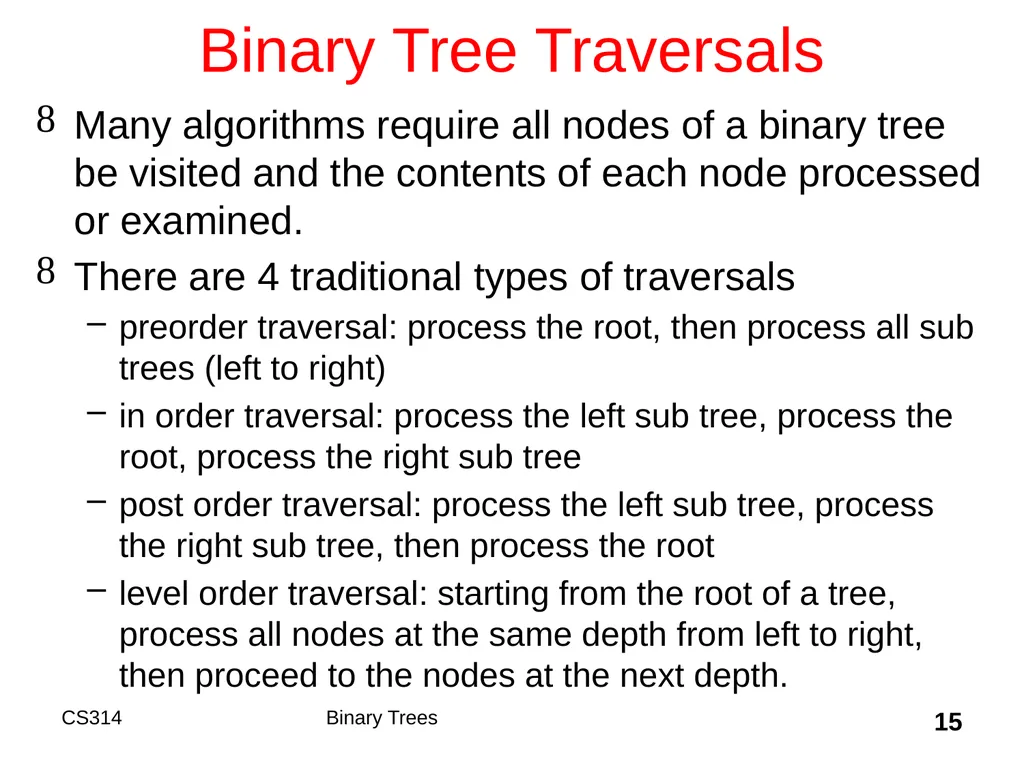
15 Binary Tree Traversals Many algorithms require all nodes of a binary tree be visited and the contents of each node processed or examined.
There are 4 traditional types of traversals
preorder traversal: process the root, then process all sub trees (left to right)
in order traversal: process the left sub tree, process the root, process the right sub tree
post order traversal: process the left sub tree, process the right sub tree, then process the root
level order traversal: starting from the root of a tree, process all nodes at the same depth from left to right, then proceed to the nodes at the next depth. Binary Trees CS314<br>
There are 4 traditional types of traversals
preorder traversal: process the root, then process all sub trees (left to right)
in order traversal: process the left sub tree, process the root, process the right sub tree
post order traversal: process the left sub tree, process the right sub tree, then process the root
level order traversal: starting from the root of a tree, process all nodes at the same depth from left to right, then proceed to the nodes at the next depth. Binary Trees CS314<br>
16
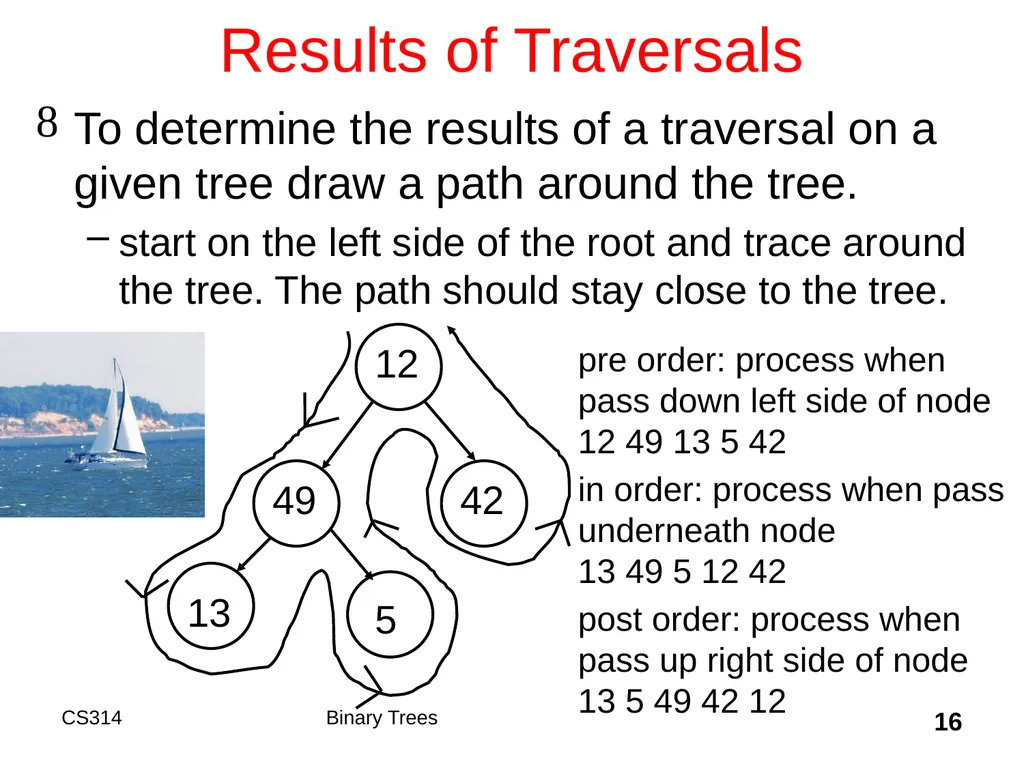
16 Results of Traversals To determine the results of a traversal on a given tree draw a path around the tree.
start on the left side of the root and trace around the tree. The path should stay close to the tree. 12 49 42 5 13 pre order: process when pass down left side of node 12 49 13 5 42
in order: process when pass underneath node 13 49 5 12 42
post order: process when pass up right side of node 13 5 49 42 12 Binary Trees CS314<br>
start on the left side of the root and trace around the tree. The path should stay close to the tree. 12 49 42 5 13 pre order: process when pass down left side of node 12 49 13 5 42
in order: process when pass underneath node 13 49 5 12 42
post order: process when pass up right side of node 13 5 49 42 12 Binary Trees CS314<br>
17
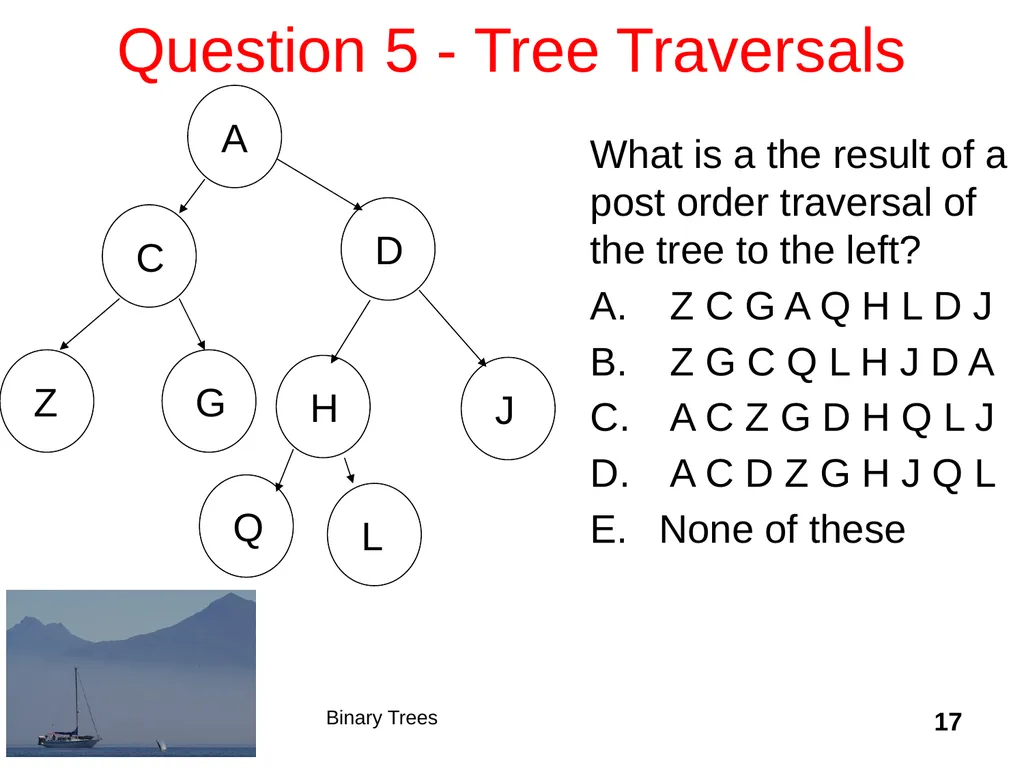
17 Question 5 - Tree Traversals Binary Trees What is a the result of a
post order traversal of
the tree to the left?
Z C G A Q H L D J
Z G C Q L H J D A
A C Z G D H Q L J
A C D Z G H J Q L
None of these<br>
Z C G A Q H L D J
Z G C Q L H J D A
A C Z G D H Q L J
A C D Z G H J Q L
None of these<br>
18
18 Implement Traversals Implement preorder, inorder, and post order traversal
Big O time and space?
Implement a level order traversal using a queue
Big O time and space?
Implement a level order traversal without a queue
target depth Binary Trees CS314<br>
Big O time and space?
Implement a level order traversal using a queue
Big O time and space?
Implement a level order traversal without a queue
target depth Binary Trees CS314<br>
19
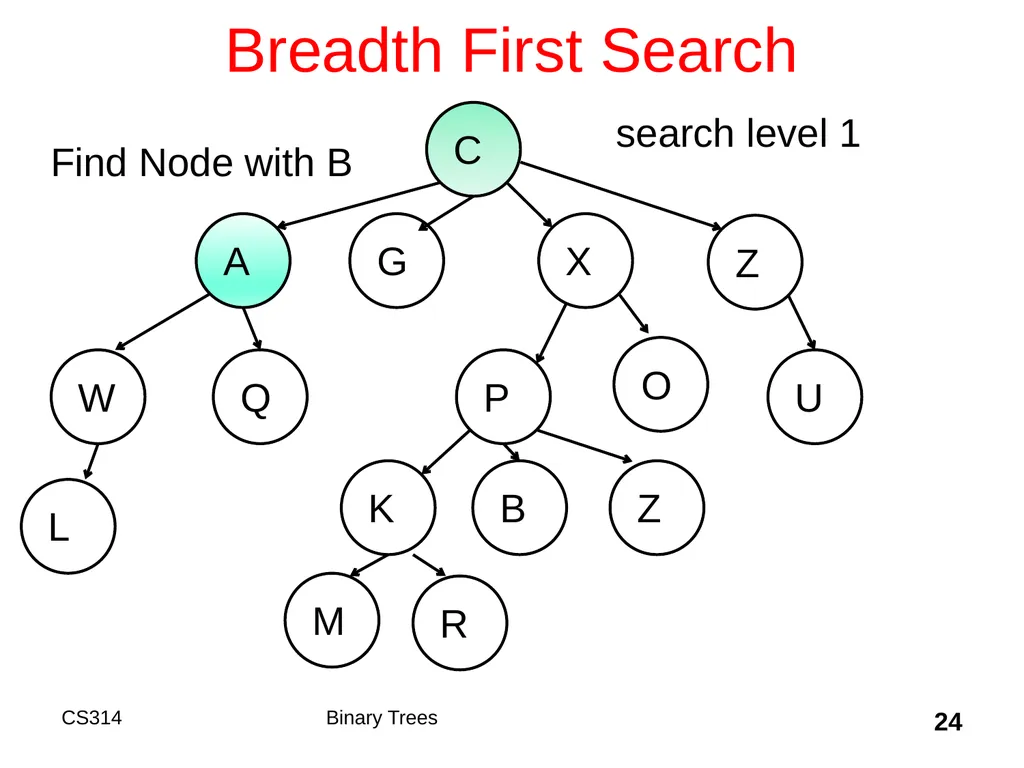
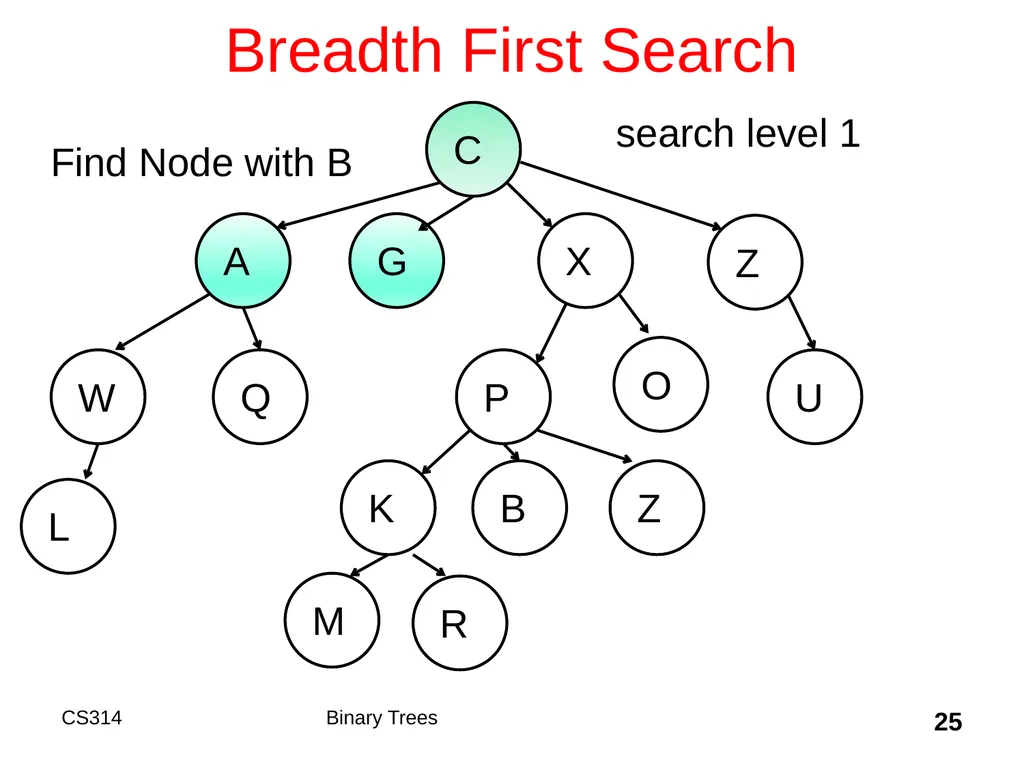
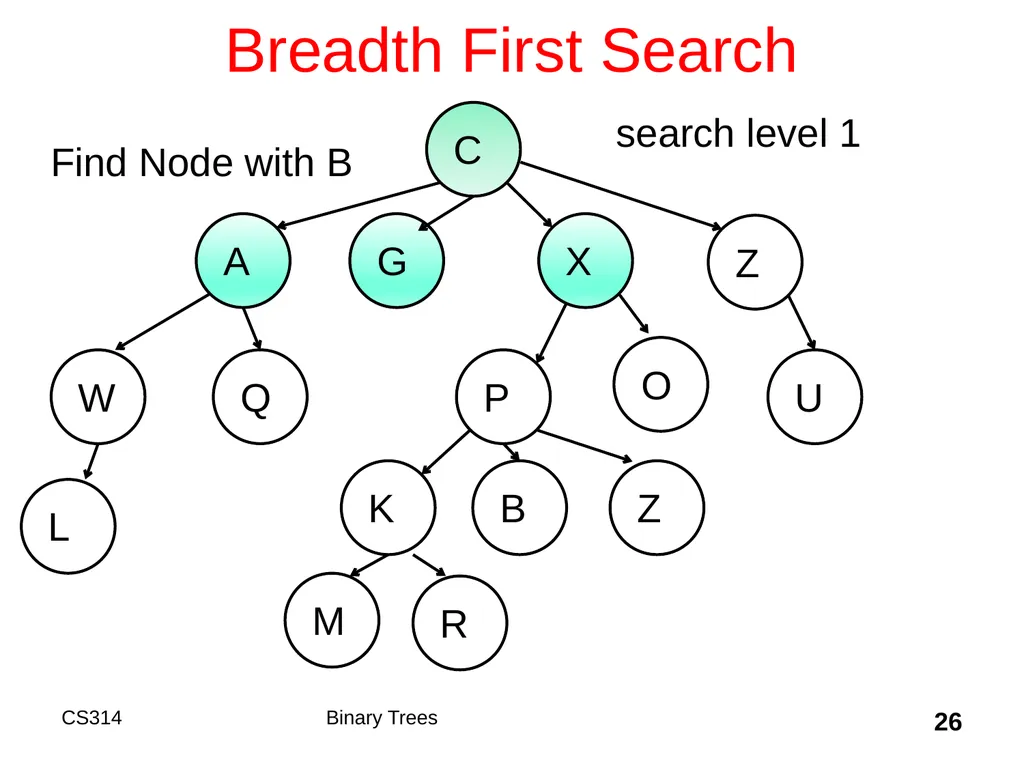
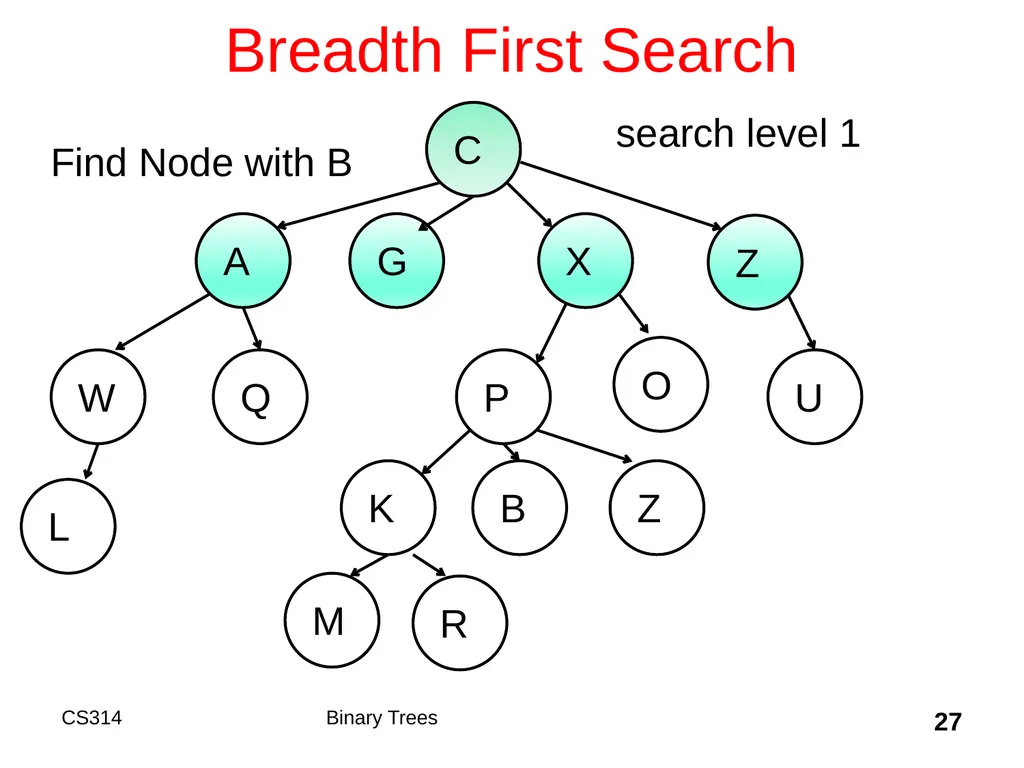
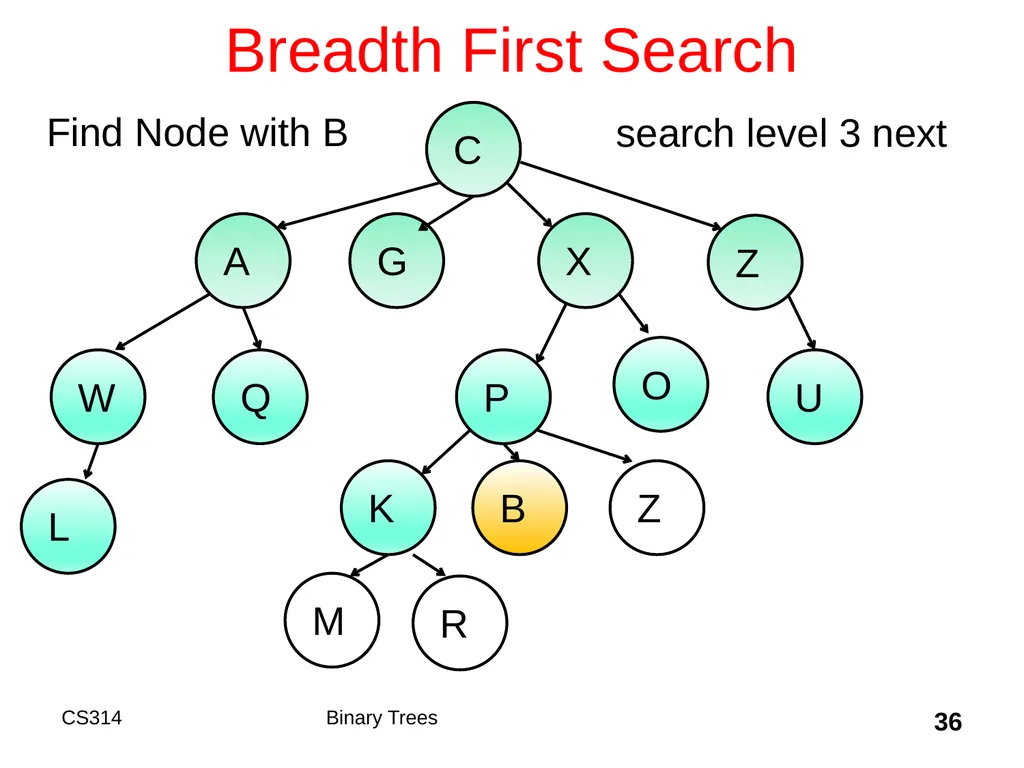
Breadth First Search
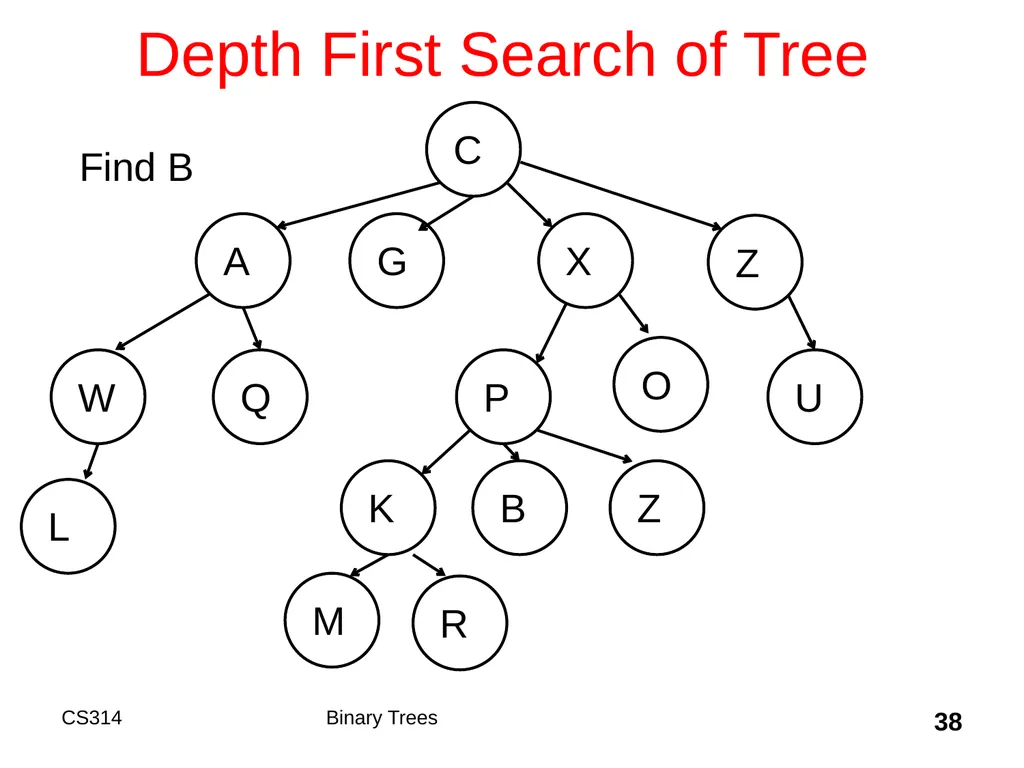
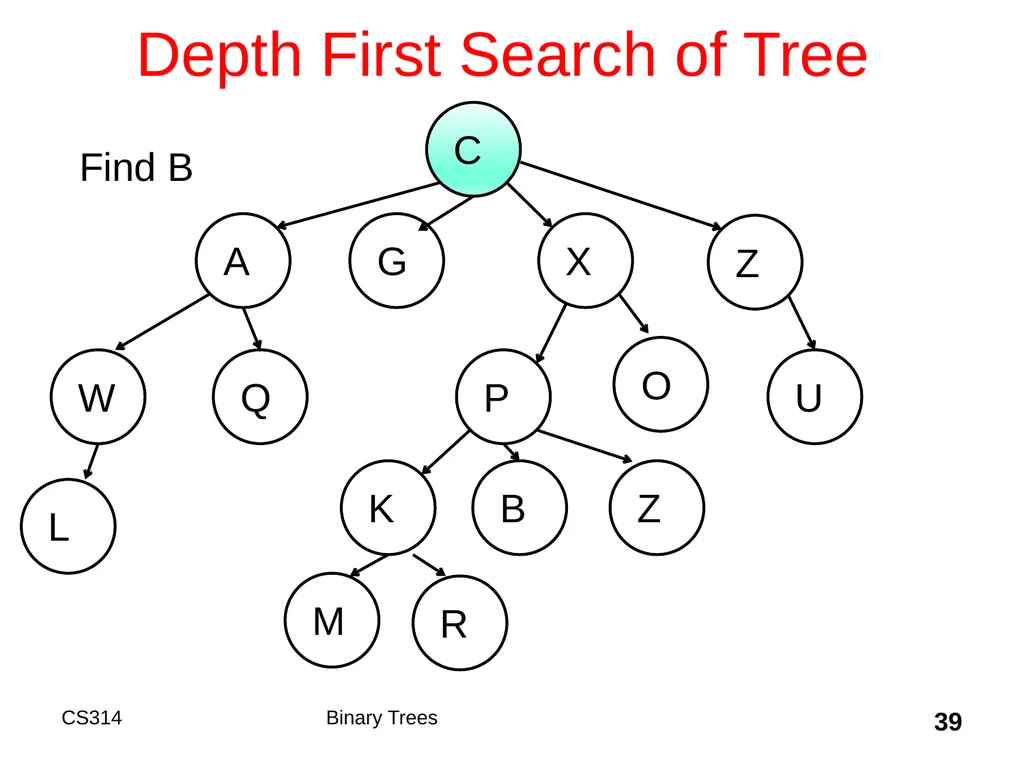
Depth First Search from NIST - DADS
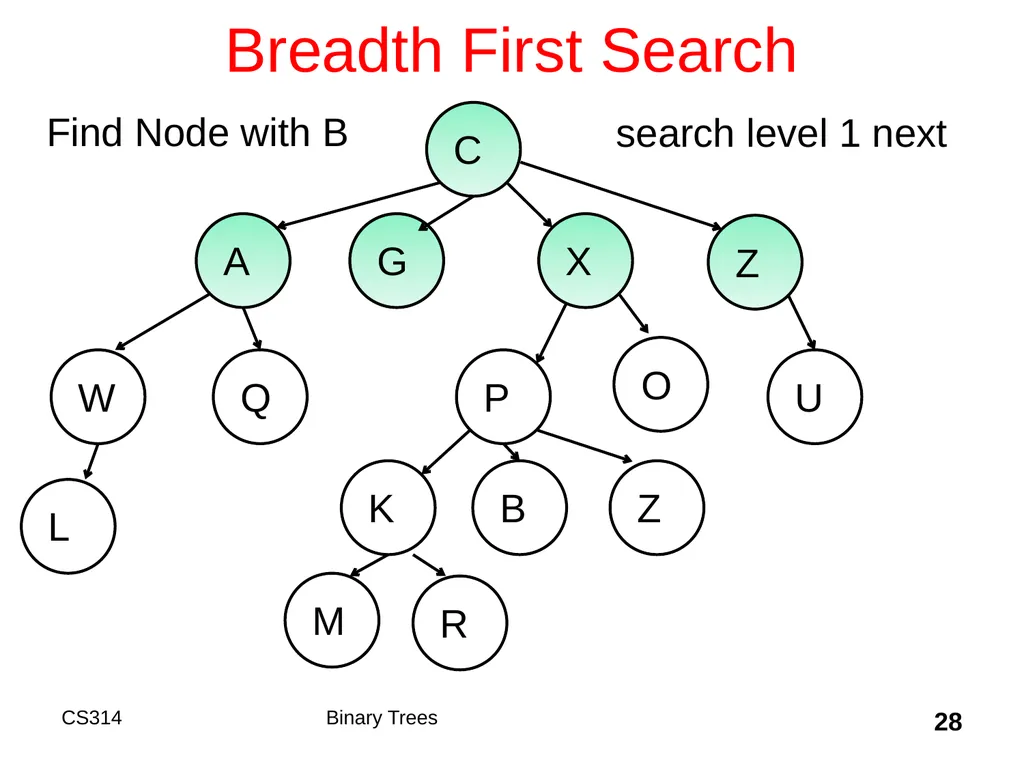
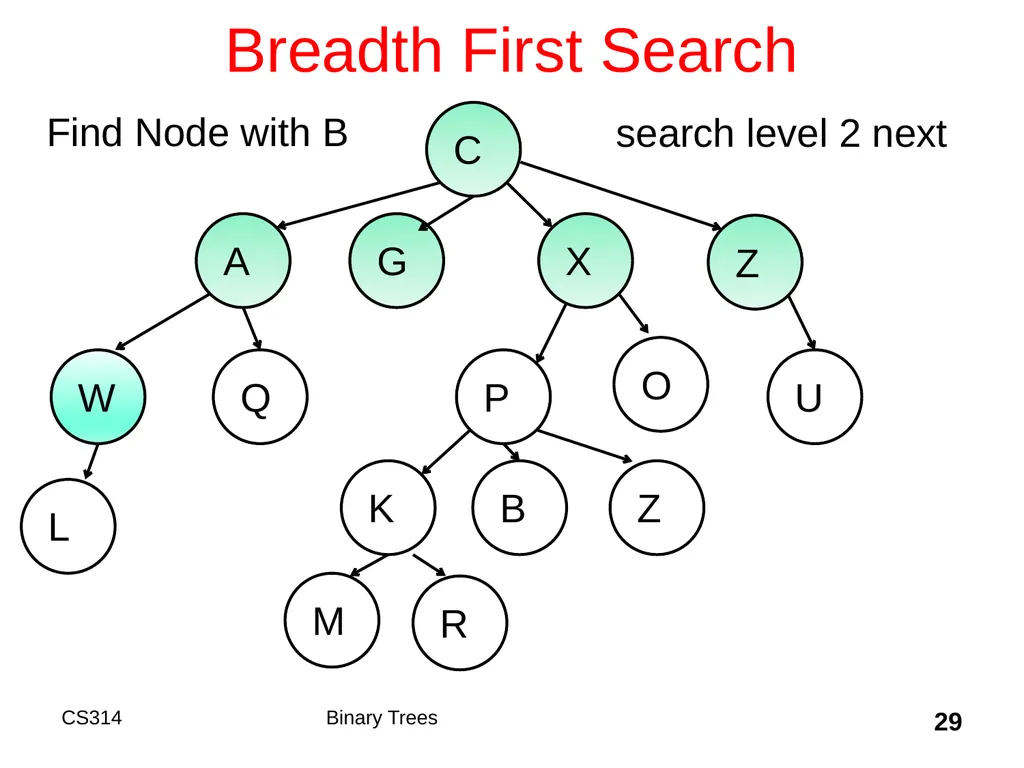
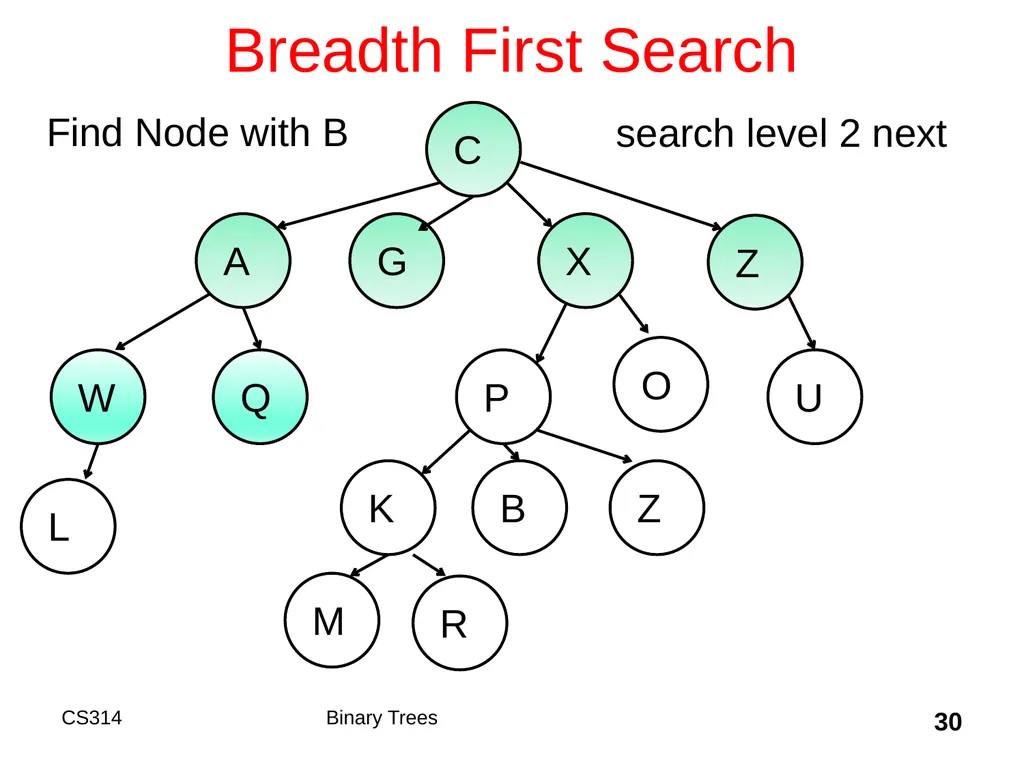
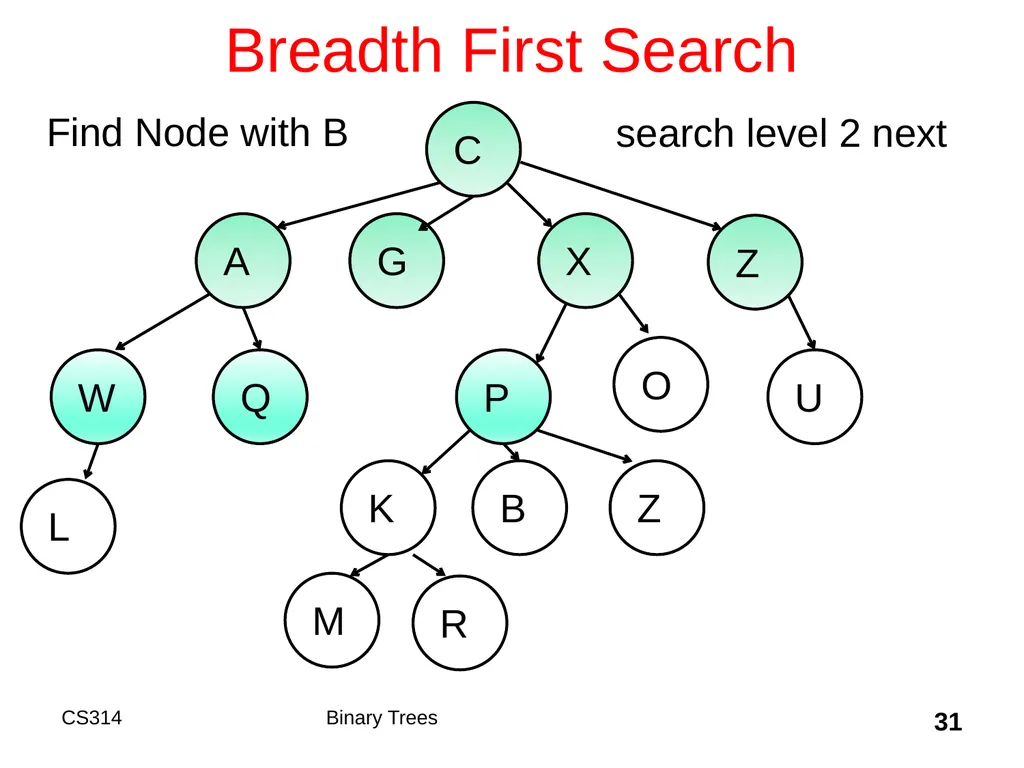
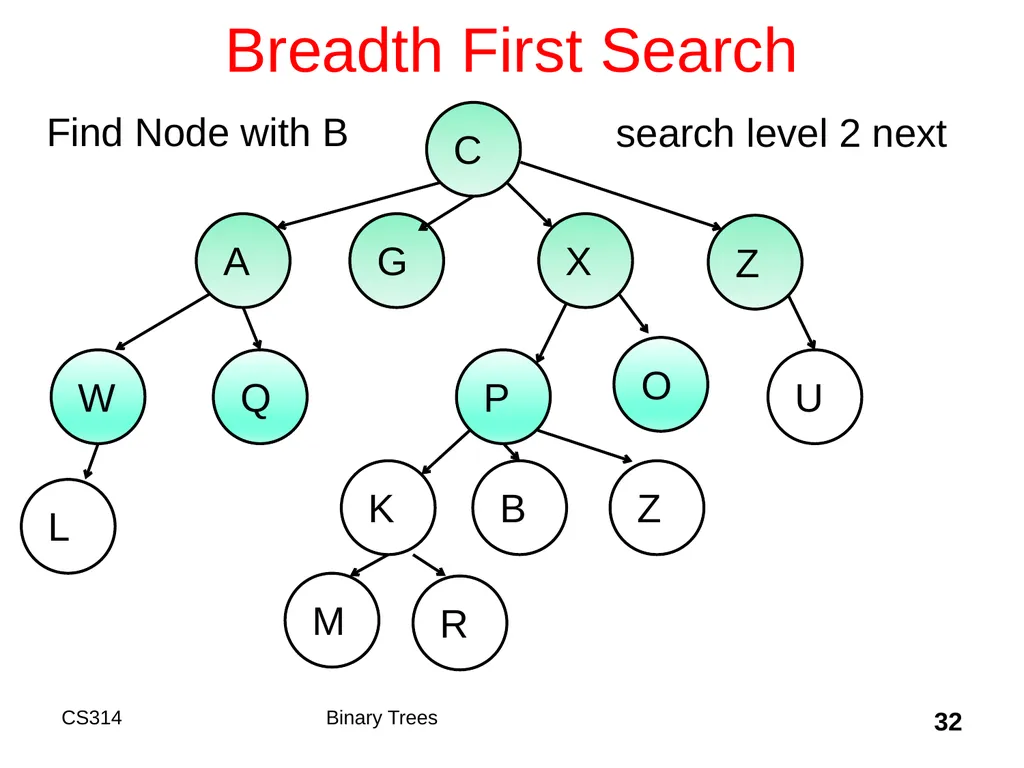
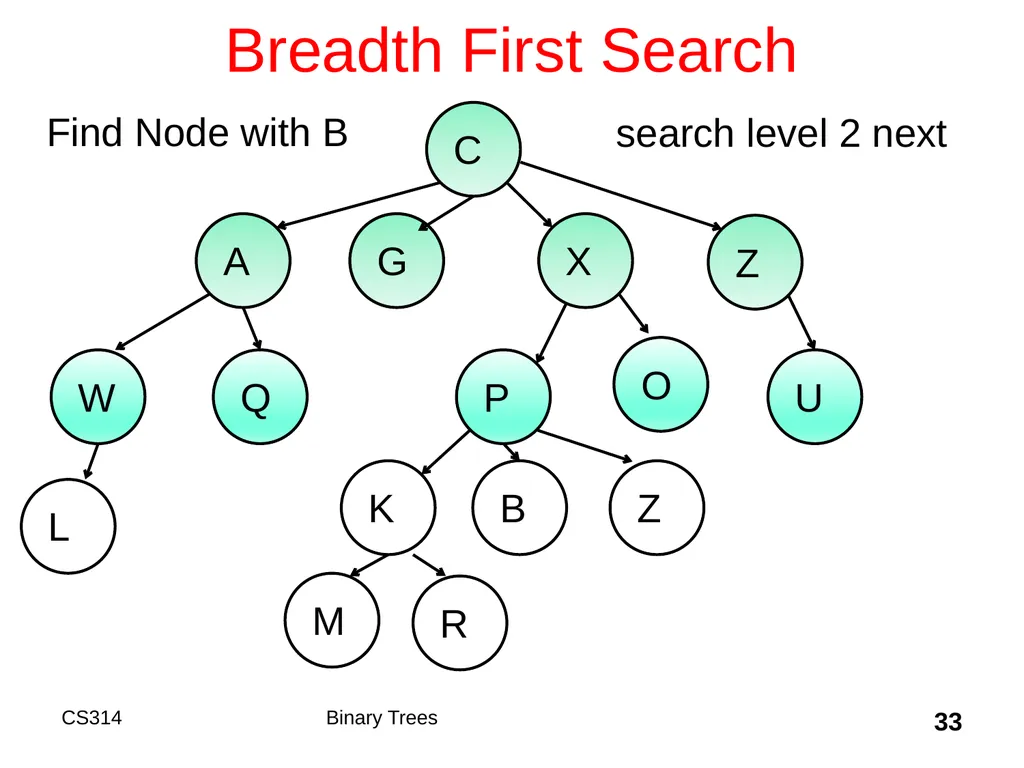
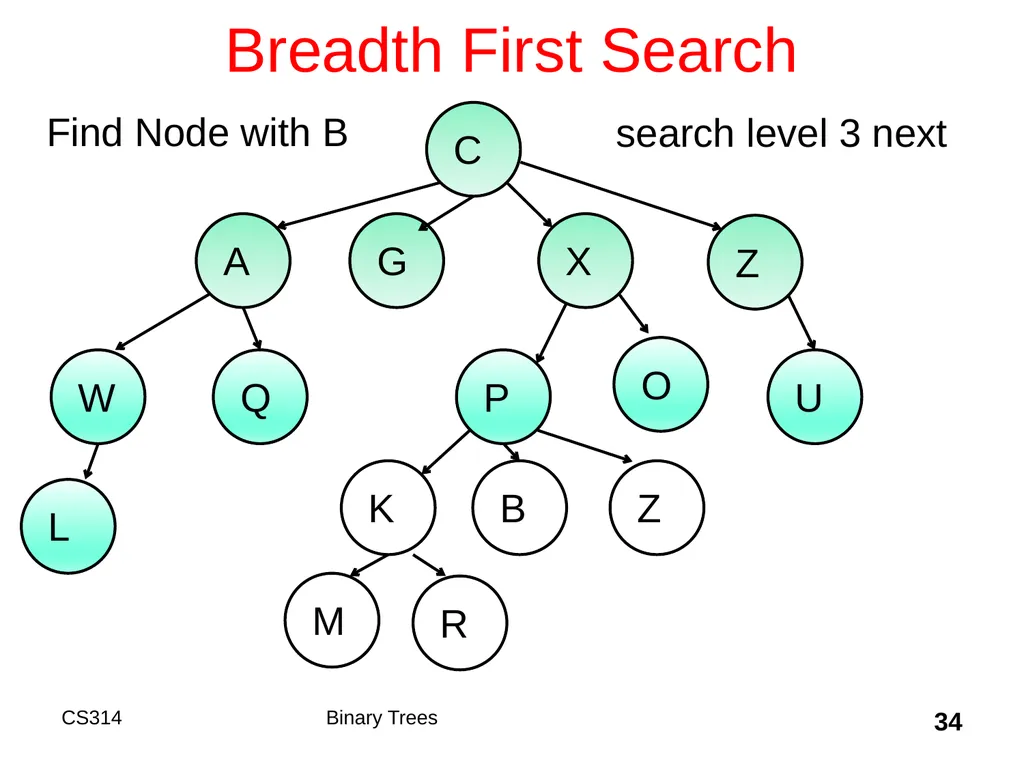
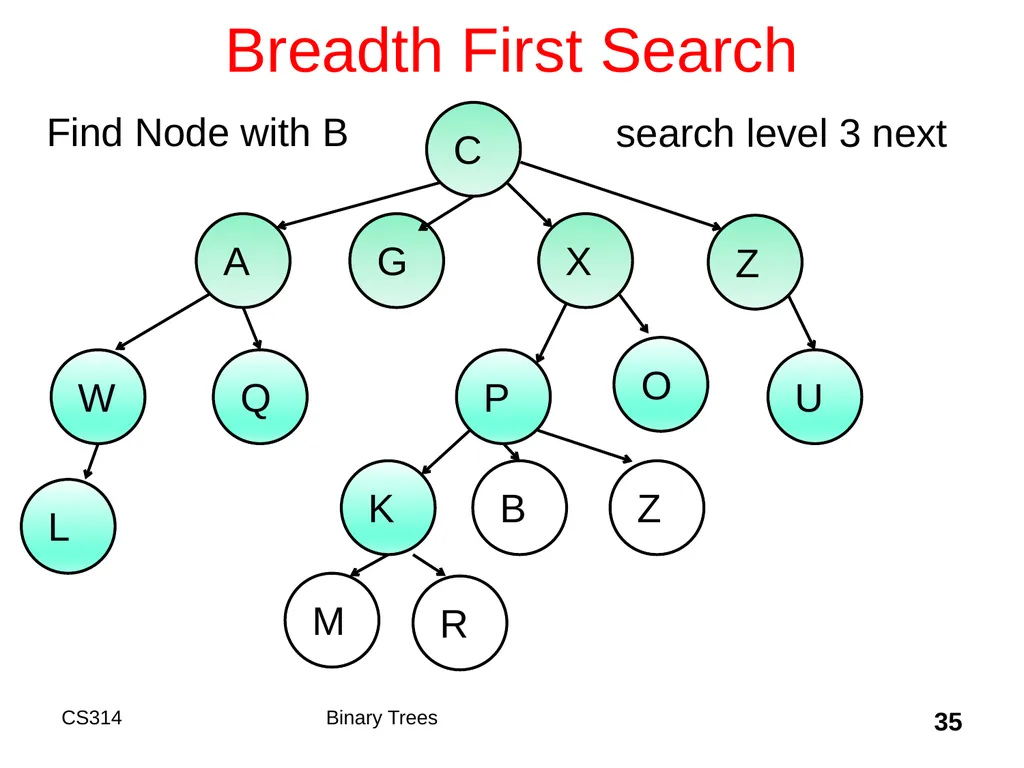
breadth first search: Any search algorithm that considers neighbors of a vertex (node), that is, outgoing edges (links) of the vertex's predecessor in the search, before any outgoing edges of the vertex
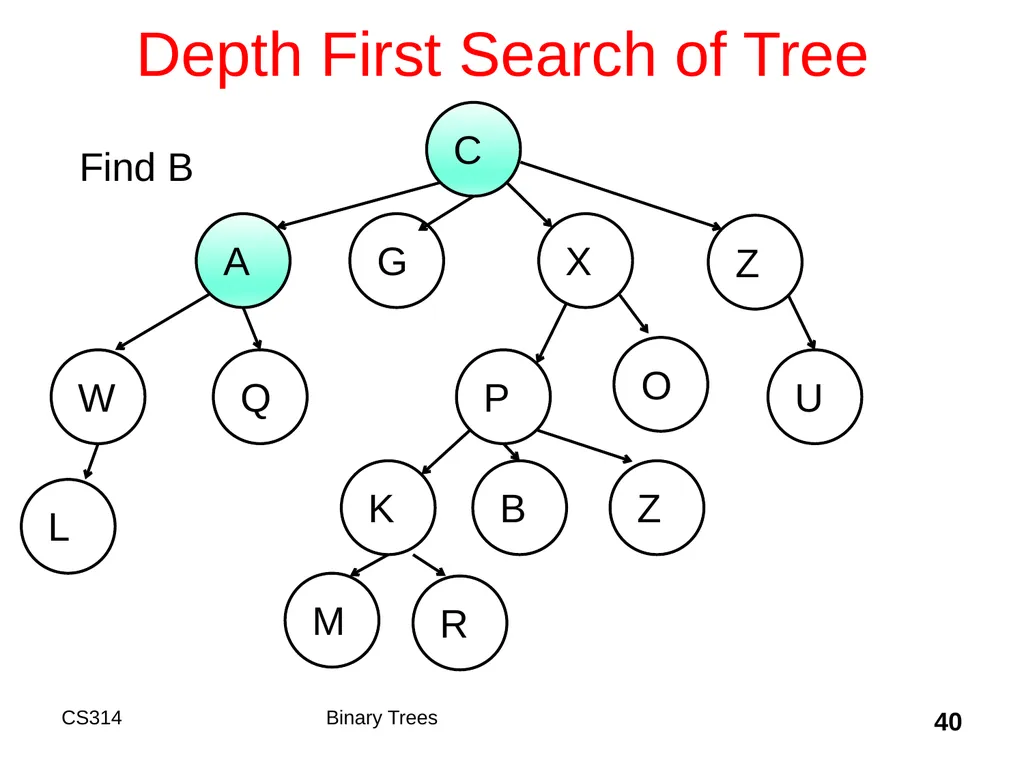
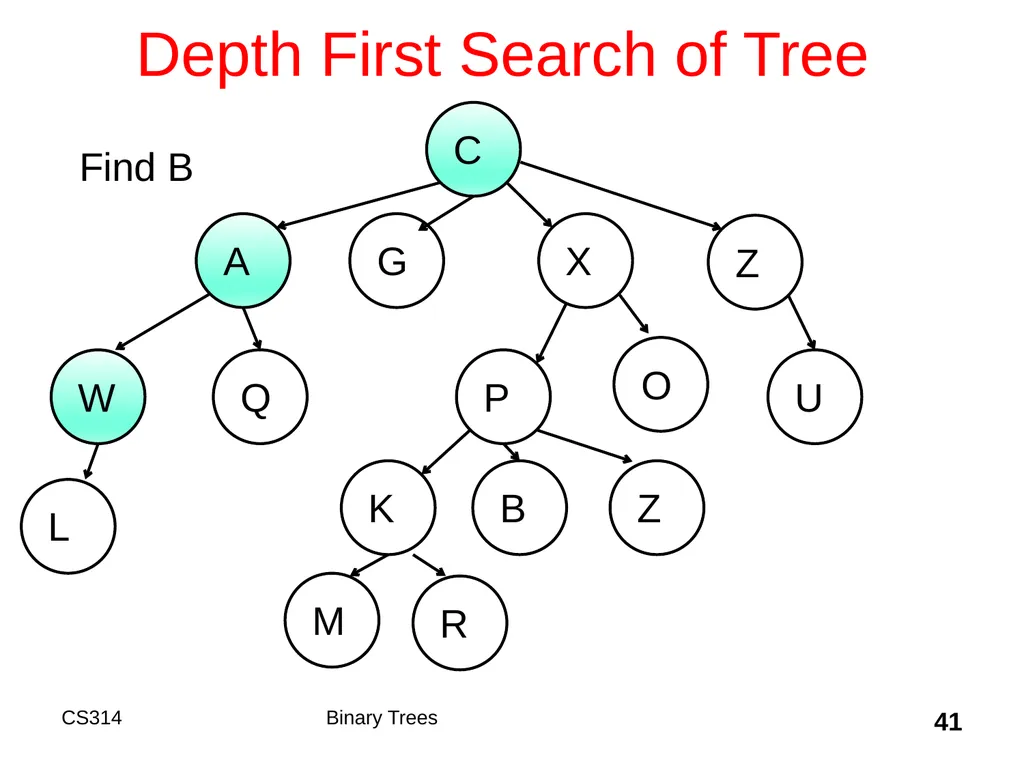
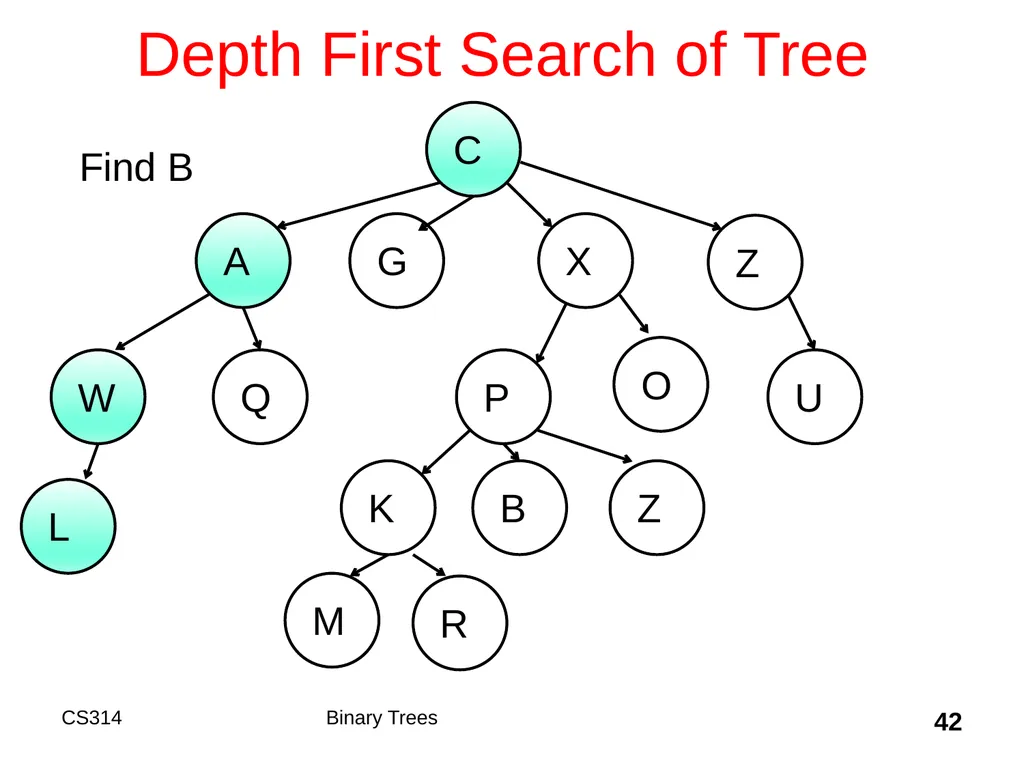
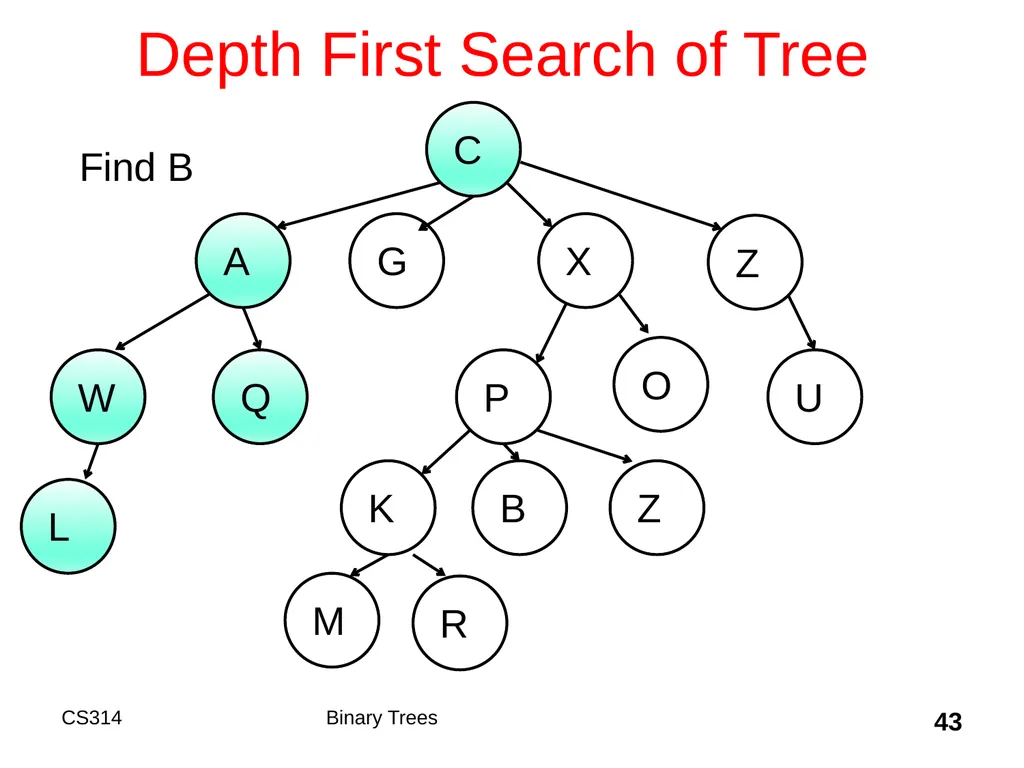
depth first search: Any search algorithm that considers outgoing edges (links of children) of a vertex (node) before any of the vertex's (node) siblings, that is, outgoing edges of the vertex's predecessor in the search. Extremes are searched first.<br>
breadth first search: Any search algorithm that considers neighbors of a vertex (node), that is, outgoing edges (links) of the vertex's predecessor in the search, before any outgoing edges of the vertex
depth first search: Any search algorithm that considers outgoing edges (links of children) of a vertex (node) before any of the vertex's (node) siblings, that is, outgoing edges of the vertex's predecessor in the search. Extremes are searched first.<br>
20
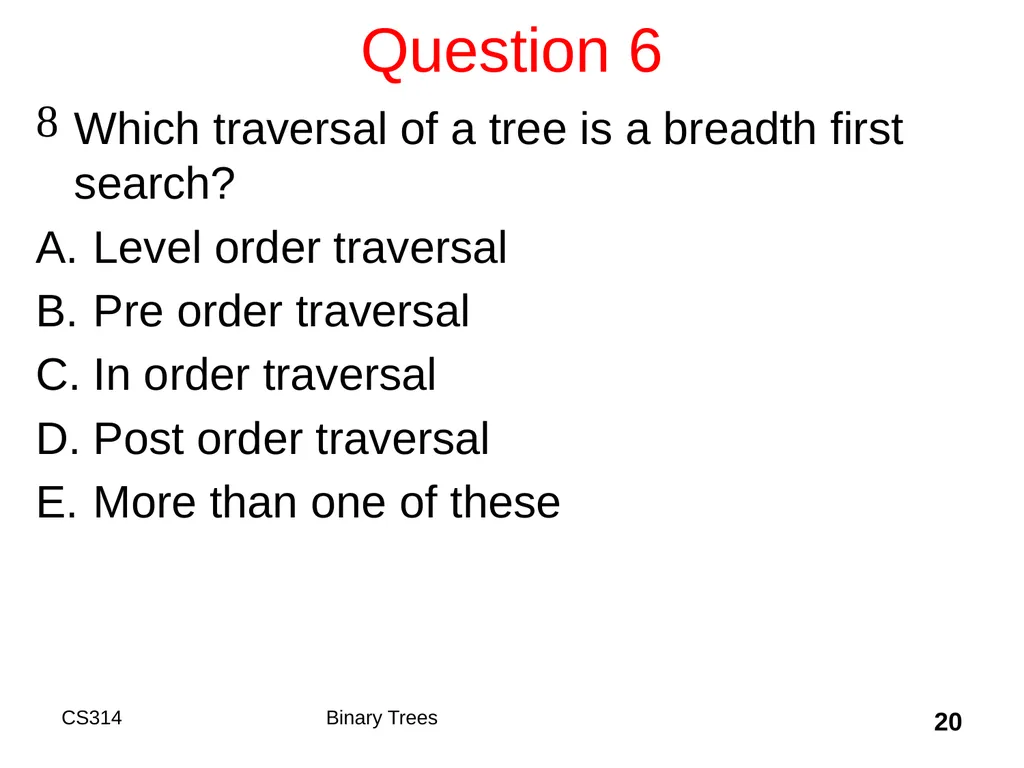
Question 6 Which traversal of a tree is a breadth first search?
Level order traversal
Pre order traversal
In order traversal
Post order traversal
More than one of these CS314 Binary Trees 20<br>
Level order traversal
Pre order traversal
In order traversal
Post order traversal
More than one of these CS314 Binary Trees 20<br>
21
Breadth First A level order traversal of a tree could be used as a breadth first search
Search all nodes in a level before going down to the next level CS314 Binary Trees 21<br>
Search all nodes in a level before going down to the next level CS314 Binary Trees 21<br>
22
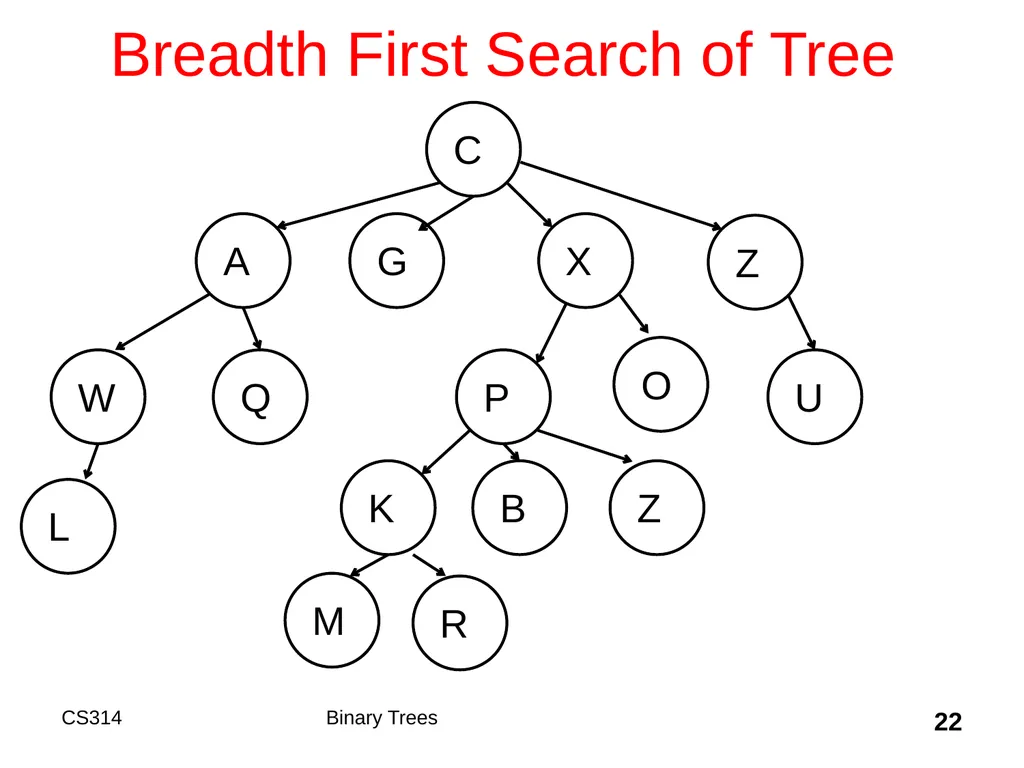
Breadth First Search of Tree CS314 Binary Trees 22 C A G X Z W B Q P O U K Z L M R<br>
23
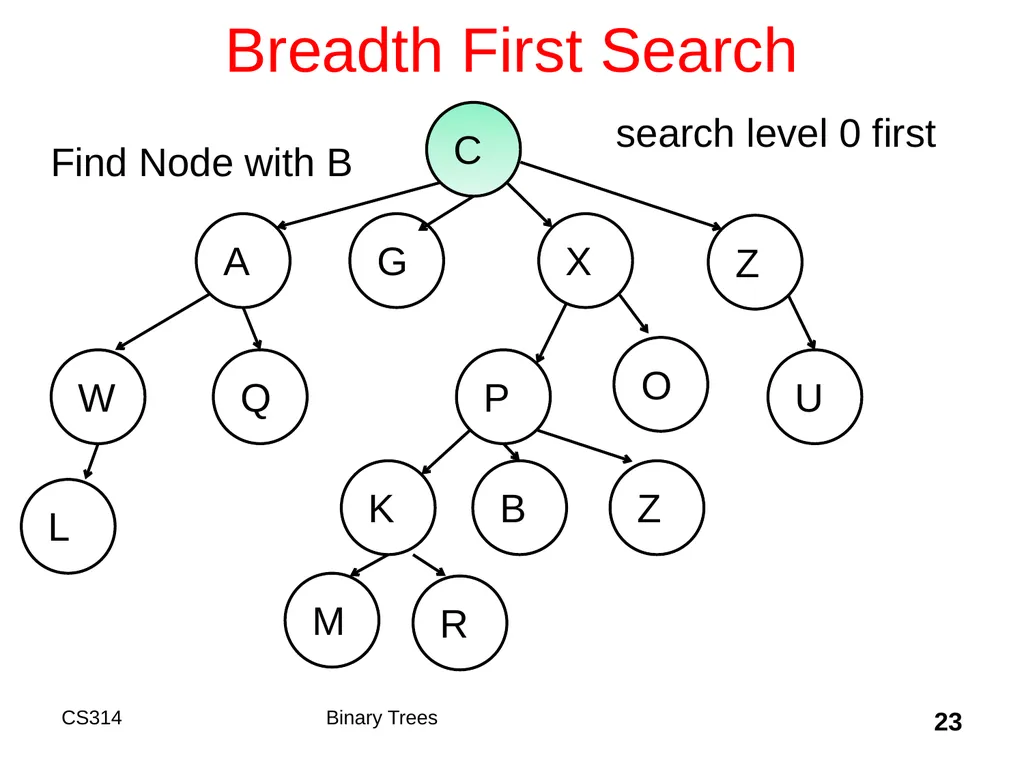
Breadth First Search CS314 Binary Trees 23 C A G X Z W B Q P O U K Z L M R search level 0 first Find Node with B<br>
24
Breadth First Search CS314 Binary Trees 24 C A G X Z W B Q P O U K Z L M R search level 1 Find Node with B<br>
25
Breadth First Search CS314 Binary Trees 25 C A G X Z W B Q P O U K Z L M R search level 1 Find Node with B<br>
26
Breadth First Search CS314 Binary Trees 26 C A G X Z W B Q P O U K Z L M R search level 1 Find Node with B<br>
27
Breadth First Search CS314 Binary Trees 27 C A G X Z W B Q P O U K Z L M R search level 1 Find Node with B<br>
28
Breadth First Search CS314 Binary Trees 28 C A G X Z W B Q P O U K Z L M R search level 1 next Find Node with B<br>
29
Breadth First Search CS314 Binary Trees 29 C A G X Z W B Q P O U K Z L M R search level 2 next Find Node with B<br>
30
Breadth First Search CS314 Binary Trees 30 C A G X Z W B Q P O U K Z L M R search level 2 next Find Node with B<br>
31
Breadth First Search CS314 Binary Trees 31 C A G X Z W B Q P O U K Z L M R search level 2 next Find Node with B<br>
32
Breadth First Search CS314 Binary Trees 32 C A G X Z W B Q P O U K Z L M R search level 2 next Find Node with B<br>
33
Breadth First Search CS314 Binary Trees 33 C A G X Z W B Q P O U K Z L M R search level 2 next Find Node with B<br>
34
Breadth First Search CS314 Binary Trees 34 C A G X Z W B Q P O U K Z L M R search level 3 next Find Node with B<br>
35
Breadth First Search CS314 Binary Trees 35 C A G X Z W B Q P O U K Z L M R search level 3 next Find Node with B<br>
36
Breadth First Search CS314 Binary Trees 36 C A G X Z W B Q P O U K Z L M R search level 3 next Find Node with B<br>
37
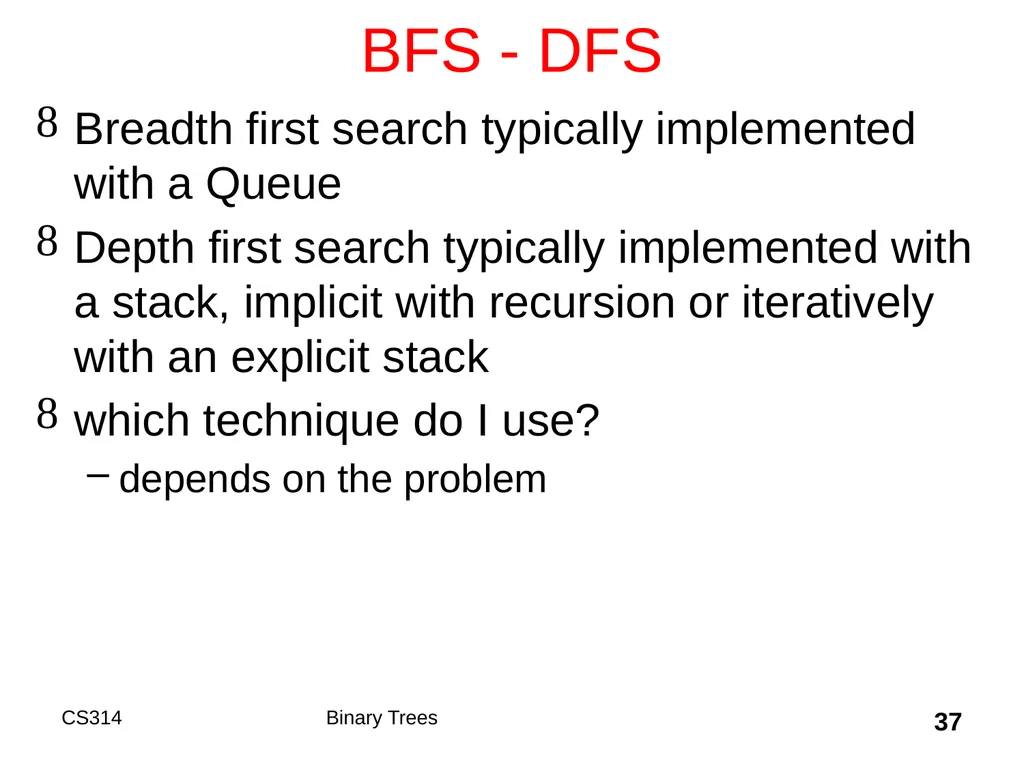
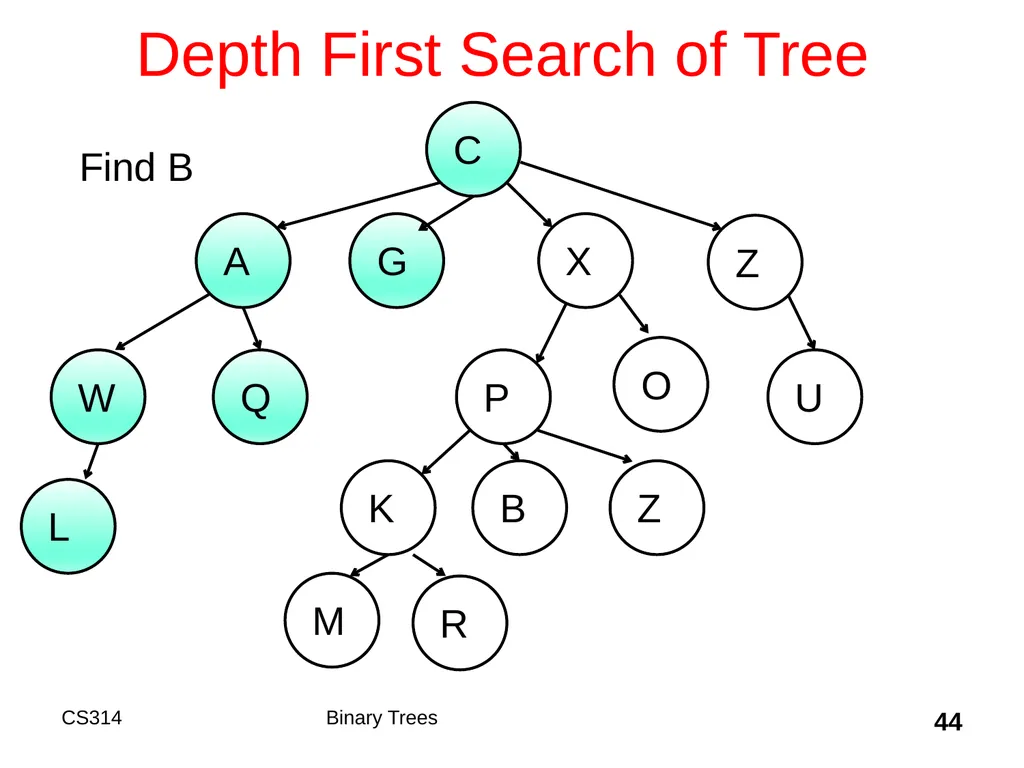
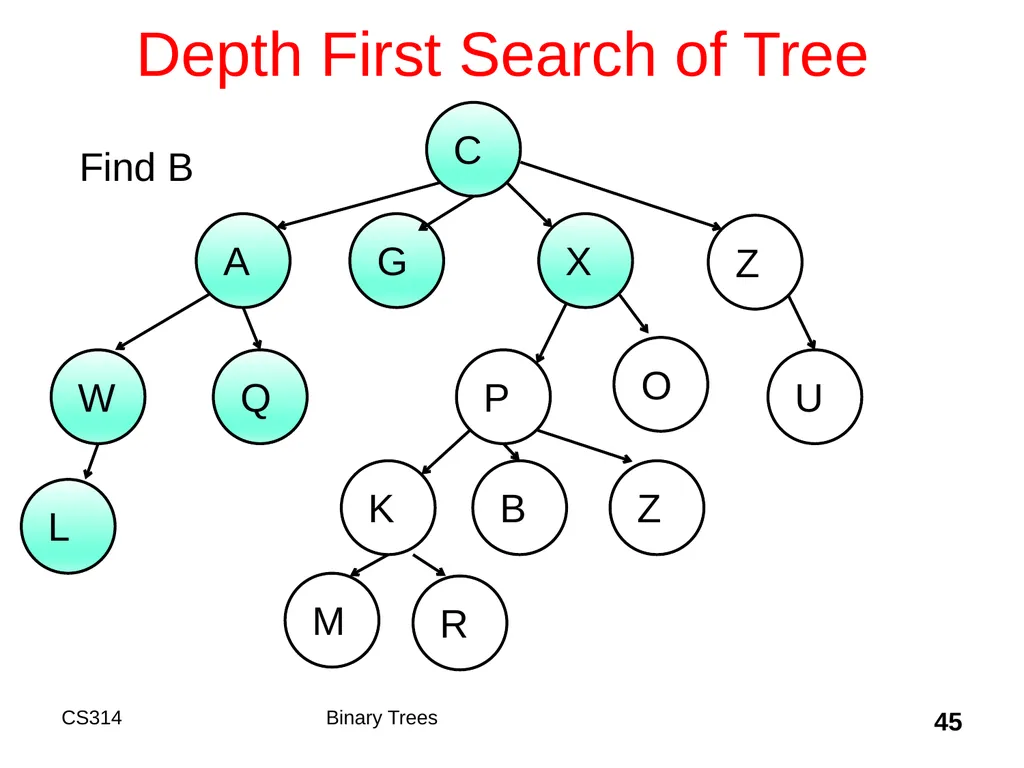
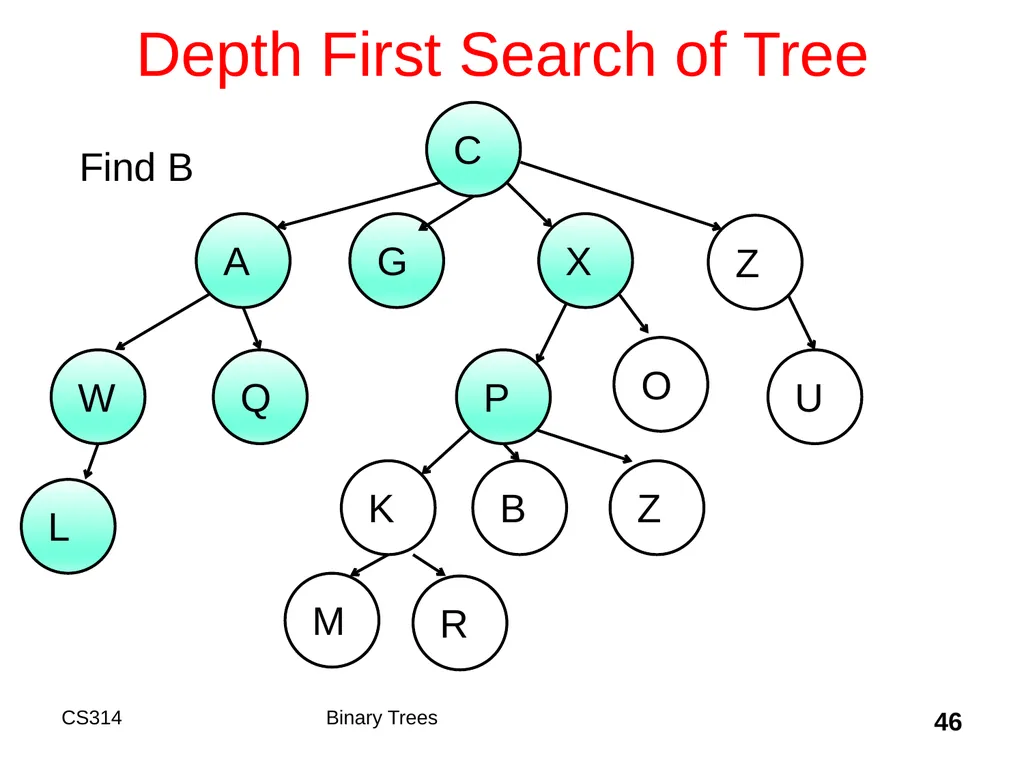
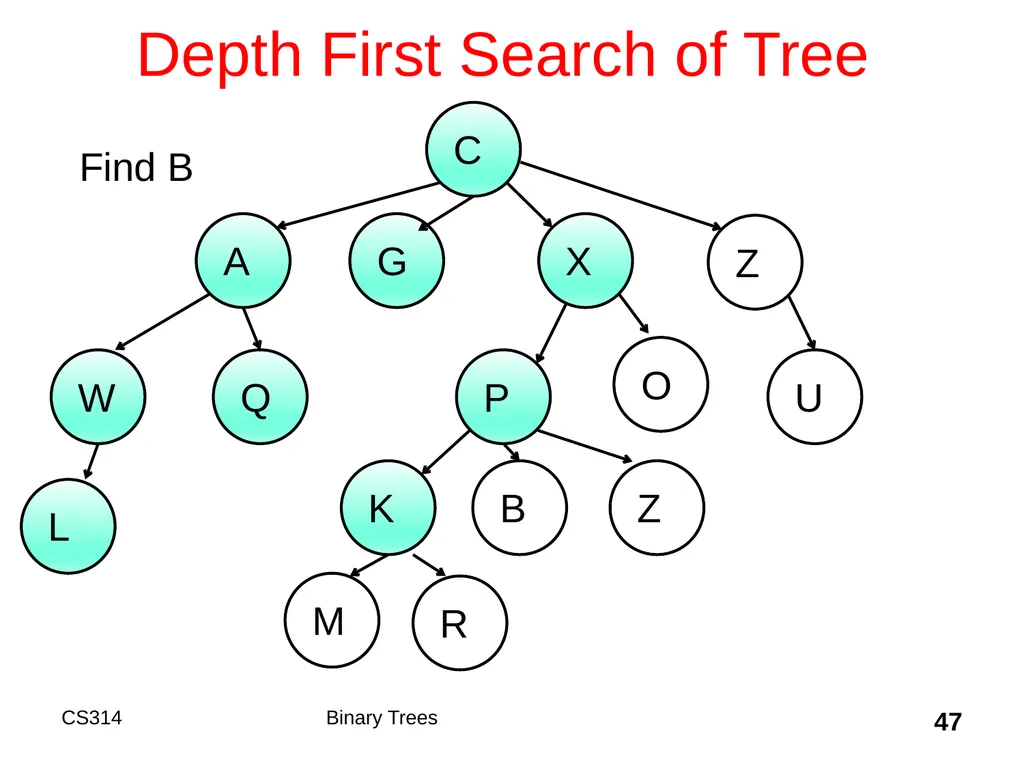
BFS - DFS Breadth first search typically implemented with a Queue
Depth first search typically implemented with a stack, implicit with recursion or iteratively with an explicit stack
which technique do I use?
depends on the problem CS314 Binary Trees 37<br>
Depth first search typically implemented with a stack, implicit with recursion or iteratively with an explicit stack
which technique do I use?
depends on the problem CS314 Binary Trees 37<br>
38
Depth First Search of Tree CS314 Binary Trees 38 C A G X Z W B Q P O U K Z L M R Find B<br>
39
Depth First Search of Tree CS314 Binary Trees 39 C A G X Z W B Q P O U K Z L M R Find B<br>
40
Depth First Search of Tree CS314 Binary Trees 40 C A G X Z W B Q P O U K Z L M R Find B<br>
41
Depth First Search of Tree CS314 Binary Trees 41 C A G X Z W B Q P O U K Z L M R Find B<br>
42
Depth First Search of Tree CS314 Binary Trees 42 C A G X Z W B Q P O U K Z L M R Find B<br>
43
Depth First Search of Tree CS314 Binary Trees 43 C A G X Z W B Q P O U K Z L M R Find B<br>
44
Depth First Search of Tree CS314 Binary Trees 44 C A G X Z W B Q P O U K Z L M R Find B<br>
45
Depth First Search of Tree CS314 Binary Trees 45 C A G X Z W B Q P O U K Z L M R Find B<br>
46
Depth First Search of Tree CS314 Binary Trees 46 C A G X Z W B Q P O U K Z L M R Find B<br>
47
Depth First Search of Tree CS314 Binary Trees 47 C A G X Z W B Q P O U K Z L M R Find B<br>
48
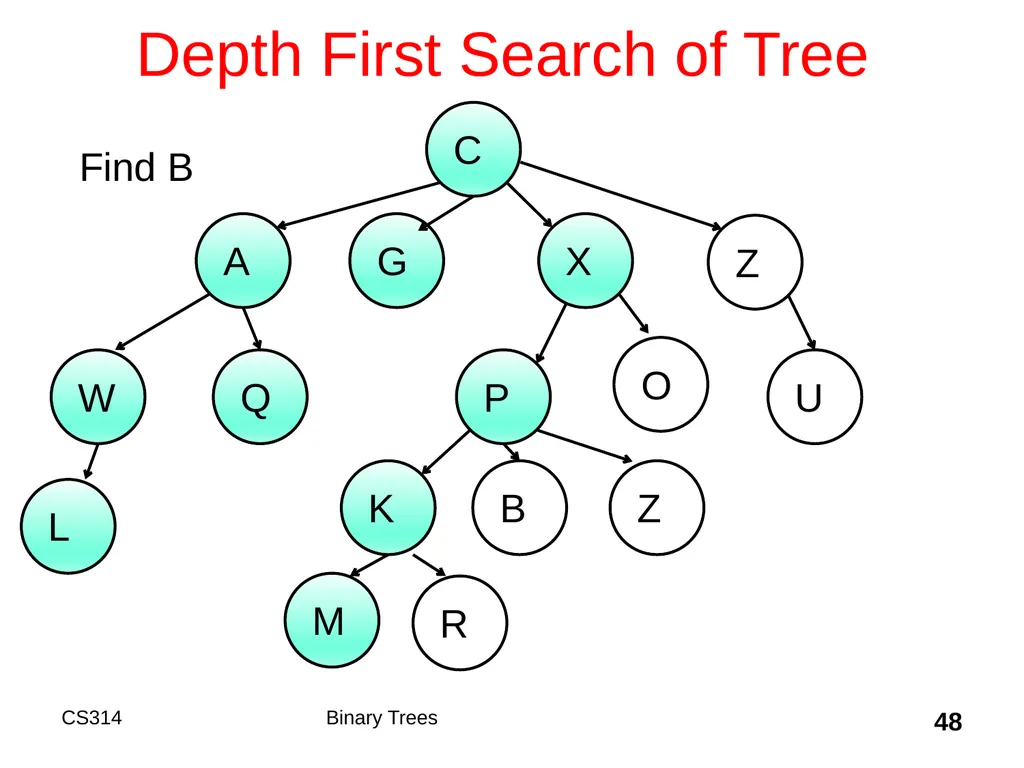
Depth First Search of Tree CS314 Binary Trees 48 C A G X Z W B Q P O U K Z L M R Find B<br>
49
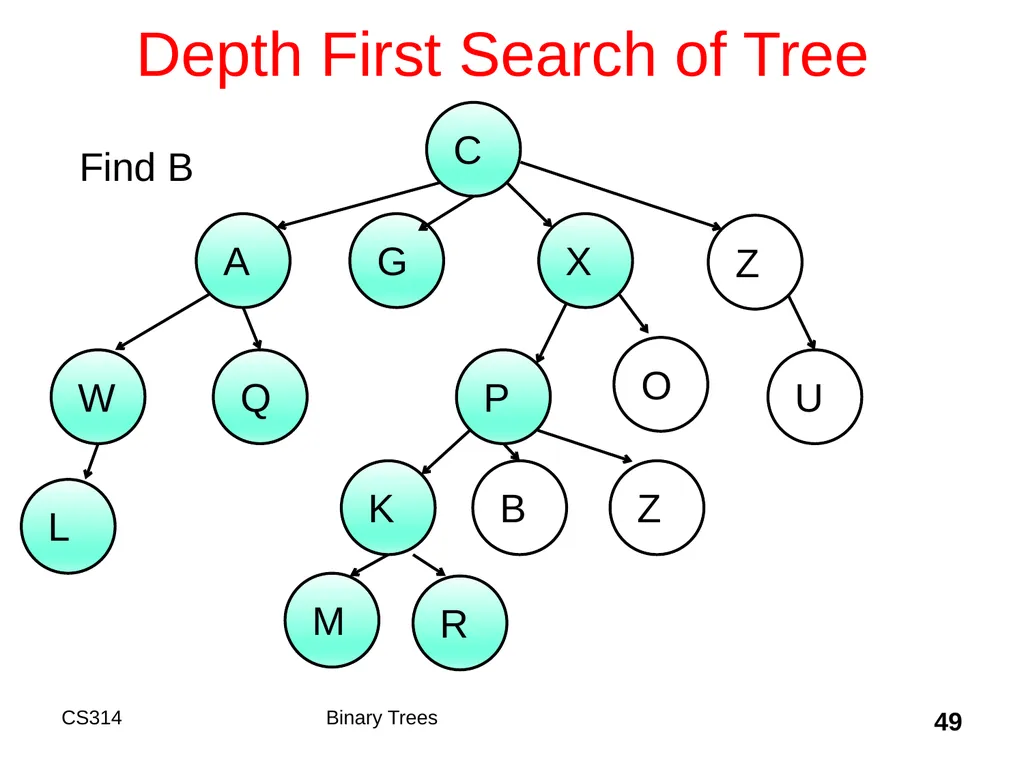
Depth First Search of Tree CS314 Binary Trees 49 C A G X Z W B Q P O U K Z L M R Find B<br>
50
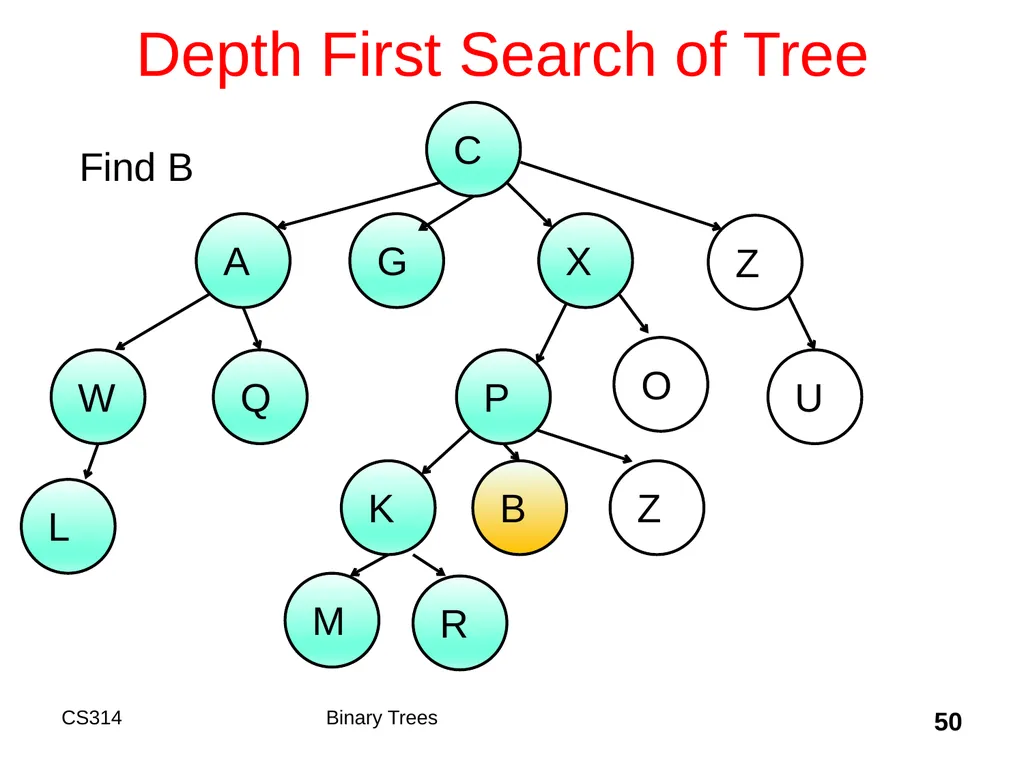
Depth First Search of Tree CS314 Binary Trees 50 C A G X Z W B Q P O U K Z L M R Find B<br>