
Topic 6: AI and Financial Statements Larry
GB
Published · 67 slides · 0 views

1 / 1









Description
Topic 6: AI and Financial Statements Larry Schrenk, Instructor FIN 450 - Finance and Artificial Intelligence Accounting Principles Types of Financial Reports The Financial Statements AI and Data Analysis Hands-On Friday: Hermes Agent 2
Related Topics
Share
Embed code
Download this presentation From Below
"Topic 6: AI and Financial Statements Larry" is the property of its rightful owner. Permission is granted to download and print the materials on this website for personal, non-commercial use only, and to display it on your personal computer provided you do not modify the materials and that you retain all copyright notices contained in the materials. By downloading content from our website, you accept the terms of this agreement.
Presentation Transcript
01
Topic 6: AI and Financial Statements
Larry Schrenk, Instructor FIN 450 - Finance and Artificial Intelligence<br>
Larry Schrenk, Instructor FIN 450 - Finance and Artificial Intelligence<br>
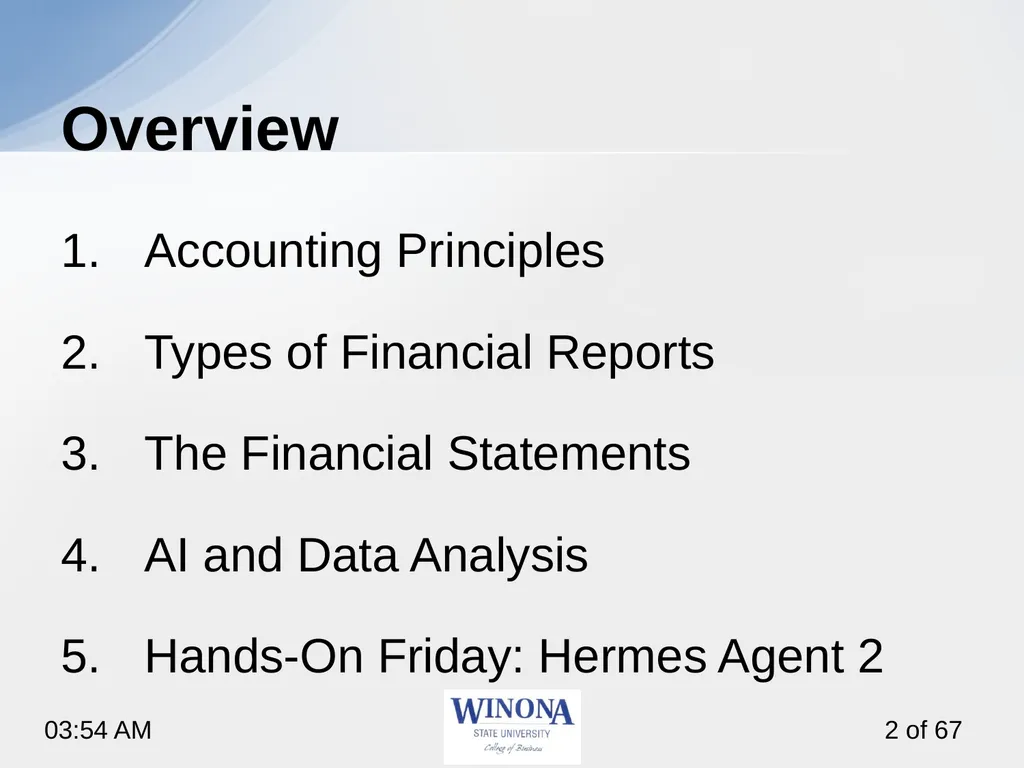
02
Accounting Principles
Types of Financial Reports
The Financial Statements
AI and Data Analysis
Hands-On Friday: Hermes Agent 2 Overview<br>
Types of Financial Reports
The Financial Statements
AI and Data Analysis
Hands-On Friday: Hermes Agent 2 Overview<br>
03
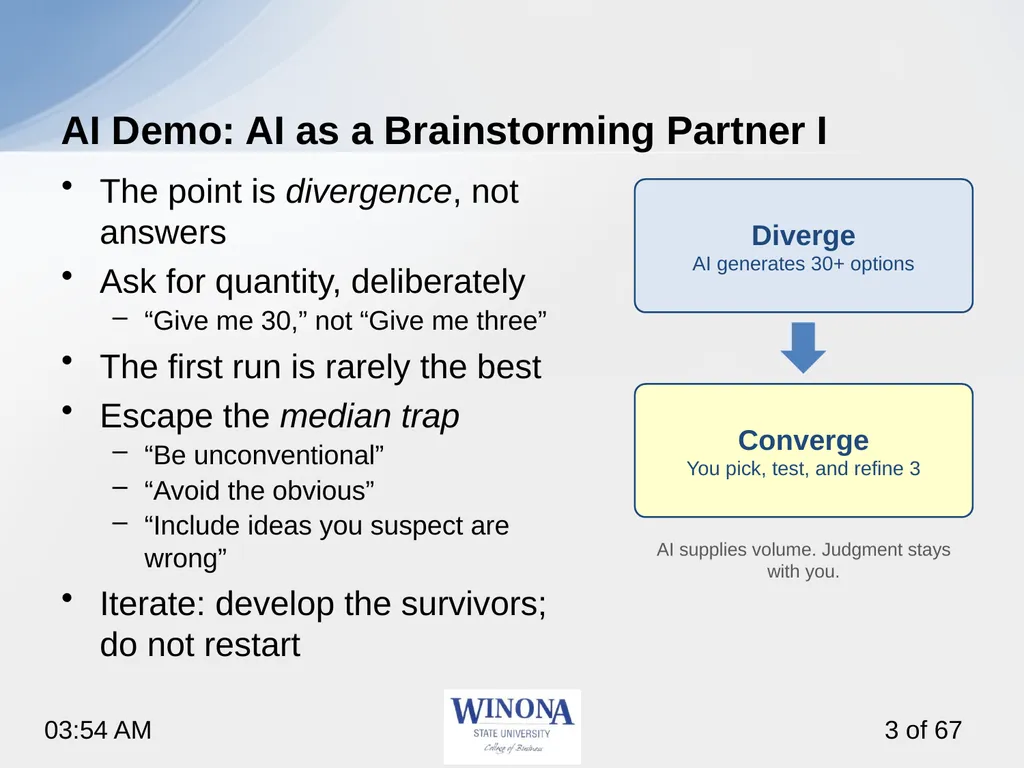
The point is divergence, not answers
Ask for quantity, deliberately
“Give me 30,” not “Give me three”
The first run is rarely the best
Escape the median trap
“Be unconventional”
“Avoid the obvious”
“Include ideas you suspect are wrong”
Iterate: develop the survivors; do not restart AI Demo: AI as a Brainstorming Partner I Diverge
AI generates 30+ options Converge
You pick, test, and refine 3 AI supplies volume. Judgment stays with you.<br>
Ask for quantity, deliberately
“Give me 30,” not “Give me three”
The first run is rarely the best
Escape the median trap
“Be unconventional”
“Avoid the obvious”
“Include ideas you suspect are wrong”
Iterate: develop the survivors; do not restart AI Demo: AI as a Brainstorming Partner I Diverge
AI generates 30+ options Converge
You pick, test, and refine 3 AI supplies volume. Judgment stays with you.<br>
04
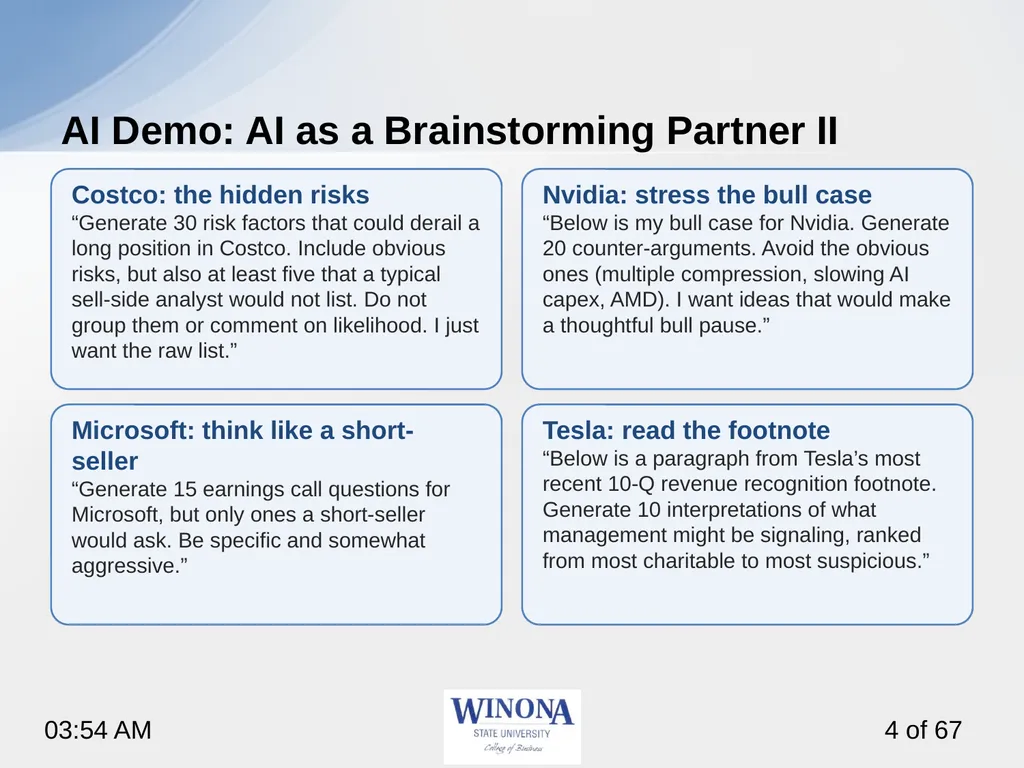
AI Demo: AI as a Brainstorming Partner II Costco: the hidden risks
“Generate 30 risk factors that could derail a long position in Costco. Include obvious risks, but also at least five that a typical sell-side analyst would not list. Do not group them or comment on likelihood. I just want the raw list.” Nvidia: stress the bull case
“Below is my bull case for Nvidia. Generate 20 counter-arguments. Avoid the obvious ones (multiple compression, slowing AI capex, AMD). I want ideas that would make a thoughtful bull pause.” Microsoft: think like a short-seller
“Generate 15 earnings call questions for Microsoft, but only ones a short-seller would ask. Be specific and somewhat aggressive.” Tesla: read the footnote
“Below is a paragraph from Tesla’s most recent 10-Q revenue recognition footnote. Generate 10 interpretations of what management might be signaling, ranked from most charitable to most suspicious.”<br>
“Generate 30 risk factors that could derail a long position in Costco. Include obvious risks, but also at least five that a typical sell-side analyst would not list. Do not group them or comment on likelihood. I just want the raw list.” Nvidia: stress the bull case
“Below is my bull case for Nvidia. Generate 20 counter-arguments. Avoid the obvious ones (multiple compression, slowing AI capex, AMD). I want ideas that would make a thoughtful bull pause.” Microsoft: think like a short-seller
“Generate 15 earnings call questions for Microsoft, but only ones a short-seller would ask. Be specific and somewhat aggressive.” Tesla: read the footnote
“Below is a paragraph from Tesla’s most recent 10-Q revenue recognition footnote. Generate 10 interpretations of what management might be signaling, ranked from most charitable to most suspicious.”<br>
05
1. Accounting Principles<br>
06
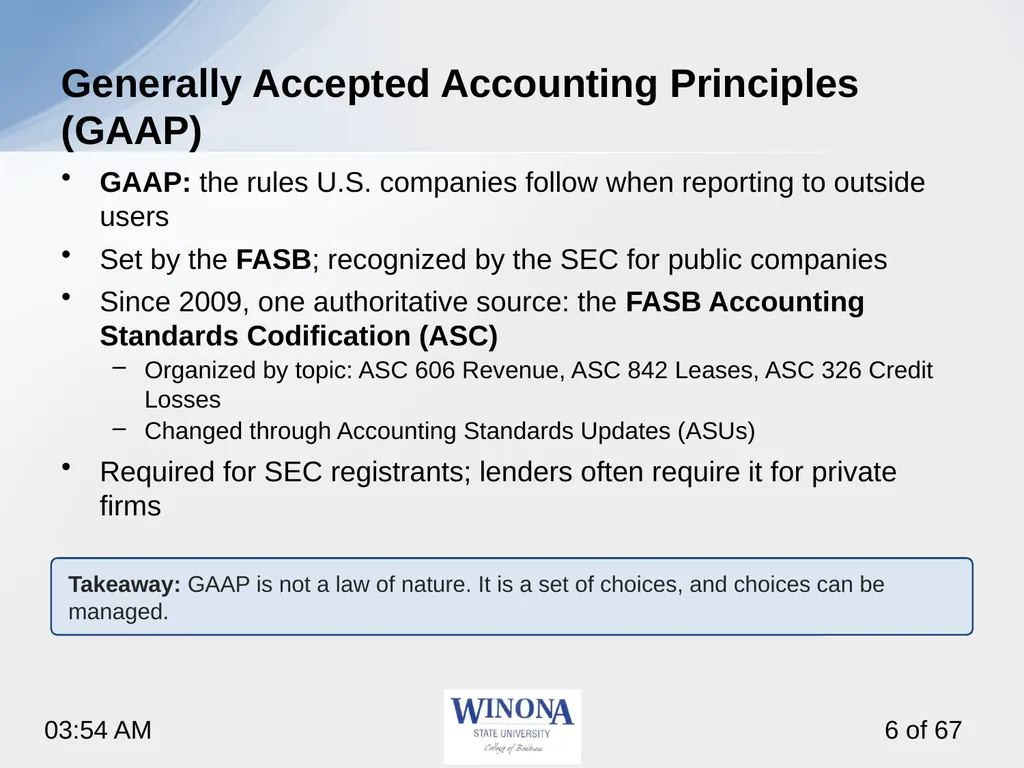
Generally Accepted Accounting Principles (GAAP) GAAP: the rules U.S. companies follow when reporting to outside users
Set by the FASB; recognized by the SEC for public companies
Since 2009, one authoritative source: the FASB Accounting Standards Codification (ASC)
Organized by topic: ASC 606 Revenue, ASC 842 Leases, ASC 326 Credit Losses
Changed through Accounting Standards Updates (ASUs)
Required for SEC registrants; lenders often require it for private firms Takeaway: GAAP is not a law of nature. It is a set of choices, and choices can be managed.<br>
Set by the FASB; recognized by the SEC for public companies
Since 2009, one authoritative source: the FASB Accounting Standards Codification (ASC)
Organized by topic: ASC 606 Revenue, ASC 842 Leases, ASC 326 Credit Losses
Changed through Accounting Standards Updates (ASUs)
Required for SEC registrants; lenders often require it for private firms Takeaway: GAAP is not a law of nature. It is a set of choices, and choices can be managed.<br>
07
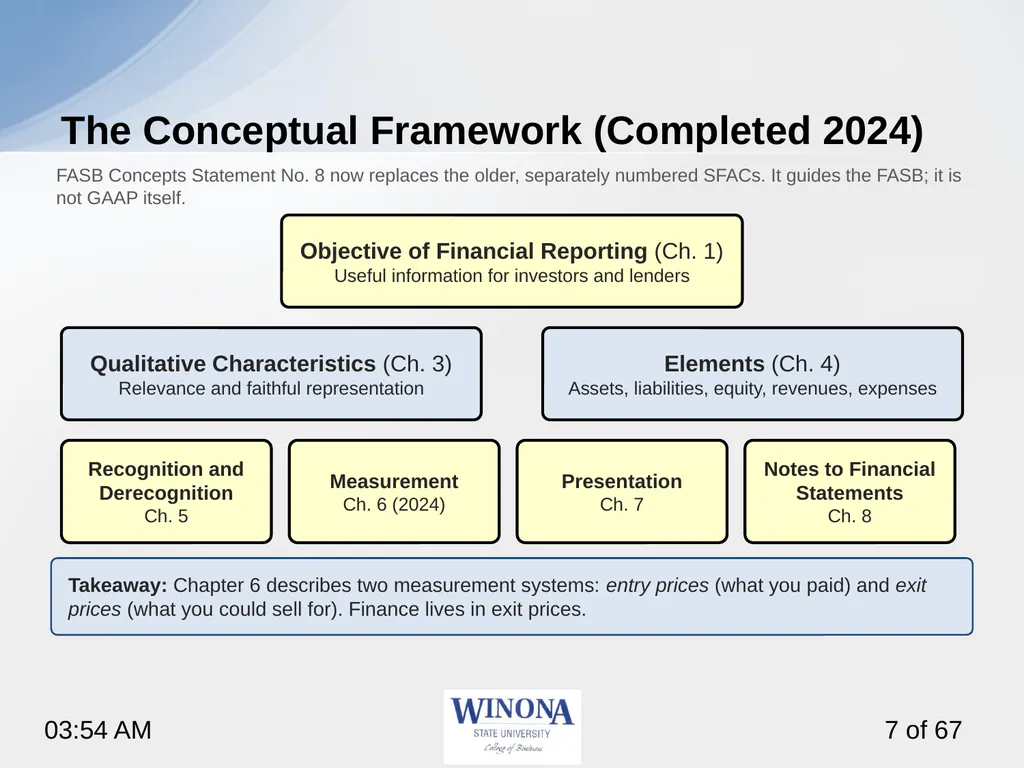
The Conceptual Framework (Completed 2024) FASB Concepts Statement No. 8 now replaces the older, separately numbered SFACs. It guides the FASB; it is not GAAP itself. Objective of Financial Reporting (Ch. 1)
Useful information for investors and lenders Qualitative Characteristics (Ch. 3)
Relevance and faithful representation Elements (Ch. 4)
Assets, liabilities, equity, revenues, expenses Recognition and Derecognition
Ch. 5 Measurement
Ch. 6 (2024) Presentation
Ch. 7 Notes to Financial Statements
Ch. 8 Takeaway: Chapter 6 describes two measurement systems: entry prices (what you paid) and exit prices (what you could sell for). Finance lives in exit prices.<br>
Useful information for investors and lenders Qualitative Characteristics (Ch. 3)
Relevance and faithful representation Elements (Ch. 4)
Assets, liabilities, equity, revenues, expenses Recognition and Derecognition
Ch. 5 Measurement
Ch. 6 (2024) Presentation
Ch. 7 Notes to Financial Statements
Ch. 8 Takeaway: Chapter 6 describes two measurement systems: entry prices (what you paid) and exit prices (what you could sell for). Finance lives in exit prices.<br>
08
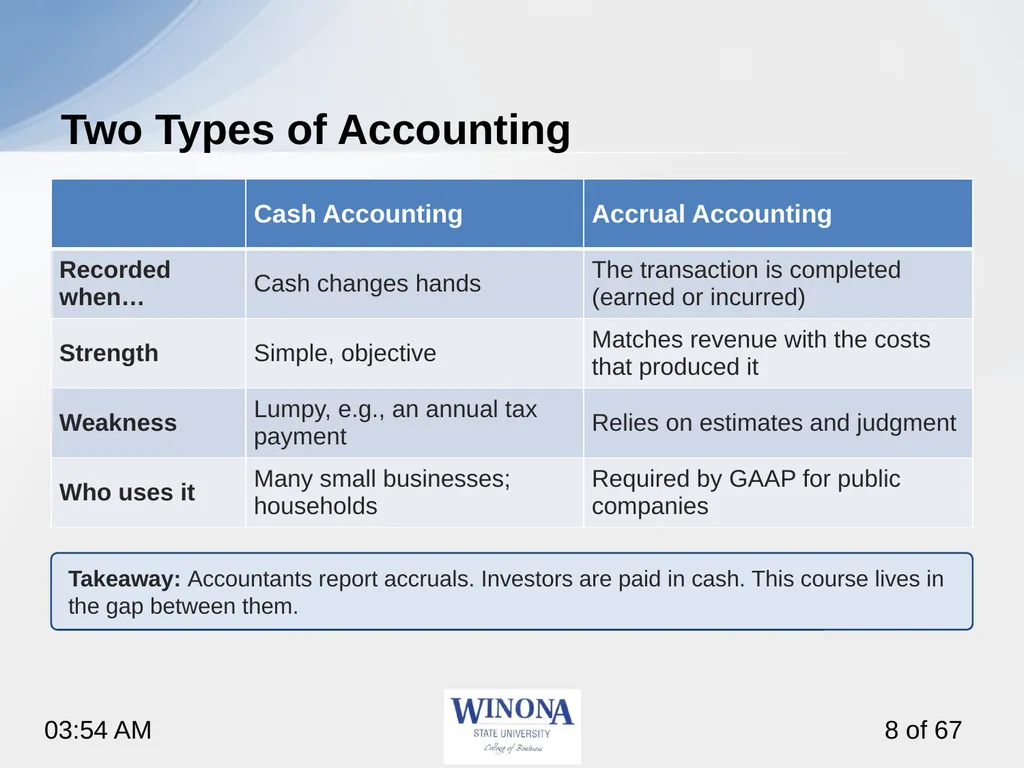
Two Types of Accounting Takeaway: Accountants report accruals. Investors are paid in cash. This course lives in the gap between them.<br>
09
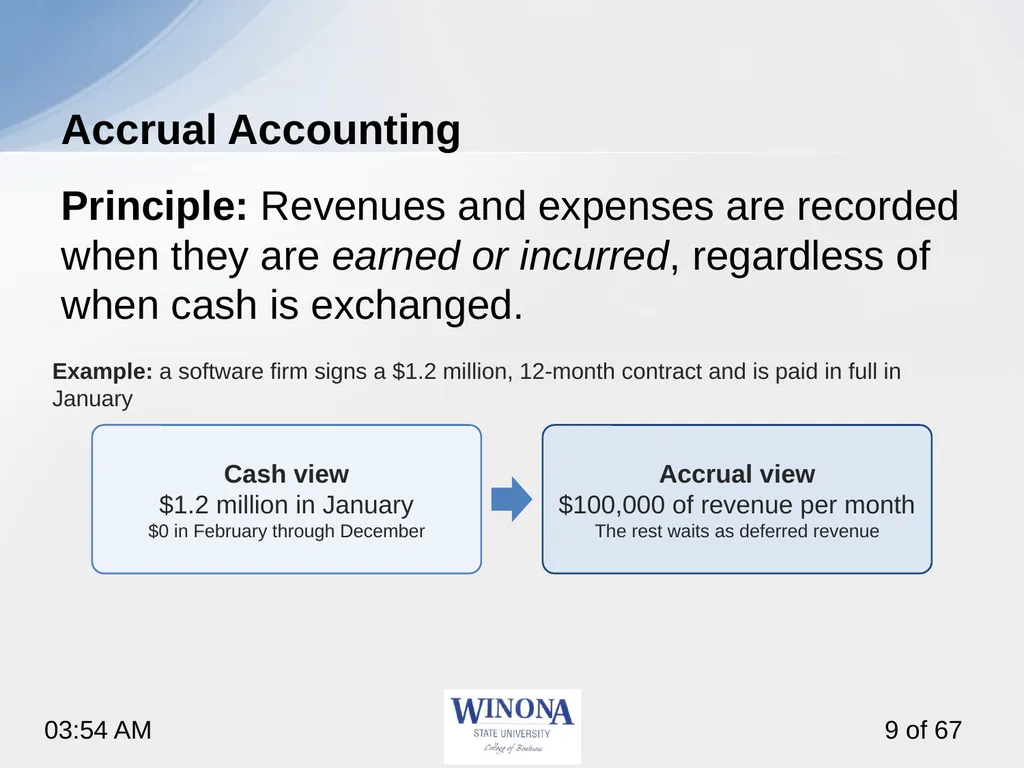
Accrual Accounting Principle: Revenues and expenses are recorded when they are earned or incurred, regardless of when cash is exchanged. Example: a software firm signs a $1.2 million, 12-month contract and is paid in full in January Cash view
$1.2 million in January
$0 in February through December Accrual view
$100,000 of revenue per month
The rest waits as deferred revenue<br>
$1.2 million in January
$0 in February through December Accrual view
$100,000 of revenue per month
The rest waits as deferred revenue<br>
10
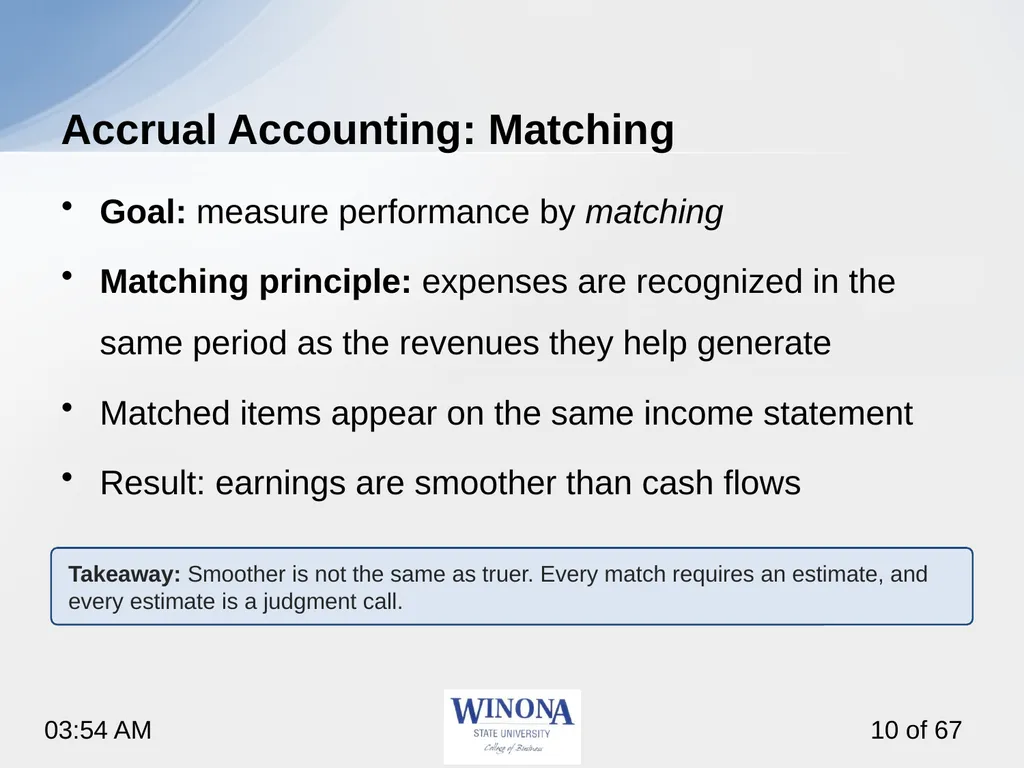
Accrual Accounting: Matching Goal: measure performance by matching
Matching principle: expenses are recognized in the same period as the revenues they help generate
Matched items appear on the same income statement
Result: earnings are smoother than cash flows Takeaway: Smoother is not the same as truer. Every match requires an estimate, and every estimate is a judgment call.<br>
Matching principle: expenses are recognized in the same period as the revenues they help generate
Matched items appear on the same income statement
Result: earnings are smoother than cash flows Takeaway: Smoother is not the same as truer. Every match requires an estimate, and every estimate is a judgment call.<br>
11
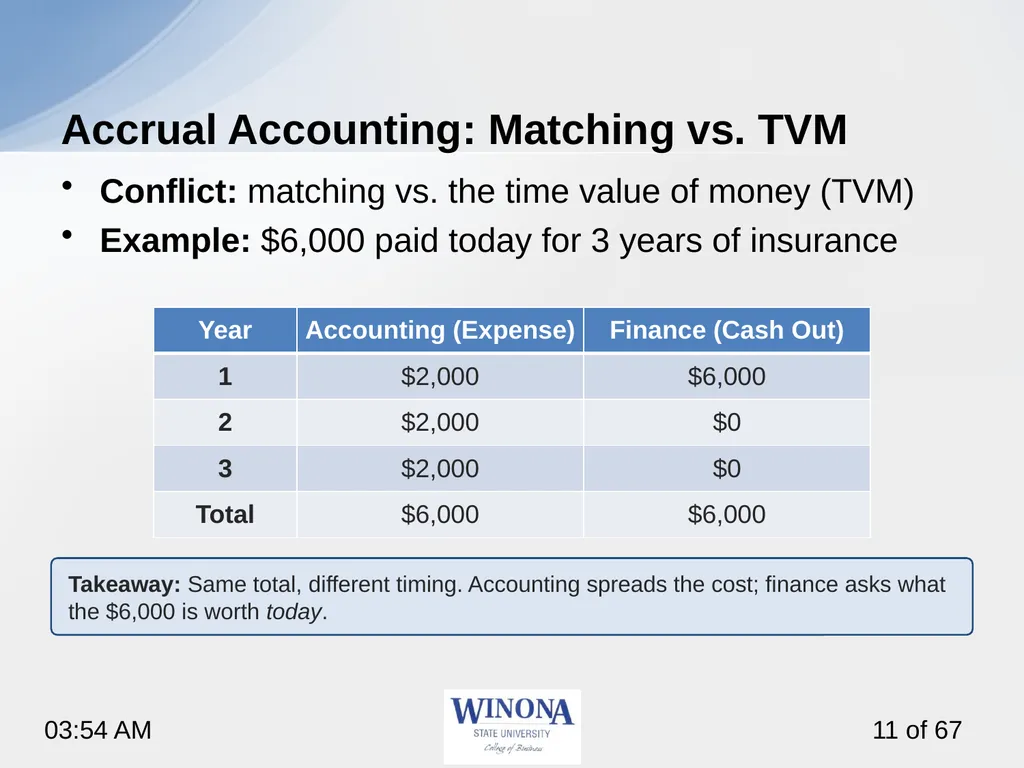
Accrual Accounting: Matching vs. TVM Conflict: matching vs. the time value of money (TVM)
Example: $6,000 paid today for 3 years of insurance Takeaway: Same total, different timing. Accounting spreads the cost; finance asks what the $6,000 is worth today.<br>
Example: $6,000 paid today for 3 years of insurance Takeaway: Same total, different timing. Accounting spreads the cost; finance asks what the $6,000 is worth today.<br>
12
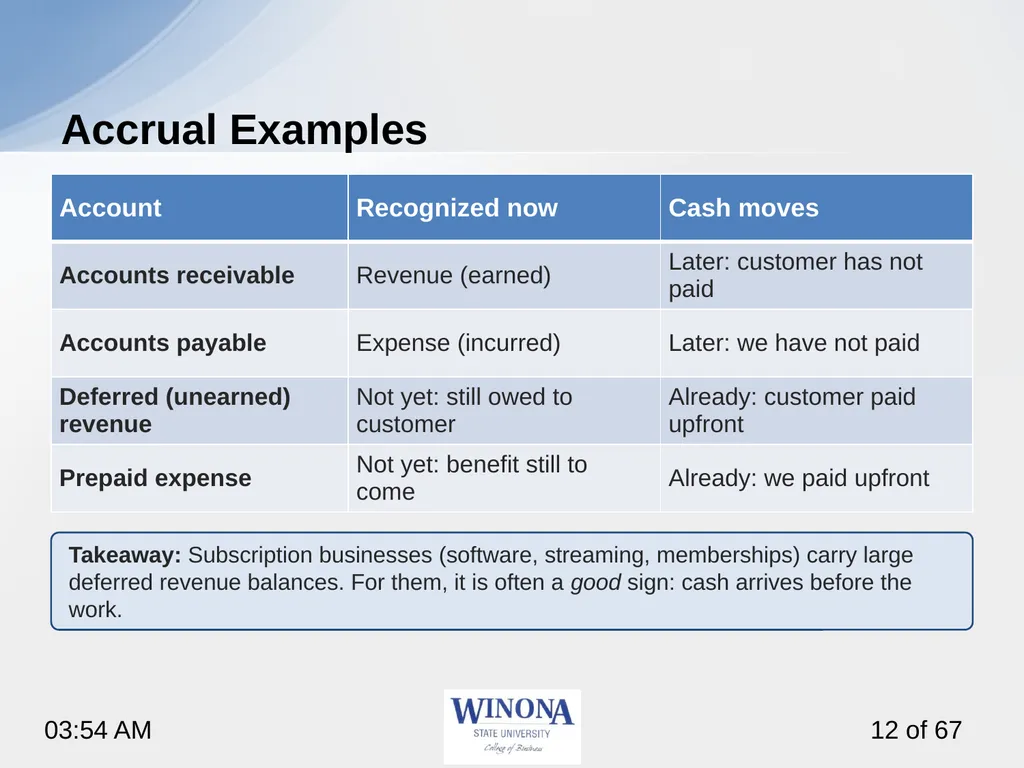
Accrual Examples Takeaway: Subscription businesses (software, streaming, memberships) carry large deferred revenue balances. For them, it is often a good sign: cash arrives before the work.<br>
13
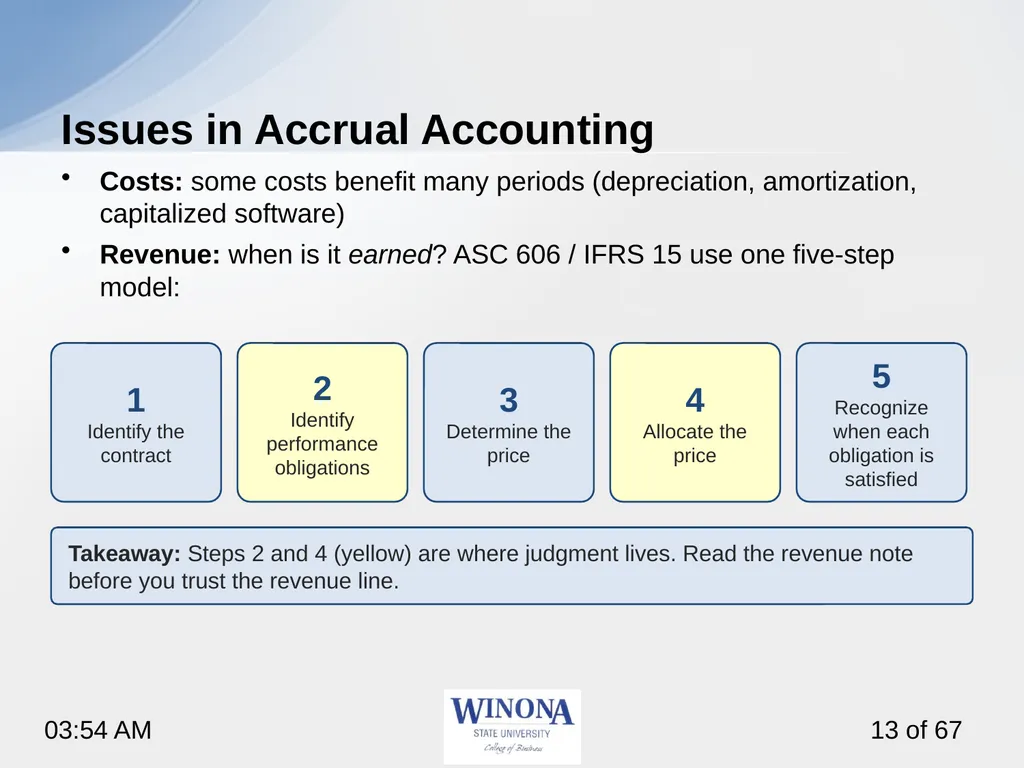
Issues in Accrual Accounting Costs: some costs benefit many periods (depreciation, amortization, capitalized software)
Revenue: when is it earned? ASC 606 / IFRS 15 use one five-step model: 1
Identify the contract 2
Identify performance obligations 3
Determine the price 4
Allocate the price 5
Recognize when each obligation is satisfied Takeaway: Steps 2 and 4 (yellow) are where judgment lives. Read the revenue note before you trust the revenue line.<br>
Revenue: when is it earned? ASC 606 / IFRS 15 use one five-step model: 1
Identify the contract 2
Identify performance obligations 3
Determine the price 4
Allocate the price 5
Recognize when each obligation is satisfied Takeaway: Steps 2 and 4 (yellow) are where judgment lives. Read the revenue note before you trust the revenue line.<br>
14
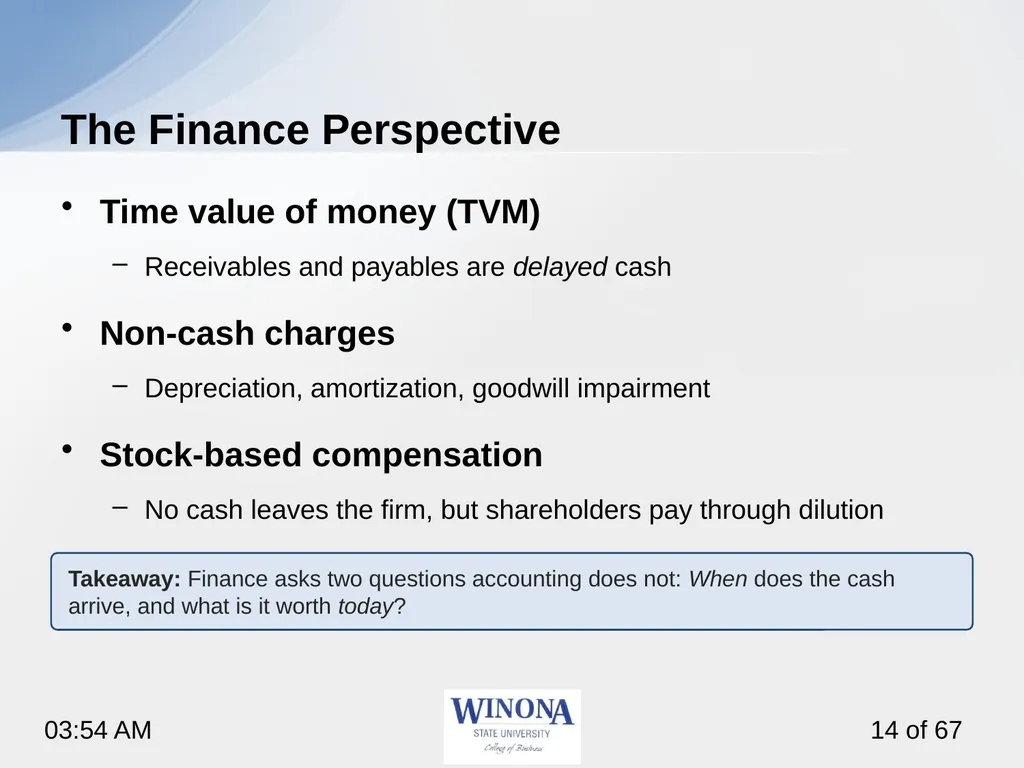
The Finance Perspective Time value of money (TVM)
Receivables and payables are delayed cash
Non-cash charges
Depreciation, amortization, goodwill impairment
Stock-based compensation
No cash leaves the firm, but shareholders pay through dilution Takeaway: Finance asks two questions accounting does not: When does the cash arrive, and what is it worth today?<br>
Receivables and payables are delayed cash
Non-cash charges
Depreciation, amortization, goodwill impairment
Stock-based compensation
No cash leaves the firm, but shareholders pay through dilution Takeaway: Finance asks two questions accounting does not: When does the cash arrive, and what is it worth today?<br>
15
2. Types of Financial Reports<br>
16
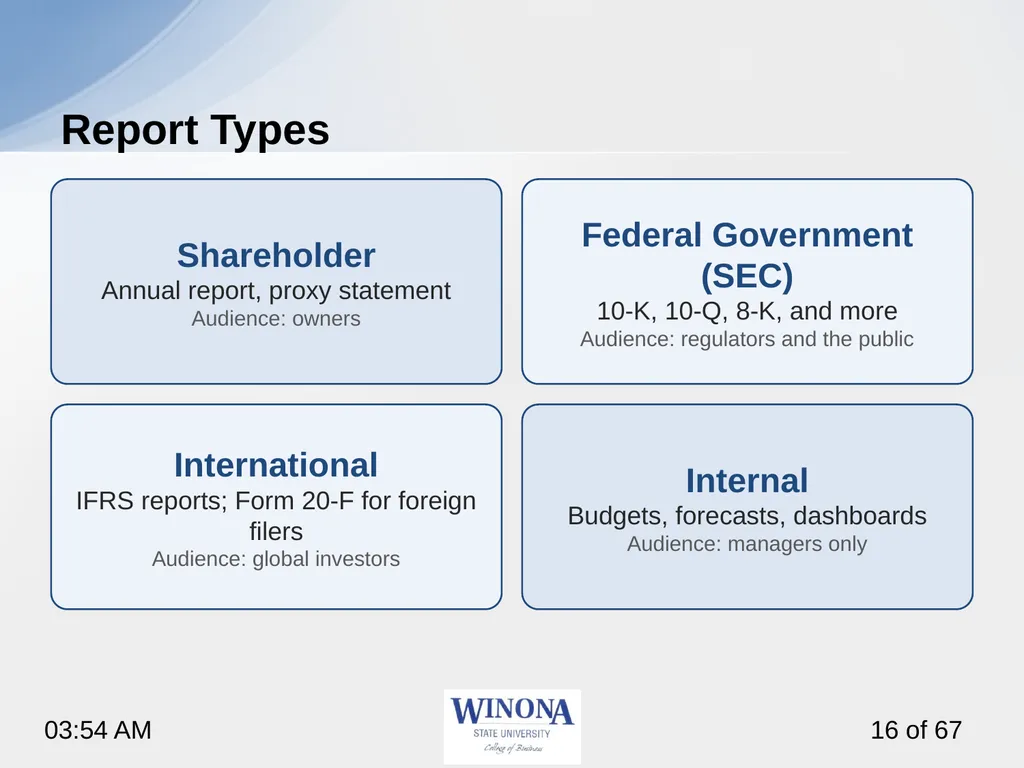
Report Types Shareholder
Annual report, proxy statement
Audience: owners Federal Government (SEC)
10-K, 10-Q, 8-K, and more
Audience: regulators and the public International
IFRS reports; Form 20-F for foreign filers
Audience: global investors Internal
Budgets, forecasts, dashboards
Audience: managers only<br>
Annual report, proxy statement
Audience: owners Federal Government (SEC)
10-K, 10-Q, 8-K, and more
Audience: regulators and the public International
IFRS reports; Form 20-F for foreign filers
Audience: global investors Internal
Budgets, forecasts, dashboards
Audience: managers only<br>
17
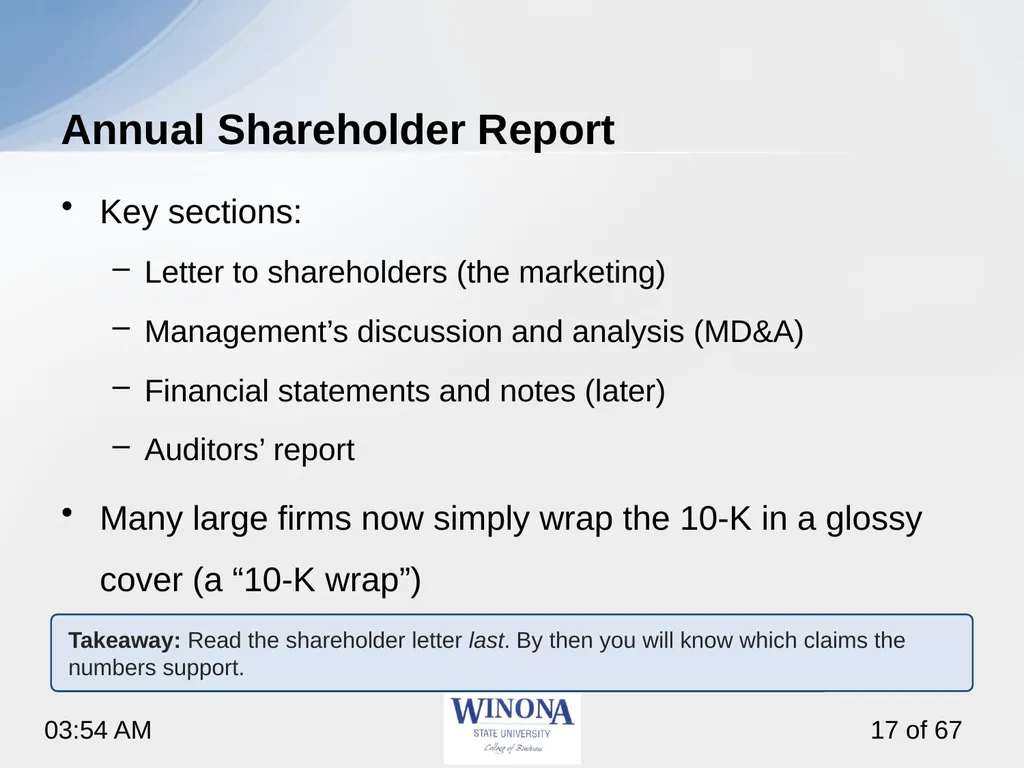
Annual Shareholder Report Key sections:
Letter to shareholders (the marketing)
Management’s discussion and analysis (MD&A)
Financial statements and notes (later)
Auditors’ report
Many large firms now simply wrap the 10-K in a glossy cover (a “10-K wrap”) Takeaway: Read the shareholder letter last. By then you will know which claims the numbers support.<br>
Letter to shareholders (the marketing)
Management’s discussion and analysis (MD&A)
Financial statements and notes (later)
Auditors’ report
Many large firms now simply wrap the 10-K in a glossy cover (a “10-K wrap”) Takeaway: Read the shareholder letter last. By then you will know which claims the numbers support.<br>
18
The story
Results of operations
Liquidity and capital resources
Known trends and uncertainties
Segment performance
Critical accounting estimates The estimates to probe
Revenue recognition
Impairments of assets
Pensions
Stock-based compensation
Credit loss allowances (CECL)
Restructuring charges Management’s Discussion and Analysis (MD&A) Takeaway: MD&A is management’s own narrative of the numbers. Test it against the notes: does the story match the evidence?<br>
Results of operations
Liquidity and capital resources
Known trends and uncertainties
Segment performance
Critical accounting estimates The estimates to probe
Revenue recognition
Impairments of assets
Pensions
Stock-based compensation
Credit loss allowances (CECL)
Restructuring charges Management’s Discussion and Analysis (MD&A) Takeaway: MD&A is management’s own narrative of the numbers. Test it against the notes: does the story match the evidence?<br>
19
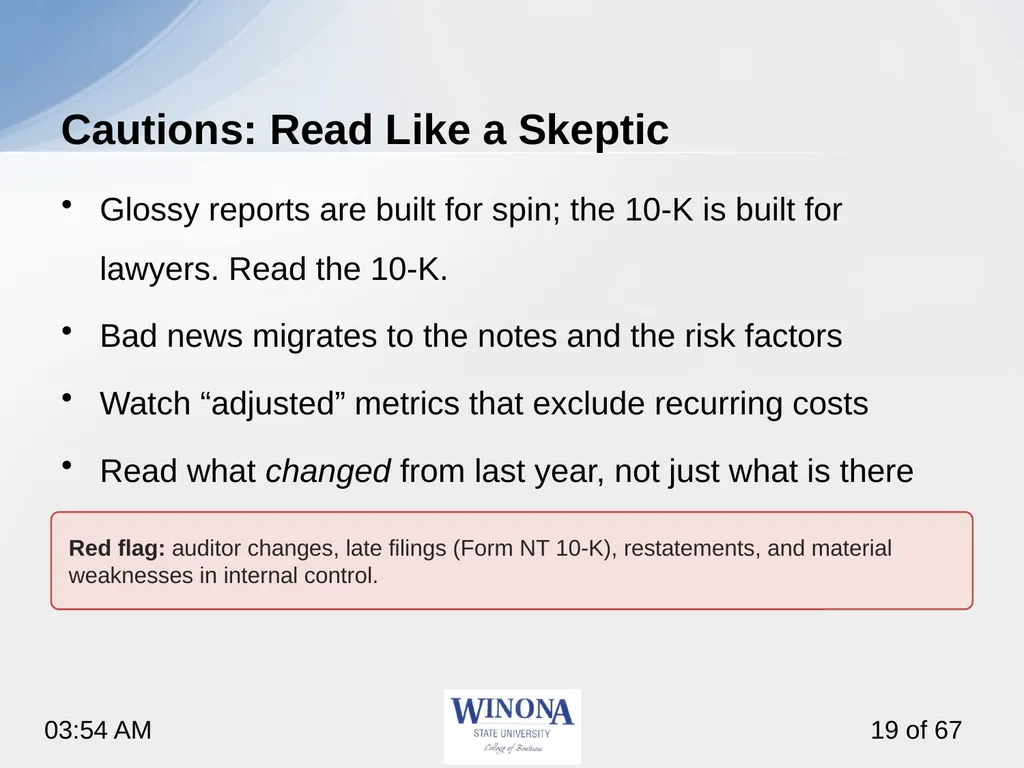
Glossy reports are built for spin; the 10-K is built for lawyers. Read the 10-K.
Bad news migrates to the notes and the risk factors
Watch “adjusted” metrics that exclude recurring costs
Read what changed from last year, not just what is there Cautions: Read Like a Skeptic Red flag: auditor changes, late filings (Form NT 10-K), restatements, and material weaknesses in internal control.<br>
Bad news migrates to the notes and the risk factors
Watch “adjusted” metrics that exclude recurring costs
Read what changed from last year, not just what is there Cautions: Read Like a Skeptic Red flag: auditor changes, late filings (Form NT 10-K), restatements, and material weaknesses in internal control.<br>
20
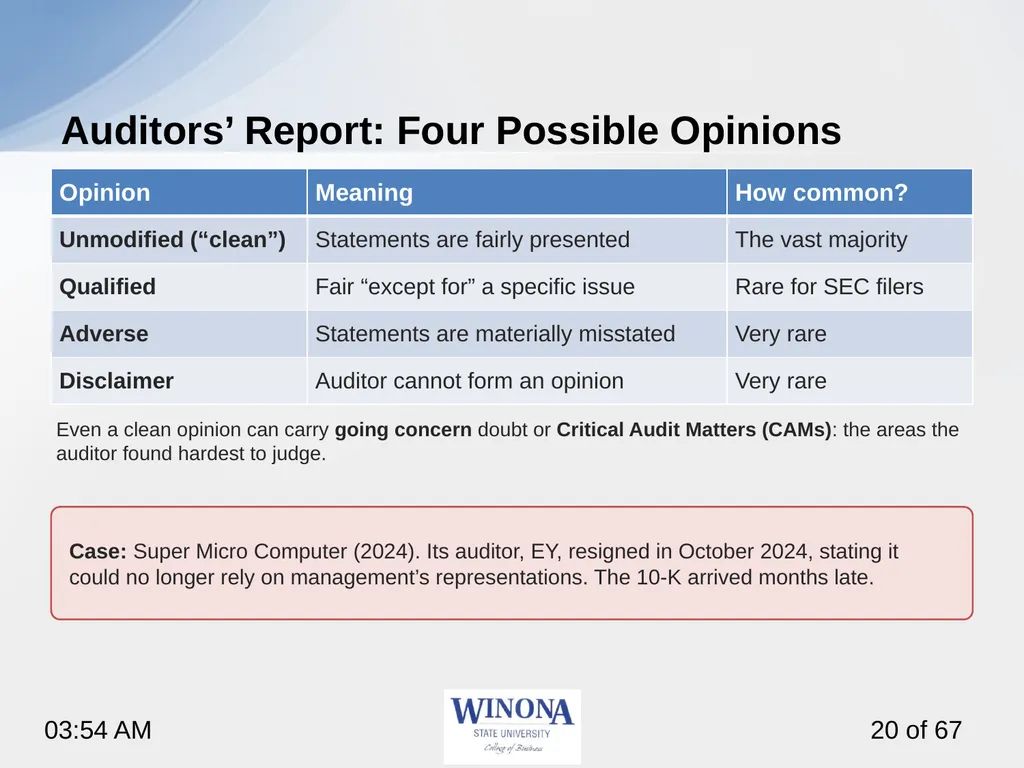
Auditors’ Report: Four Possible Opinions Even a clean opinion can carry going concern doubt or Critical Audit Matters (CAMs): the areas the auditor found hardest to judge. Case: Super Micro Computer (2024). Its auditor, EY, resigned in October 2024, stating it could no longer rely on management’s representations. The 10-K arrived months late.<br>
21
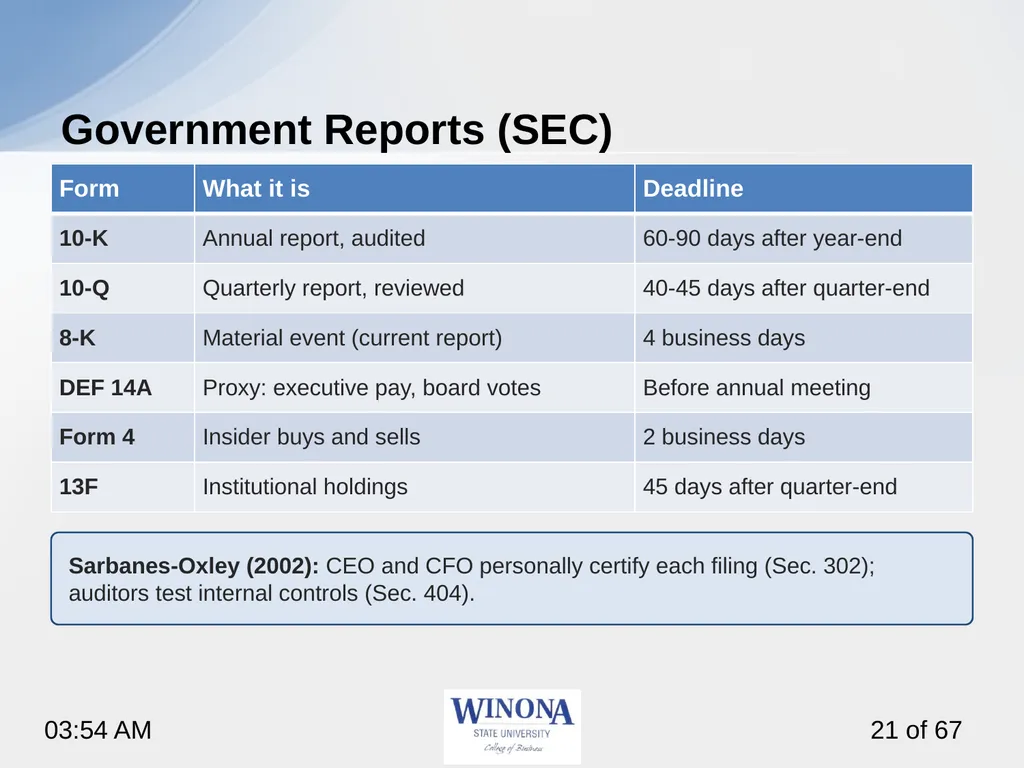
Government Reports (SEC) Sarbanes-Oxley (2002): CEO and CFO personally certify each filing (Sec. 302); auditors test internal controls (Sec. 404).<br>
22
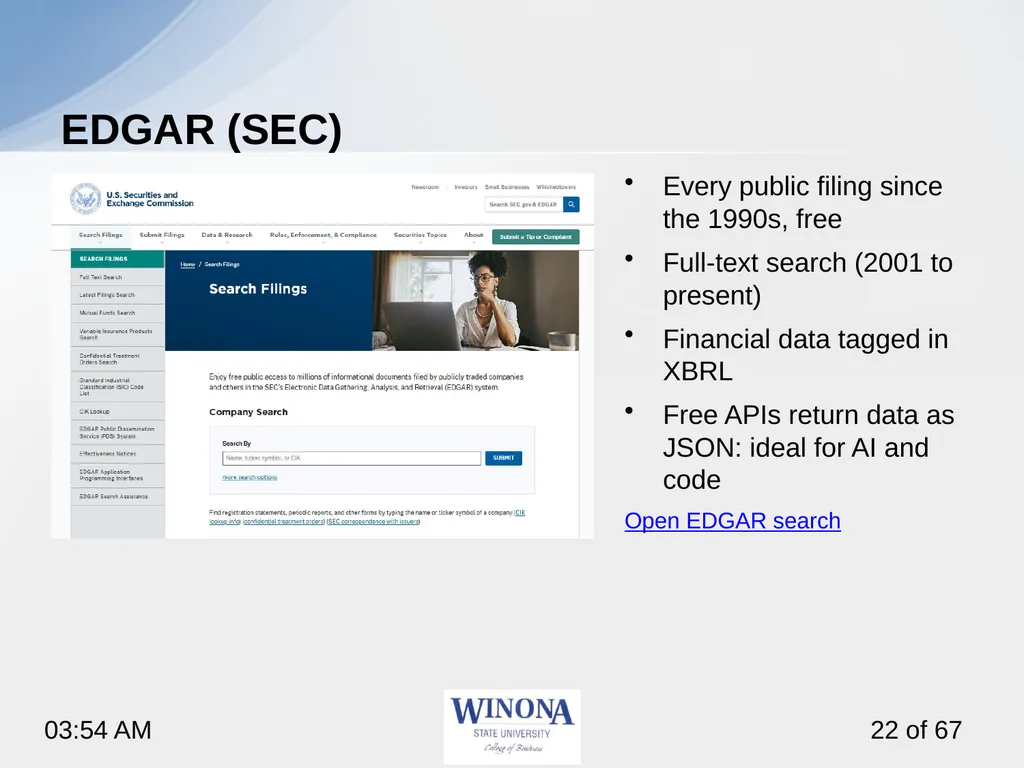
Every public filing since the 1990s, free
Full-text search (2001 to present)
Financial data tagged in XBRL
Free APIs return data as JSON: ideal for AI and code
Open EDGAR search EDGAR (SEC)<br>
Full-text search (2001 to present)
Financial data tagged in XBRL
Free APIs return data as JSON: ideal for AI and code
Open EDGAR search EDGAR (SEC)<br>
23
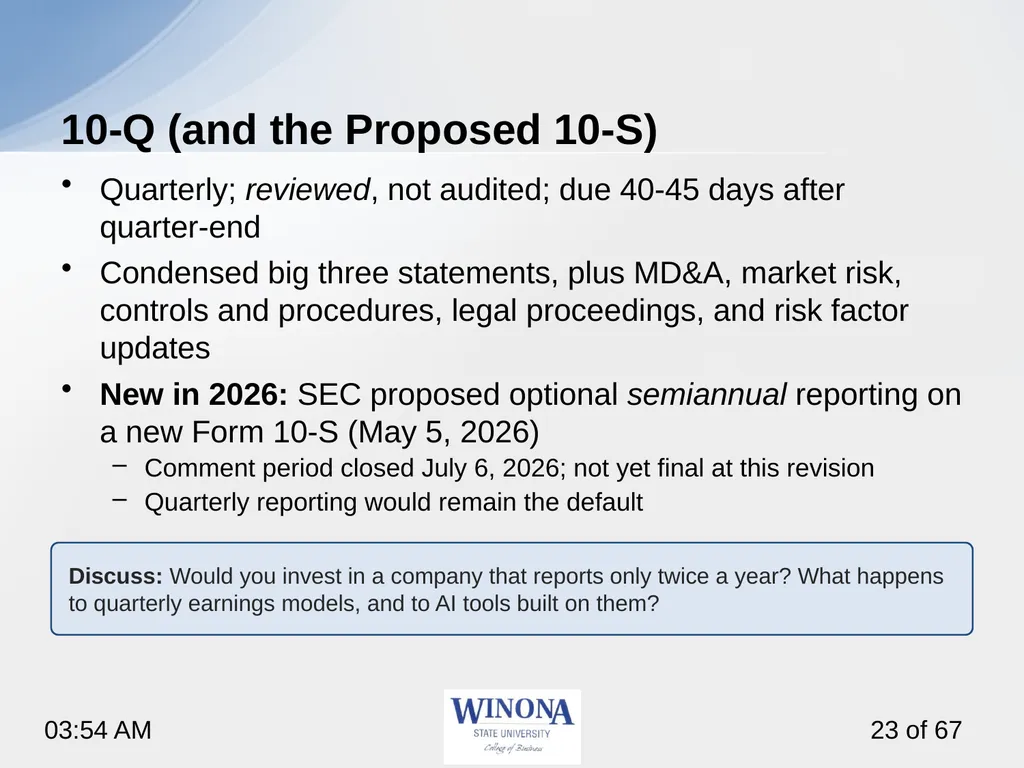
Quarterly; reviewed, not audited; due 40-45 days after quarter-end
Condensed big three statements, plus MD&A, market risk, controls and procedures, legal proceedings, and risk factor updates
New in 2026: SEC proposed optional semiannual reporting on a new Form 10-S (May 5, 2026)
Comment period closed July 6, 2026; not yet final at this revision
Quarterly reporting would remain the default 10-Q (and the Proposed 10-S) Discuss: Would you invest in a company that reports only twice a year? What happens to quarterly earnings models, and to AI tools built on them?<br>
Condensed big three statements, plus MD&A, market risk, controls and procedures, legal proceedings, and risk factor updates
New in 2026: SEC proposed optional semiannual reporting on a new Form 10-S (May 5, 2026)
Comment period closed July 6, 2026; not yet final at this revision
Quarterly reporting would remain the default 10-Q (and the Proposed 10-S) Discuss: Would you invest in a company that reports only twice a year? What happens to quarterly earnings models, and to AI tools built on them?<br>
24
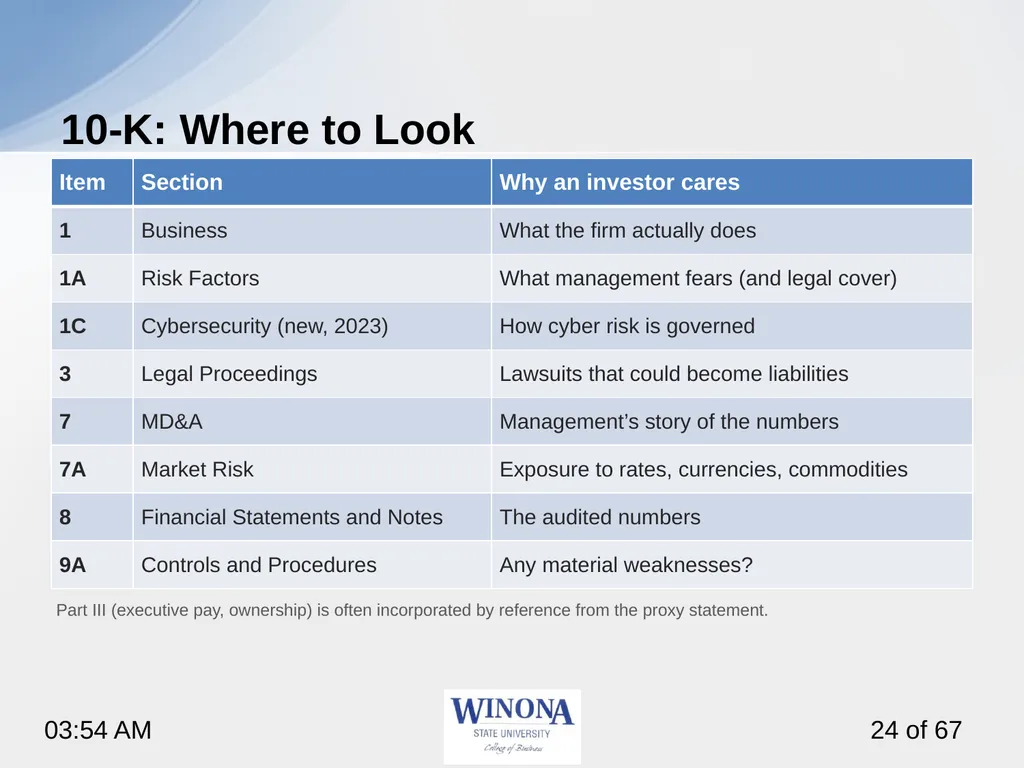
10-K: Where to Look Part III (executive pay, ownership) is often incorporated by reference from the proxy statement.<br>
25
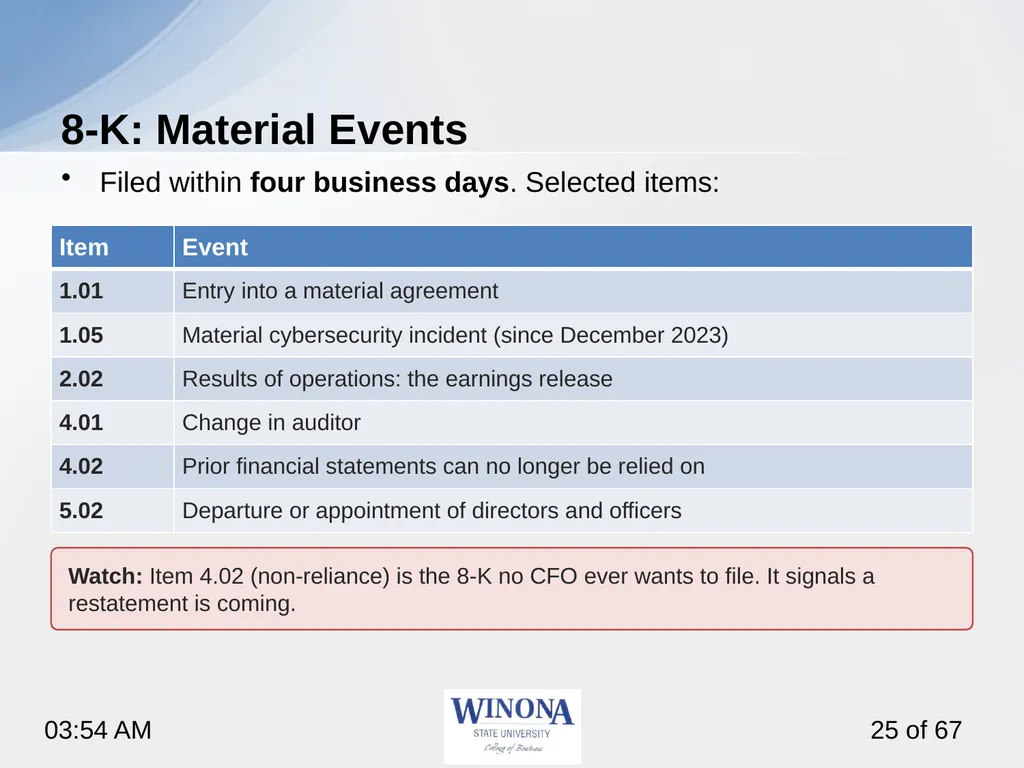
Filed within four business days. Selected items: 8-K: Material Events Watch: Item 4.02 (non-reliance) is the 8-K no CFO ever wants to file. It signals a restatement is coming.<br>
26
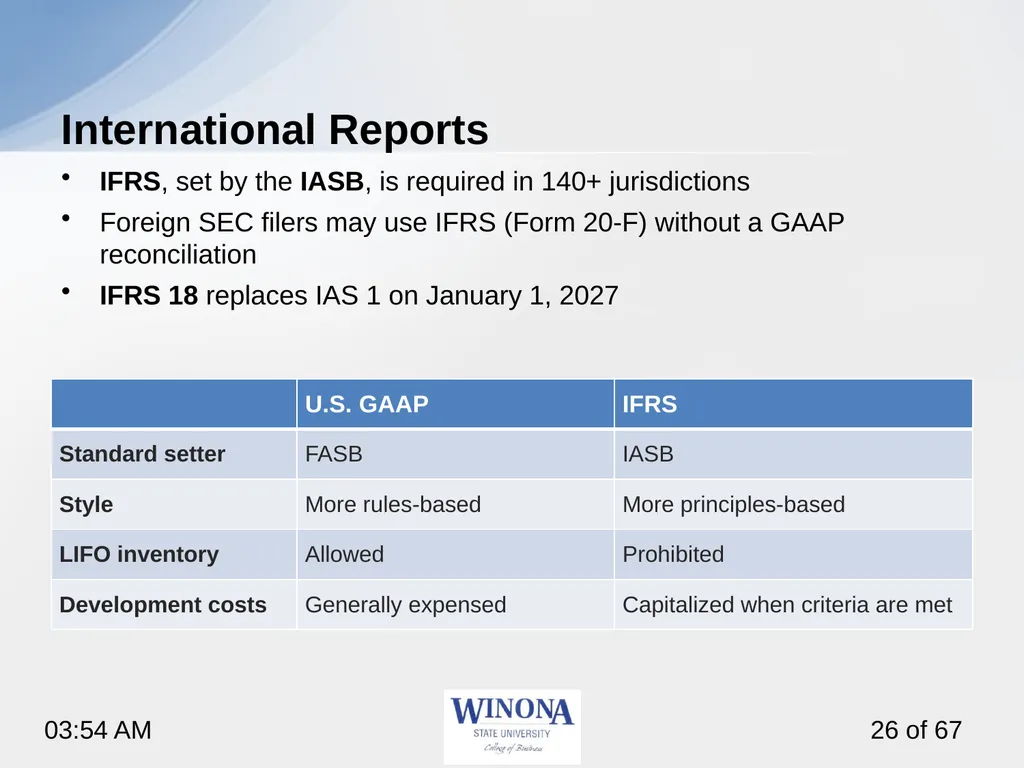
IFRS, set by the IASB, is required in 140+ jurisdictions
Foreign SEC filers may use IFRS (Form 20-F) without a GAAP reconciliation
IFRS 18 replaces IAS 1 on January 1, 2027 International Reports<br>
Foreign SEC filers may use IFRS (Form 20-F) without a GAAP reconciliation
IFRS 18 replaces IAS 1 on January 1, 2027 International Reports<br>
27
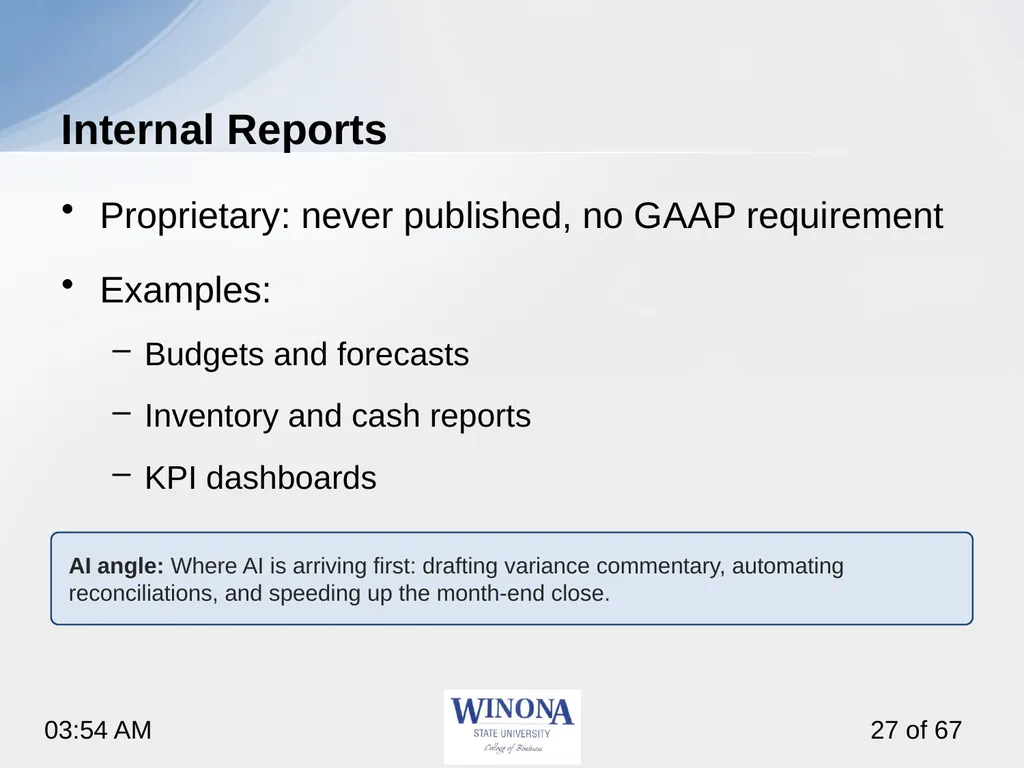
Proprietary: never published, no GAAP requirement
Examples:
Budgets and forecasts
Inventory and cash reports
KPI dashboards Internal Reports AI angle: Where AI is arriving first: drafting variance commentary, automating reconciliations, and speeding up the month-end close.<br>
Examples:
Budgets and forecasts
Inventory and cash reports
KPI dashboards Internal Reports AI angle: Where AI is arriving first: drafting variance commentary, automating reconciliations, and speeding up the month-end close.<br>
28
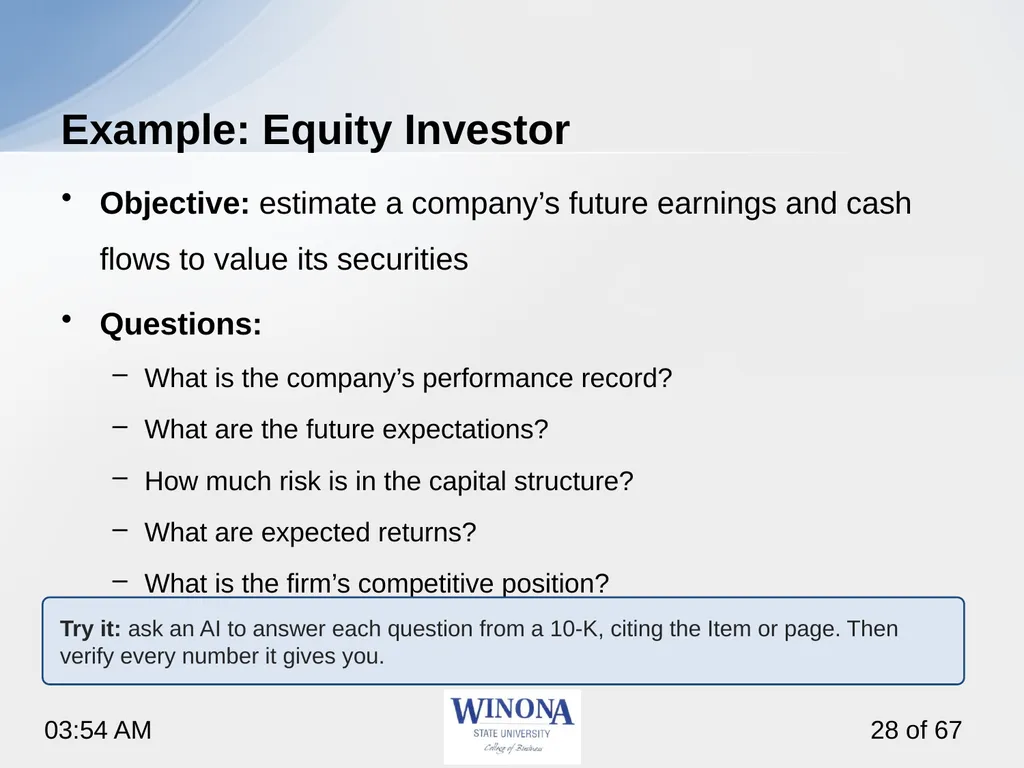
Objective: estimate a company’s future earnings and cash flows to value its securities
Questions:
What is the company’s performance record?
What are the future expectations?
How much risk is in the capital structure?
What are expected returns?
What is the firm’s competitive position? Example: Equity Investor Try it: ask an AI to answer each question from a 10-K, citing the Item or page. Then verify every number it gives you.<br>
Questions:
What is the company’s performance record?
What are the future expectations?
How much risk is in the capital structure?
What are expected returns?
What is the firm’s competitive position? Example: Equity Investor Try it: ask an AI to answer each question from a 10-K, citing the Item or page. Then verify every number it gives you.<br>
29
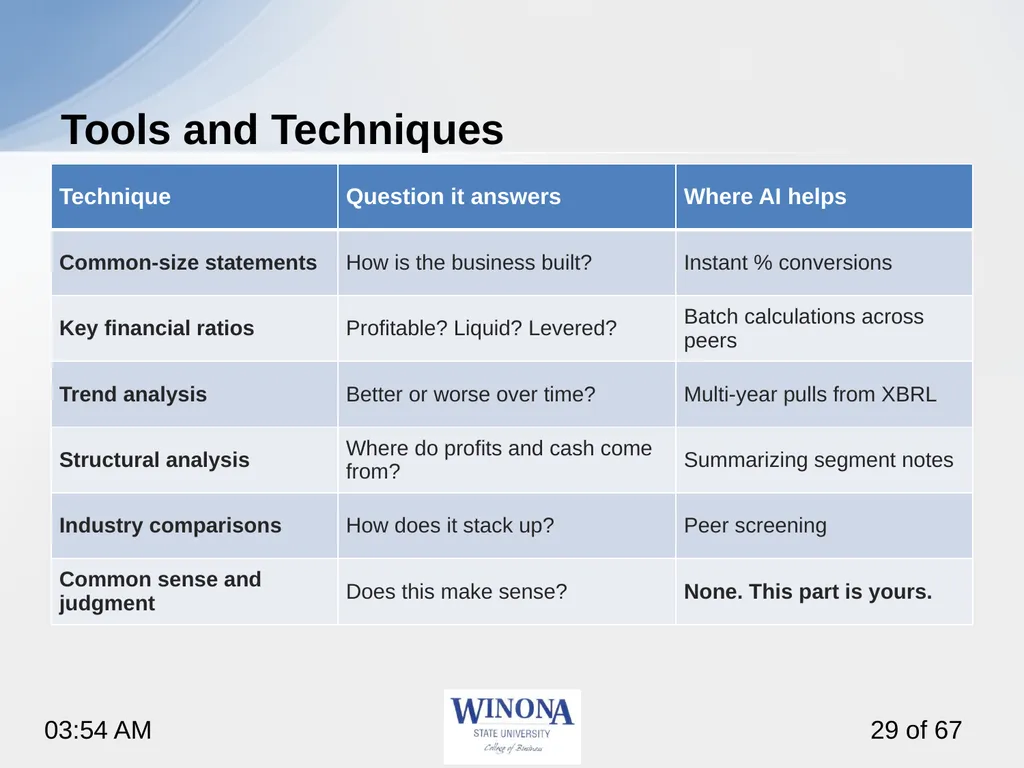
Tools and Techniques<br>
30
3. The Financial Statements<br>
31
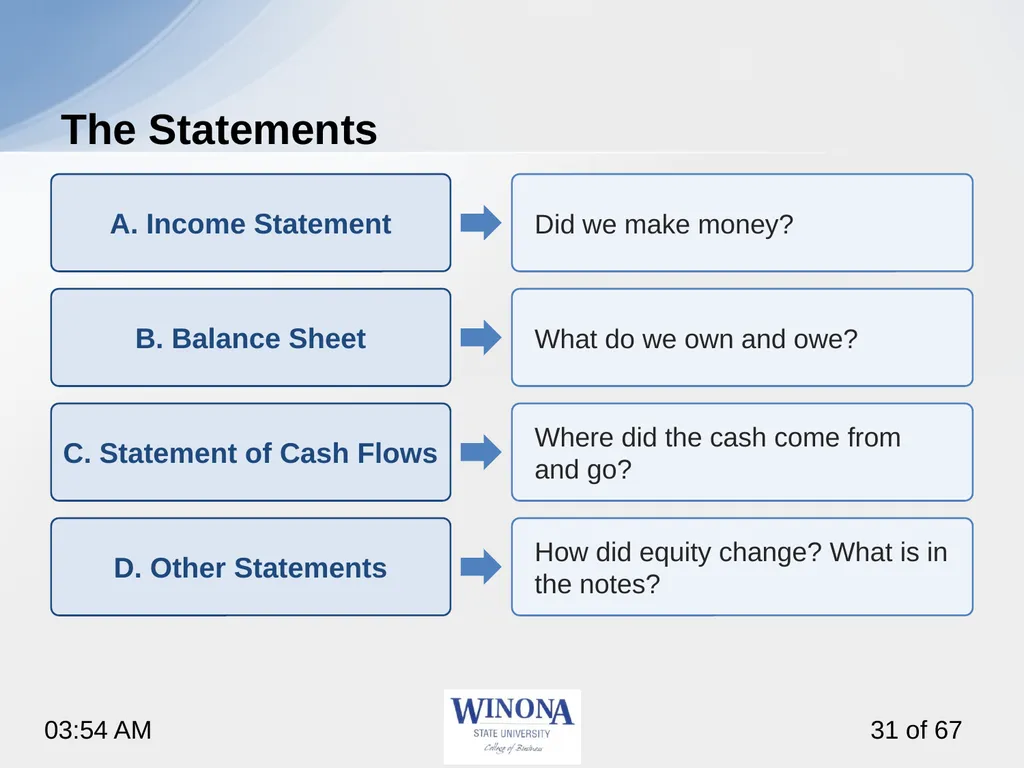
The Statements A. Income Statement Did we make money? B. Balance Sheet What do we own and owe? C. Statement of Cash Flows Where did the cash come from and go? D. Other Statements How did equity change? What is in the notes?<br>
32
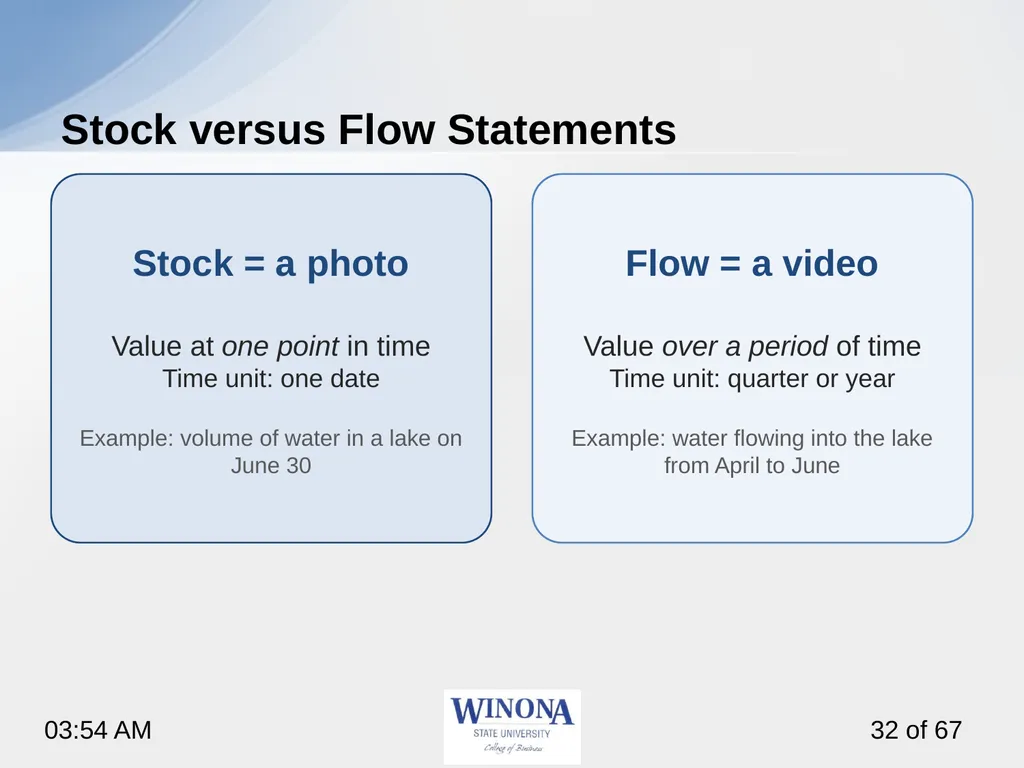
Stock versus Flow Statements Stock = a photo
Value at one point in time
Time unit: one date
Example: volume of water in a lake on June 30 Flow = a video
Value over a period of time
Time unit: quarter or year
Example: water flowing into the lake from April to June<br>
Value at one point in time
Time unit: one date
Example: volume of water in a lake on June 30 Flow = a video
Value over a period of time
Time unit: quarter or year
Example: water flowing into the lake from April to June<br>
33
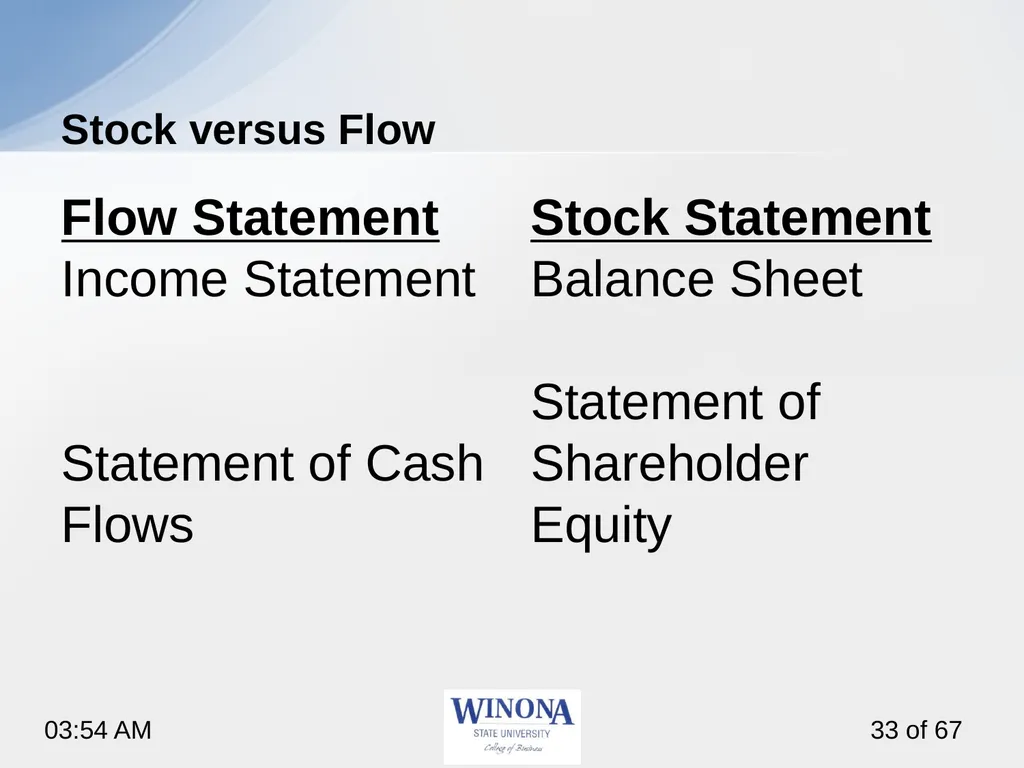
Flow Statement
Income Statement
Statement of Cash Flows Stock Statement
Balance Sheet
Statement of Shareholder Equity Stock versus Flow<br>
Income Statement
Statement of Cash Flows Stock Statement
Balance Sheet
Statement of Shareholder Equity Stock versus Flow<br>
34
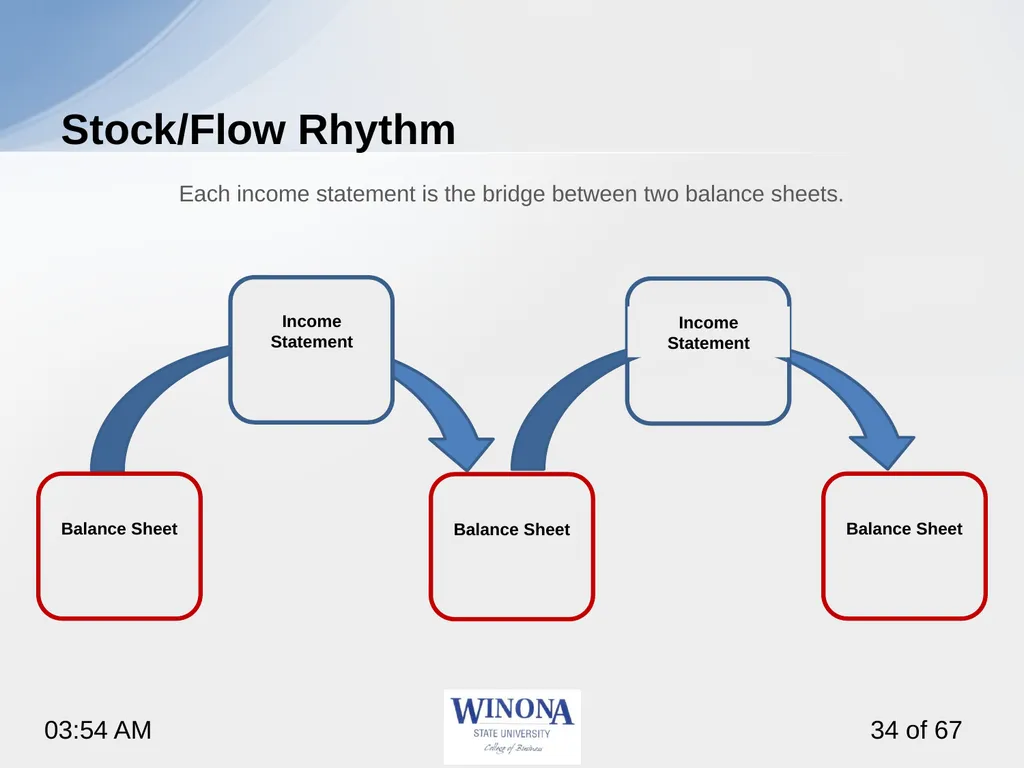
Stock/Flow Rhythm Income Statement Balance Sheet Income Statement Balance Sheet Balance Sheet Each income statement is the bridge between two balance sheets.<br>
35
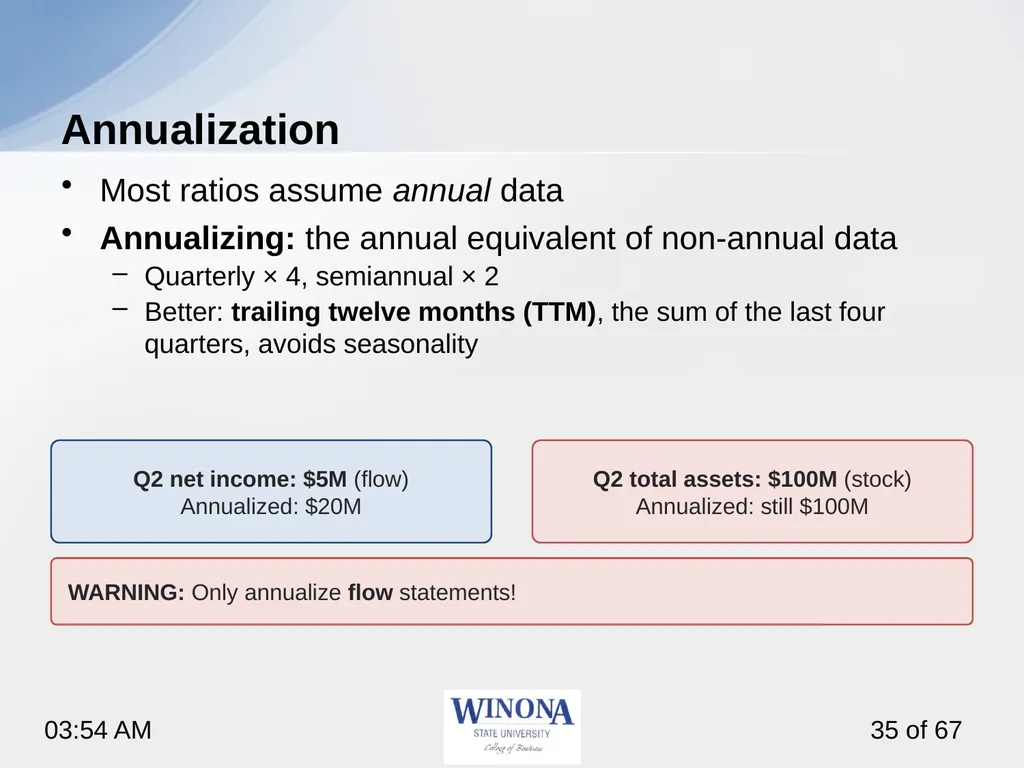
Most ratios assume annual data
Annualizing: the annual equivalent of non-annual data
Quarterly × 4, semiannual × 2
Better: trailing twelve months (TTM), the sum of the last four quarters, avoids seasonality Annualization Q2 net income: $5M (flow)
Annualized: $20M Q2 total assets: $100M (stock)
Annualized: still $100M WARNING: Only annualize flow statements!<br>
Annualizing: the annual equivalent of non-annual data
Quarterly × 4, semiannual × 2
Better: trailing twelve months (TTM), the sum of the last four quarters, avoids seasonality Annualization Q2 net income: $5M (flow)
Annualized: $20M Q2 total assets: $100M (stock)
Annualized: still $100M WARNING: Only annualize flow statements!<br>
36
3.A Income Statement<br>
37
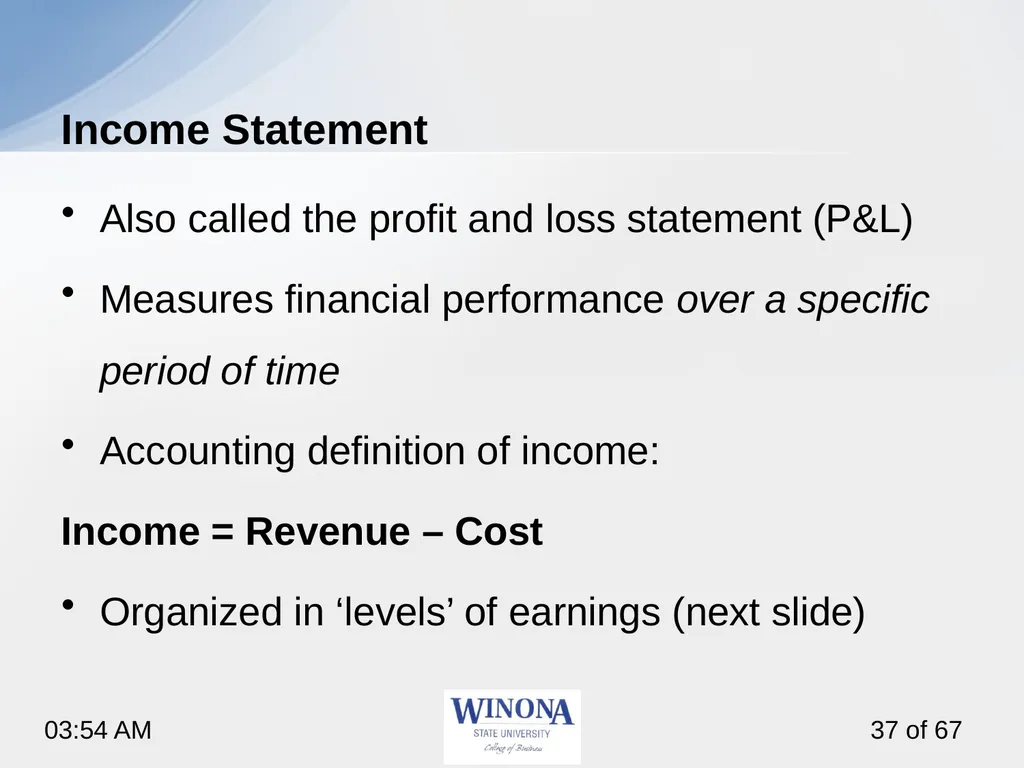
Also called the profit and loss statement (P&L)
Measures financial performance over a specific period of time
Accounting definition of income:
Income = Revenue – Cost
Organized in ‘levels’ of earnings (next slide) Income Statement<br>
Measures financial performance over a specific period of time
Accounting definition of income:
Income = Revenue – Cost
Organized in ‘levels’ of earnings (next slide) Income Statement<br>
38
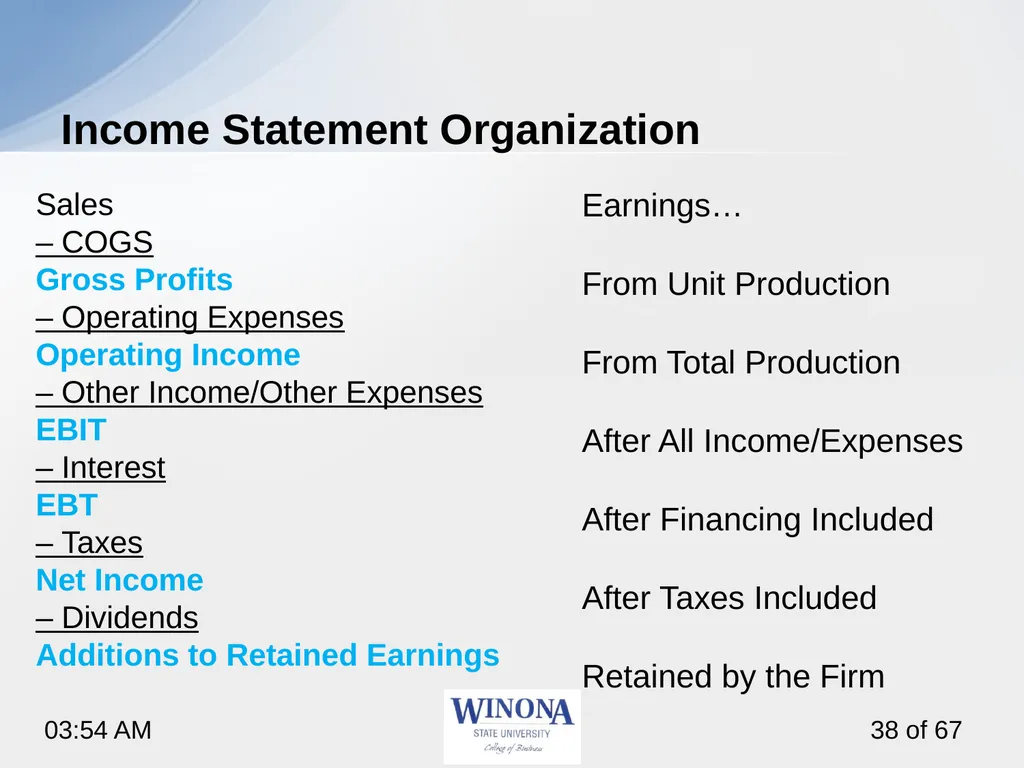
Sales
– COGS
Gross Profits
– Operating Expenses
Operating Income
– Other Income/Other Expenses
EBIT
– Interest
EBT
– Taxes
Net Income
– Dividends
Additions to Retained Earnings Earnings…
From Unit Production
From Total Production
After All Income/Expenses
After Financing Included
After Taxes Included
Retained by the Firm Income Statement Organization<br>
– COGS
Gross Profits
– Operating Expenses
Operating Income
– Other Income/Other Expenses
EBIT
– Interest
EBT
– Taxes
Net Income
– Dividends
Additions to Retained Earnings Earnings…
From Unit Production
From Total Production
After All Income/Expenses
After Financing Included
After Taxes Included
Retained by the Firm Income Statement Organization<br>
39
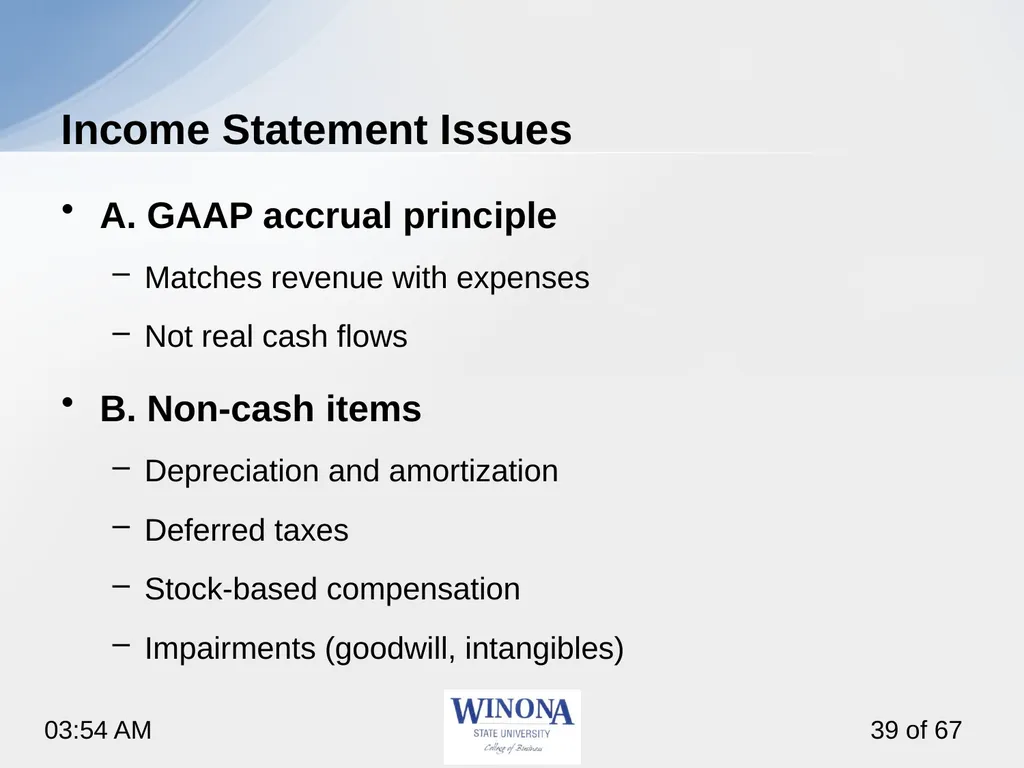
A. GAAP accrual principle
Matches revenue with expenses
Not real cash flows
B. Non-cash items
Depreciation and amortization
Deferred taxes
Stock-based compensation
Impairments (goodwill, intangibles) Income Statement Issues<br>
Matches revenue with expenses
Not real cash flows
B. Non-cash items
Depreciation and amortization
Deferred taxes
Stock-based compensation
Impairments (goodwill, intangibles) Income Statement Issues<br>
40
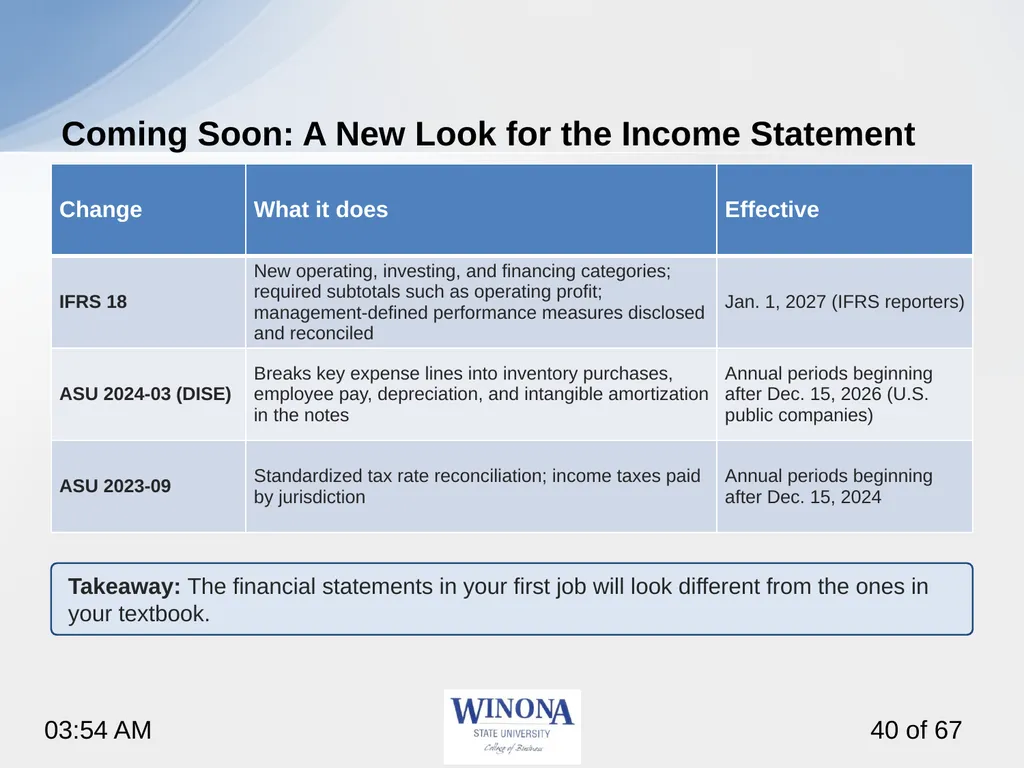
Coming Soon: A New Look for the Income Statement Takeaway: The financial statements in your first job will look different from the ones in your textbook.<br>
41
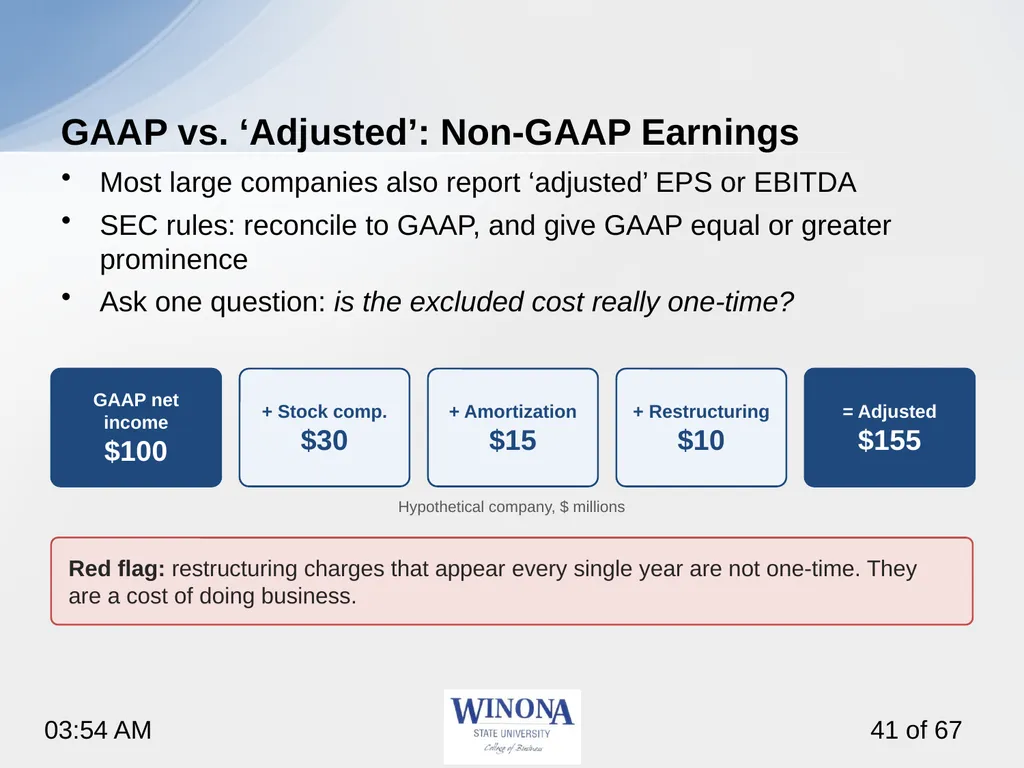
Most large companies also report ‘adjusted’ EPS or EBITDA
SEC rules: reconcile to GAAP, and give GAAP equal or greater prominence
Ask one question: is the excluded cost really one-time? GAAP vs. ‘Adjusted’: Non-GAAP Earnings GAAP net income
$100 + Stock comp.
$30 + Amortization
$15 + Restructuring
$10 = Adjusted
$155 Hypothetical company, $ millions Red flag: restructuring charges that appear every single year are not one-time. They are a cost of doing business.<br>
SEC rules: reconcile to GAAP, and give GAAP equal or greater prominence
Ask one question: is the excluded cost really one-time? GAAP vs. ‘Adjusted’: Non-GAAP Earnings GAAP net income
$100 + Stock comp.
$30 + Amortization
$15 + Restructuring
$10 = Adjusted
$155 Hypothetical company, $ millions Red flag: restructuring charges that appear every single year are not one-time. They are a cost of doing business.<br>
42
3.B Balance Sheet<br>
43
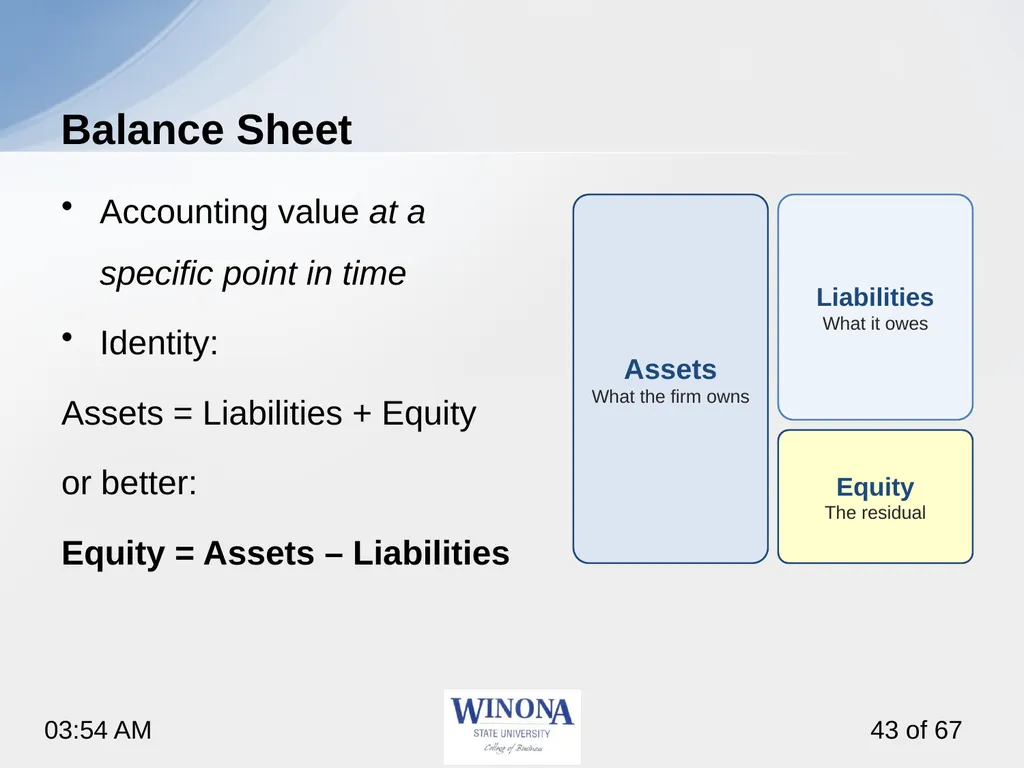
Accounting value at a specific point in time
Identity:
Assets = Liabilities + Equity
or better:
Equity = Assets – Liabilities Balance Sheet Assets
What the firm owns Liabilities
What it owes Equity
The residual<br>
Identity:
Assets = Liabilities + Equity
or better:
Equity = Assets – Liabilities Balance Sheet Assets
What the firm owns Liabilities
What it owes Equity
The residual<br>
44
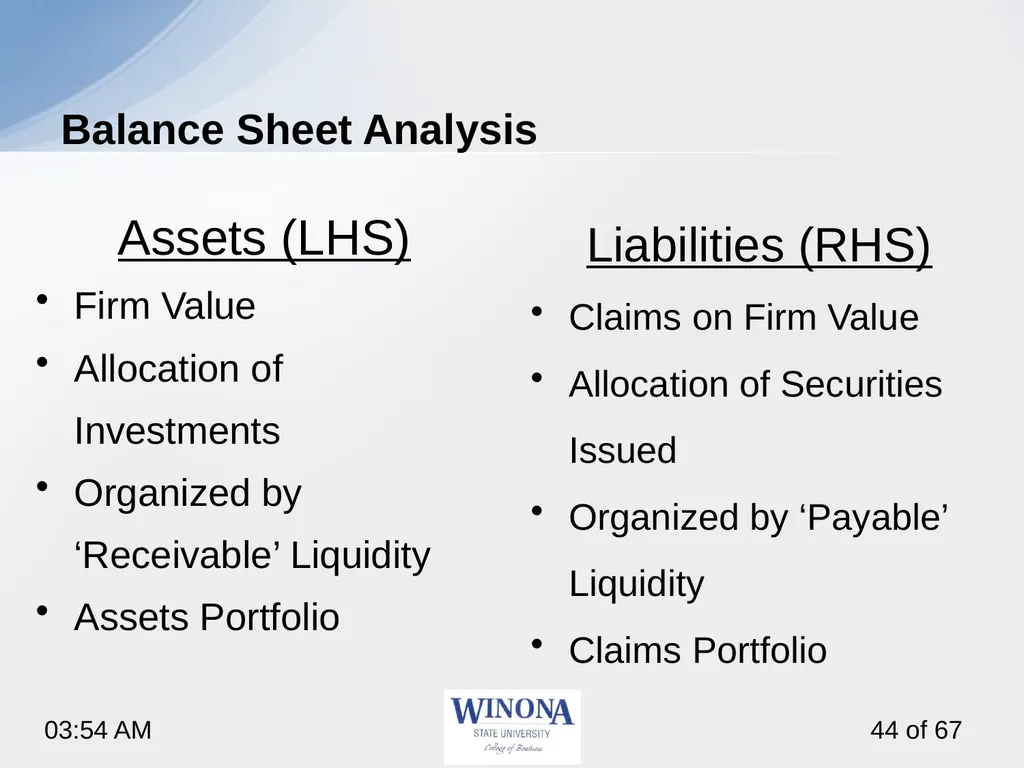
Assets (LHS)
Firm Value
Allocation of Investments
Organized by ‘Receivable’ Liquidity
Assets Portfolio Liabilities (RHS)
Claims on Firm Value
Allocation of Securities Issued
Organized by ‘Payable’ Liquidity
Claims Portfolio Balance Sheet Analysis<br>
Firm Value
Allocation of Investments
Organized by ‘Receivable’ Liquidity
Assets Portfolio Liabilities (RHS)
Claims on Firm Value
Allocation of Securities Issued
Organized by ‘Payable’ Liquidity
Claims Portfolio Balance Sheet Analysis<br>
45
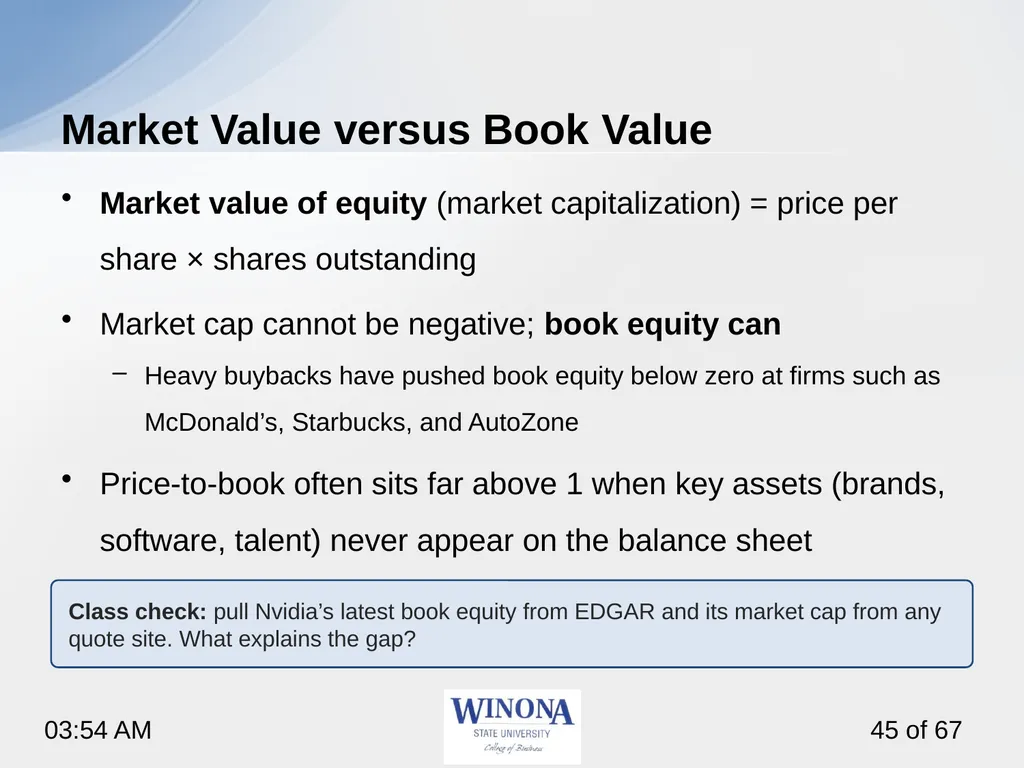
Market value of equity (market capitalization) = price per share × shares outstanding
Market cap cannot be negative; book equity can
Heavy buybacks have pushed book equity below zero at firms such as McDonald’s, Starbucks, and AutoZone
Price-to-book often sits far above 1 when key assets (brands, software, talent) never appear on the balance sheet Market Value versus Book Value Class check: pull Nvidia’s latest book equity from EDGAR and its market cap from any quote site. What explains the gap?<br>
Market cap cannot be negative; book equity can
Heavy buybacks have pushed book equity below zero at firms such as McDonald’s, Starbucks, and AutoZone
Price-to-book often sits far above 1 when key assets (brands, software, talent) never appear on the balance sheet Market Value versus Book Value Class check: pull Nvidia’s latest book equity from EDGAR and its market cap from any quote site. What explains the gap?<br>
46
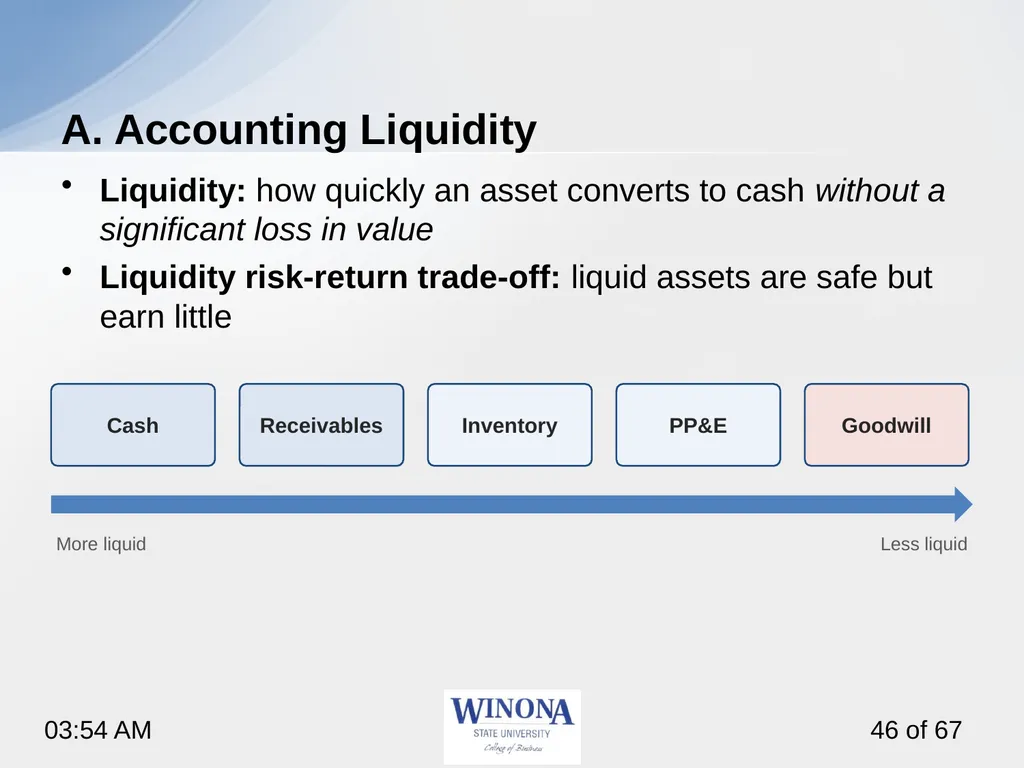
Liquidity: how quickly an asset converts to cash without a significant loss in value
Liquidity risk-return trade-off: liquid assets are safe but earn little A. Accounting Liquidity Cash Receivables Inventory PP&E Goodwill More liquid Less liquid<br>
Liquidity risk-return trade-off: liquid assets are safe but earn little A. Accounting Liquidity Cash Receivables Inventory PP&E Goodwill More liquid Less liquid<br>
47
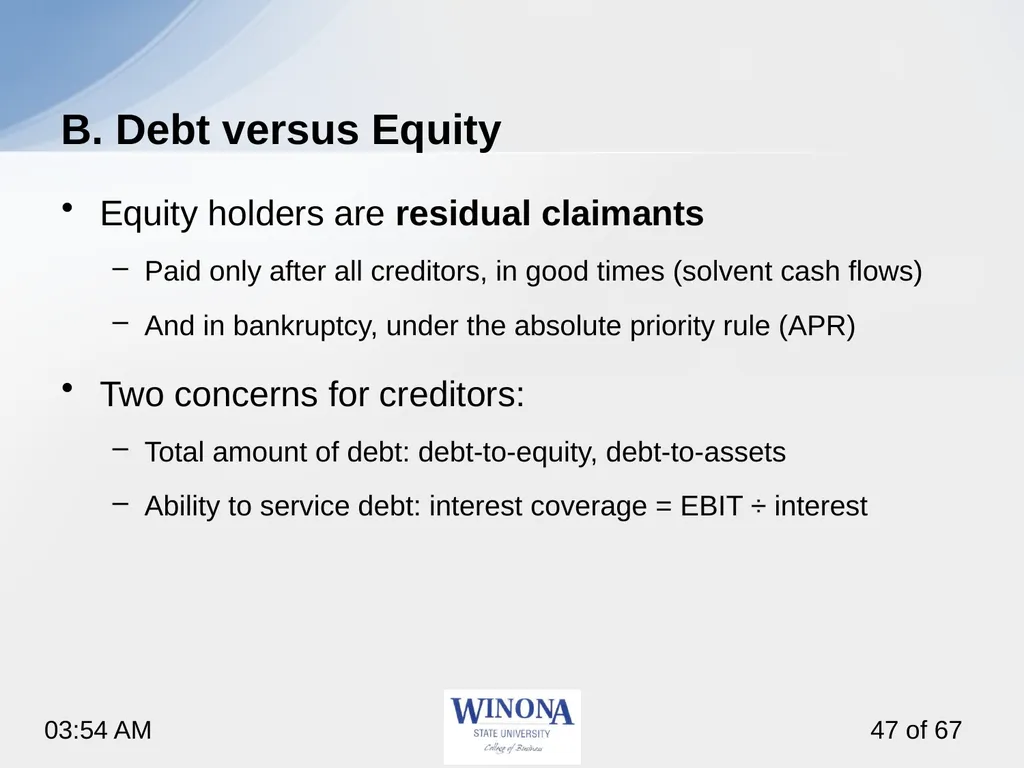
Equity holders are residual claimants
Paid only after all creditors, in good times (solvent cash flows)
And in bankruptcy, under the absolute priority rule (APR)
Two concerns for creditors:
Total amount of debt: debt-to-equity, debt-to-assets
Ability to service debt: interest coverage = EBIT ÷ interest B. Debt versus Equity<br>
Paid only after all creditors, in good times (solvent cash flows)
And in bankruptcy, under the absolute priority rule (APR)
Two concerns for creditors:
Total amount of debt: debt-to-equity, debt-to-assets
Ability to service debt: interest coverage = EBIT ÷ interest B. Debt versus Equity<br>
48
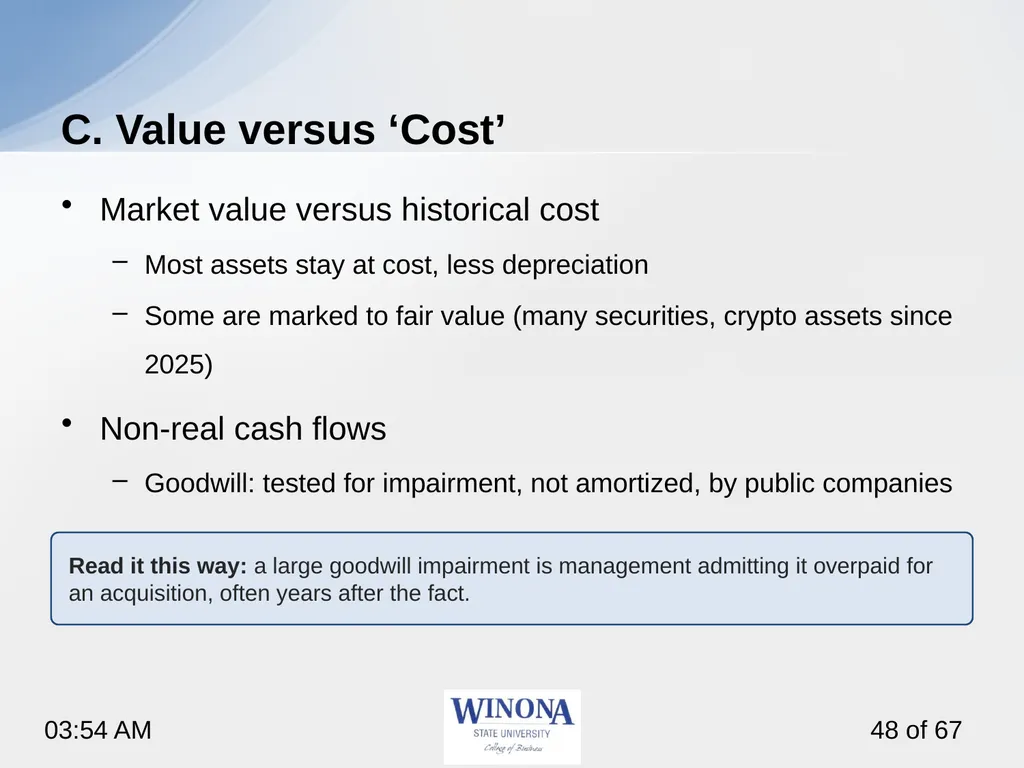
Market value versus historical cost
Most assets stay at cost, less depreciation
Some are marked to fair value (many securities, crypto assets since 2025)
Non-real cash flows
Goodwill: tested for impairment, not amortized, by public companies C. Value versus ‘Cost’ Read it this way: a large goodwill impairment is management admitting it overpaid for an acquisition, often years after the fact.<br>
Most assets stay at cost, less depreciation
Some are marked to fair value (many securities, crypto assets since 2025)
Non-real cash flows
Goodwill: tested for impairment, not amortized, by public companies C. Value versus ‘Cost’ Read it this way: a large goodwill impairment is management admitting it overpaid for an acquisition, often years after the fact.<br>
49
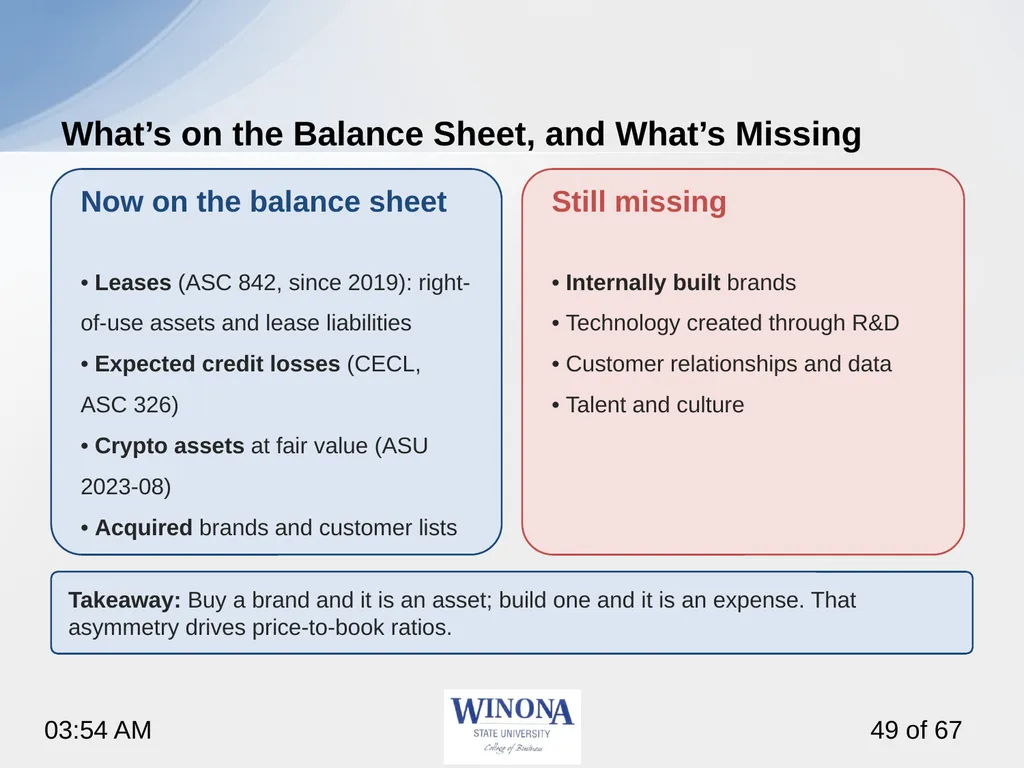
What’s on the Balance Sheet, and What’s Missing Now on the balance sheet
• Leases (ASC 842, since 2019): right-of-use assets and lease liabilities
• Expected credit losses (CECL, ASC 326)
• Crypto assets at fair value (ASU 2023-08)
• Acquired brands and customer lists Still missing
• Internally built brands
• Technology created through R&D
• Customer relationships and data
• Talent and culture Takeaway: Buy a brand and it is an asset; build one and it is an expense. That asymmetry drives price-to-book ratios.<br>
• Leases (ASC 842, since 2019): right-of-use assets and lease liabilities
• Expected credit losses (CECL, ASC 326)
• Crypto assets at fair value (ASU 2023-08)
• Acquired brands and customer lists Still missing
• Internally built brands
• Technology created through R&D
• Customer relationships and data
• Talent and culture Takeaway: Buy a brand and it is an asset; build one and it is an expense. That asymmetry drives price-to-book ratios.<br>
50
3.C Statement of Cash Flows<br>
51
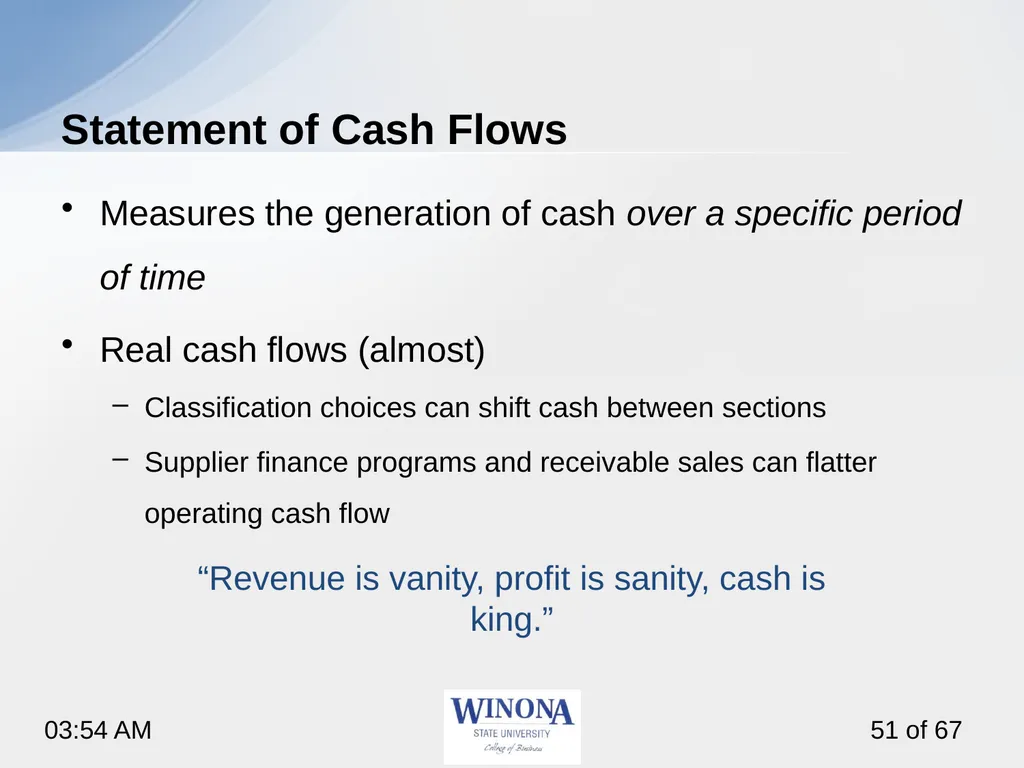
Measures the generation of cash over a specific period of time
Real cash flows (almost)
Classification choices can shift cash between sections
Supplier finance programs and receivable sales can flatter operating cash flow Statement of Cash Flows “Revenue is vanity, profit is sanity, cash is king.”<br>
Real cash flows (almost)
Classification choices can shift cash between sections
Supplier finance programs and receivable sales can flatter operating cash flow Statement of Cash Flows “Revenue is vanity, profit is sanity, cash is king.”<br>
52
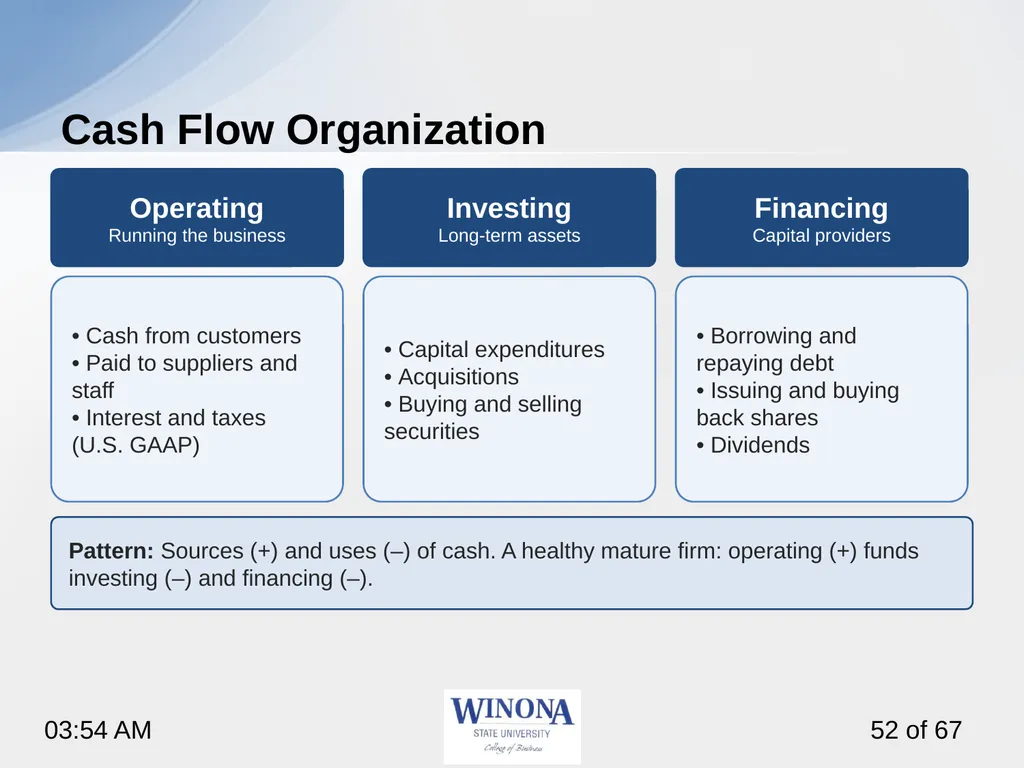
Cash Flow Organization Operating
Running the business • Cash from customers
• Paid to suppliers and staff
• Interest and taxes (U.S. GAAP) Investing
Long-term assets • Capital expenditures
• Acquisitions
• Buying and selling securities Financing
Capital providers • Borrowing and repaying debt
• Issuing and buying back shares
• Dividends Pattern: Sources (+) and uses (–) of cash. A healthy mature firm: operating (+) funds investing (–) and financing (–).<br>
Running the business • Cash from customers
• Paid to suppliers and staff
• Interest and taxes (U.S. GAAP) Investing
Long-term assets • Capital expenditures
• Acquisitions
• Buying and selling securities Financing
Capital providers • Borrowing and repaying debt
• Issuing and buying back shares
• Dividends Pattern: Sources (+) and uses (–) of cash. A healthy mature firm: operating (+) funds investing (–) and financing (–).<br>
53
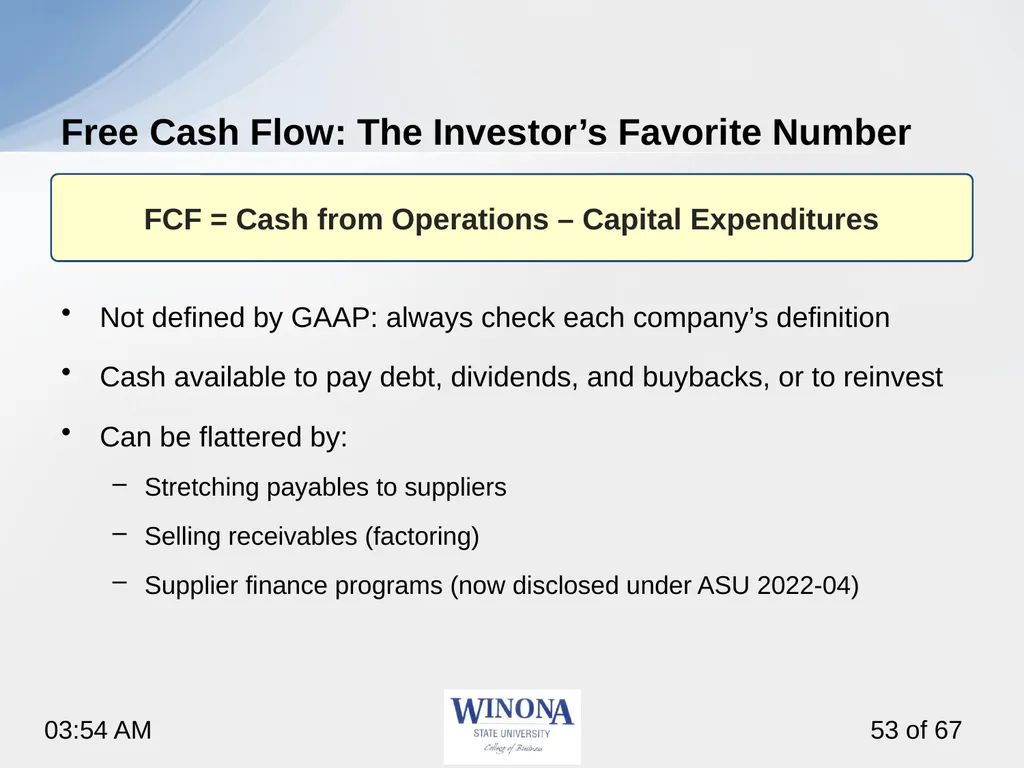
Not defined by GAAP: always check each company’s definition
Cash available to pay debt, dividends, and buybacks, or to reinvest
Can be flattered by:
Stretching payables to suppliers
Selling receivables (factoring)
Supplier finance programs (now disclosed under ASU 2022-04) Free Cash Flow: The Investor’s Favorite Number FCF = Cash from Operations – Capital Expenditures<br>
Cash available to pay debt, dividends, and buybacks, or to reinvest
Can be flattered by:
Stretching payables to suppliers
Selling receivables (factoring)
Supplier finance programs (now disclosed under ASU 2022-04) Free Cash Flow: The Investor’s Favorite Number FCF = Cash from Operations – Capital Expenditures<br>
54
3.D Other Statements<br>
55
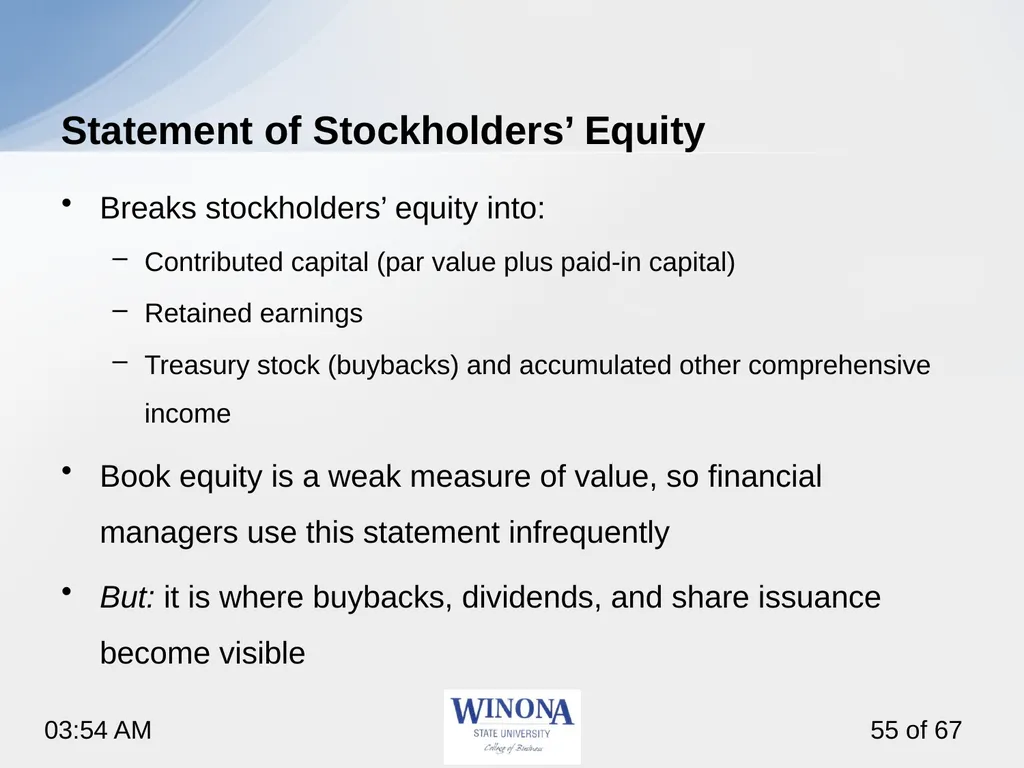
Breaks stockholders’ equity into:
Contributed capital (par value plus paid-in capital)
Retained earnings
Treasury stock (buybacks) and accumulated other comprehensive income
Book equity is a weak measure of value, so financial managers use this statement infrequently
But: it is where buybacks, dividends, and share issuance become visible Statement of Stockholders’ Equity<br>
Contributed capital (par value plus paid-in capital)
Retained earnings
Treasury stock (buybacks) and accumulated other comprehensive income
Book equity is a weak measure of value, so financial managers use this statement infrequently
But: it is where buybacks, dividends, and share issuance become visible Statement of Stockholders’ Equity<br>
56
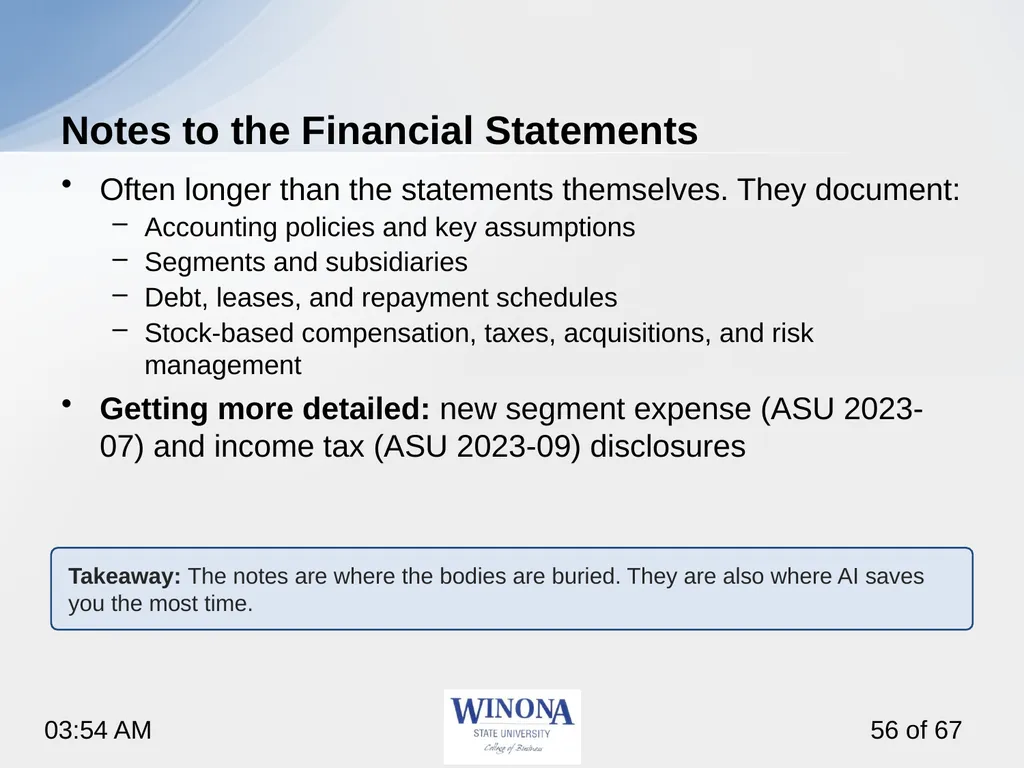
Often longer than the statements themselves. They document:
Accounting policies and key assumptions
Segments and subsidiaries
Debt, leases, and repayment schedules
Stock-based compensation, taxes, acquisitions, and risk management
Getting more detailed: new segment expense (ASU 2023-07) and income tax (ASU 2023-09) disclosures Notes to the Financial Statements Takeaway: The notes are where the bodies are buried. They are also where AI saves you the most time.<br>
Accounting policies and key assumptions
Segments and subsidiaries
Debt, leases, and repayment schedules
Stock-based compensation, taxes, acquisitions, and risk management
Getting more detailed: new segment expense (ASU 2023-07) and income tax (ASU 2023-09) disclosures Notes to the Financial Statements Takeaway: The notes are where the bodies are buried. They are also where AI saves you the most time.<br>
57
4. AI and Data Analysis<br>
58
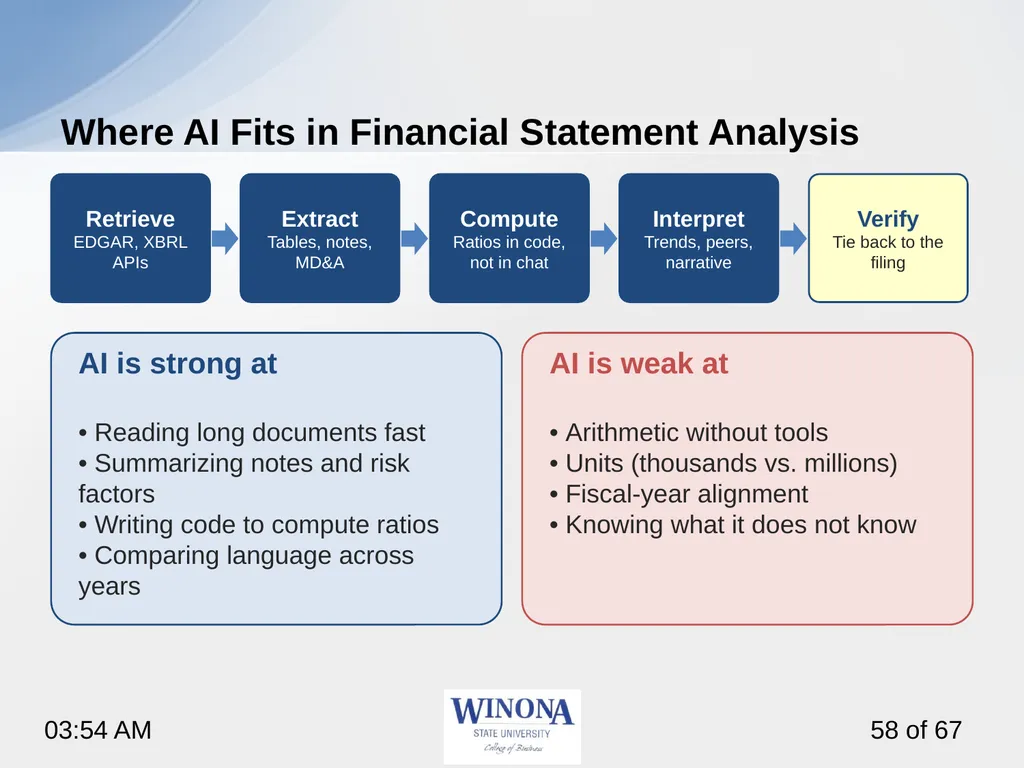
Where AI Fits in Financial Statement Analysis Retrieve
EDGAR, XBRL APIs Extract
Tables, notes, MD&A Compute
Ratios in code, not in chat Interpret
Trends, peers, narrative Verify
Tie back to the filing AI is strong at
• Reading long documents fast
• Summarizing notes and risk factors
• Writing code to compute ratios
• Comparing language across years AI is weak at
• Arithmetic without tools
• Units (thousands vs. millions)
• Fiscal-year alignment
• Knowing what it does not know<br>
EDGAR, XBRL APIs Extract
Tables, notes, MD&A Compute
Ratios in code, not in chat Interpret
Trends, peers, narrative Verify
Tie back to the filing AI is strong at
• Reading long documents fast
• Summarizing notes and risk factors
• Writing code to compute ratios
• Comparing language across years AI is weak at
• Arithmetic without tools
• Units (thousands vs. millions)
• Fiscal-year alignment
• Knowing what it does not know<br>
59
Every number in a 10-K or 10-Q statement is tagged in Inline XBRL (e.g., us-gaap:Revenues)
The SEC’s free APIs (data.sec.gov) return those tags as JSON
Exact values, units, and periods: no PDF scraping, no OCR errors
Prompt to try: Start with Structured Data: XBRL “Write Python that pulls Costco’s Revenues and NetIncomeLoss from the SEC companyfacts API for the last five fiscal years and computes net margin. Include a User-Agent header, as the SEC requires.” Rule: let AI write the code; let the code do the math.<br>
The SEC’s free APIs (data.sec.gov) return those tags as JSON
Exact values, units, and periods: no PDF scraping, no OCR errors
Prompt to try: Start with Structured Data: XBRL “Write Python that pulls Costco’s Revenues and NetIncomeLoss from the SEC companyfacts API for the last five fiscal years and computes net margin. Include a User-Agent header, as the SEC requires.” Rule: let AI write the code; let the code do the math.<br>
60
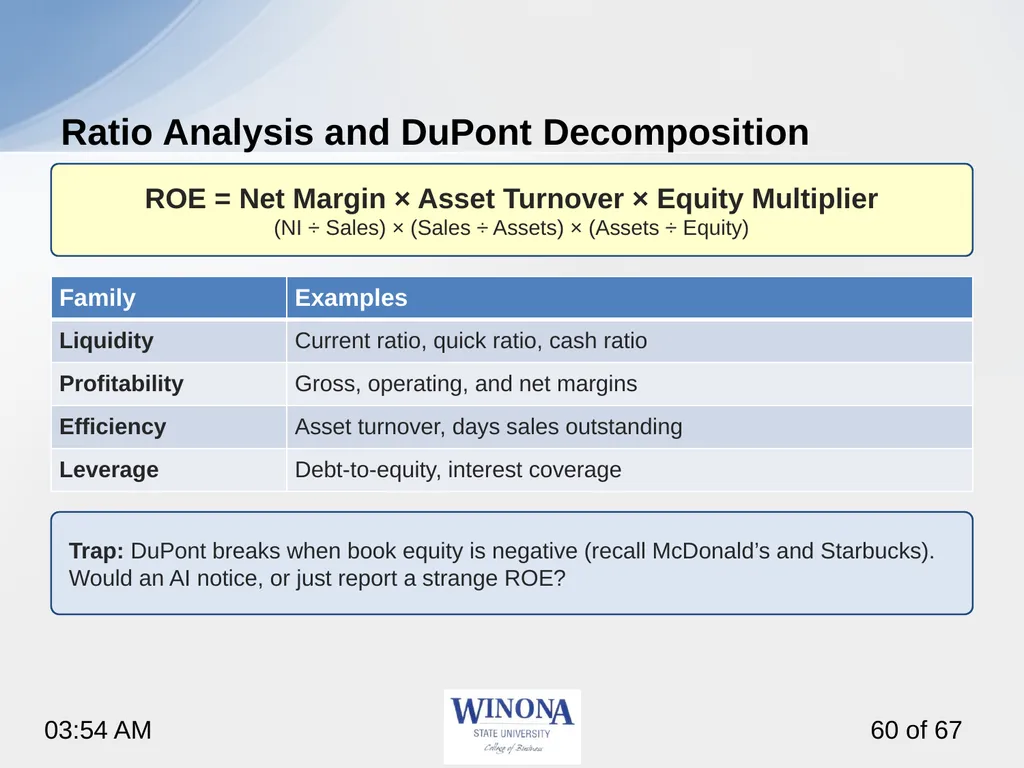
Ratio Analysis and DuPont Decomposition ROE = Net Margin × Asset Turnover × Equity Multiplier
(NI ÷ Sales) × (Sales ÷ Assets) × (Assets ÷ Equity) Trap: DuPont breaks when book equity is negative (recall McDonald’s and Starbucks). Would an AI notice, or just report a strange ROE?<br>
(NI ÷ Sales) × (Sales ÷ Assets) × (Assets ÷ Equity) Trap: DuPont breaks when book equity is negative (recall McDonald’s and Starbucks). Would an AI notice, or just report a strange ROE?<br>
61
Compare CFO to net income: persistently below 1 means earnings are running ahead of cash
Accruals matter: high-accrual firms tend to have lower future returns (Sloan 1996)
Track the cash conversion cycle: Cash Flow Quality and Working Capital CCC = DSO + DIO – DPO Prompt: “Using the last eight quarters of this company’s 10-Q data, compute DSO, DIO, DPO, and the cash conversion cycle in a table. Flag any quarter where CCC rose more than 10 days, and quote the MD&A explanation, if any.”<br>
Accruals matter: high-accrual firms tend to have lower future returns (Sloan 1996)
Track the cash conversion cycle: Cash Flow Quality and Working Capital CCC = DSO + DIO – DPO Prompt: “Using the last eight quarters of this company’s 10-Q data, compute DSO, DIO, DPO, and the cash conversion cycle in a table. Flag any quarter where CCC rose more than 10 days, and quote the MD&A explanation, if any.”<br>
62
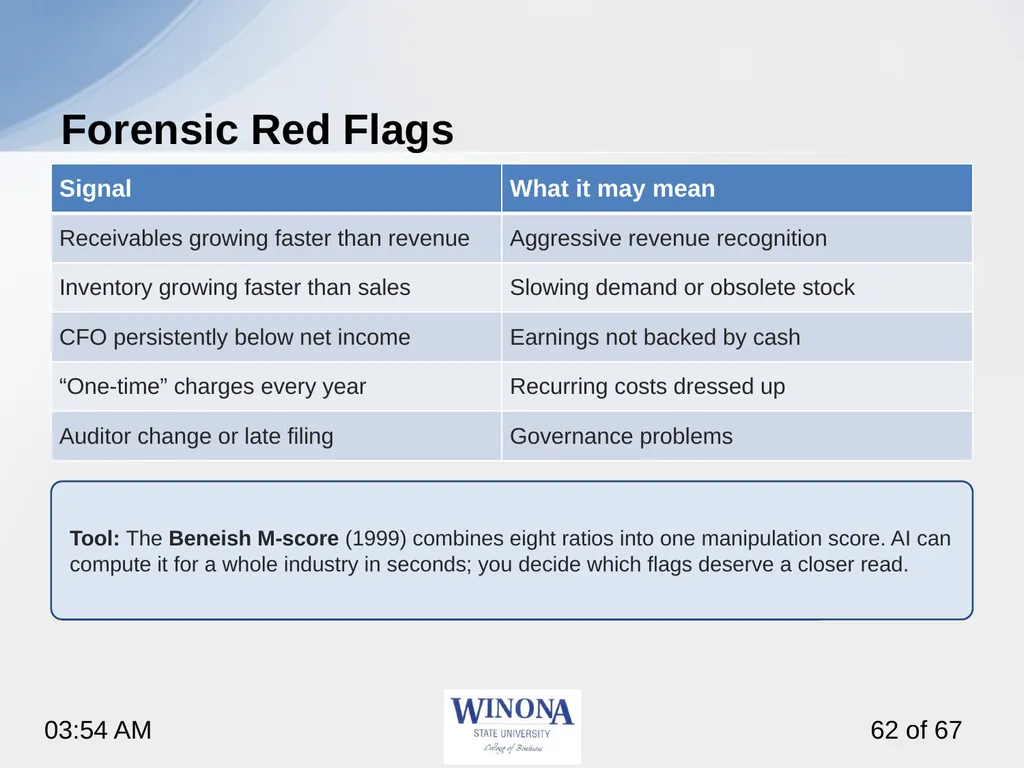
Forensic Red Flags Tool: The Beneish M-score (1999) combines eight ratios into one manipulation score. AI can compute it for a whole industry in seconds; you decide which flags deserve a closer read.<br>
63
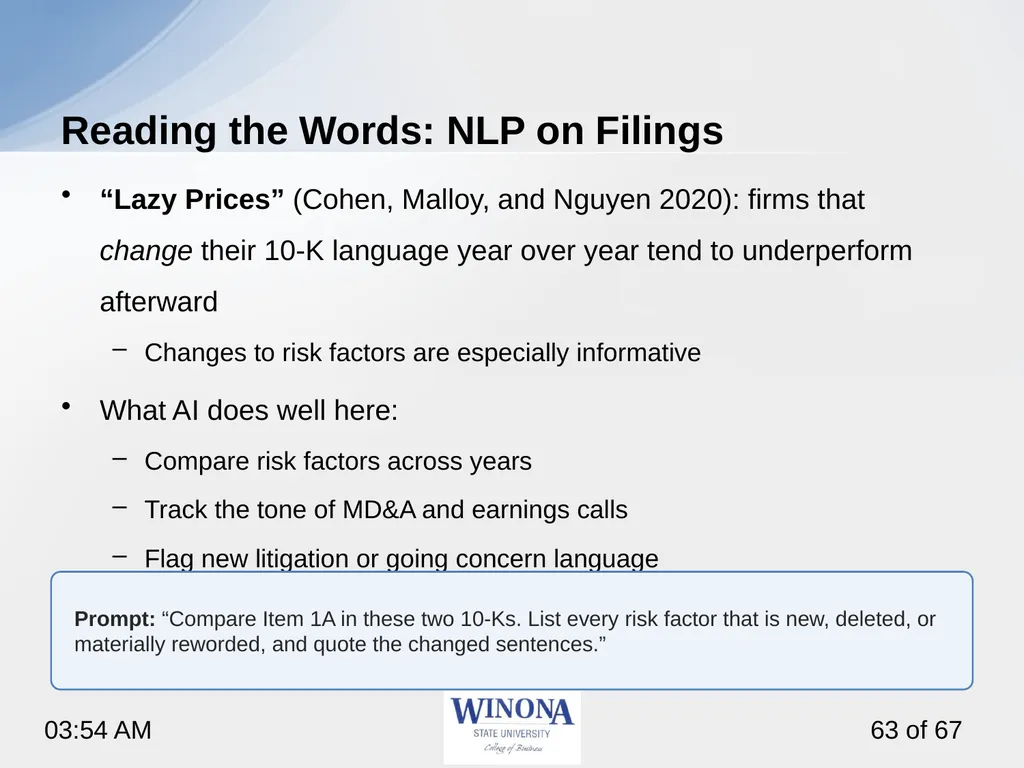
“Lazy Prices” (Cohen, Malloy, and Nguyen 2020): firms that change their 10-K language year over year tend to underperform afterward
Changes to risk factors are especially informative
What AI does well here:
Compare risk factors across years
Track the tone of MD&A and earnings calls
Flag new litigation or going concern language Reading the Words: NLP on Filings Prompt: “Compare Item 1A in these two 10-Ks. List every risk factor that is new, deleted, or materially reworded, and quote the changed sentences.”<br>
Changes to risk factors are especially informative
What AI does well here:
Compare risk factors across years
Track the tone of MD&A and earnings calls
Flag new litigation or going concern language Reading the Words: NLP on Filings Prompt: “Compare Item 1A in these two 10-Ks. List every risk factor that is new, deleted, or materially reworded, and quote the changed sentences.”<br>
64
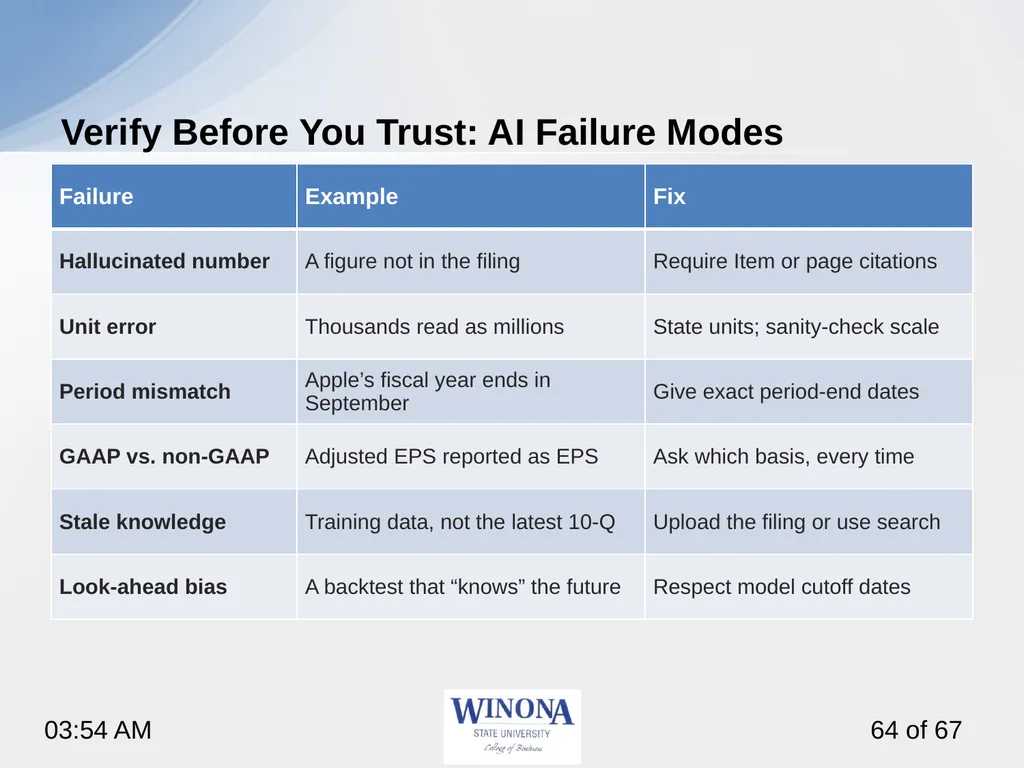
Verify Before You Trust: AI Failure Modes<br>
65
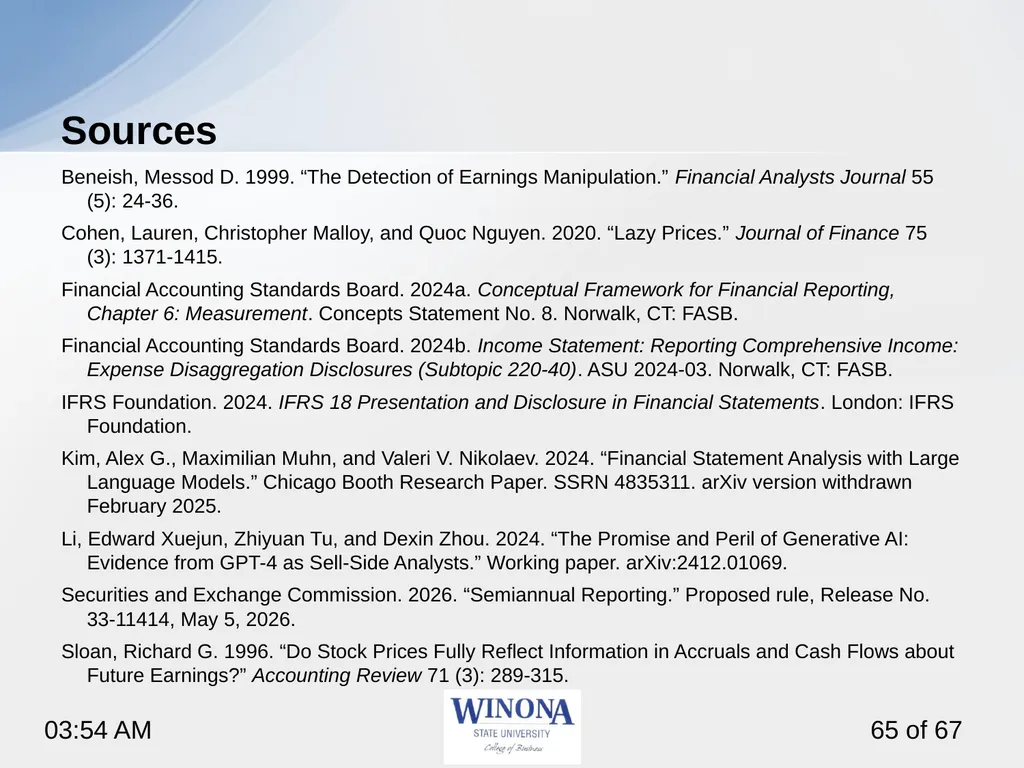
Beneish, Messod D. 1999. “The Detection of Earnings Manipulation.” Financial Analysts Journal 55 (5): 24-36.
Cohen, Lauren, Christopher Malloy, and Quoc Nguyen. 2020. “Lazy Prices.” Journal of Finance 75 (3): 1371-1415.
Financial Accounting Standards Board. 2024a. Conceptual Framework for Financial Reporting, Chapter 6: Measurement. Concepts Statement No. 8. Norwalk, CT: FASB.
Financial Accounting Standards Board. 2024b. Income Statement: Reporting Comprehensive Income: Expense Disaggregation Disclosures (Subtopic 220-40). ASU 2024-03. Norwalk, CT: FASB.
IFRS Foundation. 2024. IFRS 18 Presentation and Disclosure in Financial Statements. London: IFRS Foundation.
Kim, Alex G., Maximilian Muhn, and Valeri V. Nikolaev. 2024. “Financial Statement Analysis with Large Language Models.” Chicago Booth Research Paper. SSRN 4835311. arXiv version withdrawn February 2025.
Li, Edward Xuejun, Zhiyuan Tu, and Dexin Zhou. 2024. “The Promise and Peril of Generative AI: Evidence from GPT-4 as Sell-Side Analysts.” Working paper. arXiv:2412.01069.
Securities and Exchange Commission. 2026. “Semiannual Reporting.” Proposed rule, Release No. 33-11414, May 5, 2026.
Sloan, Richard G. 1996. “Do Stock Prices Fully Reflect Information in Accruals and Cash Flows about Future Earnings?” Accounting Review 71 (3): 289-315. Sources<br>
Cohen, Lauren, Christopher Malloy, and Quoc Nguyen. 2020. “Lazy Prices.” Journal of Finance 75 (3): 1371-1415.
Financial Accounting Standards Board. 2024a. Conceptual Framework for Financial Reporting, Chapter 6: Measurement. Concepts Statement No. 8. Norwalk, CT: FASB.
Financial Accounting Standards Board. 2024b. Income Statement: Reporting Comprehensive Income: Expense Disaggregation Disclosures (Subtopic 220-40). ASU 2024-03. Norwalk, CT: FASB.
IFRS Foundation. 2024. IFRS 18 Presentation and Disclosure in Financial Statements. London: IFRS Foundation.
Kim, Alex G., Maximilian Muhn, and Valeri V. Nikolaev. 2024. “Financial Statement Analysis with Large Language Models.” Chicago Booth Research Paper. SSRN 4835311. arXiv version withdrawn February 2025.
Li, Edward Xuejun, Zhiyuan Tu, and Dexin Zhou. 2024. “The Promise and Peril of Generative AI: Evidence from GPT-4 as Sell-Side Analysts.” Working paper. arXiv:2412.01069.
Securities and Exchange Commission. 2026. “Semiannual Reporting.” Proposed rule, Release No. 33-11414, May 5, 2026.
Sloan, Richard G. 1996. “Do Stock Prices Fully Reflect Information in Accruals and Cash Flows about Future Earnings?” Accounting Review 71 (3): 289-315. Sources<br>
66
5. Hands-On Friday:
Hermes Agent 2<br>
67
Hermes Agent 2:
Multi-Step Research, Persistence, and Scheduled Tasks
FIN 450 Lab Report 6
You must have Hermes Agent installed before this lab. Friday Lab Prep<br>
Multi-Step Research, Persistence, and Scheduled Tasks
FIN 450 Lab Report 6
You must have Hermes Agent installed before this lab. Friday Lab Prep<br>