
Topic-Orientation & Information Ordering Ling573
CS
Published · 68 slides · 0 views

1 / 1









Description
Topic-Orientation Information Ordering Ling573 Systems Applications April 21, 2016 Notes Deliverable 2: Coderesults Updated project report Presentations next week: Doodle poll will be sent after class Please email me slide deck (or
Related Topics
Share
Embed code
Download this presentation From Below
"Topic-Orientation & Information Ordering Ling573" is the property of its rightful owner. Permission is granted to download and print the materials on this website for personal, non-commercial use only, and to display it on your personal computer provided you do not modify the materials and that you retain all copyright notices contained in the materials. By downloading content from our website, you accept the terms of this agreement.
Presentation Transcript
01
Topic-Orientation &
Information Ordering Ling573
Systems & Applications
April 21, 2016<br>
Systems & Applications
April 21, 2016<br>
02
Notes Deliverable 2:
Code/results
Updated project report
Presentations next week:
Doodle poll will be sent after class
Please email me slide deck (or pointer) by noon
If planning to present remotely, contact me to check audio<br>
Code/results
Updated project report
Presentations next week:
Doodle poll will be sent after class
Please email me slide deck (or pointer) by noon
If planning to present remotely, contact me to check audio<br>
03
Deliverable #3 Goals:
Focus on information ordering
Using one or more of:
Chronology, Cohesion, Coherence
Continue to improve content selection
Incorporate some guided/topic-orientation
Same deliverable structure as D#2
Due in 3 weeks:
Code/results; Updated report<br>
Focus on information ordering
Using one or more of:
Chronology, Cohesion, Coherence
Continue to improve content selection
Incorporate some guided/topic-orientation
Same deliverable structure as D#2
Due in 3 weeks:
Code/results; Updated report<br>
04
Roadmap Topic-focused summarization
Focusing existing approaches
LexRank
CLASSY, FastSumm
Information Ordering:
Basic approaches
Variants on chronological ordering
Enhancing cohesion<br>
Focusing existing approaches
LexRank
CLASSY, FastSumm
Information Ordering:
Basic approaches
Variants on chronological ordering
Enhancing cohesion<br>
05
Key Idea (aka ”query-focused”, “guided”)
Motivations:
Extrinsic task vs generic
Why are we creating this summary?
Viewed as complex question answering (vs factoid)
High variation in human summaries
Depending on perspective different content focused
Idea:
Target response to specific question, topic in docs
Later TACs identify topic categories and aspects
E.g Natural disasters: who, what, where, when..<br>
Motivations:
Extrinsic task vs generic
Why are we creating this summary?
Viewed as complex question answering (vs factoid)
High variation in human summaries
Depending on perspective different content focused
Idea:
Target response to specific question, topic in docs
Later TACs identify topic categories and aspects
E.g Natural disasters: who, what, where, when..<br>
06
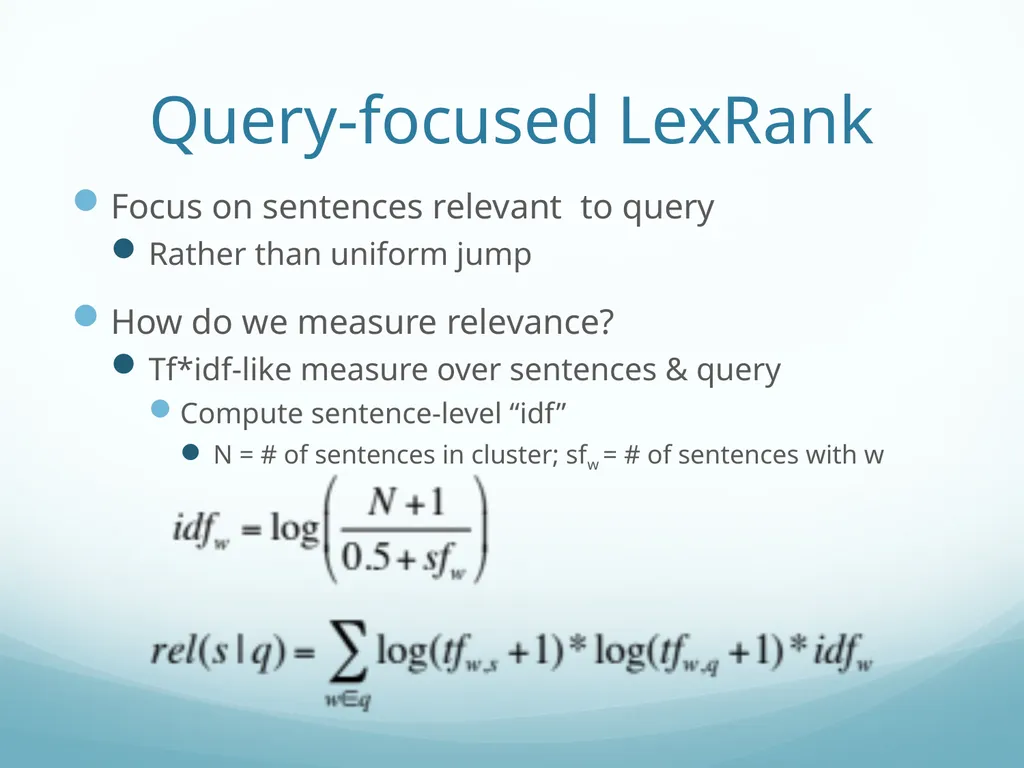
Query-focused LexRank Focus on sentences relevant to query
Rather than uniform jump
How do we measure relevance?
Tf*idf-like measure over sentences & query
Compute sentence-level “idf”
N = # of sentences in cluster; sfw = # of sentences with w<br>
Rather than uniform jump
How do we measure relevance?
Tf*idf-like measure over sentences & query
Compute sentence-level “idf”
N = # of sentences in cluster; sfw = # of sentences with w<br>
07
Updated LexRank Model Combines original similarity weighting w/query<br>
08
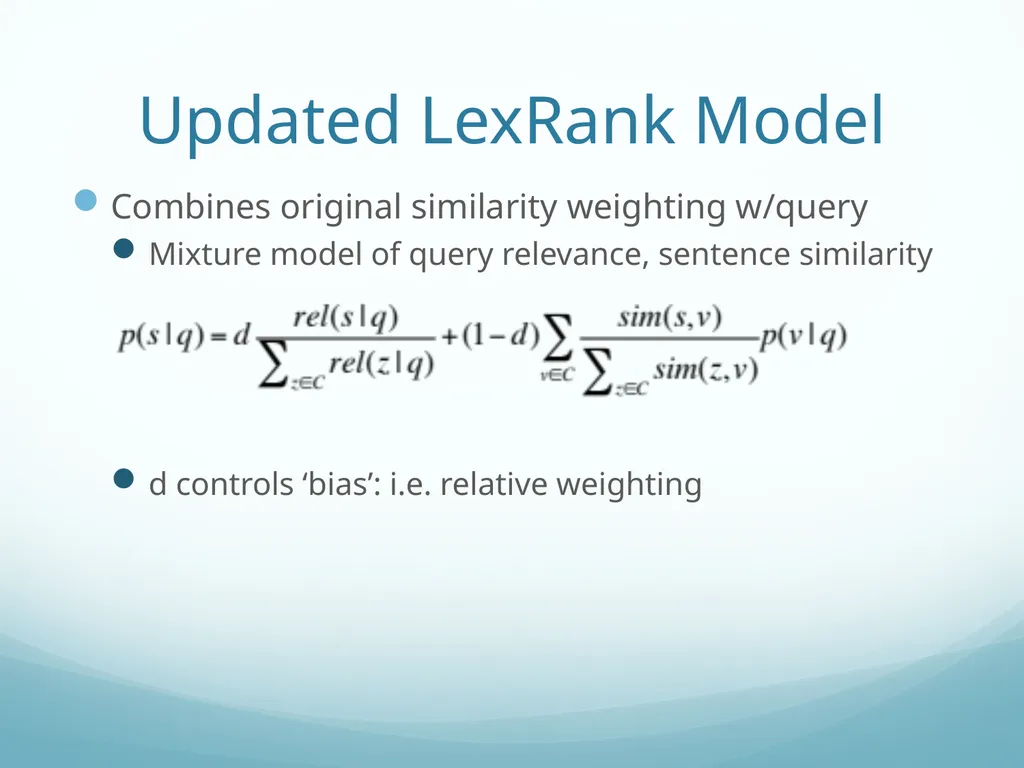
Updated LexRank Model Combines original similarity weighting w/query
Mixture model of query relevance, sentence similarity<br>
Mixture model of query relevance, sentence similarity<br>
09
Updated LexRank Model Combines original similarity weighting w/query
Mixture model of query relevance, sentence similarity
d controls ‘bias’: i.e. relative weighting<br>
Mixture model of query relevance, sentence similarity
d controls ‘bias’: i.e. relative weighting<br>
10
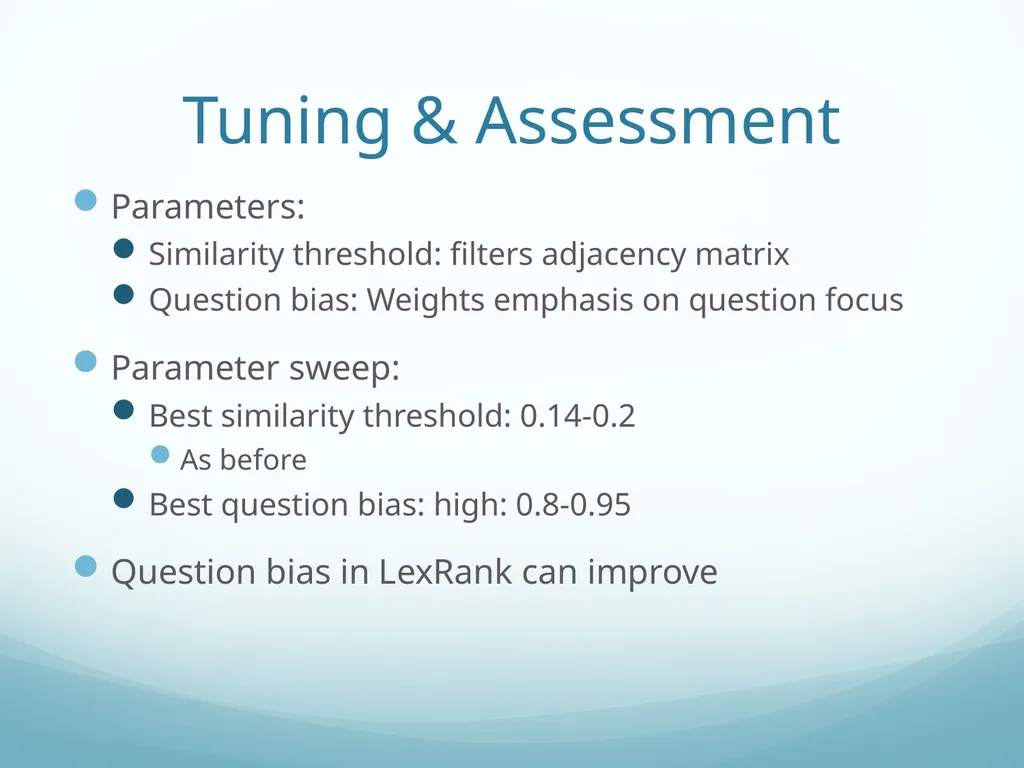
Tuning & Assessment Parameters:
Similarity threshold: filters adjacency matrix
Question bias: Weights emphasis on question focus<br>
Similarity threshold: filters adjacency matrix
Question bias: Weights emphasis on question focus<br>
11
Tuning & Assessment Parameters:
Similarity threshold: filters adjacency matrix
Question bias: Weights emphasis on question focus
Parameter sweep:
Best similarity threshold: 0.14-0.2
As before
Best question bias: high: 0.8-0.95<br>
Similarity threshold: filters adjacency matrix
Question bias: Weights emphasis on question focus
Parameter sweep:
Best similarity threshold: 0.14-0.2
As before
Best question bias: high: 0.8-0.95<br>
12
Tuning & Assessment Parameters:
Similarity threshold: filters adjacency matrix
Question bias: Weights emphasis on question focus
Parameter sweep:
Best similarity threshold: 0.14-0.2
As before
Best question bias: high: 0.8-0.95
Question bias in LexRank can improve<br>
Similarity threshold: filters adjacency matrix
Question bias: Weights emphasis on question focus
Parameter sweep:
Best similarity threshold: 0.14-0.2
As before
Best question bias: high: 0.8-0.95
Question bias in LexRank can improve<br>
13
Other Strategies Methods depend on base system design
All aim to incorporate similarity with query/topic<br>
All aim to incorporate similarity with query/topic<br>
14
Other Strategies Methods depend on base system design
All aim to incorporate similarity with query/topic
CLASSY HMM:<br>
All aim to incorporate similarity with query/topic
CLASSY HMM:<br>
15
Other Strategies Methods depend on base system design
All aim to incorporate similarity with query/topic
CLASSY HMM:
Add question overlap feature to HMM vector<br>
All aim to incorporate similarity with query/topic
CLASSY HMM:
Add question overlap feature to HMM vector<br>
16
Other Strategies Methods depend on base system design
All aim to incorporate similarity with query/topic
CLASSY HMM:
Add question overlap feature to HMM vector
Log (# query tokens in sentence + 1)
Query tokens: tagged as noun, verb, adj, adv, or proper nouns<br>
All aim to incorporate similarity with query/topic
CLASSY HMM:
Add question overlap feature to HMM vector
Log (# query tokens in sentence + 1)
Query tokens: tagged as noun, verb, adj, adv, or proper nouns<br>
17
Other Strategies Methods depend on base system design
All aim to incorporate similarity with query/topic
CLASSY HMM:
Add question overlap feature to HMM vector
Log (# query tokens in sentence + 1)
Query tokens: tagged as noun, verb, adj, adv, or proper nouns
Other, more aggressive approach detrimental
FastSumm: SVM regression on sentences<br>
All aim to incorporate similarity with query/topic
CLASSY HMM:
Add question overlap feature to HMM vector
Log (# query tokens in sentence + 1)
Query tokens: tagged as noun, verb, adj, adv, or proper nouns
Other, more aggressive approach detrimental
FastSumm: SVM regression on sentences<br>
18
Other Strategies Methods depend on base system design
All aim to incorporate similarity with query/topic
CLASSY HMM:
Add question overlap feature to HMM vector
Log (# query tokens in sentence + 1)
Query tokens: tagged as noun, verb, adj, adv, or proper nouns
Other, more aggressive approach detrimental
FastSumm: SVM regression on sentences
Adds topic title frequency feature:
Proportion of words in sent which appear in title<br>
All aim to incorporate similarity with query/topic
CLASSY HMM:
Add question overlap feature to HMM vector
Log (# query tokens in sentence + 1)
Query tokens: tagged as noun, verb, adj, adv, or proper nouns
Other, more aggressive approach detrimental
FastSumm: SVM regression on sentences
Adds topic title frequency feature:
Proportion of words in sent which appear in title<br>
19
Overview Many similar strategies:
Features, weighting, ranking: overlap based<br>
Features, weighting, ranking: overlap based<br>
20
Overview Many similar strategies:
Features, weighting, ranking: overlap based
Actual evaluation impact:
Not necessarily very large (e.g. 0.003 ROUGE)
But can be useful<br>
Features, weighting, ranking: overlap based
Actual evaluation impact:
Not necessarily very large (e.g. 0.003 ROUGE)
But can be useful<br>
21
Overview Many similar strategies:
Features, weighting, ranking: overlap based
Actual evaluation impact:
Not necessarily very large (e.g. 0.003 ROUGE)
But can be useful
Aggressive approaches can have large negative impact
I.e. explicitly adding NER spans<br>
Features, weighting, ranking: overlap based
Actual evaluation impact:
Not necessarily very large (e.g. 0.003 ROUGE)
But can be useful
Aggressive approaches can have large negative impact
I.e. explicitly adding NER spans<br>
22
Optimization Approaches to Reducing Redundancy DPP: Determinantal Point Processes (Kulesza &Taskar, ‘12)
Set models balancing information importance w/diversity
ICSISumm: Uses Integer Linear Programming frame
Optimizes coverage of key bigrams weighted by doc freq
OCCAMS_V
Uses LSA (Latent Semantic Analysis) to weight terms
Sentence selection via optimization problems:
Budgeted maximal coverage; knapsack<br>
Set models balancing information importance w/diversity
ICSISumm: Uses Integer Linear Programming frame
Optimizes coverage of key bigrams weighted by doc freq
OCCAMS_V
Uses LSA (Latent Semantic Analysis) to weight terms
Sentence selection via optimization problems:
Budgeted maximal coverage; knapsack<br>
23
Information Ordering<br>
24
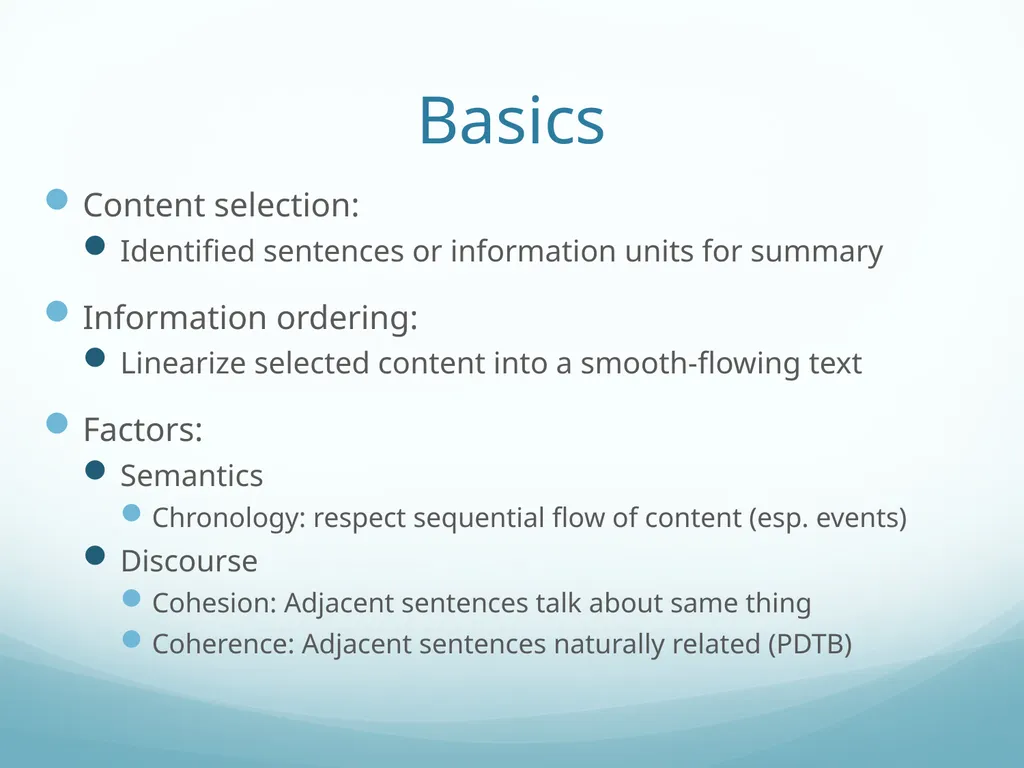
Basics Content selection:
Identified sentences or information units for summary<br>
Identified sentences or information units for summary<br>
25
Basics Content selection:
Identified sentences or information units for summary
Information ordering:
Linearize selected content into a smooth-flowing text<br>
Identified sentences or information units for summary
Information ordering:
Linearize selected content into a smooth-flowing text<br>
26
Basics Content selection:
Identified sentences or information units for summary
Information ordering:
Linearize selected content into a smooth-flowing text
Factors:
Semantics<br>
Identified sentences or information units for summary
Information ordering:
Linearize selected content into a smooth-flowing text
Factors:
Semantics<br>
27
Basics Content selection:
Identified sentences or information units for summary
Information ordering:
Linearize selected content into a smooth-flowing text
Factors:
Semantics
Chronology: respect sequential flow of content (esp. events)
Discourse<br>
Identified sentences or information units for summary
Information ordering:
Linearize selected content into a smooth-flowing text
Factors:
Semantics
Chronology: respect sequential flow of content (esp. events)
Discourse<br>
28
Basics Content selection:
Identified sentences or information units for summary
Information ordering:
Linearize selected content into a smooth-flowing text
Factors:
Semantics
Chronology: respect sequential flow of content (esp. events)
Discourse
Cohesion: Adjacent sentences talk about same thing
Coherence: Adjacent sentences naturally related (PDTB)<br>
Identified sentences or information units for summary
Information ordering:
Linearize selected content into a smooth-flowing text
Factors:
Semantics
Chronology: respect sequential flow of content (esp. events)
Discourse
Cohesion: Adjacent sentences talk about same thing
Coherence: Adjacent sentences naturally related (PDTB)<br>
29
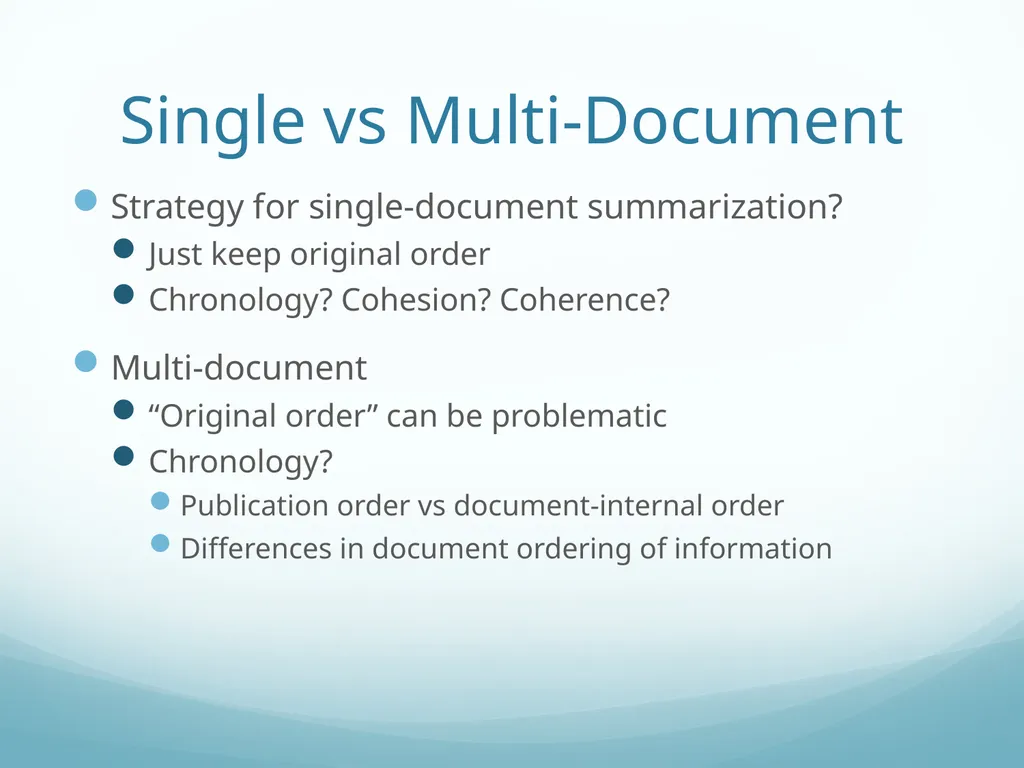
Single vs Multi-Document Strategy for single-document summarization?<br>
30
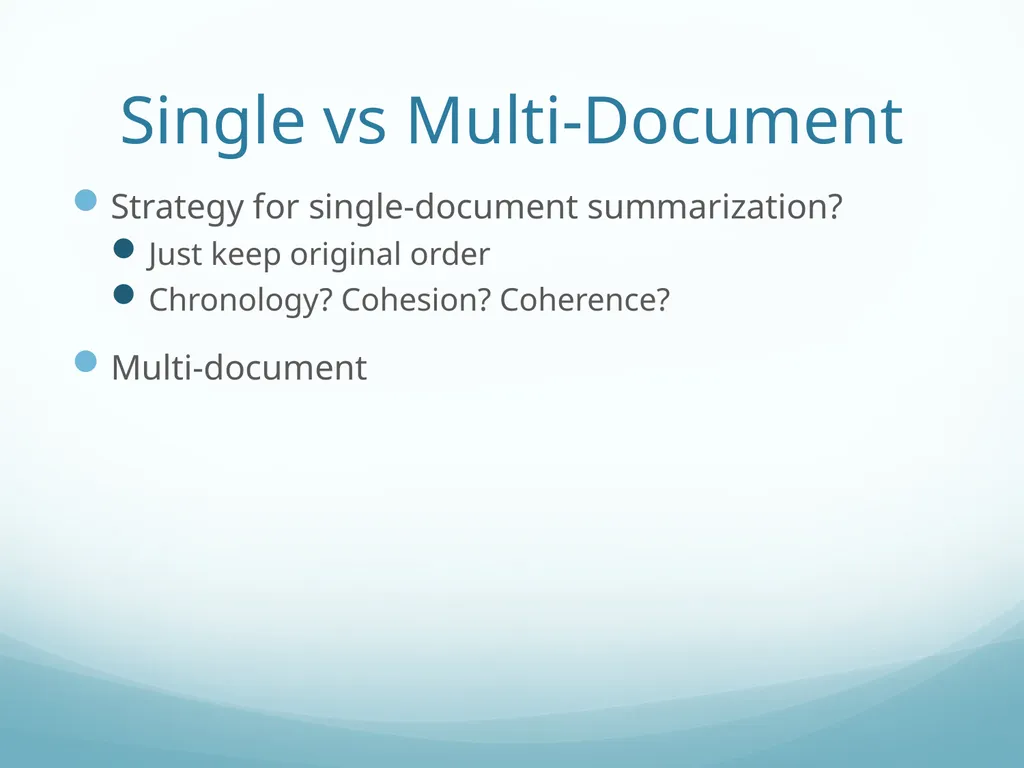
Single vs Multi-Document Strategy for single-document summarization?
Just keep original order
Chronology? Cohesion? Coherence?
Multi-document<br>
Just keep original order
Chronology? Cohesion? Coherence?
Multi-document<br>
31
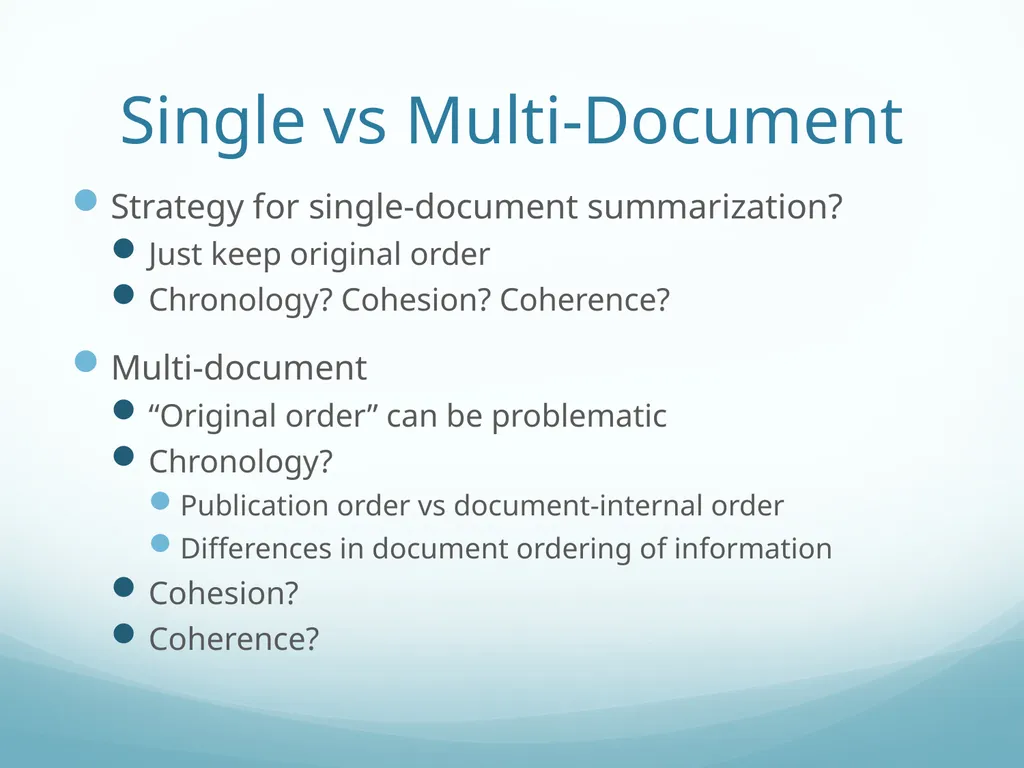
Single vs Multi-Document Strategy for single-document summarization?
Just keep original order
Chronology? Cohesion? Coherence?
Multi-document
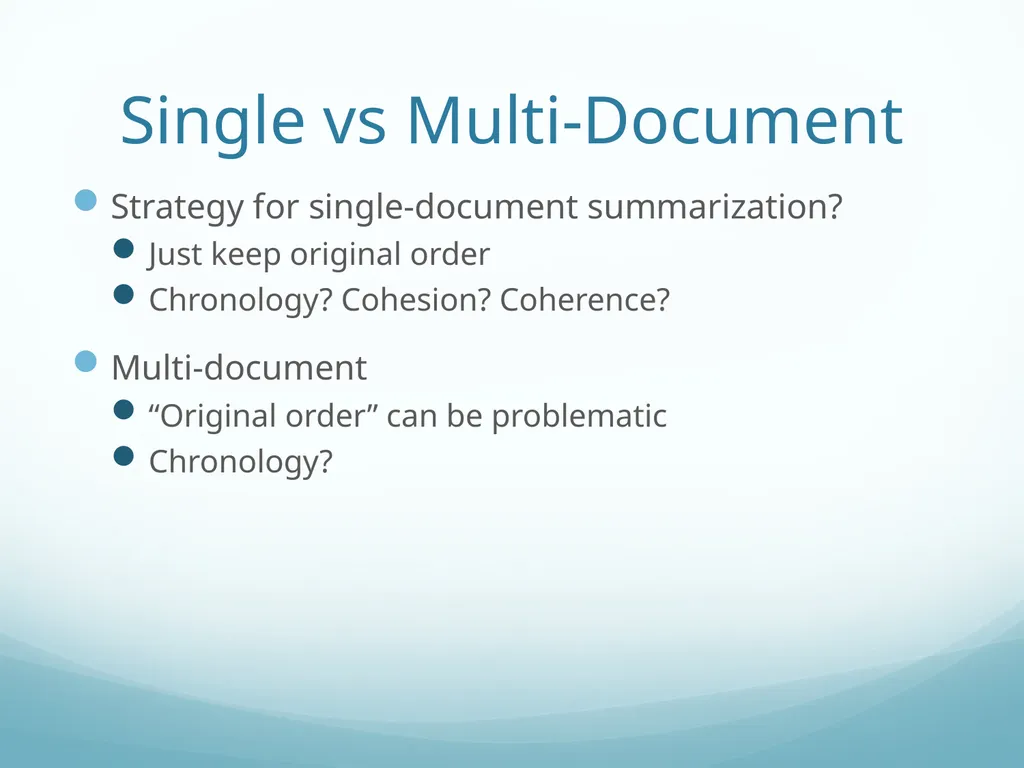
“Original order” can be problematic
Chronology?<br>
Just keep original order
Chronology? Cohesion? Coherence?
Multi-document
“Original order” can be problematic
Chronology?<br>
32
Single vs Multi-Document Strategy for single-document summarization?
Just keep original order
Chronology? Cohesion? Coherence?
Multi-document
“Original order” can be problematic
Chronology?
Publication order vs document-internal order
Differences in document ordering of information<br>
Just keep original order
Chronology? Cohesion? Coherence?
Multi-document
“Original order” can be problematic
Chronology?
Publication order vs document-internal order
Differences in document ordering of information<br>
33
Single vs Multi-Document Strategy for single-document summarization?
Just keep original order
Chronology? Cohesion? Coherence?
Multi-document
“Original order” can be problematic
Chronology?
Publication order vs document-internal order
Differences in document ordering of information
Cohesion?
Coherence?<br>
Just keep original order
Chronology? Cohesion? Coherence?
Multi-document
“Original order” can be problematic
Chronology?
Publication order vs document-internal order
Differences in document ordering of information
Cohesion?
Coherence?<br>
34
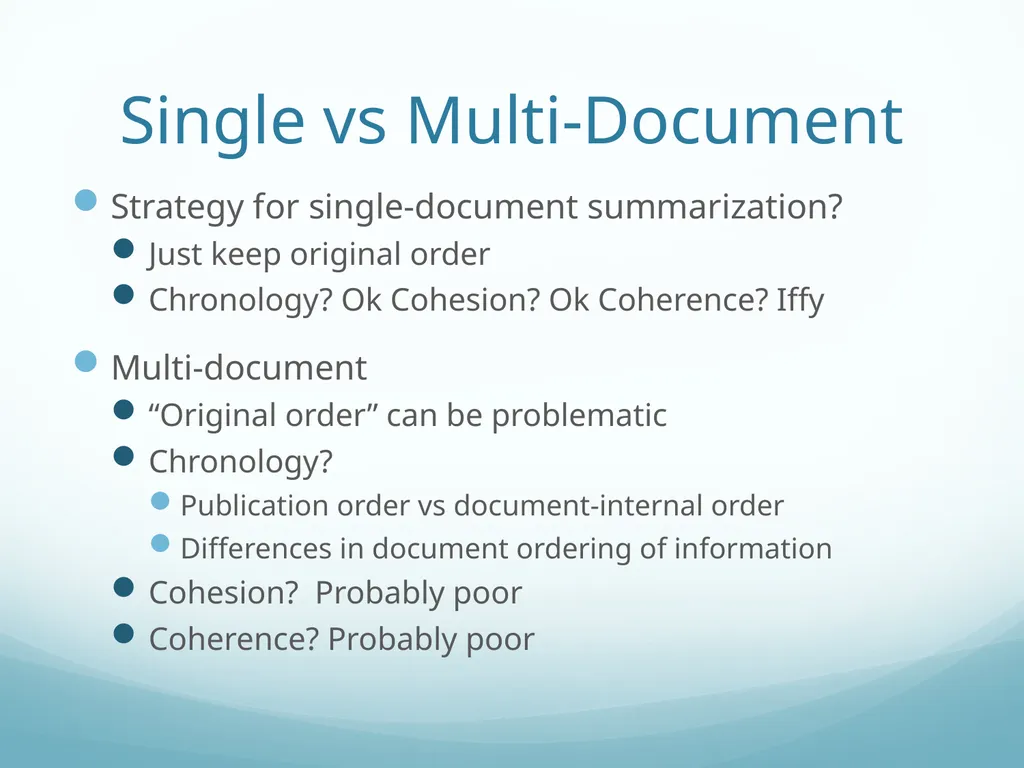
Single vs Multi-Document Strategy for single-document summarization?
Just keep original order
Chronology? Ok Cohesion? Ok Coherence? Iffy
Multi-document
“Original order” can be problematic
Chronology?
Publication order vs document-internal order
Differences in document ordering of information
Cohesion? Probably poor
Coherence? Probably poor<br>
Just keep original order
Chronology? Ok Cohesion? Ok Coherence? Iffy
Multi-document
“Original order” can be problematic
Chronology?
Publication order vs document-internal order
Differences in document ordering of information
Cohesion? Probably poor
Coherence? Probably poor<br>
35
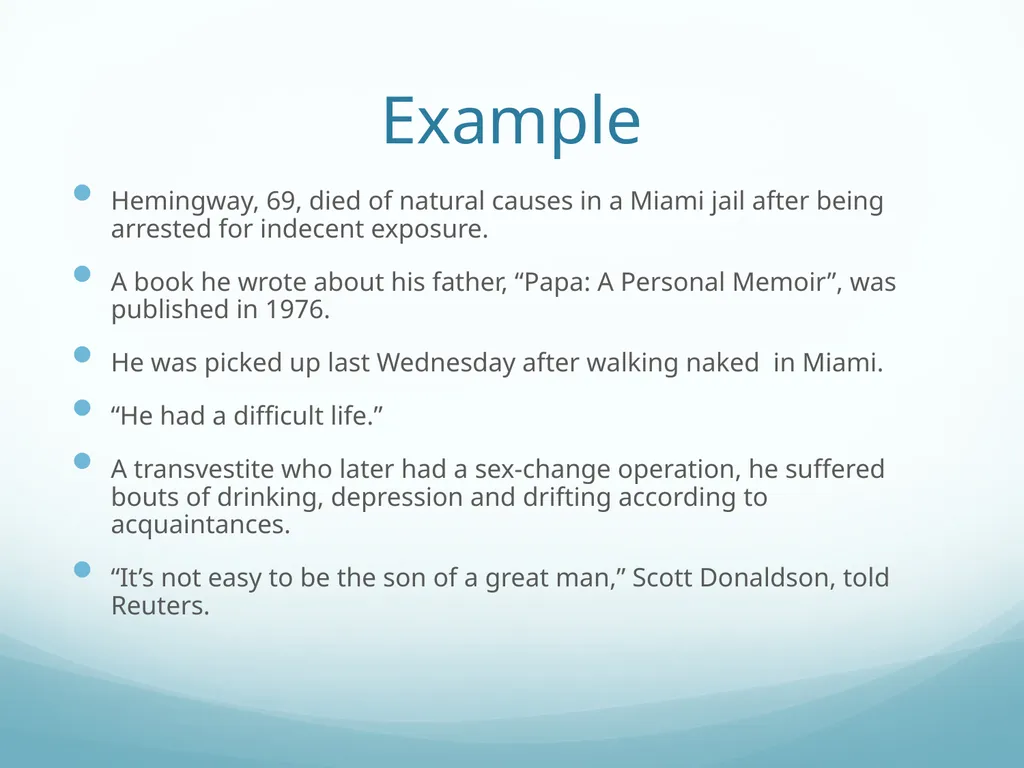
Example Hemingway, 69, died of natural causes in a Miami jail after being arrested for indecent exposure.
A book he wrote about his father, “Papa: A Personal Memoir”, was published in 1976.
He was picked up last Wednesday after walking naked in Miami.
“He had a difficult life.”
A transvestite who later had a sex-change operation, he suffered bouts of drinking, depression and drifting according to acquaintances.
“It’s not easy to be the son of a great man,” Scott Donaldson, told Reuters.<br>
A book he wrote about his father, “Papa: A Personal Memoir”, was published in 1976.
He was picked up last Wednesday after walking naked in Miami.
“He had a difficult life.”
A transvestite who later had a sex-change operation, he suffered bouts of drinking, depression and drifting according to acquaintances.
“It’s not easy to be the son of a great man,” Scott Donaldson, told Reuters.<br>
36
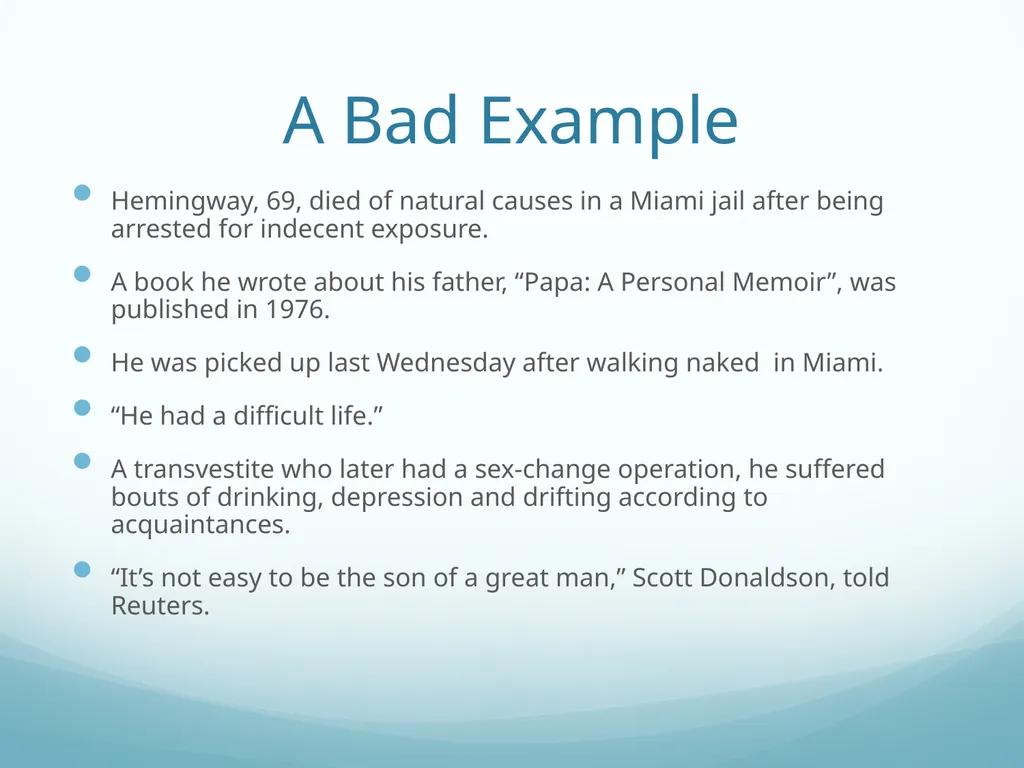
A Bad Example Hemingway, 69, died of natural causes in a Miami jail after being arrested for indecent exposure.
A book he wrote about his father, “Papa: A Personal Memoir”, was published in 1976.
He was picked up last Wednesday after walking naked in Miami.
“He had a difficult life.”
A transvestite who later had a sex-change operation, he suffered bouts of drinking, depression and drifting according to acquaintances.
“It’s not easy to be the son of a great man,” Scott Donaldson, told Reuters.<br>
A book he wrote about his father, “Papa: A Personal Memoir”, was published in 1976.
He was picked up last Wednesday after walking naked in Miami.
“He had a difficult life.”
A transvestite who later had a sex-change operation, he suffered bouts of drinking, depression and drifting according to acquaintances.
“It’s not easy to be the son of a great man,” Scott Donaldson, told Reuters.<br>
37
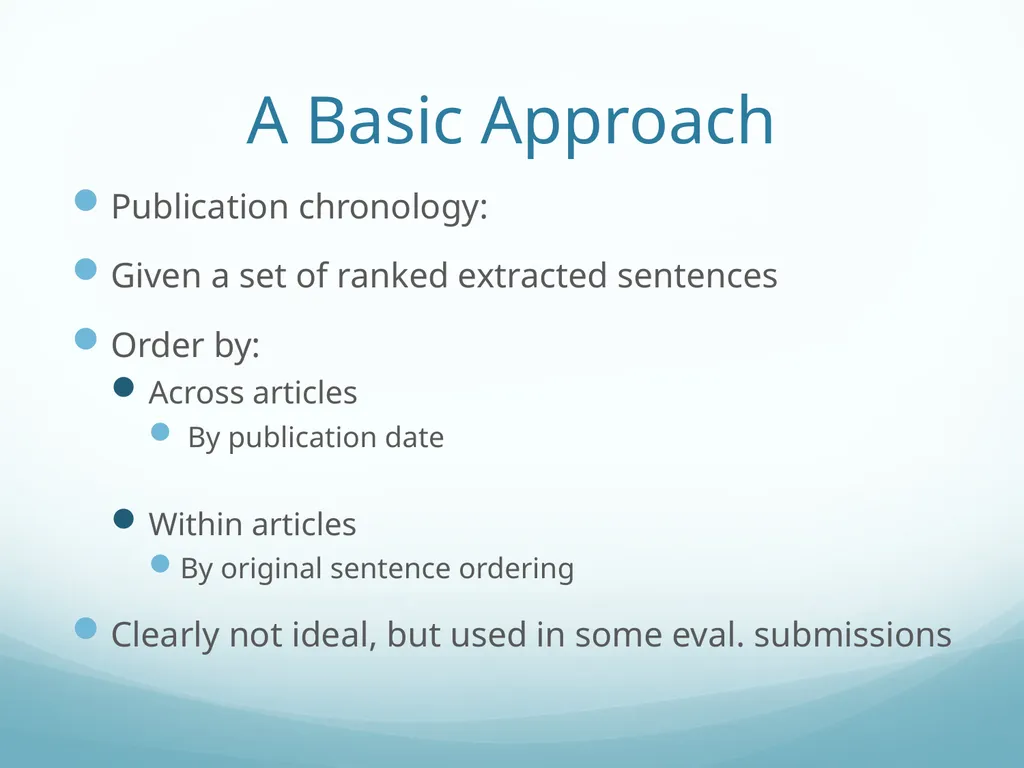
A Basic Approach Publication chronology:
Given a set of ranked extracted sentences
Order by:<br>
Given a set of ranked extracted sentences
Order by:<br>
38
A Basic Approach Publication chronology:
Given a set of ranked extracted sentences
Order by:
Across articles<br>
Given a set of ranked extracted sentences
Order by:
Across articles<br>
39
A Basic Approach Publication chronology:
Given a set of ranked extracted sentences
Order by:
Across articles
By publication date
Within articles<br>
Given a set of ranked extracted sentences
Order by:
Across articles
By publication date
Within articles<br>
40
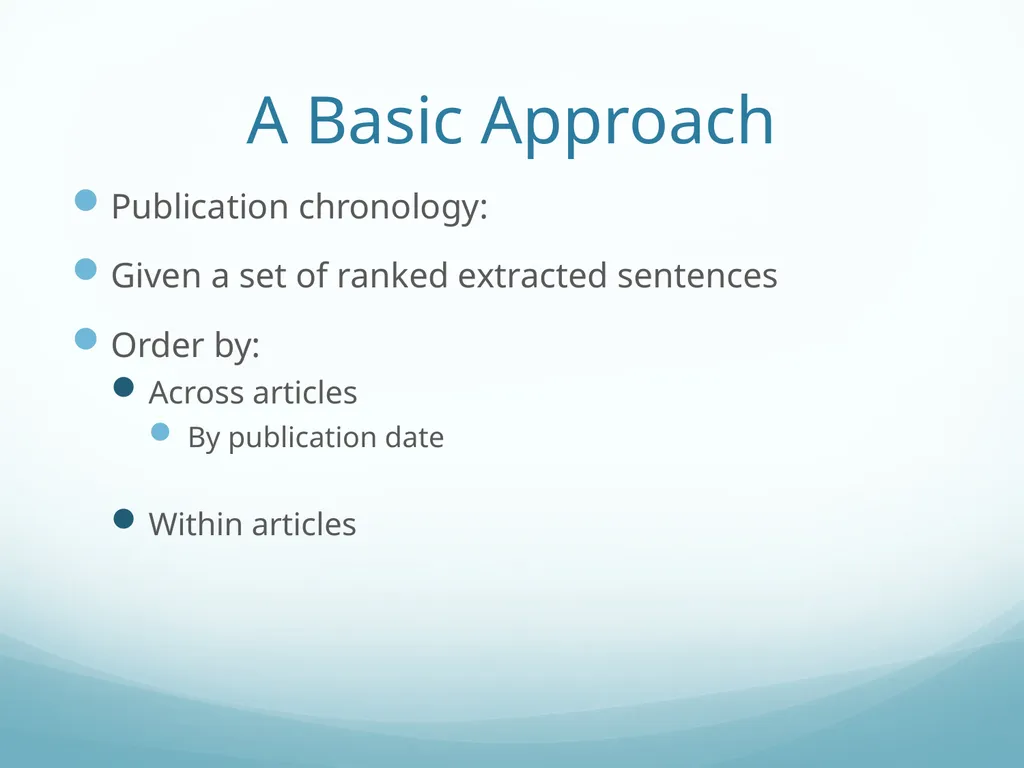
A Basic Approach Publication chronology:
Given a set of ranked extracted sentences
Order by:
Across articles
By publication date
Within articles
By original sentence ordering
Clearly not ideal, but used in some eval. submissions<br>
Given a set of ranked extracted sentences
Order by:
Across articles
By publication date
Within articles
By original sentence ordering
Clearly not ideal, but used in some eval. submissions<br>
41
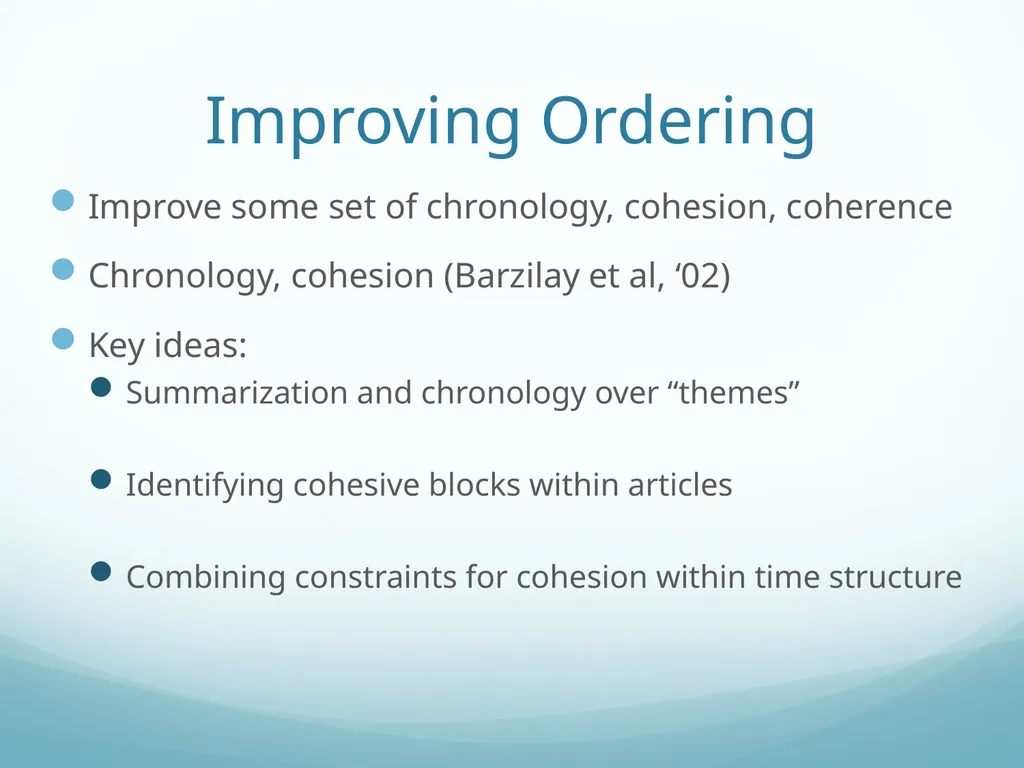
Improving Ordering Improve some set of chronology, cohesion, coherence
Chronology, cohesion (Barzilay et al, ‘02)
Key ideas:
Summarization and chronology over “themes”
Identifying cohesive blocks within articles
Combining constraints for cohesion within time structure<br>
Chronology, cohesion (Barzilay et al, ‘02)
Key ideas:
Summarization and chronology over “themes”
Identifying cohesive blocks within articles
Combining constraints for cohesion within time structure<br>
42
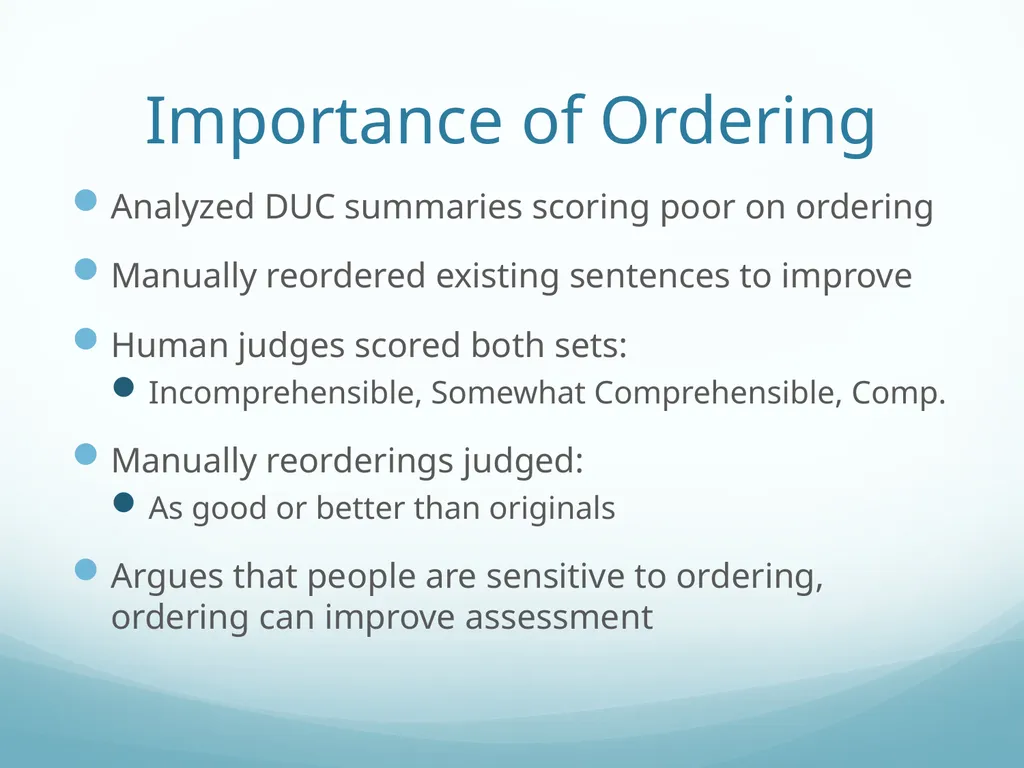
Importance of Ordering Analyzed DUC summaries scoring poor on ordering
Manually reordered existing sentences to improve<br>
Manually reordered existing sentences to improve<br>
43
Importance of Ordering Analyzed DUC summaries scoring poor on ordering
Manually reordered existing sentences to improve
Human judges scored both sets:
Incomprehensible, Somewhat Comprehensible, Comp.
Manually reorderings judged:<br>
Manually reordered existing sentences to improve
Human judges scored both sets:
Incomprehensible, Somewhat Comprehensible, Comp.
Manually reorderings judged:<br>
44
Importance of Ordering Analyzed DUC summaries scoring poor on ordering
Manually reordered existing sentences to improve
Human judges scored both sets:
Incomprehensible, Somewhat Comprehensible, Comp.
Manually reorderings judged:
As good or better than originals
Argues that people are sensitive to ordering, ordering can improve assessment<br>
Manually reordered existing sentences to improve
Human judges scored both sets:
Incomprehensible, Somewhat Comprehensible, Comp.
Manually reorderings judged:
As good or better than originals
Argues that people are sensitive to ordering, ordering can improve assessment<br>
45
Framework Build on their existing systems (Multigen)
Motivated by issues of similarity and difference
Managing redundancy and contradiction in docs<br>
Motivated by issues of similarity and difference
Managing redundancy and contradiction in docs<br>
46
Framework Build on their existing systems (Multigen)
Motivated by issues of similarity and difference
Managing redundancy and contradiction in docs
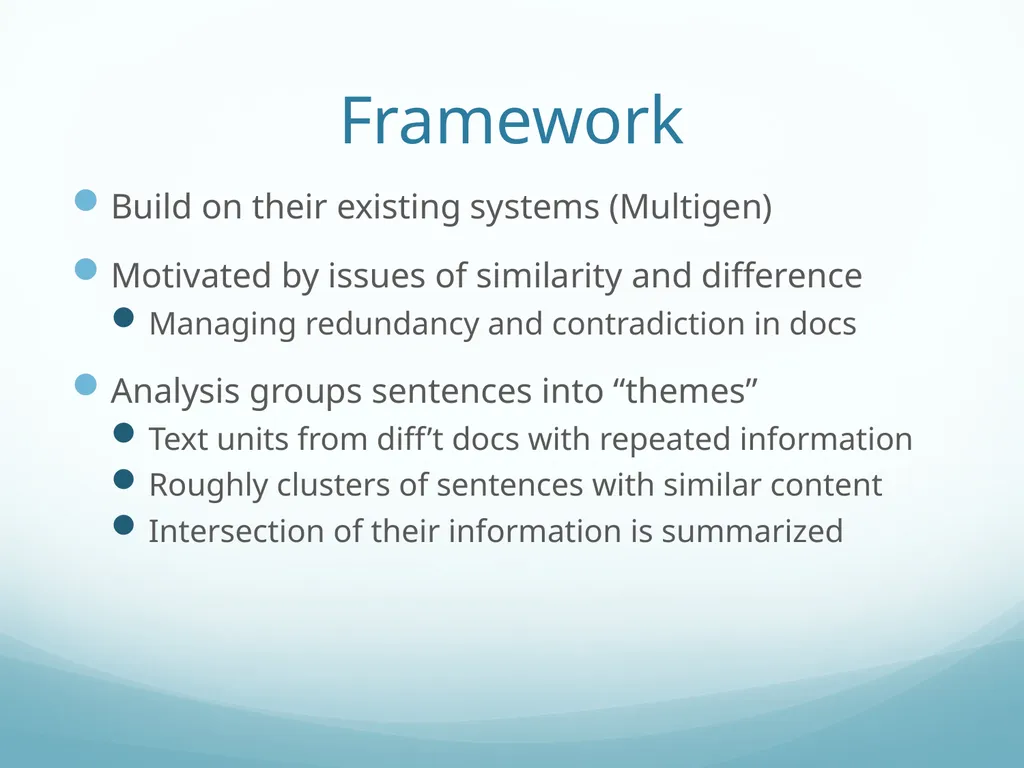
Analysis groups sentences into “themes”
Text units from diff’t docs with repeated information
Roughly clusters of sentences with similar content
Intersection of their information is summarized<br>
Motivated by issues of similarity and difference
Managing redundancy and contradiction in docs
Analysis groups sentences into “themes”
Text units from diff’t docs with repeated information
Roughly clusters of sentences with similar content
Intersection of their information is summarized<br>
47
Framework Build on their existing systems (Multigen)
Motivated by issues of similarity and difference
Managing redundancy and contradiction in docs
Analysis groups sentences into “themes”
Text units from diff’t docs with repeated information
Roughly clusters of sentences with similar content
Intersection of their information is summarized
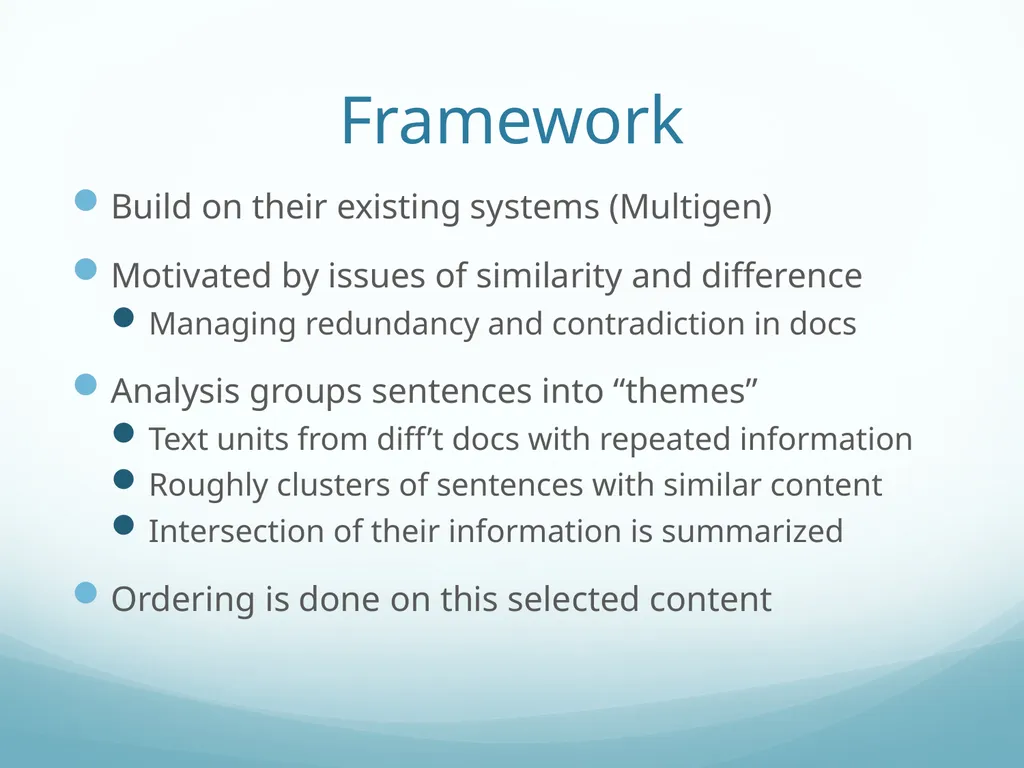
Ordering is done on this selected content<br>
Motivated by issues of similarity and difference
Managing redundancy and contradiction in docs
Analysis groups sentences into “themes”
Text units from diff’t docs with repeated information
Roughly clusters of sentences with similar content
Intersection of their information is summarized
Ordering is done on this selected content<br>
48
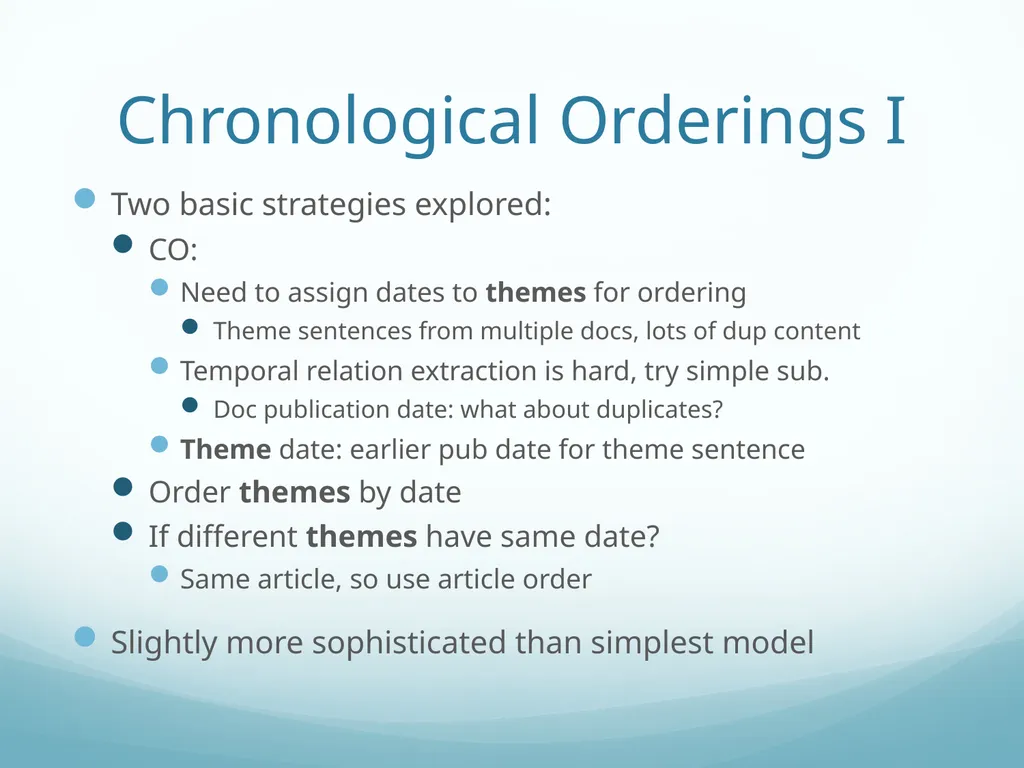
Chronological Orderings I Two basic strategies explored:
CO:
Need to assign dates to themes for ordering<br>
CO:
Need to assign dates to themes for ordering<br>
49
Chronological Orderings I Two basic strategies explored:
CO:
Need to assign dates to themes for ordering
Theme sentences from multiple docs, lots of dup content
Temporal relation extraction<br>
CO:
Need to assign dates to themes for ordering
Theme sentences from multiple docs, lots of dup content
Temporal relation extraction<br>
50
Chronological Orderings I Two basic strategies explored:
CO:
Need to assign dates to themes for ordering
Theme sentences from multiple docs, lots of dup content
Temporal relation extraction is hard, try simple sub.
Doc publication date: what about duplicates?<br>
CO:
Need to assign dates to themes for ordering
Theme sentences from multiple docs, lots of dup content
Temporal relation extraction is hard, try simple sub.
Doc publication date: what about duplicates?<br>
51
Chronological Orderings I Two basic strategies explored:
CO:
Need to assign dates to themes for ordering
Theme sentences from multiple docs, lots of dup content
Temporal relation extraction is hard, try simple sub.
Doc publication date: what about duplicates?
Theme date: earlier pub date for theme sentence
Order themes by date
If different themes have same date?<br>
CO:
Need to assign dates to themes for ordering
Theme sentences from multiple docs, lots of dup content
Temporal relation extraction is hard, try simple sub.
Doc publication date: what about duplicates?
Theme date: earlier pub date for theme sentence
Order themes by date
If different themes have same date?<br>
52
Chronological Orderings I Two basic strategies explored:
CO:
Need to assign dates to themes for ordering
Theme sentences from multiple docs, lots of dup content
Temporal relation extraction is hard, try simple sub.
Doc publication date: what about duplicates?
Theme date: earlier pub date for theme sentence
Order themes by date
If different themes have same date?
Same article, so use article order
Slightly more sophisticated than simplest model<br>
CO:
Need to assign dates to themes for ordering
Theme sentences from multiple docs, lots of dup content
Temporal relation extraction is hard, try simple sub.
Doc publication date: what about duplicates?
Theme date: earlier pub date for theme sentence
Order themes by date
If different themes have same date?
Same article, so use article order
Slightly more sophisticated than simplest model<br>
53
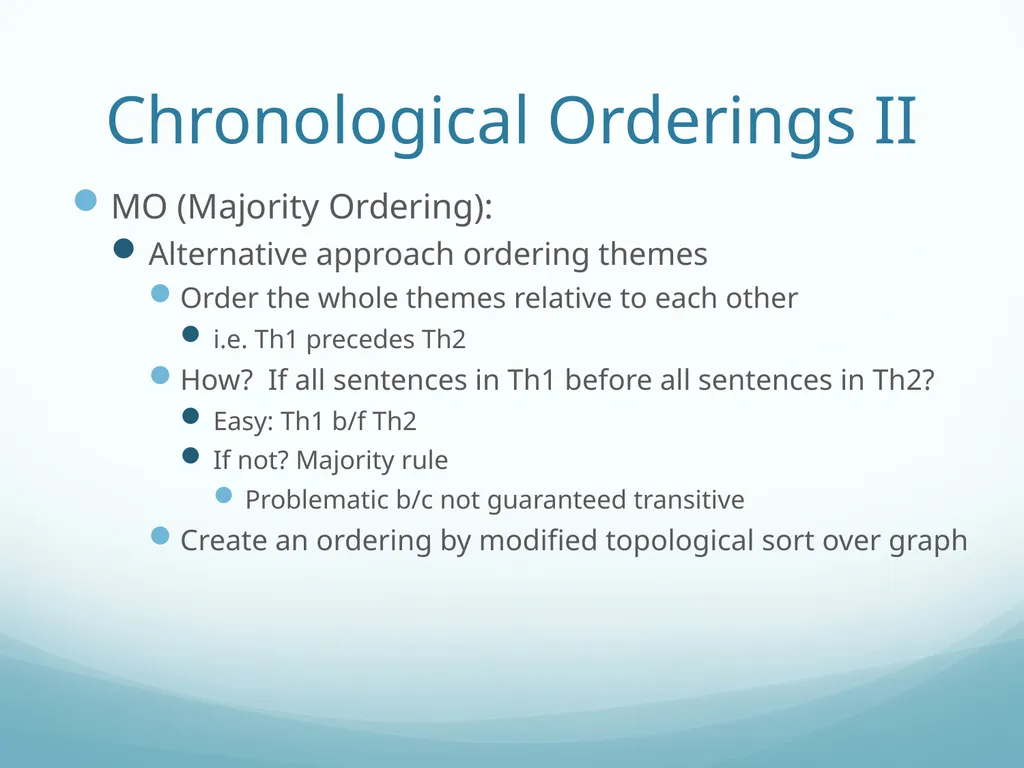
Chronological Orderings II MO (Majority Ordering):
Alternative approach to ordering themes
Order the whole themes relative to each other
i.e. Th1 precedes Th2
How?<br>
Alternative approach to ordering themes
Order the whole themes relative to each other
i.e. Th1 precedes Th2
How?<br>
54
Chronological Orderings II MO (Majority Ordering):
Alternative approach ordering themes
Order the whole themes relative to each other
i.e. Th1 precedes Th2
How? If all sentences in Th1 before all sentences in Th2?<br>
Alternative approach ordering themes
Order the whole themes relative to each other
i.e. Th1 precedes Th2
How? If all sentences in Th1 before all sentences in Th2?<br>
55
Chronological Orderings II MO (Majority Ordering):
Alternative approach ordering themes
Order the whole themes relative to each other
i.e. Th1 precedes Th2
How? If all sentences in Th1 before all sentences in Th2?
Easy: Th1 b/f Th2
If not?<br>
Alternative approach ordering themes
Order the whole themes relative to each other
i.e. Th1 precedes Th2
How? If all sentences in Th1 before all sentences in Th2?
Easy: Th1 b/f Th2
If not?<br>
56
Chronological Orderings II MO (Majority Ordering):
Alternative approach ordering themes
Order the whole themes relative to each other
i.e. Th1 precedes Th2
How? If all sentences in Th1 before all sentences in Th2?
Easy: Th1 b/f Th2
If not? Majority rule
Problematic b/c not guaranteed transitive
Create an ordering by modified topological sort over graph<br>
Alternative approach ordering themes
Order the whole themes relative to each other
i.e. Th1 precedes Th2
How? If all sentences in Th1 before all sentences in Th2?
Easy: Th1 b/f Th2
If not? Majority rule
Problematic b/c not guaranteed transitive
Create an ordering by modified topological sort over graph<br>
57
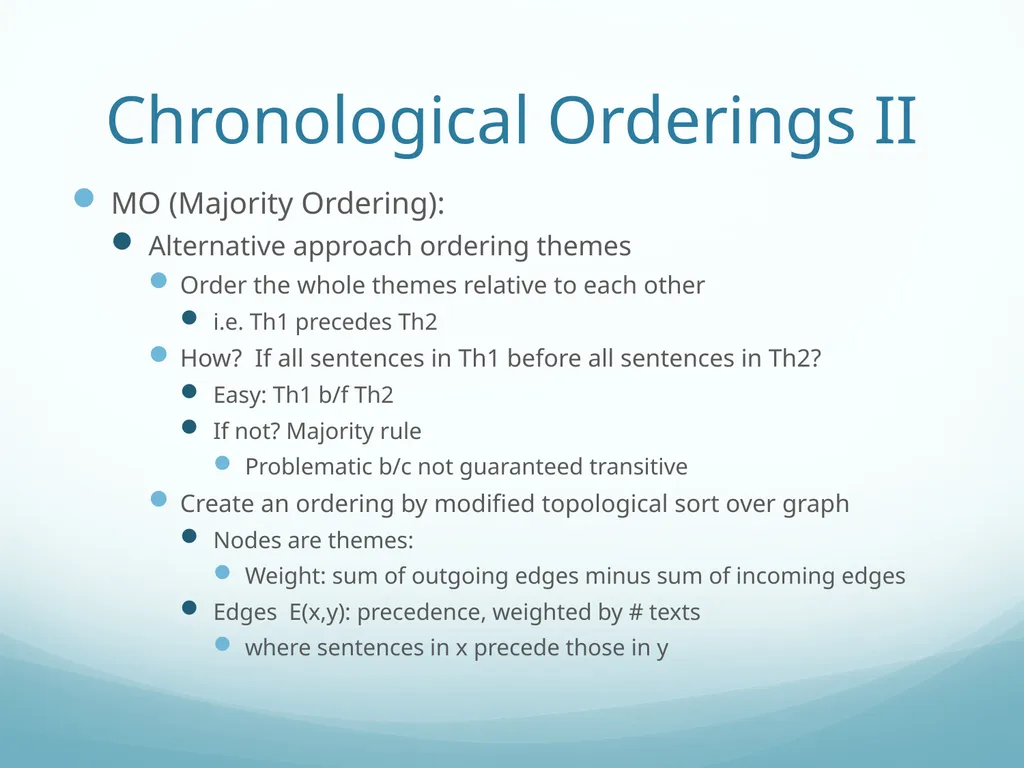
Chronological Orderings II MO (Majority Ordering):
Alternative approach ordering themes
Order the whole themes relative to each other
i.e. Th1 precedes Th2
How? If all sentences in Th1 before all sentences in Th2?
Easy: Th1 b/f Th2
If not? Majority rule
Problematic b/c not guaranteed transitive
Create an ordering by modified topological sort over graph
Nodes are themes:
Weight: sum of outgoing edges minus sum of incoming edges
Edges E(x,y): precedence, weighted by # texts
where sentences in x precede those in y<br>
Alternative approach ordering themes
Order the whole themes relative to each other
i.e. Th1 precedes Th2
How? If all sentences in Th1 before all sentences in Th2?
Easy: Th1 b/f Th2
If not? Majority rule
Problematic b/c not guaranteed transitive
Create an ordering by modified topological sort over graph
Nodes are themes:
Weight: sum of outgoing edges minus sum of incoming edges
Edges E(x,y): precedence, weighted by # texts
where sentences in x precede those in y<br>
58
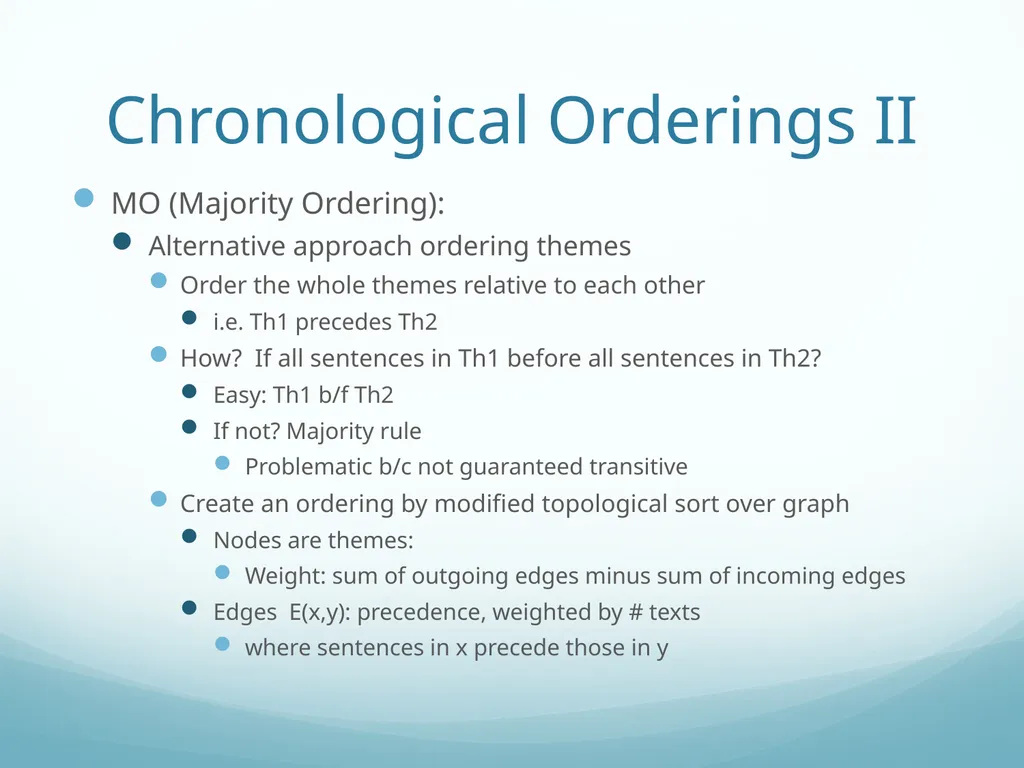
Chronological Orderings II MO (Majority Ordering):
Alternative approach ordering themes
Order the whole themes relative to each other
i.e. Th1 precedes Th2
How? If all sentences in Th1 before all sentences in Th2?
Easy: Th1 b/f Th2
If not? Majority rule
Problematic b/c not guaranteed transitive
Create an ordering by modified topological sort over graph
Nodes are themes:
Weight: sum of outgoing edges minus sum of incoming edges
Edges E(x,y): precedence, weighted by # texts
where sentences in x precede those in y<br>
Alternative approach ordering themes
Order the whole themes relative to each other
i.e. Th1 precedes Th2
How? If all sentences in Th1 before all sentences in Th2?
Easy: Th1 b/f Th2
If not? Majority rule
Problematic b/c not guaranteed transitive
Create an ordering by modified topological sort over graph
Nodes are themes:
Weight: sum of outgoing edges minus sum of incoming edges
Edges E(x,y): precedence, weighted by # texts
where sentences in x precede those in y<br>
59
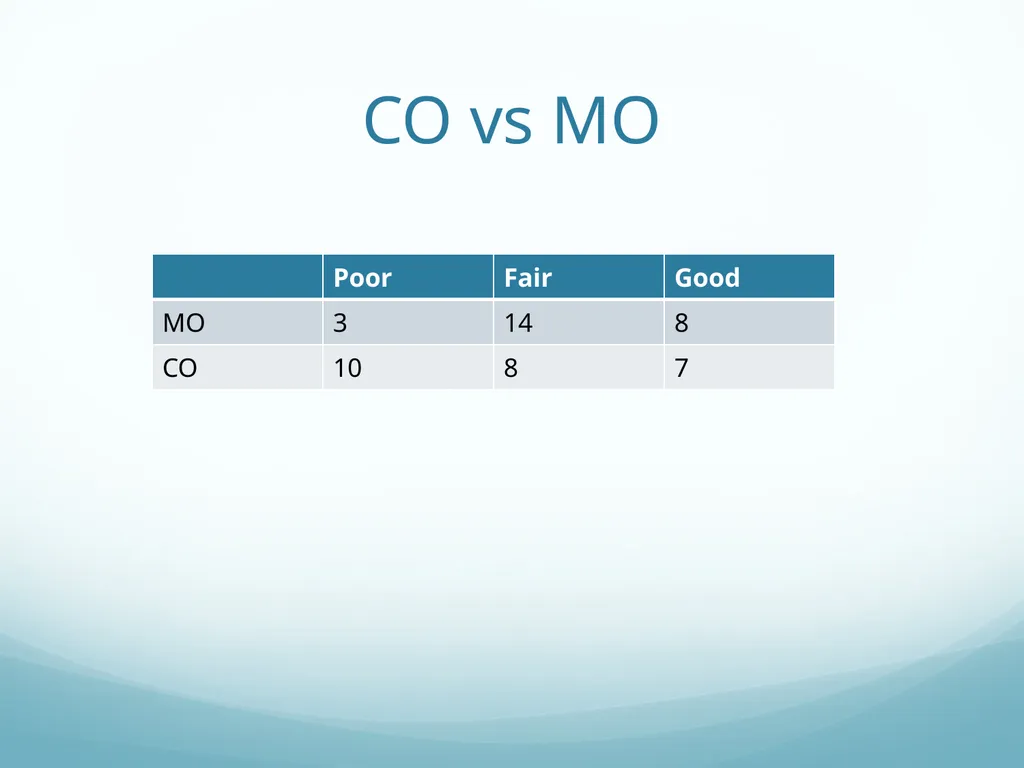
CO vs MO<br>
60
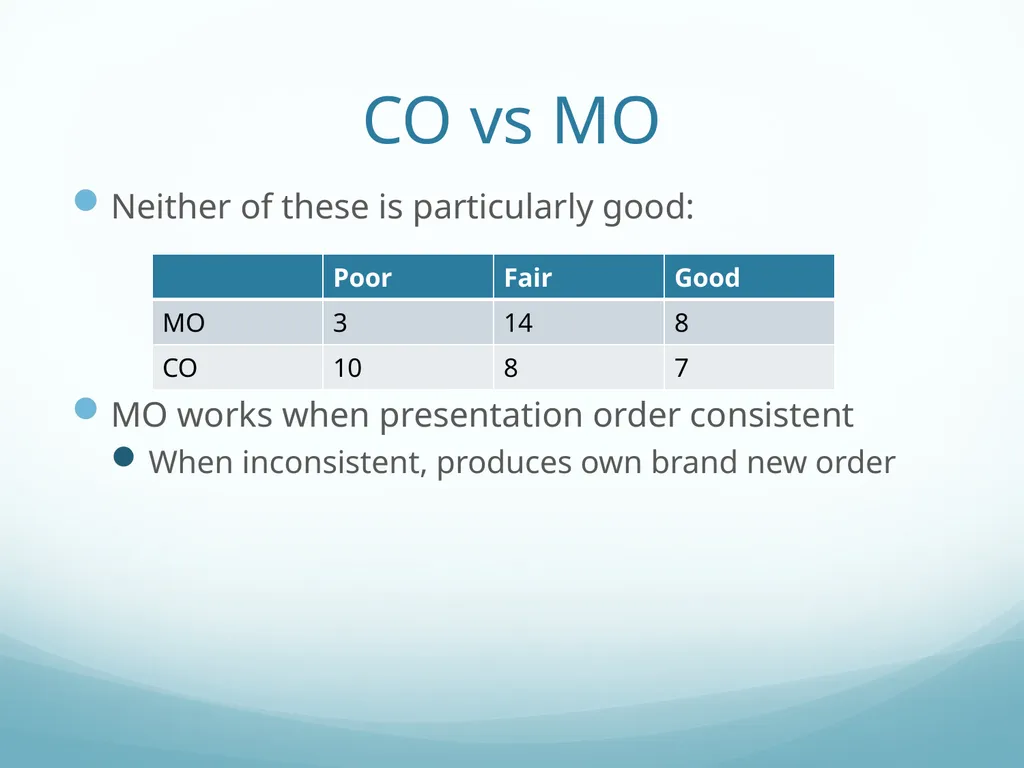
CO vs MO Neither of these is particularly good:
MO works when presentation order consistent
When inconsistent, produces own brand new order<br>
MO works when presentation order consistent
When inconsistent, produces own brand new order<br>
61
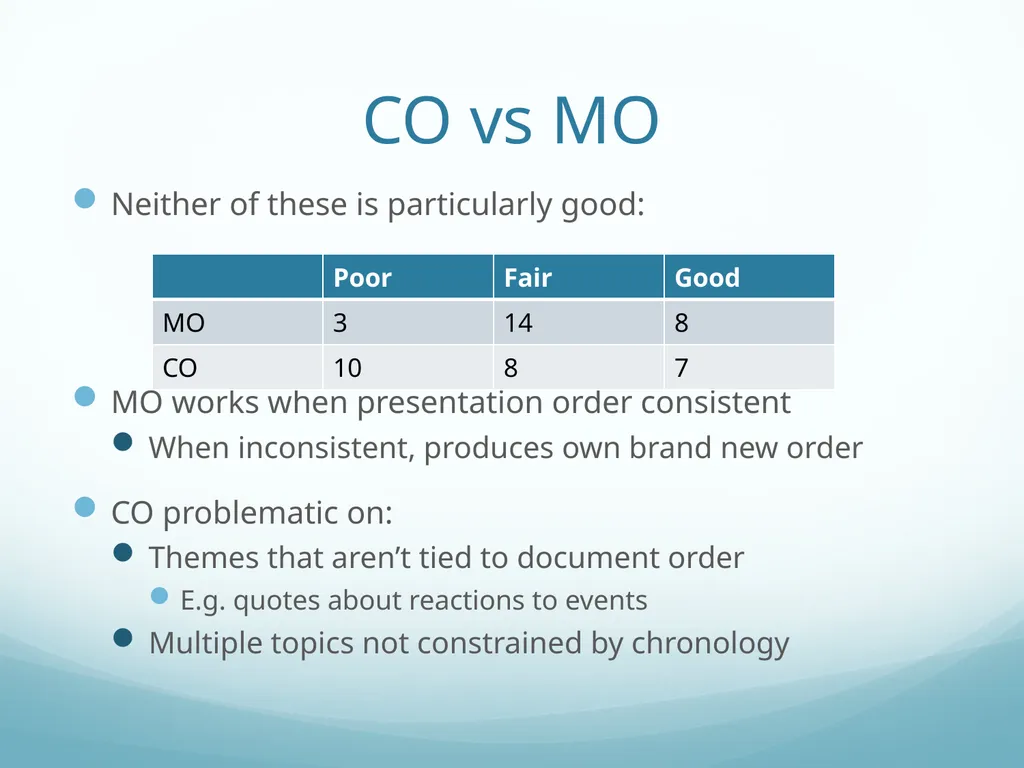
CO vs MO Neither of these is particularly good:
MO works when presentation order consistent
When inconsistent, produces own brand new order
CO problematic on:
Themes that aren’t tied to document order
E.g. quotes about reactions to events
Multiple topics not constrained by chronology<br>
MO works when presentation order consistent
When inconsistent, produces own brand new order
CO problematic on:
Themes that aren’t tied to document order
E.g. quotes about reactions to events
Multiple topics not constrained by chronology<br>
62
New Approach Experiments on sentence ordering by subjects
Many possible orderings but far from random
Blocks of sentences group together (cohere)<br>
Many possible orderings but far from random
Blocks of sentences group together (cohere)<br>
63
New Approach Experiments on sentence ordering by subjects
Many possible orderings but far from random
Blocks of sentences group together (cohere)
Combine chronology with cohesion
Order chronologically, but group similar themes<br>
Many possible orderings but far from random
Blocks of sentences group together (cohere)
Combine chronology with cohesion
Order chronologically, but group similar themes<br>
64
New Approach Experiments on sentence ordering by subjects
Many possible orderings but far from random
Blocks of sentences group together (cohere)
Combine chronology with cohesion
Order chronologically, but group similar themes
Perform topic segmentation on original texts
Themes “related” if,<br>
Many possible orderings but far from random
Blocks of sentences group together (cohere)
Combine chronology with cohesion
Order chronologically, but group similar themes
Perform topic segmentation on original texts
Themes “related” if,<br>
65
New Approach Experiments on sentence ordering by subjects
Many possible orderings but far from random
Blocks of sentences group together (cohere)
Combine chronology with cohesion
Order chronologically, but group similar themes
Perform topic segmentation on original texts
Themes “related” if, when two themes appear in same text, they frequently appear in same segment (threshold)<br>
Many possible orderings but far from random
Blocks of sentences group together (cohere)
Combine chronology with cohesion
Order chronologically, but group similar themes
Perform topic segmentation on original texts
Themes “related” if, when two themes appear in same text, they frequently appear in same segment (threshold)<br>
66
New Approach Experiments on sentence ordering by subjects
Many possible orderings but far from random
Blocks of sentences group together (cohere)
Combine chronology with cohesion
Order chronologically, but group similar themes
Perform topic segmentation on original texts
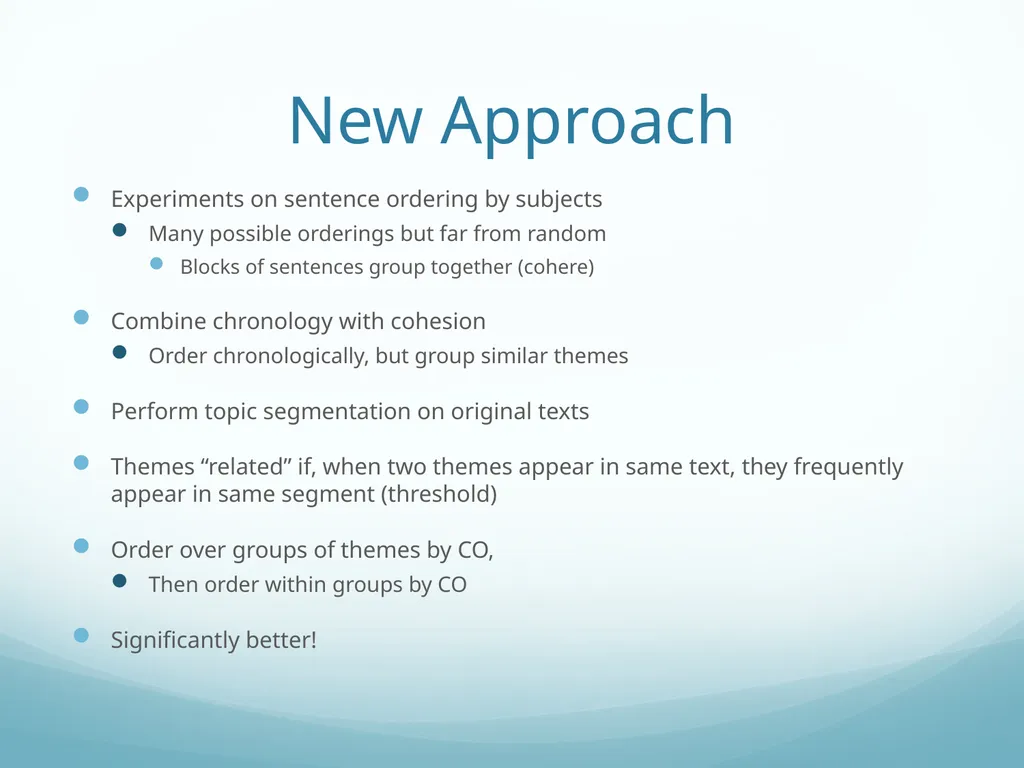
Themes “related” if, when two themes appear in same text, they frequently appear in same segment (threshold)
Order over groups of themes by CO,
Then order within groups by CO
Significantly better!<br>
Many possible orderings but far from random
Blocks of sentences group together (cohere)
Combine chronology with cohesion
Order chronologically, but group similar themes
Perform topic segmentation on original texts
Themes “related” if, when two themes appear in same text, they frequently appear in same segment (threshold)
Order over groups of themes by CO,
Then order within groups by CO
Significantly better!<br>
67
Before and After<br>
68
Before and After<br>