Topics, Research Agenda, Cooperation Principles Maria Semenova (msemenovahse.ru) Head of the Laboratory for Banking Studies, FES HSE Associate Professor, School of Finance, HSE At ICEF: Lectures on the art of research and supervising
"Topics, Research Agenda, Cooperation Principles" is the property of its rightful owner. Permission is granted to
download and print the materials on this website for personal, non-commercial use only, and to display it
on your personal computer provided you do not modify the materials and that you retain all copyright
notices contained in the materials. By downloading content from our website, you accept the terms of this
agreement.
Presentation Transcript
01
Topics, Research Agenda, Cooperation Principles Maria Semenova (msemenova@hse.ru)
Head of the Laboratory for Banking Studies, FES HSE
Associate Professor, School of Finance, HSE
At ICEF: Lectures on the art of research and supervising student papers<br>
02
Main areas of interest and expertise:
(Mostly) empirical banking
Household finance (~bank-related)<br>
03
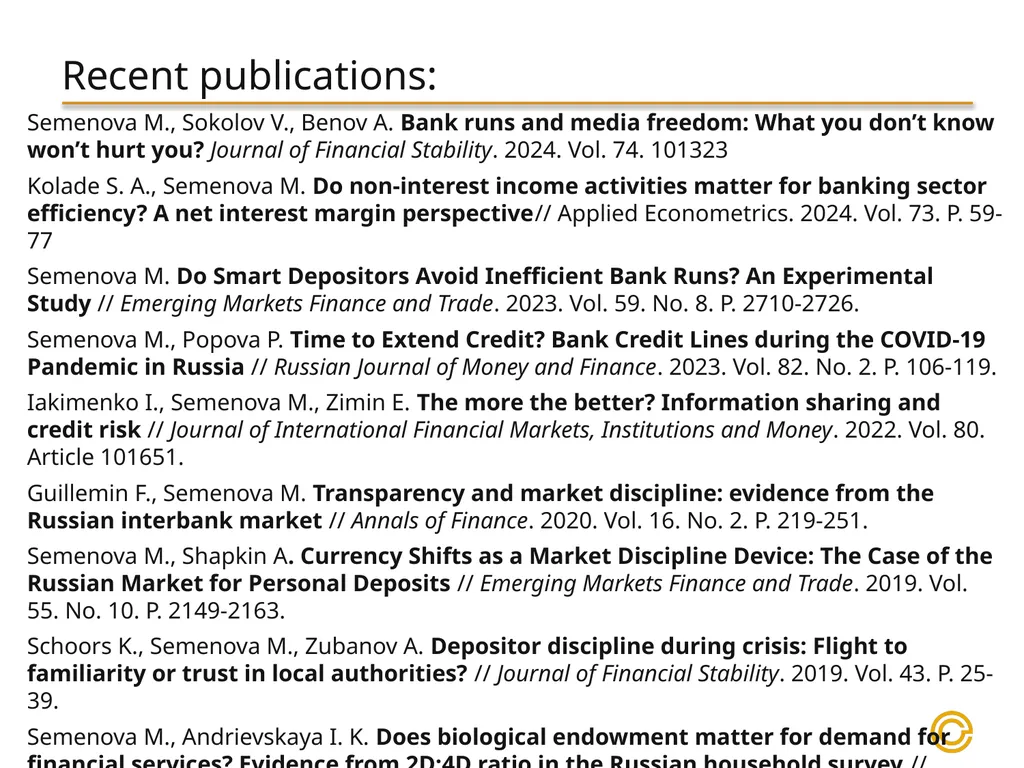
Recent publications: Semenova M., Sokolov V., Benov A. Bank runs and media freedom: What you don’t know won’t hurt you? Journal of Financial Stability. 2024. Vol. 74. 101323
Kolade S. A., Semenova M. Do non-interest income activities matter for banking sector efficiency? A net interest margin perspective// Applied Econometrics. 2024. Vol. 73. P. 59-77
Semenova M. Do Smart Depositors Avoid Inefficient Bank Runs? An Experimental Study // Emerging Markets Finance and Trade. 2023. Vol. 59. No. 8. P. 2710-2726.
Semenova M., Popova P. Time to Extend Credit? Bank Credit Lines during the COVID-19 Pandemic in Russia // Russian Journal of Money and Finance. 2023. Vol. 82. No. 2. P. 106-119.
Iakimenko I., Semenova M., Zimin E. The more the better? Information sharing and credit risk // Journal of International Financial Markets, Institutions and Money. 2022. Vol. 80. Article 101651.
Guillemin F., Semenova M. Transparency and market discipline: evidence from the Russian interbank market // Annals of Finance. 2020. Vol. 16. No. 2. P. 219-251.
Semenova M., Shapkin A. Currency Shifts as a Market Discipline Device: The Case of the Russian Market for Personal Deposits // Emerging Markets Finance and Trade. 2019. Vol. 55. No. 10. P. 2149-2163.
Schoors K., Semenova M., Zubanov A. Depositor discipline during crisis: Flight to familiarity or trust in local authorities? // Journal of Financial Stability. 2019. Vol. 43. P. 25-39.
Semenova M., Andrievskaya I. K. Does biological endowment matter for demand for financial services? Evidence from 2D:4D ratio in the Russian household survey // Personality and Individual Differences. 2017. Vol. 104. P. 155-165.<br>
04
Important notes YES!
You can come with any research idea, but be sure that
It is related to banking/household finance
The data is available
NO!
Don’t come saying “I just need to have this term/diploma paper done somehow. So give me any topic and I’ll take it”
More about working with me<br>
05
Data Data availability is now a students’ nightmare…
…but not that much here
Worldwide bank-level data till early 2024 (cross-country studies)
Russian bank-level data till 2021 (Mobile database)
TheGlobalEconomy.com database for macro, institutional and other country-level data
Many topic-specific datasets are open!
Does not mean we won’t need hand-collected data, though…<br>
06
Still need some examples of topics?..<br>
07
COVID-19 and banking “Perfect example of external, non-economic shock”
Influencing households (physical limitations, unemployment, liquidity shocks, uncertainty, …) – depositors and borrowers
Influencing firms (disruption of production chains, credit rationing uncertainty) - borrowers
Therefore influencing banks (increased risks VS financial innovations)
Regulators do react
BUT! Much is done here<br>
08
COVID-19 and banking - questions Different banking markets under pandemic pressure:
Who suffers worse where, how and why
Who copes better where, how and why
Regulatory interventions under pandemic pressure
Who did what, where and why
Restrictions VS Support measures
Bank-related VS Bank-unrelated measures
A combination of the two
Any good news? Financial innovations, ecosystems, banks and public procurement (e.g. medicine)<br>
09
Market Discipline Definition: creditors’ (usually depositors’) sensitivity to bank risks: interest rates, funds growth rates, funds structure…
Questions:
What undermines MD?
Crisis (including external shocks)
Explicit guaranties (deposit insurance)
Implicit guaranties (ownership structure, ties with government, regions, municipalities…, any signs of those - bank titles, bank brands…)
Information environment (transparency, financial literacy…)
Where to find MD?
Credit market, interbank market…
New mechanisms
Does MD influence risk appetite?<br>
10
Deposit insurance Designed to resolve bank bankruptcies efficiently and increase trust to banks
Aims at banking system stability, but produces moral hazard
Should be priced fairly according to bank risks, but it does not work when systemic risk is realized or a simultaneous failure occurs (the recent US case is a good example)
Questions:
How to design the DIS optimally?
Are there other mechanisms for the current “new normal”? Guaranteeing instead of insuring?<br>
11
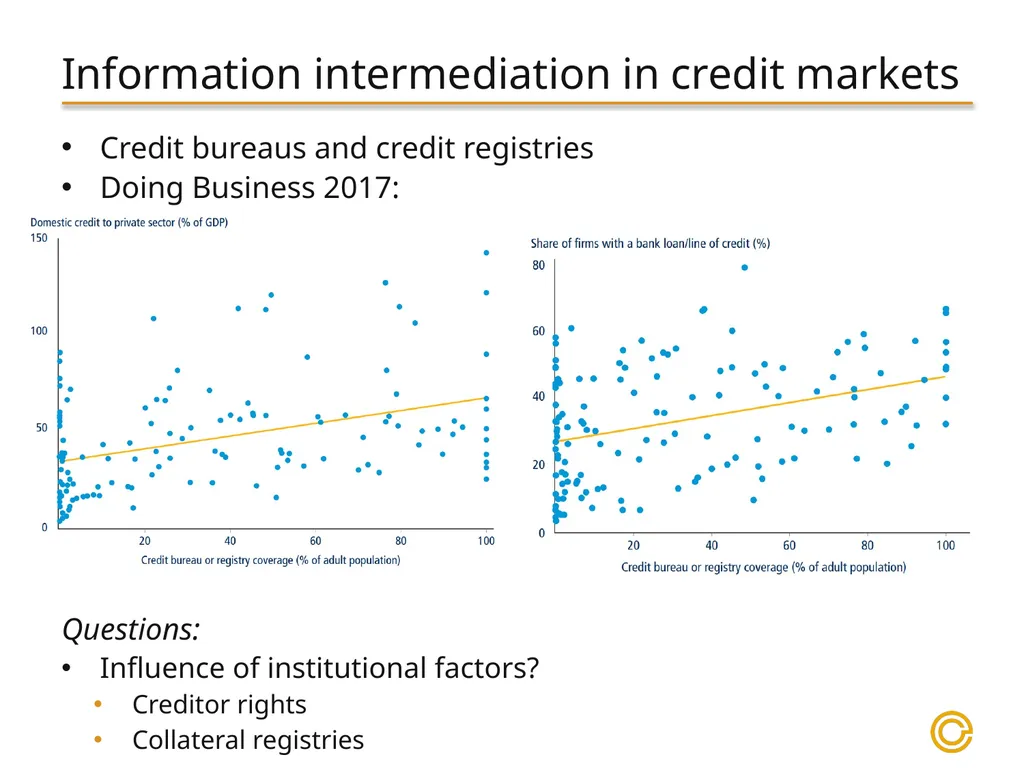
Information intermediation in credit markets Credit bureaus and credit registries
Doing Business 2017:
Questions:
Influence of institutional factors?
Creditor rights
Collateral registries<br>
12
Non-bank banking Microfinance VS banks
Regulatory differences
Competition VS efficient market sharing
Microfinance: efficient business models
Social aspect
Microfinance as a source of economic growth (e.g. via SMEs)
Other sources of funds, coming outside the financial institutions
Non-economic sources of credit discipline<br>
13
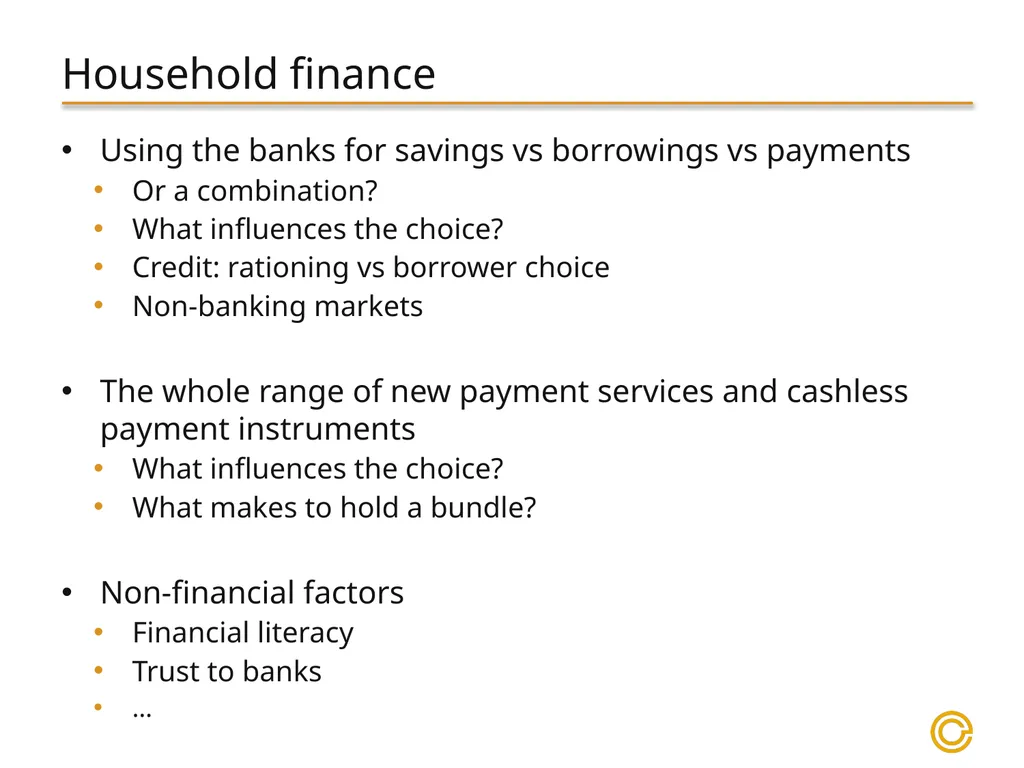
Household finance Using the banks for savings vs borrowings vs payments
Or a combination?
What influences the choice?
Credit: rationing vs borrower choice
Non-banking markets
The whole range of new payment services and cashless payment instruments
What influences the choice?
What makes to hold a bundle?
Non-financial factors
Financial literacy
Trust to banks
…<br>
14
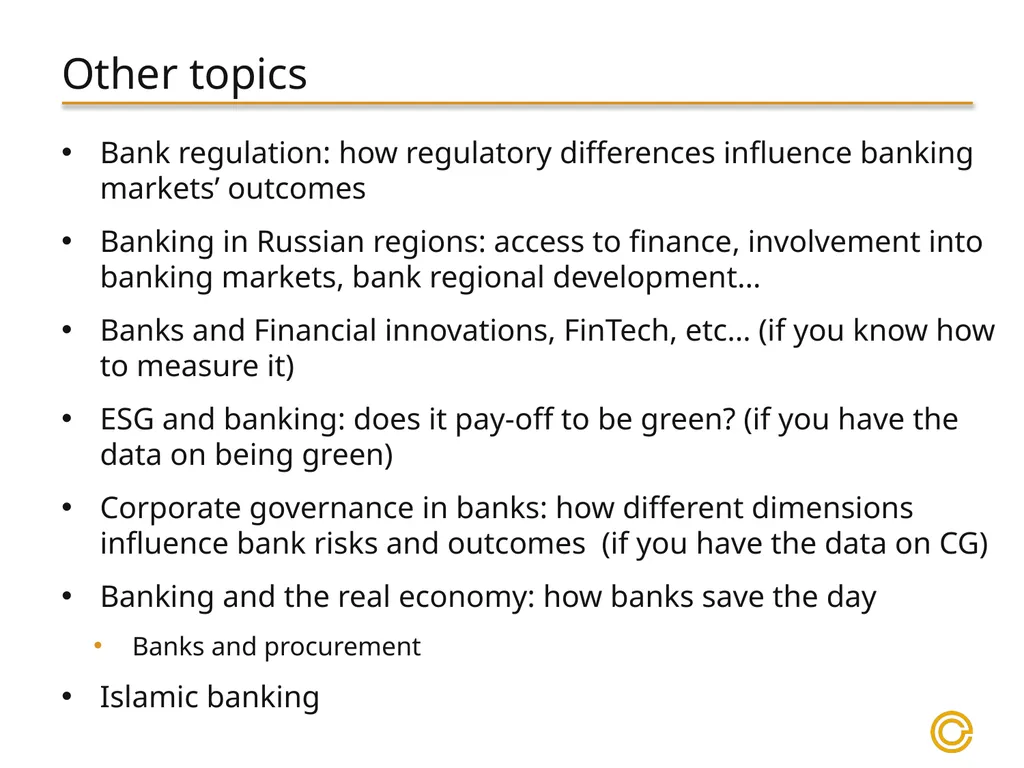
Other topics Bank regulation: how regulatory differences influence banking markets’ outcomes
Banking in Russian regions: access to finance, involvement into banking markets, bank regional development…
Banks and Financial innovations, FinTech, etc… (if you know how to measure it)
ESG and banking: does it pay-off to be green? (if you have the data on being green)
Corporate governance in banks: how different dimensions influence bank risks and outcomes (if you have the data on CG)
Banking and the real economy: how banks save the day
Banks and procurement
Islamic banking<br>
15
Important notes (con’t) I’ll teach you a bit on how to deal with research projects
Check your schedule on October 18 & 21
I’ll be happy to collaborate with you as potential colleagues, IF:
You’re willing to taste the academic career and/or get some experience as a research assistant
You perform well till December
You can join the LaBS team with your diploma project
…and yes, it’s a formal employment, real job, you’re paid for it, etc.<br>