
“ “Towards a client-oriented health insurance










Description: Towards a client-oriented health insurance system in Ghana Some key findings NHIS 10th Anniversary Conference 5th November, 2013 Accra, Ghana Edward Nketiah-Amponsah Stephen Duku Christine Fenenga Robert Kaba Alhassan Tobias Rinke de
Related Topics
Download Presentation
"“ “Towards a client-oriented health insurance" is the property of its rightful owner. Permission is granted to download and print the materials on this website for personal, non-commercial use only, and to display it on your personal computer provided you do not modify the materials and that you retain all copyright notices contained in the materials. By downloading content from our website, you accept the terms of this agreement.
Presentation Transcript
slide1. “
“Towards a client-oriented health insurance system in Ghana”
Some key findings
NHIS 10th Anniversary Conference
5th November, 2013
Accra, Ghana Edward Nketiah-Amponsah
Stephen Duku
Christine Fenenga
Robert Kaba Alhassan
Tobias Rinke de Wit, Inge Hutter, Menno Pradhan, Daniel Arhinful 1 NHIS 10th Anniversary Conference<br>
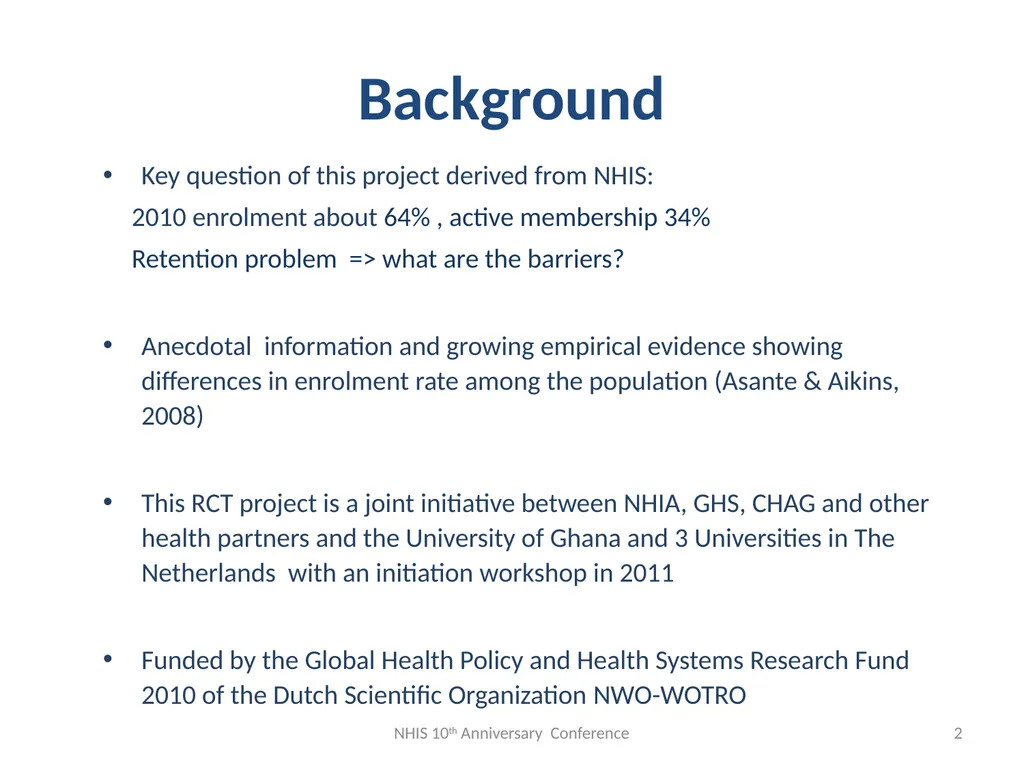
slide2. Background Key question of this project derived from NHIS:
2010 enrolment about 64% , active membership 34%
Retention problem => what are the barriers?
Anecdotal information and growing empirical evidence showing differences in enrolment rate among the population (Asante & Aikins, 2008)
This RCT project is a joint initiative between NHIA, GHS, CHAG and other health partners and the University of Ghana and 3 Universities in The Netherlands with an initiation workshop in 2011
Funded by the Global Health Policy and Health Systems Research Fund 2010 of the Dutch Scientific Organization NWO-WOTRO 2 NHIS 10th Anniversary Conference<br>
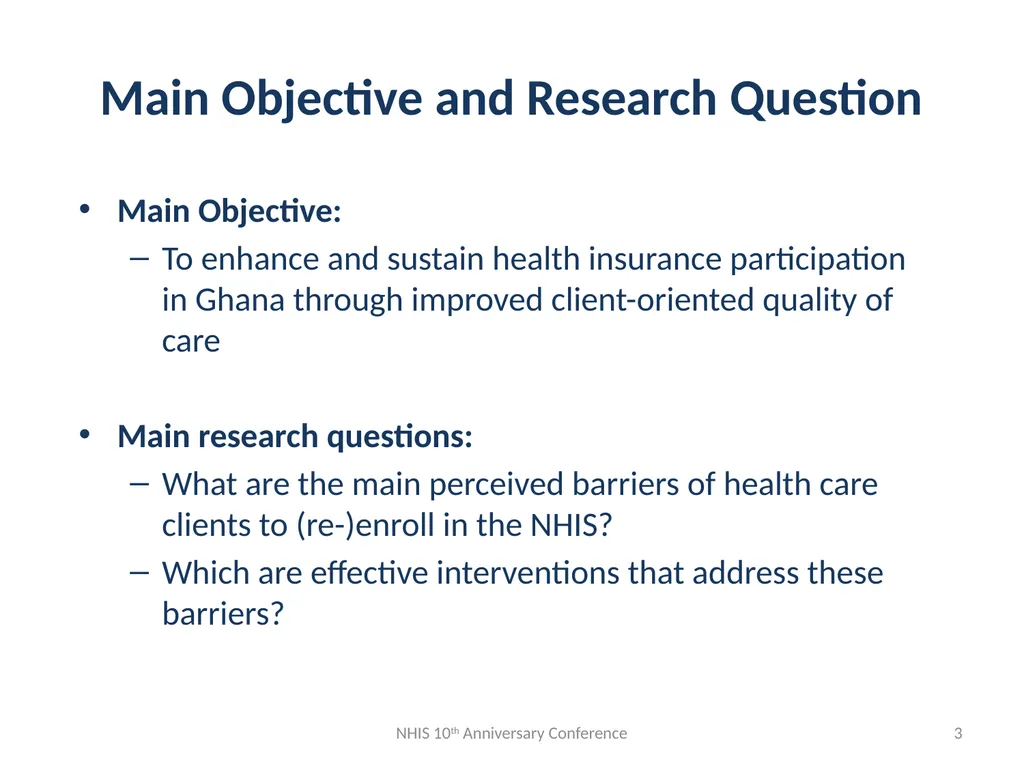
slide3. Main Objective and Research Question Main Objective:
To enhance and sustain health insurance participation in Ghana through improved client-oriented quality of care
Main research questions:
What are the main perceived barriers of health care clients to (re-)enroll in the NHIS?
Which are effective interventions that address these barriers? 3 NHIS 10th Anniversary Conference<br>
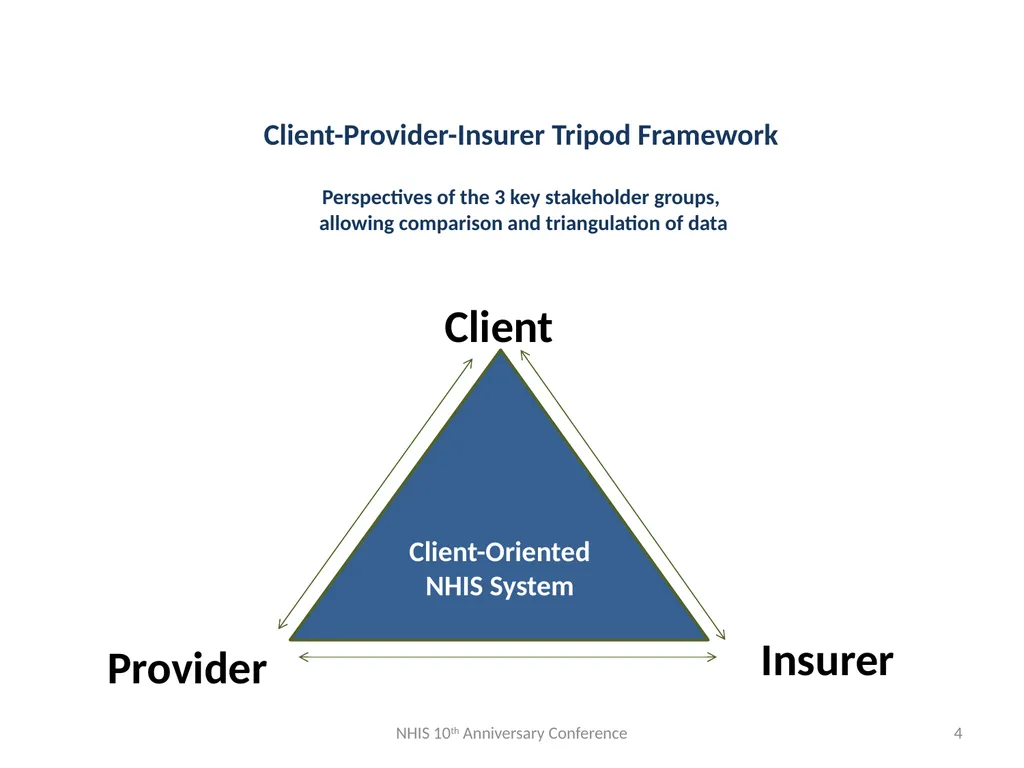
slide4. Client-Provider-Insurer Tripod Framework Perspectives of the 3 key stakeholder groups, allowing comparison and triangulation of data Client-Oriented NHIS System Client Insurer Provider 4 NHIS 10th Anniversary Conference<br>
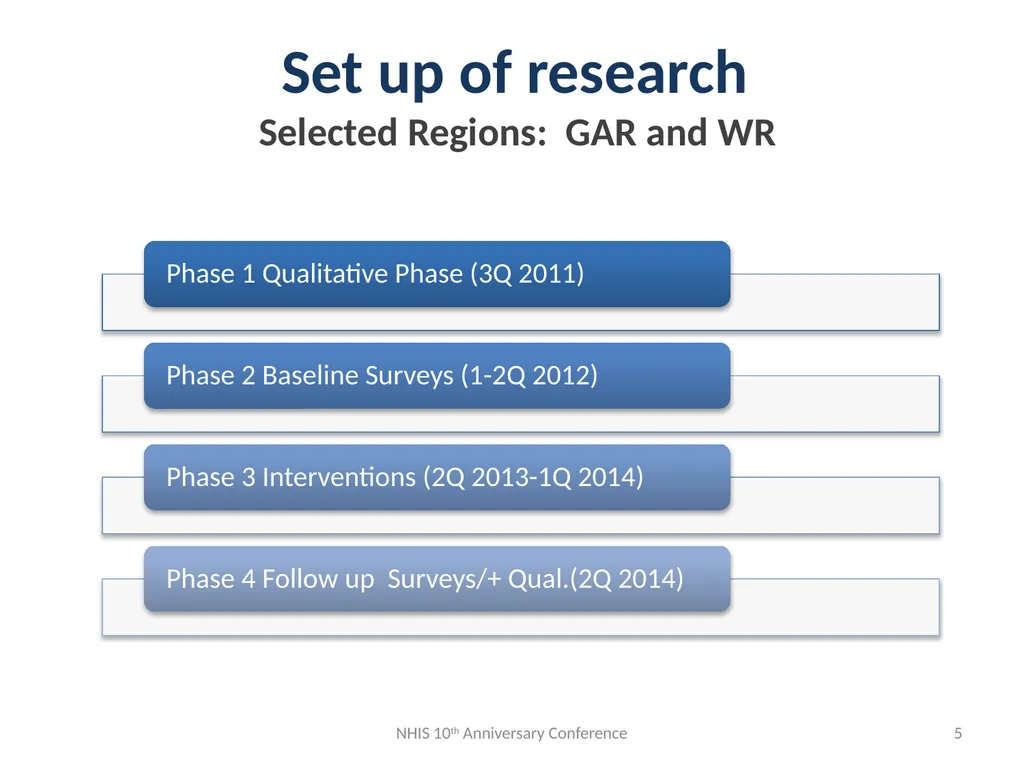
slide5. Set up of research Selected Regions: GAR and WR 5 NHIS 10th Anniversary Conference<br>
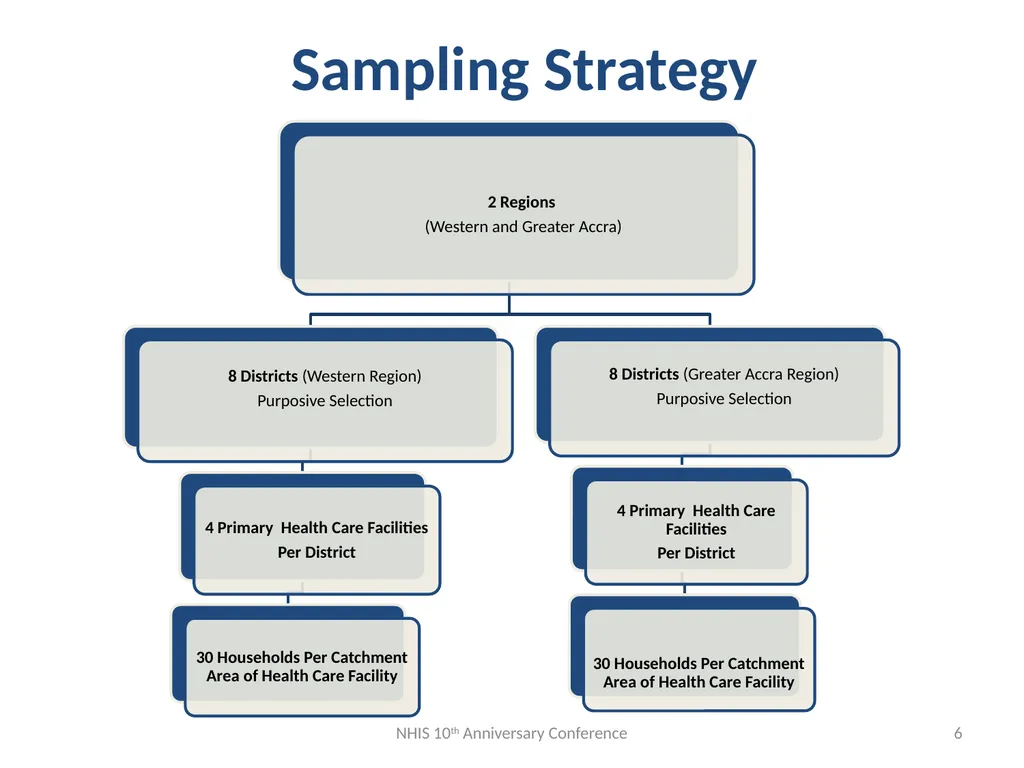
slide6. Sampling Strategy 6 NHIS 10th Anniversary Conference<br>
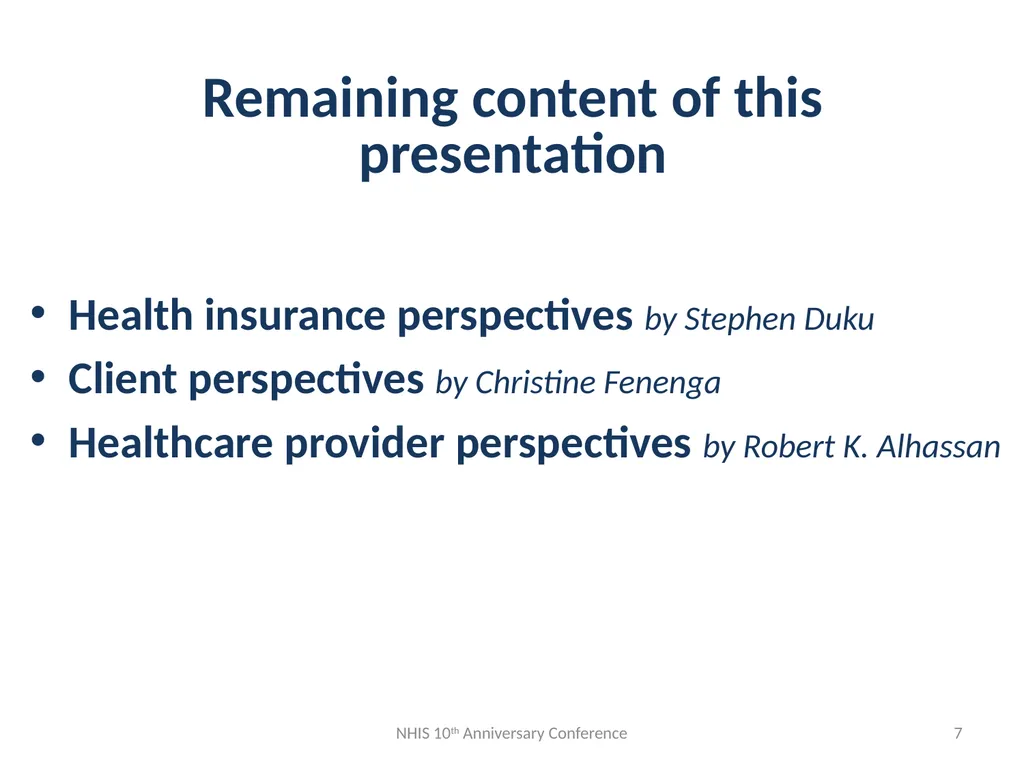
slide7. Remaining content of this presentation Health insurance perspectives by Stephen Duku
Client perspectives by Christine Fenenga
Healthcare provider perspectives by Robert K. Alhassan NHIS 10th Anniversary Conference 7<br>
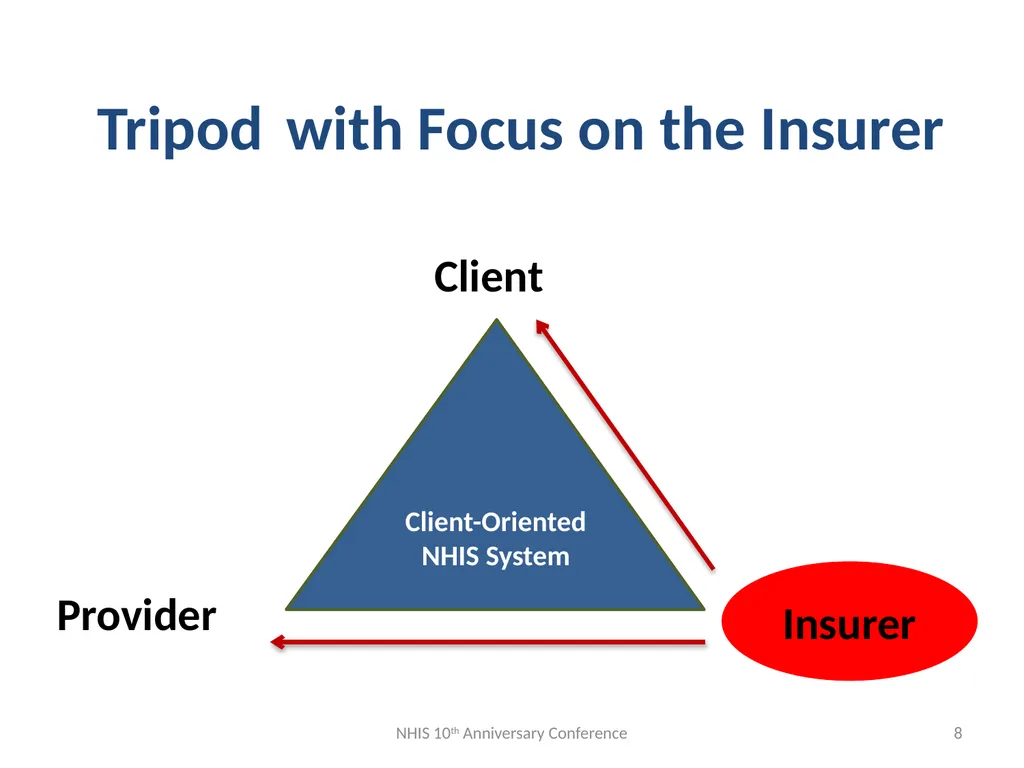
slide8. Tripod with Focus on the Insurer Client-Oriented NHIS System Client Provider Insurer 8 NHIS 10th Anniversary Conference<br>
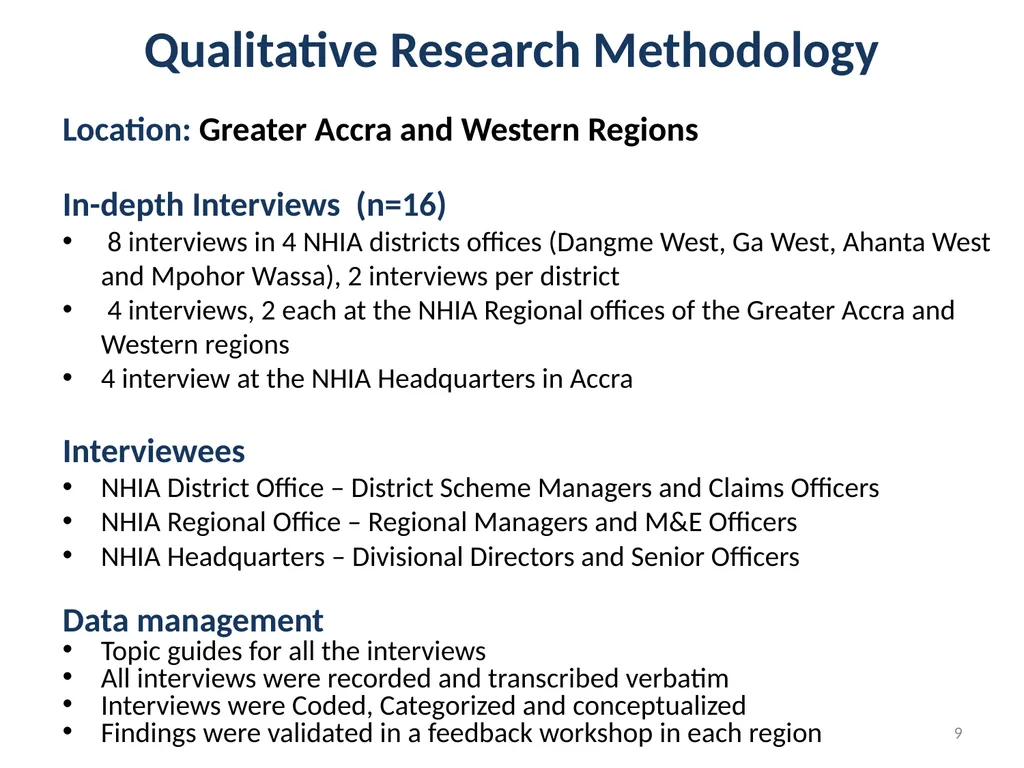
slide9. Qualitative Research Methodology Location: Greater Accra and Western Regions
In-depth Interviews (n=16)
8 interviews in 4 NHIA districts offices (Dangme West, Ga West, Ahanta West and Mpohor Wassa), 2 interviews per district
4 interviews, 2 each at the NHIA Regional offices of the Greater Accra and Western regions
4 interview at the NHIA Headquarters in Accra
Interviewees
NHIA District Office – District Scheme Managers and Claims Officers
NHIA Regional Office – Regional Managers and M&E Officers
NHIA Headquarters – Divisional Directors and Senior Officers
Data management
Topic guides for all the interviews
All interviews were recorded and transcribed verbatim
Interviews were Coded, Categorized and conceptualized
Findings were validated in a feedback workshop in each region 9<br>
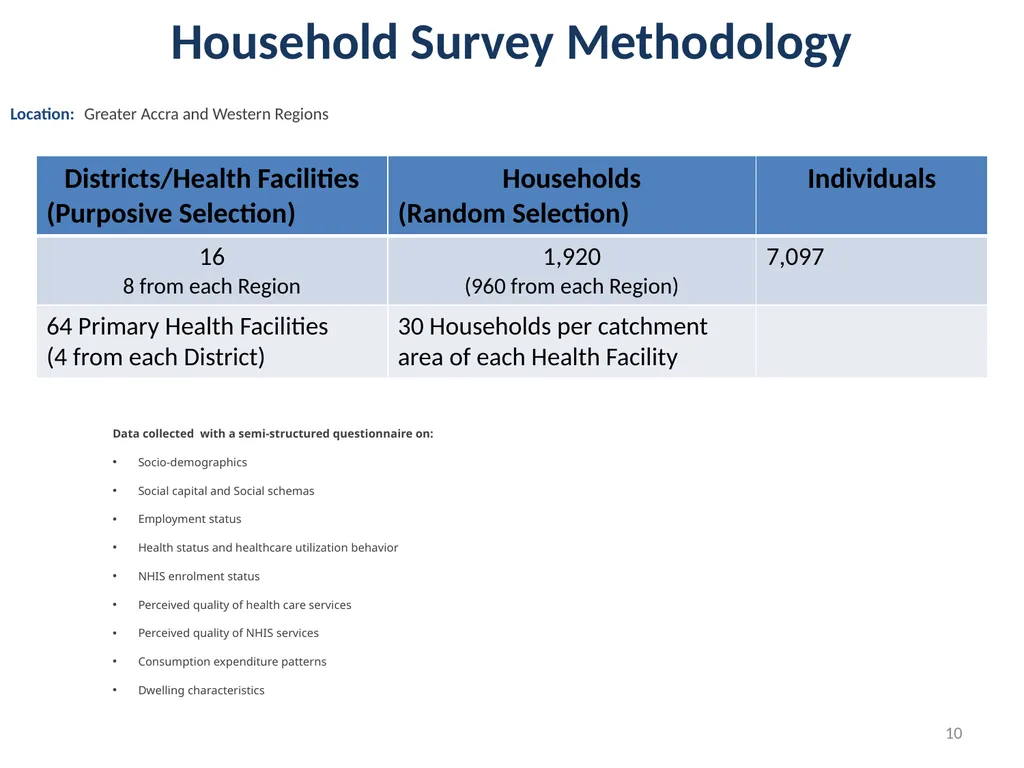
slide10. Household Survey Methodology Location: Greater Accra and Western Regions
Data collected with a semi-structured questionnaire on:
Socio-demographics
Social capital and Social schemas
Employment status
Health status and healthcare utilization behavior
NHIS enrolment status
Perceived quality of health care services
Perceived quality of NHIS services
Consumption expenditure patterns
Dwelling characteristics 10<br>
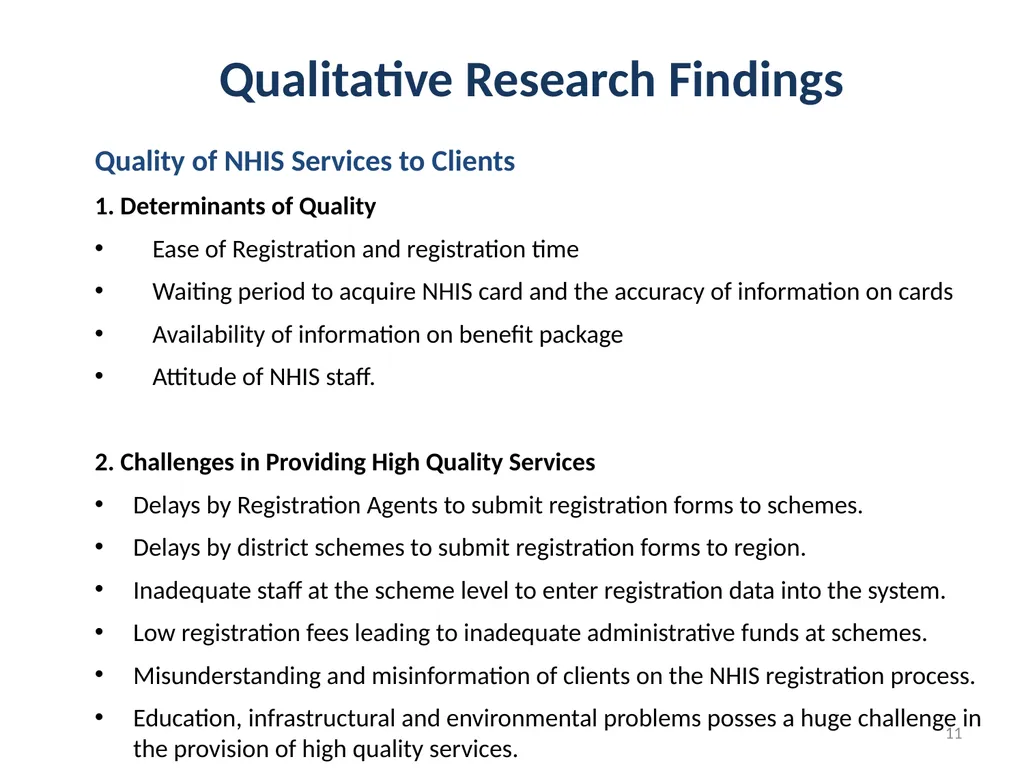
slide11. Qualitative Research Findings Quality of NHIS Services to Clients
1. Determinants of Quality
Ease of Registration and registration time
Waiting period to acquire NHIS card and the accuracy of information on cards
Availability of information on benefit package
Attitude of NHIS staff.
2. Challenges in Providing High Quality Services
Delays by Registration Agents to submit registration forms to schemes.
Delays by district schemes to submit registration forms to region.
Inadequate staff at the scheme level to enter registration data into the system.
Low registration fees leading to inadequate administrative funds at schemes.
Misunderstanding and misinformation of clients on the NHIS registration process.
Education, infrastructural and environmental problems posses a huge challenge in the provision of high quality services. 11<br>
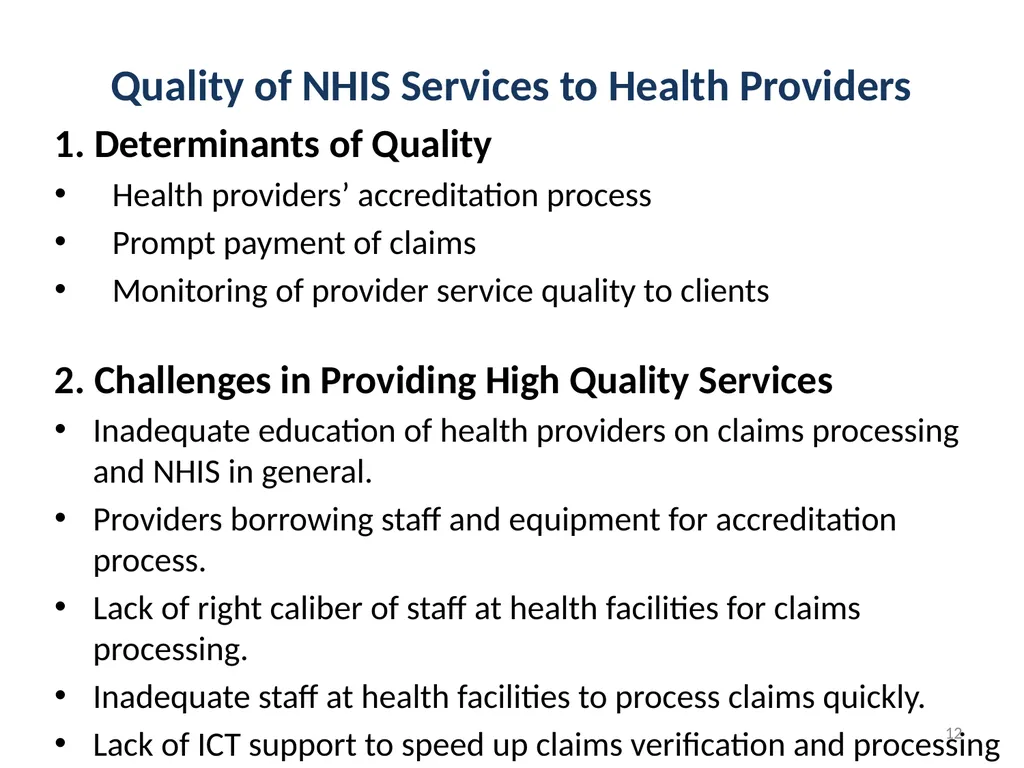
slide12. Quality of NHIS Services to Health Providers
1. Determinants of Quality
Health providers’ accreditation process
Prompt payment of claims
Monitoring of provider service quality to clients
2. Challenges in Providing High Quality Services
Inadequate education of health providers on claims processing and NHIS in general.
Providers borrowing staff and equipment for accreditation process.
Lack of right caliber of staff at health facilities for claims processing.
Inadequate staff at health facilities to process claims quickly.
Lack of ICT support to speed up claims verification and processing 12<br>
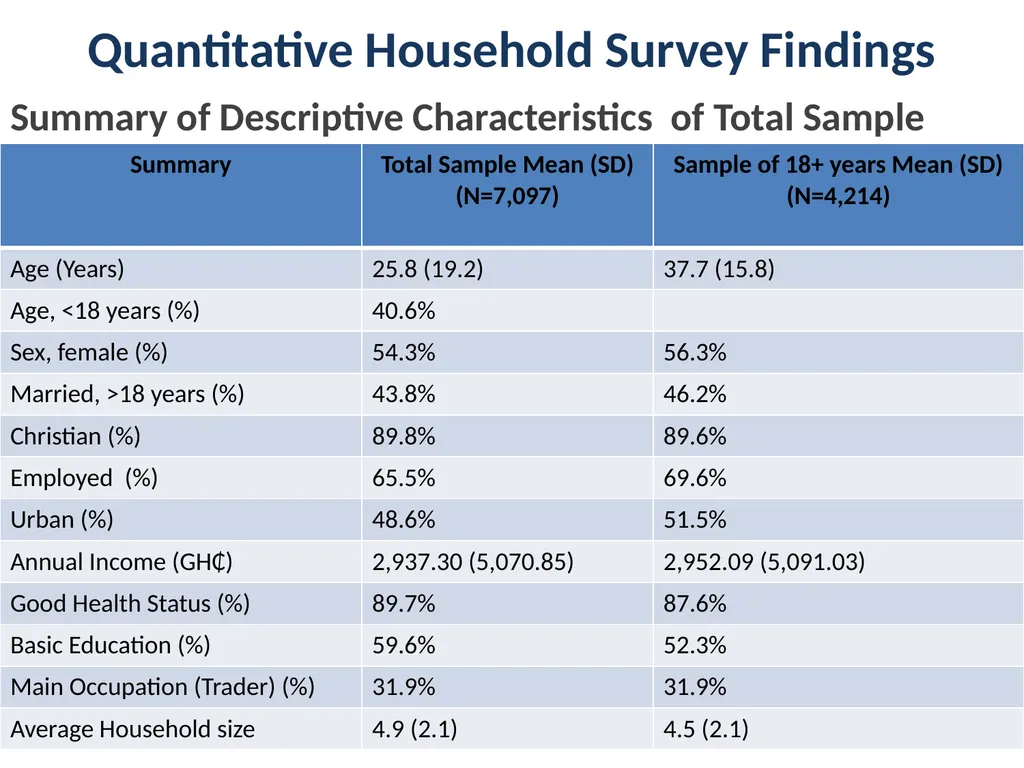
slide13. Quantitative Household Survey Findings Summary of Descriptive Characteristics of Total Sample 13<br>
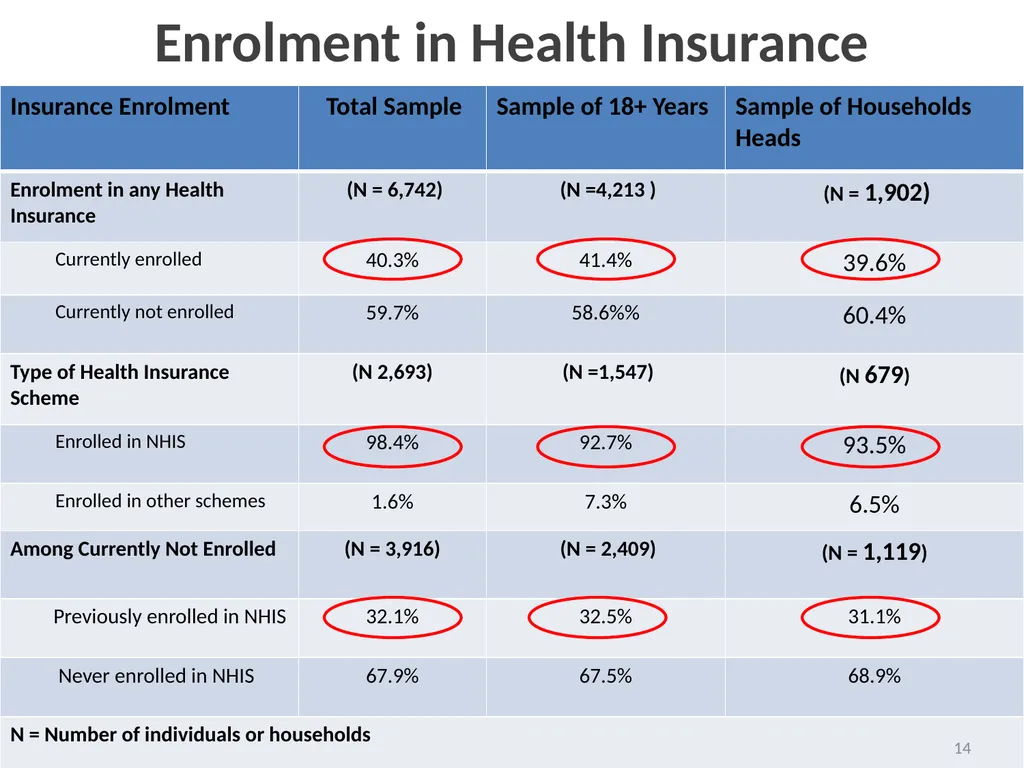
slide14. Enrolment in Health Insurance 14<br>
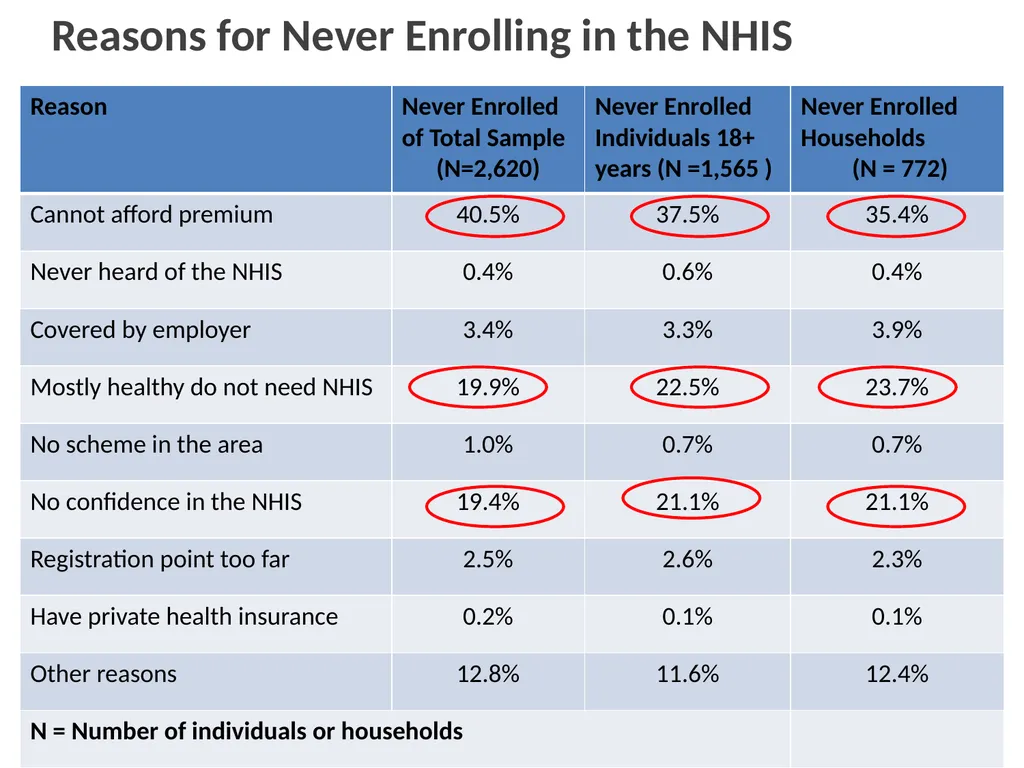
slide15. Reasons for Never Enrolling in the NHIS 15<br>
slide16. Age Group, Sex and Locality of Residence per Percentage Enrolled of Sample 18+ Years<br>
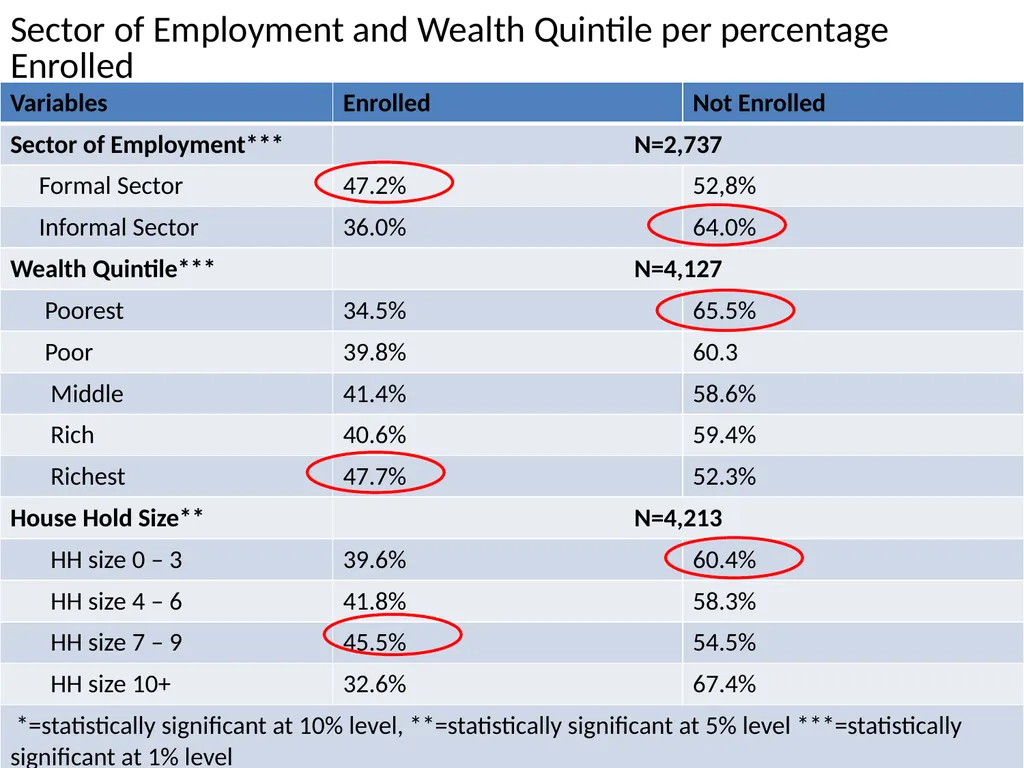
slide17. Sector of Employment and Wealth Quintile per percentage Enrolled<br>
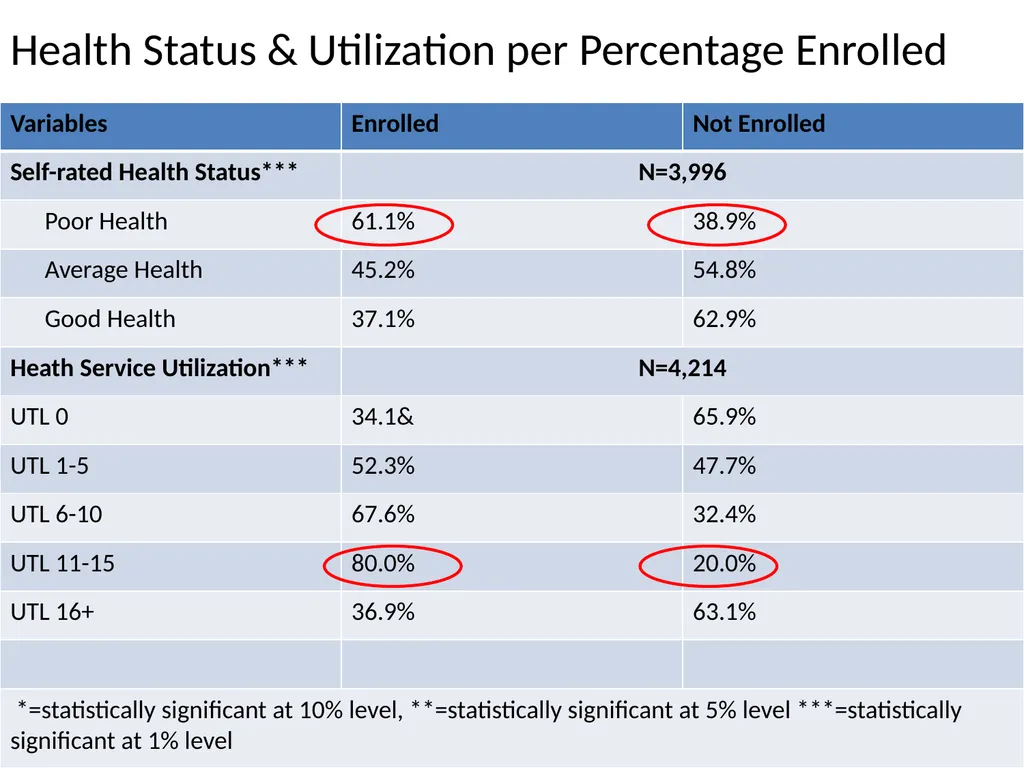
slide18. Health Status & Utilization per Percentage Enrolled<br>
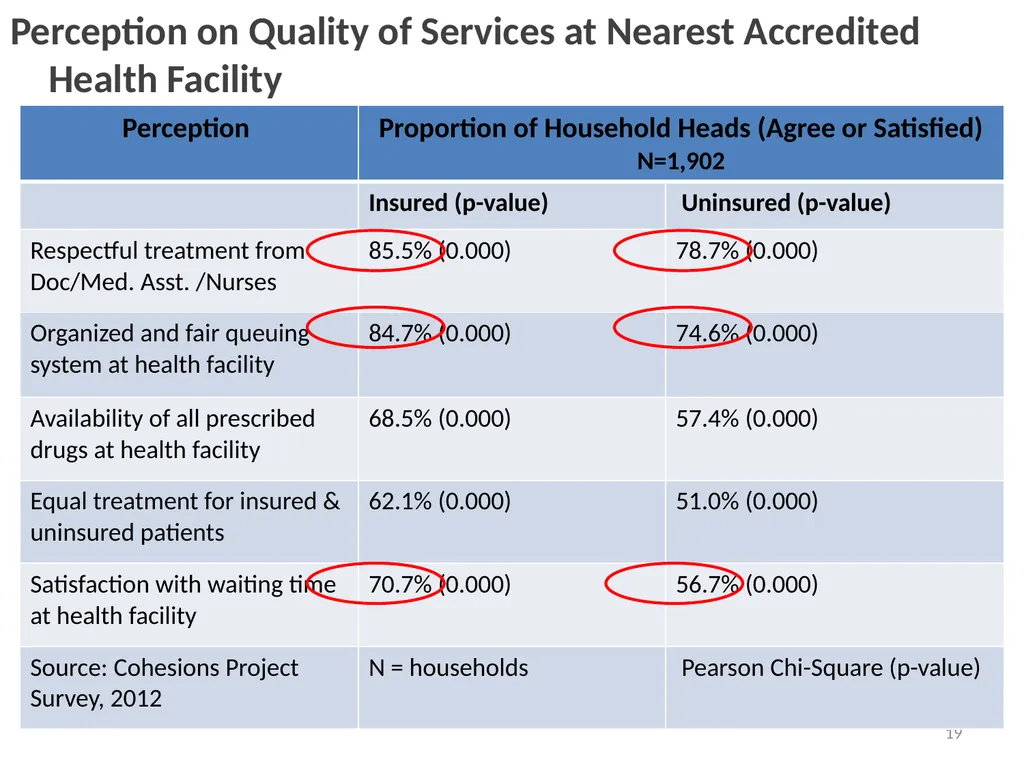
slide19. Perception on Quality of Services at Nearest Accredited Health Facility 19<br>
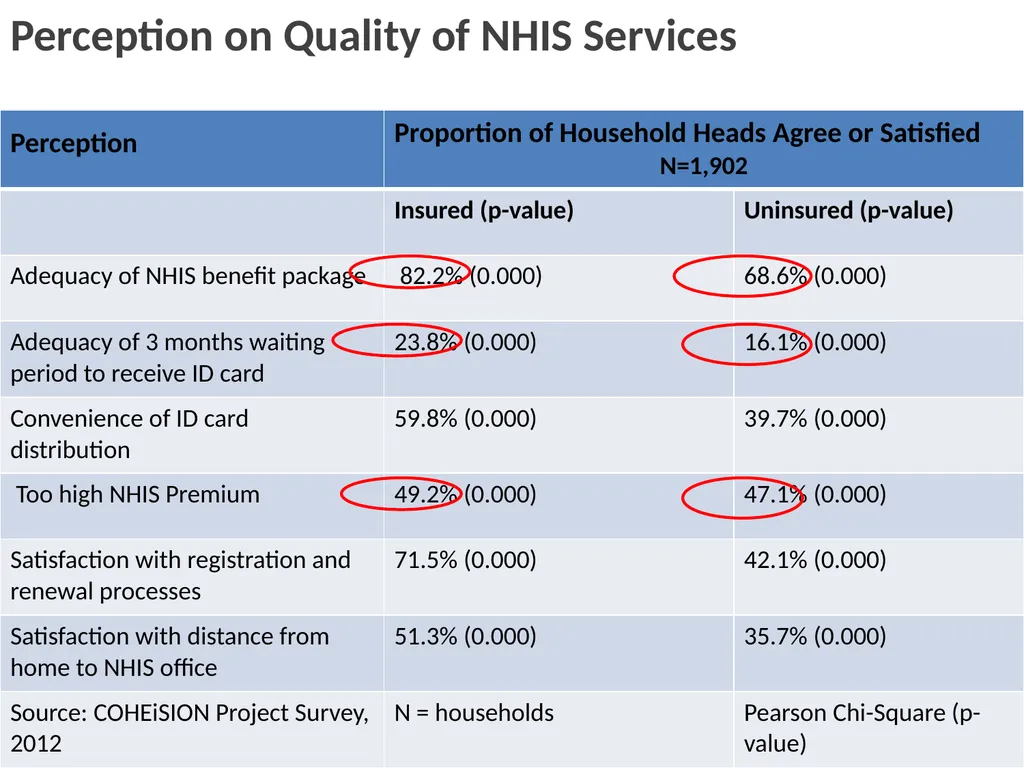
slide20. Perception on Quality of NHIS Services 20<br>
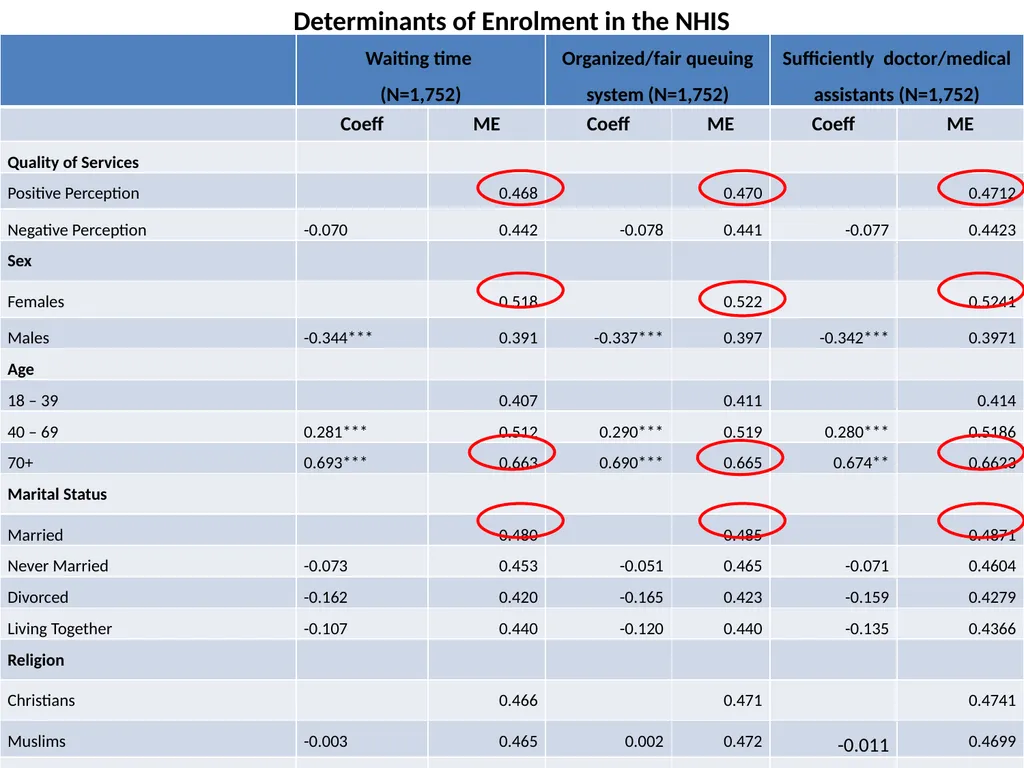
slide21. Determinants of Enrolment in the NHIS<br>
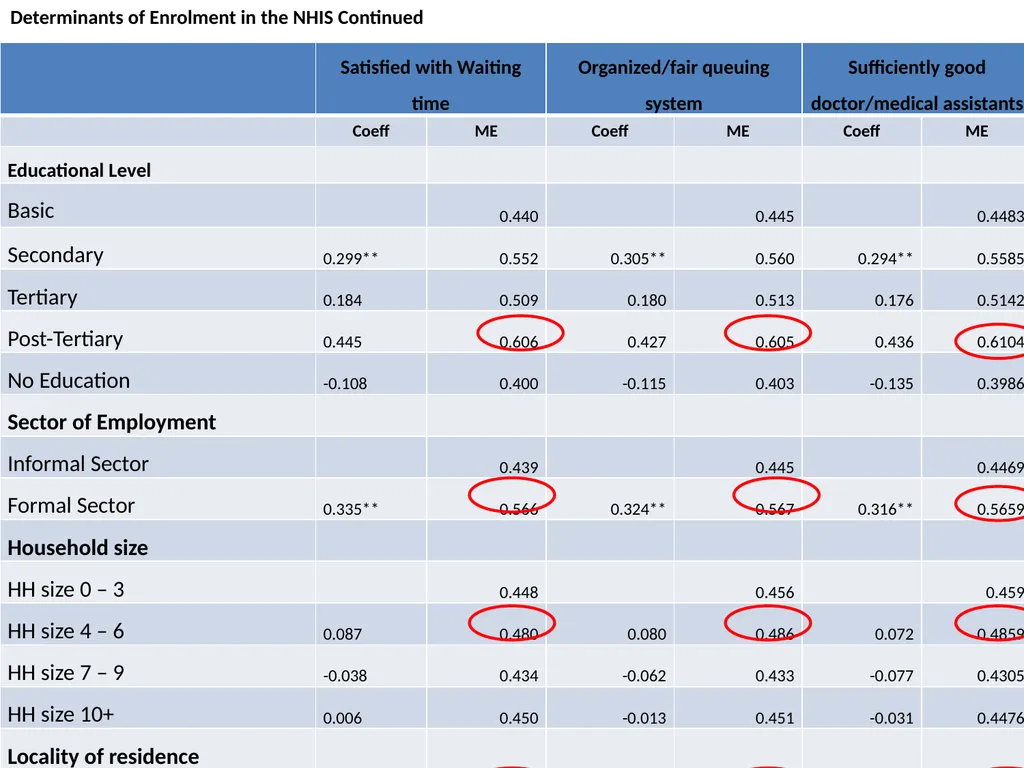
slide22. Determinants of Enrolment in the NHIS Continued<br>
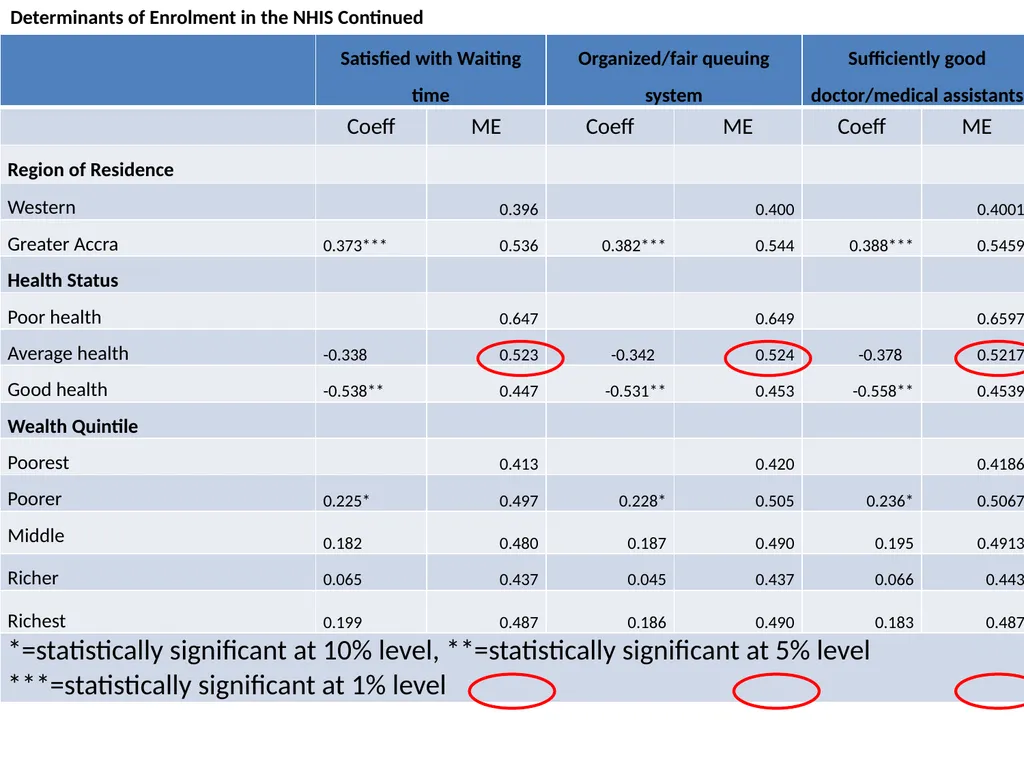
slide23. Determinants of Enrolment in the NHIS Continued<br>
slide24. Tripod with Focus on the Clients Client-Oriented NHIS System Provider Insurer 24 NHIS 10th Anniversary Conference Client Trust
-Socio cultural schemas
-Social capital<br>
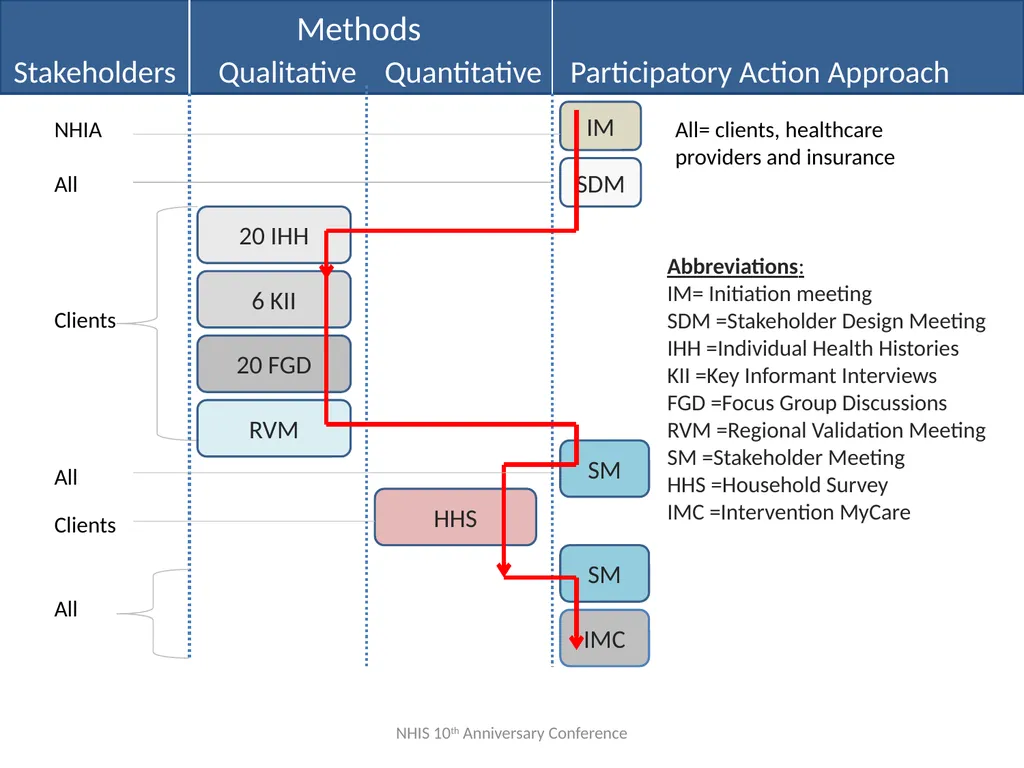
slide25. HHS 20 IHH 20 FGD Abbreviations:
IM= Initiation meeting
SDM =Stakeholder Design Meeting IHH =Individual Health Histories
KII =Key Informant Interviews
FGD =Focus Group Discussions
RVM =Regional Validation Meeting
SM =Stakeholder Meeting
HHS =Household Survey
IMC =Intervention MyCare 6 KII Stakeholders Qualitative Quantitative Participatory Action Approach Methods NHIA
All
Clients
All
Clients
All SDM SM SM IMC IM RVM NHIS 10th Anniversary Conference All= clients, healthcare providers and insurance<br>
slide26. NHIS 10th Anniversary Conference 26 FGD Western Region 2011<br>
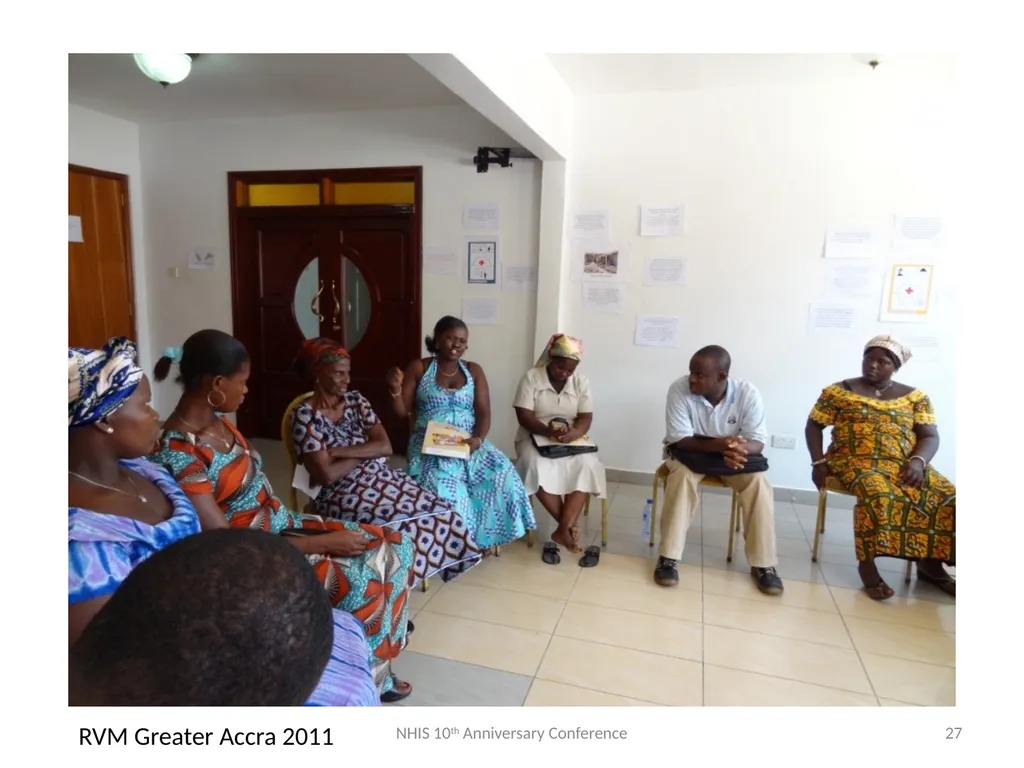
slide27. 27 NHIS 10th Anniversary Conference RVM Greater Accra 2011<br>
slide28. 28 NHIS 10th Anniversary Conference Stakeholder meeting 2012<br>
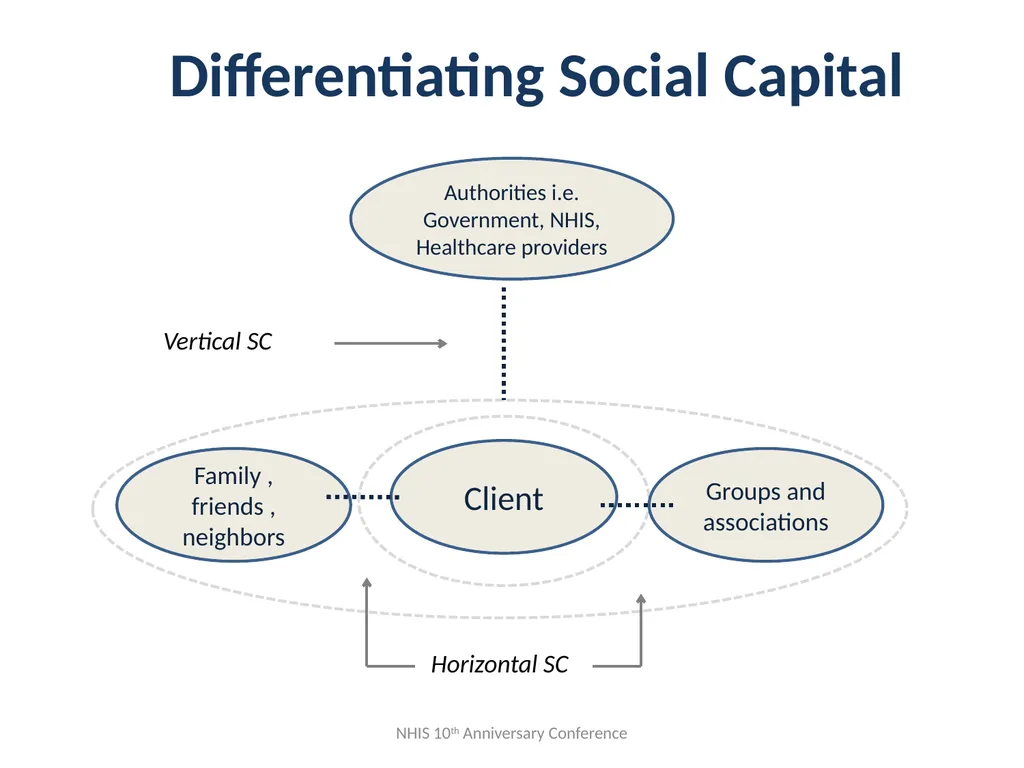
slide29. Social Capital (Bourdieu 1986, Coleman 1988, Putnam 1993,Fukuyama 2000, Grootaert 2001) social connections or social networks that catalyzes cooperation, coordination and reciprocity;
reduces incomplete or asymmetric information
reduces transaction costs in the absence of formal, enforced contracts.
can achieve improved social and economic outcomes.
Trust is seen as important determinant of SC.
SC at the community level can positively and significantly impact households’ decision in take up of health insurance (Donfouet et al 2011; Zangh et al 2006) NHIS 10th Anniversary Conference 29<br>
slide30. Family , friends , neighbors Client Groups and associations Authorities i.e. Government, NHIS, Healthcare providers Vertical SC Horizontal SC Differentiating Social Capital NHIS 10th Anniversary Conference<br>
slide31. Clients’ views on social networks and support structures ‘Why I realized that ‘health’ is not good is because most of my siblings and even my friends that I know have insurance, look disappointed when they go for treatment and come back’ (FGD female GAR) If ‘you walk alone’ and keep things to yourself, nobody knows what is worrying you or what is in your heart but if you are part of a group, you can share what is bothering you. Someone who is knowledgeable about it will give you advice and help you. So the group is good’ (IHH female, Insured Western Region) What motivated me to join the NHIS is that I may not have money when I fall ill and that would make the illness worse. I have already paid and keep my card so when I fall ill without having any money I can access health care. (Female insured IHH GAR) ‘Now the world has become difficult, family members are no more supporting anybody, (interjection by a participant: 'Everyone for himself, God for us all' that is the motto we have in this family’ (FGD Male/Female Western Region)<br>
slide32. Social capital: membership of groups (n=3963) 32 NHIS 10th Anniversary Conference<br>
slide33. Social capital: Social cohesion and inclusion (n=3963) 33 NHIS 10th Anniversary Conference<br>
slide34. Social capital :Trust and solidarity (n-3963) 34 NHIS 10th Anniversary Conference<br>
slide35. Survey findings: Trust in the healthcare provider (N=3963) 35 NHIS 10th Anniversary Conference<br>
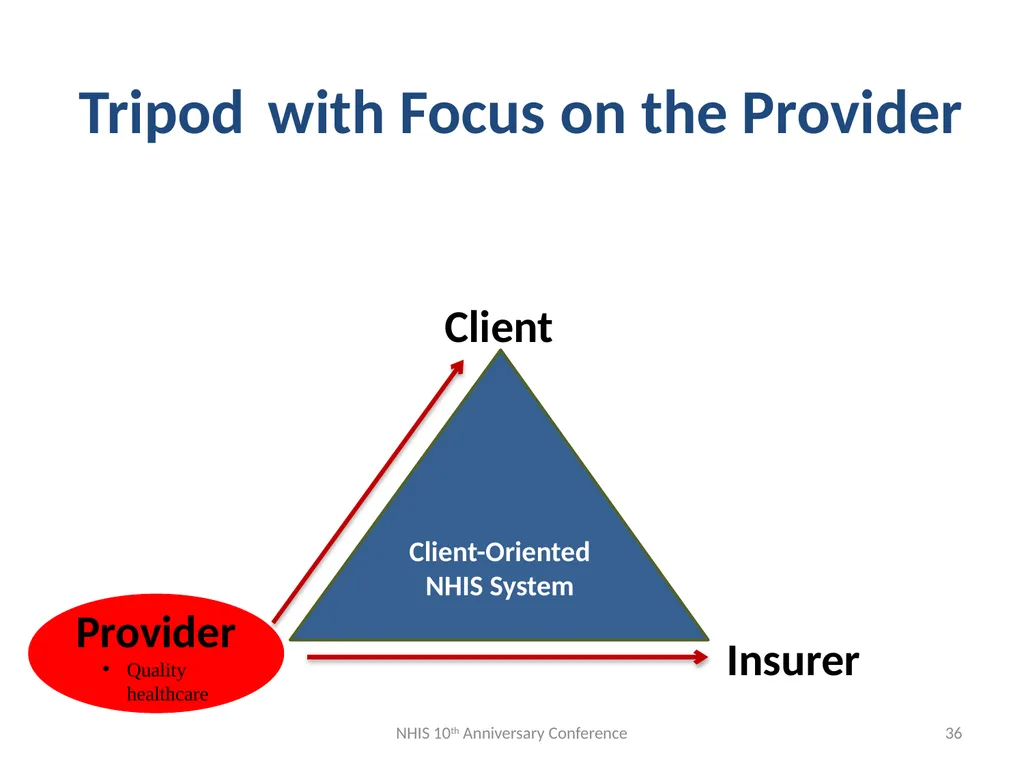
slide36. Tripod with Focus on the Provider Client-Oriented NHIS System Client Insurer Provider
Quality healthcare 36 NHIS 10th Anniversary Conference<br>
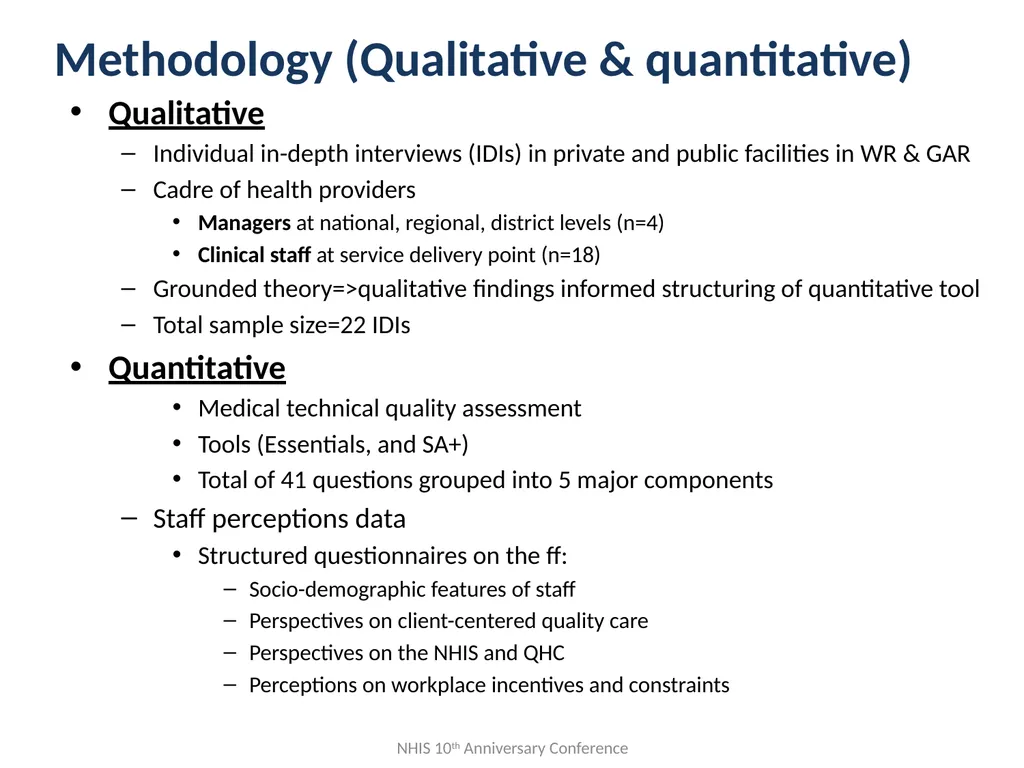
slide37. Methodology (Qualitative & quantitative) Qualitative
Individual in-depth interviews (IDIs) in private and public facilities in WR & GAR
Cadre of health providers
Managers at national, regional, district levels (n=4)
Clinical staff at service delivery point (n=18)
Grounded theory=>qualitative findings informed structuring of quantitative tool
Total sample size=22 IDIs
Quantitative
Medical technical quality assessment
Tools (Essentials, and SA+)
Total of 41 questions grouped into 5 major components
Staff perceptions data
Structured questionnaires on the ff:
Socio-demographic features of staff
Perspectives on client-centered quality care
Perspectives on the NHIS and QHC
Perceptions on workplace incentives and constraints NHIS 10th Anniversary Conference<br>
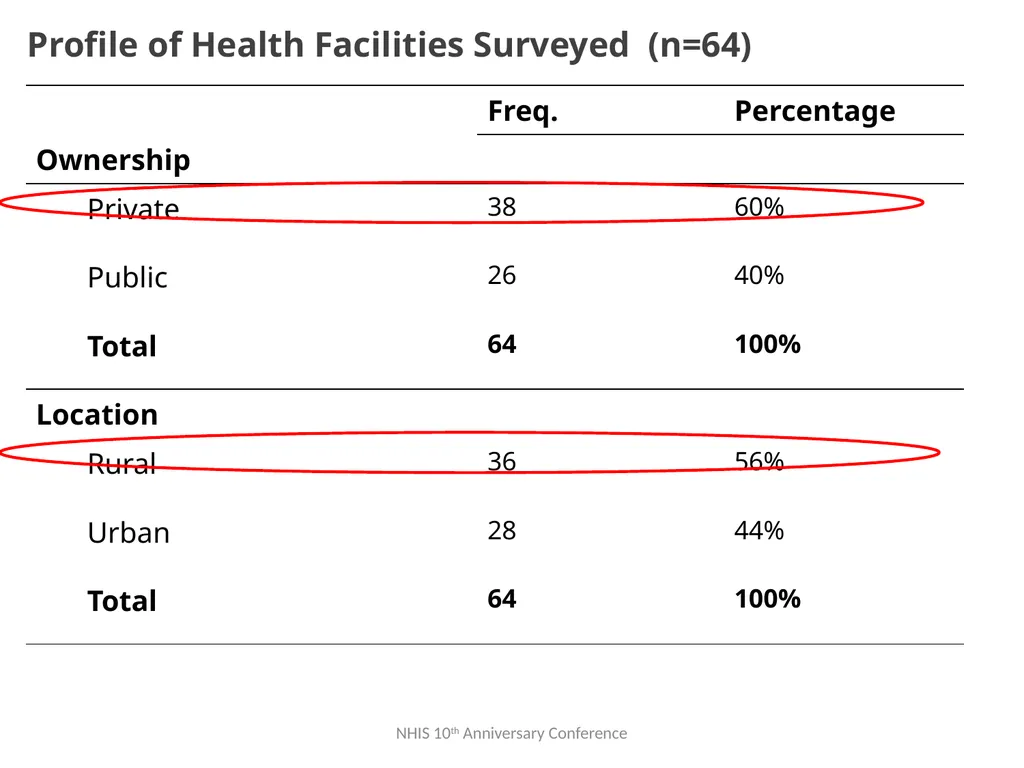
slide38. Profile of Health Facilities Surveyed (n=64) NHIS 10th Anniversary Conference<br>
slide39. Quality care and patient safety situation in clinics and health centres Mean percentage scores in NHIA core standard areas (n=64) Source: Analyzed NHIA Accreditation Data on selected 64 clinics and health centres (2009/2010) NHIS 10th Anniversary Conference<br>
slide40. Mean percentage scores on Essentials Risk Areas (n=64) NHIS 10th Anniversary Conference<br>
slide41. NHIS 10th Anniversary Conference<br>
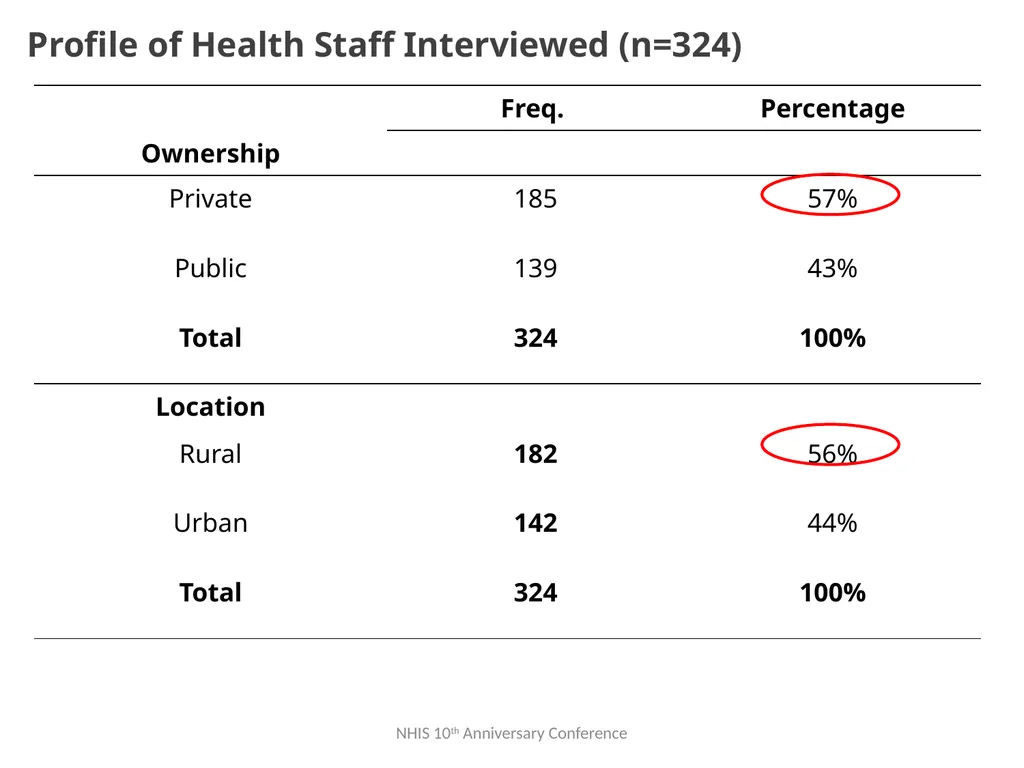
slide42. Profile of Health Staff Interviewed (n=324) NHIS 10th Anniversary Conference<br>
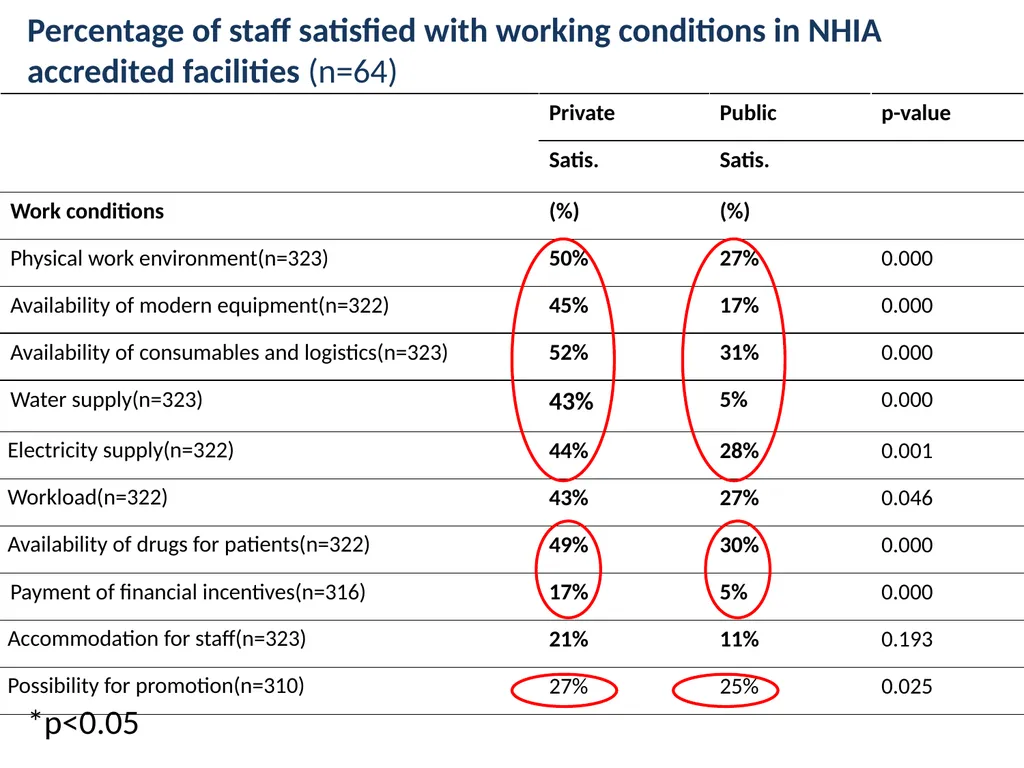
slide43. Percentage of staff satisfied with working conditions in NHIA accredited facilities (n=64) *p<0.05<br>
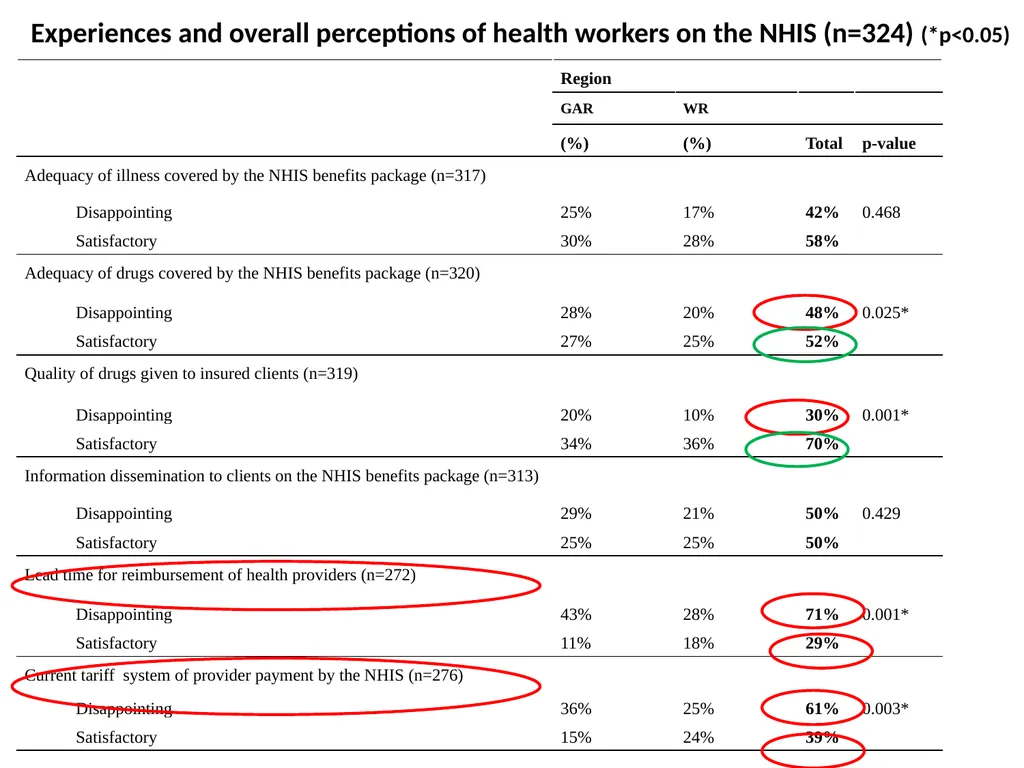
slide44. Experiences and overall perceptions of health workers on the NHIS (n=324) (*p<0.05)<br>
slide45. Perspectives health staff on the effects of NHIS on quality care<br>
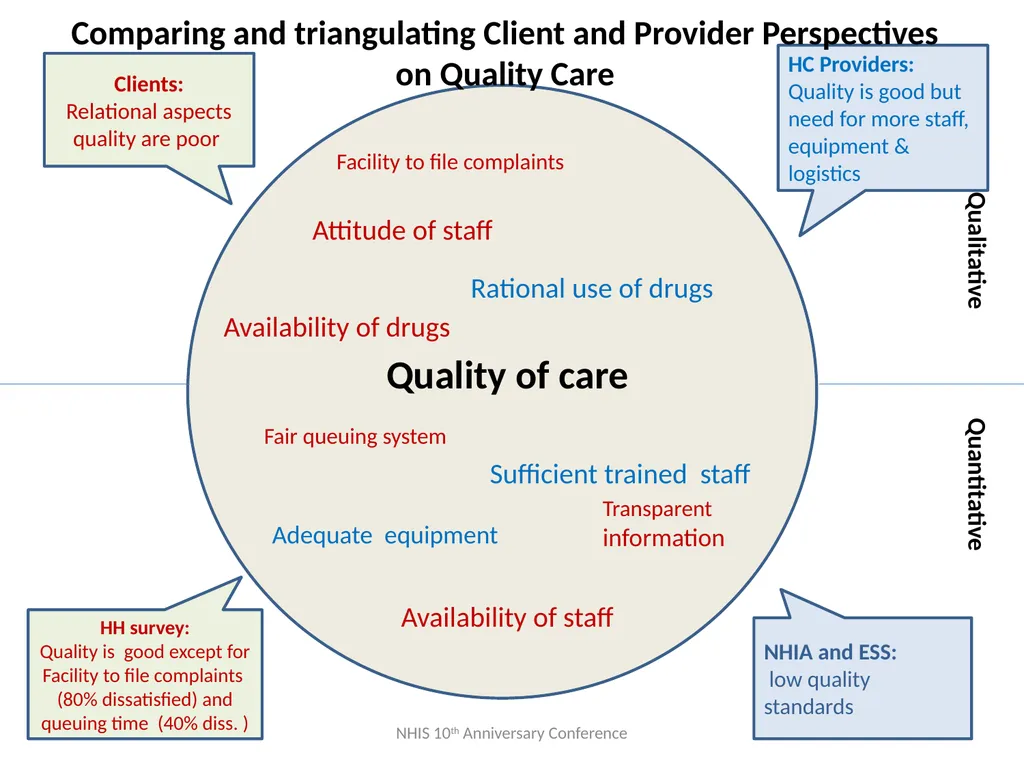
slide46. Quality of care Attitude of staff Availability of drugs Transparent information Fair queuing system Facility to file complaints Availability of staff Rational use of drugs Adequate equipment Sufficient trained staff Qualitative Quantitative Clients:
Relational aspects quality are poor HC Providers:
Quality is good but need for more staff, equipment & logistics NHIA and ESS:
low quality standards HH survey:
Quality is good except for
Facility to file complaints (80% dissatisfied) and queuing time (40% diss. ) Comparing and triangulating Client and Provider Perspectives on Quality Care 46 NHIS 10th Anniversary Conference<br>
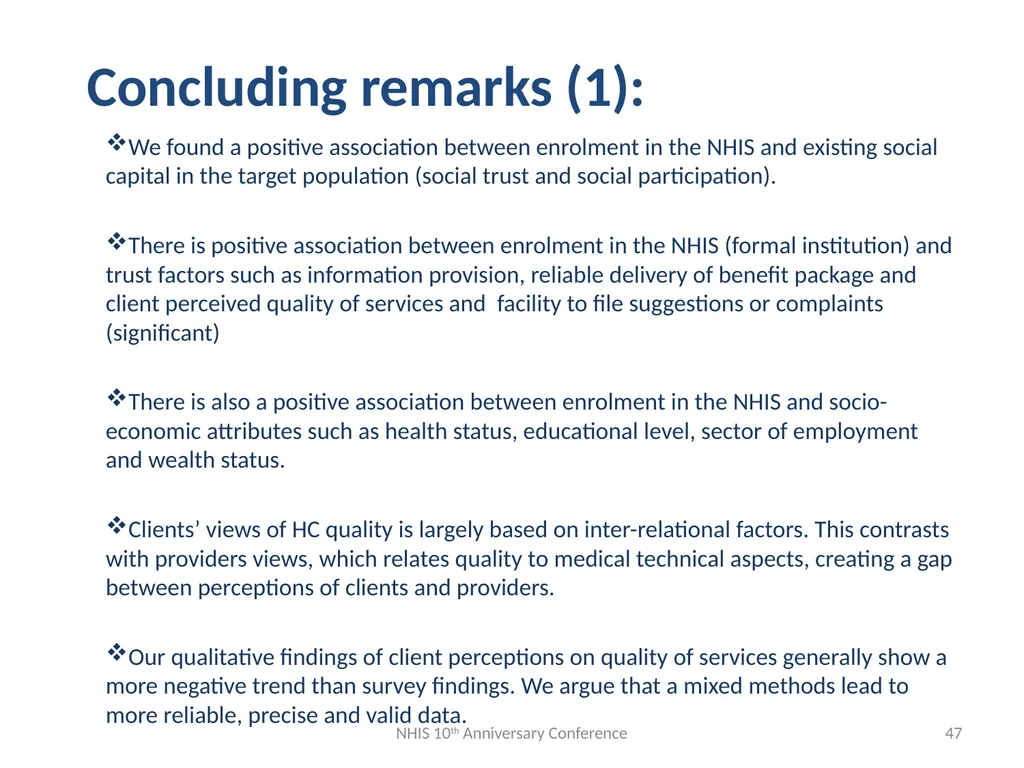
slide47. Concluding remarks (1): We found a positive association between enrolment in the NHIS and existing social capital in the target population (social trust and social participation).
There is positive association between enrolment in the NHIS (formal institution) and trust factors such as information provision, reliable delivery of benefit package and client perceived quality of services and facility to file suggestions or complaints (significant)
There is also a positive association between enrolment in the NHIS and socio-economic attributes such as health status, educational level, sector of employment and wealth status.
Clients’ views of HC quality is largely based on inter-relational factors. This contrasts with providers views, which relates quality to medical technical aspects, creating a gap between perceptions of clients and providers.
Our qualitative findings of client perceptions on quality of services generally show a more negative trend than survey findings. We argue that a mixed methods lead to more reliable, precise and valid data. 47 NHIS 10th Anniversary Conference<br>
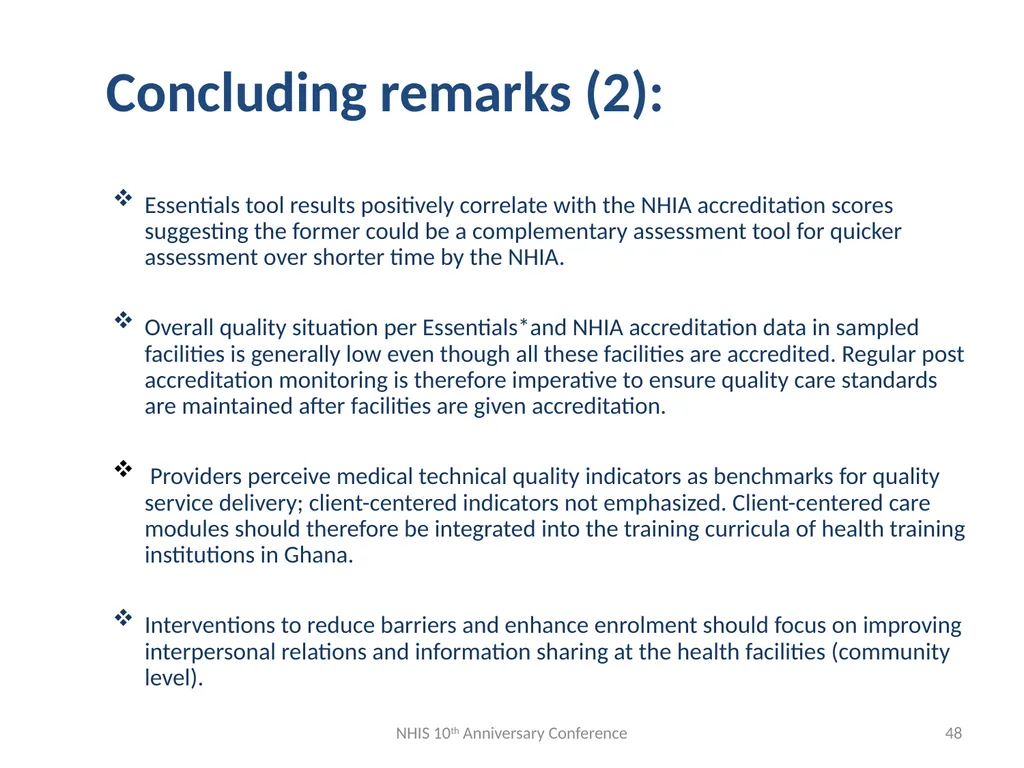
slide48. Essentials tool results positively correlate with the NHIA accreditation scores suggesting the former could be a complementary assessment tool for quicker assessment over shorter time by the NHIA.
Overall quality situation per Essentials*and NHIA accreditation data in sampled facilities is generally low even though all these facilities are accredited. Regular post accreditation monitoring is therefore imperative to ensure quality care standards are maintained after facilities are given accreditation.
Providers perceive medical technical quality indicators as benchmarks for quality service delivery; client-centered indicators not emphasized. Client-centered care modules should therefore be integrated into the training curricula of health training institutions in Ghana.
Interventions to reduce barriers and enhance enrolment should focus on improving interpersonal relations and information sharing at the health facilities (community level). Concluding remarks (2): NHIS 10th Anniversary Conference 48<br>
slide49. Thank you NHIS 10th Anniversary onference 49<br>
Stephen Duku
Christine Fenenga
Robert Kaba Alhassan
Tobias Rinke de Wit, Inge Hutter, Menno Pradhan, Daniel Arhinful 1 NHIS 10th Anniversary Conference<br>
slide2. Background Key question of this project derived from NHIS:
2010 enrolment about 64% , active membership 34%
Retention problem => what are the barriers?
Anecdotal information and growing empirical evidence showing differences in enrolment rate among the population (Asante & Aikins, 2008)
This RCT project is a joint initiative between NHIA, GHS, CHAG and other health partners and the University of Ghana and 3 Universities in The Netherlands with an initiation workshop in 2011
Funded by the Global Health Policy and Health Systems Research Fund 2010 of the Dutch Scientific Organization NWO-WOTRO 2 NHIS 10th Anniversary Conference<br>
slide3. Main Objective and Research Question Main Objective:
To enhance and sustain health insurance participation in Ghana through improved client-oriented quality of care
Main research questions:
What are the main perceived barriers of health care clients to (re-)enroll in the NHIS?
Which are effective interventions that address these barriers? 3 NHIS 10th Anniversary Conference<br>
slide4. Client-Provider-Insurer Tripod Framework Perspectives of the 3 key stakeholder groups, allowing comparison and triangulation of data Client-Oriented NHIS System Client Insurer Provider 4 NHIS 10th Anniversary Conference<br>
slide5. Set up of research Selected Regions: GAR and WR 5 NHIS 10th Anniversary Conference<br>
slide6. Sampling Strategy 6 NHIS 10th Anniversary Conference<br>
slide7. Remaining content of this presentation Health insurance perspectives by Stephen Duku
Client perspectives by Christine Fenenga
Healthcare provider perspectives by Robert K. Alhassan NHIS 10th Anniversary Conference 7<br>
slide8. Tripod with Focus on the Insurer Client-Oriented NHIS System Client Provider Insurer 8 NHIS 10th Anniversary Conference<br>
slide9. Qualitative Research Methodology Location: Greater Accra and Western Regions
In-depth Interviews (n=16)
8 interviews in 4 NHIA districts offices (Dangme West, Ga West, Ahanta West and Mpohor Wassa), 2 interviews per district
4 interviews, 2 each at the NHIA Regional offices of the Greater Accra and Western regions
4 interview at the NHIA Headquarters in Accra
Interviewees
NHIA District Office – District Scheme Managers and Claims Officers
NHIA Regional Office – Regional Managers and M&E Officers
NHIA Headquarters – Divisional Directors and Senior Officers
Data management
Topic guides for all the interviews
All interviews were recorded and transcribed verbatim
Interviews were Coded, Categorized and conceptualized
Findings were validated in a feedback workshop in each region 9<br>
slide10. Household Survey Methodology Location: Greater Accra and Western Regions
Data collected with a semi-structured questionnaire on:
Socio-demographics
Social capital and Social schemas
Employment status
Health status and healthcare utilization behavior
NHIS enrolment status
Perceived quality of health care services
Perceived quality of NHIS services
Consumption expenditure patterns
Dwelling characteristics 10<br>
slide11. Qualitative Research Findings Quality of NHIS Services to Clients
1. Determinants of Quality
Ease of Registration and registration time
Waiting period to acquire NHIS card and the accuracy of information on cards
Availability of information on benefit package
Attitude of NHIS staff.
2. Challenges in Providing High Quality Services
Delays by Registration Agents to submit registration forms to schemes.
Delays by district schemes to submit registration forms to region.
Inadequate staff at the scheme level to enter registration data into the system.
Low registration fees leading to inadequate administrative funds at schemes.
Misunderstanding and misinformation of clients on the NHIS registration process.
Education, infrastructural and environmental problems posses a huge challenge in the provision of high quality services. 11<br>
slide12. Quality of NHIS Services to Health Providers
1. Determinants of Quality
Health providers’ accreditation process
Prompt payment of claims
Monitoring of provider service quality to clients
2. Challenges in Providing High Quality Services
Inadequate education of health providers on claims processing and NHIS in general.
Providers borrowing staff and equipment for accreditation process.
Lack of right caliber of staff at health facilities for claims processing.
Inadequate staff at health facilities to process claims quickly.
Lack of ICT support to speed up claims verification and processing 12<br>
slide13. Quantitative Household Survey Findings Summary of Descriptive Characteristics of Total Sample 13<br>
slide14. Enrolment in Health Insurance 14<br>
slide15. Reasons for Never Enrolling in the NHIS 15<br>
slide16. Age Group, Sex and Locality of Residence per Percentage Enrolled of Sample 18+ Years<br>
slide17. Sector of Employment and Wealth Quintile per percentage Enrolled<br>
slide18. Health Status & Utilization per Percentage Enrolled<br>
slide19. Perception on Quality of Services at Nearest Accredited Health Facility 19<br>
slide20. Perception on Quality of NHIS Services 20<br>
slide21. Determinants of Enrolment in the NHIS<br>
slide22. Determinants of Enrolment in the NHIS Continued<br>
slide23. Determinants of Enrolment in the NHIS Continued<br>
slide24. Tripod with Focus on the Clients Client-Oriented NHIS System Provider Insurer 24 NHIS 10th Anniversary Conference Client Trust
-Socio cultural schemas
-Social capital<br>
slide25. HHS 20 IHH 20 FGD Abbreviations:
IM= Initiation meeting
SDM =Stakeholder Design Meeting IHH =Individual Health Histories
KII =Key Informant Interviews
FGD =Focus Group Discussions
RVM =Regional Validation Meeting
SM =Stakeholder Meeting
HHS =Household Survey
IMC =Intervention MyCare 6 KII Stakeholders Qualitative Quantitative Participatory Action Approach Methods NHIA
All
Clients
All
Clients
All SDM SM SM IMC IM RVM NHIS 10th Anniversary Conference All= clients, healthcare providers and insurance<br>
slide26. NHIS 10th Anniversary Conference 26 FGD Western Region 2011<br>
slide27. 27 NHIS 10th Anniversary Conference RVM Greater Accra 2011<br>
slide28. 28 NHIS 10th Anniversary Conference Stakeholder meeting 2012<br>
slide29. Social Capital (Bourdieu 1986, Coleman 1988, Putnam 1993,Fukuyama 2000, Grootaert 2001) social connections or social networks that catalyzes cooperation, coordination and reciprocity;
reduces incomplete or asymmetric information
reduces transaction costs in the absence of formal, enforced contracts.
can achieve improved social and economic outcomes.
Trust is seen as important determinant of SC.
SC at the community level can positively and significantly impact households’ decision in take up of health insurance (Donfouet et al 2011; Zangh et al 2006) NHIS 10th Anniversary Conference 29<br>
slide30. Family , friends , neighbors Client Groups and associations Authorities i.e. Government, NHIS, Healthcare providers Vertical SC Horizontal SC Differentiating Social Capital NHIS 10th Anniversary Conference<br>
slide31. Clients’ views on social networks and support structures ‘Why I realized that ‘health’ is not good is because most of my siblings and even my friends that I know have insurance, look disappointed when they go for treatment and come back’ (FGD female GAR) If ‘you walk alone’ and keep things to yourself, nobody knows what is worrying you or what is in your heart but if you are part of a group, you can share what is bothering you. Someone who is knowledgeable about it will give you advice and help you. So the group is good’ (IHH female, Insured Western Region) What motivated me to join the NHIS is that I may not have money when I fall ill and that would make the illness worse. I have already paid and keep my card so when I fall ill without having any money I can access health care. (Female insured IHH GAR) ‘Now the world has become difficult, family members are no more supporting anybody, (interjection by a participant: 'Everyone for himself, God for us all' that is the motto we have in this family’ (FGD Male/Female Western Region)<br>
slide32. Social capital: membership of groups (n=3963) 32 NHIS 10th Anniversary Conference<br>
slide33. Social capital: Social cohesion and inclusion (n=3963) 33 NHIS 10th Anniversary Conference<br>
slide34. Social capital :Trust and solidarity (n-3963) 34 NHIS 10th Anniversary Conference<br>
slide35. Survey findings: Trust in the healthcare provider (N=3963) 35 NHIS 10th Anniversary Conference<br>
slide36. Tripod with Focus on the Provider Client-Oriented NHIS System Client Insurer Provider
Quality healthcare 36 NHIS 10th Anniversary Conference<br>
slide37. Methodology (Qualitative & quantitative) Qualitative
Individual in-depth interviews (IDIs) in private and public facilities in WR & GAR
Cadre of health providers
Managers at national, regional, district levels (n=4)
Clinical staff at service delivery point (n=18)
Grounded theory=>qualitative findings informed structuring of quantitative tool
Total sample size=22 IDIs
Quantitative
Medical technical quality assessment
Tools (Essentials, and SA+)
Total of 41 questions grouped into 5 major components
Staff perceptions data
Structured questionnaires on the ff:
Socio-demographic features of staff
Perspectives on client-centered quality care
Perspectives on the NHIS and QHC
Perceptions on workplace incentives and constraints NHIS 10th Anniversary Conference<br>
slide38. Profile of Health Facilities Surveyed (n=64) NHIS 10th Anniversary Conference<br>
slide39. Quality care and patient safety situation in clinics and health centres Mean percentage scores in NHIA core standard areas (n=64) Source: Analyzed NHIA Accreditation Data on selected 64 clinics and health centres (2009/2010) NHIS 10th Anniversary Conference<br>
slide40. Mean percentage scores on Essentials Risk Areas (n=64) NHIS 10th Anniversary Conference<br>
slide41. NHIS 10th Anniversary Conference<br>
slide42. Profile of Health Staff Interviewed (n=324) NHIS 10th Anniversary Conference<br>
slide43. Percentage of staff satisfied with working conditions in NHIA accredited facilities (n=64) *p<0.05<br>
slide44. Experiences and overall perceptions of health workers on the NHIS (n=324) (*p<0.05)<br>
slide45. Perspectives health staff on the effects of NHIS on quality care<br>
slide46. Quality of care Attitude of staff Availability of drugs Transparent information Fair queuing system Facility to file complaints Availability of staff Rational use of drugs Adequate equipment Sufficient trained staff Qualitative Quantitative Clients:
Relational aspects quality are poor HC Providers:
Quality is good but need for more staff, equipment & logistics NHIA and ESS:
low quality standards HH survey:
Quality is good except for
Facility to file complaints (80% dissatisfied) and queuing time (40% diss. ) Comparing and triangulating Client and Provider Perspectives on Quality Care 46 NHIS 10th Anniversary Conference<br>
slide47. Concluding remarks (1): We found a positive association between enrolment in the NHIS and existing social capital in the target population (social trust and social participation).
There is positive association between enrolment in the NHIS (formal institution) and trust factors such as information provision, reliable delivery of benefit package and client perceived quality of services and facility to file suggestions or complaints (significant)
There is also a positive association between enrolment in the NHIS and socio-economic attributes such as health status, educational level, sector of employment and wealth status.
Clients’ views of HC quality is largely based on inter-relational factors. This contrasts with providers views, which relates quality to medical technical aspects, creating a gap between perceptions of clients and providers.
Our qualitative findings of client perceptions on quality of services generally show a more negative trend than survey findings. We argue that a mixed methods lead to more reliable, precise and valid data. 47 NHIS 10th Anniversary Conference<br>
slide48. Essentials tool results positively correlate with the NHIA accreditation scores suggesting the former could be a complementary assessment tool for quicker assessment over shorter time by the NHIA.
Overall quality situation per Essentials*and NHIA accreditation data in sampled facilities is generally low even though all these facilities are accredited. Regular post accreditation monitoring is therefore imperative to ensure quality care standards are maintained after facilities are given accreditation.
Providers perceive medical technical quality indicators as benchmarks for quality service delivery; client-centered indicators not emphasized. Client-centered care modules should therefore be integrated into the training curricula of health training institutions in Ghana.
Interventions to reduce barriers and enhance enrolment should focus on improving interpersonal relations and information sharing at the health facilities (community level). Concluding remarks (2): NHIS 10th Anniversary Conference 48<br>
slide49. Thank you NHIS 10th Anniversary onference 49<br>