
Towards an ASEAN Economic Community (AEC):
NS
Published · 25 slides · 0 views

1 / 1

Description
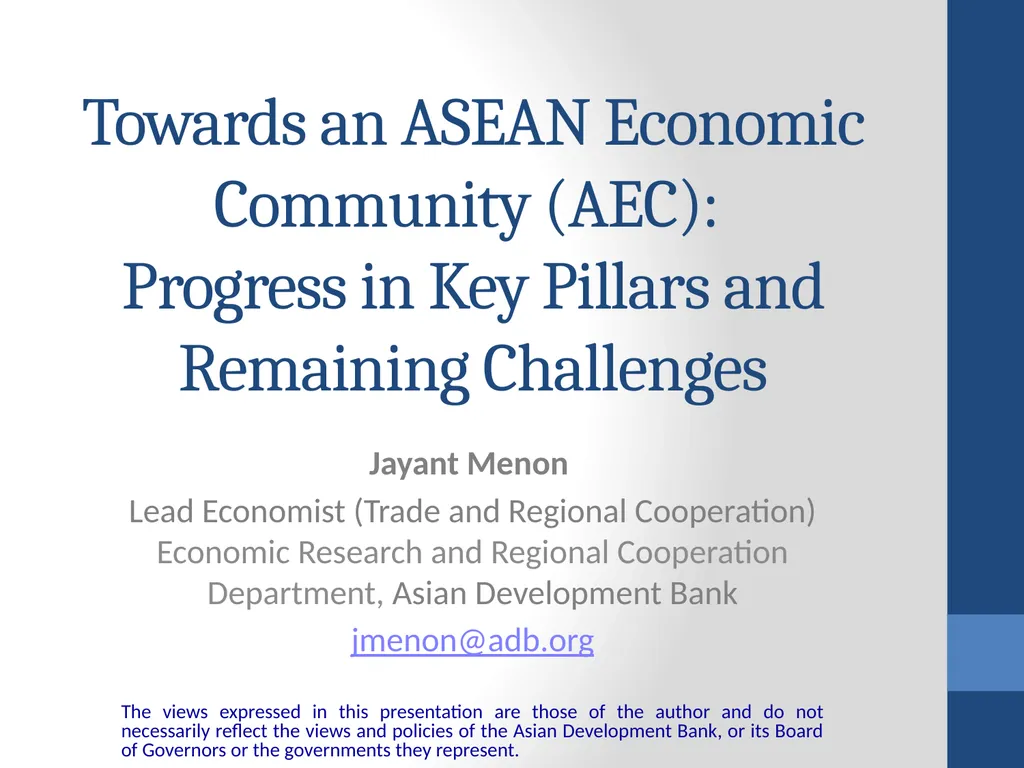
Towards an ASEAN Economic Community (AEC): Progress in Key Pillars and Remaining Challenges Jayant Menon Lead Economist (Trade and Regional Cooperation) Economic Research and Regional Cooperation Department, Asian Development Bank
Related Topics
Share
Embed code
Download this presentation From Below
"Towards an ASEAN Economic Community (AEC):" is the property of its rightful owner. Permission is granted to download and print the materials on this website for personal, non-commercial use only, and to display it on your personal computer provided you do not modify the materials and that you retain all copyright notices contained in the materials. By downloading content from our website, you accept the terms of this agreement.
Presentation Transcript
01
Towards an ASEAN Economic Community (AEC):
Progress in Key Pillars and Remaining Challenges Jayant Menon
Lead Economist (Trade and Regional Cooperation) Economic Research and Regional Cooperation Department, Asian Development Bank
jmenon@adb.org
The views expressed in this presentation are those of the author and do not necessarily reflect the views and policies of the Asian Development Bank, or its Board of Governors or the governments they represent.<br>
Lead Economist (Trade and Regional Cooperation) Economic Research and Regional Cooperation Department, Asian Development Bank
jmenon@adb.org
The views expressed in this presentation are those of the author and do not necessarily reflect the views and policies of the Asian Development Bank, or its Board of Governors or the governments they represent.<br>
02
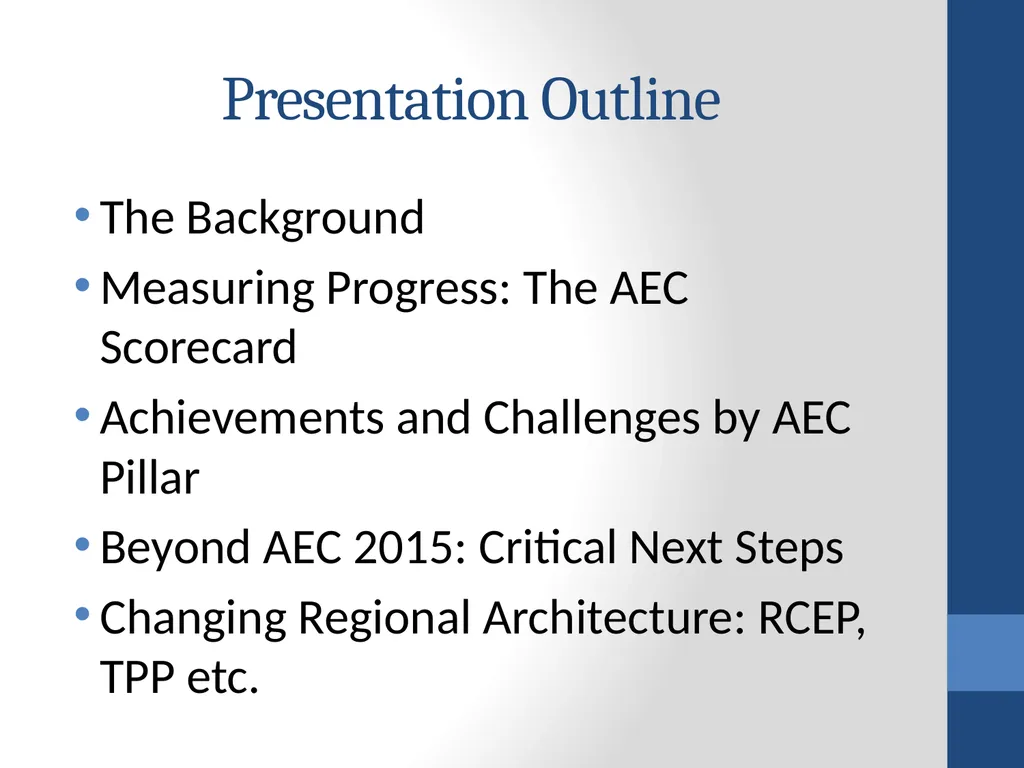
Presentation Outline The Background
Measuring Progress: The AEC Scorecard
Achievements and Challenges by AEC Pillar
Beyond AEC 2015: Critical Next Steps
Changing Regional Architecture: RCEP, TPP etc.<br>
Measuring Progress: The AEC Scorecard
Achievements and Challenges by AEC Pillar
Beyond AEC 2015: Critical Next Steps
Changing Regional Architecture: RCEP, TPP etc.<br>
03
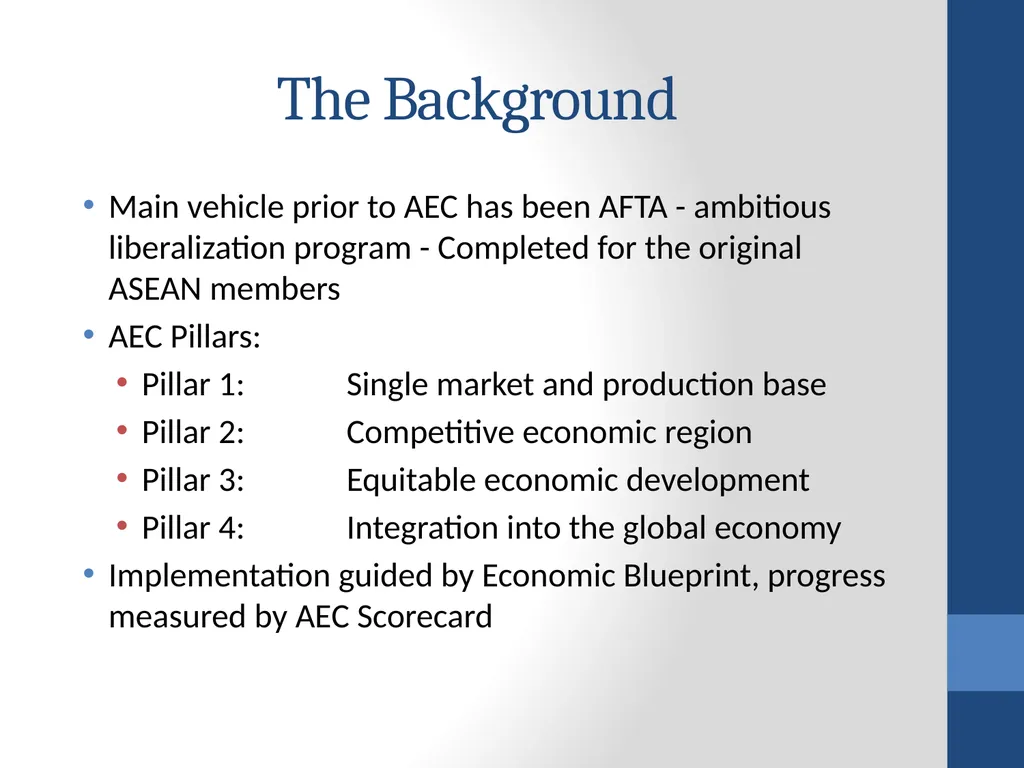
The Background Main vehicle prior to AEC has been AFTA - ambitious liberalization program - Completed for the original ASEAN members
AEC Pillars:
Pillar 1: Single market and production base
Pillar 2: Competitive economic region
Pillar 3: Equitable economic development
Pillar 4: Integration into the global economy
Implementation guided by Economic Blueprint, progress measured by AEC Scorecard<br>
AEC Pillars:
Pillar 1: Single market and production base
Pillar 2: Competitive economic region
Pillar 3: Equitable economic development
Pillar 4: Integration into the global economy
Implementation guided by Economic Blueprint, progress measured by AEC Scorecard<br>
04
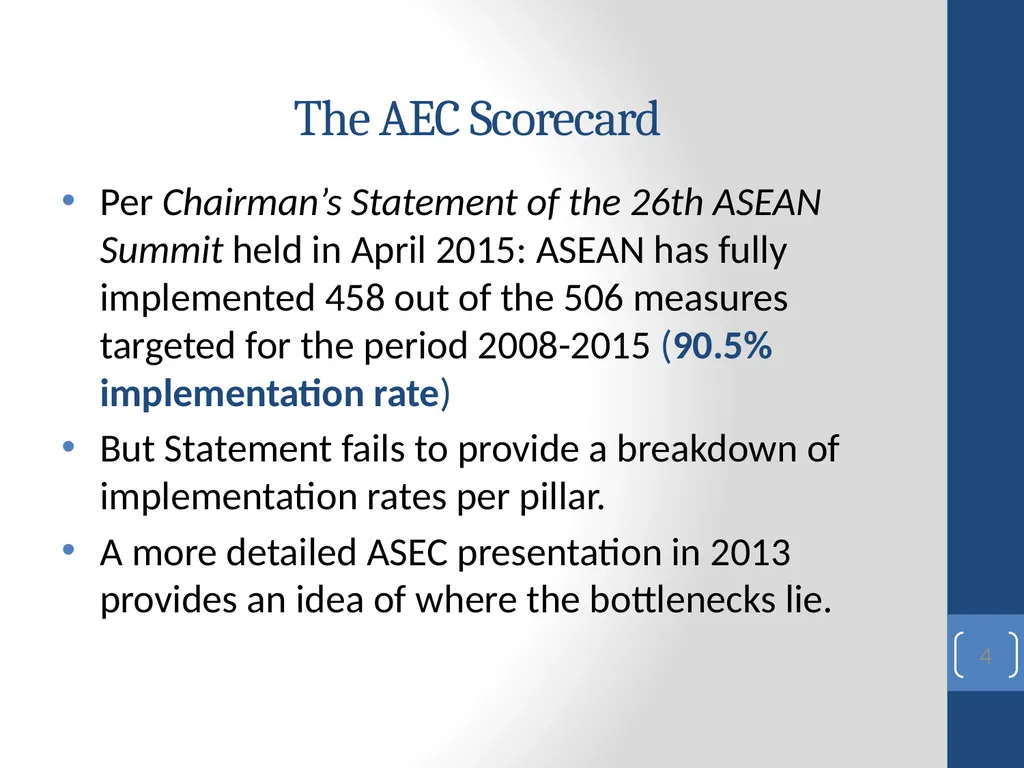
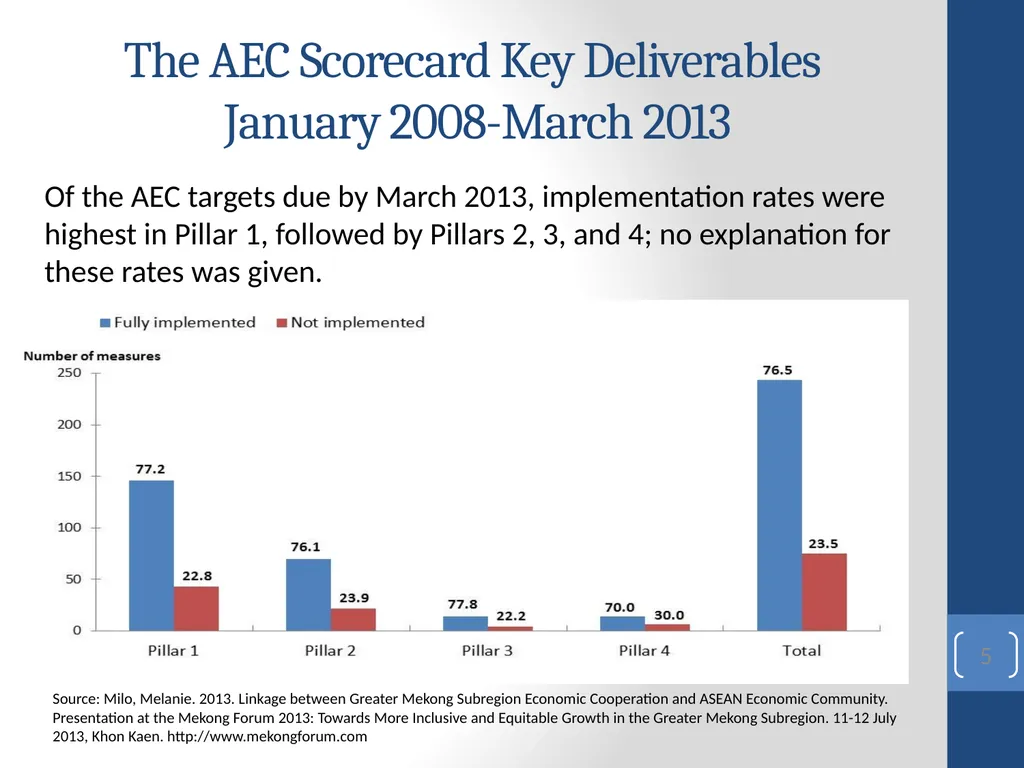
The AEC Scorecard 4 Per Chairman’s Statement of the 26th ASEAN Summit held in April 2015: ASEAN has fully implemented 458 out of the 506 measures targeted for the period 2008-2015 (90.5% implementation rate)
But Statement fails to provide a breakdown of implementation rates per pillar.
A more detailed ASEC presentation in 2013 provides an idea of where the bottlenecks lie.<br>
But Statement fails to provide a breakdown of implementation rates per pillar.
A more detailed ASEC presentation in 2013 provides an idea of where the bottlenecks lie.<br>
05
The AEC Scorecard Key Deliverables
January 2008-March 2013 5 Of the AEC targets due by March 2013, implementation rates were highest in Pillar 1, followed by Pillars 2, 3, and 4; no explanation for these rates was given. Source: Milo, Melanie. 2013. Linkage between Greater Mekong Subregion Economic Cooperation and ASEAN Economic Community. Presentation at the Mekong Forum 2013: Towards More Inclusive and Equitable Growth in the Greater Mekong Subregion. 11-12 July 2013, Khon Kaen. http://www.mekongforum.com<br>
06
Some Caveats Scorecard relies on self-assessment – may not be balanced
Scorecard measures aggregate progress – no in-depth analysis of bottlenecks, especially at national level
Only two Scorecards have been made public, covering the first two phases of AEC implementation (2008-2009 and 2010-2011)<br>
Scorecard measures aggregate progress – no in-depth analysis of bottlenecks, especially at national level
Only two Scorecards have been made public, covering the first two phases of AEC implementation (2008-2009 and 2010-2011)<br>
07
Pillar 1: Achievements and Challenges Pillar 1 elements: (i) free flow of goods; (ii) free flow of services; (iii) free flow of investments; (iv) freer flow of capital; and (v) free flow of skilled labor
Success has been uneven, across elements and sectors
Biggest achievements in reducing tariffs
Some improvements in trade facilitation and investment liberalization
Biggest gaps in liberalizing services and labor flows<br>
Success has been uneven, across elements and sectors
Biggest achievements in reducing tariffs
Some improvements in trade facilitation and investment liberalization
Biggest gaps in liberalizing services and labor flows<br>
08
Achievements under Pillar 1 Tariffs
Import duties for 99.20% and 90.85% of committed tariff lines have been eliminated by ASEAN-6 and CLMV, respectively.
On the average, ASEAN member states have 96% Tariff Lines at 0% (MITI, 2015).
Trade Facilitation
National Single Windows have gone live in the ASEAN-6; ASEAN-6 plus Viet Nam have tested preliminary exchange of trade data and information through the ASEAN Single Window (ASW)
Protocol on the Legal Framework to Implement the ASW has been signed
Pilot programs for Self-Certification System and ASEAN Customs Transit System have been launched<br>
Import duties for 99.20% and 90.85% of committed tariff lines have been eliminated by ASEAN-6 and CLMV, respectively.
On the average, ASEAN member states have 96% Tariff Lines at 0% (MITI, 2015).
Trade Facilitation
National Single Windows have gone live in the ASEAN-6; ASEAN-6 plus Viet Nam have tested preliminary exchange of trade data and information through the ASEAN Single Window (ASW)
Protocol on the Legal Framework to Implement the ASW has been signed
Pilot programs for Self-Certification System and ASEAN Customs Transit System have been launched<br>
09
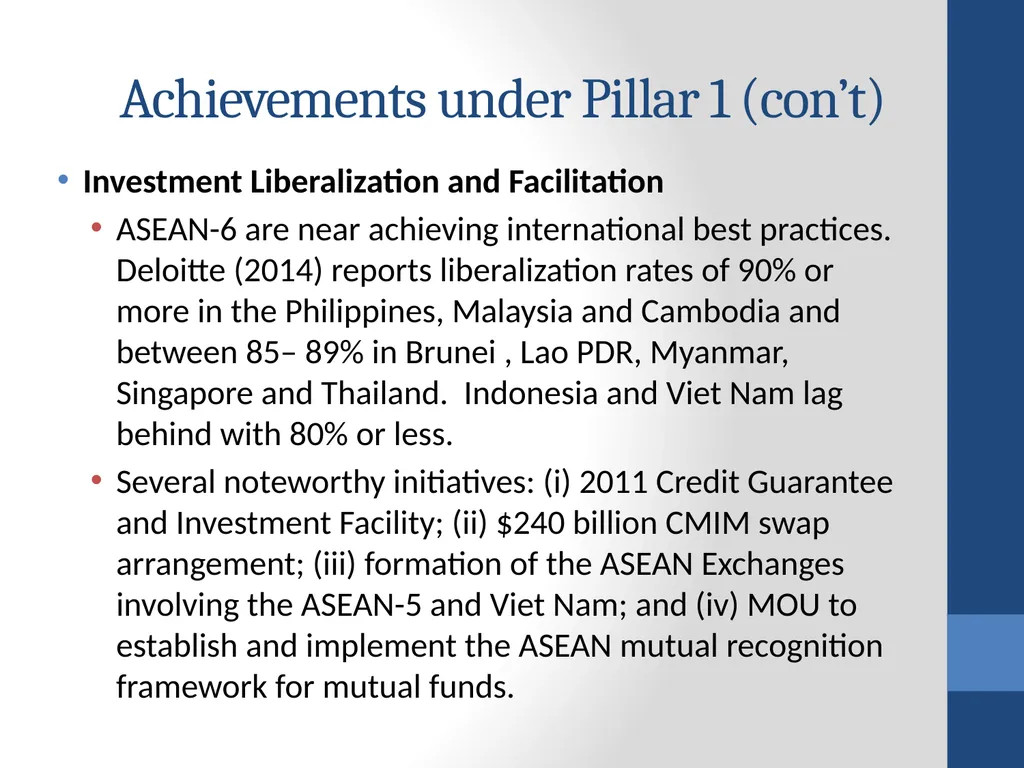
Achievements under Pillar 1 (con’t) Investment Liberalization and Facilitation
ASEAN-6 are near achieving international best practices. Deloitte (2014) reports liberalization rates of 90% or more in the Philippines, Malaysia and Cambodia and between 85– 89% in Brunei , Lao PDR, Myanmar, Singapore and Thailand. Indonesia and Viet Nam lag behind with 80% or less.
Several noteworthy initiatives: (i) 2011 Credit Guarantee and Investment Facility; (ii) $240 billion CMIM swap arrangement; (iii) formation of the ASEAN Exchanges involving the ASEAN-5 and Viet Nam; and (iv) MOU to establish and implement the ASEAN mutual recognition framework for mutual funds.<br>
ASEAN-6 are near achieving international best practices. Deloitte (2014) reports liberalization rates of 90% or more in the Philippines, Malaysia and Cambodia and between 85– 89% in Brunei , Lao PDR, Myanmar, Singapore and Thailand. Indonesia and Viet Nam lag behind with 80% or less.
Several noteworthy initiatives: (i) 2011 Credit Guarantee and Investment Facility; (ii) $240 billion CMIM swap arrangement; (iii) formation of the ASEAN Exchanges involving the ASEAN-5 and Viet Nam; and (iv) MOU to establish and implement the ASEAN mutual recognition framework for mutual funds.<br>
10
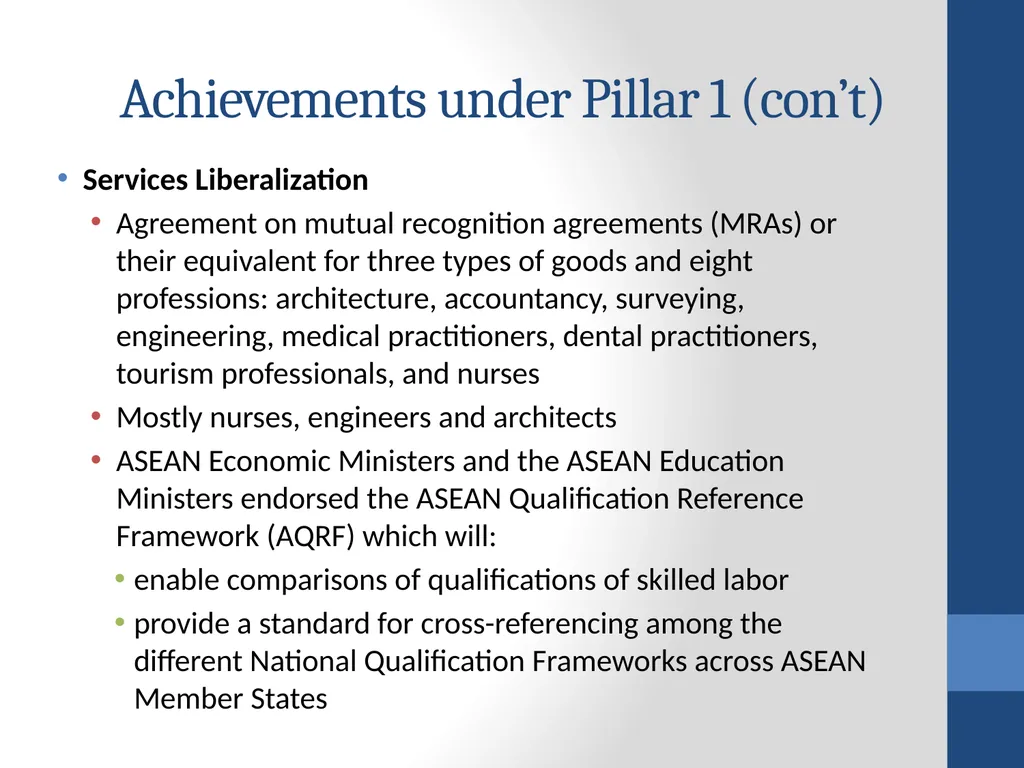
Achievements under Pillar 1 (con’t) Services Liberalization
Agreement on mutual recognition agreements (MRAs) or their equivalent for three types of goods and eight professions: architecture, accountancy, surveying, engineering, medical practitioners, dental practitioners, tourism professionals, and nurses
Mostly nurses, engineers and architects
ASEAN Economic Ministers and the ASEAN Education Ministers endorsed the ASEAN Qualification Reference Framework (AQRF) which will:
enable comparisons of qualifications of skilled labor
provide a standard for cross-referencing among the different National Qualification Frameworks across ASEAN Member States<br>
Agreement on mutual recognition agreements (MRAs) or their equivalent for three types of goods and eight professions: architecture, accountancy, surveying, engineering, medical practitioners, dental practitioners, tourism professionals, and nurses
Mostly nurses, engineers and architects
ASEAN Economic Ministers and the ASEAN Education Ministers endorsed the ASEAN Qualification Reference Framework (AQRF) which will:
enable comparisons of qualifications of skilled labor
provide a standard for cross-referencing among the different National Qualification Frameworks across ASEAN Member States<br>
11
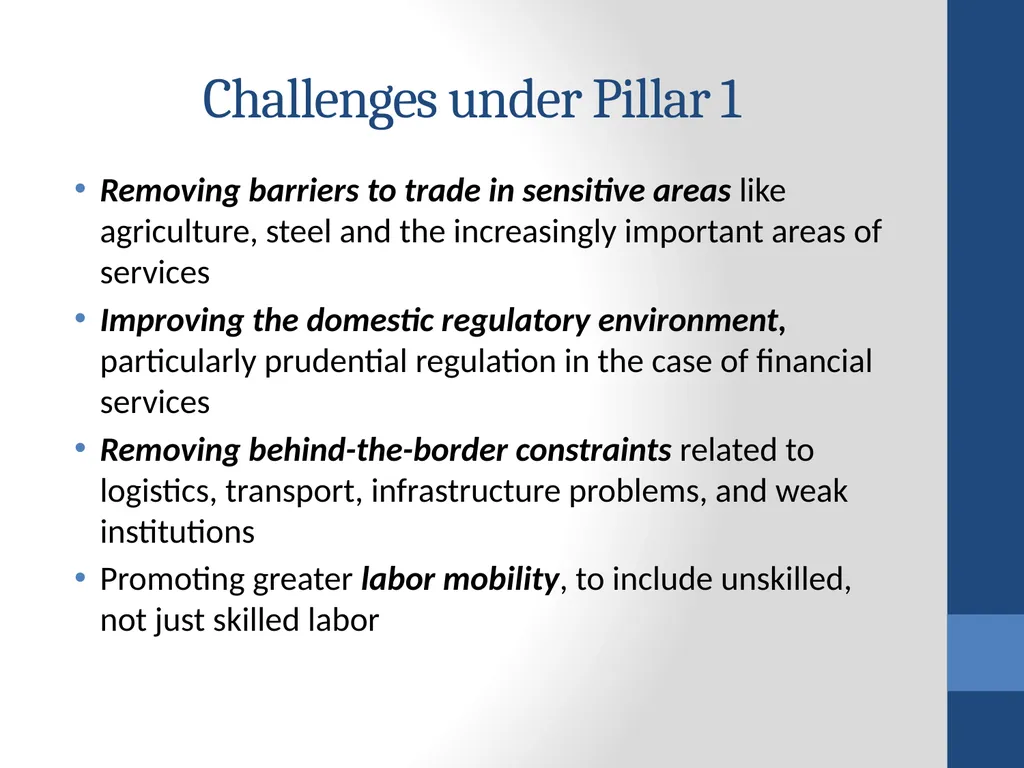
Challenges under Pillar 1 Removing barriers to trade in sensitive areas like agriculture, steel and the increasingly important areas of services
Improving the domestic regulatory environment, particularly prudential regulation in the case of financial services
Removing behind-the-border constraints related to logistics, transport, infrastructure problems, and weak institutions
Promoting greater labor mobility, to include unskilled, not just skilled labor<br>
Improving the domestic regulatory environment, particularly prudential regulation in the case of financial services
Removing behind-the-border constraints related to logistics, transport, infrastructure problems, and weak institutions
Promoting greater labor mobility, to include unskilled, not just skilled labor<br>
12
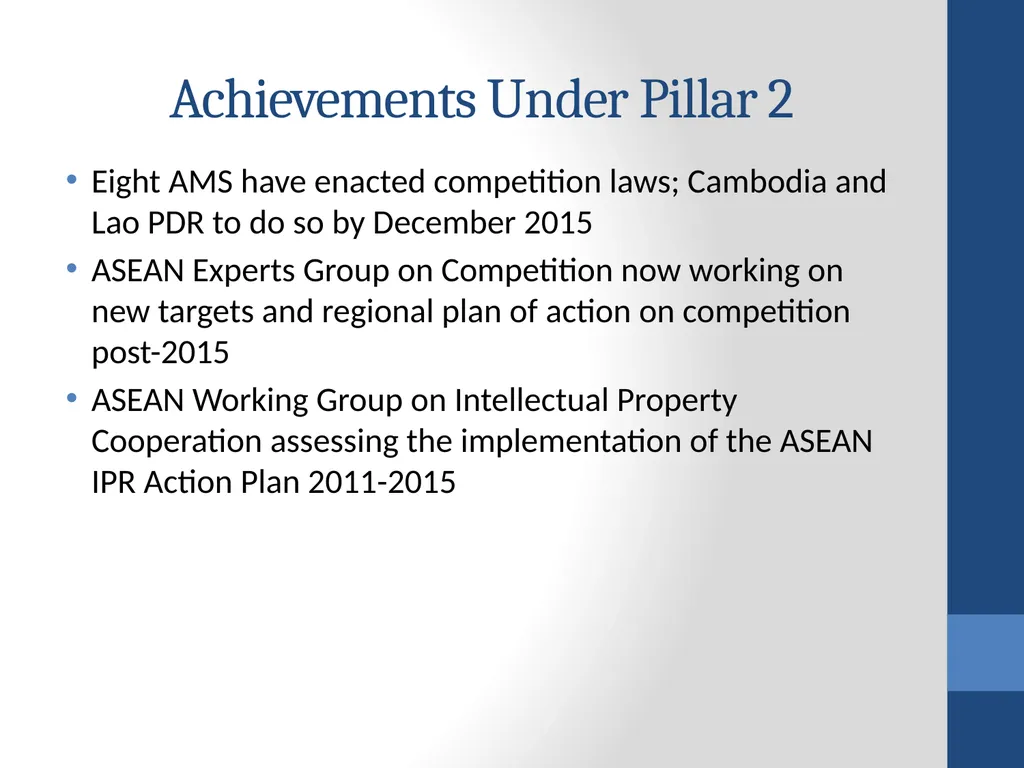
Achievements Under Pillar 2 Eight AMS have enacted competition laws; Cambodia and Lao PDR to do so by December 2015
ASEAN Experts Group on Competition now working on new targets and regional plan of action on competition post-2015
ASEAN Working Group on Intellectual Property Cooperation assessing the implementation of the ASEAN IPR Action Plan 2011-2015<br>
ASEAN Experts Group on Competition now working on new targets and regional plan of action on competition post-2015
ASEAN Working Group on Intellectual Property Cooperation assessing the implementation of the ASEAN IPR Action Plan 2011-2015<br>
13
Challenges Under Pillar 2 Biggest challenge still lies in competition policy and IPR – both difficult areas of reform
Competition policy and IPR protection are essentially national in application
Given different levels of development and national interests, cooperation and coordination—rather than uniformity in competition and IPR rules—are likely to be more achievable as goals<br>
Competition policy and IPR protection are essentially national in application
Given different levels of development and national interests, cooperation and coordination—rather than uniformity in competition and IPR rules—are likely to be more achievable as goals<br>
14
Achievements Under Pillar 3 Some evidence that the process of convergence has begun, as newer members begin to catch up
Implementation of flagship projects under the Strategic Action Plan for ASEAN SME Development (2010-2015); successor plan being developed
Implementation of ASEAN Framework for Equitable Economic Development (AFEED), adopted in 2011; second phase being considered
Some positive results from subregional arrangements such as the Initiative for ASEAN Integration (IAI)<br>
Implementation of flagship projects under the Strategic Action Plan for ASEAN SME Development (2010-2015); successor plan being developed
Implementation of ASEAN Framework for Equitable Economic Development (AFEED), adopted in 2011; second phase being considered
Some positive results from subregional arrangements such as the Initiative for ASEAN Integration (IAI)<br>
15
Challenges Under Pillar 3 AEC priority actions under Pillar 3 are useful, but not sufficient
Domestic policy actions are also important, particularly investments in social infrastructure, especially in education and health
Regional initiatives must be complemented with other elements of an inclusive growth strategy to ensure convergence<br>
Domestic policy actions are also important, particularly investments in social infrastructure, especially in education and health
Regional initiatives must be complemented with other elements of an inclusive growth strategy to ensure convergence<br>
16
Achievements and Challenges Under Pillar 4 The region’s openness has enabled a thriving ‘Factory ASEAN’
5 ASEAN countries rank among the world’s 50 most connected nations, based on the MGI Connectedness Index: Singapore (ranked fourth), Malaysia (18th), Thailand (36th), the Philippines (45th), and Viet Nam (48th)
However, there has been a shift from unilateral liberalization to preferential liberalization (through free trade agreements)
Two mega-regionals involving ASEAN Member States: Regional Comprehensive Economic Partnership (RCEP) and Trans-Pacific Partnership (TPP) - more later…<br>
5 ASEAN countries rank among the world’s 50 most connected nations, based on the MGI Connectedness Index: Singapore (ranked fourth), Malaysia (18th), Thailand (36th), the Philippines (45th), and Viet Nam (48th)
However, there has been a shift from unilateral liberalization to preferential liberalization (through free trade agreements)
Two mega-regionals involving ASEAN Member States: Regional Comprehensive Economic Partnership (RCEP) and Trans-Pacific Partnership (TPP) - more later…<br>
17
Achievements and Challenges Under Pillar 4 (con’t) Many studies (eg WTO, 2011) confirm the failure of most Asian FTAs to deepen coverage to deal with trade facilitation and behind the border issues
Even if these FTAs deepen coverage, the need to be discriminatory in the exchange of concessions suggests problems
Unilateral liberalization of trade and FDI should continue to be given priority
Multilateral approaches may offer more feasible solutions than regional ones in addressing issues such as competition policy and IPR<br>
Even if these FTAs deepen coverage, the need to be discriminatory in the exchange of concessions suggests problems
Unilateral liberalization of trade and FDI should continue to be given priority
Multilateral approaches may offer more feasible solutions than regional ones in addressing issues such as competition policy and IPR<br>
18
Beyond AEC 2015:
Critical Next Steps December 31, 2015 will not see ASEAN achieving all of its AEC targets.
Given that the deadline is likely to be missed, it is critical to ensure that reforms continue beyond 2015.
The flexibility that characterizes ASEAN cooperation and institutional arrangements could give member states a pretext for non-compliance—and there are enforcement issues. Giving AEC commitments more teeth is a key challenge.
Geo-political issues need to be addressed to ensure peace and stability, which are prerequisites for successful economic integration.<br>
Given that the deadline is likely to be missed, it is critical to ensure that reforms continue beyond 2015.
The flexibility that characterizes ASEAN cooperation and institutional arrangements could give member states a pretext for non-compliance—and there are enforcement issues. Giving AEC commitments more teeth is a key challenge.
Geo-political issues need to be addressed to ensure peace and stability, which are prerequisites for successful economic integration.<br>
19
Changing Architecture AEC is not the only game in town
Two other significant mega-regionals are the ASEAN+6 RCEP, and the US-led TPP. Also APEC’s FTAAP, but early still
Mega-regionals partly a response to proliferation of bilateral FTAs involving at least one country from the region<br>
Two other significant mega-regionals are the ASEAN+6 RCEP, and the US-led TPP. Also APEC’s FTAAP, but early still
Mega-regionals partly a response to proliferation of bilateral FTAs involving at least one country from the region<br>
20
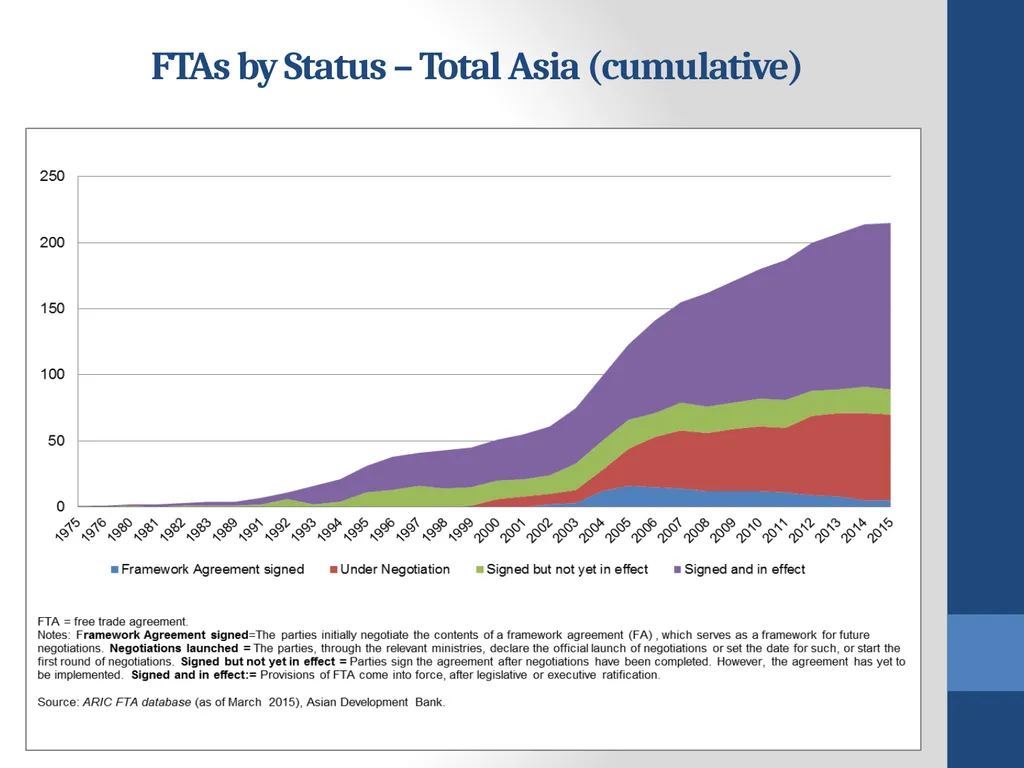
FTAs by Status – Total Asia (cumulative)<br>
21
FTAs by Scope – Asia (cumulative)<br>
22
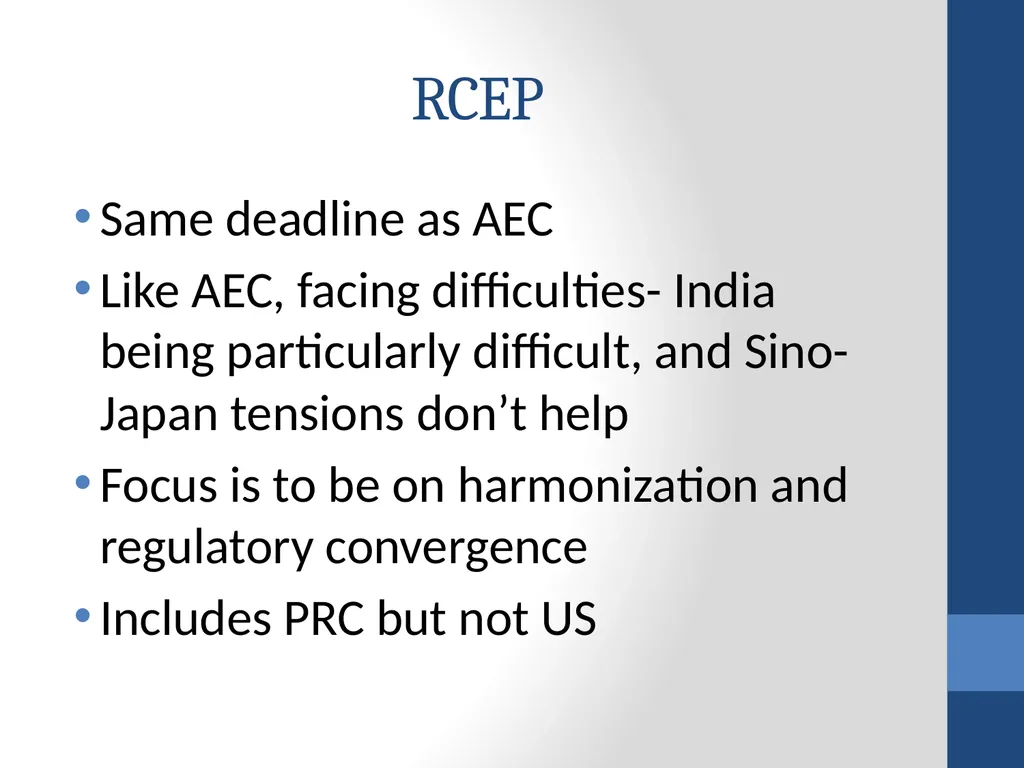
RCEP Same deadline as AEC
Like AEC, facing difficulties- India being particularly difficult, and Sino-Japan tensions don’t help
Focus is to be on harmonization and regulatory convergence
Includes PRC but not US<br>
Like AEC, facing difficulties- India being particularly difficult, and Sino-Japan tensions don’t help
Focus is to be on harmonization and regulatory convergence
Includes PRC but not US<br>
23
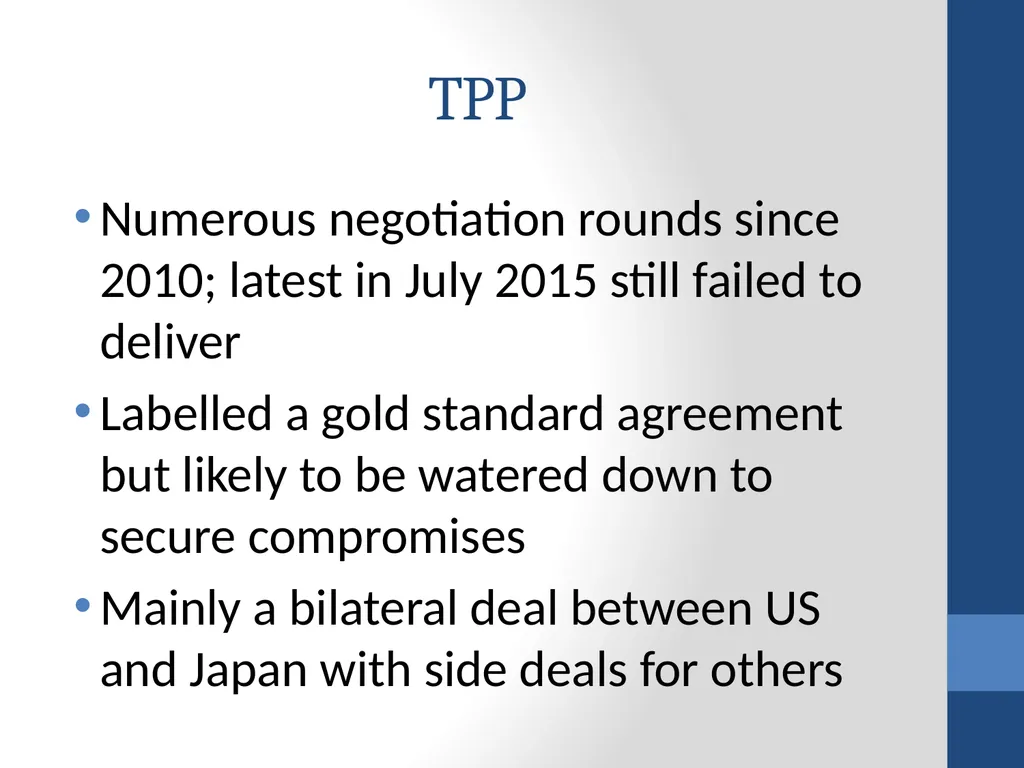
TPP Numerous negotiation rounds since 2010; latest in July 2015 still failed to deliver
Labelled a gold standard agreement but likely to be watered down to secure compromises
Mainly a bilateral deal between US and Japan with side deals for others<br>
Labelled a gold standard agreement but likely to be watered down to secure compromises
Mainly a bilateral deal between US and Japan with side deals for others<br>
24
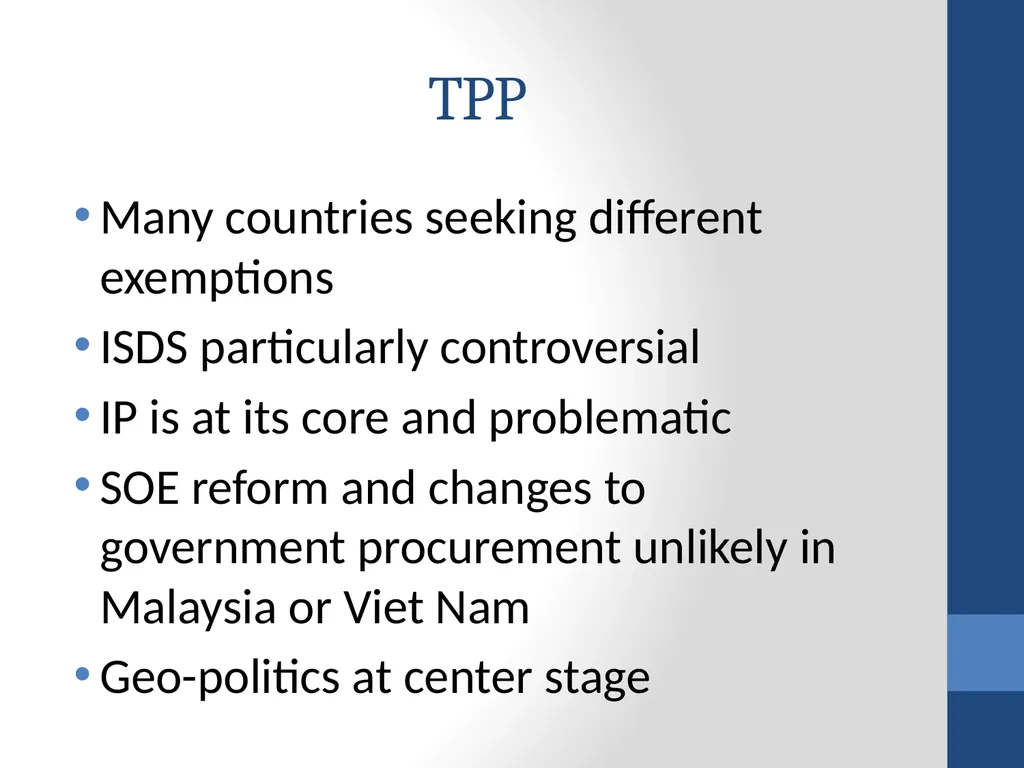
TPP Many countries seeking different exemptions
ISDS particularly controversial
IP is at its core and problematic
SOE reform and changes to government procurement unlikely in Malaysia or Viet Nam
Geo-politics at center stage<br>
ISDS particularly controversial
IP is at its core and problematic
SOE reform and changes to government procurement unlikely in Malaysia or Viet Nam
Geo-politics at center stage<br>
25
Thank you!
For inquiry or comments, please contact: Jayant Menon Lead Economist (Trade and Regional Cooperation), ERCD Telephone: (63-2) 632-6205
Email: jmenon@adb.org<br>
For inquiry or comments, please contact: Jayant Menon Lead Economist (Trade and Regional Cooperation), ERCD Telephone: (63-2) 632-6205
Email: jmenon@adb.org<br>