
Toxicokinetics Dr. Satish S Karoli Pharm.D



Description: Toxicokinetics Dr. Satish S Karoli Pharm.D Assistant Professor Department of Pharmacy Practice KLE College of Pharmacy, Belagavi - 10 Toxicokinetics deals with absorption, distribution biotransformation (biotransformation) and excretion of
Related Topics
Download Presentation
"Toxicokinetics Dr. Satish S Karoli Pharm.D" is the property of its rightful owner. Permission is granted to download and print the materials on this website for personal, non-commercial use only, and to display it on your personal computer provided you do not modify the materials and that you retain all copyright notices contained in the materials. By downloading content from our website, you accept the terms of this agreement.
Presentation Transcript
slide1. Toxicokinetics Dr. Satish S Karoli Pharm.D
Assistant Professor
Department of Pharmacy Practice
KLE College of Pharmacy, Belagavi - 10<br>
slide2. Toxicokinetics deals with absorption, distribution biotransformation (biotransformation) and excretion of chemicals A. Toxicokinetics Toxicokinetics<br>
slide3. Absorption is the process by which the chemical enters the body. It depends on the route of administration.
Oral route – the GIT is the most important route of absorption, as most acute poisonings involve ingestions. Absorption:<br>
slide4. Dermal route – lipid solubility of a substance is an important factor affecting the degree of absorption through the skin.
Inhalational route – toxic fumes, particulate and noxious gases may be absorbed through the lungs.<br>
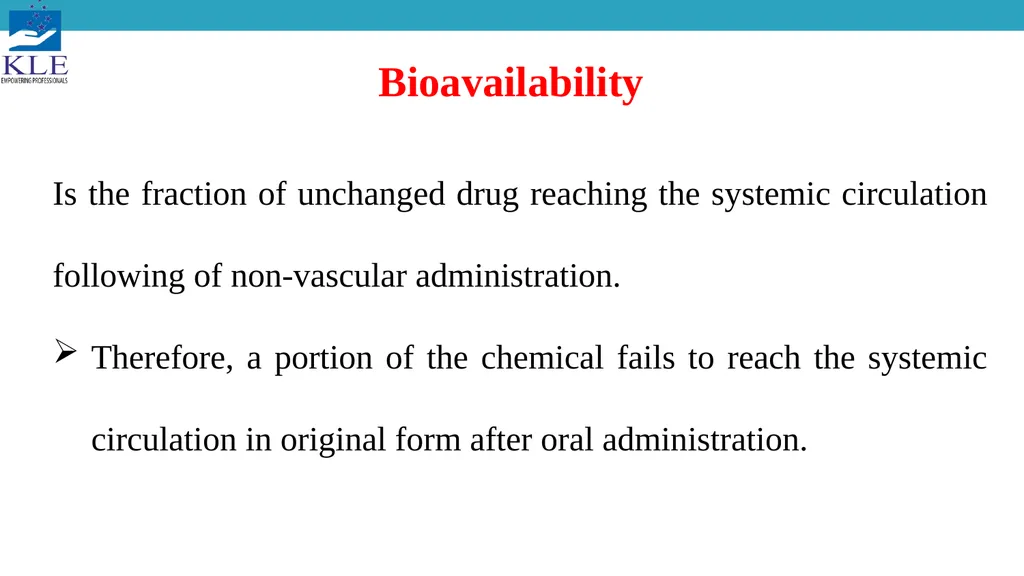
slide5. Is the fraction of unchanged drug reaching the systemic circulation following of non-vascular administration.
Therefore, a portion of the chemical fails to reach the systemic circulation in original form after oral administration. Bioavailability<br>
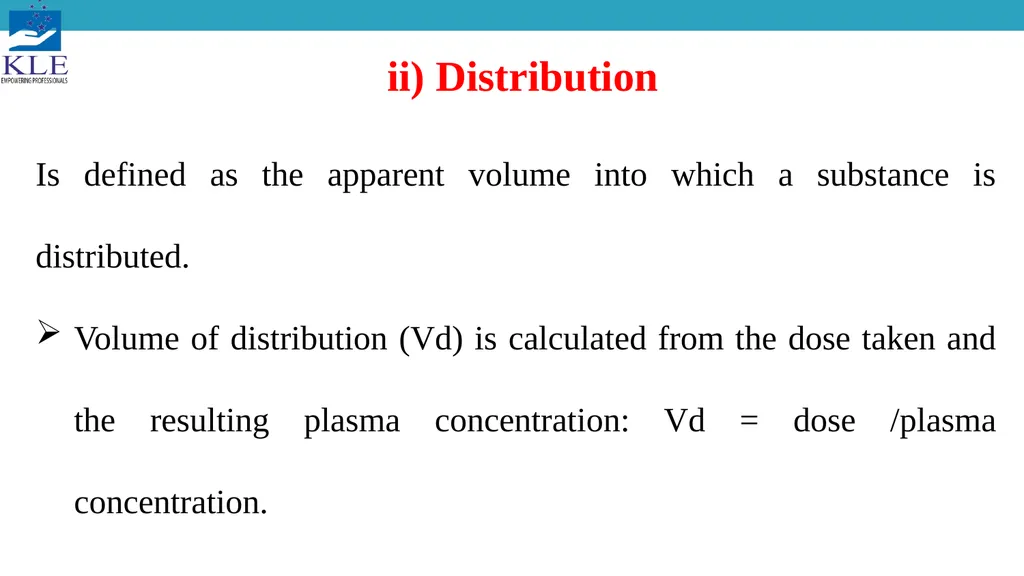
slide6. Is defined as the apparent volume into which a substance is distributed.
Volume of distribution (Vd) is calculated from the dose taken and the resulting plasma concentration: Vd = dose /plasma concentration. ii) Distribution<br>
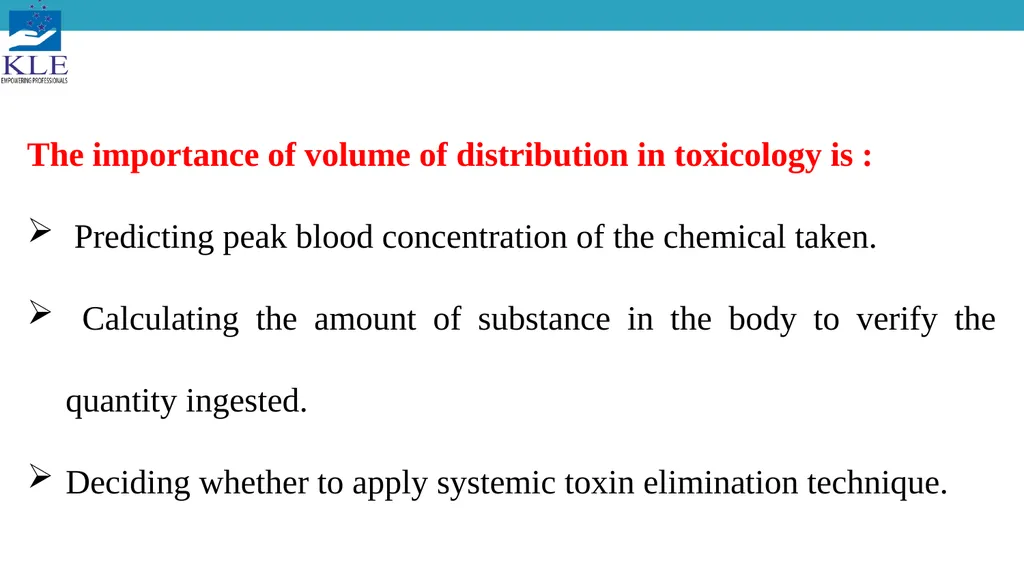
slide7. The importance of volume of distribution in toxicology is :
Predicting peak blood concentration of the chemical taken.
Calculating the amount of substance in the body to verify the quantity ingested.
Deciding whether to apply systemic toxin elimination technique.<br>
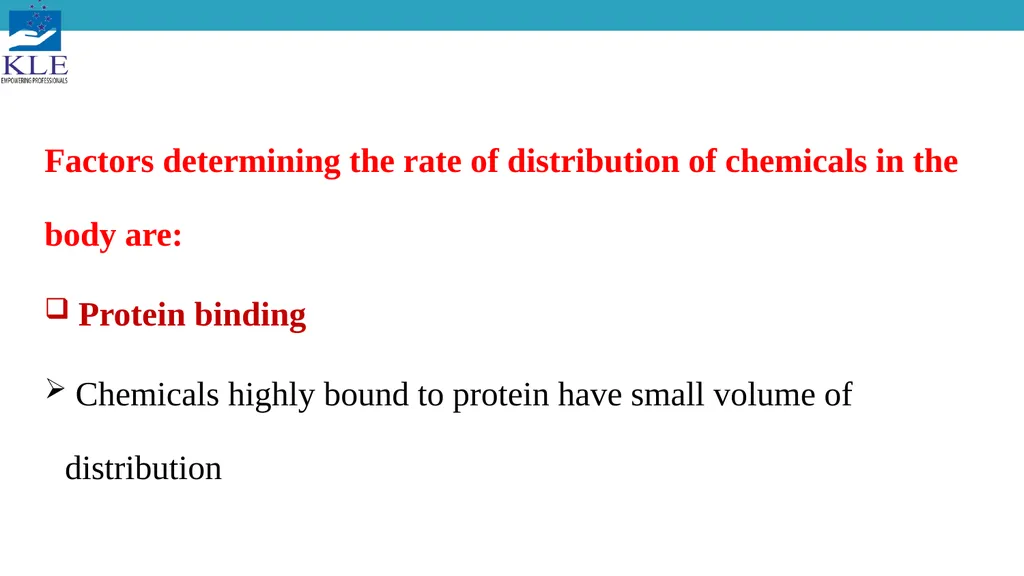
slide8. Factors determining the rate of distribution of chemicals in the body are:
Protein binding
Chemicals highly bound to protein have small volume of distribution<br>
slide9. Plasma concentration
When the volume of distribution of chemicals is small, most of the chemical remains in the plasma.<br>
slide10. Physiological barriers
Chemicals will not uniformly distributed to the body due to specialized barriers e.g blood brain barrier.<br>
slide11. Biotransformation is the biochemical transformation of a chemical.
It is a process by which the body transforms a chemical and makes it more water soluble so the chemical can be eliminated more rapidly via the kidney into the urine.
Biotransformation can produce metabolites that are pharmacologically active and toxic. iii) Biotransformation (metabolism)<br>
slide12. E.g. parathion→ parathoxon (toxic metabolite).
Liver is the major site of biotransformation for many chemicals & other organs that are involved are lungs, kidneys, skin &so on.<br>
slide13. Interactions during biotransformation include. There are two phases of biotransformation.
Phase I
Phase II<br>
slide14. Phase I– the drug is converted into more polar compound e.g oxidation, reduction, &hydrolysis
Phase II (conjugation) – a drug or its metabolite is conjugated with an endogenous substance e.g glucuronide conjugate
Enzyme inhibition- by this the biotransformation of drugs is delayed & is a cause of increased toxicity.<br>
slide15. Enzyme induction- by this the biotransformation of drugs is accelerated & is a cause of therapeutic failure.
First – pass effect – is the biotransformation of some chemicals by the liver during the initial pass from the portal circulation after oral administration.
Half life (t ½) –is the time required to reduce the blood concentration of the chemical to half.<br>
slide16. Excretion is the final means of chemical elimination, either as metabolites or unchanged parent chemical.
Excretion through the lungs is the major route for gaseous substances; and in the case of non-volatile water – soluble drugs, the kidneys are the most important routes of excretion.
Additional routes include sweat, saliva, tears, nasal secretions, milk, bile and feces. IV) Excretion<br>
slide17. Clearance :
Elimination of chemicals from the body may be described by the term clearance (CL).
It is a quantitative measure of the volume of blood cleared of drug per unit time, usually expressed in milliliter per 4 minute.<br>
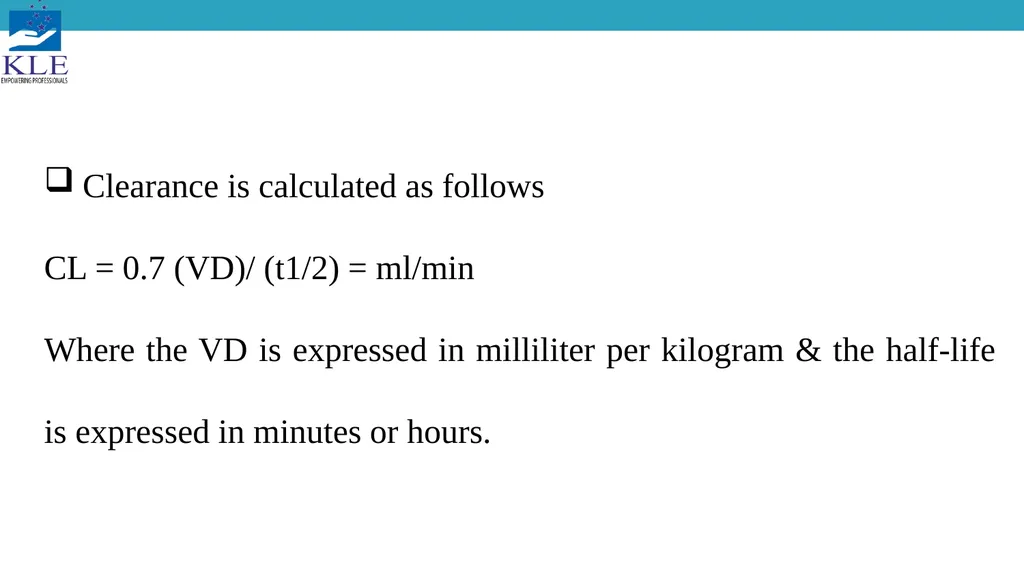
slide18. Clearance is calculated as follows
CL = 0.7 (VD)/ (t1/2) = ml/min
Where the VD is expressed in milliliter per kilogram & the half-life is expressed in minutes or hours.<br>
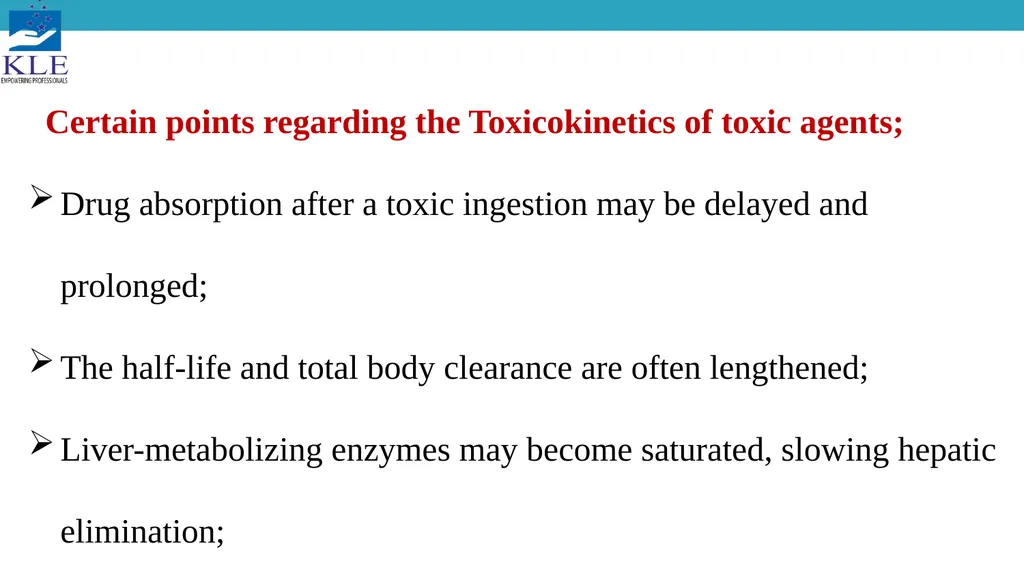
slide19. Certain points regarding the Toxicokinetics of toxic agents;
Drug absorption after a toxic ingestion may be delayed and prolonged;
The half-life and total body clearance are often lengthened;
Liver-metabolizing enzymes may become saturated, slowing hepatic elimination;<br>
slide20. Chemicals with large volumes of distribution are often highly tissue-bound and measures to enhance their elimination are not effective;
Poor perfusion of the liver and kidneys secondary to the toxic effects of the substance may slow clearance.<br>
slide21. Thank You
For Patience Listening<br>
Assistant Professor
Department of Pharmacy Practice
KLE College of Pharmacy, Belagavi - 10<br>
slide2. Toxicokinetics deals with absorption, distribution biotransformation (biotransformation) and excretion of chemicals A. Toxicokinetics Toxicokinetics<br>
slide3. Absorption is the process by which the chemical enters the body. It depends on the route of administration.
Oral route – the GIT is the most important route of absorption, as most acute poisonings involve ingestions. Absorption:<br>
slide4. Dermal route – lipid solubility of a substance is an important factor affecting the degree of absorption through the skin.
Inhalational route – toxic fumes, particulate and noxious gases may be absorbed through the lungs.<br>
slide5. Is the fraction of unchanged drug reaching the systemic circulation following of non-vascular administration.
Therefore, a portion of the chemical fails to reach the systemic circulation in original form after oral administration. Bioavailability<br>
slide6. Is defined as the apparent volume into which a substance is distributed.
Volume of distribution (Vd) is calculated from the dose taken and the resulting plasma concentration: Vd = dose /plasma concentration. ii) Distribution<br>
slide7. The importance of volume of distribution in toxicology is :
Predicting peak blood concentration of the chemical taken.
Calculating the amount of substance in the body to verify the quantity ingested.
Deciding whether to apply systemic toxin elimination technique.<br>
slide8. Factors determining the rate of distribution of chemicals in the body are:
Protein binding
Chemicals highly bound to protein have small volume of distribution<br>
slide9. Plasma concentration
When the volume of distribution of chemicals is small, most of the chemical remains in the plasma.<br>
slide10. Physiological barriers
Chemicals will not uniformly distributed to the body due to specialized barriers e.g blood brain barrier.<br>
slide11. Biotransformation is the biochemical transformation of a chemical.
It is a process by which the body transforms a chemical and makes it more water soluble so the chemical can be eliminated more rapidly via the kidney into the urine.
Biotransformation can produce metabolites that are pharmacologically active and toxic. iii) Biotransformation (metabolism)<br>
slide12. E.g. parathion→ parathoxon (toxic metabolite).
Liver is the major site of biotransformation for many chemicals & other organs that are involved are lungs, kidneys, skin &so on.<br>
slide13. Interactions during biotransformation include. There are two phases of biotransformation.
Phase I
Phase II<br>
slide14. Phase I– the drug is converted into more polar compound e.g oxidation, reduction, &hydrolysis
Phase II (conjugation) – a drug or its metabolite is conjugated with an endogenous substance e.g glucuronide conjugate
Enzyme inhibition- by this the biotransformation of drugs is delayed & is a cause of increased toxicity.<br>
slide15. Enzyme induction- by this the biotransformation of drugs is accelerated & is a cause of therapeutic failure.
First – pass effect – is the biotransformation of some chemicals by the liver during the initial pass from the portal circulation after oral administration.
Half life (t ½) –is the time required to reduce the blood concentration of the chemical to half.<br>
slide16. Excretion is the final means of chemical elimination, either as metabolites or unchanged parent chemical.
Excretion through the lungs is the major route for gaseous substances; and in the case of non-volatile water – soluble drugs, the kidneys are the most important routes of excretion.
Additional routes include sweat, saliva, tears, nasal secretions, milk, bile and feces. IV) Excretion<br>
slide17. Clearance :
Elimination of chemicals from the body may be described by the term clearance (CL).
It is a quantitative measure of the volume of blood cleared of drug per unit time, usually expressed in milliliter per 4 minute.<br>
slide18. Clearance is calculated as follows
CL = 0.7 (VD)/ (t1/2) = ml/min
Where the VD is expressed in milliliter per kilogram & the half-life is expressed in minutes or hours.<br>
slide19. Certain points regarding the Toxicokinetics of toxic agents;
Drug absorption after a toxic ingestion may be delayed and prolonged;
The half-life and total body clearance are often lengthened;
Liver-metabolizing enzymes may become saturated, slowing hepatic elimination;<br>
slide20. Chemicals with large volumes of distribution are often highly tissue-bound and measures to enhance their elimination are not effective;
Poor perfusion of the liver and kidneys secondary to the toxic effects of the substance may slow clearance.<br>
slide21. Thank You
For Patience Listening<br>