
Toxicology CHAPTER 23: Focused Lecture National




Description: Toxicology CHAPTER 23: Focused Lecture National EMS Education Standard Competencies (1 of 3) Medicine Applies fundamental knowledge to provide basic and selected advanced emergency care and transportation based on assessment findings for an
Related Topics
Download Presentation
"Toxicology CHAPTER 23: Focused Lecture National" is the property of its rightful owner. Permission is granted to download and print the materials on this website for personal, non-commercial use only, and to display it on your personal computer provided you do not modify the materials and that you retain all copyright notices contained in the materials. By downloading content from our website, you accept the terms of this agreement.
Presentation Transcript
slide1. Toxicology CHAPTER 23: Focused Lecture<br>
slide2. National EMS Education Standard Competencies (1 of 3) Medicine
Applies fundamental knowledge to provide basic and selected advanced emergency care and transportation based on assessment findings for an acutely ill patient.<br>
slide3. National EMS Education Standard Competencies (2 of 3) Toxicology
Recognition and management of
Carbon monoxide poisoning
Nerve agent poisoning
How and when to contact a poison control center<br>
slide4. National EMS Education Standard Competencies (3 of 3) Anatomy, physiology, pathophysiology, assessment, and management of
Inhaled poisons
Ingested poisons
Injected poisons
Absorbed poisons
Alcohol intoxication and withdrawal
Opiate toxidrome<br>
slide5. Introduction (1 of 2) AEMTs treat patients who have taken drugs of abuse.
Legal (licit) drugs (alcohol and oxycodone)
Illegal (Illicit) drugs (heroin and ecstasy)<br>
slide6. Introduction (2 of 2) A poison is toxic by nature.
A drug can have a physiologic effect if given in appropriate circumstances and dose.
Overdose is a toxicologic emergency.<br>
slide7. Types of Toxicologic Emergencies (1 of 2) Toxicology is the study of toxic or poisonous substances.
Toxicologic emergencies
Intentional
Unintentional<br>
slide8. Types of Toxicologic Emergencies (2 of 2) Can be found in nature and workplace
Can occur from neglect or oversight
Can also be intentional (biologic warfare and date rape drugs)<br>
slide9. Poison Centers Don’t hesitate to contact a poison center.
National Poison Control Center hotline: 1-800-222-1222
Access to information about all commonly used medications, chemicals, and substances that might be poisonous<br>
slide10. Pathophysiology: Routes of Absorption Toxins enter the body in four main ways:
Ingestion
Inhalation
Injection
Absorption
Effects and excretion rate are determined by amount of toxin and speed of metabolizing it.<br>
slide11. Poisoning by Ingestion (1 of 2) Most common sources
Medications around the home
Household chemicals
Effects may be immediate or delayed.
Entry of toxin by oral route takes longer to be absorbed by the body.<br>
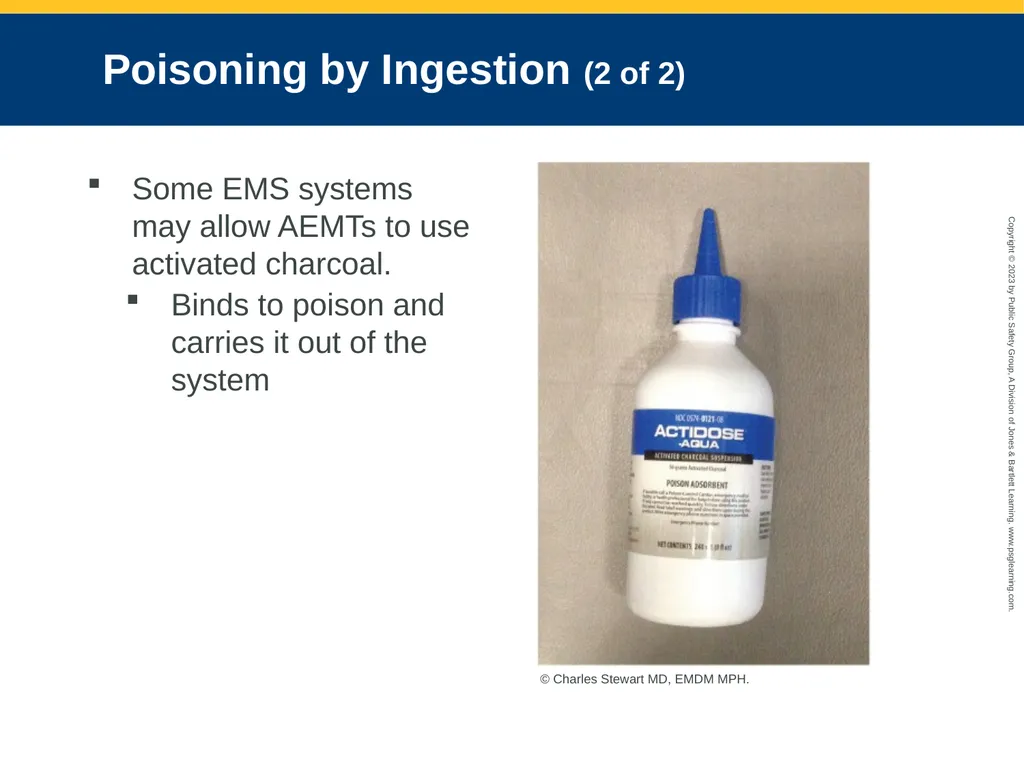
slide12. Poisoning by Ingestion (2 of 2) Some EMS systems may allow AEMTs to use activated charcoal.
Binds to poison and carries it out of the system © Charles Stewart MD, EMDM MPH.<br>
slide13. Poisoning by Inhalation (1 of 2) Most common sources:
Home medications
Household chemical products
Poison by inhalation can only occur if poison is present in atmosphere.
Do not enter hazardous environment.
Call for resources with specialized protective equipment.<br>
slide14. Poisoning by Inhalation (2 of 2) Inhaled toxins quickly reach alveoli.
Window of opportunity for treatment is limited.
First consideration is scene safety.
Take containers, bottles, and labels with you.
Clues from scene, assistance from poison center, and direction from medical control will drive your treatment plan.
Treat hypoxia immediately.<br>
slide15. Poisoning by Injection Usually the result of drug abuse
Signs and symptoms can vary greatly.
Generally, injected poisons are impossible to dilute.
Quickly absorbed and can cause intense local tissue destruction<br>
slide16. Poisoning by Absorption (1 of 3) Most-serious absorption poisons are pesticides.
Corrosive substances damage skin, mucous membranes, or eyes.
Other substances are absorbed and have systemic effects.
Distinguish between contact burns and contact absorptions.<br>
slide17. Poisoning by Absorption (2 of 3) Signs and symptoms
History of exposure
Liquid or powder on patient’s skin
Burns
Itching, irritation
Skin redness in light-skinned people
Typical odors of substances<br>
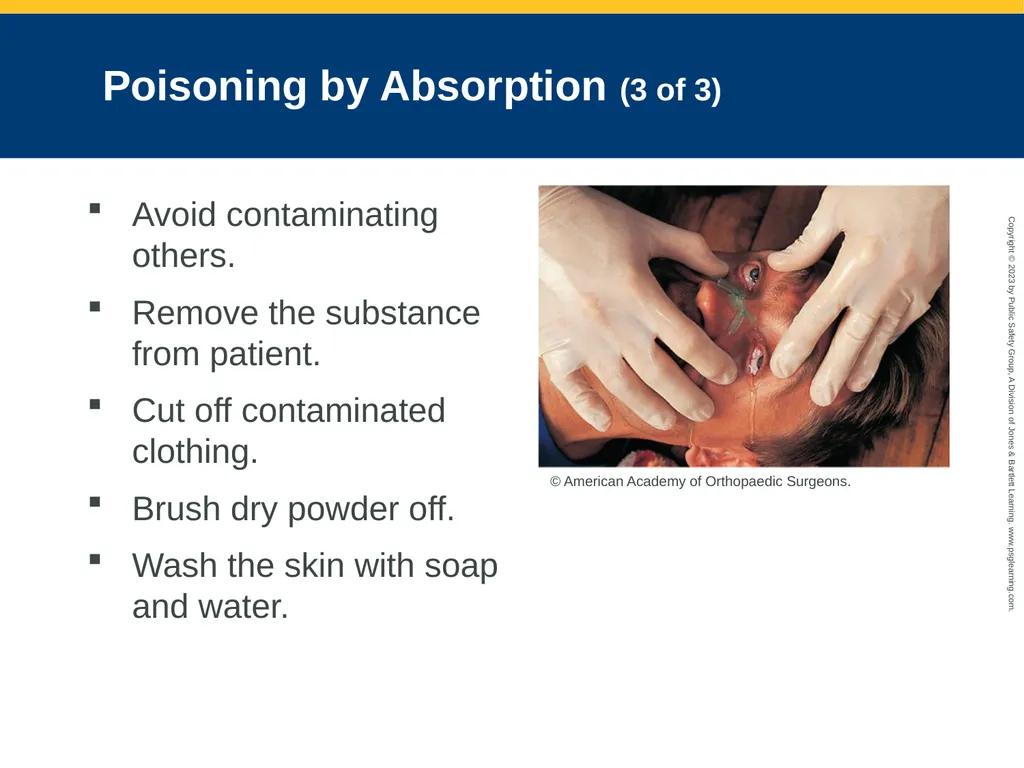
slide18. Poisoning by Absorption (3 of 3) Avoid contaminating others.
Remove the substance from patient.
Cut off contaminated clothing.
Brush dry powder off.
Wash the skin with soap and water. © American Academy of Orthopaedic Surgeons.<br>
slide19. Understanding and Using Toxidromes Many drugs result in similar signs and symptoms.
Toxidrome: Syndromelike symptoms of poisonous agent<br>
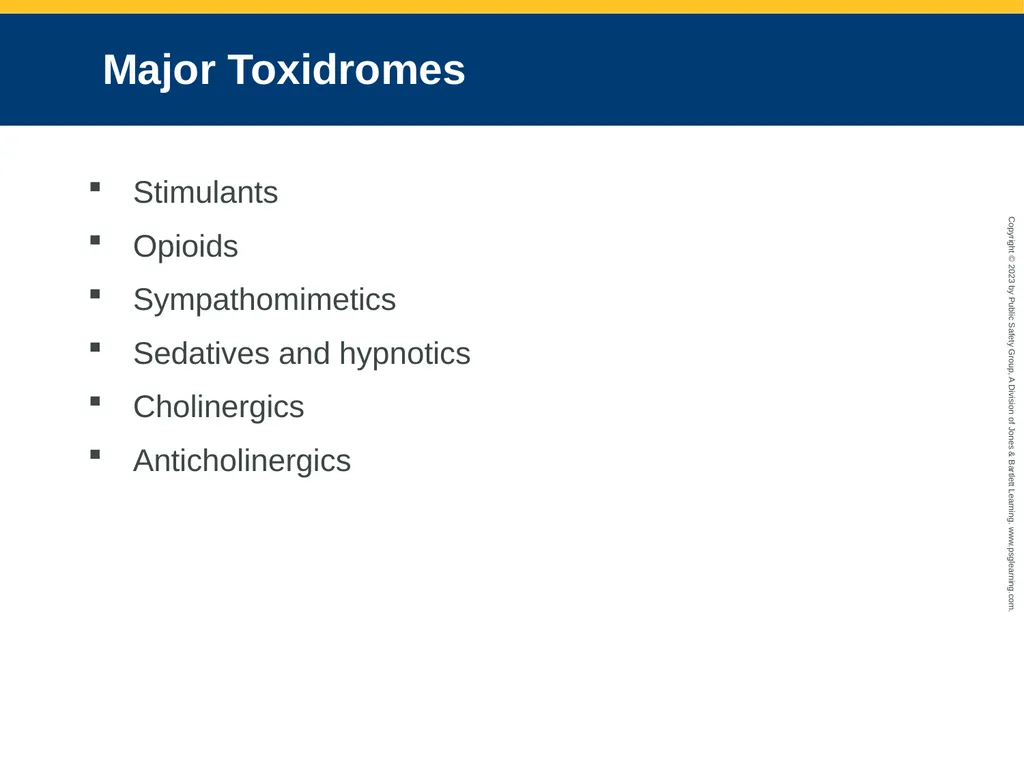
slide20. Major Toxidromes Stimulants
Opioids
Sympathomimetics
Sedatives and hypnotics
Cholinergics
Anticholinergics<br>
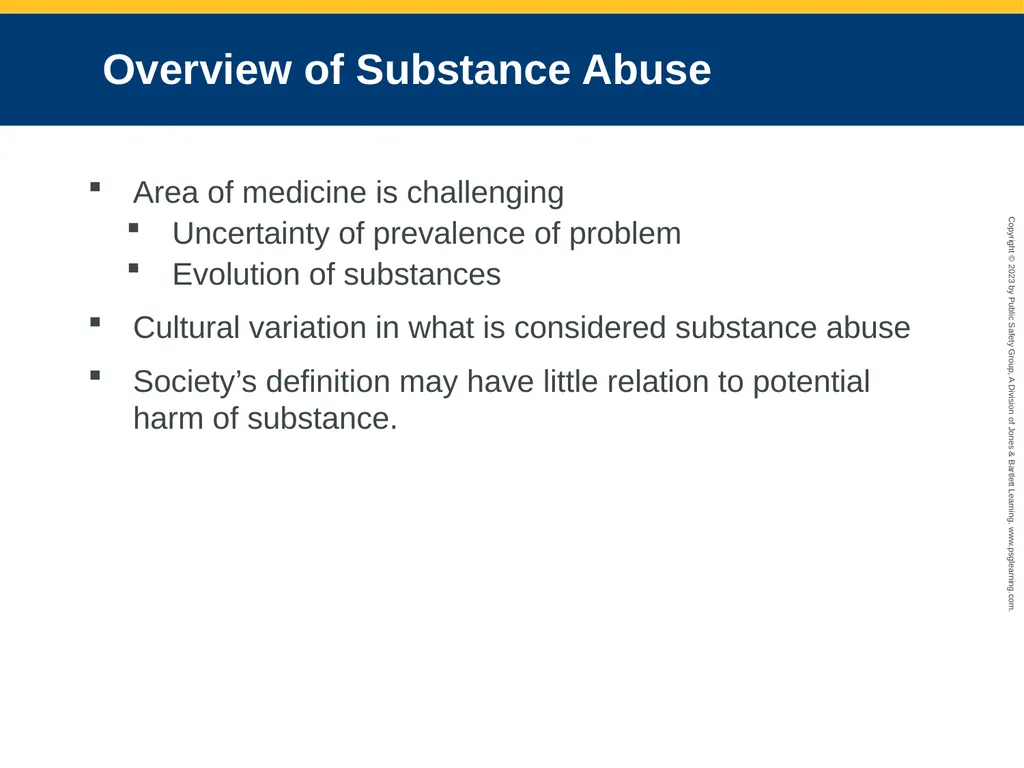
slide21. Overview of Substance Abuse Area of medicine is challenging
Uncertainty of prevalence of problem
Evolution of substances
Cultural variation in what is considered substance abuse
Society’s definition may have little relation to potential harm of substance.<br>
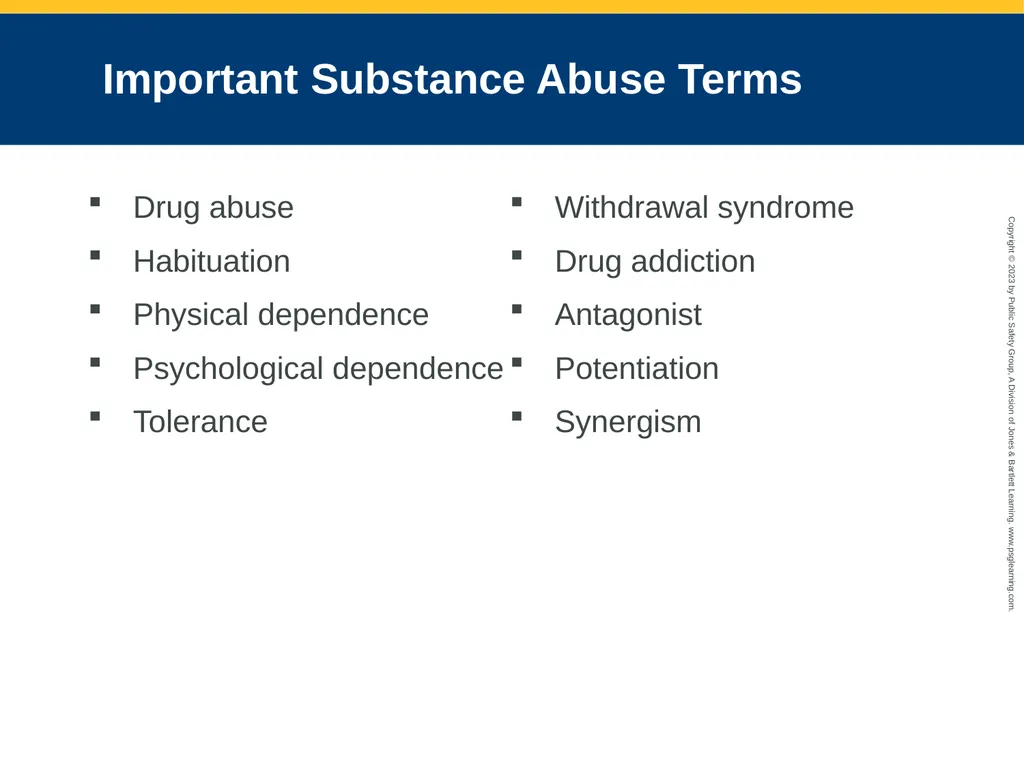
slide22. Important Substance Abuse Terms Drug abuse
Habituation
Physical dependence
Psychological dependence
Tolerance
Withdrawal syndrome
Drug addiction
Antagonist
Potentiation
Synergism<br>
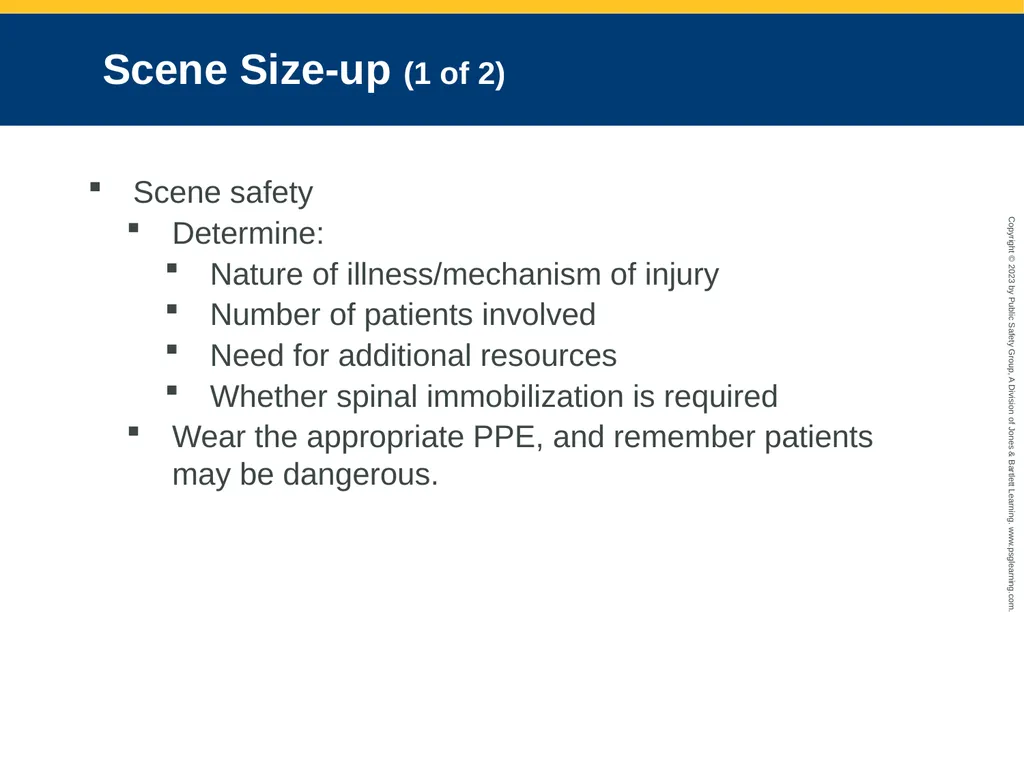
slide23. Scene Size-up (1 of 2) Scene safety
Determine:
Nature of illness/mechanism of injury
Number of patients involved
Need for additional resources
Whether spinal immobilization is required
Wear the appropriate PPE, and remember patients may be dangerous.<br>
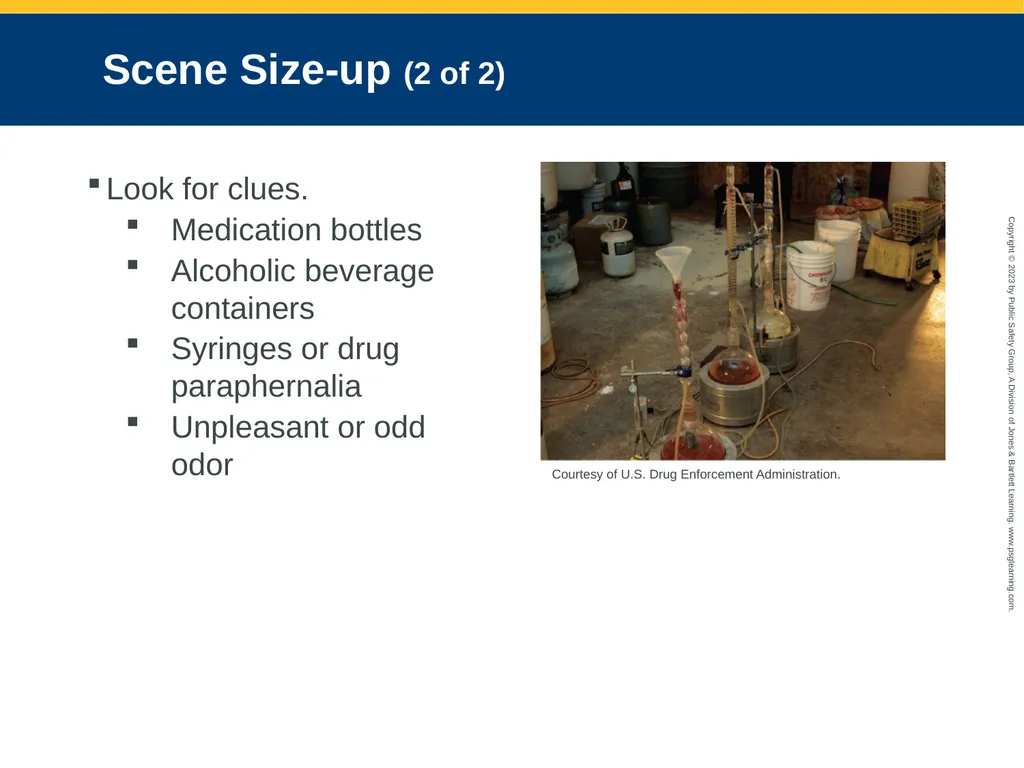
slide24. Scene Size-up (2 of 2) Look for clues.
Medication bottles
Alcoholic beverage containers
Syringes or drug paraphernalia
Unpleasant or odd odor Courtesy of U.S. Drug Enforcement Administration.<br>
slide25. Primary Survey (1 of 2) Begins with a general impression.
Do not be fooled into thinking that a conscious, alert, and orientated patient is in stable condition.
Identify any life threats.
Airway and breathing
Ensure that the patient has an open airway and adequate ventilation.
Do not hesitate to begin oxygen therapy.<br>
slide26. Primary Survey (2 of 2) Patient’s circulatory status
Assess the pulse and skin condition.
Check for bleeding.
Assess for disability.
Alterations in ABCDEs or poor general impression require immediate transport.
A delay on the scene is rarely indicated.
Consider decontamination of the patient before transport, depending on the poison.<br>
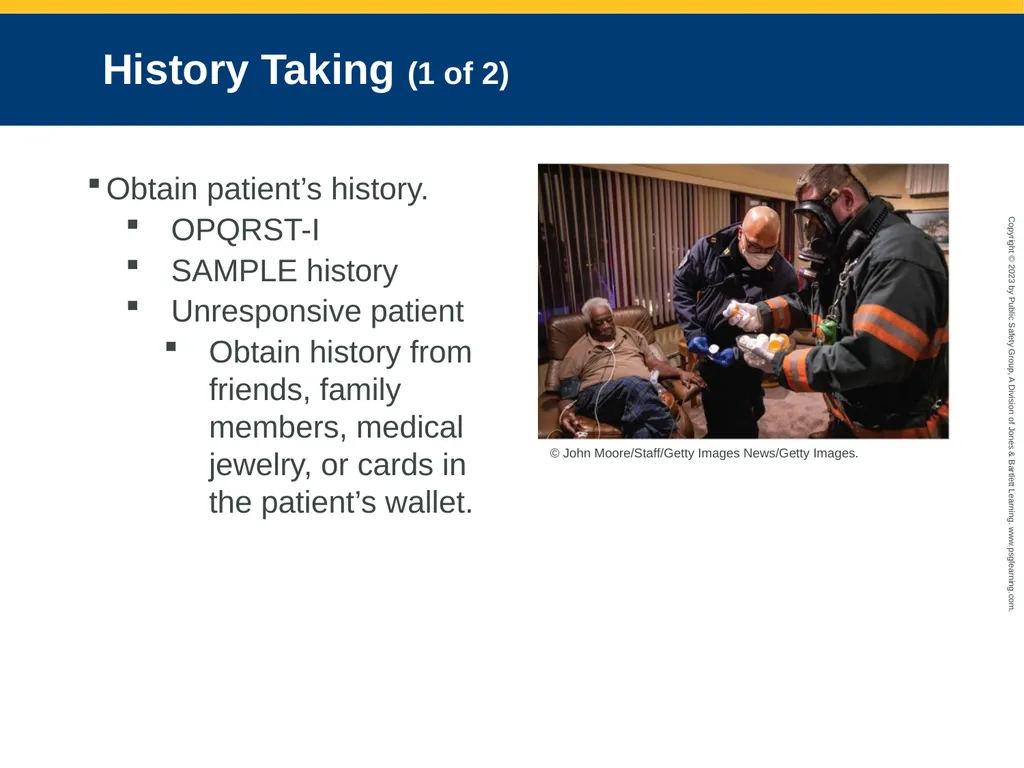
slide27. History Taking (1 of 2) Obtain patient’s history.
OPQRST-I
SAMPLE history
Unresponsive patient
Obtain history from friends, family members, medical jewelry, or cards in the patient’s wallet. © John Moore/Staff/Getty Images News/Getty Images.<br>
slide28. History Taking (2 of 2) What is the agent?
When was the poison ingested, injected, absorbed, or inhaled?
How much was taken?
What else was taken?
Over what period?
Has any intervention been performed?
Has the patient vomited or aspirated?
How much does the patient weigh?
Why was the substance taken?<br>
slide29. Secondary Assessment Focus on the area of the body involved with the poisoning or the route of exposure.
Manage life threats.
Obtain a complete set of vital signs.
Many poisons produce no outward indications of the exposure’s seriousness.
Look for alterations in the level of consciousness, pulse, respirations, blood pressure, and skin.<br>
slide30. Reassessment (1 of 3) Reassess the adequacy of the ABCDEs.
Retake vital signs and compare with baseline set.
Evaluate your interventions.
Repeat the assessment of vital signs.
Every 15 minutes for stable patient
Every 5 minutes or more for patient who has consumed a harmful or lethal dose<br>
slide31. Reassessment (2 of 3) Interventions
Supporting the ABCs is most important.
Dilute airborne exposures with oxygen.
Remove contact exposures with water.
Consider activated charcoal for ingestions.
Continuously monitor the airway.
Contact medical control or a poison center to discuss treatment options.<br>
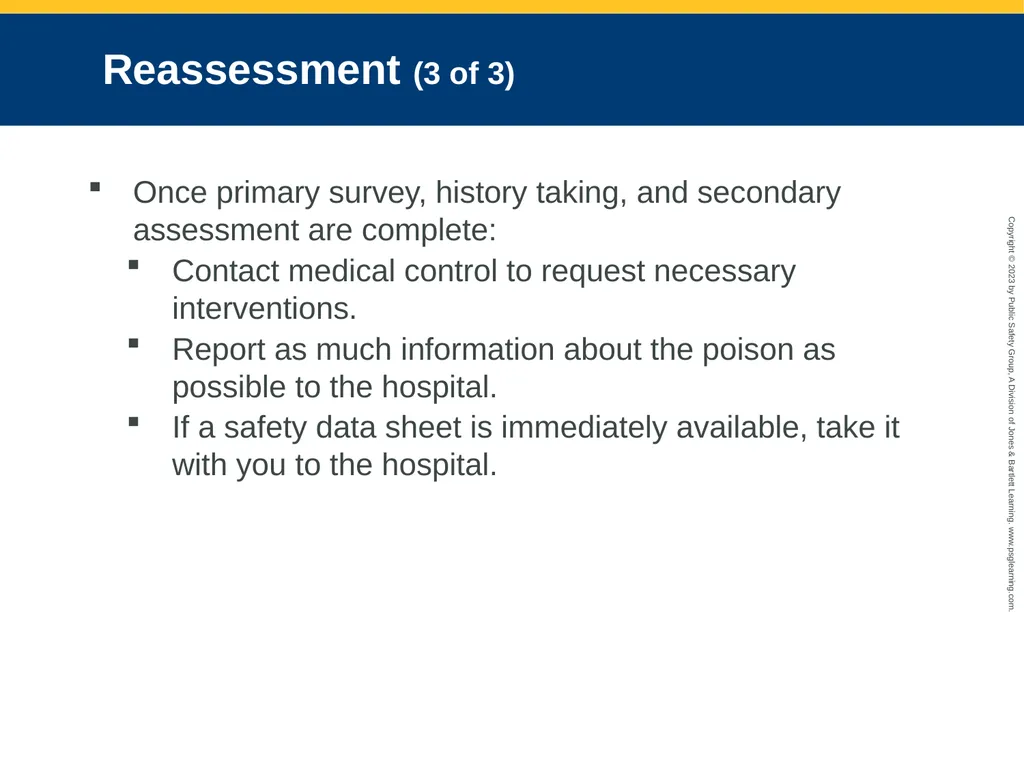
slide32. Reassessment (3 of 3) Once primary survey, history taking, and secondary assessment are complete:
Contact medical control to request necessary interventions.
Report as much information about the poison as possible to the hospital.
If a safety data sheet is immediately available, take it with you to the hospital.<br>
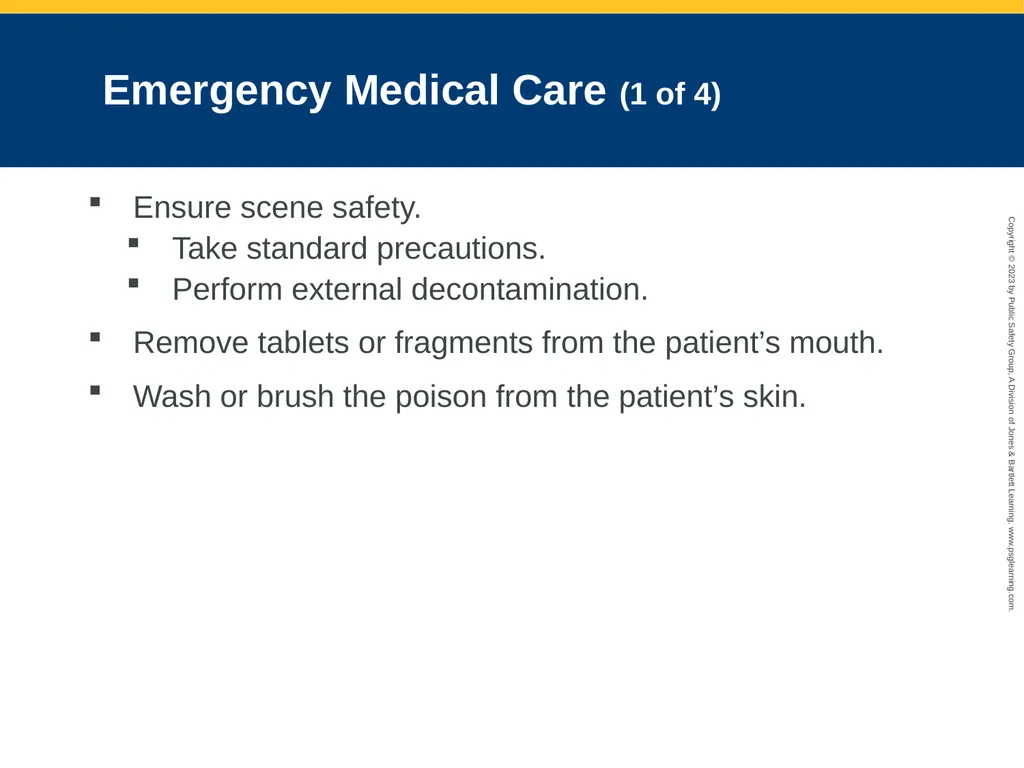
slide33. Emergency Medical Care (1 of 4) Ensure scene safety.
Take standard precautions.
Perform external decontamination.
Remove tablets or fragments from the patient’s mouth.
Wash or brush the poison from the patient’s skin.<br>
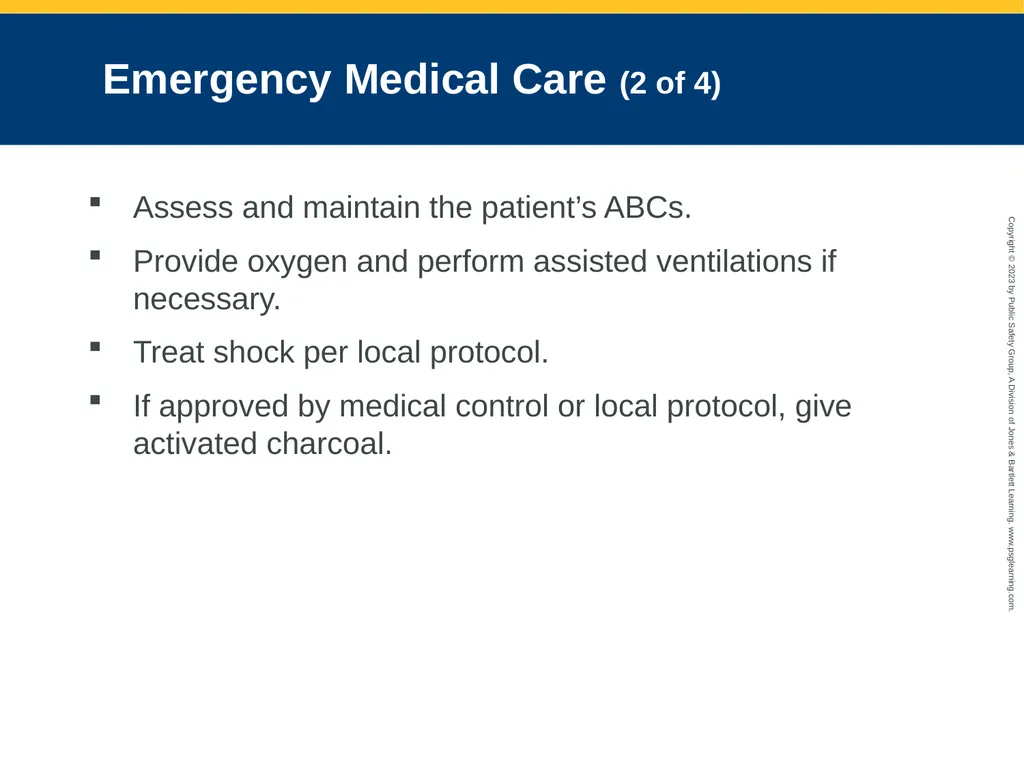
slide34. Emergency Medical Care (2 of 4) Assess and maintain the patient’s ABCs.
Provide oxygen and perform assisted ventilations if necessary.
Treat shock per local protocol.
If approved by medical control or local protocol, give activated charcoal.<br>
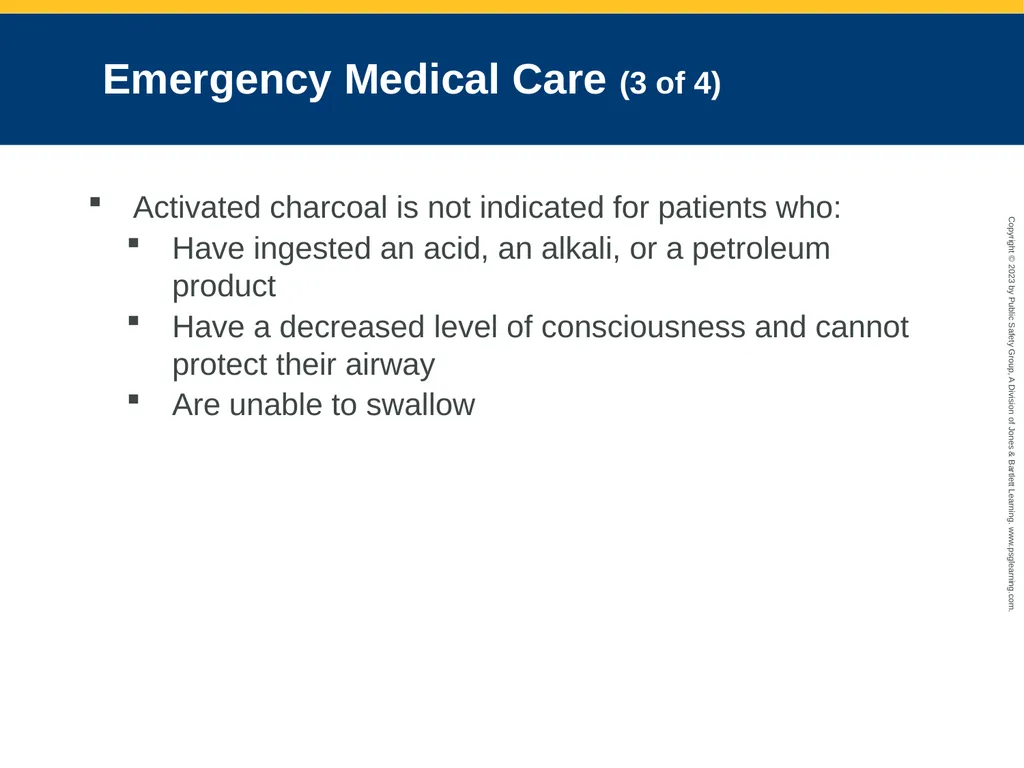
slide35. Emergency Medical Care (3 of 4) Activated charcoal is not indicated for patients who:
Have ingested an acid, an alkali, or a petroleum product
Have a decreased level of consciousness and cannot protect their airway
Are unable to swallow<br>
slide36. Emergency Medical Care (4 of 4) Dose: 1 g of activated charcoal per kilogram of body weight
Side effects of activated charcoal
Black stools
Nausea and vomiting
Possible airway problems<br>
slide37. Alcohol (1 of 5) Most widely abused drug in the United States and around the world
Alcoholism
State of physical and psychological addiction
Alcoholics tend to have chronic malnutrition and fall frequently.
Fourth leading cause of death in the United States<br>
slide38. Alcohol (2 of 5) Alcohol is a powerful CNS depressant.
Decreases activity and excitement
Induces sleep
Dulls the sense of awareness, slows reflexes, and reduces reaction time
Causes aggressive and inappropriate behavior and lack of coordination<br>
slide39. Alcohol (3 of 5) Medical problems associated with alcoholism
Head trauma, toxic reactions, uncontrolled diabetes
Death from respiratory depression and/or aspiration of vomitus or stomach contents
Physical dependence and/or withdrawal
Hepatitis and cirrhosis<br>
slide40. Alcohol (4 of 5) Establish and maintain the airway.
Suspect internal bleeding if the patient appears to be in shock.
Withdrawal symptoms include seizures.
Call for paramedic backup.<br>
slide41. Alcohol (5 of 5) If a patient exhibits signs of delirium tremens:
Keep patient calm.
Administer oxygen.
Establish vascular access.
Manage hypotension.
Reassess breath sounds.
Maintain dialogue.<br>
slide42. Opioids (1 of 4) An opioid is a drug that acts as a central nervous system depressant.
Opiate: Natural drug derived from opium or poppy plant
Opioid: Non–opium-derived synthetic Examples
Morphine
Codeine
Heroin
Fentanyl
Oxycodone
Meperidine
Propoxyphene
Dextromethorphan<br>
slide43. Opioids (2 of 4) Opioids bind with receptor sites in brain and other tissues.
Absorbed through GI tract, nasal mucosa, or lungs
When heroin passes through liver, it continues to exert narcotic effects that may outlast effects of naloxone.
Morphine and heroin produce an impressive dreamlike state.<br>
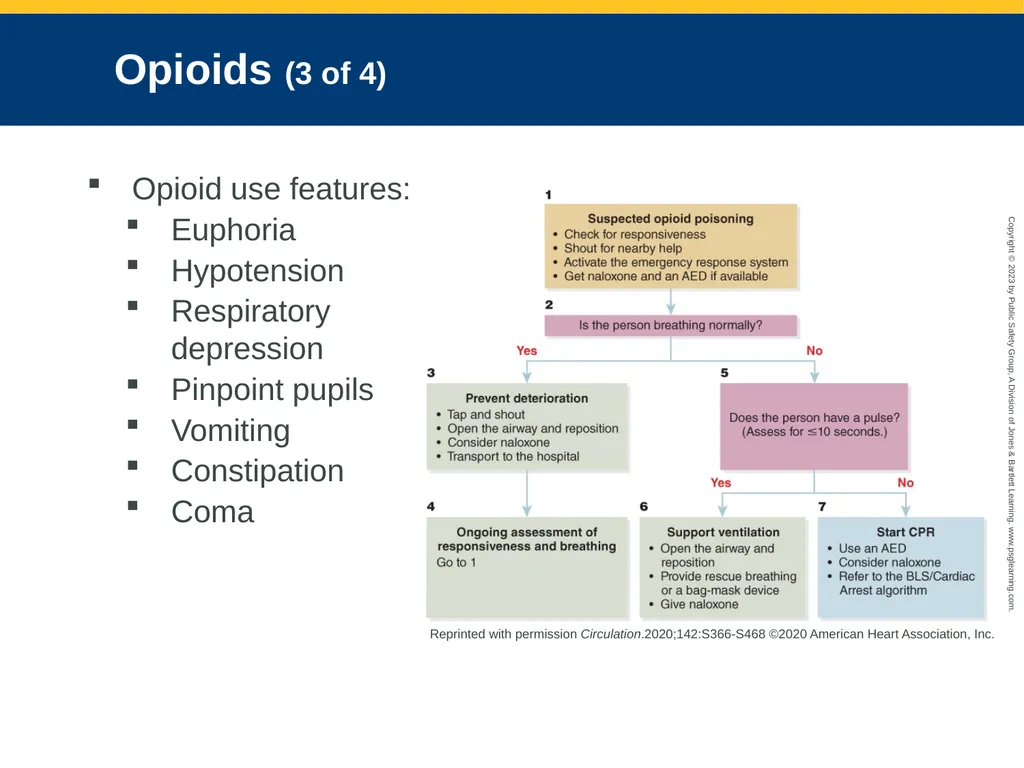
slide44. Opioids (3 of 4) Opioid use features:
Euphoria
Hypotension
Respiratory depression
Pinpoint pupils
Vomiting
Constipation
Coma Reprinted with permission Circulation.2020;142:S366-S468 ©2020 American Heart Association, Inc.<br>
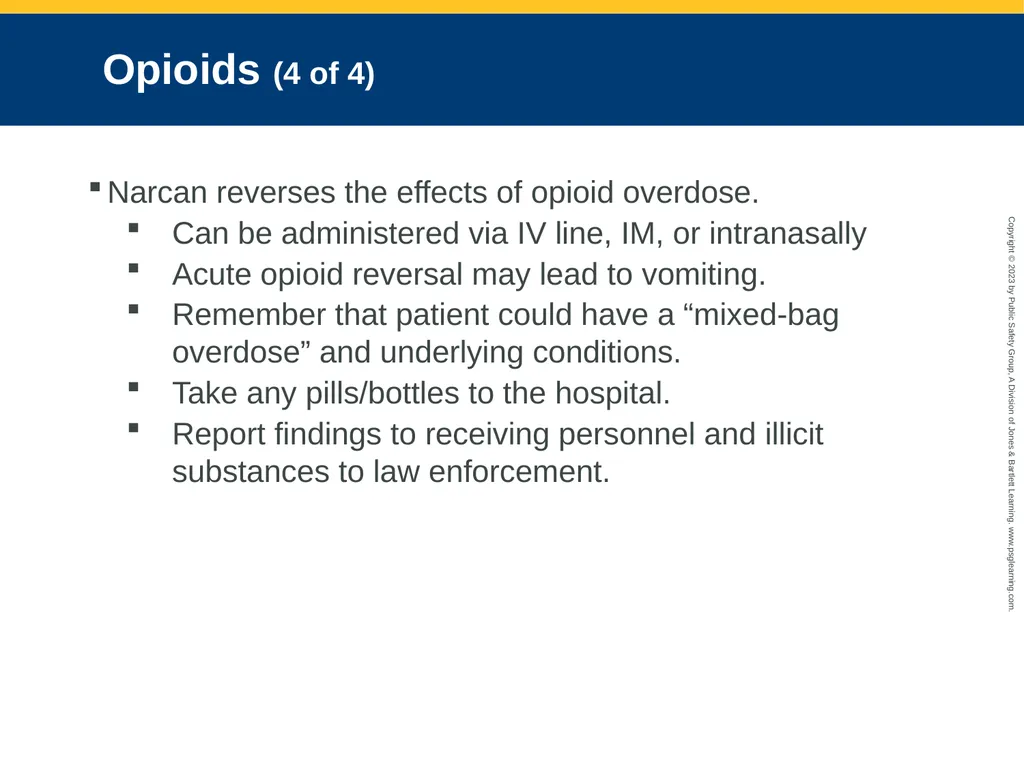
slide45. Opioids (4 of 4) Narcan reverses the effects of opioid overdose.
Can be administered via IV line, IM, or intranasally
Acute opioid reversal may lead to vomiting.
Remember that patient could have a “mixed-bag overdose” and underlying conditions.
Take any pills/bottles to the hospital.
Report findings to receiving personnel and illicit substances to law enforcement.<br>
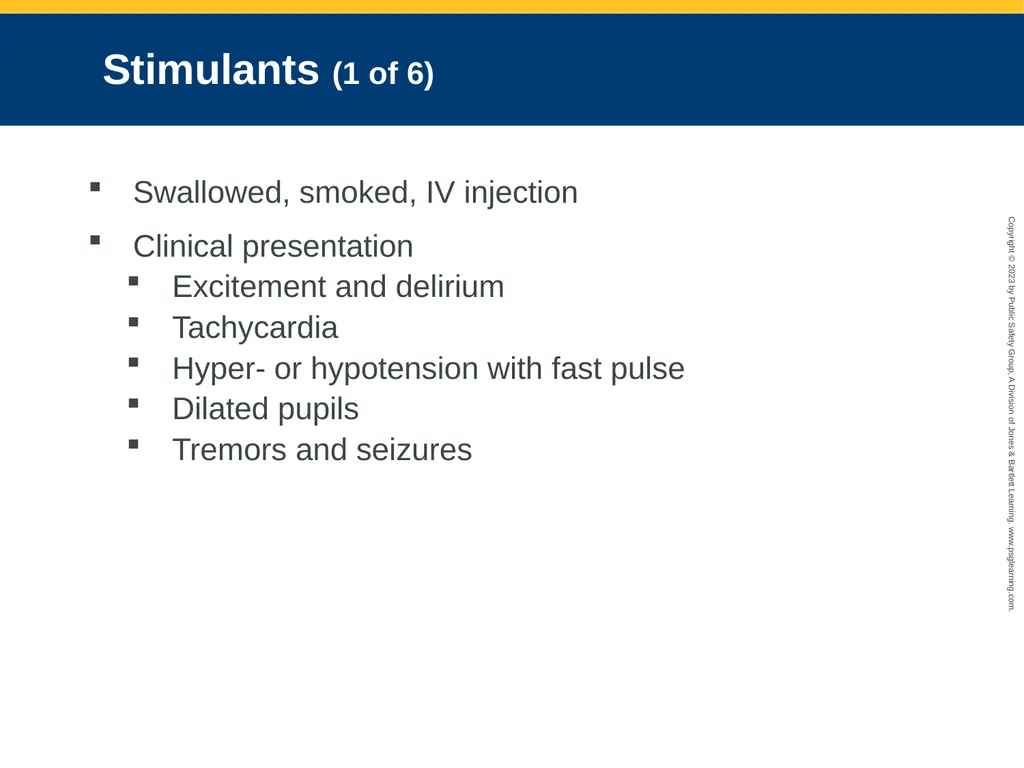
slide46. Stimulants (1 of 6) Swallowed, smoked, IV injection
Clinical presentation
Excitement and delirium
Tachycardia
Hyper- or hypotension with fast pulse
Dilated pupils
Tremors and seizures<br>
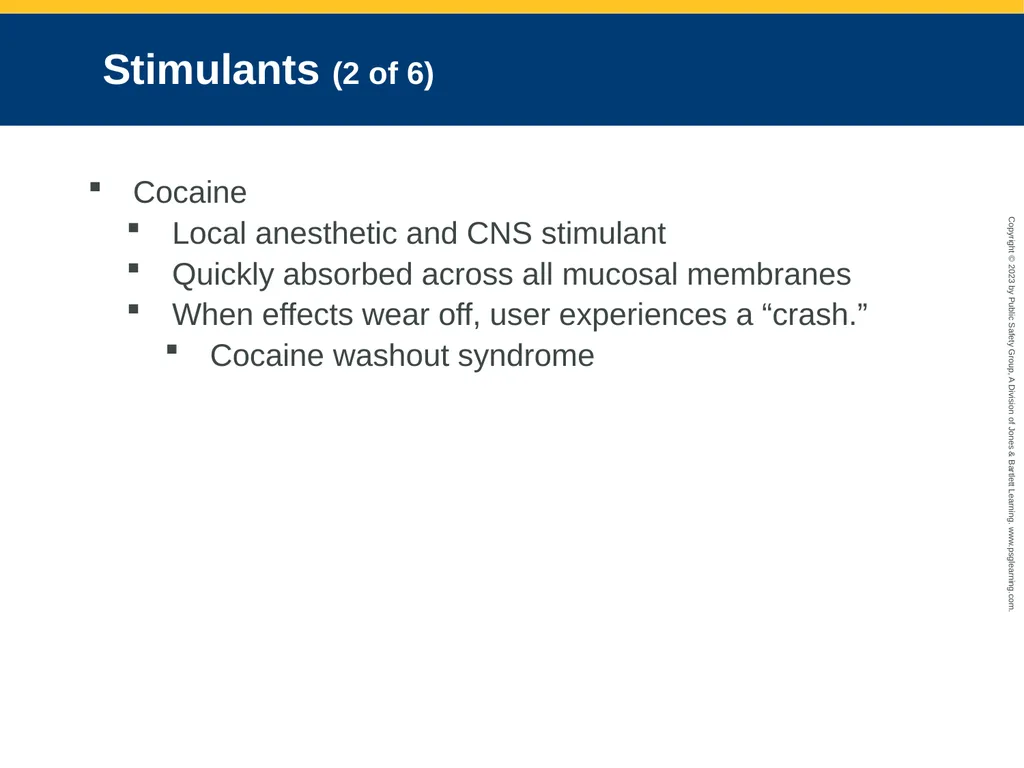
slide47. Stimulants (2 of 6) Cocaine
Local anesthetic and CNS stimulant
Quickly absorbed across all mucosal membranes
When effects wear off, user experiences a “crash.”
Cocaine washout syndrome<br>
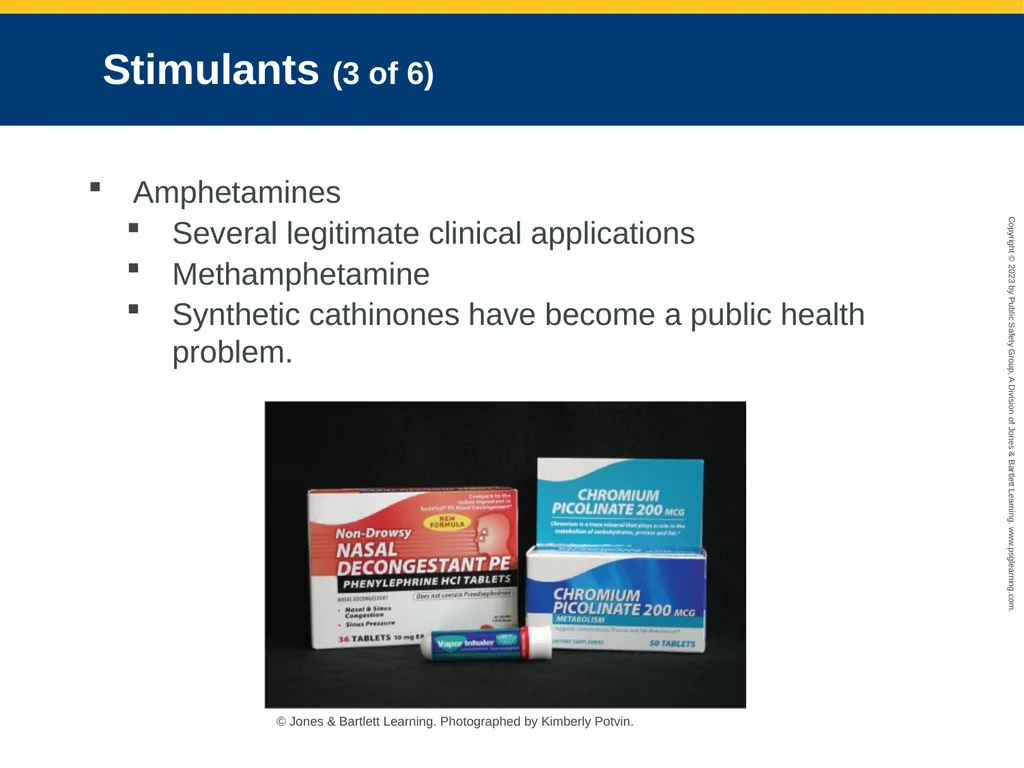
slide48. Stimulants (3 of 6) Amphetamines
Several legitimate clinical applications
Methamphetamine
Synthetic cathinones have become a public health problem. © Jones & Bartlett Learning. Photographed by Kimberly Potvin.<br>
slide49. Stimulants (4 of 6) Signs and symptoms of stimulant abuse
Wild-eyed, thin-as-a-rail appearance
Nervous or jittery
Inadequate nutrition and sleep
Increasing paranoia<br>
slide50. Stimulants (5 of 6) Complications associated with cocaine use include:
Cardiac dysrhythmias
Acute myocardial infarction
Seizures
Stroke
Apnea
Hyperthermia<br>
slide51. Stimulants (6 of 6) Treatment for stimulants
Maintain maximum oxygen saturation levels.
Prevent seizures with adequate sedation.
Monitor serial vital signs.
Establish IV access and manage hypotension.
Apply the pulse oximeter.
Consider paramedic backup.<br>
slide52. Marijuana and Cannabis Compounds (1 of 2) Usually smoked with effects in minutes
Smoking marijuana results in bronchodilation and slight tachycardia.
Other symptoms include
Euphoria
Drowsiness
Diminished motor coordination
Bloodshot eyes
Management focuses on supportive care.<br>
slide53. Marijuana and Cannabis Compounds (2 of 2) Spice
Blend of synthetic cannabinoids
Can cause psychosis, hallucinations, tachycardia, vomiting, renal problems, and seizures
Treatment is supportive care.<br>
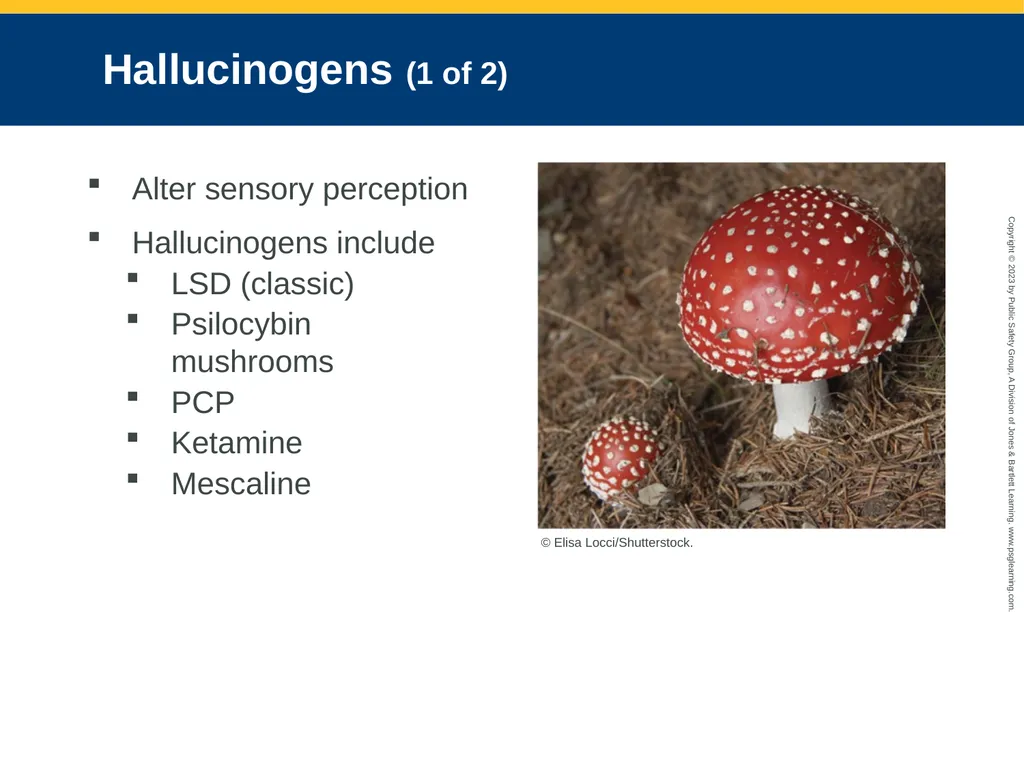
slide54. Hallucinogens (1 of 2) Alter sensory perception
Hallucinogens include
LSD (classic)
Psilocybin mushrooms
PCP
Ketamine
Mescaline © Elisa Locci/Shutterstock.<br>
slide55. Hallucinogens (2 of 2) Treatment is primarily supportive.
Limit sensory stimulation.
Routine transport plus psychological support
PCP and ketamine users: Administer oxygen therapy, and establish vascular access
Mescaline and psilocybin mushroom users: Pay attention to ABCDEs, give oxygen, monitor vital signs, and transport.<br>
slide56. Sedatives and Hypnotics (1 of 2) Sedatives: Reduce anxiety
Hypnotics: Produce drowsiness and sleep
Sedative-hypnotic drugs function as CNS depressants.
Barbiturates
Benzodiazepines<br>
slide57. Sedatives and Hypnotics (2 of 2) Treatment
Airway management is first priority.
Call for paramedic backup.
Administer high-concentration oxygen.
Establish venous access.
For shock, rapid infusion of 20-mL to 2-L boluses of normal saline may be needed.
Activated charcoal is a treatment option.<br>
slide58. Cardiac Medications (1 of 3) Major classes:
Antidysrhythmics
Beta-blockers
Calcium channel blockers
Cardiac glycosides
Angiotensin-converting enzyme inhibitors
Many patients take a combination.<br>
slide59. Cardiac Medications (2 of 3) Signs of overdose
Hypotension
Weakness or confusion
Nausea and vomiting
Rhythm disturbances
Headache
Difficulty breathing<br>
slide60. Cardiac Medications (3 of 3) Ensure a patent airway, provide adequate ventilation, administer high-flow oxygen.
Establish vascular access.
Interventions and antidotes are available if specific agent is identified.
Consider paramedic backup
For advanced airway management and administration of vasopressors
Contact medical control.<br>
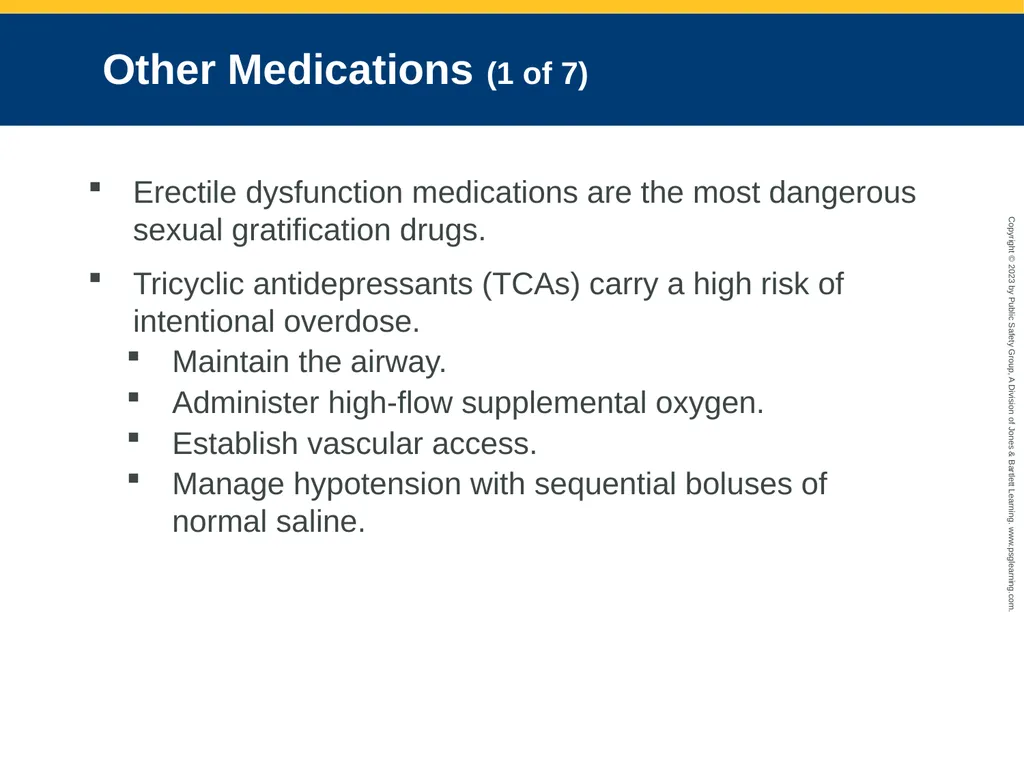
slide61. Other Medications (1 of 7) Erectile dysfunction medications are the most dangerous sexual gratification drugs.
Tricyclic antidepressants (TCAs) carry a high risk of intentional overdose.
Maintain the airway.
Administer high-flow supplemental oxygen.
Establish vascular access.
Manage hypotension with sequential boluses of normal saline.<br>
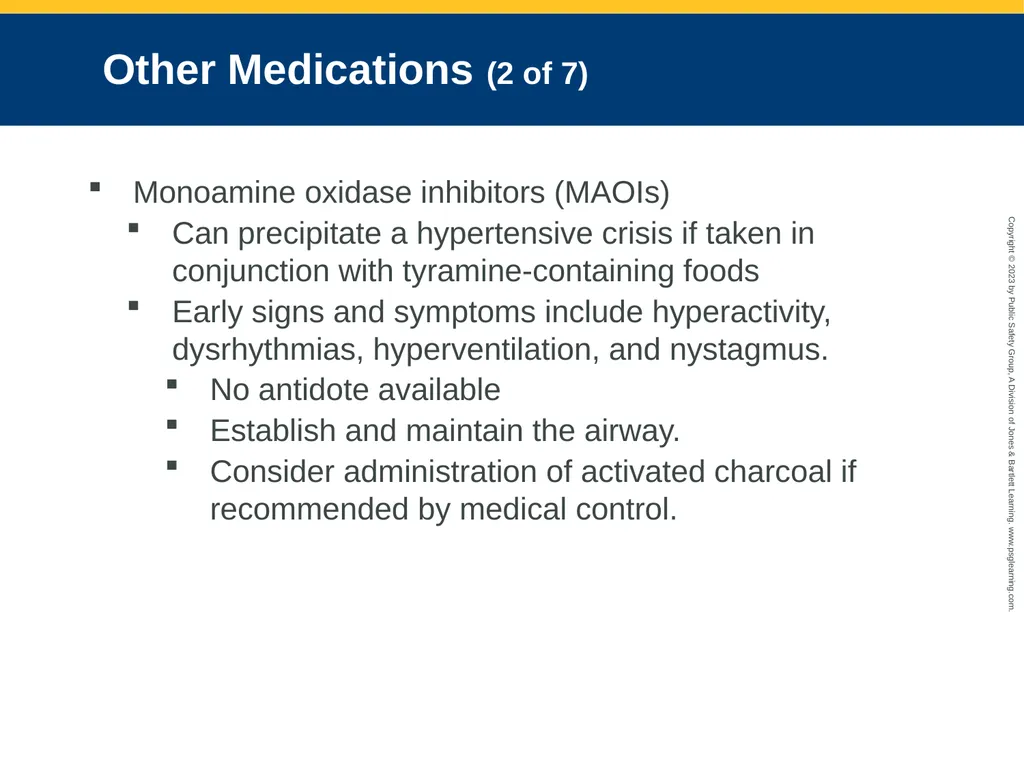
slide62. Other Medications (2 of 7) Monoamine oxidase inhibitors (MAOIs)
Can precipitate a hypertensive crisis if taken in conjunction with tyramine-containing foods
Early signs and symptoms include hyperactivity, dysrhythmias, hyperventilation, and nystagmus.
No antidote available
Establish and maintain the airway.
Consider administration of activated charcoal if recommended by medical control.<br>
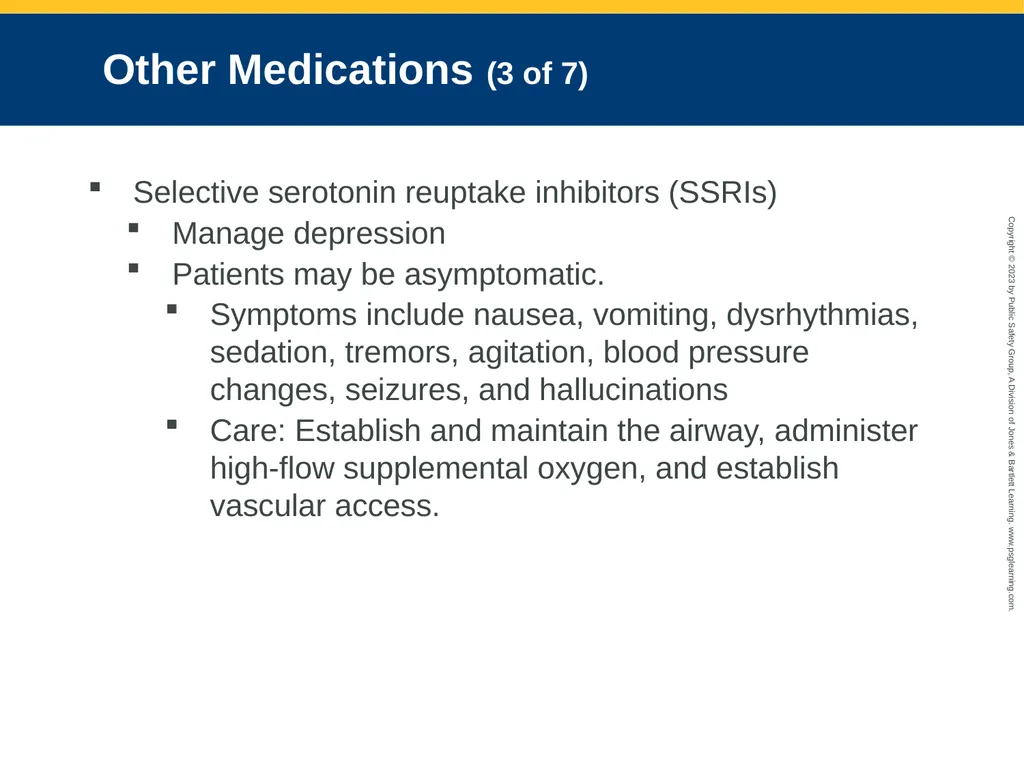
slide63. Other Medications (3 of 7) Selective serotonin reuptake inhibitors (SSRIs)
Manage depression
Patients may be asymptomatic.
Symptoms include nausea, vomiting, dysrhythmias, sedation, tremors, agitation, blood pressure changes, seizures, and hallucinations
Care: Establish and maintain the airway, administer high-flow supplemental oxygen, and establish vascular access.<br>
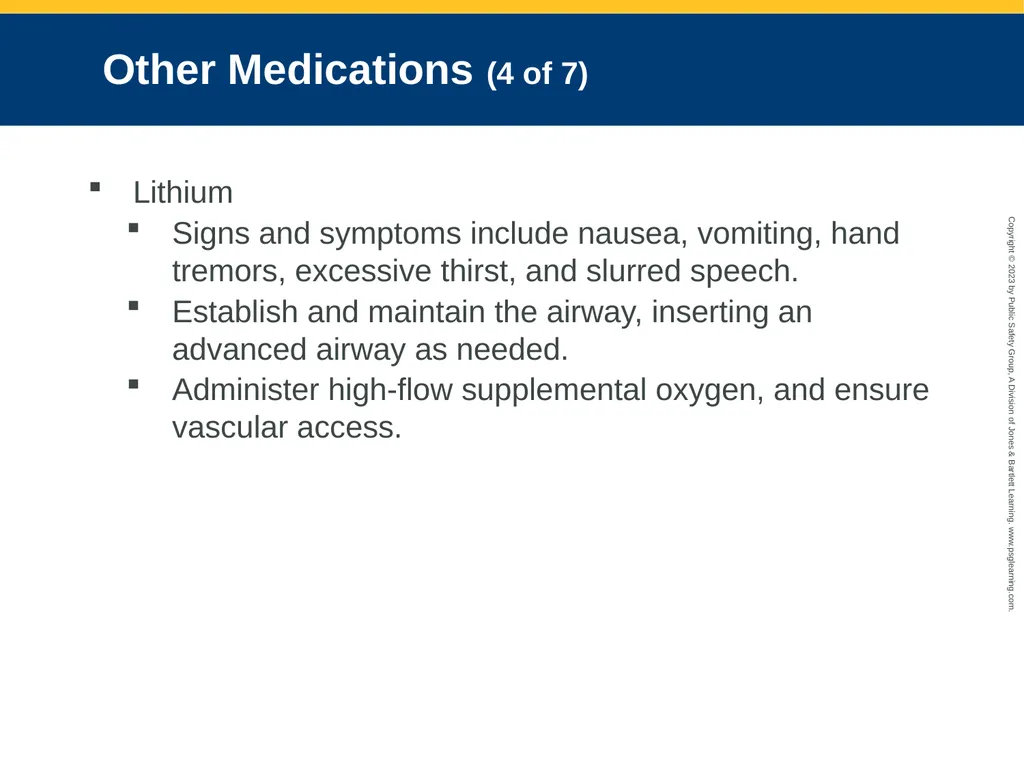
slide64. Other Medications (4 of 7) Lithium
Signs and symptoms include nausea, vomiting, hand tremors, excessive thirst, and slurred speech.
Establish and maintain the airway, inserting an advanced airway as needed.
Administer high-flow supplemental oxygen, and ensure vascular access.<br>
slide65. Other Medications (5 of 7) Nonsteroidal anti-inflammatory drugs (NSAIDs)
Most of the problems involve long-term use.
Signs and symptoms include headache, altered mentation, behavioral changes, seizures, bradydysrhythmias, hypotension, abdominal pain, nausea, and vomiting.
Care in the prehospital setting is usually supportive.<br>
slide66. Other Medications (6 of 7) Salicylates
OTC products containing salicylates cause toxicity.
No salicylate antidote or antagonist is available.
Field management is primarily supportive.
Acetaminophen
Well-tolerated drug with few side effects
Antidote should be given fewer than 8 hours after the ingestion.<br>
slide67. Other Medications (7 of 7) Gamma-hydroxybutyrate (GHB)
Frequently associated with sexual assaults
Produces a pronounced hypnotic effect along with disinhibition, severe passivity, and antegrade amnesia
Treatment focuses on the CNS depression and the risks associated with the patient being unable to protect the airway.<br>
slide68. Organophosphates (1 of 3) Major component in many insecticides
Similar to chemical warfare “nerve gases”
Often, exposure comes from agricultural accident or suicide attempts.<br>
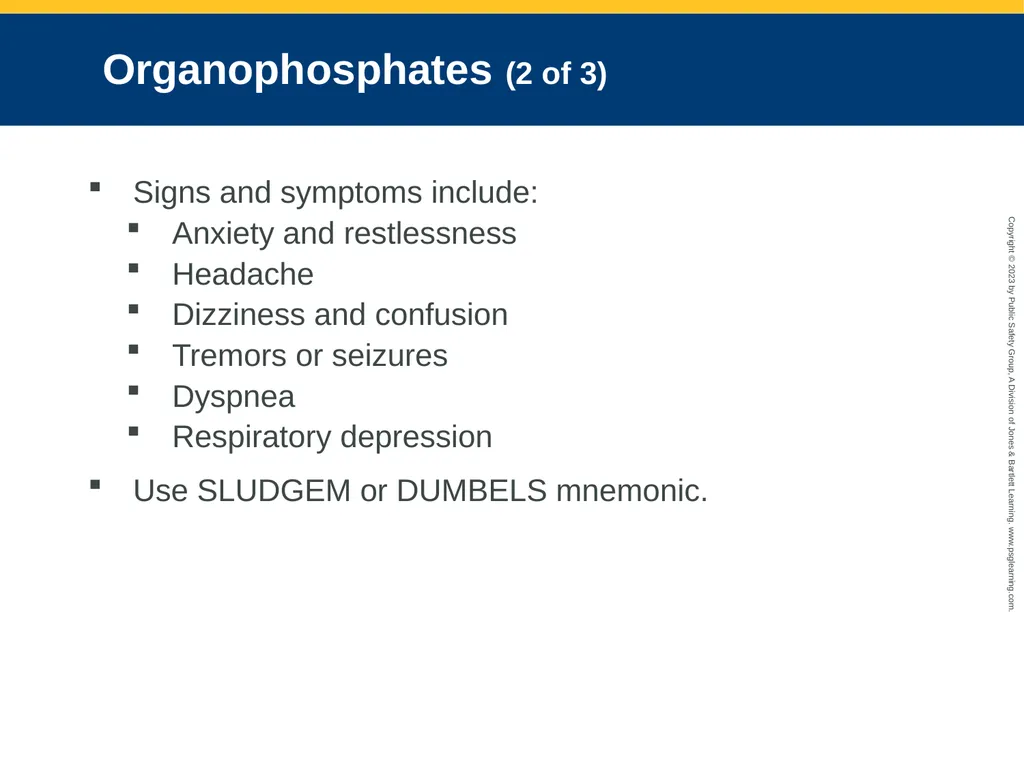
slide69. Organophosphates (2 of 3) Signs and symptoms include:
Anxiety and restlessness
Headache
Dizziness and confusion
Tremors or seizures
Dyspnea
Respiratory depression
Use SLUDGEM or DUMBELS mnemonic.<br>
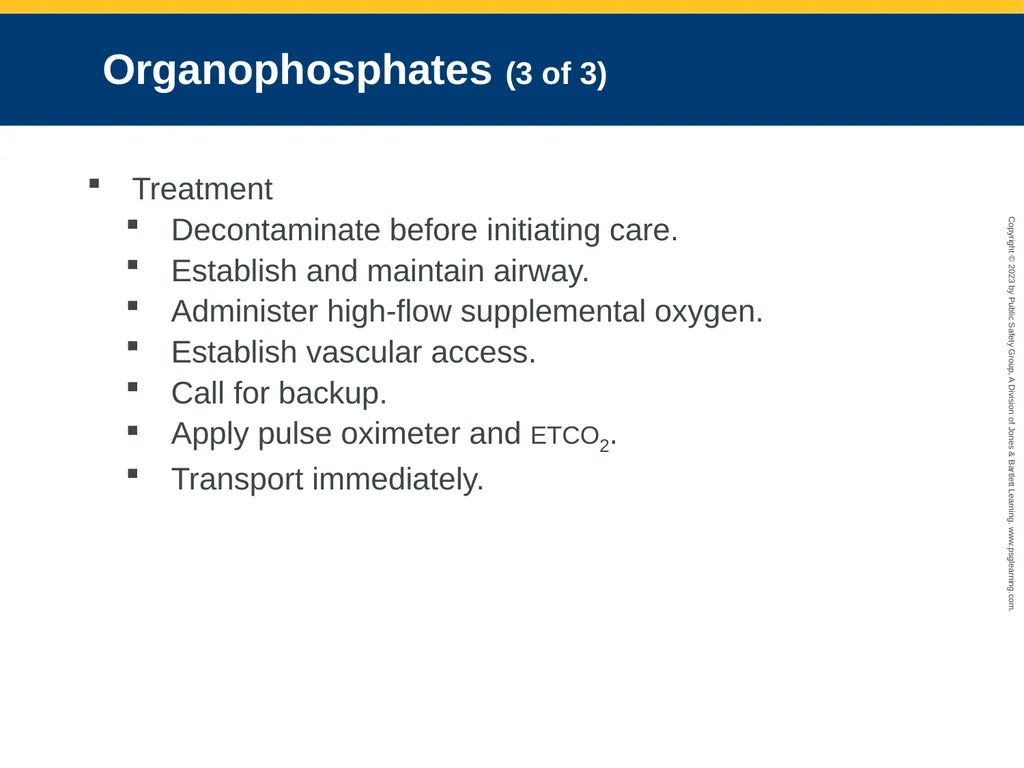
slide70. Organophosphates (3 of 3) Treatment
Decontaminate before initiating care.
Establish and maintain airway.
Administer high-flow supplemental oxygen.
Establish vascular access.
Call for backup.
Apply pulse oximeter and etco2.
Transport immediately.<br>
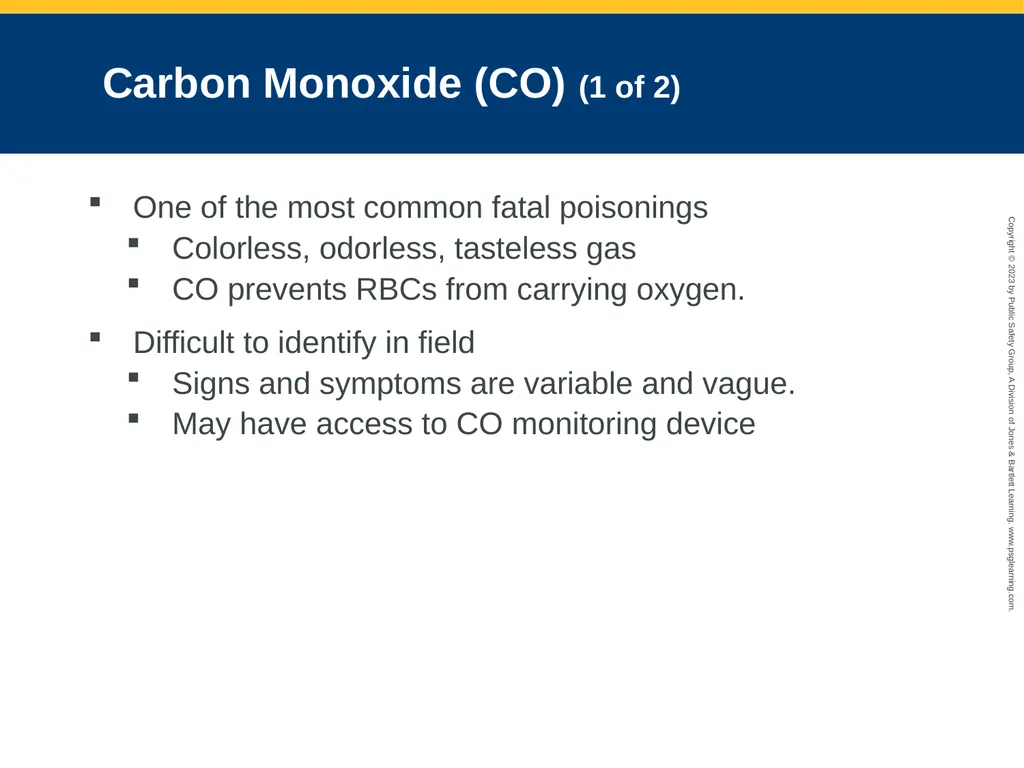
slide71. Carbon Monoxide (CO) (1 of 2) One of the most common fatal poisonings
Colorless, odorless, tasteless gas
CO prevents RBCs from carrying oxygen.
Difficult to identify in field
Signs and symptoms are variable and vague.
May have access to CO monitoring device<br>
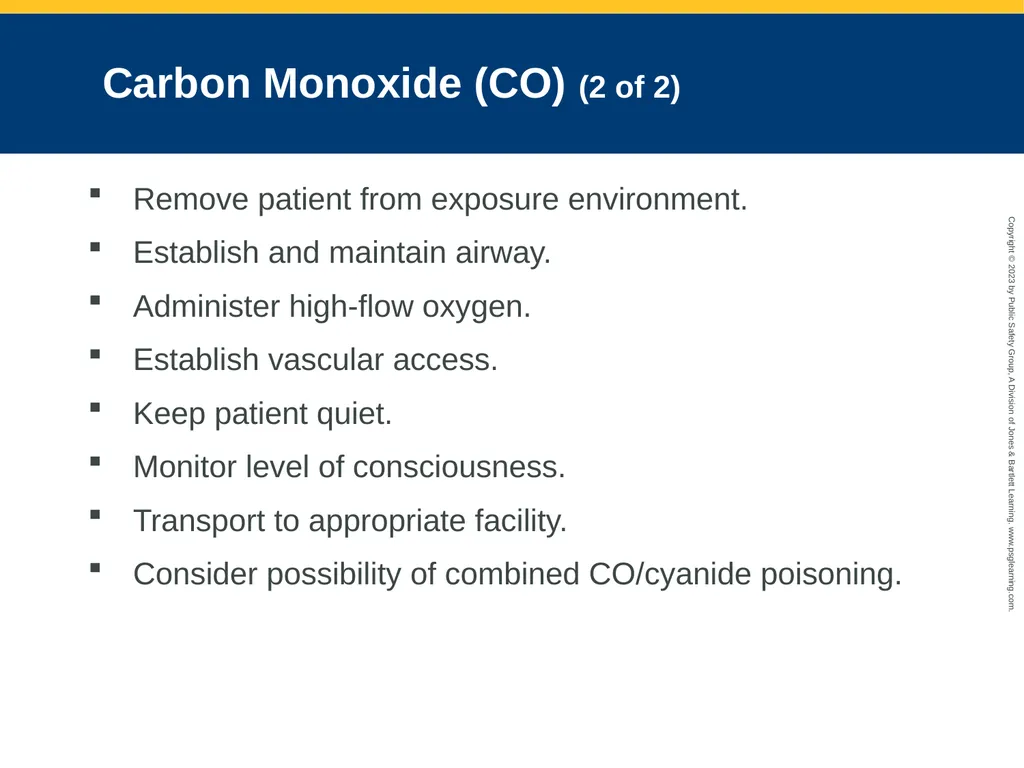
slide72. Carbon Monoxide (CO) (2 of 2) Remove patient from exposure environment.
Establish and maintain airway.
Administer high-flow oxygen.
Establish vascular access.
Keep patient quiet.
Monitor level of consciousness.
Transport to appropriate facility.
Consider possibility of combined CO/cyanide poisoning.<br>
slide73. Metals Lead
Leading cause of chronic metal poisoning
Hampers intellectual development in children
Half-life in bone is 30 years.
Few treatment options in the field
Iron
Gastrointestinal toxicity
Systemic toxicity
There is little you can do in the field for iron poisoning.<br>
slide74. Miscellaneous Substances (1 of 2) Chlorine gas
Use of chlorine compounds in home
Burning sensations in eyes, nose, throat
Cyanide
Fire, industrial exposure
Altered mental state
Caustics
Chemicals used in industry, agriculture, and home
Severe pain in mouth, throat, and chest<br>
slide75. Miscellaneous Substances (2 of 2) Methyl alcohol and ethylene glycol
Dry gas and antifreeze products
Tachypnea, blindness, renal failure
Hydrocarbons
Household products
Respiratory distress and sudden death<br>
slide76. Food Poisoning (1 of 2) Consider when two or more people are sick at same time at same scene
Four pathogens
Salmonella
Toxoplasma
Listeria
Norovirus
Signs and symptoms may appear several hours after ingestion or days or weeks later<br>
slide77. Food Poisoning (2 of 2) Symptoms include abdominal pain and cramping, nausea, vomiting, and diarrhea.
Treatment is supportive.
Establish and maintain airway.
Administer high-flow supplemental oxygen.
Establish vascular access.
Administer fluid for hypotension.<br>
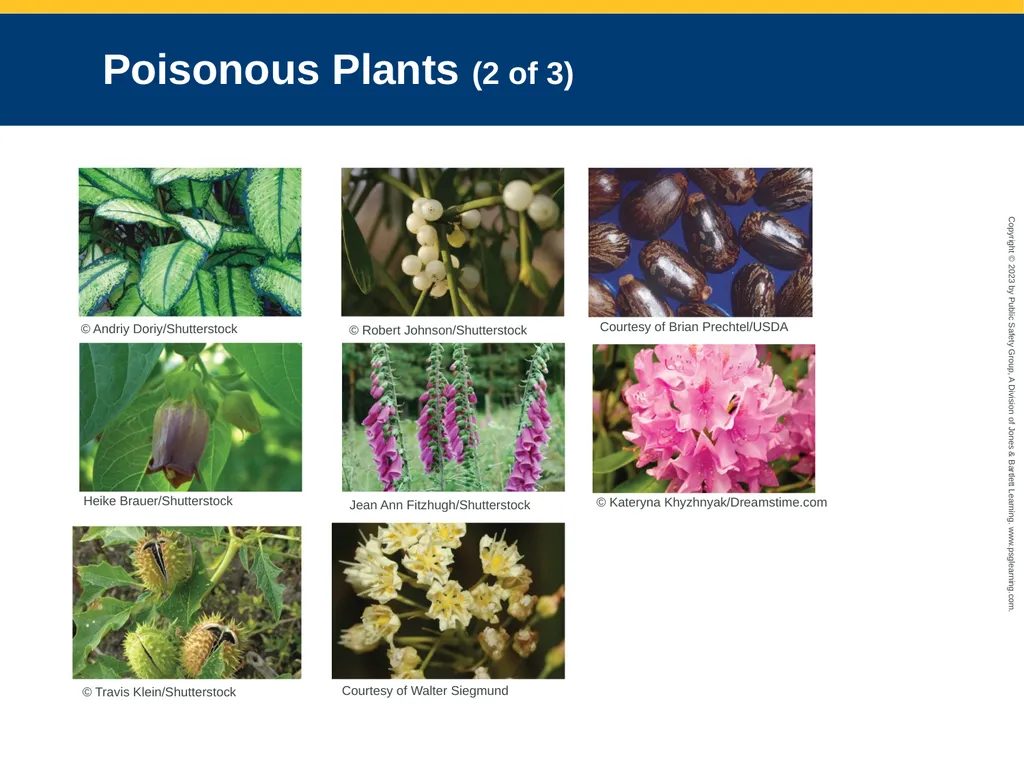
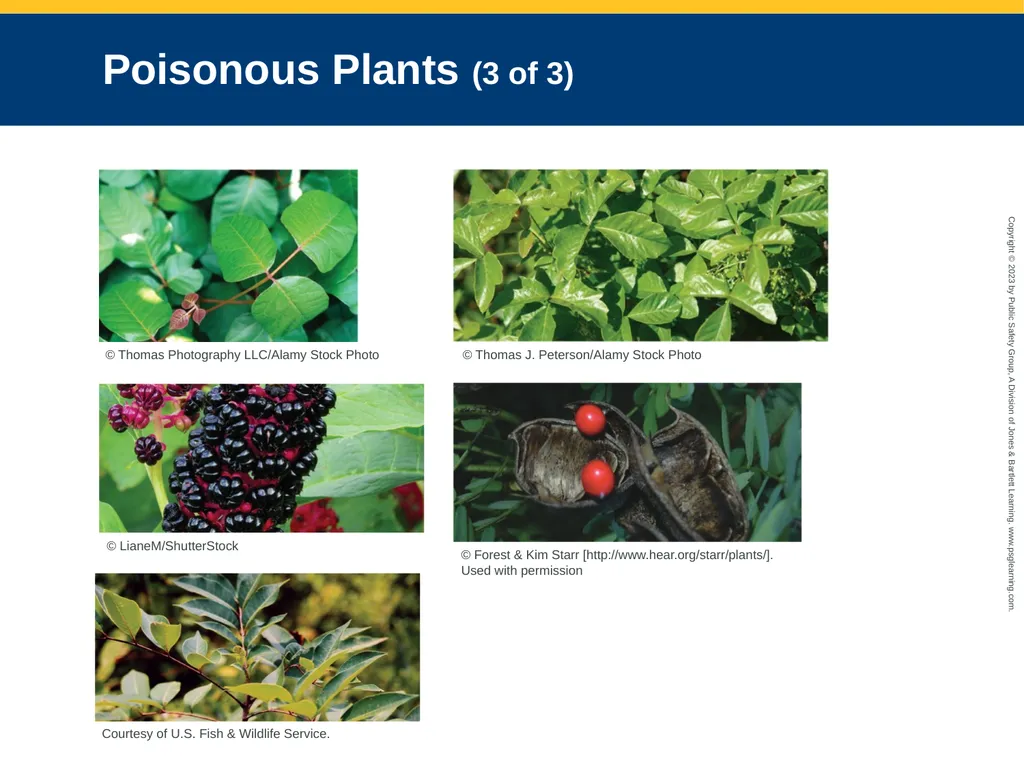
slide78. Poisonous Plants (1 of 3) Few plants are poisonous.
Deaths are rare, but dieffenbachia and castor bean seeds can be deadly.
Question patient; call poison control center.<br>
slide79. Poisonous Plants (2 of 3) © Andriy Doriy/Shutterstock © Robert Johnson/Shutterstock Courtesy of Brian Prechtel/USDA Heike Brauer/Shutterstock Jean Ann Fitzhugh/Shutterstock © Kateryna Khyzhnyak/Dreamstime.com © Travis Klein/Shutterstock Courtesy of Walter Siegmund<br>
slide80. Poisonous Plants (3 of 3) © Thomas Photography LLC/Alamy Stock Photo © Thomas J. Peterson/Alamy Stock Photo © LianeM/ShutterStock © Forest & Kim Starr [http://www.hear.org/starr/plants/]. Used with permission Courtesy of U.S. Fish & Wildlife Service.<br>
slide2. National EMS Education Standard Competencies (1 of 3) Medicine
Applies fundamental knowledge to provide basic and selected advanced emergency care and transportation based on assessment findings for an acutely ill patient.<br>
slide3. National EMS Education Standard Competencies (2 of 3) Toxicology
Recognition and management of
Carbon monoxide poisoning
Nerve agent poisoning
How and when to contact a poison control center<br>
slide4. National EMS Education Standard Competencies (3 of 3) Anatomy, physiology, pathophysiology, assessment, and management of
Inhaled poisons
Ingested poisons
Injected poisons
Absorbed poisons
Alcohol intoxication and withdrawal
Opiate toxidrome<br>
slide5. Introduction (1 of 2) AEMTs treat patients who have taken drugs of abuse.
Legal (licit) drugs (alcohol and oxycodone)
Illegal (Illicit) drugs (heroin and ecstasy)<br>
slide6. Introduction (2 of 2) A poison is toxic by nature.
A drug can have a physiologic effect if given in appropriate circumstances and dose.
Overdose is a toxicologic emergency.<br>
slide7. Types of Toxicologic Emergencies (1 of 2) Toxicology is the study of toxic or poisonous substances.
Toxicologic emergencies
Intentional
Unintentional<br>
slide8. Types of Toxicologic Emergencies (2 of 2) Can be found in nature and workplace
Can occur from neglect or oversight
Can also be intentional (biologic warfare and date rape drugs)<br>
slide9. Poison Centers Don’t hesitate to contact a poison center.
National Poison Control Center hotline: 1-800-222-1222
Access to information about all commonly used medications, chemicals, and substances that might be poisonous<br>
slide10. Pathophysiology: Routes of Absorption Toxins enter the body in four main ways:
Ingestion
Inhalation
Injection
Absorption
Effects and excretion rate are determined by amount of toxin and speed of metabolizing it.<br>
slide11. Poisoning by Ingestion (1 of 2) Most common sources
Medications around the home
Household chemicals
Effects may be immediate or delayed.
Entry of toxin by oral route takes longer to be absorbed by the body.<br>
slide12. Poisoning by Ingestion (2 of 2) Some EMS systems may allow AEMTs to use activated charcoal.
Binds to poison and carries it out of the system © Charles Stewart MD, EMDM MPH.<br>
slide13. Poisoning by Inhalation (1 of 2) Most common sources:
Home medications
Household chemical products
Poison by inhalation can only occur if poison is present in atmosphere.
Do not enter hazardous environment.
Call for resources with specialized protective equipment.<br>
slide14. Poisoning by Inhalation (2 of 2) Inhaled toxins quickly reach alveoli.
Window of opportunity for treatment is limited.
First consideration is scene safety.
Take containers, bottles, and labels with you.
Clues from scene, assistance from poison center, and direction from medical control will drive your treatment plan.
Treat hypoxia immediately.<br>
slide15. Poisoning by Injection Usually the result of drug abuse
Signs and symptoms can vary greatly.
Generally, injected poisons are impossible to dilute.
Quickly absorbed and can cause intense local tissue destruction<br>
slide16. Poisoning by Absorption (1 of 3) Most-serious absorption poisons are pesticides.
Corrosive substances damage skin, mucous membranes, or eyes.
Other substances are absorbed and have systemic effects.
Distinguish between contact burns and contact absorptions.<br>
slide17. Poisoning by Absorption (2 of 3) Signs and symptoms
History of exposure
Liquid or powder on patient’s skin
Burns
Itching, irritation
Skin redness in light-skinned people
Typical odors of substances<br>
slide18. Poisoning by Absorption (3 of 3) Avoid contaminating others.
Remove the substance from patient.
Cut off contaminated clothing.
Brush dry powder off.
Wash the skin with soap and water. © American Academy of Orthopaedic Surgeons.<br>
slide19. Understanding and Using Toxidromes Many drugs result in similar signs and symptoms.
Toxidrome: Syndromelike symptoms of poisonous agent<br>
slide20. Major Toxidromes Stimulants
Opioids
Sympathomimetics
Sedatives and hypnotics
Cholinergics
Anticholinergics<br>
slide21. Overview of Substance Abuse Area of medicine is challenging
Uncertainty of prevalence of problem
Evolution of substances
Cultural variation in what is considered substance abuse
Society’s definition may have little relation to potential harm of substance.<br>
slide22. Important Substance Abuse Terms Drug abuse
Habituation
Physical dependence
Psychological dependence
Tolerance
Withdrawal syndrome
Drug addiction
Antagonist
Potentiation
Synergism<br>
slide23. Scene Size-up (1 of 2) Scene safety
Determine:
Nature of illness/mechanism of injury
Number of patients involved
Need for additional resources
Whether spinal immobilization is required
Wear the appropriate PPE, and remember patients may be dangerous.<br>
slide24. Scene Size-up (2 of 2) Look for clues.
Medication bottles
Alcoholic beverage containers
Syringes or drug paraphernalia
Unpleasant or odd odor Courtesy of U.S. Drug Enforcement Administration.<br>
slide25. Primary Survey (1 of 2) Begins with a general impression.
Do not be fooled into thinking that a conscious, alert, and orientated patient is in stable condition.
Identify any life threats.
Airway and breathing
Ensure that the patient has an open airway and adequate ventilation.
Do not hesitate to begin oxygen therapy.<br>
slide26. Primary Survey (2 of 2) Patient’s circulatory status
Assess the pulse and skin condition.
Check for bleeding.
Assess for disability.
Alterations in ABCDEs or poor general impression require immediate transport.
A delay on the scene is rarely indicated.
Consider decontamination of the patient before transport, depending on the poison.<br>
slide27. History Taking (1 of 2) Obtain patient’s history.
OPQRST-I
SAMPLE history
Unresponsive patient
Obtain history from friends, family members, medical jewelry, or cards in the patient’s wallet. © John Moore/Staff/Getty Images News/Getty Images.<br>
slide28. History Taking (2 of 2) What is the agent?
When was the poison ingested, injected, absorbed, or inhaled?
How much was taken?
What else was taken?
Over what period?
Has any intervention been performed?
Has the patient vomited or aspirated?
How much does the patient weigh?
Why was the substance taken?<br>
slide29. Secondary Assessment Focus on the area of the body involved with the poisoning or the route of exposure.
Manage life threats.
Obtain a complete set of vital signs.
Many poisons produce no outward indications of the exposure’s seriousness.
Look for alterations in the level of consciousness, pulse, respirations, blood pressure, and skin.<br>
slide30. Reassessment (1 of 3) Reassess the adequacy of the ABCDEs.
Retake vital signs and compare with baseline set.
Evaluate your interventions.
Repeat the assessment of vital signs.
Every 15 minutes for stable patient
Every 5 minutes or more for patient who has consumed a harmful or lethal dose<br>
slide31. Reassessment (2 of 3) Interventions
Supporting the ABCs is most important.
Dilute airborne exposures with oxygen.
Remove contact exposures with water.
Consider activated charcoal for ingestions.
Continuously monitor the airway.
Contact medical control or a poison center to discuss treatment options.<br>
slide32. Reassessment (3 of 3) Once primary survey, history taking, and secondary assessment are complete:
Contact medical control to request necessary interventions.
Report as much information about the poison as possible to the hospital.
If a safety data sheet is immediately available, take it with you to the hospital.<br>
slide33. Emergency Medical Care (1 of 4) Ensure scene safety.
Take standard precautions.
Perform external decontamination.
Remove tablets or fragments from the patient’s mouth.
Wash or brush the poison from the patient’s skin.<br>
slide34. Emergency Medical Care (2 of 4) Assess and maintain the patient’s ABCs.
Provide oxygen and perform assisted ventilations if necessary.
Treat shock per local protocol.
If approved by medical control or local protocol, give activated charcoal.<br>
slide35. Emergency Medical Care (3 of 4) Activated charcoal is not indicated for patients who:
Have ingested an acid, an alkali, or a petroleum product
Have a decreased level of consciousness and cannot protect their airway
Are unable to swallow<br>
slide36. Emergency Medical Care (4 of 4) Dose: 1 g of activated charcoal per kilogram of body weight
Side effects of activated charcoal
Black stools
Nausea and vomiting
Possible airway problems<br>
slide37. Alcohol (1 of 5) Most widely abused drug in the United States and around the world
Alcoholism
State of physical and psychological addiction
Alcoholics tend to have chronic malnutrition and fall frequently.
Fourth leading cause of death in the United States<br>
slide38. Alcohol (2 of 5) Alcohol is a powerful CNS depressant.
Decreases activity and excitement
Induces sleep
Dulls the sense of awareness, slows reflexes, and reduces reaction time
Causes aggressive and inappropriate behavior and lack of coordination<br>
slide39. Alcohol (3 of 5) Medical problems associated with alcoholism
Head trauma, toxic reactions, uncontrolled diabetes
Death from respiratory depression and/or aspiration of vomitus or stomach contents
Physical dependence and/or withdrawal
Hepatitis and cirrhosis<br>
slide40. Alcohol (4 of 5) Establish and maintain the airway.
Suspect internal bleeding if the patient appears to be in shock.
Withdrawal symptoms include seizures.
Call for paramedic backup.<br>
slide41. Alcohol (5 of 5) If a patient exhibits signs of delirium tremens:
Keep patient calm.
Administer oxygen.
Establish vascular access.
Manage hypotension.
Reassess breath sounds.
Maintain dialogue.<br>
slide42. Opioids (1 of 4) An opioid is a drug that acts as a central nervous system depressant.
Opiate: Natural drug derived from opium or poppy plant
Opioid: Non–opium-derived synthetic Examples
Morphine
Codeine
Heroin
Fentanyl
Oxycodone
Meperidine
Propoxyphene
Dextromethorphan<br>
slide43. Opioids (2 of 4) Opioids bind with receptor sites in brain and other tissues.
Absorbed through GI tract, nasal mucosa, or lungs
When heroin passes through liver, it continues to exert narcotic effects that may outlast effects of naloxone.
Morphine and heroin produce an impressive dreamlike state.<br>
slide44. Opioids (3 of 4) Opioid use features:
Euphoria
Hypotension
Respiratory depression
Pinpoint pupils
Vomiting
Constipation
Coma Reprinted with permission Circulation.2020;142:S366-S468 ©2020 American Heart Association, Inc.<br>
slide45. Opioids (4 of 4) Narcan reverses the effects of opioid overdose.
Can be administered via IV line, IM, or intranasally
Acute opioid reversal may lead to vomiting.
Remember that patient could have a “mixed-bag overdose” and underlying conditions.
Take any pills/bottles to the hospital.
Report findings to receiving personnel and illicit substances to law enforcement.<br>
slide46. Stimulants (1 of 6) Swallowed, smoked, IV injection
Clinical presentation
Excitement and delirium
Tachycardia
Hyper- or hypotension with fast pulse
Dilated pupils
Tremors and seizures<br>
slide47. Stimulants (2 of 6) Cocaine
Local anesthetic and CNS stimulant
Quickly absorbed across all mucosal membranes
When effects wear off, user experiences a “crash.”
Cocaine washout syndrome<br>
slide48. Stimulants (3 of 6) Amphetamines
Several legitimate clinical applications
Methamphetamine
Synthetic cathinones have become a public health problem. © Jones & Bartlett Learning. Photographed by Kimberly Potvin.<br>
slide49. Stimulants (4 of 6) Signs and symptoms of stimulant abuse
Wild-eyed, thin-as-a-rail appearance
Nervous or jittery
Inadequate nutrition and sleep
Increasing paranoia<br>
slide50. Stimulants (5 of 6) Complications associated with cocaine use include:
Cardiac dysrhythmias
Acute myocardial infarction
Seizures
Stroke
Apnea
Hyperthermia<br>
slide51. Stimulants (6 of 6) Treatment for stimulants
Maintain maximum oxygen saturation levels.
Prevent seizures with adequate sedation.
Monitor serial vital signs.
Establish IV access and manage hypotension.
Apply the pulse oximeter.
Consider paramedic backup.<br>
slide52. Marijuana and Cannabis Compounds (1 of 2) Usually smoked with effects in minutes
Smoking marijuana results in bronchodilation and slight tachycardia.
Other symptoms include
Euphoria
Drowsiness
Diminished motor coordination
Bloodshot eyes
Management focuses on supportive care.<br>
slide53. Marijuana and Cannabis Compounds (2 of 2) Spice
Blend of synthetic cannabinoids
Can cause psychosis, hallucinations, tachycardia, vomiting, renal problems, and seizures
Treatment is supportive care.<br>
slide54. Hallucinogens (1 of 2) Alter sensory perception
Hallucinogens include
LSD (classic)
Psilocybin mushrooms
PCP
Ketamine
Mescaline © Elisa Locci/Shutterstock.<br>
slide55. Hallucinogens (2 of 2) Treatment is primarily supportive.
Limit sensory stimulation.
Routine transport plus psychological support
PCP and ketamine users: Administer oxygen therapy, and establish vascular access
Mescaline and psilocybin mushroom users: Pay attention to ABCDEs, give oxygen, monitor vital signs, and transport.<br>
slide56. Sedatives and Hypnotics (1 of 2) Sedatives: Reduce anxiety
Hypnotics: Produce drowsiness and sleep
Sedative-hypnotic drugs function as CNS depressants.
Barbiturates
Benzodiazepines<br>
slide57. Sedatives and Hypnotics (2 of 2) Treatment
Airway management is first priority.
Call for paramedic backup.
Administer high-concentration oxygen.
Establish venous access.
For shock, rapid infusion of 20-mL to 2-L boluses of normal saline may be needed.
Activated charcoal is a treatment option.<br>
slide58. Cardiac Medications (1 of 3) Major classes:
Antidysrhythmics
Beta-blockers
Calcium channel blockers
Cardiac glycosides
Angiotensin-converting enzyme inhibitors
Many patients take a combination.<br>
slide59. Cardiac Medications (2 of 3) Signs of overdose
Hypotension
Weakness or confusion
Nausea and vomiting
Rhythm disturbances
Headache
Difficulty breathing<br>
slide60. Cardiac Medications (3 of 3) Ensure a patent airway, provide adequate ventilation, administer high-flow oxygen.
Establish vascular access.
Interventions and antidotes are available if specific agent is identified.
Consider paramedic backup
For advanced airway management and administration of vasopressors
Contact medical control.<br>
slide61. Other Medications (1 of 7) Erectile dysfunction medications are the most dangerous sexual gratification drugs.
Tricyclic antidepressants (TCAs) carry a high risk of intentional overdose.
Maintain the airway.
Administer high-flow supplemental oxygen.
Establish vascular access.
Manage hypotension with sequential boluses of normal saline.<br>
slide62. Other Medications (2 of 7) Monoamine oxidase inhibitors (MAOIs)
Can precipitate a hypertensive crisis if taken in conjunction with tyramine-containing foods
Early signs and symptoms include hyperactivity, dysrhythmias, hyperventilation, and nystagmus.
No antidote available
Establish and maintain the airway.
Consider administration of activated charcoal if recommended by medical control.<br>
slide63. Other Medications (3 of 7) Selective serotonin reuptake inhibitors (SSRIs)
Manage depression
Patients may be asymptomatic.
Symptoms include nausea, vomiting, dysrhythmias, sedation, tremors, agitation, blood pressure changes, seizures, and hallucinations
Care: Establish and maintain the airway, administer high-flow supplemental oxygen, and establish vascular access.<br>
slide64. Other Medications (4 of 7) Lithium
Signs and symptoms include nausea, vomiting, hand tremors, excessive thirst, and slurred speech.
Establish and maintain the airway, inserting an advanced airway as needed.
Administer high-flow supplemental oxygen, and ensure vascular access.<br>
slide65. Other Medications (5 of 7) Nonsteroidal anti-inflammatory drugs (NSAIDs)
Most of the problems involve long-term use.
Signs and symptoms include headache, altered mentation, behavioral changes, seizures, bradydysrhythmias, hypotension, abdominal pain, nausea, and vomiting.
Care in the prehospital setting is usually supportive.<br>
slide66. Other Medications (6 of 7) Salicylates
OTC products containing salicylates cause toxicity.
No salicylate antidote or antagonist is available.
Field management is primarily supportive.
Acetaminophen
Well-tolerated drug with few side effects
Antidote should be given fewer than 8 hours after the ingestion.<br>
slide67. Other Medications (7 of 7) Gamma-hydroxybutyrate (GHB)
Frequently associated with sexual assaults
Produces a pronounced hypnotic effect along with disinhibition, severe passivity, and antegrade amnesia
Treatment focuses on the CNS depression and the risks associated with the patient being unable to protect the airway.<br>
slide68. Organophosphates (1 of 3) Major component in many insecticides
Similar to chemical warfare “nerve gases”
Often, exposure comes from agricultural accident or suicide attempts.<br>
slide69. Organophosphates (2 of 3) Signs and symptoms include:
Anxiety and restlessness
Headache
Dizziness and confusion
Tremors or seizures
Dyspnea
Respiratory depression
Use SLUDGEM or DUMBELS mnemonic.<br>
slide70. Organophosphates (3 of 3) Treatment
Decontaminate before initiating care.
Establish and maintain airway.
Administer high-flow supplemental oxygen.
Establish vascular access.
Call for backup.
Apply pulse oximeter and etco2.
Transport immediately.<br>
slide71. Carbon Monoxide (CO) (1 of 2) One of the most common fatal poisonings
Colorless, odorless, tasteless gas
CO prevents RBCs from carrying oxygen.
Difficult to identify in field
Signs and symptoms are variable and vague.
May have access to CO monitoring device<br>
slide72. Carbon Monoxide (CO) (2 of 2) Remove patient from exposure environment.
Establish and maintain airway.
Administer high-flow oxygen.
Establish vascular access.
Keep patient quiet.
Monitor level of consciousness.
Transport to appropriate facility.
Consider possibility of combined CO/cyanide poisoning.<br>
slide73. Metals Lead
Leading cause of chronic metal poisoning
Hampers intellectual development in children
Half-life in bone is 30 years.
Few treatment options in the field
Iron
Gastrointestinal toxicity
Systemic toxicity
There is little you can do in the field for iron poisoning.<br>
slide74. Miscellaneous Substances (1 of 2) Chlorine gas
Use of chlorine compounds in home
Burning sensations in eyes, nose, throat
Cyanide
Fire, industrial exposure
Altered mental state
Caustics
Chemicals used in industry, agriculture, and home
Severe pain in mouth, throat, and chest<br>
slide75. Miscellaneous Substances (2 of 2) Methyl alcohol and ethylene glycol
Dry gas and antifreeze products
Tachypnea, blindness, renal failure
Hydrocarbons
Household products
Respiratory distress and sudden death<br>
slide76. Food Poisoning (1 of 2) Consider when two or more people are sick at same time at same scene
Four pathogens
Salmonella
Toxoplasma
Listeria
Norovirus
Signs and symptoms may appear several hours after ingestion or days or weeks later<br>
slide77. Food Poisoning (2 of 2) Symptoms include abdominal pain and cramping, nausea, vomiting, and diarrhea.
Treatment is supportive.
Establish and maintain airway.
Administer high-flow supplemental oxygen.
Establish vascular access.
Administer fluid for hypotension.<br>
slide78. Poisonous Plants (1 of 3) Few plants are poisonous.
Deaths are rare, but dieffenbachia and castor bean seeds can be deadly.
Question patient; call poison control center.<br>
slide79. Poisonous Plants (2 of 3) © Andriy Doriy/Shutterstock © Robert Johnson/Shutterstock Courtesy of Brian Prechtel/USDA Heike Brauer/Shutterstock Jean Ann Fitzhugh/Shutterstock © Kateryna Khyzhnyak/Dreamstime.com © Travis Klein/Shutterstock Courtesy of Walter Siegmund<br>
slide80. Poisonous Plants (3 of 3) © Thomas Photography LLC/Alamy Stock Photo © Thomas J. Peterson/Alamy Stock Photo © LianeM/ShutterStock © Forest & Kim Starr [http://www.hear.org/starr/plants/]. Used with permission Courtesy of U.S. Fish & Wildlife Service.<br>