
Trademark fee proposal Background information June




Description: Trademark fee proposal Background information June 2023 3 Introduction This document provides background information for the proposed trademark fee adjustments. The following additional documents comprise the fee proposal package
Related Topics
Download Presentation
"Trademark fee proposal Background information June" is the property of its rightful owner. Permission is granted to download and print the materials on this website for personal, non-commercial use only, and to display it on your personal computer provided you do not modify the materials and that you retain all copyright notices contained in the materials. By downloading content from our website, you accept the terms of this agreement.
Presentation Transcript
slide2. Trademark fee proposal
Background information June 2023<br>
slide3. 3 Introduction This document provides background information for the proposed trademark fee adjustments.
The following additional documents comprise the fee proposal package delineating changes to the fee schedule:
Letter from the Under Secretary of Commerce for Intellectual Property and Director of the USPTO to Trademark Public Advisory Committee (TPAC)
Trademark fee proposal executive summary
Table of proposed trademark fee adjustments
Table of trademark fees: current, proposed, and unit cost.
Documents are available at the fee setting and adjusting section of the USPTO website.<br>
slide4. 4 Table of contents Sections:
Section A – Background on the USPTO financing model ……………………………….…………..…5
Section B – Background on fee setting methodology and analyses ……………….……....…..10
Section C – Background on activity based information (ABI) costing methodology …...19
Section D – Background on trademark fees ………....…………………………………………..……...….25
Section E – Aggregate cost information …………….………………………………………………...……...33
Section F – Aggregate revenue information ……….……………………………………...…………….….37
Section G – Rationale for fee changes ……………….……………………………………………..….………42
Section H – Operating reserve................................................................................................................47<br>
slide5. Section A – USPTO financing model The information included in this section provides details on the manner in which our fees fund operations and the relationship between fees, costs, application filings, and workload.<br>
slide6. 6 USPTO financing model The USPTO operates like a business in certain respects:
Customers request products and services in exchange for user fees and expect them to be delivered in either the current or future years, in accordance with established performance metrics.
The aggregate cost [see Section E for details] of trademark products and services (budgetary requirements) are financed from the aggregate revenue [see Section F for details] derived from trademark fees and from the operating reserve.
Prospective aggregate cost and revenue are predicated on forecasted demand and workload, as well as relevant indicators of economic and IP activity. These forecasts are inherently uncertain.
Actual demand could be higher or lower than projected and we must work to meet actual demand and established performance metrics regardless of these forecasts.
Trademark fees not used in support of current year operations are maintained as an operating reserve to mitigate the risk of uncertain demand and cash flow variability, and to maintain operations while recalibrating aggregate cost and revenue.<br>
slide7. 7 USPTO financing model (cont.) Every year over 700 thousand trademark applications are filed (demand for services), bringing with them both fees and the associated workload (production requirements) in trademark examination.
Maintaining exclusive rights fees from registered trademarks subsidize the cost of trademark examination. This includes applications that we refuse or the applicant abandons.
This model is beneficial for innovation and the U.S. Intellectual Property (IP) system, yet it adds additional complexities when analyzing, forecasting, and monitoring trademark fee collections in relation to trademark costs.
The Leahy-Smith America Invents Act (AIA), as amended, mandates that trademark fees be set to recover the prospective aggregate cost of trademark operations—leaving a zero net cost to general taxpayers.
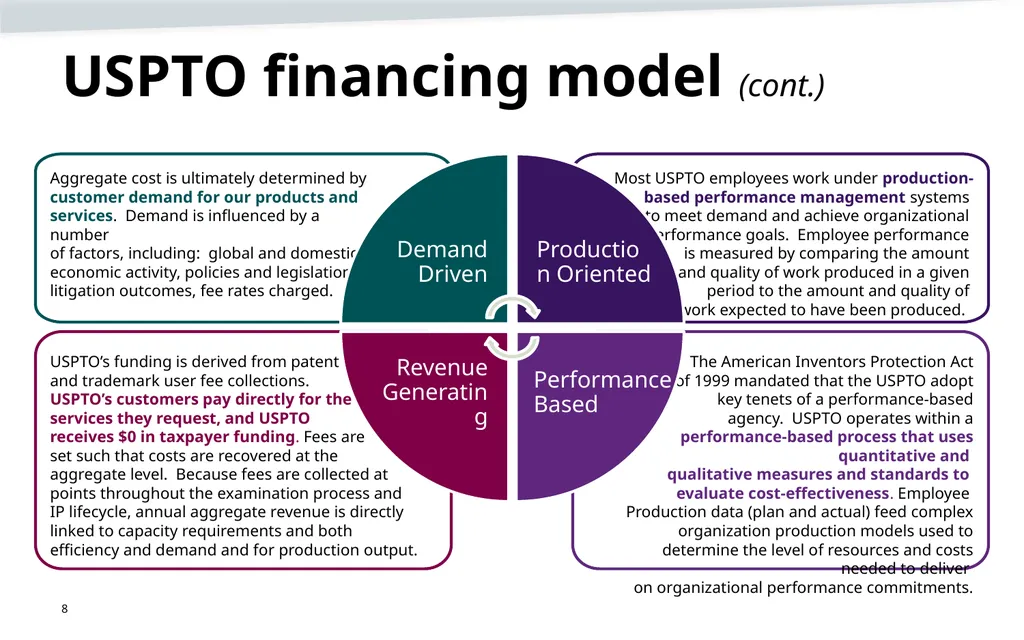
The following charts depict the relationship between incoming applications (demand), workload (production), cost drivers (performance commitments), and aggregate cost and aggregate revenue.<br>
slide8. 8 USPTO financing model (cont.)<br>
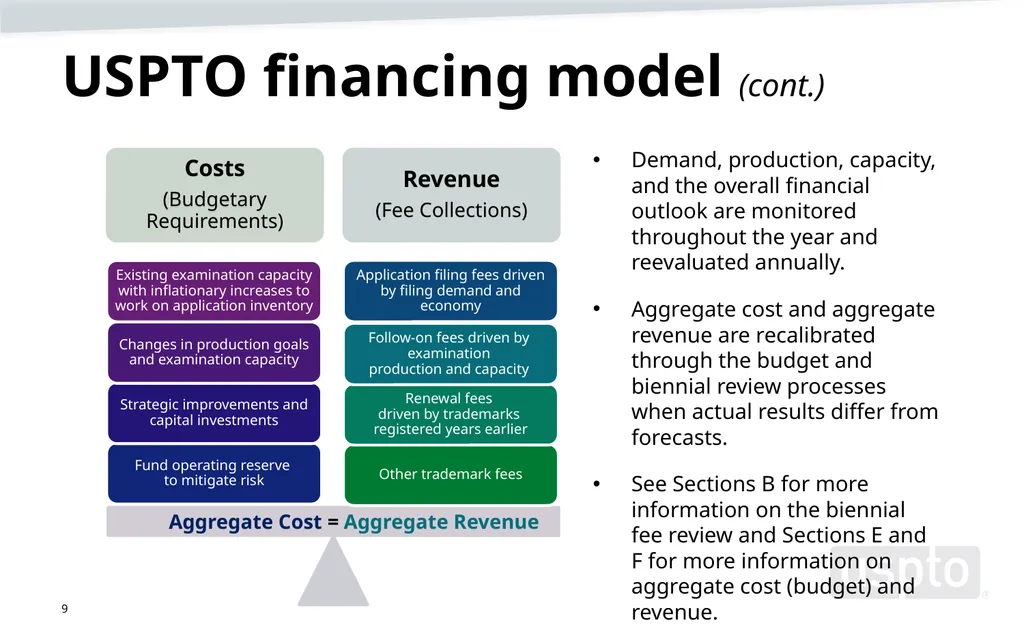
slide9. 9 USPTO financing model (cont.) Demand, production, capacity, and the overall financial outlook are monitored throughout the year and reevaluated annually.
Aggregate cost and aggregate revenue are recalibrated through the budget and biennial review processes when actual results differ from forecasts.
See Sections B for more information on the biennial fee review and Sections E and F for more information on aggregate cost (budget) and revenue. Aggregate Cost = Aggregate Revenue<br>
slide10. Section B – fee setting methodology and analysis The information included in this section describes the framework and philosophy of USPTO fee setting, the biennial fee review process, the methodology used to recalibrate the fee structure, and an overview of the various analyses completed to arrive at the proposed fee structure.<br>
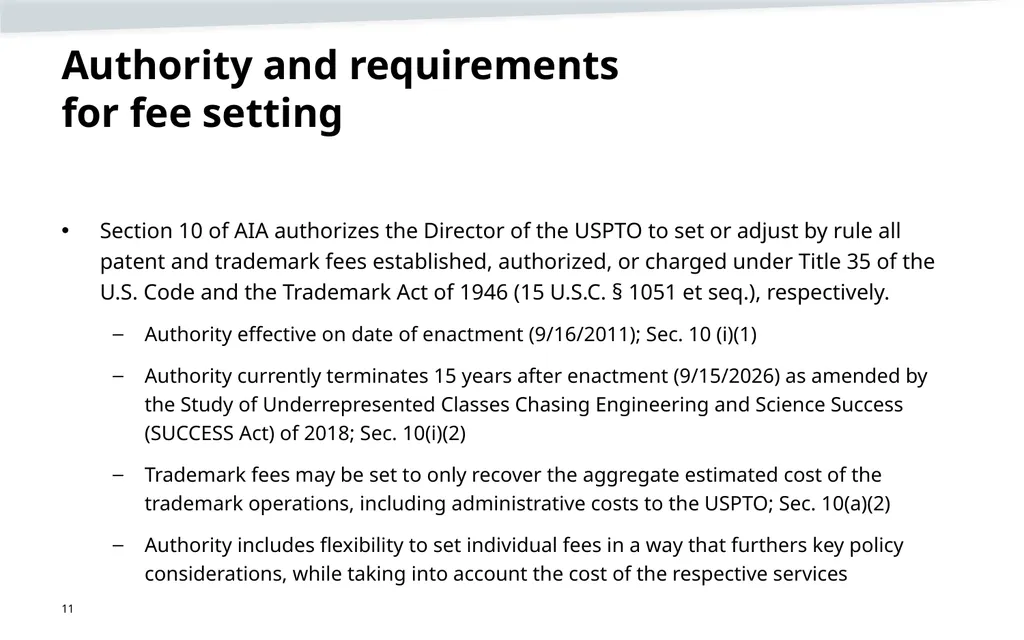
slide11. 11 Authority and requirements for fee setting Section 10 of AIA authorizes the Director of the USPTO to set or adjust by rule all patent and trademark fees established, authorized, or charged under Title 35 of the U.S. Code and the Trademark Act of 1946 (15 U.S.C. § 1051 et seq.), respectively.
Authority effective on date of enactment (9/16/2011); Sec. 10 (i)(1)
Authority currently terminates 15 years after enactment (9/15/2026) as amended by the Study of Underrepresented Classes Chasing Engineering and Science Success (SUCCESS Act) of 2018; Sec. 10(i)(2)
Trademark fees may be set to only recover the aggregate estimated cost of the trademark operations, including administrative costs to the USPTO; Sec. 10(a)(2)
Authority includes flexibility to set individual fees in a way that furthers key policy considerations, while taking into account the cost of the respective services<br>
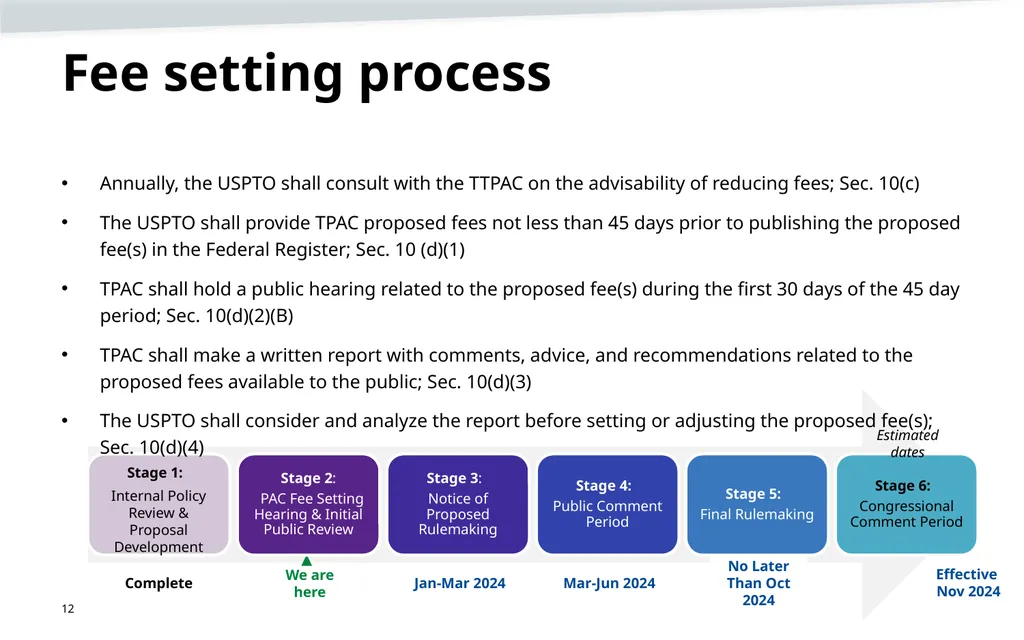
slide12. 12 Fee setting process Annually, the USPTO shall consult with the TTPAC on the advisability of reducing fees; Sec. 10(c)
The USPTO shall provide TPAC proposed fees not less than 45 days prior to publishing the proposed fee(s) in the Federal Register; Sec. 10 (d)(1)
TPAC shall hold a public hearing related to the proposed fee(s) during the first 30 days of the 45 day period; Sec. 10(d)(2)(B)
TPAC shall make a written report with comments, advice, and recommendations related to the proposed fees available to the public; Sec. 10(d)(3)
The USPTO shall consider and analyze the report before setting or adjusting the proposed fee(s); Sec. 10(d)(4)<br>
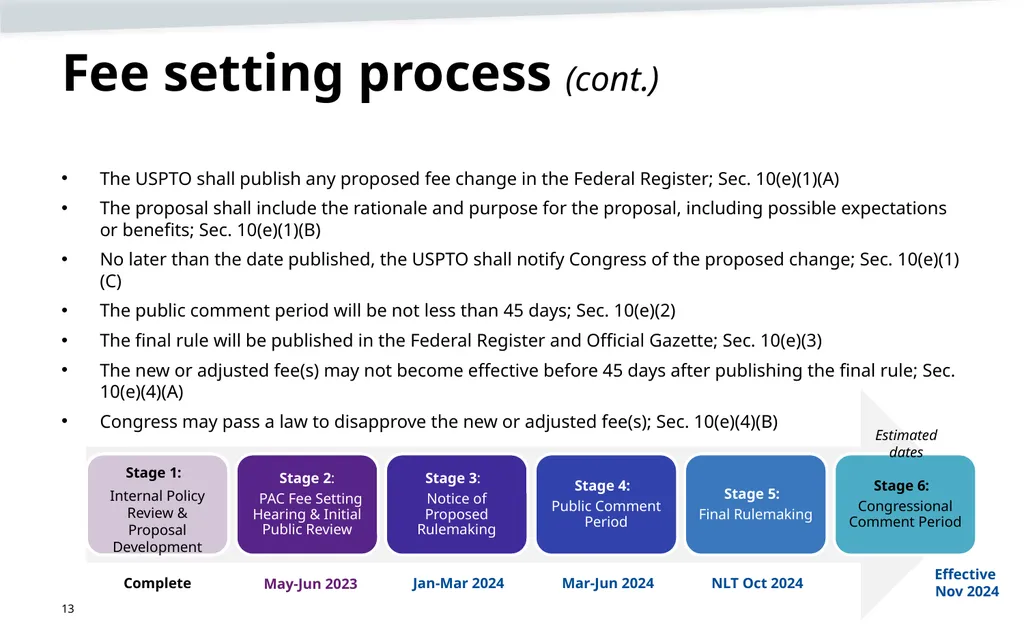
slide13. 13 Fee setting process (cont.) The USPTO shall publish any proposed fee change in the Federal Register; Sec. 10(e)(1)(A)
The proposal shall include the rationale and purpose for the proposal, including possible expectations or benefits; Sec. 10(e)(1)(B)
No later than the date published, the USPTO shall notify Congress of the proposed change; Sec. 10(e)(1)(C)
The public comment period will be not less than 45 days; Sec. 10(e)(2)
The final rule will be published in the Federal Register and Official Gazette; Sec. 10(e)(3)
The new or adjusted fee(s) may not become effective before 45 days after publishing the final rule; Sec. 10(e)(4)(A)
Congress may pass a law to disapprove the new or adjusted fee(s); Sec. 10(e)(4)(B)<br>
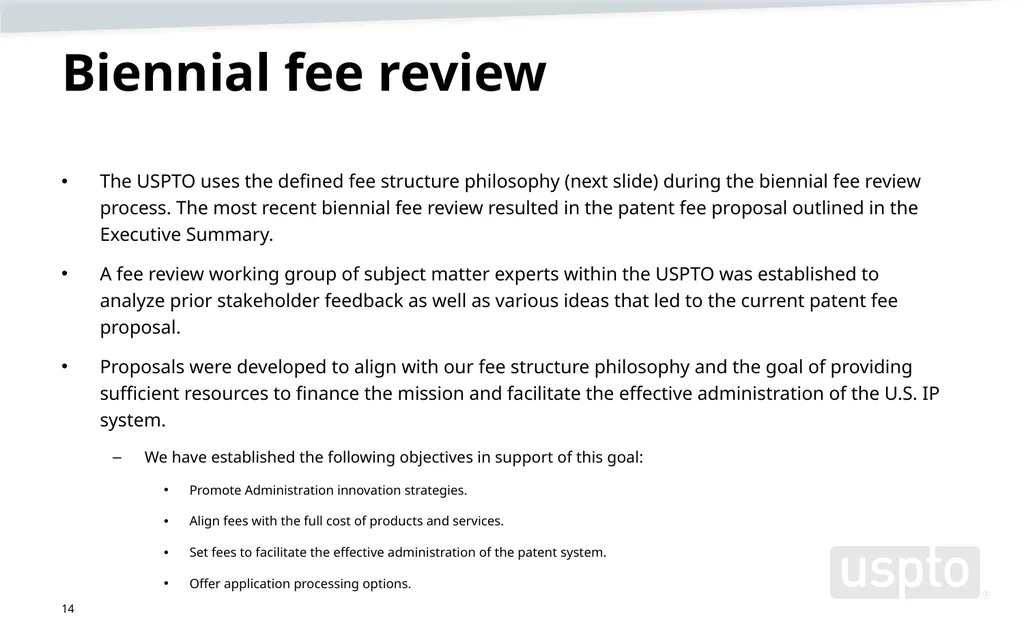
slide14. 14 Biennial fee review The USPTO uses the defined fee structure philosophy (next slide) during the biennial fee review process. The most recent biennial fee review resulted in the patent fee proposal outlined in the Executive Summary.
A fee review working group of subject matter experts within the USPTO was established to analyze prior stakeholder feedback as well as various ideas that led to the current patent fee proposal.
Proposals were developed to align with our fee structure philosophy and the goal of providing sufficient resources to finance the mission and facilitate the effective administration of the U.S. IP system.
We have established the following objectives in support of this goal:
Promote Administration innovation strategies.
Align fees with the full cost of products and services.
Set fees to facilitate the effective administration of the patent system.
Offer application processing options.<br>
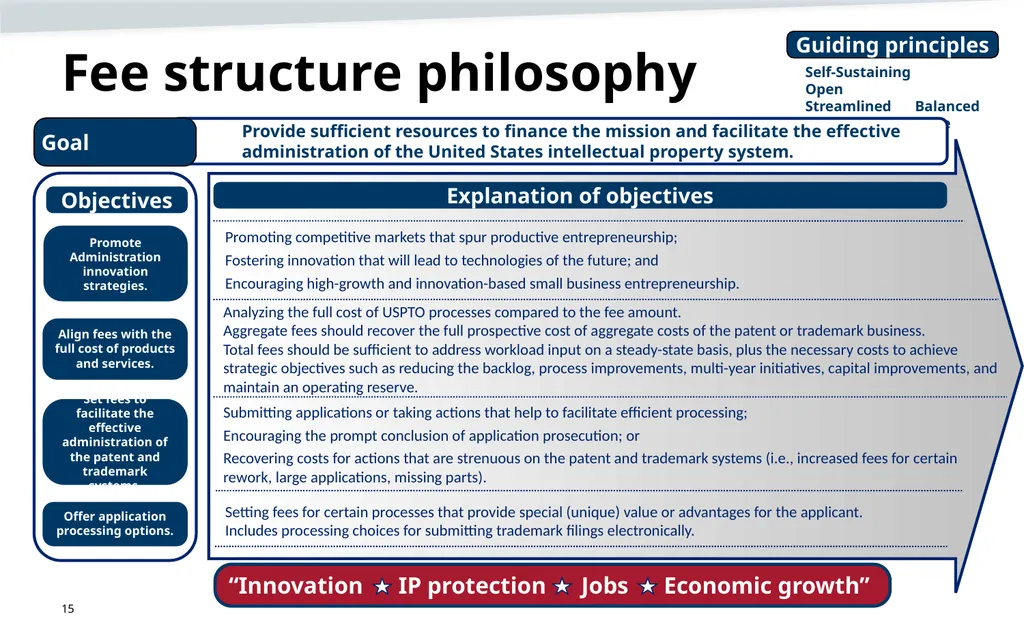
slide15. 15 Fee structure philosophy Guiding principles Self-Sustaining Open
Streamlined Balanced
Dynamic Agile “Innovation IP protection Jobs Economic growth”<br>
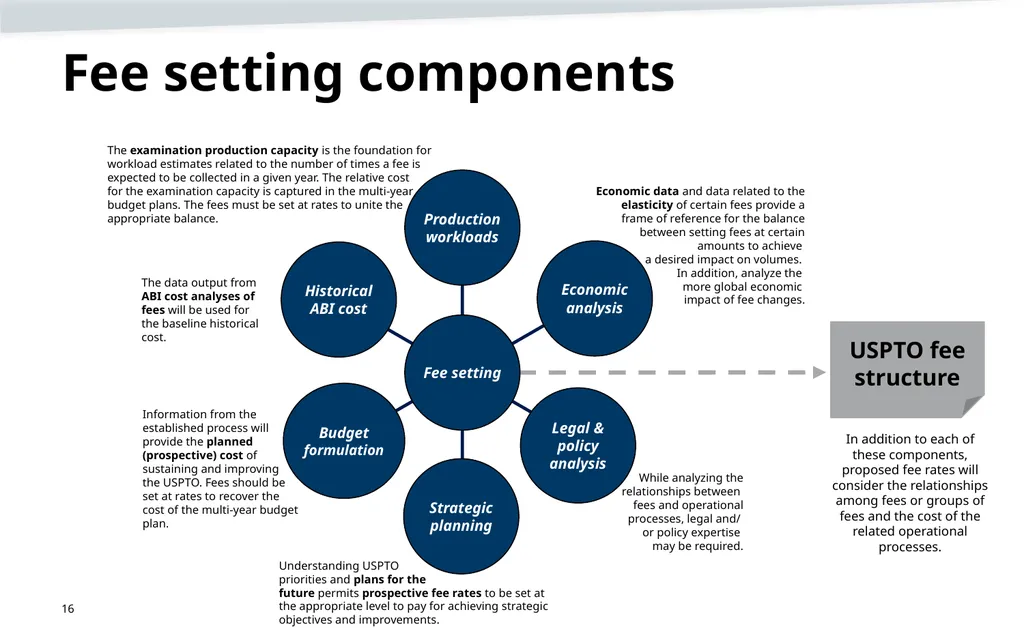
slide16. 16 Fee setting components<br>
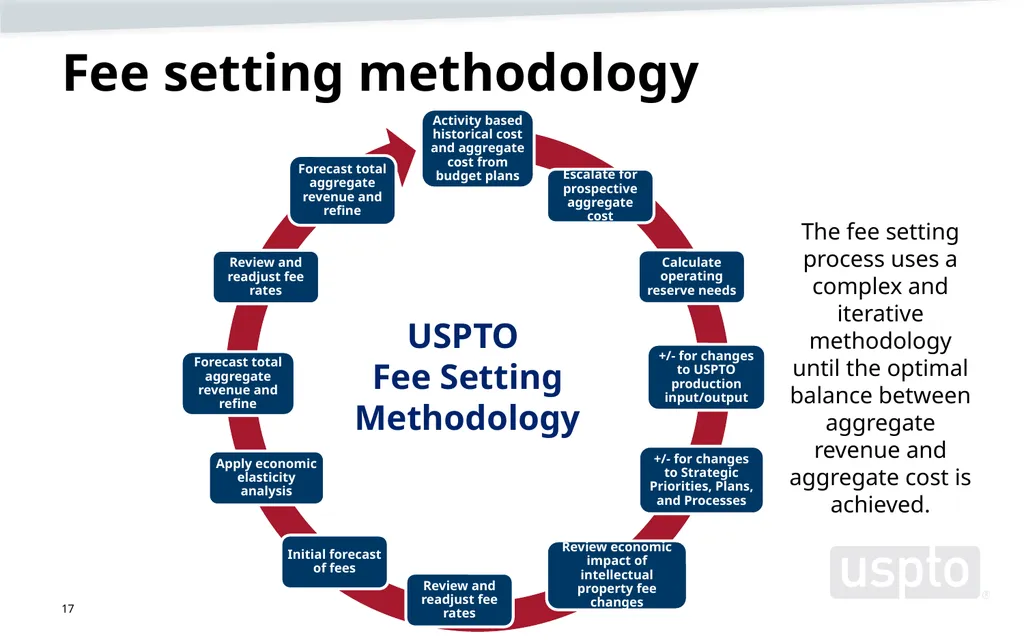
slide17. 17 Fee setting methodology<br>
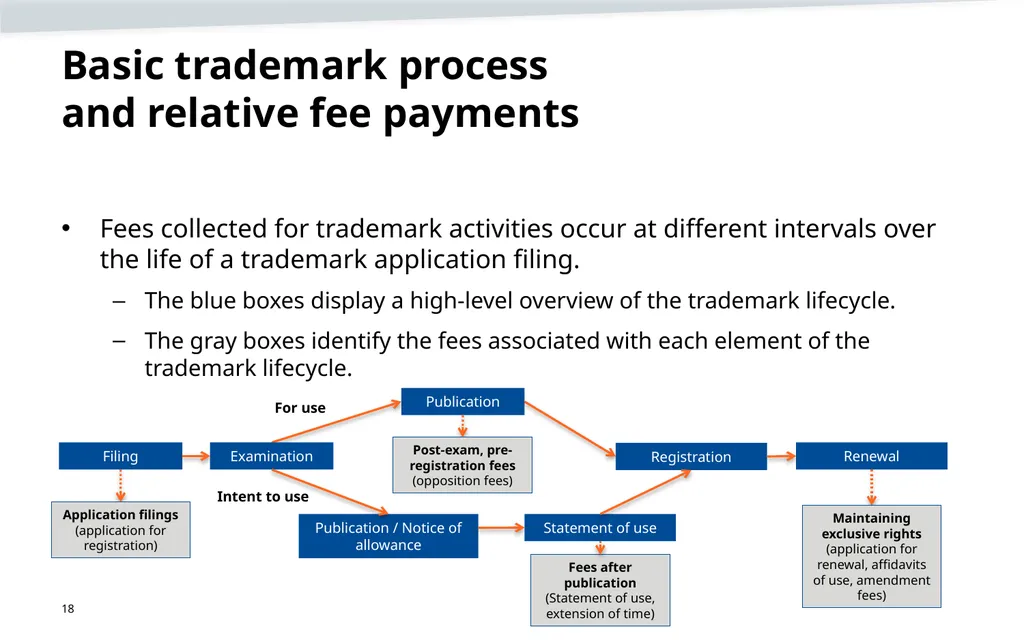
slide18. 18 Basic trademark process and relative fee payments Fees collected for trademark activities occur at different intervals over the life of a trademark application filing.
The blue boxes display a high-level overview of the trademark lifecycle.
The gray boxes identify the fees associated with each element of the trademark lifecycle.<br>
slide19. Section C – Activity-based information (ABI) costing methodology The information included in this section provides an overview of the methodology used to determine the unit cost of the trademark fees at Section G – Rationale for Fee Changes and Table of Trademark Fee Adjustments.<br>
slide20. 20 ABI costing program A major component of analyzing trademark user fees is to identify the full cost of activities associated with the fee rates. This information is used as a reference point when reviewing the alignment of costs (expenses) with collection points in the trademark process.
We use an activity-based managerial costing methodology, which is referred to as activity-based information (ABI) at the USPTO, to determine historical costs for trademark-related activities and outputs (fee services) as well as allocating an appropriate share of administrative costs to determine aggregate cost.
Our ABI program has been in place for over 25 years and is responsible for developing, maintaining and updating cost information for all USPTO organizations. The ABI methodology follows the full cost guidance outlined in federal managerial cost accounting and fee setting standards.
Our ABI program is widely recognized to be one of the best in the federal government and compares well with commercial implementations of ABC. The USPTO ABI program has been the subject of a special Inspector General study, and is examined each year as part of the financial statement audit. There has never been a material weakness in internal controls reported concerning the ABI methodology or data.<br>
slide21. 21 ABI costing program (cont.) To facilitate agency-wide ABI program collaboration, the ABI Steering Committee is the official rulemaking body for all issues related to ABI at the USPTO. This committee is comprised of representatives from all USPTO organizations and all changes to ABI methodology or ABI models are reviewed by the Steering Committee.
ABI uses a two-step methodology to assign costs to its work activities and then to its related outputs.
Expenses (also referred to as costs) capture the spending by an organization, such as salaries and benefits for employees, contractor costs, rent, equipment, etc.
Activities represent the work that people in the organization perform (e.g., examining a trademark application and fee processing).
Outputs are the goods or services that the organization produces through its activities (e.g., registered trademarks).
The cost analysis and all historical expenses referenced in this proposal are based upon FY 2022 data for trademark fees.<br>
slide22. 22 ABI costing program (cont.) The ABI analysis starts with extracting expense information from the USPTO core financial system. This information is “tagged” with identifiers such as the organization that spent the money, the activities performed, and the type of expense (e.g., salaries, benefits, printing, supplies, etc.).
When compiling trademark costs, any spending by, or directly on behalf of, the trademark organization are considered direct expenses such as salaries and contracts. Those expenses occurring outside of the Trademark and TTAB organizations but required for mission specific activities are referred to as allocated direct expenses (e.g., rent, IT specific automation, etc.).
Indirect expenses are those expenses that originate in a support organization, but are allocated to the trademark operation because they indirectly facilitate trademark services or products (e.g. IT help desk support, human resources hiring support, invoice processing, etc.).
Expenses are assigned or allocated to activities based on “drivers” such as timecodes, surveys, workloads, etc.<br>
slide23. 23 ABI costing program (cont.) All allocated costs are aggregated with the direct costs of the activity to capture the “fully burdened” cost for that activity.
The “fully burdened” cost for an activity is then divided by workload measures (number of outputs completed for that particular activity) to arrive at the fully burdened unit cost for that activity.
In some cases, the cost for a particular process is then determined by identifying which activities occur for the process, and how often each activity occurs. This is known as the “frequency factor” and is based on a statistical analysis of a one year set of completed applications.
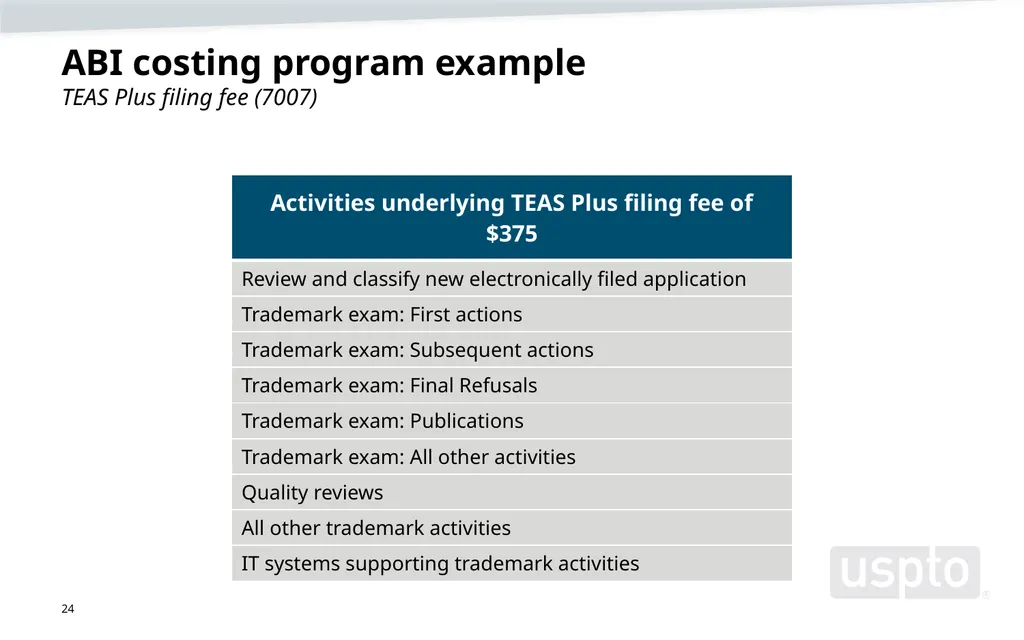
Examples of the unit cost calculations for filing fees can be found on the following page.<br>
slide24. 24 ABI costing program example TEAS Plus filing fee (7007)<br>
slide25. Section D – Background on trademark fees The information included in this section provides an overview of the current trademark fee structure, including historical trends of fees and fee collections.<br>
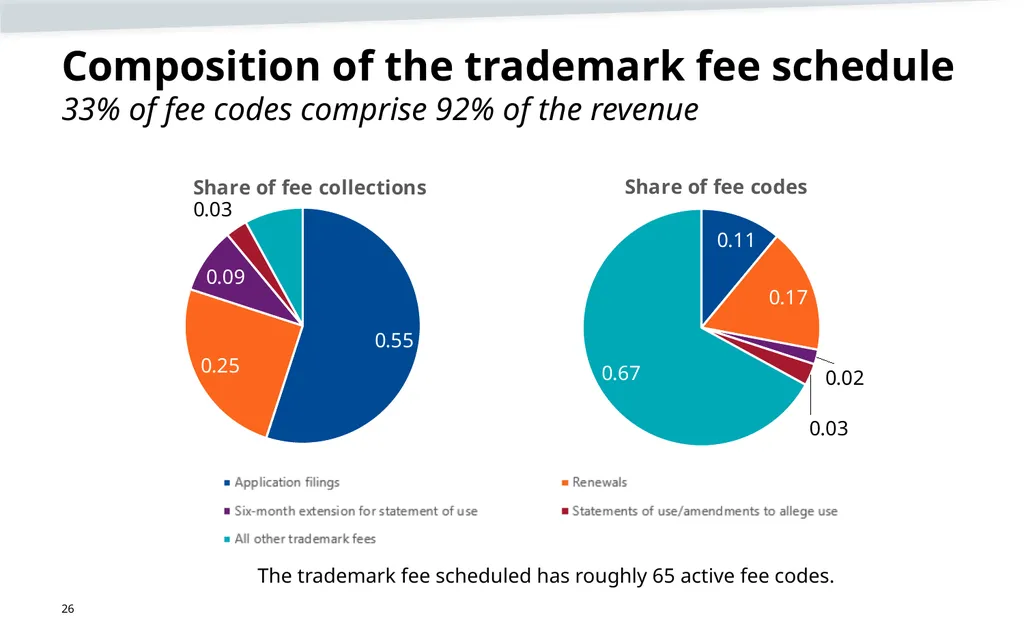
slide26. 26 Composition of the trademark fee schedule 33% of fee codes comprise 92% of the revenue The trademark fee scheduled has roughly 65 active fee codes.<br>
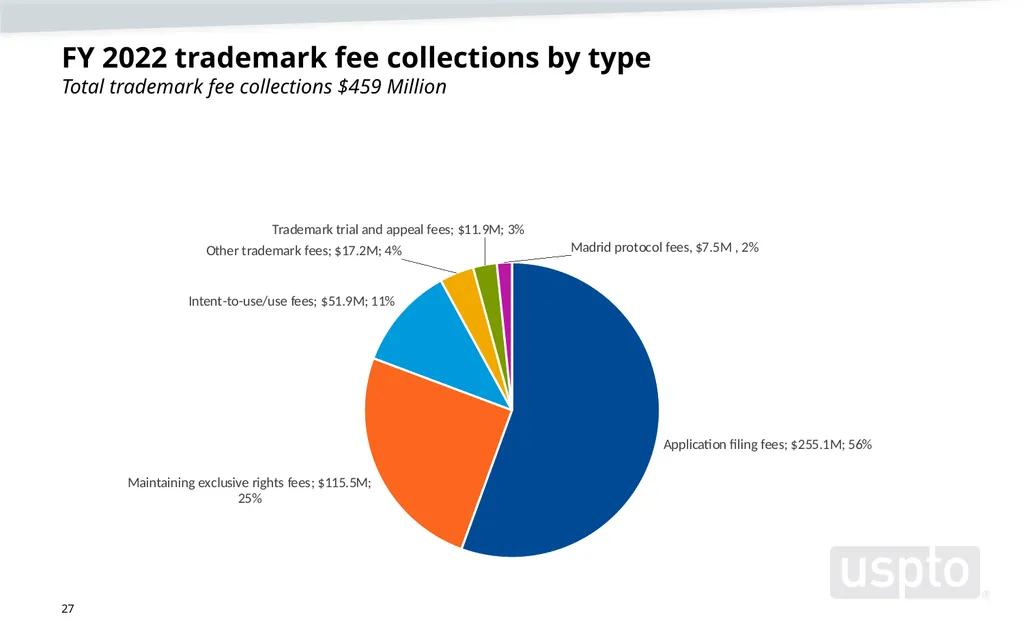
slide27. 27 FY 2022 trademark fee collections by type Total trademark fee collections $459 Million<br>
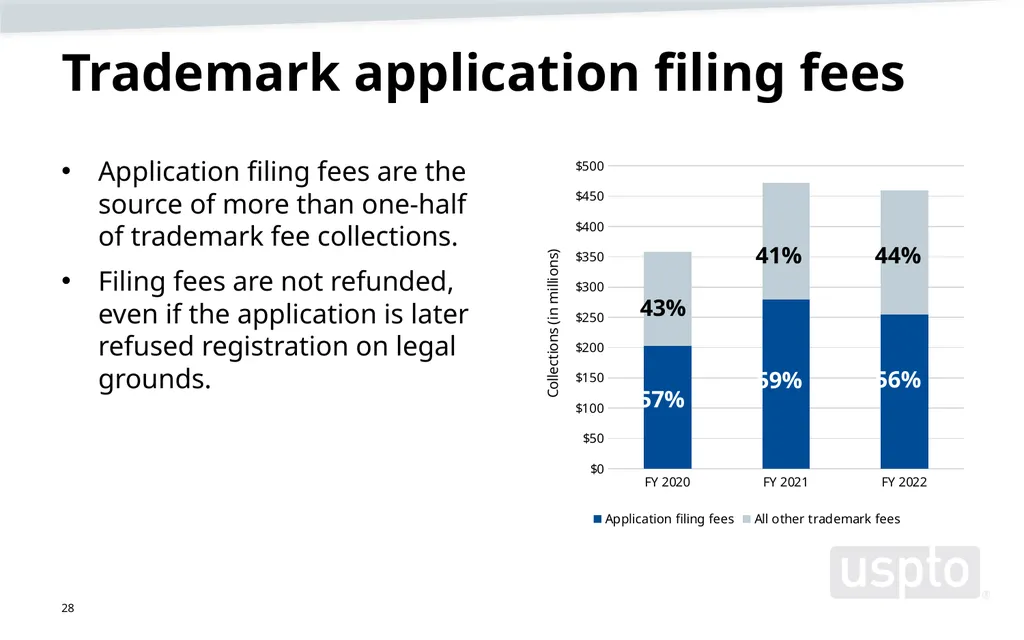
slide28. 28 Trademark application filing fees Application filing fees are the source of more than one-half of trademark fee collections.
Filing fees are not refunded, even if the application is later refused registration on legal grounds. 41% 44% 56%<br>
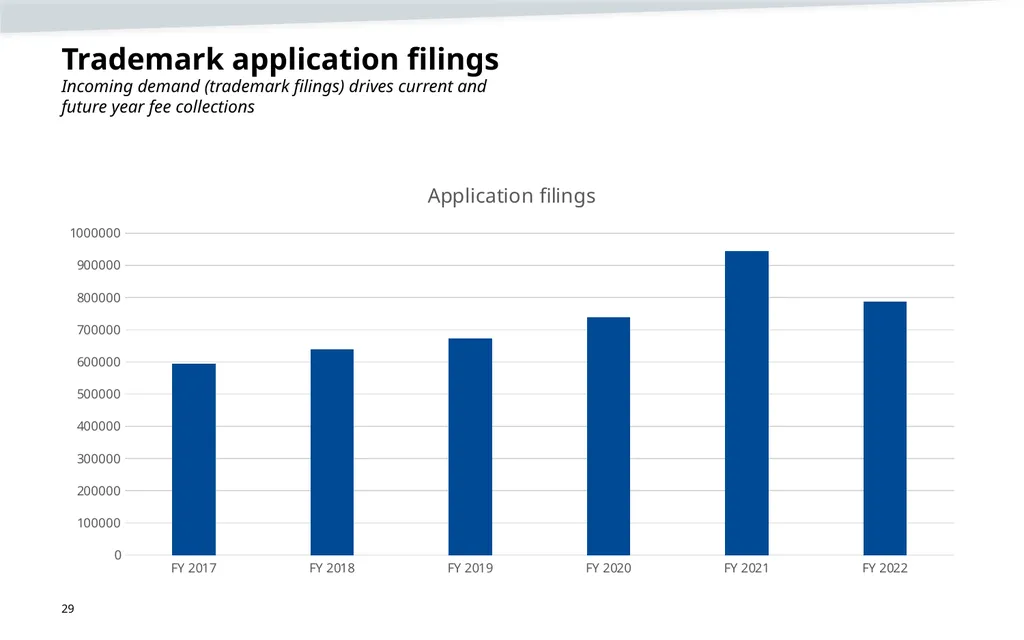
slide29. 29 Trademark application filings Incoming demand (trademark filings) drives current and future year fee collections<br>
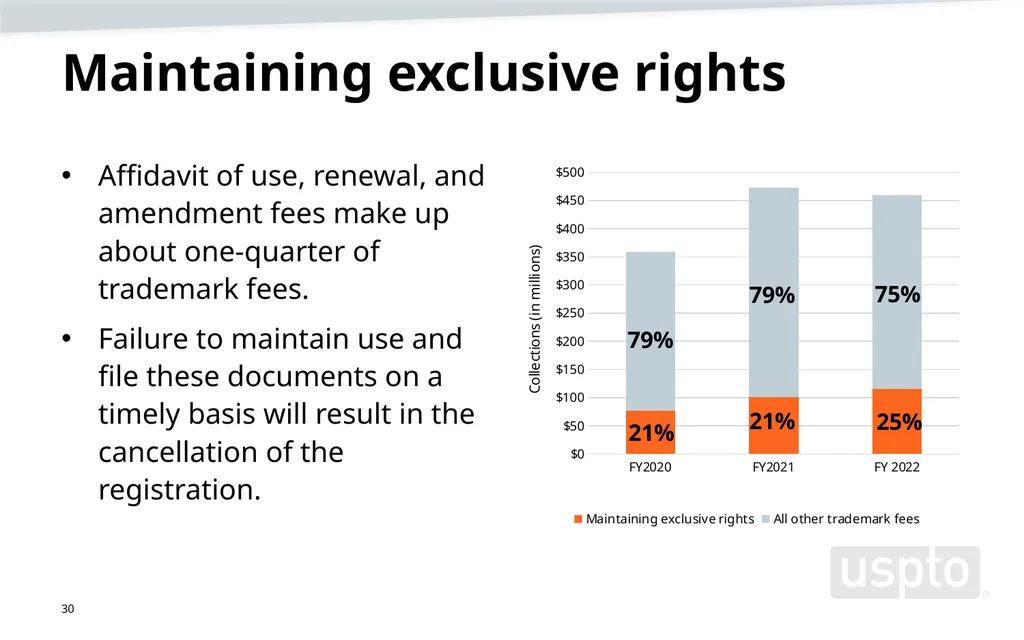
slide30. 30 Maintaining exclusive rights Affidavit of use, renewal, and amendment fees make up about one-quarter of trademark fees.
Failure to maintain use and file these documents on a timely basis will result in the cancellation of the registration.<br>
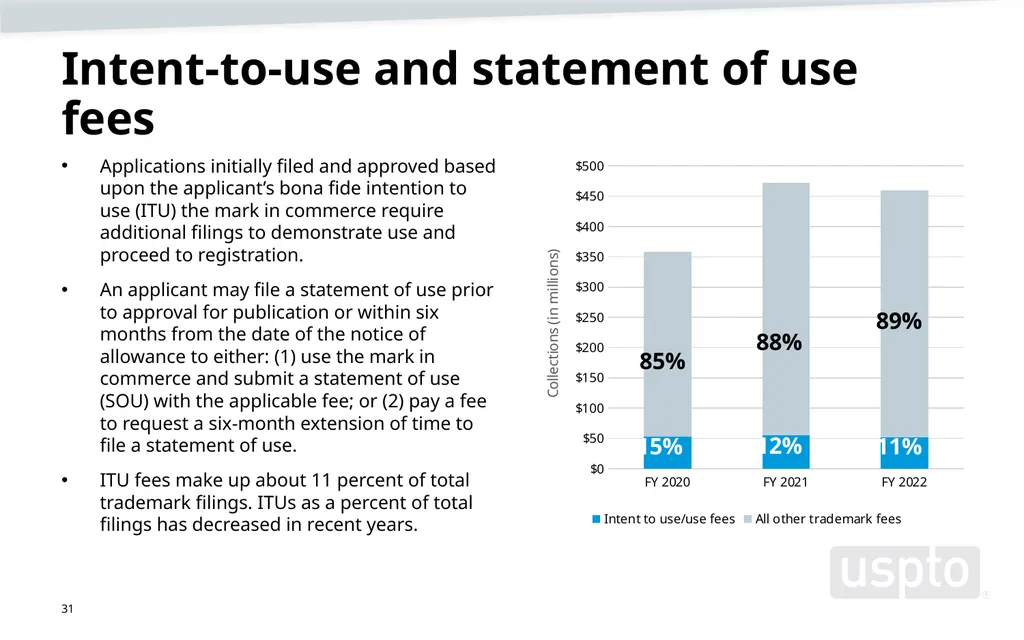
slide31. 31 Intent-to-use and statement of use fees Applications initially filed and approved based upon the applicant’s bona fide intention to use (ITU) the mark in commerce require additional filings to demonstrate use and proceed to registration.
An applicant may file a statement of use prior to approval for publication or within six months from the date of the notice of allowance to either: (1) use the mark in commerce and submit a statement of use (SOU) with the applicable fee; or (2) pay a fee to request a six-month extension of time to file a statement of use.
ITU fees make up about 11 percent of total trademark filings. ITUs as a percent of total filings has decreased in recent years.<br>
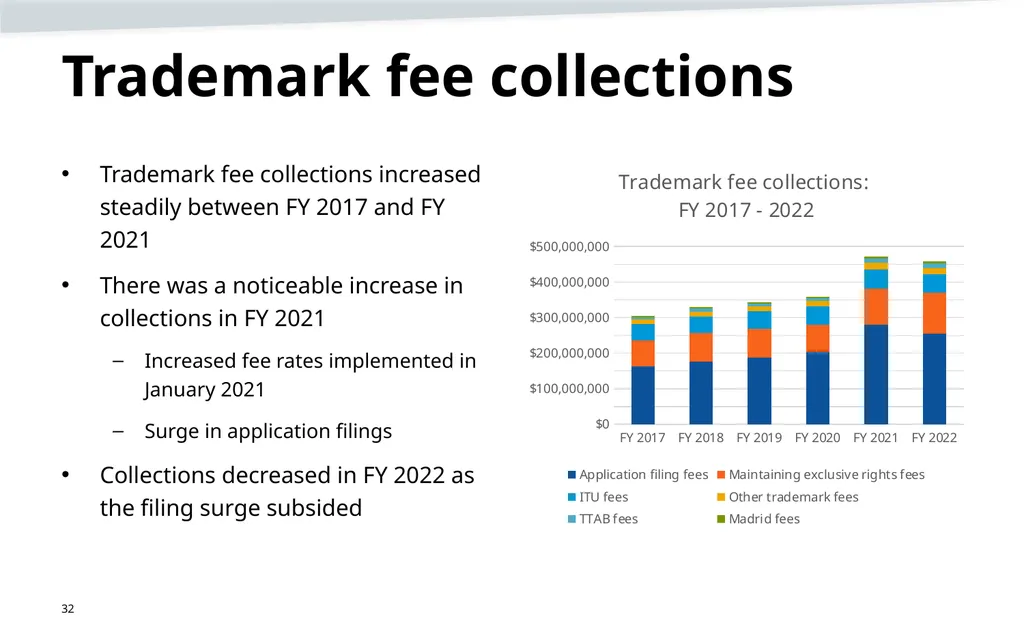
slide32. 32 Trademark fee collections Trademark fee collections increased steadily between FY 2017 and FY 2021
There was a noticeable increase in collections in FY 2021
Increased fee rates implemented in January 2021
Surge in application filings
Collections decreased in FY 2022 as the filing surge subsided<br>
slide33. Section E – Aggregate cost information The information included in this section provides details related to the prospective aggregate cost that will be funded by the aggregate revenue derived from the proposed fee structure.
This section also outlines the assumptions for trademark filing, workload, production, and performance, which provide the underlying foundation for calculating aggregate cost.<br>
slide34. 34 Aggregate cost calculation methodology The Strategic Plan is the foundation for defining priorities and activities upon which we calculate our aggregate costs to support the goals and objectives of a multi-year budget plan.
When calculating aggregate costs, we review our key strategic initiatives, goals, and performance targets to ensure they continue to be aligned with annual plans—reassessments are conducted, as necessary.
The calculations supporting the most significant trademark operating cost—trademark examining activities—begin with analyzing and forecasting the estimated application filings (demand) coming into the USPTO and the necessary examination capacity, with the associated production and workload statistics. These statistics are monetized by estimating the salaries and benefits that will be required for the personnel carrying out the examination activities, other non-salary and benefits costs, such as supporting contracts.<br>
slide35. 35 Aggregate cost calculation methodology (cont.) Aside from analyzing the examination capacity, this same process is repeated for each of the activities supporting the trademark operation (e.g., post registration, IT resources, and operational support).
These estimated prospective costs, including deposits into the operating reserve [see Section H for details], are summarized to obtain the total aggregate prospective cost for the trademark operation and submitted as part the President’s Budget each fiscal year.
This process takes several months to complete. Requests and suggestions for increases and decreases to specific activities, or new initiatives, are reviewed and approved at the executive level.
We continuously review our activities to identify opportunities for cost savings and/or activities that can be redirected to higher priority items.
The table on the following page outlines the cost environment of the USPTO. A majority of our spending is on items for which the USPTO has limited discretion in choosing to pay for, such as trademark examination, maintaining and operating supporting IT systems, rent, and utilities.<br>
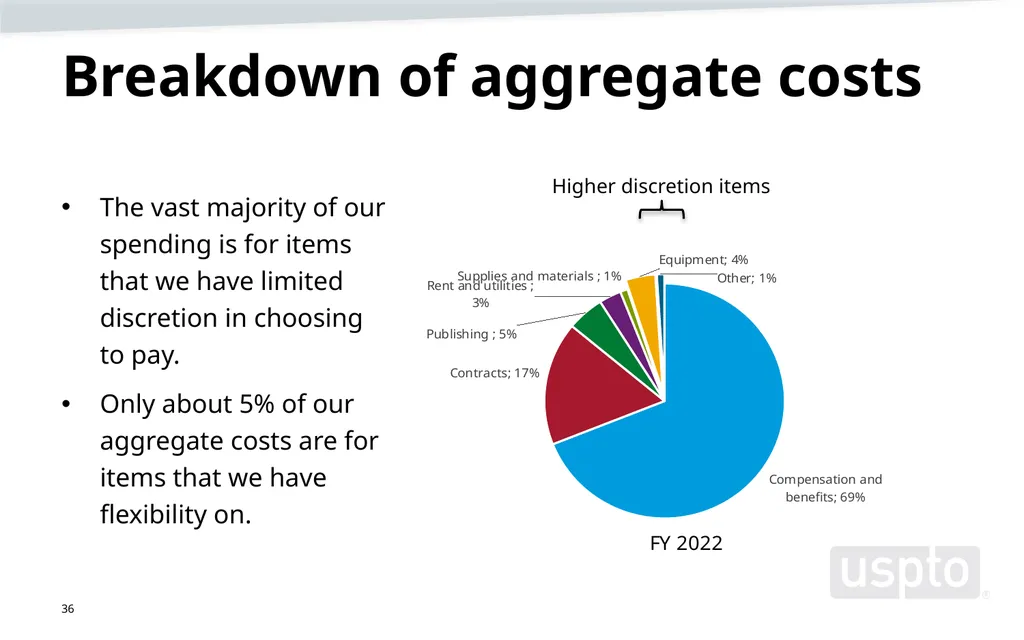
slide36. 36 Breakdown of aggregate costs The vast majority of our spending is for items that we have limited discretion in choosing to pay.
Only about 5% of our aggregate costs are for items that we have flexibility on. Higher discretion items<br>
slide37. Section F – Aggregate revenue information The information included in this section provides an overview of the methodology used to forecast aggregate revenue.<br>
slide38. 38 Fee collections forecasting components We consider many factors when forecasting fees to calculate aggregate revenue, such as:
The global and national economic outlook, by analyzing forecasts of Gross Domestic Product (GDP), research and development (R&D), consumer price index (CPI), and venture capital investments as indicators of future applicant demand.
The future of the IP environment, by examining legislative, regulatory and judicial actions or changes, and procedural or process improvements that may affect demand for IP rights. This includes strategic initiatives, management of resources, and fee rate adjustments.
The USPTO’s historical experience by analyzing events and trends to help predict future demand for IP and applicant behavior.
Stakeholder input.<br>
slide39. 39 Arriving at fee collection projections We use information compiled from reviewing the factors defined on the previous slide, coupled with internal data to:
Estimate application filing and major trademark process workloads;
Apply the historical trends (relationships among workloads and demand for products and services) to future events, when applicable;
Incorporate timing of fee payments and the applicant behavior associated with anticipated fee rate or legislative, regulatory, or procedural adjustments;
Estimate a specific workload or forecasting assumption for each fee code; and
Multiply the forecasting assumption by the fee rate to calculate the estimated aggregate revenue for each particular fee.
Each of the aggregate revenues for the individual fees are summed to calculate the total aggregate revenue.<br>
slide40. 40 Proposed fee structure changes The following page summarizes the composition of the projected aggregate trademark revenue as it transitions from the current fee structure to the proposed fee structure.
The page presents the percentage of fee collections (revenue) in each of the major trademark fee categories for:
FY 2022 (actual data),
FY 2023 and FY2024 (projected before the fee proposals go into effect), and
FY 2025 (projected after the fee proposals go into effect).<br>
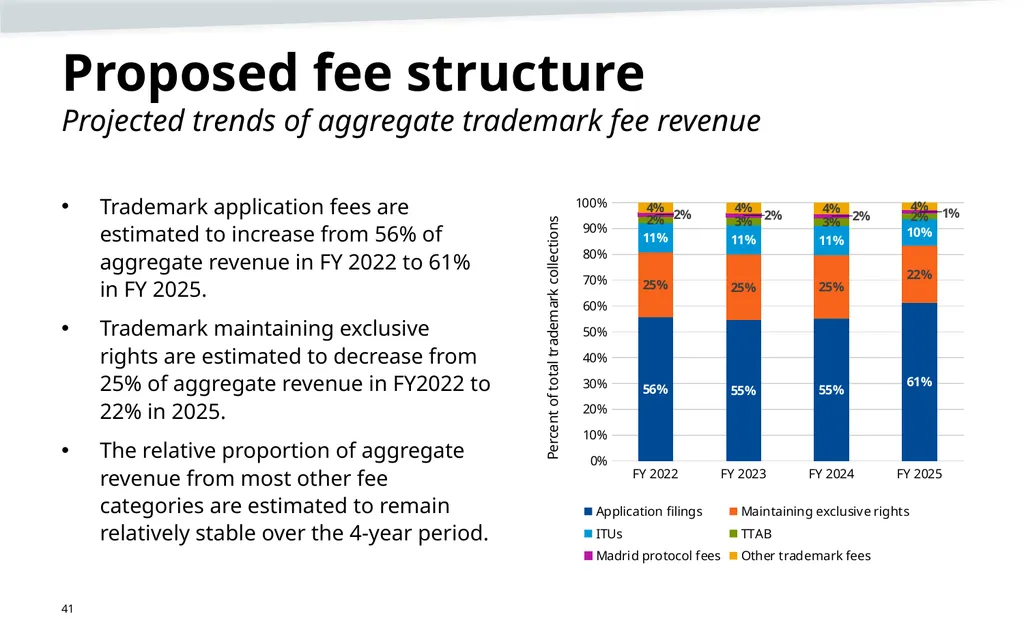
slide41. 41 Proposed fee structure Projected trends of aggregate trademark fee revenue Trademark application fees are estimated to increase from 56% of aggregate revenue in FY 2022 to 61% in FY 2025.
Trademark maintaining exclusive rights are estimated to decrease from 25% of aggregate revenue in FY2022 to 22% in 2025.
The relative proportion of aggregate revenue from most other fee categories are estimated to remain relatively stable over the 4-year period.<br>
slide42. Section G – Rationale for fee changes The information included in this Section outlines the rationale for the trademark fee change.<br>
slide43. 43 Rationale for fee changes Fee changes are required for two reasons:
Recalibrate aggregate revenue to finance forecasted aggregate cost necessary to deliver on the commitments contained in our upcoming 2022–2026 Strategic Plan outlined on the following pages, and
Refine targeted fees and fee categories to maintain efficient operations.
The financial outlook projects that aggregate costs will exceed aggregate revenue beginning in fiscal year 2023.
Trademark demand and applicant filing behaviors have changed.
Trademark demand surged without a commensurate surge in maintenance and intent-to-use filings and then softened relative to prior forecasts.
Behavioral filing patterns are generating imbalances in the fee structure.
The broader economy has experienced higher-than-expected inflation and, in turn, increased aggregate costs relative to baseline estimates.
The rationale for the proposed changes to targeted fees is outlined in the Letter from the Director to the TPAC and in the Executive Summary accompanying the proposal.<br>
slide44. 44 Upcoming 2022-2026 Strategic Plan We expect to publish our 2022-2026 Strategic Plan in Spring 2023, following a period of public review and comment. The plan implements our vision for Unleashing America’s Potential and:
Outlines our mission to drive U.S. innovation, inclusive capitalism, and global competitiveness for the benefit of all Americans.
Identifies five new strategic goals (shown on the next two slides) that will guide all of our actions over the next few years, including this fee setting.
The FY 2024 President’s budget reflects the initial aggregate cost to efficiently implement the strategic plan.
Adjusting the patent fee schedule increases aggregate revenue and enables us to continue serving our IP stakeholder community through implementing the Strategic Plan goals outlined on the following pages.<br>
slide45. 45 2022-2026 Strategic Plan goals Drive inclusive U.S. innovation and global competitiveness. The IP system must drive access and support for innovators, creators, entrepreneurs, and brand owners across the United States. Increased participation by all Americans in the innovation and entrepreneurial ecosystems will drive economic growth increasing U.S. global competitiveness.
Promote the efficient delivery of reliable IP rights. Clear, enforceable IP rights are essential to economic growth, global competitiveness, and promoting innovation. It is important to deliver timely and efficient services that help innovators, creators, entrepreneurs, and brand owners bring their ideas to impact more quickly and efficiently. Robust and reliable patents and trademarks offer meaningful, enforceable IP protection for those who hold them and those around them who operate in the same competitive landscape.
Promote the protection of IP against new and persistent threats. Our fundamental purpose is to provide stable, reliable, and predictable IP rights for those who receive a patent or a trademark registration. One of our top priorities is to protect patent and trademark owners from fraud, theft, and abuse. By reinforcing IP protections and deterring fraudulent practices, we will bolster confidence in America’s IP ecosystem.
Bring innovation to positive impact. We are focused on driving innovation for long-term economic growth, supply chain resiliency, prosperity, and national security. To achieve this, we will expand our offerings and partnerships to help those pursuing IP protection identify available public and private funding sources to bring their innovations to impact for the public good.<br>
slide46. 46 2022-2026 Strategic Plan goals (cont.) Generate impactful employee and customer experiences by maximizing agency operations. We provide exceptional service and organizational excellence by improving critical mission-enabling activities such as:
Support our diversely talented through best-in-class training and opportunities to grow as leaders as part of a workforce that values health, wellness, community connections, and innovation.
Invest in learning about and implementing best practices in customer experience (CX); usually an outcome of positive and impactful employee experiences.
Implement a modern IT infrastructure to increase accessibility to and the quality of our patent and trademark services for employees, applicants, and rights holders, among other stakeholder groups and maturing data analytics capabilities
Optimize financial management practices and align resources with strategic goals such as through implementing this fee proposal to provide the USPTO with sufficient aggregate revenue to recover the aggregate cost of patent operations in future years.<br>
slide47. Section H – Operating reserve The information included in this Section provides details on rationale, purpose, and size determination of our operating reserve used to carry over unspent fees into future years.<br>
slide48. 48 Operating reserve Definition and purpose The trademark operating reserve is funded from trademark fee collections that have been appropriated but unobligated and carried over from prior years.
Overall, the operating reserve is intended to:
Improve long-term financial stability and respond to immediate and temporary changes.
Protect against unexpected increases in requirements or unexpected declines in fee collections.
Mitigate the risk of a cash flow shortage.
Provide a contingency to minimize the impact of normal fluctuations in fee collections.<br>
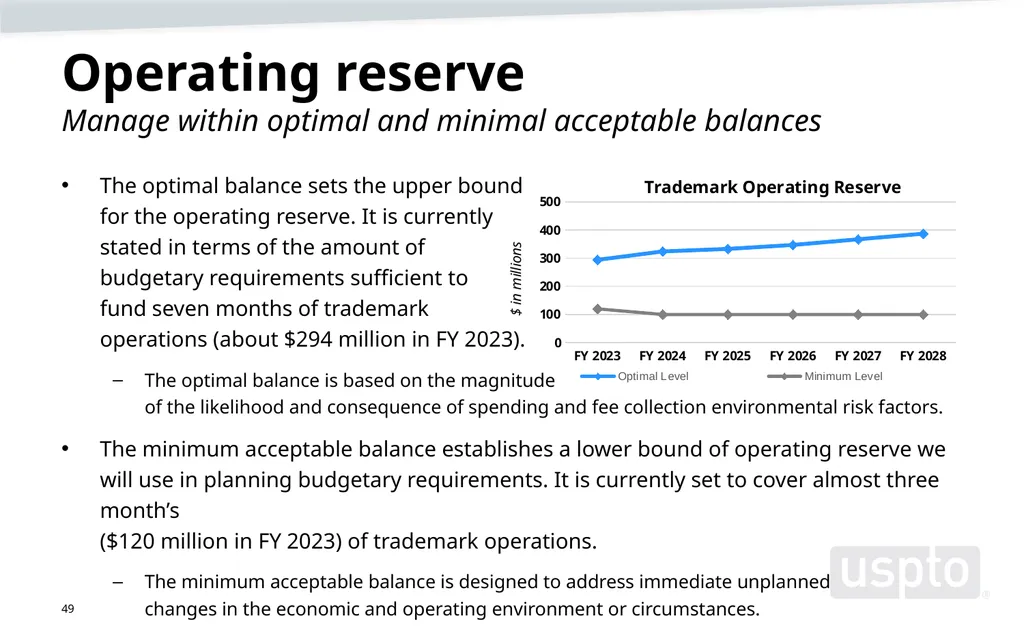
slide49. 49 Operating reserve Manage within optimal and minimal acceptable balances The optimal balance sets the upper bound for the operating reserve. It is currently stated in terms of the amount of budgetary requirements sufficient to fund seven months of trademark operations (about $294 million in FY 2023).
The optimal balance is based on the magnitude of the likelihood and consequence of spending and fee collection environmental risk factors.
The minimum acceptable balance establishes a lower bound of operating reserve we will use in planning budgetary requirements. It is currently set to cover almost three month’s ($120 million in FY 2023) of trademark operations.
The minimum acceptable balance is designed to address immediate unplanned changes in the economic and operating environment or circumstances.<br>
slide50. 50 Operating reserve Assessment We regularly assess risks to determine the appropriate range of balances for the trademark operating reserve.
The routine evaluation is necessary to ensure that our risk appetite is still being accurately represented; a risk or risk score that was appropriate last year may not be appropriate in the future due to changing circumstances.
A higher risk may warrant an increase in the operating reserve balance thresholds to mitigate that risk; conversely, a decrease in risk may warrant a reduction in thresholds when the risk subsides.
A change in circumstance may cause us to reevaluate the optimum operating reserve balance more frequently. The results of the most recent evaluation are used to inform our comprehensive fee review, fee setting, and the requirements-based budget formulation processes.
We recognize that it may take a significant amount of time to achieve the optimal operating reserve balance and, once achieved, a variety of risk factors could cause the balance to fall below the optimal balance.<br>
slide51. 51 Operating reserve Review A comprehensive review of the five-year projected trademark operating reserve balances is completed as a part of the requirements-based budget formulation process.
This is accomplished by estimating trademark fee collections for each of the five years, subtracting the respective trademark budgetary requirements for each of the five years, and accumulating the excess of fees or costs into the beginning operating reserve balance to calculate an estimated ending balance in each of the five years (projected annual operating reserve balance).
The projected annual operating reserve balance is evaluated against the current minimum and optimal operating reserve amounts. Variances between the projected annual operating reserve balances and the minimum acceptable and optimal operating reserve balances are reviewed and assessed.<br>
slide3. 3 Introduction This document provides background information for the proposed trademark fee adjustments.
The following additional documents comprise the fee proposal package delineating changes to the fee schedule:
Letter from the Under Secretary of Commerce for Intellectual Property and Director of the USPTO to Trademark Public Advisory Committee (TPAC)
Trademark fee proposal executive summary
Table of proposed trademark fee adjustments
Table of trademark fees: current, proposed, and unit cost.
Documents are available at the fee setting and adjusting section of the USPTO website.<br>
slide4. 4 Table of contents Sections:
Section A – Background on the USPTO financing model ……………………………….…………..…5
Section B – Background on fee setting methodology and analyses ……………….……....…..10
Section C – Background on activity based information (ABI) costing methodology …...19
Section D – Background on trademark fees ………....…………………………………………..……...….25
Section E – Aggregate cost information …………….………………………………………………...……...33
Section F – Aggregate revenue information ……….……………………………………...…………….….37
Section G – Rationale for fee changes ……………….……………………………………………..….………42
Section H – Operating reserve................................................................................................................47<br>
slide5. Section A – USPTO financing model The information included in this section provides details on the manner in which our fees fund operations and the relationship between fees, costs, application filings, and workload.<br>
slide6. 6 USPTO financing model The USPTO operates like a business in certain respects:
Customers request products and services in exchange for user fees and expect them to be delivered in either the current or future years, in accordance with established performance metrics.
The aggregate cost [see Section E for details] of trademark products and services (budgetary requirements) are financed from the aggregate revenue [see Section F for details] derived from trademark fees and from the operating reserve.
Prospective aggregate cost and revenue are predicated on forecasted demand and workload, as well as relevant indicators of economic and IP activity. These forecasts are inherently uncertain.
Actual demand could be higher or lower than projected and we must work to meet actual demand and established performance metrics regardless of these forecasts.
Trademark fees not used in support of current year operations are maintained as an operating reserve to mitigate the risk of uncertain demand and cash flow variability, and to maintain operations while recalibrating aggregate cost and revenue.<br>
slide7. 7 USPTO financing model (cont.) Every year over 700 thousand trademark applications are filed (demand for services), bringing with them both fees and the associated workload (production requirements) in trademark examination.
Maintaining exclusive rights fees from registered trademarks subsidize the cost of trademark examination. This includes applications that we refuse or the applicant abandons.
This model is beneficial for innovation and the U.S. Intellectual Property (IP) system, yet it adds additional complexities when analyzing, forecasting, and monitoring trademark fee collections in relation to trademark costs.
The Leahy-Smith America Invents Act (AIA), as amended, mandates that trademark fees be set to recover the prospective aggregate cost of trademark operations—leaving a zero net cost to general taxpayers.
The following charts depict the relationship between incoming applications (demand), workload (production), cost drivers (performance commitments), and aggregate cost and aggregate revenue.<br>
slide8. 8 USPTO financing model (cont.)<br>
slide9. 9 USPTO financing model (cont.) Demand, production, capacity, and the overall financial outlook are monitored throughout the year and reevaluated annually.
Aggregate cost and aggregate revenue are recalibrated through the budget and biennial review processes when actual results differ from forecasts.
See Sections B for more information on the biennial fee review and Sections E and F for more information on aggregate cost (budget) and revenue. Aggregate Cost = Aggregate Revenue<br>
slide10. Section B – fee setting methodology and analysis The information included in this section describes the framework and philosophy of USPTO fee setting, the biennial fee review process, the methodology used to recalibrate the fee structure, and an overview of the various analyses completed to arrive at the proposed fee structure.<br>
slide11. 11 Authority and requirements for fee setting Section 10 of AIA authorizes the Director of the USPTO to set or adjust by rule all patent and trademark fees established, authorized, or charged under Title 35 of the U.S. Code and the Trademark Act of 1946 (15 U.S.C. § 1051 et seq.), respectively.
Authority effective on date of enactment (9/16/2011); Sec. 10 (i)(1)
Authority currently terminates 15 years after enactment (9/15/2026) as amended by the Study of Underrepresented Classes Chasing Engineering and Science Success (SUCCESS Act) of 2018; Sec. 10(i)(2)
Trademark fees may be set to only recover the aggregate estimated cost of the trademark operations, including administrative costs to the USPTO; Sec. 10(a)(2)
Authority includes flexibility to set individual fees in a way that furthers key policy considerations, while taking into account the cost of the respective services<br>
slide12. 12 Fee setting process Annually, the USPTO shall consult with the TTPAC on the advisability of reducing fees; Sec. 10(c)
The USPTO shall provide TPAC proposed fees not less than 45 days prior to publishing the proposed fee(s) in the Federal Register; Sec. 10 (d)(1)
TPAC shall hold a public hearing related to the proposed fee(s) during the first 30 days of the 45 day period; Sec. 10(d)(2)(B)
TPAC shall make a written report with comments, advice, and recommendations related to the proposed fees available to the public; Sec. 10(d)(3)
The USPTO shall consider and analyze the report before setting or adjusting the proposed fee(s); Sec. 10(d)(4)<br>
slide13. 13 Fee setting process (cont.) The USPTO shall publish any proposed fee change in the Federal Register; Sec. 10(e)(1)(A)
The proposal shall include the rationale and purpose for the proposal, including possible expectations or benefits; Sec. 10(e)(1)(B)
No later than the date published, the USPTO shall notify Congress of the proposed change; Sec. 10(e)(1)(C)
The public comment period will be not less than 45 days; Sec. 10(e)(2)
The final rule will be published in the Federal Register and Official Gazette; Sec. 10(e)(3)
The new or adjusted fee(s) may not become effective before 45 days after publishing the final rule; Sec. 10(e)(4)(A)
Congress may pass a law to disapprove the new or adjusted fee(s); Sec. 10(e)(4)(B)<br>
slide14. 14 Biennial fee review The USPTO uses the defined fee structure philosophy (next slide) during the biennial fee review process. The most recent biennial fee review resulted in the patent fee proposal outlined in the Executive Summary.
A fee review working group of subject matter experts within the USPTO was established to analyze prior stakeholder feedback as well as various ideas that led to the current patent fee proposal.
Proposals were developed to align with our fee structure philosophy and the goal of providing sufficient resources to finance the mission and facilitate the effective administration of the U.S. IP system.
We have established the following objectives in support of this goal:
Promote Administration innovation strategies.
Align fees with the full cost of products and services.
Set fees to facilitate the effective administration of the patent system.
Offer application processing options.<br>
slide15. 15 Fee structure philosophy Guiding principles Self-Sustaining Open
Streamlined Balanced
Dynamic Agile “Innovation IP protection Jobs Economic growth”<br>
slide16. 16 Fee setting components<br>
slide17. 17 Fee setting methodology<br>
slide18. 18 Basic trademark process and relative fee payments Fees collected for trademark activities occur at different intervals over the life of a trademark application filing.
The blue boxes display a high-level overview of the trademark lifecycle.
The gray boxes identify the fees associated with each element of the trademark lifecycle.<br>
slide19. Section C – Activity-based information (ABI) costing methodology The information included in this section provides an overview of the methodology used to determine the unit cost of the trademark fees at Section G – Rationale for Fee Changes and Table of Trademark Fee Adjustments.<br>
slide20. 20 ABI costing program A major component of analyzing trademark user fees is to identify the full cost of activities associated with the fee rates. This information is used as a reference point when reviewing the alignment of costs (expenses) with collection points in the trademark process.
We use an activity-based managerial costing methodology, which is referred to as activity-based information (ABI) at the USPTO, to determine historical costs for trademark-related activities and outputs (fee services) as well as allocating an appropriate share of administrative costs to determine aggregate cost.
Our ABI program has been in place for over 25 years and is responsible for developing, maintaining and updating cost information for all USPTO organizations. The ABI methodology follows the full cost guidance outlined in federal managerial cost accounting and fee setting standards.
Our ABI program is widely recognized to be one of the best in the federal government and compares well with commercial implementations of ABC. The USPTO ABI program has been the subject of a special Inspector General study, and is examined each year as part of the financial statement audit. There has never been a material weakness in internal controls reported concerning the ABI methodology or data.<br>
slide21. 21 ABI costing program (cont.) To facilitate agency-wide ABI program collaboration, the ABI Steering Committee is the official rulemaking body for all issues related to ABI at the USPTO. This committee is comprised of representatives from all USPTO organizations and all changes to ABI methodology or ABI models are reviewed by the Steering Committee.
ABI uses a two-step methodology to assign costs to its work activities and then to its related outputs.
Expenses (also referred to as costs) capture the spending by an organization, such as salaries and benefits for employees, contractor costs, rent, equipment, etc.
Activities represent the work that people in the organization perform (e.g., examining a trademark application and fee processing).
Outputs are the goods or services that the organization produces through its activities (e.g., registered trademarks).
The cost analysis and all historical expenses referenced in this proposal are based upon FY 2022 data for trademark fees.<br>
slide22. 22 ABI costing program (cont.) The ABI analysis starts with extracting expense information from the USPTO core financial system. This information is “tagged” with identifiers such as the organization that spent the money, the activities performed, and the type of expense (e.g., salaries, benefits, printing, supplies, etc.).
When compiling trademark costs, any spending by, or directly on behalf of, the trademark organization are considered direct expenses such as salaries and contracts. Those expenses occurring outside of the Trademark and TTAB organizations but required for mission specific activities are referred to as allocated direct expenses (e.g., rent, IT specific automation, etc.).
Indirect expenses are those expenses that originate in a support organization, but are allocated to the trademark operation because they indirectly facilitate trademark services or products (e.g. IT help desk support, human resources hiring support, invoice processing, etc.).
Expenses are assigned or allocated to activities based on “drivers” such as timecodes, surveys, workloads, etc.<br>
slide23. 23 ABI costing program (cont.) All allocated costs are aggregated with the direct costs of the activity to capture the “fully burdened” cost for that activity.
The “fully burdened” cost for an activity is then divided by workload measures (number of outputs completed for that particular activity) to arrive at the fully burdened unit cost for that activity.
In some cases, the cost for a particular process is then determined by identifying which activities occur for the process, and how often each activity occurs. This is known as the “frequency factor” and is based on a statistical analysis of a one year set of completed applications.
Examples of the unit cost calculations for filing fees can be found on the following page.<br>
slide24. 24 ABI costing program example TEAS Plus filing fee (7007)<br>
slide25. Section D – Background on trademark fees The information included in this section provides an overview of the current trademark fee structure, including historical trends of fees and fee collections.<br>
slide26. 26 Composition of the trademark fee schedule 33% of fee codes comprise 92% of the revenue The trademark fee scheduled has roughly 65 active fee codes.<br>
slide27. 27 FY 2022 trademark fee collections by type Total trademark fee collections $459 Million<br>
slide28. 28 Trademark application filing fees Application filing fees are the source of more than one-half of trademark fee collections.
Filing fees are not refunded, even if the application is later refused registration on legal grounds. 41% 44% 56%<br>
slide29. 29 Trademark application filings Incoming demand (trademark filings) drives current and future year fee collections<br>
slide30. 30 Maintaining exclusive rights Affidavit of use, renewal, and amendment fees make up about one-quarter of trademark fees.
Failure to maintain use and file these documents on a timely basis will result in the cancellation of the registration.<br>
slide31. 31 Intent-to-use and statement of use fees Applications initially filed and approved based upon the applicant’s bona fide intention to use (ITU) the mark in commerce require additional filings to demonstrate use and proceed to registration.
An applicant may file a statement of use prior to approval for publication or within six months from the date of the notice of allowance to either: (1) use the mark in commerce and submit a statement of use (SOU) with the applicable fee; or (2) pay a fee to request a six-month extension of time to file a statement of use.
ITU fees make up about 11 percent of total trademark filings. ITUs as a percent of total filings has decreased in recent years.<br>
slide32. 32 Trademark fee collections Trademark fee collections increased steadily between FY 2017 and FY 2021
There was a noticeable increase in collections in FY 2021
Increased fee rates implemented in January 2021
Surge in application filings
Collections decreased in FY 2022 as the filing surge subsided<br>
slide33. Section E – Aggregate cost information The information included in this section provides details related to the prospective aggregate cost that will be funded by the aggregate revenue derived from the proposed fee structure.
This section also outlines the assumptions for trademark filing, workload, production, and performance, which provide the underlying foundation for calculating aggregate cost.<br>
slide34. 34 Aggregate cost calculation methodology The Strategic Plan is the foundation for defining priorities and activities upon which we calculate our aggregate costs to support the goals and objectives of a multi-year budget plan.
When calculating aggregate costs, we review our key strategic initiatives, goals, and performance targets to ensure they continue to be aligned with annual plans—reassessments are conducted, as necessary.
The calculations supporting the most significant trademark operating cost—trademark examining activities—begin with analyzing and forecasting the estimated application filings (demand) coming into the USPTO and the necessary examination capacity, with the associated production and workload statistics. These statistics are monetized by estimating the salaries and benefits that will be required for the personnel carrying out the examination activities, other non-salary and benefits costs, such as supporting contracts.<br>
slide35. 35 Aggregate cost calculation methodology (cont.) Aside from analyzing the examination capacity, this same process is repeated for each of the activities supporting the trademark operation (e.g., post registration, IT resources, and operational support).
These estimated prospective costs, including deposits into the operating reserve [see Section H for details], are summarized to obtain the total aggregate prospective cost for the trademark operation and submitted as part the President’s Budget each fiscal year.
This process takes several months to complete. Requests and suggestions for increases and decreases to specific activities, or new initiatives, are reviewed and approved at the executive level.
We continuously review our activities to identify opportunities for cost savings and/or activities that can be redirected to higher priority items.
The table on the following page outlines the cost environment of the USPTO. A majority of our spending is on items for which the USPTO has limited discretion in choosing to pay for, such as trademark examination, maintaining and operating supporting IT systems, rent, and utilities.<br>
slide36. 36 Breakdown of aggregate costs The vast majority of our spending is for items that we have limited discretion in choosing to pay.
Only about 5% of our aggregate costs are for items that we have flexibility on. Higher discretion items<br>
slide37. Section F – Aggregate revenue information The information included in this section provides an overview of the methodology used to forecast aggregate revenue.<br>
slide38. 38 Fee collections forecasting components We consider many factors when forecasting fees to calculate aggregate revenue, such as:
The global and national economic outlook, by analyzing forecasts of Gross Domestic Product (GDP), research and development (R&D), consumer price index (CPI), and venture capital investments as indicators of future applicant demand.
The future of the IP environment, by examining legislative, regulatory and judicial actions or changes, and procedural or process improvements that may affect demand for IP rights. This includes strategic initiatives, management of resources, and fee rate adjustments.
The USPTO’s historical experience by analyzing events and trends to help predict future demand for IP and applicant behavior.
Stakeholder input.<br>
slide39. 39 Arriving at fee collection projections We use information compiled from reviewing the factors defined on the previous slide, coupled with internal data to:
Estimate application filing and major trademark process workloads;
Apply the historical trends (relationships among workloads and demand for products and services) to future events, when applicable;
Incorporate timing of fee payments and the applicant behavior associated with anticipated fee rate or legislative, regulatory, or procedural adjustments;
Estimate a specific workload or forecasting assumption for each fee code; and
Multiply the forecasting assumption by the fee rate to calculate the estimated aggregate revenue for each particular fee.
Each of the aggregate revenues for the individual fees are summed to calculate the total aggregate revenue.<br>
slide40. 40 Proposed fee structure changes The following page summarizes the composition of the projected aggregate trademark revenue as it transitions from the current fee structure to the proposed fee structure.
The page presents the percentage of fee collections (revenue) in each of the major trademark fee categories for:
FY 2022 (actual data),
FY 2023 and FY2024 (projected before the fee proposals go into effect), and
FY 2025 (projected after the fee proposals go into effect).<br>
slide41. 41 Proposed fee structure Projected trends of aggregate trademark fee revenue Trademark application fees are estimated to increase from 56% of aggregate revenue in FY 2022 to 61% in FY 2025.
Trademark maintaining exclusive rights are estimated to decrease from 25% of aggregate revenue in FY2022 to 22% in 2025.
The relative proportion of aggregate revenue from most other fee categories are estimated to remain relatively stable over the 4-year period.<br>
slide42. Section G – Rationale for fee changes The information included in this Section outlines the rationale for the trademark fee change.<br>
slide43. 43 Rationale for fee changes Fee changes are required for two reasons:
Recalibrate aggregate revenue to finance forecasted aggregate cost necessary to deliver on the commitments contained in our upcoming 2022–2026 Strategic Plan outlined on the following pages, and
Refine targeted fees and fee categories to maintain efficient operations.
The financial outlook projects that aggregate costs will exceed aggregate revenue beginning in fiscal year 2023.
Trademark demand and applicant filing behaviors have changed.
Trademark demand surged without a commensurate surge in maintenance and intent-to-use filings and then softened relative to prior forecasts.
Behavioral filing patterns are generating imbalances in the fee structure.
The broader economy has experienced higher-than-expected inflation and, in turn, increased aggregate costs relative to baseline estimates.
The rationale for the proposed changes to targeted fees is outlined in the Letter from the Director to the TPAC and in the Executive Summary accompanying the proposal.<br>
slide44. 44 Upcoming 2022-2026 Strategic Plan We expect to publish our 2022-2026 Strategic Plan in Spring 2023, following a period of public review and comment. The plan implements our vision for Unleashing America’s Potential and:
Outlines our mission to drive U.S. innovation, inclusive capitalism, and global competitiveness for the benefit of all Americans.
Identifies five new strategic goals (shown on the next two slides) that will guide all of our actions over the next few years, including this fee setting.
The FY 2024 President’s budget reflects the initial aggregate cost to efficiently implement the strategic plan.
Adjusting the patent fee schedule increases aggregate revenue and enables us to continue serving our IP stakeholder community through implementing the Strategic Plan goals outlined on the following pages.<br>
slide45. 45 2022-2026 Strategic Plan goals Drive inclusive U.S. innovation and global competitiveness. The IP system must drive access and support for innovators, creators, entrepreneurs, and brand owners across the United States. Increased participation by all Americans in the innovation and entrepreneurial ecosystems will drive economic growth increasing U.S. global competitiveness.
Promote the efficient delivery of reliable IP rights. Clear, enforceable IP rights are essential to economic growth, global competitiveness, and promoting innovation. It is important to deliver timely and efficient services that help innovators, creators, entrepreneurs, and brand owners bring their ideas to impact more quickly and efficiently. Robust and reliable patents and trademarks offer meaningful, enforceable IP protection for those who hold them and those around them who operate in the same competitive landscape.
Promote the protection of IP against new and persistent threats. Our fundamental purpose is to provide stable, reliable, and predictable IP rights for those who receive a patent or a trademark registration. One of our top priorities is to protect patent and trademark owners from fraud, theft, and abuse. By reinforcing IP protections and deterring fraudulent practices, we will bolster confidence in America’s IP ecosystem.
Bring innovation to positive impact. We are focused on driving innovation for long-term economic growth, supply chain resiliency, prosperity, and national security. To achieve this, we will expand our offerings and partnerships to help those pursuing IP protection identify available public and private funding sources to bring their innovations to impact for the public good.<br>
slide46. 46 2022-2026 Strategic Plan goals (cont.) Generate impactful employee and customer experiences by maximizing agency operations. We provide exceptional service and organizational excellence by improving critical mission-enabling activities such as:
Support our diversely talented through best-in-class training and opportunities to grow as leaders as part of a workforce that values health, wellness, community connections, and innovation.
Invest in learning about and implementing best practices in customer experience (CX); usually an outcome of positive and impactful employee experiences.
Implement a modern IT infrastructure to increase accessibility to and the quality of our patent and trademark services for employees, applicants, and rights holders, among other stakeholder groups and maturing data analytics capabilities
Optimize financial management practices and align resources with strategic goals such as through implementing this fee proposal to provide the USPTO with sufficient aggregate revenue to recover the aggregate cost of patent operations in future years.<br>
slide47. Section H – Operating reserve The information included in this Section provides details on rationale, purpose, and size determination of our operating reserve used to carry over unspent fees into future years.<br>
slide48. 48 Operating reserve Definition and purpose The trademark operating reserve is funded from trademark fee collections that have been appropriated but unobligated and carried over from prior years.
Overall, the operating reserve is intended to:
Improve long-term financial stability and respond to immediate and temporary changes.
Protect against unexpected increases in requirements or unexpected declines in fee collections.
Mitigate the risk of a cash flow shortage.
Provide a contingency to minimize the impact of normal fluctuations in fee collections.<br>
slide49. 49 Operating reserve Manage within optimal and minimal acceptable balances The optimal balance sets the upper bound for the operating reserve. It is currently stated in terms of the amount of budgetary requirements sufficient to fund seven months of trademark operations (about $294 million in FY 2023).
The optimal balance is based on the magnitude of the likelihood and consequence of spending and fee collection environmental risk factors.
The minimum acceptable balance establishes a lower bound of operating reserve we will use in planning budgetary requirements. It is currently set to cover almost three month’s ($120 million in FY 2023) of trademark operations.
The minimum acceptable balance is designed to address immediate unplanned changes in the economic and operating environment or circumstances.<br>
slide50. 50 Operating reserve Assessment We regularly assess risks to determine the appropriate range of balances for the trademark operating reserve.
The routine evaluation is necessary to ensure that our risk appetite is still being accurately represented; a risk or risk score that was appropriate last year may not be appropriate in the future due to changing circumstances.
A higher risk may warrant an increase in the operating reserve balance thresholds to mitigate that risk; conversely, a decrease in risk may warrant a reduction in thresholds when the risk subsides.
A change in circumstance may cause us to reevaluate the optimum operating reserve balance more frequently. The results of the most recent evaluation are used to inform our comprehensive fee review, fee setting, and the requirements-based budget formulation processes.
We recognize that it may take a significant amount of time to achieve the optimal operating reserve balance and, once achieved, a variety of risk factors could cause the balance to fall below the optimal balance.<br>
slide51. 51 Operating reserve Review A comprehensive review of the five-year projected trademark operating reserve balances is completed as a part of the requirements-based budget formulation process.
This is accomplished by estimating trademark fee collections for each of the five years, subtracting the respective trademark budgetary requirements for each of the five years, and accumulating the excess of fees or costs into the beginning operating reserve balance to calculate an estimated ending balance in each of the five years (projected annual operating reserve balance).
The projected annual operating reserve balance is evaluated against the current minimum and optimal operating reserve amounts. Variances between the projected annual operating reserve balances and the minimum acceptable and optimal operating reserve balances are reviewed and assessed.<br>