
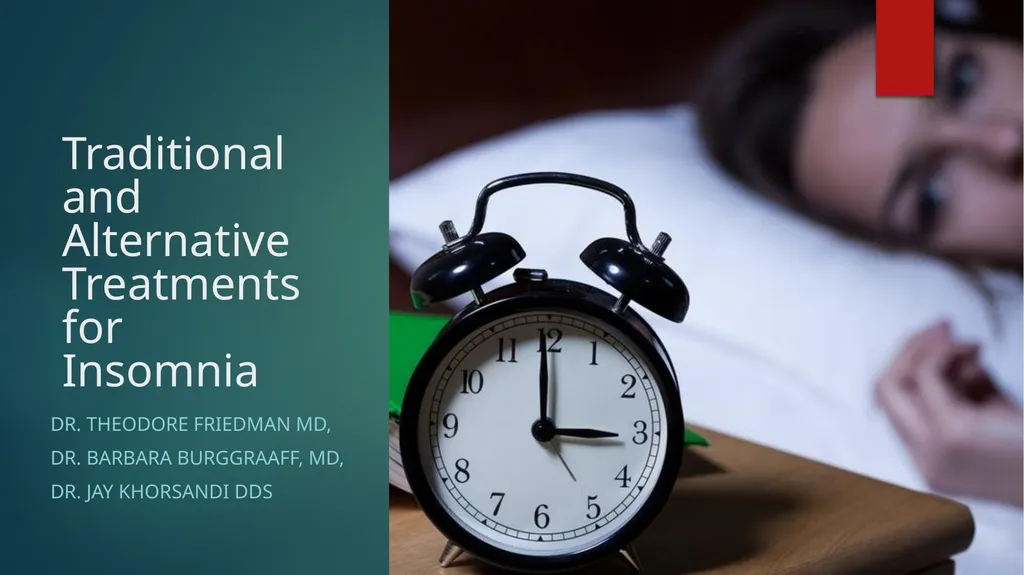
Traditional and Alternative Treatments for
TG
Published · 39 slides · 0 views

1 / 1



Description
Traditional and Alternative Treatments for Insomnia Dr. Theodore friedman md, dr. BARBARA BURGGRAAFF, MD, dr. Jay khorsandi dds Introductions Dr. Theodore Friedman Chairman, Department of Internal Medicine Chief, Division of Endocrinology,
Related Topics
Share
Embed code
Download this presentation From Below
"Traditional and Alternative Treatments for" is the property of its rightful owner. Permission is granted to download and print the materials on this website for personal, non-commercial use only, and to display it on your personal computer provided you do not modify the materials and that you retain all copyright notices contained in the materials. By downloading content from our website, you accept the terms of this agreement.
Presentation Transcript
01
Traditional and Alternative Treatments for Insomnia Dr. Theodore friedman md,
dr. BARBARA BURGGRAAFF, MD,
dr. Jay khorsandi dds<br>
dr. BARBARA BURGGRAAFF, MD,
dr. Jay khorsandi dds<br>
02
Introductions Dr. Theodore Friedman
Chairman, Department of Internal Medicine
Chief, Division of Endocrinology, Metabolism and Molecular Medicine
Endowed Professor of Cardio-Metabolic Medicine
Lead Physician, Endocrinology, Martin Luther King, Jr. Outpatient Center
Chairman, DHS Endocrinology Work Group
Professor of Medicine-Charles R. Drew University of Medicine & Science<br>
03
Introductions Dr. Barbara Burggraaff
Dual Boarded ENT (Ear Nose Throat) and Sleep Physician
Medical Director for Snore Experts
Fellow American Academy of Otolaryngology-Head and Neck Surgery
Fellow American Academy of Sleep Medicine
Medical humanitarian work in Nepal, Hiking, Horses and Oil Painting
Meditation Enthusiast<br>
Dual Boarded ENT (Ear Nose Throat) and Sleep Physician
Medical Director for Snore Experts
Fellow American Academy of Otolaryngology-Head and Neck Surgery
Fellow American Academy of Sleep Medicine
Medical humanitarian work in Nepal, Hiking, Horses and Oil Painting
Meditation Enthusiast<br>
04
Introductions Dr. Jay Khorsandi
Practicing healthcare dentistry and sleep for almost 20 years
Private practice owner in Los Angeles for 10 years
Was co-founder and Chief Dental Officer for a start-up Dental Service Organization (DSO) in New York
Transitioned to Sleep about 5 years ago exclusively
Member of ADA, CDA, LADS, AADSM, CA Sleep Society
Co-developer of an oral appliance. "Zyppah-K"
Delivered more CPAP's than any dentist in the country
Top provider of NightLase – Laser Snoring Therapy
Biohacker and Sleep Enthusiast<br>
05
Before we begin....FREE GIVEAWAY at the end of the webinar! You'll want to stay tuned as we will be giving away a bottle of an amazing supplement that can help you calm the mind down and sleep better!
More details at the end!<br>
More details at the end!<br>
06
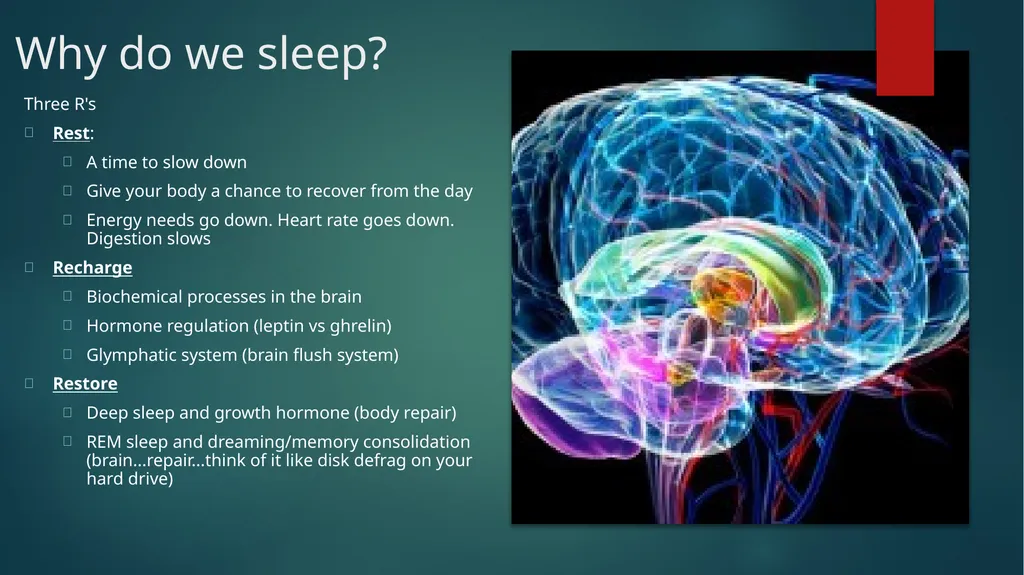
Why do we sleep? Three R's
Rest:
A time to slow down
Give your body a chance to recover from the day
Energy needs go down. Heart rate goes down. Digestion slows
Recharge
Biochemical processes in the brain
Hormone regulation (leptin vs ghrelin)
Glymphatic system (brain flush system)
Restore
Deep sleep and growth hormone (body repair)
REM sleep and dreaming/memory consolidation (brain...repair...think of it like disk defrag on your hard drive)<br>
07
What controls our sleep?
2 Components: Rhythm and Drive Rhythm
AKA, your sleep/wake cycle
Our body is regulated by internal clocks known as circadian rhythms
Your brain is the main one but research is showing all major organ systems working optimally at different times of days
Shift workers constantly battle with this
Jet lag amplifies the consequences of sleep cycle<br>
08
What controls our sleep? Drive - Pressure to Sleep
It effectively reminds the body that it needs to sleep after a certain time
Timer or counter that diminishes throughout the day
The longer we have been awake, the stronger the desire and need to sleep becomes, and the more the likelihood of falling asleep increases
The longer we have been asleep, the more the pressure to sleep dissipates, and the more the likelihood of awakening increases.<br>
09
Trouble Falling Asleep and Waking Up Falling Asleep
Work related stress
Acute pyschological or physical trauma
Family stress
Lifestyle choices
Waking Up
Waking up in the middle of night (bathroom trips, brain energy expenditure, sleep apnea)
Trouble waking up in the morning = Insomnia, Snoring, Sleep Apnea<br>
Work related stress
Acute pyschological or physical trauma
Family stress
Lifestyle choices
Waking Up
Waking up in the middle of night (bathroom trips, brain energy expenditure, sleep apnea)
Trouble waking up in the morning = Insomnia, Snoring, Sleep Apnea<br>
10
What kind of sleeper are you?
AKA, what is your "Chronotype" Michael Breus "The Sleep Doctor" - The Power of When Book
Lion
Wolf
Bear
Dolphin<br>
Lion
Wolf
Bear
Dolphin<br>
11
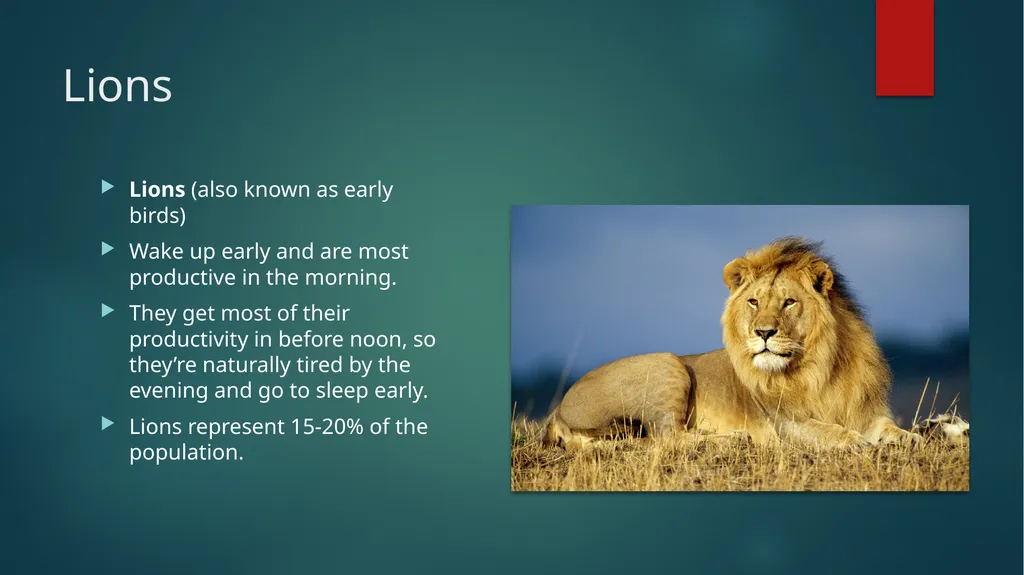
Lions Lions (also known as early birds)
Wake up early and are most productive in the morning.
They get most of their productivity in before noon, so they’re naturally tired by the evening and go to sleep early.
Lions represent 15-20% of the population.<br>
Wake up early and are most productive in the morning.
They get most of their productivity in before noon, so they’re naturally tired by the evening and go to sleep early.
Lions represent 15-20% of the population.<br>
12
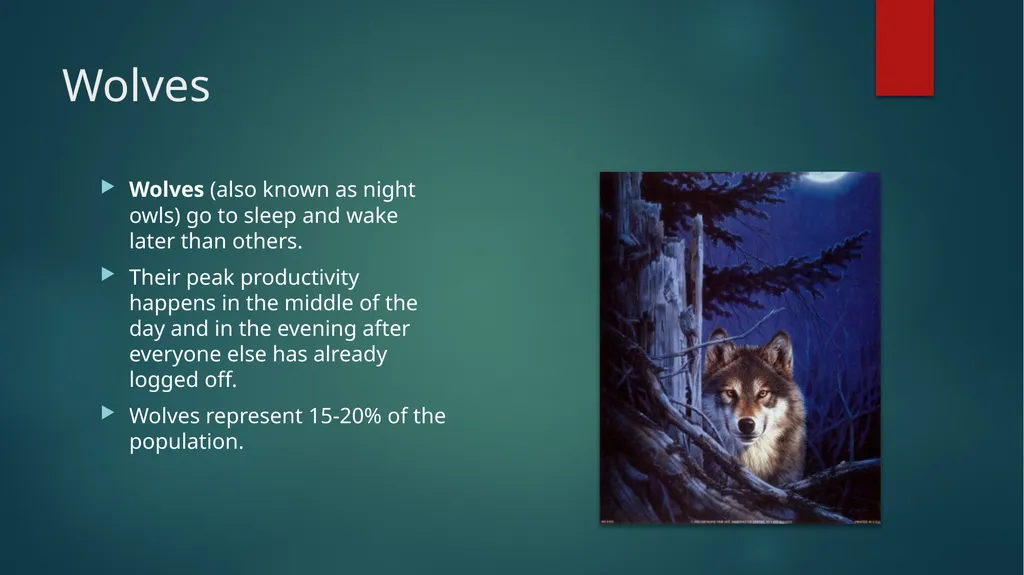
Wolves Wolves (also known as night owls) go to sleep and wake later than others.
Their peak productivity happens in the middle of the day and in the evening after everyone else has already logged off.
Wolves represent 15-20% of the population.<br>
Their peak productivity happens in the middle of the day and in the evening after everyone else has already logged off.
Wolves represent 15-20% of the population.<br>
13
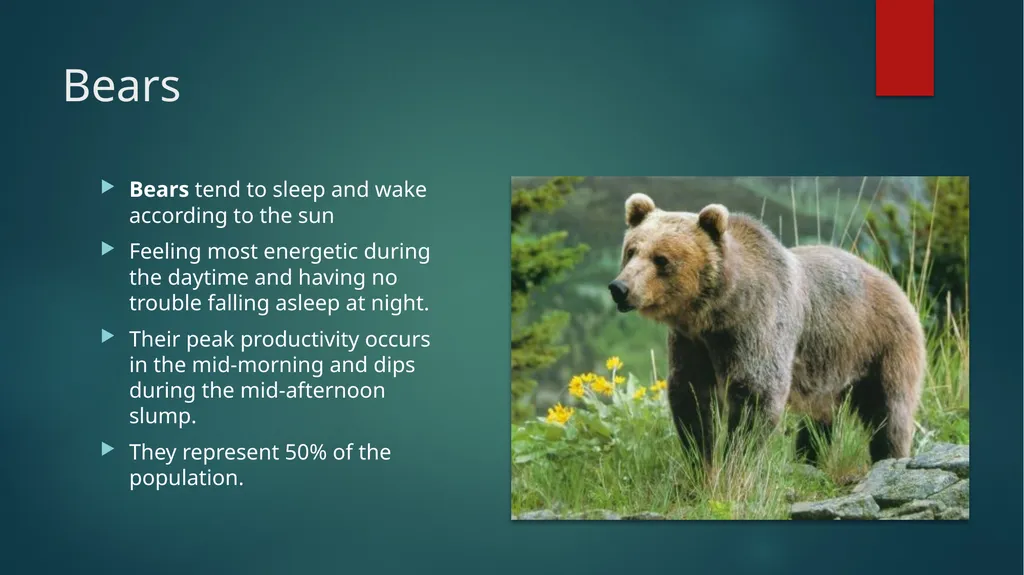
Bears Bears tend to sleep and wake according to the sun
Feeling most energetic during the daytime and having no trouble falling asleep at night.
Their peak productivity occurs in the mid-morning and dips during the mid-afternoon slump.
They represent 50% of the population.<br>
Feeling most energetic during the daytime and having no trouble falling asleep at night.
Their peak productivity occurs in the mid-morning and dips during the mid-afternoon slump.
They represent 50% of the population.<br>
14
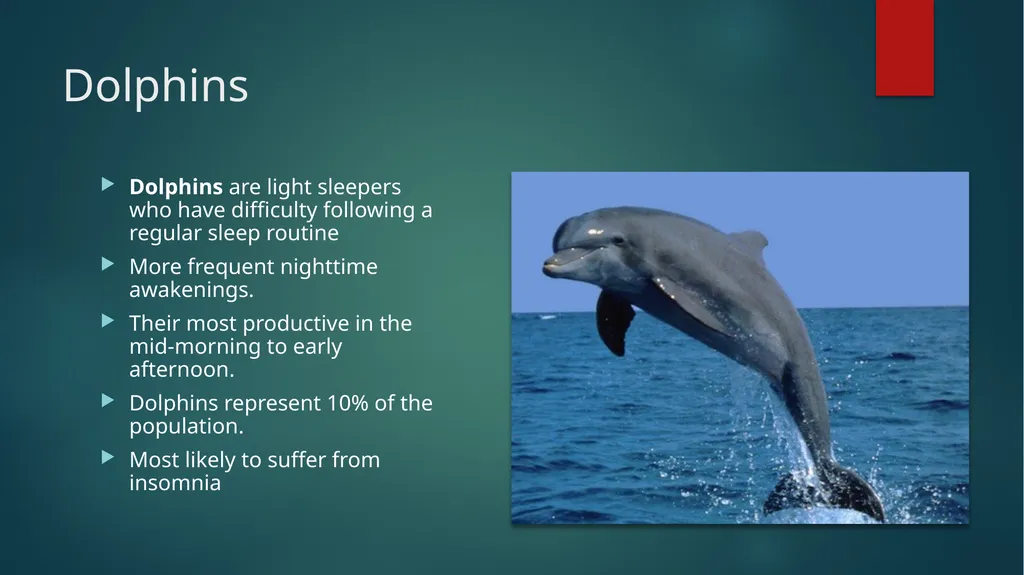
Dolphins Dolphins are light sleepers who have difficulty following a regular sleep routine
More frequent nighttime awakenings.
Their most productive in the mid-morning to early afternoon.
Dolphins represent 10% of the population.
Most likely to suffer from insomnia<br>
More frequent nighttime awakenings.
Their most productive in the mid-morning to early afternoon.
Dolphins represent 10% of the population.
Most likely to suffer from insomnia<br>
15
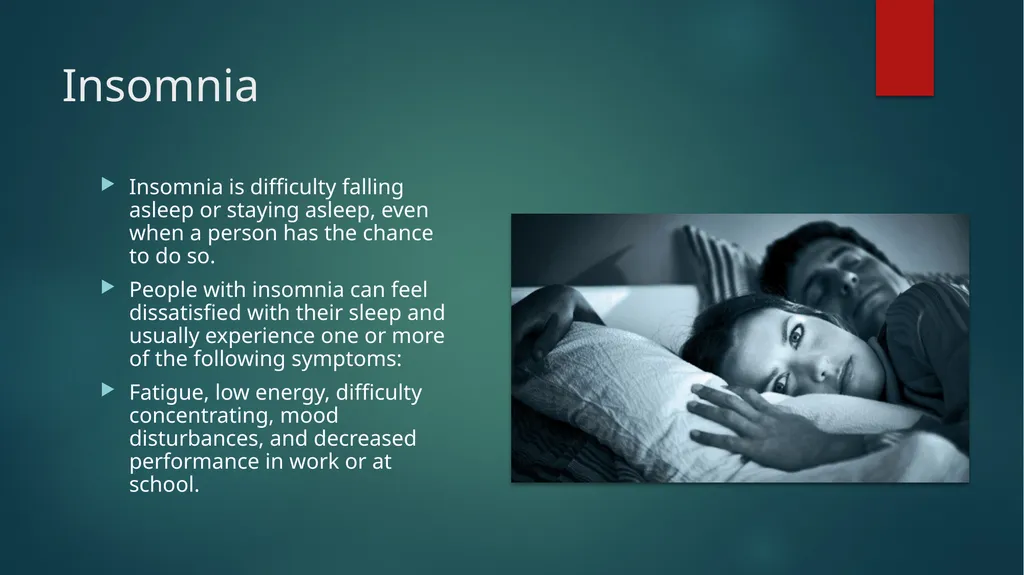
Insomnia Insomnia is difficulty falling asleep or staying asleep, even when a person has the chance to do so.
People with insomnia can feel dissatisfied with their sleep and usually experience one or more of the following symptoms:
Fatigue, low energy, difficulty concentrating, mood disturbances, and decreased performance in work or at school.<br>
People with insomnia can feel dissatisfied with their sleep and usually experience one or more of the following symptoms:
Fatigue, low energy, difficulty concentrating, mood disturbances, and decreased performance in work or at school.<br>
16
Hormonal Causes of Insomnia Menopause
Cushing’s syndrome
High cortisol at night
Growth Hormone deficiency
Hyperthyroidism or over-replacement with thyroid medication
Adrenal insufficiency (need some cortisol before bedtime)<br>
Cushing’s syndrome
High cortisol at night
Growth Hormone deficiency
Hyperthyroidism or over-replacement with thyroid medication
Adrenal insufficiency (need some cortisol before bedtime)<br>
17
Cortisol in Adrenal Insufficiency Patients with adrenal insufficiency needed some cortisol to go into deep sleep
I give 2.5-5 mg of hydrocortisone to patients with adrenal insufficiency before bedtime
Too much and too little cortisol is bad for sleep<br>
I give 2.5-5 mg of hydrocortisone to patients with adrenal insufficiency before bedtime
Too much and too little cortisol is bad for sleep<br>
18
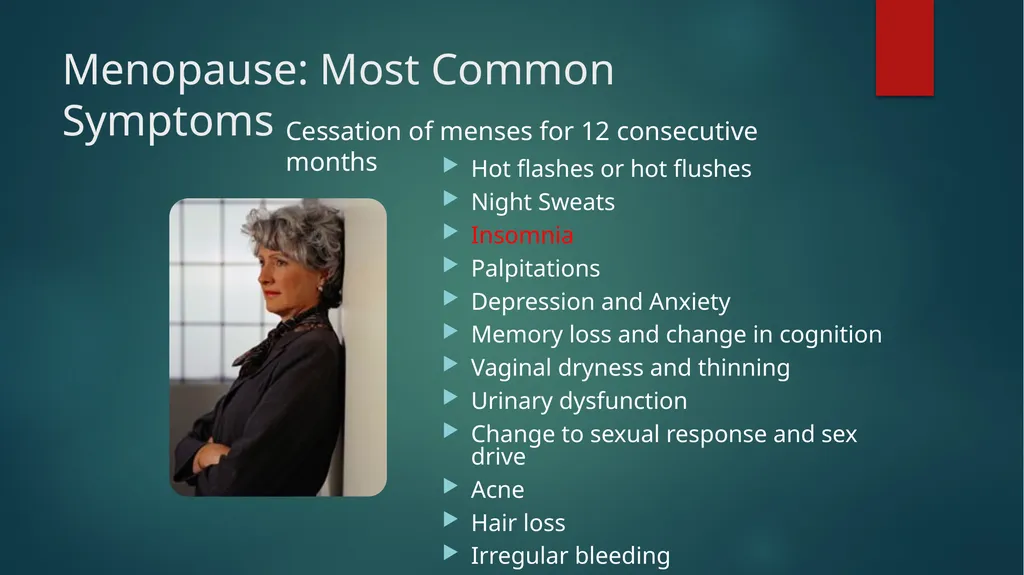
Menopause: Most Common Symptoms Hot flashes or hot flushes
Night Sweats
Insomnia
Palpitations
Depression and Anxiety
Memory loss and change in cognition
Vaginal dryness and thinning
Urinary dysfunction
Change to sexual response and sex drive
Acne
Hair loss
Irregular bleeding Cessation of menses for 12 consecutive months<br>
Night Sweats
Insomnia
Palpitations
Depression and Anxiety
Memory loss and change in cognition
Vaginal dryness and thinning
Urinary dysfunction
Change to sexual response and sex drive
Acne
Hair loss
Irregular bleeding Cessation of menses for 12 consecutive months<br>
19
Treatments for Insomnia Behavioral
Psychological
Medical
Hormonal
Alternative<br>
Psychological
Medical
Hormonal
Alternative<br>
20
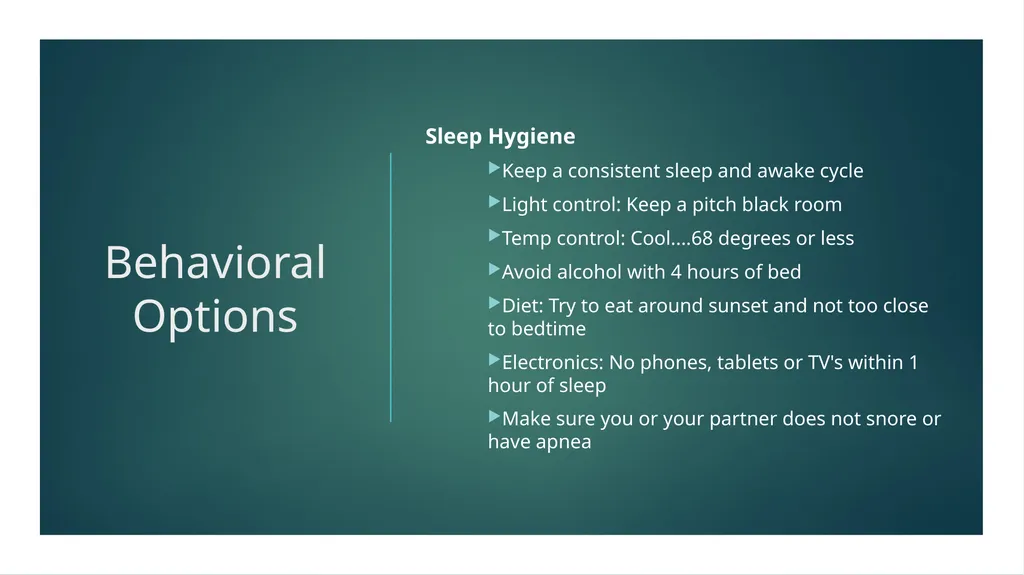
Behavioral Options Sleep Hygiene
Keep a consistent sleep and awake cycle
Light control: Keep a pitch black room
Temp control: Cool....68 degrees or less
Avoid alcohol with 4 hours of bed
Diet: Try to eat around sunset and not too close to bedtime
Electronics: No phones, tablets or TV's within 1 hour of sleep
Make sure you or your partner does not snore or have apnea<br>
21
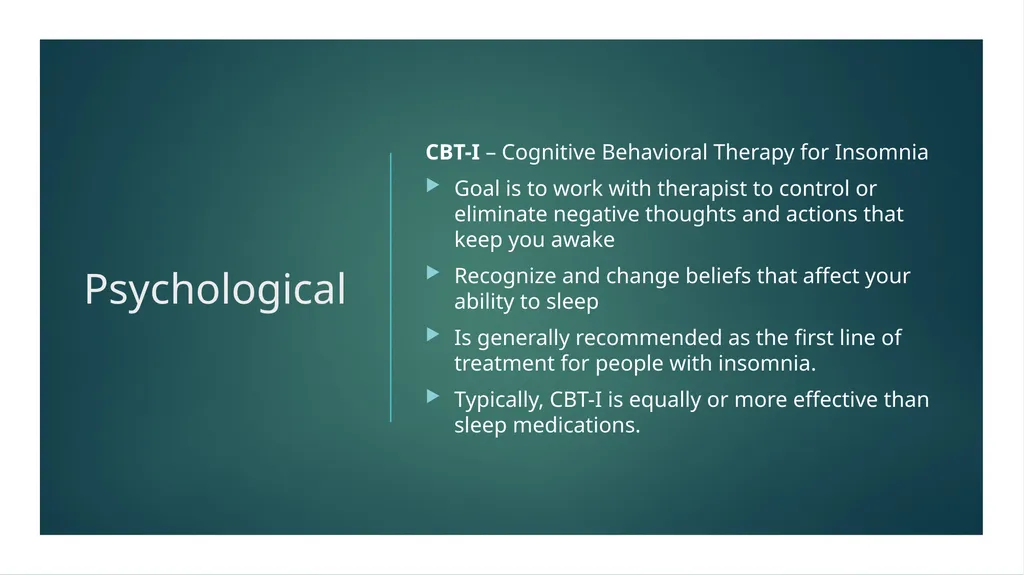
Psychological CBT-I – Cognitive Behavioral Therapy for Insomnia
Goal is to work with therapist to control or eliminate negative thoughts and actions that keep you awake
Recognize and change beliefs that affect your ability to sleep
Is generally recommended as the first line of treatment for people with insomnia.
Typically, CBT-I is equally or more effective than sleep medications.<br>
22
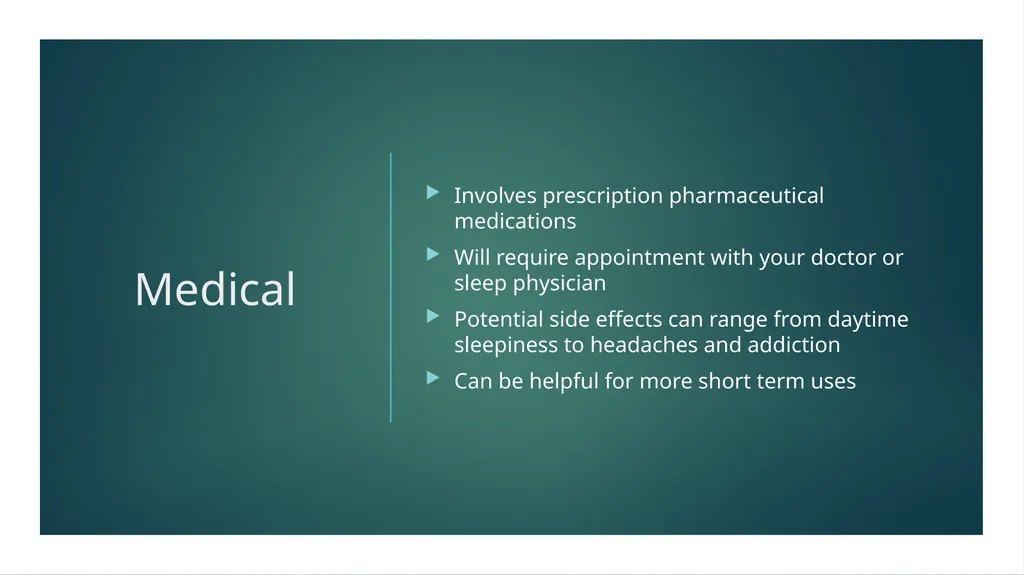
Medical Involves prescription pharmaceutical medications
Will require appointment with your doctor or sleep physician
Potential side effects can range from daytime sleepiness to headaches and addiction
Can be helpful for more short term uses<br>
Will require appointment with your doctor or sleep physician
Potential side effects can range from daytime sleepiness to headaches and addiction
Can be helpful for more short term uses<br>
23
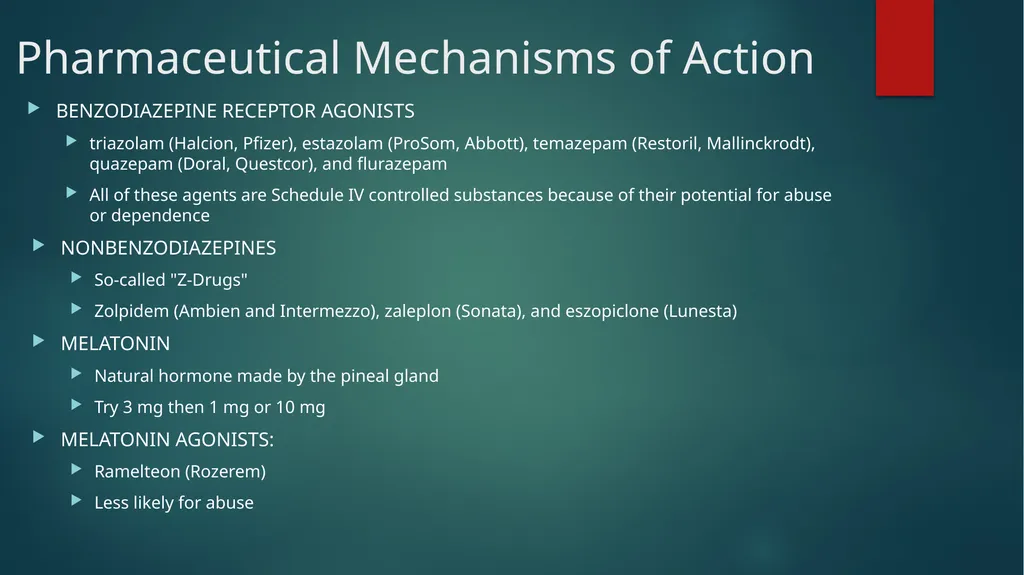
Pharmaceutical Mechanisms of Action BENZODIAZEPINE RECEPTOR AGONISTS
triazolam (Halcion, Pfizer), estazolam (ProSom, Abbott), temazepam (Restoril, Mallinckrodt), quazepam (Doral, Questcor), and flurazepam
All of these agents are Schedule IV controlled substances because of their potential for abuse or dependence
NONBENZODIAZEPINES
So-called "Z-Drugs"
Zolpidem (Ambien and Intermezzo), zaleplon (Sonata), and eszopiclone (Lunesta)
MELATONIN
Natural hormone made by the pineal gland
Try 3 mg then 1 mg or 10 mg
MELATONIN AGONISTS:
Ramelteon (Rozerem)
Less likely for abuse<br>
24
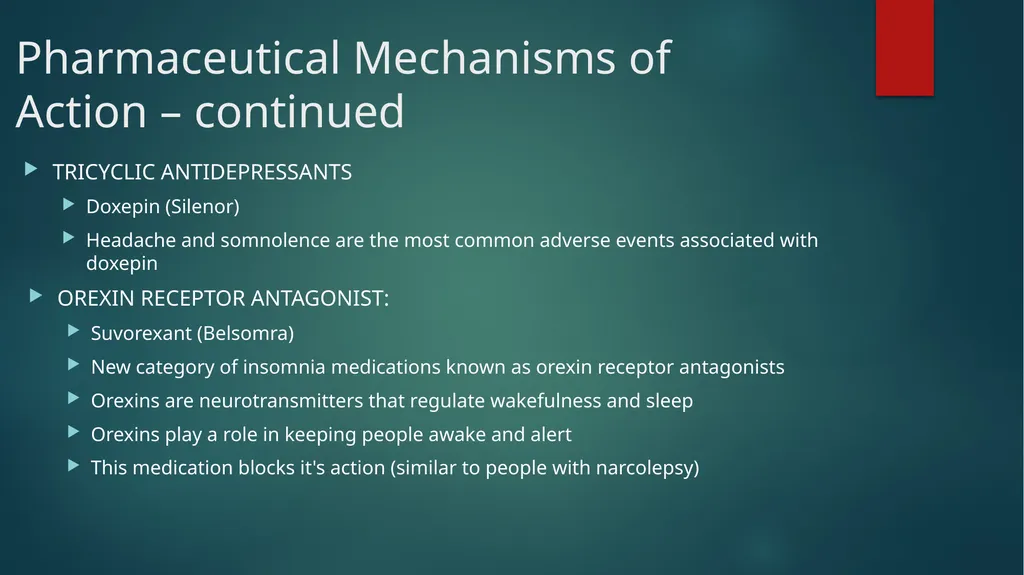
Pharmaceutical Mechanisms of Action – continued TRICYCLIC ANTIDEPRESSANTS
Doxepin (Silenor)
Headache and somnolence are the most common adverse events associated with doxepin
OREXIN RECEPTOR ANTAGONIST:
Suvorexant (Belsomra)
New category of insomnia medications known as orexin receptor antagonists
Orexins are neurotransmitters that regulate wakefulness and sleep
Orexins play a role in keeping people awake and alert
This medication blocks it's action (similar to people with narcolepsy)<br>
25
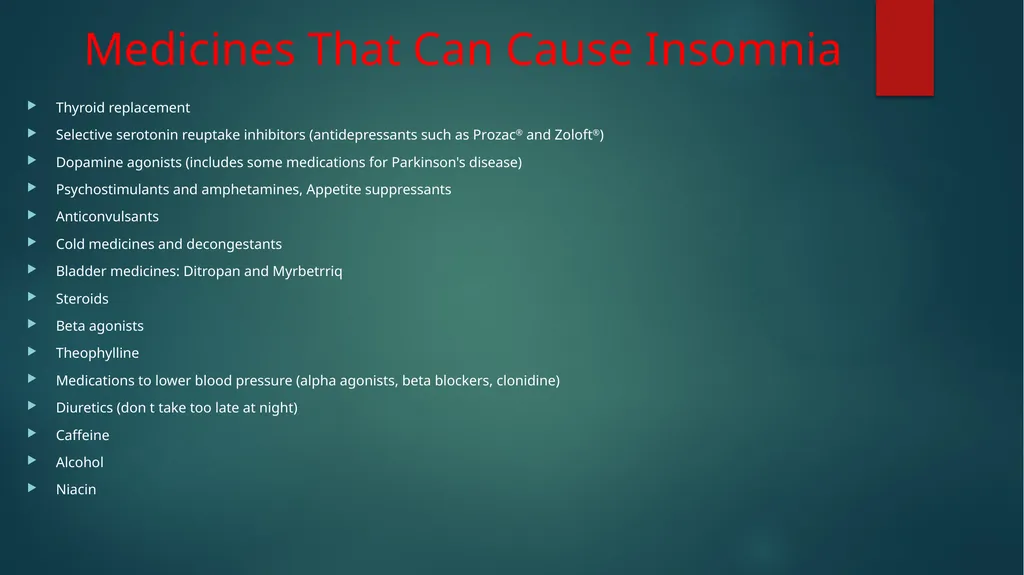
Medicines That Can Cause Insomnia Thyroid replacement
Selective serotonin reuptake inhibitors (antidepressants such as Prozac® and Zoloft®)
Dopamine agonists (includes some medications for Parkinson's disease)
Psychostimulants and amphetamines, Appetite suppressants
Anticonvulsants
Cold medicines and decongestants
Bladder medicines: Ditropan and Myrbetrriq
Steroids
Beta agonists
Theophylline
Medications to lower blood pressure (alpha agonists, beta blockers, clonidine)
Diuretics (don t take too late at night)
Caffeine
Alcohol
Niacin<br>
26
Hormone Treatments Estrogen/Progesterone for menopause
Vitamin E 400 iU a day helps with hot flashes
Phosphotidyl Serine (Seriphos) 300 mg an hour before bedtime lowers night time cortisol
DHEA-25 mg a day in women and 50 mg a day in men at night, counteracts cortisol
Gingko bilabo 120 mg twice a day lowers cortisol
Serovital raises growth hormone<br>
Vitamin E 400 iU a day helps with hot flashes
Phosphotidyl Serine (Seriphos) 300 mg an hour before bedtime lowers night time cortisol
DHEA-25 mg a day in women and 50 mg a day in men at night, counteracts cortisol
Gingko bilabo 120 mg twice a day lowers cortisol
Serovital raises growth hormone<br>
27
Alternative Options Supplements + Light Control
Meditation and Mindfulness
EMF Mitigation
Dietary Considerations<br>
Meditation and Mindfulness
EMF Mitigation
Dietary Considerations<br>
28
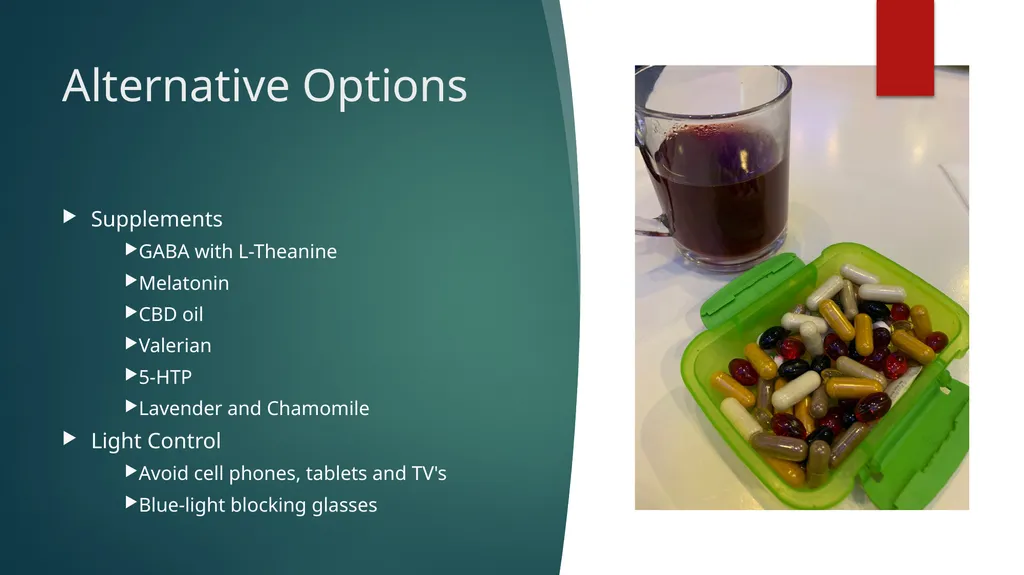
Alternative Options Supplements
GABA with L-Theanine
Melatonin
Valerian
5-HTP
CBD oil
Lavender and Chamomile
Light Control
Avoid cell phones, tablets and TV's
Blue-light blocking glasses<br>
GABA with L-Theanine
Melatonin
Valerian
5-HTP
CBD oil
Lavender and Chamomile
Light Control
Avoid cell phones, tablets and TV's
Blue-light blocking glasses<br>
29
Alternative Options Supplements
GABA with L-Theanine
Our brain naturally produces GABA--the premier ‘calm and connect’ neurotransmitter that inhibits or slows down nerve impulses.
GABA supports rest and relaxation.
L-Theanine, an amino acid found in green tea, also facilitates relaxation and calms without impairing cognition.
Together, they help support a balanced state.
2- 4 pumps sublingual recommended dosage<br>
30
Alternative Options Supplements
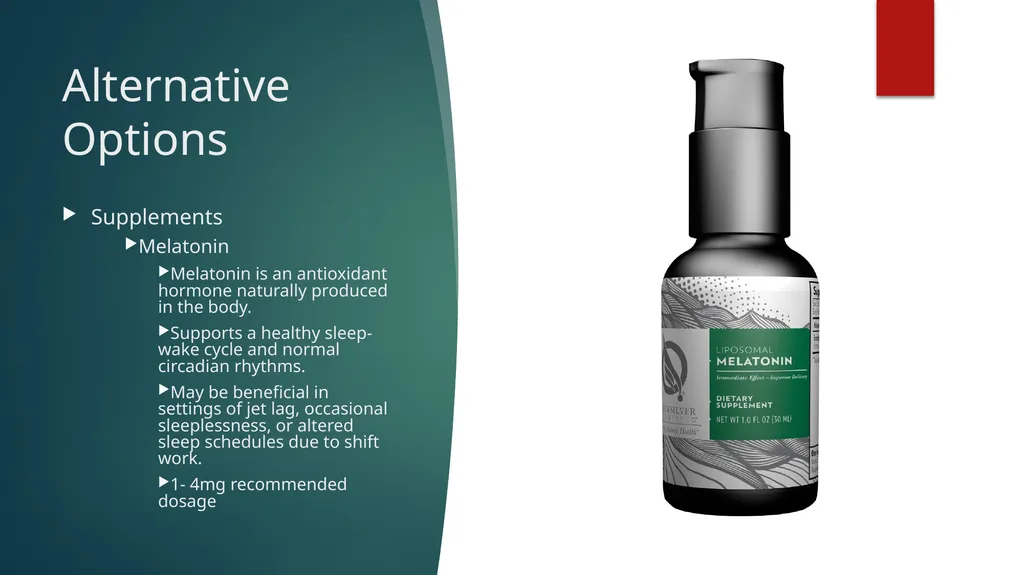
Melatonin
Melatonin is an antioxidant hormone naturally produced in the body.
Supports a healthy sleep-wake cycle and normal circadian rhythms.
May be beneficial in settings of jet lag, occasional sleeplessness, or altered sleep schedules due to shift work.
1- 4mg recommended dosage<br>
Melatonin
Melatonin is an antioxidant hormone naturally produced in the body.
Supports a healthy sleep-wake cycle and normal circadian rhythms.
May be beneficial in settings of jet lag, occasional sleeplessness, or altered sleep schedules due to shift work.
1- 4mg recommended dosage<br>
31
Alternative Options Supplements
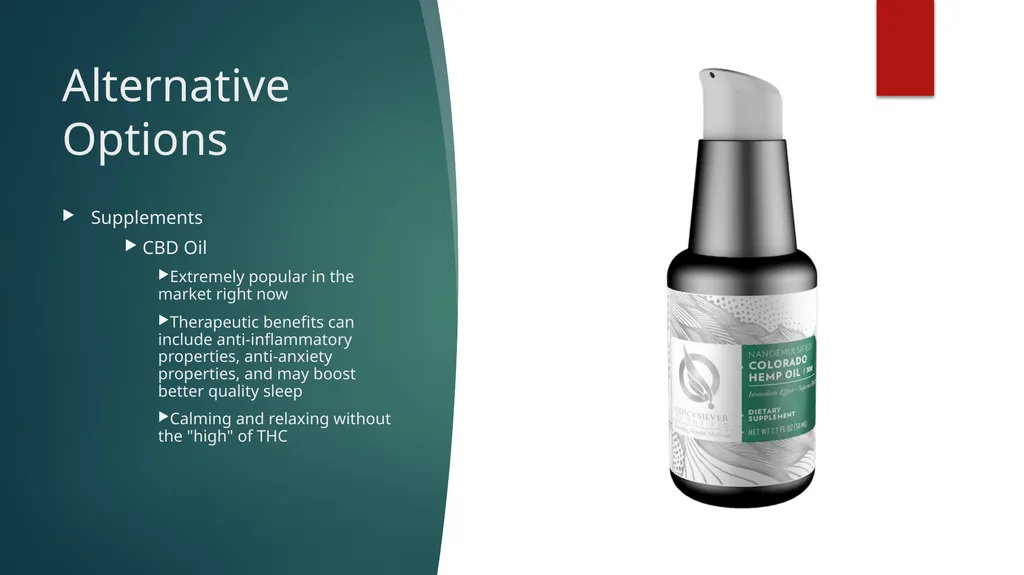
CBD Oil
Extremely popular in the market right now
Therapeutic benefits can include anti-inflammatory properties, anti-anxiety properties, and may boost better quality sleep
Calming and relaxing without the "high" of THC<br>
CBD Oil
Extremely popular in the market right now
Therapeutic benefits can include anti-inflammatory properties, anti-anxiety properties, and may boost better quality sleep
Calming and relaxing without the "high" of THC<br>
32
Alternative Options Supplements
GABA with L-Theanine
Melatonin
CBD oil
Valerian
5-HTP
Lavender and Chamomile
Light Control
Avoid cell phones, tablets and TV's
Blue-light blocking glasses<br>
GABA with L-Theanine
Melatonin
CBD oil
Valerian
5-HTP
Lavender and Chamomile
Light Control
Avoid cell phones, tablets and TV's
Blue-light blocking glasses<br>
33
Where to find/buy these? We carry them at Snore Experts locations
Encino, Pasadena, Brentwood, Irvine, Valencia
Also available online @ www.snoreexperts.com in the "Store" section
Also stay tuned for giveaway of a bottle of GABA (valued at $40)!!<br>
Encino, Pasadena, Brentwood, Irvine, Valencia
Also available online @ www.snoreexperts.com in the "Store" section
Also stay tuned for giveaway of a bottle of GABA (valued at $40)!!<br>
34
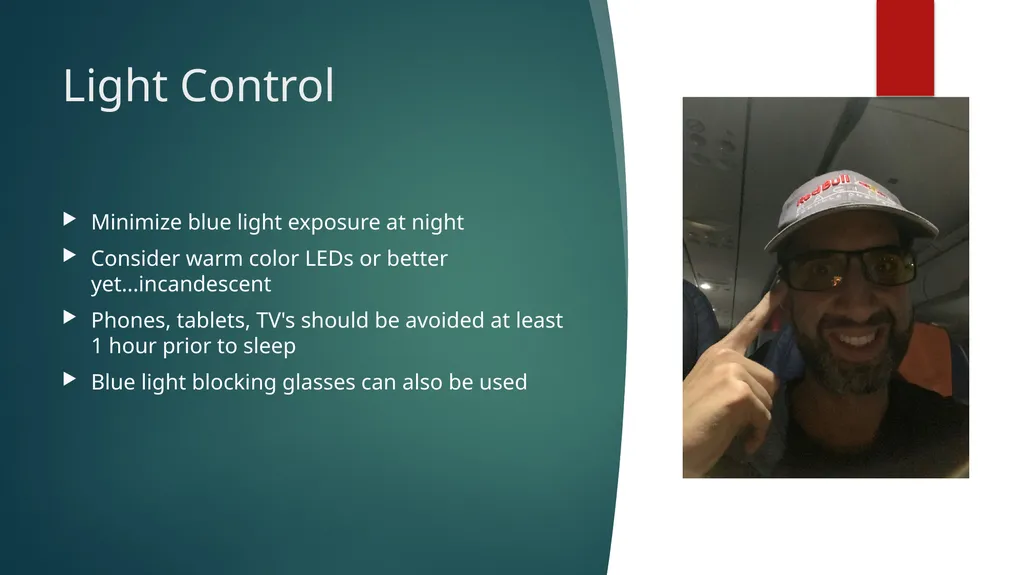
Light Control Minimize blue light exposure at night
Consider warm color LEDs or better yet...incandescent
Phones, tablets, TV's should be avoided at least 1 hour prior to sleep
Blue light blocking glasses can also be used<br>
Consider warm color LEDs or better yet...incandescent
Phones, tablets, TV's should be avoided at least 1 hour prior to sleep
Blue light blocking glasses can also be used<br>
35
Alternative Options Meditation and Mindfullness
Develop a meditation practice
2 x 10min a day better than 1x 20min session
Helps to evoke parasympathetic activation (aka relaxation response)
Mindfullness = being in the present and not focusing on past or future
Box Breathing Technique<br>
Develop a meditation practice
2 x 10min a day better than 1x 20min session
Helps to evoke parasympathetic activation (aka relaxation response)
Mindfullness = being in the present and not focusing on past or future
Box Breathing Technique<br>
36
Alternative Options EMF (electromagnetic frequencies) Mitigation
Put your phone on airplane mode at night
Keep away from your bed
Put your wi-fi router on timer
Examine your house for "smart meters"
Don't use microwave oven anymore
Buy an EMF meter and test around your house especially where you sleep<br>
Put your phone on airplane mode at night
Keep away from your bed
Put your wi-fi router on timer
Examine your house for "smart meters"
Don't use microwave oven anymore
Buy an EMF meter and test around your house especially where you sleep<br>
37
Alternative Options Diet Considerations
Avoid eating after sunset or with 2 hours of sleep
Avoid inflammatory foods (deep fried, carb heavy, gluten)
Stay away from alcohol. Or stop 1 hour per drink
Have low glycemic foods as night snacks (handful or walnuts or berries)
Focus on healthy fats (avocados, salmon, nuts, extra virgin olive oil, MCT oil)
No caffeine after 2 pm<br>
38
Thank you! To learn more:
www.snoreexperts.com
Facebook – SnoreExperts
Instagram – SnoreExperts
Podcast – Best Night Ever This Photo by Unknown author is licensed under CC BY-SA-NC.<br>
www.snoreexperts.com
Facebook – SnoreExperts
Instagram – SnoreExperts
Podcast – Best Night Ever This Photo by Unknown author is licensed under CC BY-SA-NC.<br>
39
Questions? Please use the chat button
Thank you for sharing your time tonight!
If you have any more questions after tonight or want an appointment, please email: mail@goodhormonehealth.com
www.goodhormonehealth.com
Webinar will be posted in a few days and also available at https://www.dropbox.com/sh/nsq61x0rvdcni00/AAAps1JLD1zm1D-JeVasqO3Va?dl=0<br>