
Trails to Translational Research: A step-by-step
SN
Published · 18 slides · 0 views

1 / 1
Description
Trails to Translational Research: A step-by-step resource navigation guide to designing your research project On-site Resources, web-links, contact Online Resources, web-links Off-site Resources, web-links Have a research idea? SYNERGY can
Related Topics
Share
Embed code
Download this presentation From Below
"Trails to Translational Research: A step-by-step" is the property of its rightful owner. Permission is granted to download and print the materials on this website for personal, non-commercial use only, and to display it on your personal computer provided you do not modify the materials and that you retain all copyright notices contained in the materials. By downloading content from our website, you accept the terms of this agreement.
Presentation Transcript
01
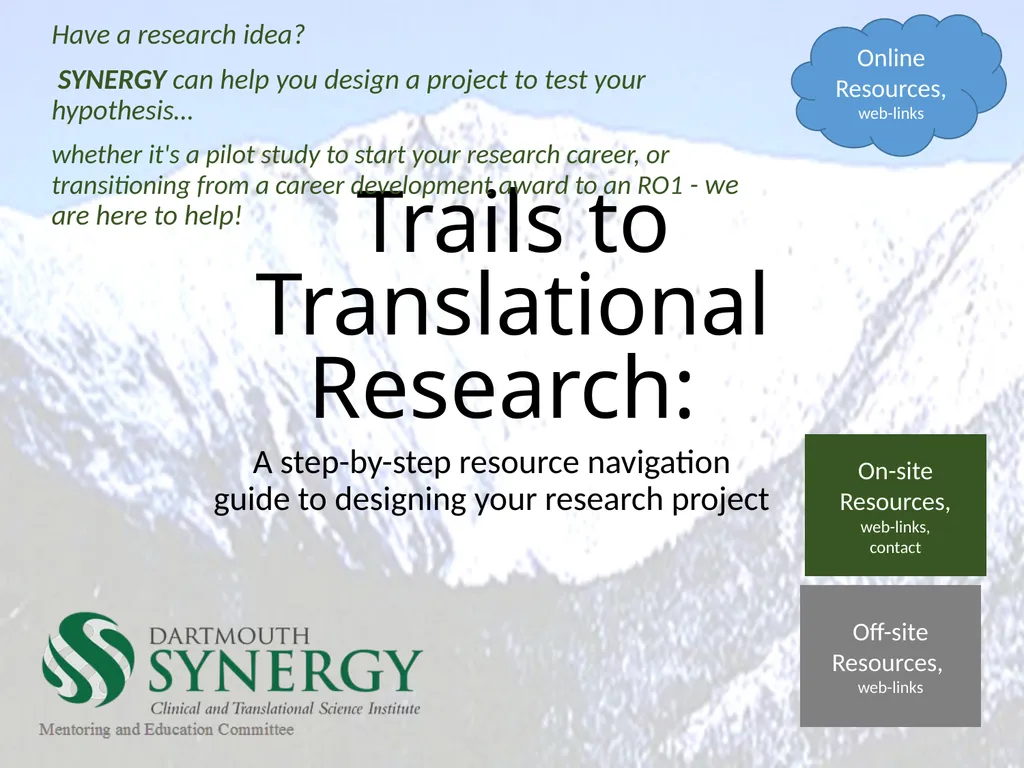
Trails to Translational Research: A step-by-step resource navigation guide to designing your research project On-site Resources,
web-links,
contact Online Resources,
web-links Off-site Resources,
web-links Have a research idea?
SYNERGY can help you design a project to test your hypothesis…
whether it's a pilot study to start your research career, or transitioning from a career development award to an RO1 - we are here to help!<br>
web-links,
contact Online Resources,
web-links Off-site Resources,
web-links Have a research idea?
SYNERGY can help you design a project to test your hypothesis…
whether it's a pilot study to start your research career, or transitioning from a career development award to an RO1 - we are here to help!<br>
02
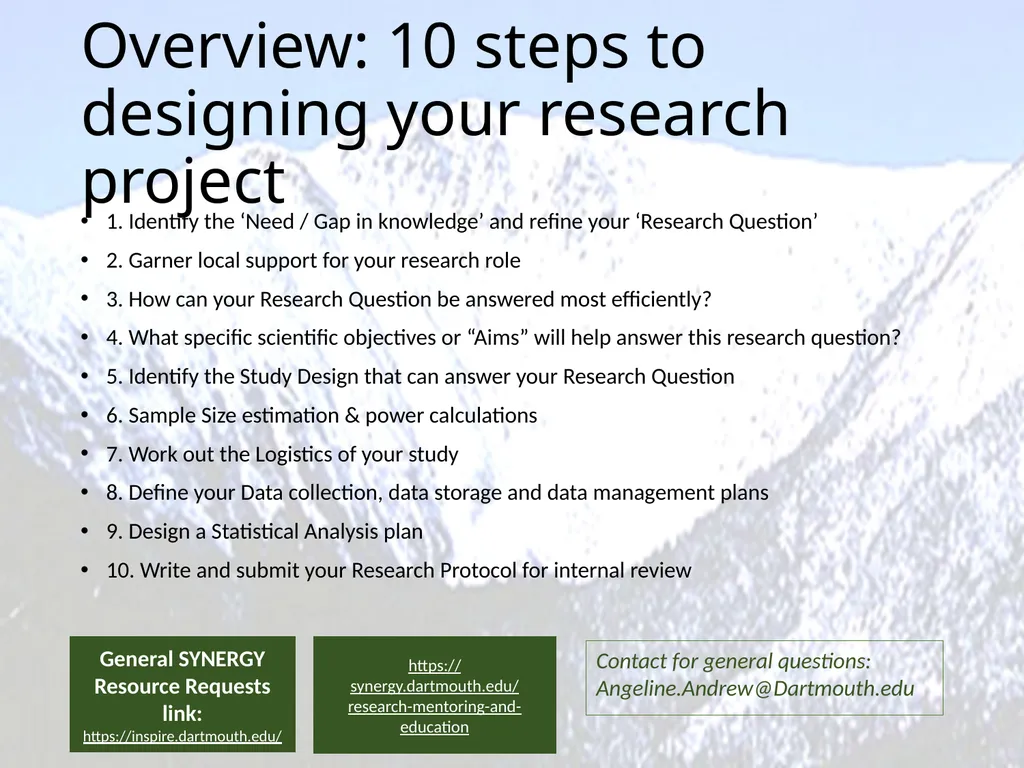
Overview: 10 steps to designing your research project 1. Identify the ‘Need / Gap in knowledge’ and refine your ‘Research Question’
2. Garner local support for your research role
3. How can your Research Question be answered most efficiently?
4. What specific scientific objectives or “Aims” will help answer this research question?
5. Identify the Study Design that can answer your Research Question
6. Sample Size estimation & power calculations
7. Work out the Logistics of your study
8. Define your Data collection, data storage and data management plans
9. Design a Statistical Analysis plan
10. Write and submit your Research Protocol for internal review https://synergy.dartmouth.edu/research-mentoring-and-education General SYNERGY
Resource Requests link:
https://inspire.dartmouth.edu/ Contact for general questions:
Angeline.Andrew@Dartmouth.edu<br>
2. Garner local support for your research role
3. How can your Research Question be answered most efficiently?
4. What specific scientific objectives or “Aims” will help answer this research question?
5. Identify the Study Design that can answer your Research Question
6. Sample Size estimation & power calculations
7. Work out the Logistics of your study
8. Define your Data collection, data storage and data management plans
9. Design a Statistical Analysis plan
10. Write and submit your Research Protocol for internal review https://synergy.dartmouth.edu/research-mentoring-and-education General SYNERGY
Resource Requests link:
https://inspire.dartmouth.edu/ Contact for general questions:
Angeline.Andrew@Dartmouth.edu<br>
03
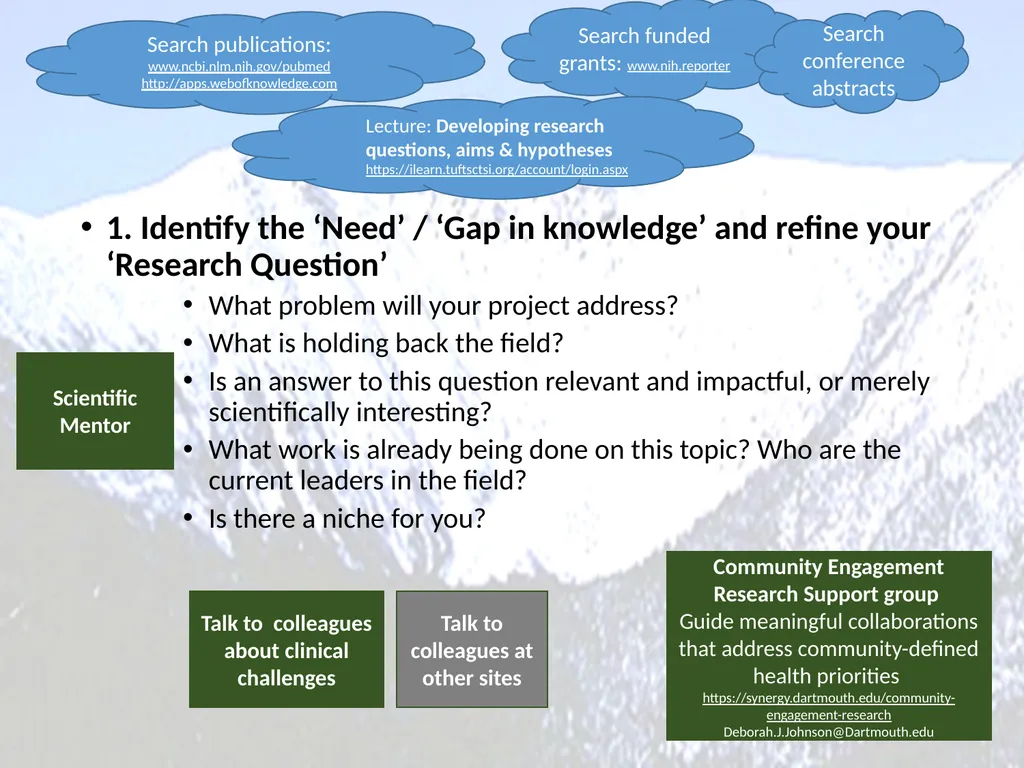
1. Identify the ‘Need’ / ‘Gap in knowledge’ and refine your ‘Research Question’
What problem will your project address?
What is holding back the field?
Is an answer to this question relevant and impactful, or merely scientifically interesting?
What work is already being done on this topic? Who are the current leaders in the field?
Is there a niche for you? Search funded grants: www.nih.reporter Search conference abstracts Search publications: www.ncbi.nlm.nih.gov/pubmed
http://apps.webofknowledge.com Community Engagement Research Support group
Guide meaningful collaborations that address community-defined health priorities
https://synergy.dartmouth.edu/community-engagement-research
Deborah.J.Johnson@Dartmouth.edu Talk to colleagues about clinical challenges Talk to colleagues at other sites Lecture: Developing research questions, aims & hypotheses https://ilearn.tuftsctsi.org/account/login.aspx Scientific Mentor<br>
What problem will your project address?
What is holding back the field?
Is an answer to this question relevant and impactful, or merely scientifically interesting?
What work is already being done on this topic? Who are the current leaders in the field?
Is there a niche for you? Search funded grants: www.nih.reporter Search conference abstracts Search publications: www.ncbi.nlm.nih.gov/pubmed
http://apps.webofknowledge.com Community Engagement Research Support group
Guide meaningful collaborations that address community-defined health priorities
https://synergy.dartmouth.edu/community-engagement-research
Deborah.J.Johnson@Dartmouth.edu Talk to colleagues about clinical challenges Talk to colleagues at other sites Lecture: Developing research questions, aims & hypotheses https://ilearn.tuftsctsi.org/account/login.aspx Scientific Mentor<br>
04
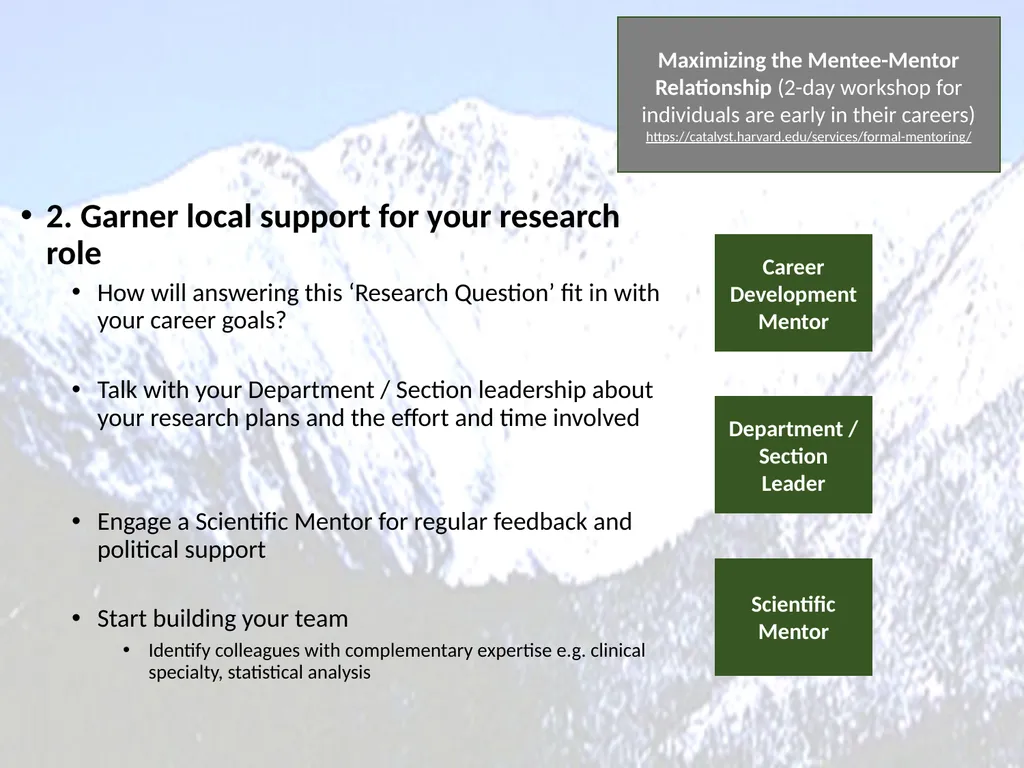
2. Garner local support for your research role
How will answering this ‘Research Question’ fit in with your career goals?
Talk with your Department / Section leadership about your research plans and the effort and time involved
Engage a Scientific Mentor for regular feedback and political support
Start building your team
Identify colleagues with complementary expertise e.g. clinical specialty, statistical analysis Scientific Mentor Career Development Mentor Department / Section Leader Maximizing the Mentee-Mentor Relationship (2-day workshop for individuals are early in their careers) https://catalyst.harvard.edu/services/formal-mentoring/<br>
How will answering this ‘Research Question’ fit in with your career goals?
Talk with your Department / Section leadership about your research plans and the effort and time involved
Engage a Scientific Mentor for regular feedback and political support
Start building your team
Identify colleagues with complementary expertise e.g. clinical specialty, statistical analysis Scientific Mentor Career Development Mentor Department / Section Leader Maximizing the Mentee-Mentor Relationship (2-day workshop for individuals are early in their careers) https://catalyst.harvard.edu/services/formal-mentoring/<br>
05
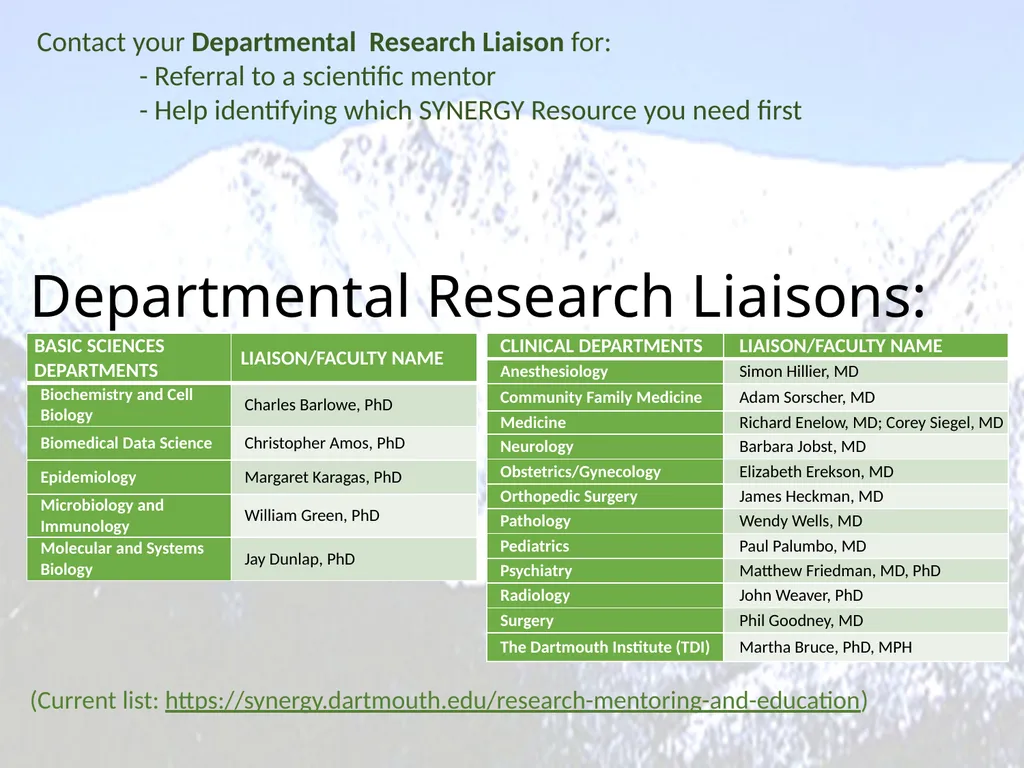
Departmental Research Liaisons: (Current list: https://synergy.dartmouth.edu/research-mentoring-and-education) Contact your Departmental Research Liaison for:
- Referral to a scientific mentor
- Help identifying which SYNERGY Resource you need first<br>
- Referral to a scientific mentor
- Help identifying which SYNERGY Resource you need first<br>
06
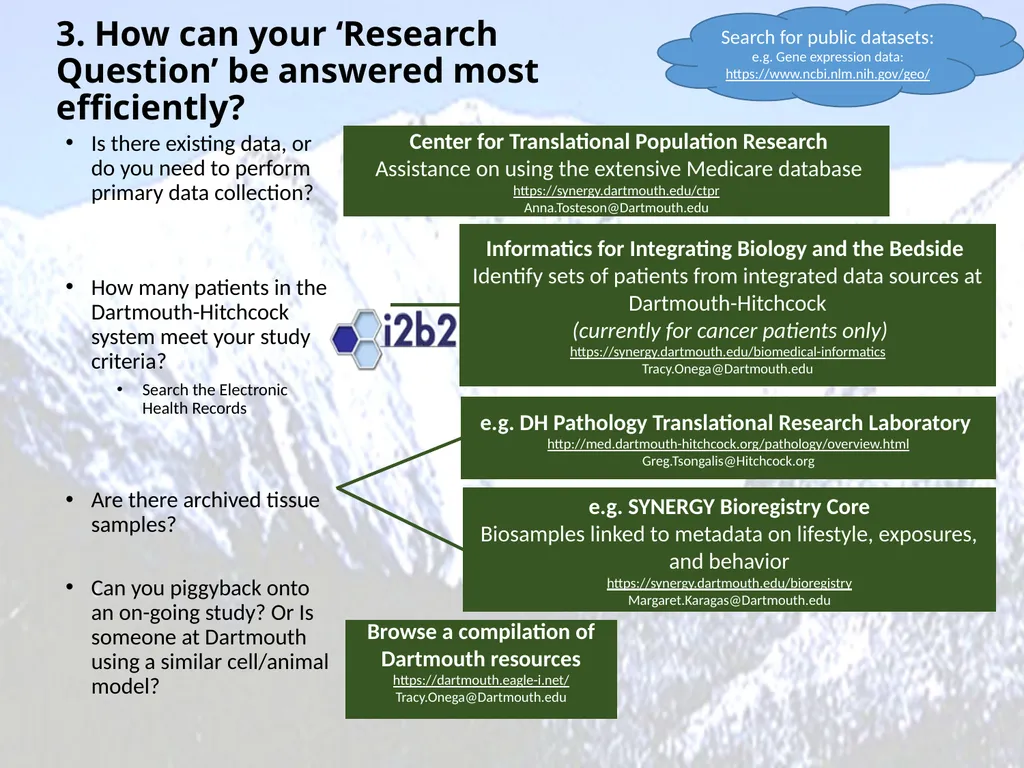
3. How can your ‘Research Question’ be answered most efficiently? Is there existing data, or do you need to perform primary data collection?
How many patients in the Dartmouth-Hitchcock system meet your study criteria?
Search the Electronic Health Records
Are there archived tissue samples?
Can you piggyback onto an on-going study? Or Is someone at Dartmouth using a similar cell/animal model? Search for public datasets: e.g. Gene expression data: https://www.ncbi.nlm.nih.gov/geo/ Browse a compilation of Dartmouth resources
https://dartmouth.eagle-i.net/
Tracy.Onega@Dartmouth.edu Center for Translational Population Research
Assistance on using the extensive Medicare database
https://synergy.dartmouth.edu/ctpr
Anna.Tosteson@Dartmouth.edu<br>
How many patients in the Dartmouth-Hitchcock system meet your study criteria?
Search the Electronic Health Records
Are there archived tissue samples?
Can you piggyback onto an on-going study? Or Is someone at Dartmouth using a similar cell/animal model? Search for public datasets: e.g. Gene expression data: https://www.ncbi.nlm.nih.gov/geo/ Browse a compilation of Dartmouth resources
https://dartmouth.eagle-i.net/
Tracy.Onega@Dartmouth.edu Center for Translational Population Research
Assistance on using the extensive Medicare database
https://synergy.dartmouth.edu/ctpr
Anna.Tosteson@Dartmouth.edu<br>
07
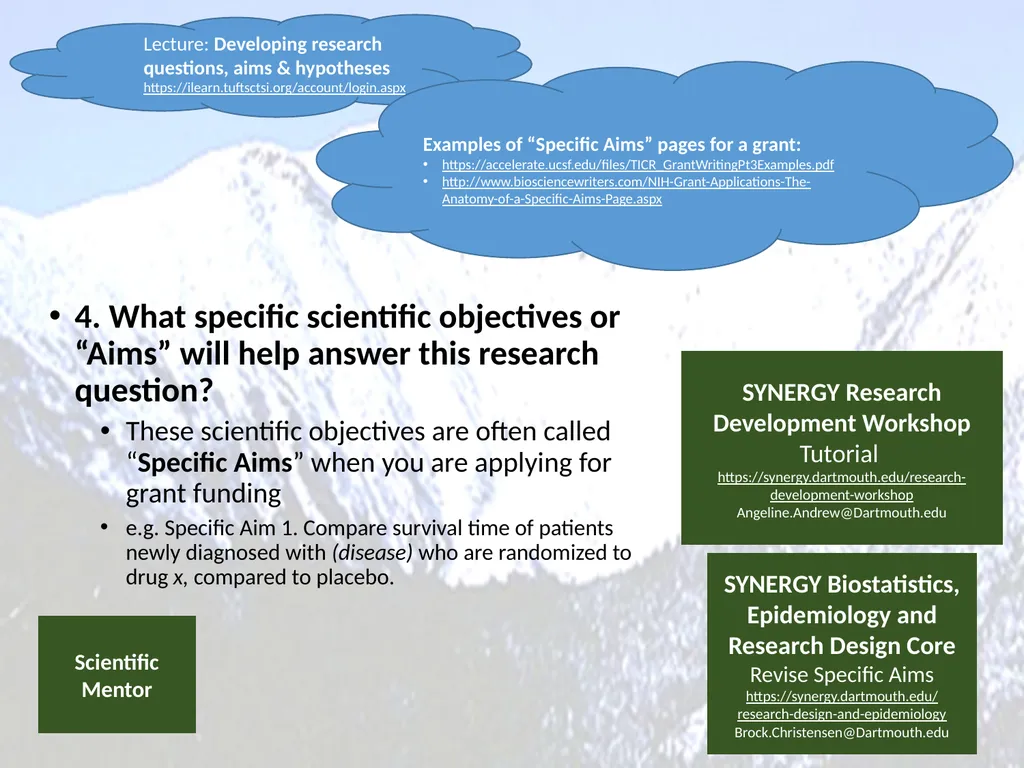
4. What specific scientific objectives or “Aims” will help answer this research question?
These scientific objectives are often called “Specific Aims” when you are applying for grant funding
e.g. Specific Aim 1. Compare survival time of patients newly diagnosed with (disease) who are randomized to drug x, compared to placebo. SYNERGY Research Development Workshop
Tutorial
https://synergy.dartmouth.edu/research-development-workshop
Angeline.Andrew@Dartmouth.edu Lecture: Developing research questions, aims & hypotheses https://ilearn.tuftsctsi.org/account/login.aspx Scientific Mentor Examples of “Specific Aims” pages for a grant:
https://accelerate.ucsf.edu/files/TICR_GrantWritingPt3Examples.pdf
http://www.biosciencewriters.com/NIH-Grant-Applications-The-Anatomy-of-a-Specific-Aims-Page.aspx SYNERGY Biostatistics, Epidemiology and Research Design Core
Revise Specific Aims
https://synergy.dartmouth.edu/research-design-and-epidemiology
Brock.Christensen@Dartmouth.edu<br>
These scientific objectives are often called “Specific Aims” when you are applying for grant funding
e.g. Specific Aim 1. Compare survival time of patients newly diagnosed with (disease) who are randomized to drug x, compared to placebo. SYNERGY Research Development Workshop
Tutorial
https://synergy.dartmouth.edu/research-development-workshop
Angeline.Andrew@Dartmouth.edu Lecture: Developing research questions, aims & hypotheses https://ilearn.tuftsctsi.org/account/login.aspx Scientific Mentor Examples of “Specific Aims” pages for a grant:
https://accelerate.ucsf.edu/files/TICR_GrantWritingPt3Examples.pdf
http://www.biosciencewriters.com/NIH-Grant-Applications-The-Anatomy-of-a-Specific-Aims-Page.aspx SYNERGY Biostatistics, Epidemiology and Research Design Core
Revise Specific Aims
https://synergy.dartmouth.edu/research-design-and-epidemiology
Brock.Christensen@Dartmouth.edu<br>
08
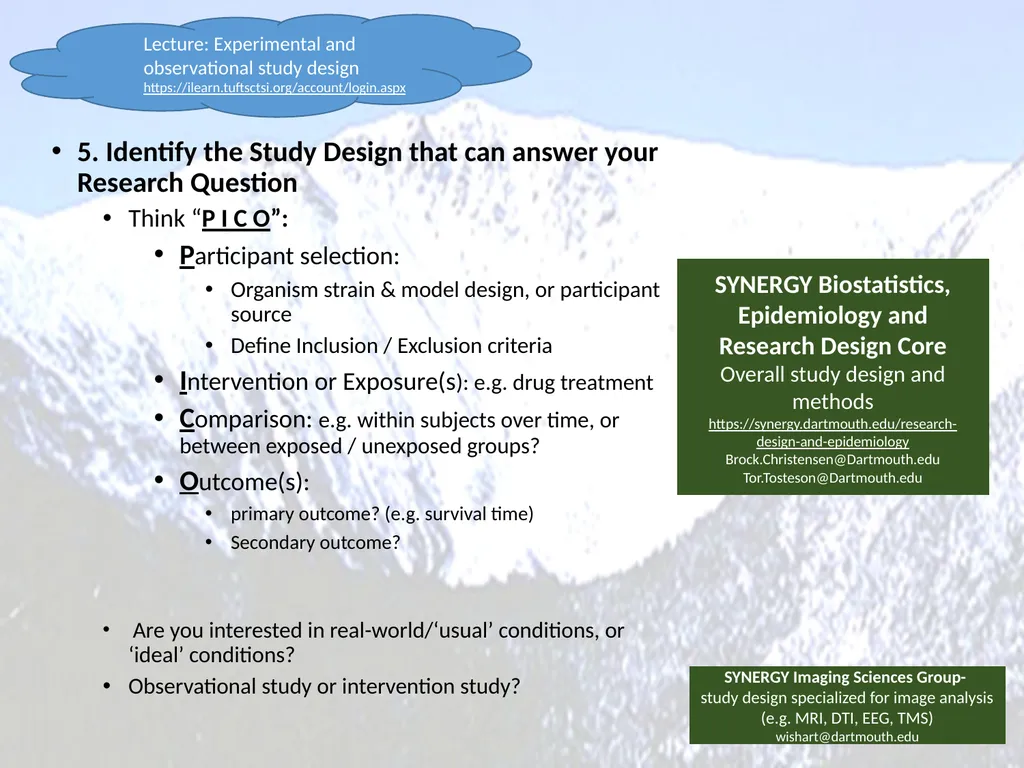
5. Identify the Study Design that can answer your Research Question
Think “P I C O”:
Participant selection:
Organism strain & model design, or participant source
Define Inclusion / Exclusion criteria
Intervention or Exposure(s): e.g. drug treatment
Comparison: e.g. within subjects over time, or between exposed / unexposed groups?
Outcome(s):
primary outcome? (e.g. survival time)
Secondary outcome?
Are you interested in real-world/‘usual’ conditions, or ‘ideal’ conditions?
Observational study or intervention study? SYNERGY Biostatistics, Epidemiology and Research Design Core
Overall study design and methods
https://synergy.dartmouth.edu/research-design-and-epidemiology
Brock.Christensen@Dartmouth.edu
Tor.Tosteson@Dartmouth.edu Lecture: Experimental and observational study design https://ilearn.tuftsctsi.org/account/login.aspx SYNERGY Imaging Sciences Group-
study design specialized for image analysis
(e.g. MRI, DTI, EEG, TMS)
wishart@dartmouth.edu<br>
Think “P I C O”:
Participant selection:
Organism strain & model design, or participant source
Define Inclusion / Exclusion criteria
Intervention or Exposure(s): e.g. drug treatment
Comparison: e.g. within subjects over time, or between exposed / unexposed groups?
Outcome(s):
primary outcome? (e.g. survival time)
Secondary outcome?
Are you interested in real-world/‘usual’ conditions, or ‘ideal’ conditions?
Observational study or intervention study? SYNERGY Biostatistics, Epidemiology and Research Design Core
Overall study design and methods
https://synergy.dartmouth.edu/research-design-and-epidemiology
Brock.Christensen@Dartmouth.edu
Tor.Tosteson@Dartmouth.edu Lecture: Experimental and observational study design https://ilearn.tuftsctsi.org/account/login.aspx SYNERGY Imaging Sciences Group-
study design specialized for image analysis
(e.g. MRI, DTI, EEG, TMS)
wishart@dartmouth.edu<br>
09
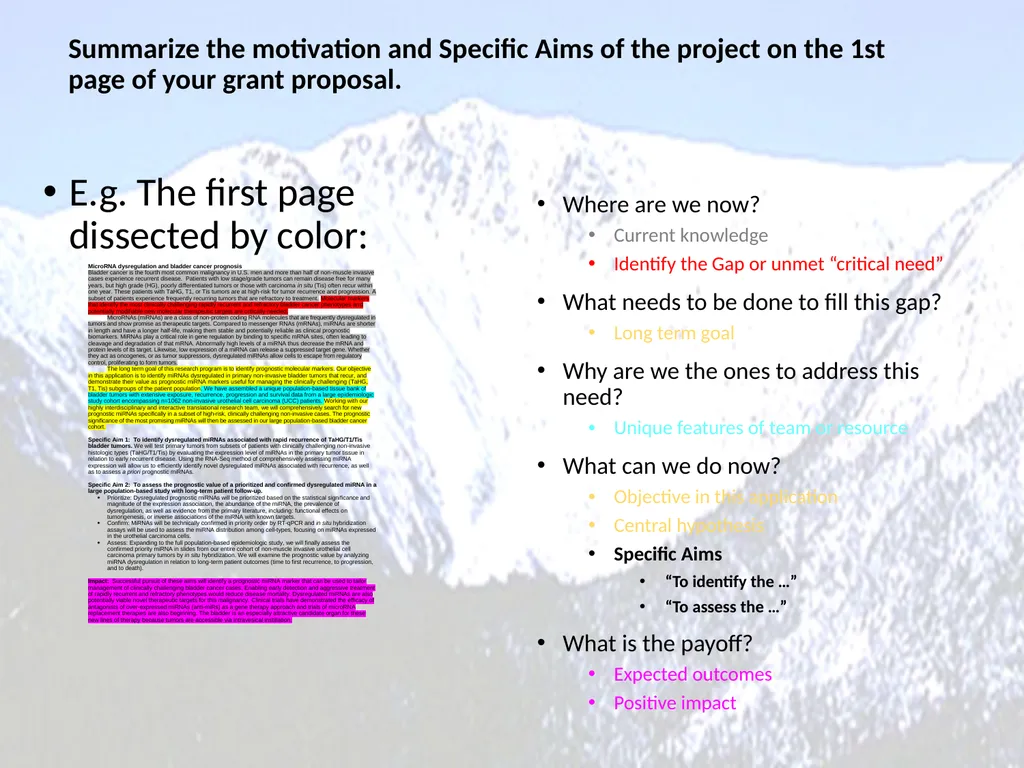
Summarize the motivation and Specific Aims of the project on the 1st page of your grant proposal. E.g. The first page dissected by color: Where are we now?
Current knowledge
Identify the Gap or unmet “critical need”
What needs to be done to fill this gap?
Long term goal
Why are we the ones to address this need?
Unique features of team or resource
What can we do now?
Objective in this application
Central hypothesis
Specific Aims
“To identify the …”
“To assess the …”
What is the payoff?
Expected outcomes
Positive impact<br>
Current knowledge
Identify the Gap or unmet “critical need”
What needs to be done to fill this gap?
Long term goal
Why are we the ones to address this need?
Unique features of team or resource
What can we do now?
Objective in this application
Central hypothesis
Specific Aims
“To identify the …”
“To assess the …”
What is the payoff?
Expected outcomes
Positive impact<br>
10
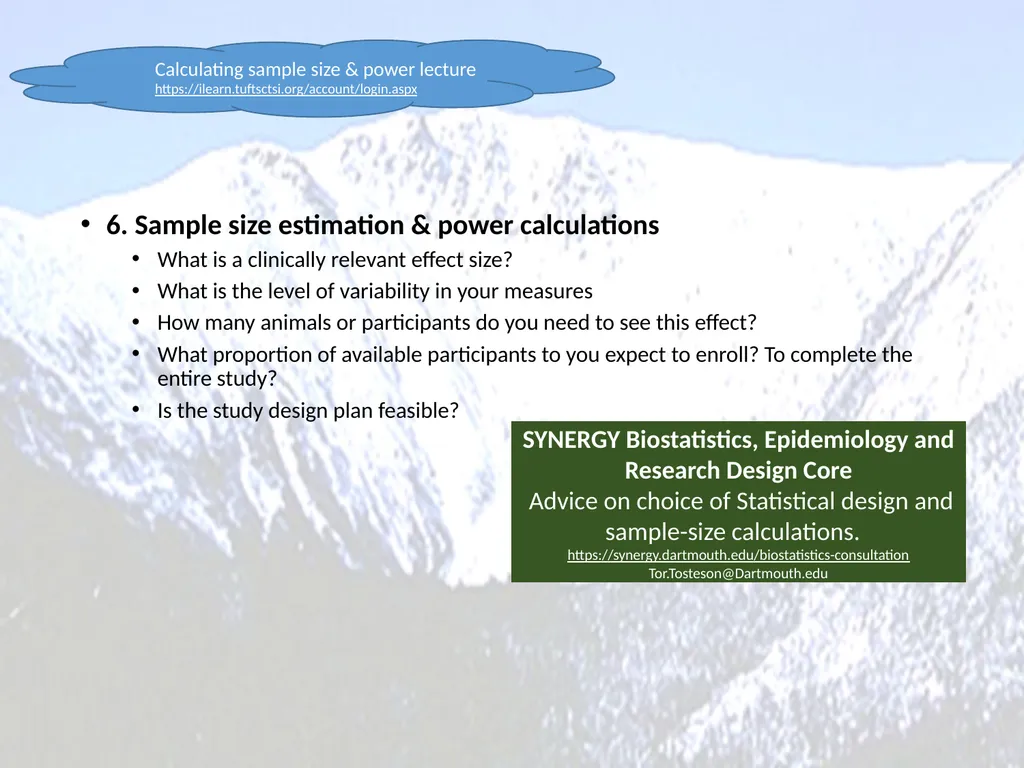
6. Sample size estimation & power calculations
What is a clinically relevant effect size?
What is the level of variability in your measures
How many animals or participants do you need to see this effect?
What proportion of available participants to you expect to enroll? To complete the entire study?
Is the study design plan feasible? SYNERGY Biostatistics, Epidemiology and Research Design Core
Advice on choice of Statistical design and sample-size calculations.
https://synergy.dartmouth.edu/biostatistics-consultation
Tor.Tosteson@Dartmouth.edu Calculating sample size & power lecture
https://ilearn.tuftsctsi.org/account/login.aspx<br>
What is a clinically relevant effect size?
What is the level of variability in your measures
How many animals or participants do you need to see this effect?
What proportion of available participants to you expect to enroll? To complete the entire study?
Is the study design plan feasible? SYNERGY Biostatistics, Epidemiology and Research Design Core
Advice on choice of Statistical design and sample-size calculations.
https://synergy.dartmouth.edu/biostatistics-consultation
Tor.Tosteson@Dartmouth.edu Calculating sample size & power lecture
https://ilearn.tuftsctsi.org/account/login.aspx<br>
11
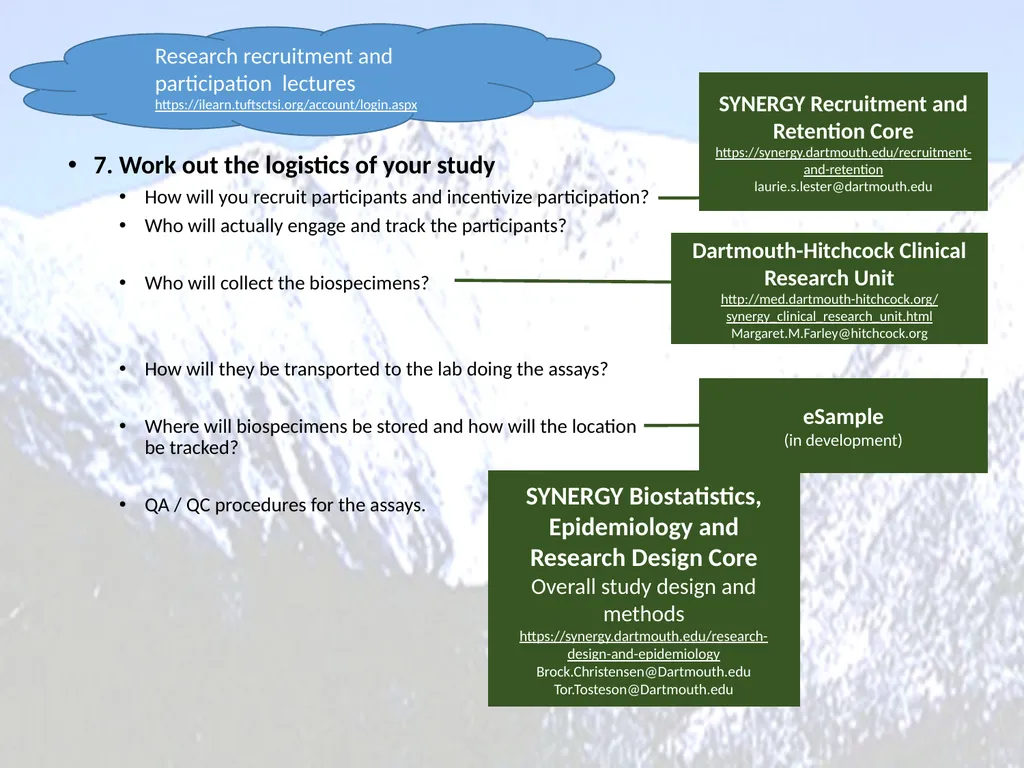
7. Work out the logistics of your study
How will you recruit participants and incentivize participation?
Who will actually engage and track the participants?
Who will collect the biospecimens?
How will they be transported to the lab doing the assays?
Where will biospecimens be stored and how will the location be tracked?
QA / QC procedures for the assays. Research recruitment and participation lectures
https://ilearn.tuftsctsi.org/account/login.aspx SYNERGY Biostatistics, Epidemiology and Research Design Core
Overall study design and methods
https://synergy.dartmouth.edu/research-design-and-epidemiology
Brock.Christensen@Dartmouth.edu
Tor.Tosteson@Dartmouth.edu<br>
How will you recruit participants and incentivize participation?
Who will actually engage and track the participants?
Who will collect the biospecimens?
How will they be transported to the lab doing the assays?
Where will biospecimens be stored and how will the location be tracked?
QA / QC procedures for the assays. Research recruitment and participation lectures
https://ilearn.tuftsctsi.org/account/login.aspx SYNERGY Biostatistics, Epidemiology and Research Design Core
Overall study design and methods
https://synergy.dartmouth.edu/research-design-and-epidemiology
Brock.Christensen@Dartmouth.edu
Tor.Tosteson@Dartmouth.edu<br>
12
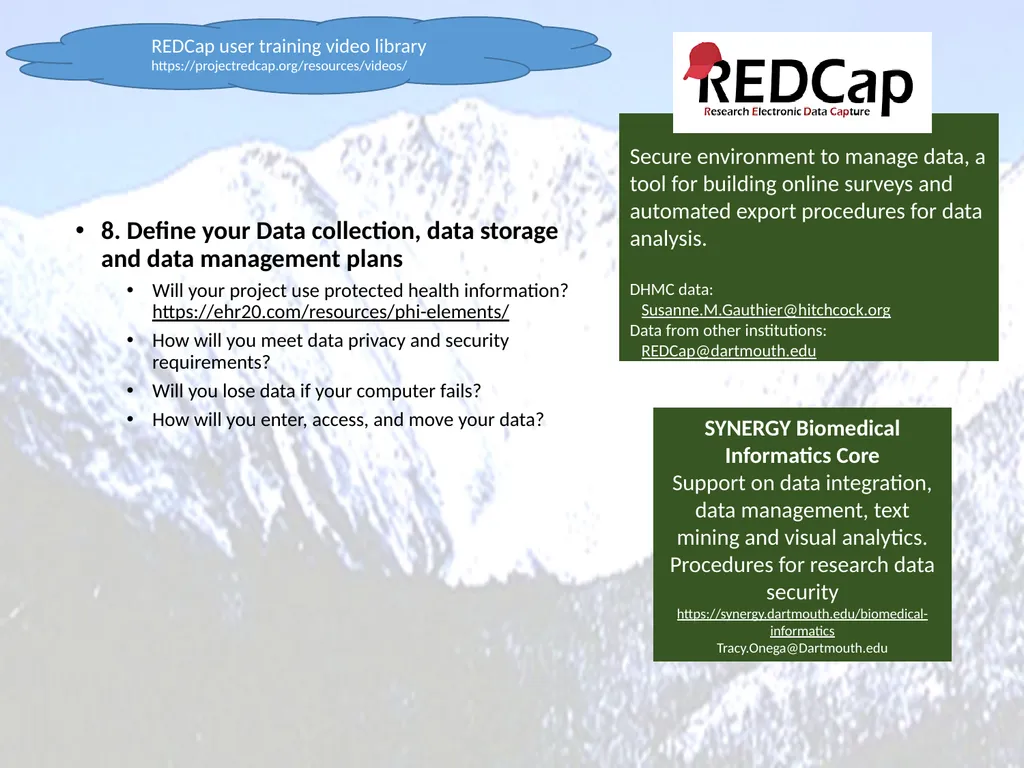
8. Define your Data collection, data storage and data management plans
Will your project use protected health information? https://ehr20.com/resources/phi-elements/
How will you meet data privacy and security requirements?
Will you lose data if your computer fails?
How will you enter, access, and move your data? SYNERGY Biomedical Informatics Core
Support on data integration, data management, text mining and visual analytics. Procedures for research data security
https://synergy.dartmouth.edu/biomedical-informatics
Tracy.Onega@Dartmouth.edu REDCap user training video library https://projectredcap.org/resources/videos/<br>
Will your project use protected health information? https://ehr20.com/resources/phi-elements/
How will you meet data privacy and security requirements?
Will you lose data if your computer fails?
How will you enter, access, and move your data? SYNERGY Biomedical Informatics Core
Support on data integration, data management, text mining and visual analytics. Procedures for research data security
https://synergy.dartmouth.edu/biomedical-informatics
Tracy.Onega@Dartmouth.edu REDCap user training video library https://projectredcap.org/resources/videos/<br>
13
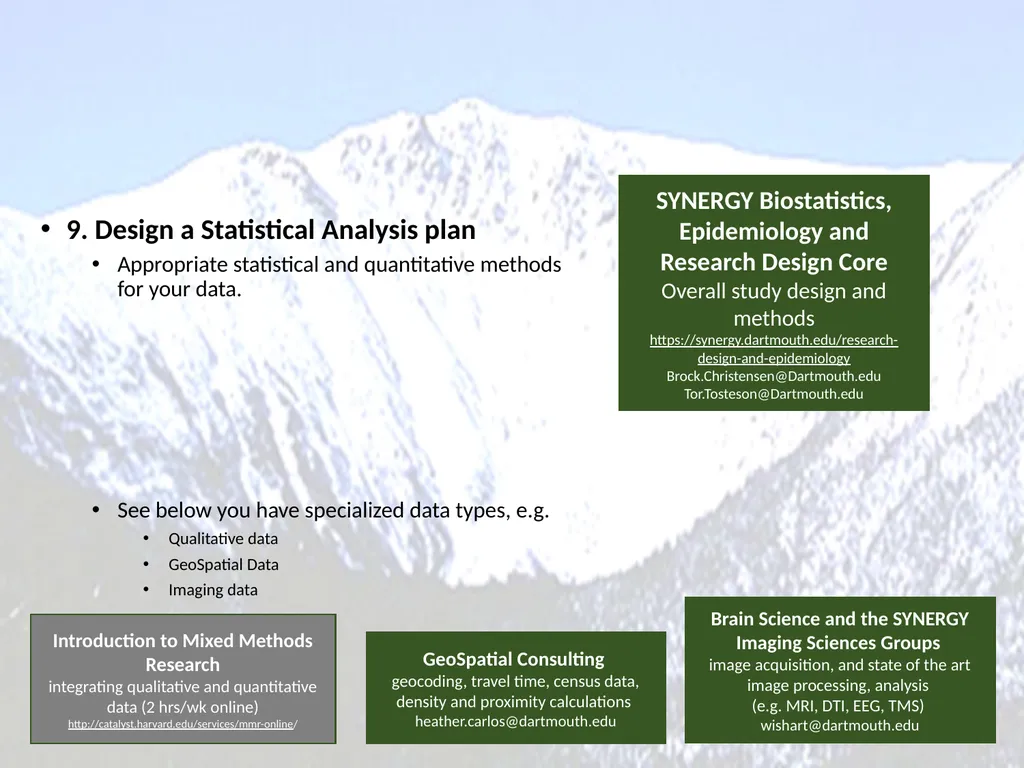
9. Design a Statistical Analysis plan
Appropriate statistical and quantitative methods for your data.
See below you have specialized data types, e.g.
Qualitative data
GeoSpatial Data
Imaging data GeoSpatial Consulting
geocoding, travel time, census data, density and proximity calculations
heather.carlos@dartmouth.edu Brain Science and the SYNERGY Imaging Sciences Groups
image acquisition, and state of the art image processing, analysis
(e.g. MRI, DTI, EEG, TMS)
wishart@dartmouth.edu Introduction to Mixed Methods Research
integrating qualitative and quantitative data (2 hrs/wk online) http://catalyst.harvard.edu/services/mmr-online/ SYNERGY Biostatistics, Epidemiology and Research Design Core
Overall study design and methods
https://synergy.dartmouth.edu/research-design-and-epidemiology
Brock.Christensen@Dartmouth.edu
Tor.Tosteson@Dartmouth.edu<br>
Appropriate statistical and quantitative methods for your data.
See below you have specialized data types, e.g.
Qualitative data
GeoSpatial Data
Imaging data GeoSpatial Consulting
geocoding, travel time, census data, density and proximity calculations
heather.carlos@dartmouth.edu Brain Science and the SYNERGY Imaging Sciences Groups
image acquisition, and state of the art image processing, analysis
(e.g. MRI, DTI, EEG, TMS)
wishart@dartmouth.edu Introduction to Mixed Methods Research
integrating qualitative and quantitative data (2 hrs/wk online) http://catalyst.harvard.edu/services/mmr-online/ SYNERGY Biostatistics, Epidemiology and Research Design Core
Overall study design and methods
https://synergy.dartmouth.edu/research-design-and-epidemiology
Brock.Christensen@Dartmouth.edu
Tor.Tosteson@Dartmouth.edu<br>
14
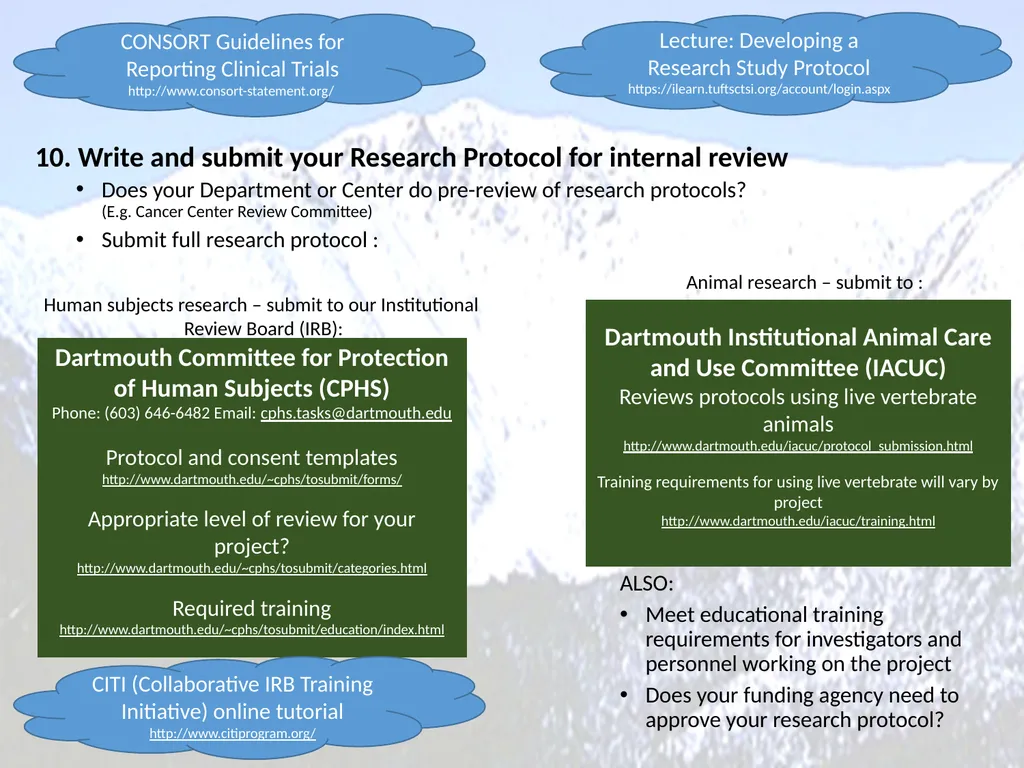
10. Write and submit your Research Protocol for internal review Does your Department or Center do pre-review of research protocols? (E.g. Cancer Center Review Committee)
Submit full research protocol : Animal research – submit to : Dartmouth Committee for Protection of Human Subjects (CPHS)
Phone: (603) 646-6482 Email: cphs.tasks@dartmouth.edu
Protocol and consent templates
http://www.dartmouth.edu/~cphs/tosubmit/forms/
Appropriate level of review for your project?
http://www.dartmouth.edu/~cphs/tosubmit/categories.html
Required training http://www.dartmouth.edu/~cphs/tosubmit/education/index.html Dartmouth Institutional Animal Care and Use Committee (IACUC)
Reviews protocols using live vertebrate animals
http://www.dartmouth.edu/iacuc/protocol_submission.html
Training requirements for using live vertebrate will vary by project
http://www.dartmouth.edu/iacuc/training.html Lecture: Developing a Research Study Protocol
https://ilearn.tuftsctsi.org/account/login.aspx CONSORT Guidelines for Reporting Clinical Trials
http://www.consort-statement.org/ CITI (Collaborative IRB Training Initiative) online tutorial
http://www.citiprogram.org/ ALSO:
Meet educational training requirements for investigators and personnel working on the project
Does your funding agency need to approve your research protocol? Human subjects research – submit to our Institutional
Review Board (IRB):<br>
Submit full research protocol : Animal research – submit to : Dartmouth Committee for Protection of Human Subjects (CPHS)
Phone: (603) 646-6482 Email: cphs.tasks@dartmouth.edu
Protocol and consent templates
http://www.dartmouth.edu/~cphs/tosubmit/forms/
Appropriate level of review for your project?
http://www.dartmouth.edu/~cphs/tosubmit/categories.html
Required training http://www.dartmouth.edu/~cphs/tosubmit/education/index.html Dartmouth Institutional Animal Care and Use Committee (IACUC)
Reviews protocols using live vertebrate animals
http://www.dartmouth.edu/iacuc/protocol_submission.html
Training requirements for using live vertebrate will vary by project
http://www.dartmouth.edu/iacuc/training.html Lecture: Developing a Research Study Protocol
https://ilearn.tuftsctsi.org/account/login.aspx CONSORT Guidelines for Reporting Clinical Trials
http://www.consort-statement.org/ CITI (Collaborative IRB Training Initiative) online tutorial
http://www.citiprogram.org/ ALSO:
Meet educational training requirements for investigators and personnel working on the project
Does your funding agency need to approve your research protocol? Human subjects research – submit to our Institutional
Review Board (IRB):<br>
15
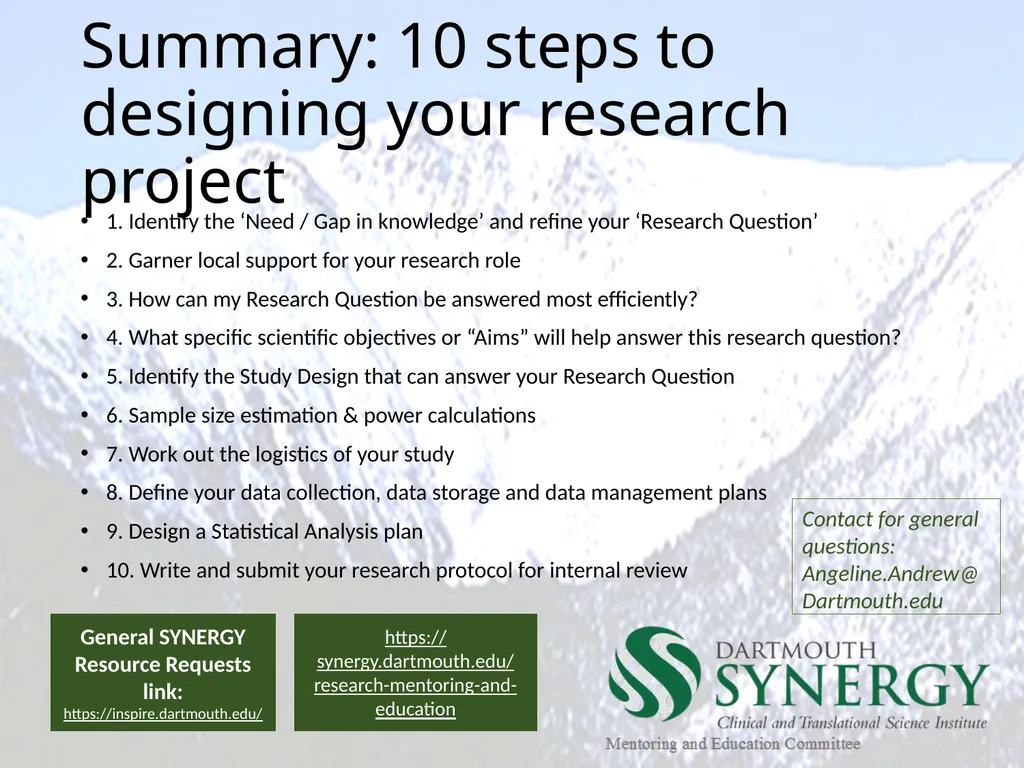
Summary: 10 steps to designing your research project 1. Identify the ‘Need / Gap in knowledge’ and refine your ‘Research Question’
2. Garner local support for your research role
3. How can my Research Question be answered most efficiently?
4. What specific scientific objectives or “Aims” will help answer this research question?
5. Identify the Study Design that can answer your Research Question
6. Sample size estimation & power calculations
7. Work out the logistics of your study
8. Define your data collection, data storage and data management plans
9. Design a Statistical Analysis plan
10. Write and submit your research protocol for internal review https://synergy.dartmouth.edu/research-mentoring-and-education General SYNERGY
Resource Requests link:
https://inspire.dartmouth.edu/ Contact for general questions:
Angeline.Andrew@Dartmouth.edu<br>
2. Garner local support for your research role
3. How can my Research Question be answered most efficiently?
4. What specific scientific objectives or “Aims” will help answer this research question?
5. Identify the Study Design that can answer your Research Question
6. Sample size estimation & power calculations
7. Work out the logistics of your study
8. Define your data collection, data storage and data management plans
9. Design a Statistical Analysis plan
10. Write and submit your research protocol for internal review https://synergy.dartmouth.edu/research-mentoring-and-education General SYNERGY
Resource Requests link:
https://inspire.dartmouth.edu/ Contact for general questions:
Angeline.Andrew@Dartmouth.edu<br>
16
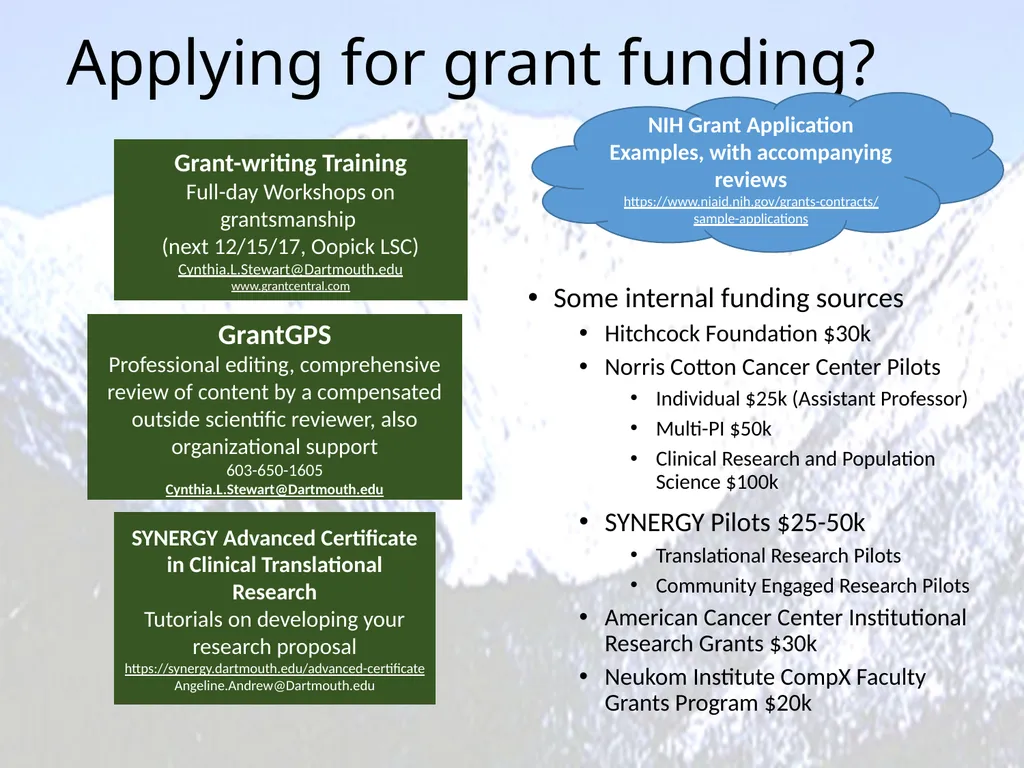
Applying for grant funding? Some internal funding sources
Hitchcock Foundation $30k
Norris Cotton Cancer Center Pilots
Individual $25k (Assistant Professor)
Multi-PI $50k
Clinical Research and Population Science $100k
SYNERGY Pilots $25-50k
Translational Research Pilots
Community Engaged Research Pilots
American Cancer Center Institutional Research Grants $30k
Neukom Institute CompX Faculty Grants Program $20k GrantGPS
Professional editing, comprehensive review of content by a compensated outside scientific reviewer, also organizational support
603-650-1605
Cynthia.L.Stewart@Dartmouth.edu Grant-writing Training
Full-day Workshops on grantsmanship
(next 12/15/17, Oopick LSC)
Cynthia.L.Stewart@Dartmouth.edu
www.grantcentral.com SYNERGY Advanced Certificate in Clinical Translational Research
Tutorials on developing your research proposal
https://synergy.dartmouth.edu/advanced-certificate
Angeline.Andrew@Dartmouth.edu NIH Grant Application Examples, with accompanying reviews
https://www.niaid.nih.gov/grants-contracts/sample-applications<br>
Hitchcock Foundation $30k
Norris Cotton Cancer Center Pilots
Individual $25k (Assistant Professor)
Multi-PI $50k
Clinical Research and Population Science $100k
SYNERGY Pilots $25-50k
Translational Research Pilots
Community Engaged Research Pilots
American Cancer Center Institutional Research Grants $30k
Neukom Institute CompX Faculty Grants Program $20k GrantGPS
Professional editing, comprehensive review of content by a compensated outside scientific reviewer, also organizational support
603-650-1605
Cynthia.L.Stewart@Dartmouth.edu Grant-writing Training
Full-day Workshops on grantsmanship
(next 12/15/17, Oopick LSC)
Cynthia.L.Stewart@Dartmouth.edu
www.grantcentral.com SYNERGY Advanced Certificate in Clinical Translational Research
Tutorials on developing your research proposal
https://synergy.dartmouth.edu/advanced-certificate
Angeline.Andrew@Dartmouth.edu NIH Grant Application Examples, with accompanying reviews
https://www.niaid.nih.gov/grants-contracts/sample-applications<br>
17
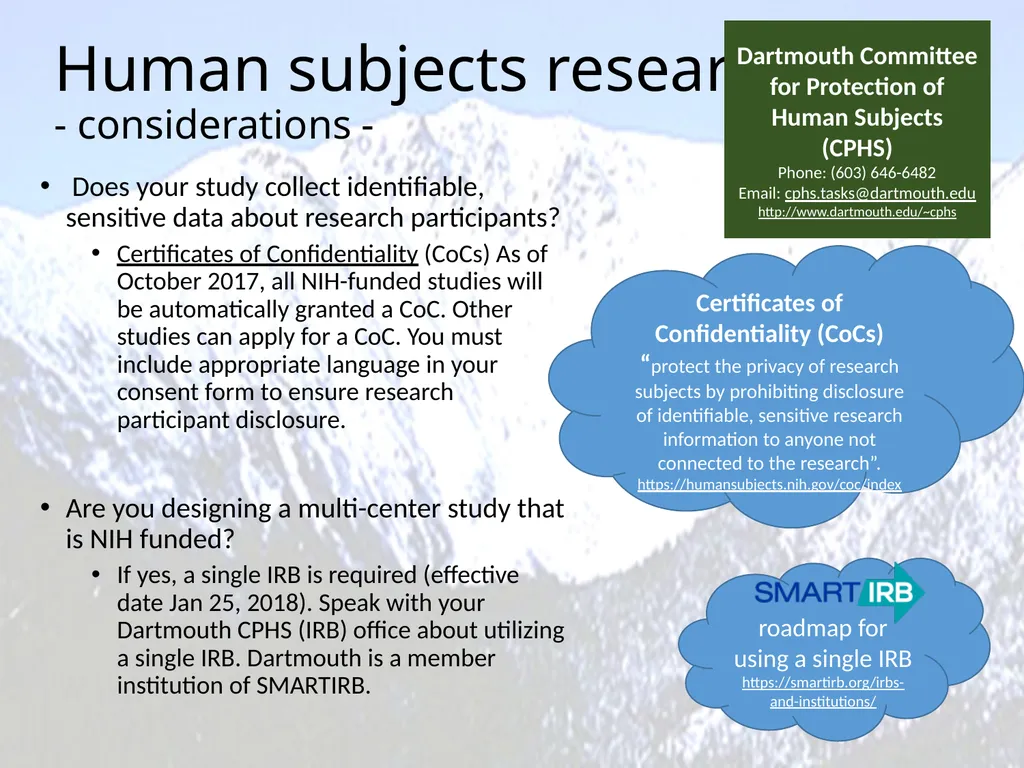
Human subjects research
- considerations - Does your study collect identifiable, sensitive data about research participants?
Certificates of Confidentiality (CoCs) As of October 2017, all NIH-funded studies will be automatically granted a CoC. Other studies can apply for a CoC. You must include appropriate language in your consent form to ensure research participant disclosure.
Are you designing a multi-center study that is NIH funded?
If yes, a single IRB is required (effective date Jan 25, 2018). Speak with your Dartmouth CPHS (IRB) office about utilizing a single IRB. Dartmouth is a member institution of SMARTIRB. roadmap for using a single IRB
https://smartirb.org/irbs-and-institutions/ Dartmouth Committee for Protection of Human Subjects (CPHS)
Phone: (603) 646-6482 Email: cphs.tasks@dartmouth.edu
http://www.dartmouth.edu/~cphs Certificates of Confidentiality (CoCs) “protect the privacy of research subjects by prohibiting disclosure of identifiable, sensitive research information to anyone not connected to the research”. https://humansubjects.nih.gov/coc/index<br>
Certificates of Confidentiality (CoCs) As of October 2017, all NIH-funded studies will be automatically granted a CoC. Other studies can apply for a CoC. You must include appropriate language in your consent form to ensure research participant disclosure.
Are you designing a multi-center study that is NIH funded?
If yes, a single IRB is required (effective date Jan 25, 2018). Speak with your Dartmouth CPHS (IRB) office about utilizing a single IRB. Dartmouth is a member institution of SMARTIRB. roadmap for using a single IRB
https://smartirb.org/irbs-and-institutions/ Dartmouth Committee for Protection of Human Subjects (CPHS)
Phone: (603) 646-6482 Email: cphs.tasks@dartmouth.edu
http://www.dartmouth.edu/~cphs Certificates of Confidentiality (CoCs) “protect the privacy of research subjects by prohibiting disclosure of identifiable, sensitive research information to anyone not connected to the research”. https://humansubjects.nih.gov/coc/index<br>
18
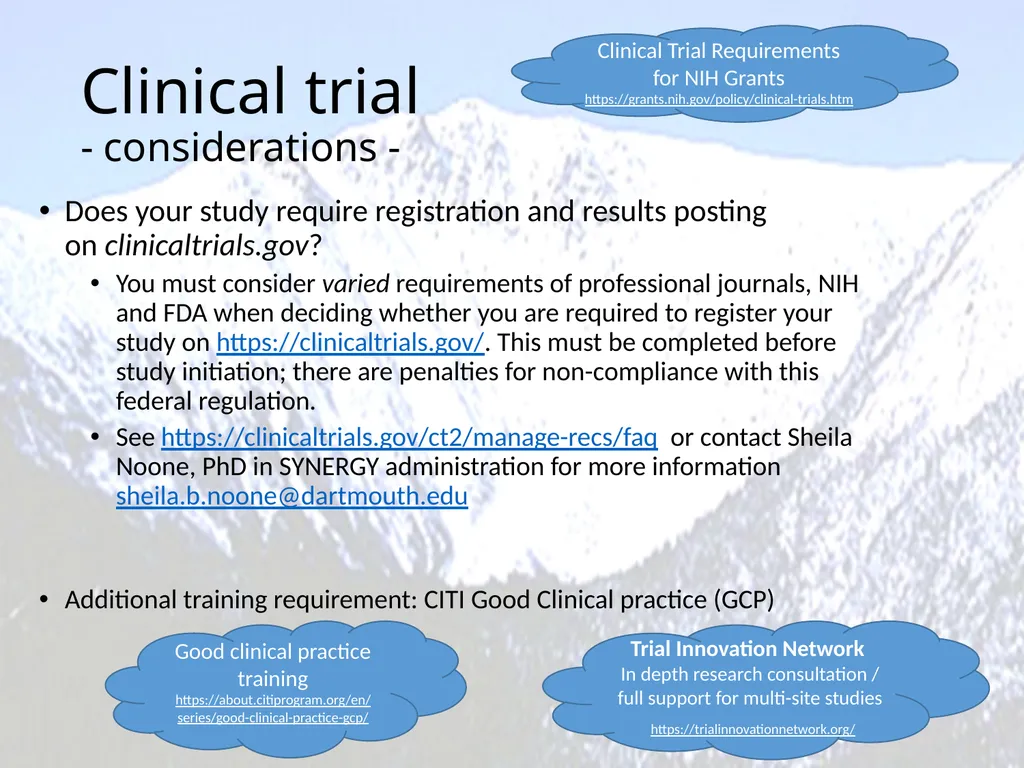
Clinical trial
- considerations - Does your study require registration and results posting on clinicaltrials.gov?
You must consider varied requirements of professional journals, NIH and FDA when deciding whether you are required to register your study on https://clinicaltrials.gov/. This must be completed before study initiation; there are penalties for non-compliance with this federal regulation.
See https://clinicaltrials.gov/ct2/manage-recs/faq or contact Sheila Noone, PhD in SYNERGY administration for more information sheila.b.noone@dartmouth.edu
Additional training requirement: CITI Good Clinical practice (GCP) Clinical Trial Requirements for NIH Grants
https://grants.nih.gov/policy/clinical-trials.htm Trial Innovation Network
In depth research consultation / full support for multi-site studies
https://trialinnovationnetwork.org/ Good clinical practice training
https://about.citiprogram.org/en/series/good-clinical-practice-gcp/<br>
You must consider varied requirements of professional journals, NIH and FDA when deciding whether you are required to register your study on https://clinicaltrials.gov/. This must be completed before study initiation; there are penalties for non-compliance with this federal regulation.
See https://clinicaltrials.gov/ct2/manage-recs/faq or contact Sheila Noone, PhD in SYNERGY administration for more information sheila.b.noone@dartmouth.edu
Additional training requirement: CITI Good Clinical practice (GCP) Clinical Trial Requirements for NIH Grants
https://grants.nih.gov/policy/clinical-trials.htm Trial Innovation Network
In depth research consultation / full support for multi-site studies
https://trialinnovationnetwork.org/ Good clinical practice training
https://about.citiprogram.org/en/series/good-clinical-practice-gcp/<br>