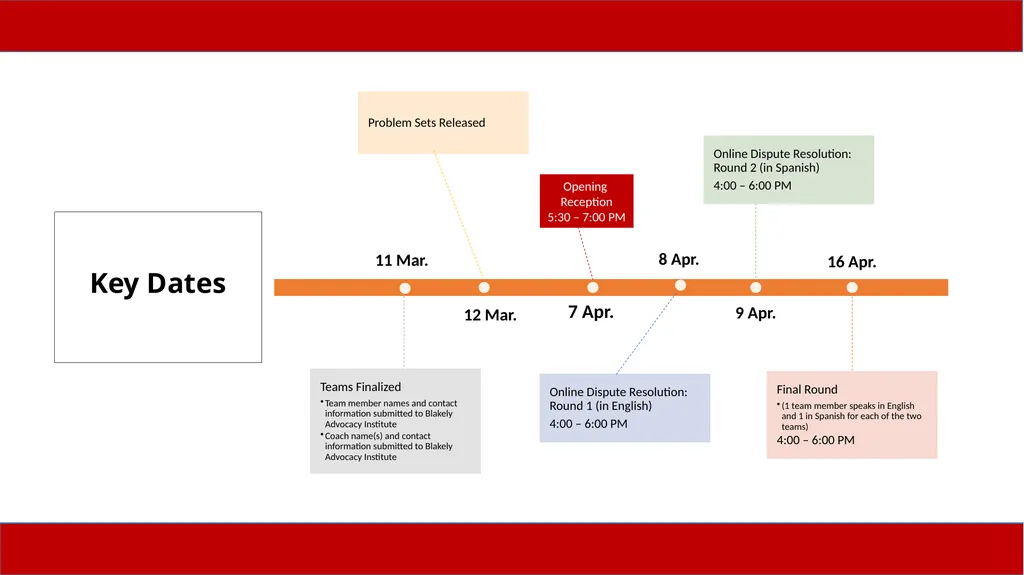
Train The Trainers Bilingual Dispute Resolution Competition 2021 (updated 2242021) Alfonso Lopez de la Osa Escribano, Director, Center for U.S. and Mexican Law Karen Jones, Executive Director, Global and Graduate Programs James Lawrence,
"Train The Trainers Bilingual Dispute Resolution" is the property of its rightful owner. Permission is granted to
download and print the materials on this website for personal, non-commercial use only, and to display it
on your personal computer provided you do not modify the materials and that you retain all copyright
notices contained in the materials. By downloading content from our website, you accept the terms of this
agreement.
Presentation Transcript
01
Train The Trainers Bilingual Dispute Resolution Competition 2021 (updated 2/24/2021)<br>
02
Alfonso Lopez de la Osa Escribano, Director, Center for U.S. and Mexican Law
Karen Jones, Executive Director, Global and Graduate Programs
James Lawrence, Executive Director, Blakely Advocacy Institute UH Law Center – BDRC Pilot<br>
03
About the BDRC Spanish is second most prevalent language in Houston
Spanish is challenging the English-only model in the U.S.
Increasing multi-lingual business and communication
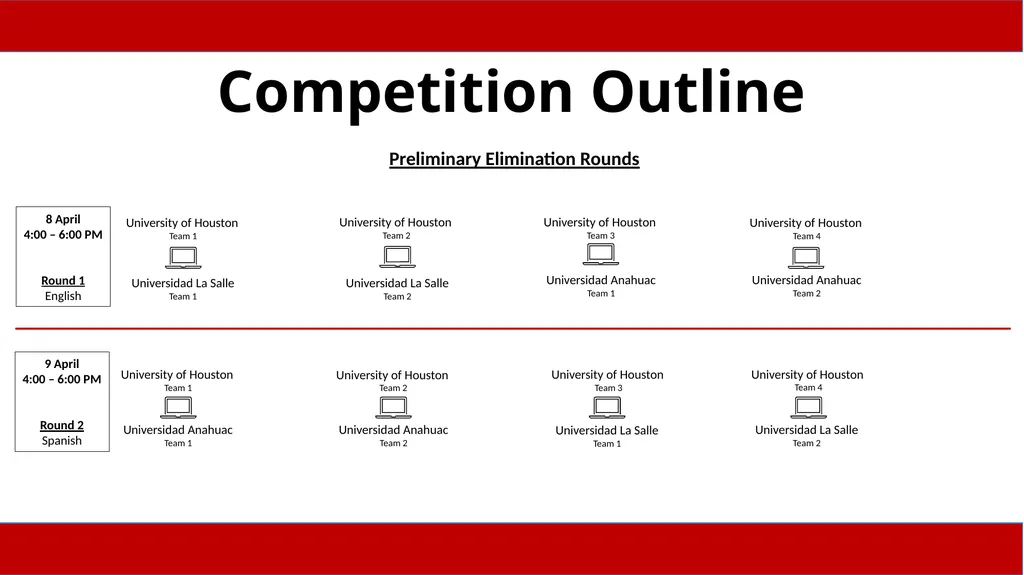
Competition Outline University of Houston
Team 1 Universidad La Salle
Team 1 Universidad Anahuac
Team 1 Preliminary Elimination Rounds 8 April
4:00 – 6:00 PM
Round 1
English University of Houston
Team 4 University of Houston
Team 3 University of Houston
Team 2 Universidad La Salle
Team 2 Universidad Anahuac
Team 2 University of Houston
Team 1 Universidad Anahuac
Team 1 University of Houston
Team 2 Universidad Anahuac
Team 2 University of Houston
Team 3 Universidad La Salle
Team 1 University of Houston
Team 4 Universidad La Salle
Team 2 9 April
4:00 – 6:00 PM
Round 2
Spanish<br>
06
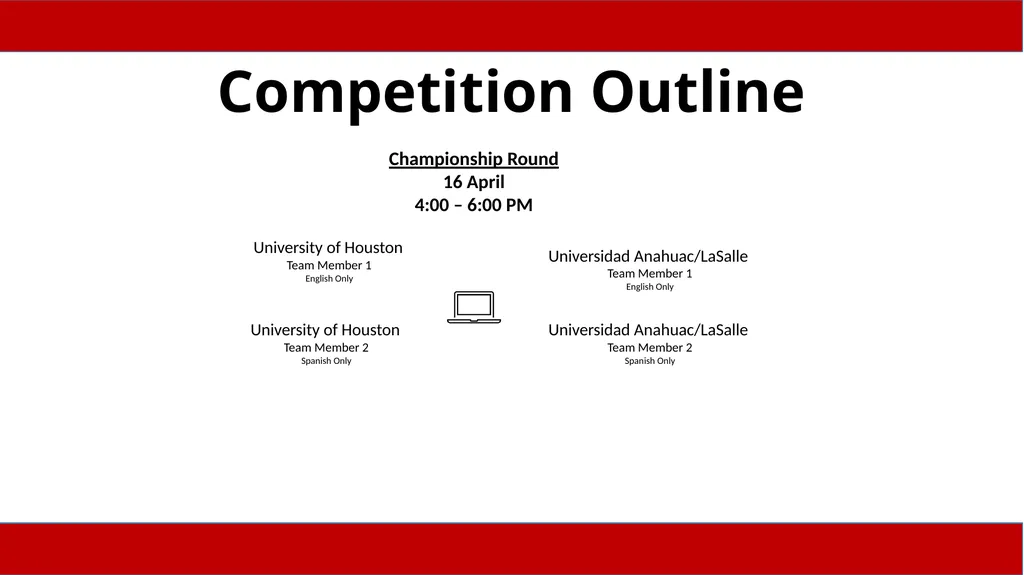
Competition Outline Championship Round
16 April
4:00 – 6:00 PM University of Houston
Team Member 1
English Only Universidad Anahuac/LaSalle
Team Member 1
English Only University of Houston
Team Member 2
Spanish Only Universidad Anahuac/LaSalle
Team Member 2
Spanish Only<br>
07
BDRC: Why this competition? 7<br>
08
Hispanic lawyers : more & more working opportunities in the U.S. and Mexico.
Greater demand from law firms in the U.S.
Professional advantage of bilingual, binational, bicultural lawyers
Few challenges though, but you can cope with them !<br>
09
Knowledge and understanding of respective legal systems: e.g. the Mexican and the U.S.
Roman or Napoleonic codification
Anglo-Saxon system
Passing the exam of the corresponding bar
Special capacity of binational lawyers to adapt to different legal cultures: they normally have a binational, bicultural or transnational training
They will know what to do to succeed in the transaction, to get the deal done<br>
10
Binational lawyer or international lawyer?
Binational lawyer
a term increasingly used in the United States, comparative law has become an unparalleled tool,
when knowing the law of each country,
but also when integrating the comparison and anticipating obstacles or pitfalls
To this end, the education and training of binational lawyers should seek to be as similar as possible in both systems of law.
Knowledge of languages
Controversy about a Binational lawyers
Detractors: doesn’t integrate the relationship that may exist between different countries, but deals with two nations juxtaposed or parallel
Supporters:
it represents an even greater degree of integration
binational lawyer can represent the paradigm of the person who has assumed and integrated two legal cultures and is equally competent in both<br>
11
The skills and capacities of a binational lawyer:
Excellent student with the intellectual interest of knowing how other legal systems work;
Good communicator, knows how to move and adapt quickly to the environment, (work meetings, with clients, or in Courts);
Excellent communication skills: expresses arguments in orderly and structured manner, as a person used to work in different legal and cultural environments (comprehension)
Follows continuing education trainings in the countries they are interested in (Bars, Professional associations), on national topics and comparative law topics
Complies with the accreditation or equivalences systems by recognized authorities: JD, LLM, PhD. etc.
Becomes an expert in both countries at the same time, or has been an expert in one specific field and develops an expertise in the other country’s same field afterwards.<br>
12
coaching 12<br>
13
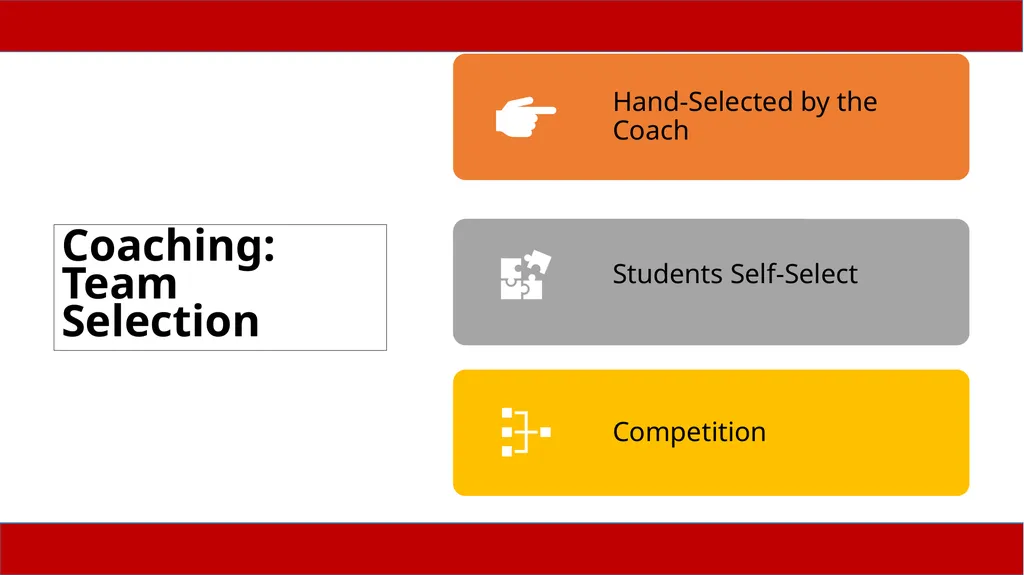
Coaching: Team Selection 13<br>
14
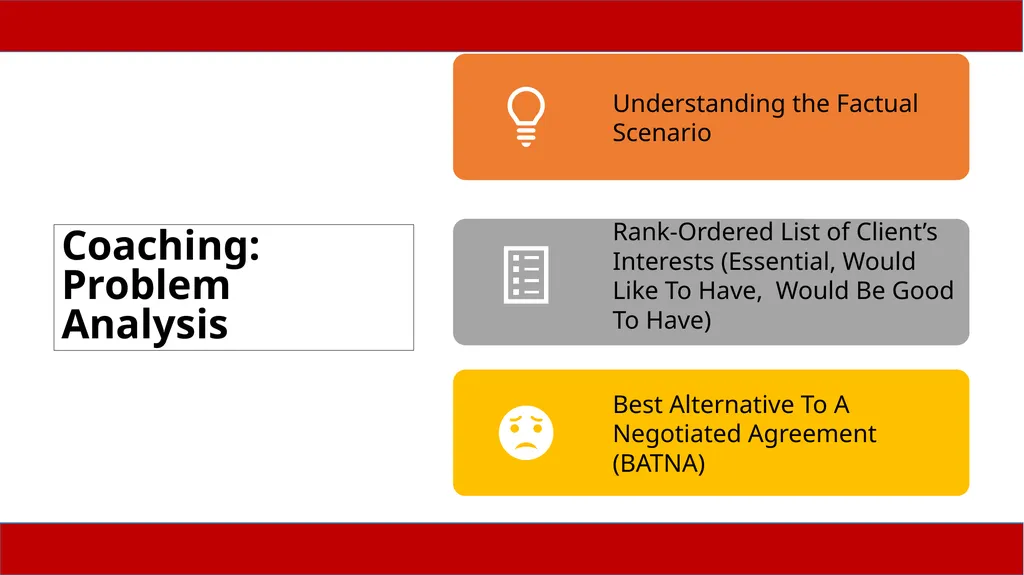
Coaching: Problem Analysis 14<br>
15
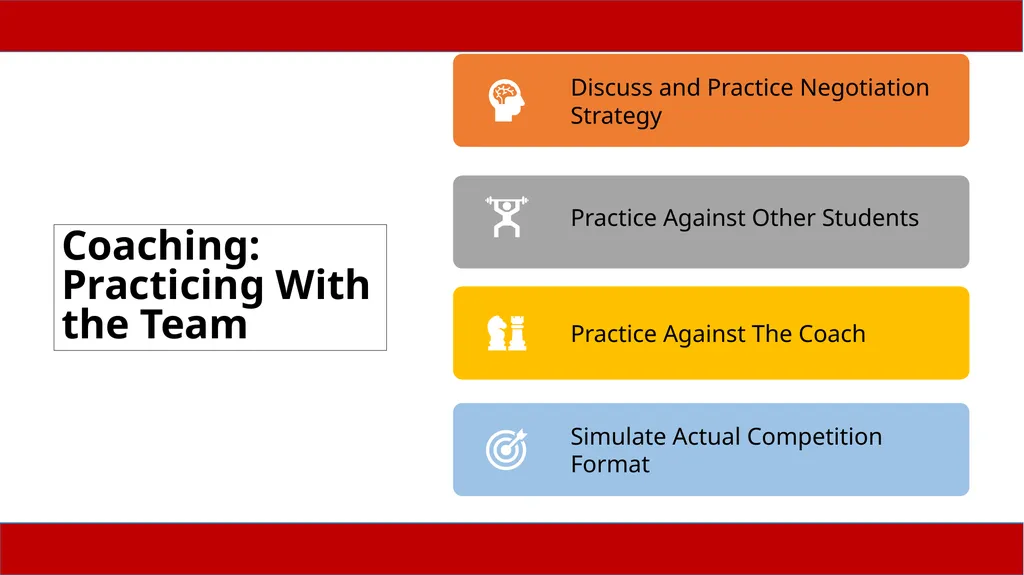
Coaching: Practicing With the Team 15<br>
16
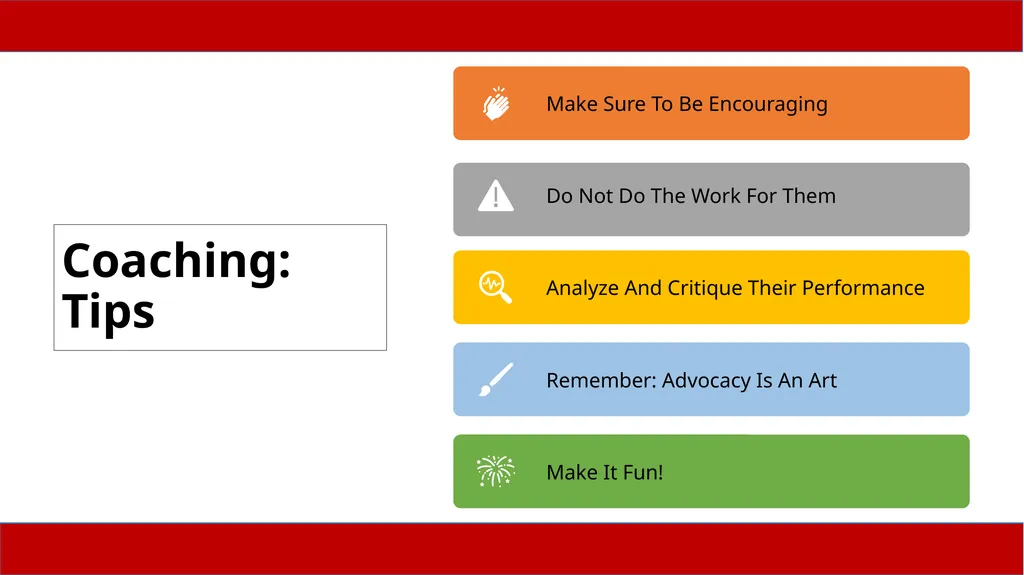
Coaching: Tips 16<br>
17
Judging 17<br>
18
BDRC judge Responsible for judging the rounds of the competition 18<br>
19
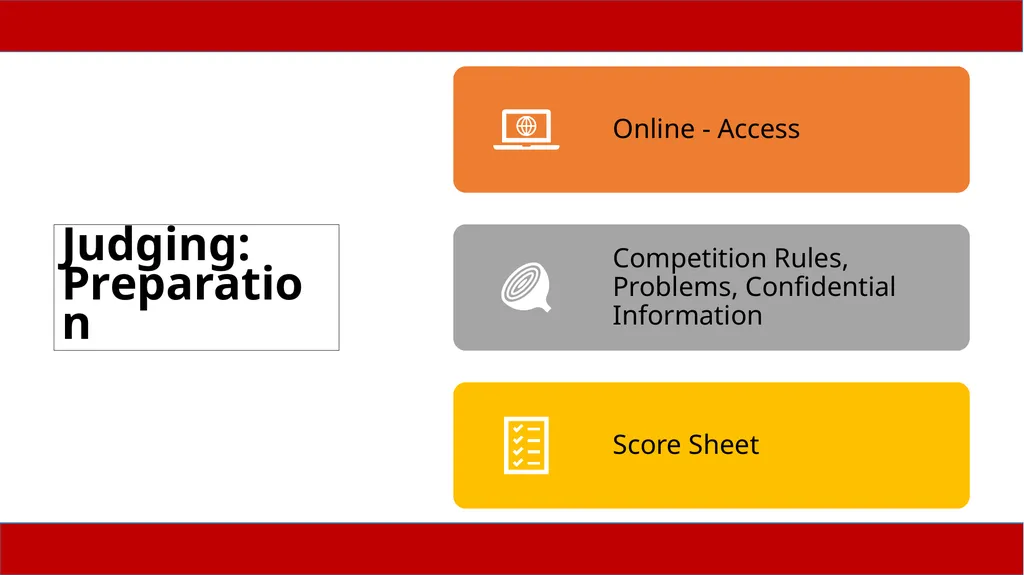
Judging: Preparation 19<br>
20
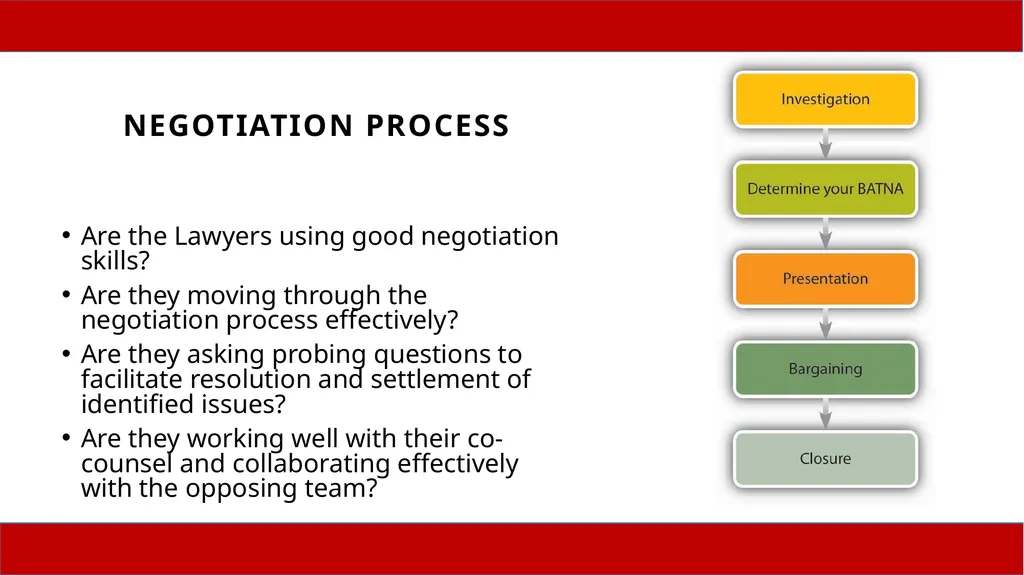
Negotiation Process Are the Lawyers using good negotiation skills?
Are they moving through the negotiation process effectively?
Are they asking probing questions to facilitate resolution and settlement of identified issues?
Are they working well with their co-counsel and collaborating effectively with the opposing team? 20<br>
21
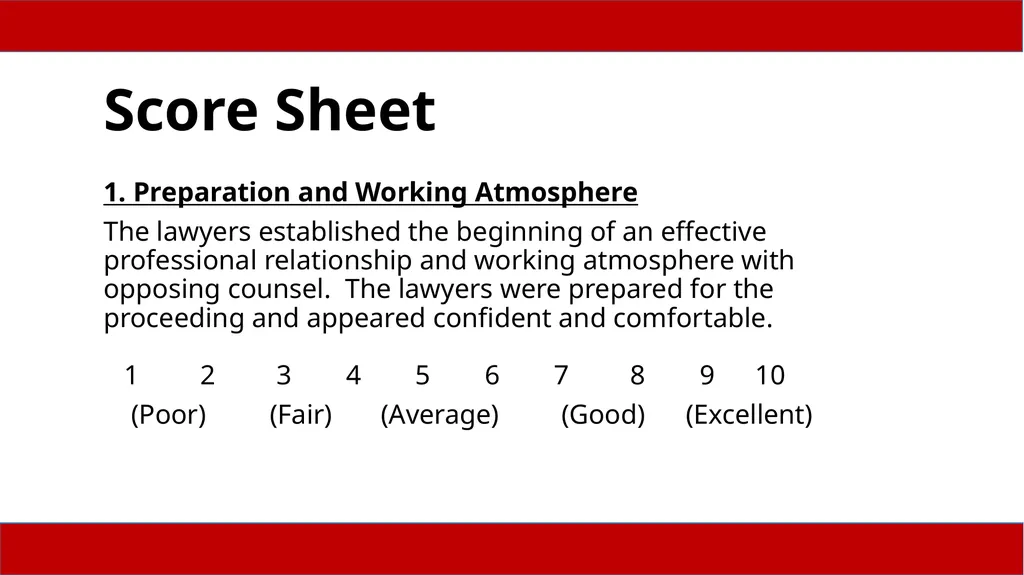
1. Preparation and Working Atmosphere
The lawyers established the beginning of an effective professional relationship and working atmosphere with opposing counsel. The lawyers were prepared for the proceeding and appeared confident and comfortable. 1 2 3 4 5 6 7 8 9 10
(Poor) (Fair) (Average) (Good) (Excellent) 21 Score Sheet<br>
22
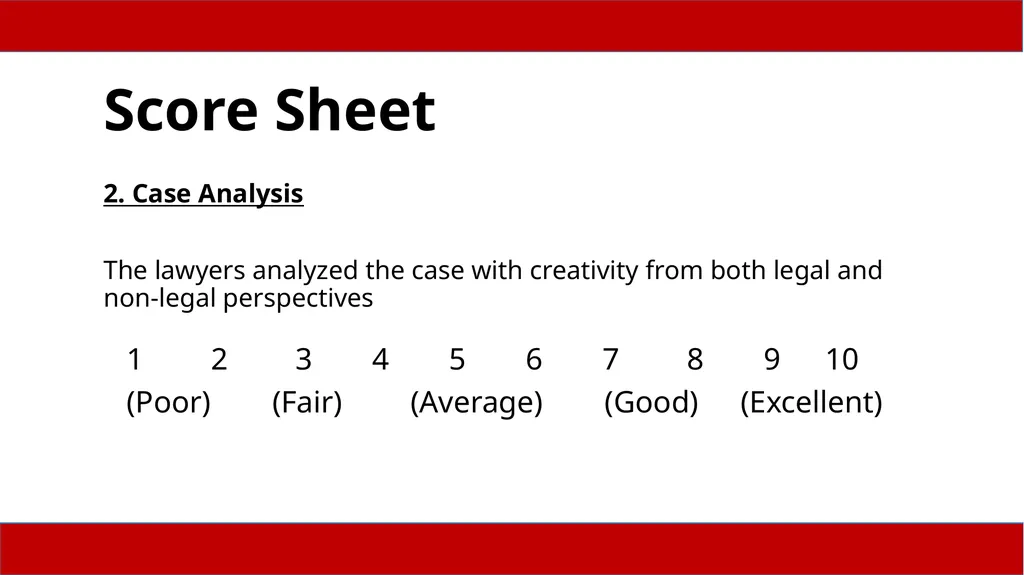
2. Case Analysis
The lawyers analyzed the case with creativity from both legal and non-legal perspectives 1 2 3 4 5 6 7 8 9 10
(Poor) (Fair) (Average) (Good) (Excellent) 22 Score Sheet<br>
23
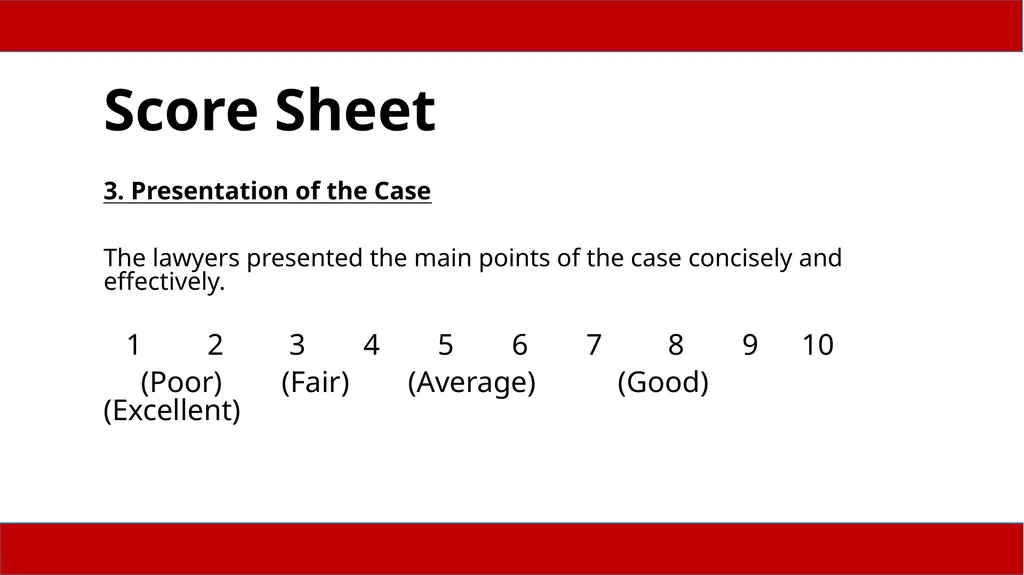
3. Presentation of the Case
The lawyers presented the main points of the case concisely and effectively.
1 2 3 4 5 6 7 8 9 10
(Poor) (Fair) (Average) (Good) (Excellent) 23 Score Sheet<br>
24
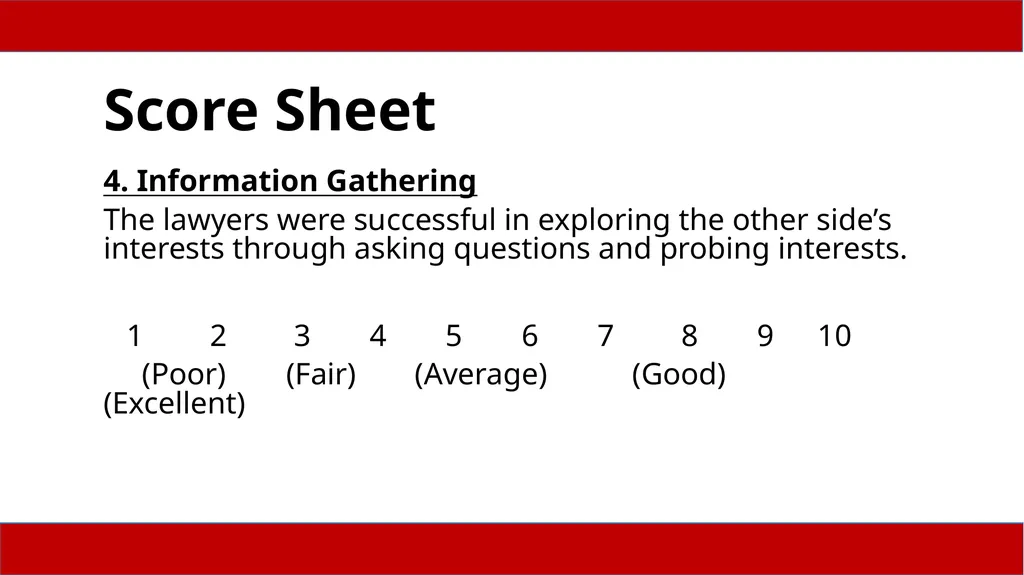
4. Information Gathering
The lawyers were successful in exploring the other side’s interests through asking questions and probing interests. 1 2 3 4 5 6 7 8 9 10
(Poor) (Fair) (Average) (Good) (Excellent) 24 Score Sheet<br>
25
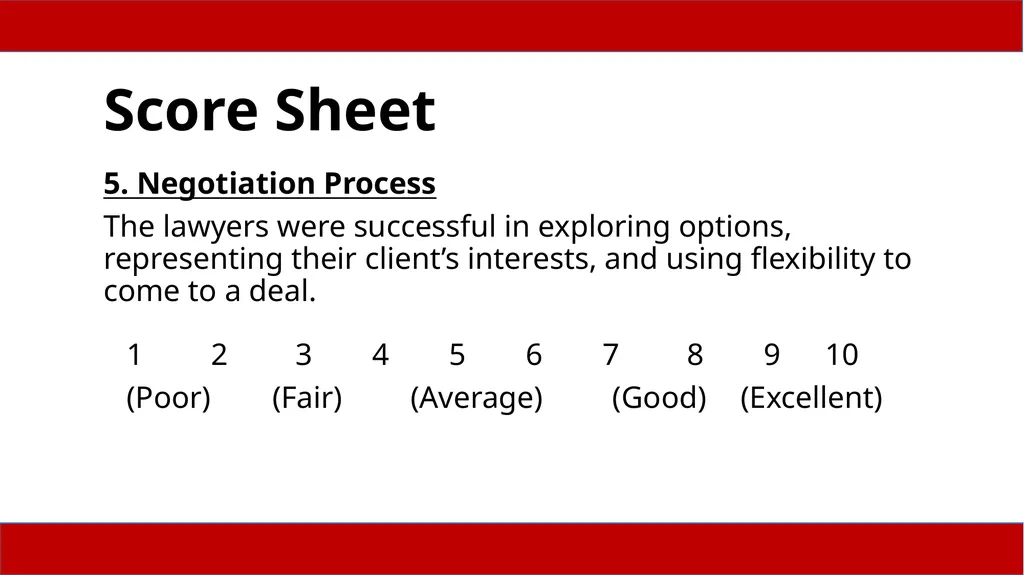
5. Negotiation Process
The lawyers were successful in exploring options, representing their client’s interests, and using flexibility to come to a deal. 1 2 3 4 5 6 7 8 9 10
(Poor) (Fair) (Average) (Good) (Excellent) 25 Score Sheet<br>
26
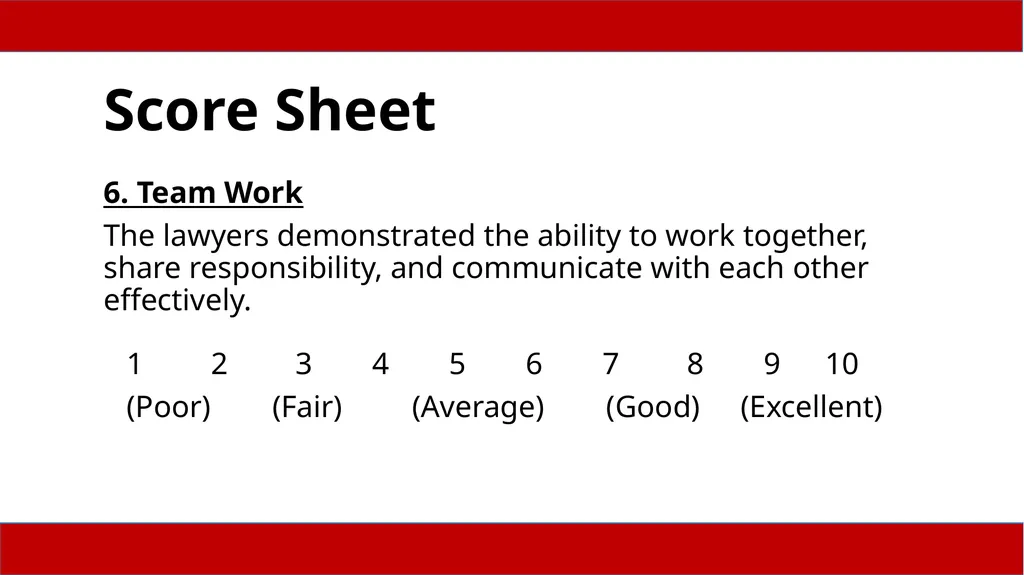
6. Team Work
The lawyers demonstrated the ability to work together, share responsibility, and communicate with each other effectively. 1 2 3 4 5 6 7 8 9 10
(Poor) (Fair) (Average) (Good) (Excellent) 26 Score Sheet<br>
27
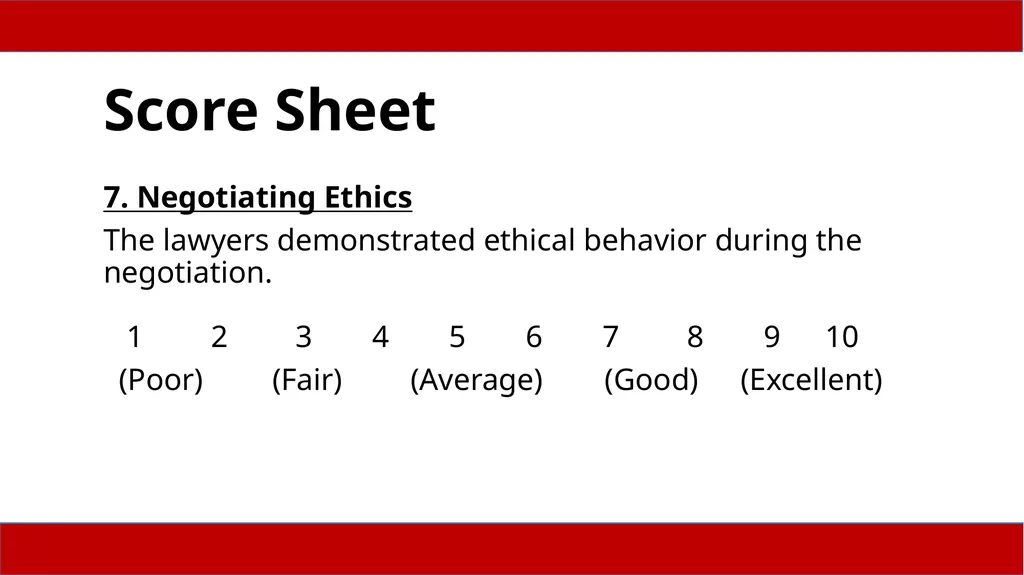
7. Negotiating Ethics
The lawyers demonstrated ethical behavior during the negotiation. 1 2 3 4 5 6 7 8 9 10
(Poor) (Fair) (Average) (Good) (Excellent) 27 Score Sheet<br>
28
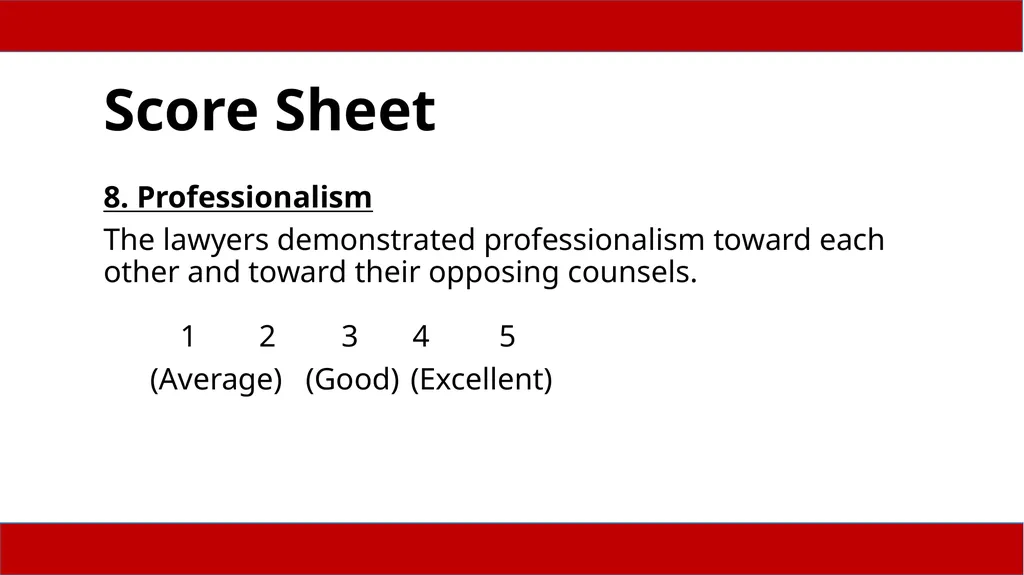
8. Professionalism
The lawyers demonstrated professionalism toward each other and toward their opposing counsels. 1 2 3 4 5
(Average) (Good) (Excellent) 28 Score Sheet<br>