
TRAINING MATERIALS Facilitating Fair and Effective


Description: TRAINING MATERIALS Facilitating Fair and Effective Informal Resolution Processes Under Title IX Fall 2020 Copyrighted material. May not be reproduced without permission. Facilitating Fair and Effective Informal Resolution Processes Under
Related Topics
Download Presentation
"TRAINING MATERIALS Facilitating Fair and Effective" is the property of its rightful owner. Permission is granted to download and print the materials on this website for personal, non-commercial use only, and to display it on your personal computer provided you do not modify the materials and that you retain all copyright notices contained in the materials. By downloading content from our website, you accept the terms of this agreement.
Presentation Transcript
slide1. TRAINING MATERIALS
Facilitating Fair and Effective
Informal Resolution Processes Under Title IX
Fall 2020 Copyrighted material. May not be reproduced without permission. Facilitating Fair and Effective Informal Resolution Processes Under Title IX Module 1: Introduction and Overview
Peter Lake
Professor of Law, Charles A. Dana Chair, and Director of the Center for Excellence in Higher Education Law and Policy
Stetson University College of Law
Kristine Goodwin M.Ed., J.D.
Associate of The Registry, CPR Distinguished Neutrals, MWI, Inc., and Umass Justice Bridge What are the regulatory
requirements regarding “informal resolution” under Title IX? Informal resolution may present a way to resolve sexual harassment allegations in a less adversarial manner than the investigation and adjudication procedures that comprise the §
106.45 grievance process. From the Commentary… Department of Education, Nondiscrimination on the Basis of Sex in Education Programs or Activities Receiving Federal Financial Assistance, 85 Fed. Reg. 30026 (May 19, 2020) (final rule) (online at www.govinfo.gov/content/pkg/FR-2020-05-19/pdf/2020-10512.pdf) at 30098. The Department believes an explicit definition of “informal resolution” in the final regulations is unnecessary. Informal resolution may encompass a broad range of conflict resolution strategies, including, but not limited to, arbitration, mediation, or restorative justice.
Defining this concept may have the unintended effect of limiting
parties’ freedom to choose the resolution option that is best for them,
and recipient flexibility to craft resolution processes that serve the unique educational needs of their communities.
Id. at 30401. From the commentary… § 106.45(b)(9) Informal resolution. 5 6 A recipient may not require as a condition of enrollment or continuing enrollment, or employment or continuing employment, or enjoyment of any other right, waiver of the right to an investigation and adjudication of formal complaints of sexual harassment consistent with this section.
[A] recipient may not require the parties to participate in an informal resolution process under this section and may not offer an informal resolution process unless a formal complaint is filed.
(emphasis added) 1 2
©NASPA/Hierophant Enterprises, Inc, 2020. Copyrighted material. Express permission to post this
material on the University of Louisville website has been granted to comply with 34 C.F.R. § 106.45(b)(10)(i)(D). This material is not intended to be used by other entities, including other entities of higher education, for their own training purposes for any reason. Use of this material for proprietary reasons, except by the original author(s), is strictly prohibited. 3 4
©NASPA/Hierophant Enterprises, Inc, 2020. Copyrighted material. Express permission to post this material on the University of Louisville website has been granted to comply with 34 C.F.R. § 106.45(b)(10)(i)(D). This material is not intended to be used by other entities, including other entities of higher education, for their own training purposes for any reason. Use of this material for proprietary reasons, except by the original author(s), is strictly prohibited. Page One<br>
slide2. [A]t any time prior to reaching a determination regarding responsibility the recipient may facilitate an informal resolution process, such as mediation, that does not involve a full investigation and adjudication . . . § 106.45(b)(9) Cont’d (emphasis added) § 106.45(b)(9)(i) (Written Notice) Parties must be provided written notice that outlines
The allegations
The requirements of the informal resolution process including the circumstances under which it precludes the parties from resuming a formal complaint arising from the same allegations, provided, however, that at any time prior to agreeing to a resolution, any party has the right to withdraw from the informal resolution process and resume the grievance process with respect to the formal complaint
any consequences resulting from participating in the informal resolution process, including the records that will be maintained or could be shared
(emphasis and bullets added) Obtains the parties’ voluntary, written consent to the
informal resolution process; and
Does not offer or facilitate an informal resolution process to resolve allegations that an employee sexually harassed a student. (emphasis added) Because informal resolution is only an option, and is never required, under the final regulations, the Department does not believe that § 106.45(b)(9) presents conflict with other Federal or State laws or practices concerning resolution of sexual harassment allegations through mediation or other alternative dispute resolution processes.
Id. at 30404. The new regulations don’t require it, but informal resolution is
allowed.
A formal complaint must be filed before any informal resolution process can begin.
Both parties must voluntarily agree to informal resolution (written consent required). [No coercion or undue influence.]
No “informed” consent standard as such, other than information
required by regulations.
Parties do not have to be in the same room…often, they are not.
Equitable implementation by trained personnel Should you offer it?
Pros/Cons
Increased complainant autonomy
Training of personnel is required under the new regulations
Who should implement?
What type of training is needed?
Mediation? Arbitration? Restorative justice?
When can’t we use informal resolution?
→When the allegation is that an employee sexually harassed a student.
Does this option provide for more opportunities for “educational”
interventions?
What does this look like in practice? 11 12 7 8
©NASPA/Hierophant Enterprises, Inc, 2020. Copyrighted material. Express permission to post this
material on the University of Louisville website has been granted to comply with 34 C.F.R. § 106.45(b)(10)(i)(D). This material is not intended to be used by other entities, including other entities of higher education, for their own training purposes for any reason. Use of this material for proprietary reasons, except by the original author(s), is strictly prohibited.
§ 106.45(b)(9)(ii-iii) From the commentary… 9 10
©NASPA/Hierophant Enterprises, Inc, 2020. Copyrighted material. Express permission to post this material on the University of Louisville website has been granted to comply with 34 C.F.R. § 106.45(b)(10)(i)(D). This material is not intended to be used by other entities, including other entities of higher education, for their own training purposes for any reason. Use of this material for proprietary reasons, except by the original author(s), is strictly prohibited.
Points on Informal Resolution Points on Informal Resolution Page 2<br>
slide3. What types of informal resolution exist?
What are the range of options
available to institutions? Educational Conferences Mediation (Neutral, Facilitative, Collaborative)
Med-Arb (Mediation and Arbitration, Non-Binding Arbitration)
Restorative Justice
Collaborative Law Model [Each of these will be discussed more in-depth in the next module.] Informal Resolution Options Important Considerations Title IX Coordinator
Dean of Students
Student Conduct
Campus Ombudsperson
Outside Entity/Third Party/Trained Mediators
Other options…. § 106.45(b)(9)(iii) [N]ot offer or facilitate an informal resolution process to resolve allegations that an employee sexually harassed a student. When is it inappropriate to use informal resolution processes? Who are “impacted Individuals” under Title IX?
How do informal processes support culture and climate work on campus?
How do informal processes relate to other, more formalized processes such as bias and incident response processes?
Budget impacts/size and nature of an institution?
What are the intersections among advisors, investigators and decision- makers? 17 18 Important Questions 13 14
©NASPA/Hierophant Enterprises, Inc, 2020. Copyrighted material. Express permission to post this
material on the University of Louisville website has been granted to comply with 34 C.F.R. § 106.45(b)(10)(i)(D). This material is not intended to be used by other entities, including other entities of higher education, for their own training purposes for any reason. Use of this material for proprietary reasons, except by the original author(s), is strictly prohibited.
Who can implement informal resolutions on your campus? 15 16
©NASPA/Hierophant Enterprises, Inc, 2020. Copyrighted material. Express permission to post this material on the University of Louisville website has been granted to comply with 34 C.F.R. § 106.45(b)(10)(i)(D). This material is not intended to be used by other entities, including other entities of higher education, for their own training purposes for any reason. Use of this material for proprietary reasons, except by the original author(s), is strictly prohibited. Page 3<br>
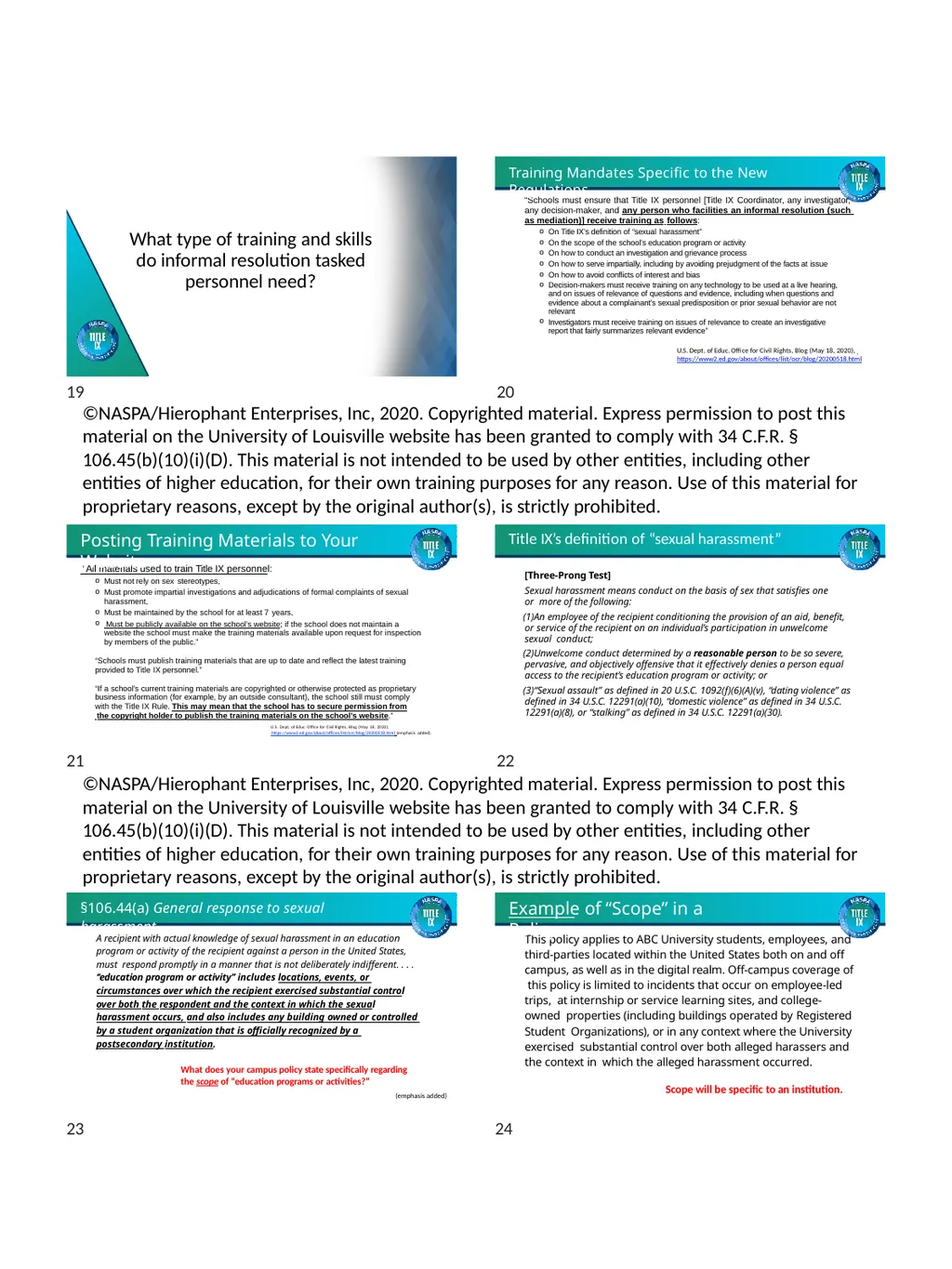
slide4. What type of training and skills do informal resolution tasked personnel need? “Schools must ensure that Title IX personnel [Title IX Coordinator, any investigator, any decision-maker, and any person who facilities an informal resolution (such as mediation)] receive training as follows:
On Title IX’s definition of “sexual harassment”
On the scope of the school’s education program or activity
On how to conduct an investigation and grievance process
On how to serve impartially, including by avoiding prejudgment of the facts at issue
On how to avoid conflicts of interest and bias
Decision-makers must receive training on any technology to be used at a live hearing, and on issues of relevance of questions and evidence, including when questions and evidence about a complainant’s sexual predisposition or prior sexual behavior are not relevant
Investigators must receive training on issues of relevance to create an investigative report that fairly summarizes relevant evidence” Training Mandates Specific to the New Regulations U.S. Dept. of Educ. Office for Civil Rights, Blog (May 18, 2020), https://www2.ed.gov/about/offices/list/ocr/blog/20200518.html “All materials used to train Title IX personnel:
Must not rely on sex stereotypes,
Must promote impartial investigations and adjudications of formal complaints of sexual harassment,
Must be maintained by the school for at least 7 years,
Must be publicly available on the school’s website; if the school does not maintain a website the school must make the training materials available upon request for inspection by members of the public.” “Schools must publish training materials that are up to date and reflect the latest training provided to Title IX personnel.” Posting Training Materials to Your Website “If a school’s current training materials are copyrighted or otherwise protected as proprietary business information (for example, by an outside consultant), the school still must comply with the Title IX Rule. This may mean that the school has to secure permission from
the copyright holder to publish the training materials on the school’s website.”
U.S. Dept. of Educ. Office for Civil Rights, Blog (May 18, 2020), https://www2.ed.gov/about/offices/list/ocr/blog/20200518.html (emphasis added). [Three-Prong Test]
Sexual harassment means conduct on the basis of sex that satisfies one or more of the following:
An employee of the recipient conditioning the provision of an aid, benefit, or service of the recipient on an individual’s participation in unwelcome sexual conduct;
Unwelcome conduct determined by a reasonable person to be so severe, pervasive, and objectively offensive that it effectively denies a person equal
access to the recipient’s education program or activity; or
“Sexual assault” as defined in 20 U.S.C. 1092(f)(6)(A)(v), “dating violence” as defined in 34 U.S.C. 12291(a)(10), “domestic violence” as defined in 34 U.S.C. 12291(a)(8), or “stalking” as defined in 34 U.S.C. 12291(a)(30). Title IX’s definition of “sexual harassment” A recipient with actual knowledge of sexual harassment in an education program or activity of the recipient against a person in the United States, must respond promptly in a manner that is not deliberately indifferent. . . . ‘‘education program or activity’’ includes locations, events, or circumstances over which the recipient exercised substantial control over both the respondent and the context in which the sexual harassment occurs, and also includes any building owned or controlled by a student organization that is officially recognized by a postsecondary institution. §106.44(a) General response to sexual harassment. What does your campus policy state specifically regarding the scope of “education programs or activities?”
(emphasis added) This policy applies to ABC University students, employees, and third-parties located within the United States both on and off campus, as well as in the digital realm. Off-campus coverage of this policy is limited to incidents that occur on employee-led trips, at internship or service learning sites, and college-owned properties (including buildings operated by Registered Student Organizations), or in any context where the University exercised substantial control over both alleged harassers and the context in which the alleged harassment occurred. Example of “Scope” in a Policy 23 24 Scope will be specific to an institution. 19 20
©NASPA/Hierophant Enterprises, Inc, 2020. Copyrighted material. Express permission to post this
material on the University of Louisville website has been granted to comply with 34 C.F.R. § 106.45(b)(10)(i)(D). This material is not intended to be used by other entities, including other entities of higher education, for their own training purposes for any reason. Use of this material for proprietary reasons, except by the original author(s), is strictly prohibited. 21 22
©NASPA/Hierophant Enterprises, Inc, 2020. Copyrighted material. Express permission to post this material on the University of Louisville website has been granted to comply with 34 C.F.R. § 106.45(b)(10)(i)(D). This material is not intended to be used by other entities, including other entities of higher education, for their own training purposes for any reason. Use of this material for proprietary reasons, except by the original author(s), is strictly prohibited. Page 4<br>
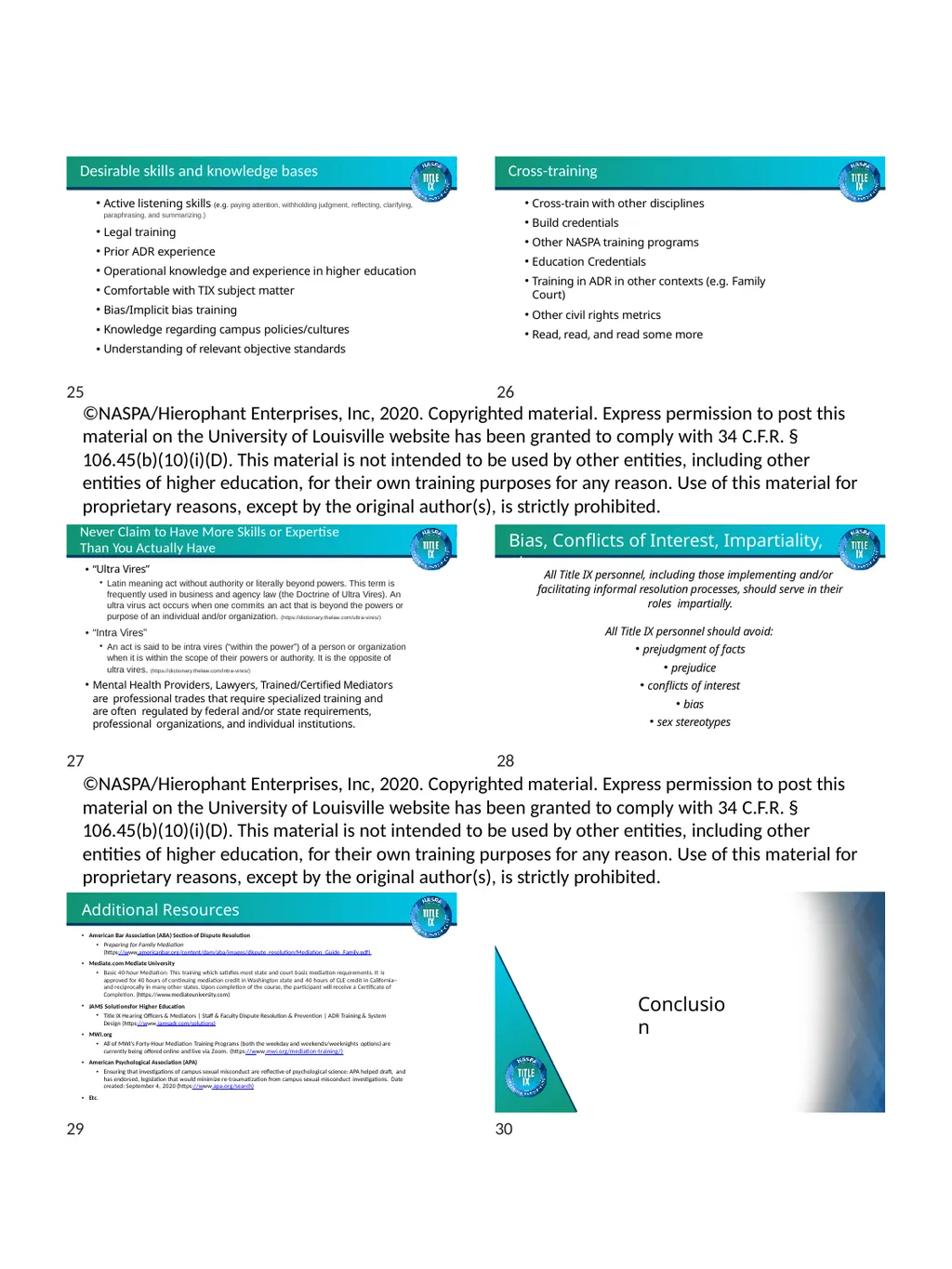
slide5. Active listening skills (e.g. paying attention, withholding judgment, reflecting, clarifying, paraphrasing, and summarizing.)
Legal training
Prior ADR experience
Operational knowledge and experience in higher education
Comfortable with TIX subject matter
Bias/Implicit bias training
Knowledge regarding campus policies/cultures
Understanding of relevant objective standards Desirable skills and knowledge bases Cross-train with other disciplines
Build credentials
Other NASPA training programs
Education Credentials
Training in ADR in other contexts (e.g. Family Court)
Other civil rights metrics
Read, read, and read some more Cross-training “Ultra Vires”
Latin meaning act without authority or literally beyond powers. This term is frequently used in business and agency law (the Doctrine of Ultra Vires). An ultra virus act occurs when one commits an act that is beyond the powers or purpose of an individual and/or organization. (https://dictionary.thelaw.com/ultra-vires/)
“Intra Vires”
An act is said to be intra vires (“within the power”) of a person or organization when it is within the scope of their powers or authority. It is the opposite of ultra vires. (https://dictionary.thelaw.com/intra-vires/)
Mental Health Providers, Lawyers, Trained/Certified Mediators are professional trades that require specialized training and are often regulated by federal and/or state requirements, professional organizations, and individual institutions. Never Claim to Have More Skills or Expertise Than You Actually Have All Title IX personnel, including those implementing and/or facilitating informal resolution processes, should serve in their roles impartially.
All Title IX personnel should avoid:
prejudgment of facts
prejudice
conflicts of interest
bias
sex stereotypes Bias, Conflicts of Interest, Impartiality, etc. American Bar Association (ABA) Section of Dispute Resolution
Preparing for Family Mediation
(https://www.americanbar.org/content/dam/aba/images/dispute_resolution/Mediation_Guide_Family.pdf)
Mediate.com Mediate University
Basic 40-hour Mediation: This training which satisfies most state and court basic mediation requirements. It is approved for 40 hours of continuing mediation credit in Washington state and 40 hours of CLE credit in California-- and reciprocally in many other states. Upon completion of the course, the participant will receive a Certificate of Completion. (https://www.mediateuniversity.com)
JAMS Solutionsfor Higher Education
Title IX Hearing Officers & Mediators | Staff & Faculty Dispute Resolution & Prevention | ADR Training & System Design (https://www.jamsadr.com/solutions)
MWI.org
All of MWI’s Forty-Hour Mediation Training Programs (both the weekday and weekends/weeknights options) are currently being offered online and live via Zoom. (https://www.mwi.org/mediation-training/)
American Psychological Association (APA)
Ensuring that investigations of campus sexual misconduct are reflective of psychological science: APA helped draft, and has endorsed, legislation that would minimize re-traumatization from campus sexual misconduct investigations. Date created: September 4, 2020 (https://www.apa.org/search)
Etc. Conclusion 29 30 25 26
©NASPA/Hierophant Enterprises, Inc, 2020. Copyrighted material. Express permission to post this
material on the University of Louisville website has been granted to comply with 34 C.F.R. § 106.45(b)(10)(i)(D). This material is not intended to be used by other entities, including other entities of higher education, for their own training purposes for any reason. Use of this material for proprietary reasons, except by the original author(s), is strictly prohibited. 27 28
©NASPA/Hierophant Enterprises, Inc, 2020. Copyrighted material. Express permission to post this material on the University of Louisville website has been granted to comply with 34 C.F.R. § 106.45(b)(10)(i)(D). This material is not intended to be used by other entities, including other entities of higher education, for their own training purposes for any reason. Use of this material for proprietary reasons, except by the original author(s), is strictly prohibited.
Additional Resources Page 5<br>
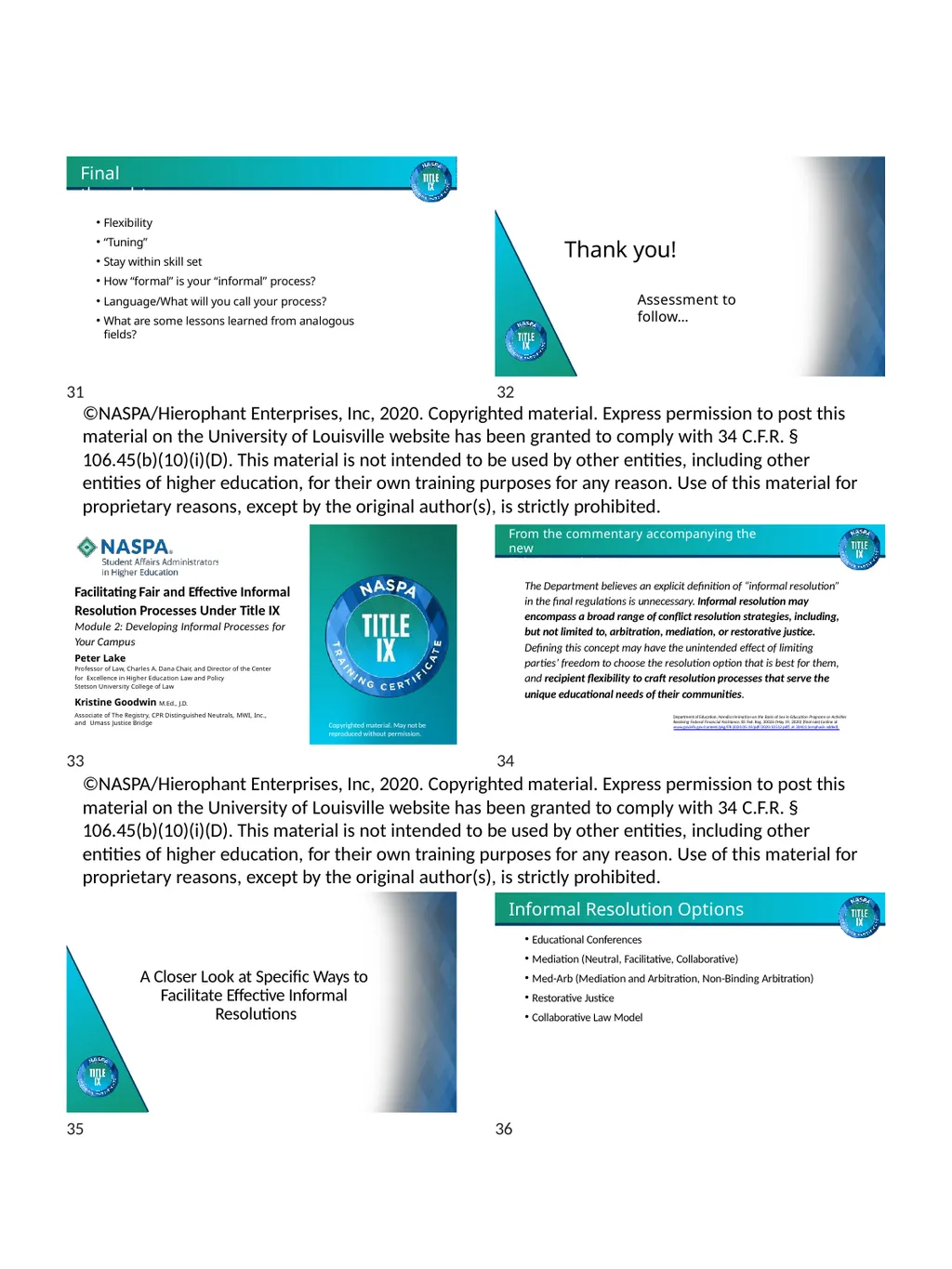
slide6. Flexibility
“Tuning”
Stay within skill set
How “formal” is your “informal” process?
Language/What will you call your process?
What are some lessons learned from analogous fields? Final thoughts… Thank you!
Assessment to follow… Copyrighted material. May not be reproduced without permission. Facilitating Fair and Effective Informal Resolution Processes Under Title IX Module 2: Developing Informal Processes for Your Campus
Peter Lake
Professor of Law, Charles A. Dana Chair, and Director of the Center for Excellence in Higher Education Law and Policy
Stetson University College of Law
Kristine Goodwin M.Ed., J.D.
Associate of The Registry, CPR Distinguished Neutrals, MWI, Inc., and Umass Justice Bridge The Department believes an explicit definition of “informal resolution” in the final regulations is unnecessary. Informal resolution may encompass a broad range of conflict resolution strategies, including, but not limited to, arbitration, mediation, or restorative justice.
Defining this concept may have the unintended effect of limiting
parties’ freedom to choose the resolution option that is best for them,
and recipient flexibility to craft resolution processes that serve the unique educational needs of their communities. From the commentary accompanying the new
Title IX regulations… Department of Education, Nondiscrimination on the Basis of Sex in Education Programs or Activities Receiving Federal Financial Assistance, 85 Fed. Reg. 30026 (May 19, 2020) (final rule) (online at www.govinfo.gov/content/pkg/FR-2020-05-19/pdf/2020-10512.pdf) at 30401 (emphasis added). A Closer Look at Specific Ways to Facilitate Effective Informal Resolutions Educational Conferences
Mediation (Neutral, Facilitative, Collaborative)
Med-Arb (Mediation and Arbitration, Non-Binding Arbitration)
Restorative Justice
Collaborative Law Model 35 36 31 32
©NASPA/Hierophant Enterprises, Inc, 2020. Copyrighted material. Express permission to post this
material on the University of Louisville website has been granted to comply with 34 C.F.R. § 106.45(b)(10)(i)(D). This material is not intended to be used by other entities, including other entities of higher education, for their own training purposes for any reason. Use of this material for proprietary reasons, except by the original author(s), is strictly prohibited. 33 34
©NASPA/Hierophant Enterprises, Inc, 2020. Copyrighted material. Express permission to post this material on the University of Louisville website has been granted to comply with 34 C.F.R. § 106.45(b)(10)(i)(D). This material is not intended to be used by other entities, including other entities of higher education, for their own training purposes for any reason. Use of this material for proprietary reasons, except by the original author(s), is strictly prohibited.
Informal Resolution Options Page 6<br>
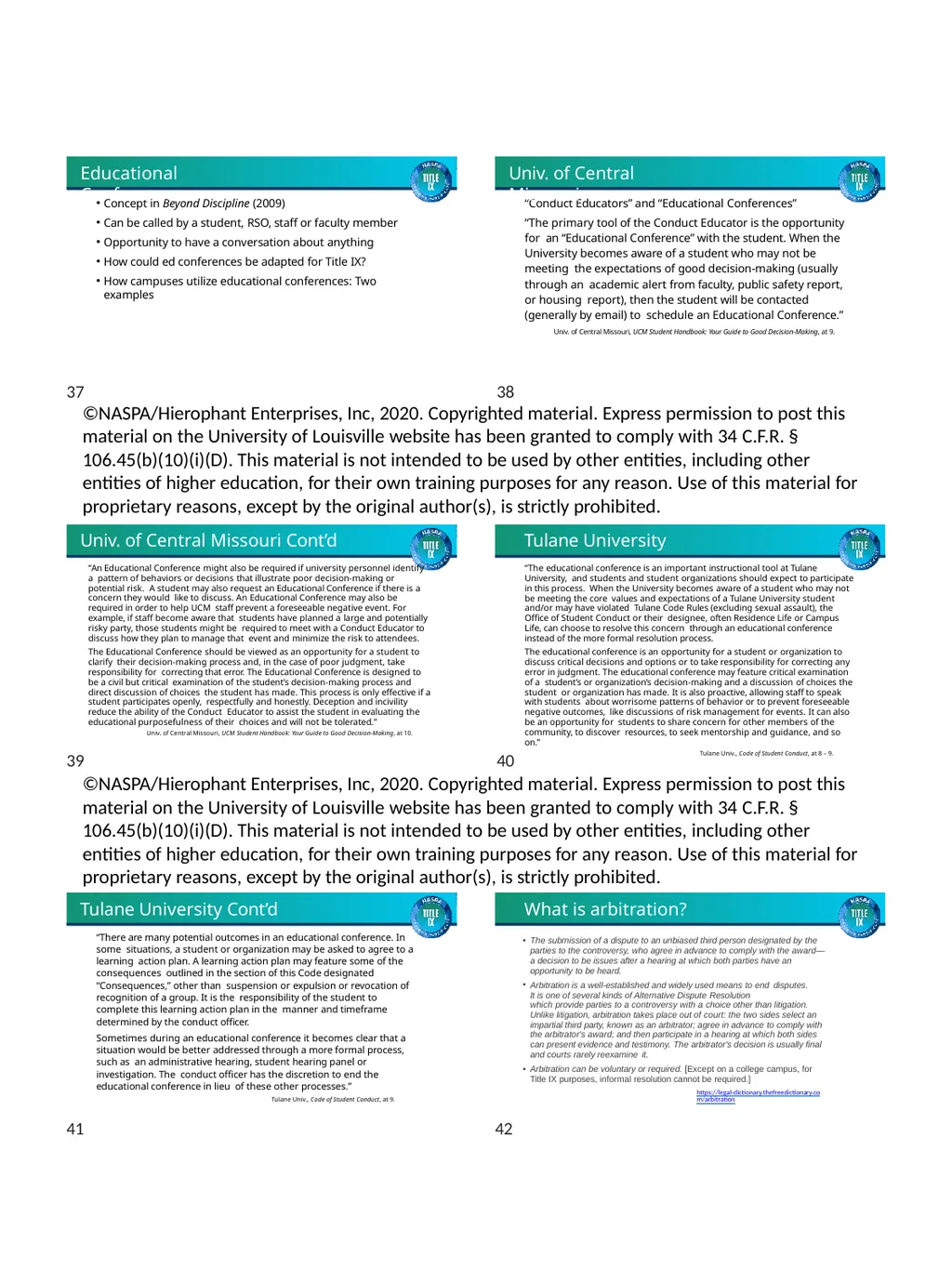
slide7. Concept in Beyond Discipline (2009)
Can be called by a student, RSO, staff or faculty member
Opportunity to have a conversation about anything
How could ed conferences be adapted for Title IX?
How campuses utilize educational conferences: Two examples Educational Conferences “Conduct Educators” and “Educational Conferences”
“The primary tool of the Conduct Educator is the opportunity for an “Educational Conference” with the student. When the University becomes aware of a student who may not be meeting the expectations of good decision-making (usually through an academic alert from faculty, public safety report, or housing report), then the student will be contacted (generally by email) to schedule an Educational Conference.”
Univ. of Central Missouri, UCM Student Handbook: Your Guide to Good Decision-Making, at 9. Univ. of Central Missouri “An Educational Conference might also be required if university personnel identify a pattern of behaviors or decisions that illustrate poor decision-making or potential risk. A student may also request an Educational Conference if there is a concern they would like to discuss. An Educational Conference may also be required in order to help UCM staff prevent a foreseeable negative event. For example, if staff become aware that students have planned a large and potentially risky party, those students might be required to meet with a Conduct Educator to discuss how they plan to manage that event and minimize the risk to attendees.
The Educational Conference should be viewed as an opportunity for a student to clarify their decision-making process and, in the case of poor judgment, take responsibility for correcting that error. The Educational Conference is designed to be a civil but critical examination of the student’s decision-making process and direct discussion of choices the student has made. This process is only effective if a student participates openly, respectfully and honestly. Deception and incivility reduce the ability of the Conduct Educator to assist the student in evaluating the educational purposefulness of their choices and will not be tolerated.”
Univ. of Central Missouri, UCM Student Handbook: Your Guide to Good Decision-Making, at 10. “The educational conference is an important instructional tool at Tulane University, and students and student organizations should expect to participate in this process. When the University becomes aware of a student who may not be meeting the core values and expectations of a Tulane University student and/or may have violated Tulane Code Rules (excluding sexual assault), the Office of Student Conduct or their designee, often Residence Life or Campus Life, can choose to resolve this concern through an educational conference instead of the more formal resolution process.
The educational conference is an opportunity for a student or organization to discuss critical decisions and options or to take responsibility for correcting any error in judgment. The educational conference may feature critical examination of a student’s or organization’s decision-making and a discussion of choices the student or organization has made. It is also proactive, allowing staff to speak with students about worrisome patterns of behavior or to prevent foreseeable negative outcomes, like discussions of risk management for events. It can also be an opportunity for students to share concern for other members of the community, to discover resources, to seek mentorship and guidance, and so on.”
Tulane Univ., Code of Student Conduct, at 8 – 9. “There are many potential outcomes in an educational conference. In some situations, a student or organization may be asked to agree to a learning action plan. A learning action plan may feature some of the consequences outlined in the section of this Code designated “Consequences,” other than suspension or expulsion or revocation of recognition of a group. It is the responsibility of the student to complete this learning action plan in the manner and timeframe determined by the conduct officer.
Sometimes during an educational conference it becomes clear that a situation would be better addressed through a more formal process, such as an administrative hearing, student hearing panel or investigation. The conduct officer has the discretion to end the educational conference in lieu of these other processes.”
Tulane Univ., Code of Student Conduct, at 9. The submission of a dispute to an unbiased third person designated by the parties to the controversy, who agree in advance to comply with the award— a decision to be issues after a hearing at which both parties have an opportunity to be heard.
Arbitration is a well-established and widely used means to end disputes.
It is one of several kinds of Alternative Dispute Resolution
which provide parties to a controversy with a choice other than litigation. Unlike litigation, arbitration takes place out of court: the two sides select an impartial third party, known as an arbitrator; agree in advance to comply with the arbitrator's award; and then participate in a hearing at which both sides can present evidence and testimony. The arbitrator's decision is usually final and courts rarely reexamine it.
Arbitration can be voluntary or required. [Except on a college campus, for Title IX purposes, informal resolution cannot be required.]
https://legal-dictionary.thefreedictionary.com/arbitration 41 42 37 38
©NASPA/Hierophant Enterprises, Inc, 2020. Copyrighted material. Express permission to post this
material on the University of Louisville website has been granted to comply with 34 C.F.R. § 106.45(b)(10)(i)(D). This material is not intended to be used by other entities, including other entities of higher education, for their own training purposes for any reason. Use of this material for proprietary reasons, except by the original author(s), is strictly prohibited.
Univ. of Central Missouri Cont’d Tulane University 39 40
©NASPA/Hierophant Enterprises, Inc, 2020. Copyrighted material. Express permission to post this material on the University of Louisville website has been granted to comply with 34 C.F.R. § 106.45(b)(10)(i)(D). This material is not intended to be used by other entities, including other entities of higher education, for their own training purposes for any reason. Use of this material for proprietary reasons, except by the original author(s), is strictly prohibited.
Tulane University Cont’d What is arbitration? Page 7<br>
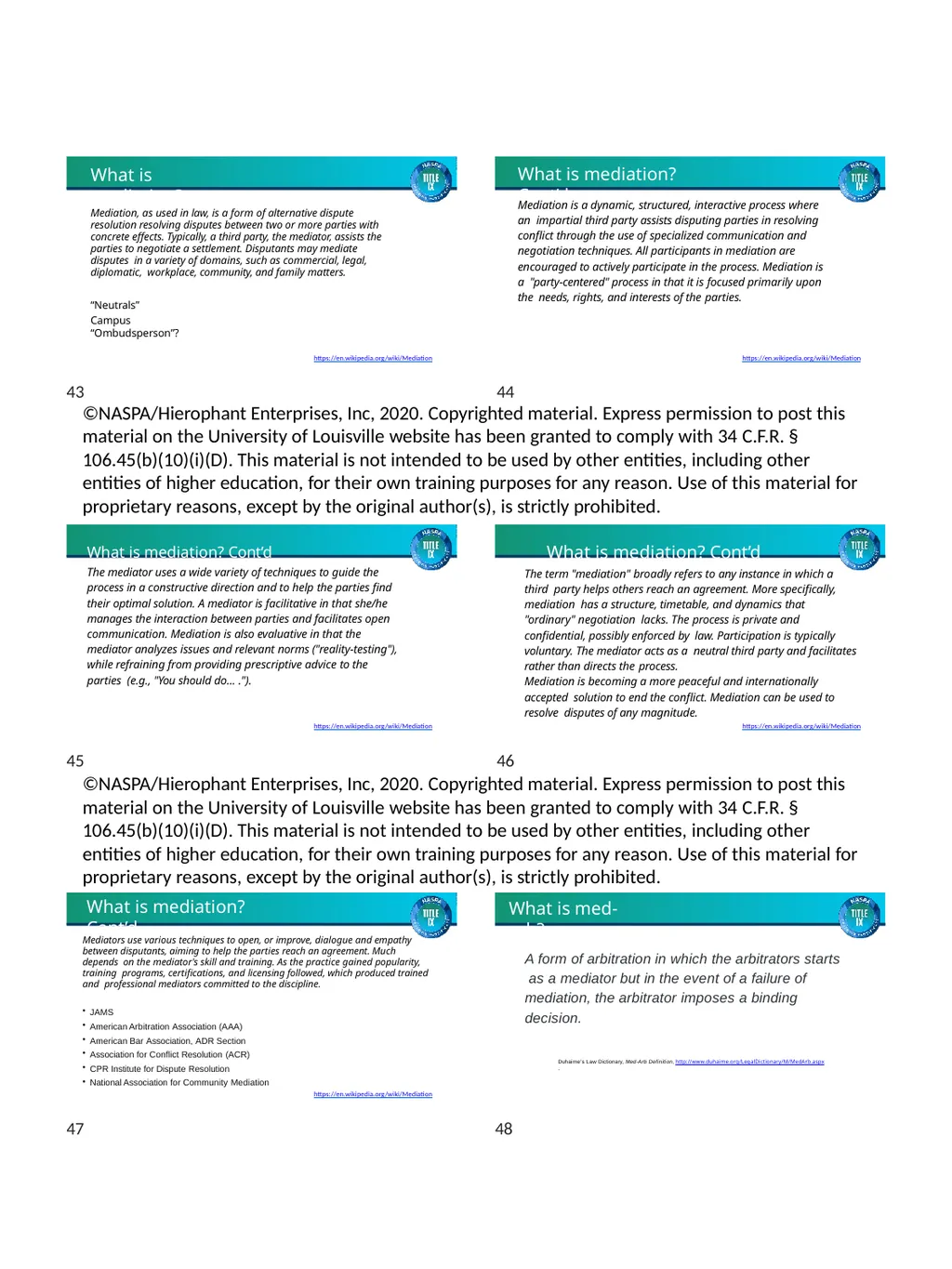
slide8. What is mediation? Mediation, as used in law, is a form of alternative dispute resolution resolving disputes between two or more parties with concrete effects. Typically, a third party, the mediator, assists the parties to negotiate a settlement. Disputants may mediate disputes in a variety of domains, such as commercial, legal, diplomatic, workplace, community, and family matters. “Neutrals”
Campus “Ombudsperson”? https://en.wikipedia.org/wiki/Mediation What is mediation? Cont’d Mediation is a dynamic, structured, interactive process where an impartial third party assists disputing parties in resolving conflict through the use of specialized communication and negotiation techniques. All participants in mediation are encouraged to actively participate in the process. Mediation is a "party-centered" process in that it is focused primarily upon the needs, rights, and interests of the parties. https://en.wikipedia.org/wiki/Mediation The mediator uses a wide variety of techniques to guide the process in a constructive direction and to help the parties find their optimal solution. A mediator is facilitative in that she/he manages the interaction between parties and facilitates open communication. Mediation is also evaluative in that the mediator analyzes issues and relevant norms ("reality-testing"), while refraining from providing prescriptive advice to the parties (e.g., "You should do... ."). https://en.wikipedia.org/wiki/Mediation The term "mediation" broadly refers to any instance in which a third party helps others reach an agreement. More specifically, mediation has a structure, timetable, and dynamics that "ordinary" negotiation lacks. The process is private and confidential, possibly enforced by law. Participation is typically voluntary. The mediator acts as a neutral third party and facilitates rather than directs the process.
Mediation is becoming a more peaceful and internationally accepted solution to end the conflict. Mediation can be used to resolve disputes of any magnitude. https://en.wikipedia.org/wiki/Mediation What is mediation? Cont’d Mediators use various techniques to open, or improve, dialogue and empathy between disputants, aiming to help the parties reach an agreement. Much depends on the mediator's skill and training. As the practice gained popularity, training programs, certifications, and licensing followed, which produced trained and professional mediators committed to the discipline. JAMS
American Arbitration Association (AAA)
American Bar Association, ADR Section
Association for Conflict Resolution (ACR)
CPR Institute for Dispute Resolution
National Association for Community Mediation https://en.wikipedia.org/wiki/Mediation A form of arbitration in which the arbitrators starts as a mediator but in the event of a failure of mediation, the arbitrator imposes a binding decision. Duhaime’s Law Dictionary, Med-Arb Definition, http://www.duhaime.org/LegalDictionary/M/MedArb.aspx. 47 48 What is med-arb? 43 44
©NASPA/Hierophant Enterprises, Inc, 2020. Copyrighted material. Express permission to post this
material on the University of Louisville website has been granted to comply with 34 C.F.R. § 106.45(b)(10)(i)(D). This material is not intended to be used by other entities, including other entities of higher education, for their own training purposes for any reason. Use of this material for proprietary reasons, except by the original author(s), is strictly prohibited.
What is mediation? Cont’d What is mediation? Cont’d 45 46
©NASPA/Hierophant Enterprises, Inc, 2020. Copyrighted material. Express permission to post this material on the University of Louisville website has been granted to comply with 34 C.F.R. § 106.45(b)(10)(i)(D). This material is not intended to be used by other entities, including other entities of higher education, for their own training purposes for any reason. Use of this material for proprietary reasons, except by the original author(s), is strictly prohibited. Page 8<br>
slide9. “[T]he essence of med-arb is to allow a softer mediation process to occur first thus taking every opportunity of achieving a resolution to a dispute which is not imposed and to which each party to the dispute subscribes voluntarily.
In this initial phase, the presiding neutral third-party acts as a mediator and coaches or encourages the parties towards a settlement taking into account the information received from both at a mediation hearing.
Med/arb motivates the participants at the mediation given the shadow of the hammer of med/arb: the transformation, if mediation fails, of the process to arbitration. At that point, the presiding officer, now sitting as an arbitrator and no longer as a mediator, is enabled to proceed as if the hearing was one of arbitration and to impose a resolution, a final and binding award, generally relying on the information presented during the mediation hearing.”
Duhaime’s Law Dictionary, Med-Arb Definition, http://www.duhaime.org/LegalDictionary/M/MedArb.aspx. Med-arb Cont’d What is restorative justice? A restorative justice program aims to get offenders to take responsibility for their actions, to understand the harm they have caused, to give them an opportunity to redeem themselves and to discourage them from causing further harm. For victims, its goal is to give them an active role in the process and to reduce feelings of anxiety and powerlessness. Restorative justice is founded on an alternative theory to the traditional methods of justice, which often focus on retribution. However, restorative justice programs can complement traditional methods.
Academic assessment of restorative justice is positive. Most studies suggest it makes offenders less likely to reoffend. A 2007 study also found that it had the highest rate of victim satisfaction and offender accountability of any method of justice. Its use has seen worldwide growth since the 1990s. Restorative justice inspired and is part of the wider study of restorative practices.
https://en.wikipedia.org/wiki/Restorative_justice
(internal citations omitted)
How can it be used in Title IX/sexual misconduct?
Koss MP, Wilgus JK, Williamsen KM. Campus Sexual Misconduct: Restorative Justice Approaches to Enhance Compliance With Title IX Guidance. Trauma Violence Abuse. 2014;15(3):242-257. doi:10.1177/1524838014521500 Theories about its effectiveness include:
The offender has to learn about the harm they have caused to their victim, making it hard for them to justify their behavior.
It offers a chance to discuss moral development to offenders who may have had little of it in their life.
Offenders are more likely to view their punishment as legitimate.
The programs tend to avoid shaming and stigmatizing the offender.
Many restorative justice systems, especially victim-offender mediation and family group conferencing, require participants to sign a confidentiality agreement. These agreements usually state that conference discussions will not be disclosed to nonparticipants. The rationale for confidentiality is that it promotes open and honest communication. Restorative Justice https://en.wikipedia.org/wiki/Restorative_justice
(internal citation omitted) With respect to the implications of restorative justice and the recipient reaching a determination regarding responsibility, the Department acknowledges that generally a critical feature of restorative justice is that the respondent admits responsibility at the start of the process. However, this admission of responsibility does not necessarily mean the recipient has also reached that determination, and participation in restorative justice as a type of informal resolution must be a voluntary decision on the part of the respondent. Id. at 30406 (emphasis added). From the commentary accompanying the new
Title IX regulations… Therefore, the language limiting the availability of an informal resolution process only to a time period before there is a determination of responsibility does not prevent a recipient from using the process of restorative justice under § 106.45(b)(9), and a recipient has discretion under this provision to specify the
circumstances under which a respondent’s admission of responsibility while participating in a restorative justice model would, or would not, be used in an adjudication if either party withdraws from the informal process and resumes the formal grievance process.
Id. at 30406 (emphasis added). From the commentary accompanying the new Title IX regulations… Similarly, a recipient could use a restorative justice model after a determination of responsibility finds a respondent responsible; nothing in the final regulations dictates the form of disciplinary sanction a recipient may or must impose on a respondent. 53 54 Id. at 30406 (emphasis added). From the commentary accompanying the new
Title IX regulations… 49 50
©NASPA/Hierophant Enterprises, Inc, 2020. Copyrighted material. Express permission to post this
material on the University of Louisville website has been granted to comply with 34 C.F.R. § 106.45(b)(10)(i)(D). This material is not intended to be used by other entities, including other entities of higher education, for their own training purposes for any reason. Use of this material for proprietary reasons, except by the original author(s), is strictly prohibited. 51 52
©NASPA/Hierophant Enterprises, Inc, 2020. Copyrighted material. Express permission to post this material on the University of Louisville website has been granted to comply with 34 C.F.R. § 106.45(b)(10)(i)(D). This material is not intended to be used by other entities, including other entities of higher education, for their own training purposes for any reason. Use of this material for proprietary reasons, except by the original author(s), is strictly prohibited. Page 9<br>
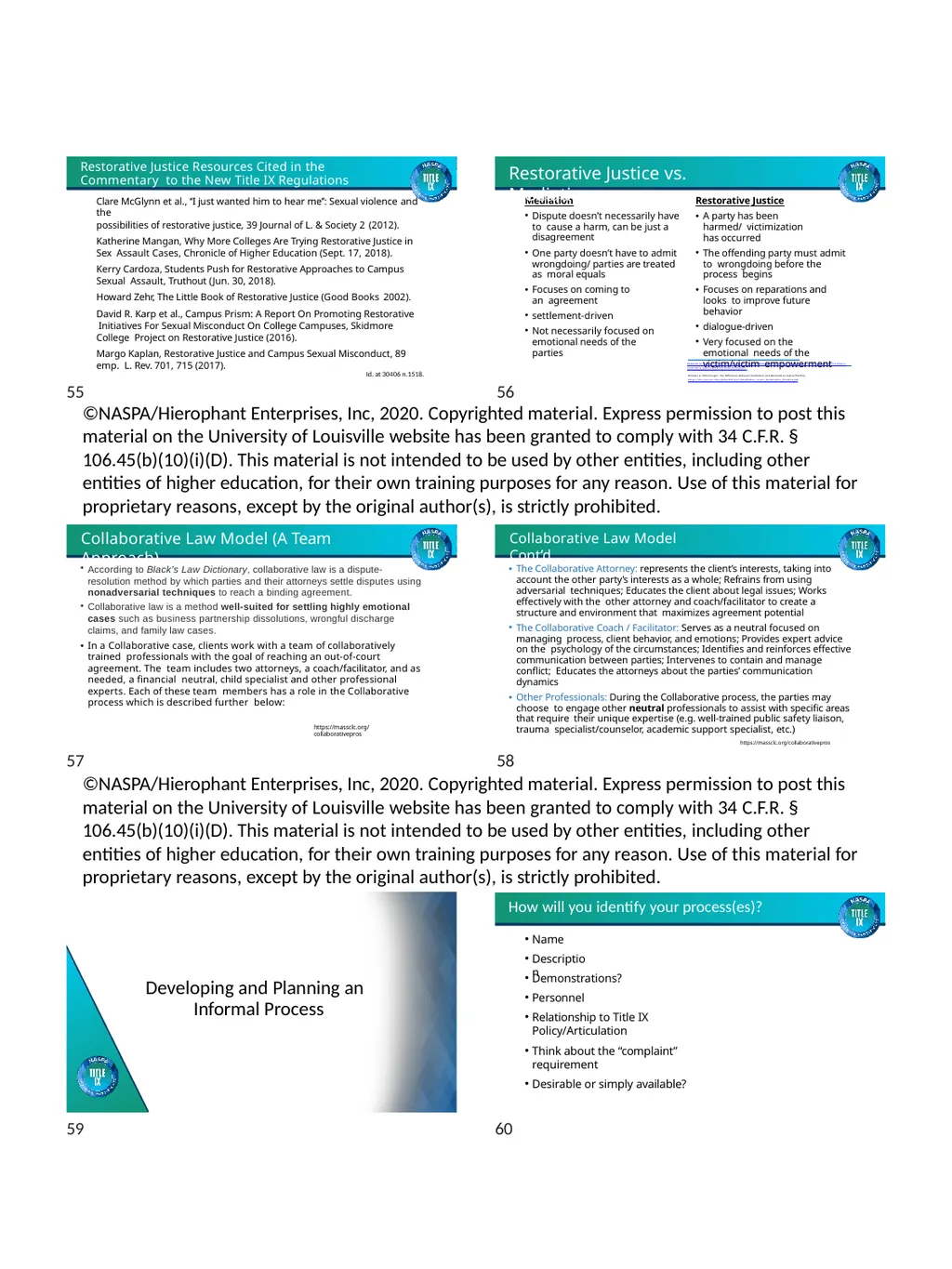
slide10. Restorative Justice Resources Cited in the Commentary to the New Title IX Regulations Clare McGlynn et al., ‘‘I just wanted him to hear me’’: Sexual violence and the
possibilities of restorative justice, 39 Journal of L. & Society 2 (2012).
Katherine Mangan, Why More Colleges Are Trying Restorative Justice in Sex Assault Cases, Chronicle of Higher Education (Sept. 17, 2018).
Kerry Cardoza, Students Push for Restorative Approaches to Campus Sexual Assault, Truthout (Jun. 30, 2018).
Howard Zehr, The Little Book of Restorative Justice (Good Books 2002).
David R. Karp et al., Campus Prism: A Report On Promoting Restorative Initiatives For Sexual Misconduct On College Campuses, Skidmore College Project on Restorative Justice (2016).
Margo Kaplan, Restorative Justice and Campus Sexual Misconduct, 89 emp. L. Rev. 701, 715 (2017).
Id. at 30406 n.1518. Mediation
Dispute doesn’t necessarily have to cause a harm, can be just a disagreement
One party doesn’t have to admit wrongdoing/ parties are treated as moral equals
Focuses on coming to an agreement
settlement-driven
Not necessarily focused on emotional needs of the parties Restorative Justice vs. Mediation Restorative Justice
A party has been harmed/ victimization has occurred
The offending party must admit to wrongdoing before the process begins
Focuses on reparations and looks to improve future behavior
dialogue-driven
Very focused on the emotional needs of the victim/victim empowerment
Brookes & McDonough, The Differences Between Mediation and Restorative Justice/Practice, https://moj.gov.jm/sites/default/files/rj/Mediation_versus_Restorative_Practice.pdf. Restorative Justice Victoria, How is Restorative Justice Different than Mediation, http://www.rjvictoria.com/ufaqs/13-how-is- restorative-justice-different-than-mediation/ According to Black's Law Dictionary, collaborative law is a dispute- resolution method by which parties and their attorneys settle disputes using nonadversarial techniques to reach a binding agreement.
Collaborative law is a method well-suited for settling highly emotional cases such as business partnership dissolutions, wrongful discharge claims, and family law cases.
In a Collaborative case, clients work with a team of collaboratively trained professionals with the goal of reaching an out-of-court agreement. The team includes two attorneys, a coach/facilitator, and as needed, a financial neutral, child specialist and other professional experts. Each of these team members has a role in the Collaborative process which is described further below: https://massclc.org/collaborativepros Collaborative Law Model (A Team Approach) The Collaborative Attorney: represents the client’s interests, taking into account the other party’s interests as a whole; Refrains from using adversarial techniques; Educates the client about legal issues; Works effectively with the other attorney and coach/facilitator to create a structure and environment that maximizes agreement potential
The Collaborative Coach / Facilitator: Serves as a neutral focused on managing process, client behavior, and emotions; Provides expert advice on the psychology of the circumstances; Identifies and reinforces effective communication between parties; Intervenes to contain and manage conflict; Educates the attorneys about the parties’ communication dynamics
Other Professionals: During the Collaborative process, the parties may choose to engage other neutral professionals to assist with specific areas that require their unique expertise (e.g. well-trained public safety liaison, trauma specialist/counselor, academic support specialist, etc.)
https://massclc.org/collaborativepros Collaborative Law Model Cont’d Developing and Planning an Informal Process Name
Description 59 60 Demonstrations?
Personnel
Relationship to Title IX Policy/Articulation
Think about the “complaint” requirement
Desirable or simply available? 55 56
©NASPA/Hierophant Enterprises, Inc, 2020. Copyrighted material. Express permission to post this
material on the University of Louisville website has been granted to comply with 34 C.F.R. § 106.45(b)(10)(i)(D). This material is not intended to be used by other entities, including other entities of higher education, for their own training purposes for any reason. Use of this material for proprietary reasons, except by the original author(s), is strictly prohibited. 57 58
©NASPA/Hierophant Enterprises, Inc, 2020. Copyrighted material. Express permission to post this material on the University of Louisville website has been granted to comply with 34 C.F.R. § 106.45(b)(10)(i)(D). This material is not intended to be used by other entities, including other entities of higher education, for their own training purposes for any reason. Use of this material for proprietary reasons, except by the original author(s), is strictly prohibited.
How will you identify your process(es)? Page 10<br>
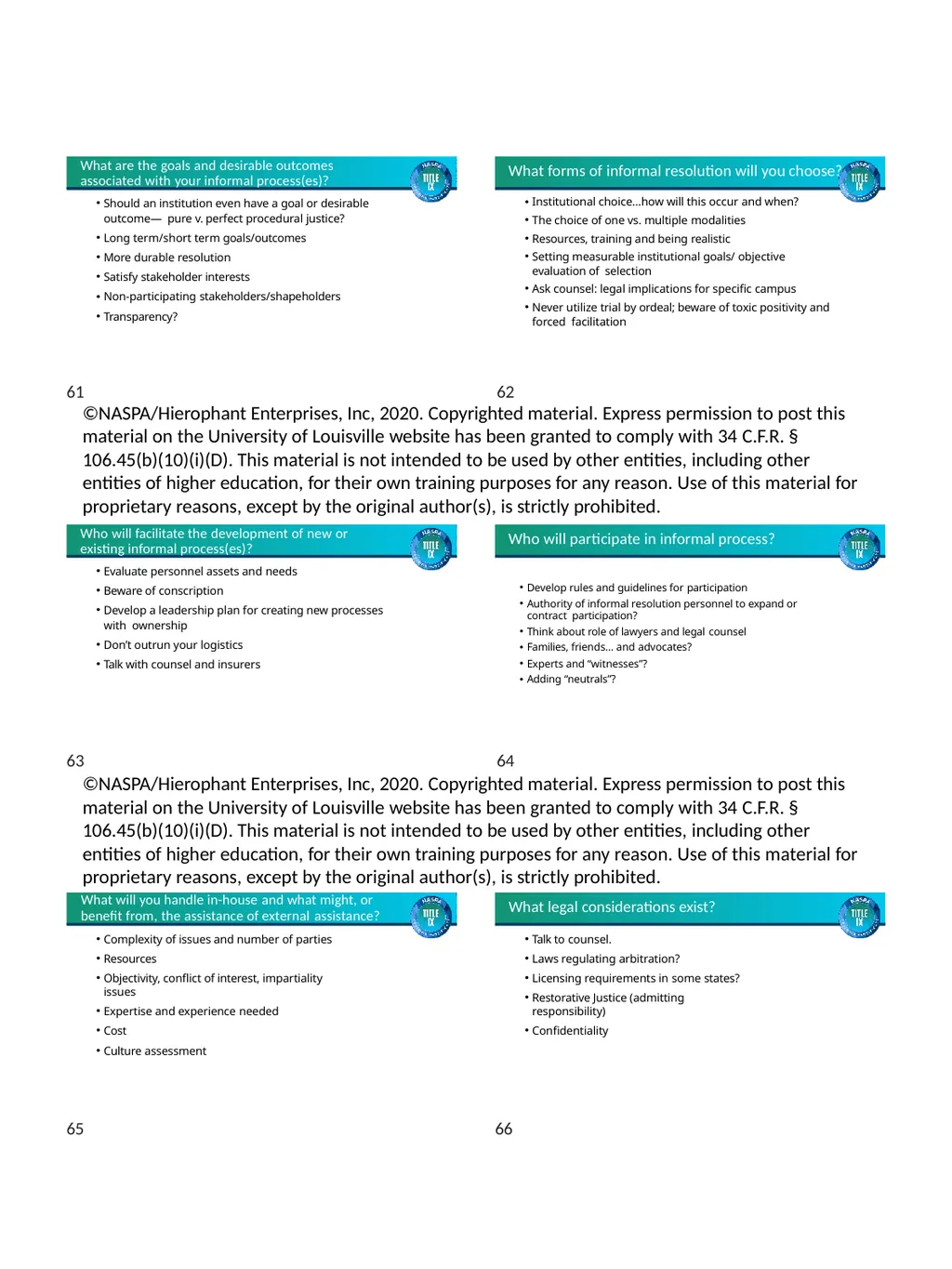
slide11. Should an institution even have a goal or desirable outcome— pure v. perfect procedural justice?
Long term/short term goals/outcomes
More durable resolution
Satisfy stakeholder interests
Non-participating stakeholders/shapeholders
Transparency? What are the goals and desirable outcomes associated with your informal process(es)? Institutional choice…how will this occur and when?
The choice of one vs. multiple modalities
Resources, training and being realistic
Setting measurable institutional goals/ objective evaluation of selection
Ask counsel: legal implications for specific campus
Never utilize trial by ordeal; beware of toxic positivity and forced facilitation What forms of informal resolution will you choose? Evaluate personnel assets and needs
Beware of conscription
Develop a leadership plan for creating new processes with ownership
Don’t outrun your logistics
Talk with counsel and insurers Who will facilitate the development of new or existing informal process(es)? Develop rules and guidelines for participation
Authority of informal resolution personnel to expand or contract participation?
Think about role of lawyers and legal counsel
Families, friends… and advocates?
Experts and “witnesses”?
Adding “neutrals”? Who will participate in informal process? Complexity of issues and number of parties
Resources
Objectivity, conflict of interest, impartiality issues
Expertise and experience needed
Cost
Culture assessment What will you handle in-house and what might, or benefit from, the assistance of external assistance? Talk to counsel.
Laws regulating arbitration?
Licensing requirements in some states?
Restorative Justice (admitting responsibility)
Confidentiality 65 66 What legal considerations exist? 61 62
©NASPA/Hierophant Enterprises, Inc, 2020. Copyrighted material. Express permission to post this
material on the University of Louisville website has been granted to comply with 34 C.F.R. § 106.45(b)(10)(i)(D). This material is not intended to be used by other entities, including other entities of higher education, for their own training purposes for any reason. Use of this material for proprietary reasons, except by the original author(s), is strictly prohibited. 63 64
©NASPA/Hierophant Enterprises, Inc, 2020. Copyrighted material. Express permission to post this material on the University of Louisville website has been granted to comply with 34 C.F.R. § 106.45(b)(10)(i)(D). This material is not intended to be used by other entities, including other entities of higher education, for their own training purposes for any reason. Use of this material for proprietary reasons, except by the original author(s), is strictly prohibited. Page 11<br>
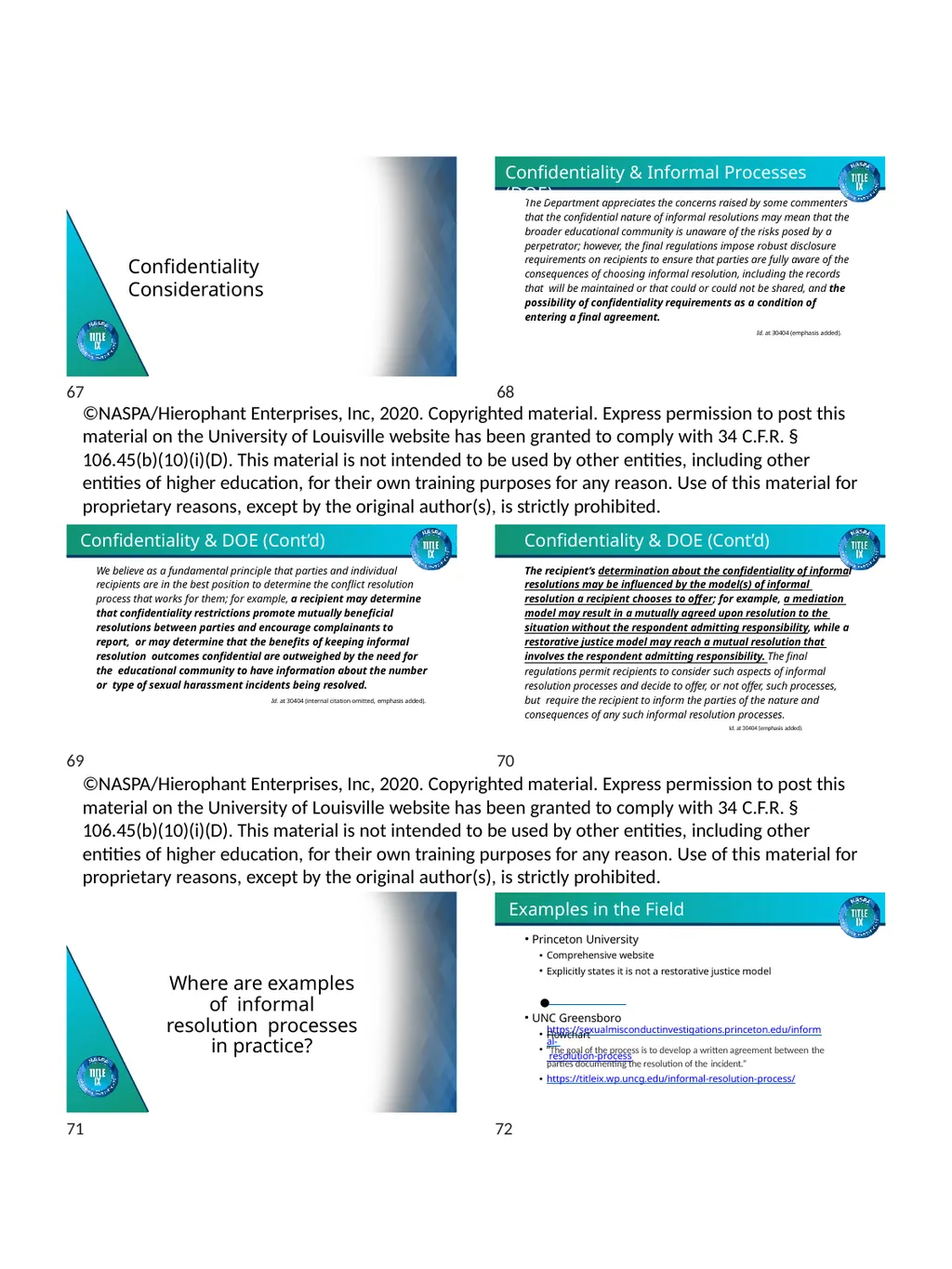
slide12. Confidentiality Considerations The Department appreciates the concerns raised by some commenters that the confidential nature of informal resolutions may mean that the broader educational community is unaware of the risks posed by a perpetrator; however, the final regulations impose robust disclosure requirements on recipients to ensure that parties are fully aware of the consequences of choosing informal resolution, including the records that will be maintained or that could or could not be shared, and the possibility of confidentiality requirements as a condition of entering a final agreement.
Id. at 30404 (emphasis added). Confidentiality & Informal Processes (DOE) We believe as a fundamental principle that parties and individual recipients are in the best position to determine the conflict resolution process that works for them; for example, a recipient may determine that confidentiality restrictions promote mutually beneficial resolutions between parties and encourage complainants to report, or may determine that the benefits of keeping informal resolution outcomes confidential are outweighed by the need for the educational community to have information about the number or type of sexual harassment incidents being resolved.
Id. at 30404 (internal citation omitted, emphasis added). The recipient’s determination about the confidentiality of informal resolutions may be influenced by the model(s) of informal resolution a recipient chooses to offer; for example, a mediation model may result in a mutually agreed upon resolution to the situation without the respondent admitting responsibility, while a restorative justice model may reach a mutual resolution that involves the respondent admitting responsibility. The final regulations permit recipients to consider such aspects of informal resolution processes and decide to offer, or not offer, such processes, but require the recipient to inform the parties of the nature and consequences of any such informal resolution processes.
Id. at 30404 (emphasis added). Where are examples of informal resolution processes in practice? Princeton University
Comprehensive website
Explicitly states it is not a restorative justice model
https://sexualmisconductinvestigations.princeton.edu/informal- resolution-process 71 72 UNC Greensboro
Flowchart
”The goal of the process is to develop a written agreement between the
parties documenting the resolution of the incident.”
https://titleix.wp.uncg.edu/informal-resolution-process/ 67 68
©NASPA/Hierophant Enterprises, Inc, 2020. Copyrighted material. Express permission to post this
material on the University of Louisville website has been granted to comply with 34 C.F.R. § 106.45(b)(10)(i)(D). This material is not intended to be used by other entities, including other entities of higher education, for their own training purposes for any reason. Use of this material for proprietary reasons, except by the original author(s), is strictly prohibited.
Confidentiality & DOE (Cont’d) Confidentiality & DOE (Cont’d) 69 70
©NASPA/Hierophant Enterprises, Inc, 2020. Copyrighted material. Express permission to post this material on the University of Louisville website has been granted to comply with 34 C.F.R. § 106.45(b)(10)(i)(D). This material is not intended to be used by other entities, including other entities of higher education, for their own training purposes for any reason. Use of this material for proprietary reasons, except by the original author(s), is strictly prohibited.
Examples in the Field Page 12<br>
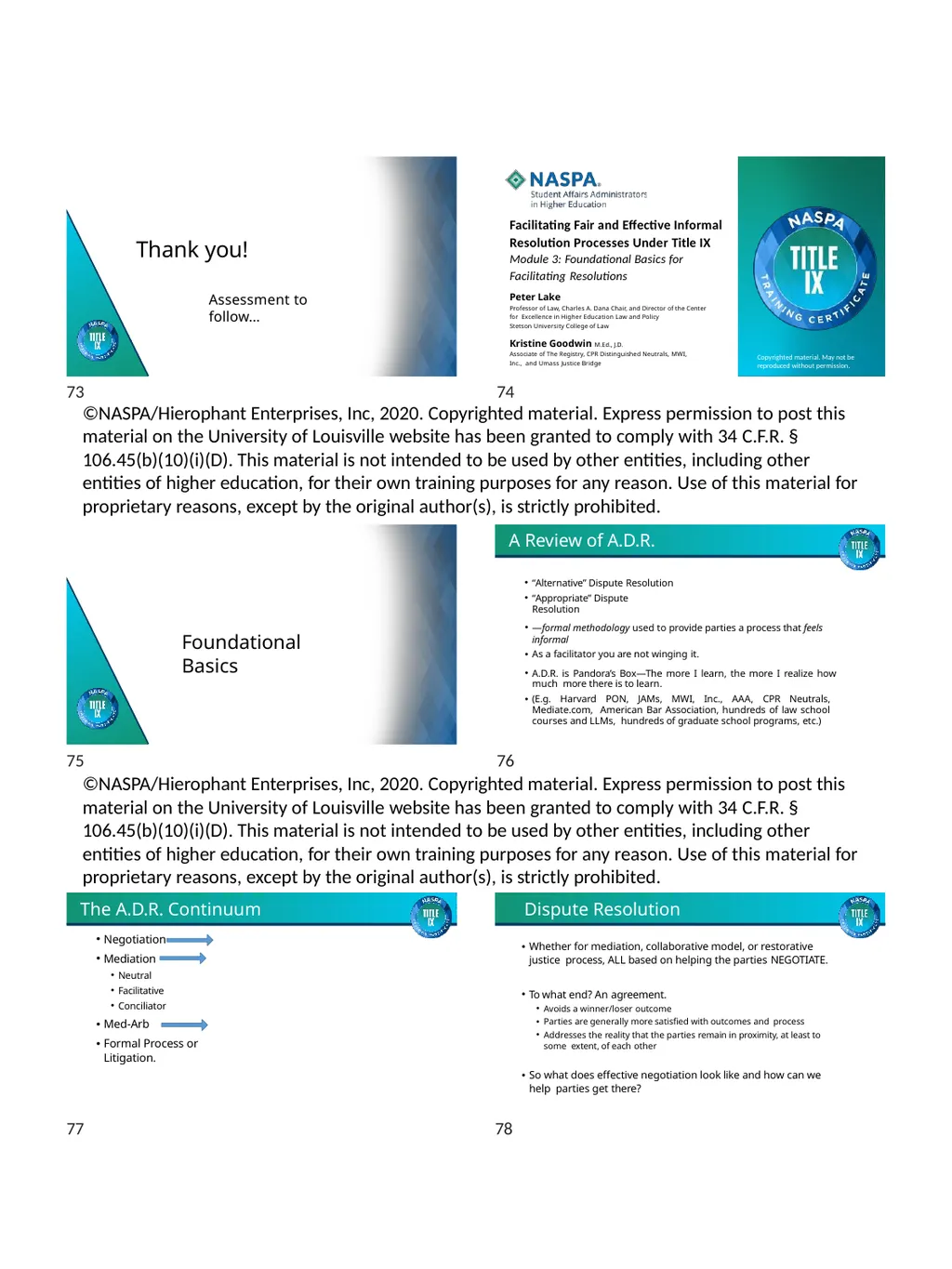
slide13. Thank you!
Assessment to follow… Copyrighted material. May not be reproduced without permission. Facilitating Fair and Effective Informal Resolution Processes Under Title IX Module 3: Foundational Basics for Facilitating Resolutions
Peter Lake
Professor of Law, Charles A. Dana Chair, and Director of the Center for Excellence in Higher Education Law and Policy
Stetson University College of Law
Kristine Goodwin M.Ed., J.D.
Associate of The Registry, CPR Distinguished Neutrals, MWI, Inc., and Umass Justice Bridge Foundational Basics “Alternative” Dispute Resolution
“Appropriate” Dispute Resolution —formal methodology used to provide parties a process that feels informal
As a facilitator you are not winging it. A.D.R. is Pandora’s Box—The more I learn, the more I realize how much more there is to learn.
(E.g. Harvard PON, JAMs, MWI, Inc., AAA, CPR Neutrals, Mediate.com, American Bar Association, hundreds of law school courses and LLMs, hundreds of graduate school programs, etc.) Negotiation
Mediation
Neutral
Facilitative
Conciliator
Med-Arb
Formal Process or Litigation. Whether for mediation, collaborative model, or restorative justice process, ALL based on helping the parties NEGOTIATE. 77 78 To what end? An agreement.
Avoids a winner/loser outcome
Parties are generally more satisfied with outcomes and process
Addresses the reality that the parties remain in proximity, at least to some extent, of each other So what does effective negotiation look like and how can we help parties get there? 73 74
©NASPA/Hierophant Enterprises, Inc, 2020. Copyrighted material. Express permission to post this
material on the University of Louisville website has been granted to comply with 34 C.F.R. § 106.45(b)(10)(i)(D). This material is not intended to be used by other entities, including other entities of higher education, for their own training purposes for any reason. Use of this material for proprietary reasons, except by the original author(s), is strictly prohibited.
A Review of A.D.R. 75 76
©NASPA/Hierophant Enterprises, Inc, 2020. Copyrighted material. Express permission to post this material on the University of Louisville website has been granted to comply with 34 C.F.R. § 106.45(b)(10)(i)(D). This material is not intended to be used by other entities, including other entities of higher education, for their own training purposes for any reason. Use of this material for proprietary reasons, except by the original author(s), is strictly prohibited.
The A.D.R. Continuum Dispute Resolution Page 13<br>
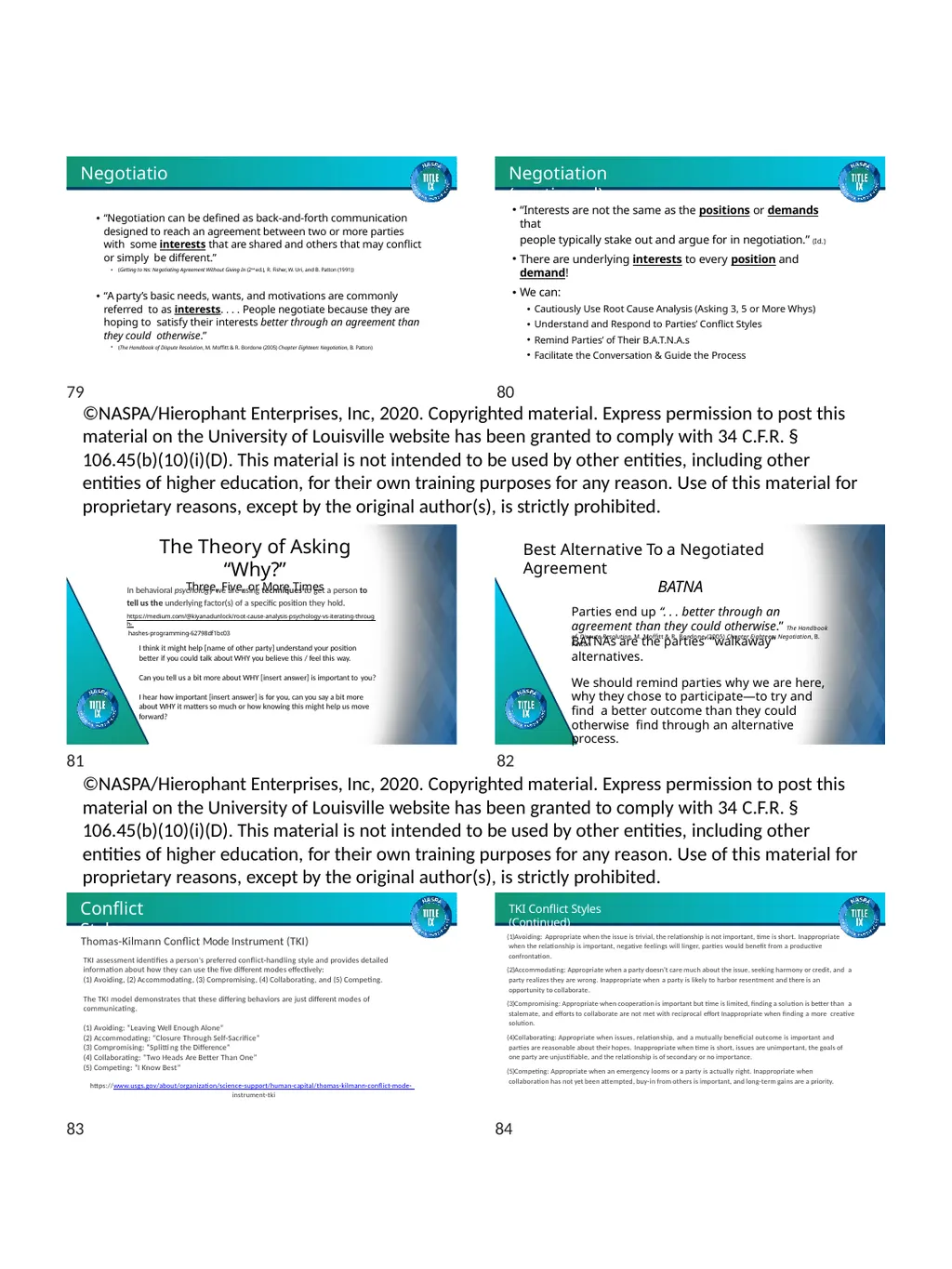
slide14. “Negotiation can be defined as back-and-forth communication designed to reach an agreement between two or more parties with some interests that are shared and others that may conflict or simply be different.”
(Getting to Yes: Negotiating Agreement Without Giving In (2nd ed.), R. Fisher, W. Uri, and B. Patton (1991)) “A party’s basic needs, wants, and motivations are commonly referred to as interests. . . . People negotiate because they are hoping to satisfy their interests better through an agreement than they could otherwise.”
(The Handbook of Dispute Resolution, M. Moffitt & R. Bordone (2005) Chapter Eighteen: Negotiation, B. Patton) Negotiation “Interests are not the same as the positions or demands that
people typically stake out and argue for in negotiation.” (Id.) There are underlying interests to every position and demand!
We can:
Cautiously Use Root Cause Analysis (Asking 3, 5 or More Whys)
Understand and Respond to Parties’ Conflict Styles
Remind Parties’ of Their B.A.T.N.A.s
Facilitate the Conversation & Guide the Process Negotiation (continued) The Theory of Asking “Why?”
Three, Five, or More Times In behavioral psychology we are using techniques to get a person to tell us the underlying factor(s) of a specific position they hold.
https://medium.com/@kiyanadunlock/root-cause-analysis-psychology-vs-iterating-through- hashes-programming-62798df1bc03 I think it might help [name of other party] understand your position better if you could talk about WHY you believe this / feel this way. Can you tell us a bit more about WHY [insert answer] is important to you? I hear how important [insert answer] is for you, can you say a bit more about WHY it matters so much or how knowing this might help us move forward? Best Alternative To a Negotiated Agreement
BATNA
Parties end up “. . . better through an agreement than they could otherwise.” The Handbook of Dispute Resolution, M. Moffitt & R. Bordone (2005) Chapter Eighteen: Negotiation, B. Patton BATNAs are the parties’ “walkaway”
alternatives.
We should remind parties why we are here, why they chose to participate—to try and find a better outcome than they could otherwise find through an alternative process. Conflict Styles Thomas-Kilmann Conflict Mode Instrument (TKI)
TKI assessment identifies a person's preferred conflict-handling style and provides detailed information about how they can use the five different modes effectively:
(1) Avoiding, (2) Accommodating, (3) Compromising, (4) Collaborating, and (5) Competing. The TKI model demonstrates that these differing behaviors are just different modes of communicating. Avoiding: “Leaving Well Enough Alone”
Accommodating: “Closure Through Self-Sacrifice”
Compromising: “Splitting the Difference”
Collaborating: “Two Heads Are Better Than One”
Competing: “I Know Best” https://www.usgs.gov/about/organization/science-support/human-capital/thomas-kilmann-conflict-mode- instrument-tki Avoiding: Appropriate when the issue is trivial, the relationship is not important, time is short. Inappropriate when the relationship is important, negative feelings will linger, parties would benefit from a productive confrontation.
Accommodating: Appropriate when a party doesn’t care much about the issue, seeking harmony or credit, and a party realizes they are wrong. Inappropriate when a party is likely to harbor resentment and there is an opportunity to collaborate.
Compromising: Appropriate when cooperation is important but time is limited, finding a solution is better than a stalemate, and efforts to collaborate are not met with reciprocal effort Inappropriate when finding a more creative solution.
Collaborating: Appropriate when issues, relationship, and a mutually beneficial outcome is important and parties are reasonable about their hopes. Inappropriate when time is short, issues are unimportant, the goals of one party are unjustifiable, and the relationship is of secondary or no importance.
Competing: Appropriate when an emergency looms or a party is actually right. Inappropriate when collaboration has not yet been attempted, buy-in from others is important, and long-term gains are a priority. 83 84 TKI Conflict Styles (Continued) 79 80
©NASPA/Hierophant Enterprises, Inc, 2020. Copyrighted material. Express permission to post this
material on the University of Louisville website has been granted to comply with 34 C.F.R. § 106.45(b)(10)(i)(D). This material is not intended to be used by other entities, including other entities of higher education, for their own training purposes for any reason. Use of this material for proprietary reasons, except by the original author(s), is strictly prohibited. 81 82
©NASPA/Hierophant Enterprises, Inc, 2020. Copyrighted material. Express permission to post this material on the University of Louisville website has been granted to comply with 34 C.F.R. § 106.45(b)(10)(i)(D). This material is not intended to be used by other entities, including other entities of higher education, for their own training purposes for any reason. Use of this material for proprietary reasons, except by the original author(s), is strictly prohibited. Page 14<br>
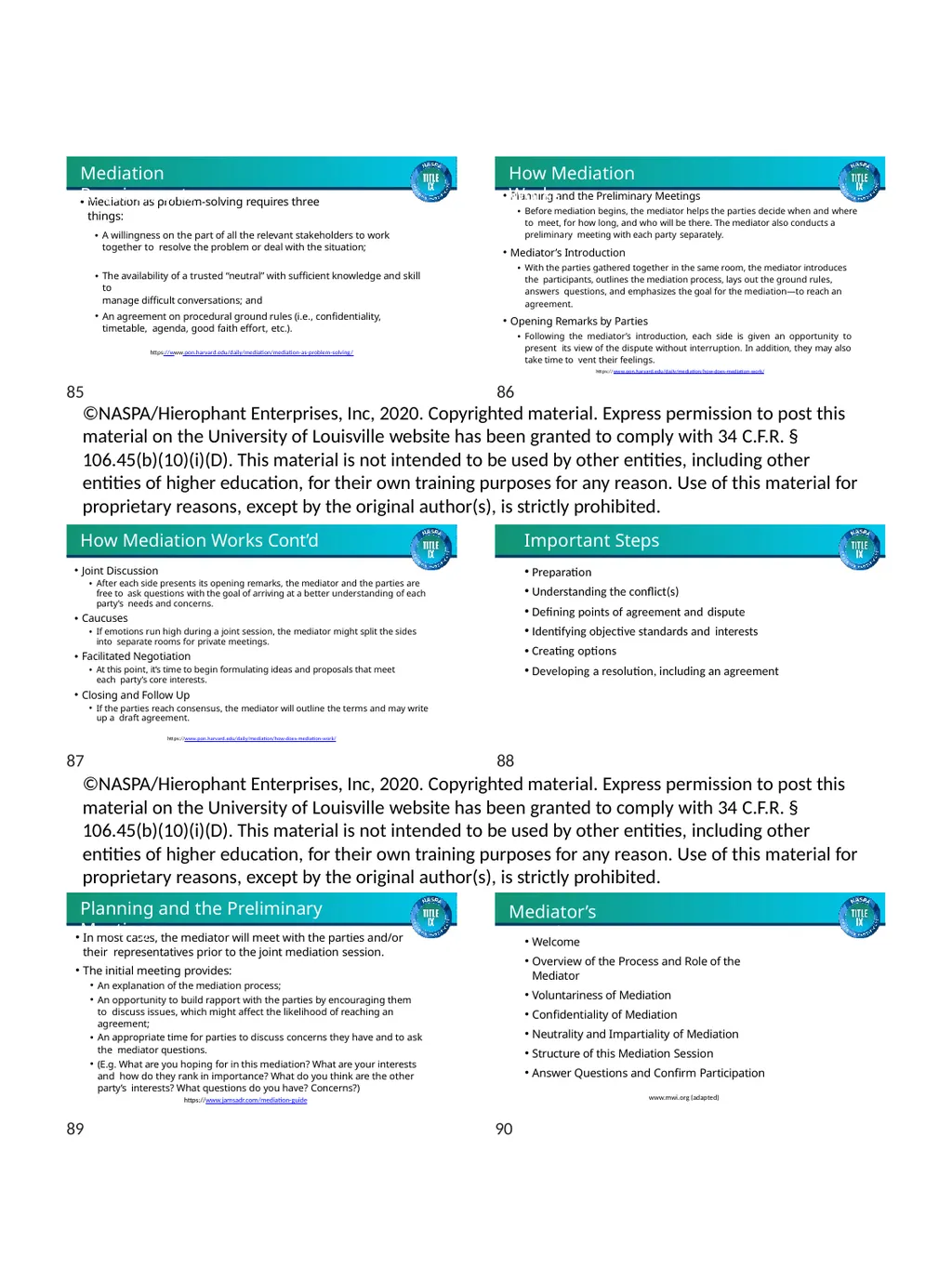
slide15. Mediation as problem-solving requires three things: A willingness on the part of all the relevant stakeholders to work together to resolve the problem or deal with the situation; The availability of a trusted “neutral” with sufficient knowledge and skill to
manage difficult conversations; and An agreement on procedural ground rules (i.e., confidentiality, timetable, agenda, good faith effort, etc.). Mediation Requirements https://www.pon.harvard.edu/daily/mediation/mediation-as-problem-solving/ Planning and the Preliminary Meetings
Before mediation begins, the mediator helps the parties decide when and where to meet, for how long, and who will be there. The mediator also conducts a preliminary meeting with each party separately.
Mediator’s Introduction
With the parties gathered together in the same room, the mediator introduces the participants, outlines the mediation process, lays out the ground rules, answers questions, and emphasizes the goal for the mediation—to reach an agreement.
Opening Remarks by Parties
Following the mediator’s introduction, each side is given an opportunity to present its view of the dispute without interruption. In addition, they may also take time to vent their feelings. How Mediation Works https://www.pon.harvard.edu/daily/mediation/how-does-mediation-work/ Joint Discussion
After each side presents its opening remarks, the mediator and the parties are free to ask questions with the goal of arriving at a better understanding of each party’s needs and concerns.
Caucuses
If emotions run high during a joint session, the mediator might split the sides into separate rooms for private meetings.
Facilitated Negotiation
At this point, it’s time to begin formulating ideas and proposals that meet each party’s core interests.
Closing and Follow Up
If the parties reach consensus, the mediator will outline the terms and may write up a draft agreement. https://www.pon.harvard.edu/daily/mediation/how-does-mediation-work/ Preparation
Understanding the conflict(s)
Defining points of agreement and dispute
Identifying objective standards and interests
Creating options
Developing a resolution, including an agreement In most cases, the mediator will meet with the parties and/or their representatives prior to the joint mediation session.
The initial meeting provides:
An explanation of the mediation process;
An opportunity to build rapport with the parties by encouraging them to discuss issues, which might affect the likelihood of reaching an agreement;
An appropriate time for parties to discuss concerns they have and to ask the mediator questions.
(E.g. What are you hoping for in this mediation? What are your interests and how do they rank in importance? What do you think are the other party’s interests? What questions do you have? Concerns?) Planning and the Preliminary Meetings https://www.jamsadr.com/mediation-guide Welcome
Overview of the Process and Role of the Mediator
Voluntariness of Mediation
Confidentiality of Mediation
Neutrality and Impartiality of Mediation
Structure of this Mediation Session
Answer Questions and Confirm Participation 89 90 Mediator’s Introduction www.mwi.org (adapted) 85 86
©NASPA/Hierophant Enterprises, Inc, 2020. Copyrighted material. Express permission to post this
material on the University of Louisville website has been granted to comply with 34 C.F.R. § 106.45(b)(10)(i)(D). This material is not intended to be used by other entities, including other entities of higher education, for their own training purposes for any reason. Use of this material for proprietary reasons, except by the original author(s), is strictly prohibited.
How Mediation Works Cont’d Important Steps 87 88
©NASPA/Hierophant Enterprises, Inc, 2020. Copyrighted material. Express permission to post this material on the University of Louisville website has been granted to comply with 34 C.F.R. § 106.45(b)(10)(i)(D). This material is not intended to be used by other entities, including other entities of higher education, for their own training purposes for any reason. Use of this material for proprietary reasons, except by the original author(s), is strictly prohibited. Page 15<br>
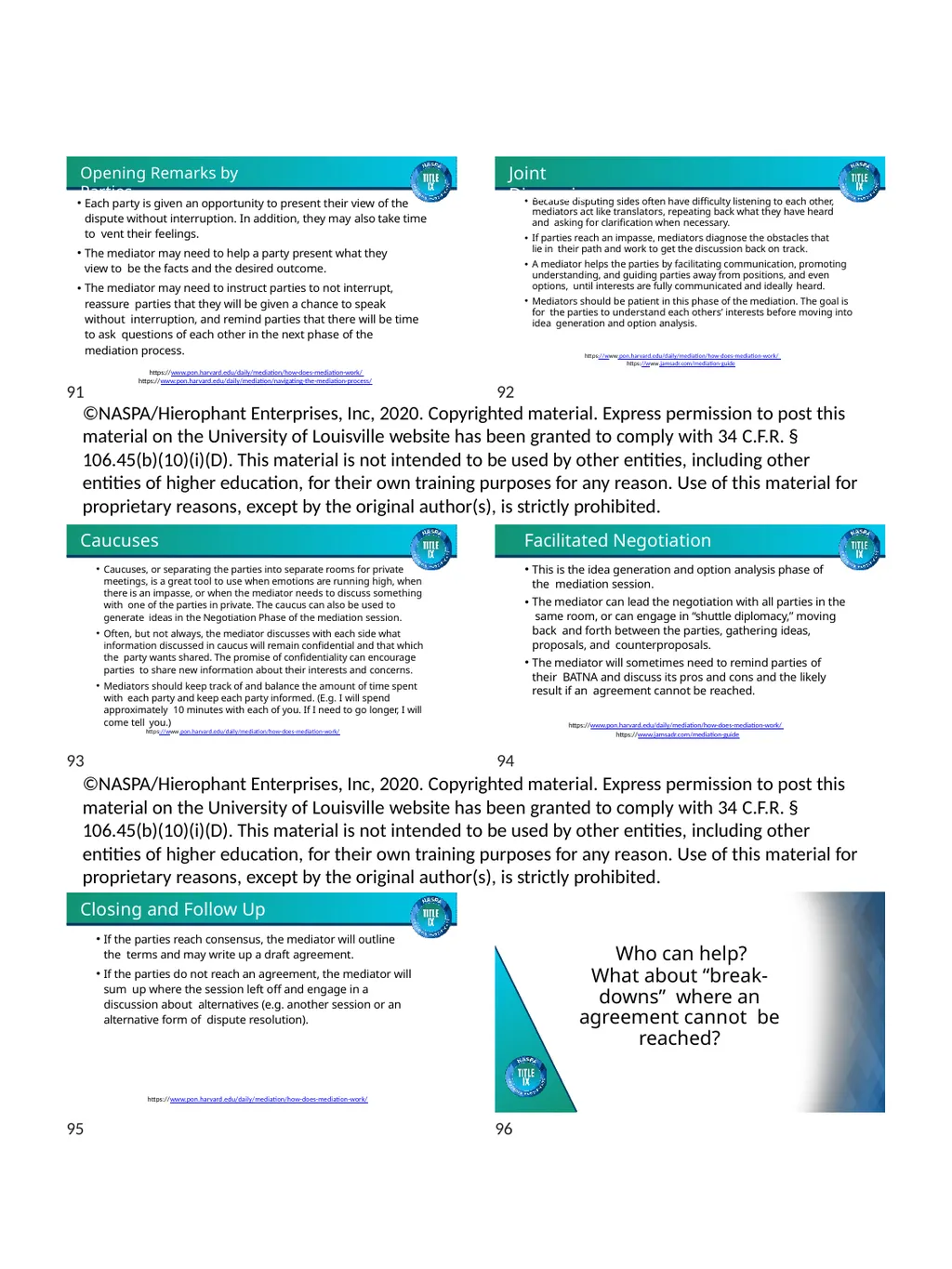
slide16. Opening Remarks by Parties Each party is given an opportunity to present their view of the dispute without interruption. In addition, they may also take time to vent their feelings.
The mediator may need to help a party present what they view to be the facts and the desired outcome.
The mediator may need to instruct parties to not interrupt, reassure parties that they will be given a chance to speak without interruption, and remind parties that there will be time to ask questions of each other in the next phase of the mediation process.
https://www.pon.harvard.edu/daily/mediation/how-does-mediation-work/ https://www.pon.harvard.edu/daily/mediation/navigating-the-mediation-process/ Because disputing sides often have difficulty listening to each other, mediators act like translators, repeating back what they have heard and asking for clarification when necessary.
If parties reach an impasse, mediators diagnose the obstacles that lie in their path and work to get the discussion back on track.
A mediator helps the parties by facilitating communication, promoting understanding, and guiding parties away from positions, and even options, until interests are fully communicated and ideally heard.
Mediators should be patient in this phase of the mediation. The goal is for the parties to understand each others’ interests before moving into idea generation and option analysis. Joint Discussion https://www.pon.harvard.edu/daily/mediation/how-does-mediation-work/ https://www.jamsadr.com/mediation-guide Caucuses, or separating the parties into separate rooms for private meetings, is a great tool to use when emotions are running high, when there is an impasse, or when the mediator needs to discuss something with one of the parties in private. The caucus can also be used to generate ideas in the Negotiation Phase of the mediation session.
Often, but not always, the mediator discusses with each side what information discussed in caucus will remain confidential and that which the party wants shared. The promise of confidentiality can encourage parties to share new information about their interests and concerns.
Mediators should keep track of and balance the amount of time spent with each party and keep each party informed. (E.g. I will spend approximately 10 minutes with each of you. If I need to go longer, I will come tell you.) https://www.pon.harvard.edu/daily/mediation/how-does-mediation-work/ This is the idea generation and option analysis phase of the mediation session.
The mediator can lead the negotiation with all parties in the same room, or can engage in “shuttle diplomacy,” moving back and forth between the parties, gathering ideas, proposals, and counterproposals.
The mediator will sometimes need to remind parties of their BATNA and discuss its pros and cons and the likely result if an agreement cannot be reached. https://www.pon.harvard.edu/daily/mediation/how-does-mediation-work/ https://www.jamsadr.com/mediation-guide If the parties reach consensus, the mediator will outline the terms and may write up a draft agreement.
If the parties do not reach an agreement, the mediator will sum up where the session left off and engage in a discussion about alternatives (e.g. another session or an alternative form of dispute resolution). https://www.pon.harvard.edu/daily/mediation/how-does-mediation-work/ Who can help?
What about “break-downs” where an agreement cannot be reached? 95 96 91 92
©NASPA/Hierophant Enterprises, Inc, 2020. Copyrighted material. Express permission to post this
material on the University of Louisville website has been granted to comply with 34 C.F.R. § 106.45(b)(10)(i)(D). This material is not intended to be used by other entities, including other entities of higher education, for their own training purposes for any reason. Use of this material for proprietary reasons, except by the original author(s), is strictly prohibited.
Caucuses Facilitated Negotiation 93 94
©NASPA/Hierophant Enterprises, Inc, 2020. Copyrighted material. Express permission to post this material on the University of Louisville website has been granted to comply with 34 C.F.R. § 106.45(b)(10)(i)(D). This material is not intended to be used by other entities, including other entities of higher education, for their own training purposes for any reason. Use of this material for proprietary reasons, except by the original author(s), is strictly prohibited.
Closing and Follow Up Page 16<br>
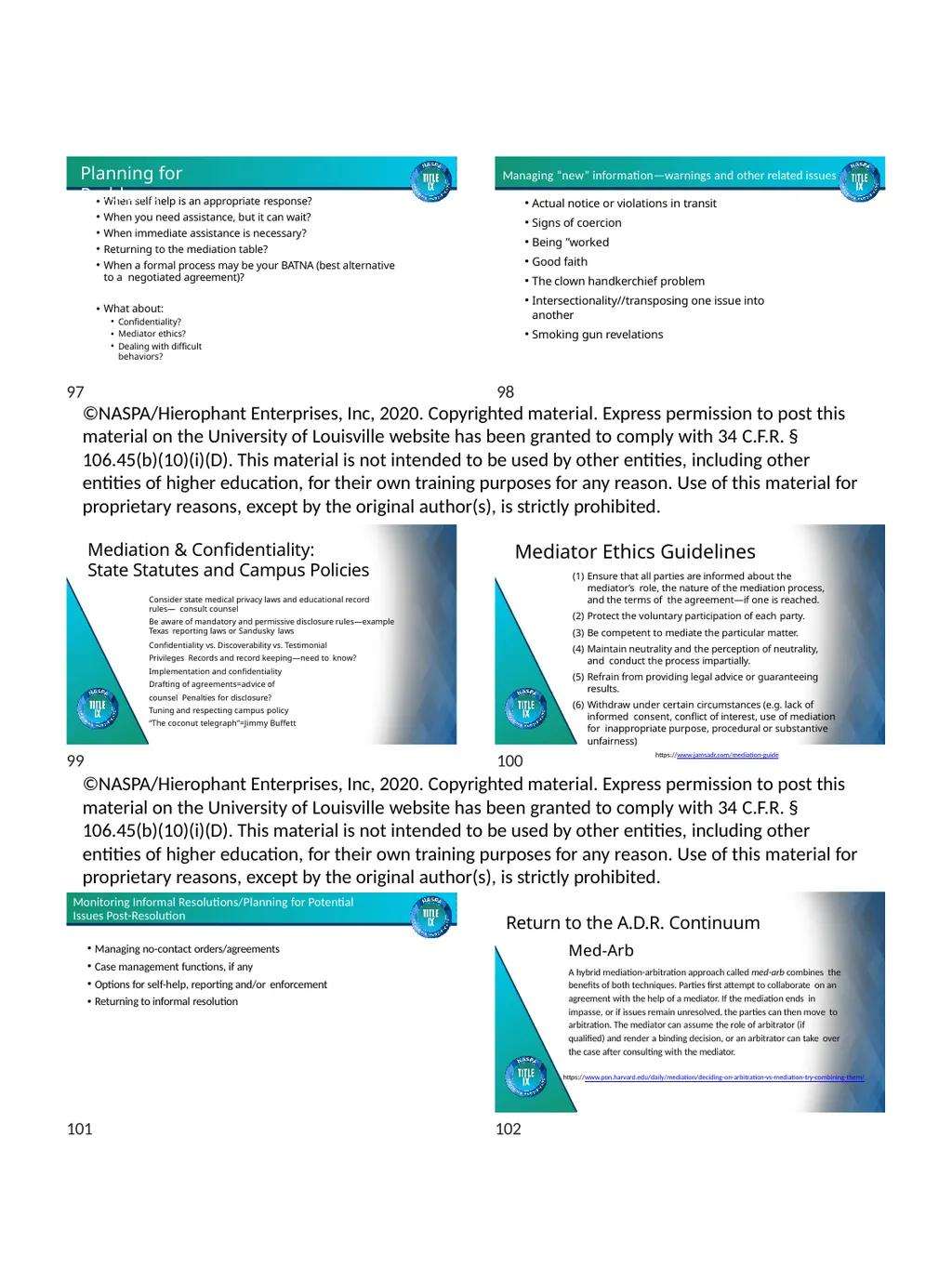
slide17. When self help is an appropriate response?
When you need assistance, but it can wait?
When immediate assistance is necessary?
Returning to the mediation table?
When a formal process may be your BATNA (best alternative to a negotiated agreement)? What about:
Confidentiality?
Mediator ethics?
Dealing with difficult behaviors? Planning for Problems Actual notice or violations in transit
Signs of coercion
Being ”worked
Good faith
The clown handkerchief problem
Intersectionality//transposing one issue into another
Smoking gun revelations Managing “new” information—warnings and other related issues Mediation & Confidentiality:
State Statutes and Campus Policies
Consider state medical privacy laws and educational record rules— consult counsel
Be aware of mandatory and permissive disclosure rules—example Texas reporting laws or Sandusky laws
Confidentiality vs. Discoverability vs. Testimonial Privileges Records and record keeping—need to know?
Implementation and confidentiality Drafting of agreements=advice of counsel Penalties for disclosure?
Tuning and respecting campus policy
“The coconut telegraph”=Jimmy Buffett Mediator Ethics Guidelines
Ensure that all parties are informed about the mediator’s role, the nature of the mediation process, and the terms of the agreement—if one is reached.
Protect the voluntary participation of each party.
Be competent to mediate the particular matter.
Maintain neutrality and the perception of neutrality, and conduct the process impartially.
Refrain from providing legal advice or guaranteeing results.
Withdraw under certain circumstances (e.g. lack of informed consent, conflict of interest, use of mediation for inappropriate purpose, procedural or substantive unfairness)
https://www.jamsadr.com/mediation-guide Managing no-contact orders/agreements
Case management functions, if any
Options for self-help, reporting and/or enforcement
Returning to informal resolution Monitoring Informal Resolutions/Planning for Potential Issues Post-Resolution Return to the A.D.R. Continuum
Med-Arb
A hybrid mediation-arbitration approach called med-arb combines the benefits of both techniques. Parties first attempt to collaborate on an agreement with the help of a mediator. If the mediation ends in impasse, or if issues remain unresolved, the parties can then move to arbitration. The mediator can assume the role of arbitrator (if qualified) and render a binding decision, or an arbitrator can take over the case after consulting with the mediator. 101 102 https://www.pon.harvard.edu/daily/mediation/deciding-on-arbitration-vs-mediation-try-combining-them/ 97 98
©NASPA/Hierophant Enterprises, Inc, 2020. Copyrighted material. Express permission to post this
material on the University of Louisville website has been granted to comply with 34 C.F.R. § 106.45(b)(10)(i)(D). This material is not intended to be used by other entities, including other entities of higher education, for their own training purposes for any reason. Use of this material for proprietary reasons, except by the original author(s), is strictly prohibited. 99 100
©NASPA/Hierophant Enterprises, Inc, 2020. Copyrighted material. Express permission to post this material on the University of Louisville website has been granted to comply with 34 C.F.R. § 106.45(b)(10)(i)(D). This material is not intended to be used by other entities, including other entities of higher education, for their own training purposes for any reason. Use of this material for proprietary reasons, except by the original author(s), is strictly prohibited. Page 17<br>
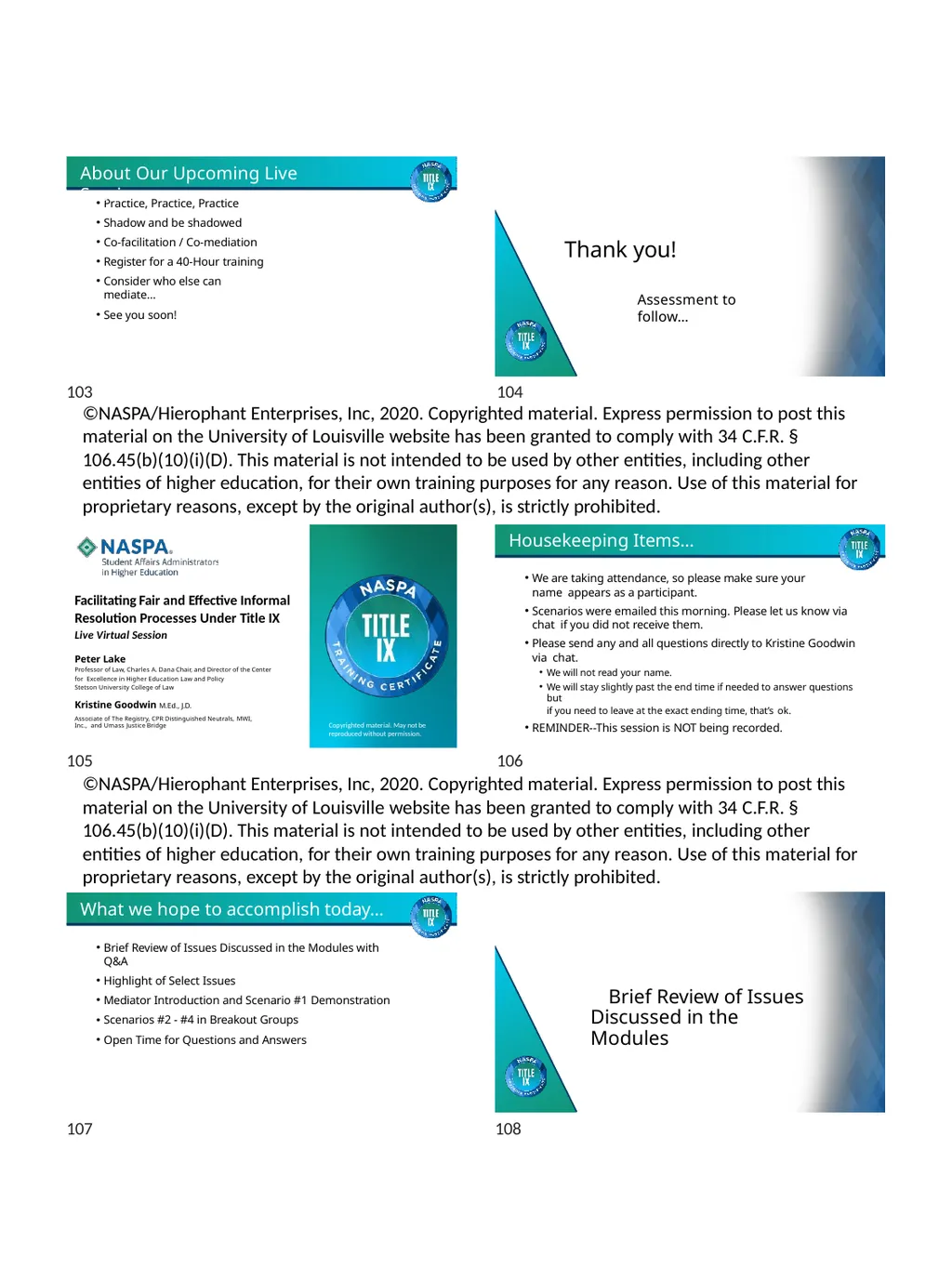
slide18. Practice, Practice, Practice
Shadow and be shadowed
Co-facilitation / Co-mediation
Register for a 40-Hour training
Consider who else can mediate…
See you soon! About Our Upcoming Live Session Thank you!
Assessment to follow… Copyrighted material. May not be reproduced without permission. Facilitating Fair and Effective Informal Resolution Processes Under Title IX Live Virtual Session
Peter Lake
Professor of Law, Charles A. Dana Chair, and Director of the Center for Excellence in Higher Education Law and Policy
Stetson University College of Law
Kristine Goodwin M.Ed., J.D.
Associate of The Registry, CPR Distinguished Neutrals, MWI, Inc., and Umass Justice Bridge We are taking attendance, so please make sure your name appears as a participant.
Scenarios were emailed this morning. Please let us know via chat if you did not receive them.
Please send any and all questions directly to Kristine Goodwin via chat.
We will not read your name.
We will stay slightly past the end time if needed to answer questions but
if you need to leave at the exact ending time, that’s ok.
REMINDER--This session is NOT being recorded. Brief Review of Issues Discussed in the Modules with Q&A
Highlight of Select Issues
Mediator Introduction and Scenario #1 Demonstration
Scenarios #2 - #4 in Breakout Groups
Open Time for Questions and Answers Brief Review of Issues Discussed in the Modules 107 108 103 104
©NASPA/Hierophant Enterprises, Inc, 2020. Copyrighted material. Express permission to post this
material on the University of Louisville website has been granted to comply with 34 C.F.R. § 106.45(b)(10)(i)(D). This material is not intended to be used by other entities, including other entities of higher education, for their own training purposes for any reason. Use of this material for proprietary reasons, except by the original author(s), is strictly prohibited.
Housekeeping Items… 105 106
©NASPA/Hierophant Enterprises, Inc, 2020. Copyrighted material. Express permission to post this material on the University of Louisville website has been granted to comply with 34 C.F.R. § 106.45(b)(10)(i)(D). This material is not intended to be used by other entities, including other entities of higher education, for their own training purposes for any reason. Use of this material for proprietary reasons, except by the original author(s), is strictly prohibited.
What we hope to accomplish today… Page 18<br>
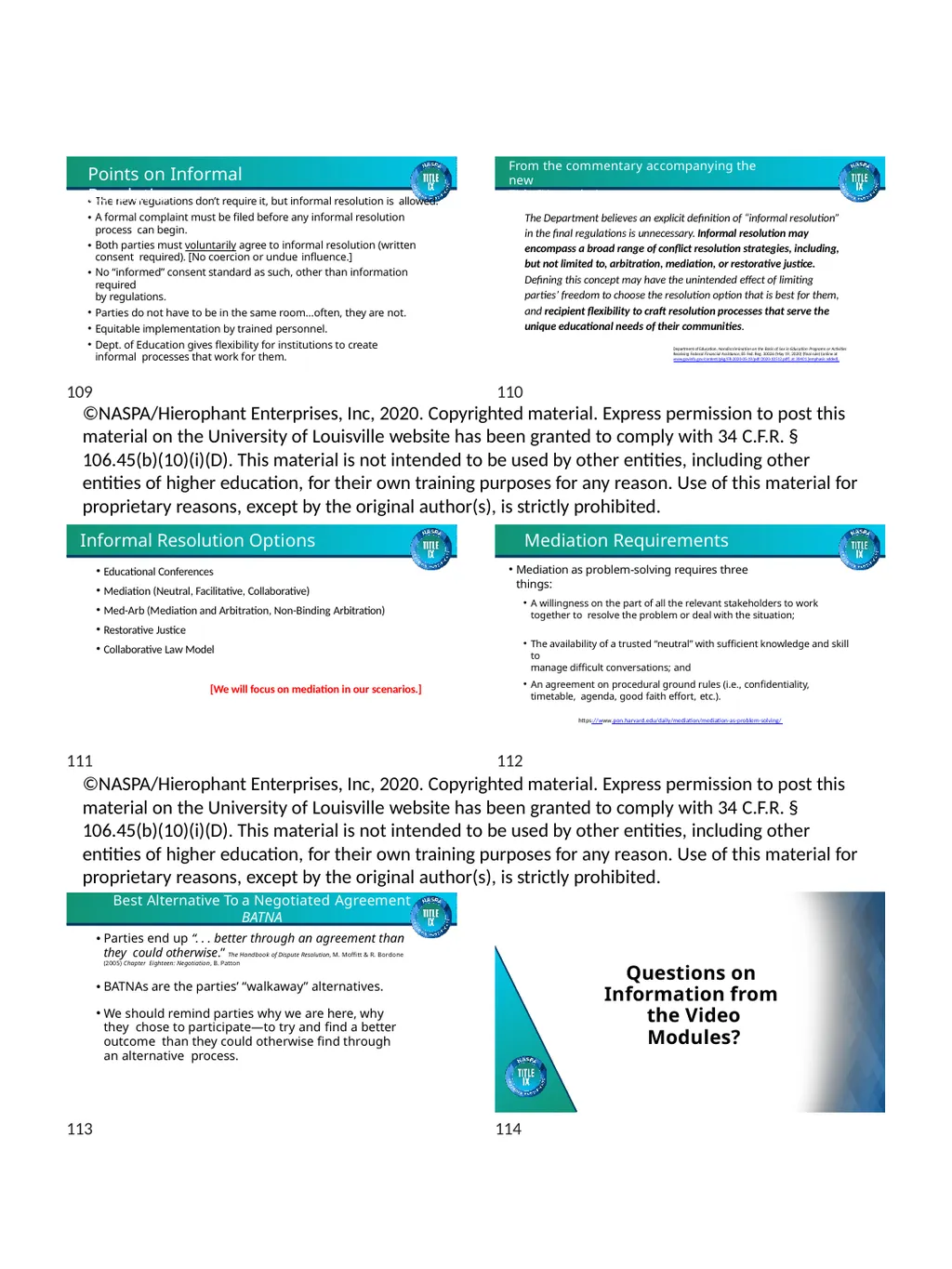
slide19. The new regulations don’t require it, but informal resolution is allowed.
A formal complaint must be filed before any informal resolution process can begin.
Both parties must voluntarily agree to informal resolution (written consent required). [No coercion or undue influence.]
No “informed” consent standard as such, other than information required
by regulations.
Parties do not have to be in the same room…often, they are not.
Equitable implementation by trained personnel.
Dept. of Education gives flexibility for institutions to create informal processes that work for them. Points on Informal Resolution The Department believes an explicit definition of “informal resolution” in the final regulations is unnecessary. Informal resolution may encompass a broad range of conflict resolution strategies, including, but not limited to, arbitration, mediation, or restorative justice.
Defining this concept may have the unintended effect of limiting
parties’ freedom to choose the resolution option that is best for them,
and recipient flexibility to craft resolution processes that serve the unique educational needs of their communities. From the commentary accompanying the new
Title IX regulations… Department of Education, Nondiscrimination on the Basis of Sex in Education Programs or Activities Receiving Federal Financial Assistance, 85 Fed. Reg. 30026 (May 19, 2020) (final rule) (online at www.govinfo.gov/content/pkg/FR-2020-05-19/pdf/2020-10512.pdf) at 30401 (emphasis added). Educational Conferences
Mediation (Neutral, Facilitative, Collaborative)
Med-Arb (Mediation and Arbitration, Non-Binding Arbitration)
Restorative Justice
Collaborative Law Model [We will focus on mediation in our scenarios.] Mediation as problem-solving requires three things: A willingness on the part of all the relevant stakeholders to work together to resolve the problem or deal with the situation; The availability of a trusted “neutral” with sufficient knowledge and skill to
manage difficult conversations; and An agreement on procedural ground rules (i.e., confidentiality, timetable, agenda, good faith effort, etc.). https://www.pon.harvard.edu/daily/mediation/mediation-as-problem-solving/ Parties end up “. . . better through an agreement than they could otherwise.” The Handbook of Dispute Resolution, M. Moffitt & R. Bordone (2005) Chapter Eighteen: Negotiation, B. Patton BATNAs are the parties’ “walkaway” alternatives.
We should remind parties why we are here, why they chose to participate—to try and find a better outcome than they could otherwise find through an alternative process. Questions on Information from the Video Modules? 113 114 109 110
©NASPA/Hierophant Enterprises, Inc, 2020. Copyrighted material. Express permission to post this
material on the University of Louisville website has been granted to comply with 34 C.F.R. § 106.45(b)(10)(i)(D). This material is not intended to be used by other entities, including other entities of higher education, for their own training purposes for any reason. Use of this material for proprietary reasons, except by the original author(s), is strictly prohibited.
Informal Resolution Options Mediation Requirements 111 112
©NASPA/Hierophant Enterprises, Inc, 2020. Copyrighted material. Express permission to post this material on the University of Louisville website has been granted to comply with 34 C.F.R. § 106.45(b)(10)(i)(D). This material is not intended to be used by other entities, including other entities of higher education, for their own training purposes for any reason. Use of this material for proprietary reasons, except by the original author(s), is strictly prohibited.
Best Alternative To a Negotiated Agreement
BATNA Page 19<br>
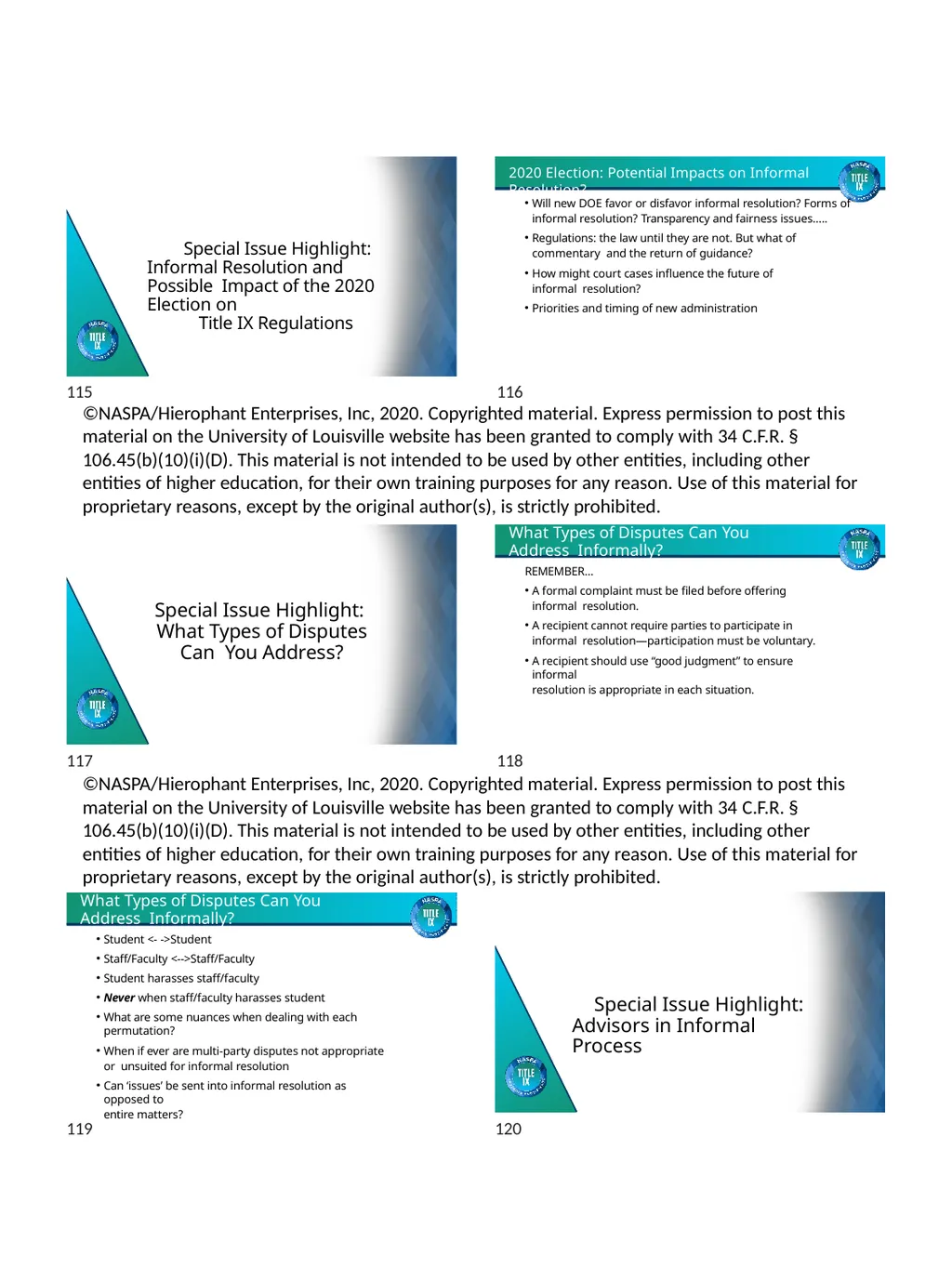
slide20. Special Issue Highlight: Informal Resolution and Possible Impact of the 2020 Election on
Title IX Regulations Will new DOE favor or disfavor informal resolution? Forms of
informal resolution? Transparency and fairness issues…..
Regulations: the law until they are not. But what of commentary and the return of guidance?
How might court cases influence the future of informal resolution?
Priorities and timing of new administration 2020 Election: Potential Impacts on Informal Resolution? Special Issue Highlight: What Types of Disputes Can You Address? REMEMBER…
A formal complaint must be filed before offering informal resolution.
A recipient cannot require parties to participate in informal resolution—participation must be voluntary.
A recipient should use “good judgment” to ensure informal
resolution is appropriate in each situation. Student <- ->Student
Staff/Faculty <-->Staff/Faculty
Student harasses staff/faculty
Never when staff/faculty harasses student
What are some nuances when dealing with each permutation?
When if ever are multi-party disputes not appropriate or unsuited for informal resolution
Can ‘issues’ be sent into informal resolution as opposed to
entire matters? Special Issue Highlight: Advisors in Informal Process 119 120 115 116
©NASPA/Hierophant Enterprises, Inc, 2020. Copyrighted material. Express permission to post this
material on the University of Louisville website has been granted to comply with 34 C.F.R. § 106.45(b)(10)(i)(D). This material is not intended to be used by other entities, including other entities of higher education, for their own training purposes for any reason. Use of this material for proprietary reasons, except by the original author(s), is strictly prohibited.
What Types of Disputes Can You Address Informally? 117 118
©NASPA/Hierophant Enterprises, Inc, 2020. Copyrighted material. Express permission to post this material on the University of Louisville website has been granted to comply with 34 C.F.R. § 106.45(b)(10)(i)(D). This material is not intended to be used by other entities, including other entities of higher education, for their own training purposes for any reason. Use of this material for proprietary reasons, except by the original author(s), is strictly prohibited.
What Types of Disputes Can You Address Informally? Page 20<br>
slide21. Will advisors participate in informal process? Only certain types
of “advisors”? Prohibition on attorneys?
If advisors can participate, how?
[W]e decline to mandate that the parties confer with an advisor before entering an informal resolution process, or to mandate that recipients provide the parties with advisors before entering an informal resolution process. Id. at 30402.
Remember: the Department of Education gives flexibility to institutions to create informal processes that serve their needs. The Role of Advisors in Informal Processes Special Issue Highlight: Confidentiality Section 106.45(b)(9)(i) provides that the written notice given to both parties before entering an informal resolution process must indicate what records would be maintained or could be shared in that process. Importantly, records that could potentially be kept confidential could include the written notice itself, which would not become a public record. The Department leaves it to the discretion of recipients to make these determinations. The Department believes this requirement effectively puts both parties on notice as to the confidentiality and privacy implications of participating in informal resolution. Recipients remain free to exercise their judgment in determining the confidentiality parameters of the informal resolution process they offer to parties. Id. at 30402. Special Issue Highlight: “Consequences” or “Sanctions” in Informal Resolution [A]n informal resolution process, in which the parties voluntarily participate, may end in an agreement under which the respondent agrees to a disciplinary sanction or other adverse consequence, without the recipient completing a grievance process, under § 106.45(b)(9). Id. at 30059 n.286. Informal resolutions may reach agreements between the parties, facilitated by the recipient, that include [supportive] measures but that also could include disciplinary measures, while providing finality for both parties in terms of resolving allegations raised in a formal complaint of sexual harassment. Because an informal resolution may result in disciplinary or punitive measures agreed to by a respondent, we have revised § 106.45(b)(9) to expressly state that a recipient may not offer informal resolution unless a formal complaint is filed. This ensures that the parties understand the allegations at issue and the right to have the allegations resolved through the formal grievance process, and the right to voluntarily consent to participate in informal resolution. 125 126 Id. at 30401. 121 122
©NASPA/Hierophant Enterprises, Inc, 2020. Copyrighted material. Express permission to post this
material on the University of Louisville website has been granted to comply with 34 C.F.R. § 106.45(b)(10)(i)(D). This material is not intended to be used by other entities, including other entities of higher education, for their own training purposes for any reason. Use of this material for proprietary reasons, except by the original author(s), is strictly prohibited. 123 124
©NASPA/Hierophant Enterprises, Inc, 2020. Copyrighted material. Express permission to post this material on the University of Louisville website has been granted to comply with 34 C.F.R. § 106.45(b)(10)(i)(D). This material is not intended to be used by other entities, including other entities of higher education, for their own training purposes for any reason. Use of this material for proprietary reasons, except by the original author(s), is strictly prohibited. Page 21<br>
slide22. Mediation does not bar imposition of penalties.
E.g., Rajib Chanda, Mediating University Sexual Assault Cases, 6 Harv. Negotiation L. Rev. 265, 301 (2001) (defining mediation as ‘‘a process through which two or more disputing parties negotiate a voluntary settlement with the help of a ‘third party’ (the mediator) who typically has no stake in the outcome’’ and stressing that this ‘‘does not impose a ‘win-win’ requirement, nor does it bar penalties. A party can ‘lose’ or be penalized; mediation only requires that the loss or penalty is agreed to by both parties—in a sexual assault case, ‘agreements . . . may include
reconciliation, restitution for the victim, rehabilitation for whoever needs
it, and the acceptance of responsibility by the offender.’’’)
Id. at 30406 n.1519 (emphasis added). “Disciplinary sanction”
“Consequence”
“Outcome”
Due process? Informal resolution consequences will be/will not be on student record?
What is discipline and what is not?
Counseling?
Continuation of supportive measures?
Consult counsel What can be an outcome? Do respondents face discipline as a result of the informal resolution process? Can a respondent’s participation in the informal resolution process be considered in future disciplinary proceedings?
Under this process, there will be no disciplinary action taken against a respondent, and the resolution will not appear on the respondent’s disciplinary record. In addition, if a formal complaint is filed against the respondent in as subsequent matter under the Title IX Sexual Harassment policy or the University Sexual Misconduct policy, the respondent’s participation in a prior informal resolution process will not be considered relevant and will not be taken into account in the resolution of the subsequent complaint. https://sexualmisconductinvestigations.princeton.edu/informal-resolution-process The Department expects informal resolution agreements to be treated as contracts; the parties remain free to negotiate the terms of the agreement and, once entered into, it may become binding according to its terms. Id. at 30405. None?
Institution (Title IX coordinator or decision-maker or designee) signs off on agreement parameters?
Institution manages “contract” agreed to under informal
resolution processes?
Institution “enforces” agreement?
Institution implements sanctions?
Mediators act on behalf of the institution? The Department believes that the robust disclosure requirements of § 106.45(b)(9), the requirement that both parties provide voluntary written consent to informal resolution, and the explicit right of either party to withdraw from the informal resolution process at any time prior to agreeing to the resolution (which may or may not include expulsion of the respondent), will adequately protect the respondent’s interest in a fair process before the sanction of expulsion is imposed. Accordingly, the Department believes that prohibiting recipients from using informal resolution where it results in expulsion is unnecessary; if expulsion is the sanction proposed as part of an informal resolution process, that result can only occur if both parties agree to the resolution. 131 132 Id. at 30407. 127 128
©NASPA/Hierophant Enterprises, Inc, 2020. Copyrighted material. Express permission to post this
material on the University of Louisville website has been granted to comply with 34 C.F.R. § 106.45(b)(10)(i)(D). This material is not intended to be used by other entities, including other entities of higher education, for their own training purposes for any reason. Use of this material for proprietary reasons, except by the original author(s), is strictly prohibited.
Princeton University Example Agreements = Contracts 129 130
©NASPA/Hierophant Enterprises, Inc, 2020. Copyrighted material. Express permission to post this material on the University of Louisville website has been granted to comply with 34 C.F.R. § 106.45(b)(10)(i)(D). This material is not intended to be used by other entities, including other entities of higher education, for their own training purposes for any reason. Use of this material for proprietary reasons, except by the original author(s), is strictly prohibited.
What part does the institution play? Expulsion as a Result of Informal Process? Page 22<br>
slide23. If a respondent, for example, does not believe that expulsion is appropriate then the respondent can withdraw from the informal resolution process and resume the formal grievance process under which the recipient must complete a fair investigation and adjudication, render a determination regarding responsibility, and only then decide on any disciplinary sanction. Expulsion Cont’d Id. at 30407. Special Issue Highlight: Legal Liability With respect to recipients’ potential legal liability where the respondent acknowledges commission of Title IX sexual
harassment (or other violation of recipient’s policy) during an
informal resolution process, yet the agreement reached allows the respondent to remain on campus and the respondent commits Title IX sexual harassment (or violates the recipient’s policy) again, the Department believes that recipients should have the flexibility and discretion to determine under what circumstances respondents should be suspended or expelled from campus as a disciplinary sanction, whether that follows from an informal resolution or after a determination of responsibility under the formal grievance process. Id. at 30407. Federal courts have considered a recipient’s duty not to be deliberately indifferent by exposing potential victims to repeat misconduct of a respondent, when considering what sanctions to impose against a particular respondent. The Department declines to adopt a rule that would mandate suspension or expulsion as the only appropriate sanction following a determination of responsibility against a respondent; recipients deserve flexibility to design
sanctions that best reflect the needs and values of the recipient’s educational mission and community, and that most appropriately address the unique circumstances of each case. While Federal courts have found recipients to be deliberately indifferent where the recipient failed to take measures to avoid subjecting students to discrimination in light of known circumstances that included a respondent’s prior sexual misconduct, courts have also emphasized that the deliberate indifference standard is not intended to imply that a school must suspend or expel every respondent found responsible for sexual harassment. Id. at 30407. Special Issue Highlight: Bias, Impartiality, Etc. All who implement informal processes should serve in their roles impartially.
All Title IX personnel should avoid
prejudgment of facts
prejudice
conflicts of interest
bias
sex stereotypes 137 138 133 134
©NASPA/Hierophant Enterprises, Inc, 2020. Copyrighted material. Express permission to post this
material on the University of Louisville website has been granted to comply with 34 C.F.R. § 106.45(b)(10)(i)(D). This material is not intended to be used by other entities, including other entities of higher education, for their own training purposes for any reason. Use of this material for proprietary reasons, except by the original author(s), is strictly prohibited. 135 136
©NASPA/Hierophant Enterprises, Inc, 2020. Copyrighted material. Express permission to post this material on the University of Louisville website has been granted to comply with 34 C.F.R. § 106.45(b)(10)(i)(D). This material is not intended to be used by other entities, including other entities of higher education, for their own training purposes for any reason. Use of this material for proprietary reasons, except by the original author(s), is strictly prohibited. Page 23<br>
slide24. Remember, you have no “side” other than the integrity of the process. Mediator’s Introduction and
Scenario #1 Demonstration WE NEED 4 VOLUNTEERS! Welcome
Overview of the Process and Role of the Mediator
Voluntariness of Mediation
Confidentiality of Mediation
Neutrality and Impartiality of Mediation
Structure of this Mediation Session
Answer Questions and Confirm Participation Mediator’s Introduction www.mwi.org (adapted) Planning and the Preliminary Meetings
Before mediation begins, the mediator helps the parties decide when and where to meet, for how long, and who will be there. The mediator also conducts a preliminary meeting with each party separately.
Mediator’s Introduction
With the parties gathered together in the same room, the mediator introduces the participants, outlines the mediation process, lays out the ground rules, answers questions, and emphasizes the goal for the mediation—to reach an agreement.
Opening Remarks by Parties
Following the mediator’s introduction, each side is given an opportunity to present its view of the dispute without interruption. In addition, they may also take time to vent their feelings. How Mediation Works https://www.pon.harvard.edu/daily/mediation/how-does-mediation-work/ Joint Discussion
After each side presents its opening remarks, the mediator and the parties are free to ask questions with the goal of arriving at a better understanding of each party’s needs and concerns.
Caucuses
If emotions run high during a joint session, the mediator might split the sides into separate rooms for private meetings.
Facilitated Negotiation
At this point, it’s time to begin formulating ideas and proposals that meet each party’s core interests.
Closing and Follow Up
If the parties reach consensus, the mediator will outline the terms and may write up a draft agreement. https://www.pon.harvard.edu/daily/mediation/how-does-mediation-work/ It’s Your Turn!
Scenarios #2 – #4 in Breakout Groups 143 144 139 140
©NASPA/Hierophant Enterprises, Inc, 2020. Copyrighted material. Express permission to post this
material on the University of Louisville website has been granted to comply with 34 C.F.R. § 106.45(b)(10)(i)(D). This material is not intended to be used by other entities, including other entities of higher education, for their own training purposes for any reason. Use of this material for proprietary reasons, except by the original author(s), is strictly prohibited. 141 142
©NASPA/Hierophant Enterprises, Inc, 2020. Copyrighted material. Express permission to post this material on the University of Louisville website has been granted to comply with 34 C.F.R. § 106.45(b)(10)(i)(D). This material is not intended to be used by other entities, including other entities of higher education, for their own training purposes for any reason. Use of this material for proprietary reasons, except by the original author(s), is strictly prohibited.
How Mediation Works Cont’d Page 24<br>
Facilitating Fair and Effective
Informal Resolution Processes Under Title IX
Fall 2020 Copyrighted material. May not be reproduced without permission. Facilitating Fair and Effective Informal Resolution Processes Under Title IX Module 1: Introduction and Overview
Peter Lake
Professor of Law, Charles A. Dana Chair, and Director of the Center for Excellence in Higher Education Law and Policy
Stetson University College of Law
Kristine Goodwin M.Ed., J.D.
Associate of The Registry, CPR Distinguished Neutrals, MWI, Inc., and Umass Justice Bridge What are the regulatory
requirements regarding “informal resolution” under Title IX? Informal resolution may present a way to resolve sexual harassment allegations in a less adversarial manner than the investigation and adjudication procedures that comprise the §
106.45 grievance process. From the Commentary… Department of Education, Nondiscrimination on the Basis of Sex in Education Programs or Activities Receiving Federal Financial Assistance, 85 Fed. Reg. 30026 (May 19, 2020) (final rule) (online at www.govinfo.gov/content/pkg/FR-2020-05-19/pdf/2020-10512.pdf) at 30098. The Department believes an explicit definition of “informal resolution” in the final regulations is unnecessary. Informal resolution may encompass a broad range of conflict resolution strategies, including, but not limited to, arbitration, mediation, or restorative justice.
Defining this concept may have the unintended effect of limiting
parties’ freedom to choose the resolution option that is best for them,
and recipient flexibility to craft resolution processes that serve the unique educational needs of their communities.
Id. at 30401. From the commentary… § 106.45(b)(9) Informal resolution. 5 6 A recipient may not require as a condition of enrollment or continuing enrollment, or employment or continuing employment, or enjoyment of any other right, waiver of the right to an investigation and adjudication of formal complaints of sexual harassment consistent with this section.
[A] recipient may not require the parties to participate in an informal resolution process under this section and may not offer an informal resolution process unless a formal complaint is filed.
(emphasis added) 1 2
©NASPA/Hierophant Enterprises, Inc, 2020. Copyrighted material. Express permission to post this
material on the University of Louisville website has been granted to comply with 34 C.F.R. § 106.45(b)(10)(i)(D). This material is not intended to be used by other entities, including other entities of higher education, for their own training purposes for any reason. Use of this material for proprietary reasons, except by the original author(s), is strictly prohibited. 3 4
©NASPA/Hierophant Enterprises, Inc, 2020. Copyrighted material. Express permission to post this material on the University of Louisville website has been granted to comply with 34 C.F.R. § 106.45(b)(10)(i)(D). This material is not intended to be used by other entities, including other entities of higher education, for their own training purposes for any reason. Use of this material for proprietary reasons, except by the original author(s), is strictly prohibited. Page One<br>
slide2. [A]t any time prior to reaching a determination regarding responsibility the recipient may facilitate an informal resolution process, such as mediation, that does not involve a full investigation and adjudication . . . § 106.45(b)(9) Cont’d (emphasis added) § 106.45(b)(9)(i) (Written Notice) Parties must be provided written notice that outlines
The allegations
The requirements of the informal resolution process including the circumstances under which it precludes the parties from resuming a formal complaint arising from the same allegations, provided, however, that at any time prior to agreeing to a resolution, any party has the right to withdraw from the informal resolution process and resume the grievance process with respect to the formal complaint
any consequences resulting from participating in the informal resolution process, including the records that will be maintained or could be shared
(emphasis and bullets added) Obtains the parties’ voluntary, written consent to the
informal resolution process; and
Does not offer or facilitate an informal resolution process to resolve allegations that an employee sexually harassed a student. (emphasis added) Because informal resolution is only an option, and is never required, under the final regulations, the Department does not believe that § 106.45(b)(9) presents conflict with other Federal or State laws or practices concerning resolution of sexual harassment allegations through mediation or other alternative dispute resolution processes.
Id. at 30404. The new regulations don’t require it, but informal resolution is
allowed.
A formal complaint must be filed before any informal resolution process can begin.
Both parties must voluntarily agree to informal resolution (written consent required). [No coercion or undue influence.]
No “informed” consent standard as such, other than information
required by regulations.
Parties do not have to be in the same room…often, they are not.
Equitable implementation by trained personnel Should you offer it?
Pros/Cons
Increased complainant autonomy
Training of personnel is required under the new regulations
Who should implement?
What type of training is needed?
Mediation? Arbitration? Restorative justice?
When can’t we use informal resolution?
→When the allegation is that an employee sexually harassed a student.
Does this option provide for more opportunities for “educational”
interventions?
What does this look like in practice? 11 12 7 8
©NASPA/Hierophant Enterprises, Inc, 2020. Copyrighted material. Express permission to post this
material on the University of Louisville website has been granted to comply with 34 C.F.R. § 106.45(b)(10)(i)(D). This material is not intended to be used by other entities, including other entities of higher education, for their own training purposes for any reason. Use of this material for proprietary reasons, except by the original author(s), is strictly prohibited.
§ 106.45(b)(9)(ii-iii) From the commentary… 9 10
©NASPA/Hierophant Enterprises, Inc, 2020. Copyrighted material. Express permission to post this material on the University of Louisville website has been granted to comply with 34 C.F.R. § 106.45(b)(10)(i)(D). This material is not intended to be used by other entities, including other entities of higher education, for their own training purposes for any reason. Use of this material for proprietary reasons, except by the original author(s), is strictly prohibited.
Points on Informal Resolution Points on Informal Resolution Page 2<br>
slide3. What types of informal resolution exist?
What are the range of options
available to institutions? Educational Conferences Mediation (Neutral, Facilitative, Collaborative)
Med-Arb (Mediation and Arbitration, Non-Binding Arbitration)
Restorative Justice
Collaborative Law Model [Each of these will be discussed more in-depth in the next module.] Informal Resolution Options Important Considerations Title IX Coordinator
Dean of Students
Student Conduct
Campus Ombudsperson
Outside Entity/Third Party/Trained Mediators
Other options…. § 106.45(b)(9)(iii) [N]ot offer or facilitate an informal resolution process to resolve allegations that an employee sexually harassed a student. When is it inappropriate to use informal resolution processes? Who are “impacted Individuals” under Title IX?
How do informal processes support culture and climate work on campus?
How do informal processes relate to other, more formalized processes such as bias and incident response processes?
Budget impacts/size and nature of an institution?
What are the intersections among advisors, investigators and decision- makers? 17 18 Important Questions 13 14
©NASPA/Hierophant Enterprises, Inc, 2020. Copyrighted material. Express permission to post this
material on the University of Louisville website has been granted to comply with 34 C.F.R. § 106.45(b)(10)(i)(D). This material is not intended to be used by other entities, including other entities of higher education, for their own training purposes for any reason. Use of this material for proprietary reasons, except by the original author(s), is strictly prohibited.
Who can implement informal resolutions on your campus? 15 16
©NASPA/Hierophant Enterprises, Inc, 2020. Copyrighted material. Express permission to post this material on the University of Louisville website has been granted to comply with 34 C.F.R. § 106.45(b)(10)(i)(D). This material is not intended to be used by other entities, including other entities of higher education, for their own training purposes for any reason. Use of this material for proprietary reasons, except by the original author(s), is strictly prohibited. Page 3<br>
slide4. What type of training and skills do informal resolution tasked personnel need? “Schools must ensure that Title IX personnel [Title IX Coordinator, any investigator, any decision-maker, and any person who facilities an informal resolution (such as mediation)] receive training as follows:
On Title IX’s definition of “sexual harassment”
On the scope of the school’s education program or activity
On how to conduct an investigation and grievance process
On how to serve impartially, including by avoiding prejudgment of the facts at issue
On how to avoid conflicts of interest and bias
Decision-makers must receive training on any technology to be used at a live hearing, and on issues of relevance of questions and evidence, including when questions and evidence about a complainant’s sexual predisposition or prior sexual behavior are not relevant
Investigators must receive training on issues of relevance to create an investigative report that fairly summarizes relevant evidence” Training Mandates Specific to the New Regulations U.S. Dept. of Educ. Office for Civil Rights, Blog (May 18, 2020), https://www2.ed.gov/about/offices/list/ocr/blog/20200518.html “All materials used to train Title IX personnel:
Must not rely on sex stereotypes,
Must promote impartial investigations and adjudications of formal complaints of sexual harassment,
Must be maintained by the school for at least 7 years,
Must be publicly available on the school’s website; if the school does not maintain a website the school must make the training materials available upon request for inspection by members of the public.” “Schools must publish training materials that are up to date and reflect the latest training provided to Title IX personnel.” Posting Training Materials to Your Website “If a school’s current training materials are copyrighted or otherwise protected as proprietary business information (for example, by an outside consultant), the school still must comply with the Title IX Rule. This may mean that the school has to secure permission from
the copyright holder to publish the training materials on the school’s website.”
U.S. Dept. of Educ. Office for Civil Rights, Blog (May 18, 2020), https://www2.ed.gov/about/offices/list/ocr/blog/20200518.html (emphasis added). [Three-Prong Test]
Sexual harassment means conduct on the basis of sex that satisfies one or more of the following:
An employee of the recipient conditioning the provision of an aid, benefit, or service of the recipient on an individual’s participation in unwelcome sexual conduct;
Unwelcome conduct determined by a reasonable person to be so severe, pervasive, and objectively offensive that it effectively denies a person equal
access to the recipient’s education program or activity; or
“Sexual assault” as defined in 20 U.S.C. 1092(f)(6)(A)(v), “dating violence” as defined in 34 U.S.C. 12291(a)(10), “domestic violence” as defined in 34 U.S.C. 12291(a)(8), or “stalking” as defined in 34 U.S.C. 12291(a)(30). Title IX’s definition of “sexual harassment” A recipient with actual knowledge of sexual harassment in an education program or activity of the recipient against a person in the United States, must respond promptly in a manner that is not deliberately indifferent. . . . ‘‘education program or activity’’ includes locations, events, or circumstances over which the recipient exercised substantial control over both the respondent and the context in which the sexual harassment occurs, and also includes any building owned or controlled by a student organization that is officially recognized by a postsecondary institution. §106.44(a) General response to sexual harassment. What does your campus policy state specifically regarding the scope of “education programs or activities?”
(emphasis added) This policy applies to ABC University students, employees, and third-parties located within the United States both on and off campus, as well as in the digital realm. Off-campus coverage of this policy is limited to incidents that occur on employee-led trips, at internship or service learning sites, and college-owned properties (including buildings operated by Registered Student Organizations), or in any context where the University exercised substantial control over both alleged harassers and the context in which the alleged harassment occurred. Example of “Scope” in a Policy 23 24 Scope will be specific to an institution. 19 20
©NASPA/Hierophant Enterprises, Inc, 2020. Copyrighted material. Express permission to post this
material on the University of Louisville website has been granted to comply with 34 C.F.R. § 106.45(b)(10)(i)(D). This material is not intended to be used by other entities, including other entities of higher education, for their own training purposes for any reason. Use of this material for proprietary reasons, except by the original author(s), is strictly prohibited. 21 22
©NASPA/Hierophant Enterprises, Inc, 2020. Copyrighted material. Express permission to post this material on the University of Louisville website has been granted to comply with 34 C.F.R. § 106.45(b)(10)(i)(D). This material is not intended to be used by other entities, including other entities of higher education, for their own training purposes for any reason. Use of this material for proprietary reasons, except by the original author(s), is strictly prohibited. Page 4<br>
slide5. Active listening skills (e.g. paying attention, withholding judgment, reflecting, clarifying, paraphrasing, and summarizing.)
Legal training
Prior ADR experience
Operational knowledge and experience in higher education
Comfortable with TIX subject matter
Bias/Implicit bias training
Knowledge regarding campus policies/cultures
Understanding of relevant objective standards Desirable skills and knowledge bases Cross-train with other disciplines
Build credentials
Other NASPA training programs
Education Credentials
Training in ADR in other contexts (e.g. Family Court)
Other civil rights metrics
Read, read, and read some more Cross-training “Ultra Vires”
Latin meaning act without authority or literally beyond powers. This term is frequently used in business and agency law (the Doctrine of Ultra Vires). An ultra virus act occurs when one commits an act that is beyond the powers or purpose of an individual and/or organization. (https://dictionary.thelaw.com/ultra-vires/)
“Intra Vires”
An act is said to be intra vires (“within the power”) of a person or organization when it is within the scope of their powers or authority. It is the opposite of ultra vires. (https://dictionary.thelaw.com/intra-vires/)
Mental Health Providers, Lawyers, Trained/Certified Mediators are professional trades that require specialized training and are often regulated by federal and/or state requirements, professional organizations, and individual institutions. Never Claim to Have More Skills or Expertise Than You Actually Have All Title IX personnel, including those implementing and/or facilitating informal resolution processes, should serve in their roles impartially.
All Title IX personnel should avoid:
prejudgment of facts
prejudice
conflicts of interest
bias
sex stereotypes Bias, Conflicts of Interest, Impartiality, etc. American Bar Association (ABA) Section of Dispute Resolution
Preparing for Family Mediation
(https://www.americanbar.org/content/dam/aba/images/dispute_resolution/Mediation_Guide_Family.pdf)
Mediate.com Mediate University
Basic 40-hour Mediation: This training which satisfies most state and court basic mediation requirements. It is approved for 40 hours of continuing mediation credit in Washington state and 40 hours of CLE credit in California-- and reciprocally in many other states. Upon completion of the course, the participant will receive a Certificate of Completion. (https://www.mediateuniversity.com)
JAMS Solutionsfor Higher Education
Title IX Hearing Officers & Mediators | Staff & Faculty Dispute Resolution & Prevention | ADR Training & System Design (https://www.jamsadr.com/solutions)
MWI.org
All of MWI’s Forty-Hour Mediation Training Programs (both the weekday and weekends/weeknights options) are currently being offered online and live via Zoom. (https://www.mwi.org/mediation-training/)
American Psychological Association (APA)
Ensuring that investigations of campus sexual misconduct are reflective of psychological science: APA helped draft, and has endorsed, legislation that would minimize re-traumatization from campus sexual misconduct investigations. Date created: September 4, 2020 (https://www.apa.org/search)
Etc. Conclusion 29 30 25 26
©NASPA/Hierophant Enterprises, Inc, 2020. Copyrighted material. Express permission to post this
material on the University of Louisville website has been granted to comply with 34 C.F.R. § 106.45(b)(10)(i)(D). This material is not intended to be used by other entities, including other entities of higher education, for their own training purposes for any reason. Use of this material for proprietary reasons, except by the original author(s), is strictly prohibited. 27 28
©NASPA/Hierophant Enterprises, Inc, 2020. Copyrighted material. Express permission to post this material on the University of Louisville website has been granted to comply with 34 C.F.R. § 106.45(b)(10)(i)(D). This material is not intended to be used by other entities, including other entities of higher education, for their own training purposes for any reason. Use of this material for proprietary reasons, except by the original author(s), is strictly prohibited.
Additional Resources Page 5<br>
slide6. Flexibility
“Tuning”
Stay within skill set
How “formal” is your “informal” process?
Language/What will you call your process?
What are some lessons learned from analogous fields? Final thoughts… Thank you!
Assessment to follow… Copyrighted material. May not be reproduced without permission. Facilitating Fair and Effective Informal Resolution Processes Under Title IX Module 2: Developing Informal Processes for Your Campus
Peter Lake
Professor of Law, Charles A. Dana Chair, and Director of the Center for Excellence in Higher Education Law and Policy
Stetson University College of Law
Kristine Goodwin M.Ed., J.D.
Associate of The Registry, CPR Distinguished Neutrals, MWI, Inc., and Umass Justice Bridge The Department believes an explicit definition of “informal resolution” in the final regulations is unnecessary. Informal resolution may encompass a broad range of conflict resolution strategies, including, but not limited to, arbitration, mediation, or restorative justice.
Defining this concept may have the unintended effect of limiting
parties’ freedom to choose the resolution option that is best for them,
and recipient flexibility to craft resolution processes that serve the unique educational needs of their communities. From the commentary accompanying the new
Title IX regulations… Department of Education, Nondiscrimination on the Basis of Sex in Education Programs or Activities Receiving Federal Financial Assistance, 85 Fed. Reg. 30026 (May 19, 2020) (final rule) (online at www.govinfo.gov/content/pkg/FR-2020-05-19/pdf/2020-10512.pdf) at 30401 (emphasis added). A Closer Look at Specific Ways to Facilitate Effective Informal Resolutions Educational Conferences
Mediation (Neutral, Facilitative, Collaborative)
Med-Arb (Mediation and Arbitration, Non-Binding Arbitration)
Restorative Justice
Collaborative Law Model 35 36 31 32
©NASPA/Hierophant Enterprises, Inc, 2020. Copyrighted material. Express permission to post this
material on the University of Louisville website has been granted to comply with 34 C.F.R. § 106.45(b)(10)(i)(D). This material is not intended to be used by other entities, including other entities of higher education, for their own training purposes for any reason. Use of this material for proprietary reasons, except by the original author(s), is strictly prohibited. 33 34
©NASPA/Hierophant Enterprises, Inc, 2020. Copyrighted material. Express permission to post this material on the University of Louisville website has been granted to comply with 34 C.F.R. § 106.45(b)(10)(i)(D). This material is not intended to be used by other entities, including other entities of higher education, for their own training purposes for any reason. Use of this material for proprietary reasons, except by the original author(s), is strictly prohibited.
Informal Resolution Options Page 6<br>
slide7. Concept in Beyond Discipline (2009)
Can be called by a student, RSO, staff or faculty member
Opportunity to have a conversation about anything
How could ed conferences be adapted for Title IX?
How campuses utilize educational conferences: Two examples Educational Conferences “Conduct Educators” and “Educational Conferences”
“The primary tool of the Conduct Educator is the opportunity for an “Educational Conference” with the student. When the University becomes aware of a student who may not be meeting the expectations of good decision-making (usually through an academic alert from faculty, public safety report, or housing report), then the student will be contacted (generally by email) to schedule an Educational Conference.”
Univ. of Central Missouri, UCM Student Handbook: Your Guide to Good Decision-Making, at 9. Univ. of Central Missouri “An Educational Conference might also be required if university personnel identify a pattern of behaviors or decisions that illustrate poor decision-making or potential risk. A student may also request an Educational Conference if there is a concern they would like to discuss. An Educational Conference may also be required in order to help UCM staff prevent a foreseeable negative event. For example, if staff become aware that students have planned a large and potentially risky party, those students might be required to meet with a Conduct Educator to discuss how they plan to manage that event and minimize the risk to attendees.
The Educational Conference should be viewed as an opportunity for a student to clarify their decision-making process and, in the case of poor judgment, take responsibility for correcting that error. The Educational Conference is designed to be a civil but critical examination of the student’s decision-making process and direct discussion of choices the student has made. This process is only effective if a student participates openly, respectfully and honestly. Deception and incivility reduce the ability of the Conduct Educator to assist the student in evaluating the educational purposefulness of their choices and will not be tolerated.”
Univ. of Central Missouri, UCM Student Handbook: Your Guide to Good Decision-Making, at 10. “The educational conference is an important instructional tool at Tulane University, and students and student organizations should expect to participate in this process. When the University becomes aware of a student who may not be meeting the core values and expectations of a Tulane University student and/or may have violated Tulane Code Rules (excluding sexual assault), the Office of Student Conduct or their designee, often Residence Life or Campus Life, can choose to resolve this concern through an educational conference instead of the more formal resolution process.
The educational conference is an opportunity for a student or organization to discuss critical decisions and options or to take responsibility for correcting any error in judgment. The educational conference may feature critical examination of a student’s or organization’s decision-making and a discussion of choices the student or organization has made. It is also proactive, allowing staff to speak with students about worrisome patterns of behavior or to prevent foreseeable negative outcomes, like discussions of risk management for events. It can also be an opportunity for students to share concern for other members of the community, to discover resources, to seek mentorship and guidance, and so on.”
Tulane Univ., Code of Student Conduct, at 8 – 9. “There are many potential outcomes in an educational conference. In some situations, a student or organization may be asked to agree to a learning action plan. A learning action plan may feature some of the consequences outlined in the section of this Code designated “Consequences,” other than suspension or expulsion or revocation of recognition of a group. It is the responsibility of the student to complete this learning action plan in the manner and timeframe determined by the conduct officer.
Sometimes during an educational conference it becomes clear that a situation would be better addressed through a more formal process, such as an administrative hearing, student hearing panel or investigation. The conduct officer has the discretion to end the educational conference in lieu of these other processes.”
Tulane Univ., Code of Student Conduct, at 9. The submission of a dispute to an unbiased third person designated by the parties to the controversy, who agree in advance to comply with the award— a decision to be issues after a hearing at which both parties have an opportunity to be heard.
Arbitration is a well-established and widely used means to end disputes.
It is one of several kinds of Alternative Dispute Resolution
which provide parties to a controversy with a choice other than litigation. Unlike litigation, arbitration takes place out of court: the two sides select an impartial third party, known as an arbitrator; agree in advance to comply with the arbitrator's award; and then participate in a hearing at which both sides can present evidence and testimony. The arbitrator's decision is usually final and courts rarely reexamine it.
Arbitration can be voluntary or required. [Except on a college campus, for Title IX purposes, informal resolution cannot be required.]
https://legal-dictionary.thefreedictionary.com/arbitration 41 42 37 38
©NASPA/Hierophant Enterprises, Inc, 2020. Copyrighted material. Express permission to post this
material on the University of Louisville website has been granted to comply with 34 C.F.R. § 106.45(b)(10)(i)(D). This material is not intended to be used by other entities, including other entities of higher education, for their own training purposes for any reason. Use of this material for proprietary reasons, except by the original author(s), is strictly prohibited.
Univ. of Central Missouri Cont’d Tulane University 39 40
©NASPA/Hierophant Enterprises, Inc, 2020. Copyrighted material. Express permission to post this material on the University of Louisville website has been granted to comply with 34 C.F.R. § 106.45(b)(10)(i)(D). This material is not intended to be used by other entities, including other entities of higher education, for their own training purposes for any reason. Use of this material for proprietary reasons, except by the original author(s), is strictly prohibited.
Tulane University Cont’d What is arbitration? Page 7<br>
slide8. What is mediation? Mediation, as used in law, is a form of alternative dispute resolution resolving disputes between two or more parties with concrete effects. Typically, a third party, the mediator, assists the parties to negotiate a settlement. Disputants may mediate disputes in a variety of domains, such as commercial, legal, diplomatic, workplace, community, and family matters. “Neutrals”
Campus “Ombudsperson”? https://en.wikipedia.org/wiki/Mediation What is mediation? Cont’d Mediation is a dynamic, structured, interactive process where an impartial third party assists disputing parties in resolving conflict through the use of specialized communication and negotiation techniques. All participants in mediation are encouraged to actively participate in the process. Mediation is a "party-centered" process in that it is focused primarily upon the needs, rights, and interests of the parties. https://en.wikipedia.org/wiki/Mediation The mediator uses a wide variety of techniques to guide the process in a constructive direction and to help the parties find their optimal solution. A mediator is facilitative in that she/he manages the interaction between parties and facilitates open communication. Mediation is also evaluative in that the mediator analyzes issues and relevant norms ("reality-testing"), while refraining from providing prescriptive advice to the parties (e.g., "You should do... ."). https://en.wikipedia.org/wiki/Mediation The term "mediation" broadly refers to any instance in which a third party helps others reach an agreement. More specifically, mediation has a structure, timetable, and dynamics that "ordinary" negotiation lacks. The process is private and confidential, possibly enforced by law. Participation is typically voluntary. The mediator acts as a neutral third party and facilitates rather than directs the process.
Mediation is becoming a more peaceful and internationally accepted solution to end the conflict. Mediation can be used to resolve disputes of any magnitude. https://en.wikipedia.org/wiki/Mediation What is mediation? Cont’d Mediators use various techniques to open, or improve, dialogue and empathy between disputants, aiming to help the parties reach an agreement. Much depends on the mediator's skill and training. As the practice gained popularity, training programs, certifications, and licensing followed, which produced trained and professional mediators committed to the discipline. JAMS
American Arbitration Association (AAA)
American Bar Association, ADR Section
Association for Conflict Resolution (ACR)
CPR Institute for Dispute Resolution
National Association for Community Mediation https://en.wikipedia.org/wiki/Mediation A form of arbitration in which the arbitrators starts as a mediator but in the event of a failure of mediation, the arbitrator imposes a binding decision. Duhaime’s Law Dictionary, Med-Arb Definition, http://www.duhaime.org/LegalDictionary/M/MedArb.aspx. 47 48 What is med-arb? 43 44
©NASPA/Hierophant Enterprises, Inc, 2020. Copyrighted material. Express permission to post this
material on the University of Louisville website has been granted to comply with 34 C.F.R. § 106.45(b)(10)(i)(D). This material is not intended to be used by other entities, including other entities of higher education, for their own training purposes for any reason. Use of this material for proprietary reasons, except by the original author(s), is strictly prohibited.
What is mediation? Cont’d What is mediation? Cont’d 45 46
©NASPA/Hierophant Enterprises, Inc, 2020. Copyrighted material. Express permission to post this material on the University of Louisville website has been granted to comply with 34 C.F.R. § 106.45(b)(10)(i)(D). This material is not intended to be used by other entities, including other entities of higher education, for their own training purposes for any reason. Use of this material for proprietary reasons, except by the original author(s), is strictly prohibited. Page 8<br>
slide9. “[T]he essence of med-arb is to allow a softer mediation process to occur first thus taking every opportunity of achieving a resolution to a dispute which is not imposed and to which each party to the dispute subscribes voluntarily.
In this initial phase, the presiding neutral third-party acts as a mediator and coaches or encourages the parties towards a settlement taking into account the information received from both at a mediation hearing.
Med/arb motivates the participants at the mediation given the shadow of the hammer of med/arb: the transformation, if mediation fails, of the process to arbitration. At that point, the presiding officer, now sitting as an arbitrator and no longer as a mediator, is enabled to proceed as if the hearing was one of arbitration and to impose a resolution, a final and binding award, generally relying on the information presented during the mediation hearing.”
Duhaime’s Law Dictionary, Med-Arb Definition, http://www.duhaime.org/LegalDictionary/M/MedArb.aspx. Med-arb Cont’d What is restorative justice? A restorative justice program aims to get offenders to take responsibility for their actions, to understand the harm they have caused, to give them an opportunity to redeem themselves and to discourage them from causing further harm. For victims, its goal is to give them an active role in the process and to reduce feelings of anxiety and powerlessness. Restorative justice is founded on an alternative theory to the traditional methods of justice, which often focus on retribution. However, restorative justice programs can complement traditional methods.
Academic assessment of restorative justice is positive. Most studies suggest it makes offenders less likely to reoffend. A 2007 study also found that it had the highest rate of victim satisfaction and offender accountability of any method of justice. Its use has seen worldwide growth since the 1990s. Restorative justice inspired and is part of the wider study of restorative practices.
https://en.wikipedia.org/wiki/Restorative_justice
(internal citations omitted)
How can it be used in Title IX/sexual misconduct?
Koss MP, Wilgus JK, Williamsen KM. Campus Sexual Misconduct: Restorative Justice Approaches to Enhance Compliance With Title IX Guidance. Trauma Violence Abuse. 2014;15(3):242-257. doi:10.1177/1524838014521500 Theories about its effectiveness include:
The offender has to learn about the harm they have caused to their victim, making it hard for them to justify their behavior.
It offers a chance to discuss moral development to offenders who may have had little of it in their life.
Offenders are more likely to view their punishment as legitimate.
The programs tend to avoid shaming and stigmatizing the offender.
Many restorative justice systems, especially victim-offender mediation and family group conferencing, require participants to sign a confidentiality agreement. These agreements usually state that conference discussions will not be disclosed to nonparticipants. The rationale for confidentiality is that it promotes open and honest communication. Restorative Justice https://en.wikipedia.org/wiki/Restorative_justice
(internal citation omitted) With respect to the implications of restorative justice and the recipient reaching a determination regarding responsibility, the Department acknowledges that generally a critical feature of restorative justice is that the respondent admits responsibility at the start of the process. However, this admission of responsibility does not necessarily mean the recipient has also reached that determination, and participation in restorative justice as a type of informal resolution must be a voluntary decision on the part of the respondent. Id. at 30406 (emphasis added). From the commentary accompanying the new
Title IX regulations… Therefore, the language limiting the availability of an informal resolution process only to a time period before there is a determination of responsibility does not prevent a recipient from using the process of restorative justice under § 106.45(b)(9), and a recipient has discretion under this provision to specify the
circumstances under which a respondent’s admission of responsibility while participating in a restorative justice model would, or would not, be used in an adjudication if either party withdraws from the informal process and resumes the formal grievance process.
Id. at 30406 (emphasis added). From the commentary accompanying the new Title IX regulations… Similarly, a recipient could use a restorative justice model after a determination of responsibility finds a respondent responsible; nothing in the final regulations dictates the form of disciplinary sanction a recipient may or must impose on a respondent. 53 54 Id. at 30406 (emphasis added). From the commentary accompanying the new
Title IX regulations… 49 50
©NASPA/Hierophant Enterprises, Inc, 2020. Copyrighted material. Express permission to post this
material on the University of Louisville website has been granted to comply with 34 C.F.R. § 106.45(b)(10)(i)(D). This material is not intended to be used by other entities, including other entities of higher education, for their own training purposes for any reason. Use of this material for proprietary reasons, except by the original author(s), is strictly prohibited. 51 52
©NASPA/Hierophant Enterprises, Inc, 2020. Copyrighted material. Express permission to post this material on the University of Louisville website has been granted to comply with 34 C.F.R. § 106.45(b)(10)(i)(D). This material is not intended to be used by other entities, including other entities of higher education, for their own training purposes for any reason. Use of this material for proprietary reasons, except by the original author(s), is strictly prohibited. Page 9<br>
slide10. Restorative Justice Resources Cited in the Commentary to the New Title IX Regulations Clare McGlynn et al., ‘‘I just wanted him to hear me’’: Sexual violence and the
possibilities of restorative justice, 39 Journal of L. & Society 2 (2012).
Katherine Mangan, Why More Colleges Are Trying Restorative Justice in Sex Assault Cases, Chronicle of Higher Education (Sept. 17, 2018).
Kerry Cardoza, Students Push for Restorative Approaches to Campus Sexual Assault, Truthout (Jun. 30, 2018).
Howard Zehr, The Little Book of Restorative Justice (Good Books 2002).
David R. Karp et al., Campus Prism: A Report On Promoting Restorative Initiatives For Sexual Misconduct On College Campuses, Skidmore College Project on Restorative Justice (2016).
Margo Kaplan, Restorative Justice and Campus Sexual Misconduct, 89 emp. L. Rev. 701, 715 (2017).
Id. at 30406 n.1518. Mediation
Dispute doesn’t necessarily have to cause a harm, can be just a disagreement
One party doesn’t have to admit wrongdoing/ parties are treated as moral equals
Focuses on coming to an agreement
settlement-driven
Not necessarily focused on emotional needs of the parties Restorative Justice vs. Mediation Restorative Justice
A party has been harmed/ victimization has occurred
The offending party must admit to wrongdoing before the process begins
Focuses on reparations and looks to improve future behavior
dialogue-driven
Very focused on the emotional needs of the victim/victim empowerment
Brookes & McDonough, The Differences Between Mediation and Restorative Justice/Practice, https://moj.gov.jm/sites/default/files/rj/Mediation_versus_Restorative_Practice.pdf. Restorative Justice Victoria, How is Restorative Justice Different than Mediation, http://www.rjvictoria.com/ufaqs/13-how-is- restorative-justice-different-than-mediation/ According to Black's Law Dictionary, collaborative law is a dispute- resolution method by which parties and their attorneys settle disputes using nonadversarial techniques to reach a binding agreement.
Collaborative law is a method well-suited for settling highly emotional cases such as business partnership dissolutions, wrongful discharge claims, and family law cases.
In a Collaborative case, clients work with a team of collaboratively trained professionals with the goal of reaching an out-of-court agreement. The team includes two attorneys, a coach/facilitator, and as needed, a financial neutral, child specialist and other professional experts. Each of these team members has a role in the Collaborative process which is described further below: https://massclc.org/collaborativepros Collaborative Law Model (A Team Approach) The Collaborative Attorney: represents the client’s interests, taking into account the other party’s interests as a whole; Refrains from using adversarial techniques; Educates the client about legal issues; Works effectively with the other attorney and coach/facilitator to create a structure and environment that maximizes agreement potential
The Collaborative Coach / Facilitator: Serves as a neutral focused on managing process, client behavior, and emotions; Provides expert advice on the psychology of the circumstances; Identifies and reinforces effective communication between parties; Intervenes to contain and manage conflict; Educates the attorneys about the parties’ communication dynamics
Other Professionals: During the Collaborative process, the parties may choose to engage other neutral professionals to assist with specific areas that require their unique expertise (e.g. well-trained public safety liaison, trauma specialist/counselor, academic support specialist, etc.)
https://massclc.org/collaborativepros Collaborative Law Model Cont’d Developing and Planning an Informal Process Name
Description 59 60 Demonstrations?
Personnel
Relationship to Title IX Policy/Articulation
Think about the “complaint” requirement
Desirable or simply available? 55 56
©NASPA/Hierophant Enterprises, Inc, 2020. Copyrighted material. Express permission to post this
material on the University of Louisville website has been granted to comply with 34 C.F.R. § 106.45(b)(10)(i)(D). This material is not intended to be used by other entities, including other entities of higher education, for their own training purposes for any reason. Use of this material for proprietary reasons, except by the original author(s), is strictly prohibited. 57 58
©NASPA/Hierophant Enterprises, Inc, 2020. Copyrighted material. Express permission to post this material on the University of Louisville website has been granted to comply with 34 C.F.R. § 106.45(b)(10)(i)(D). This material is not intended to be used by other entities, including other entities of higher education, for their own training purposes for any reason. Use of this material for proprietary reasons, except by the original author(s), is strictly prohibited.
How will you identify your process(es)? Page 10<br>
slide11. Should an institution even have a goal or desirable outcome— pure v. perfect procedural justice?
Long term/short term goals/outcomes
More durable resolution
Satisfy stakeholder interests
Non-participating stakeholders/shapeholders
Transparency? What are the goals and desirable outcomes associated with your informal process(es)? Institutional choice…how will this occur and when?
The choice of one vs. multiple modalities
Resources, training and being realistic
Setting measurable institutional goals/ objective evaluation of selection
Ask counsel: legal implications for specific campus
Never utilize trial by ordeal; beware of toxic positivity and forced facilitation What forms of informal resolution will you choose? Evaluate personnel assets and needs
Beware of conscription
Develop a leadership plan for creating new processes with ownership
Don’t outrun your logistics
Talk with counsel and insurers Who will facilitate the development of new or existing informal process(es)? Develop rules and guidelines for participation
Authority of informal resolution personnel to expand or contract participation?
Think about role of lawyers and legal counsel
Families, friends… and advocates?
Experts and “witnesses”?
Adding “neutrals”? Who will participate in informal process? Complexity of issues and number of parties
Resources
Objectivity, conflict of interest, impartiality issues
Expertise and experience needed
Cost
Culture assessment What will you handle in-house and what might, or benefit from, the assistance of external assistance? Talk to counsel.
Laws regulating arbitration?
Licensing requirements in some states?
Restorative Justice (admitting responsibility)
Confidentiality 65 66 What legal considerations exist? 61 62
©NASPA/Hierophant Enterprises, Inc, 2020. Copyrighted material. Express permission to post this
material on the University of Louisville website has been granted to comply with 34 C.F.R. § 106.45(b)(10)(i)(D). This material is not intended to be used by other entities, including other entities of higher education, for their own training purposes for any reason. Use of this material for proprietary reasons, except by the original author(s), is strictly prohibited. 63 64
©NASPA/Hierophant Enterprises, Inc, 2020. Copyrighted material. Express permission to post this material on the University of Louisville website has been granted to comply with 34 C.F.R. § 106.45(b)(10)(i)(D). This material is not intended to be used by other entities, including other entities of higher education, for their own training purposes for any reason. Use of this material for proprietary reasons, except by the original author(s), is strictly prohibited. Page 11<br>
slide12. Confidentiality Considerations The Department appreciates the concerns raised by some commenters that the confidential nature of informal resolutions may mean that the broader educational community is unaware of the risks posed by a perpetrator; however, the final regulations impose robust disclosure requirements on recipients to ensure that parties are fully aware of the consequences of choosing informal resolution, including the records that will be maintained or that could or could not be shared, and the possibility of confidentiality requirements as a condition of entering a final agreement.
Id. at 30404 (emphasis added). Confidentiality & Informal Processes (DOE) We believe as a fundamental principle that parties and individual recipients are in the best position to determine the conflict resolution process that works for them; for example, a recipient may determine that confidentiality restrictions promote mutually beneficial resolutions between parties and encourage complainants to report, or may determine that the benefits of keeping informal resolution outcomes confidential are outweighed by the need for the educational community to have information about the number or type of sexual harassment incidents being resolved.
Id. at 30404 (internal citation omitted, emphasis added). The recipient’s determination about the confidentiality of informal resolutions may be influenced by the model(s) of informal resolution a recipient chooses to offer; for example, a mediation model may result in a mutually agreed upon resolution to the situation without the respondent admitting responsibility, while a restorative justice model may reach a mutual resolution that involves the respondent admitting responsibility. The final regulations permit recipients to consider such aspects of informal resolution processes and decide to offer, or not offer, such processes, but require the recipient to inform the parties of the nature and consequences of any such informal resolution processes.
Id. at 30404 (emphasis added). Where are examples of informal resolution processes in practice? Princeton University
Comprehensive website
Explicitly states it is not a restorative justice model
https://sexualmisconductinvestigations.princeton.edu/informal- resolution-process 71 72 UNC Greensboro
Flowchart
”The goal of the process is to develop a written agreement between the
parties documenting the resolution of the incident.”
https://titleix.wp.uncg.edu/informal-resolution-process/ 67 68
©NASPA/Hierophant Enterprises, Inc, 2020. Copyrighted material. Express permission to post this
material on the University of Louisville website has been granted to comply with 34 C.F.R. § 106.45(b)(10)(i)(D). This material is not intended to be used by other entities, including other entities of higher education, for their own training purposes for any reason. Use of this material for proprietary reasons, except by the original author(s), is strictly prohibited.
Confidentiality & DOE (Cont’d) Confidentiality & DOE (Cont’d) 69 70
©NASPA/Hierophant Enterprises, Inc, 2020. Copyrighted material. Express permission to post this material on the University of Louisville website has been granted to comply with 34 C.F.R. § 106.45(b)(10)(i)(D). This material is not intended to be used by other entities, including other entities of higher education, for their own training purposes for any reason. Use of this material for proprietary reasons, except by the original author(s), is strictly prohibited.
Examples in the Field Page 12<br>
slide13. Thank you!
Assessment to follow… Copyrighted material. May not be reproduced without permission. Facilitating Fair and Effective Informal Resolution Processes Under Title IX Module 3: Foundational Basics for Facilitating Resolutions
Peter Lake
Professor of Law, Charles A. Dana Chair, and Director of the Center for Excellence in Higher Education Law and Policy
Stetson University College of Law
Kristine Goodwin M.Ed., J.D.
Associate of The Registry, CPR Distinguished Neutrals, MWI, Inc., and Umass Justice Bridge Foundational Basics “Alternative” Dispute Resolution
“Appropriate” Dispute Resolution —formal methodology used to provide parties a process that feels informal
As a facilitator you are not winging it. A.D.R. is Pandora’s Box—The more I learn, the more I realize how much more there is to learn.
(E.g. Harvard PON, JAMs, MWI, Inc., AAA, CPR Neutrals, Mediate.com, American Bar Association, hundreds of law school courses and LLMs, hundreds of graduate school programs, etc.) Negotiation
Mediation
Neutral
Facilitative
Conciliator
Med-Arb
Formal Process or Litigation. Whether for mediation, collaborative model, or restorative justice process, ALL based on helping the parties NEGOTIATE. 77 78 To what end? An agreement.
Avoids a winner/loser outcome
Parties are generally more satisfied with outcomes and process
Addresses the reality that the parties remain in proximity, at least to some extent, of each other So what does effective negotiation look like and how can we help parties get there? 73 74
©NASPA/Hierophant Enterprises, Inc, 2020. Copyrighted material. Express permission to post this
material on the University of Louisville website has been granted to comply with 34 C.F.R. § 106.45(b)(10)(i)(D). This material is not intended to be used by other entities, including other entities of higher education, for their own training purposes for any reason. Use of this material for proprietary reasons, except by the original author(s), is strictly prohibited.
A Review of A.D.R. 75 76
©NASPA/Hierophant Enterprises, Inc, 2020. Copyrighted material. Express permission to post this material on the University of Louisville website has been granted to comply with 34 C.F.R. § 106.45(b)(10)(i)(D). This material is not intended to be used by other entities, including other entities of higher education, for their own training purposes for any reason. Use of this material for proprietary reasons, except by the original author(s), is strictly prohibited.
The A.D.R. Continuum Dispute Resolution Page 13<br>
slide14. “Negotiation can be defined as back-and-forth communication designed to reach an agreement between two or more parties with some interests that are shared and others that may conflict or simply be different.”
(Getting to Yes: Negotiating Agreement Without Giving In (2nd ed.), R. Fisher, W. Uri, and B. Patton (1991)) “A party’s basic needs, wants, and motivations are commonly referred to as interests. . . . People negotiate because they are hoping to satisfy their interests better through an agreement than they could otherwise.”
(The Handbook of Dispute Resolution, M. Moffitt & R. Bordone (2005) Chapter Eighteen: Negotiation, B. Patton) Negotiation “Interests are not the same as the positions or demands that
people typically stake out and argue for in negotiation.” (Id.) There are underlying interests to every position and demand!
We can:
Cautiously Use Root Cause Analysis (Asking 3, 5 or More Whys)
Understand and Respond to Parties’ Conflict Styles
Remind Parties’ of Their B.A.T.N.A.s
Facilitate the Conversation & Guide the Process Negotiation (continued) The Theory of Asking “Why?”
Three, Five, or More Times In behavioral psychology we are using techniques to get a person to tell us the underlying factor(s) of a specific position they hold.
https://medium.com/@kiyanadunlock/root-cause-analysis-psychology-vs-iterating-through- hashes-programming-62798df1bc03 I think it might help [name of other party] understand your position better if you could talk about WHY you believe this / feel this way. Can you tell us a bit more about WHY [insert answer] is important to you? I hear how important [insert answer] is for you, can you say a bit more about WHY it matters so much or how knowing this might help us move forward? Best Alternative To a Negotiated Agreement
BATNA
Parties end up “. . . better through an agreement than they could otherwise.” The Handbook of Dispute Resolution, M. Moffitt & R. Bordone (2005) Chapter Eighteen: Negotiation, B. Patton BATNAs are the parties’ “walkaway”
alternatives.
We should remind parties why we are here, why they chose to participate—to try and find a better outcome than they could otherwise find through an alternative process. Conflict Styles Thomas-Kilmann Conflict Mode Instrument (TKI)
TKI assessment identifies a person's preferred conflict-handling style and provides detailed information about how they can use the five different modes effectively:
(1) Avoiding, (2) Accommodating, (3) Compromising, (4) Collaborating, and (5) Competing. The TKI model demonstrates that these differing behaviors are just different modes of communicating. Avoiding: “Leaving Well Enough Alone”
Accommodating: “Closure Through Self-Sacrifice”
Compromising: “Splitting the Difference”
Collaborating: “Two Heads Are Better Than One”
Competing: “I Know Best” https://www.usgs.gov/about/organization/science-support/human-capital/thomas-kilmann-conflict-mode- instrument-tki Avoiding: Appropriate when the issue is trivial, the relationship is not important, time is short. Inappropriate when the relationship is important, negative feelings will linger, parties would benefit from a productive confrontation.
Accommodating: Appropriate when a party doesn’t care much about the issue, seeking harmony or credit, and a party realizes they are wrong. Inappropriate when a party is likely to harbor resentment and there is an opportunity to collaborate.
Compromising: Appropriate when cooperation is important but time is limited, finding a solution is better than a stalemate, and efforts to collaborate are not met with reciprocal effort Inappropriate when finding a more creative solution.
Collaborating: Appropriate when issues, relationship, and a mutually beneficial outcome is important and parties are reasonable about their hopes. Inappropriate when time is short, issues are unimportant, the goals of one party are unjustifiable, and the relationship is of secondary or no importance.
Competing: Appropriate when an emergency looms or a party is actually right. Inappropriate when collaboration has not yet been attempted, buy-in from others is important, and long-term gains are a priority. 83 84 TKI Conflict Styles (Continued) 79 80
©NASPA/Hierophant Enterprises, Inc, 2020. Copyrighted material. Express permission to post this
material on the University of Louisville website has been granted to comply with 34 C.F.R. § 106.45(b)(10)(i)(D). This material is not intended to be used by other entities, including other entities of higher education, for their own training purposes for any reason. Use of this material for proprietary reasons, except by the original author(s), is strictly prohibited. 81 82
©NASPA/Hierophant Enterprises, Inc, 2020. Copyrighted material. Express permission to post this material on the University of Louisville website has been granted to comply with 34 C.F.R. § 106.45(b)(10)(i)(D). This material is not intended to be used by other entities, including other entities of higher education, for their own training purposes for any reason. Use of this material for proprietary reasons, except by the original author(s), is strictly prohibited. Page 14<br>
slide15. Mediation as problem-solving requires three things: A willingness on the part of all the relevant stakeholders to work together to resolve the problem or deal with the situation; The availability of a trusted “neutral” with sufficient knowledge and skill to
manage difficult conversations; and An agreement on procedural ground rules (i.e., confidentiality, timetable, agenda, good faith effort, etc.). Mediation Requirements https://www.pon.harvard.edu/daily/mediation/mediation-as-problem-solving/ Planning and the Preliminary Meetings
Before mediation begins, the mediator helps the parties decide when and where to meet, for how long, and who will be there. The mediator also conducts a preliminary meeting with each party separately.
Mediator’s Introduction
With the parties gathered together in the same room, the mediator introduces the participants, outlines the mediation process, lays out the ground rules, answers questions, and emphasizes the goal for the mediation—to reach an agreement.
Opening Remarks by Parties
Following the mediator’s introduction, each side is given an opportunity to present its view of the dispute without interruption. In addition, they may also take time to vent their feelings. How Mediation Works https://www.pon.harvard.edu/daily/mediation/how-does-mediation-work/ Joint Discussion
After each side presents its opening remarks, the mediator and the parties are free to ask questions with the goal of arriving at a better understanding of each party’s needs and concerns.
Caucuses
If emotions run high during a joint session, the mediator might split the sides into separate rooms for private meetings.
Facilitated Negotiation
At this point, it’s time to begin formulating ideas and proposals that meet each party’s core interests.
Closing and Follow Up
If the parties reach consensus, the mediator will outline the terms and may write up a draft agreement. https://www.pon.harvard.edu/daily/mediation/how-does-mediation-work/ Preparation
Understanding the conflict(s)
Defining points of agreement and dispute
Identifying objective standards and interests
Creating options
Developing a resolution, including an agreement In most cases, the mediator will meet with the parties and/or their representatives prior to the joint mediation session.
The initial meeting provides:
An explanation of the mediation process;
An opportunity to build rapport with the parties by encouraging them to discuss issues, which might affect the likelihood of reaching an agreement;
An appropriate time for parties to discuss concerns they have and to ask the mediator questions.
(E.g. What are you hoping for in this mediation? What are your interests and how do they rank in importance? What do you think are the other party’s interests? What questions do you have? Concerns?) Planning and the Preliminary Meetings https://www.jamsadr.com/mediation-guide Welcome
Overview of the Process and Role of the Mediator
Voluntariness of Mediation
Confidentiality of Mediation
Neutrality and Impartiality of Mediation
Structure of this Mediation Session
Answer Questions and Confirm Participation 89 90 Mediator’s Introduction www.mwi.org (adapted) 85 86
©NASPA/Hierophant Enterprises, Inc, 2020. Copyrighted material. Express permission to post this
material on the University of Louisville website has been granted to comply with 34 C.F.R. § 106.45(b)(10)(i)(D). This material is not intended to be used by other entities, including other entities of higher education, for their own training purposes for any reason. Use of this material for proprietary reasons, except by the original author(s), is strictly prohibited.
How Mediation Works Cont’d Important Steps 87 88
©NASPA/Hierophant Enterprises, Inc, 2020. Copyrighted material. Express permission to post this material on the University of Louisville website has been granted to comply with 34 C.F.R. § 106.45(b)(10)(i)(D). This material is not intended to be used by other entities, including other entities of higher education, for their own training purposes for any reason. Use of this material for proprietary reasons, except by the original author(s), is strictly prohibited. Page 15<br>
slide16. Opening Remarks by Parties Each party is given an opportunity to present their view of the dispute without interruption. In addition, they may also take time to vent their feelings.
The mediator may need to help a party present what they view to be the facts and the desired outcome.
The mediator may need to instruct parties to not interrupt, reassure parties that they will be given a chance to speak without interruption, and remind parties that there will be time to ask questions of each other in the next phase of the mediation process.
https://www.pon.harvard.edu/daily/mediation/how-does-mediation-work/ https://www.pon.harvard.edu/daily/mediation/navigating-the-mediation-process/ Because disputing sides often have difficulty listening to each other, mediators act like translators, repeating back what they have heard and asking for clarification when necessary.
If parties reach an impasse, mediators diagnose the obstacles that lie in their path and work to get the discussion back on track.
A mediator helps the parties by facilitating communication, promoting understanding, and guiding parties away from positions, and even options, until interests are fully communicated and ideally heard.
Mediators should be patient in this phase of the mediation. The goal is for the parties to understand each others’ interests before moving into idea generation and option analysis. Joint Discussion https://www.pon.harvard.edu/daily/mediation/how-does-mediation-work/ https://www.jamsadr.com/mediation-guide Caucuses, or separating the parties into separate rooms for private meetings, is a great tool to use when emotions are running high, when there is an impasse, or when the mediator needs to discuss something with one of the parties in private. The caucus can also be used to generate ideas in the Negotiation Phase of the mediation session.
Often, but not always, the mediator discusses with each side what information discussed in caucus will remain confidential and that which the party wants shared. The promise of confidentiality can encourage parties to share new information about their interests and concerns.
Mediators should keep track of and balance the amount of time spent with each party and keep each party informed. (E.g. I will spend approximately 10 minutes with each of you. If I need to go longer, I will come tell you.) https://www.pon.harvard.edu/daily/mediation/how-does-mediation-work/ This is the idea generation and option analysis phase of the mediation session.
The mediator can lead the negotiation with all parties in the same room, or can engage in “shuttle diplomacy,” moving back and forth between the parties, gathering ideas, proposals, and counterproposals.
The mediator will sometimes need to remind parties of their BATNA and discuss its pros and cons and the likely result if an agreement cannot be reached. https://www.pon.harvard.edu/daily/mediation/how-does-mediation-work/ https://www.jamsadr.com/mediation-guide If the parties reach consensus, the mediator will outline the terms and may write up a draft agreement.
If the parties do not reach an agreement, the mediator will sum up where the session left off and engage in a discussion about alternatives (e.g. another session or an alternative form of dispute resolution). https://www.pon.harvard.edu/daily/mediation/how-does-mediation-work/ Who can help?
What about “break-downs” where an agreement cannot be reached? 95 96 91 92
©NASPA/Hierophant Enterprises, Inc, 2020. Copyrighted material. Express permission to post this
material on the University of Louisville website has been granted to comply with 34 C.F.R. § 106.45(b)(10)(i)(D). This material is not intended to be used by other entities, including other entities of higher education, for their own training purposes for any reason. Use of this material for proprietary reasons, except by the original author(s), is strictly prohibited.
Caucuses Facilitated Negotiation 93 94
©NASPA/Hierophant Enterprises, Inc, 2020. Copyrighted material. Express permission to post this material on the University of Louisville website has been granted to comply with 34 C.F.R. § 106.45(b)(10)(i)(D). This material is not intended to be used by other entities, including other entities of higher education, for their own training purposes for any reason. Use of this material for proprietary reasons, except by the original author(s), is strictly prohibited.
Closing and Follow Up Page 16<br>
slide17. When self help is an appropriate response?
When you need assistance, but it can wait?
When immediate assistance is necessary?
Returning to the mediation table?
When a formal process may be your BATNA (best alternative to a negotiated agreement)? What about:
Confidentiality?
Mediator ethics?
Dealing with difficult behaviors? Planning for Problems Actual notice or violations in transit
Signs of coercion
Being ”worked
Good faith
The clown handkerchief problem
Intersectionality//transposing one issue into another
Smoking gun revelations Managing “new” information—warnings and other related issues Mediation & Confidentiality:
State Statutes and Campus Policies
Consider state medical privacy laws and educational record rules— consult counsel
Be aware of mandatory and permissive disclosure rules—example Texas reporting laws or Sandusky laws
Confidentiality vs. Discoverability vs. Testimonial Privileges Records and record keeping—need to know?
Implementation and confidentiality Drafting of agreements=advice of counsel Penalties for disclosure?
Tuning and respecting campus policy
“The coconut telegraph”=Jimmy Buffett Mediator Ethics Guidelines
Ensure that all parties are informed about the mediator’s role, the nature of the mediation process, and the terms of the agreement—if one is reached.
Protect the voluntary participation of each party.
Be competent to mediate the particular matter.
Maintain neutrality and the perception of neutrality, and conduct the process impartially.
Refrain from providing legal advice or guaranteeing results.
Withdraw under certain circumstances (e.g. lack of informed consent, conflict of interest, use of mediation for inappropriate purpose, procedural or substantive unfairness)
https://www.jamsadr.com/mediation-guide Managing no-contact orders/agreements
Case management functions, if any
Options for self-help, reporting and/or enforcement
Returning to informal resolution Monitoring Informal Resolutions/Planning for Potential Issues Post-Resolution Return to the A.D.R. Continuum
Med-Arb
A hybrid mediation-arbitration approach called med-arb combines the benefits of both techniques. Parties first attempt to collaborate on an agreement with the help of a mediator. If the mediation ends in impasse, or if issues remain unresolved, the parties can then move to arbitration. The mediator can assume the role of arbitrator (if qualified) and render a binding decision, or an arbitrator can take over the case after consulting with the mediator. 101 102 https://www.pon.harvard.edu/daily/mediation/deciding-on-arbitration-vs-mediation-try-combining-them/ 97 98
©NASPA/Hierophant Enterprises, Inc, 2020. Copyrighted material. Express permission to post this
material on the University of Louisville website has been granted to comply with 34 C.F.R. § 106.45(b)(10)(i)(D). This material is not intended to be used by other entities, including other entities of higher education, for their own training purposes for any reason. Use of this material for proprietary reasons, except by the original author(s), is strictly prohibited. 99 100
©NASPA/Hierophant Enterprises, Inc, 2020. Copyrighted material. Express permission to post this material on the University of Louisville website has been granted to comply with 34 C.F.R. § 106.45(b)(10)(i)(D). This material is not intended to be used by other entities, including other entities of higher education, for their own training purposes for any reason. Use of this material for proprietary reasons, except by the original author(s), is strictly prohibited. Page 17<br>
slide18. Practice, Practice, Practice
Shadow and be shadowed
Co-facilitation / Co-mediation
Register for a 40-Hour training
Consider who else can mediate…
See you soon! About Our Upcoming Live Session Thank you!
Assessment to follow… Copyrighted material. May not be reproduced without permission. Facilitating Fair and Effective Informal Resolution Processes Under Title IX Live Virtual Session
Peter Lake
Professor of Law, Charles A. Dana Chair, and Director of the Center for Excellence in Higher Education Law and Policy
Stetson University College of Law
Kristine Goodwin M.Ed., J.D.
Associate of The Registry, CPR Distinguished Neutrals, MWI, Inc., and Umass Justice Bridge We are taking attendance, so please make sure your name appears as a participant.
Scenarios were emailed this morning. Please let us know via chat if you did not receive them.
Please send any and all questions directly to Kristine Goodwin via chat.
We will not read your name.
We will stay slightly past the end time if needed to answer questions but
if you need to leave at the exact ending time, that’s ok.
REMINDER--This session is NOT being recorded. Brief Review of Issues Discussed in the Modules with Q&A
Highlight of Select Issues
Mediator Introduction and Scenario #1 Demonstration
Scenarios #2 - #4 in Breakout Groups
Open Time for Questions and Answers Brief Review of Issues Discussed in the Modules 107 108 103 104
©NASPA/Hierophant Enterprises, Inc, 2020. Copyrighted material. Express permission to post this
material on the University of Louisville website has been granted to comply with 34 C.F.R. § 106.45(b)(10)(i)(D). This material is not intended to be used by other entities, including other entities of higher education, for their own training purposes for any reason. Use of this material for proprietary reasons, except by the original author(s), is strictly prohibited.
Housekeeping Items… 105 106
©NASPA/Hierophant Enterprises, Inc, 2020. Copyrighted material. Express permission to post this material on the University of Louisville website has been granted to comply with 34 C.F.R. § 106.45(b)(10)(i)(D). This material is not intended to be used by other entities, including other entities of higher education, for their own training purposes for any reason. Use of this material for proprietary reasons, except by the original author(s), is strictly prohibited.
What we hope to accomplish today… Page 18<br>
slide19. The new regulations don’t require it, but informal resolution is allowed.
A formal complaint must be filed before any informal resolution process can begin.
Both parties must voluntarily agree to informal resolution (written consent required). [No coercion or undue influence.]
No “informed” consent standard as such, other than information required
by regulations.
Parties do not have to be in the same room…often, they are not.
Equitable implementation by trained personnel.
Dept. of Education gives flexibility for institutions to create informal processes that work for them. Points on Informal Resolution The Department believes an explicit definition of “informal resolution” in the final regulations is unnecessary. Informal resolution may encompass a broad range of conflict resolution strategies, including, but not limited to, arbitration, mediation, or restorative justice.
Defining this concept may have the unintended effect of limiting
parties’ freedom to choose the resolution option that is best for them,
and recipient flexibility to craft resolution processes that serve the unique educational needs of their communities. From the commentary accompanying the new
Title IX regulations… Department of Education, Nondiscrimination on the Basis of Sex in Education Programs or Activities Receiving Federal Financial Assistance, 85 Fed. Reg. 30026 (May 19, 2020) (final rule) (online at www.govinfo.gov/content/pkg/FR-2020-05-19/pdf/2020-10512.pdf) at 30401 (emphasis added). Educational Conferences
Mediation (Neutral, Facilitative, Collaborative)
Med-Arb (Mediation and Arbitration, Non-Binding Arbitration)
Restorative Justice
Collaborative Law Model [We will focus on mediation in our scenarios.] Mediation as problem-solving requires three things: A willingness on the part of all the relevant stakeholders to work together to resolve the problem or deal with the situation; The availability of a trusted “neutral” with sufficient knowledge and skill to
manage difficult conversations; and An agreement on procedural ground rules (i.e., confidentiality, timetable, agenda, good faith effort, etc.). https://www.pon.harvard.edu/daily/mediation/mediation-as-problem-solving/ Parties end up “. . . better through an agreement than they could otherwise.” The Handbook of Dispute Resolution, M. Moffitt & R. Bordone (2005) Chapter Eighteen: Negotiation, B. Patton BATNAs are the parties’ “walkaway” alternatives.
We should remind parties why we are here, why they chose to participate—to try and find a better outcome than they could otherwise find through an alternative process. Questions on Information from the Video Modules? 113 114 109 110
©NASPA/Hierophant Enterprises, Inc, 2020. Copyrighted material. Express permission to post this
material on the University of Louisville website has been granted to comply with 34 C.F.R. § 106.45(b)(10)(i)(D). This material is not intended to be used by other entities, including other entities of higher education, for their own training purposes for any reason. Use of this material for proprietary reasons, except by the original author(s), is strictly prohibited.
Informal Resolution Options Mediation Requirements 111 112
©NASPA/Hierophant Enterprises, Inc, 2020. Copyrighted material. Express permission to post this material on the University of Louisville website has been granted to comply with 34 C.F.R. § 106.45(b)(10)(i)(D). This material is not intended to be used by other entities, including other entities of higher education, for their own training purposes for any reason. Use of this material for proprietary reasons, except by the original author(s), is strictly prohibited.
Best Alternative To a Negotiated Agreement
BATNA Page 19<br>
slide20. Special Issue Highlight: Informal Resolution and Possible Impact of the 2020 Election on
Title IX Regulations Will new DOE favor or disfavor informal resolution? Forms of
informal resolution? Transparency and fairness issues…..
Regulations: the law until they are not. But what of commentary and the return of guidance?
How might court cases influence the future of informal resolution?
Priorities and timing of new administration 2020 Election: Potential Impacts on Informal Resolution? Special Issue Highlight: What Types of Disputes Can You Address? REMEMBER…
A formal complaint must be filed before offering informal resolution.
A recipient cannot require parties to participate in informal resolution—participation must be voluntary.
A recipient should use “good judgment” to ensure informal
resolution is appropriate in each situation. Student <- ->Student
Staff/Faculty <-->Staff/Faculty
Student harasses staff/faculty
Never when staff/faculty harasses student
What are some nuances when dealing with each permutation?
When if ever are multi-party disputes not appropriate or unsuited for informal resolution
Can ‘issues’ be sent into informal resolution as opposed to
entire matters? Special Issue Highlight: Advisors in Informal Process 119 120 115 116
©NASPA/Hierophant Enterprises, Inc, 2020. Copyrighted material. Express permission to post this
material on the University of Louisville website has been granted to comply with 34 C.F.R. § 106.45(b)(10)(i)(D). This material is not intended to be used by other entities, including other entities of higher education, for their own training purposes for any reason. Use of this material for proprietary reasons, except by the original author(s), is strictly prohibited.
What Types of Disputes Can You Address Informally? 117 118
©NASPA/Hierophant Enterprises, Inc, 2020. Copyrighted material. Express permission to post this material on the University of Louisville website has been granted to comply with 34 C.F.R. § 106.45(b)(10)(i)(D). This material is not intended to be used by other entities, including other entities of higher education, for their own training purposes for any reason. Use of this material for proprietary reasons, except by the original author(s), is strictly prohibited.
What Types of Disputes Can You Address Informally? Page 20<br>
slide21. Will advisors participate in informal process? Only certain types
of “advisors”? Prohibition on attorneys?
If advisors can participate, how?
[W]e decline to mandate that the parties confer with an advisor before entering an informal resolution process, or to mandate that recipients provide the parties with advisors before entering an informal resolution process. Id. at 30402.
Remember: the Department of Education gives flexibility to institutions to create informal processes that serve their needs. The Role of Advisors in Informal Processes Special Issue Highlight: Confidentiality Section 106.45(b)(9)(i) provides that the written notice given to both parties before entering an informal resolution process must indicate what records would be maintained or could be shared in that process. Importantly, records that could potentially be kept confidential could include the written notice itself, which would not become a public record. The Department leaves it to the discretion of recipients to make these determinations. The Department believes this requirement effectively puts both parties on notice as to the confidentiality and privacy implications of participating in informal resolution. Recipients remain free to exercise their judgment in determining the confidentiality parameters of the informal resolution process they offer to parties. Id. at 30402. Special Issue Highlight: “Consequences” or “Sanctions” in Informal Resolution [A]n informal resolution process, in which the parties voluntarily participate, may end in an agreement under which the respondent agrees to a disciplinary sanction or other adverse consequence, without the recipient completing a grievance process, under § 106.45(b)(9). Id. at 30059 n.286. Informal resolutions may reach agreements between the parties, facilitated by the recipient, that include [supportive] measures but that also could include disciplinary measures, while providing finality for both parties in terms of resolving allegations raised in a formal complaint of sexual harassment. Because an informal resolution may result in disciplinary or punitive measures agreed to by a respondent, we have revised § 106.45(b)(9) to expressly state that a recipient may not offer informal resolution unless a formal complaint is filed. This ensures that the parties understand the allegations at issue and the right to have the allegations resolved through the formal grievance process, and the right to voluntarily consent to participate in informal resolution. 125 126 Id. at 30401. 121 122
©NASPA/Hierophant Enterprises, Inc, 2020. Copyrighted material. Express permission to post this
material on the University of Louisville website has been granted to comply with 34 C.F.R. § 106.45(b)(10)(i)(D). This material is not intended to be used by other entities, including other entities of higher education, for their own training purposes for any reason. Use of this material for proprietary reasons, except by the original author(s), is strictly prohibited. 123 124
©NASPA/Hierophant Enterprises, Inc, 2020. Copyrighted material. Express permission to post this material on the University of Louisville website has been granted to comply with 34 C.F.R. § 106.45(b)(10)(i)(D). This material is not intended to be used by other entities, including other entities of higher education, for their own training purposes for any reason. Use of this material for proprietary reasons, except by the original author(s), is strictly prohibited. Page 21<br>
slide22. Mediation does not bar imposition of penalties.
E.g., Rajib Chanda, Mediating University Sexual Assault Cases, 6 Harv. Negotiation L. Rev. 265, 301 (2001) (defining mediation as ‘‘a process through which two or more disputing parties negotiate a voluntary settlement with the help of a ‘third party’ (the mediator) who typically has no stake in the outcome’’ and stressing that this ‘‘does not impose a ‘win-win’ requirement, nor does it bar penalties. A party can ‘lose’ or be penalized; mediation only requires that the loss or penalty is agreed to by both parties—in a sexual assault case, ‘agreements . . . may include
reconciliation, restitution for the victim, rehabilitation for whoever needs
it, and the acceptance of responsibility by the offender.’’’)
Id. at 30406 n.1519 (emphasis added). “Disciplinary sanction”
“Consequence”
“Outcome”
Due process? Informal resolution consequences will be/will not be on student record?
What is discipline and what is not?
Counseling?
Continuation of supportive measures?
Consult counsel What can be an outcome? Do respondents face discipline as a result of the informal resolution process? Can a respondent’s participation in the informal resolution process be considered in future disciplinary proceedings?
Under this process, there will be no disciplinary action taken against a respondent, and the resolution will not appear on the respondent’s disciplinary record. In addition, if a formal complaint is filed against the respondent in as subsequent matter under the Title IX Sexual Harassment policy or the University Sexual Misconduct policy, the respondent’s participation in a prior informal resolution process will not be considered relevant and will not be taken into account in the resolution of the subsequent complaint. https://sexualmisconductinvestigations.princeton.edu/informal-resolution-process The Department expects informal resolution agreements to be treated as contracts; the parties remain free to negotiate the terms of the agreement and, once entered into, it may become binding according to its terms. Id. at 30405. None?
Institution (Title IX coordinator or decision-maker or designee) signs off on agreement parameters?
Institution manages “contract” agreed to under informal
resolution processes?
Institution “enforces” agreement?
Institution implements sanctions?
Mediators act on behalf of the institution? The Department believes that the robust disclosure requirements of § 106.45(b)(9), the requirement that both parties provide voluntary written consent to informal resolution, and the explicit right of either party to withdraw from the informal resolution process at any time prior to agreeing to the resolution (which may or may not include expulsion of the respondent), will adequately protect the respondent’s interest in a fair process before the sanction of expulsion is imposed. Accordingly, the Department believes that prohibiting recipients from using informal resolution where it results in expulsion is unnecessary; if expulsion is the sanction proposed as part of an informal resolution process, that result can only occur if both parties agree to the resolution. 131 132 Id. at 30407. 127 128
©NASPA/Hierophant Enterprises, Inc, 2020. Copyrighted material. Express permission to post this
material on the University of Louisville website has been granted to comply with 34 C.F.R. § 106.45(b)(10)(i)(D). This material is not intended to be used by other entities, including other entities of higher education, for their own training purposes for any reason. Use of this material for proprietary reasons, except by the original author(s), is strictly prohibited.
Princeton University Example Agreements = Contracts 129 130
©NASPA/Hierophant Enterprises, Inc, 2020. Copyrighted material. Express permission to post this material on the University of Louisville website has been granted to comply with 34 C.F.R. § 106.45(b)(10)(i)(D). This material is not intended to be used by other entities, including other entities of higher education, for their own training purposes for any reason. Use of this material for proprietary reasons, except by the original author(s), is strictly prohibited.
What part does the institution play? Expulsion as a Result of Informal Process? Page 22<br>
slide23. If a respondent, for example, does not believe that expulsion is appropriate then the respondent can withdraw from the informal resolution process and resume the formal grievance process under which the recipient must complete a fair investigation and adjudication, render a determination regarding responsibility, and only then decide on any disciplinary sanction. Expulsion Cont’d Id. at 30407. Special Issue Highlight: Legal Liability With respect to recipients’ potential legal liability where the respondent acknowledges commission of Title IX sexual
harassment (or other violation of recipient’s policy) during an
informal resolution process, yet the agreement reached allows the respondent to remain on campus and the respondent commits Title IX sexual harassment (or violates the recipient’s policy) again, the Department believes that recipients should have the flexibility and discretion to determine under what circumstances respondents should be suspended or expelled from campus as a disciplinary sanction, whether that follows from an informal resolution or after a determination of responsibility under the formal grievance process. Id. at 30407. Federal courts have considered a recipient’s duty not to be deliberately indifferent by exposing potential victims to repeat misconduct of a respondent, when considering what sanctions to impose against a particular respondent. The Department declines to adopt a rule that would mandate suspension or expulsion as the only appropriate sanction following a determination of responsibility against a respondent; recipients deserve flexibility to design
sanctions that best reflect the needs and values of the recipient’s educational mission and community, and that most appropriately address the unique circumstances of each case. While Federal courts have found recipients to be deliberately indifferent where the recipient failed to take measures to avoid subjecting students to discrimination in light of known circumstances that included a respondent’s prior sexual misconduct, courts have also emphasized that the deliberate indifference standard is not intended to imply that a school must suspend or expel every respondent found responsible for sexual harassment. Id. at 30407. Special Issue Highlight: Bias, Impartiality, Etc. All who implement informal processes should serve in their roles impartially.
All Title IX personnel should avoid
prejudgment of facts
prejudice
conflicts of interest
bias
sex stereotypes 137 138 133 134
©NASPA/Hierophant Enterprises, Inc, 2020. Copyrighted material. Express permission to post this
material on the University of Louisville website has been granted to comply with 34 C.F.R. § 106.45(b)(10)(i)(D). This material is not intended to be used by other entities, including other entities of higher education, for their own training purposes for any reason. Use of this material for proprietary reasons, except by the original author(s), is strictly prohibited. 135 136
©NASPA/Hierophant Enterprises, Inc, 2020. Copyrighted material. Express permission to post this material on the University of Louisville website has been granted to comply with 34 C.F.R. § 106.45(b)(10)(i)(D). This material is not intended to be used by other entities, including other entities of higher education, for their own training purposes for any reason. Use of this material for proprietary reasons, except by the original author(s), is strictly prohibited. Page 23<br>
slide24. Remember, you have no “side” other than the integrity of the process. Mediator’s Introduction and
Scenario #1 Demonstration WE NEED 4 VOLUNTEERS! Welcome
Overview of the Process and Role of the Mediator
Voluntariness of Mediation
Confidentiality of Mediation
Neutrality and Impartiality of Mediation
Structure of this Mediation Session
Answer Questions and Confirm Participation Mediator’s Introduction www.mwi.org (adapted) Planning and the Preliminary Meetings
Before mediation begins, the mediator helps the parties decide when and where to meet, for how long, and who will be there. The mediator also conducts a preliminary meeting with each party separately.
Mediator’s Introduction
With the parties gathered together in the same room, the mediator introduces the participants, outlines the mediation process, lays out the ground rules, answers questions, and emphasizes the goal for the mediation—to reach an agreement.
Opening Remarks by Parties
Following the mediator’s introduction, each side is given an opportunity to present its view of the dispute without interruption. In addition, they may also take time to vent their feelings. How Mediation Works https://www.pon.harvard.edu/daily/mediation/how-does-mediation-work/ Joint Discussion
After each side presents its opening remarks, the mediator and the parties are free to ask questions with the goal of arriving at a better understanding of each party’s needs and concerns.
Caucuses
If emotions run high during a joint session, the mediator might split the sides into separate rooms for private meetings.
Facilitated Negotiation
At this point, it’s time to begin formulating ideas and proposals that meet each party’s core interests.
Closing and Follow Up
If the parties reach consensus, the mediator will outline the terms and may write up a draft agreement. https://www.pon.harvard.edu/daily/mediation/how-does-mediation-work/ It’s Your Turn!
Scenarios #2 – #4 in Breakout Groups 143 144 139 140
©NASPA/Hierophant Enterprises, Inc, 2020. Copyrighted material. Express permission to post this
material on the University of Louisville website has been granted to comply with 34 C.F.R. § 106.45(b)(10)(i)(D). This material is not intended to be used by other entities, including other entities of higher education, for their own training purposes for any reason. Use of this material for proprietary reasons, except by the original author(s), is strictly prohibited. 141 142
©NASPA/Hierophant Enterprises, Inc, 2020. Copyrighted material. Express permission to post this material on the University of Louisville website has been granted to comply with 34 C.F.R. § 106.45(b)(10)(i)(D). This material is not intended to be used by other entities, including other entities of higher education, for their own training purposes for any reason. Use of this material for proprietary reasons, except by the original author(s), is strictly prohibited.
How Mediation Works Cont’d Page 24<br>