Training package on active tuberculosis drug safety monitoring and management (aDSM) 2023 3.3. Introduction to signal detection Learning objectives By the end of this presentation, the participant is expected to be able to: Describe the
"Training package on active tuberculosis drug" is the property of its rightful owner. Permission is granted to
download and print the materials on this website for personal, non-commercial use only, and to display it
on your personal computer provided you do not modify the materials and that you retain all copyright
notices contained in the materials. By downloading content from our website, you accept the terms of this
agreement.
Presentation Transcript
01
Training package on active tuberculosis drug safety monitoring and management (aDSM)
2023<br>
02
3.3. Introduction to signal detection<br>
03
Learning objectives By the end of this presentation, the participant is expected to be able to: Describe the main aims and principles of signal detectiona
Describe the completion of safety profiles for new TB drugs and regimens<br>
04
One of the main reasons we collect aDSM data Signal detection (1)<br>
05
Reported information on a possible causal relationship between an AE and a TB medicine
The relationship was previously unknown or incompletely documented (e.g. a new aspect of a known association)
Signal detection is based on analyses of multiple data points Definition of signal<br>
06
Reporting (1) Signal detection is a continuous activity
Analysis for
completeness
consistency
timeliness
number and type of events per facility and nationwide
patterns over place and time
Related to the number of patients exposed<br>
07
Reporting (2) Construction of risk profile
Definite, probable and possible relationship
Communication to NTP and all DR-TB facilities
Signal detection would best be done over a large set of observations<br>
08
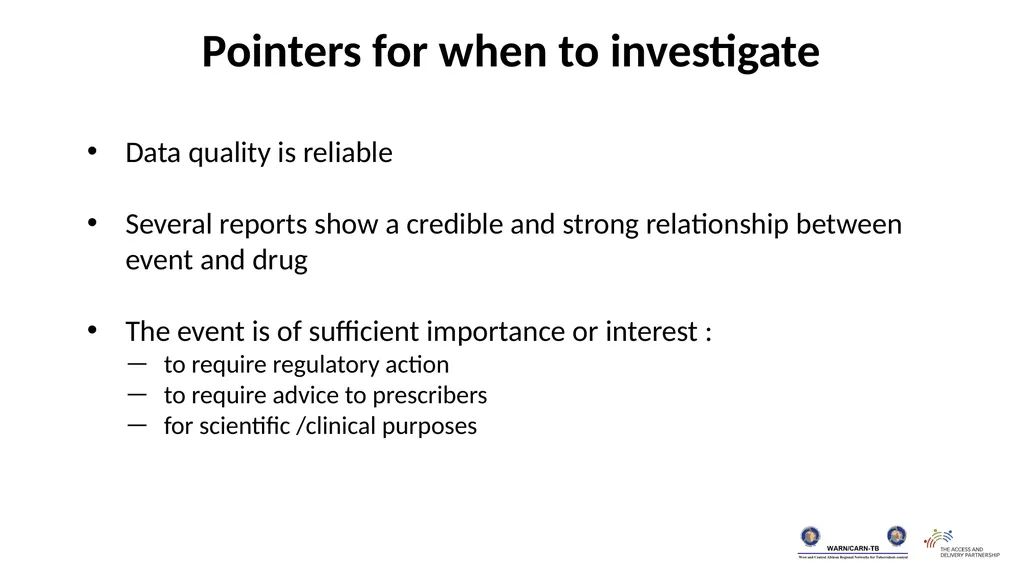
Data quality is reliable
Several reports show a credible and strong relationship between event and drug
The event is of sufficient importance or interest :
to require regulatory action
to require advice to prescribers
for scientific /clinical purposes Pointers for when to investigate<br>
09
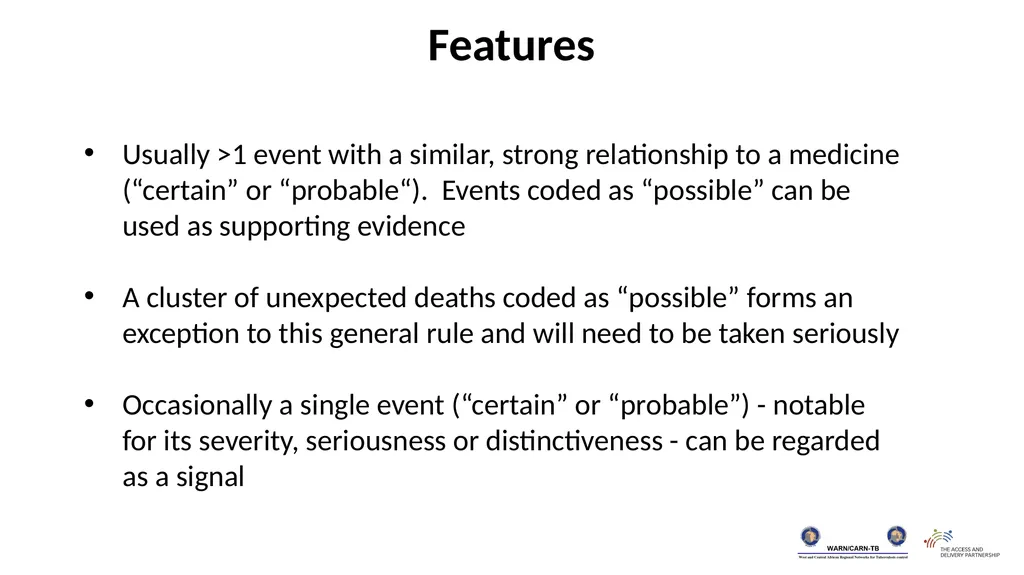
Usually >1 event with a similar, strong relationship to a medicine (“certain” or “probable“). Events coded as “possible” can be used as supporting evidence
A cluster of unexpected deaths coded as “possible” forms an exception to this general rule and will need to be taken seriously
Occasionally a single event (“certain” or “probable”) - notable for its severity, seriousness or distinctiveness - can be regarded as a signal Features<br>
10
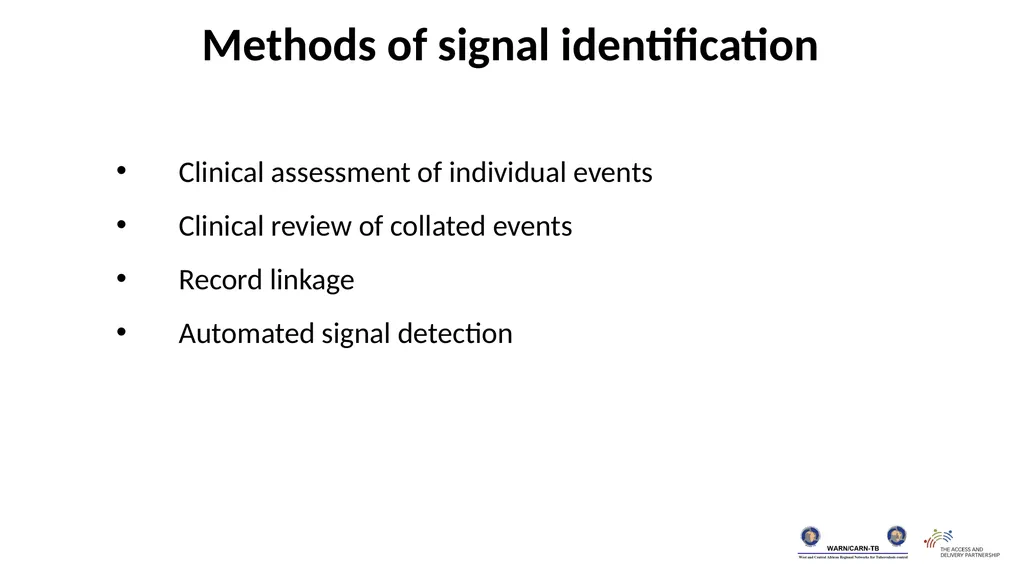
Clinical assessment of individual events
Clinical review of collated events
Record linkage
Automated signal detection Methods of signal identification<br>
11
Drug-safety profile (1)
definition Drug-safety profile:
A description of the benefits, risks and toxicity of a given TB drug or regimen, specifying any known or likely safety concerns, contraindications, cautions, preventive measures and other features that the user should be aware of to protect the health of a TB patient<br>
12
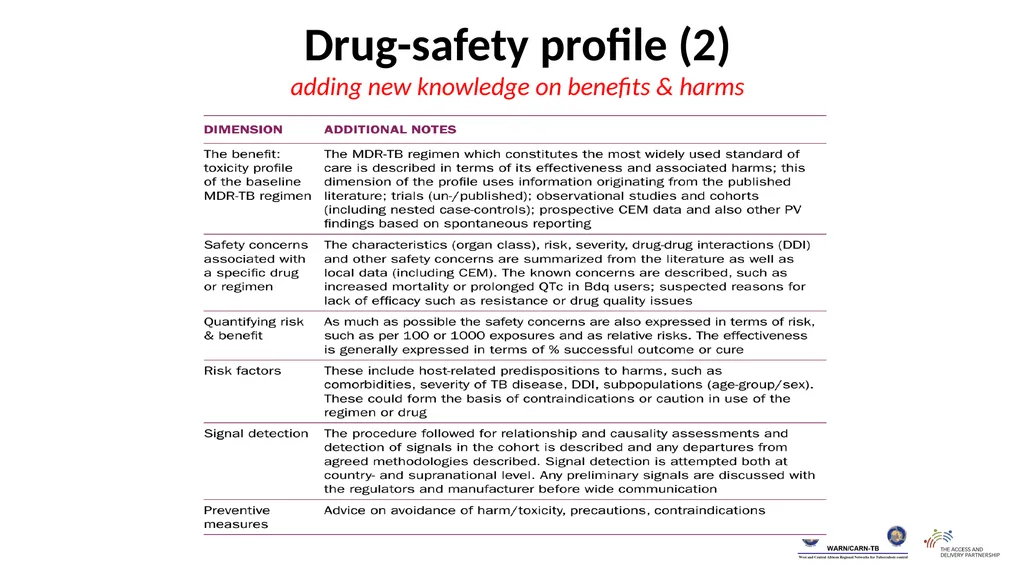
Drug-safety profile (2) adding new knowledge on benefits & harms<br>
13
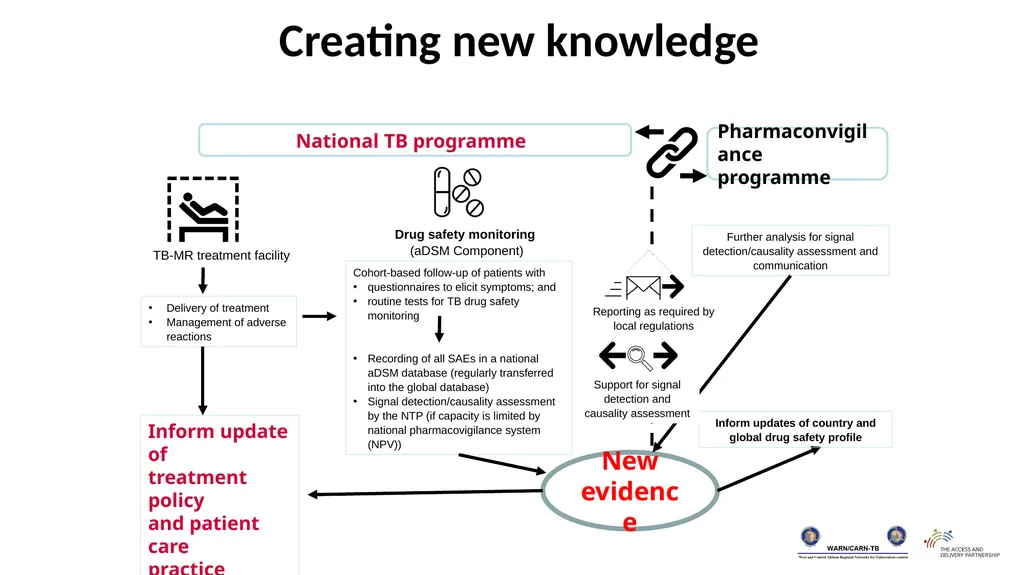
National TB programme TB-MR treatment facility Delivery of treatment
Management of adverse reactions Inform update of
treatment policy
and patient care
practice
(as per PMDT guidance) Drug safety monitoring
(aDSM Component) Cohort-based follow-up of patients with
questionnaires to elicit symptoms; and
routine tests for TB drug safety monitoring
Recording of all SAEs in a national aDSM database (regularly transferred into the global database)
Signal detection/causality assessment by the NTP (if capacity is limited by national pharmacovigilance system (NPV)) Pharmaconvigilance
programme Further analysis for signal detection/causality assessment and communication New
evidence Reporting as required by local regulations Inform updates of country and global drug safety profile Support for signal detection and causality assessment Creating new knowledge<br>
14
Conclusions Signal detection is an important process to improve knowledge on the new TB medicines and complete the safety profile of a new drug
When monitoring AEs it is important to look beyond adverse reactions and biological pathways already linked to particular drugs: previously unknown or rare associations may occur, especially for newly released drugs
Reports of adverse events to the global aDSM database is expected to improve the likelihood of picking up signals<br>
15
Acknowledgements
The development of the aDSM training material was funded by TDR as part of the Access and Delivery Partnership (ADP) with funding from the Government of Japan.
These training materials were put together in 2016 the WHO Task Force on aDSM with technical partners KNCV Tuberculosis Foundation, Management Sciences for Health (SIAPS), MSF, WHO GTB, and TDR.
The materials were updated in 2022-23 by Mahamadou Bassirou Souleymane (TDR consultant) with Marie-Eve Raguenaud (TDR), Branwen J Hennig (TDR), and Corinne Merle (TDR), and reviewed by Linh Nhat Nguyen (WHO/GTB), Medea Gegia (WHO/GTB), and Fuad Mirzayev (WHO/GTB).
We thank all members of the WARN/CARN-TB working group on aDSM who contributed to the development of the aDSM generic guidelines as well as the secretariat, particularly Dr Christ Houessinon: Disadidi Ambrioso, Esse Marius, Adomou Jamal Rouamba Ruffine, Haro Sougrimani, Koumbem Boureima, Nsanzerugeze Josélyne, Tollo Tollo Daniel Alphonse Désiré, Mpaba Minkat Théophile Mistral, Julie Abessolo, Ursule IDOKO, Tijan Baldeh , Wandifa Samateh, Tida S Kinteh, Alieu Wurie, Mardemn Yeasuen, Benjamin K. Quenneh, Cheick Oumar Bah, Kane El Hadj Malick, Aw Idriss, Mamoudou Hama Rachida, Gagara I. M. Assiatou, Katambé Balkissa, Seiyabatou Elh Saidou, Liombo Anastasie, Lunganyu Junior, Kitambala Sentime, Lula Yves , Habimana-Mucyo Yves, Migambi Patrick, dos Santos Brigite, Castro Vânia, Wadson Cruz, Gueye Aminata, Mukeh Fahnbulleh, Bailor Samuel, Manjo Lamin, Saleh Mahareb Abdoulaye, Haroun Saleh Naima, Mouhoudine Yerima, Kpelafia Silifa<br>