04
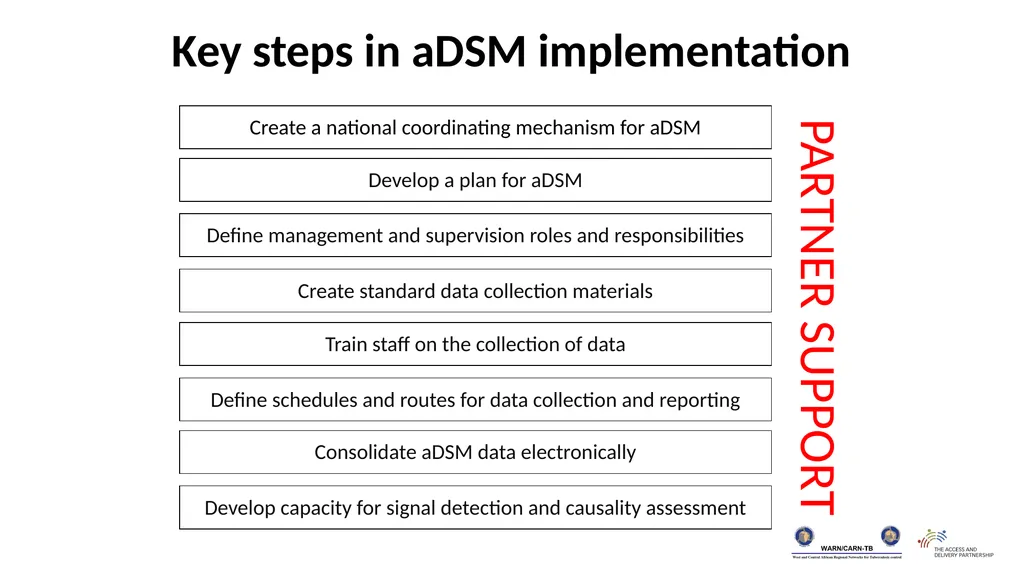
Key steps in aDSM implementation PARTNER SUPPORT<br>
05
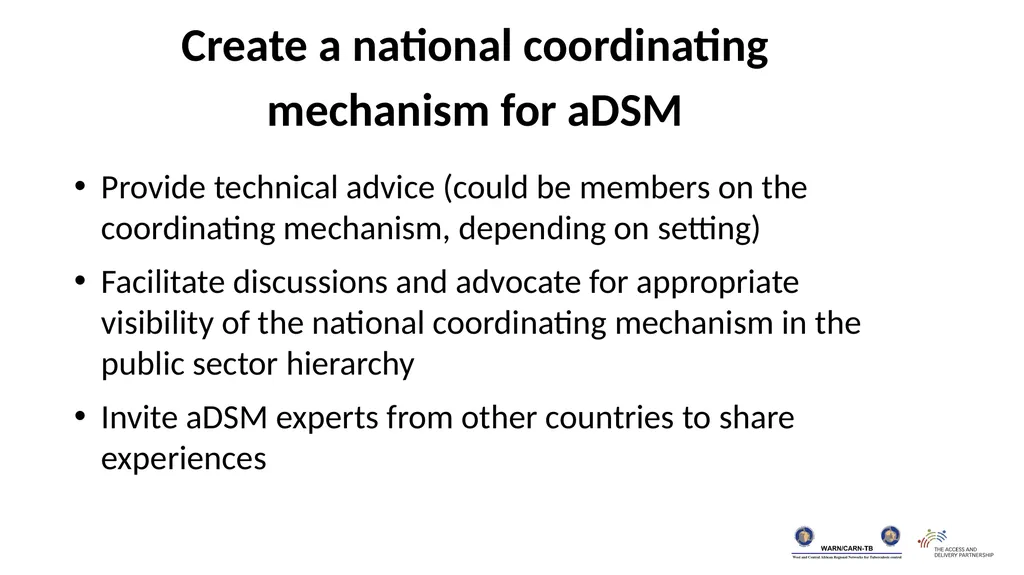
Provide technical advice (could be members on the coordinating mechanism, depending on setting)
Facilitate discussions and advocate for appropriate visibility of the national coordinating mechanism in the public sector hierarchy
Invite aDSM experts from other countries to share experiences Create a national coordinating mechanism for aDSM<br>
06
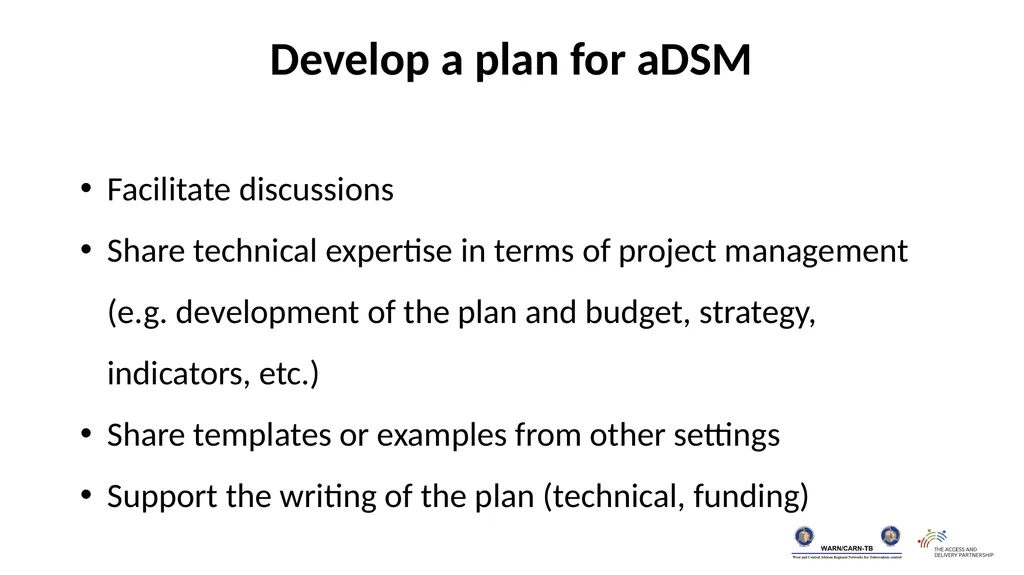
Develop a plan for aDSM Facilitate discussions
Share technical expertise in terms of project management (e.g. development of the plan and budget, strategy, indicators, etc.)
Share templates or examples from other settings
Support the writing of the plan (technical, funding)<br>
07
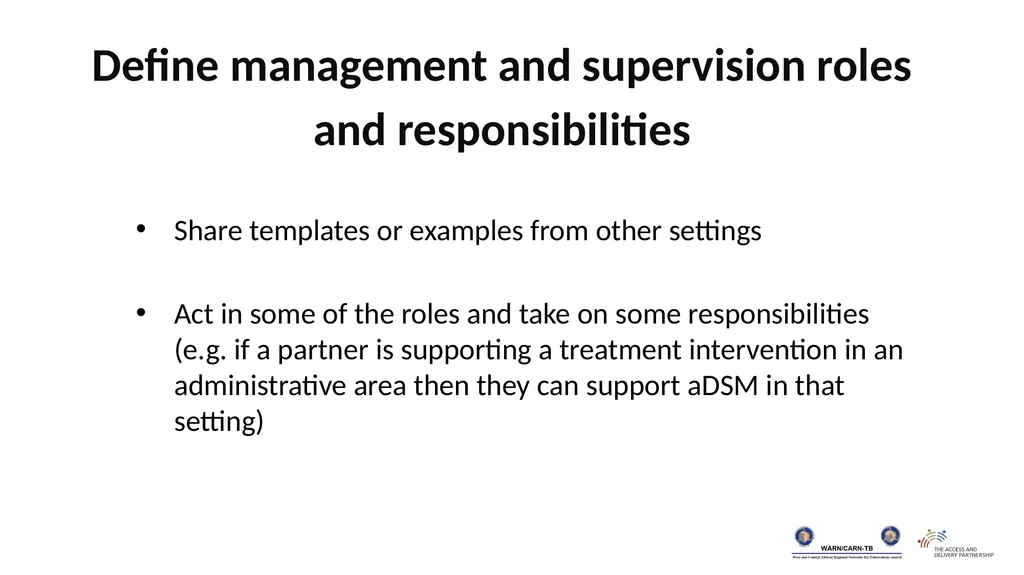
Define management and supervision roles and responsibilities Share templates or examples from other settings
Act in some of the roles and take on some responsibilities (e.g. if a partner is supporting a treatment intervention in an administrative area then they can support aDSM in that setting)<br>
08
Create standard data collection materials Share technical expertise (e.g. expert review of the paper or electronic forms used in the country)
Share templates, examples from other countries
Help draft standard operation procedures, adapt data collection tools
Ensure that any tools developed by a partner in a country are in conformity with the requirements for local and international reporting<br>
09
Train staff on the collection of data Facilitate the organisation of training at different levels (e.g. national, regional, district, health facility, private sector)
Share technical expertise (e.g. pedagogical advisor support)
Share curriculum, case studies and other materials
Train the “national trainers”
Provide funding & venues for training activities
Develop training materials<br>
10
Define schedules and routes for data collection and reporting Facilitate discussions
Share examples and lessons learnt from other settings
Support the collection of data and reporting to national and global level
Updating the methods as knowledge advances<br>
11
Consolidate aDSM data electronically Technical support in adaptation of existing system (or implementation of new system)
Help on revising systems to allow reporting<br>
12
Develop capacity for signal detection and causality assessment Role for partners?
Facilitate discussions
Organize dedicated training on signal detection (methods, stats) and causality assessment<br>
13
Conclusions Technical partners could play an important catalytic role to help national TB programmes implement the changes required to introduce aDSM
In addition to the technical expertise, advocacy and facilitation of discussion, given the relative novelty of aDSM agencies and donors may need to provide funds to enable key activities in the short term (e.g. to train, hire consultants, undertake some of the clinical tests, modify information systems)
In the maintenance phase and long term, partners could play a role to ensure supervision, completeness of reporting and updating the methods and human resource development<br>
14
Acknowledgements
The development of the aDSM training material was funded by TDR as part of the Access and Delivery Partnership (ADP) with funding from the Government of Japan.
These training materials were put together in 2016 the WHO Task Force on aDSM with technical partners KNCV Tuberculosis Foundation, Management Sciences for Health (SIAPS), MSF, WHO GTB, and TDR.
The materials were updated in 2022-23 by Mahamadou Bassirou Souleymane (TDR consultant) with Marie-Eve Raguenaud (TDR), Branwen J Hennig (TDR), and Corinne Merle (TDR), and reviewed by Linh Nhat Nguyen (WHO/GTB), Medea Gegia (WHO/GTB), and Fuad Mirzayev (WHO/GTB).
We thank all members of the WARN/CARN-TB working group on aDSM who contributed to the development of the aDSM generic guidelines as well as the secretariat, particularly Dr Christ Houessinon: Disadidi Ambrioso, Esse Marius, Adomou Jamal Rouamba Ruffine, Haro Sougrimani, Koumbem Boureima, Nsanzerugeze Josélyne, Tollo Tollo Daniel Alphonse Désiré, Mpaba Minkat Théophile Mistral, Julie Abessolo, Ursule IDOKO, Tijan Baldeh , Wandifa Samateh, Tida S Kinteh, Alieu Wurie, Mardemn Yeasuen, Benjamin K. Quenneh, Cheick Oumar Bah, Kane El Hadj Malick, Aw Idriss, Mamoudou Hama Rachida, Gagara I. M. Assiatou, Katambé Balkissa, Seiyabatou Elh Saidou, Liombo Anastasie, Lunganyu Junior, Kitambala Sentime, Lula Yves , Habimana-Mucyo Yves, Migambi Patrick, dos Santos Brigite, Castro Vânia, Wadson Cruz, Gueye Aminata, Mukeh Fahnbulleh, Bailor Samuel, Manjo Lamin, Saleh Mahareb Abdoulaye, Haroun Saleh Naima, Mouhoudine Yerima, Kpelafia Silifa<br>