Trajectory Simplification: On Minimizing the Direction-based Error Cheng Long, Hong Kong University of Science and Technology Raymond Chi-Wing Wong, Hong Kong University of Science and Technology H. V. Jagadish, University of Michigan 1
"Trajectory Simplification: On Minimizing the" is the property of its rightful owner. Permission is granted to
download and print the materials on this website for personal, non-commercial use only, and to display it
on your personal computer provided you do not modify the materials and that you retain all copyright
notices contained in the materials. By downloading content from our website, you accept the terms of this
agreement.
Presentation Transcript
01
Trajectory Simplification: On Minimizing the Direction-based Error Cheng Long, Hong Kong University of Science and Technology
Raymond Chi-Wing Wong, Hong Kong University of Science and Technology
H. V. Jagadish, University of Michigan 1<br>
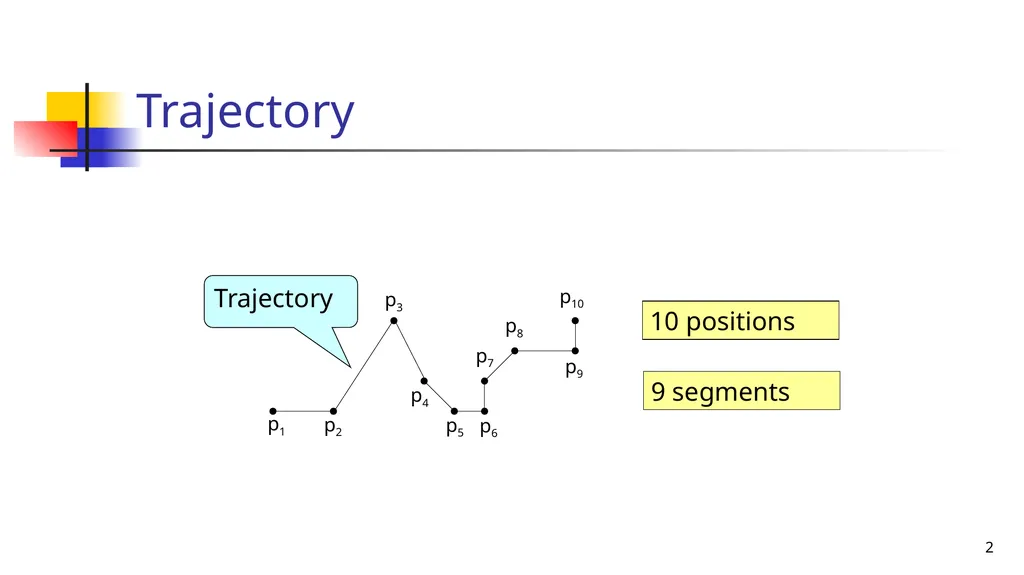
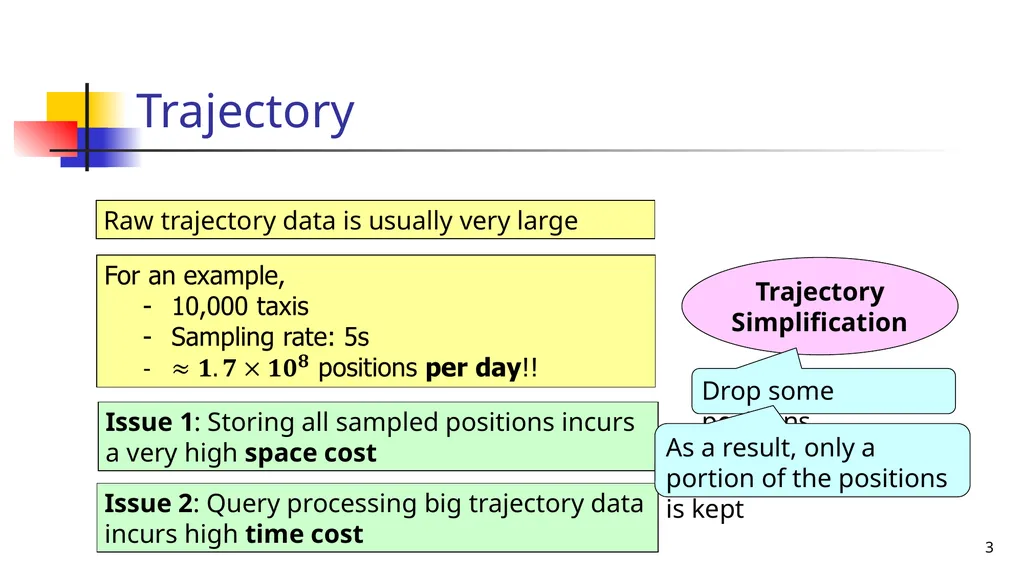
Trajectory 3 Raw trajectory data is usually very large Issue 1: Storing all sampled positions incurs a very high space cost Issue 2: Query processing big trajectory data incurs high time cost Trajectory Simplification Drop some positions As a result, only a portion of the positions is kept<br>
04
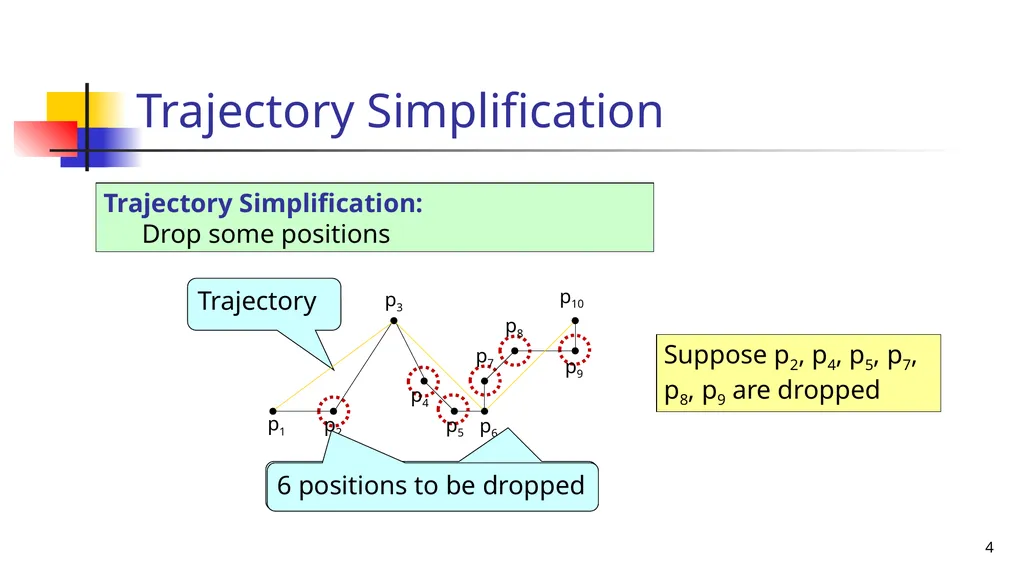
Trajectory Simplification 4 Trajectory Simplification:
Drop some positions Trajectory Suppose p2, p4, p5, p7, p8, p9 are dropped Trajectory 6 positions to be dropped<br>
05
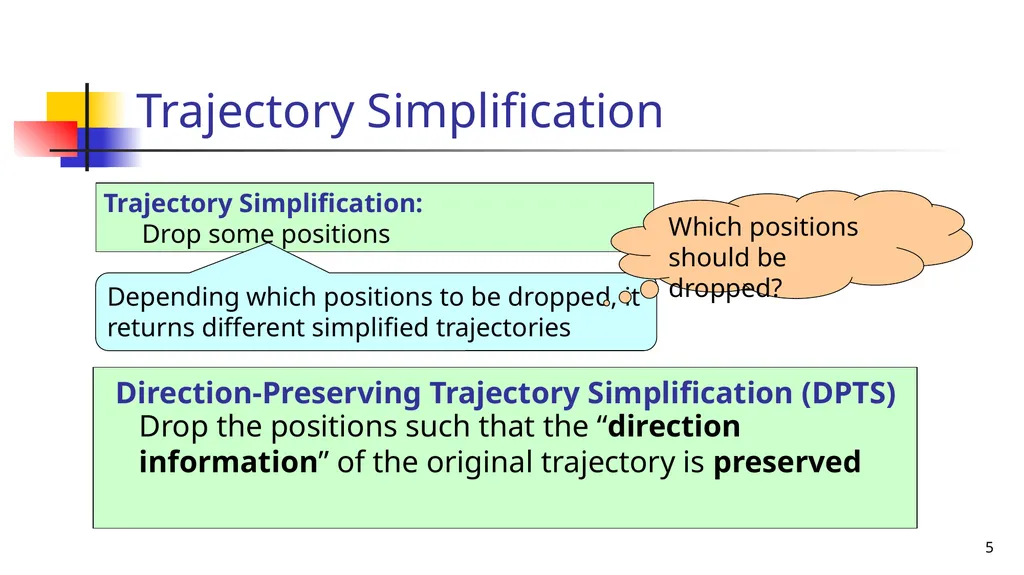
Trajectory Simplification 5 Trajectory Simplification:
Drop some positions Depending which positions to be dropped, it returns different simplified trajectories Which positions should be dropped? Our Idea:
Drop the positions such that the “direction information” of the original trajectory is preserved Direction-Preserving Trajectory Simplification (DPTS)<br>
06
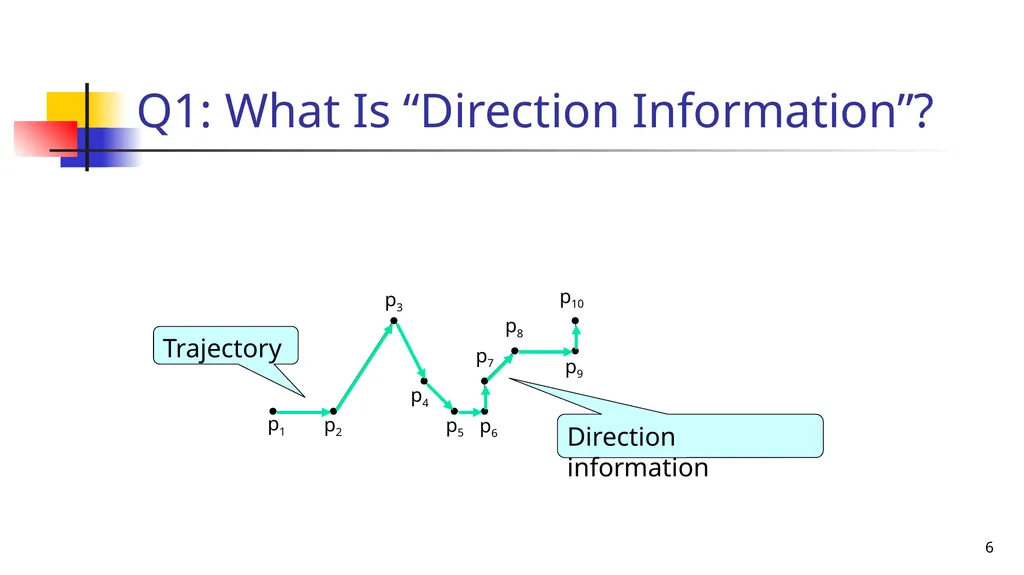
Q1: What Is “Direction Information”? 6 Trajectory Direction information<br>
07
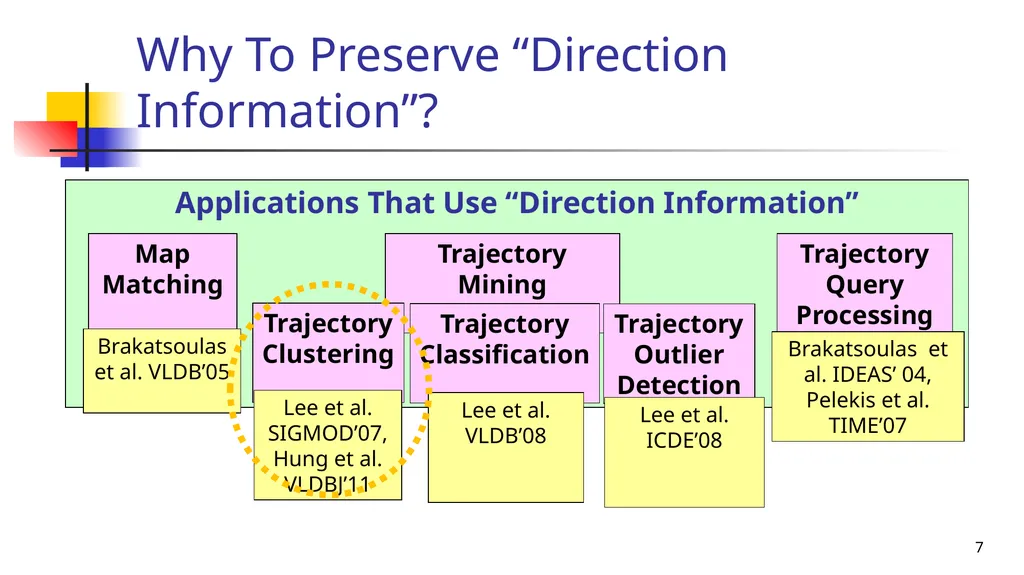
Why To Preserve “Direction Information”? 7 Applications That Use “Direction Information” Trajectory Query Processing Trajectory Mining Map Matching Trajectory Clustering Trajectory Classification Trajectory Outlier Detection Lee et al. SIGMOD’07, Hung et al. VLDBJ’11 Lee et al. VLDB’08 Brakatsoulas et al. IDEAS’ 04, Pelekis et al. TIME’07 Brakatsoulas et al. VLDB’05 Lee et al. ICDE’08<br>
08
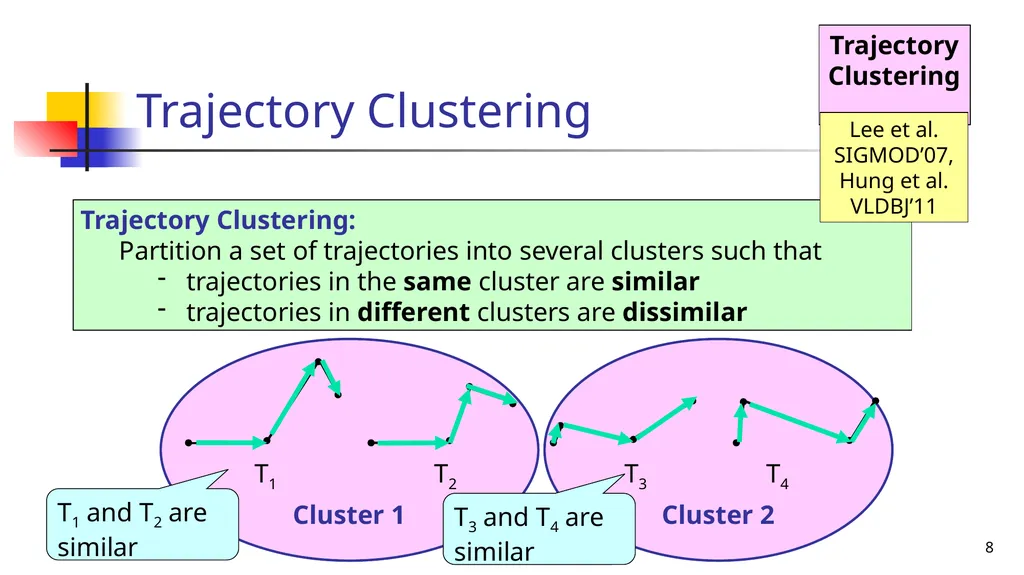
Cluster 2 Cluster 1 Trajectory Clustering 8 Trajectory Clustering:
Partition a set of trajectories into several clusters such that
trajectories in the same cluster are similar
trajectories in different clusters are dissimilar T1 T2 T3 T4 T1 and T2 are similar T3 and T4 are similar Trajectory Clustering Lee et al. SIGMOD’07, Hung et al. VLDBJ’11<br>
09
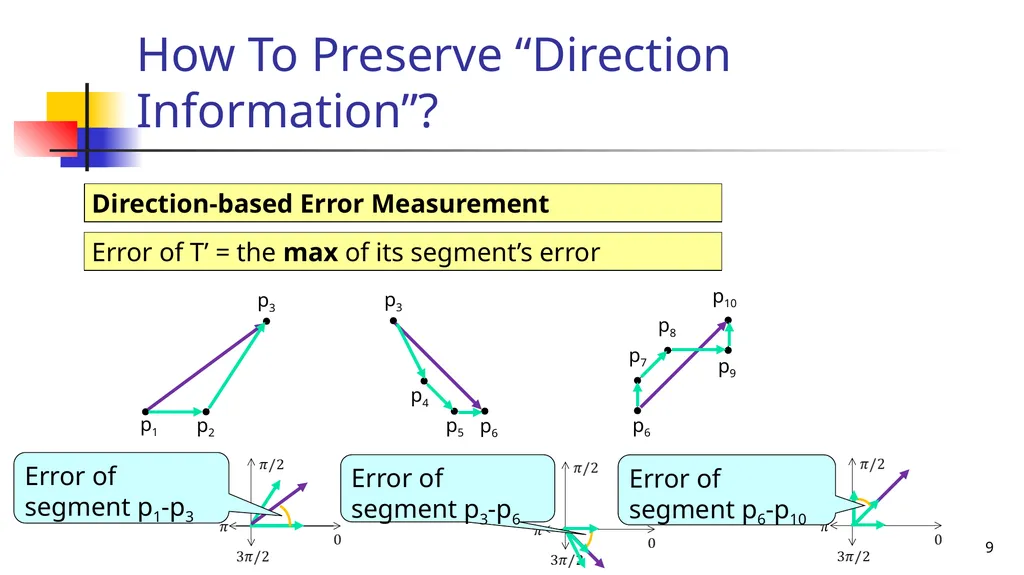
p4 p5 How To Preserve “Direction Information”? 9 Direction-based Error Measurement Error of segment p1-p3 Error of segment p3-p6 Error of segment p6-p10 Error of T’ = the max of its segment’s error<br>
10
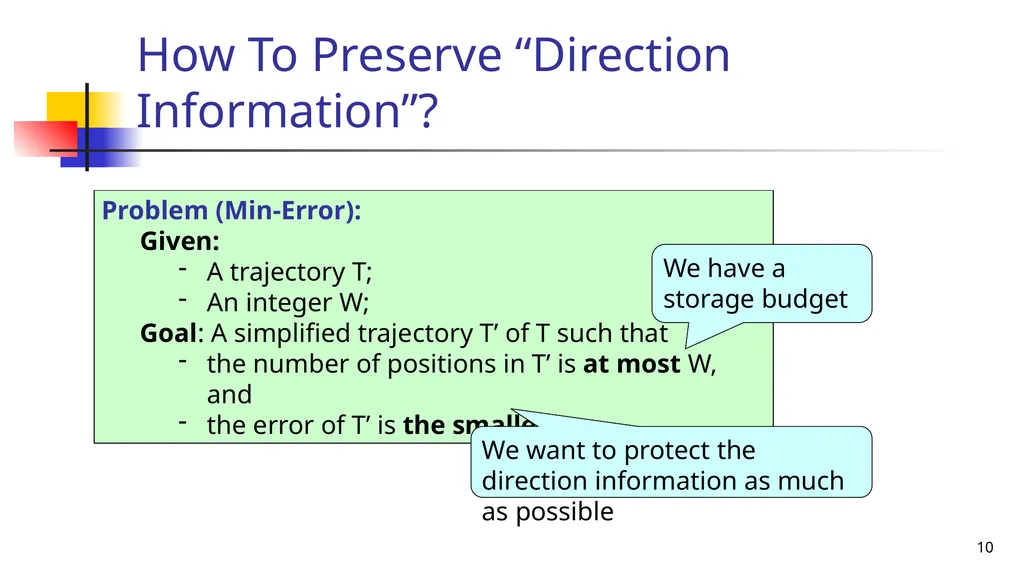
How To Preserve “Direction Information”? 10 Problem (Min-Error):
Given:
A trajectory T;
An integer W;
Goal: A simplified trajectory T’ of T such that
the number of positions in T’ is at most W, and
the error of T’ is the smallest We have a storage budget We want to protect the direction information as much as possible<br>
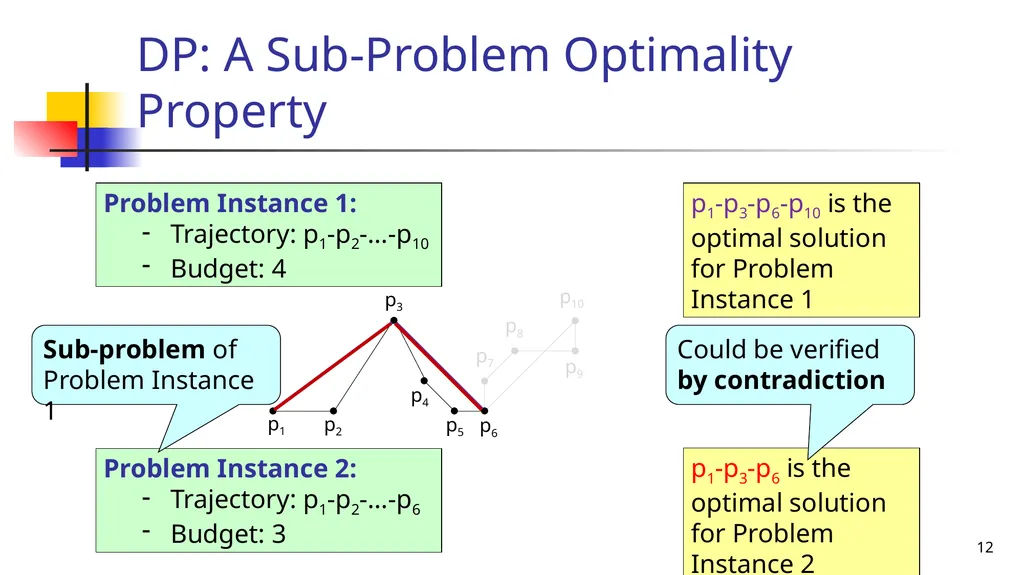
DP: A Sub-Problem Optimality Property 12 Problem Instance 2:
Trajectory: p1-p2-…-p6
Budget: 3 Problem Instance 1:
Trajectory: p1-p2-…-p10
Budget: 4 p1-p3-p6-p10 is the optimal solution for Problem Instance 1 Sub-problem of Problem Instance 1 p1-p3-p6 is the optimal solution for Problem Instance 2 Could be verified by contradiction<br>
13
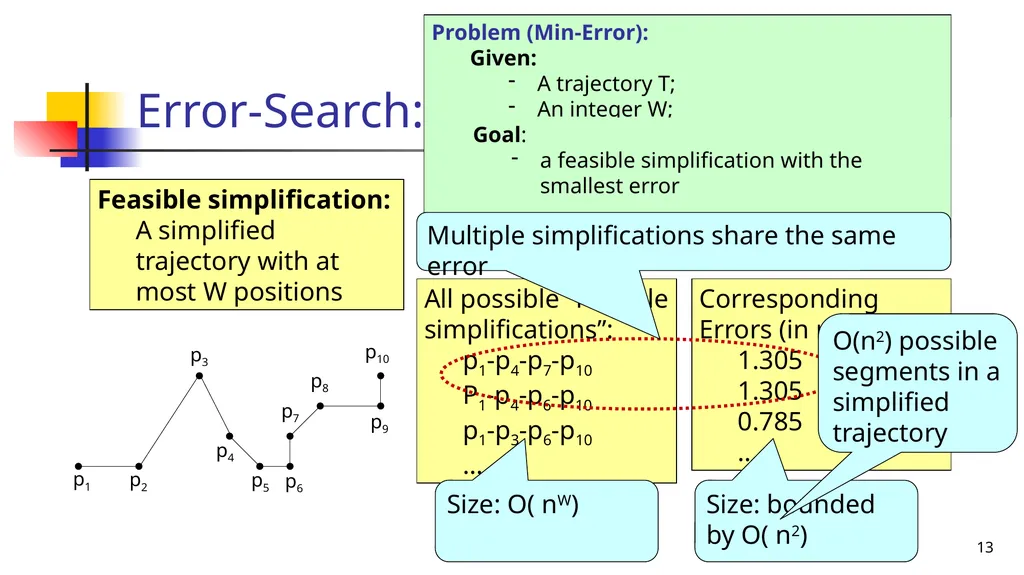
Error-Search: A Rough Idea 13 Feasible simplification:
A simplified trajectory with at most W positions All possible “feasible simplifications”:
p1-p4-p7-p10
P1-p4-p6-p10
p1-p3-p6-p10
… Corresponding Errors (in radians):
1.305
1.305
0.785
… Size: O( nW) Size: bounded by O( n2) Problem (Min-Error):
Given:
A trajectory T;
An integer W;
Goal: A simplified trajectory T’ of T such that
the number of positions in T’ is at most W, and
the error of T’ is the smallest Goal:
a feasible simplification with the smallest error Multiple simplifications share the same error O(n2) possible segments in a simplified trajectory<br>
14
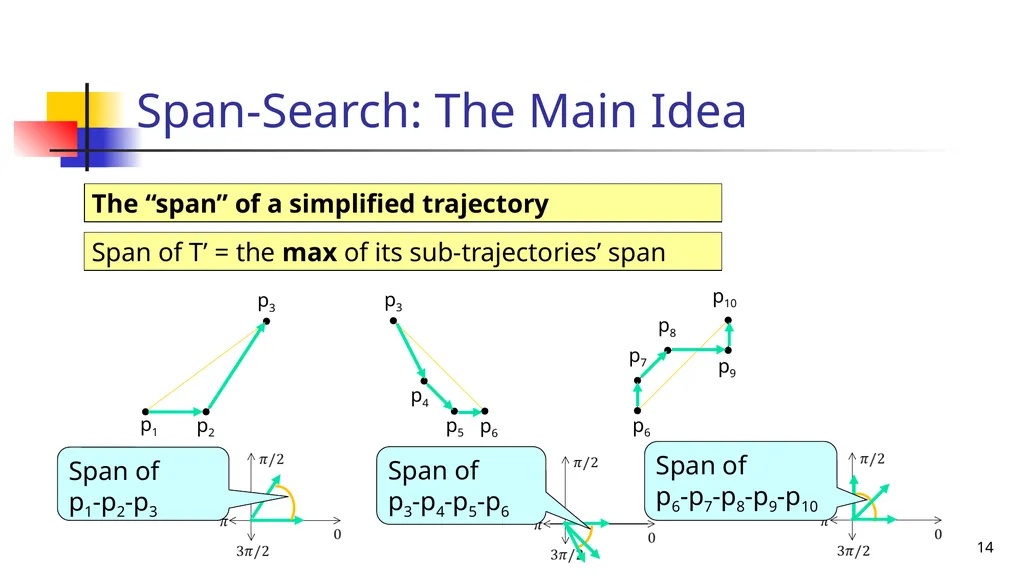
p4 p5 Span-Search: The Main Idea 14 Span of
p1-p2-p3 Span of
p3-p4-p5-p6 Span of
p6-p7-p8-p9-p10 Span of T’ = the max of its sub-trajectories’ span The “span” of a simplified trajectory<br>
15
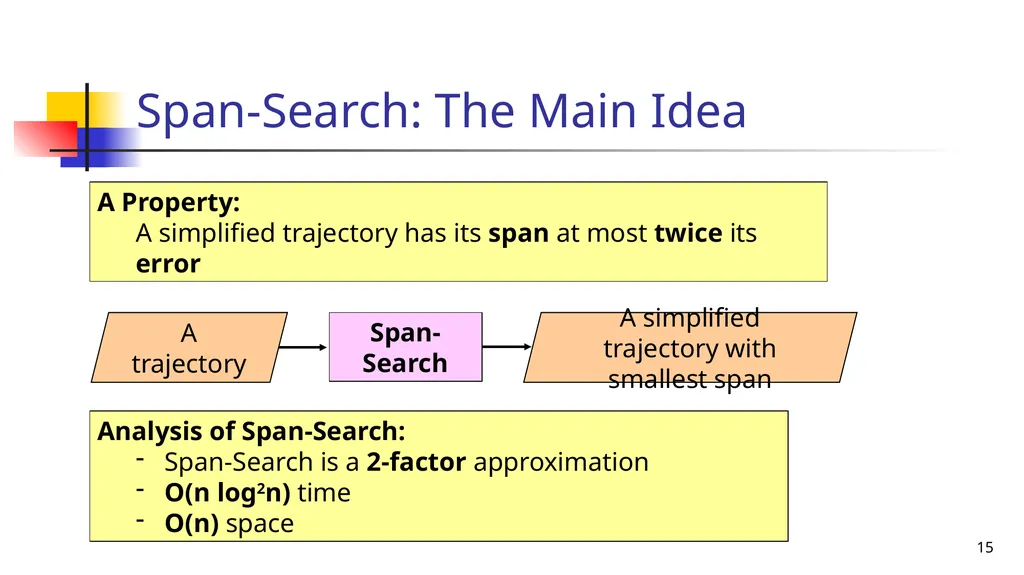
Span-Search: The Main Idea 15 A Property:
A simplified trajectory has its span at most twice its error Span-Search Analysis of Span-Search:
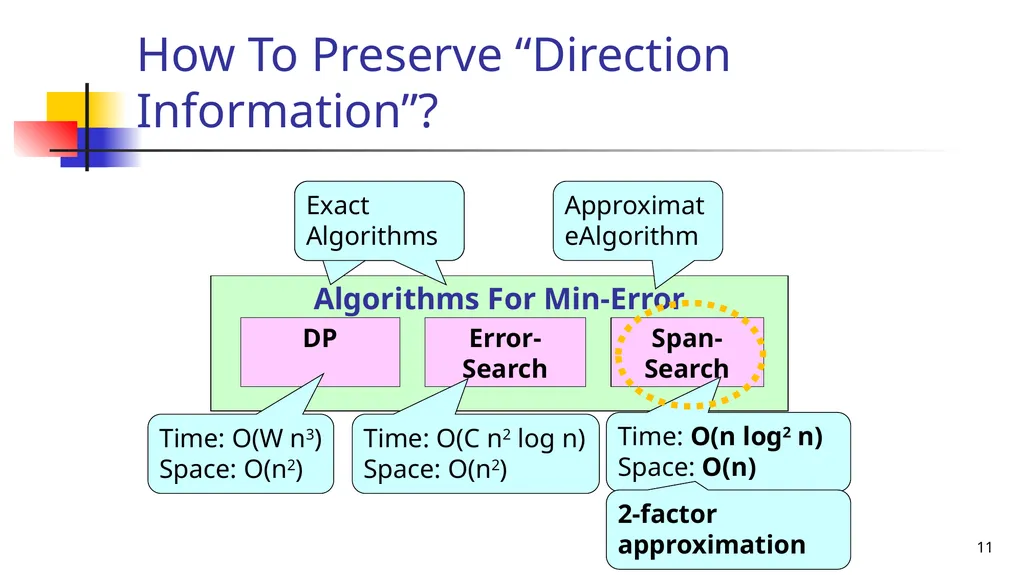
Span-Search is a 2-factor approximation
O(n log2n) time
O(n) space A trajectory A simplified trajectory with smallest span<br>
16
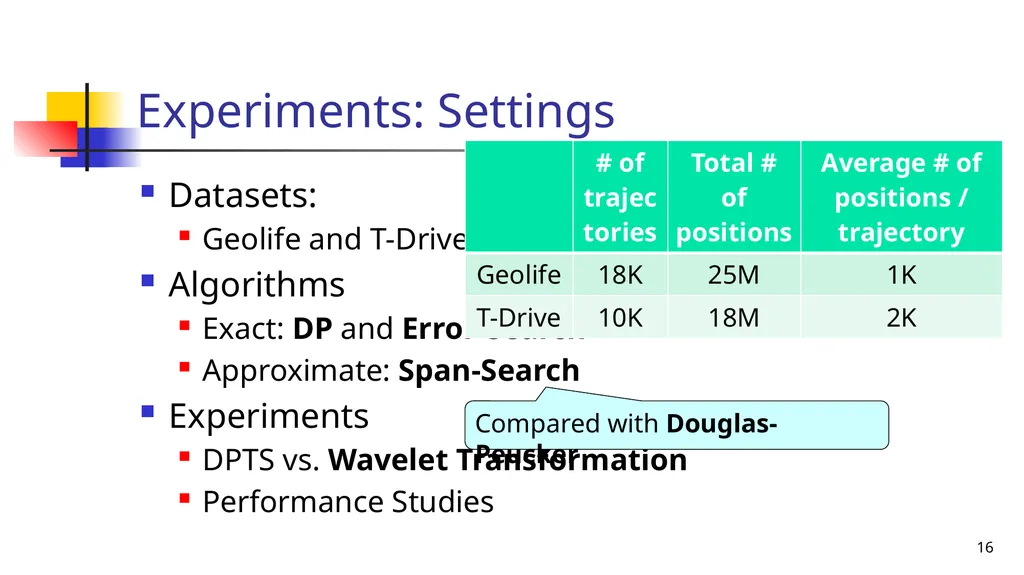
Experiments: Settings Datasets:
Geolife and T-Drive
Algorithms
Exact: DP and Error-Search
Approximate: Span-Search
Experiments
DPTS vs. Wavelet Transformation
Performance Studies 16 Compared with Douglas-Peucker<br>
17
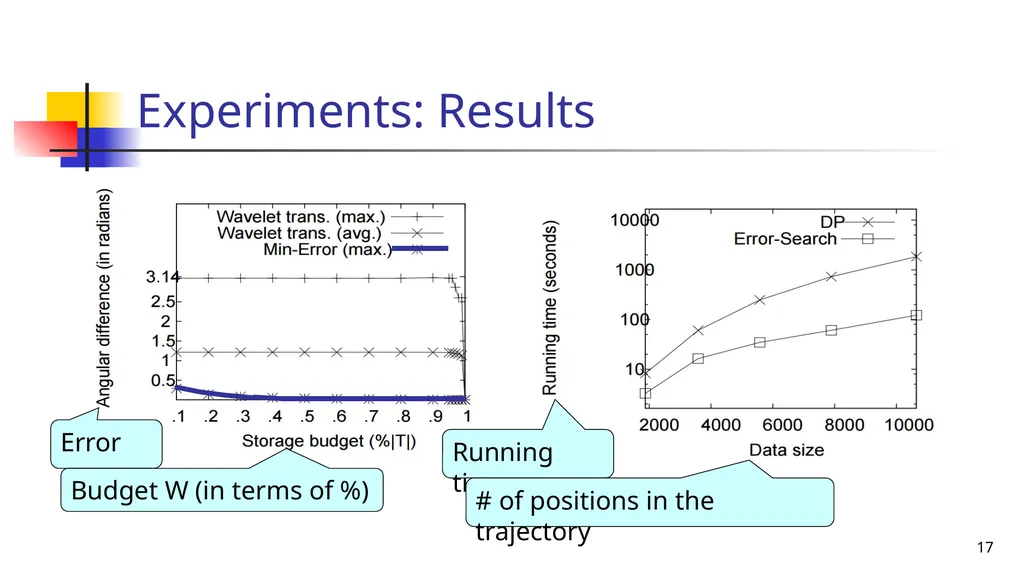
Experiments: Results 17 Error Budget W (in terms of %) Running time # of positions in the trajectory<br>
18
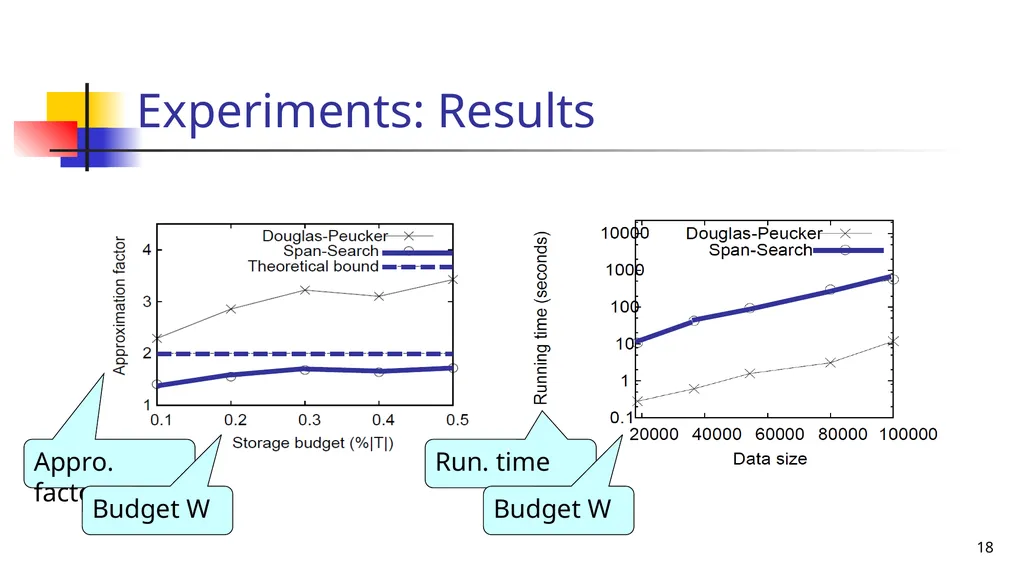
Experiments: Results 18 Appro. factor Budget W Run. time Budget W<br>