
Trans Europe Experts 16 mars 2018 Denis PHILIPPE
LO
Published · 35 slides · 0 views

1 / 1

Description
Trans Europe Experts 16 mars 2018 Denis PHILIPPE Avocat à Paris et Bruxelles Professeur à lUniversité catholique de Louvain Chargé de cours à lUniversité de Paris Ouest dphilippephilippelaw.eu Rescue of Business in Insolvency Law
Related Topics
Share
Embed code
Download this presentation From Below
"Trans Europe Experts 16 mars 2018 Denis PHILIPPE" is the property of its rightful owner. Permission is granted to download and print the materials on this website for personal, non-commercial use only, and to display it on your personal computer provided you do not modify the materials and that you retain all copyright notices contained in the materials. By downloading content from our website, you accept the terms of this agreement.
Presentation Transcript
01
Trans Europe Experts
16 mars 2018
Denis PHILIPPE
Avocat à Paris et Bruxelles
Professeur à l’Université catholique de Louvain
Chargé de cours à l’Université de Paris Ouest
dphilippe@philippelaw.eu Rescue of Business
in Insolvency Law<br>
16 mars 2018
Denis PHILIPPE
Avocat à Paris et Bruxelles
Professeur à l’Université catholique de Louvain
Chargé de cours à l’Université de Paris Ouest
dphilippe@philippelaw.eu Rescue of Business
in Insolvency Law<br>
02
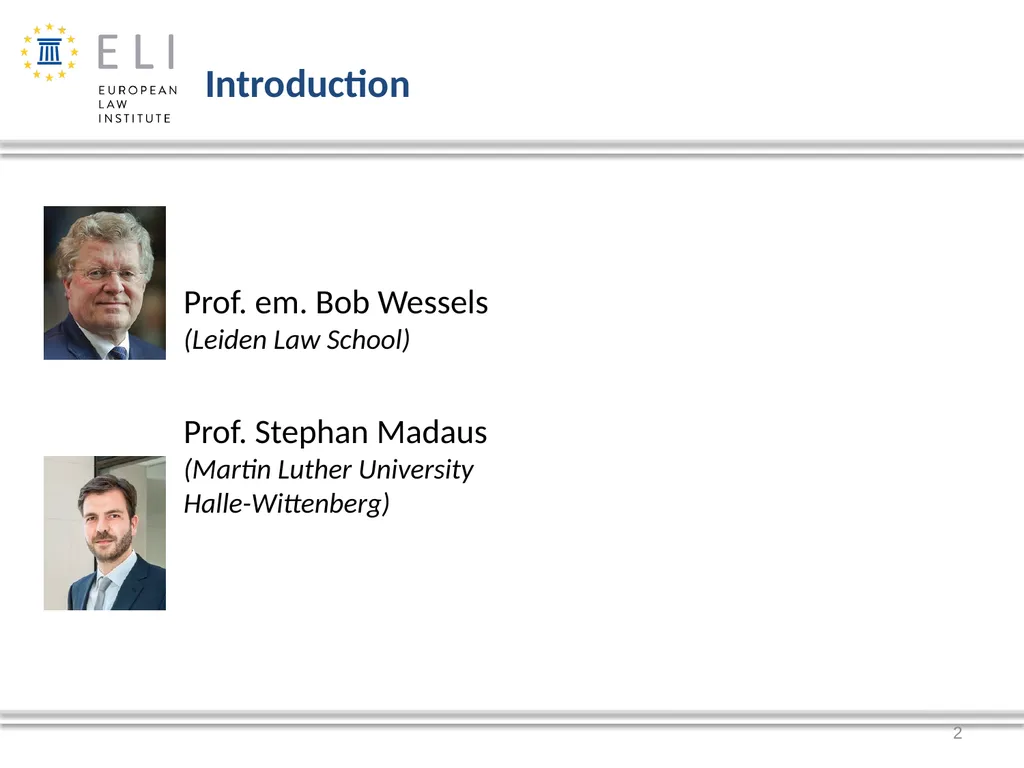
Introduction Prof. em. Bob Wessels
(Leiden Law School)
Prof. Stephan Madaus (Martin Luther University Halle-Wittenberg) 2<br>
Prof. Stephan Madaus (Martin Luther University Halle-Wittenberg) 2<br>
03
ELI Project Business Rescue in Insolvency Law
Q1/2014 – Q3/2017
Aim: to design a set of norms and requirements that will enable the further development of coherent and functional rules for business rescue in the EU 3<br>
Q1/2014 – Q3/2017
Aim: to design a set of norms and requirements that will enable the further development of coherent and functional rules for business rescue in the EU 3<br>
04
Business Rescue Project Organisation 2 Reporters
25 National Correspondents (NCs)
Advisory Committee of 10 (AC)
Members Consultative Committee (MCC), some 30
Glossary of terms and expressions commonly used in restructuring and insolvency law.
115 recommendations explained on more than 375 pages.
Chair: prof. Tatjana Josipović (Uni of Zagreb)
businessrescue@europeanlawinstitute.eu 4<br>
25 National Correspondents (NCs)
Advisory Committee of 10 (AC)
Members Consultative Committee (MCC), some 30
Glossary of terms and expressions commonly used in restructuring and insolvency law.
115 recommendations explained on more than 375 pages.
Chair: prof. Tatjana Josipović (Uni of Zagreb)
businessrescue@europeanlawinstitute.eu 4<br>
05
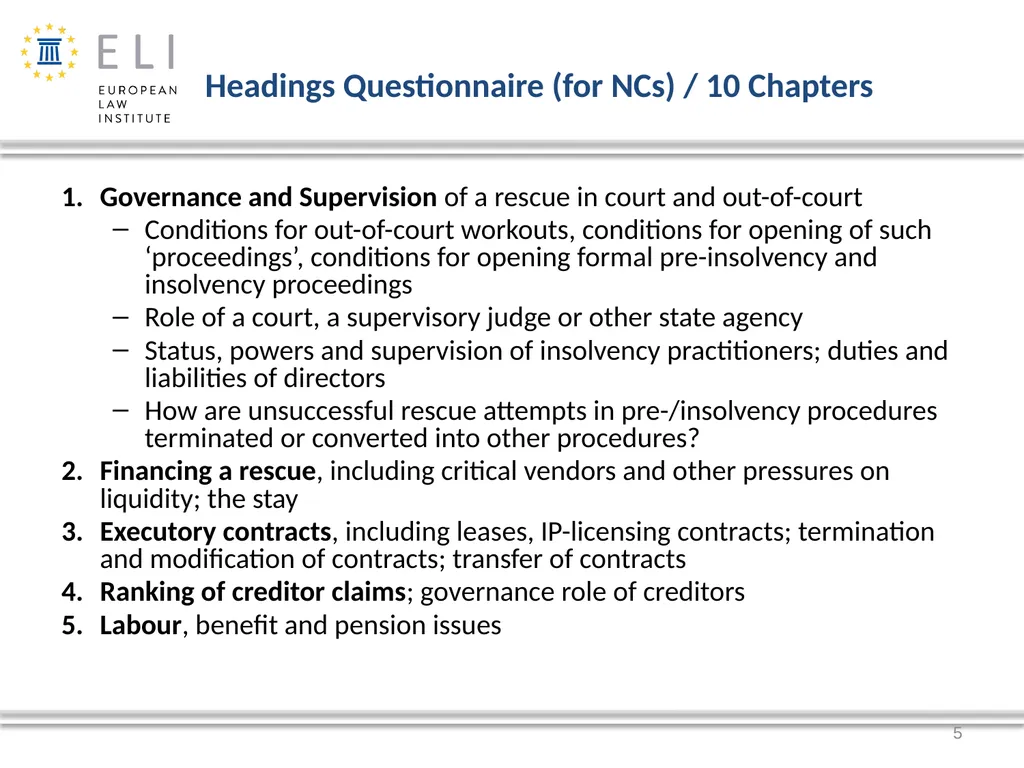
Headings Questionnaire (for NCs) / 10 Chapters Governance and Supervision of a rescue in court and out-of-court
Conditions for out-of-court workouts, conditions for opening of such ‘proceedings’, conditions for opening formal pre-insolvency and insolvency proceedings
Role of a court, a supervisory judge or other state agency
Status, powers and supervision of insolvency practitioners; duties and liabilities of directors
How are unsuccessful rescue attempts in pre-/insolvency procedures terminated or converted into other procedures?
Financing a rescue, including critical vendors and other pressures on liquidity; the stay
Executory contracts, including leases, IP-licensing contracts; termination and modification of contracts; transfer of contracts
Ranking of creditor claims; governance role of creditors
Labour, benefit and pension issues 5<br>
Conditions for out-of-court workouts, conditions for opening of such ‘proceedings’, conditions for opening formal pre-insolvency and insolvency proceedings
Role of a court, a supervisory judge or other state agency
Status, powers and supervision of insolvency practitioners; duties and liabilities of directors
How are unsuccessful rescue attempts in pre-/insolvency procedures terminated or converted into other procedures?
Financing a rescue, including critical vendors and other pressures on liquidity; the stay
Executory contracts, including leases, IP-licensing contracts; termination and modification of contracts; transfer of contracts
Ranking of creditor claims; governance role of creditors
Labour, benefit and pension issues 5<br>
06
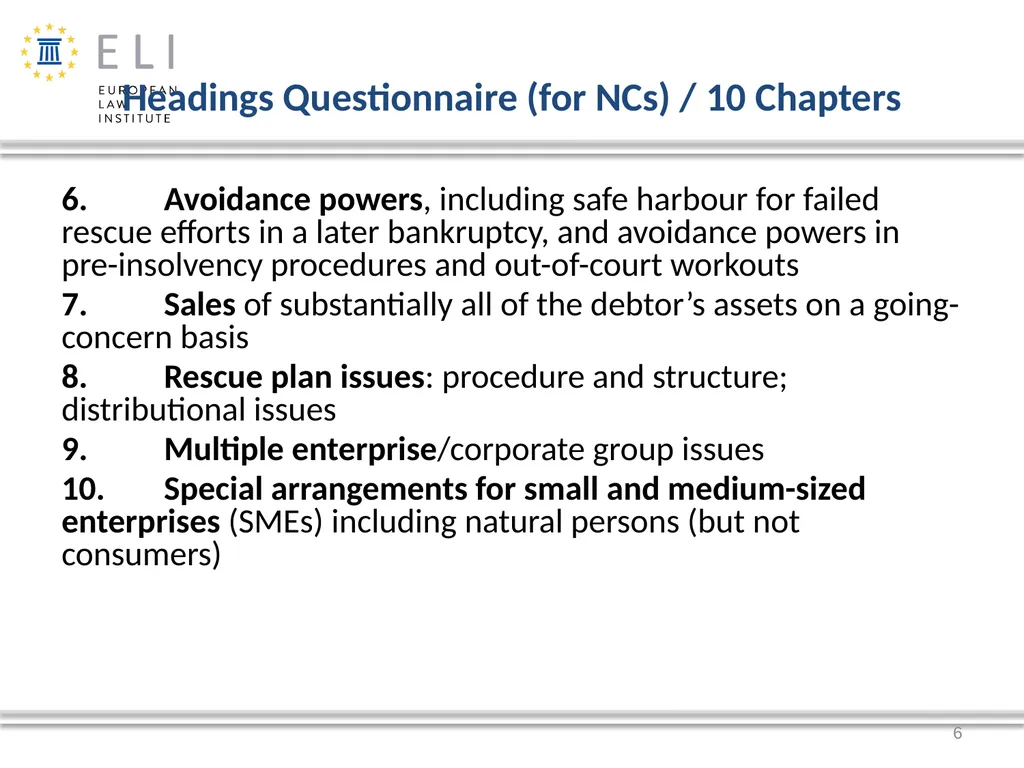
Headings Questionnaire (for NCs) / 10 Chapters 6. Avoidance powers, including safe harbour for failed rescue efforts in a later bankruptcy, and avoidance powers in pre-insolvency procedures and out-of-court workouts
7. Sales of substantially all of the debtor’s assets on a going-concern basis
8. Rescue plan issues: procedure and structure; distributional issues
9. Multiple enterprise/corporate group issues
10. Special arrangements for small and medium-sized enterprises (SMEs) including natural persons (but not consumers) 6<br>
7. Sales of substantially all of the debtor’s assets on a going-concern basis
8. Rescue plan issues: procedure and structure; distributional issues
9. Multiple enterprise/corporate group issues
10. Special arrangements for small and medium-sized enterprises (SMEs) including natural persons (but not consumers) 6<br>
07
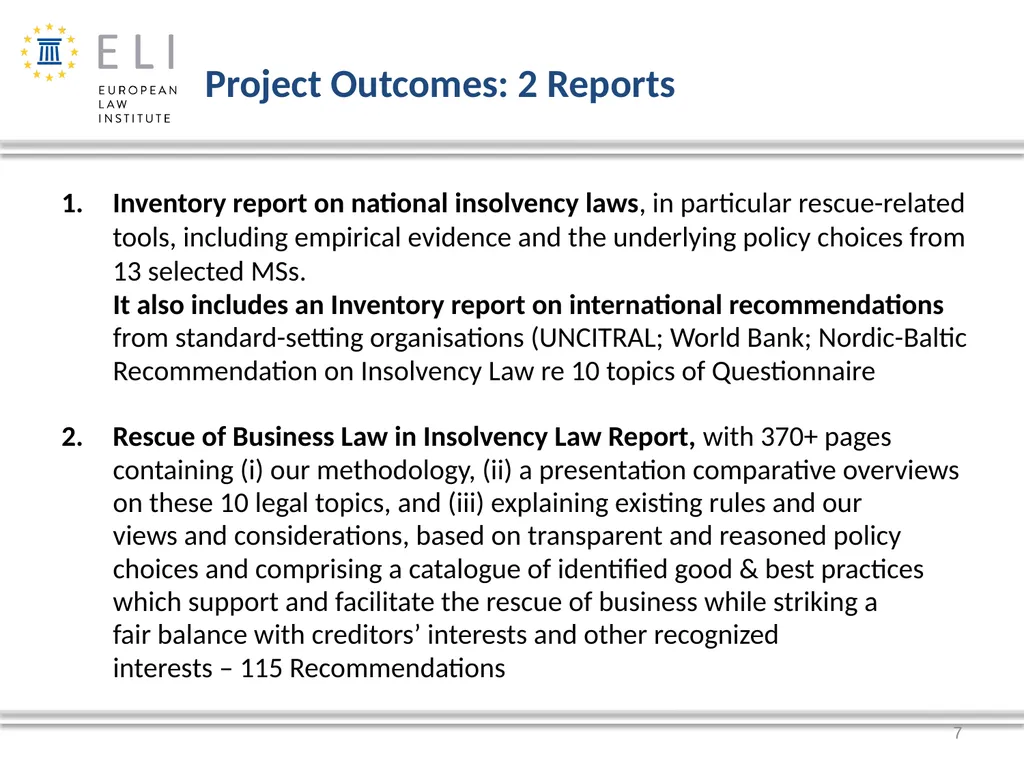
Project Outcomes: 2 Reports Inventory report on national insolvency laws, in particular rescue-related tools, including empirical evidence and the underlying policy choices from 13 selected MSs.
It also includes an Inventory report on international recommendations
from standard-setting organisations (UNCITRAL; World Bank; Nordic-Baltic
Recommendation on Insolvency Law re 10 topics of Questionnaire
Rescue of Business Law in Insolvency Law Report, with 370+ pages
containing (i) our methodology, (ii) a presentation comparative overviews
on these 10 legal topics, and (iii) explaining existing rules and our
views and considerations, based on transparent and reasoned policy
choices and comprising a catalogue of identified good & best practices
which support and facilitate the rescue of business while striking a
fair balance with creditors’ interests and other recognized
interests – 115 Recommendations 7<br>
It also includes an Inventory report on international recommendations
from standard-setting organisations (UNCITRAL; World Bank; Nordic-Baltic
Recommendation on Insolvency Law re 10 topics of Questionnaire
Rescue of Business Law in Insolvency Law Report, with 370+ pages
containing (i) our methodology, (ii) a presentation comparative overviews
on these 10 legal topics, and (iii) explaining existing rules and our
views and considerations, based on transparent and reasoned policy
choices and comprising a catalogue of identified good & best practices
which support and facilitate the rescue of business while striking a
fair balance with creditors’ interests and other recognized
interests – 115 Recommendations 7<br>
08
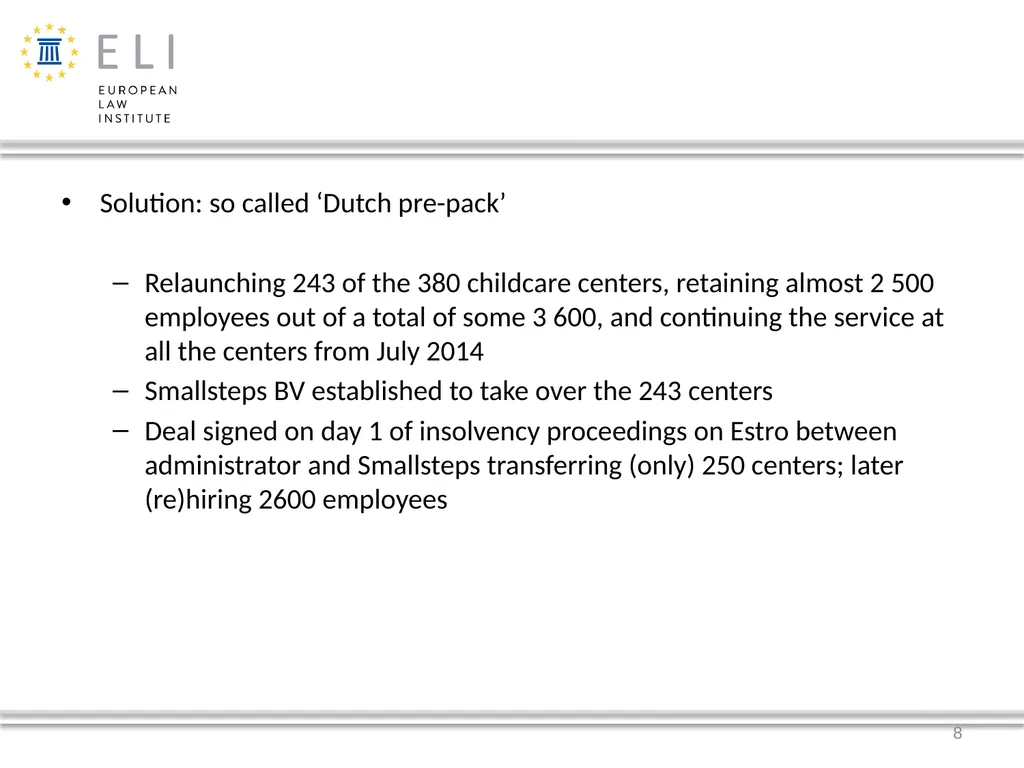
Solution: so called ‘Dutch pre-pack’
Relaunching 243 of the 380 childcare centers, retaining almost 2 500 employees out of a total of some 3 600, and continuing the service at all the centers from July 2014
Smallsteps BV established to take over the 243 centers
Deal signed on day 1 of insolvency proceedings on Estro between administrator and Smallsteps transferring (only) 250 centers; later (re)hiring 2600 employees 8<br>
Relaunching 243 of the 380 childcare centers, retaining almost 2 500 employees out of a total of some 3 600, and continuing the service at all the centers from July 2014
Smallsteps BV established to take over the 243 centers
Deal signed on day 1 of insolvency proceedings on Estro between administrator and Smallsteps transferring (only) 250 centers; later (re)hiring 2600 employees 8<br>
09
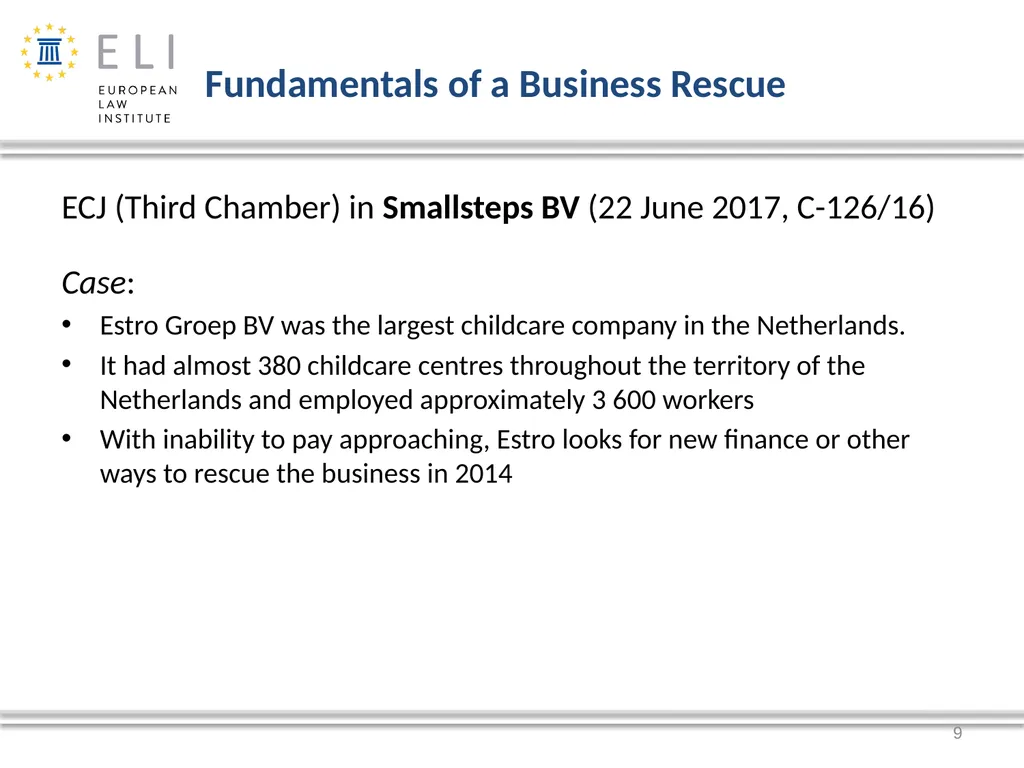
Fundamentals of a Business Rescue ECJ (Third Chamber) in Smallsteps BV (22 June 2017, C-126/16)
Case:
Estro Groep BV was the largest childcare company in the Netherlands.
It had almost 380 childcare centres throughout the territory of the Netherlands and employed approximately 3 600 workers
With inability to pay approaching, Estro looks for new finance or other ways to rescue the business in 2014 9<br>
Case:
Estro Groep BV was the largest childcare company in the Netherlands.
It had almost 380 childcare centres throughout the territory of the Netherlands and employed approximately 3 600 workers
With inability to pay approaching, Estro looks for new finance or other ways to rescue the business in 2014 9<br>
10
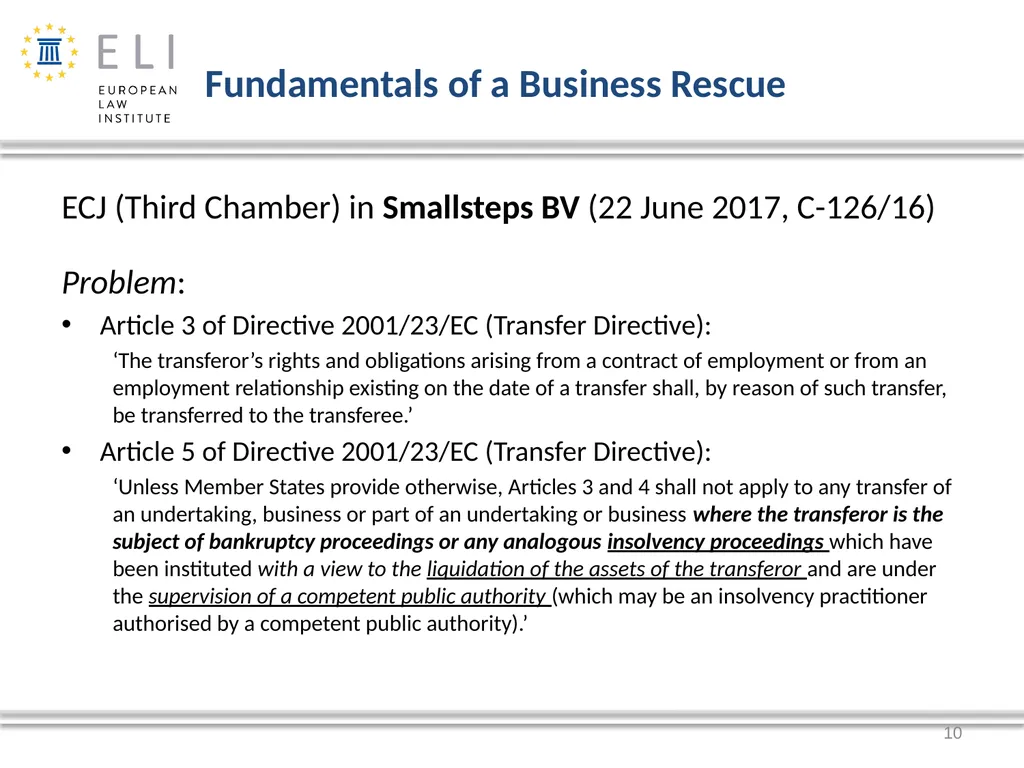
Fundamentals of a Business Rescue ECJ (Third Chamber) in Smallsteps BV (22 June 2017, C-126/16)
Problem:
Article 3 of Directive 2001/23/EC (Transfer Directive):
‘The transferor’s rights and obligations arising from a contract of employment or from an employment relationship existing on the date of a transfer shall, by reason of such transfer, be transferred to the transferee.’
Article 5 of Directive 2001/23/EC (Transfer Directive):
‘Unless Member States provide otherwise, Articles 3 and 4 shall not apply to any transfer of an undertaking, business or part of an undertaking or business where the transferor is the subject of bankruptcy proceedings or any analogous insolvency proceedings which have been instituted with a view to the liquidation of the assets of the transferor and are under the supervision of a competent public authority (which may be an insolvency practitioner authorised by a competent public authority).’ 10<br>
Problem:
Article 3 of Directive 2001/23/EC (Transfer Directive):
‘The transferor’s rights and obligations arising from a contract of employment or from an employment relationship existing on the date of a transfer shall, by reason of such transfer, be transferred to the transferee.’
Article 5 of Directive 2001/23/EC (Transfer Directive):
‘Unless Member States provide otherwise, Articles 3 and 4 shall not apply to any transfer of an undertaking, business or part of an undertaking or business where the transferor is the subject of bankruptcy proceedings or any analogous insolvency proceedings which have been instituted with a view to the liquidation of the assets of the transferor and are under the supervision of a competent public authority (which may be an insolvency practitioner authorised by a competent public authority).’ 10<br>
11
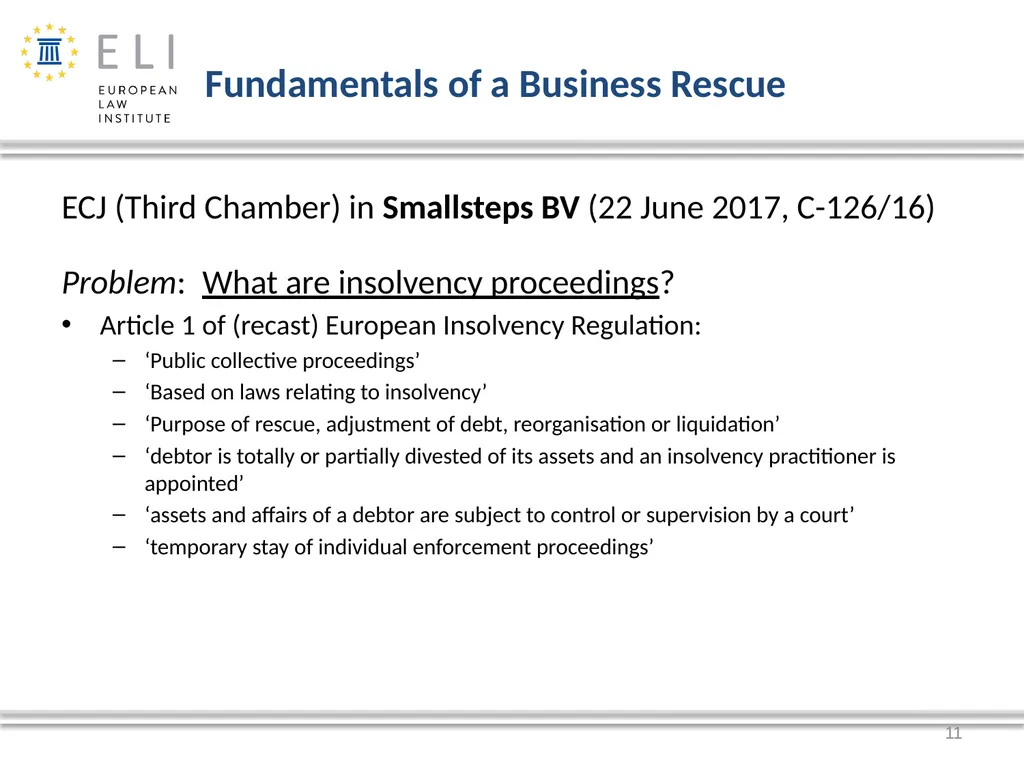
Fundamentals of a Business Rescue ECJ (Third Chamber) in Smallsteps BV (22 June 2017, C-126/16)
Problem: What are insolvency proceedings?
Article 1 of (recast) European Insolvency Regulation:
‘Public collective proceedings’
‘Based on laws relating to insolvency’
‘Purpose of rescue, adjustment of debt, reorganisation or liquidation’
‘debtor is totally or partially divested of its assets and an insolvency practitioner is appointed’
‘assets and affairs of a debtor are subject to control or supervision by a court’
‘temporary stay of individual enforcement proceedings’ 11<br>
Problem: What are insolvency proceedings?
Article 1 of (recast) European Insolvency Regulation:
‘Public collective proceedings’
‘Based on laws relating to insolvency’
‘Purpose of rescue, adjustment of debt, reorganisation or liquidation’
‘debtor is totally or partially divested of its assets and an insolvency practitioner is appointed’
‘assets and affairs of a debtor are subject to control or supervision by a court’
‘temporary stay of individual enforcement proceedings’ 11<br>
12
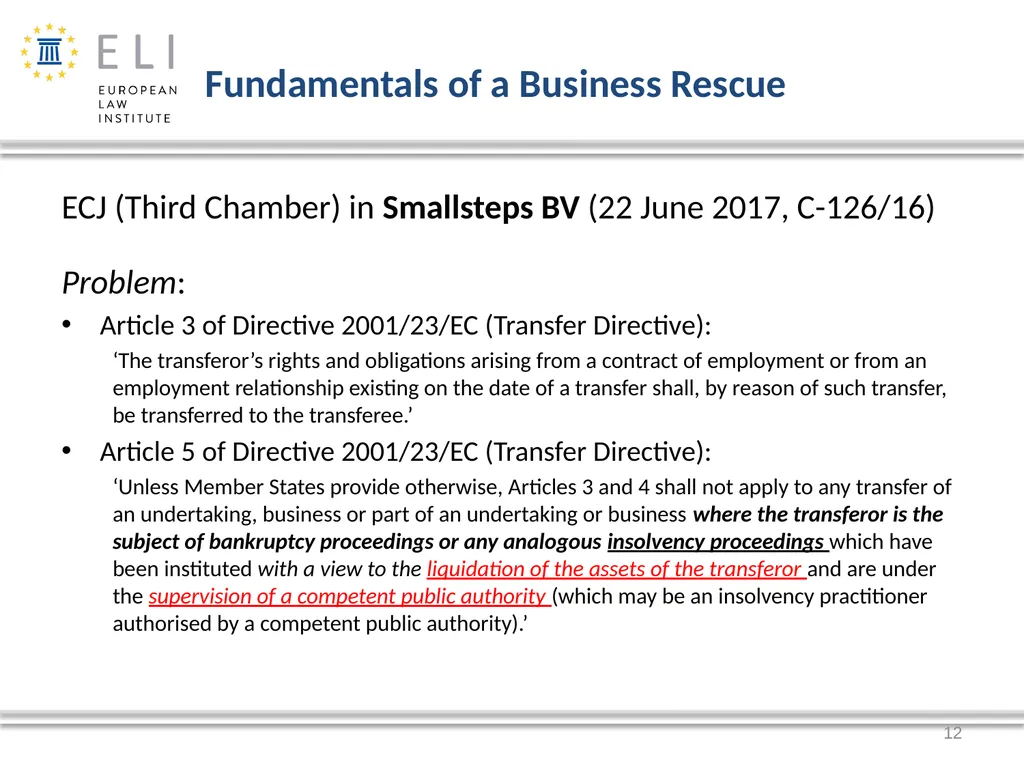
Fundamentals of a Business Rescue ECJ (Third Chamber) in Smallsteps BV (22 June 2017, C-126/16)
Problem:
Article 3 of Directive 2001/23/EC (Transfer Directive):
‘The transferor’s rights and obligations arising from a contract of employment or from an employment relationship existing on the date of a transfer shall, by reason of such transfer, be transferred to the transferee.’
Article 5 of Directive 2001/23/EC (Transfer Directive):
‘Unless Member States provide otherwise, Articles 3 and 4 shall not apply to any transfer of an undertaking, business or part of an undertaking or business where the transferor is the subject of bankruptcy proceedings or any analogous insolvency proceedings which have been instituted with a view to the liquidation of the assets of the transferor and are under the supervision of a competent public authority (which may be an insolvency practitioner authorised by a competent public authority).’ 12<br>
Problem:
Article 3 of Directive 2001/23/EC (Transfer Directive):
‘The transferor’s rights and obligations arising from a contract of employment or from an employment relationship existing on the date of a transfer shall, by reason of such transfer, be transferred to the transferee.’
Article 5 of Directive 2001/23/EC (Transfer Directive):
‘Unless Member States provide otherwise, Articles 3 and 4 shall not apply to any transfer of an undertaking, business or part of an undertaking or business where the transferor is the subject of bankruptcy proceedings or any analogous insolvency proceedings which have been instituted with a view to the liquidation of the assets of the transferor and are under the supervision of a competent public authority (which may be an insolvency practitioner authorised by a competent public authority).’ 12<br>
13
Fundamentals of a Business Rescue ECJ (Third Chamber) in Smallsteps BV (22 June 2017, C-126/16)
Problem:
What is a ‘liquidation of the assets of the transferor’?
ECJ: ‘a procedure aimed at ensuring the continuation of the undertaking in question does not satisfy that requirement’ 13<br>
Problem:
What is a ‘liquidation of the assets of the transferor’?
ECJ: ‘a procedure aimed at ensuring the continuation of the undertaking in question does not satisfy that requirement’ 13<br>
14
Fundamentals of a Business Rescue ECJ (Third Chamber) in Smallsteps BV (22 June 2017, C-126/16)
Problem:
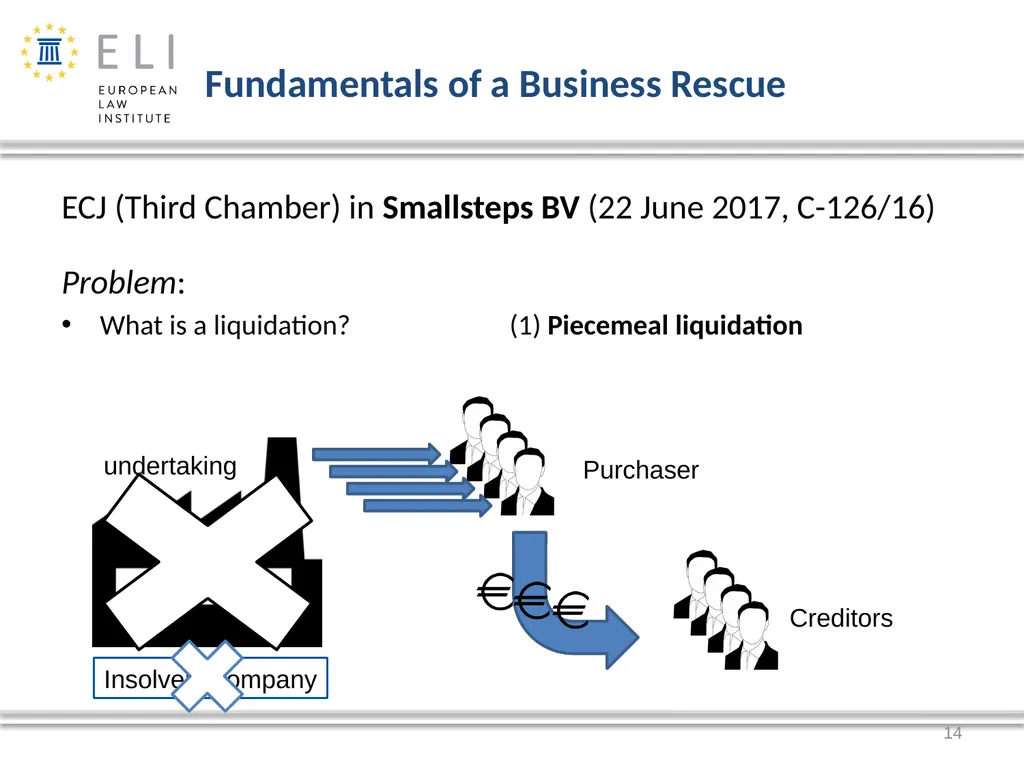
What is a liquidation? (1) Piecemeal liquidation 14 Insolvent company undertaking Purchaser Creditors<br>
Problem:
What is a liquidation? (1) Piecemeal liquidation 14 Insolvent company undertaking Purchaser Creditors<br>
15
Fundamentals of a Business Rescue ECJ (Third Chamber) in Smallsteps BV (22 June 2017, C-126/16)
Problem:
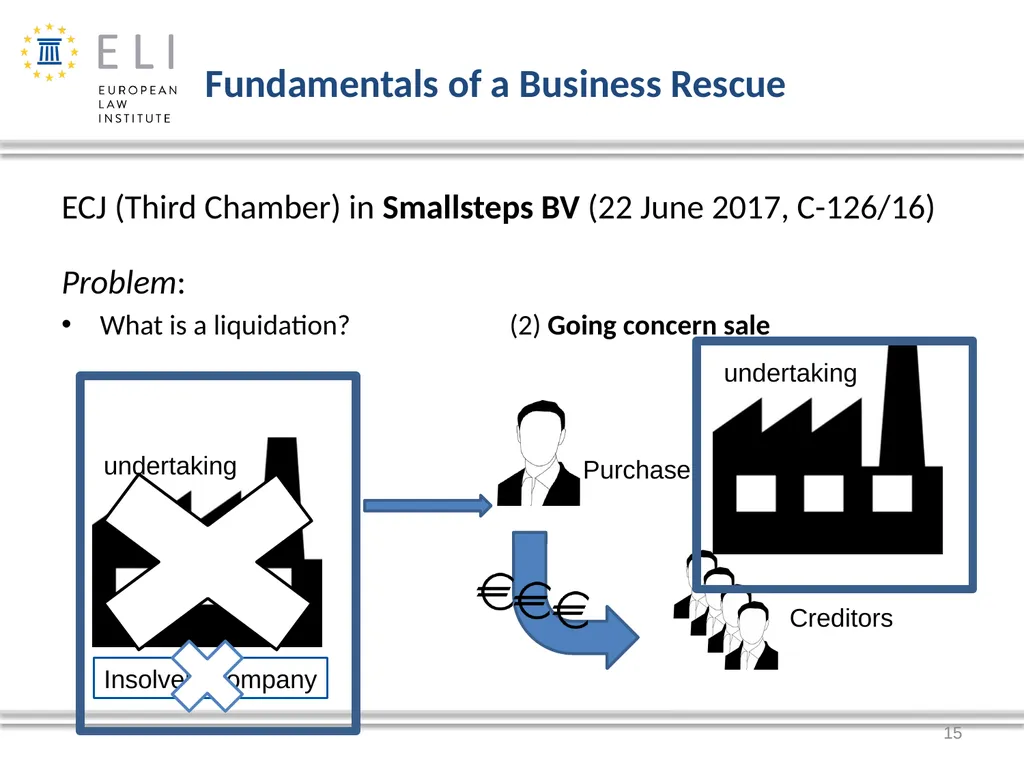
What is a liquidation? (2) Going concern sale 15 Insolvent company undertaking Purchaser Creditors undertaking<br>
Problem:
What is a liquidation? (2) Going concern sale 15 Insolvent company undertaking Purchaser Creditors undertaking<br>
16
Fundamentals of a Business Rescue ECJ (Third Chamber) in Smallsteps BV (22 June 2017, C-126/16)
Problem:
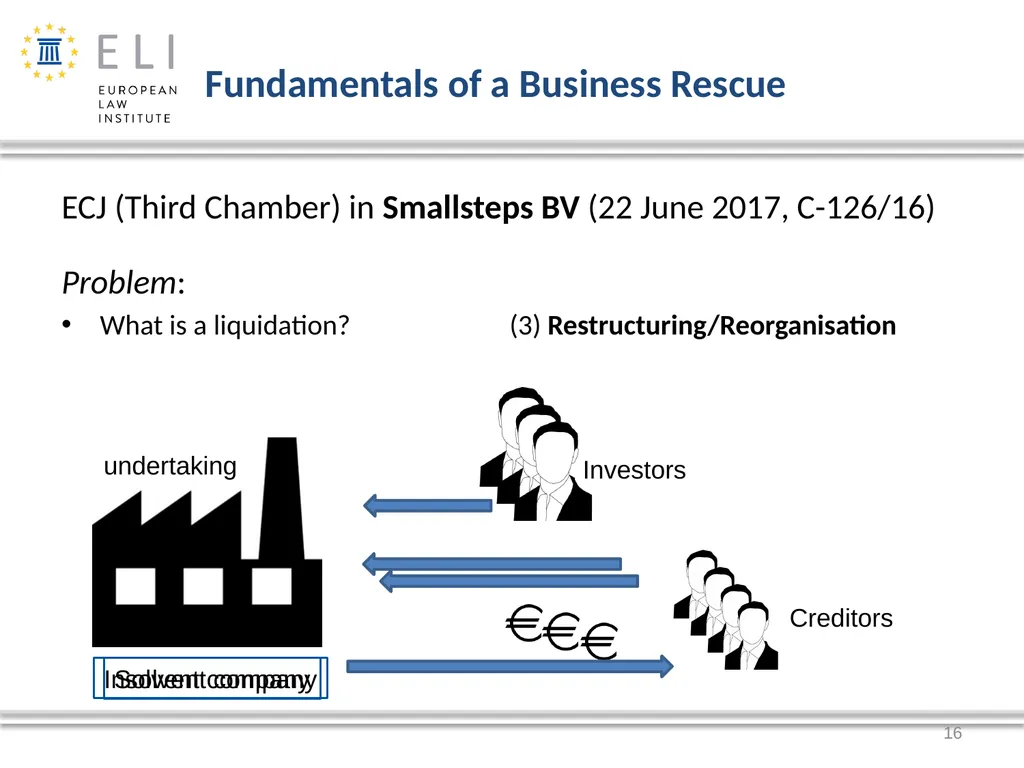
What is a liquidation? (3) Restructuring/Reorganisation 16 Insolvent company undertaking Investors Creditors Solvent company<br>
Problem:
What is a liquidation? (3) Restructuring/Reorganisation 16 Insolvent company undertaking Investors Creditors Solvent company<br>
17
Fundamentals of a Business Rescue ECJ (Third Chamber) in Smallsteps BV (22 June 2017, C-126/16)
Problem:
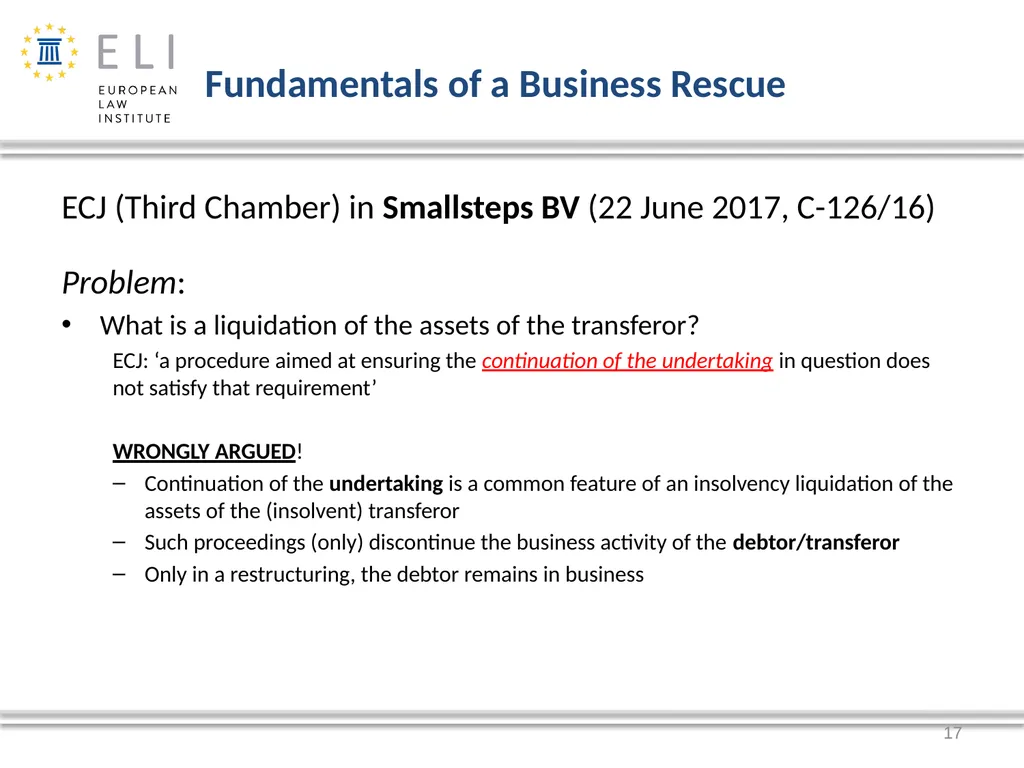
What is a liquidation of the assets of the transferor?
ECJ: ‘a procedure aimed at ensuring the continuation of the undertaking in question does not satisfy that requirement’
WRONGLY ARGUED!
Continuation of the undertaking is a common feature of an insolvency liquidation of the assets of the (insolvent) transferor
Such proceedings (only) discontinue the business activity of the debtor/transferor
Only in a restructuring, the debtor remains in business 17<br>
Problem:
What is a liquidation of the assets of the transferor?
ECJ: ‘a procedure aimed at ensuring the continuation of the undertaking in question does not satisfy that requirement’
WRONGLY ARGUED!
Continuation of the undertaking is a common feature of an insolvency liquidation of the assets of the (insolvent) transferor
Such proceedings (only) discontinue the business activity of the debtor/transferor
Only in a restructuring, the debtor remains in business 17<br>
18
Business Rescue Project – Results Elaborate and discuss two key results:
1. Designing a restructuring and insolvency framework
2. Role of the court 18<br>
1. Designing a restructuring and insolvency framework
2. Role of the court 18<br>
19
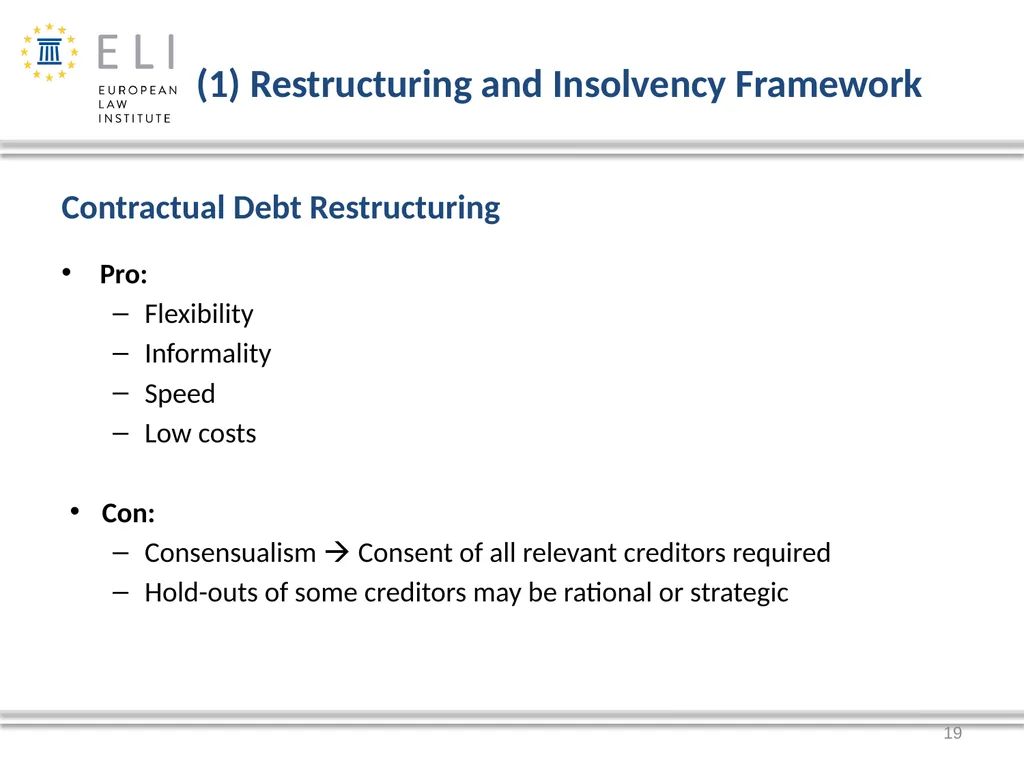
(1) Restructuring and Insolvency Framework Contractual Debt Restructuring
Pro:
Flexibility
Informality
Speed
Low costs
Con:
Consensualism Consent of all relevant creditors required
Hold-outs of some creditors may be rational or strategic 19<br>
Pro:
Flexibility
Informality
Speed
Low costs
Con:
Consensualism Consent of all relevant creditors required
Hold-outs of some creditors may be rational or strategic 19<br>
20
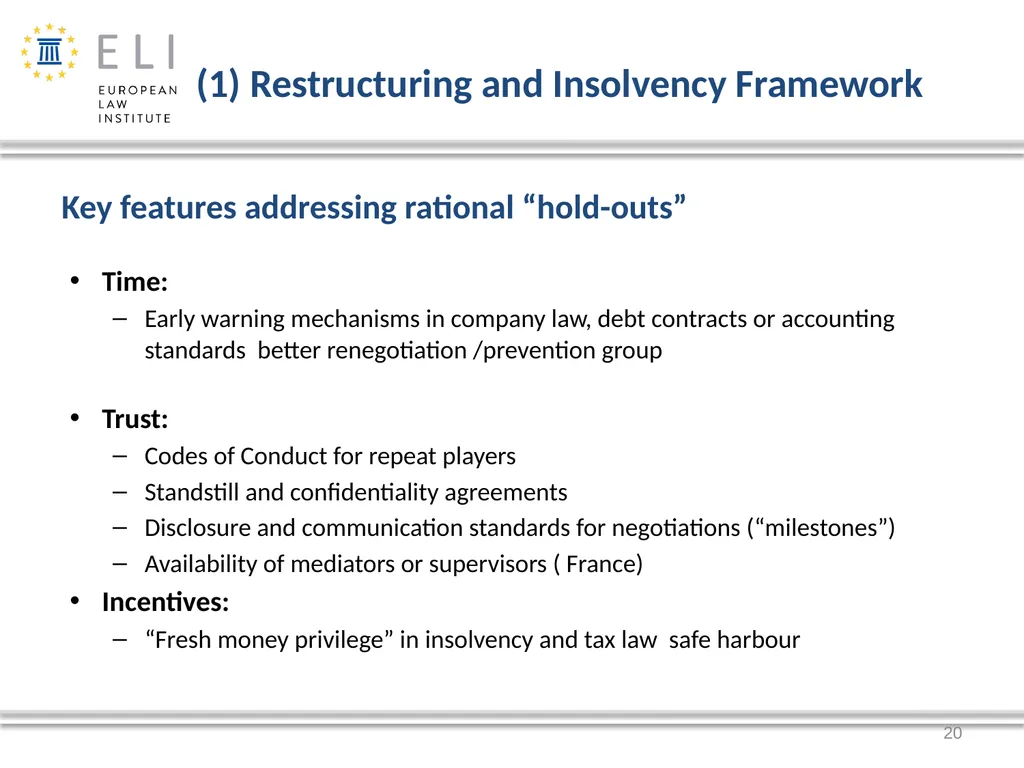
(1) Restructuring and Insolvency Framework Key features addressing rational “hold-outs”
Time:
Early warning mechanisms in company law, debt contracts or accounting standards better renegotiation /prevention group
Trust:
Codes of Conduct for repeat players
Standstill and confidentiality agreements
Disclosure and communication standards for negotiations (“milestones”)
Availability of mediators or supervisors ( France)
Incentives:
“Fresh money privilege” in insolvency and tax law safe harbour 20<br>
Time:
Early warning mechanisms in company law, debt contracts or accounting standards better renegotiation /prevention group
Trust:
Codes of Conduct for repeat players
Standstill and confidentiality agreements
Disclosure and communication standards for negotiations (“milestones”)
Availability of mediators or supervisors ( France)
Incentives:
“Fresh money privilege” in insolvency and tax law safe harbour 20<br>
21
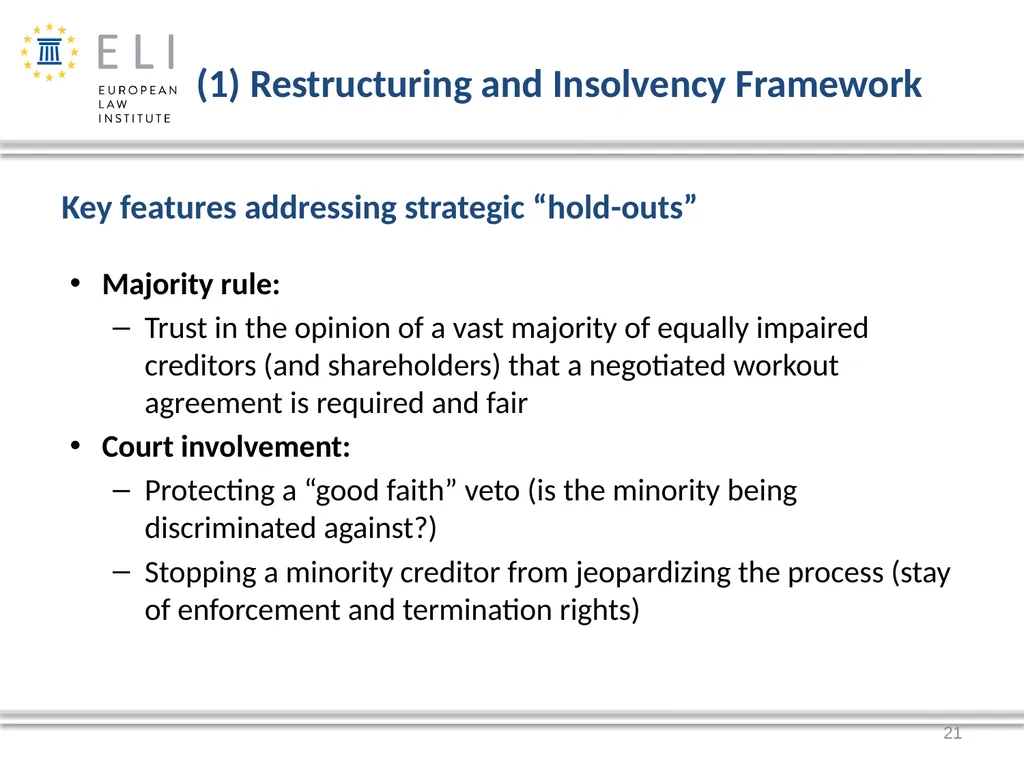
(1) Restructuring and Insolvency Framework Key features addressing strategic “hold-outs”
Majority rule:
Trust in the opinion of a vast majority of equally impaired creditors (and shareholders) that a negotiated workout agreement is required and fair
Court involvement:
Protecting a “good faith” veto (is the minority being discriminated against?)
Stopping a minority creditor from jeopardizing the process (stay of enforcement and termination rights) 21<br>
Majority rule:
Trust in the opinion of a vast majority of equally impaired creditors (and shareholders) that a negotiated workout agreement is required and fair
Court involvement:
Protecting a “good faith” veto (is the minority being discriminated against?)
Stopping a minority creditor from jeopardizing the process (stay of enforcement and termination rights) 21<br>
22
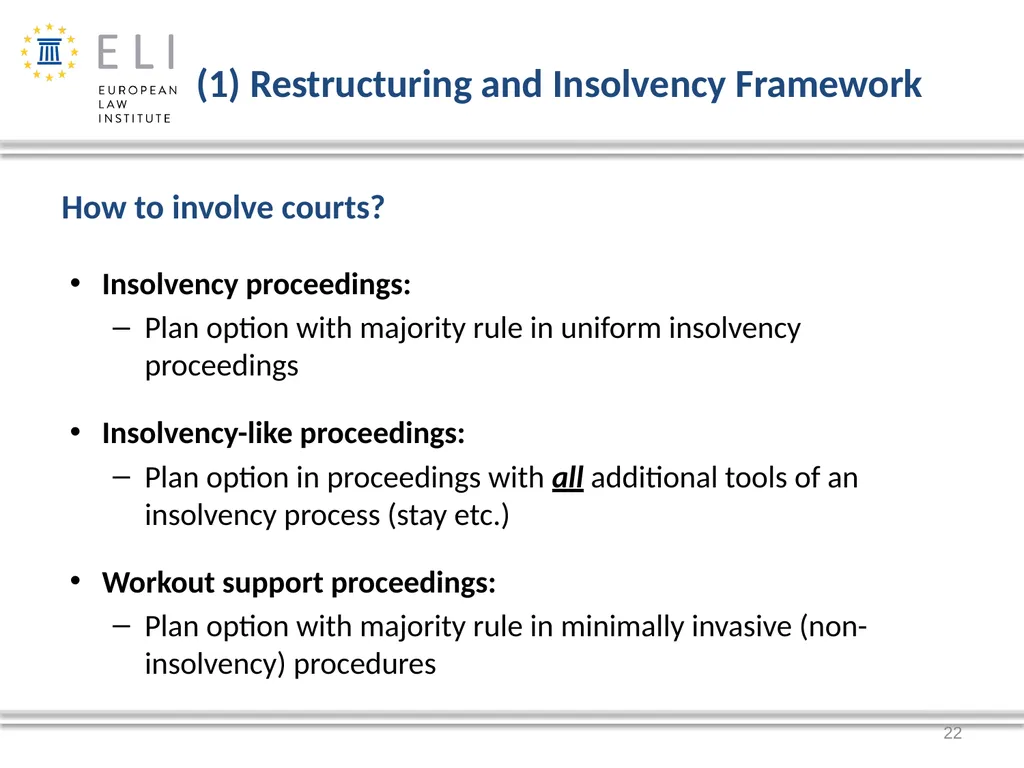
(1) Restructuring and Insolvency Framework How to involve courts?
Insolvency proceedings:
Plan option with majority rule in uniform insolvency proceedings
Insolvency-like proceedings:
Plan option in proceedings with all additional tools of an insolvency process (stay etc.)
Workout support proceedings:
Plan option with majority rule in minimally invasive (non-insolvency) procedures 22<br>
Insolvency proceedings:
Plan option with majority rule in uniform insolvency proceedings
Insolvency-like proceedings:
Plan option in proceedings with all additional tools of an insolvency process (stay etc.)
Workout support proceedings:
Plan option with majority rule in minimally invasive (non-insolvency) procedures 22<br>
23
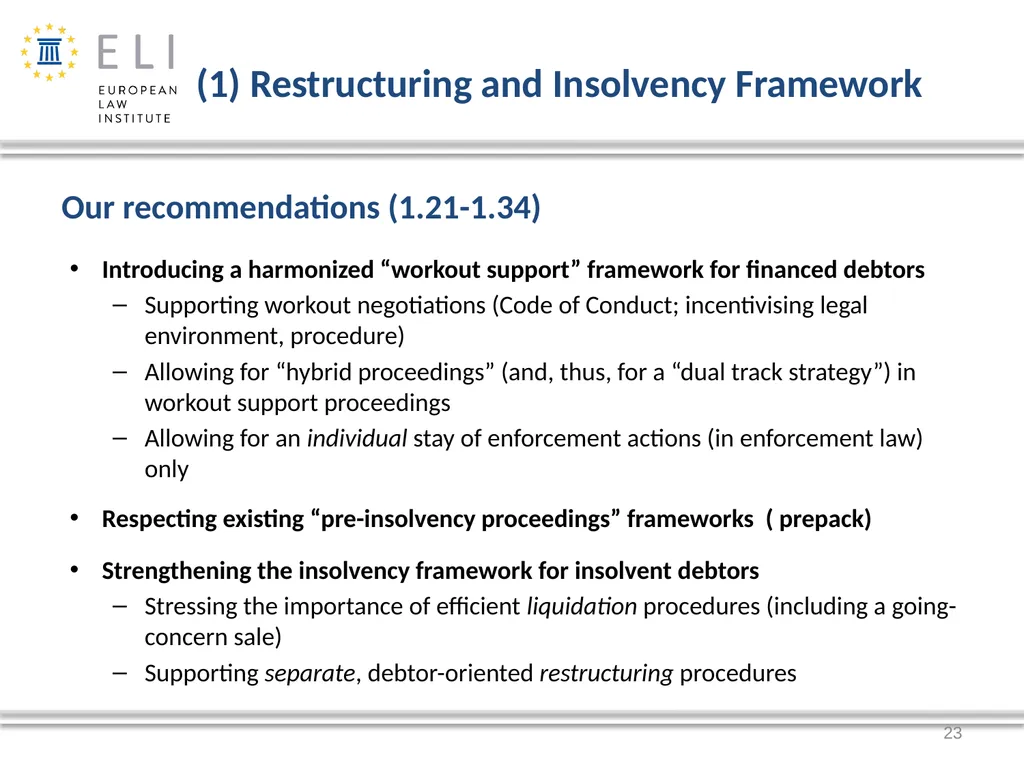
(1) Restructuring and Insolvency Framework Our recommendations (1.21-1.34)
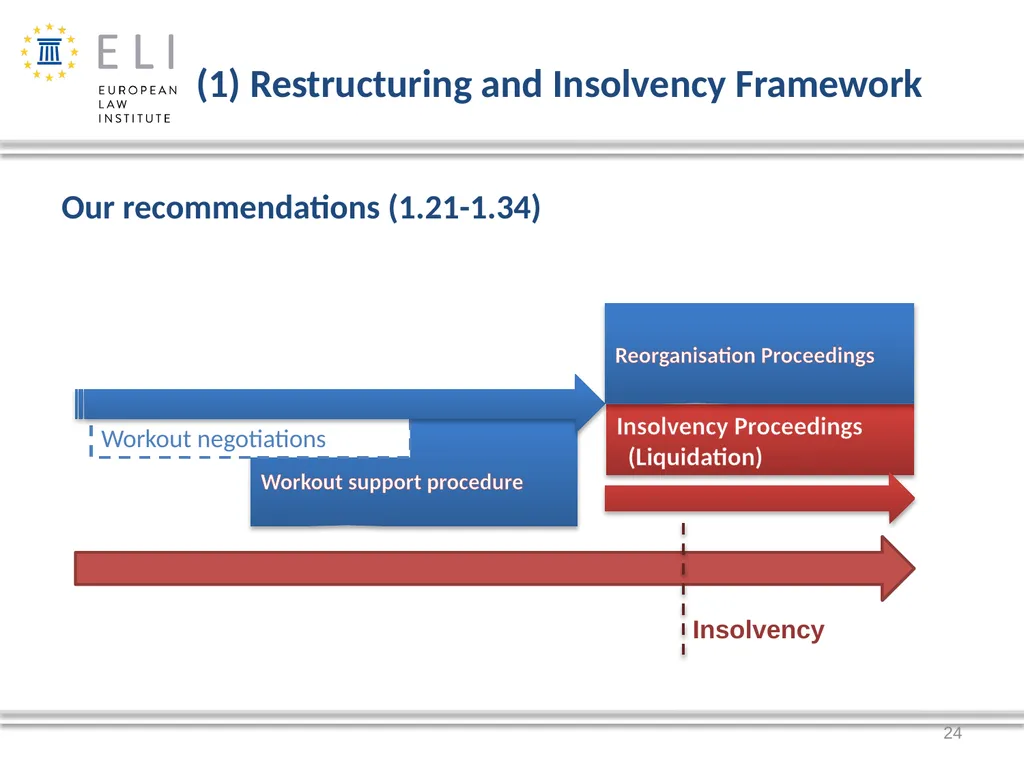
Introducing a harmonized “workout support” framework for financed debtors
Supporting workout negotiations (Code of Conduct; incentivising legal environment, procedure)
Allowing for “hybrid proceedings” (and, thus, for a “dual track strategy”) in workout support proceedings
Allowing for an individual stay of enforcement actions (in enforcement law) only
Respecting existing “pre-insolvency proceedings” frameworks ( prepack)
Strengthening the insolvency framework for insolvent debtors
Stressing the importance of efficient liquidation procedures (including a going-concern sale)
Supporting separate, debtor-oriented restructuring procedures 23<br>
Introducing a harmonized “workout support” framework for financed debtors
Supporting workout negotiations (Code of Conduct; incentivising legal environment, procedure)
Allowing for “hybrid proceedings” (and, thus, for a “dual track strategy”) in workout support proceedings
Allowing for an individual stay of enforcement actions (in enforcement law) only
Respecting existing “pre-insolvency proceedings” frameworks ( prepack)
Strengthening the insolvency framework for insolvent debtors
Stressing the importance of efficient liquidation procedures (including a going-concern sale)
Supporting separate, debtor-oriented restructuring procedures 23<br>
24
(1) Restructuring and Insolvency Framework Our recommendations (1.21-1.34) 24 Workout support procedure Workout negotiations Insolvency Insolvency Proceedings
(Liquidation) Reorganisation Proceedings<br>
(Liquidation) Reorganisation Proceedings<br>
25
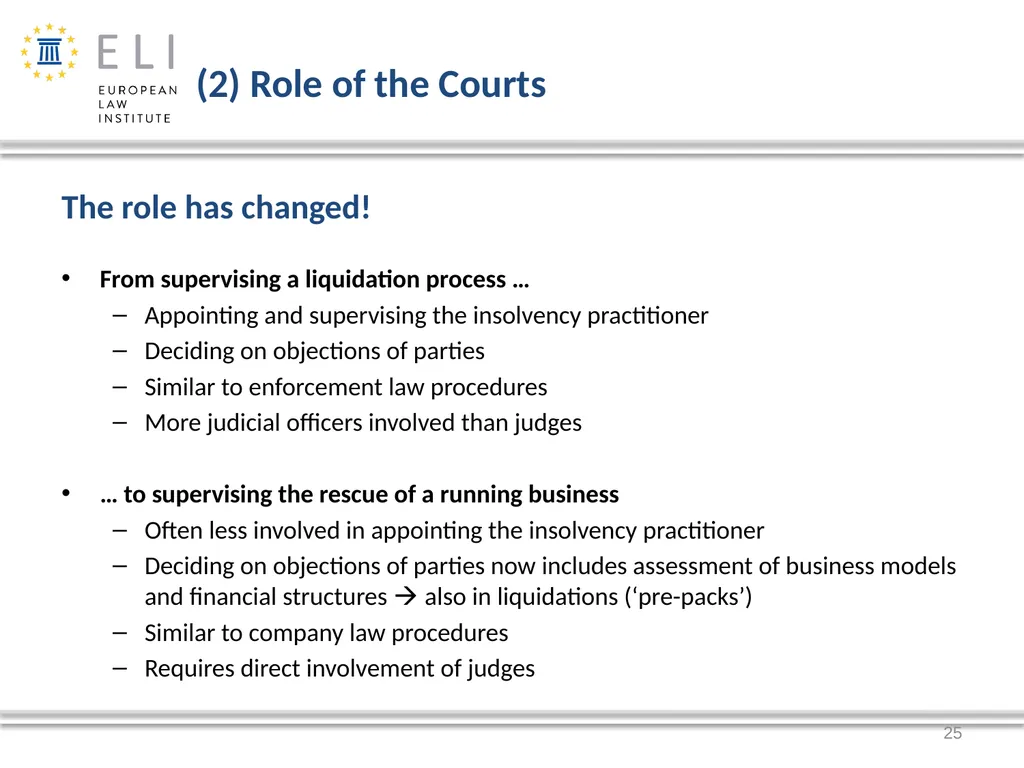
(2) Role of the Courts The role has changed!
From supervising a liquidation process …
Appointing and supervising the insolvency practitioner
Deciding on objections of parties
Similar to enforcement law procedures
More judicial officers involved than judges
… to supervising the rescue of a running business
Often less involved in appointing the insolvency practitioner
Deciding on objections of parties now includes assessment of business models and financial structures also in liquidations (‘pre-packs’)
Similar to company law procedures
Requires direct involvement of judges 25<br>
From supervising a liquidation process …
Appointing and supervising the insolvency practitioner
Deciding on objections of parties
Similar to enforcement law procedures
More judicial officers involved than judges
… to supervising the rescue of a running business
Often less involved in appointing the insolvency practitioner
Deciding on objections of parties now includes assessment of business models and financial structures also in liquidations (‘pre-packs’)
Similar to company law procedures
Requires direct involvement of judges 25<br>
26
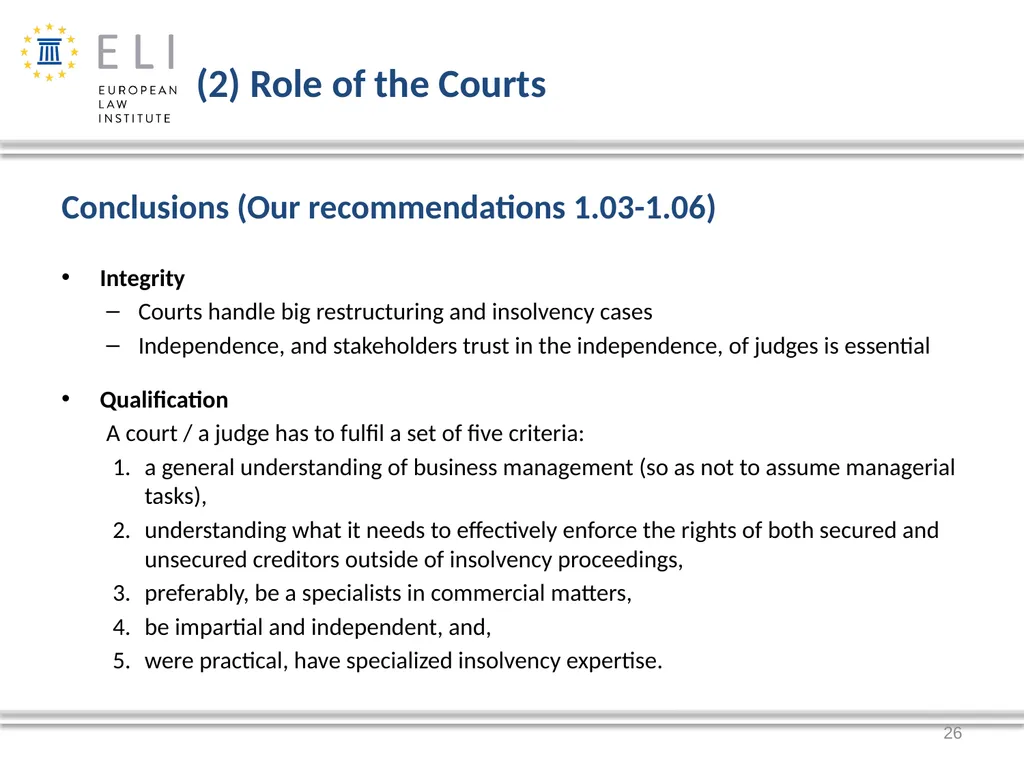
(2) Role of the Courts Conclusions (Our recommendations 1.03-1.06)
Integrity
Courts handle big restructuring and insolvency cases
Independence, and stakeholders trust in the independence, of judges is essential
Qualification
A court / a judge has to fulfil a set of five criteria:
a general understanding of business management (so as not to assume managerial tasks),
understanding what it needs to effectively enforce the rights of both secured and unsecured creditors outside of insolvency proceedings,
preferably, be a specialists in commercial matters,
be impartial and independent, and,
were practical, have specialized insolvency expertise. 26<br>
Integrity
Courts handle big restructuring and insolvency cases
Independence, and stakeholders trust in the independence, of judges is essential
Qualification
A court / a judge has to fulfil a set of five criteria:
a general understanding of business management (so as not to assume managerial tasks),
understanding what it needs to effectively enforce the rights of both secured and unsecured creditors outside of insolvency proceedings,
preferably, be a specialists in commercial matters,
be impartial and independent, and,
were practical, have specialized insolvency expertise. 26<br>
27
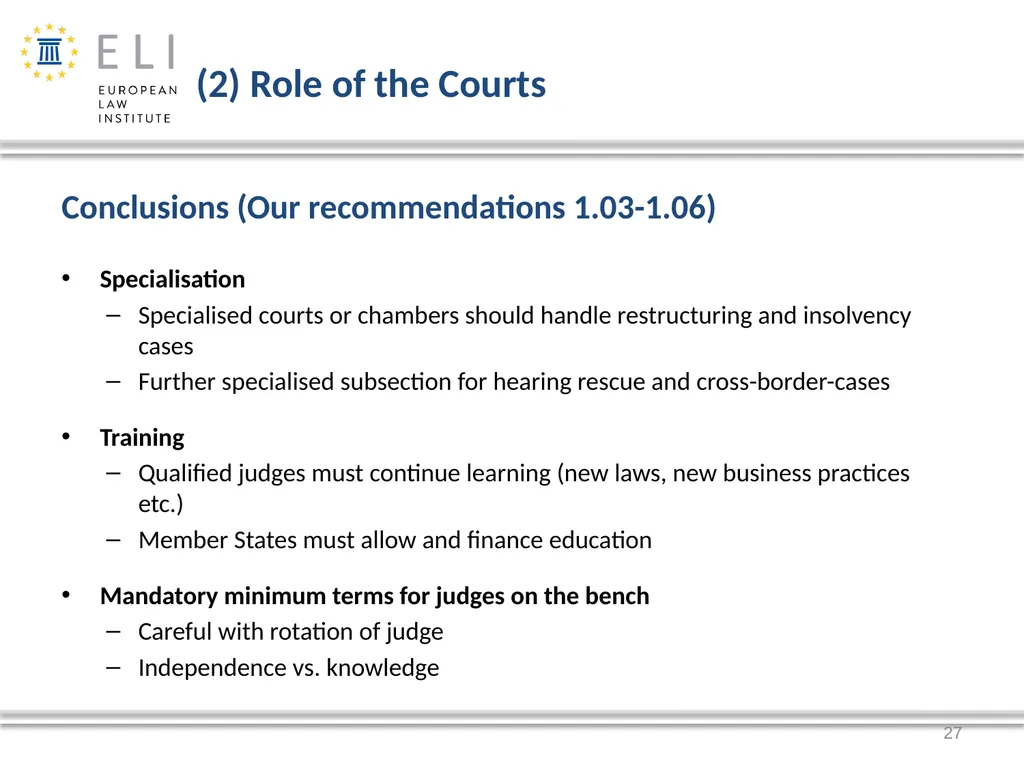
(2) Role of the Courts Conclusions (Our recommendations 1.03-1.06)
Specialisation
Specialised courts or chambers should handle restructuring and insolvency cases
Further specialised subsection for hearing rescue and cross-border-cases
Training
Qualified judges must continue learning (new laws, new business practices etc.)
Member States must allow and finance education
Mandatory minimum terms for judges on the bench
Careful with rotation of judge
Independence vs. knowledge 27<br>
Specialisation
Specialised courts or chambers should handle restructuring and insolvency cases
Further specialised subsection for hearing rescue and cross-border-cases
Training
Qualified judges must continue learning (new laws, new business practices etc.)
Member States must allow and finance education
Mandatory minimum terms for judges on the bench
Careful with rotation of judge
Independence vs. knowledge 27<br>
28
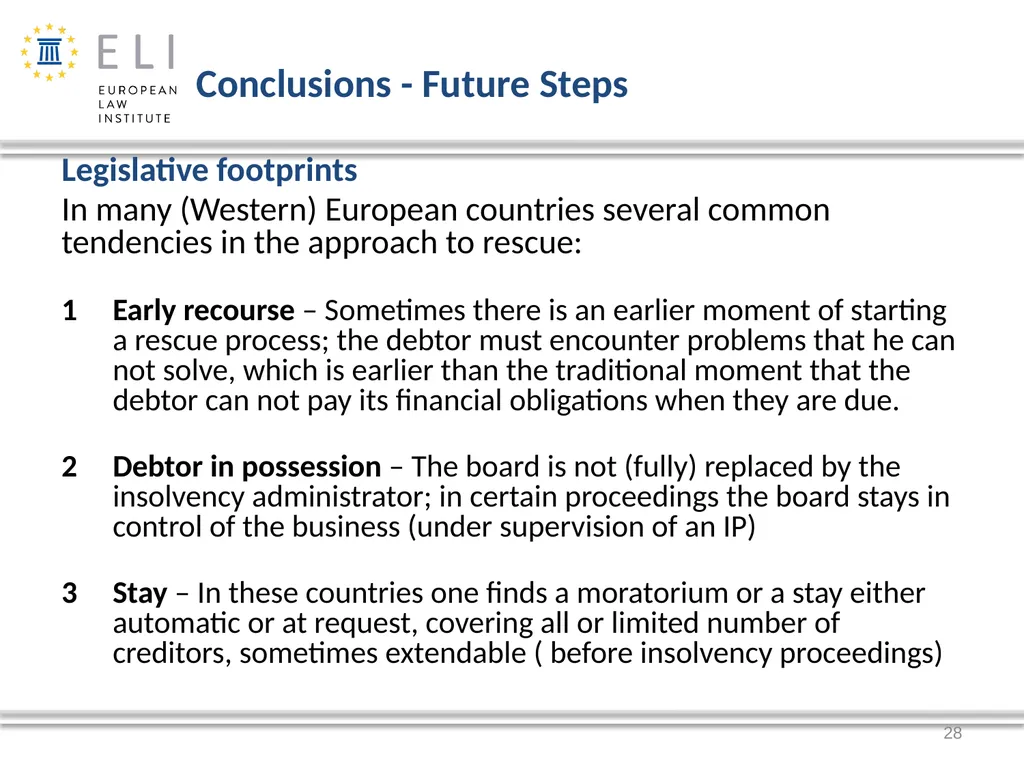
Conclusions - Future Steps Legislative footprints
In many (Western) European countries several common tendencies in the approach to rescue:
Early recourse – Sometimes there is an earlier moment of starting a rescue process; the debtor must encounter problems that he can not solve, which is earlier than the traditional moment that the debtor can not pay its financial obligations when they are due.
Debtor in possession – The board is not (fully) replaced by the insolvency administrator; in certain proceedings the board stays in control of the business (under supervision of an IP)
Stay – In these countries one finds a moratorium or a stay either automatic or at request, covering all or limited number of creditors, sometimes extendable ( before insolvency proceedings) 28<br>
In many (Western) European countries several common tendencies in the approach to rescue:
Early recourse – Sometimes there is an earlier moment of starting a rescue process; the debtor must encounter problems that he can not solve, which is earlier than the traditional moment that the debtor can not pay its financial obligations when they are due.
Debtor in possession – The board is not (fully) replaced by the insolvency administrator; in certain proceedings the board stays in control of the business (under supervision of an IP)
Stay – In these countries one finds a moratorium or a stay either automatic or at request, covering all or limited number of creditors, sometimes extendable ( before insolvency proceedings) 28<br>
29
Conclusions - Future Steps (Cont’d) Protecting fresh money – Special provisions to protect fresh money available for the company while trying to work itself out of its misery, e.g. protection from avoidance rules or grant special status in subsequent insolvency proceedings ( France)
Debt for equity swap – Possibilities of a debt for equity swap, i.e. the conversion of a creditors claim into shares in the capital of the company
Reorg. plans with certain majorities for adoption of a plan, plan confirmation by court, and mechanism to bind disapproving creditors (‘cram-down’) 29<br>
Debt for equity swap – Possibilities of a debt for equity swap, i.e. the conversion of a creditors claim into shares in the capital of the company
Reorg. plans with certain majorities for adoption of a plan, plan confirmation by court, and mechanism to bind disapproving creditors (‘cram-down’) 29<br>
30
Recent steps New roles – Enterprise mediator Belgium
Corporate groups – Consolidate revalidation proceedings of members of one group (at request or court ex officio) Portugal/France/EU regulation
MSMEs – Portugal
Protecting new finance – Croatia
Reform under construction: England, Germany (groups), NL, Italy, Luxemburg 30<br>
Corporate groups – Consolidate revalidation proceedings of members of one group (at request or court ex officio) Portugal/France/EU regulation
MSMEs – Portugal
Protecting new finance – Croatia
Reform under construction: England, Germany (groups), NL, Italy, Luxemburg 30<br>
31
Paradigm shift in European national
insolvency laws In short: aim of insolvency legislation/regulation has shifted:
from being rather exclusively to protect the creditors’ private law interests, to being deployed for rehabilitation of the debtor and the continuity of its business (increased group of interested stakeholders),
from viewing insolvency as a terminal proceeding for business ending in liquidation, to the recognition of insolvency proceedings as a gateway to potential business rescue (‘instrumentalisation’ of insolvency law), 31<br>
from being rather exclusively to protect the creditors’ private law interests, to being deployed for rehabilitation of the debtor and the continuity of its business (increased group of interested stakeholders),
from viewing insolvency as a terminal proceeding for business ending in liquidation, to the recognition of insolvency proceedings as a gateway to potential business rescue (‘instrumentalisation’ of insolvency law), 31<br>
32
Paradigm shift in European national
insolvency laws (Cont’d) from insolvency being seen as a personal ‘sin’ (morale failure), to have developed to insolvency seen as a business risk (economic failure) (enhancement of a rescue culture),
from a formal legal procedural approach to an openness for flexible and pragmatic choices: ‘deformalisation’, sometimes ‘contractualisation’ of insolvency, including a pushing back of the role of courts,
changing role of actors: involvement of courts, insolvency mediation, growing emphasis on integrity/professionality of IPs and courts.
All leading to the development of a distinct body of business rescue and insolvency law 32<br>
from a formal legal procedural approach to an openness for flexible and pragmatic choices: ‘deformalisation’, sometimes ‘contractualisation’ of insolvency, including a pushing back of the role of courts,
changing role of actors: involvement of courts, insolvency mediation, growing emphasis on integrity/professionality of IPs and courts.
All leading to the development of a distinct body of business rescue and insolvency law 32<br>
33
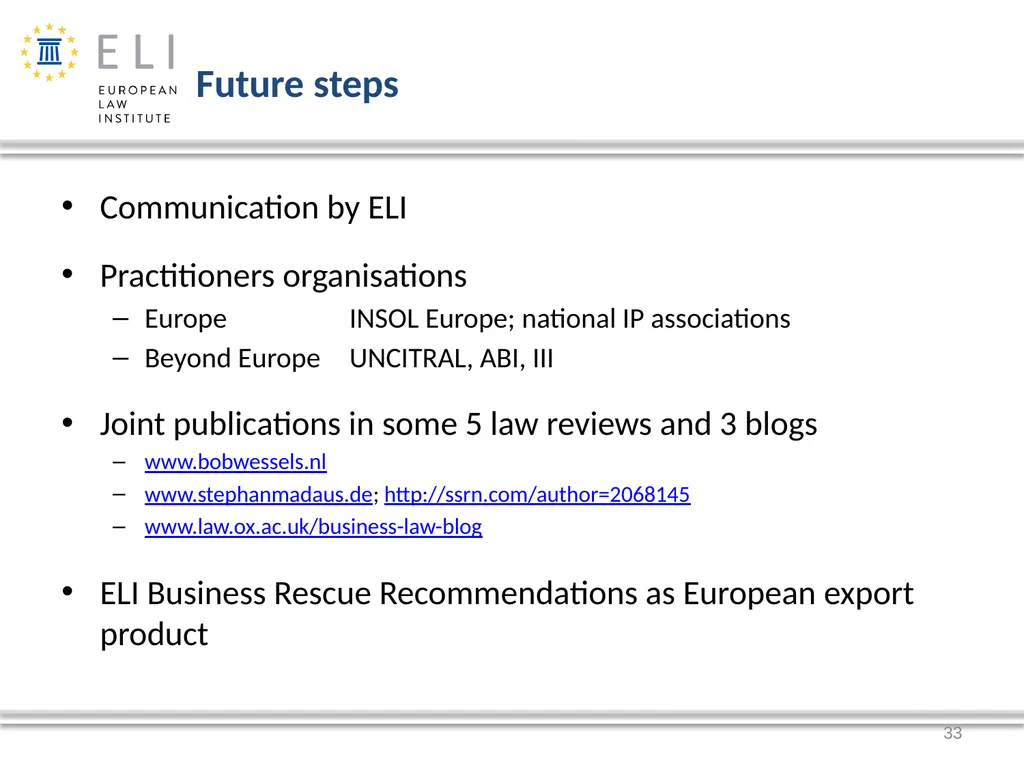
Future steps Communication by ELI
Practitioners organisations
Europe INSOL Europe; national IP associations
Beyond Europe UNCITRAL, ABI, III
Joint publications in some 5 law reviews and 3 blogs
www.bobwessels.nl
www.stephanmadaus.de; http://ssrn.com/author=2068145
www.law.ox.ac.uk/business-law-blog
ELI Business Rescue Recommendations as European export product 33<br>
Practitioners organisations
Europe INSOL Europe; national IP associations
Beyond Europe UNCITRAL, ABI, III
Joint publications in some 5 law reviews and 3 blogs
www.bobwessels.nl
www.stephanmadaus.de; http://ssrn.com/author=2068145
www.law.ox.ac.uk/business-law-blog
ELI Business Rescue Recommendations as European export product 33<br>
34
Questions? 34<br>
35
www.europeanlawinstitute.eu
businessrescue@europeanlawinstitute.eu
www.tri-leiden.eu/projects/businessrescue 35<br>
businessrescue@europeanlawinstitute.eu
www.tri-leiden.eu/projects/businessrescue 35<br>