
Transforming UT Modernization and Business
Description: Transforming UT Modernization and Business Productivity Initiative TASSCC March 21, 2014 2 Transforming UT Societal and Economic Pressures Facing Higher Education Today Affordability Accessibility Transparency Accountability Innovation
Related Topics
Download Presentation
"Transforming UT Modernization and Business" is the property of its rightful owner. Permission is granted to download and print the materials on this website for personal, non-commercial use only, and to display it on your personal computer provided you do not modify the materials and that you retain all copyright notices contained in the materials. By downloading content from our website, you accept the terms of this agreement.
Presentation Transcript
slide1. Transforming UT
Modernization and Business Productivity Initiative TASSCC
March 21, 2014<br>
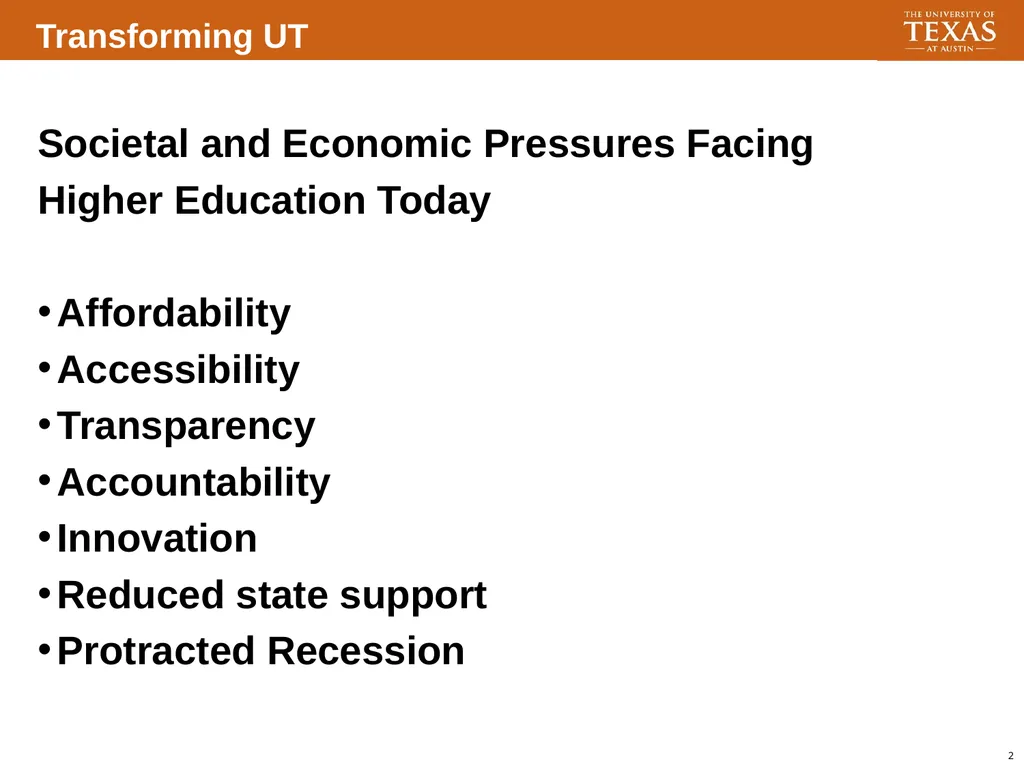
slide2. 2 Transforming UT Societal and Economic Pressures Facing
Higher Education Today
Affordability
Accessibility
Transparency
Accountability
Innovation
Reduced state support
Protracted Recession<br>
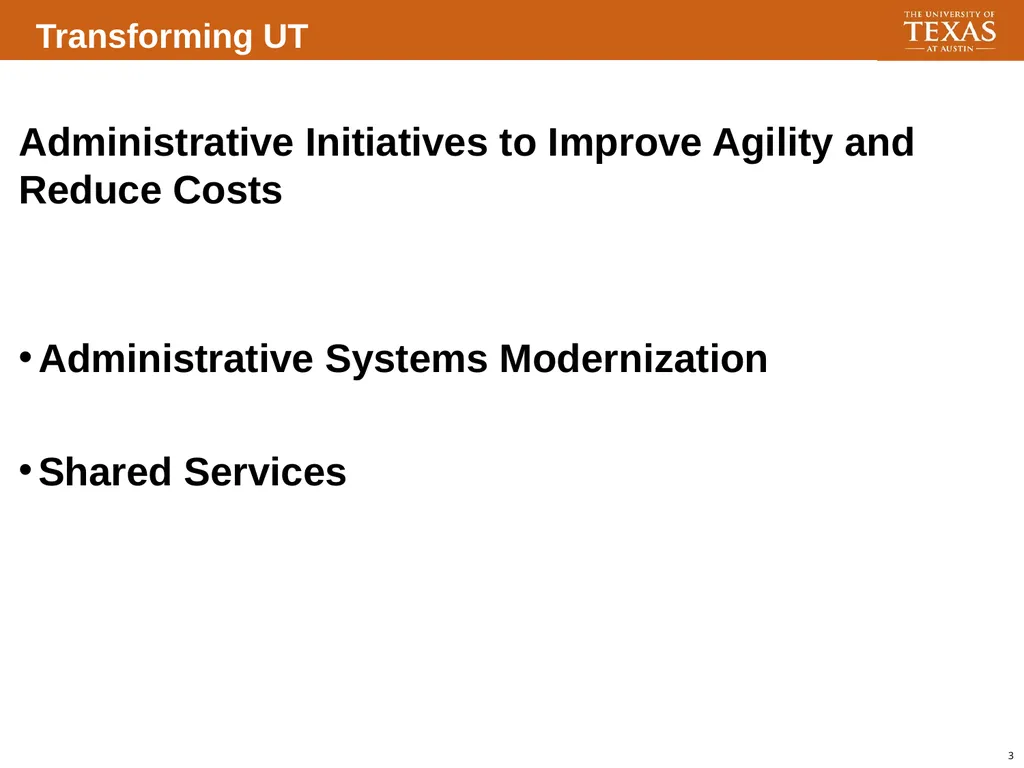
slide3. 3 Transforming UT Administrative Initiatives to Improve Agility and Reduce Costs
Administrative Systems Modernization
Shared Services<br>
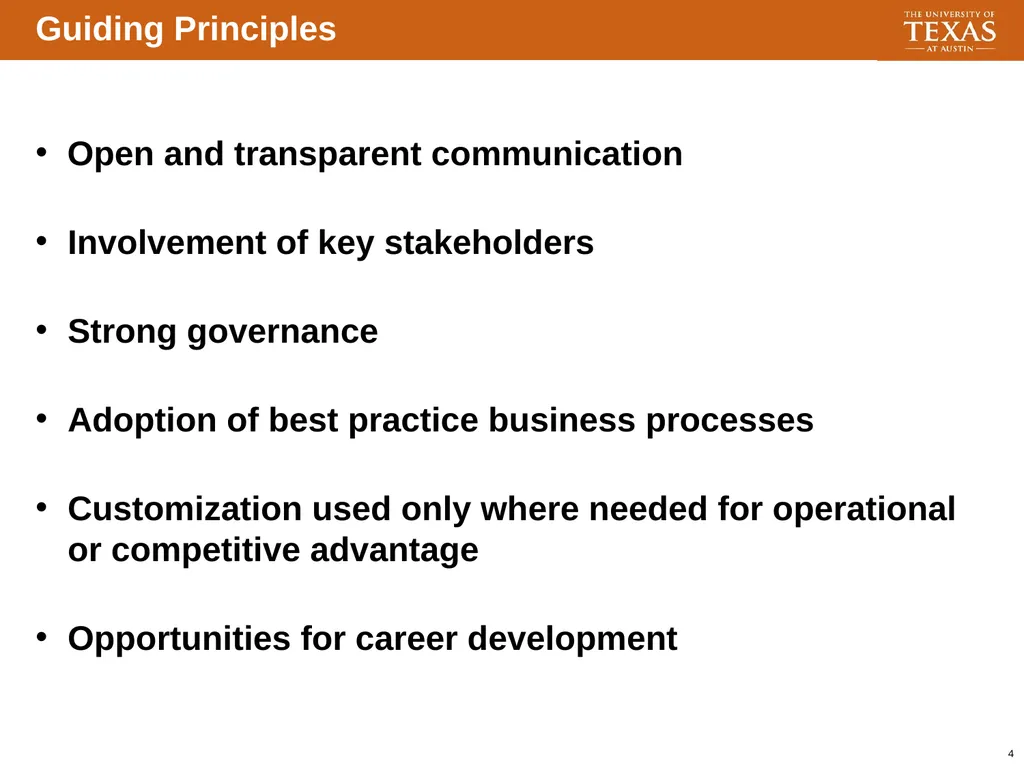
slide4. 4 Open and transparent communication
Involvement of key stakeholders
Strong governance
Adoption of best practice business processes
Customization used only where needed for operational or competitive advantage
Opportunities for career development Guiding Principles<br>
slide5. 5 Transforming UT Current Environment
Drivers to Change
Plan for Change
Expected Gains
Anticipated Challenges Administrative Systems Modernization<br>
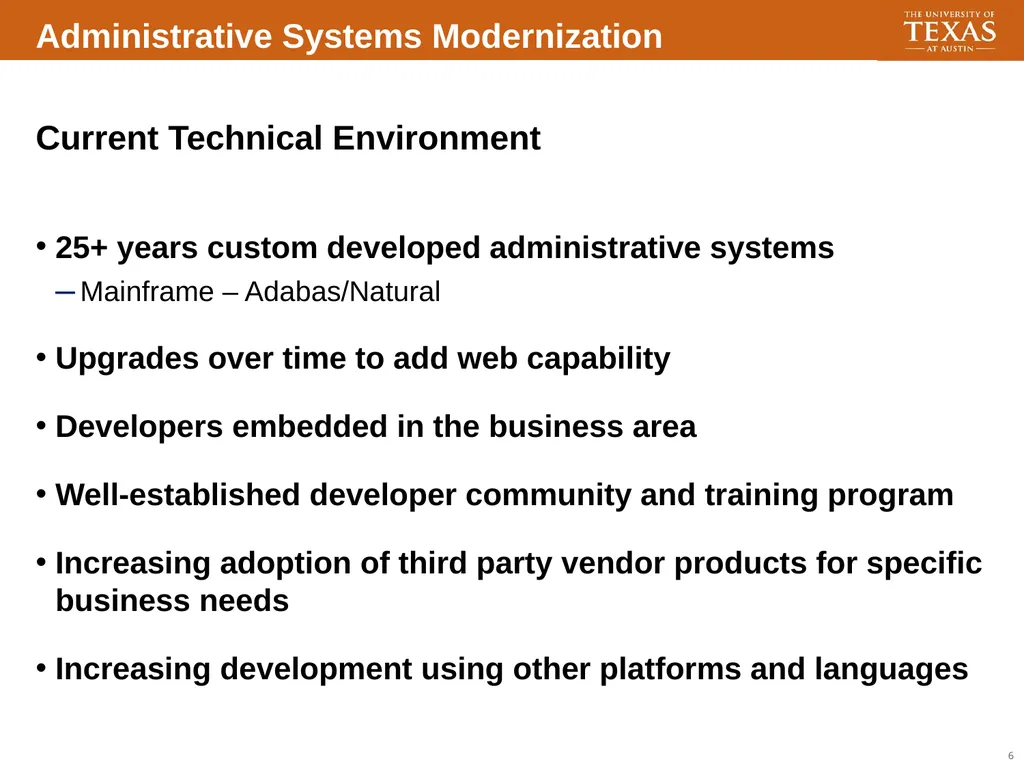
slide6. Current Technical Environment
25+ years custom developed administrative systems
Mainframe – Adabas/Natural
Upgrades over time to add web capability
Developers embedded in the business area
Well-established developer community and training program
Increasing adoption of third party vendor products for specific business needs
Increasing development using other platforms and languages 6 Administrative Systems Modernization<br>
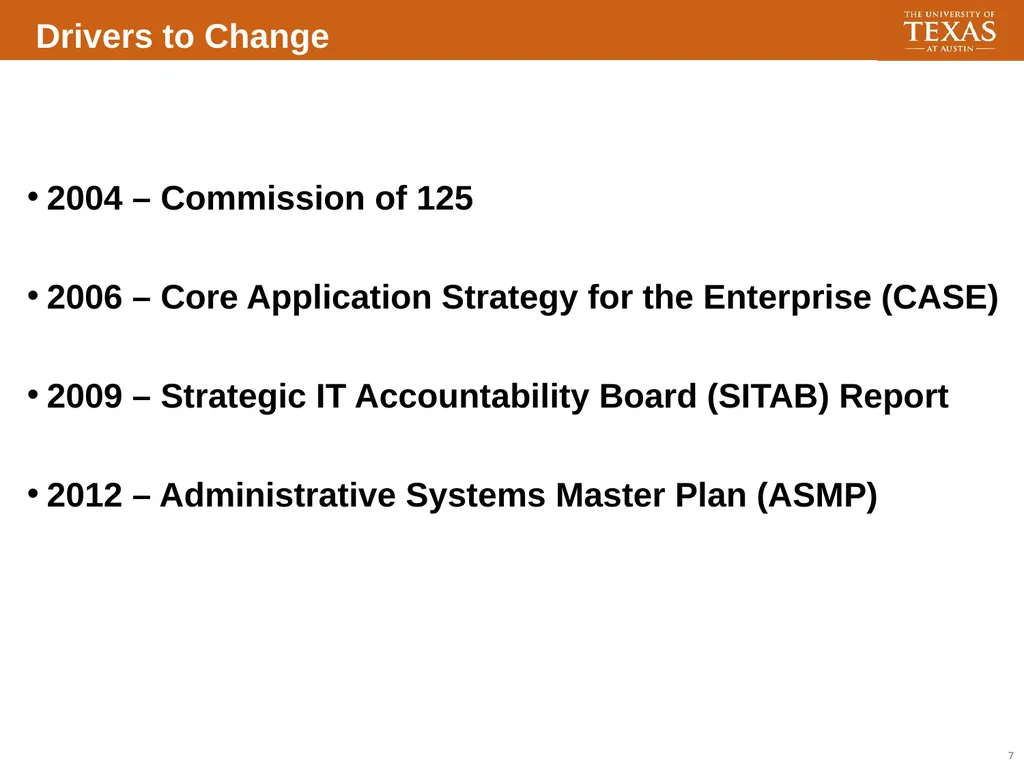
slide7. 2004 – Commission of 125
2006 – Core Application Strategy for the Enterprise (CASE)
2009 – Strategic IT Accountability Board (SITAB) Report
2012 – Administrative Systems Master Plan (ASMP) 7 Drivers to Change<br>
slide8. Case for Change
Desire to take advantage of technological advancements
Mitigate risks of relying on aging technology toolset (Adabas/Natural are reaching end of life)
Integration with third party open standard systems is very difficult and expensive in the current environment
Up-to-date standards and best practices are difficult with current toolset
Difficulty attracting and retaining workforce 8 Administrative Systems Master Plan (ASMP)<br>
slide9. Create business driven systems and data management
Modernize the administrative IT infrastructure
Strengthen systems development processes 9 ASMP Requirements<br>
slide10. What will it take to re-tool and re-train workforce?
What is an appropriate strategy for customization?
What does the market currently offer? 10 Buy vs Build Considerations<br>
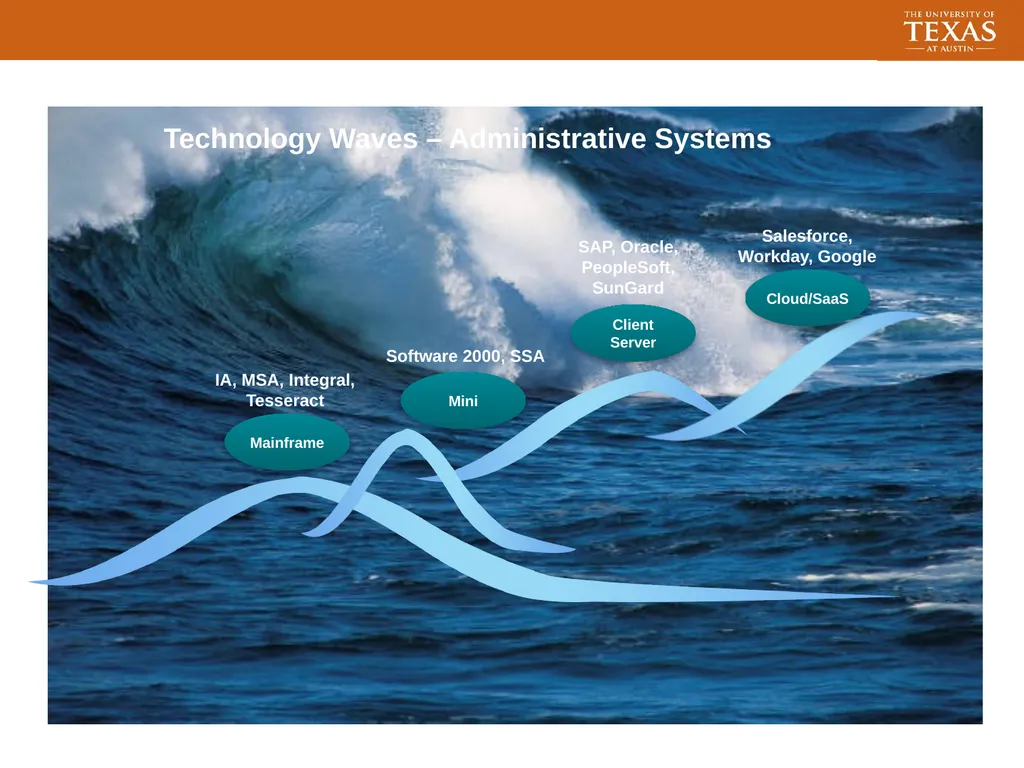
slide11. Technology Waves – Administrative Systems IA, MSA, Integral, Tesseract Software 2000, SSA SAP, Oracle, PeopleSoft, SunGard Salesforce, Workday, Google Mainframe Client Server Mini Cloud/SaaS<br>
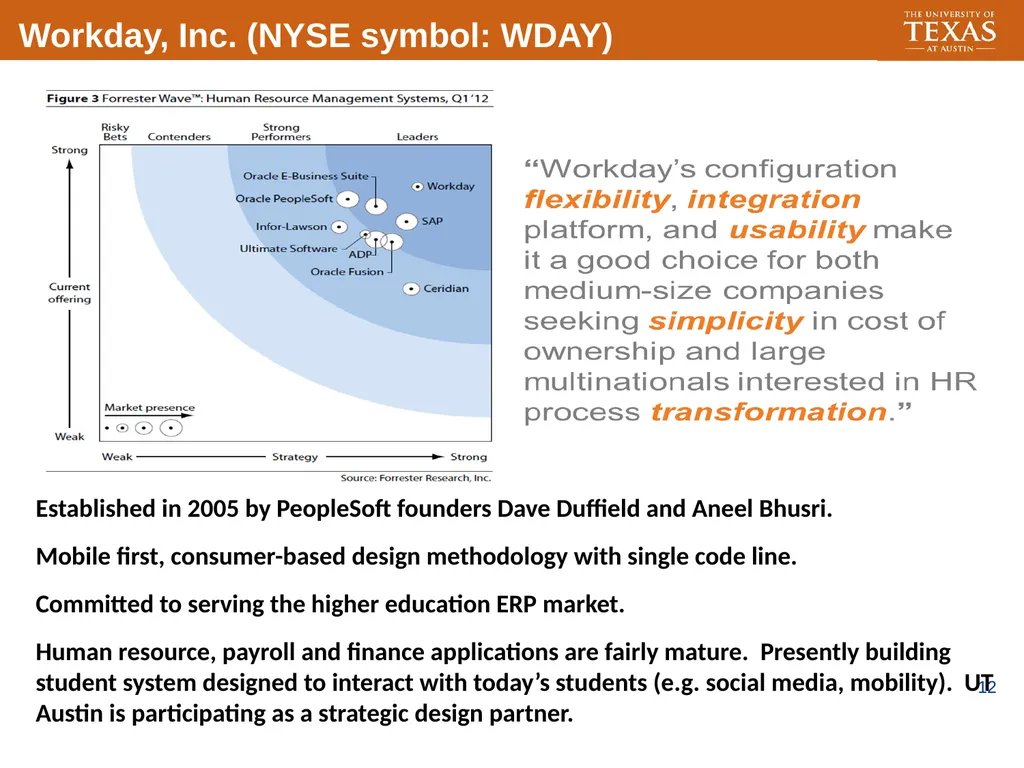
slide12. Workday, Inc. (NYSE symbol: WDAY) 12 Established in 2005 by PeopleSoft founders Dave Duffield and Aneel Bhusri.
Mobile first, consumer-based design methodology with single code line.
Committed to serving the higher education ERP market.
Human resource, payroll and finance applications are fairly mature. Presently building student system designed to interact with today’s students (e.g. social media, mobility). UT Austin is participating as a strategic design partner.<br>
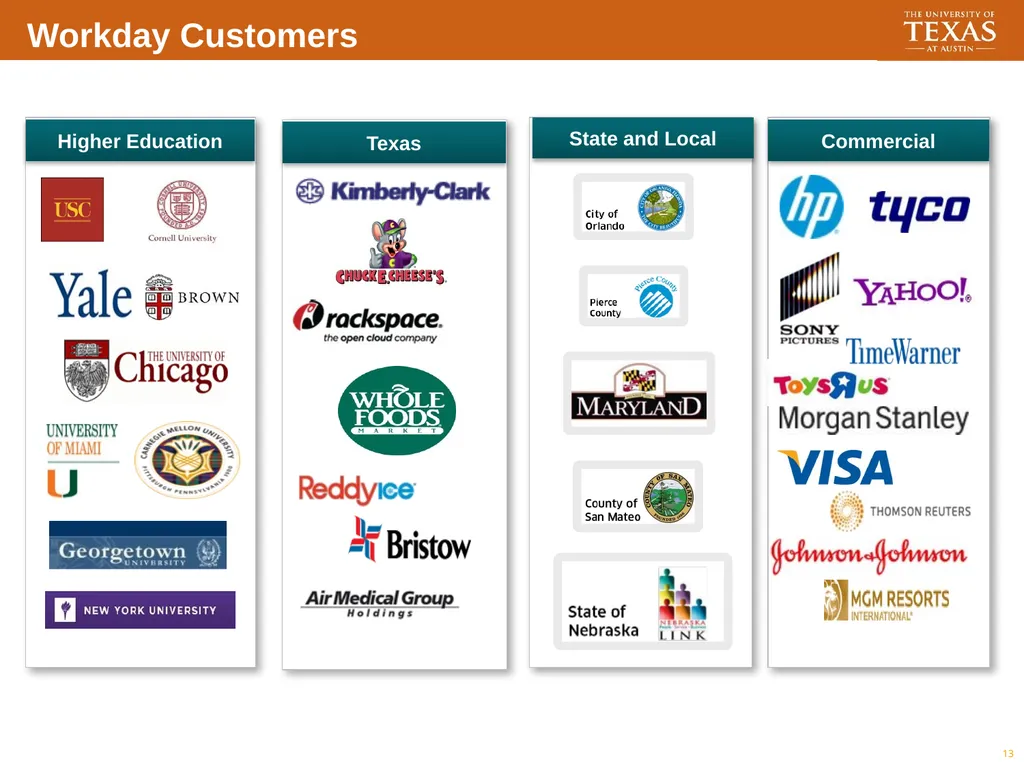
slide13. 13 Workday Customers<br>
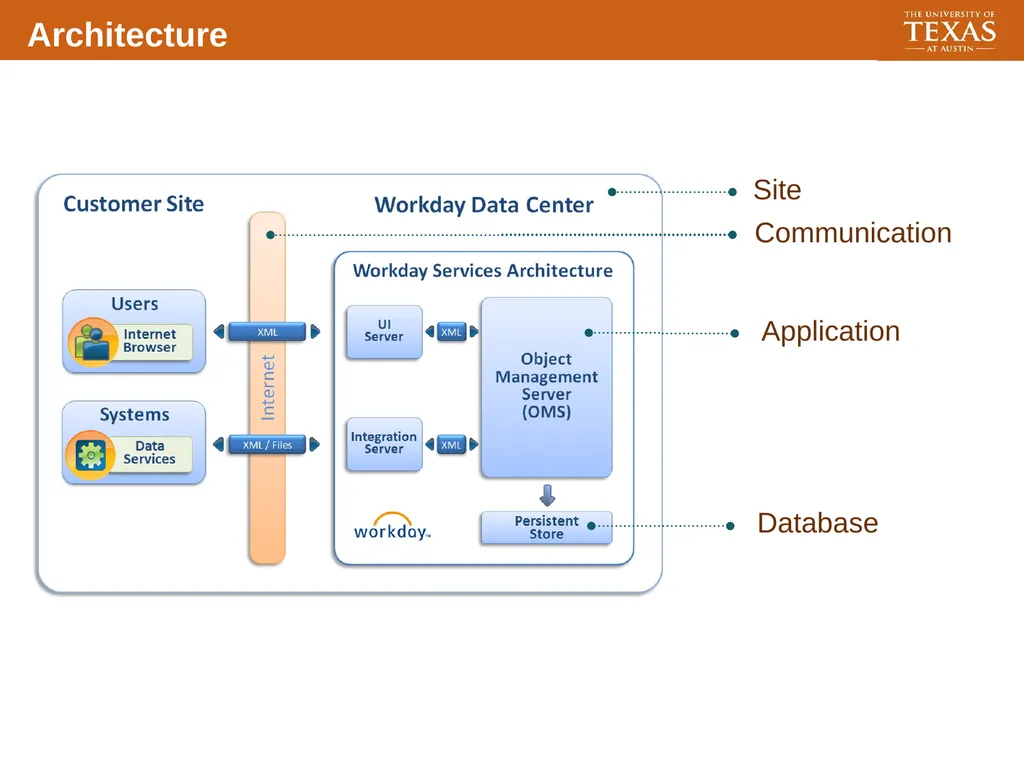
slide14. Architecture<br>
slide15. Audit and Compliance Third-party auditors test Workday processes and controls on a regular basis
ISO 27001
Certified in September 2010
SOC 1 Type II
Audited every 6 months since July 2007
Moved to SSAE-16 from SAS 70 standard in June 2011
SOC 2 Type II
Audited every 6 months since December 2011
Covers Trust Services Principles of Security & Confidentiality<br>
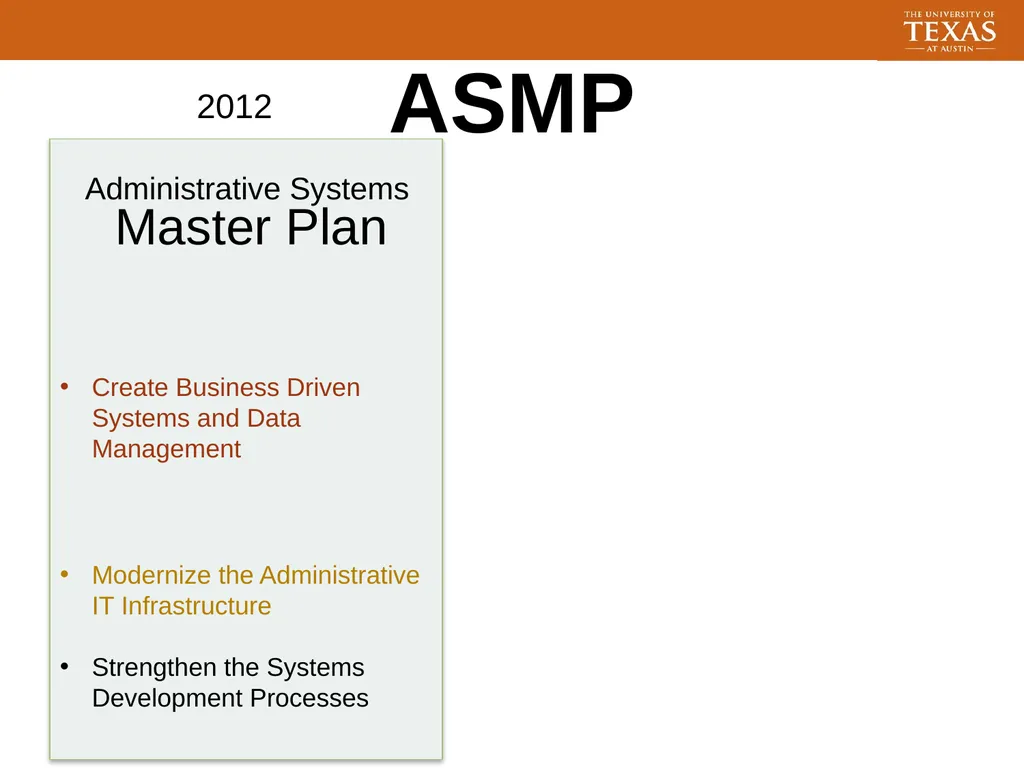
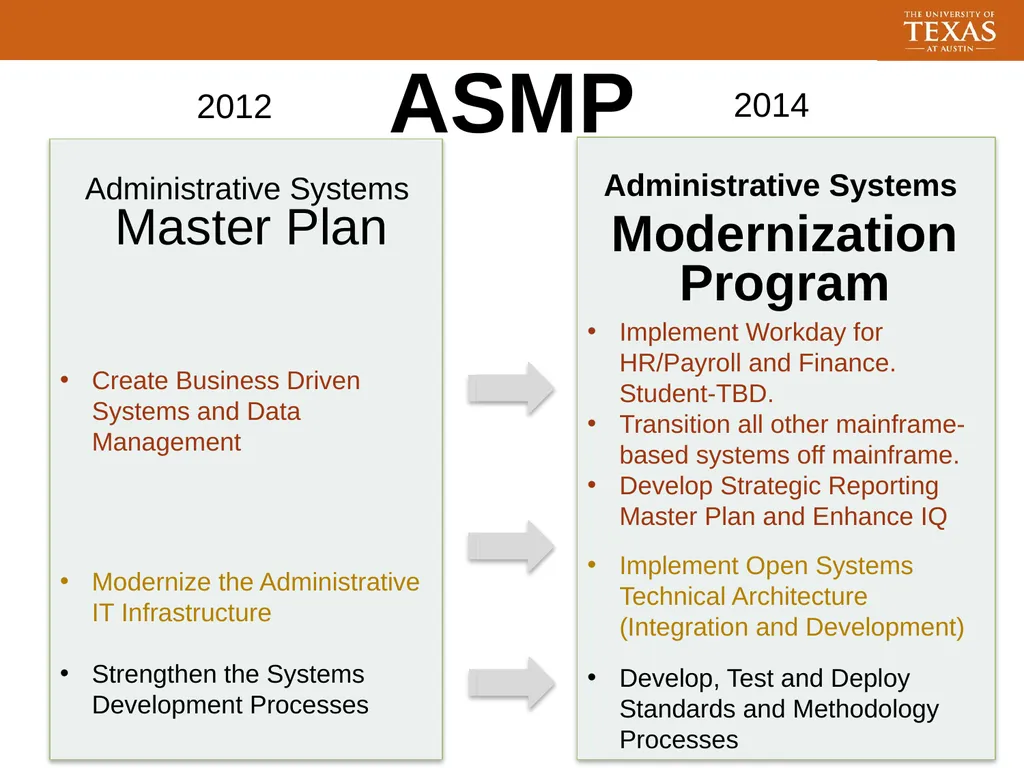
slide16. Create Business Driven Systems and Data Management
Modernize the Administrative IT Infrastructure
Strengthen the Systems Development Processes ASMP Administrative Systems
Master Plan 2012<br>
slide17. Implement Workday for HR/Payroll and Finance. Student-TBD.
Transition all other mainframe-based systems off mainframe.
Develop Strategic Reporting Master Plan and Enhance IQ
Implement Open Systems Technical Architecture (Integration and Development)
Develop, Test and Deploy Standards and Methodology Processes Create Business Driven Systems and Data Management
Modernize the Administrative IT Infrastructure
Strengthen the Systems Development Processes ASMP Administrative Systems
Master Plan Administrative Systems
Modernization Program 2012 2014<br>
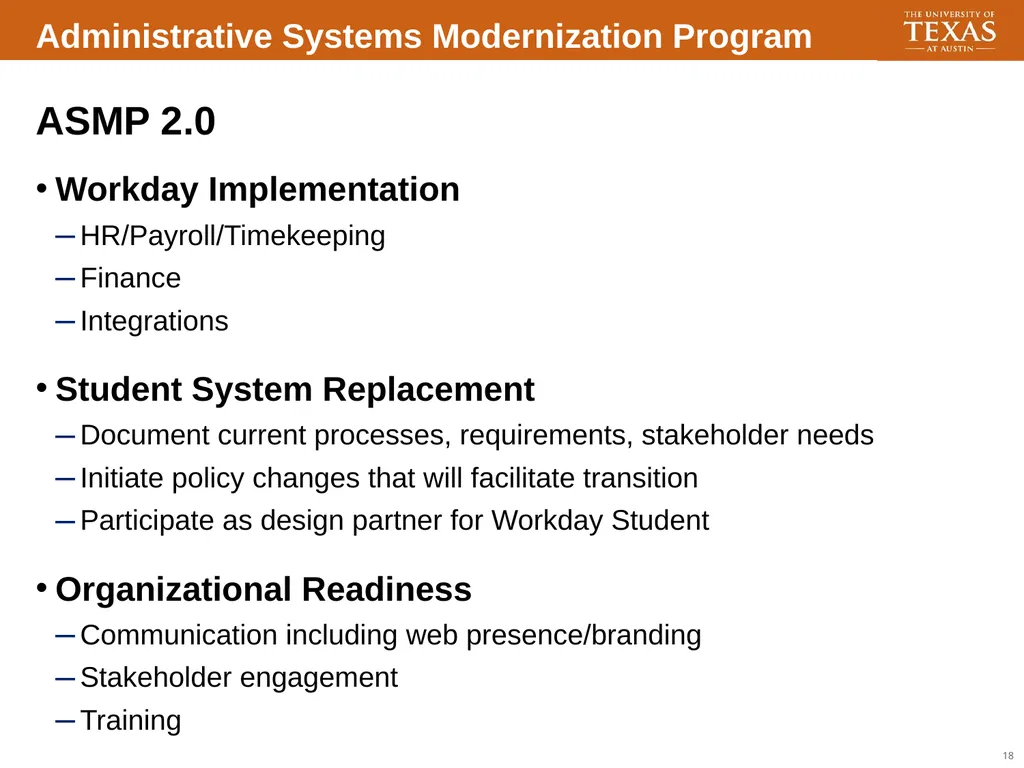
slide18. Workday Implementation
HR/Payroll/Timekeeping
Finance
Integrations
Student System Replacement
Document current processes, requirements, stakeholder needs
Initiate policy changes that will facilitate transition
Participate as design partner for Workday Student
Organizational Readiness
Communication including web presence/branding
Stakeholder engagement
Training 18 Administrative Systems Modernization Program ASMP 2.0<br>
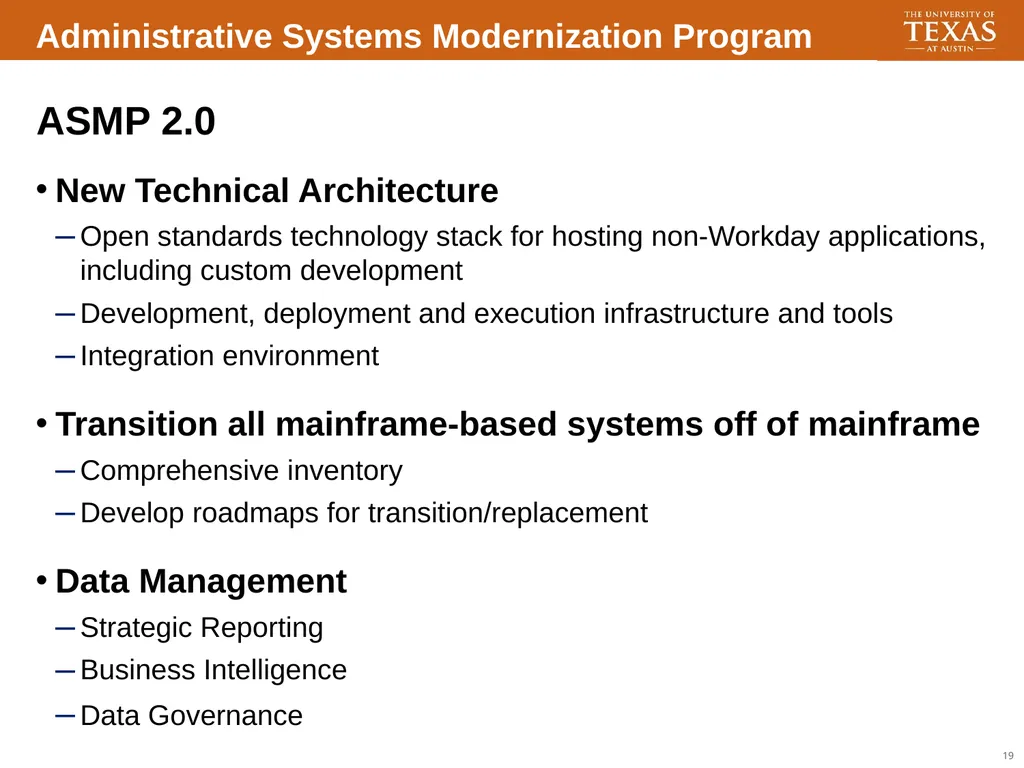
slide19. New Technical Architecture
Open standards technology stack for hosting non-Workday applications, including custom development
Development, deployment and execution infrastructure and tools
Integration environment
Transition all mainframe-based systems off of mainframe
Comprehensive inventory
Develop roadmaps for transition/replacement
Data Management
Strategic Reporting
Business Intelligence
Data Governance 19 Administrative Systems Modernization Program ASMP 2.0<br>
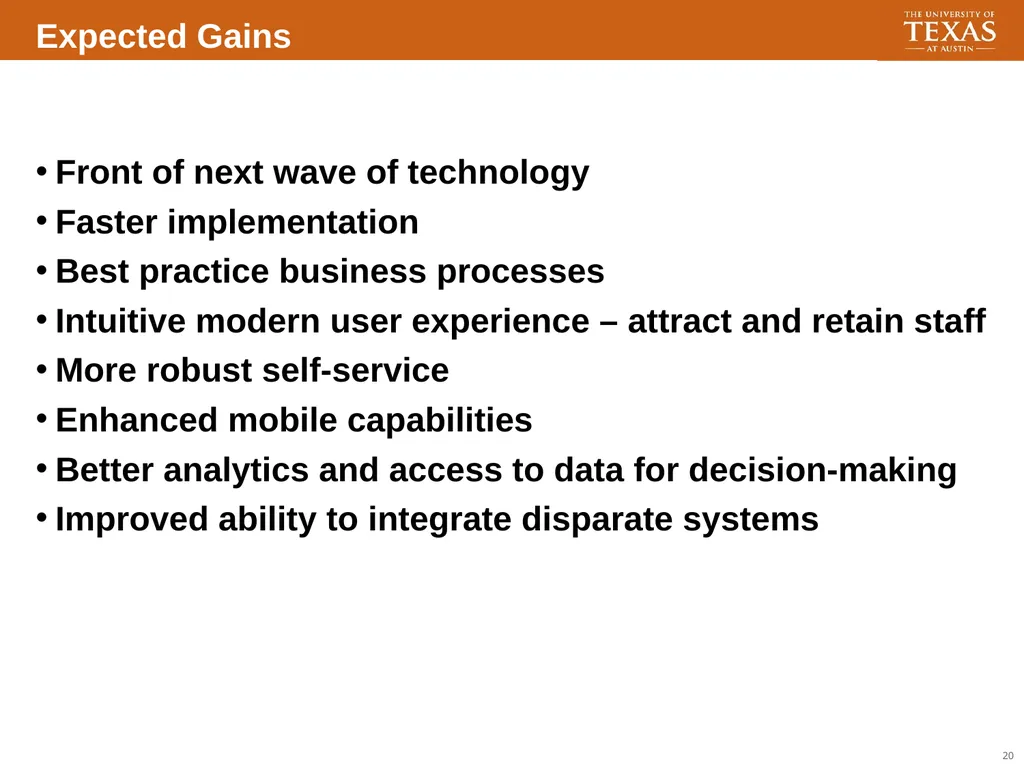
slide20. Front of next wave of technology
Faster implementation
Best practice business processes
Intuitive modern user experience – attract and retain staff
More robust self-service
Enhanced mobile capabilities
Better analytics and access to data for decision-making
Improved ability to integrate disparate systems 20 Expected Gains<br>
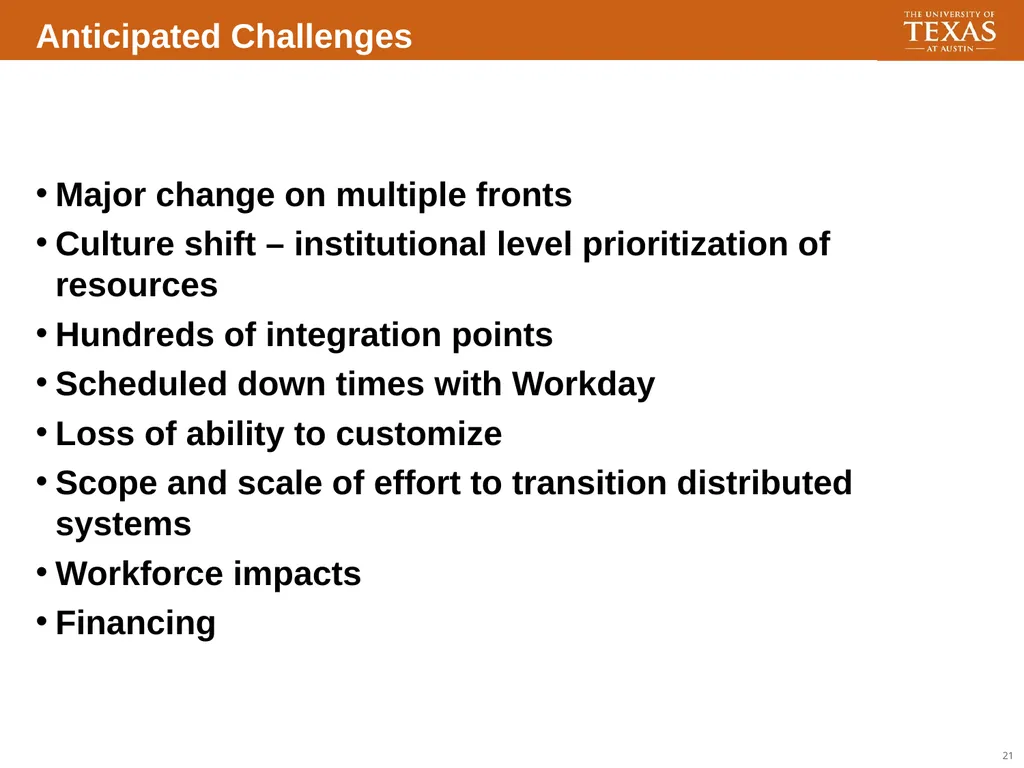
slide21. Major change on multiple fronts
Culture shift – institutional level prioritization of resources
Hundreds of integration points
Scheduled down times with Workday
Loss of ability to customize
Scope and scale of effort to transition distributed systems
Workforce impacts
Financing 21 Anticipated Challenges<br>
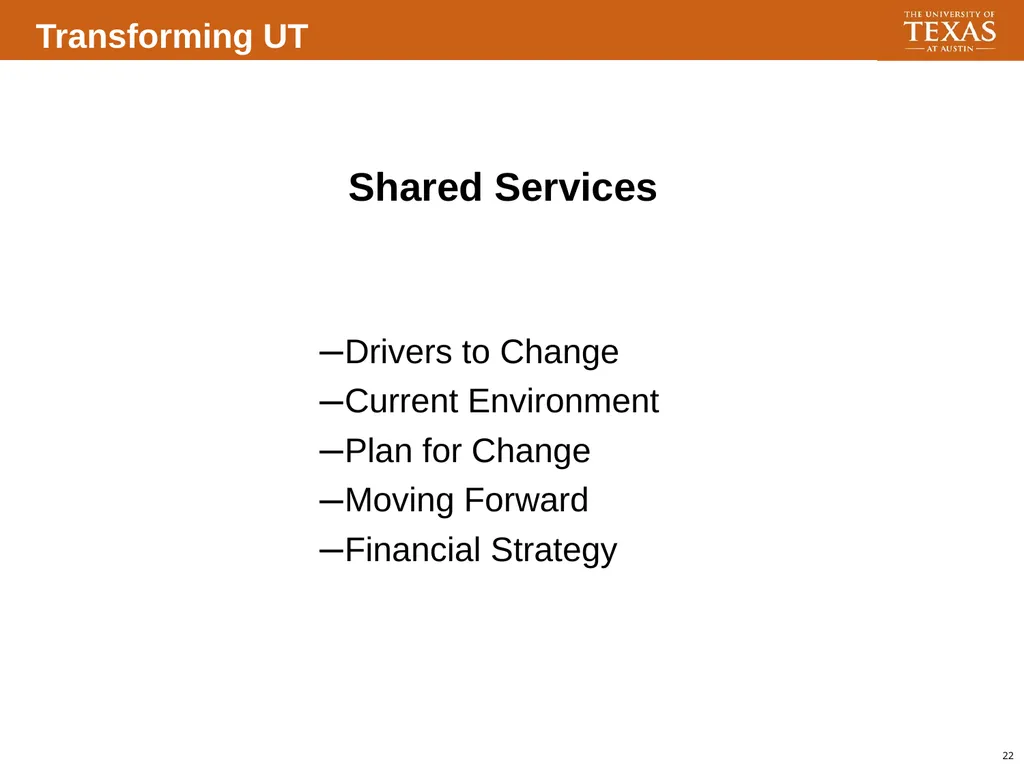
slide22. 22 Transforming UT Drivers to Change
Current Environment
Plan for Change
Moving Forward
Financial Strategy Shared Services<br>
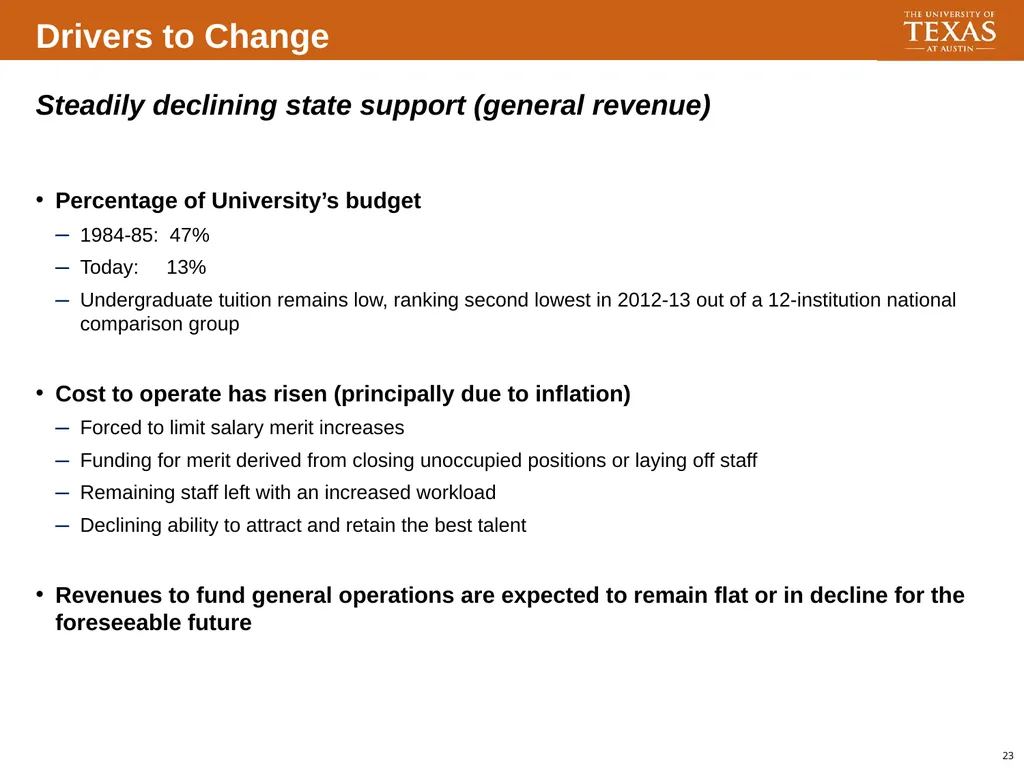
slide23. Percentage of University’s budget
1984-85: 47%
Today: 13%
Undergraduate tuition remains low, ranking second lowest in 2012-13 out of a 12-institution national comparison group
Cost to operate has risen (principally due to inflation)
Forced to limit salary merit increases
Funding for merit derived from closing unoccupied positions or laying off staff
Remaining staff left with an increased workload
Declining ability to attract and retain the best talent
Revenues to fund general operations are expected to remain flat or in decline for the foreseeable future 23 Steadily declining state support (general revenue) Drivers to Change<br>
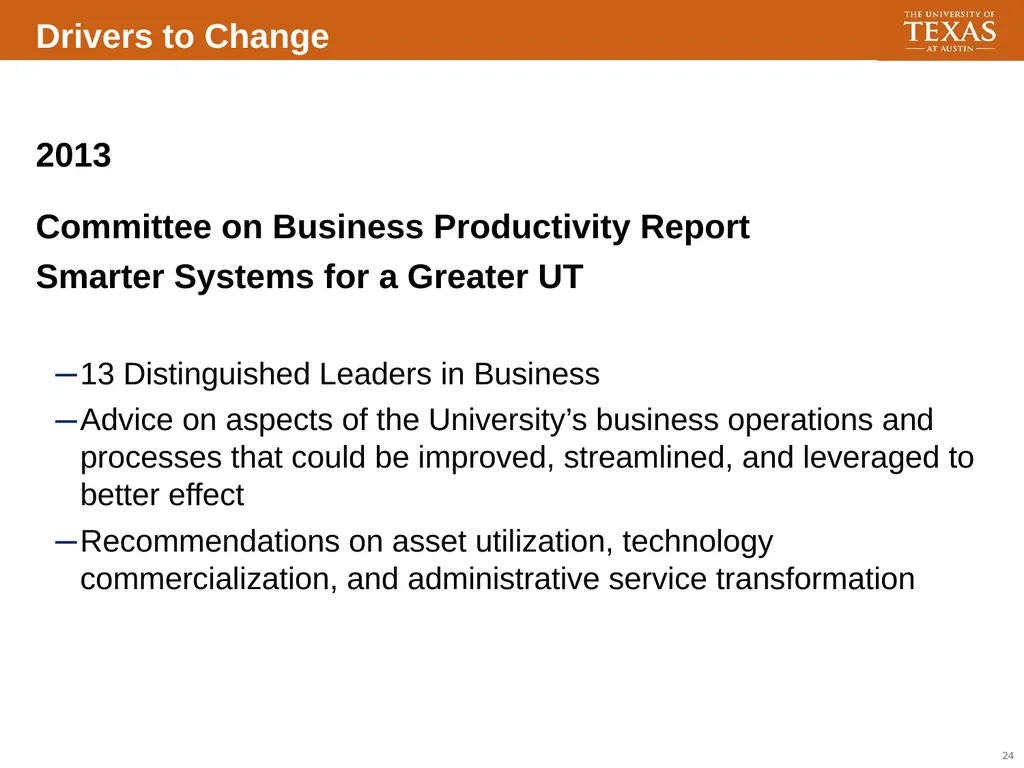
slide24. 2013
Committee on Business Productivity Report
Smarter Systems for a Greater UT
13 Distinguished Leaders in Business
Advice on aspects of the University’s business operations and processes that could be improved, streamlined, and leveraged to better effect
Recommendations on asset utilization, technology commercialization, and administrative service transformation 24 Drivers to Change<br>
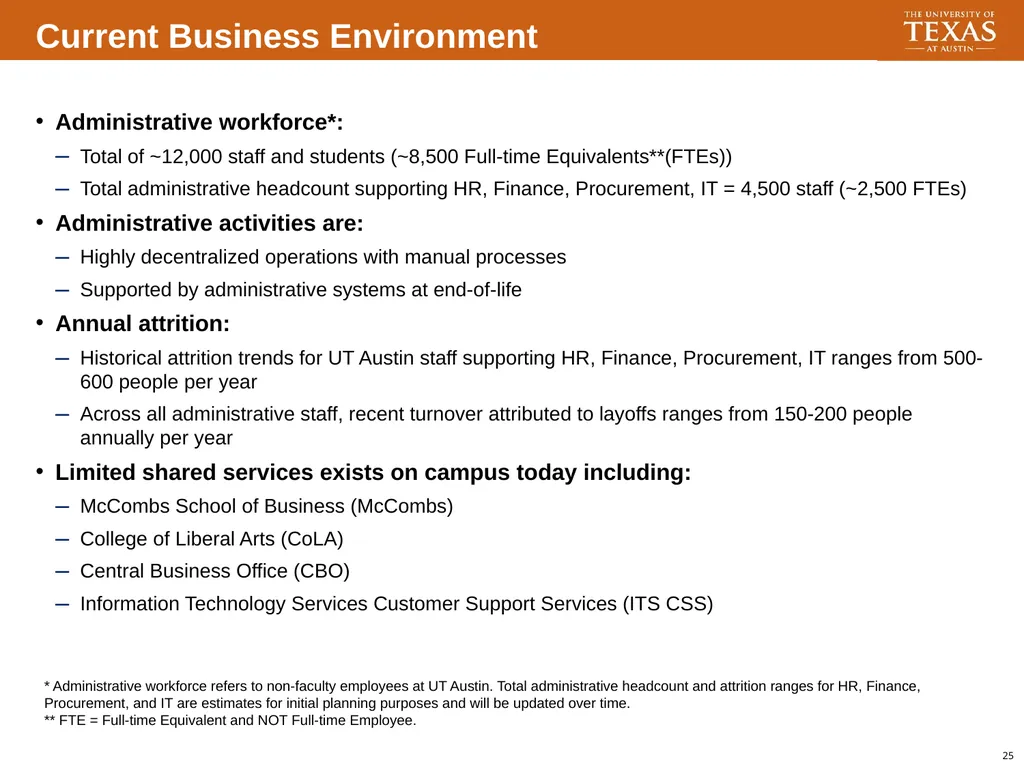
slide25. Administrative workforce*:
Total of ~12,000 staff and students (~8,500 Full-time Equivalents**(FTEs))
Total administrative headcount supporting HR, Finance, Procurement, IT = 4,500 staff (~2,500 FTEs)
Administrative activities are:
Highly decentralized operations with manual processes
Supported by administrative systems at end-of-life
Annual attrition:
Historical attrition trends for UT Austin staff supporting HR, Finance, Procurement, IT ranges from 500-600 people per year
Across all administrative staff, recent turnover attributed to layoffs ranges from 150-200 people annually per year
Limited shared services exists on campus today including:
McCombs School of Business (McCombs)
College of Liberal Arts (CoLA)
Central Business Office (CBO)
Information Technology Services Customer Support Services (ITS CSS) 25 Current Business Environment * Administrative workforce refers to non-faculty employees at UT Austin. Total administrative headcount and attrition ranges for HR, Finance, Procurement, and IT are estimates for initial planning purposes and will be updated over time.
** FTE = Full-time Equivalent and NOT Full-time Employee.<br>
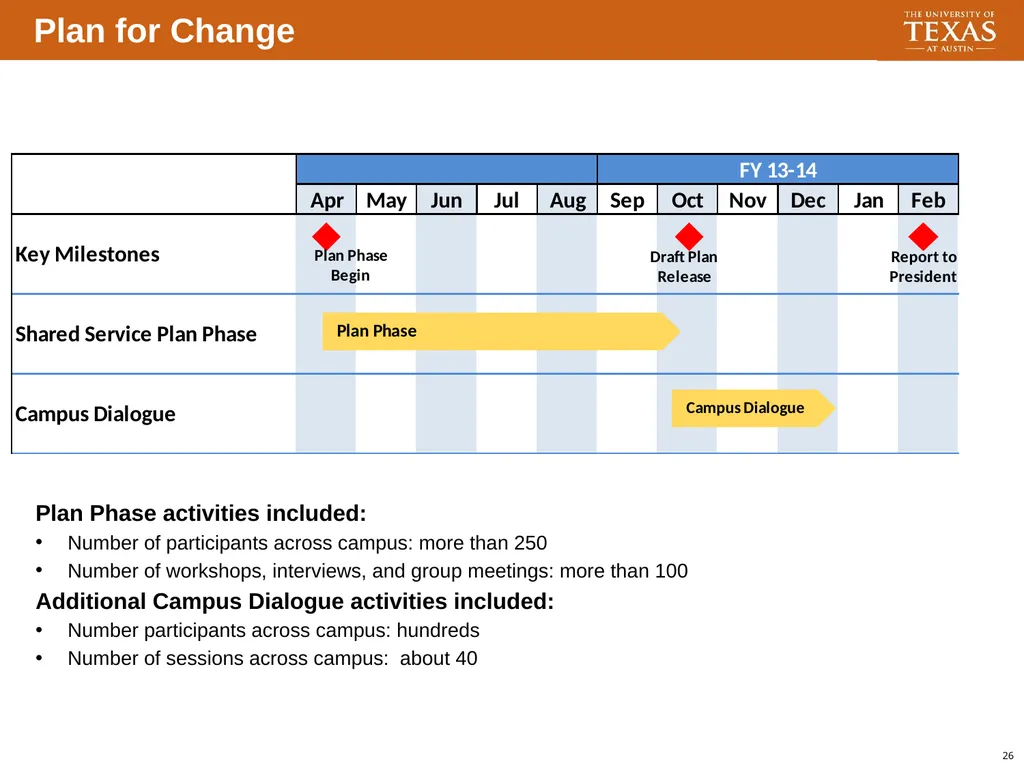
slide26. Plan for Change Plan Phase activities included:
Number of participants across campus: more than 250
Number of workshops, interviews, and group meetings: more than 100
Additional Campus Dialogue activities included:
Number participants across campus: hundreds
Number of sessions across campus: about 40 26<br>
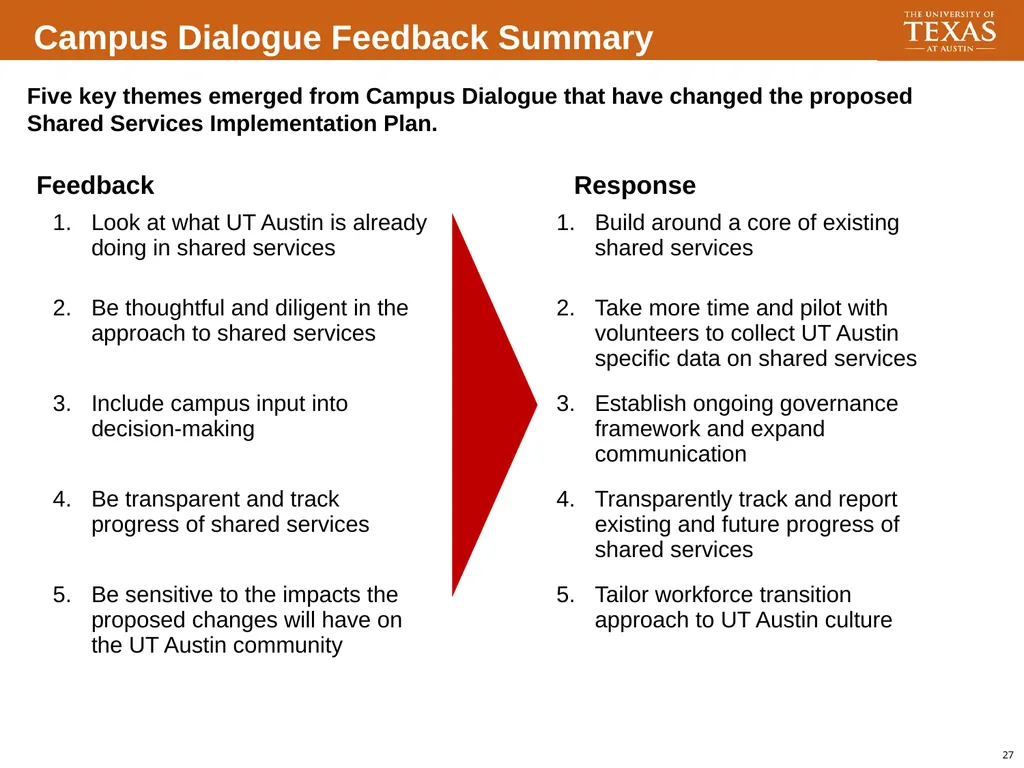
slide27. Campus Dialogue Feedback Summary Five key themes emerged from Campus Dialogue that have changed the proposed Shared Services Implementation Plan. 27 Feedback Response<br>
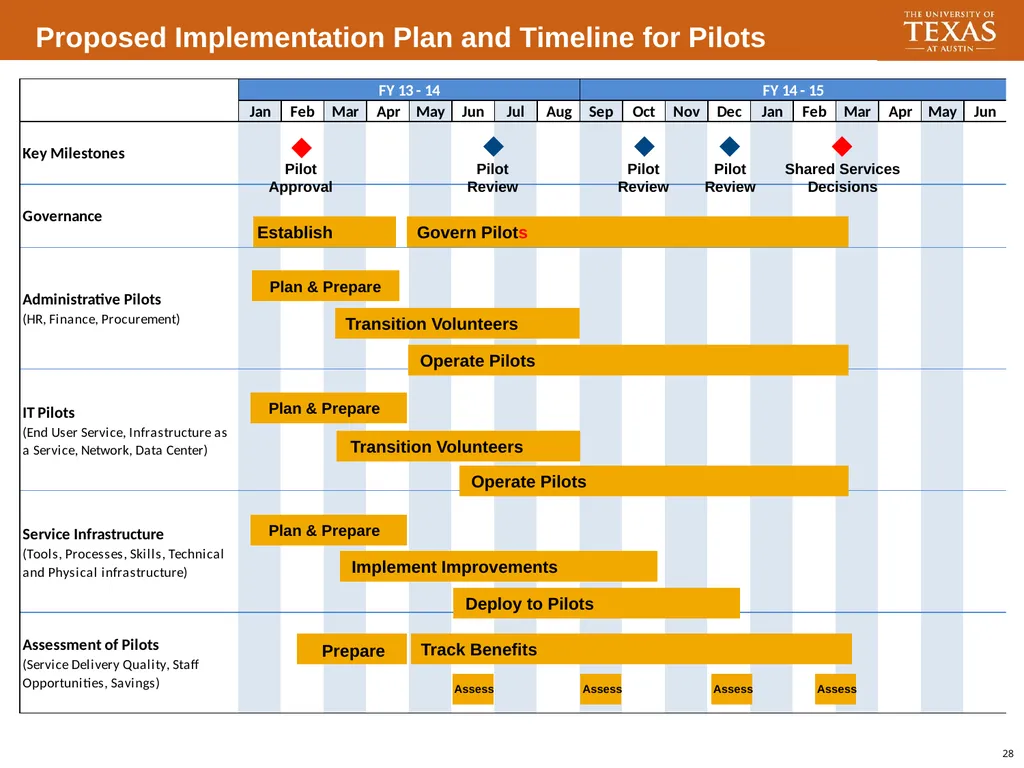
slide28. 28 Proposed Implementation Plan and Timeline for Pilots<br>
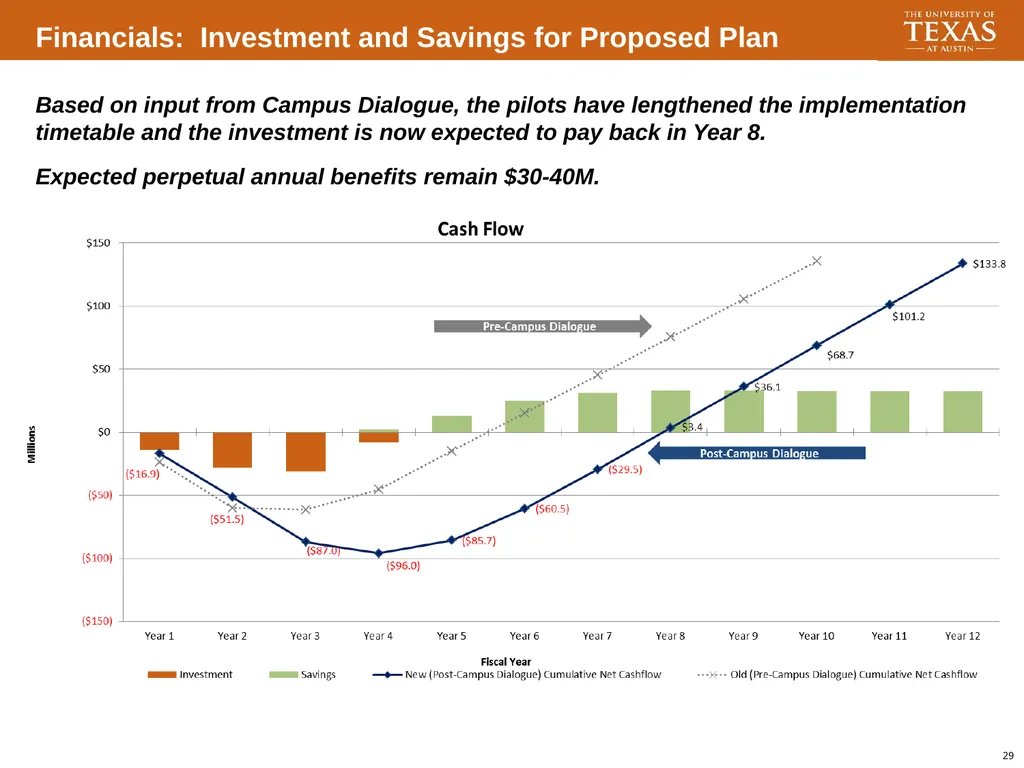
slide29. 29 Based on input from Campus Dialogue, the pilots have lengthened the implementation timetable and the investment is now expected to pay back in Year 8.
Expected perpetual annual benefits remain $30-40M. Financials: Investment and Savings for Proposed Plan<br>
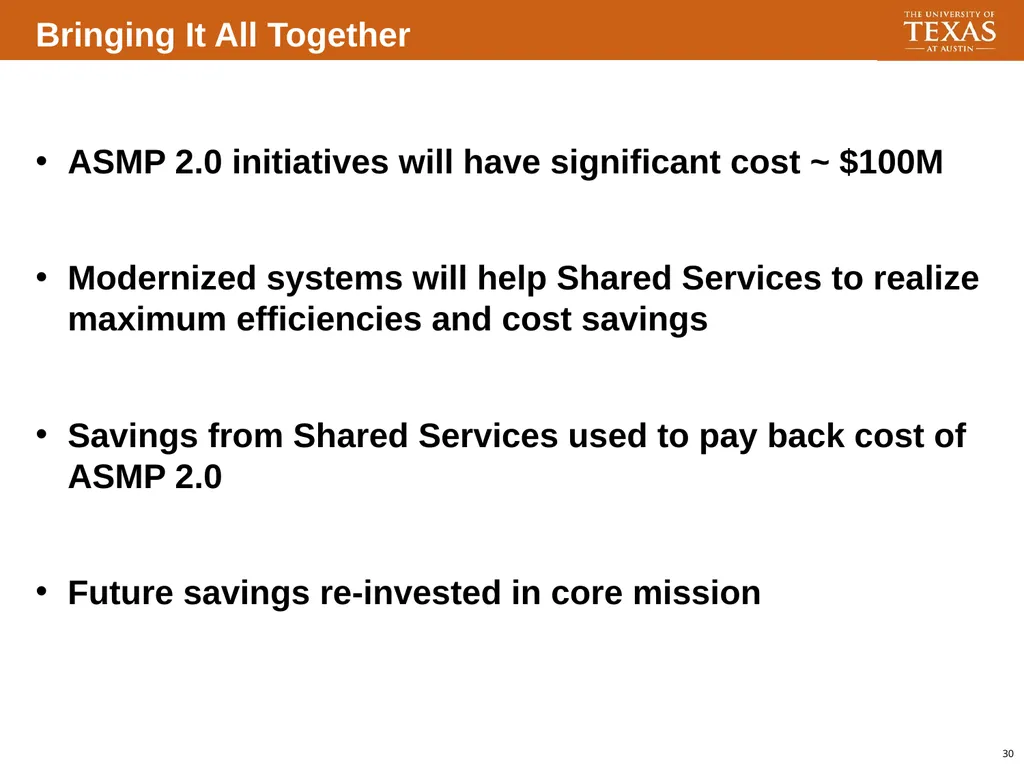
slide30. 30 ASMP 2.0 initiatives will have significant cost ~ $100M
Modernized systems will help Shared Services to realize maximum efficiencies and cost savings
Savings from Shared Services used to pay back cost of ASMP 2.0
Future savings re-invested in core mission Bringing It All Together<br>
slide31. 31 Questions?<br>
Modernization and Business Productivity Initiative TASSCC
March 21, 2014<br>
slide2. 2 Transforming UT Societal and Economic Pressures Facing
Higher Education Today
Affordability
Accessibility
Transparency
Accountability
Innovation
Reduced state support
Protracted Recession<br>
slide3. 3 Transforming UT Administrative Initiatives to Improve Agility and Reduce Costs
Administrative Systems Modernization
Shared Services<br>
slide4. 4 Open and transparent communication
Involvement of key stakeholders
Strong governance
Adoption of best practice business processes
Customization used only where needed for operational or competitive advantage
Opportunities for career development Guiding Principles<br>
slide5. 5 Transforming UT Current Environment
Drivers to Change
Plan for Change
Expected Gains
Anticipated Challenges Administrative Systems Modernization<br>
slide6. Current Technical Environment
25+ years custom developed administrative systems
Mainframe – Adabas/Natural
Upgrades over time to add web capability
Developers embedded in the business area
Well-established developer community and training program
Increasing adoption of third party vendor products for specific business needs
Increasing development using other platforms and languages 6 Administrative Systems Modernization<br>
slide7. 2004 – Commission of 125
2006 – Core Application Strategy for the Enterprise (CASE)
2009 – Strategic IT Accountability Board (SITAB) Report
2012 – Administrative Systems Master Plan (ASMP) 7 Drivers to Change<br>
slide8. Case for Change
Desire to take advantage of technological advancements
Mitigate risks of relying on aging technology toolset (Adabas/Natural are reaching end of life)
Integration with third party open standard systems is very difficult and expensive in the current environment
Up-to-date standards and best practices are difficult with current toolset
Difficulty attracting and retaining workforce 8 Administrative Systems Master Plan (ASMP)<br>
slide9. Create business driven systems and data management
Modernize the administrative IT infrastructure
Strengthen systems development processes 9 ASMP Requirements<br>
slide10. What will it take to re-tool and re-train workforce?
What is an appropriate strategy for customization?
What does the market currently offer? 10 Buy vs Build Considerations<br>
slide11. Technology Waves – Administrative Systems IA, MSA, Integral, Tesseract Software 2000, SSA SAP, Oracle, PeopleSoft, SunGard Salesforce, Workday, Google Mainframe Client Server Mini Cloud/SaaS<br>
slide12. Workday, Inc. (NYSE symbol: WDAY) 12 Established in 2005 by PeopleSoft founders Dave Duffield and Aneel Bhusri.
Mobile first, consumer-based design methodology with single code line.
Committed to serving the higher education ERP market.
Human resource, payroll and finance applications are fairly mature. Presently building student system designed to interact with today’s students (e.g. social media, mobility). UT Austin is participating as a strategic design partner.<br>
slide13. 13 Workday Customers<br>
slide14. Architecture<br>
slide15. Audit and Compliance Third-party auditors test Workday processes and controls on a regular basis
ISO 27001
Certified in September 2010
SOC 1 Type II
Audited every 6 months since July 2007
Moved to SSAE-16 from SAS 70 standard in June 2011
SOC 2 Type II
Audited every 6 months since December 2011
Covers Trust Services Principles of Security & Confidentiality<br>
slide16. Create Business Driven Systems and Data Management
Modernize the Administrative IT Infrastructure
Strengthen the Systems Development Processes ASMP Administrative Systems
Master Plan 2012<br>
slide17. Implement Workday for HR/Payroll and Finance. Student-TBD.
Transition all other mainframe-based systems off mainframe.
Develop Strategic Reporting Master Plan and Enhance IQ
Implement Open Systems Technical Architecture (Integration and Development)
Develop, Test and Deploy Standards and Methodology Processes Create Business Driven Systems and Data Management
Modernize the Administrative IT Infrastructure
Strengthen the Systems Development Processes ASMP Administrative Systems
Master Plan Administrative Systems
Modernization Program 2012 2014<br>
slide18. Workday Implementation
HR/Payroll/Timekeeping
Finance
Integrations
Student System Replacement
Document current processes, requirements, stakeholder needs
Initiate policy changes that will facilitate transition
Participate as design partner for Workday Student
Organizational Readiness
Communication including web presence/branding
Stakeholder engagement
Training 18 Administrative Systems Modernization Program ASMP 2.0<br>
slide19. New Technical Architecture
Open standards technology stack for hosting non-Workday applications, including custom development
Development, deployment and execution infrastructure and tools
Integration environment
Transition all mainframe-based systems off of mainframe
Comprehensive inventory
Develop roadmaps for transition/replacement
Data Management
Strategic Reporting
Business Intelligence
Data Governance 19 Administrative Systems Modernization Program ASMP 2.0<br>
slide20. Front of next wave of technology
Faster implementation
Best practice business processes
Intuitive modern user experience – attract and retain staff
More robust self-service
Enhanced mobile capabilities
Better analytics and access to data for decision-making
Improved ability to integrate disparate systems 20 Expected Gains<br>
slide21. Major change on multiple fronts
Culture shift – institutional level prioritization of resources
Hundreds of integration points
Scheduled down times with Workday
Loss of ability to customize
Scope and scale of effort to transition distributed systems
Workforce impacts
Financing 21 Anticipated Challenges<br>
slide22. 22 Transforming UT Drivers to Change
Current Environment
Plan for Change
Moving Forward
Financial Strategy Shared Services<br>
slide23. Percentage of University’s budget
1984-85: 47%
Today: 13%
Undergraduate tuition remains low, ranking second lowest in 2012-13 out of a 12-institution national comparison group
Cost to operate has risen (principally due to inflation)
Forced to limit salary merit increases
Funding for merit derived from closing unoccupied positions or laying off staff
Remaining staff left with an increased workload
Declining ability to attract and retain the best talent
Revenues to fund general operations are expected to remain flat or in decline for the foreseeable future 23 Steadily declining state support (general revenue) Drivers to Change<br>
slide24. 2013
Committee on Business Productivity Report
Smarter Systems for a Greater UT
13 Distinguished Leaders in Business
Advice on aspects of the University’s business operations and processes that could be improved, streamlined, and leveraged to better effect
Recommendations on asset utilization, technology commercialization, and administrative service transformation 24 Drivers to Change<br>
slide25. Administrative workforce*:
Total of ~12,000 staff and students (~8,500 Full-time Equivalents**(FTEs))
Total administrative headcount supporting HR, Finance, Procurement, IT = 4,500 staff (~2,500 FTEs)
Administrative activities are:
Highly decentralized operations with manual processes
Supported by administrative systems at end-of-life
Annual attrition:
Historical attrition trends for UT Austin staff supporting HR, Finance, Procurement, IT ranges from 500-600 people per year
Across all administrative staff, recent turnover attributed to layoffs ranges from 150-200 people annually per year
Limited shared services exists on campus today including:
McCombs School of Business (McCombs)
College of Liberal Arts (CoLA)
Central Business Office (CBO)
Information Technology Services Customer Support Services (ITS CSS) 25 Current Business Environment * Administrative workforce refers to non-faculty employees at UT Austin. Total administrative headcount and attrition ranges for HR, Finance, Procurement, and IT are estimates for initial planning purposes and will be updated over time.
** FTE = Full-time Equivalent and NOT Full-time Employee.<br>
slide26. Plan for Change Plan Phase activities included:
Number of participants across campus: more than 250
Number of workshops, interviews, and group meetings: more than 100
Additional Campus Dialogue activities included:
Number participants across campus: hundreds
Number of sessions across campus: about 40 26<br>
slide27. Campus Dialogue Feedback Summary Five key themes emerged from Campus Dialogue that have changed the proposed Shared Services Implementation Plan. 27 Feedback Response<br>
slide28. 28 Proposed Implementation Plan and Timeline for Pilots<br>
slide29. 29 Based on input from Campus Dialogue, the pilots have lengthened the implementation timetable and the investment is now expected to pay back in Year 8.
Expected perpetual annual benefits remain $30-40M. Financials: Investment and Savings for Proposed Plan<br>
slide30. 30 ASMP 2.0 initiatives will have significant cost ~ $100M
Modernized systems will help Shared Services to realize maximum efficiencies and cost savings
Savings from Shared Services used to pay back cost of ASMP 2.0
Future savings re-invested in core mission Bringing It All Together<br>
slide31. 31 Questions?<br>