
Transportation Services Division/SCFA Mission: To
AS
Published · 20 slides · 0 views

1 / 1
Description
Transportation Services DivisionSCFA Mission: To help our customers get to their destination on-time and cost-effectively with safe, dependable transportation. Services Provided: Short-Term and Long-Term Passenger Vehicle Leases Vehicle
Related Topics
Share
Embed code
Download this presentation From Below
"Transportation Services Division/SCFA Mission: To" is the property of its rightful owner. Permission is granted to download and print the materials on this website for personal, non-commercial use only, and to display it on your personal computer provided you do not modify the materials and that you retain all copyright notices contained in the materials. By downloading content from our website, you accept the terms of this agreement.
Presentation Transcript
01
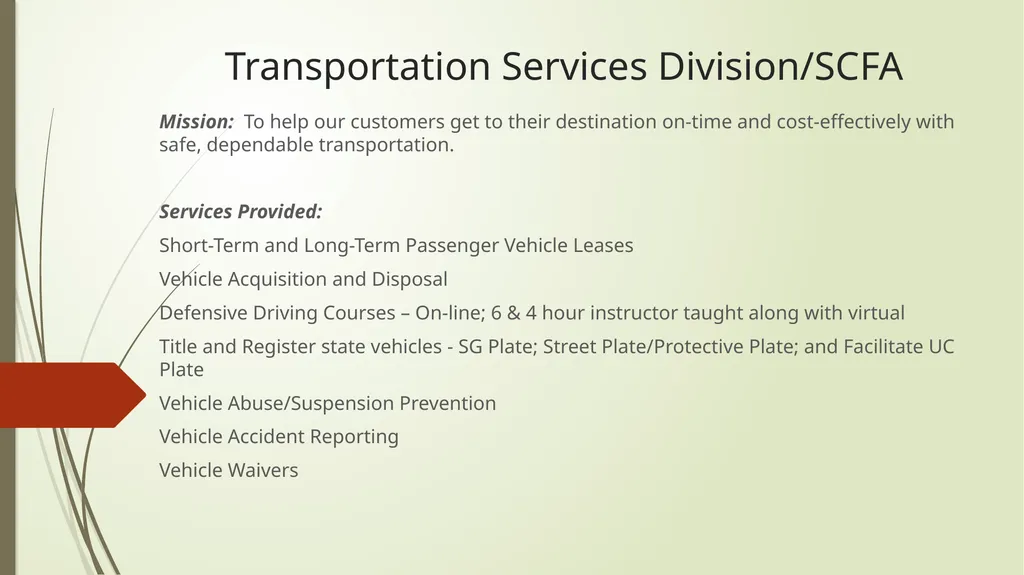
Transportation Services Division/SCFA Mission: To help our customers get to their destination on-time and cost-effectively with safe, dependable transportation.
Services Provided:
Short-Term and Long-Term Passenger Vehicle Leases
Vehicle Acquisition and Disposal
Defensive Driving Courses – On-line; 6 & 4 hour instructor taught along with virtual
Title and Register state vehicles - SG Plate; Street Plate/Protective Plate; and Facilitate UC Plate
Vehicle Abuse/Suspension Prevention
Vehicle Accident Reporting
Vehicle Waivers<br>
Services Provided:
Short-Term and Long-Term Passenger Vehicle Leases
Vehicle Acquisition and Disposal
Defensive Driving Courses – On-line; 6 & 4 hour instructor taught along with virtual
Title and Register state vehicles - SG Plate; Street Plate/Protective Plate; and Facilitate UC Plate
Vehicle Abuse/Suspension Prevention
Vehicle Accident Reporting
Vehicle Waivers<br>
02
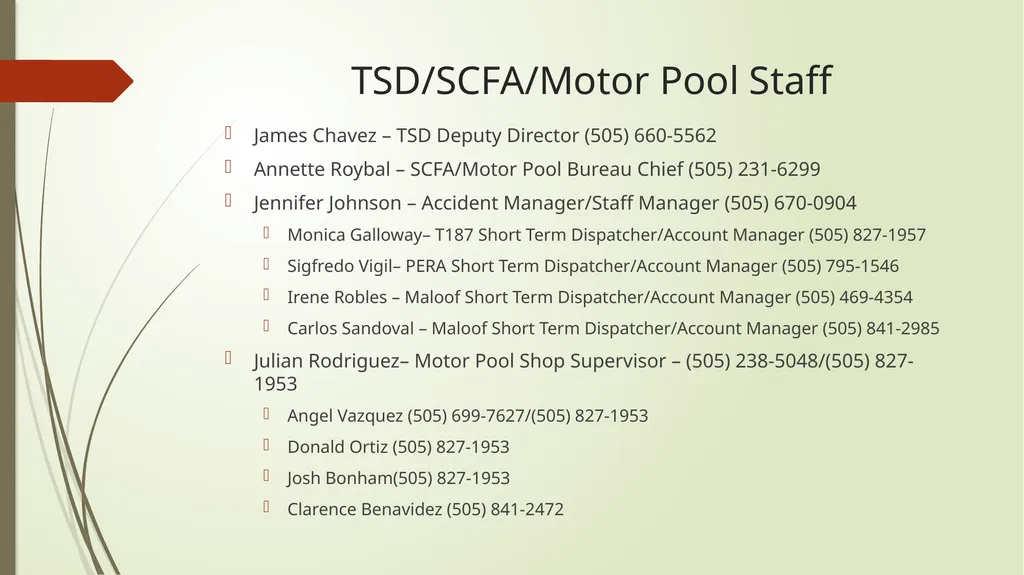
TSD/SCFA/Motor Pool Staff James Chavez – TSD Deputy Director (505) 660-5562
Annette Roybal – SCFA/Motor Pool Bureau Chief (505) 231-6299
Jennifer Johnson – Accident Manager/Staff Manager (505) 670-0904
Monica Galloway– T187 Short Term Dispatcher/Account Manager (505) 827-1957
Sigfredo Vigil– PERA Short Term Dispatcher/Account Manager (505) 795-1546
Irene Robles – Maloof Short Term Dispatcher/Account Manager (505) 469-4354
Carlos Sandoval – Maloof Short Term Dispatcher/Account Manager (505) 841-2985
Julian Rodriguez– Motor Pool Shop Supervisor – (505) 238-5048/(505) 827-1953
Angel Vazquez (505) 699-7627/(505) 827-1953
Donald Ortiz (505) 827-1953
Josh Bonham(505) 827-1953
Clarence Benavidez (505) 841-2472<br>
Annette Roybal – SCFA/Motor Pool Bureau Chief (505) 231-6299
Jennifer Johnson – Accident Manager/Staff Manager (505) 670-0904
Monica Galloway– T187 Short Term Dispatcher/Account Manager (505) 827-1957
Sigfredo Vigil– PERA Short Term Dispatcher/Account Manager (505) 795-1546
Irene Robles – Maloof Short Term Dispatcher/Account Manager (505) 469-4354
Carlos Sandoval – Maloof Short Term Dispatcher/Account Manager (505) 841-2985
Julian Rodriguez– Motor Pool Shop Supervisor – (505) 238-5048/(505) 827-1953
Angel Vazquez (505) 699-7627/(505) 827-1953
Donald Ortiz (505) 827-1953
Josh Bonham(505) 827-1953
Clarence Benavidez (505) 841-2472<br>
03
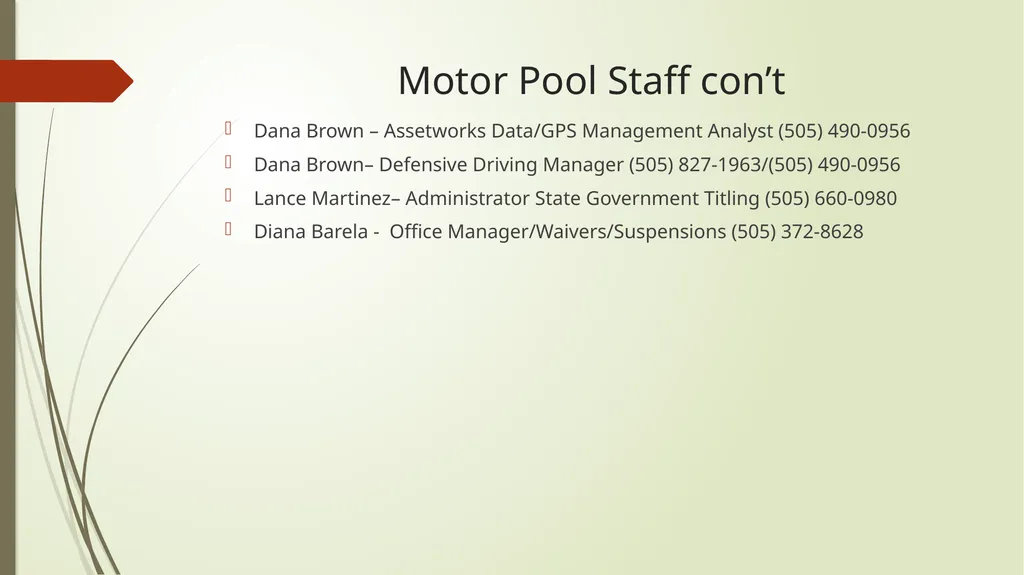
Motor Pool Staff con’t Dana Brown – Assetworks Data/GPS Management Analyst (505) 490-0956
Dana Brown– Defensive Driving Manager (505) 827-1963/(505) 490-0956
Lance Martinez– Administrator State Government Titling (505) 660-0980
Diana Barela - Office Manager/Waivers/Suspensions (505) 372-8628<br>
Dana Brown– Defensive Driving Manager (505) 827-1963/(505) 490-0956
Lance Martinez– Administrator State Government Titling (505) 660-0980
Diana Barela - Office Manager/Waivers/Suspensions (505) 372-8628<br>
04
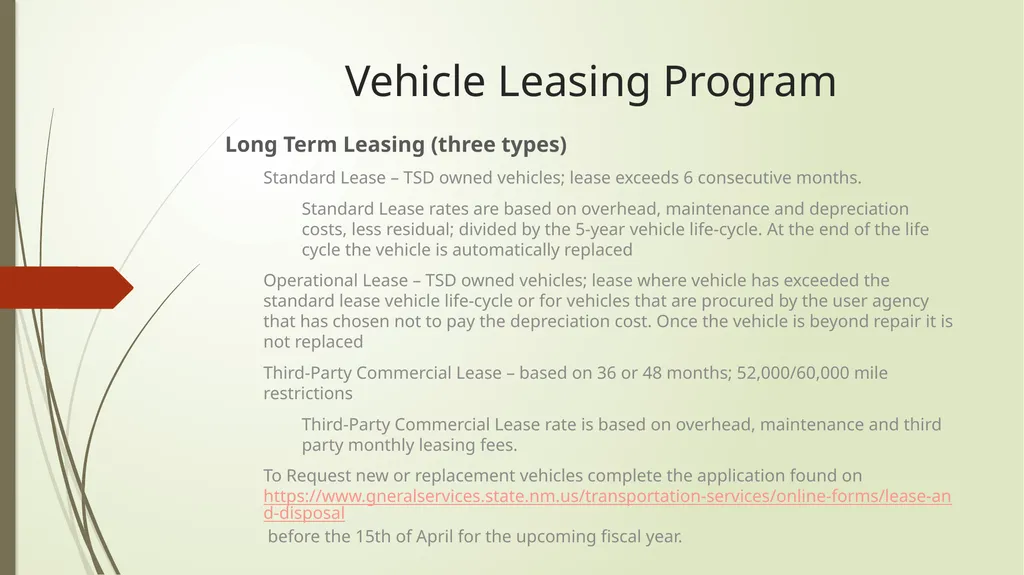
Vehicle Leasing Program Long Term Leasing (three types)
Standard Lease – TSD owned vehicles; lease exceeds 6 consecutive months.
Standard Lease rates are based on overhead, maintenance and depreciation costs, less residual; divided by the 5-year vehicle life-cycle. At the end of the life cycle the vehicle is automatically replaced
Operational Lease – TSD owned vehicles; lease where vehicle has exceeded the standard lease vehicle life-cycle or for vehicles that are procured by the user agency that has chosen not to pay the depreciation cost. Once the vehicle is beyond repair it is not replaced
Third-Party Commercial Lease – based on 36 or 48 months; 52,000/60,000 mile restrictions
Third-Party Commercial Lease rate is based on overhead, maintenance and third party monthly leasing fees.
To Request new or replacement vehicles complete the application found on https://www.gneralservices.state.nm.us/transportation-services/online-forms/lease-and-disposal before the 15th of April for the upcoming fiscal year.<br>
Standard Lease – TSD owned vehicles; lease exceeds 6 consecutive months.
Standard Lease rates are based on overhead, maintenance and depreciation costs, less residual; divided by the 5-year vehicle life-cycle. At the end of the life cycle the vehicle is automatically replaced
Operational Lease – TSD owned vehicles; lease where vehicle has exceeded the standard lease vehicle life-cycle or for vehicles that are procured by the user agency that has chosen not to pay the depreciation cost. Once the vehicle is beyond repair it is not replaced
Third-Party Commercial Lease – based on 36 or 48 months; 52,000/60,000 mile restrictions
Third-Party Commercial Lease rate is based on overhead, maintenance and third party monthly leasing fees.
To Request new or replacement vehicles complete the application found on https://www.gneralservices.state.nm.us/transportation-services/online-forms/lease-and-disposal before the 15th of April for the upcoming fiscal year.<br>
05
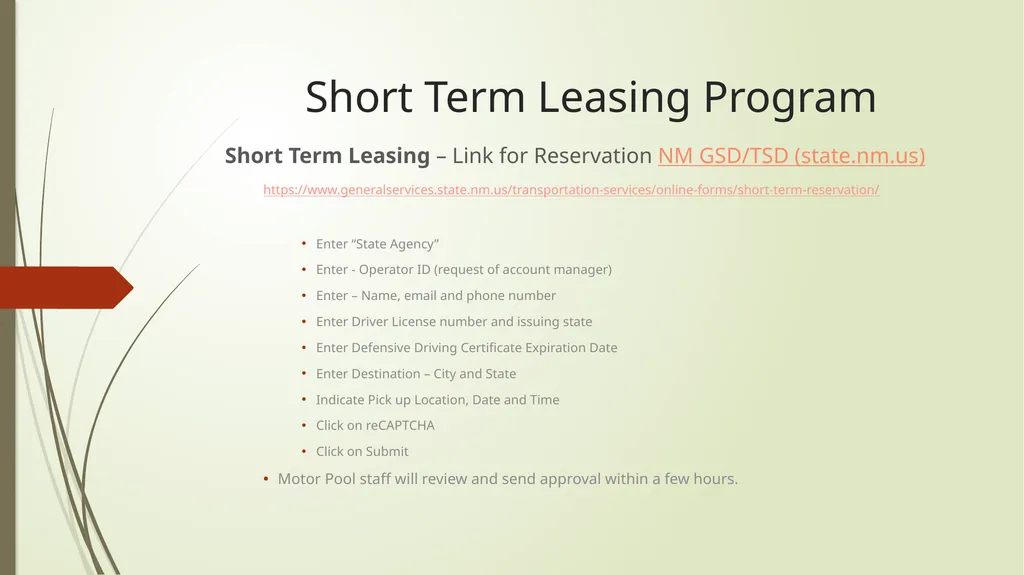
Short Term Leasing Program Short Term Leasing – Link for Reservation NM GSD/TSD (state.nm.us)
https://www.generalservices.state.nm.us/transportation-services/online-forms/short-term-reservation/
Enter “State Agency”
Enter - Operator ID (request of account manager)
Enter – Name, email and phone number
Enter Driver License number and issuing state
Enter Defensive Driving Certificate Expiration Date
Enter Destination – City and State
Indicate Pick up Location, Date and Time
Click on reCAPTCHA
Click on Submit
Motor Pool staff will review and send approval within a few hours.<br>
https://www.generalservices.state.nm.us/transportation-services/online-forms/short-term-reservation/
Enter “State Agency”
Enter - Operator ID (request of account manager)
Enter – Name, email and phone number
Enter Driver License number and issuing state
Enter Defensive Driving Certificate Expiration Date
Enter Destination – City and State
Indicate Pick up Location, Date and Time
Click on reCAPTCHA
Click on Submit
Motor Pool staff will review and send approval within a few hours.<br>
06
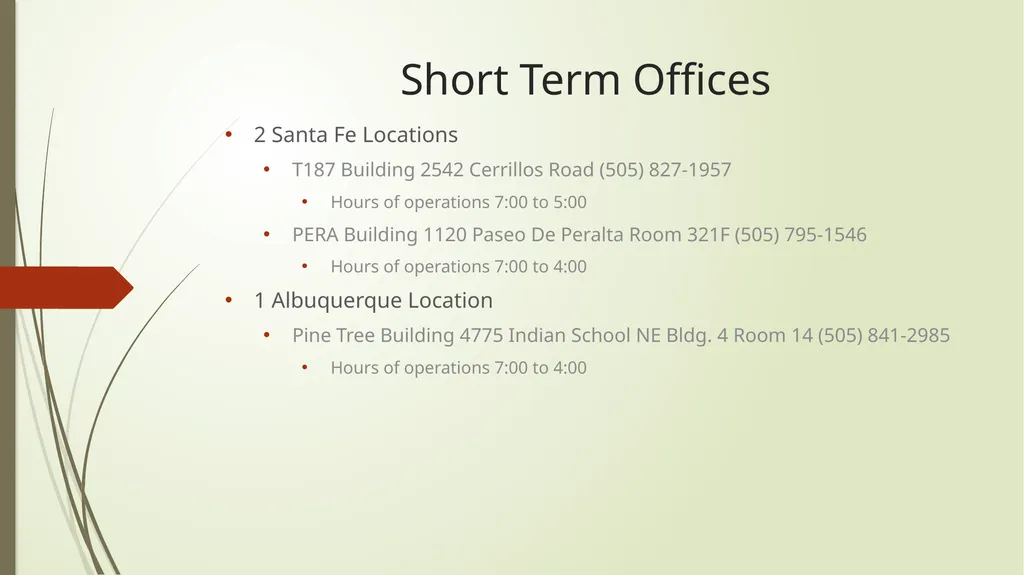
Short Term Offices 2 Santa Fe Locations
T187 Building 2542 Cerrillos Road (505) 827-1957
Hours of operations 7:00 to 5:00
PERA Building 1120 Paseo De Peralta Room 321F (505) 795-1546
Hours of operations 7:00 to 4:00
1 Albuquerque Location
Pine Tree Building 4775 Indian School NE Bldg. 4 Room 14 (505) 841-2985
Hours of operations 7:00 to 4:00<br>
T187 Building 2542 Cerrillos Road (505) 827-1957
Hours of operations 7:00 to 5:00
PERA Building 1120 Paseo De Peralta Room 321F (505) 795-1546
Hours of operations 7:00 to 4:00
1 Albuquerque Location
Pine Tree Building 4775 Indian School NE Bldg. 4 Room 14 (505) 841-2985
Hours of operations 7:00 to 4:00<br>
07
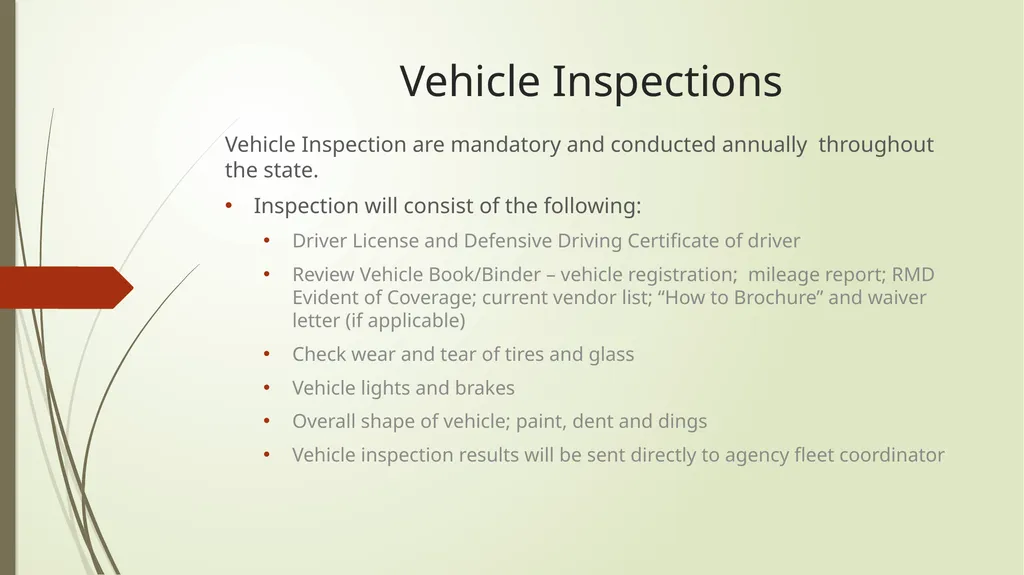
Vehicle Inspections Vehicle Inspection are mandatory and conducted annually throughout the state.
Inspection will consist of the following:
Driver License and Defensive Driving Certificate of driver
Review Vehicle Book/Binder – vehicle registration; mileage report; RMD Evident of Coverage; current vendor list; “How to Brochure” and waiver letter (if applicable)
Check wear and tear of tires and glass
Vehicle lights and brakes
Overall shape of vehicle; paint, dent and dings
Vehicle inspection results will be sent directly to agency fleet coordinator<br>
Inspection will consist of the following:
Driver License and Defensive Driving Certificate of driver
Review Vehicle Book/Binder – vehicle registration; mileage report; RMD Evident of Coverage; current vendor list; “How to Brochure” and waiver letter (if applicable)
Check wear and tear of tires and glass
Vehicle lights and brakes
Overall shape of vehicle; paint, dent and dings
Vehicle inspection results will be sent directly to agency fleet coordinator<br>
08
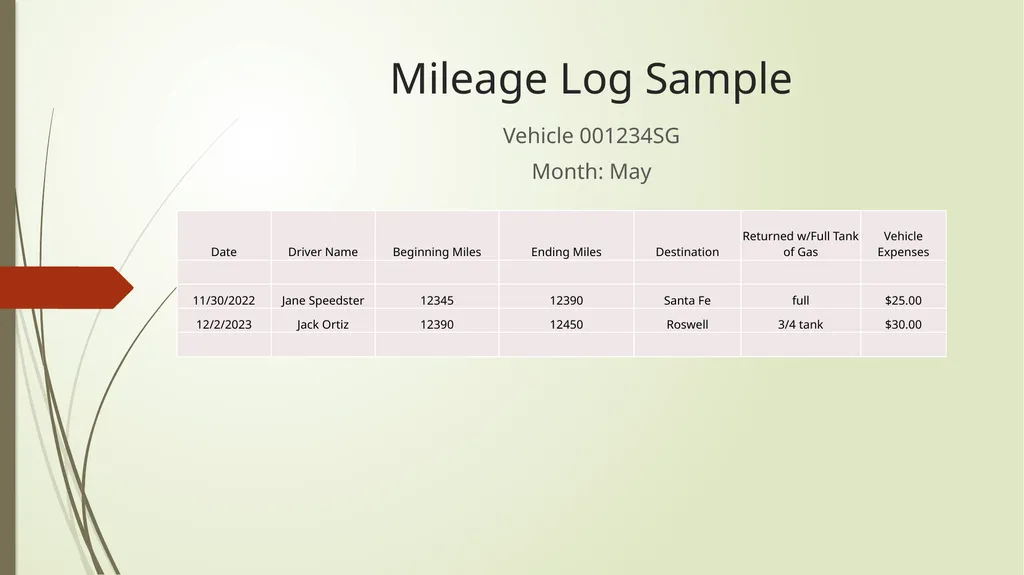
Mileage Log Sample Vehicle 001234SG
Month: May<br>
Month: May<br>
09
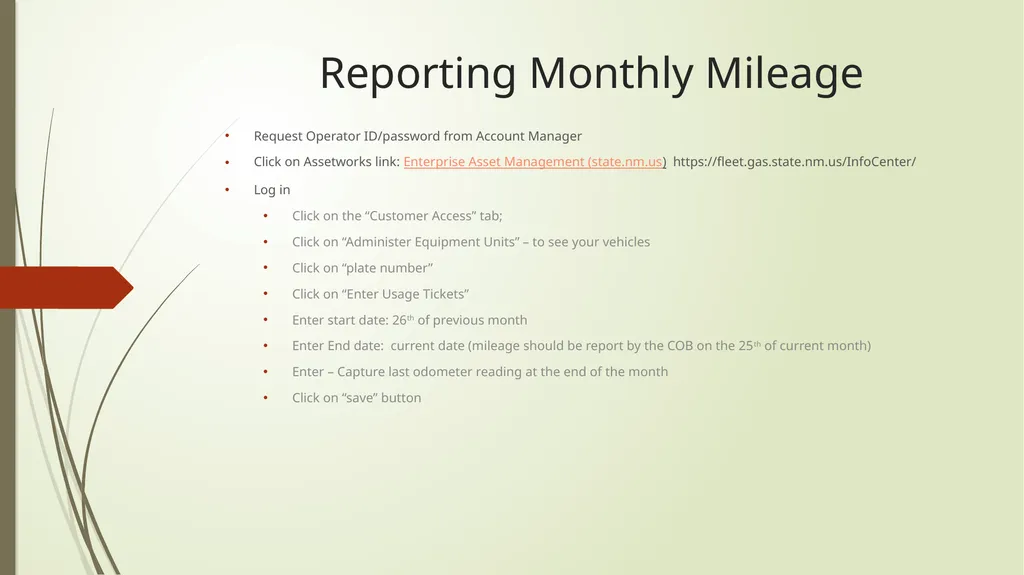
Reporting Monthly Mileage Request Operator ID/password from Account Manager
Click on Assetworks link: Enterprise Asset Management (state.nm.us) https://fleet.gas.state.nm.us/InfoCenter/
Log in
Click on the “Customer Access” tab;
Click on “Administer Equipment Units” – to see your vehicles
Click on “plate number”
Click on “Enter Usage Tickets”
Enter start date: 26th of previous month
Enter End date: current date (mileage should be report by the COB on the 25th of current month)
Enter – Capture last odometer reading at the end of the month
Click on “save” button<br>
Click on Assetworks link: Enterprise Asset Management (state.nm.us) https://fleet.gas.state.nm.us/InfoCenter/
Log in
Click on the “Customer Access” tab;
Click on “Administer Equipment Units” – to see your vehicles
Click on “plate number”
Click on “Enter Usage Tickets”
Enter start date: 26th of previous month
Enter End date: current date (mileage should be report by the COB on the 25th of current month)
Enter – Capture last odometer reading at the end of the month
Click on “save” button<br>
10
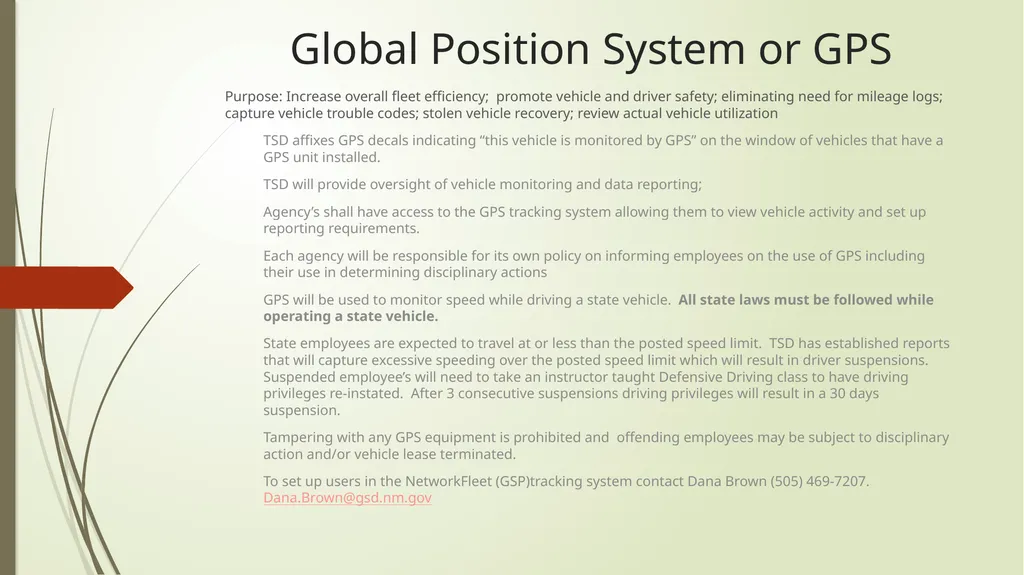
Global Position System or GPS Purpose: Increase overall fleet efficiency; promote vehicle and driver safety; eliminating need for mileage logs; capture vehicle trouble codes; stolen vehicle recovery; review actual vehicle utilization
TSD affixes GPS decals indicating “this vehicle is monitored by GPS” on the window of vehicles that have a GPS unit installed.
TSD will provide oversight of vehicle monitoring and data reporting;
Agency’s shall have access to the GPS tracking system allowing them to view vehicle activity and set up reporting requirements.
Each agency will be responsible for its own policy on informing employees on the use of GPS including their use in determining disciplinary actions
GPS will be used to monitor speed while driving a state vehicle. All state laws must be followed while operating a state vehicle.
State employees are expected to travel at or less than the posted speed limit. TSD has established reports that will capture excessive speeding over the posted speed limit which will result in driver suspensions. Suspended employee’s will need to take an instructor taught Defensive Driving class to have driving privileges re-instated. After 3 consecutive suspensions driving privileges will result in a 30 days suspension.
Tampering with any GPS equipment is prohibited and offending employees may be subject to disciplinary action and/or vehicle lease terminated.
To set up users in the NetworkFleet (GSP)tracking system contact Dana Brown (505) 469-7207. Dana.Brown@gsd.nm.gov<br>
TSD affixes GPS decals indicating “this vehicle is monitored by GPS” on the window of vehicles that have a GPS unit installed.
TSD will provide oversight of vehicle monitoring and data reporting;
Agency’s shall have access to the GPS tracking system allowing them to view vehicle activity and set up reporting requirements.
Each agency will be responsible for its own policy on informing employees on the use of GPS including their use in determining disciplinary actions
GPS will be used to monitor speed while driving a state vehicle. All state laws must be followed while operating a state vehicle.
State employees are expected to travel at or less than the posted speed limit. TSD has established reports that will capture excessive speeding over the posted speed limit which will result in driver suspensions. Suspended employee’s will need to take an instructor taught Defensive Driving class to have driving privileges re-instated. After 3 consecutive suspensions driving privileges will result in a 30 days suspension.
Tampering with any GPS equipment is prohibited and offending employees may be subject to disciplinary action and/or vehicle lease terminated.
To set up users in the NetworkFleet (GSP)tracking system contact Dana Brown (505) 469-7207. Dana.Brown@gsd.nm.gov<br>
11
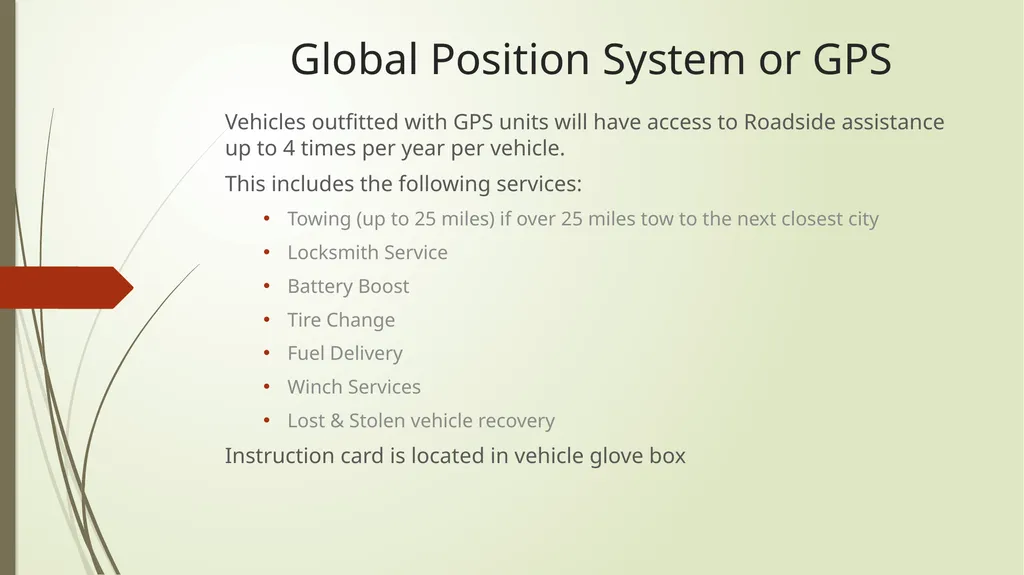
Global Position System or GPS Vehicles outfitted with GPS units will have access to Roadside assistance up to 4 times per year per vehicle.
This includes the following services:
Towing (up to 25 miles) if over 25 miles tow to the next closest city
Locksmith Service
Battery Boost
Tire Change
Fuel Delivery
Winch Services
Lost & Stolen vehicle recovery
Instruction card is located in vehicle glove box<br>
This includes the following services:
Towing (up to 25 miles) if over 25 miles tow to the next closest city
Locksmith Service
Battery Boost
Tire Change
Fuel Delivery
Winch Services
Lost & Stolen vehicle recovery
Instruction card is located in vehicle glove box<br>
12
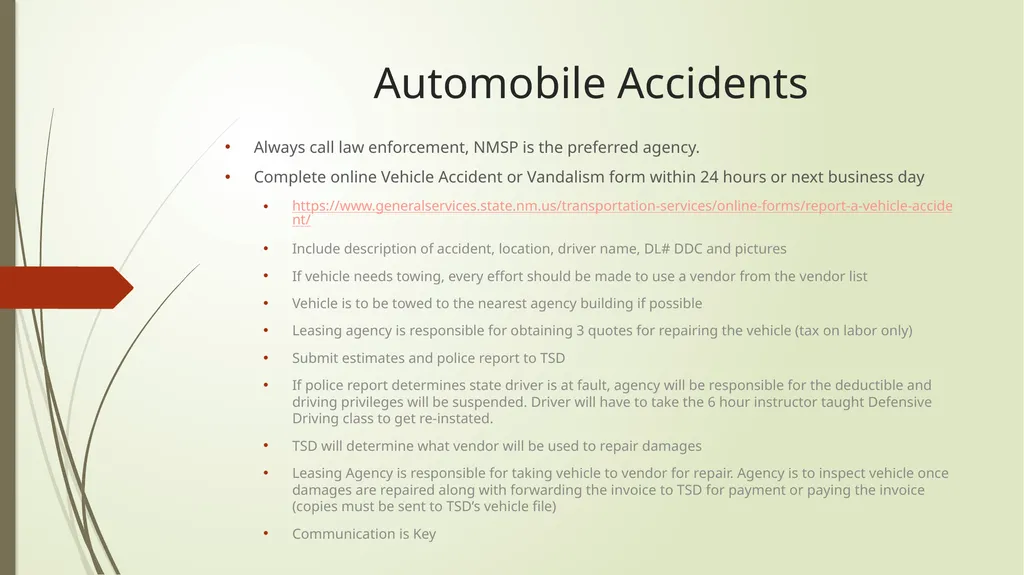
Automobile Accidents Always call law enforcement, NMSP is the preferred agency.
Complete online Vehicle Accident or Vandalism form within 24 hours or next business day
https://www.generalservices.state.nm.us/transportation-services/online-forms/report-a-vehicle-accident/
Include description of accident, location, driver name, DL# DDC and pictures
If vehicle needs towing, every effort should be made to use a vendor from the vendor list
Vehicle is to be towed to the nearest agency building if possible
Leasing agency is responsible for obtaining 3 quotes for repairing the vehicle (tax on labor only)
Submit estimates and police report to TSD
If police report determines state driver is at fault, agency will be responsible for the deductible and driving privileges will be suspended. Driver will have to take the 6 hour instructor taught Defensive Driving class to get re-instated.
TSD will determine what vendor will be used to repair damages
Leasing Agency is responsible for taking vehicle to vendor for repair. Agency is to inspect vehicle once damages are repaired along with forwarding the invoice to TSD for payment or paying the invoice (copies must be sent to TSD’s vehicle file)
Communication is Key<br>
Complete online Vehicle Accident or Vandalism form within 24 hours or next business day
https://www.generalservices.state.nm.us/transportation-services/online-forms/report-a-vehicle-accident/
Include description of accident, location, driver name, DL# DDC and pictures
If vehicle needs towing, every effort should be made to use a vendor from the vendor list
Vehicle is to be towed to the nearest agency building if possible
Leasing agency is responsible for obtaining 3 quotes for repairing the vehicle (tax on labor only)
Submit estimates and police report to TSD
If police report determines state driver is at fault, agency will be responsible for the deductible and driving privileges will be suspended. Driver will have to take the 6 hour instructor taught Defensive Driving class to get re-instated.
TSD will determine what vendor will be used to repair damages
Leasing Agency is responsible for taking vehicle to vendor for repair. Agency is to inspect vehicle once damages are repaired along with forwarding the invoice to TSD for payment or paying the invoice (copies must be sent to TSD’s vehicle file)
Communication is Key<br>
13
Defensive Driving Course All drivers of state vehicle’s need to complete a six-hour class National Safety Council Defensive Driving Course (NSC/DDC) and take a four-hour refresher every four years
Classes offered:
4 hour (renewal) and 6 hour instructor lead class (6 hour for new, expired or suspended drivers)
4 hour (renewal) and 6 hour virtual class (virtual 6 hour for new, expired or suspended drivers)
6 hour online class for new drivers and expired drivers – Stating 1/1/24 Online class will be 4-Hour renewal only
Cost of classes:
4 hour – virtual or in-person $15.00 – Starting 1/1/24 cost will be $30.00
6 hour – virtual, in-person or online $30.00
Payment for classes is in the form of Operating transfers and billing occurs on the 5th of month.
Duplicate DDC certificates can be obtained for a fee of $10
While driving a state vehicle, driver must have in their possession a valid driver’s license and a current defensive driving certificate (DDC can be an electronic copy).
Register for classes at:
https://www.generalservices.state.nm.us/transportation-services/defensive-driving/defensive-driving/training/<br>
Classes offered:
4 hour (renewal) and 6 hour instructor lead class (6 hour for new, expired or suspended drivers)
4 hour (renewal) and 6 hour virtual class (virtual 6 hour for new, expired or suspended drivers)
6 hour online class for new drivers and expired drivers – Stating 1/1/24 Online class will be 4-Hour renewal only
Cost of classes:
4 hour – virtual or in-person $15.00 – Starting 1/1/24 cost will be $30.00
6 hour – virtual, in-person or online $30.00
Payment for classes is in the form of Operating transfers and billing occurs on the 5th of month.
Duplicate DDC certificates can be obtained for a fee of $10
While driving a state vehicle, driver must have in their possession a valid driver’s license and a current defensive driving certificate (DDC can be an electronic copy).
Register for classes at:
https://www.generalservices.state.nm.us/transportation-services/defensive-driving/defensive-driving/training/<br>
14
Waivers Waivers are required for:
Driving prior to NSC/DDC course completion
Taking state vehicle out of state (overnight stay)
Transporting of non-state employees
Waiver online registration
https://www.generalservices.state.nm.us/transportation-services/online-forms/waivers
Or contact Diana Barela @ (505) 372-8628 Diana.Barela@gsd.nm.gov
Waiver will be approved 5 days prior to travel
No after the fact waivers will be approved<br>
Driving prior to NSC/DDC course completion
Taking state vehicle out of state (overnight stay)
Transporting of non-state employees
Waiver online registration
https://www.generalservices.state.nm.us/transportation-services/online-forms/waivers
Or contact Diana Barela @ (505) 372-8628 Diana.Barela@gsd.nm.gov
Waiver will be approved 5 days prior to travel
No after the fact waivers will be approved<br>
15
Commuting Report Commuting – means using a state vehicle from domicile-to-duty privilege authorized by leasing agency’s Cabinet Secretary.
State agency must develop a policy that allows authorized drivers to use state vehicles to commute between work and residence
All agency Cabinet Secretaries or agency heads wishing to commute must acquire approval from governor’s office. Approvals must be forwarded to SCFA.
Agencies must provide SCFA an annual report identifying the following:
Authorized commuter
The vehicle state plate
Total commuting mileage
Number of call backs during the year
This report shall also identify which drivers and state vehicles plates are authorized to commute for the upcoming year.
Commuting Report is due August of each year.
Commuting Forms can be found at: https://www.generalservices.state.nm.us/transportation-services/commuting/<br>
State agency must develop a policy that allows authorized drivers to use state vehicles to commute between work and residence
All agency Cabinet Secretaries or agency heads wishing to commute must acquire approval from governor’s office. Approvals must be forwarded to SCFA.
Agencies must provide SCFA an annual report identifying the following:
Authorized commuter
The vehicle state plate
Total commuting mileage
Number of call backs during the year
This report shall also identify which drivers and state vehicles plates are authorized to commute for the upcoming year.
Commuting Report is due August of each year.
Commuting Forms can be found at: https://www.generalservices.state.nm.us/transportation-services/commuting/<br>
16
Wright Express (WEX)Fuel Card Use of Wright Express Fuel Credit Card
All state agencies and authorized drivers are required to use the GSD/TSD controlled Wright Express (WEX) fuel credit card for authorized purchases.
The department/agency WEX representative (usually the department/agency vehicle coordinator) is responsible for establishing their account with WEX and for adding or deleting employees to/from the authorized WEX user listing.
The department/agency WEX representative shall assign a single fuel credit card to each state passenger vehicle and a Personal Identification Number (PIN) to each authorized driver.
Authorized drivers shall use self-service fuel pumps when refueling state vehicles. Authorized drivers are encouraged to use alternative fuels when they are available for state vehicles manufactured to burn alternative fuels (E-85, CNG, Propane, Bio-Diesel, etc.).
If an authorized driver uses the fuel credit card to purchase an unauthorized item or service, the state agency shall collect the cost of the unauthorized purchase from the authorized driver.
Following is a listing of “authorized” and “non-authorized” purchases
Authorized purchases: Unleaded Gasoline, E-85 Fuel, Diesel, Propane, Compressed Natural Gas (CNG), Car washes at WEX approved fueling stations and Emergency services or repairs which are not to exceed $250.00
Non-Authorized Purchases: Food or beverages; Oil changes, Transmission flushes, Radiator flushes, Anything not stated under “Authorize Purchases” and purchasing exceeding $250.00
The department/agency or the GSD/TSD Director may suspend or revoke the state authorized driver privileges for misuse of the WEX fuel credit card. The state department/agency may take appropriate disciplinary action as may be required.
The department/agency shall immediately notify Wright Express in the event of a lost WEX fuel card<br>
All state agencies and authorized drivers are required to use the GSD/TSD controlled Wright Express (WEX) fuel credit card for authorized purchases.
The department/agency WEX representative (usually the department/agency vehicle coordinator) is responsible for establishing their account with WEX and for adding or deleting employees to/from the authorized WEX user listing.
The department/agency WEX representative shall assign a single fuel credit card to each state passenger vehicle and a Personal Identification Number (PIN) to each authorized driver.
Authorized drivers shall use self-service fuel pumps when refueling state vehicles. Authorized drivers are encouraged to use alternative fuels when they are available for state vehicles manufactured to burn alternative fuels (E-85, CNG, Propane, Bio-Diesel, etc.).
If an authorized driver uses the fuel credit card to purchase an unauthorized item or service, the state agency shall collect the cost of the unauthorized purchase from the authorized driver.
Following is a listing of “authorized” and “non-authorized” purchases
Authorized purchases: Unleaded Gasoline, E-85 Fuel, Diesel, Propane, Compressed Natural Gas (CNG), Car washes at WEX approved fueling stations and Emergency services or repairs which are not to exceed $250.00
Non-Authorized Purchases: Food or beverages; Oil changes, Transmission flushes, Radiator flushes, Anything not stated under “Authorize Purchases” and purchasing exceeding $250.00
The department/agency or the GSD/TSD Director may suspend or revoke the state authorized driver privileges for misuse of the WEX fuel credit card. The state department/agency may take appropriate disciplinary action as may be required.
The department/agency shall immediately notify Wright Express in the event of a lost WEX fuel card<br>
17
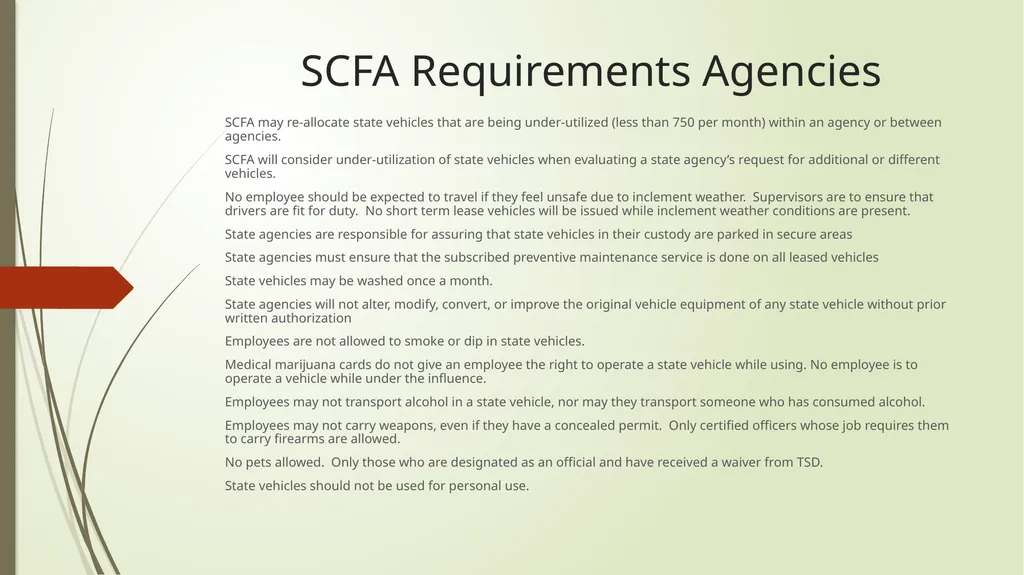
SCFA Requirements Agencies SCFA may re-allocate state vehicles that are being under-utilized (less than 750 per month) within an agency or between agencies.
SCFA will consider under-utilization of state vehicles when evaluating a state agency’s request for additional or different vehicles.
No employee should be expected to travel if they feel unsafe due to inclement weather. Supervisors are to ensure that drivers are fit for duty. No short term lease vehicles will be issued while inclement weather conditions are present.
State agencies are responsible for assuring that state vehicles in their custody are parked in secure areas
State agencies must ensure that the subscribed preventive maintenance service is done on all leased vehicles
State vehicles may be washed once a month.
State agencies will not alter, modify, convert, or improve the original vehicle equipment of any state vehicle without prior written authorization
Employees are not allowed to smoke or dip in state vehicles.
Medical marijuana cards do not give an employee the right to operate a state vehicle while using. No employee is to operate a vehicle while under the influence.
Employees may not transport alcohol in a state vehicle, nor may they transport someone who has consumed alcohol.
Employees may not carry weapons, even if they have a concealed permit. Only certified officers whose job requires them to carry firearms are allowed.
No pets allowed. Only those who are designated as an official and have received a waiver from TSD.
State vehicles should not be used for personal use.<br>
SCFA will consider under-utilization of state vehicles when evaluating a state agency’s request for additional or different vehicles.
No employee should be expected to travel if they feel unsafe due to inclement weather. Supervisors are to ensure that drivers are fit for duty. No short term lease vehicles will be issued while inclement weather conditions are present.
State agencies are responsible for assuring that state vehicles in their custody are parked in secure areas
State agencies must ensure that the subscribed preventive maintenance service is done on all leased vehicles
State vehicles may be washed once a month.
State agencies will not alter, modify, convert, or improve the original vehicle equipment of any state vehicle without prior written authorization
Employees are not allowed to smoke or dip in state vehicles.
Medical marijuana cards do not give an employee the right to operate a state vehicle while using. No employee is to operate a vehicle while under the influence.
Employees may not transport alcohol in a state vehicle, nor may they transport someone who has consumed alcohol.
Employees may not carry weapons, even if they have a concealed permit. Only certified officers whose job requires them to carry firearms are allowed.
No pets allowed. Only those who are designated as an official and have received a waiver from TSD.
State vehicles should not be used for personal use.<br>
18
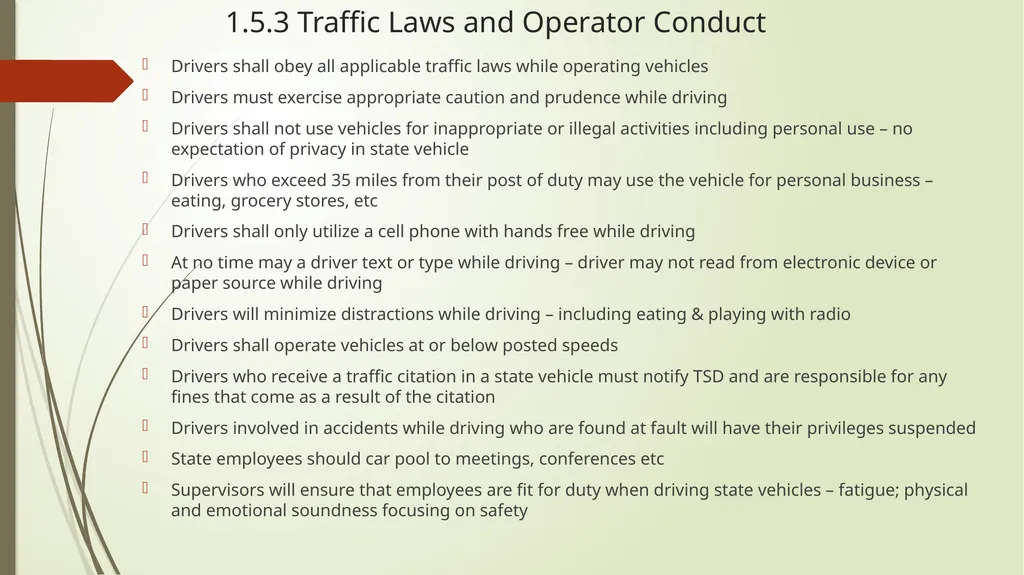
1.5.3 Traffic Laws and Operator Conduct Drivers shall obey all applicable traffic laws while operating vehicles
Drivers must exercise appropriate caution and prudence while driving
Drivers shall not use vehicles for inappropriate or illegal activities including personal use – no expectation of privacy in state vehicle
Drivers who exceed 35 miles from their post of duty may use the vehicle for personal business – eating, grocery stores, etc
Drivers shall only utilize a cell phone with hands free while driving
At no time may a driver text or type while driving – driver may not read from electronic device or paper source while driving
Drivers will minimize distractions while driving – including eating & playing with radio
Drivers shall operate vehicles at or below posted speeds
Drivers who receive a traffic citation in a state vehicle must notify TSD and are responsible for any fines that come as a result of the citation
Drivers involved in accidents while driving who are found at fault will have their privileges suspended
State employees should car pool to meetings, conferences etc
Supervisors will ensure that employees are fit for duty when driving state vehicles – fatigue; physical and emotional soundness focusing on safety<br>
Drivers must exercise appropriate caution and prudence while driving
Drivers shall not use vehicles for inappropriate or illegal activities including personal use – no expectation of privacy in state vehicle
Drivers who exceed 35 miles from their post of duty may use the vehicle for personal business – eating, grocery stores, etc
Drivers shall only utilize a cell phone with hands free while driving
At no time may a driver text or type while driving – driver may not read from electronic device or paper source while driving
Drivers will minimize distractions while driving – including eating & playing with radio
Drivers shall operate vehicles at or below posted speeds
Drivers who receive a traffic citation in a state vehicle must notify TSD and are responsible for any fines that come as a result of the citation
Drivers involved in accidents while driving who are found at fault will have their privileges suspended
State employees should car pool to meetings, conferences etc
Supervisors will ensure that employees are fit for duty when driving state vehicles – fatigue; physical and emotional soundness focusing on safety<br>
19
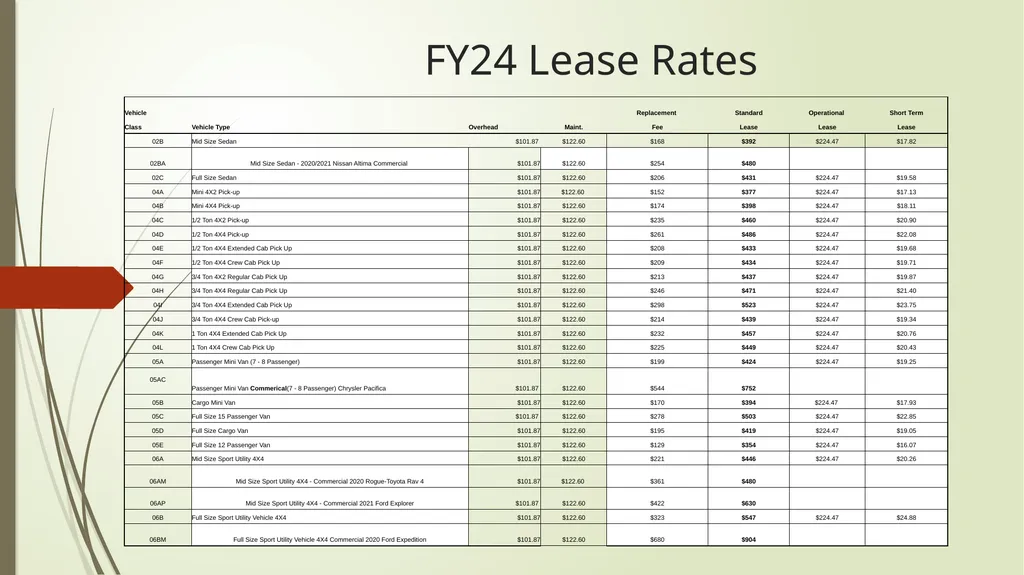
FY24 Lease Rates<br>
20
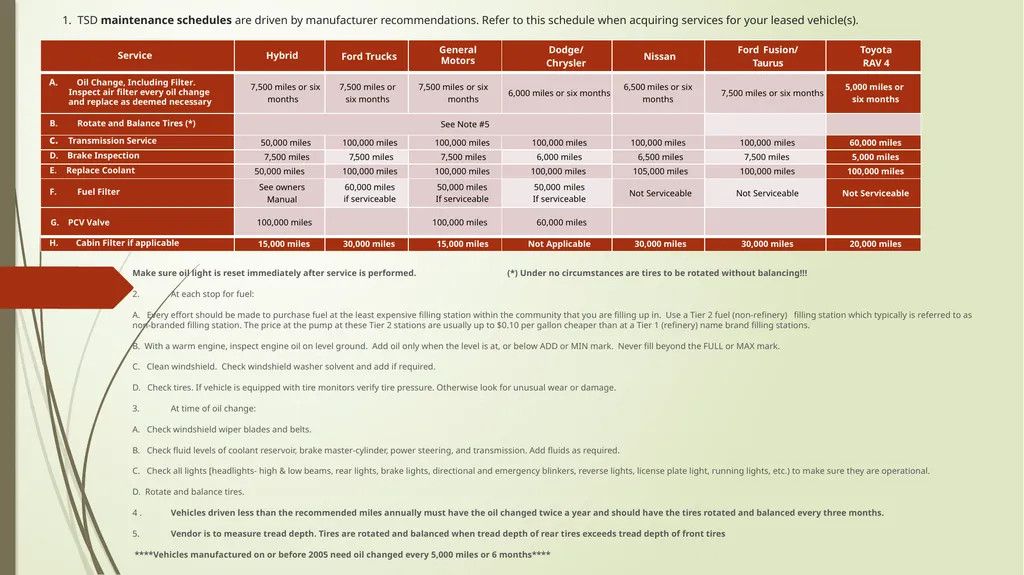
1. TSD maintenance schedules are driven by manufacturer recommendations. Refer to this schedule when acquiring services for your leased vehicle(s). Make sure oil light is reset immediately after service is performed. (*) Under no circumstances are tires to be rotated without balancing!!!
2. At each stop for fuel:
A. Every effort should be made to purchase fuel at the least expensive filling station within the community that you are filling up in. Use a Tier 2 fuel (non-refinery) filling station which typically is referred to as non-branded filling station. The price at the pump at these Tier 2 stations are usually up to $0.10 per gallon cheaper than at a Tier 1 (refinery) name brand filling stations.
B. With a warm engine, inspect engine oil on level ground. Add oil only when the level is at, or below ADD or MIN mark. Never fill beyond the FULL or MAX mark.
C. Clean windshield. Check windshield washer solvent and add if required.
D. Check tires. If vehicle is equipped with tire monitors verify tire pressure. Otherwise look for unusual wear or damage.
3. At time of oil change:
A. Check windshield wiper blades and belts.
B. Check fluid levels of coolant reservoir, brake master-cylinder, power steering, and transmission. Add fluids as required.
C. Check all lights [headlights- high & low beams, rear lights, brake lights, directional and emergency blinkers, reverse lights, license plate light, running lights, etc.) to make sure they are operational.
D. Rotate and balance tires.
4 . Vehicles driven less than the recommended miles annually must have the oil changed twice a year and should have the tires rotated and balanced every three months.
5. Vendor is to measure tread depth. Tires are rotated and balanced when tread depth of rear tires exceeds tread depth of front tires
****Vehicles manufactured on or before 2005 need oil changed every 5,000 miles or 6 months****<br>
2. At each stop for fuel:
A. Every effort should be made to purchase fuel at the least expensive filling station within the community that you are filling up in. Use a Tier 2 fuel (non-refinery) filling station which typically is referred to as non-branded filling station. The price at the pump at these Tier 2 stations are usually up to $0.10 per gallon cheaper than at a Tier 1 (refinery) name brand filling stations.
B. With a warm engine, inspect engine oil on level ground. Add oil only when the level is at, or below ADD or MIN mark. Never fill beyond the FULL or MAX mark.
C. Clean windshield. Check windshield washer solvent and add if required.
D. Check tires. If vehicle is equipped with tire monitors verify tire pressure. Otherwise look for unusual wear or damage.
3. At time of oil change:
A. Check windshield wiper blades and belts.
B. Check fluid levels of coolant reservoir, brake master-cylinder, power steering, and transmission. Add fluids as required.
C. Check all lights [headlights- high & low beams, rear lights, brake lights, directional and emergency blinkers, reverse lights, license plate light, running lights, etc.) to make sure they are operational.
D. Rotate and balance tires.
4 . Vehicles driven less than the recommended miles annually must have the oil changed twice a year and should have the tires rotated and balanced every three months.
5. Vendor is to measure tread depth. Tires are rotated and balanced when tread depth of rear tires exceeds tread depth of front tires
****Vehicles manufactured on or before 2005 need oil changed every 5,000 miles or 6 months****<br>