
Travel & Procurement Hot Topics OGC Team Talk
PC
Published · 25 slides · 0 views

1 / 1



Description
Travel Procurement Hot Topics OGC Team Talk Fiscal Compliance 2222024 Introductions Caroline Quane Assistant Director Fiscal Compliance Caroline.Quaneucdenver.edu Holly Day Senior Fiscal Compliance Auditor Holly.Dayudenver.edu Agenda
Related Topics
Share
Embed code
Download this presentation From Below
"Travel & Procurement Hot Topics OGC Team Talk" is the property of its rightful owner. Permission is granted to download and print the materials on this website for personal, non-commercial use only, and to display it on your personal computer provided you do not modify the materials and that you retain all copyright notices contained in the materials. By downloading content from our website, you accept the terms of this agreement.
Presentation Transcript
01
Travel & Procurement
Hot Topics OGC Team Talk
Fiscal Compliance
2/22/2024<br>
Fiscal Compliance
2/22/2024<br>
02
Introductions Caroline Quane
Assistant Director Fiscal Compliance
Caroline.Quane@ucdenver.edu Holly Day
Senior Fiscal Compliance Auditor
Holly.Day@udenver.edu<br>
Assistant Director Fiscal Compliance
Caroline.Quane@ucdenver.edu Holly Day
Senior Fiscal Compliance Auditor
Holly.Day@udenver.edu<br>
03
Agenda<br>
04
Policy Overview “What do you mean we have a Procurement Policy? I didn’t know!”<br>
05
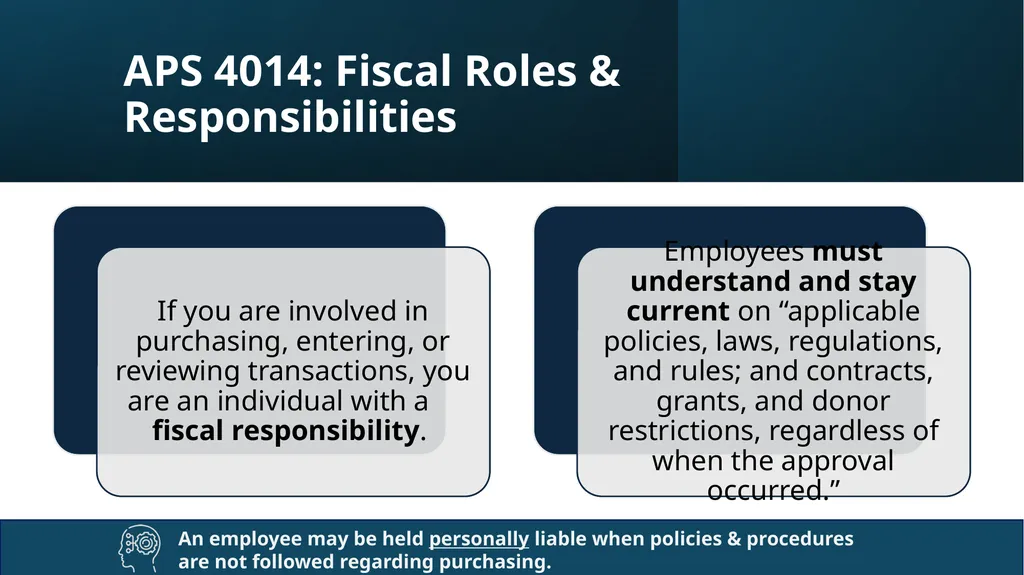
APS 4014: Fiscal Roles & Responsibilities An employee may be held personally liable when policies & procedures are not followed regarding purchasing.<br>
06
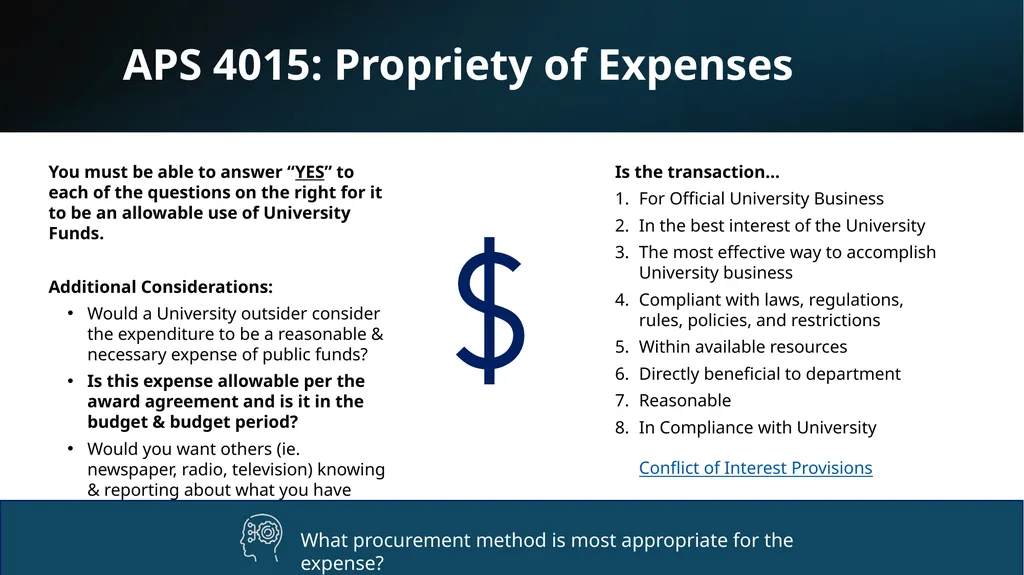
APS 4015: Propriety of Expenses You must be able to answer “YES” to each of the questions on the right for it to be an allowable use of University Funds.
Additional Considerations:
Would a University outsider consider the expenditure to be a reasonable & necessary expense of public funds?
Is this expense allowable per the award agreement and is it in the budget & budget period?
Would you want others (ie. newspaper, radio, television) knowing & reporting about what you have decided? Is the transaction…
For Official University Business
In the best interest of the University
The most effective way to accomplish University business
Compliant with laws, regulations, rules, policies, and restrictions
Within available resources
Directly beneficial to department
Reasonable
In Compliance with University Conflict of Interest Provisions What procurement method is most appropriate for the expense?<br>
Additional Considerations:
Would a University outsider consider the expenditure to be a reasonable & necessary expense of public funds?
Is this expense allowable per the award agreement and is it in the budget & budget period?
Would you want others (ie. newspaper, radio, television) knowing & reporting about what you have decided? Is the transaction…
For Official University Business
In the best interest of the University
The most effective way to accomplish University business
Compliant with laws, regulations, rules, policies, and restrictions
Within available resources
Directly beneficial to department
Reasonable
In Compliance with University Conflict of Interest Provisions What procurement method is most appropriate for the expense?<br>
07
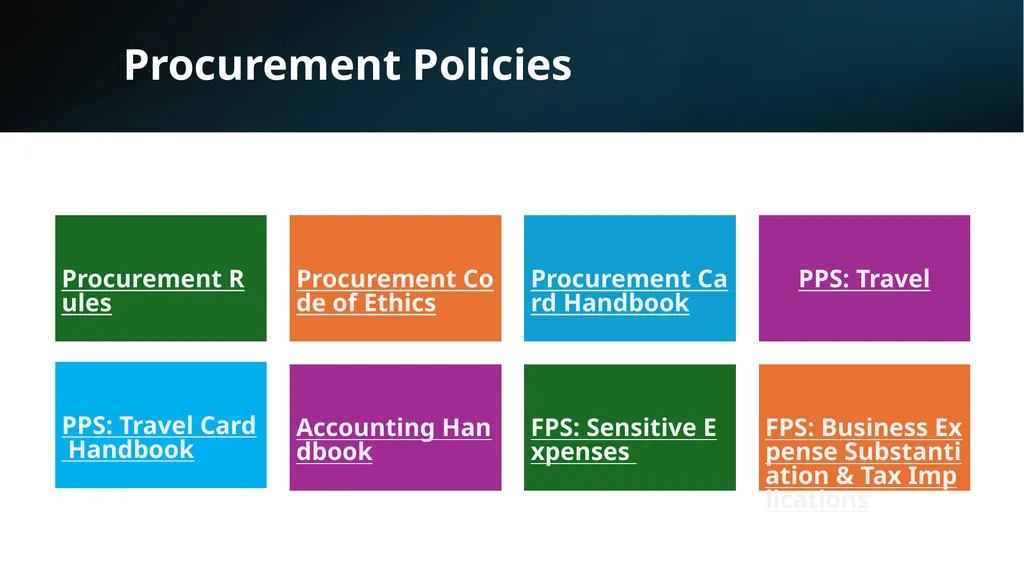
Procurement Policies<br>
08
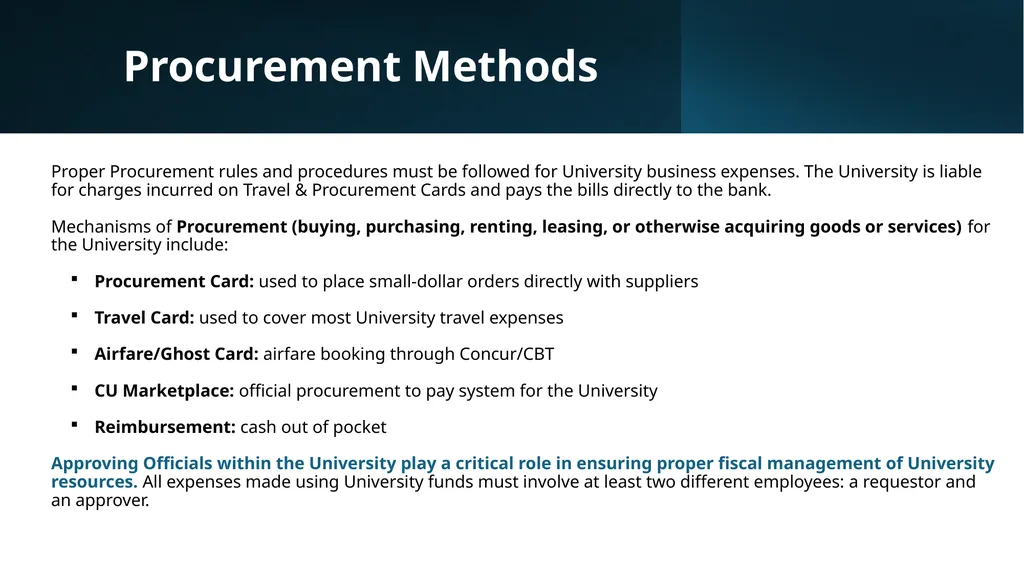
Procurement Methods Proper Procurement rules and procedures must be followed for University business expenses. The University is liable for charges incurred on Travel & Procurement Cards and pays the bills directly to the bank.
Mechanisms of Procurement (buying, purchasing, renting, leasing, or otherwise acquiring goods or services) for the University include:
Procurement Card: used to place small-dollar orders directly with suppliers
Travel Card: used to cover most University travel expenses
Airfare/Ghost Card: airfare booking through Concur/CBT
CU Marketplace: official procurement to pay system for the University
Reimbursement: cash out of pocket
Approving Officials within the University play a critical role in ensuring proper fiscal management of University resources. All expenses made using University funds must involve at least two different employees: a requestor and an approver.<br>
Mechanisms of Procurement (buying, purchasing, renting, leasing, or otherwise acquiring goods or services) for the University include:
Procurement Card: used to place small-dollar orders directly with suppliers
Travel Card: used to cover most University travel expenses
Airfare/Ghost Card: airfare booking through Concur/CBT
CU Marketplace: official procurement to pay system for the University
Reimbursement: cash out of pocket
Approving Officials within the University play a critical role in ensuring proper fiscal management of University resources. All expenses made using University funds must involve at least two different employees: a requestor and an approver.<br>
09
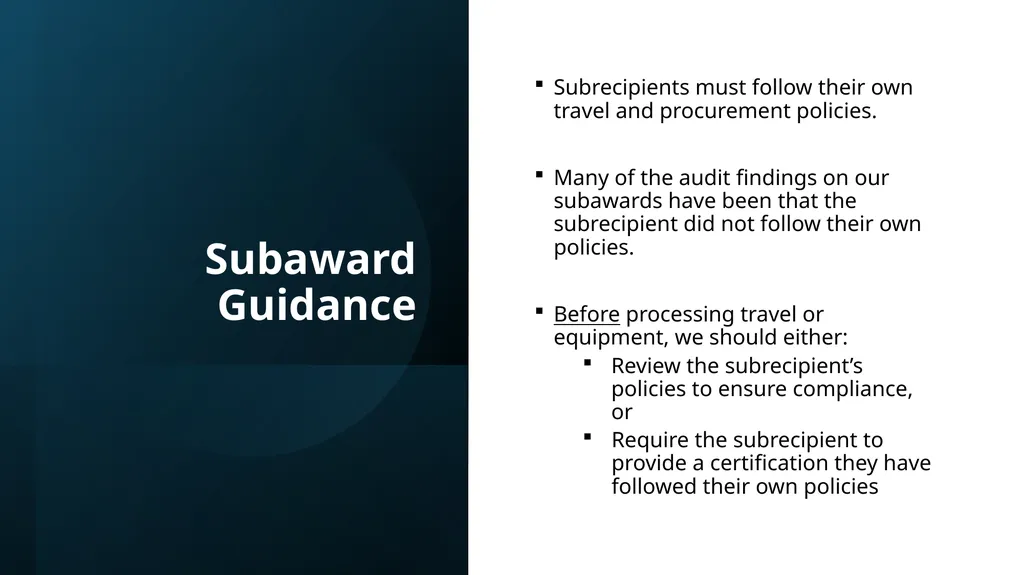
Subaward Guidance Subrecipients must follow their own travel and procurement policies.
Many of the audit findings on our subawards have been that the subrecipient did not follow their own policies.
Before processing travel or equipment, we should either:
Review the subrecipient’s policies to ensure compliance, or
Require the subrecipient to provide a certification they have followed their own policies<br>
Many of the audit findings on our subawards have been that the subrecipient did not follow their own policies.
Before processing travel or equipment, we should either:
Review the subrecipient’s policies to ensure compliance, or
Require the subrecipient to provide a certification they have followed their own policies<br>
10
Travel<br>
11
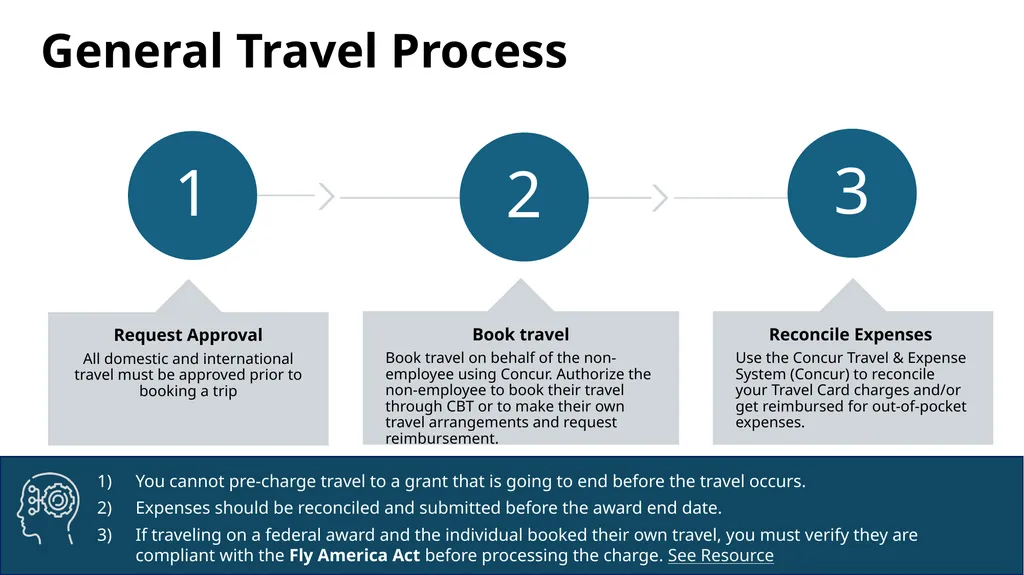
General Travel Process You cannot pre-charge travel to a grant that is going to end before the travel occurs.
Expenses should be reconciled and submitted before the award end date.
If traveling on a federal award and the individual booked their own travel, you must verify they are compliant with the Fly America Act before processing the charge. See Resource<br>
Expenses should be reconciled and submitted before the award end date.
If traveling on a federal award and the individual booked their own travel, you must verify they are compliant with the Fly America Act before processing the charge. See Resource<br>
12
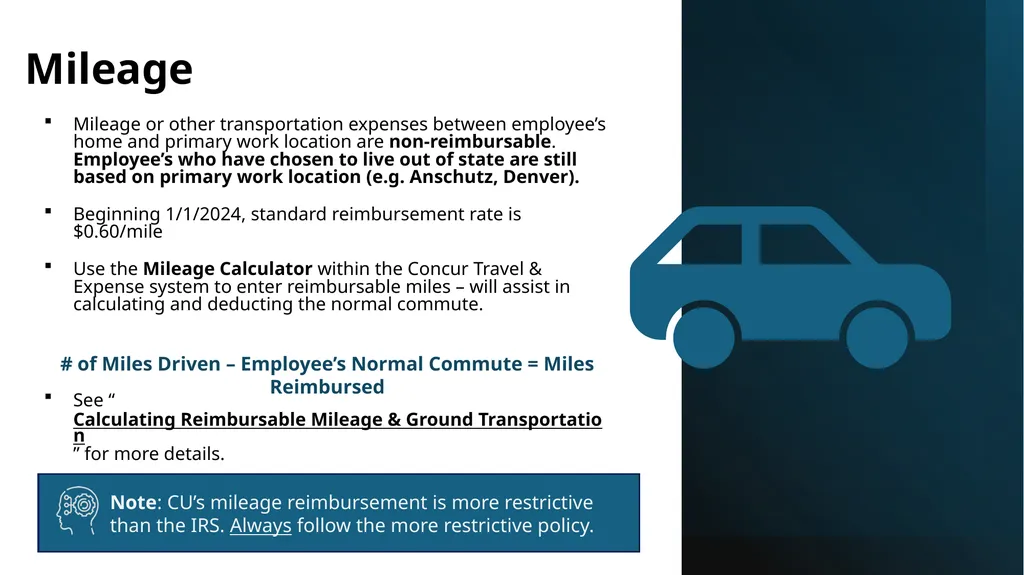
Mileage Mileage or other transportation expenses between employee’s home and primary work location are non-reimbursable. Employee’s who have chosen to live out of state are still based on primary work location (e.g. Anschutz, Denver).
Beginning 1/1/2024, standard reimbursement rate is $0.60/mile
Use the Mileage Calculator within the Concur Travel & Expense system to enter reimbursable miles – will assist in calculating and deducting the normal commute.
See “Calculating Reimbursable Mileage & Ground Transportation” for more details. # of Miles Driven – Employee’s Normal Commute = Miles Reimbursed Note: CU’s mileage reimbursement is more restrictive than the IRS. Always follow the more restrictive policy.<br>
Beginning 1/1/2024, standard reimbursement rate is $0.60/mile
Use the Mileage Calculator within the Concur Travel & Expense system to enter reimbursable miles – will assist in calculating and deducting the normal commute.
See “Calculating Reimbursable Mileage & Ground Transportation” for more details. # of Miles Driven – Employee’s Normal Commute = Miles Reimbursed Note: CU’s mileage reimbursement is more restrictive than the IRS. Always follow the more restrictive policy.<br>
13
Per Diem It is typically most advantageous to request per diem when traveling.
Reflects the maximum amount allowed for eligible meals (including meal tips) that you need to purchase during a University trip. Includes incidental amount to offset other trip expenses (ie. maids, bellhops, etc.)
Does not require submission of receipts to claim per diem.
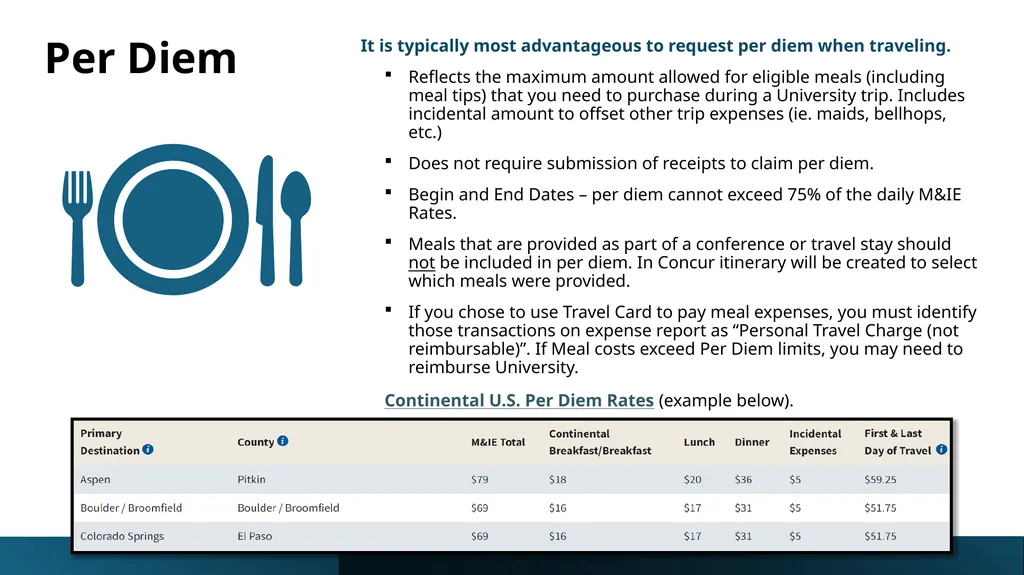
Begin and End Dates – per diem cannot exceed 75% of the daily M&IE Rates.
Meals that are provided as part of a conference or travel stay should not be included in per diem. In Concur itinerary will be created to select which meals were provided.
If you chose to use Travel Card to pay meal expenses, you must identify those transactions on expense report as “Personal Travel Charge (not reimbursable)”. If Meal costs exceed Per Diem limits, you may need to reimburse University.
Continental U.S. Per Diem Rates (example below).
Foreign Per Diem Rates<br>
Reflects the maximum amount allowed for eligible meals (including meal tips) that you need to purchase during a University trip. Includes incidental amount to offset other trip expenses (ie. maids, bellhops, etc.)
Does not require submission of receipts to claim per diem.
Begin and End Dates – per diem cannot exceed 75% of the daily M&IE Rates.
Meals that are provided as part of a conference or travel stay should not be included in per diem. In Concur itinerary will be created to select which meals were provided.
If you chose to use Travel Card to pay meal expenses, you must identify those transactions on expense report as “Personal Travel Charge (not reimbursable)”. If Meal costs exceed Per Diem limits, you may need to reimburse University.
Continental U.S. Per Diem Rates (example below).
Foreign Per Diem Rates<br>
14
General Procurement<br>
15
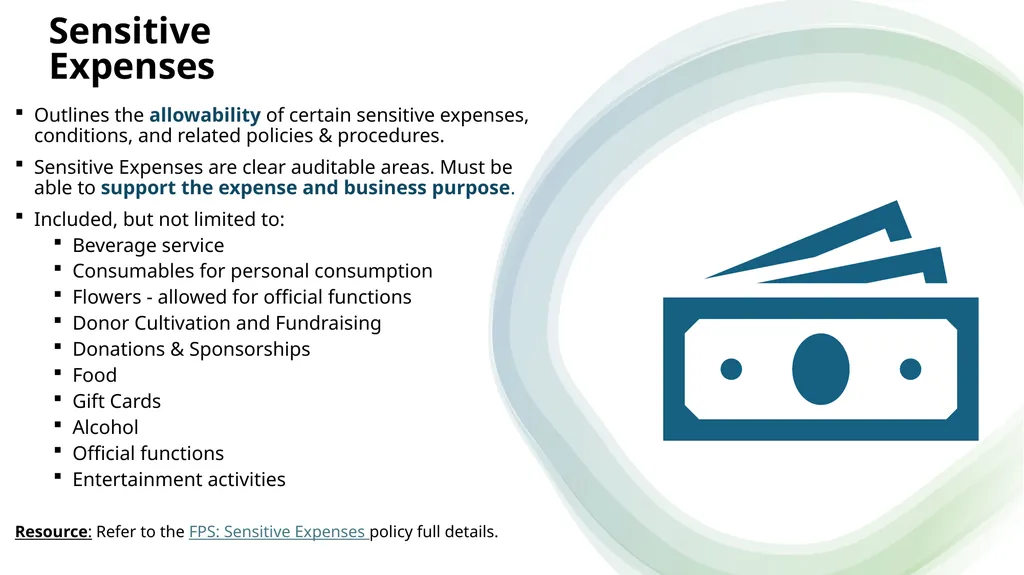
Sensitive Expenses Outlines the allowability of certain sensitive expenses, conditions, and related policies & procedures.
Sensitive Expenses are clear auditable areas. Must be able to support the expense and business purpose.
Included, but not limited to:
Beverage service
Consumables for personal consumption
Flowers - allowed for official functions
Donor Cultivation and Fundraising
Donations & Sponsorships
Food
Gift Cards
Alcohol
Official functions
Entertainment activities
Resource: Refer to the FPS: Sensitive Expenses policy full details.<br>
Sensitive Expenses are clear auditable areas. Must be able to support the expense and business purpose.
Included, but not limited to:
Beverage service
Consumables for personal consumption
Flowers - allowed for official functions
Donor Cultivation and Fundraising
Donations & Sponsorships
Food
Gift Cards
Alcohol
Official functions
Entertainment activities
Resource: Refer to the FPS: Sensitive Expenses policy full details.<br>
16
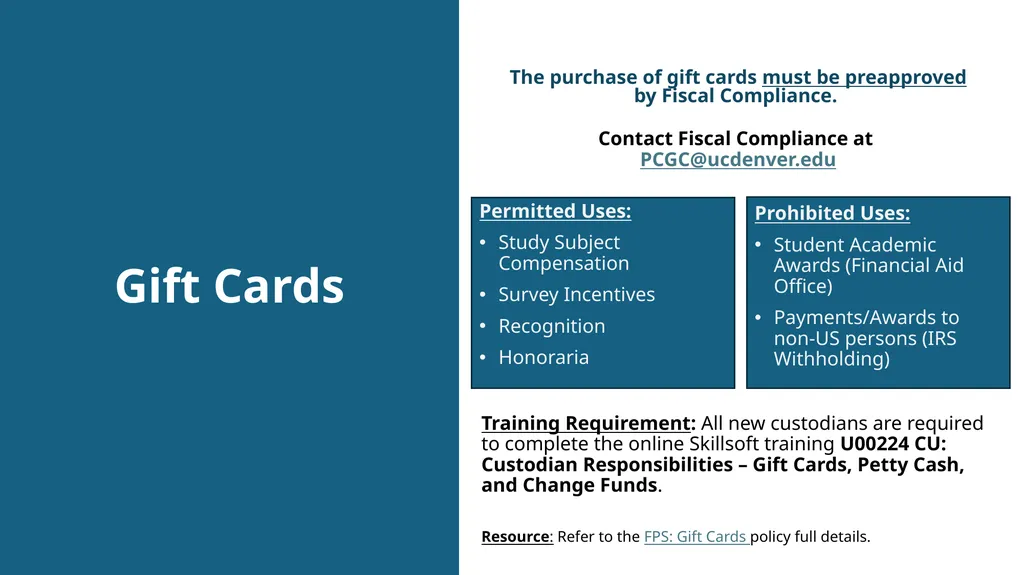
Permitted Uses:
Study Subject Compensation
Survey Incentives
Recognition
Honoraria The purchase of gift cards must be preapproved by Fiscal Compliance.
Contact Fiscal Compliance at PCGC@ucdenver.edu Training Requirement: All new custodians are required to complete the online Skillsoft training U00224 CU: Custodian Responsibilities – Gift Cards, Petty Cash, and Change Funds. Resource: Refer to the FPS: Gift Cards policy full details. Gift Cards Prohibited Uses:
Student Academic Awards (Financial Aid Office)
Payments/Awards to non-US persons (IRS Withholding)<br>
Study Subject Compensation
Survey Incentives
Recognition
Honoraria The purchase of gift cards must be preapproved by Fiscal Compliance.
Contact Fiscal Compliance at PCGC@ucdenver.edu Training Requirement: All new custodians are required to complete the online Skillsoft training U00224 CU: Custodian Responsibilities – Gift Cards, Petty Cash, and Change Funds. Resource: Refer to the FPS: Gift Cards policy full details. Gift Cards Prohibited Uses:
Student Academic Awards (Financial Aid Office)
Payments/Awards to non-US persons (IRS Withholding)<br>
17
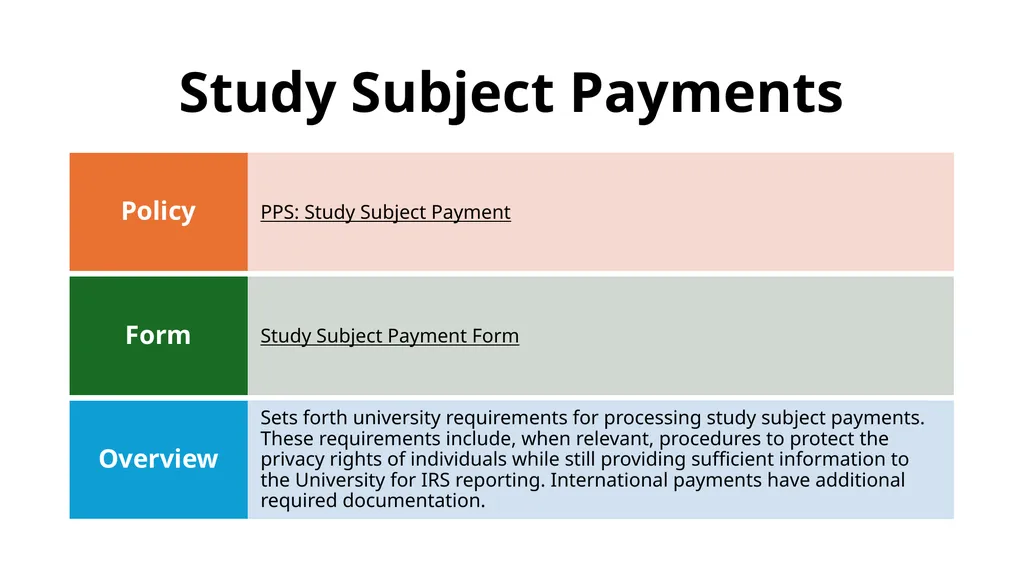
Study Subject Payments<br>
18
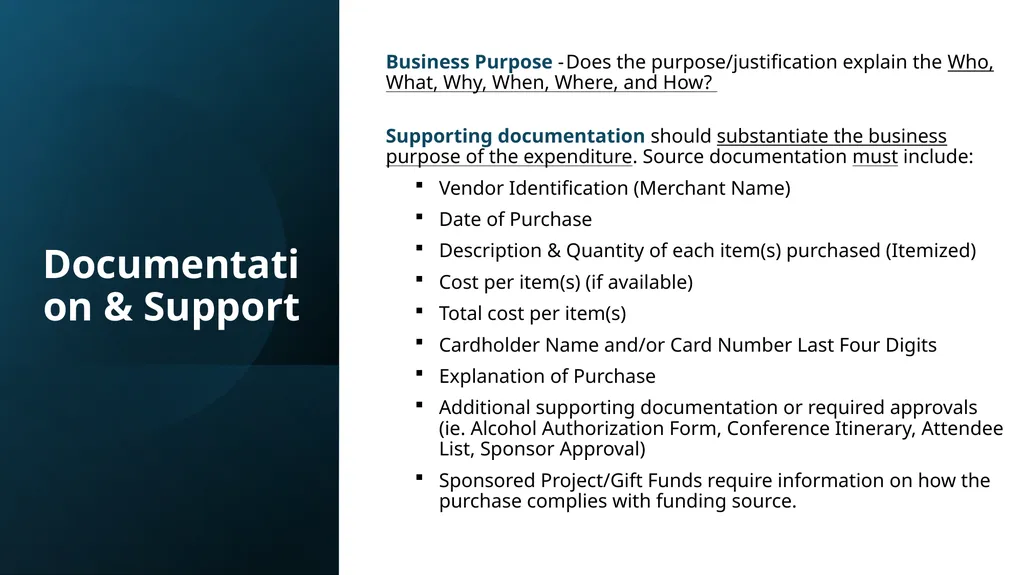
Documentation & Support Business Purpose - Does the purpose/justification explain the Who, What, Why, When, Where, and How?
Supporting documentation should substantiate the business purpose of the expenditure. Source documentation must include:
Vendor Identification (Merchant Name)
Date of Purchase
Description & Quantity of each item(s) purchased (Itemized)
Cost per item(s) (if available)
Total cost per item(s)
Cardholder Name and/or Card Number Last Four Digits
Explanation of Purchase
Additional supporting documentation or required approvals (ie. Alcohol Authorization Form, Conference Itinerary, Attendee List, Sponsor Approval)
Sponsored Project/Gift Funds require information on how the purchase complies with funding source.<br>
Supporting documentation should substantiate the business purpose of the expenditure. Source documentation must include:
Vendor Identification (Merchant Name)
Date of Purchase
Description & Quantity of each item(s) purchased (Itemized)
Cost per item(s) (if available)
Total cost per item(s)
Cardholder Name and/or Card Number Last Four Digits
Explanation of Purchase
Additional supporting documentation or required approvals (ie. Alcohol Authorization Form, Conference Itinerary, Attendee List, Sponsor Approval)
Sponsored Project/Gift Funds require information on how the purchase complies with funding source.<br>
19
Inadvertent Personal Purchases Cardholder should ask the supplier to credit the P-Card and charge their personal card instead.
If supplier issues credit and charges Employee’s personal credit card, cardholder must submit original expense as well as credit.
If supplier is unwilling to credit, cardholder needs to immediately reimburse the University with a check made out to the University of Colorado.
Check must be deposited using a Cash Receipt form and submitted to the Bursar’s Office.
The Validated Cash Receipt form must be attached with the transaction in Concur. A comment should be included to explain the situation.<br>
If supplier issues credit and charges Employee’s personal credit card, cardholder must submit original expense as well as credit.
If supplier is unwilling to credit, cardholder needs to immediately reimburse the University with a check made out to the University of Colorado.
Check must be deposited using a Cash Receipt form and submitted to the Bursar’s Office.
The Validated Cash Receipt form must be attached with the transaction in Concur. A comment should be included to explain the situation.<br>
20
Questionable Expenses Approver/AO should request more information from preparer to approve.
Can send report back to employee with comments.
Returned report should include additional documentation and explanation in comments to better support the business purpose of the transaction.
Reject report; preparer can remove questionable expense and resubmit report without questionable expense line to allow for payment.
Contact fs-compliance@ucdenver.edu to discuss if necessary.<br>
Can send report back to employee with comments.
Returned report should include additional documentation and explanation in comments to better support the business purpose of the transaction.
Reject report; preparer can remove questionable expense and resubmit report without questionable expense line to allow for payment.
Contact fs-compliance@ucdenver.edu to discuss if necessary.<br>
21
Business Expense Substantiation and Tax Implications All University Business Expenses must be submitted and substantiated in an expense report within 30 days to ensure timely review and reporting to the University’s financial record.
As an Approving Official, you will receive various notifications of unsubmitted transactions for the employees under your approving authority. Keep a pulse on these unsubmitted transactions to ensure individuals are timely in submitting their expense reports.
New Procurement Card Transactions Posted for all Assigned Cardholders in Concur (Weekly)
Aging Travel Card and/or Airfare Transactions (30 Days past transaction date, then repeats/30)
Aging Procurement Card Transactions (30 Days past transaction date, then repeats/30)
Failure to submit an expense report within 90 days from the transaction date or 90 days of the trip end date will result in the amount of the related expense being reported as additional taxable income to the employee (BEX) per the University’s Accountable plan (FPS: Business Expense Substantiation & Tax Implications).<br>
As an Approving Official, you will receive various notifications of unsubmitted transactions for the employees under your approving authority. Keep a pulse on these unsubmitted transactions to ensure individuals are timely in submitting their expense reports.
New Procurement Card Transactions Posted for all Assigned Cardholders in Concur (Weekly)
Aging Travel Card and/or Airfare Transactions (30 Days past transaction date, then repeats/30)
Aging Procurement Card Transactions (30 Days past transaction date, then repeats/30)
Failure to submit an expense report within 90 days from the transaction date or 90 days of the trip end date will result in the amount of the related expense being reported as additional taxable income to the employee (BEX) per the University’s Accountable plan (FPS: Business Expense Substantiation & Tax Implications).<br>
22
Contracts General rule is Do Not Sign Contracts.
Expense Contracts*
Expenditure contracts of any dollar amount require Procurement Service Center approval.
PSC Purchasing Agents are the only individuals authorized to sign expenditure contracts for goods and services on behalf of the University.
*Please note that subcontracts and certain research contracts may go through OGC.
Revenue
Sponsored Projects/Research
FFS/Self-Funded Revenues/Auxiliary
Fundraising, Gift, Gift-in-Kind Revenue
Please see OGC Website for details on various contacts by topic.<br>
Expense Contracts*
Expenditure contracts of any dollar amount require Procurement Service Center approval.
PSC Purchasing Agents are the only individuals authorized to sign expenditure contracts for goods and services on behalf of the University.
*Please note that subcontracts and certain research contracts may go through OGC.
Revenue
Sponsored Projects/Research
FFS/Self-Funded Revenues/Auxiliary
Fundraising, Gift, Gift-in-Kind Revenue
Please see OGC Website for details on various contacts by topic.<br>
23
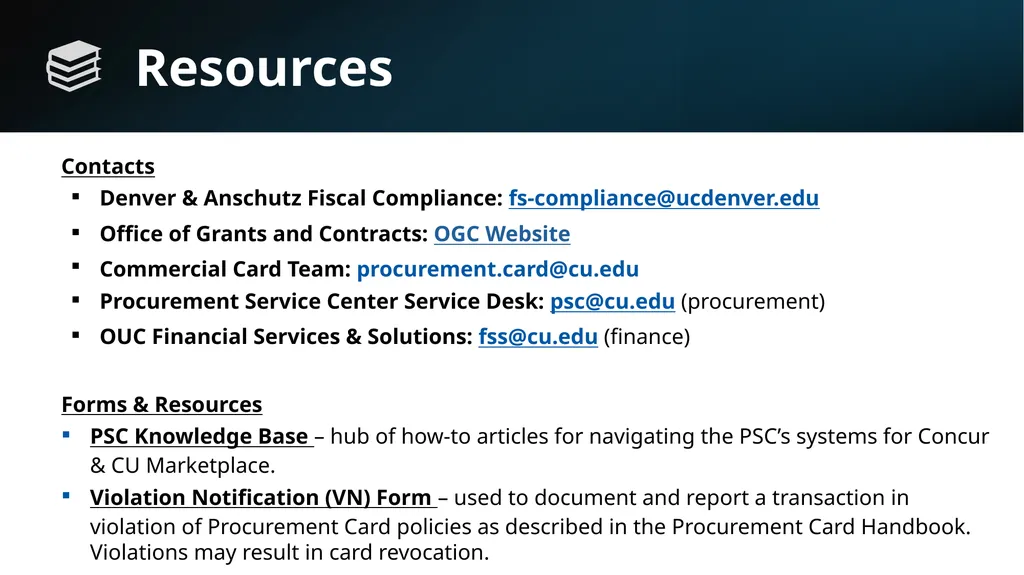
Resources Contacts
Denver & Anschutz Fiscal Compliance: fs-compliance@ucdenver.edu
Office of Grants and Contracts: OGC Website
Commercial Card Team: procurement.card@cu.edu
Procurement Service Center Service Desk: psc@cu.edu (procurement)
OUC Financial Services & Solutions: fss@cu.edu (finance)
Forms & Resources
PSC Knowledge Base – hub of how-to articles for navigating the PSC’s systems for Concur & CU Marketplace.
Violation Notification (VN) Form – used to document and report a transaction in violation of Procurement Card policies as described in the Procurement Card Handbook. Violations may result in card revocation.
CU EthicsLine – independent, anonymous way to report concerns or suspected misconduct.<br>
Denver & Anschutz Fiscal Compliance: fs-compliance@ucdenver.edu
Office of Grants and Contracts: OGC Website
Commercial Card Team: procurement.card@cu.edu
Procurement Service Center Service Desk: psc@cu.edu (procurement)
OUC Financial Services & Solutions: fss@cu.edu (finance)
Forms & Resources
PSC Knowledge Base – hub of how-to articles for navigating the PSC’s systems for Concur & CU Marketplace.
Violation Notification (VN) Form – used to document and report a transaction in violation of Procurement Card policies as described in the Procurement Card Handbook. Violations may result in card revocation.
CU EthicsLine – independent, anonymous way to report concerns or suspected misconduct.<br>
24
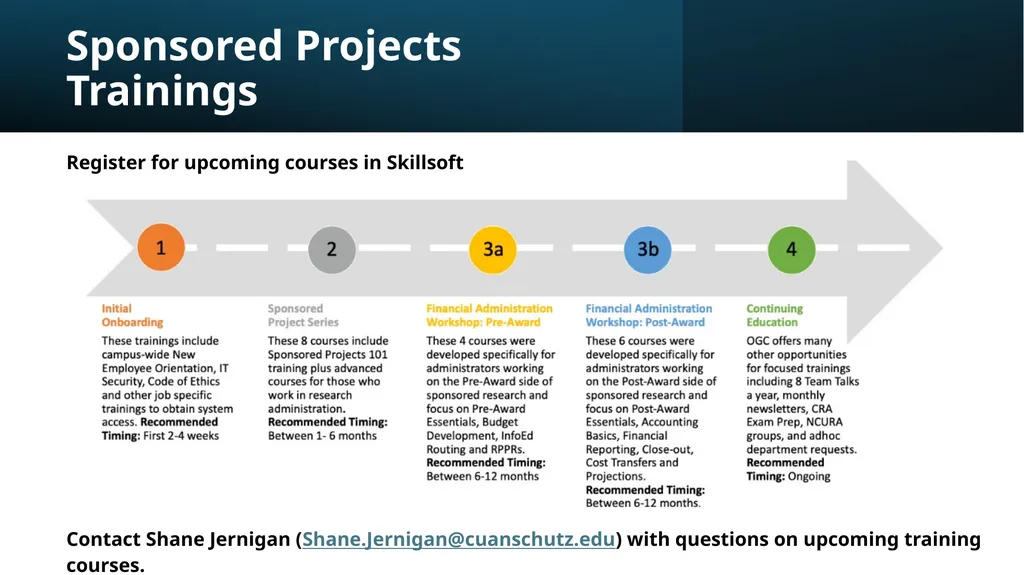
Sponsored Projects Trainings Register for upcoming courses in Skillsoft Contact Shane Jernigan (Shane.Jernigan@cuanschutz.edu) with questions on upcoming training courses.<br>
25
Questions<br>