
Treatment Intensification for Locally Advanced and
MY
Published · 48 slides · 0 views

1 / 1





Description
Treatment Intensification for Locally Advanced and BCR Prostate Cancer Patients Neal Shore, MD, FACS ADT Is a Key Component of Treatment for High-Risk Prostate Cancer Androgen deprivation therapy improves survival for men with high-risk
Related Topics
Share
Embed code
Download this presentation From Below
"Treatment Intensification for Locally Advanced and" is the property of its rightful owner. Permission is granted to download and print the materials on this website for personal, non-commercial use only, and to display it on your personal computer provided you do not modify the materials and that you retain all copyright notices contained in the materials. By downloading content from our website, you accept the terms of this agreement.
Presentation Transcript
01
Treatment Intensification for Locally Advanced and BCR Prostate Cancer Patients Neal Shore, MD, FACS<br>
02
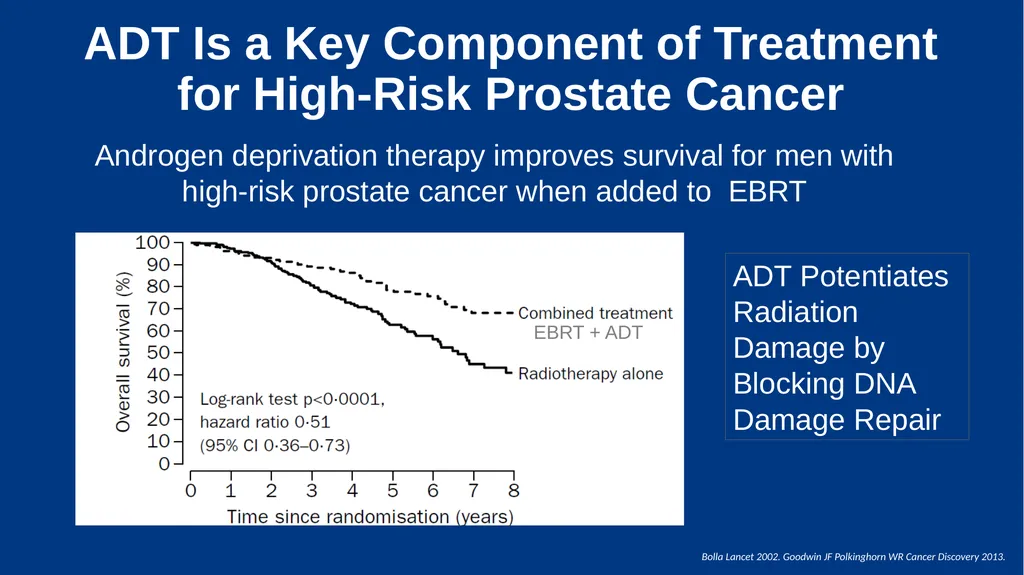
ADT Is a Key Component of Treatment
for High-Risk Prostate Cancer Androgen deprivation therapy improves survival for men with high-risk prostate cancer when added to EBRT Bolla Lancet 2002. Goodwin JF Polkinghorn WR Cancer Discovery 2013. ADT Potentiates Radiation Damage by Blocking DNA Damage Repair EBRT + ADT<br>
for High-Risk Prostate Cancer Androgen deprivation therapy improves survival for men with high-risk prostate cancer when added to EBRT Bolla Lancet 2002. Goodwin JF Polkinghorn WR Cancer Discovery 2013. ADT Potentiates Radiation Damage by Blocking DNA Damage Repair EBRT + ADT<br>
03
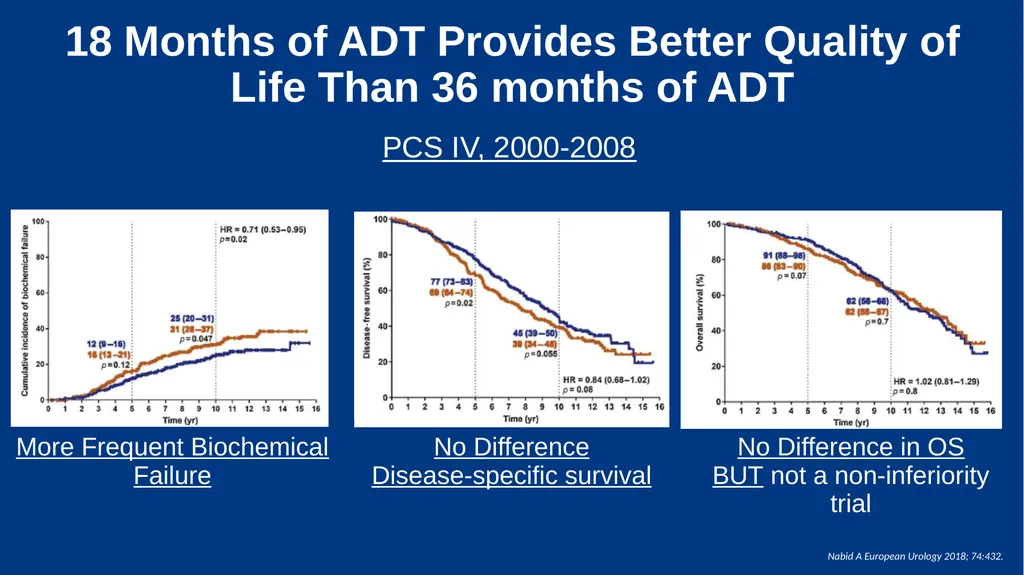
18 Months of ADT Provides Better Quality of Life Than 36 months of ADT Nabid A European Urology 2018; 74:432. PCS IV, 2000-2008<br>
04
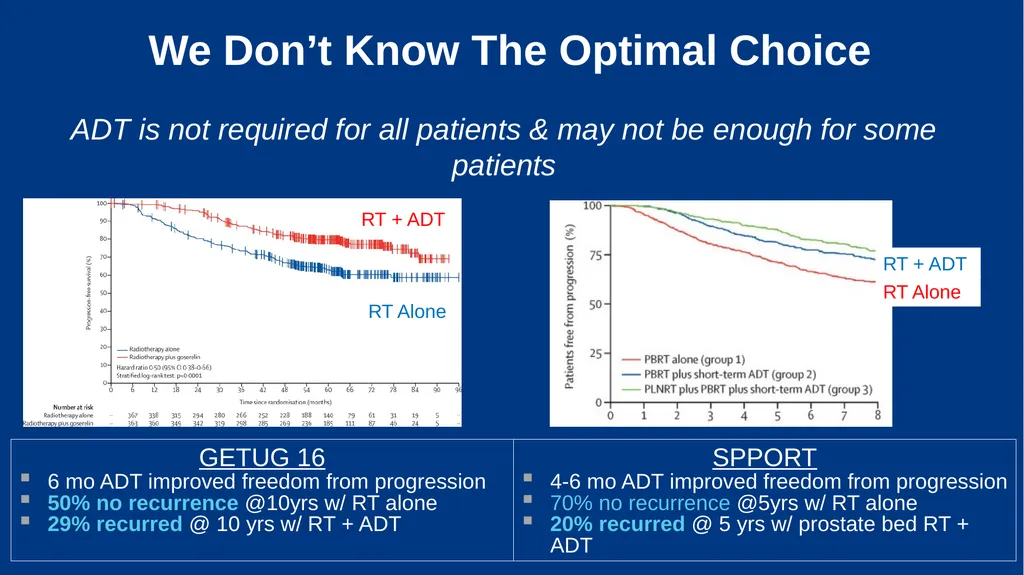
RT Alone RT + ADT RT Alone RT + ADT ADT is not required for all patients & may not be enough for some patients We Don’t Know The Optimal Choice<br>
05
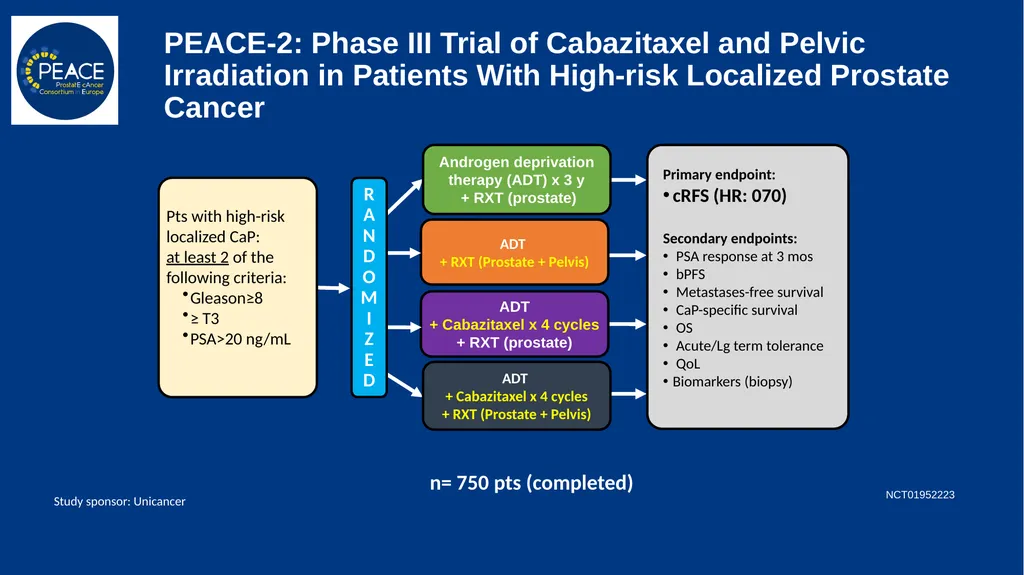
ADT
+ RXT (Prostate + Pelvis) Primary endpoint:
cRFS (HR: 070)
Secondary endpoints:
PSA response at 3 mos
bPFS
Metastases-free survival
CaP-specific survival
OS
Acute/Lg term tolerance
QoL
Biomarkers (biopsy) ADT
+ Cabazitaxel x 4 cycles
+ RXT (prostate) Pts with high-risk localized CaP:
at least 2 of the following criteria:
Gleason≥8
≥ T3
PSA>20 ng/mL Study sponsor: Unicancer Androgen deprivation therapy (ADT) x 3 y
+ RXT (prostate) ADT
+ Cabazitaxel x 4 cycles
+ RXT (Prostate + Pelvis) n= 750 pts (completed) PEACE-2: Phase III Trial of Cabazitaxel and Pelvic Irradiation in Patients With High-risk Localized Prostate Cancer NCT01952223 R A N D O M I Z E D<br>
+ RXT (Prostate + Pelvis) Primary endpoint:
cRFS (HR: 070)
Secondary endpoints:
PSA response at 3 mos
bPFS
Metastases-free survival
CaP-specific survival
OS
Acute/Lg term tolerance
QoL
Biomarkers (biopsy) ADT
+ Cabazitaxel x 4 cycles
+ RXT (prostate) Pts with high-risk localized CaP:
at least 2 of the following criteria:
Gleason≥8
≥ T3
PSA>20 ng/mL Study sponsor: Unicancer Androgen deprivation therapy (ADT) x 3 y
+ RXT (prostate) ADT
+ Cabazitaxel x 4 cycles
+ RXT (Prostate + Pelvis) n= 750 pts (completed) PEACE-2: Phase III Trial of Cabazitaxel and Pelvic Irradiation in Patients With High-risk Localized Prostate Cancer NCT01952223 R A N D O M I Z E D<br>
06
Attard, et al. Lancet, 2022 STAMPEDE: Abiraterone ± Enzalutamide in nmCSPC<br>
07
Attard, et al. Lancet, 2022 Baseline characteristics well balanced
Median age = 68
Median PSA = 34
39% N1
79% Gleason 8-10
97% patients newly diagnosed
85% receiving radiation
15% receiving primary ADT
Median follow-up = 72 months
No benefit to abi + enza vs. abi alone STAMPEDE: Abiraterone ± Enzalutamide in nmCSPC – arms combined<br>
Median age = 68
Median PSA = 34
39% N1
79% Gleason 8-10
97% patients newly diagnosed
85% receiving radiation
15% receiving primary ADT
Median follow-up = 72 months
No benefit to abi + enza vs. abi alone STAMPEDE: Abiraterone ± Enzalutamide in nmCSPC – arms combined<br>
08
Attard, et al. Lancet, 2022 STAMPEDE: Abiraterone ± Enzalutamide in nmCSPC<br>
09
STAMPEDE 1,974 PTS. Median 6-year follow up.
Node positive or 2 of the following: T3/4, Gleason 8-10, PSA >40, high-risk relapse Improvement in PFS, MFS, and OS with the Addition of Abiraterone and Prednisolone to ADT – Very High Risk Attard G Lancet 2021; 399:447. 6 yr MFS: 69% vs. 82% HR 0.53, p<0.001 HR 0.60, p<0.001 6 yr OS: 77% vs. 86% Median age 68. 73% T3/4. 79% Gl8-10. Median PSA 34. 39% Node-positive
No additional benefit to enzalutamide in addition to abiraterone.<br>
Node positive or 2 of the following: T3/4, Gleason 8-10, PSA >40, high-risk relapse Improvement in PFS, MFS, and OS with the Addition of Abiraterone and Prednisolone to ADT – Very High Risk Attard G Lancet 2021; 399:447. 6 yr MFS: 69% vs. 82% HR 0.53, p<0.001 HR 0.60, p<0.001 6 yr OS: 77% vs. 86% Median age 68. 73% T3/4. 79% Gl8-10. Median PSA 34. 39% Node-positive
No additional benefit to enzalutamide in addition to abiraterone.<br>
10
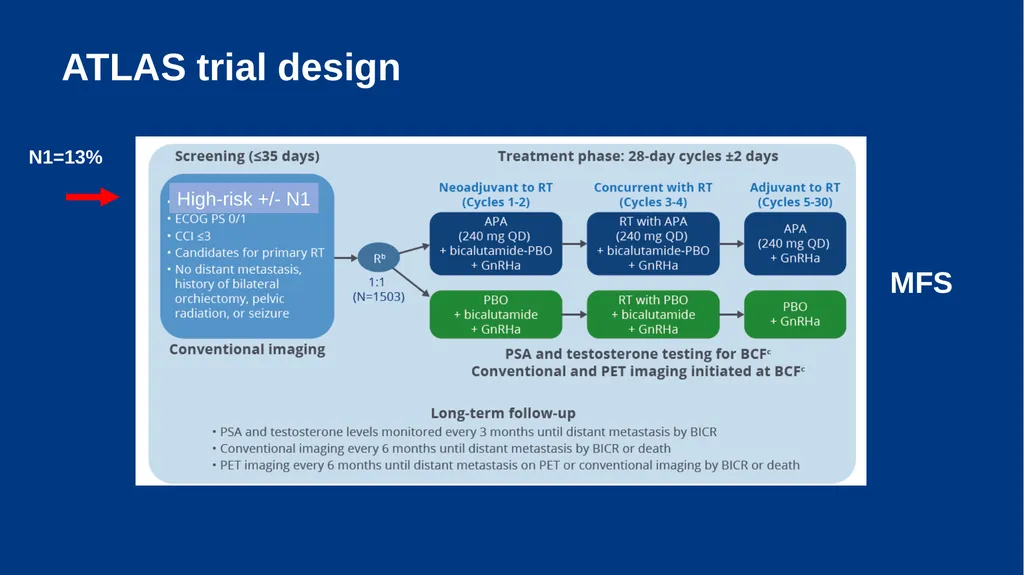
ATLAS trial design High-risk +/- N1 MFS N1=13%<br>
11
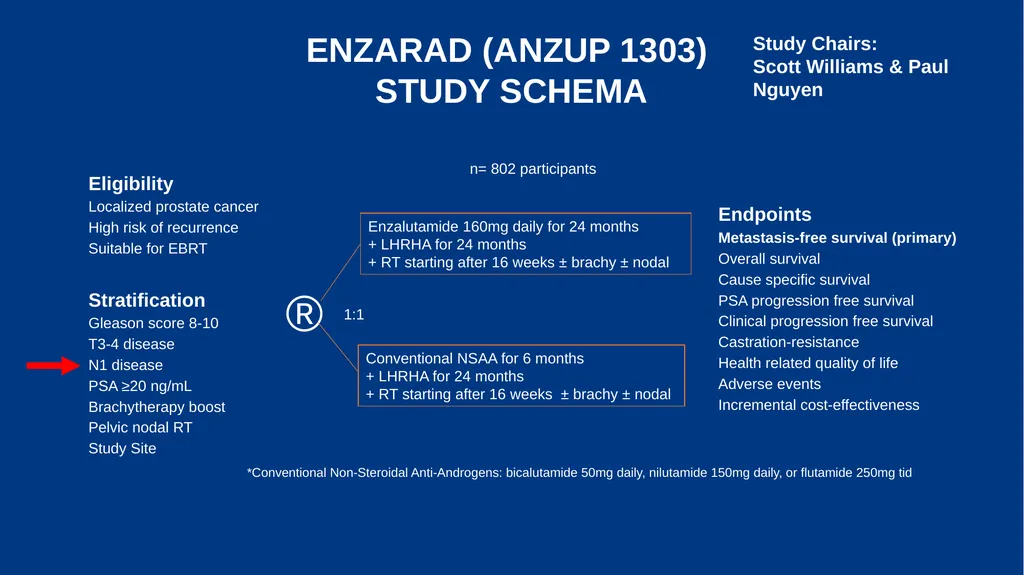
Eligibility
Localized prostate cancer
High risk of recurrence
Suitable for EBRT
Stratification
Gleason score 8-10
T3-4 disease
N1 disease
PSA ≥20 ng/mL
Brachytherapy boost
Pelvic nodal RT
Study Site Conventional NSAA for 6 months + LHRHA for 24 months + RT starting after 16 weeks ± brachy ± nodal ENZARAD (ANZUP 1303) STUDY SCHEMA Study Chairs:
Scott Williams & Paul Nguyen<br>
Localized prostate cancer
High risk of recurrence
Suitable for EBRT
Stratification
Gleason score 8-10
T3-4 disease
N1 disease
PSA ≥20 ng/mL
Brachytherapy boost
Pelvic nodal RT
Study Site Conventional NSAA for 6 months + LHRHA for 24 months + RT starting after 16 weeks ± brachy ± nodal ENZARAD (ANZUP 1303) STUDY SCHEMA Study Chairs:
Scott Williams & Paul Nguyen<br>
12
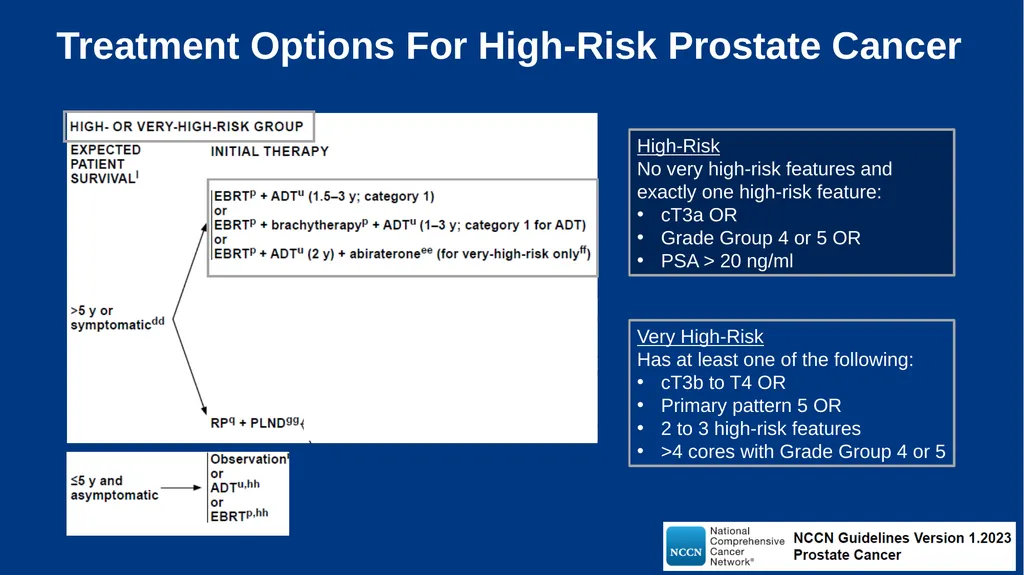
Treatment Options For High-Risk Prostate Cancer Very High-Risk
Has at least one of the following:
cT3b to T4 OR
Primary pattern 5 OR
2 to 3 high-risk features
>4 cores with Grade Group 4 or 5 High-Risk
No very high-risk features and exactly one high-risk feature:
cT3a OR
Grade Group 4 or 5 OR
PSA > 20 ng/ml<br>
Has at least one of the following:
cT3b to T4 OR
Primary pattern 5 OR
2 to 3 high-risk features
>4 cores with Grade Group 4 or 5 High-Risk
No very high-risk features and exactly one high-risk feature:
cT3a OR
Grade Group 4 or 5 OR
PSA > 20 ng/ml<br>
13
ADT with External Beam Radiation
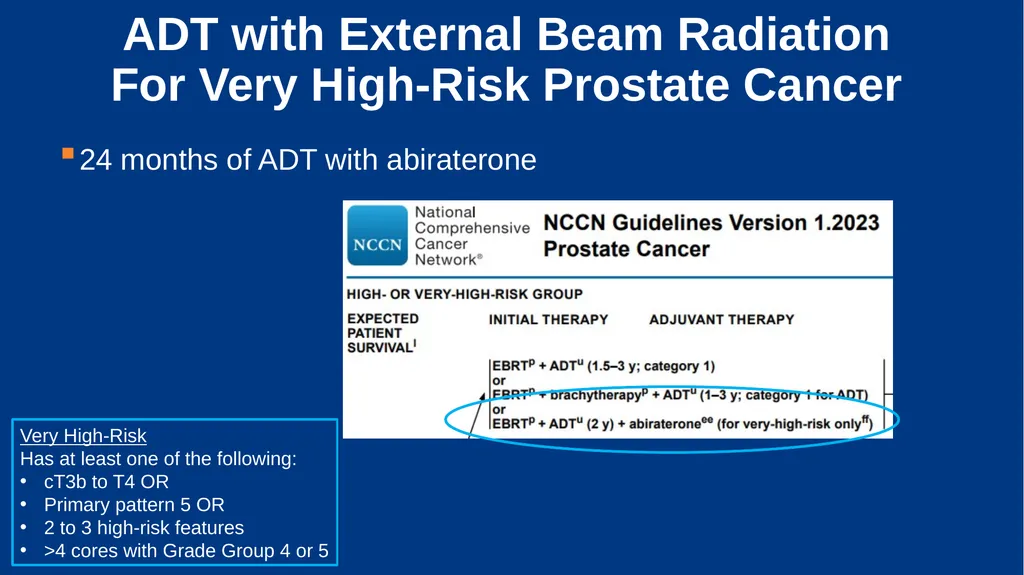
For Very High-Risk Prostate Cancer 24 months of ADT with abiraterone Very High-Risk
Has at least one of the following:
cT3b to T4 OR
Primary pattern 5 OR
2 to 3 high-risk features
>4 cores with Grade Group 4 or 5<br>
For Very High-Risk Prostate Cancer 24 months of ADT with abiraterone Very High-Risk
Has at least one of the following:
cT3b to T4 OR
Primary pattern 5 OR
2 to 3 high-risk features
>4 cores with Grade Group 4 or 5<br>
14
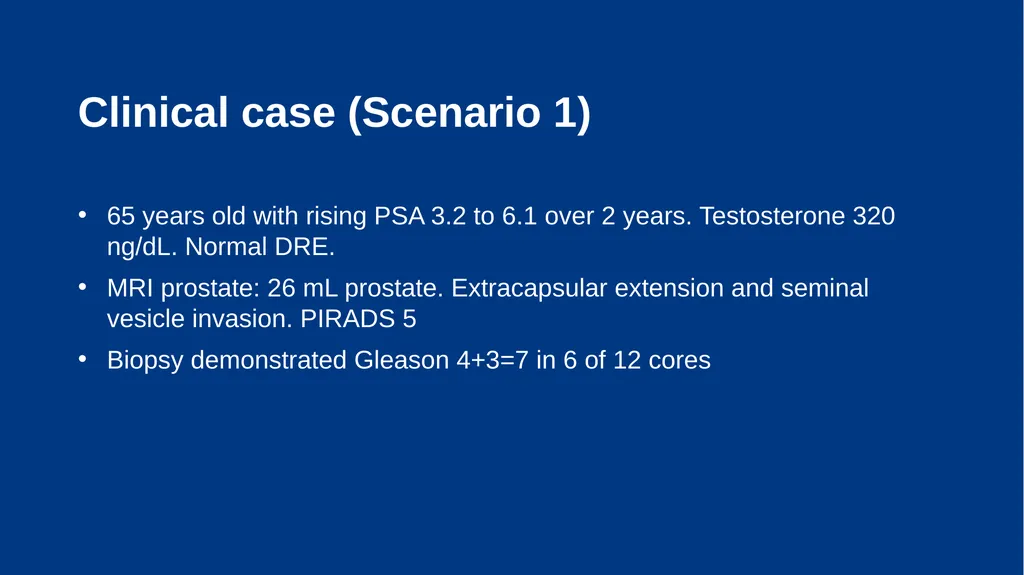
65 years old with rising PSA 3.2 to 6.1 over 2 years. Testosterone 320 ng/dL. Normal DRE.
MRI prostate: 26 mL prostate. Extracapsular extension and seminal vesicle invasion. PIRADS 5
Biopsy demonstrated Gleason 4+3=7 in 6 of 12 cores Clinical case (Scenario 1)<br>
MRI prostate: 26 mL prostate. Extracapsular extension and seminal vesicle invasion. PIRADS 5
Biopsy demonstrated Gleason 4+3=7 in 6 of 12 cores Clinical case (Scenario 1)<br>
15
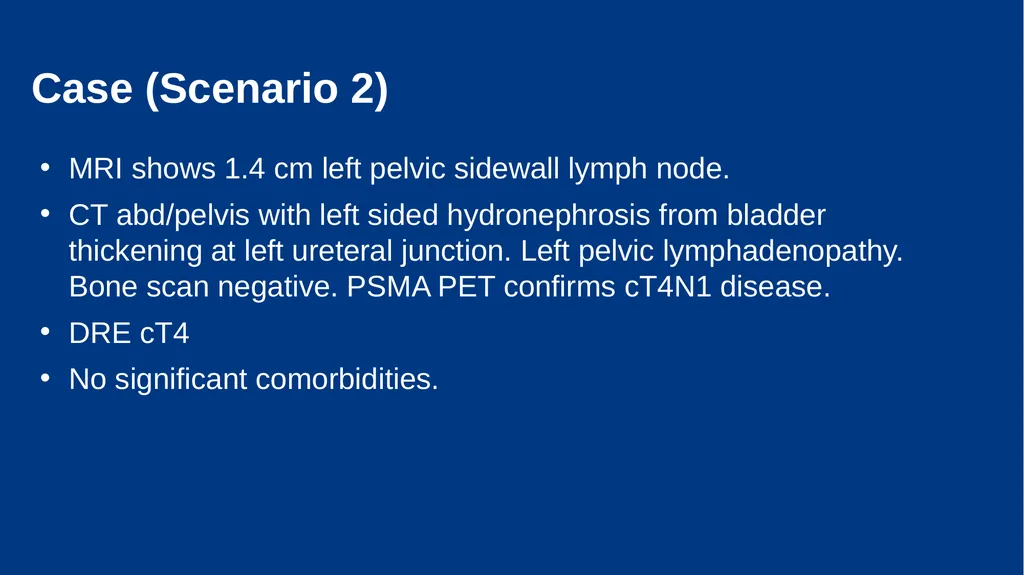
Case (Scenario 2) MRI shows 1.4 cm left pelvic sidewall lymph node.
CT abd/pelvis with left sided hydronephrosis from bladder thickening at left ureteral junction. Left pelvic lymphadenopathy. Bone scan negative. PSMA PET confirms cT4N1 disease.
DRE cT4
No significant comorbidities.<br>
CT abd/pelvis with left sided hydronephrosis from bladder thickening at left ureteral junction. Left pelvic lymphadenopathy. Bone scan negative. PSMA PET confirms cT4N1 disease.
DRE cT4
No significant comorbidities.<br>
16
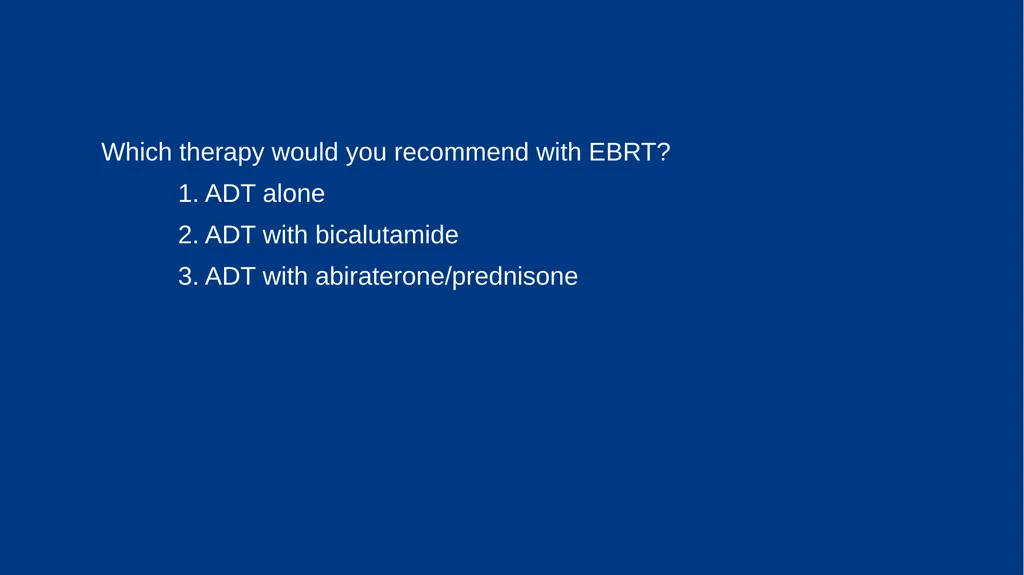
Which therapy would you recommend with EBRT?
1. ADT alone
2. ADT with bicalutamide
3. ADT with abiraterone/prednisone<br>
1. ADT alone
2. ADT with bicalutamide
3. ADT with abiraterone/prednisone<br>
17
Paris, France
11 SEP 2022 PRESTO: A Phase 3 Open-Label Study of Androgen Annihilation in Patients with High-Risk Biochemically Relapsed Prostate Cancer (AFT-19) Rahul Aggarwal, on behalf of the Alliance AFT-19 Study Investigators<br>
11 SEP 2022 PRESTO: A Phase 3 Open-Label Study of Androgen Annihilation in Patients with High-Risk Biochemically Relapsed Prostate Cancer (AFT-19) Rahul Aggarwal, on behalf of the Alliance AFT-19 Study Investigators<br>
18
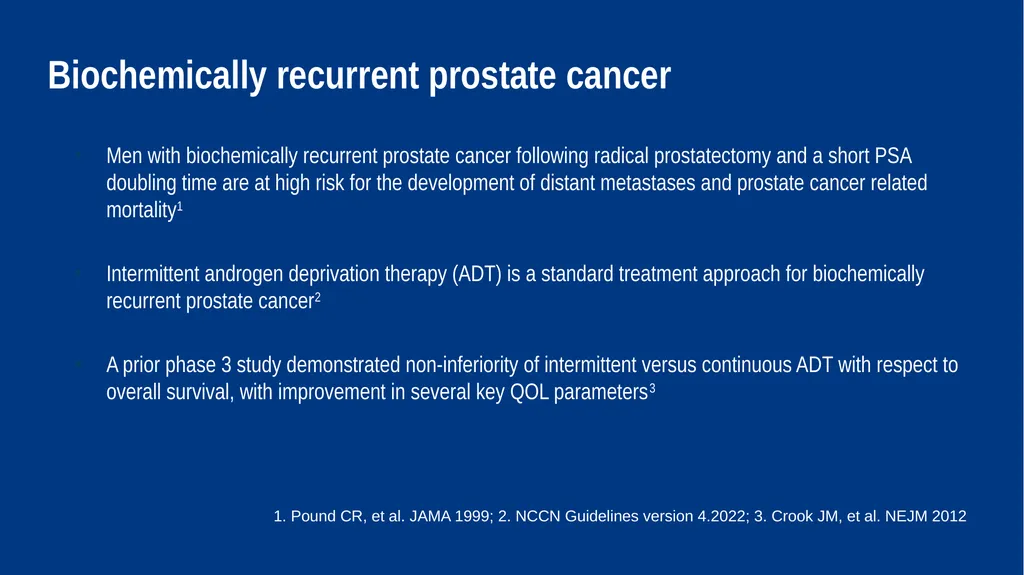
Biochemically recurrent prostate cancer Men with biochemically recurrent prostate cancer following radical prostatectomy and a short PSA doubling time are at high risk for the development of distant metastases and prostate cancer related mortality1
Intermittent androgen deprivation therapy (ADT) is a standard treatment approach for biochemically recurrent prostate cancer2
A prior phase 3 study demonstrated non-inferiority of intermittent versus continuous ADT with respect to overall survival, with improvement in several key QOL parameters3 1. Pound CR, et al. JAMA 1999; 2. NCCN Guidelines version 4.2022; 3. Crook JM, et al. NEJM 2012<br>
Intermittent androgen deprivation therapy (ADT) is a standard treatment approach for biochemically recurrent prostate cancer2
A prior phase 3 study demonstrated non-inferiority of intermittent versus continuous ADT with respect to overall survival, with improvement in several key QOL parameters3 1. Pound CR, et al. JAMA 1999; 2. NCCN Guidelines version 4.2022; 3. Crook JM, et al. NEJM 2012<br>
19
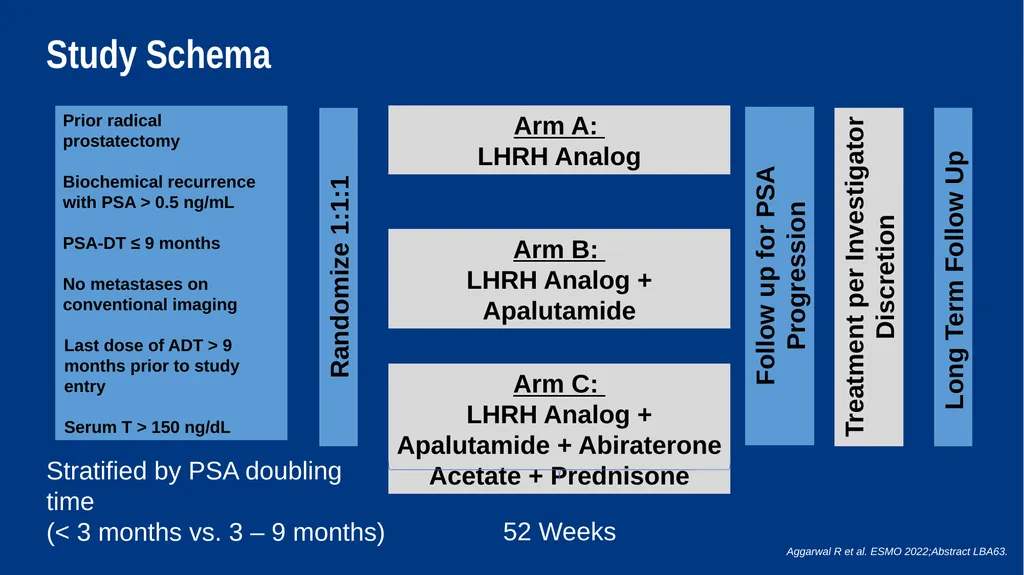
Study Schema Prior radical prostatectomy
Biochemical recurrence with PSA > 0.5 ng/mL
PSA-DT ≤ 9 months
No metastases on conventional imaging
Last dose of ADT > 9 months prior to study entry
Serum T > 150 ng/dL Randomize 1:1:1 Stratified by PSA doubling time
(< 3 months vs. 3 – 9 months) Arm A:
LHRH Analog Arm B:
LHRH Analog + Apalutamide Arm C:
LHRH Analog + Apalutamide + Abiraterone Acetate + Prednisone 52 Weeks Follow up for PSA Progression Treatment per Investigator Discretion Long Term Follow Up Aggarwal R et al. ESMO 2022;Abstract LBA63.<br>
Biochemical recurrence with PSA > 0.5 ng/mL
PSA-DT ≤ 9 months
No metastases on conventional imaging
Last dose of ADT > 9 months prior to study entry
Serum T > 150 ng/dL Randomize 1:1:1 Stratified by PSA doubling time
(< 3 months vs. 3 – 9 months) Arm A:
LHRH Analog Arm B:
LHRH Analog + Apalutamide Arm C:
LHRH Analog + Apalutamide + Abiraterone Acetate + Prednisone 52 Weeks Follow up for PSA Progression Treatment per Investigator Discretion Long Term Follow Up Aggarwal R et al. ESMO 2022;Abstract LBA63.<br>
20
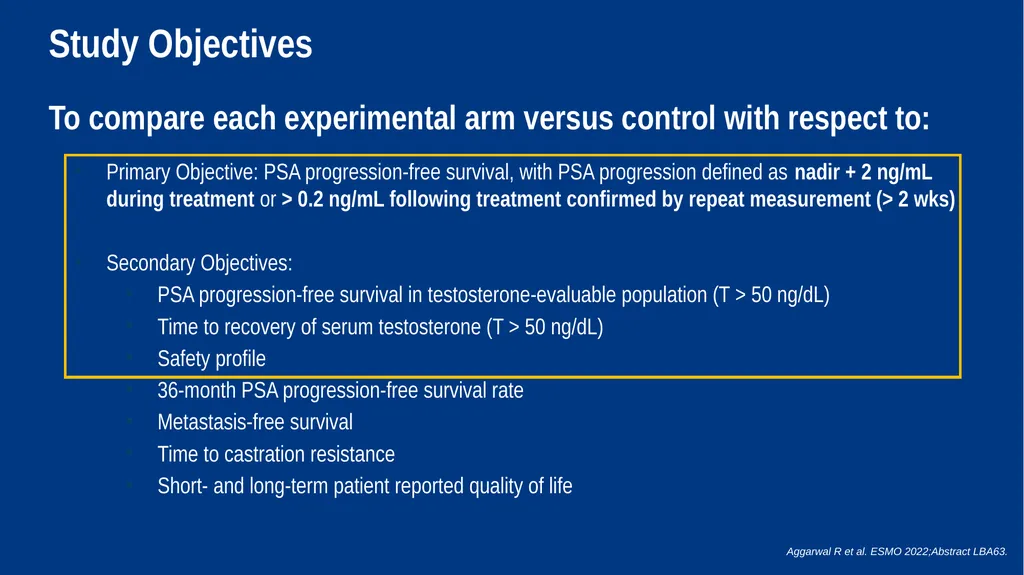
Study Objectives
To compare each experimental arm versus control with respect to: Primary Objective: PSA progression-free survival, with PSA progression defined as nadir + 2 ng/mL during treatment or > 0.2 ng/mL following treatment confirmed by repeat measurement (> 2 wks)
Secondary Objectives:
PSA progression-free survival in testosterone-evaluable population (T > 50 ng/dL)
Time to recovery of serum testosterone (T > 50 ng/dL)
Safety profile
36-month PSA progression-free survival rate
Metastasis-free survival
Time to castration resistance
Short- and long-term patient reported quality of life Aggarwal R et al. ESMO 2022;Abstract LBA63.<br>
Secondary Objectives:
PSA progression-free survival in testosterone-evaluable population (T > 50 ng/dL)
Time to recovery of serum testosterone (T > 50 ng/dL)
Safety profile
36-month PSA progression-free survival rate
Metastasis-free survival
Time to castration resistance
Short- and long-term patient reported quality of life Aggarwal R et al. ESMO 2022;Abstract LBA63.<br>
21
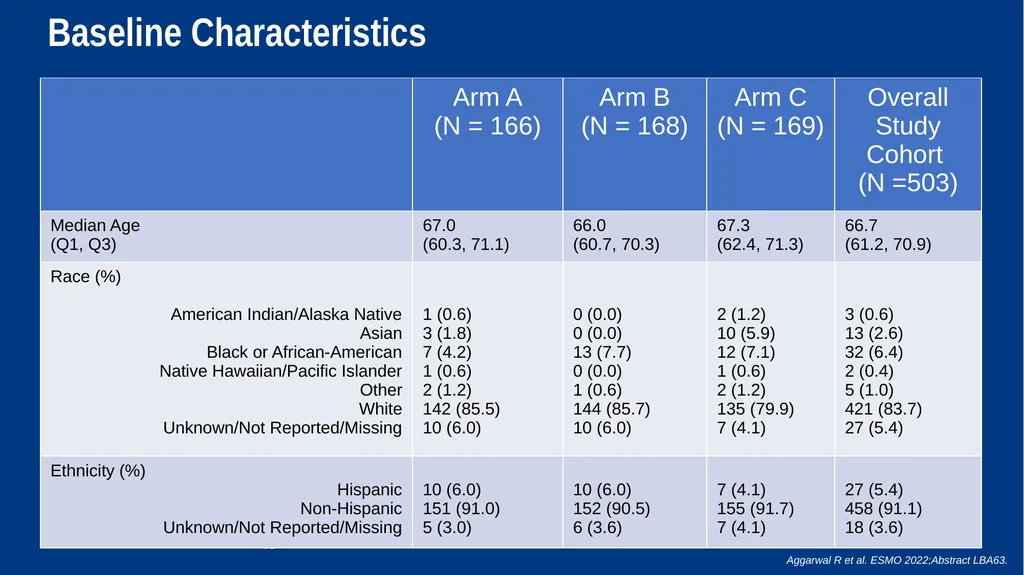
Baseline Characteristics Rahul Aggarwal, MD Aggarwal R et al. ESMO 2022;Abstract LBA63.<br>
22
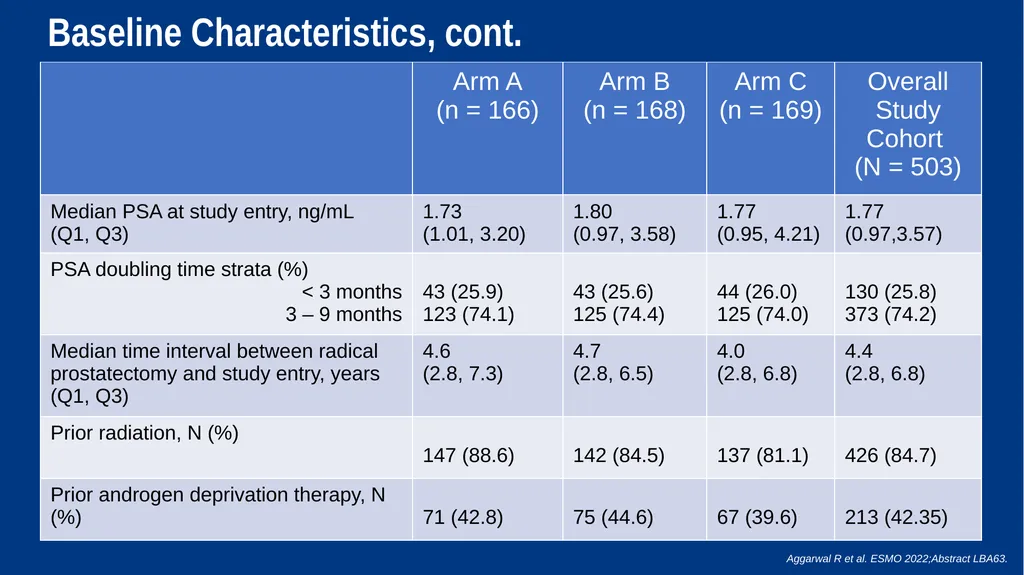
Baseline Characteristics, cont. Aggarwal R et al. ESMO 2022;Abstract LBA63.<br>
23
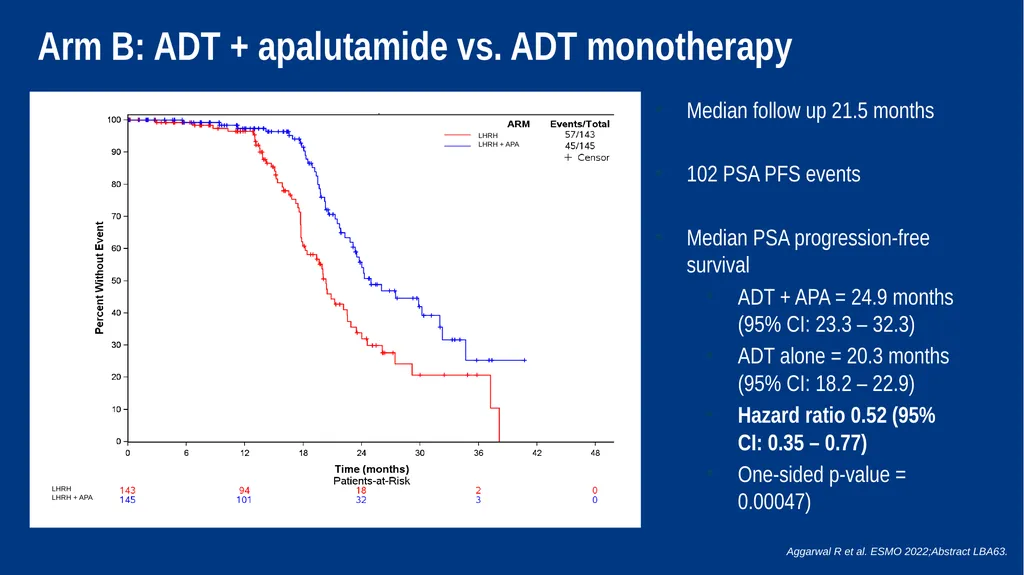
Arm B: ADT + apalutamide vs. ADT monotherapy Median follow up 21.5 months
102 PSA PFS events
Median PSA progression-free survival
ADT + APA = 24.9 months (95% CI: 23.3 – 32.3)
ADT alone = 20.3 months (95% CI: 18.2 – 22.9)
Hazard ratio 0.52 (95% CI: 0.35 – 0.77)
One-sided p-value = 0.00047) LHRH
LHRH + APA LHRH
LHRH + APA Aggarwal R et al. ESMO 2022;Abstract LBA63.<br>
102 PSA PFS events
Median PSA progression-free survival
ADT + APA = 24.9 months (95% CI: 23.3 – 32.3)
ADT alone = 20.3 months (95% CI: 18.2 – 22.9)
Hazard ratio 0.52 (95% CI: 0.35 – 0.77)
One-sided p-value = 0.00047) LHRH
LHRH + APA LHRH
LHRH + APA Aggarwal R et al. ESMO 2022;Abstract LBA63.<br>
24
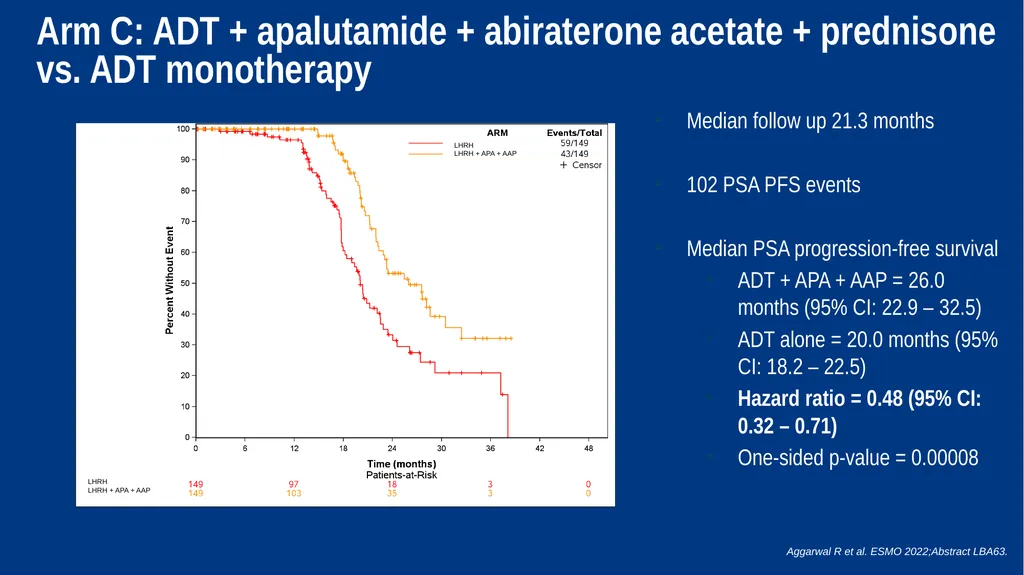
Arm C: ADT + apalutamide + abiraterone acetate + prednisone vs. ADT monotherapy Median follow up 21.3 months
102 PSA PFS events
Median PSA progression-free survival
ADT + APA + AAP = 26.0 months (95% CI: 22.9 – 32.5)
ADT alone = 20.0 months (95% CI: 18.2 – 22.5)
Hazard ratio = 0.48 (95% CI: 0.32 – 0.71)
One-sided p-value = 0.00008 LHRH
LHRH + APA + AAP LHRH
LHRH + APA + AAP Aggarwal R et al. ESMO 2022;Abstract LBA63.<br>
102 PSA PFS events
Median PSA progression-free survival
ADT + APA + AAP = 26.0 months (95% CI: 22.9 – 32.5)
ADT alone = 20.0 months (95% CI: 18.2 – 22.5)
Hazard ratio = 0.48 (95% CI: 0.32 – 0.71)
One-sided p-value = 0.00008 LHRH
LHRH + APA + AAP LHRH
LHRH + APA + AAP Aggarwal R et al. ESMO 2022;Abstract LBA63.<br>
25
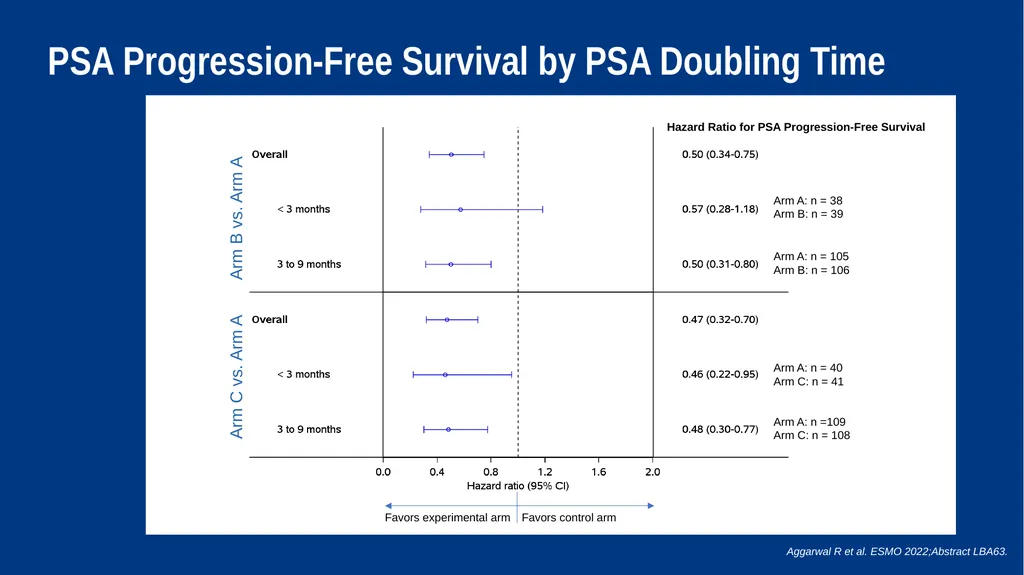
PSA Progression-Free Survival by PSA Doubling Time Favors experimental arm Favors control arm Hazard Ratio for PSA Progression-Free Survival Arm B vs. Arm A Arm C vs. Arm A Arm A: n = 38
Arm B: n = 39 Arm A: n = 105
Arm B: n = 106 Arm A: n =109
Arm C: n = 108 Arm A: n = 40
Arm C: n = 41 Aggarwal R et al. ESMO 2022;Abstract LBA63.<br>
Arm B: n = 39 Arm A: n = 105
Arm B: n = 106 Arm A: n =109
Arm C: n = 108 Arm A: n = 40
Arm C: n = 41 Aggarwal R et al. ESMO 2022;Abstract LBA63.<br>
26
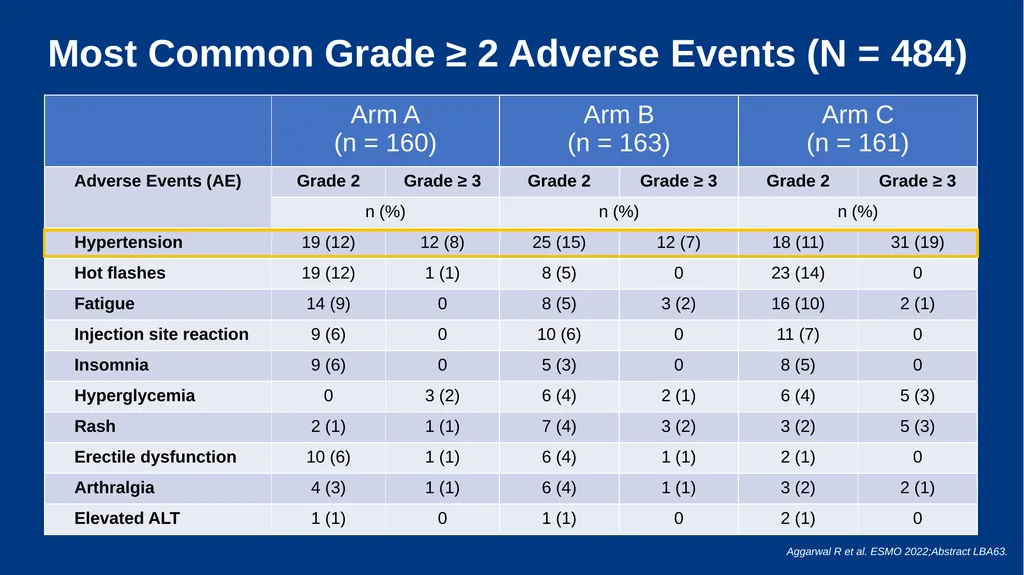
Most Common Grade ≥ 2 Adverse Events (N = 484) Aggarwal R et al. ESMO 2022;Abstract LBA63.<br>
27
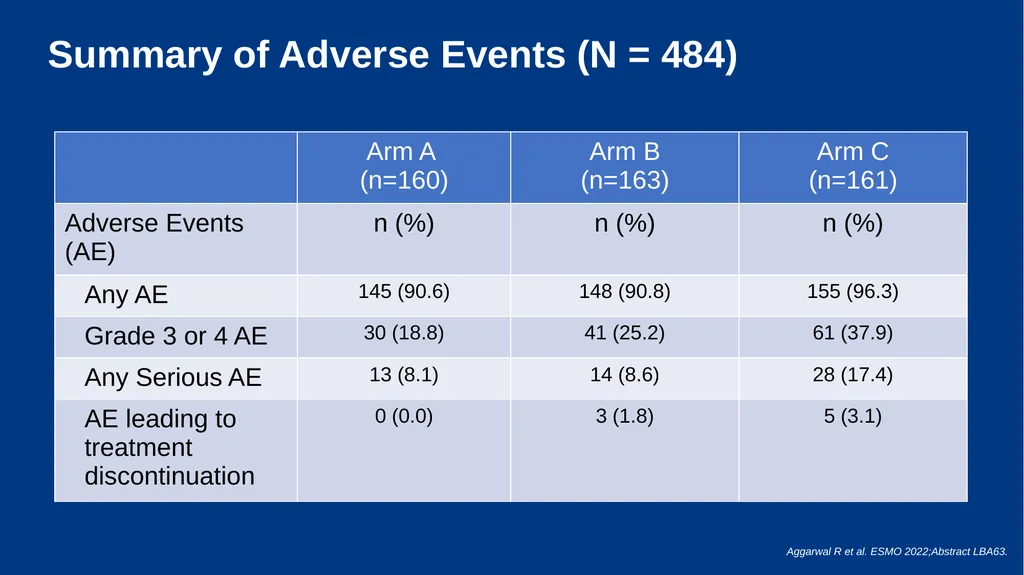
Summary of Adverse Events (N = 484) Aggarwal R et al. ESMO 2022;Abstract LBA63.<br>
28
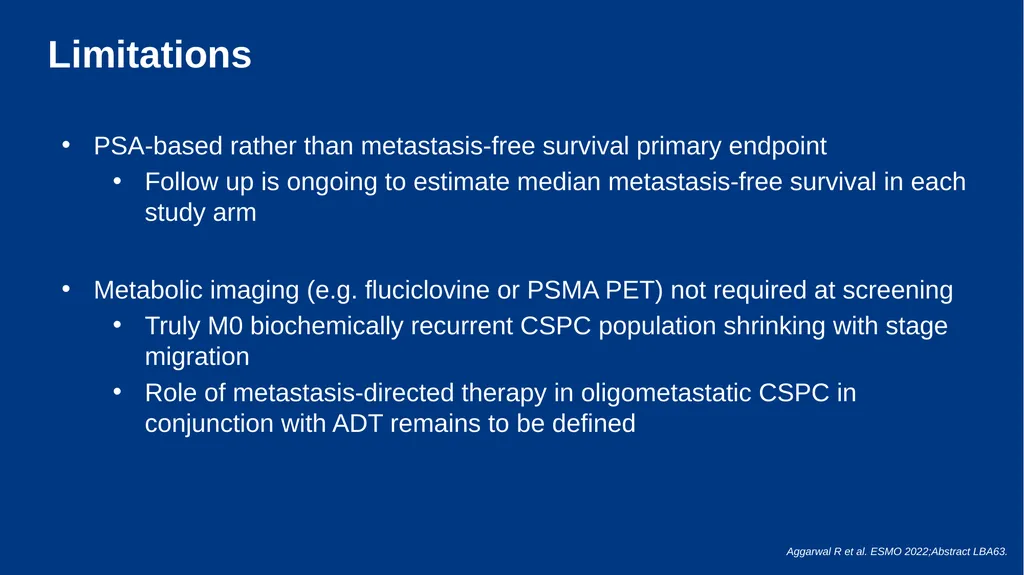
Limitations Aggarwal R et al. ESMO 2022;Abstract LBA63. PSA-based rather than metastasis-free survival primary endpoint
Follow up is ongoing to estimate median metastasis-free survival in each study arm
Metabolic imaging (e.g. fluciclovine or PSMA PET) not required at screening
Truly M0 biochemically recurrent CSPC population shrinking with stage migration
Role of metastasis-directed therapy in oligometastatic CSPC in conjunction with ADT remains to be defined<br>
Follow up is ongoing to estimate median metastasis-free survival in each study arm
Metabolic imaging (e.g. fluciclovine or PSMA PET) not required at screening
Truly M0 biochemically recurrent CSPC population shrinking with stage migration
Role of metastasis-directed therapy in oligometastatic CSPC in conjunction with ADT remains to be defined<br>
29
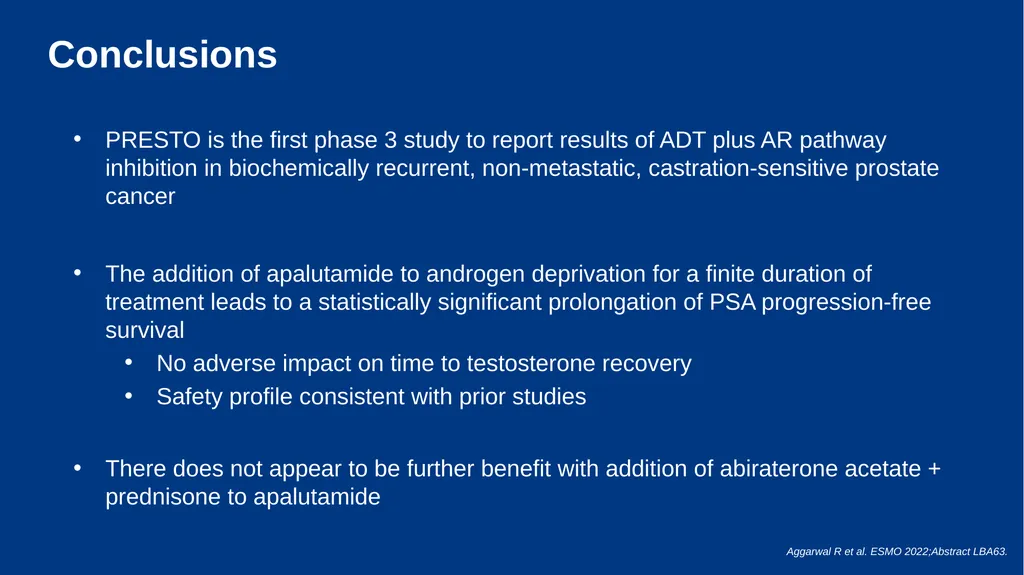
Conclusions Aggarwal R et al. ESMO 2022;Abstract LBA63. PRESTO is the first phase 3 study to report results of ADT plus AR pathway inhibition in biochemically recurrent, non-metastatic, castration-sensitive prostate cancer
The addition of apalutamide to androgen deprivation for a finite duration of treatment leads to a statistically significant prolongation of PSA progression-free survival
No adverse impact on time to testosterone recovery
Safety profile consistent with prior studies
There does not appear to be further benefit with addition of abiraterone acetate + prednisone to apalutamide<br>
The addition of apalutamide to androgen deprivation for a finite duration of treatment leads to a statistically significant prolongation of PSA progression-free survival
No adverse impact on time to testosterone recovery
Safety profile consistent with prior studies
There does not appear to be further benefit with addition of abiraterone acetate + prednisone to apalutamide<br>
30
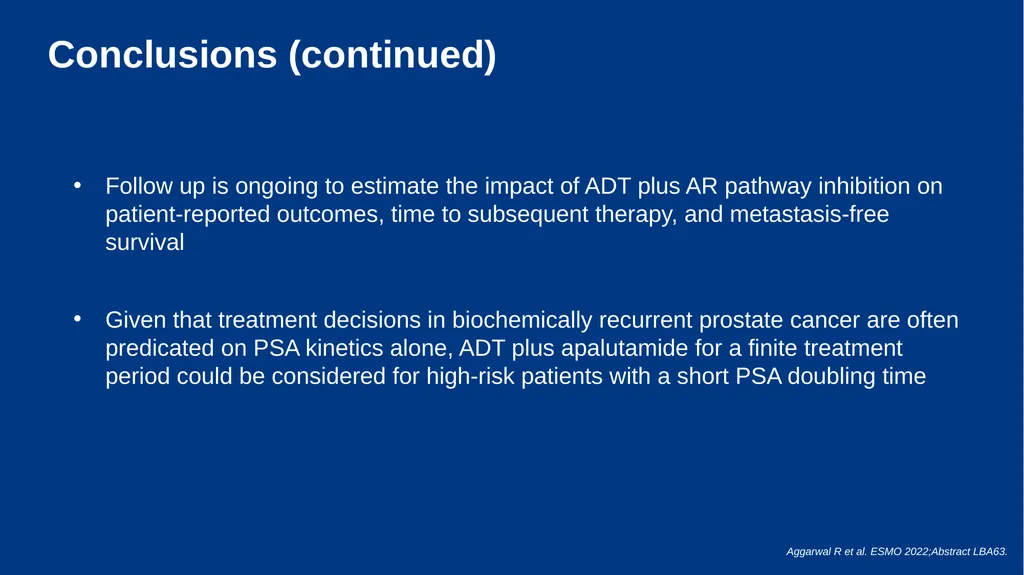
Conclusions (continued) Aggarwal R et al. ESMO 2022;Abstract LBA63. Follow up is ongoing to estimate the impact of ADT plus AR pathway inhibition on patient-reported outcomes, time to subsequent therapy, and metastasis-free survival
Given that treatment decisions in biochemically recurrent prostate cancer are often predicated on PSA kinetics alone, ADT plus apalutamide for a finite treatment period could be considered for high-risk patients with a short PSA doubling time<br>
Given that treatment decisions in biochemically recurrent prostate cancer are often predicated on PSA kinetics alone, ADT plus apalutamide for a finite treatment period could be considered for high-risk patients with a short PSA doubling time<br>
31
EMBARK: A Phase 3 Randomized Study of Enzalutamide or Placebo Plus Leuprolide Acetate and Enzalutamide Monotherapy in High-Risk Biochemically Recurrent Prostate Cancer Neal D. Shore,1 Murilo de Almeida Luz,2 Ugo De Giorgi,3 Martin Gleave,4 Geoffrey T. Gotto,5 Gabriel P. Haas,6 Miguel Ramirez-Backhaus,7 Antti Rannikko,8 Jamal Tarazi,9 Swetha Sridharan,10 Jennifer Sugg,6 Yiyun Tang,11 Ronald F. Tutrone, Jr.,12 Balaji Venugopal,13 Arnauld Villers,14 Henry H. Woo,15 Fabian Zohren,16 Stephen J. Freedland17 1Carolina Urologic Research Center/GenesisCare US, Myrtle Beach, SC, USA; 2Erasto Gaertner Hospital, Curitiba, Brazil; 3IRCCS Istituto Romagnolo per lo Studio dei Tumori (IRST) Dino Amadori, Meldola, Italy; 4University of British Columbia, Vancouver, BC, Canada; 5University of Calgary, Calgary, AB, Canada; 6Astellas Pharma Inc., Northbrook, IL, USA; 7Servicio de Urología, Fundación Instituto Valenciano de Oncología, Valencia, Spain; 8University of Helsinki and Helsinki University Hospital, Helsinki, Finland; 9Pfizer Inc., Collegeville, PA, USA; 10Calvary Mater, Newcastle, NSW, Australia; 11Pfizer Inc., San Francisco, CA, USA; 12Chesapeake Urology Research Associates, Towson, MD, USA; 13Beatson West of Scotland Cancer Centre, University of Glasgow, Glasgow, UK; 14University of Lille, Department of Urology, Claude Huriez Hospital, CHU LILLE, Lille, France; 15Sydney Adventist Hospital, Sydney, NSW, Australia; 16Pfizer Inc., Cambridge, MA, USA; 17Samuel Oschin Comprehensive Cancer Institute,
Cedars-Sinai Medical Center, Los Angeles, CA, USA<br>
32
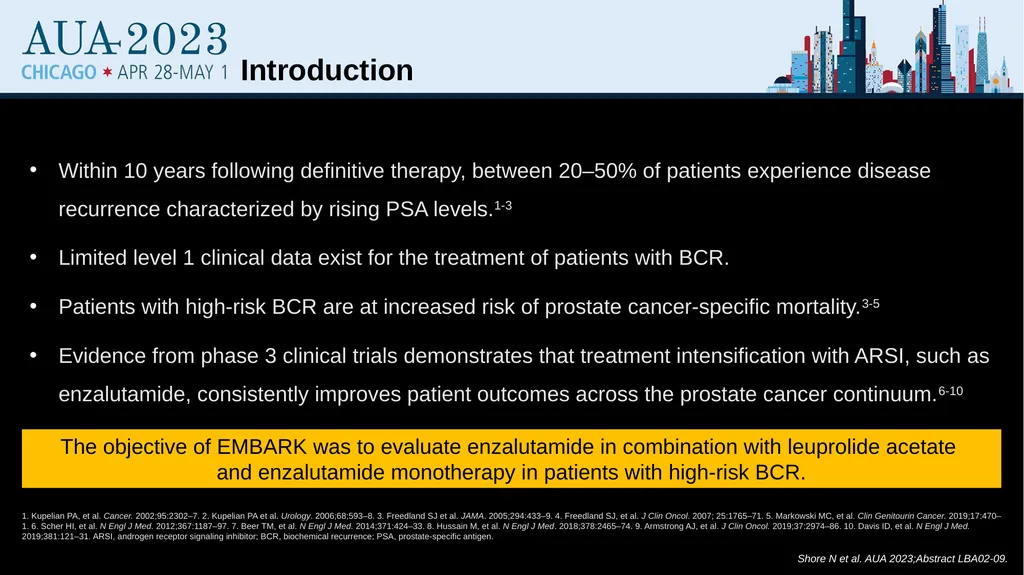
Within 10 years following definitive therapy, between 20–50% of patients experience disease recurrence characterized by rising PSA levels.1-3
Limited level 1 clinical data exist for the treatment of patients with BCR.
Patients with high-risk BCR are at increased risk of prostate cancer-specific mortality.3-5
Evidence from phase 3 clinical trials demonstrates that treatment intensification with ARSI, such as enzalutamide, consistently improves patient outcomes across the prostate cancer continuum.6-10 Introduction 1. Kupelian PA, et al. Cancer. 2002;95:2302–7. 2. Kupelian PA et al. Urology. 2006;68;593–8. 3. Freedland SJ et al. JAMA. 2005;294:433–9. 4. Freedland SJ, et al. J Clin Oncol. 2007; 25:1765–71. 5. Markowski MC, et al. Clin Genitourin Cancer. 2019;17:470–1. 6. Scher HI, et al. N Engl J Med. 2012;367:1187–97. 7. Beer TM, et al. N Engl J Med. 2014;371:424–33. 8. Hussain M, et al. N Engl J Med. 2018;378:2465–74. 9. Armstrong AJ, et al. J Clin Oncol. 2019;37:2974–86. 10. Davis ID, et al. N Engl J Med. 2019;381:121–31. ARSI, androgen receptor signaling inhibitor; BCR, biochemical recurrence; PSA, prostate-specific antigen. The objective of EMBARK was to evaluate enzalutamide in combination with leuprolide acetate and enzalutamide monotherapy in patients with high-risk BCR. Shore N et al. AUA 2023;Abstract LBA02-09.<br>
Limited level 1 clinical data exist for the treatment of patients with BCR.
Patients with high-risk BCR are at increased risk of prostate cancer-specific mortality.3-5
Evidence from phase 3 clinical trials demonstrates that treatment intensification with ARSI, such as enzalutamide, consistently improves patient outcomes across the prostate cancer continuum.6-10 Introduction 1. Kupelian PA, et al. Cancer. 2002;95:2302–7. 2. Kupelian PA et al. Urology. 2006;68;593–8. 3. Freedland SJ et al. JAMA. 2005;294:433–9. 4. Freedland SJ, et al. J Clin Oncol. 2007; 25:1765–71. 5. Markowski MC, et al. Clin Genitourin Cancer. 2019;17:470–1. 6. Scher HI, et al. N Engl J Med. 2012;367:1187–97. 7. Beer TM, et al. N Engl J Med. 2014;371:424–33. 8. Hussain M, et al. N Engl J Med. 2018;378:2465–74. 9. Armstrong AJ, et al. J Clin Oncol. 2019;37:2974–86. 10. Davis ID, et al. N Engl J Med. 2019;381:121–31. ARSI, androgen receptor signaling inhibitor; BCR, biochemical recurrence; PSA, prostate-specific antigen. The objective of EMBARK was to evaluate enzalutamide in combination with leuprolide acetate and enzalutamide monotherapy in patients with high-risk BCR. Shore N et al. AUA 2023;Abstract LBA02-09.<br>
33
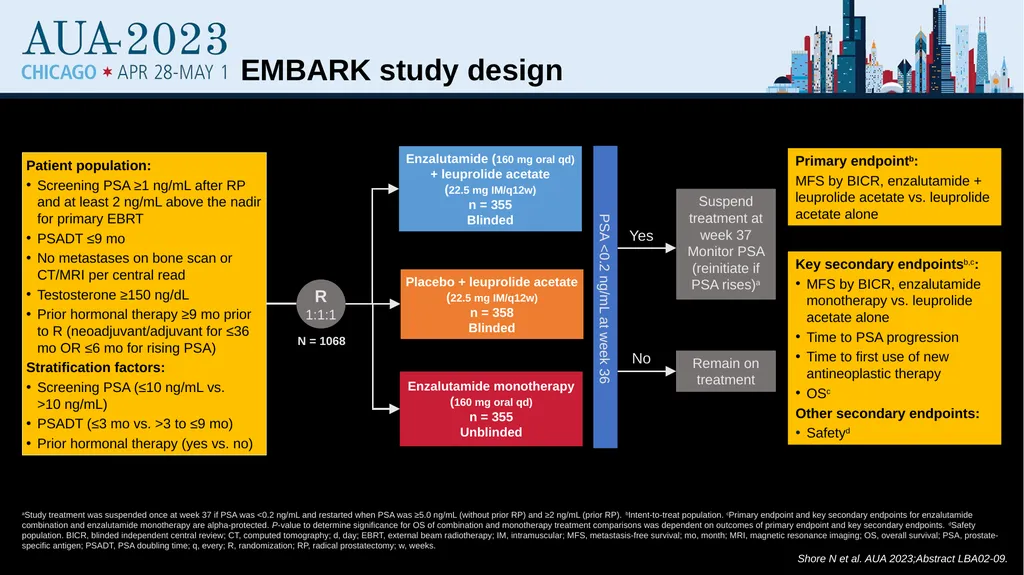
EMBARK study design aStudy treatment was suspended once at week 37 if PSA was <0.2 ng/mL and restarted when PSA was ≥5.0 ng/mL (without prior RP) and ≥2 ng/mL (prior RP). bIntent-to-treat population. cPrimary endpoint and key secondary endpoints for enzalutamide combination and enzalutamide monotherapy are alpha-protected. P-value to determine significance for OS of combination and monotherapy treatment comparisons was dependent on outcomes of primary endpoint and key secondary endpoints. dSafety population. BICR, blinded independent central review; CT, computed tomography; d, day; EBRT, external beam radiotherapy; IM, intramuscular; MFS, metastasis-free survival; mo, month; MRI, magnetic resonance imaging; OS, overall survival; PSA, prostate-specific antigen; PSADT, PSA doubling time; q, every; R, randomization; RP, radical prostatectomy; w, weeks. Key secondary endpointsb,c:
MFS by BICR, enzalutamide monotherapy vs. leuprolide acetate alone
Time to PSA progression
Time to first use of new antineoplastic therapy
OSc
Other secondary endpoints:
Safetyd N = 1068 Patient population:
Screening PSA ≥1 ng/mL after RP and at least 2 ng/mL above the nadir for primary EBRT
PSADT ≤9 mo
No metastases on bone scan or CT/MRI per central read
Testosterone ≥150 ng/dL
Prior hormonal therapy ≥9 mo prior to R (neoadjuvant/adjuvant for ≤36 mo OR ≤6 mo for rising PSA)
Stratification factors:
Screening PSA (≤10 ng/mL vs. >10 ng/mL)
PSADT (≤3 mo vs. >3 to ≤9 mo)
Prior hormonal therapy (yes vs. no) PSA <0.2 ng/mL at week 36 Suspend treatment at week 37 Monitor PSA (reinitiate if PSA rises)a Remain on treatment Week 37 Yes No Primary endpointb:
MFS by BICR, enzalutamide + leuprolide acetate vs. leuprolide acetate alone Placebo + leuprolide acetate (22.5 mg IM/q12w)
n = 358
Blinded Enzalutamide monotherapy (160 mg oral qd)
n = 355
Unblinded Enzalutamide (160 mg oral qd) + leuprolide acetate (22.5 mg IM/q12w)
n = 355
Blinded R
1:1:1 Shore N et al. AUA 2023;Abstract LBA02-09.<br>
MFS by BICR, enzalutamide monotherapy vs. leuprolide acetate alone
Time to PSA progression
Time to first use of new antineoplastic therapy
OSc
Other secondary endpoints:
Safetyd N = 1068 Patient population:
Screening PSA ≥1 ng/mL after RP and at least 2 ng/mL above the nadir for primary EBRT
PSADT ≤9 mo
No metastases on bone scan or CT/MRI per central read
Testosterone ≥150 ng/dL
Prior hormonal therapy ≥9 mo prior to R (neoadjuvant/adjuvant for ≤36 mo OR ≤6 mo for rising PSA)
Stratification factors:
Screening PSA (≤10 ng/mL vs. >10 ng/mL)
PSADT (≤3 mo vs. >3 to ≤9 mo)
Prior hormonal therapy (yes vs. no) PSA <0.2 ng/mL at week 36 Suspend treatment at week 37 Monitor PSA (reinitiate if PSA rises)a Remain on treatment Week 37 Yes No Primary endpointb:
MFS by BICR, enzalutamide + leuprolide acetate vs. leuprolide acetate alone Placebo + leuprolide acetate (22.5 mg IM/q12w)
n = 358
Blinded Enzalutamide monotherapy (160 mg oral qd)
n = 355
Unblinded Enzalutamide (160 mg oral qd) + leuprolide acetate (22.5 mg IM/q12w)
n = 355
Blinded R
1:1:1 Shore N et al. AUA 2023;Abstract LBA02-09.<br>
34
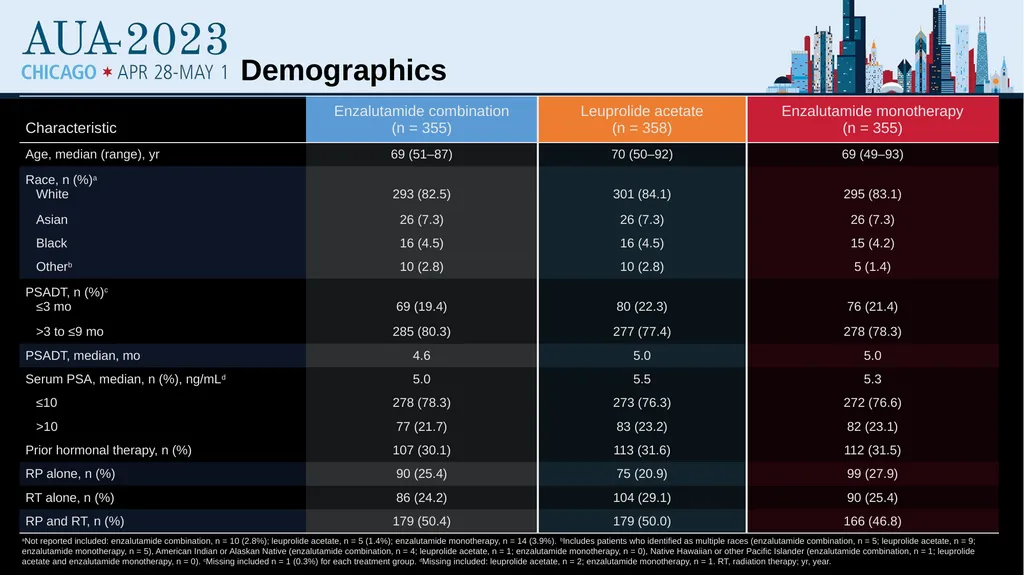
Demographics aNot reported included: enzalutamide combination, n = 10 (2.8%); leuprolide acetate, n = 5 (1.4%); enzalutamide monotherapy, n = 14 (3.9%). bIncludes patients who identified as multiple races (enzalutamide combination, n = 5; leuprolide acetate, n = 9; enzalutamide monotherapy, n = 5), American Indian or Alaskan Native (enzalutamide combination, n = 4; leuprolide acetate, n = 1; enzalutamide monotherapy, n = 0), Native Hawaiian or other Pacific Islander (enzalutamide combination, n = 1; leuprolide acetate and enzalutamide monotherapy, n = 0). cMissing included n = 1 (0.3%) for each treatment group. dMissing included: leuprolide acetate, n = 2; enzalutamide monotherapy, n = 1. RT, radiation therapy; yr, year.<br>
35
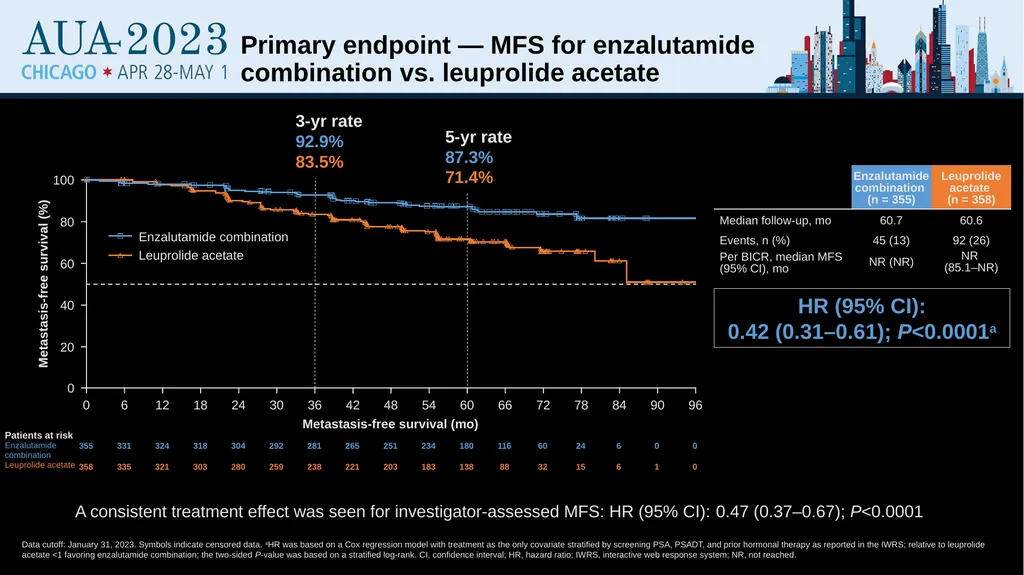
Primary endpoint — MFS for enzalutamide combination vs. leuprolide acetate Metastasis-free survival (mo) 100 0 Metastasis-free survival (%) 80 60 40 20 0 12 42 96 90 84 78 72 66 60 54 48 36 30 24 18 6 Enzalutamide combination
Leuprolide acetate HR (95% CI):
0.42 (0.31–0.61); P<0.0001a Data cutoff: January 31, 2023. Symbols indicate censored data. aHR was based on a Cox regression model with treatment as the only covariate stratified by screening PSA, PSADT, and prior hormonal therapy as reported in the IWRS; relative to leuprolide acetate <1 favoring enzalutamide combination; the two-sided P-value was based on a stratified log-rank. CI, confidence interval; HR, hazard ratio; IWRS, interactive web response system; NR, not reached. A consistent treatment effect was seen for investigator-assessed MFS: HR (95% CI): 0.47 (0.37–0.67); P<0.0001 3-yr rate
92.9%
83.5% 5-yr rate
87.3%
71.4%<br>
Leuprolide acetate HR (95% CI):
0.42 (0.31–0.61); P<0.0001a Data cutoff: January 31, 2023. Symbols indicate censored data. aHR was based on a Cox regression model with treatment as the only covariate stratified by screening PSA, PSADT, and prior hormonal therapy as reported in the IWRS; relative to leuprolide acetate <1 favoring enzalutamide combination; the two-sided P-value was based on a stratified log-rank. CI, confidence interval; HR, hazard ratio; IWRS, interactive web response system; NR, not reached. A consistent treatment effect was seen for investigator-assessed MFS: HR (95% CI): 0.47 (0.37–0.67); P<0.0001 3-yr rate
92.9%
83.5% 5-yr rate
87.3%
71.4%<br>
36
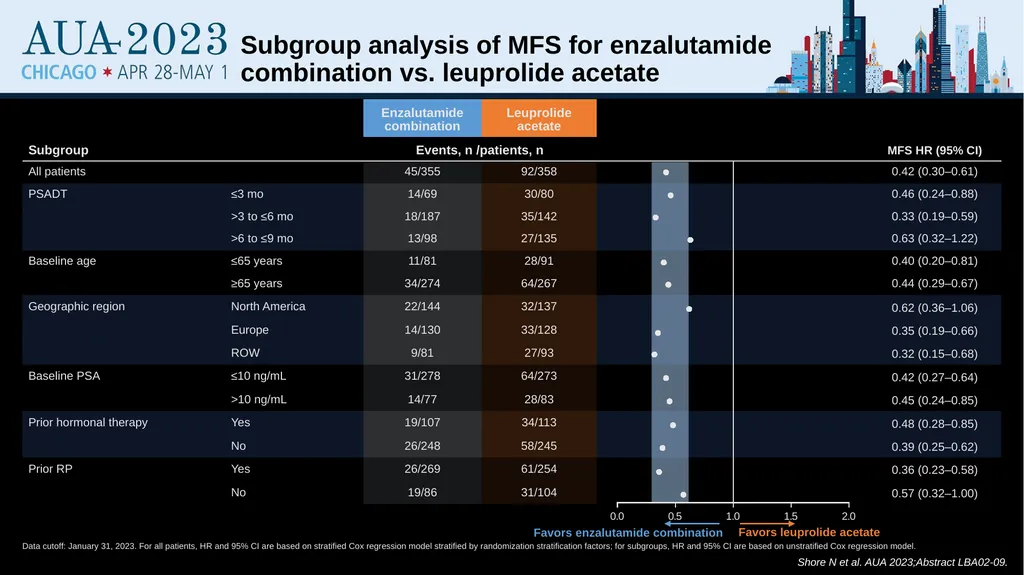
Subgroup analysis of MFS for enzalutamide combination vs. leuprolide acetate Data cutoff: January 31, 2023. For all patients, HR and 95% CI are based on stratified Cox regression model stratified by randomization stratification factors; for subgroups, HR and 95% CI are based on unstratified Cox regression model. Favors enzalutamide combination Favors leuprolide acetate Shore N et al. AUA 2023;Abstract LBA02-09.<br>
37
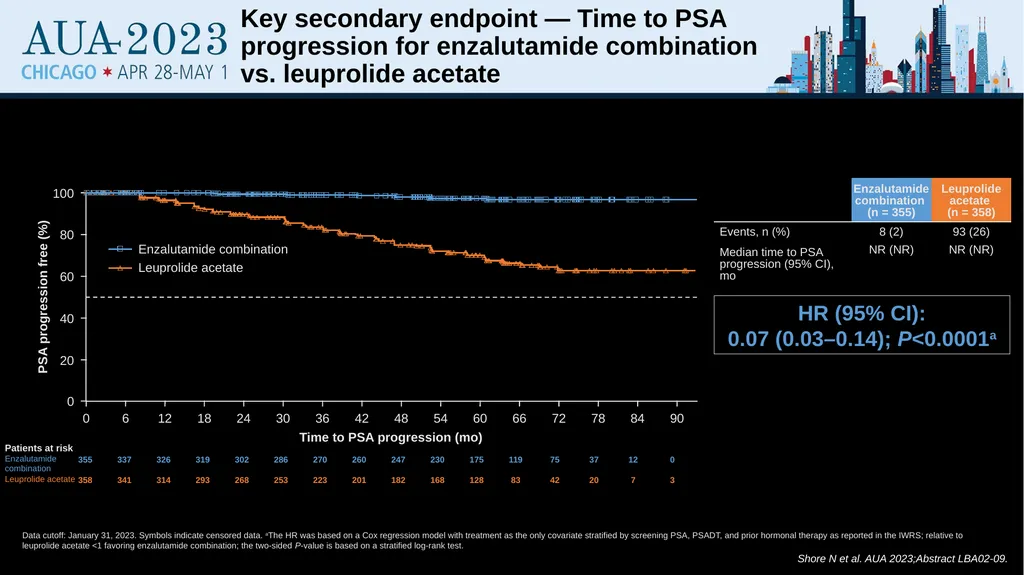
Time to PSA progression (mo) 100 0 PSA progression free (%) 80 60 40 20 0 12 42 90 84 78 72 66 60 54 48 36 30 24 18 6 Key secondary endpoint — Time to PSA progression for enzalutamide combination vs. leuprolide acetate Data cutoff: January 31, 2023. Symbols indicate censored data. aThe HR was based on a Cox regression model with treatment as the only covariate stratified by screening PSA, PSADT, and prior hormonal therapy as reported in the IWRS; relative to leuprolide acetate <1 favoring enzalutamide combination; the two-sided P-value is based on a stratified log-rank test. HR (95% CI):
0.07 (0.03–0.14); P<0.0001a Enzalutamide combination
Leuprolide acetate Shore N et al. AUA 2023;Abstract LBA02-09.<br>
0.07 (0.03–0.14); P<0.0001a Enzalutamide combination
Leuprolide acetate Shore N et al. AUA 2023;Abstract LBA02-09.<br>
38
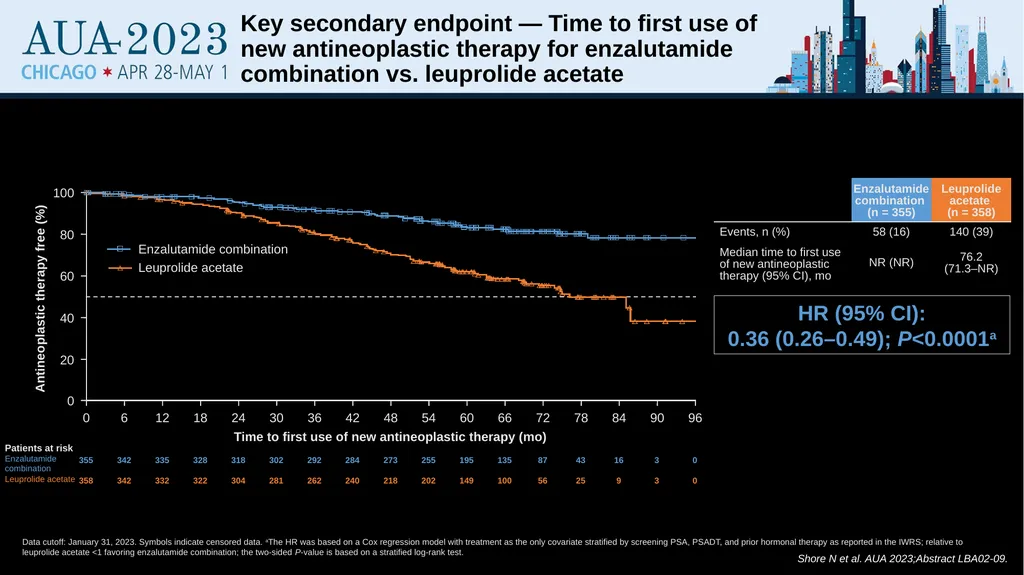
Key secondary endpoint — Time to first use of new antineoplastic therapy for enzalutamide combination vs. leuprolide acetate Data cutoff: January 31, 2023. Symbols indicate censored data. aThe HR was based on a Cox regression model with treatment as the only covariate stratified by screening PSA, PSADT, and prior hormonal therapy as reported in the IWRS; relative to leuprolide acetate <1 favoring enzalutamide combination; the two-sided P-value is based on a stratified log-rank test. HR (95% CI):
0.36 (0.26–0.49); P<0.0001a Time to first use of new antineoplastic therapy (mo) 100 0 80 60 40 20 0 12 42 96 90 84 78 72 66 60 54 48 36 30 24 18 6 Antineoplastic therapy free (%) Enzalutamide combination
Leuprolide acetate Shore N et al. AUA 2023;Abstract LBA02-09.<br>
0.36 (0.26–0.49); P<0.0001a Time to first use of new antineoplastic therapy (mo) 100 0 80 60 40 20 0 12 42 96 90 84 78 72 66 60 54 48 36 30 24 18 6 Antineoplastic therapy free (%) Enzalutamide combination
Leuprolide acetate Shore N et al. AUA 2023;Abstract LBA02-09.<br>
39
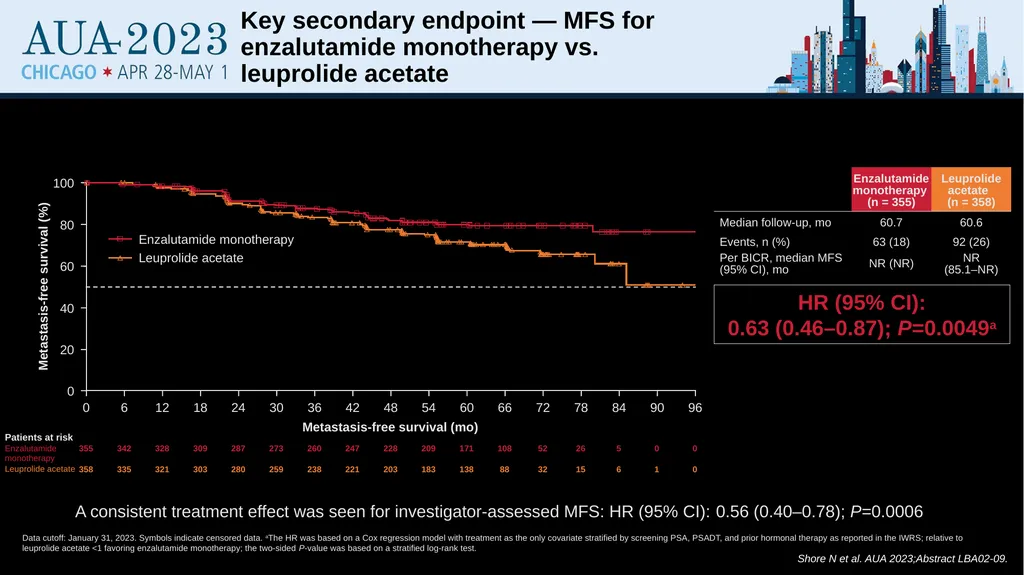
Key secondary endpoint — MFS for enzalutamide monotherapy vs. leuprolide acetate Data cutoff: January 31, 2023. Symbols indicate censored data. aThe HR was based on a Cox regression model with treatment as the only covariate stratified by screening PSA, PSADT, and prior hormonal therapy as reported in the IWRS; relative to leuprolide acetate <1 favoring enzalutamide monotherapy; the two-sided P-value was based on a stratified log-rank test. HR (95% CI):
0.63 (0.46–0.87); P=0.0049a A consistent treatment effect was seen for investigator-assessed MFS: HR (95% CI): 0.56 (0.40–0.78); P=0.0006 Shore N et al. AUA 2023;Abstract LBA02-09.<br>
0.63 (0.46–0.87); P=0.0049a A consistent treatment effect was seen for investigator-assessed MFS: HR (95% CI): 0.56 (0.40–0.78); P=0.0006 Shore N et al. AUA 2023;Abstract LBA02-09.<br>
40
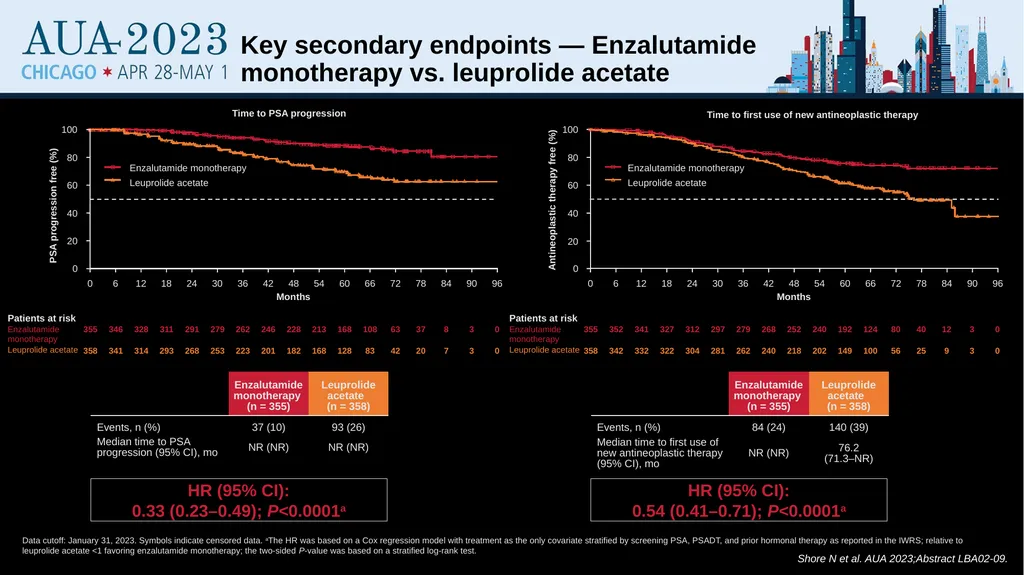
Key secondary endpoints — Enzalutamide monotherapy vs. leuprolide acetate Data cutoff: January 31, 2023. Symbols indicate censored data. aThe HR was based on a Cox regression model with treatment as the only covariate stratified by screening PSA, PSADT, and prior hormonal therapy as reported in the IWRS; relative to leuprolide acetate <1 favoring enzalutamide monotherapy; the two-sided P-value was based on a stratified log-rank test. HR (95% CI):
0.33 (0.23–0.49); P<0.0001a HR (95% CI):
0.54 (0.41–0.71); P<0.0001a Time to PSA progression Time to first use of new antineoplastic therapy Shore N et al. AUA 2023;Abstract LBA02-09.<br>
0.33 (0.23–0.49); P<0.0001a HR (95% CI):
0.54 (0.41–0.71); P<0.0001a Time to PSA progression Time to first use of new antineoplastic therapy Shore N et al. AUA 2023;Abstract LBA02-09.<br>
41
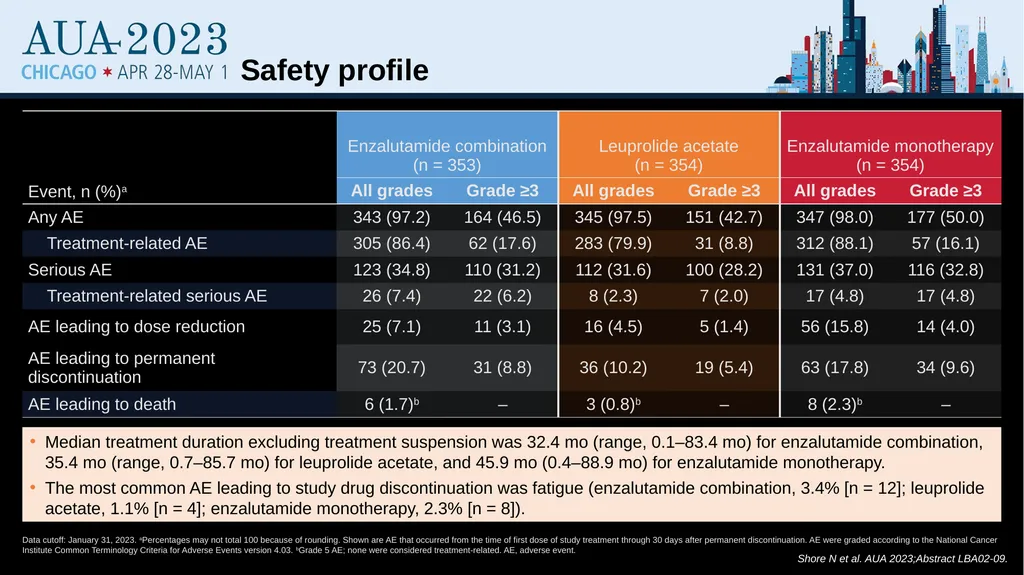
Safety profile Median treatment duration excluding treatment suspension was 32.4 mo (range, 0.1–83.4 mo) for enzalutamide combination, 35.4 mo (range, 0.7–85.7 mo) for leuprolide acetate, and 45.9 mo (0.4–88.9 mo) for enzalutamide monotherapy.
The most common AE leading to study drug discontinuation was fatigue (enzalutamide combination, 3.4% [n = 12]; leuprolide acetate, 1.1% [n = 4]; enzalutamide monotherapy, 2.3% [n = 8]). Data cutoff: January 31, 2023. aPercentages may not total 100 because of rounding. Shown are AE that occurred from the time of first dose of study treatment through 30 days after permanent discontinuation. AE were graded according to the National Cancer Institute Common Terminology Criteria for Adverse Events version 4.03. bGrade 5 AE; none were considered treatment-related. AE, adverse event. Shore N et al. AUA 2023;Abstract LBA02-09.<br>
The most common AE leading to study drug discontinuation was fatigue (enzalutamide combination, 3.4% [n = 12]; leuprolide acetate, 1.1% [n = 4]; enzalutamide monotherapy, 2.3% [n = 8]). Data cutoff: January 31, 2023. aPercentages may not total 100 because of rounding. Shown are AE that occurred from the time of first dose of study treatment through 30 days after permanent discontinuation. AE were graded according to the National Cancer Institute Common Terminology Criteria for Adverse Events version 4.03. bGrade 5 AE; none were considered treatment-related. AE, adverse event. Shore N et al. AUA 2023;Abstract LBA02-09.<br>
42
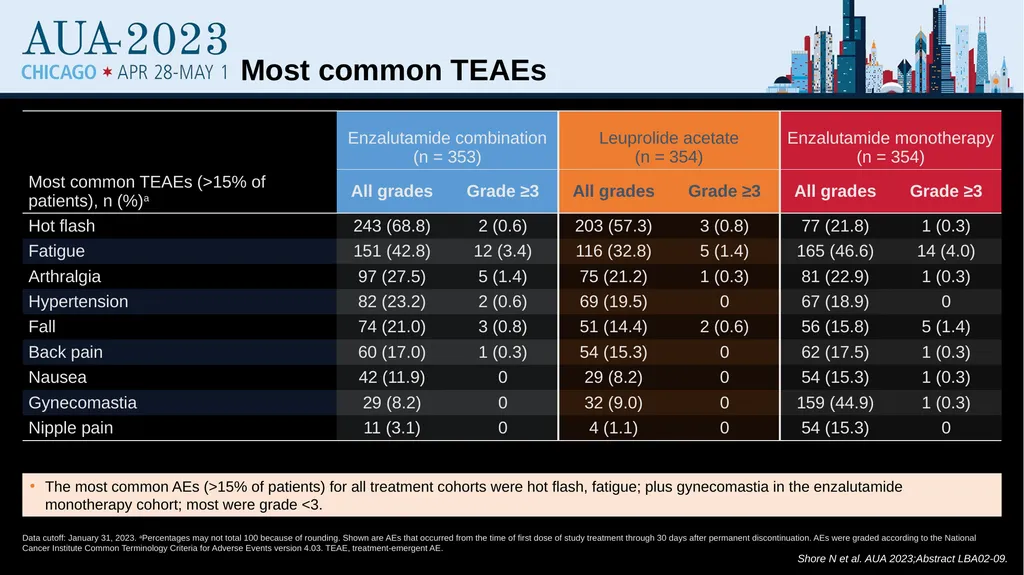
Most common TEAEs The most common AEs (>15% of patients) for all treatment cohorts were hot flash, fatigue; plus gynecomastia in the enzalutamide monotherapy cohort; most were grade <3. Data cutoff: January 31, 2023. aPercentages may not total 100 because of rounding. Shown are AEs that occurred from the time of first dose of study treatment through 30 days after permanent discontinuation. AEs were graded according to the National Cancer Institute Common Terminology Criteria for Adverse Events version 4.03. TEAE, treatment-emergent AE. Shore N et al. AUA 2023;Abstract LBA02-09.<br>
43
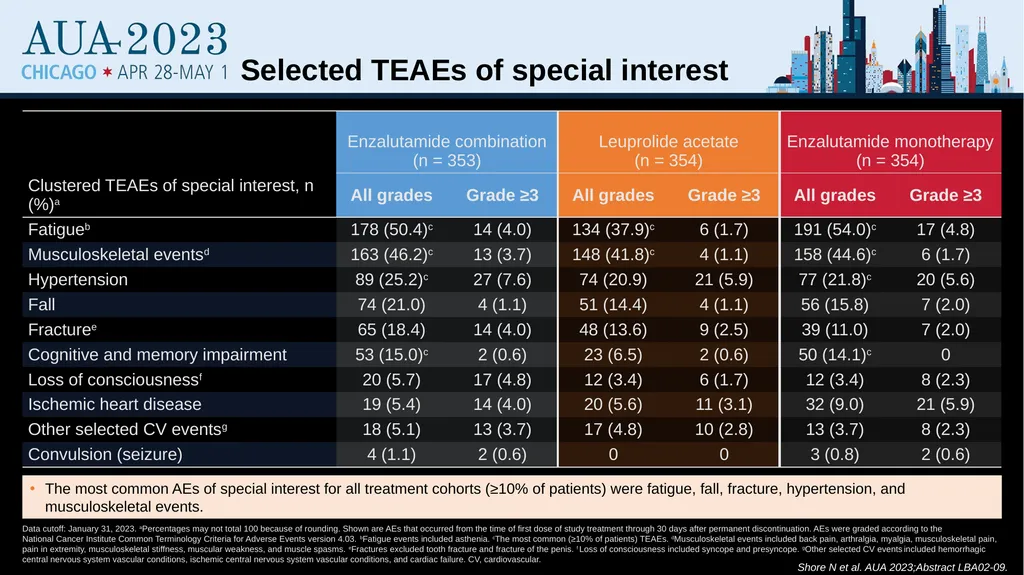
Selected TEAEs of special interest The most common AEs of special interest for all treatment cohorts (≥10% of patients) were fatigue, fall, fracture, hypertension, and musculoskeletal events. Data cutoff: January 31, 2023. aPercentages may not total 100 because of rounding. Shown are AEs that occurred from the time of first dose of study treatment through 30 days after permanent discontinuation. AEs were graded according to the National Cancer Institute Common Terminology Criteria for Adverse Events version 4.03. bFatigue events included asthenia. cThe most common (≥10% of patients) TEAEs. dMusculoskeletal events included back pain, arthralgia, myalgia, musculoskeletal pain, pain in extremity, musculoskeletal stiffness, muscular weakness, and muscle spasms. eFractures excluded tooth fracture and fracture of the penis. f Loss of consciousness included syncope and presyncope. gOther selected CV events included hemorrhagic central nervous system vascular conditions, ischemic central nervous system vascular conditions, and cardiac failure. CV, cardiovascular. Shore N et al. AUA 2023;Abstract LBA02-09.<br>
44
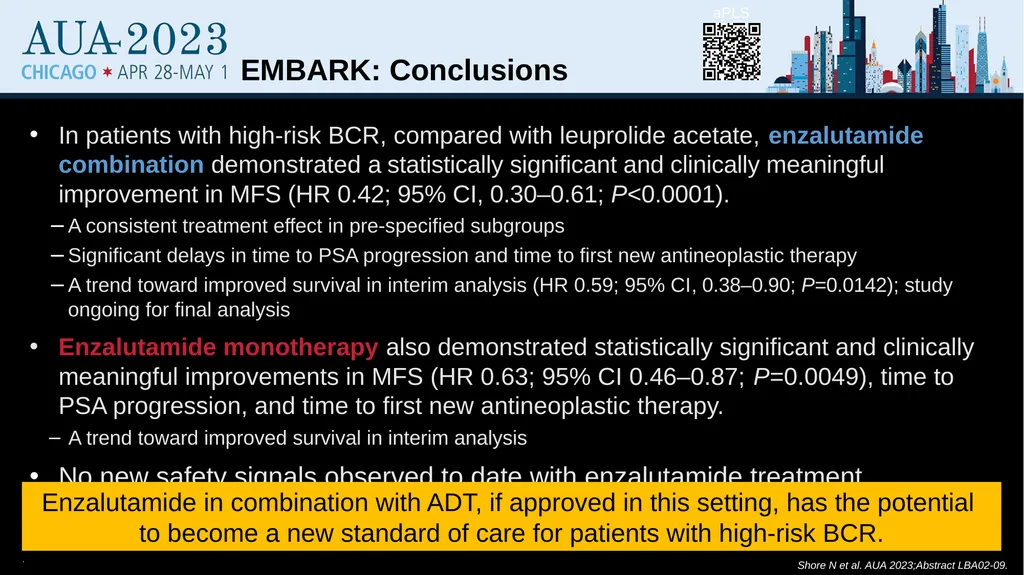
In patients with high-risk BCR, compared with leuprolide acetate, enzalutamide combination demonstrated a statistically significant and clinically meaningful improvement in MFS (HR 0.42; 95% CI, 0.30–0.61; P<0.0001).
A consistent treatment effect in pre-specified subgroups
Significant delays in time to PSA progression and time to first new antineoplastic therapy
A trend toward improved survival in interim analysis (HR 0.59; 95% CI, 0.38–0.90; P=0.0142); study ongoing for final analysis
Enzalutamide monotherapy also demonstrated statistically significant and clinically meaningful improvements in MFS (HR 0.63; 95% CI 0.46–0.87; P=0.0049), time to PSA progression, and time to first new antineoplastic therapy.
A trend toward improved survival in interim analysis
No new safety signals observed to date with enzalutamide treatment EMBARK: Conclusions Enzalutamide in combination with ADT, if approved in this setting, has the potential to become a new standard of care for patients with high-risk BCR. . Shore N et al. AUA 2023;Abstract LBA02-09.<br>
A consistent treatment effect in pre-specified subgroups
Significant delays in time to PSA progression and time to first new antineoplastic therapy
A trend toward improved survival in interim analysis (HR 0.59; 95% CI, 0.38–0.90; P=0.0142); study ongoing for final analysis
Enzalutamide monotherapy also demonstrated statistically significant and clinically meaningful improvements in MFS (HR 0.63; 95% CI 0.46–0.87; P=0.0049), time to PSA progression, and time to first new antineoplastic therapy.
A trend toward improved survival in interim analysis
No new safety signals observed to date with enzalutamide treatment EMBARK: Conclusions Enzalutamide in combination with ADT, if approved in this setting, has the potential to become a new standard of care for patients with high-risk BCR. . Shore N et al. AUA 2023;Abstract LBA02-09.<br>
45
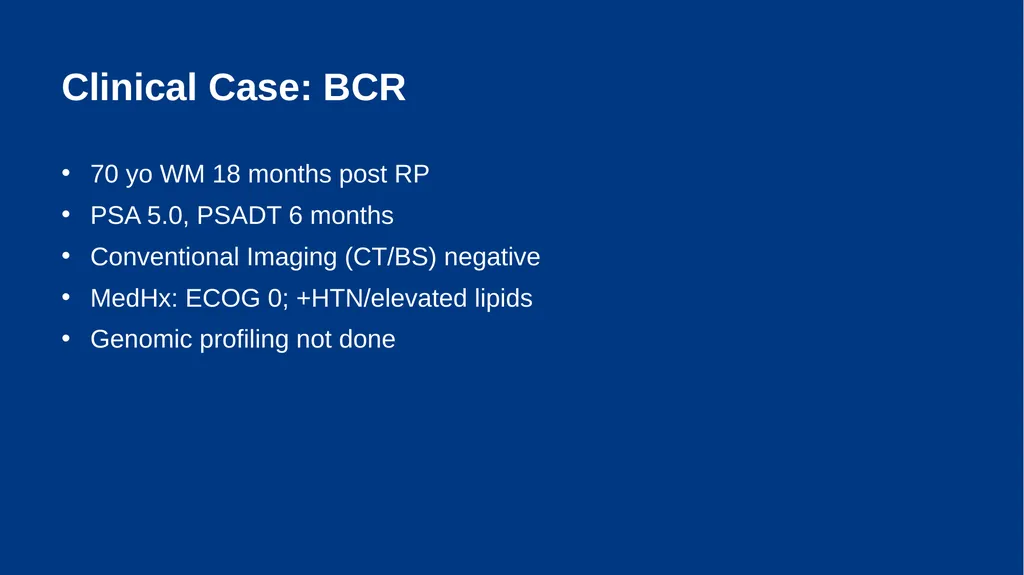
Clinical Case: BCR 70 yo WM 18 months post RP
PSA 5.0, PSADT 6 months
Conventional Imaging (CT/BS) negative
MedHx: ECOG 0; +HTN/elevated lipids
Genomic profiling not done<br>
PSA 5.0, PSADT 6 months
Conventional Imaging (CT/BS) negative
MedHx: ECOG 0; +HTN/elevated lipids
Genomic profiling not done<br>
46
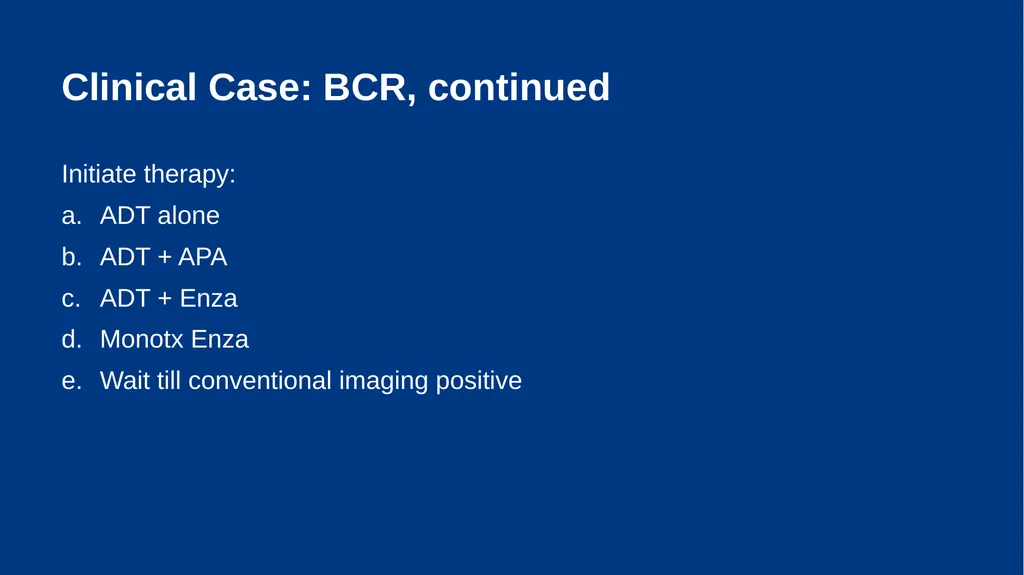
Clinical Case: BCR, continued Initiate therapy:
ADT alone
ADT + APA
ADT + Enza
Monotx Enza
Wait till conventional imaging positive<br>
ADT alone
ADT + APA
ADT + Enza
Monotx Enza
Wait till conventional imaging positive<br>
47
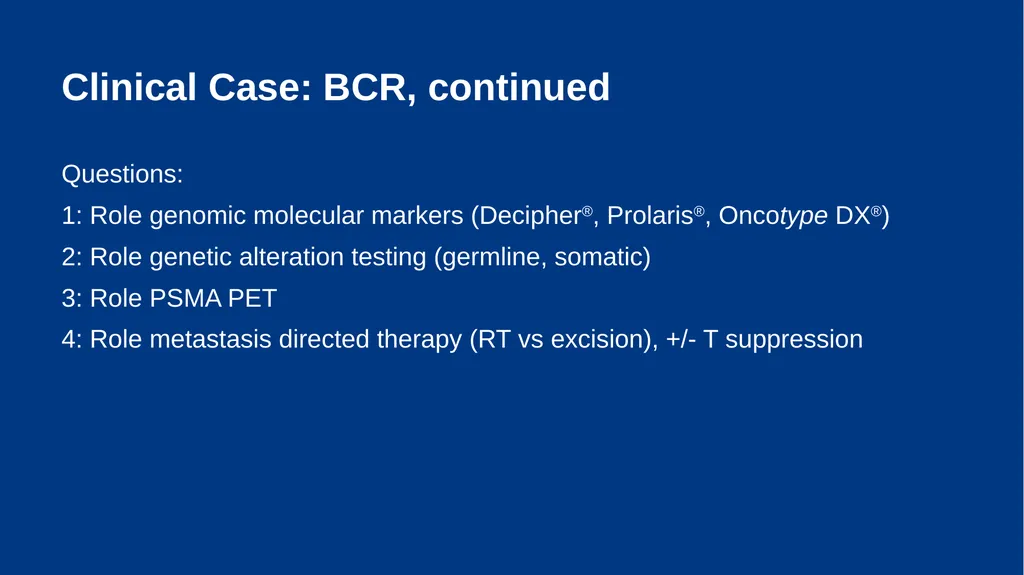
Clinical Case: BCR, continued Questions:
1: Role genomic molecular markers (Decipher®, Prolaris®, Oncotype DX®)
2: Role genetic alteration testing (germline, somatic)
3: Role PSMA PET
4: Role metastasis directed therapy (RT vs excision), +/- T suppression<br>
1: Role genomic molecular markers (Decipher®, Prolaris®, Oncotype DX®)
2: Role genetic alteration testing (germline, somatic)
3: Role PSMA PET
4: Role metastasis directed therapy (RT vs excision), +/- T suppression<br>
48
THANK YOU<br>