
Triage, Source Control and Additional Control
CP
Published · 33 slides · 0 views
1 / 1





Description
Triage, Source Control and Additional Control Measures Dr Purva Mathur MD All India Institute of Medical Sciences New Delhi Strengthening Infection Prevention Control for COVID-19 in Healthcare Facilities focus on Private Sector 4 May
Related Topics
Share
Embed code
Download this presentation From Below
"Triage, Source Control and Additional Control" is the property of its rightful owner. Permission is granted to download and print the materials on this website for personal, non-commercial use only, and to display it on your personal computer provided you do not modify the materials and that you retain all copyright notices contained in the materials. By downloading content from our website, you accept the terms of this agreement.
Presentation Transcript
01
Triage, Source Control and Additional Control Measures Dr Purva Mathur MD
All India Institute of Medical Sciences New Delhi Strengthening Infection Prevention & Control for COVID-19 in Healthcare Facilities – focus on Private Sector | 4 May 2020<br>
All India Institute of Medical Sciences New Delhi Strengthening Infection Prevention & Control for COVID-19 in Healthcare Facilities – focus on Private Sector | 4 May 2020<br>
02
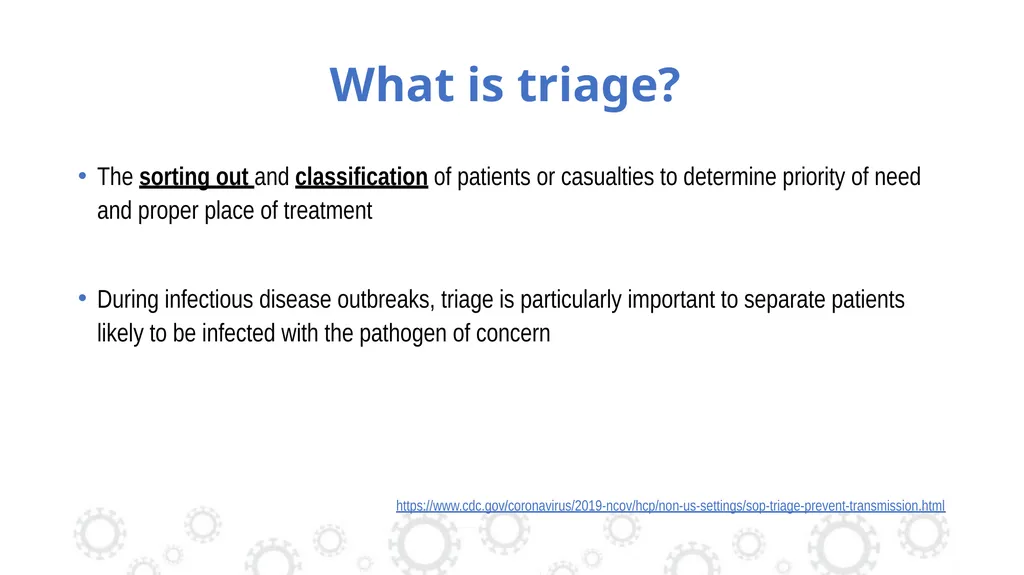
What is triage? The sorting out and classification of patients or casualties to determine priority of need and proper place of treatment
During infectious disease outbreaks, triage is particularly important to separate patients likely to be infected with the pathogen of concern https://www.cdc.gov/coronavirus/2019-ncov/hcp/non-us-settings/sop-triage-prevent-transmission.html<br>
During infectious disease outbreaks, triage is particularly important to separate patients likely to be infected with the pathogen of concern https://www.cdc.gov/coronavirus/2019-ncov/hcp/non-us-settings/sop-triage-prevent-transmission.html<br>
03
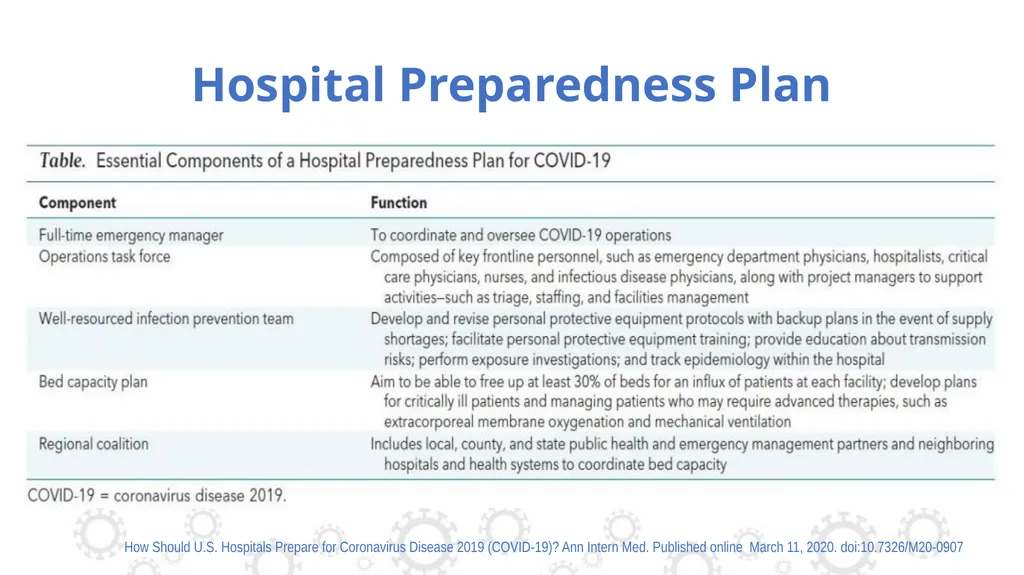
Hospital Preparedness Plan How Should U.S. Hospitals Prepare for Coronavirus Disease 2019 (COVID-19)? Ann Intern Med. Published online March 11, 2020. doi:10.7326/M20-0907<br>
04
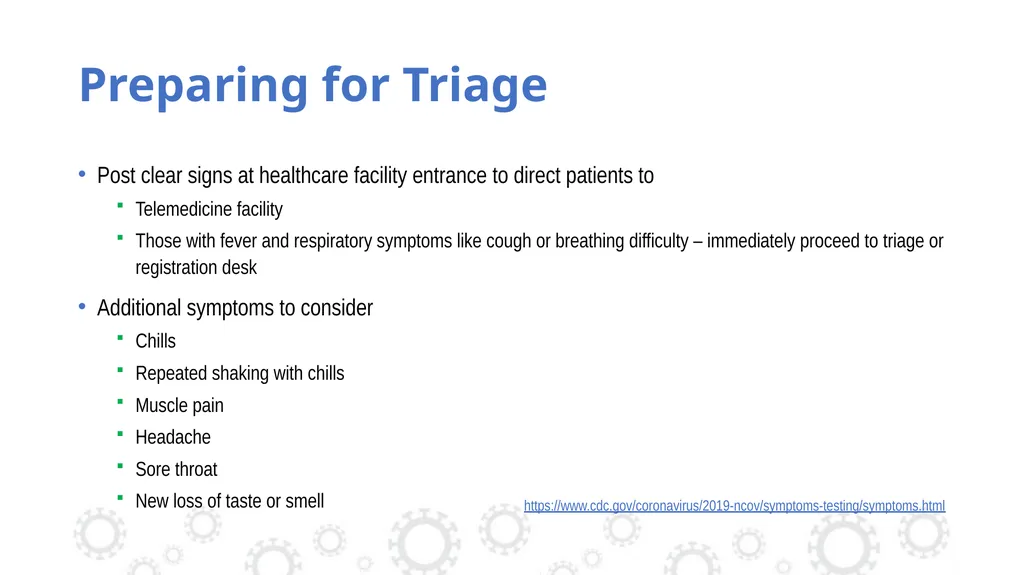
Preparing for Triage Post clear signs at healthcare facility entrance to direct patients to
Telemedicine facility
Those with fever and respiratory symptoms like cough or breathing difficulty – immediately proceed to triage or registration desk
Additional symptoms to consider
Chills
Repeated shaking with chills
Muscle pain
Headache
Sore throat
New loss of taste or smell https://www.cdc.gov/coronavirus/2019-ncov/symptoms-testing/symptoms.html<br>
Telemedicine facility
Those with fever and respiratory symptoms like cough or breathing difficulty – immediately proceed to triage or registration desk
Additional symptoms to consider
Chills
Repeated shaking with chills
Muscle pain
Headache
Sore throat
New loss of taste or smell https://www.cdc.gov/coronavirus/2019-ncov/symptoms-testing/symptoms.html<br>
05
Protecting the healthcare staff Install physical barriers (e.g. glass/plastic screens) at registration desk to limit close contact between triage staff and patients
Identify isolation rooms or separate well-ventilated rooms where suspected COVID-19 patients will be placed while waiting for examination
Provide masks/ face covers for all patients visiting the HCF<br>
Identify isolation rooms or separate well-ventilated rooms where suspected COVID-19 patients will be placed while waiting for examination
Provide masks/ face covers for all patients visiting the HCF<br>
06
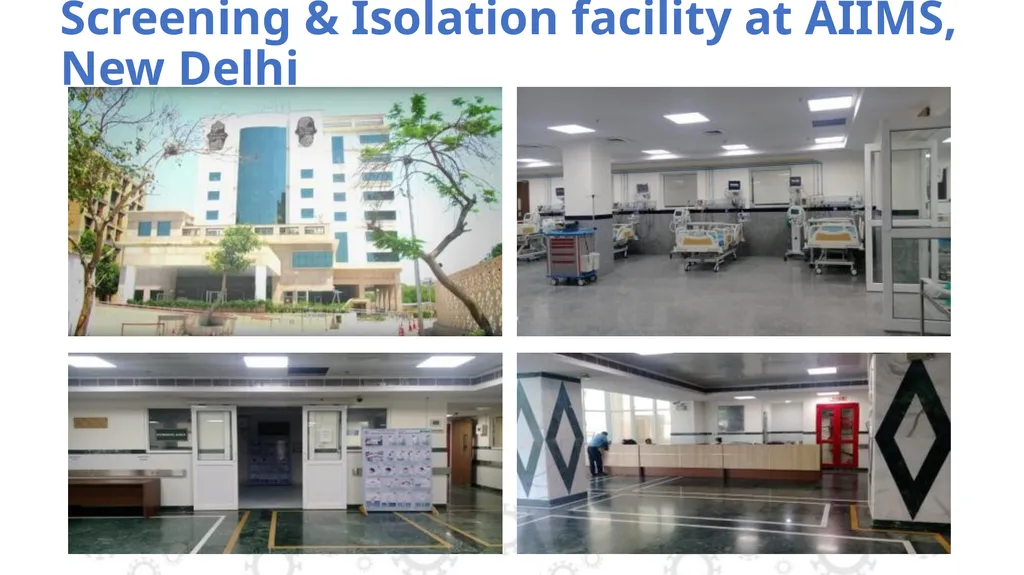
Screening & Isolation facility at AIIMS, New Delhi<br>
07
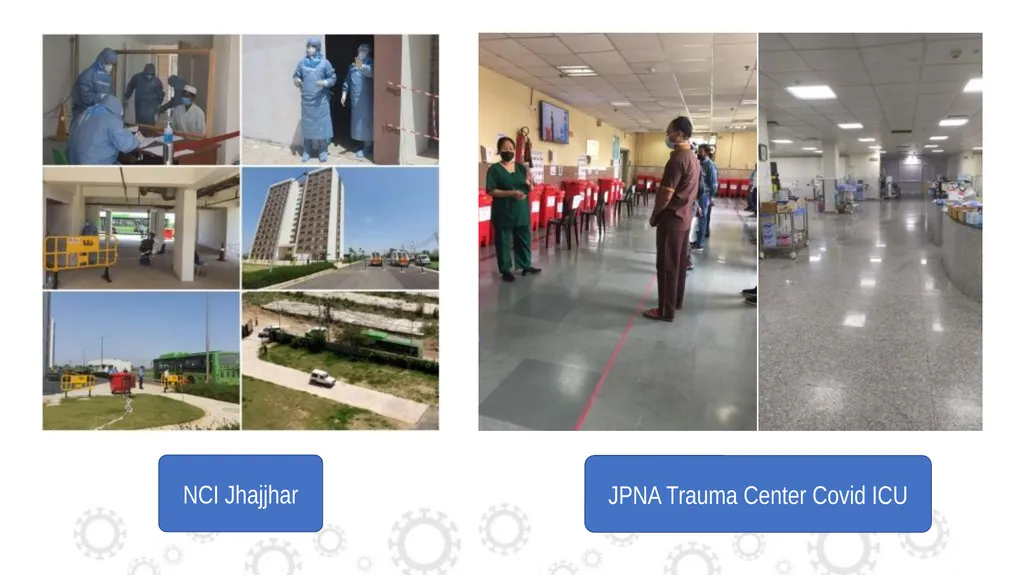
NCI Jhajjhar JPNA Trauma Center Covid ICU<br>
08
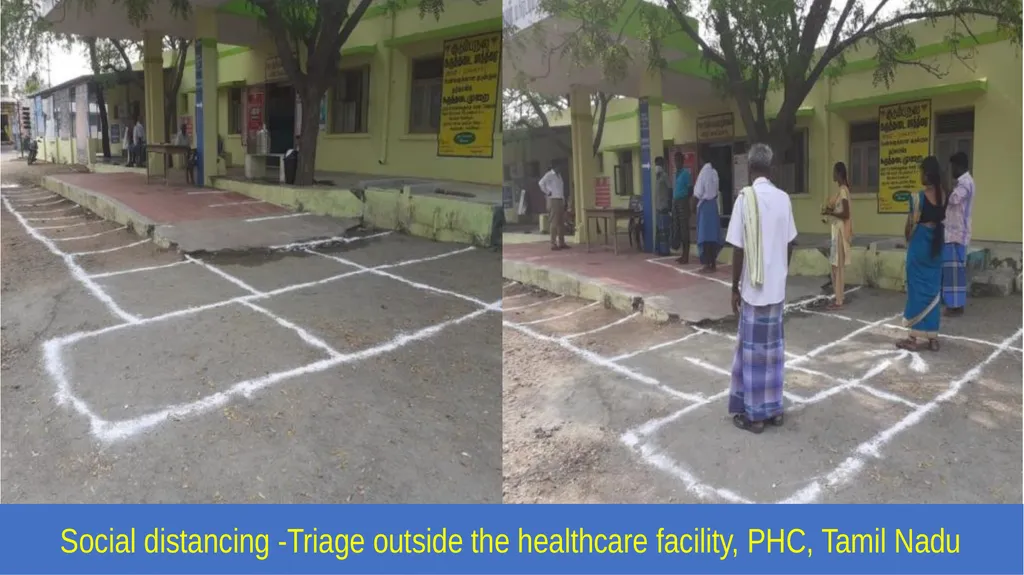
21 Social distancing -Triage outside the healthcare facility, PHC, Tamil Nadu<br>
09
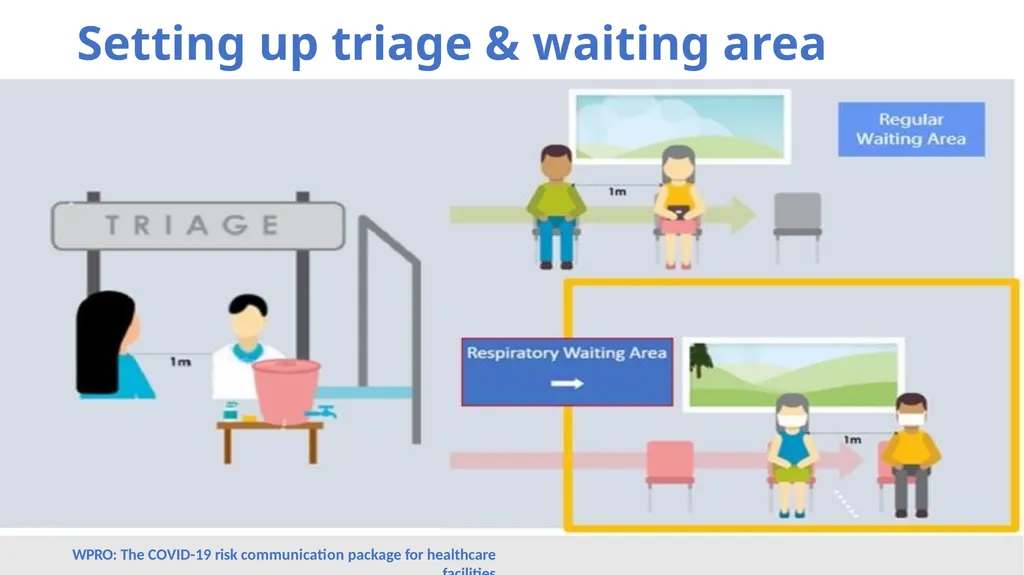
Setting up triage & waiting area WPRO: The COVID-19 risk communication package for healthcare facilities<br>
10
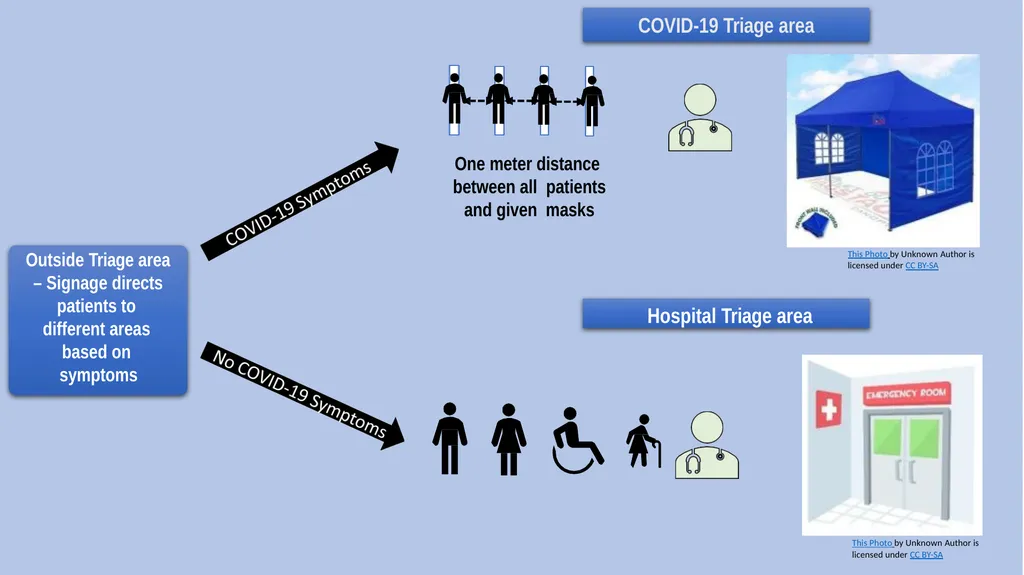
Outside Triage area
– Signage directs
patients to different areas based on symptoms One meter distance between all patients and given masks COVID-19 Triage area Hospital Triage area This Photo by Unknown Author is licensed under CC BY-SA This Photo by Unknown Author is licensed under CC BY-SA<br>
– Signage directs
patients to different areas based on symptoms One meter distance between all patients and given masks COVID-19 Triage area Hospital Triage area This Photo by Unknown Author is licensed under CC BY-SA This Photo by Unknown Author is licensed under CC BY-SA<br>
11
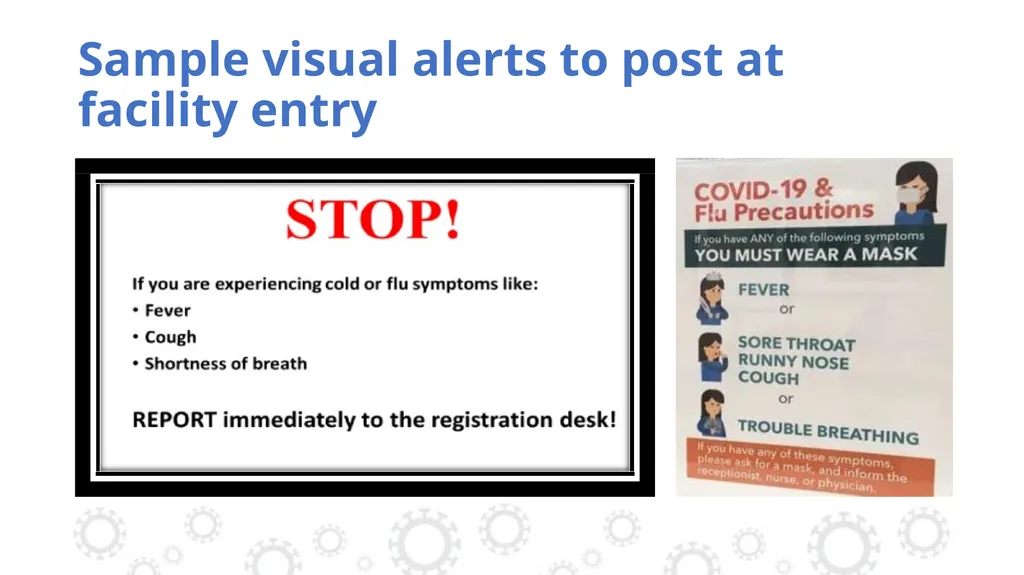
Sample visual alerts to post at facility entry<br>
12
Protecting healthcare workers at triage All HCWs performing triage activities should adhere to standard precautions at all times
These HCWs should have convenient access to hand hygiene products
HCWs conducting preliminary screening that does not require direct patient contact should maintain at least 1 m distance
These activities included interviewing patients about symptoms
Exposures and/or taking temperatures with non-contact infrared thermometer
HCWs conducting physical examination of patients with respiratory symptoms should wear gowns, gloves, face mask, and eye protection (goggles/face shield)<br>
These HCWs should have convenient access to hand hygiene products
HCWs conducting preliminary screening that does not require direct patient contact should maintain at least 1 m distance
These activities included interviewing patients about symptoms
Exposures and/or taking temperatures with non-contact infrared thermometer
HCWs conducting physical examination of patients with respiratory symptoms should wear gowns, gloves, face mask, and eye protection (goggles/face shield)<br>
13
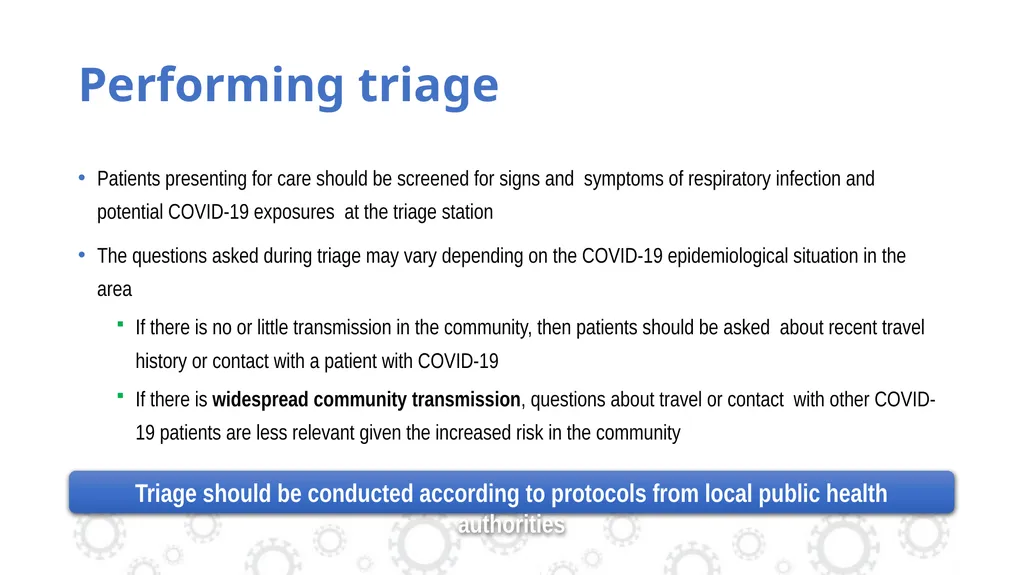
Performing triage Patients presenting for care should be screened for signs and symptoms of respiratory infection and potential COVID-19 exposures at the triage station
The questions asked during triage may vary depending on the COVID-19 epidemiological situation in the area
If there is no or little transmission in the community, then patients should be asked about recent travel history or contact with a patient with COVID-19
If there is widespread community transmission, questions about travel or contact with other COVID-19 patients are less relevant given the increased risk in the community Triage should be conducted according to protocols from local public health authorities<br>
The questions asked during triage may vary depending on the COVID-19 epidemiological situation in the area
If there is no or little transmission in the community, then patients should be asked about recent travel history or contact with a patient with COVID-19
If there is widespread community transmission, questions about travel or contact with other COVID-19 patients are less relevant given the increased risk in the community Triage should be conducted according to protocols from local public health authorities<br>
14
Isolation of suspect COVID-19 cases Patients who are identified as suspect COVID-19 cases through triage process must be
Separated from other patients as soon as possible
Given a face mask and ask them to put it on
If face masks are not available, patients should cover their mouth with a cloth
Place the patient in a single-person room with the door closed
If single-person rooms are not available, designate a separate, well-ventilated area for these patients and ensure they maintain 1 m separation from each other
Only essential HCWs designated to care for suspect COVID-19 patients should enter the isolation area wearing appropriate PPE
Ensure that HCWs caring for patients in the isolation area adhere to standard, contact, and droplet precautions and follow strict donning and doffing protocols<br>
Separated from other patients as soon as possible
Given a face mask and ask them to put it on
If face masks are not available, patients should cover their mouth with a cloth
Place the patient in a single-person room with the door closed
If single-person rooms are not available, designate a separate, well-ventilated area for these patients and ensure they maintain 1 m separation from each other
Only essential HCWs designated to care for suspect COVID-19 patients should enter the isolation area wearing appropriate PPE
Ensure that HCWs caring for patients in the isolation area adhere to standard, contact, and droplet precautions and follow strict donning and doffing protocols<br>
15
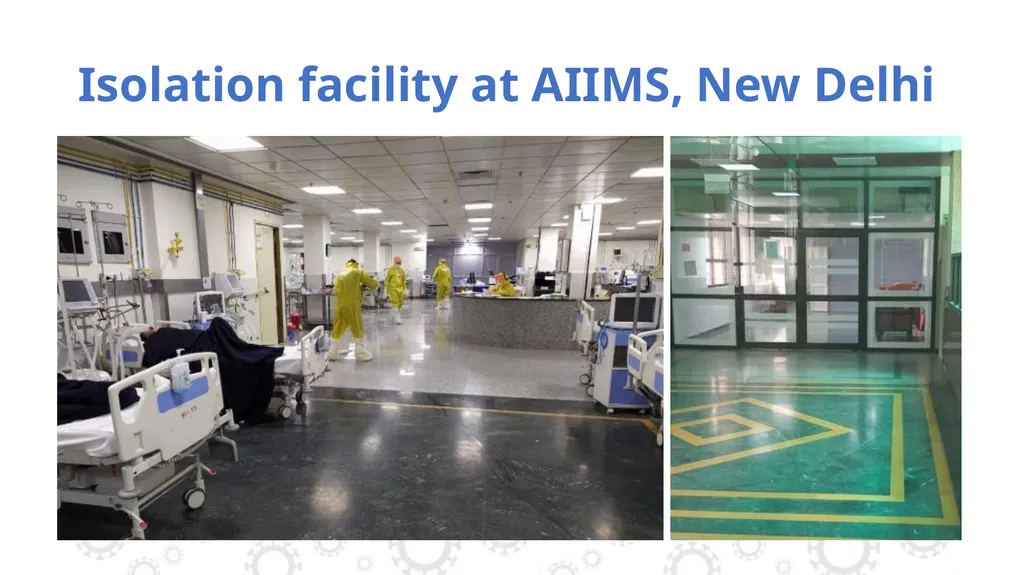
Isolation facility at AIIMS, New Delhi<br>
16
Inpatient care strategies for COVID-19 Initial cases admitted in AIIR isolation rooms Cohorting in isolation rooms/ wards Cohorting in specific units
(may require adjustment of ventilation) Units and floors converted to cohort units Designated unit may be needed for non-infectious hospitalized patients You need to revisit your admission plan based on the case surge at your facility<br>
17
Emergency department – care strategies Emergency departments often operate at or above capacity on a daily basis
In addition to above strategies for outpatient care, EDs should consider
Diversion of non-critical possible COVID-19 cases at a triage point, prior to ED entry – “parking lot triage”
Use of specific space (e.g. urgent care, pediatric, same-day surgery) for COVID-19 patients subject to appropriate isolation of that area from an air-handling and patient movement standpoint
Use of discharge waiting areas (if not routinely used)
Change in patient flow, placement and charting that can expedite non-emergency visits
Coordination with EMS, including through telephone triage, to avoid ED visits that can safely be cared for as outpatients<br>
In addition to above strategies for outpatient care, EDs should consider
Diversion of non-critical possible COVID-19 cases at a triage point, prior to ED entry – “parking lot triage”
Use of specific space (e.g. urgent care, pediatric, same-day surgery) for COVID-19 patients subject to appropriate isolation of that area from an air-handling and patient movement standpoint
Use of discharge waiting areas (if not routinely used)
Change in patient flow, placement and charting that can expedite non-emergency visits
Coordination with EMS, including through telephone triage, to avoid ED visits that can safely be cared for as outpatients<br>
18
IPC in Critical Care for COVID-19 Patients should wear simple flexible fabric masks to reduce droplet generation unless wearing an oxygen mask
Intermittent rather than continuous oximetry and cardiac monitoring may be instituted with separate for each patient
Use inhalers in lieu of nebulized medications to reduce droplet generation
Coordinate with critical care physicians regarding
Threshold for intubation
Use of bridging techniques (e.g. high flow cannula/BiPAP)
Requirement of special area and augmented PPE for providers given the higher risk of aerosol generation<br>
Intermittent rather than continuous oximetry and cardiac monitoring may be instituted with separate for each patient
Use inhalers in lieu of nebulized medications to reduce droplet generation
Coordinate with critical care physicians regarding
Threshold for intubation
Use of bridging techniques (e.g. high flow cannula/BiPAP)
Requirement of special area and augmented PPE for providers given the higher risk of aerosol generation<br>
19
IPC in critical care Use rapid sequence intubation (RSI) techniques to minimize aerosol generation
Aggressively control and suppress patient cough, as possible
Consider more aggressive sedation/paralysis strategies to reduce coughing
Reduce suctioning as possible
Use of High Efficiency Particulate Air (HEPA) filters on ventilators or at minimum in-line HME/HEPA filters on the endotracheal tube
Monitor MoHFW and latest literature to determine potential efficacy of antivirals and other therapies; currently there are no known effective medications and limited evidence for bacterial super-infection<br>
Aggressively control and suppress patient cough, as possible
Consider more aggressive sedation/paralysis strategies to reduce coughing
Reduce suctioning as possible
Use of High Efficiency Particulate Air (HEPA) filters on ventilators or at minimum in-line HME/HEPA filters on the endotracheal tube
Monitor MoHFW and latest literature to determine potential efficacy of antivirals and other therapies; currently there are no known effective medications and limited evidence for bacterial super-infection<br>
20
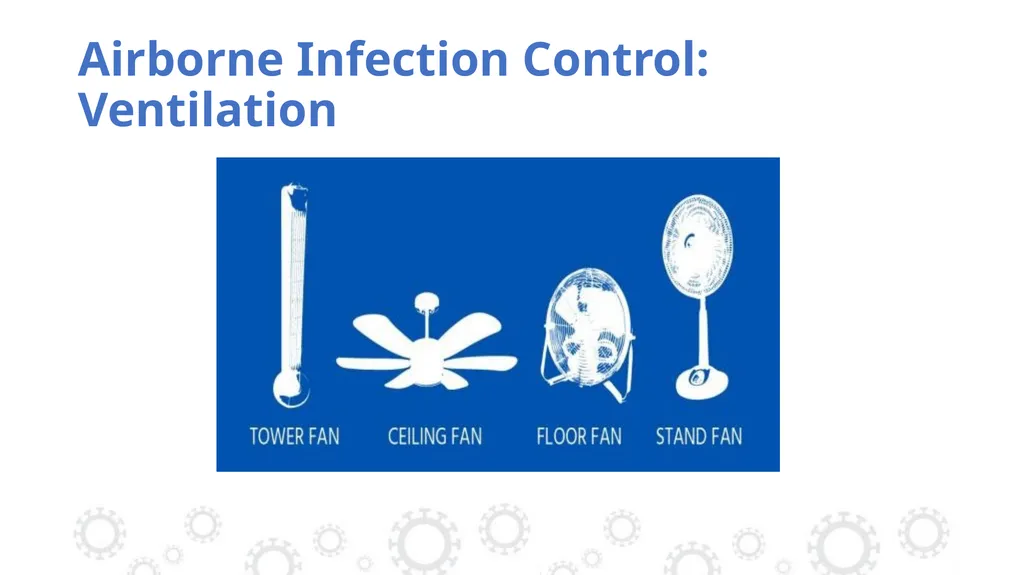
Airborne Infection Control: Ventilation<br>
21
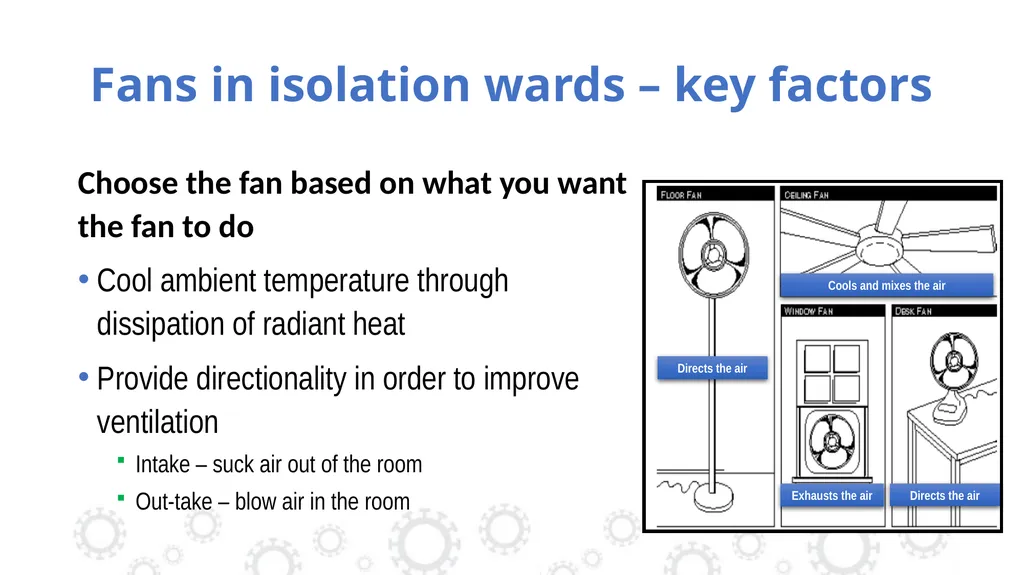
Fans in isolation wards – key factors Choose the fan based on what you want the fan to do
Cool ambient temperature through dissipation of radiant heat
Provide directionality in order to improve ventilation
Intake – suck air out of the room
Out-take – blow air in the room<br>
Cool ambient temperature through dissipation of radiant heat
Provide directionality in order to improve ventilation
Intake – suck air out of the room
Out-take – blow air in the room<br>
22
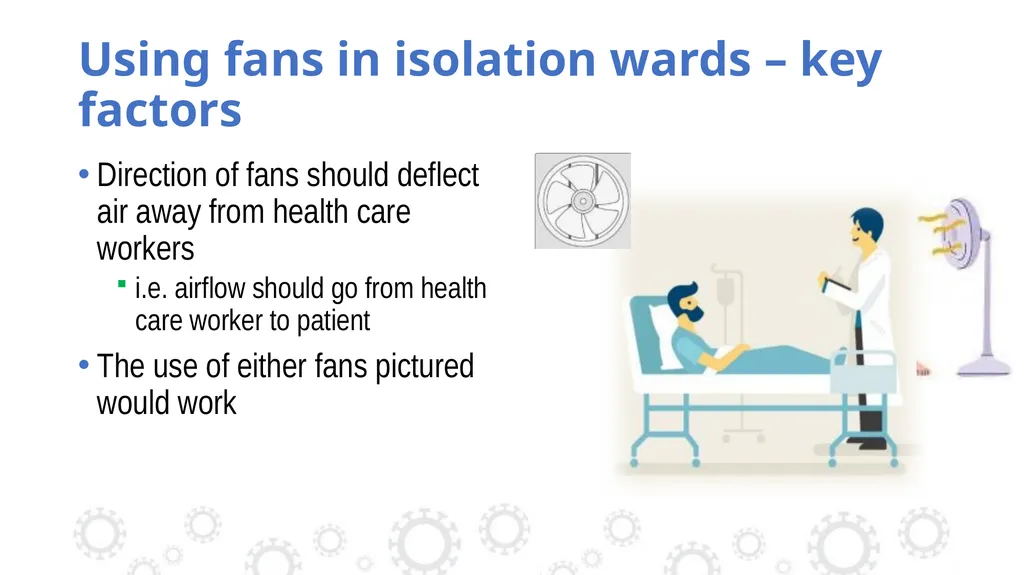
Using fans in isolation wards – key factors Direction of fans should deflect air away from health care workers
i.e. airflow should go from health care worker to patient
The use of either fans pictured would work<br>
i.e. airflow should go from health care worker to patient
The use of either fans pictured would work<br>
23
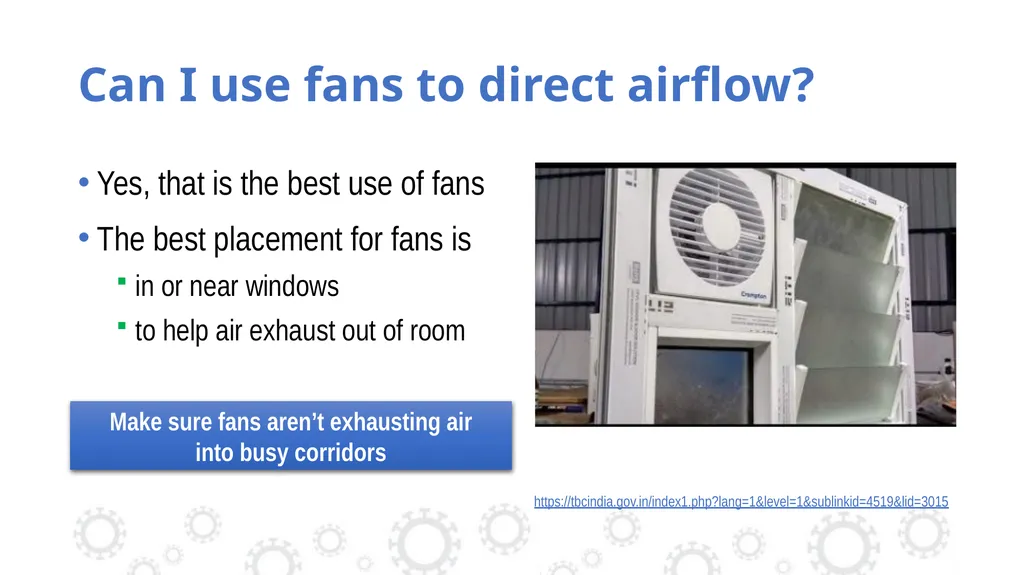
Can I use fans to direct airflow? Yes, that is the best use of fans
The best placement for fans is
in or near windows
to help air exhaust out of room https://tbcindia.gov.in/index1.php?lang=1&level=1&sublinkid=4519&lid=3015 Make sure fans aren’t exhausting air into busy corridors<br>
The best placement for fans is
in or near windows
to help air exhaust out of room https://tbcindia.gov.in/index1.php?lang=1&level=1&sublinkid=4519&lid=3015 Make sure fans aren’t exhausting air into busy corridors<br>
24
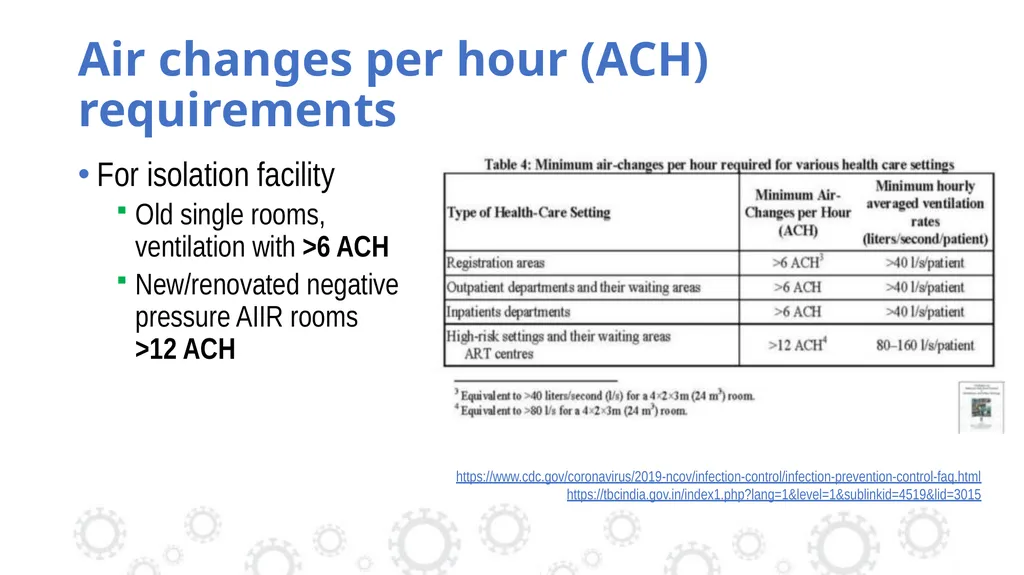
Air changes per hour (ACH) requirements For isolation facility
Old single rooms, ventilation with >6 ACH
New/renovated negative pressure AIIR rooms >12 ACH https://www.cdc.gov/coronavirus/2019-ncov/infection-control/infection-prevention-control-faq.html
https://tbcindia.gov.in/index1.php?lang=1&level=1&sublinkid=4519&lid=3015<br>
Old single rooms, ventilation with >6 ACH
New/renovated negative pressure AIIR rooms >12 ACH https://www.cdc.gov/coronavirus/2019-ncov/infection-control/infection-prevention-control-faq.html
https://tbcindia.gov.in/index1.php?lang=1&level=1&sublinkid=4519&lid=3015<br>
25
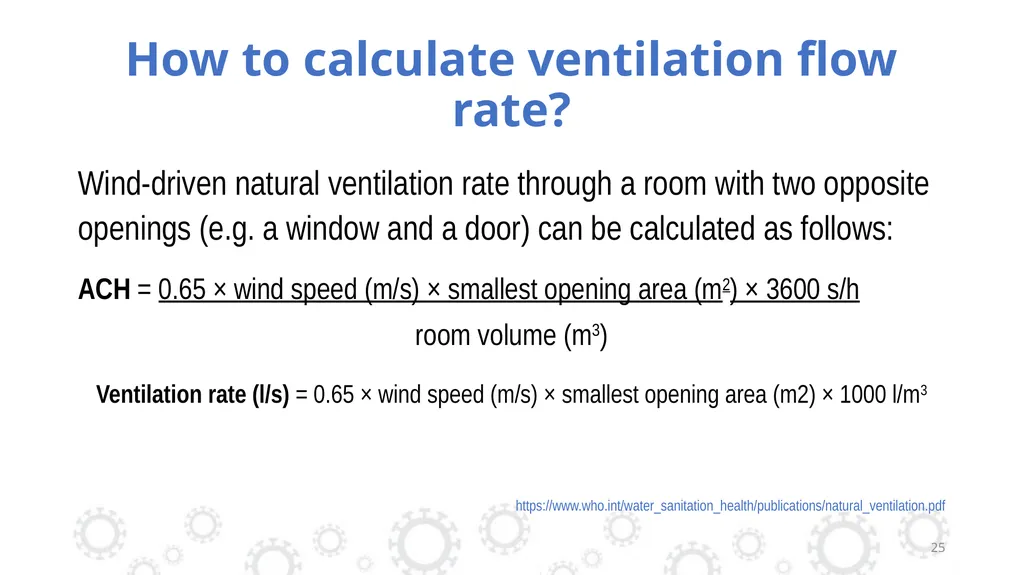
How to calculate ventilation flow rate? Wind-driven natural ventilation rate through a room with two opposite openings (e.g. a window and a door) can be calculated as follows:
ACH = 0.65 × wind speed (m/s) × smallest opening area (m2) × 3600 s/h
room volume (m3)
Ventilation rate (l/s) = 0.65 × wind speed (m/s) × smallest opening area (m2) × 1000 l/m3 25 https://www.who.int/water_sanitation_health/publications/natural_ventilation.pdf<br>
ACH = 0.65 × wind speed (m/s) × smallest opening area (m2) × 3600 s/h
room volume (m3)
Ventilation rate (l/s) = 0.65 × wind speed (m/s) × smallest opening area (m2) × 1000 l/m3 25 https://www.who.int/water_sanitation_health/publications/natural_ventilation.pdf<br>
26
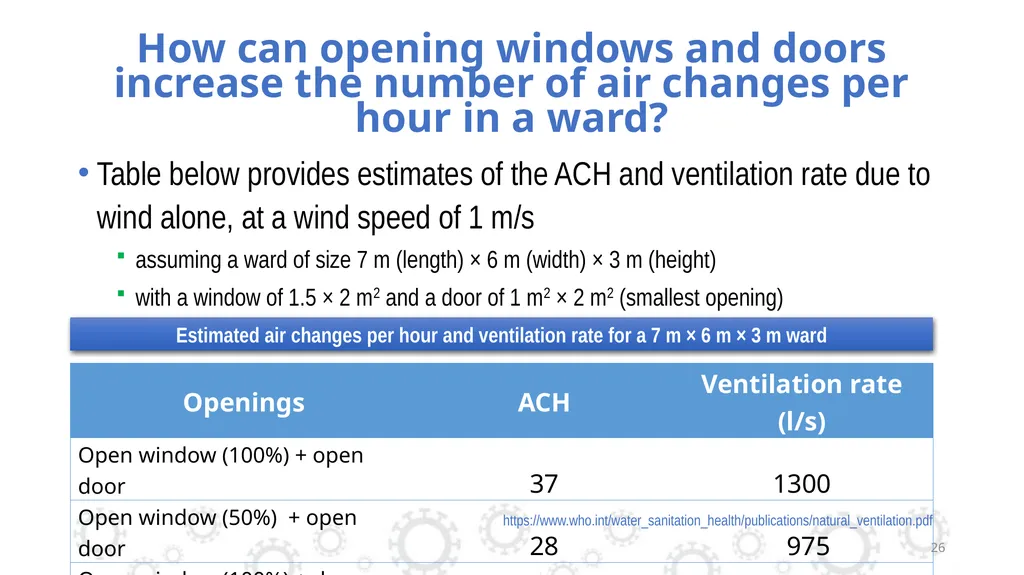
How can opening windows and doors increase the number of air changes per hour in a ward? Table below provides estimates of the ACH and ventilation rate due to wind alone, at a wind speed of 1 m/s
assuming a ward of size 7 m (length) × 6 m (width) × 3 m (height)
with a window of 1.5 × 2 m2 and a door of 1 m2 × 2 m2 (smallest opening) 26 Estimated air changes per hour and ventilation rate for a 7 m × 6 m × 3 m ward https://www.who.int/water_sanitation_health/publications/natural_ventilation.pdf<br>
assuming a ward of size 7 m (length) × 6 m (width) × 3 m (height)
with a window of 1.5 × 2 m2 and a door of 1 m2 × 2 m2 (smallest opening) 26 Estimated air changes per hour and ventilation rate for a 7 m × 6 m × 3 m ward https://www.who.int/water_sanitation_health/publications/natural_ventilation.pdf<br>
27
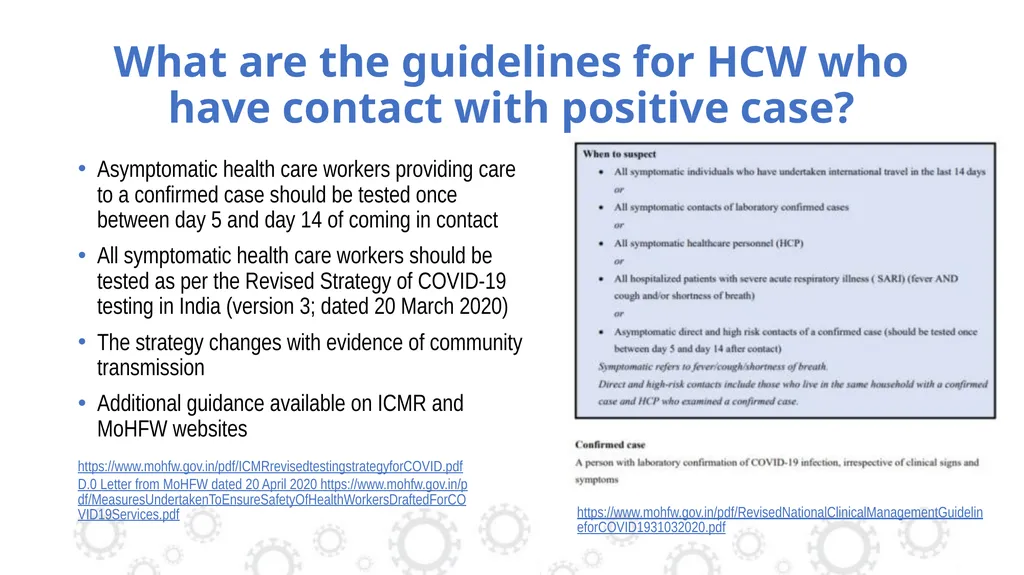
What are the guidelines for HCW who have contact with positive case? Asymptomatic health care workers providing care to a confirmed case should be tested once between day 5 and day 14 of coming in contact
All symptomatic health care workers should be tested as per the Revised Strategy of COVID-19 testing in India (version 3; dated 20 March 2020)
The strategy changes with evidence of community transmission
Additional guidance available on ICMR and MoHFW websites https://www.mohfw.gov.in/pdf/RevisedNationalClinicalManagementGuidelineforCOVID1931032020.pdf https://www.mohfw.gov.in/pdf/ICMRrevisedtestingstrategyforCOVID.pdf
D.0 Letter from MoHFW dated 20 April 2020 https://www.mohfw.gov.in/pdf/MeasuresUndertakenToEnsureSafetyOfHealthWorkersDraftedForCOVID19Services.pdf<br>
All symptomatic health care workers should be tested as per the Revised Strategy of COVID-19 testing in India (version 3; dated 20 March 2020)
The strategy changes with evidence of community transmission
Additional guidance available on ICMR and MoHFW websites https://www.mohfw.gov.in/pdf/RevisedNationalClinicalManagementGuidelineforCOVID1931032020.pdf https://www.mohfw.gov.in/pdf/ICMRrevisedtestingstrategyforCOVID.pdf
D.0 Letter from MoHFW dated 20 April 2020 https://www.mohfw.gov.in/pdf/MeasuresUndertakenToEnsureSafetyOfHealthWorkersDraftedForCOVID19Services.pdf<br>
28
Protecting our employees' health? (1 of 3) Three main ways to protect health care workers from getting COVID-19:
1. Limit infection entering your facility
Cancel elective procedures
Use telemedicine when possible
Limit points of entry and manage visitors
Screen patients for respiratory symptoms
Encourage patient respiratory hygiene using alternatives to facemasks (e.g. tissues to cover cough) https://www.cdc.gov/coronavirus/2019-ncov/infection-control/control-recommendations.html<br>
1. Limit infection entering your facility
Cancel elective procedures
Use telemedicine when possible
Limit points of entry and manage visitors
Screen patients for respiratory symptoms
Encourage patient respiratory hygiene using alternatives to facemasks (e.g. tissues to cover cough) https://www.cdc.gov/coronavirus/2019-ncov/infection-control/control-recommendations.html<br>
29
Protecting our employees' health? (2 of 3) 2. Isolate symptomatic patients as soon as possible
Set up separate, well-ventilated triage areas
Place patients with suspected or confirmed COVID-19 in private rooms with door closed and private bathroom (as possible)
If available, prioritize AIIRs for patients undergoing aerosol-generating procedures https://www.cdc.gov/coronavirus/2019-ncov/infection-control/control-recommendations.html<br>
Set up separate, well-ventilated triage areas
Place patients with suspected or confirmed COVID-19 in private rooms with door closed and private bathroom (as possible)
If available, prioritize AIIRs for patients undergoing aerosol-generating procedures https://www.cdc.gov/coronavirus/2019-ncov/infection-control/control-recommendations.html<br>
30
Protecting our employees' health (3 of 3) 3. Protect healthcare personnel
Emphasize hand hygiene
Install barriers to limit contact with patients at triage
Cohort COVID-19 patients
Limit the numbers of staff providing their care
Cohort staff working in isolation wards
Prioritize respirators and AIIRs for aerosol-generating procedures, and implement PPE optimization strategies to extend supplies https://www.cdc.gov/coronavirus/2019-ncov/infection-control/control-recommendations.html<br>
Emphasize hand hygiene
Install barriers to limit contact with patients at triage
Cohort COVID-19 patients
Limit the numbers of staff providing their care
Cohort staff working in isolation wards
Prioritize respirators and AIIRs for aerosol-generating procedures, and implement PPE optimization strategies to extend supplies https://www.cdc.gov/coronavirus/2019-ncov/infection-control/control-recommendations.html<br>
31
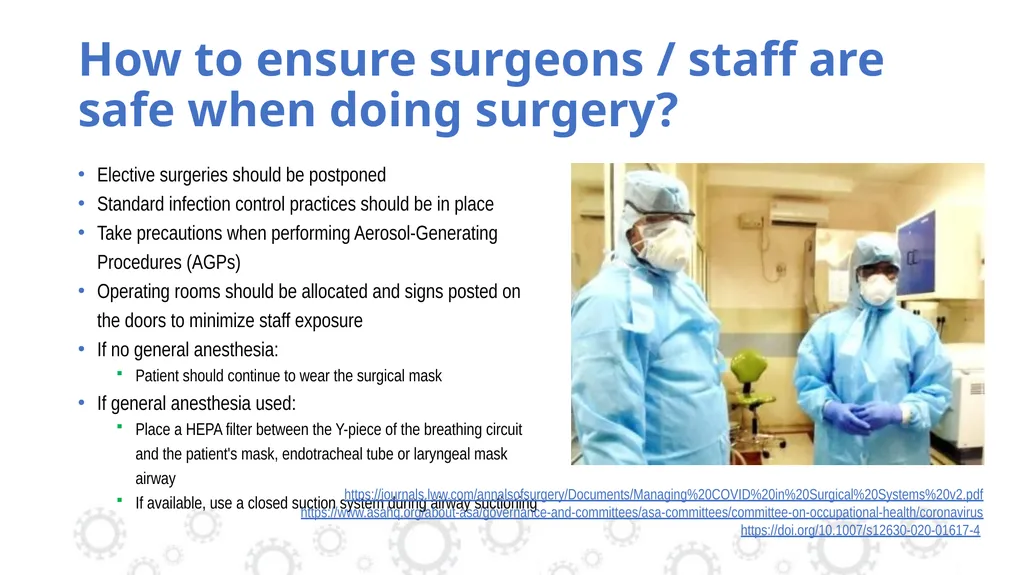
How to ensure surgeons / staff are safe when doing surgery? Elective surgeries should be postponed
Standard infection control practices should be in place
Take precautions when performing Aerosol-Generating Procedures (AGPs)
Operating rooms should be allocated and signs posted on the doors to minimize staff exposure
If no general anesthesia:
Patient should continue to wear the surgical mask
If general anesthesia used:
Place a HEPA filter between the Y-piece of the breathing circuit and the patient's mask, endotracheal tube or laryngeal mask airway
If available, use a closed suction system during airway suctioning https://journals.lww.com/annalsofsurgery/Documents/Managing%20COVID%20in%20Surgical%20Systems%20v2.pdf
https://www.asahq.org/about-asa/governance-and-committees/asa-committees/committee-on-occupational-health/coronavirus
https://doi.org/10.1007/s12630-020-01617-4<br>
Standard infection control practices should be in place
Take precautions when performing Aerosol-Generating Procedures (AGPs)
Operating rooms should be allocated and signs posted on the doors to minimize staff exposure
If no general anesthesia:
Patient should continue to wear the surgical mask
If general anesthesia used:
Place a HEPA filter between the Y-piece of the breathing circuit and the patient's mask, endotracheal tube or laryngeal mask airway
If available, use a closed suction system during airway suctioning https://journals.lww.com/annalsofsurgery/Documents/Managing%20COVID%20in%20Surgical%20Systems%20v2.pdf
https://www.asahq.org/about-asa/governance-and-committees/asa-committees/committee-on-occupational-health/coronavirus
https://doi.org/10.1007/s12630-020-01617-4<br>
32
Recommendations for planned surgeries Postpone unless essential for patient outcome
Prepare OT for possible COVID-19 cases
Educate the surgeons
Develop preparedness plan for providing essential operations during the pandemic
Decrease exposure of healthcare staff, particularly surgeons
Develop dedicated COVID-19 OT
Prepare for repurposing OT to support critical care patients https://journals.lww.com/annalsofsurgery/Documents/Managing%20COVID%20in%20Surgical%20Systems%20v2.pdf
https://doi.org/10.1007/s12630-020-01617-4<br>
Prepare OT for possible COVID-19 cases
Educate the surgeons
Develop preparedness plan for providing essential operations during the pandemic
Decrease exposure of healthcare staff, particularly surgeons
Develop dedicated COVID-19 OT
Prepare for repurposing OT to support critical care patients https://journals.lww.com/annalsofsurgery/Documents/Managing%20COVID%20in%20Surgical%20Systems%20v2.pdf
https://doi.org/10.1007/s12630-020-01617-4<br>
33
Do all patients with confirmed or suspected COVID-19 need to be placed in airborne infection isolation rooms? No
Updated CDC Interim IPC recommends placing patients in a regular examination room with the door closed
Airborne infection isolation rooms should be reserved for patients undergoing aerosol generating procedures or for diagnoses such as active tuberculosis
Patients with known or suspected COVID-19 should be cared for in a single-person room with the door closed or cohorted in well ventilated wards with beds at least one meter apart 1. https://www.cdc.gov/coronavirus/2019-ncov/infection-control/infection-prevention-control-faq.
2. htmlhttps://www.cdc.gov/coronavirus/2019-ncov/infection-control/infection-prevention-control-faq.html<br>
Updated CDC Interim IPC recommends placing patients in a regular examination room with the door closed
Airborne infection isolation rooms should be reserved for patients undergoing aerosol generating procedures or for diagnoses such as active tuberculosis
Patients with known or suspected COVID-19 should be cared for in a single-person room with the door closed or cohorted in well ventilated wards with beds at least one meter apart 1. https://www.cdc.gov/coronavirus/2019-ncov/infection-control/infection-prevention-control-faq.
2. htmlhttps://www.cdc.gov/coronavirus/2019-ncov/infection-control/infection-prevention-control-faq.html<br>