
Trigonometric Ratios and Functions Algebra 2
CP
Published · 65 slides · 0 views
1 / 1



Description
Trigonometric Ratios and Functions Algebra 2 Chapter 10 1 This Slideshow was developed to accompany the textbook Big Ideas Algebra 2 By Larson, R., Boswell 2022 K12 (National GeographicCengage) Some examples and diagrams are taken from the
Related Topics
Share
Embed code
Download this presentation From Below
"Trigonometric Ratios and Functions Algebra 2" is the property of its rightful owner. Permission is granted to download and print the materials on this website for personal, non-commercial use only, and to display it on your personal computer provided you do not modify the materials and that you retain all copyright notices contained in the materials. By downloading content from our website, you accept the terms of this agreement.
Presentation Transcript
01
Trigonometric Ratios and Functions Algebra 2
Chapter 10 1<br>
Chapter 10 1<br>
02
This Slideshow was developed to accompany the textbook
Big Ideas Algebra 2
By Larson, R., Boswell
2022 K12 (National Geographic/Cengage)
Some examples and diagrams are taken from the textbook. Slides created by
Richard Wright, Andrews Academy
rwright@andrews.edu<br>
Big Ideas Algebra 2
By Larson, R., Boswell
2022 K12 (National Geographic/Cengage)
Some examples and diagrams are taken from the textbook. Slides created by
Richard Wright, Andrews Academy
rwright@andrews.edu<br>
03
10.1 Right Triangle Trigonometry After this lesson…
• I can define the six trigonometric functions.
• I can evaluate trigonometric functions.
• I can use trigonometric functions to find side lengths of right triangles. 3<br>
• I can define the six trigonometric functions.
• I can evaluate trigonometric functions.
• I can use trigonometric functions to find side lengths of right triangles. 3<br>
04
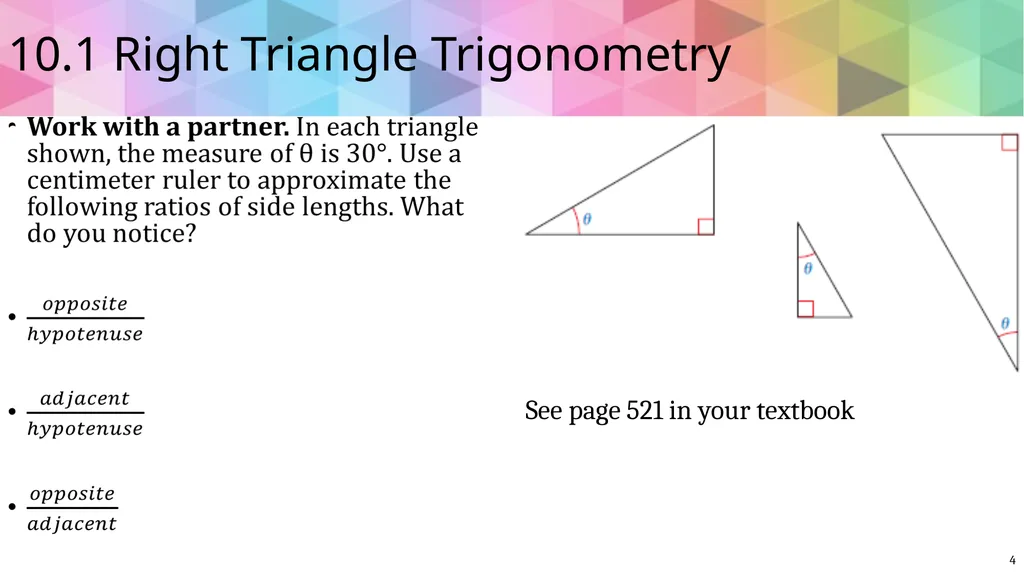
10.1 Right Triangle Trigonometry 4 See page 521 in your textbook<br>
05
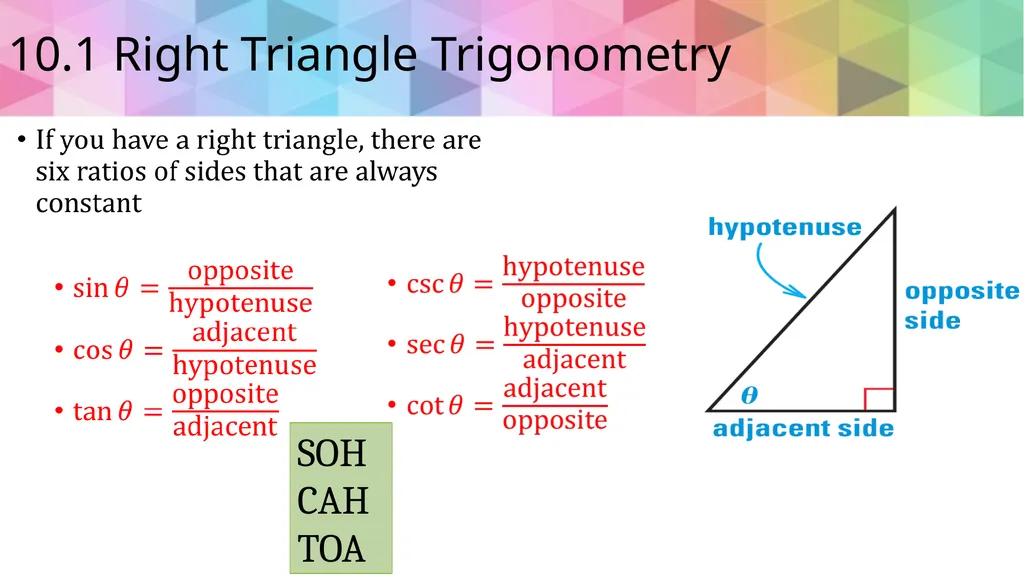
10.1 Right Triangle Trigonometry SOH
CAH
TOA<br>
CAH
TOA<br>
06
10.1 Right Triangle Trigonometry<br>
07
10.1 Right Triangle Trigonometry<br>
08
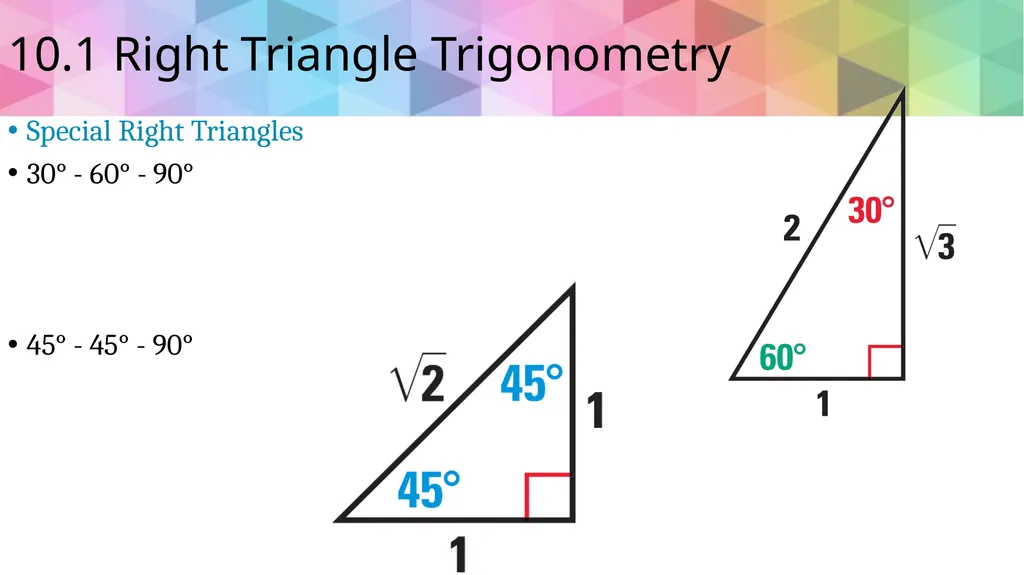
10.1 Right Triangle Trigonometry Special Right Triangles
30° - 60° - 90°
45° - 45° - 90°<br>
30° - 60° - 90°
45° - 45° - 90°<br>
09
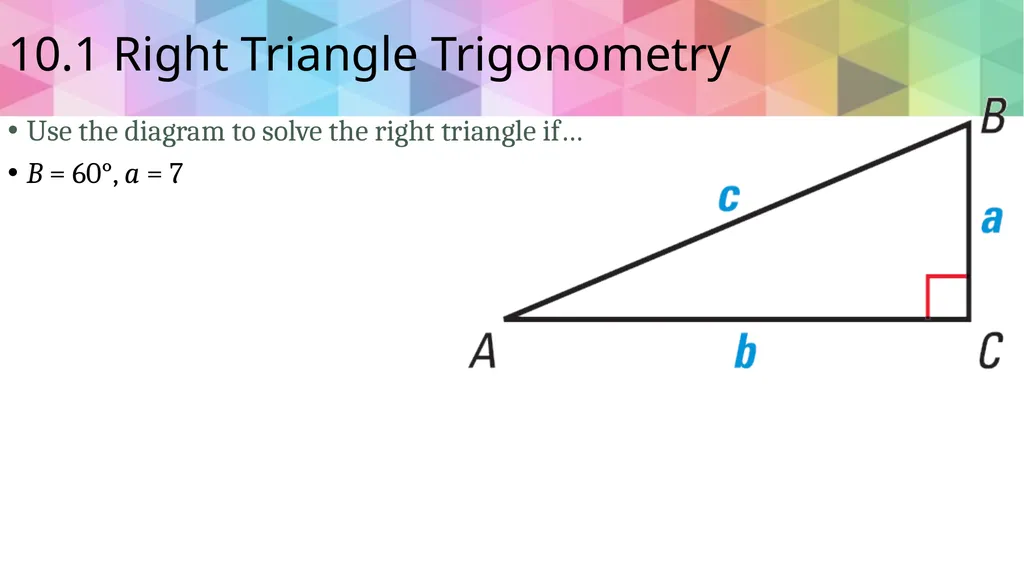
10.1 Right Triangle Trigonometry Use the diagram to solve the right triangle if…
B = 60°, a = 7<br>
B = 60°, a = 7<br>
10
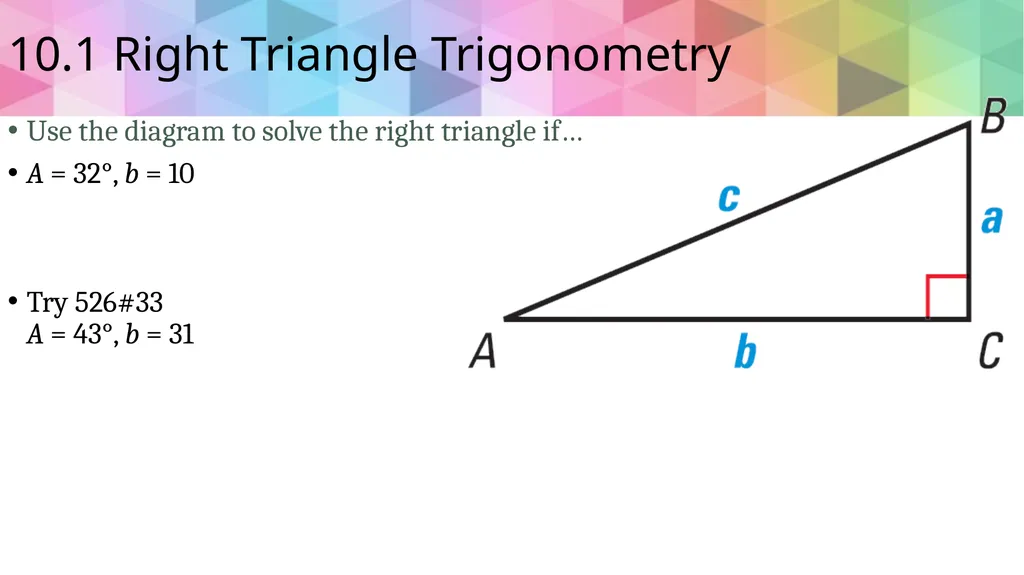
10.1 Right Triangle Trigonometry Use the diagram to solve the right triangle if…
A = 32°, b = 10
Try 526#33 A = 43°, b = 31<br>
A = 32°, b = 10
Try 526#33 A = 43°, b = 31<br>
11
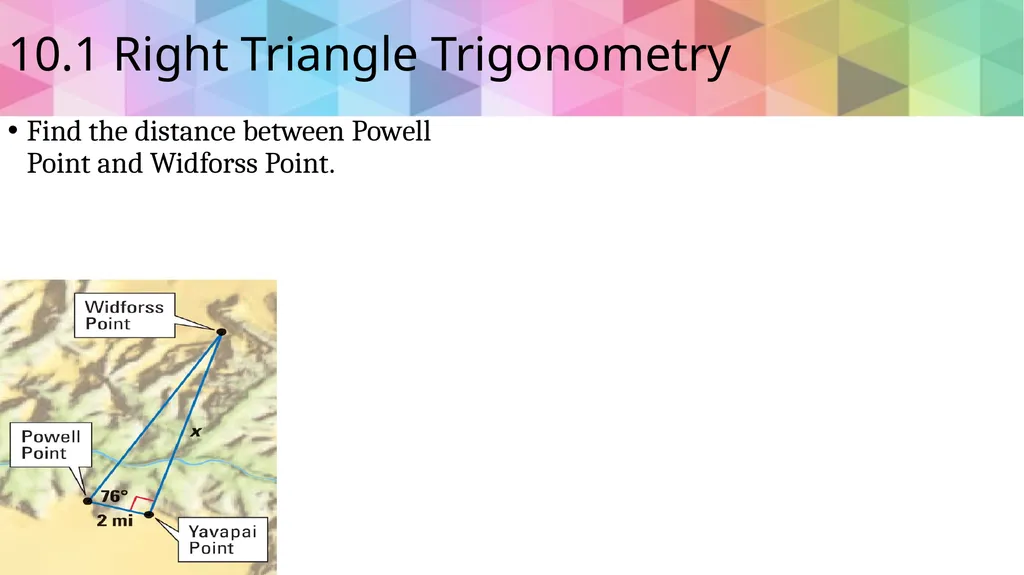
10.1 Right Triangle Trigonometry Find the distance between Powell Point and Widforss Point.<br>
12
10.2 Angles and Radian Measure After this lesson…
• I can draw angles in standard position.
• I can explain the meaning of radian measure.
• I can convert between degrees and radians.
• I can use radian measure to find arc lengths and the area of a sector. 12<br>
• I can draw angles in standard position.
• I can explain the meaning of radian measure.
• I can convert between degrees and radians.
• I can use radian measure to find arc lengths and the area of a sector. 12<br>
13
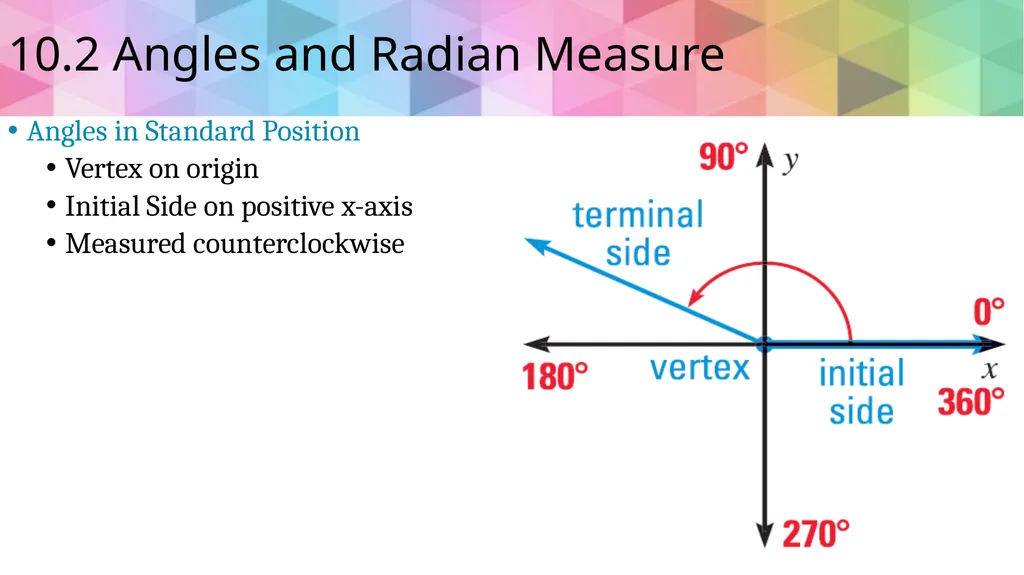
10.2 Angles and Radian Measure Angles in Standard Position
Vertex on origin
Initial Side on positive x-axis
Measured counterclockwise<br>
Vertex on origin
Initial Side on positive x-axis
Measured counterclockwise<br>
14
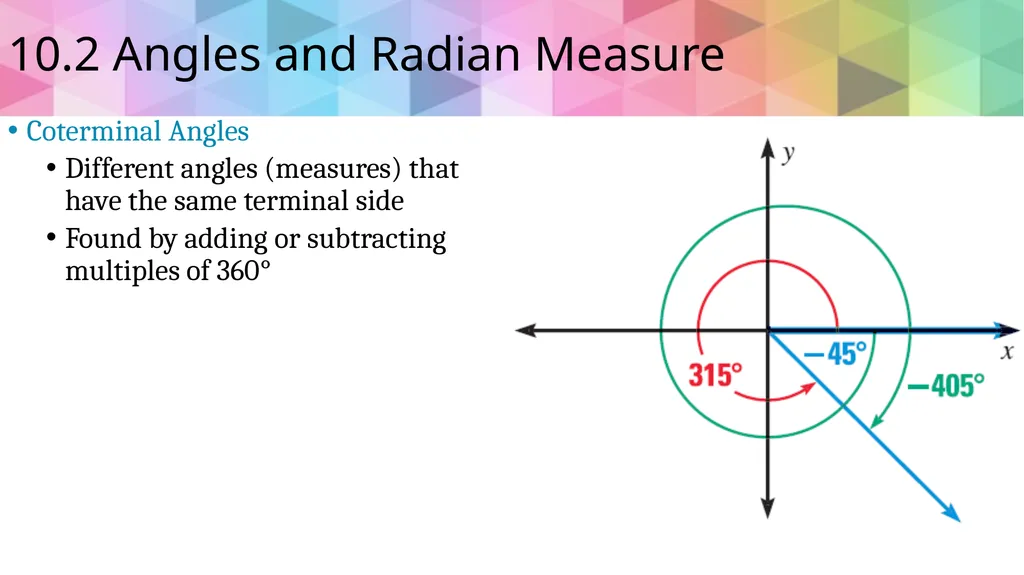
10.2 Angles and Radian Measure Coterminal Angles
Different angles (measures) that have the same terminal side
Found by adding or subtracting multiples of 360°<br>
Different angles (measures) that have the same terminal side
Found by adding or subtracting multiples of 360°<br>
15
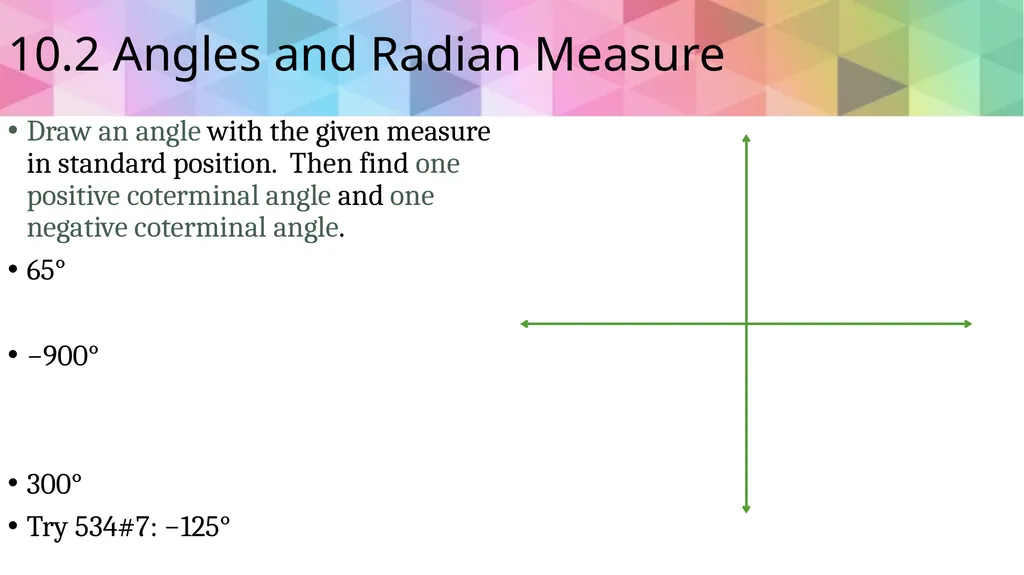
10.2 Angles and Radian Measure Draw an angle with the given measure in standard position. Then find one positive coterminal angle and one negative coterminal angle.
65°
−900°
300°
Try 534#7: −125°<br>
65°
−900°
300°
Try 534#7: −125°<br>
16
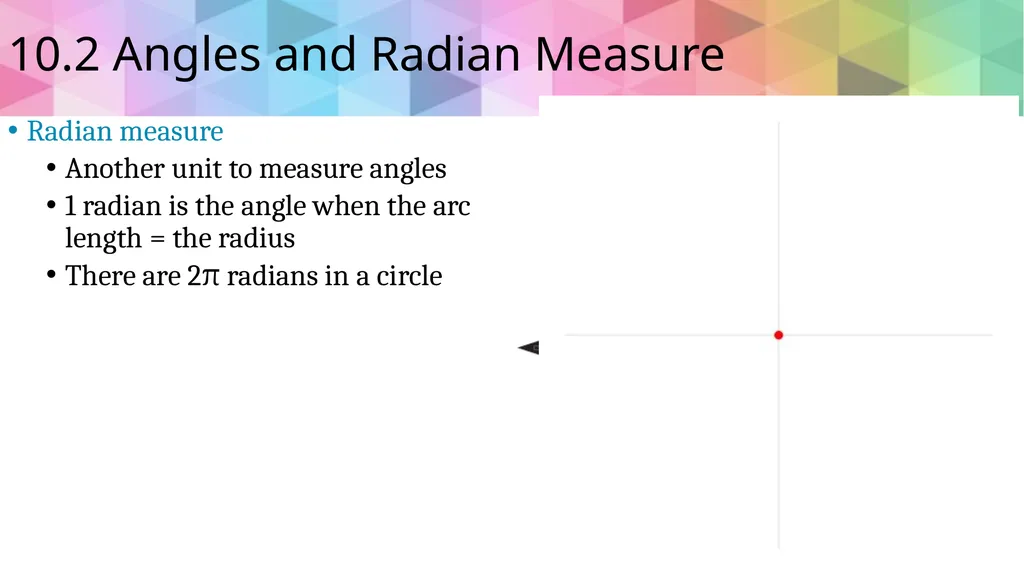
10.2 Angles and Radian Measure Radian measure
Another unit to measure angles
1 radian is the angle when the arc length = the radius
There are 2π radians in a circle<br>
Another unit to measure angles
1 radian is the angle when the arc length = the radius
There are 2π radians in a circle<br>
17
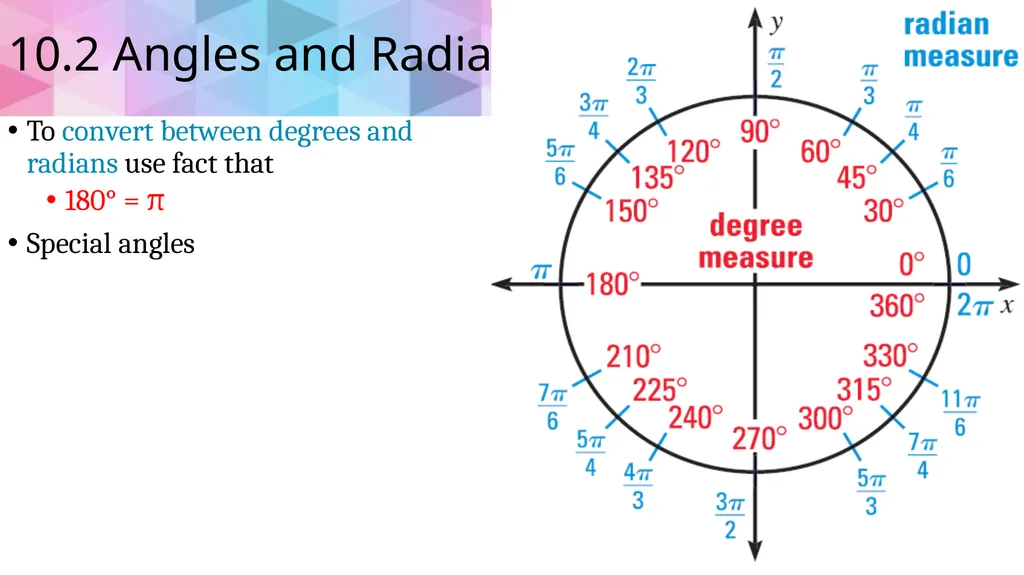
10.2 Angles and Radian Measure To convert between degrees and radians use fact that
180° = π
Special angles<br>
180° = π
Special angles<br>
18
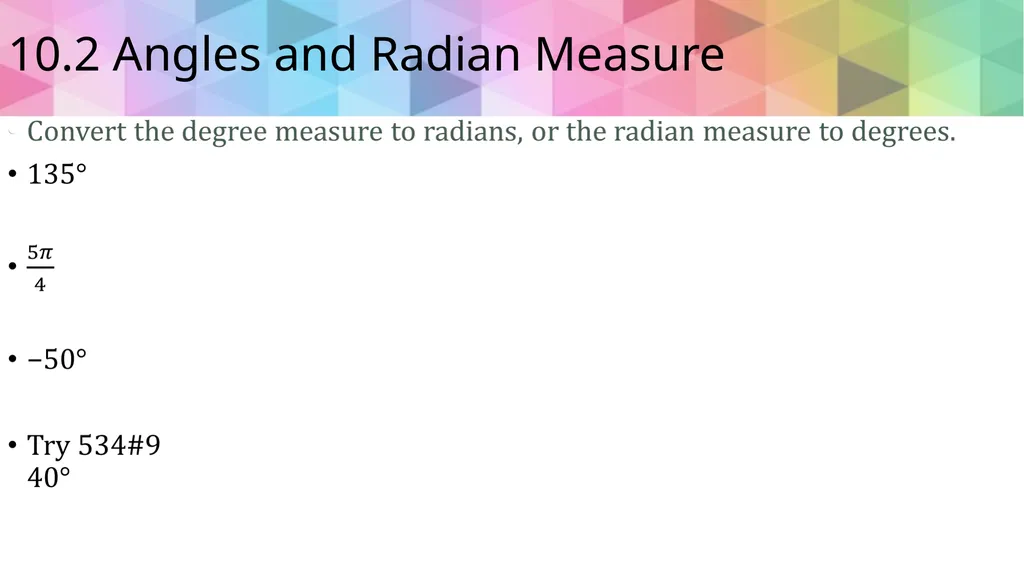
10.2 Angles and Radian Measure<br>
19
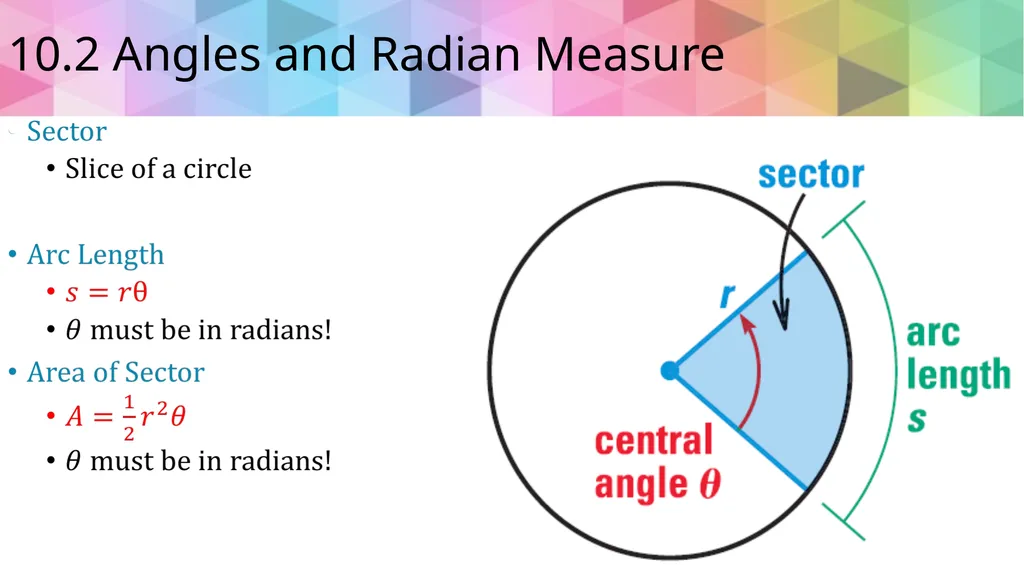
10.2 Angles and Radian Measure<br>
20
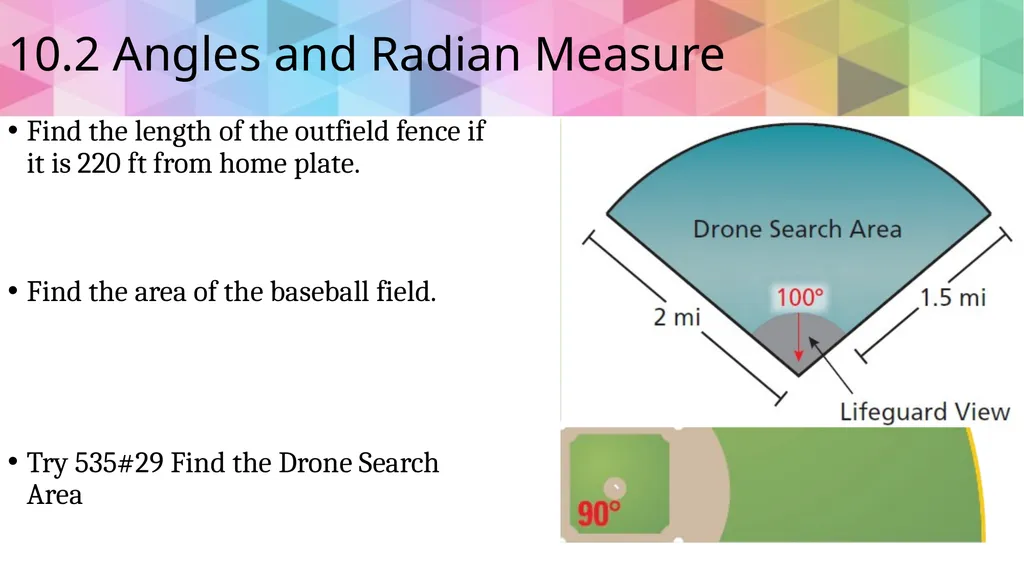
10.2 Angles and Radian Measure Find the length of the outfield fence if it is 220 ft from home plate.
Find the area of the baseball field.
Try 535#29 Find the Drone Search Area<br>
Find the area of the baseball field.
Try 535#29 Find the Drone Search Area<br>
21
10.3 Trigonometric Functions
of Any Angle After this lesson…
• I can evaluate trigonometric functions given a point on an angle.
• I can evaluate trigonometric functions using the unit circle.
• I can find and use reference angles to evaluate trigonometric functions.
• I can solve real-life problems involving projectiles. 21<br>
• I can evaluate trigonometric functions given a point on an angle.
• I can evaluate trigonometric functions using the unit circle.
• I can find and use reference angles to evaluate trigonometric functions.
• I can solve real-life problems involving projectiles. 21<br>
22
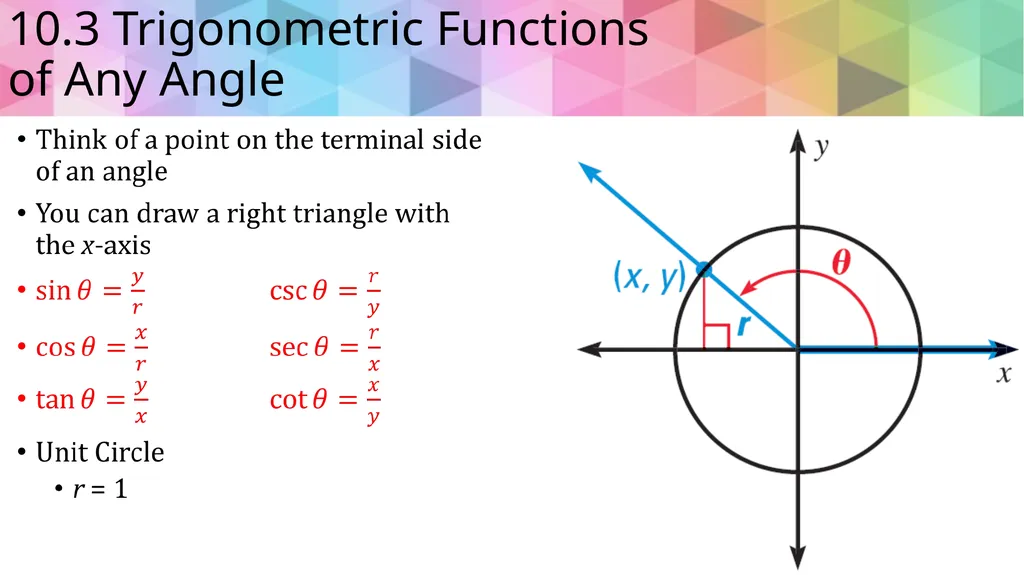
10.3 Trigonometric Functions
of Any Angle<br>
23
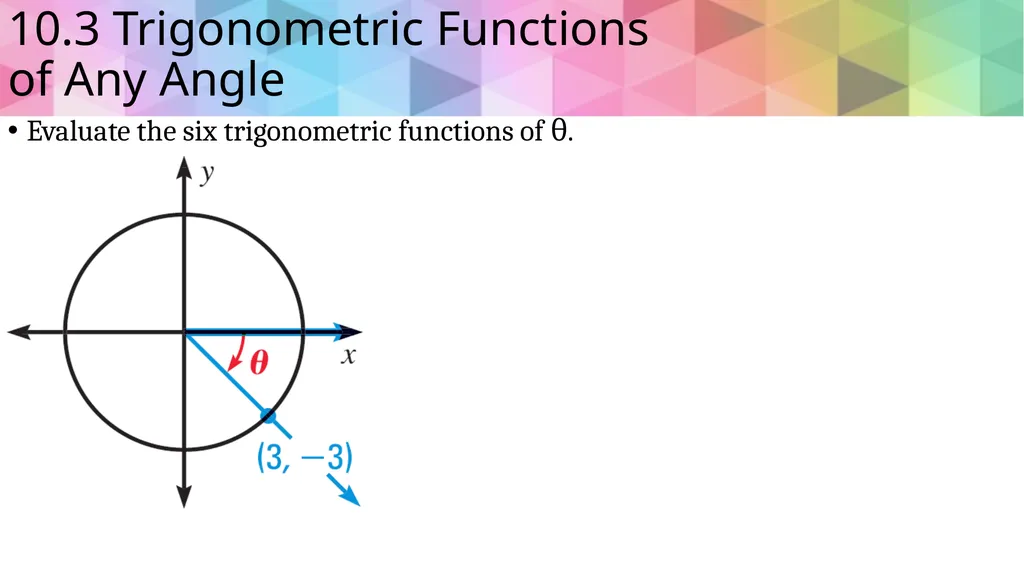
10.3 Trigonometric Functions
of Any Angle Evaluate the six trigonometric functions of θ.<br>
24
10.3 Trigonometric Functions
of Any Angle Evaluate the six trigonometric functions of θ. Try 542#3<br>
25
10.3 Trigonometric Functions
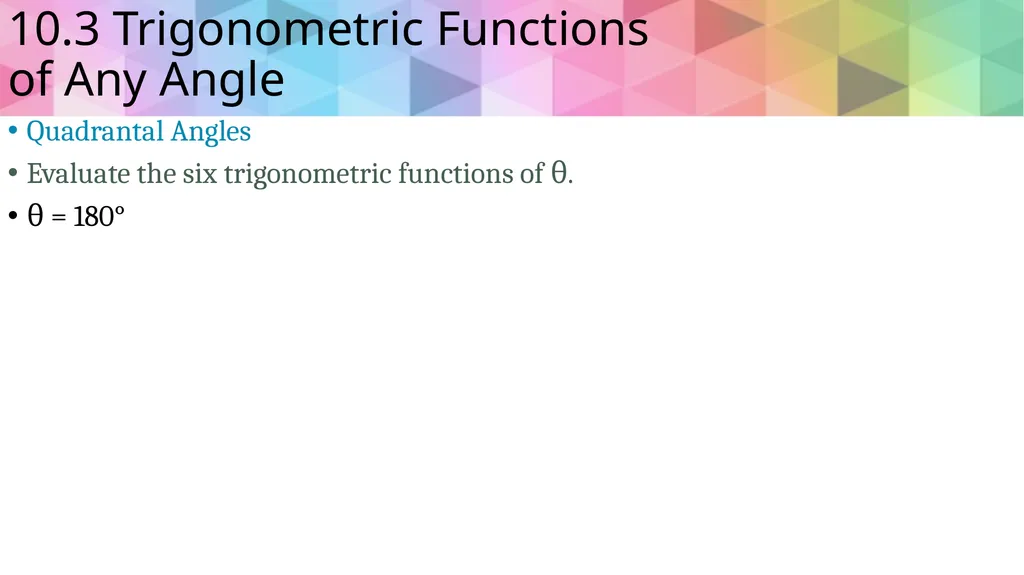
of Any Angle Quadrantal Angles
Evaluate the six trigonometric functions of θ.
θ = 180°<br>
Evaluate the six trigonometric functions of θ.
θ = 180°<br>
26
10.3 Trigonometric Functions
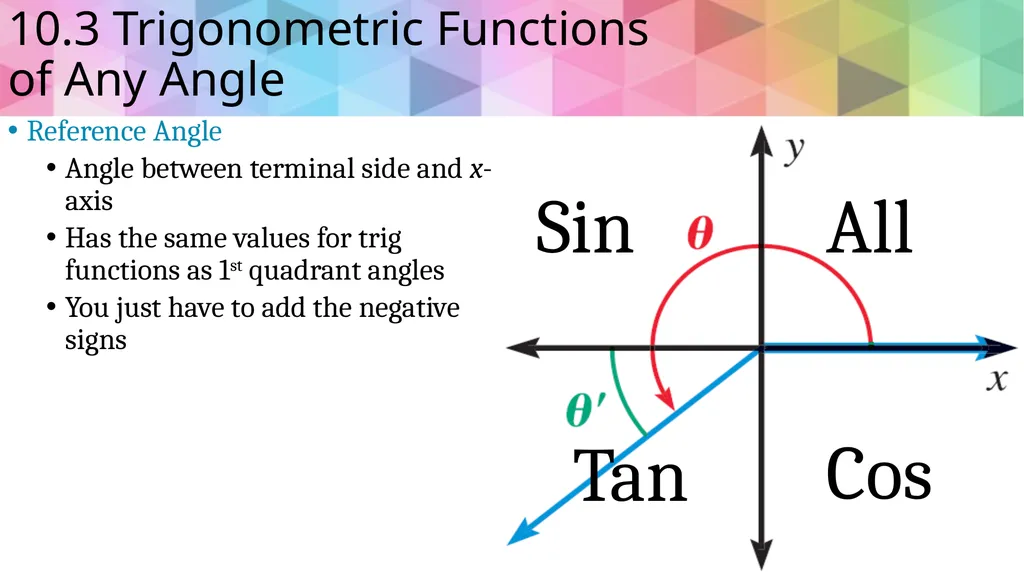
of Any Angle Reference Angle
Angle between terminal side and x-axis
Has the same values for trig functions as 1st quadrant angles
You just have to add the negative signs All Sin Cos Tan<br>
Angle between terminal side and x-axis
Has the same values for trig functions as 1st quadrant angles
You just have to add the negative signs All Sin Cos Tan<br>
27
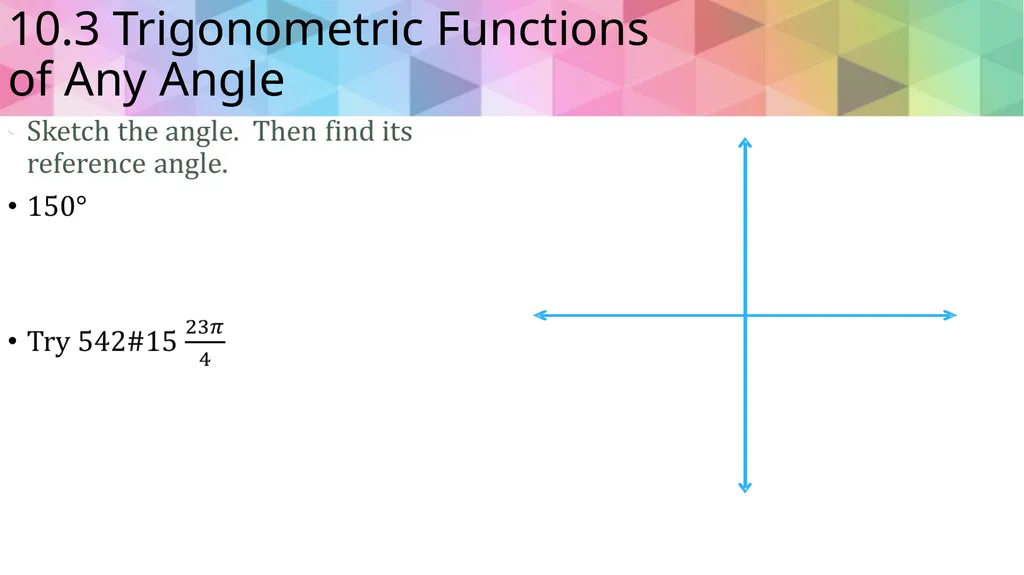
10.3 Trigonometric Functions
of Any Angle<br>
28
10.3 Trigonometric Functions
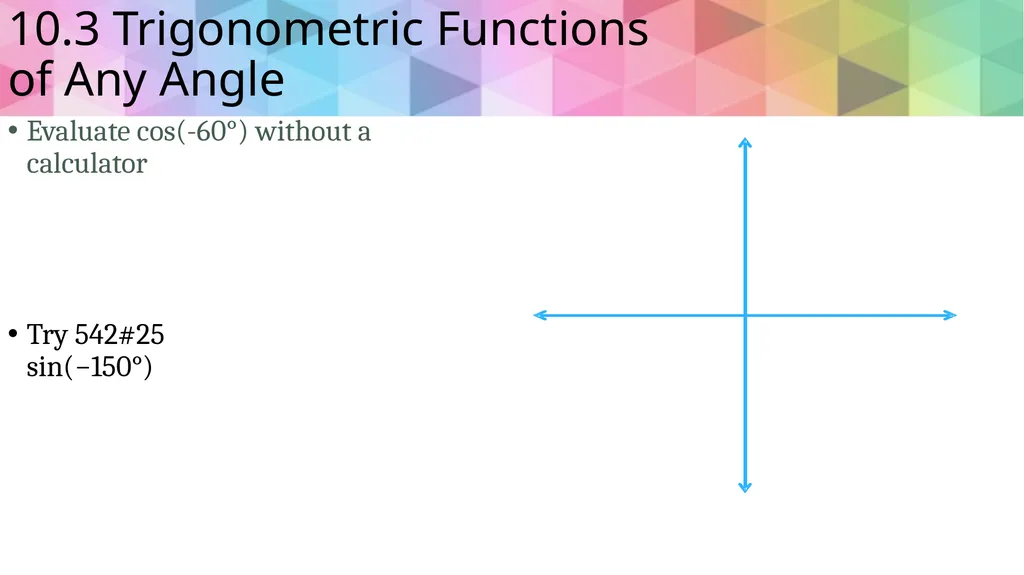
of Any Angle Evaluate cos(-60°) without a calculator
Try 542#25 sin(−150°)<br>
Try 542#25 sin(−150°)<br>
29
10.3 Trigonometric Functions
of Any Angle Estimate the horizontal distance traveled by a Red Kangaroo who jumps at an angle of 8° and with an initial speed of 53 feet per second (35 mph).<br>
30
10.4 Graphing Sine and Cosine Functions After this lesson…
• I can identify characteristics of sine and cosine functions.
• I can graph transformations of sine and cosine functions. 30<br>
• I can identify characteristics of sine and cosine functions.
• I can graph transformations of sine and cosine functions. 30<br>
31
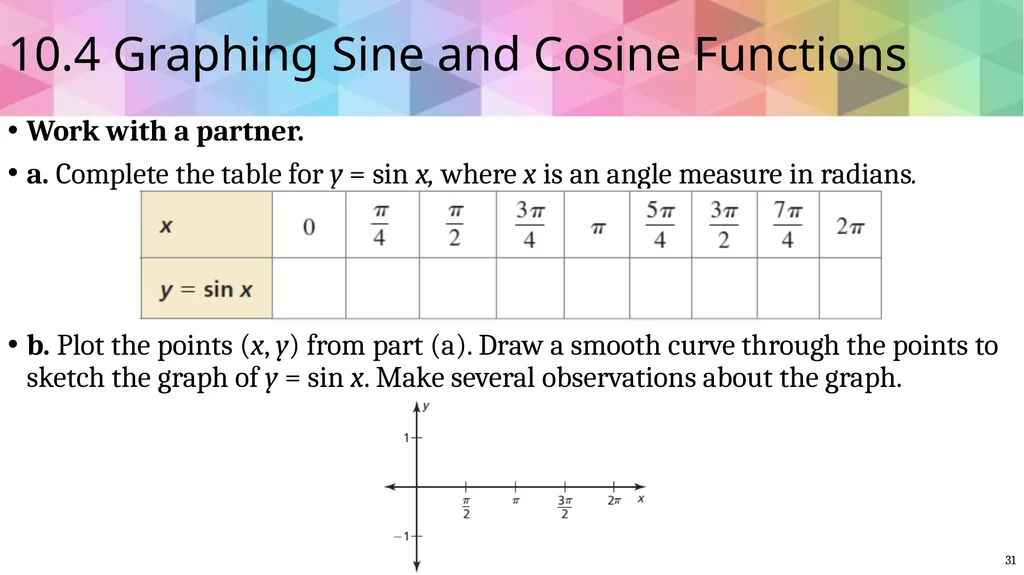
10.4 Graphing Sine and Cosine Functions Work with a partner.
a. Complete the table for y = sin x, where x is an angle measure in radians.
b. Plot the points (x, y) from part (a). Draw a smooth curve through the points to sketch the graph of y = sin x. Make several observations about the graph. 31<br>
a. Complete the table for y = sin x, where x is an angle measure in radians.
b. Plot the points (x, y) from part (a). Draw a smooth curve through the points to sketch the graph of y = sin x. Make several observations about the graph. 31<br>
32
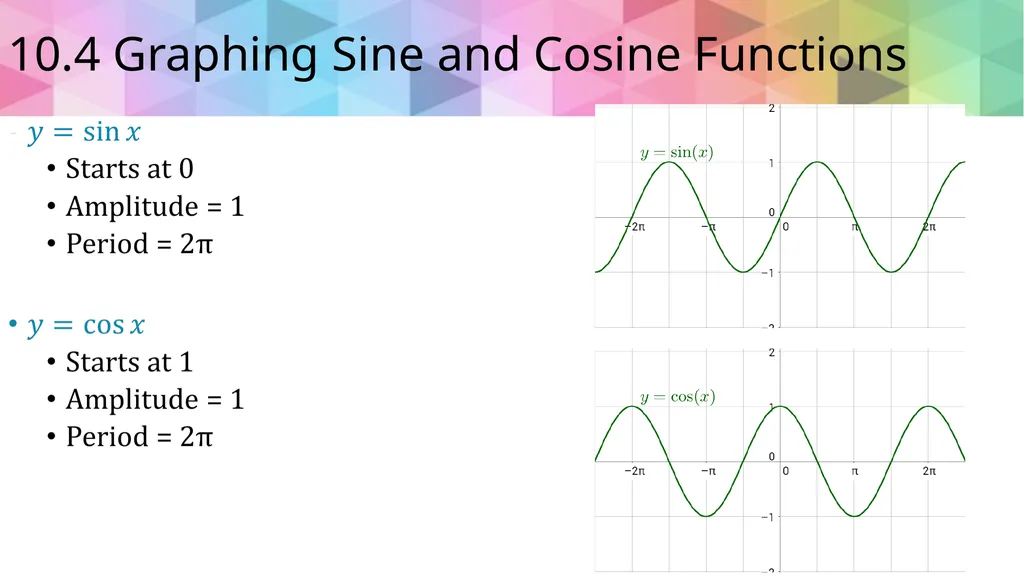
10.4 Graphing Sine and Cosine Functions<br>
33
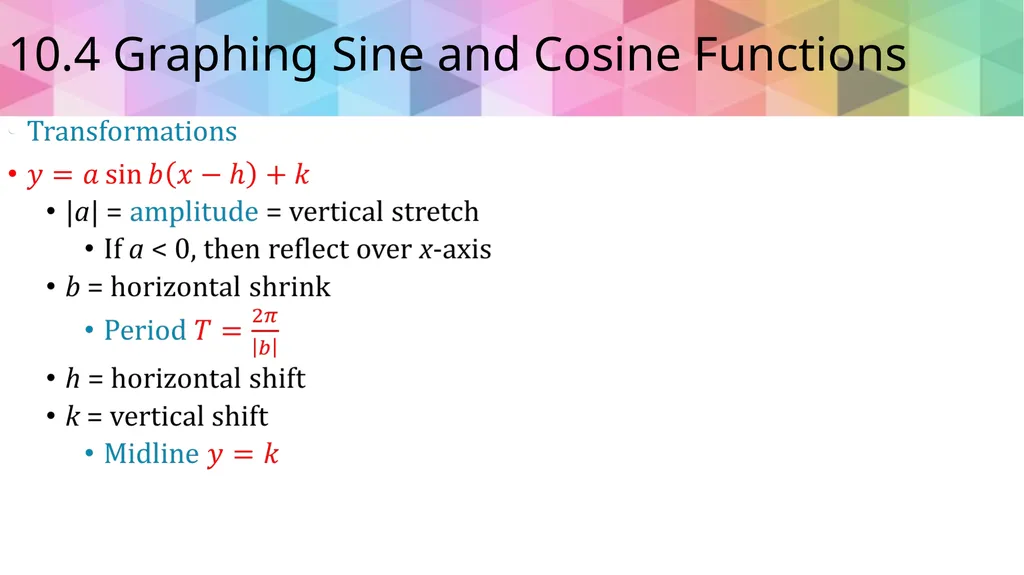
10.4 Graphing Sine and Cosine Functions<br>
34
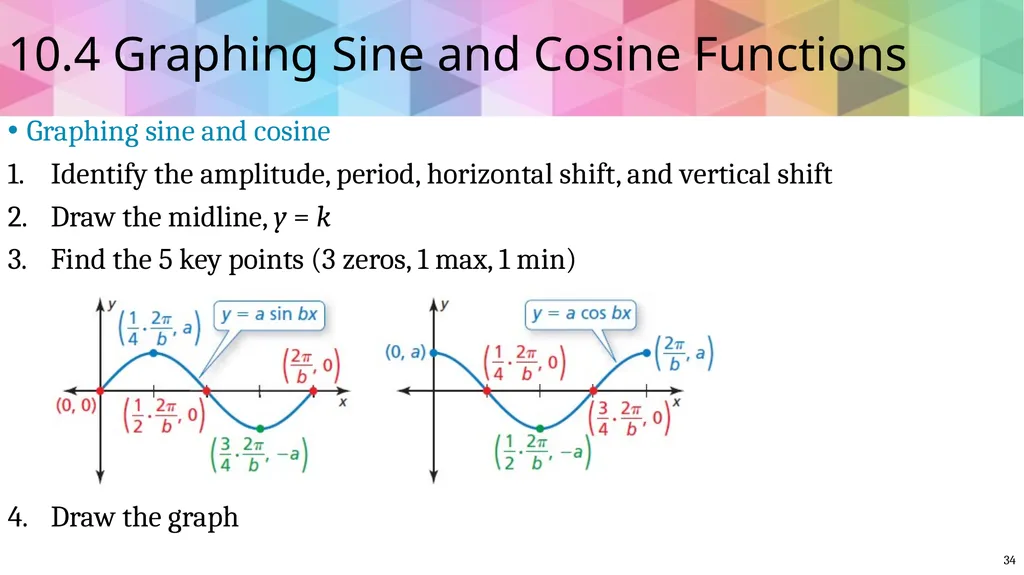
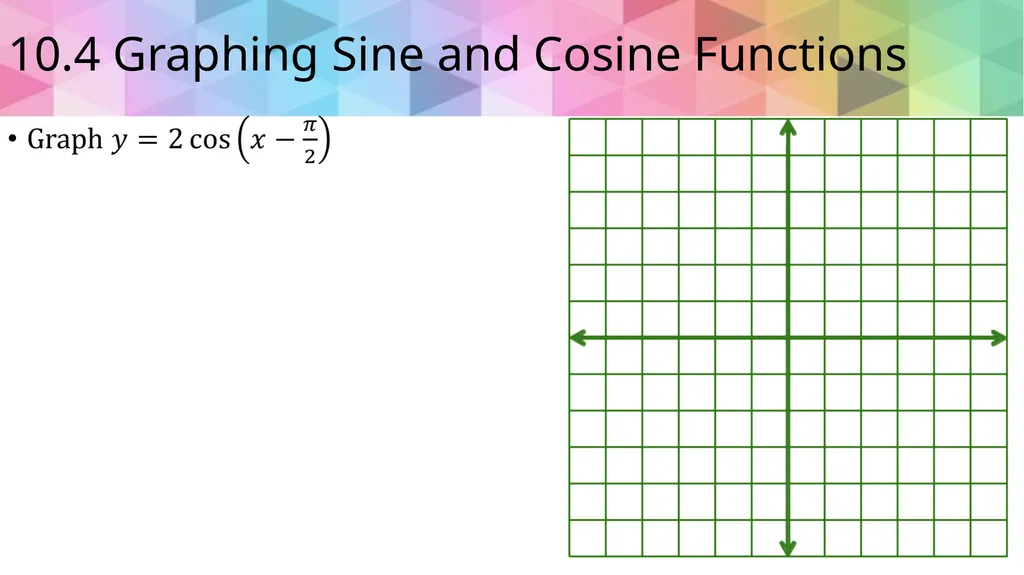
10.4 Graphing Sine and Cosine Functions Graphing sine and cosine
Identify the amplitude, period, horizontal shift, and vertical shift
Draw the midline, y = k
Find the 5 key points (3 zeros, 1 max, 1 min)
Draw the graph 34<br>
Identify the amplitude, period, horizontal shift, and vertical shift
Draw the midline, y = k
Find the 5 key points (3 zeros, 1 max, 1 min)
Draw the graph 34<br>
35
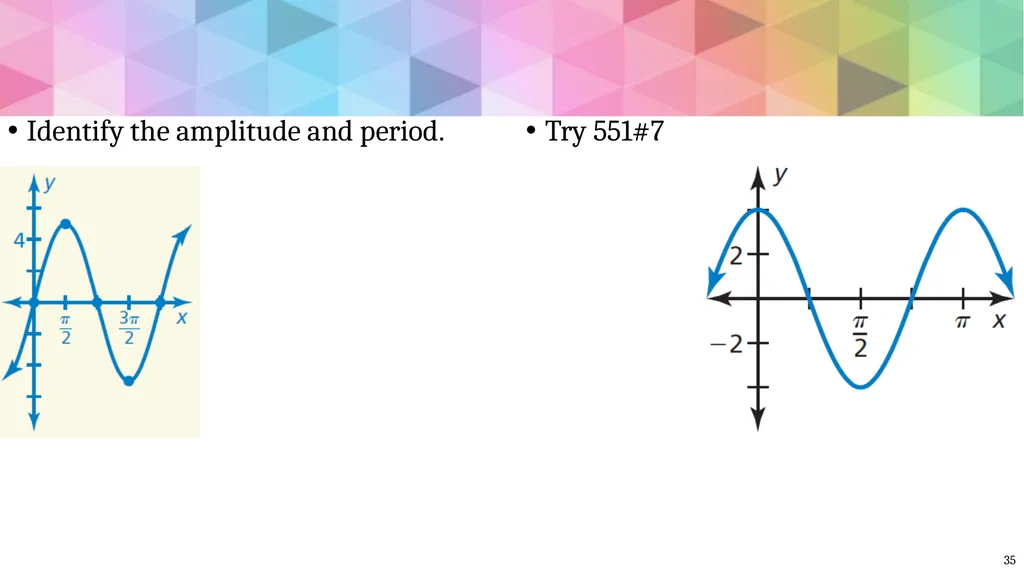
Identify the amplitude and period. Try 551#7 35<br>
36
10.4 Graphing Sine and Cosine Functions<br>
37
10.4 Graphing Sine and Cosine Functions<br>
38
10.4 Graphing Sine and Cosine Functions<br>
39
10.4 Graphing Sine and Cosine Functions<br>
40
10.5 Graphing Other Trigonometric Functions After this lesson…
• I can identify characteristics of tangent, cotangent, secant, and cosecant functions.
• I can graph tangent and cotangent functions.
• I can graph secant and cosecant functions. 40<br>
• I can identify characteristics of tangent, cotangent, secant, and cosecant functions.
• I can graph tangent and cotangent functions.
• I can graph secant and cosecant functions. 40<br>
41
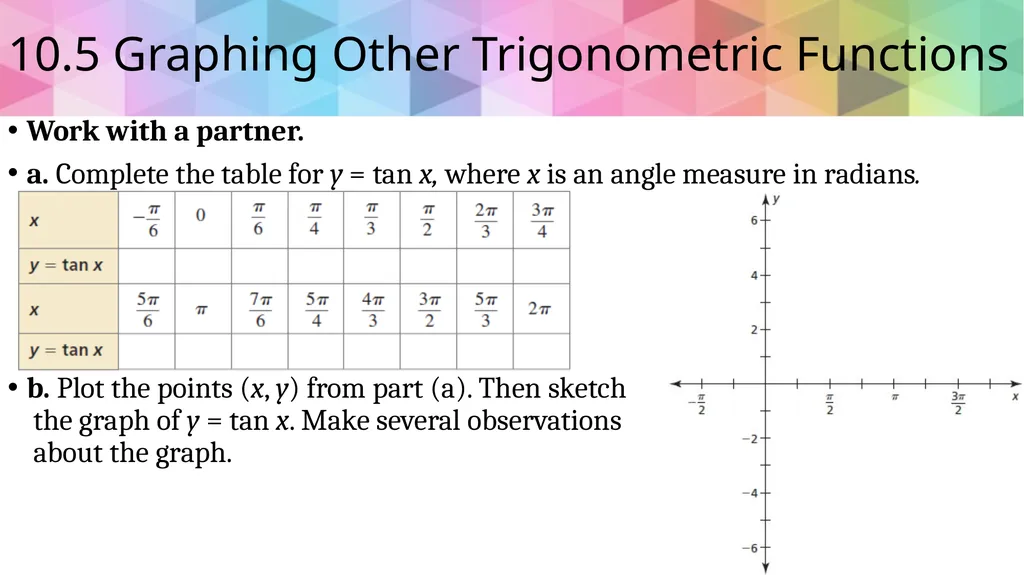
10.5 Graphing Other Trigonometric Functions Work with a partner.
a. Complete the table for y = tan x, where x is an angle measure in radians.
b. Plot the points (x, y) from part (a). Then sketch the graph of y = tan x. Make several observations about the graph. 41<br>
a. Complete the table for y = tan x, where x is an angle measure in radians.
b. Plot the points (x, y) from part (a). Then sketch the graph of y = tan x. Make several observations about the graph. 41<br>
42
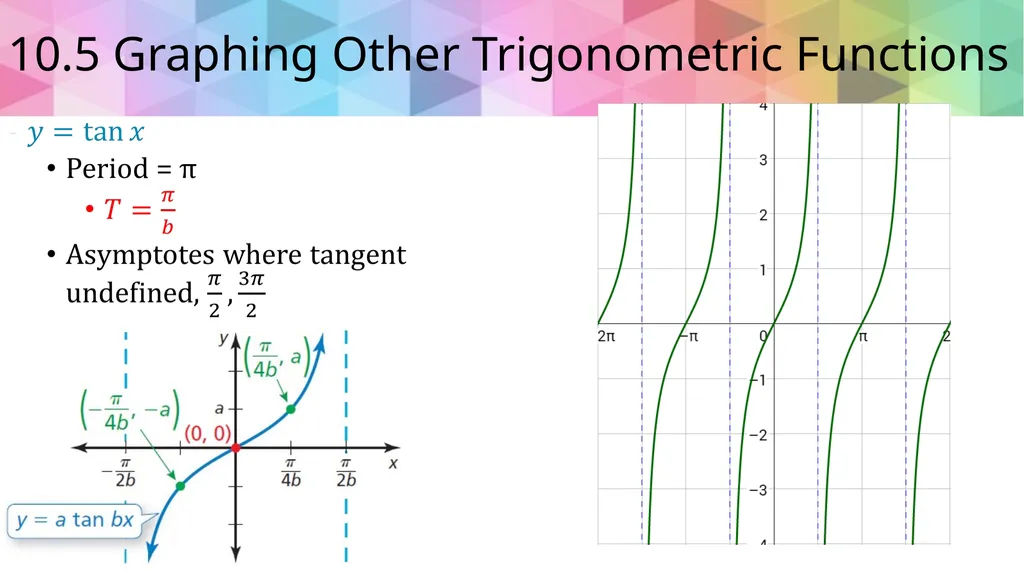
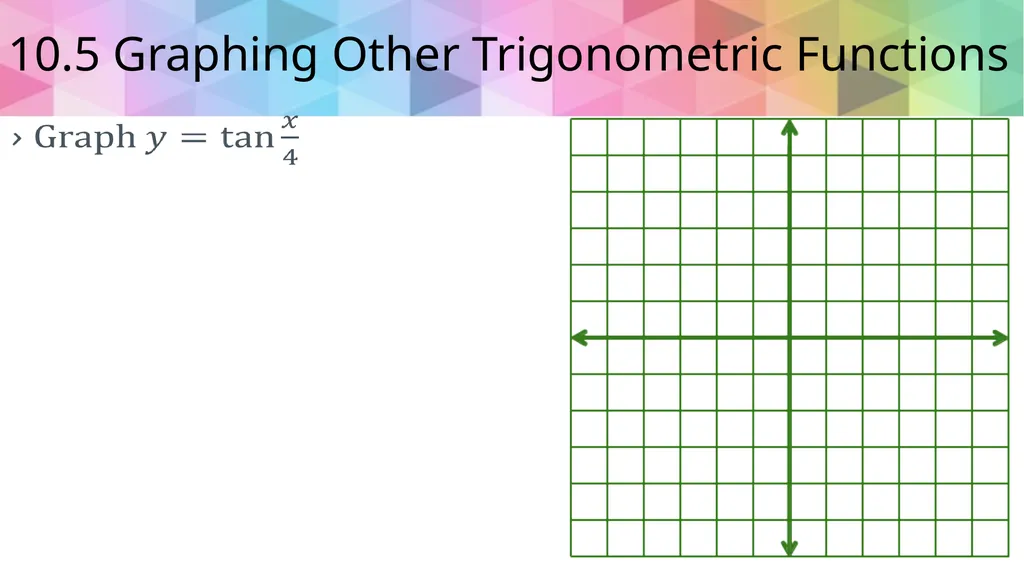
10.5 Graphing Other Trigonometric Functions<br>
43
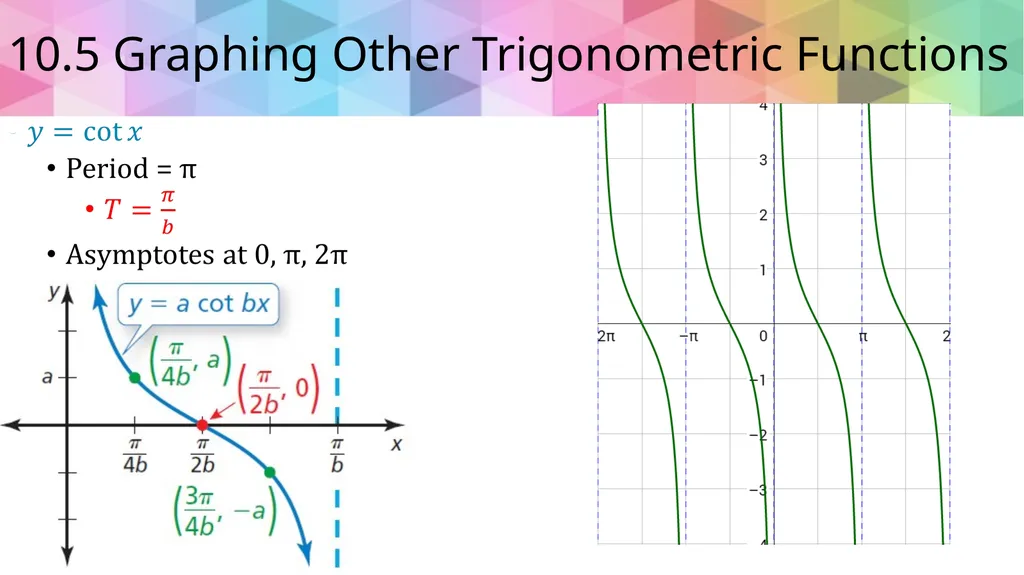
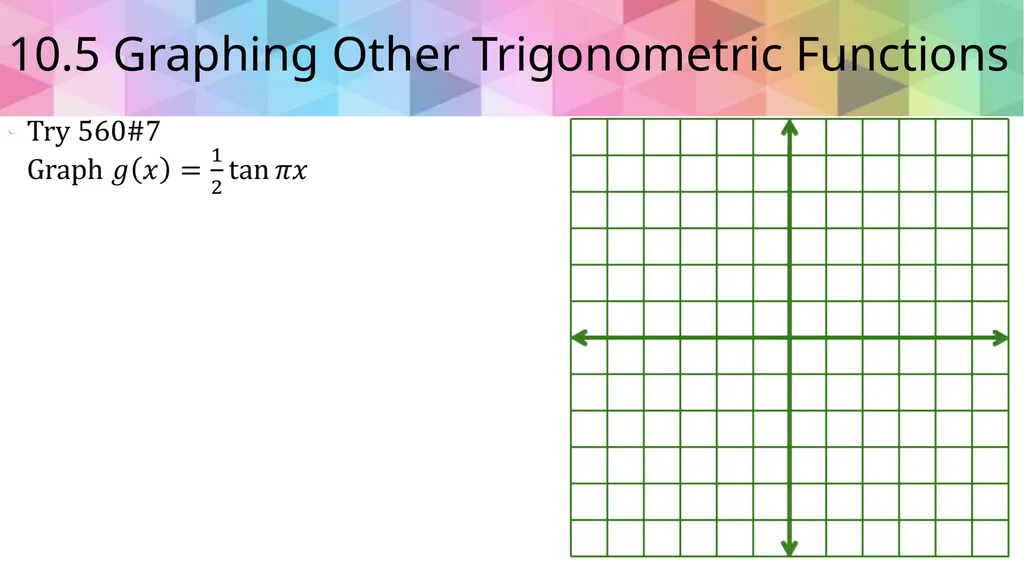
10.5 Graphing Other Trigonometric Functions<br>
44
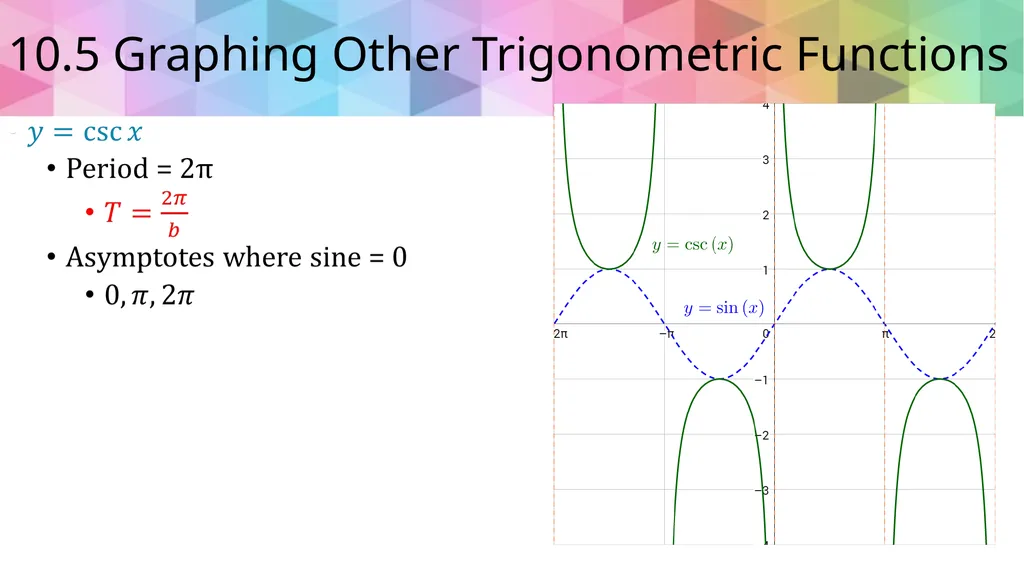
10.5 Graphing Other Trigonometric Functions<br>
45
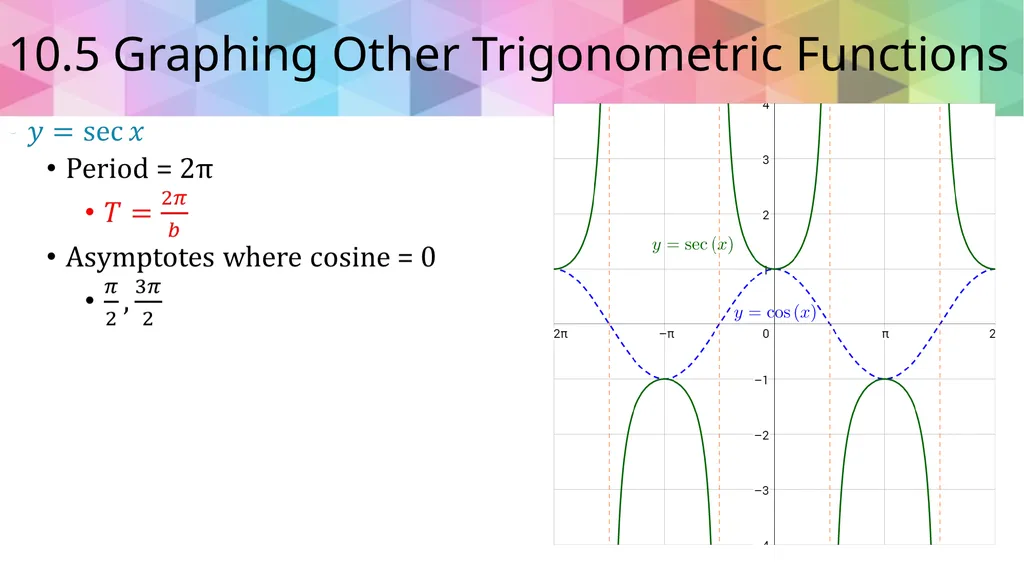
10.5 Graphing Other Trigonometric Functions<br>
46
10.5 Graphing Other Trigonometric Functions<br>
47
10.5 Graphing Other Trigonometric Functions<br>
48
10.5 Graphing Other Trigonometric Functions<br>
49
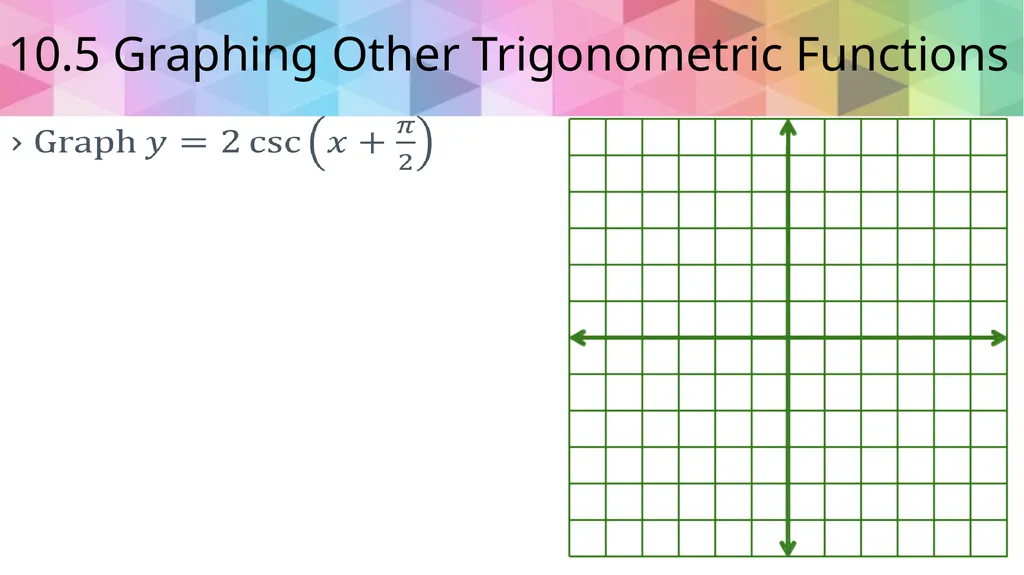
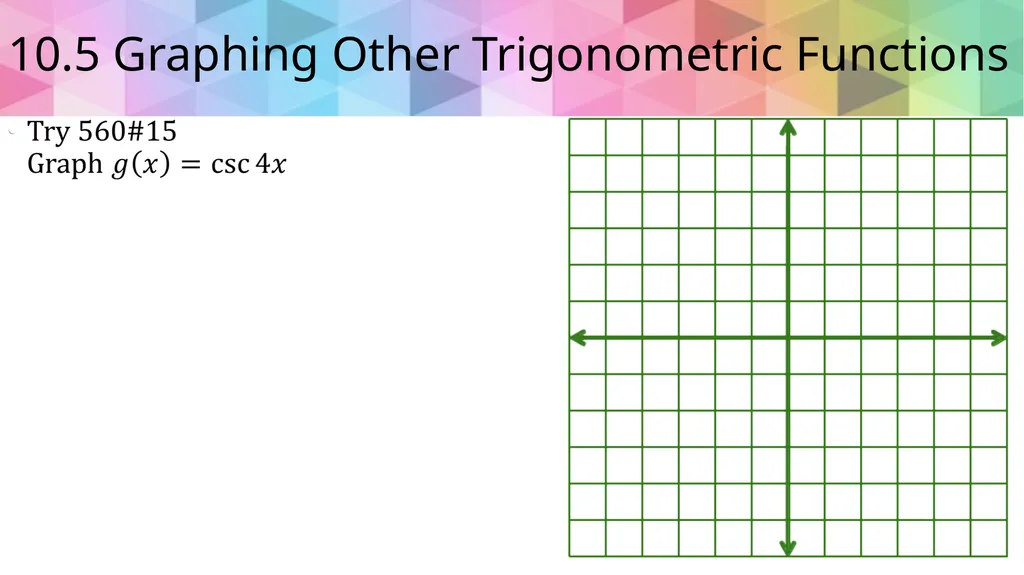
10.5 Graphing Other Trigonometric Functions<br>
50
10.6 Modeling with Trigonometric Functions After this lesson…
• I can write and graph trigonometric functions using frequency.
• I can write trigonometric functions for a given graph.
• I can find a trigonometric model for a set of data using technology. 50<br>
• I can write and graph trigonometric functions using frequency.
• I can write trigonometric functions for a given graph.
• I can find a trigonometric model for a set of data using technology. 50<br>
51
10.6 Modeling with Trigonometric Functions Trigonometric functions are periodic
Useful for modeling oscillating motions or repeated patterns
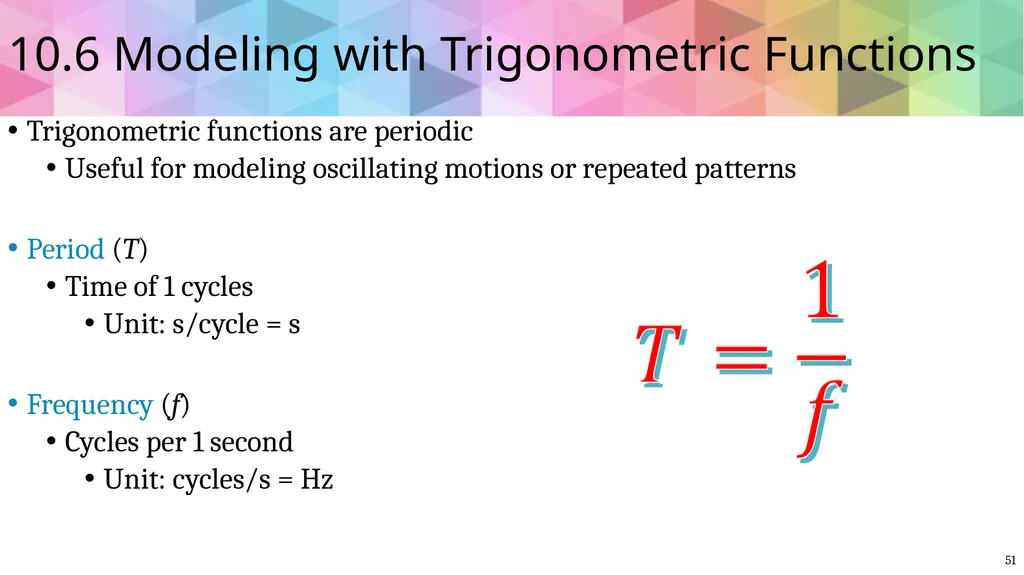
Period (T)
Time of 1 cycles
Unit: s/cycle = s
Frequency (f)
Cycles per 1 second
Unit: cycles/s = Hz 51<br>
Useful for modeling oscillating motions or repeated patterns
Period (T)
Time of 1 cycles
Unit: s/cycle = s
Frequency (f)
Cycles per 1 second
Unit: cycles/s = Hz 51<br>
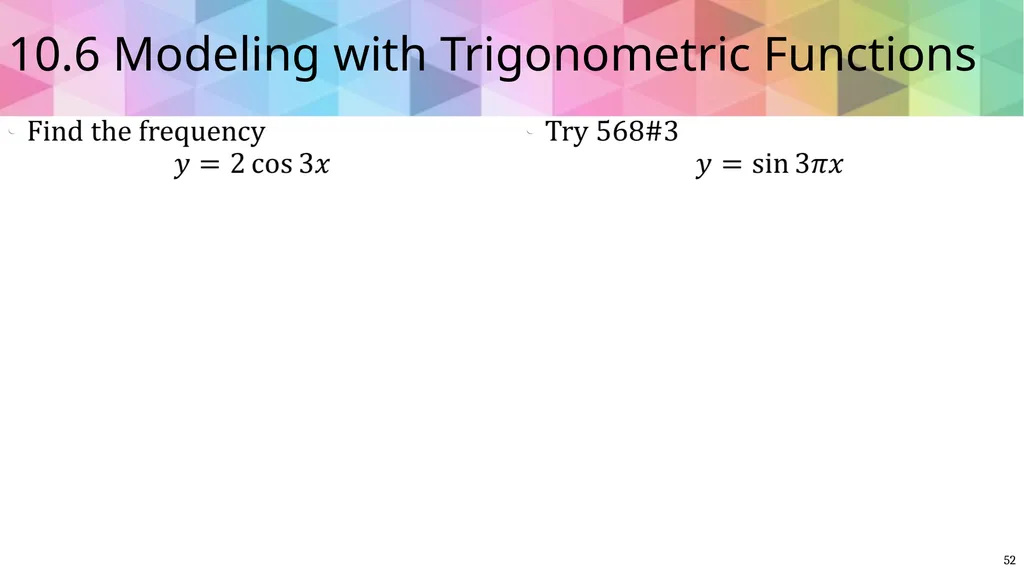
52
10.6 Modeling with Trigonometric Functions 52<br>
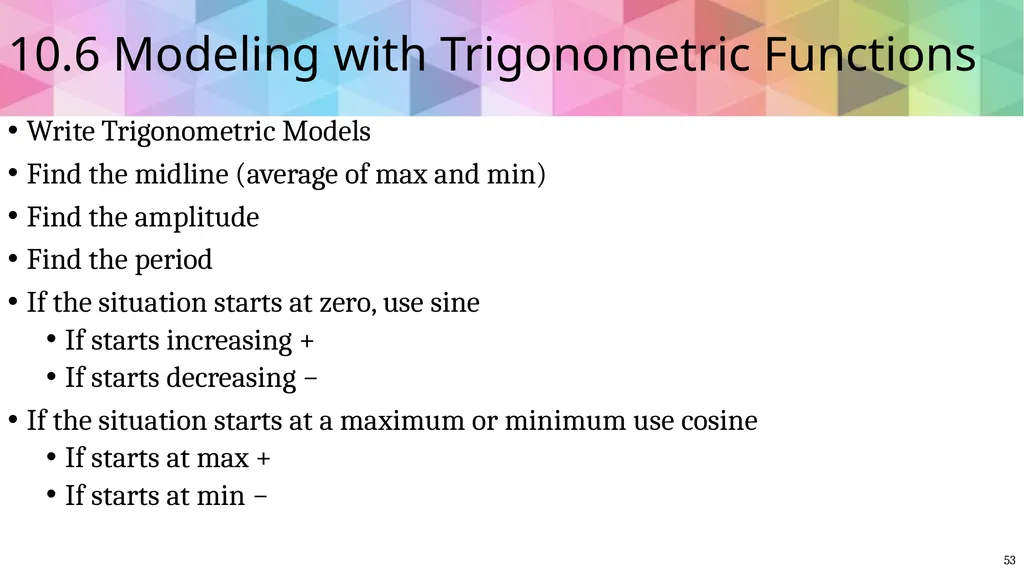
53
10.6 Modeling with Trigonometric Functions Write Trigonometric Models
Find the midline (average of max and min)
Find the amplitude
Find the period
If the situation starts at zero, use sine
If starts increasing +
If starts decreasing −
If the situation starts at a maximum or minimum use cosine
If starts at max +
If starts at min − 53<br>
Find the midline (average of max and min)
Find the amplitude
Find the period
If the situation starts at zero, use sine
If starts increasing +
If starts decreasing −
If the situation starts at a maximum or minimum use cosine
If starts at max +
If starts at min − 53<br>
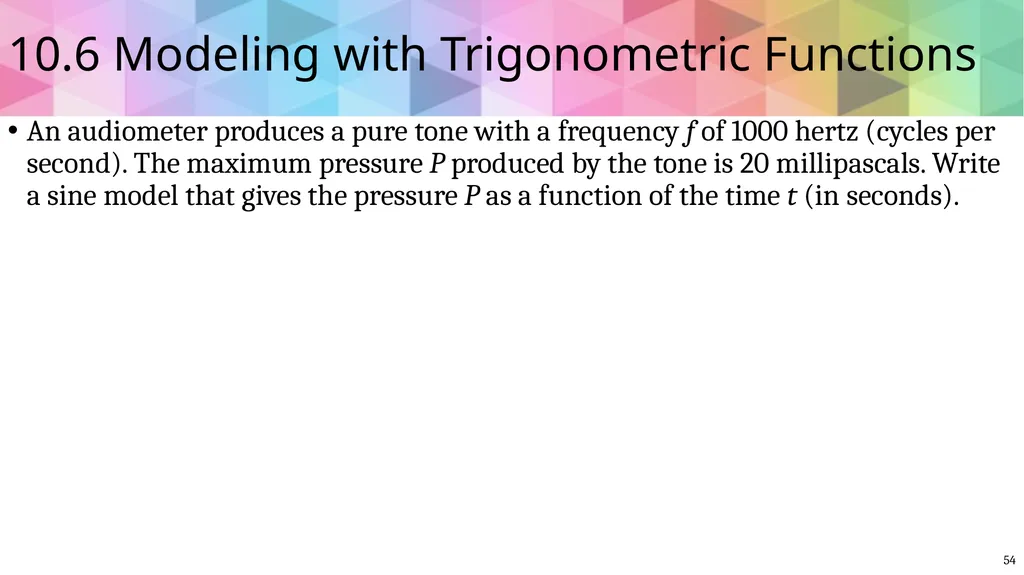
54
10.6 Modeling with Trigonometric Functions An audiometer produces a pure tone with a frequency f of 1000 hertz (cycles per second). The maximum pressure P produced by the tone is 20 millipascals. Write a sine model that gives the pressure P as a function of the time t (in seconds). 54<br>
55
10.6 Modeling with Trigonometric Functions Try 568#9
Frequency is measured in hertz, or cycles per second. The lowest frequency of sounds that can be heard by humans is 20 hertz. The maximum pressure P produced from a sound with a frequency of 20 hertz is 0.02 millipascal. Write a sine model that gives the pressure P as a function of the time t (in seconds). 55<br>
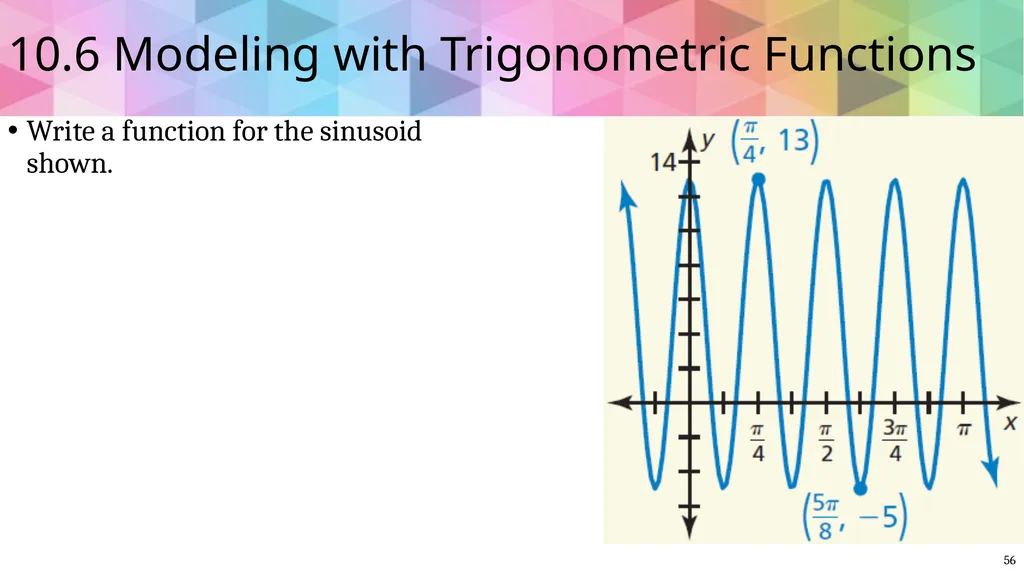
56
10.6 Modeling with Trigonometric Functions Write a function for the sinusoid shown. 56<br>
57
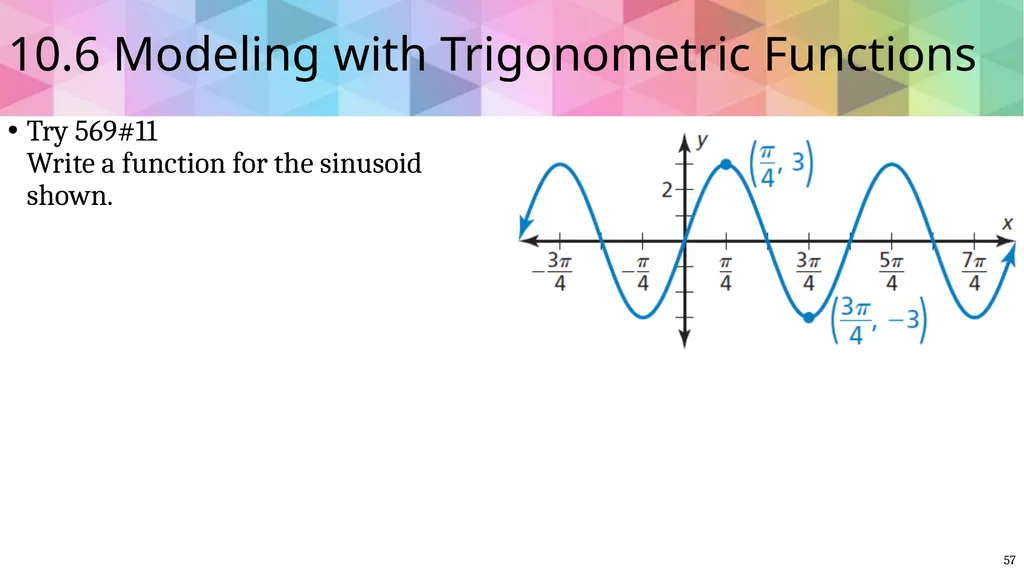
10.6 Modeling with Trigonometric Functions Try 569#11
Write a function for the sinusoid shown. 57<br>
58
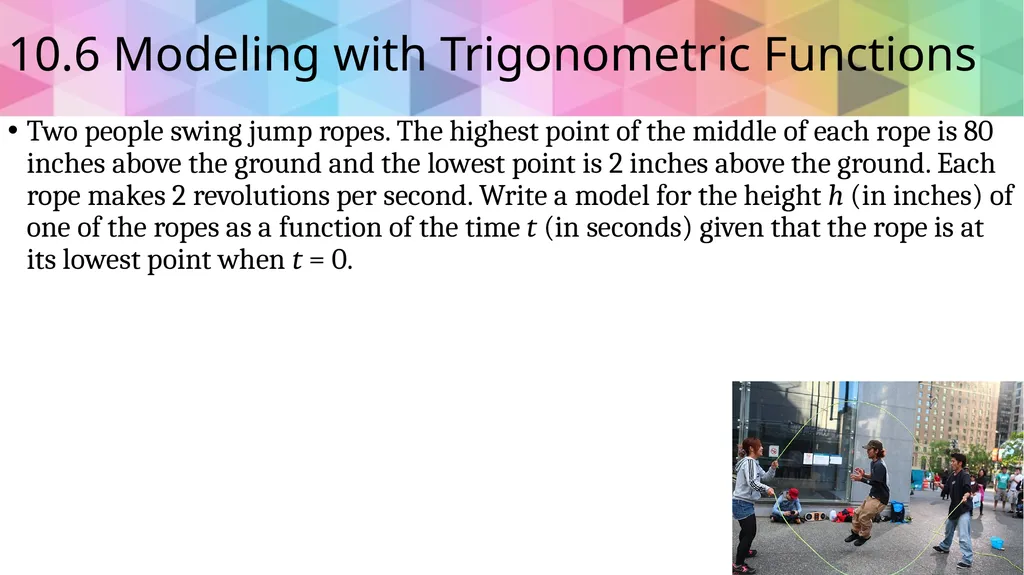
10.6 Modeling with Trigonometric Functions Two people swing jump ropes. The highest point of the middle of each rope is 80 inches above the ground and the lowest point is 2 inches above the ground. Each rope makes 2 revolutions per second. Write a model for the height h (in inches) of one of the ropes as a function of the time t (in seconds) given that the rope is at its lowest point when t = 0. 58<br>
59
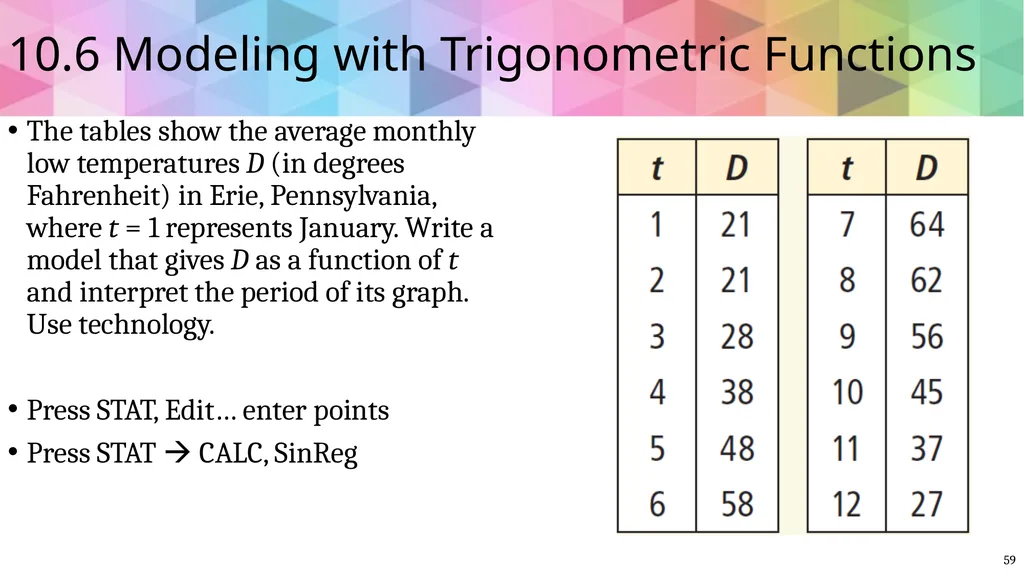
10.6 Modeling with Trigonometric Functions The tables show the average monthly low temperatures D (in degrees Fahrenheit) in Erie, Pennsylvania, where t = 1 represents January. Write a model that gives D as a function of t and interpret the period of its graph. Use technology.
Press STAT, Edit… enter points
Press STAT CALC, SinReg 59<br>
Press STAT, Edit… enter points
Press STAT CALC, SinReg 59<br>
60
10.6 Modeling with Trigonometric Functions Try 569#19
The tables show the average monthly low temperatures D (in degrees Fahrenheit) in Las Vegas, Nevada, where t = 1 represents January. Write a model that gives D as a function of t and interpret the period of its graph. Use technology. 60<br>
61
10.7 Using Trigonometric Identities After this lesson…
• I can evaluate trigonometric functions using trigonometric identities.
• I can simplify trigonometric expressions using trigonometric identities.
• I can verify trigonometric identities. 61<br>
• I can evaluate trigonometric functions using trigonometric identities.
• I can simplify trigonometric expressions using trigonometric identities.
• I can verify trigonometric identities. 61<br>
62
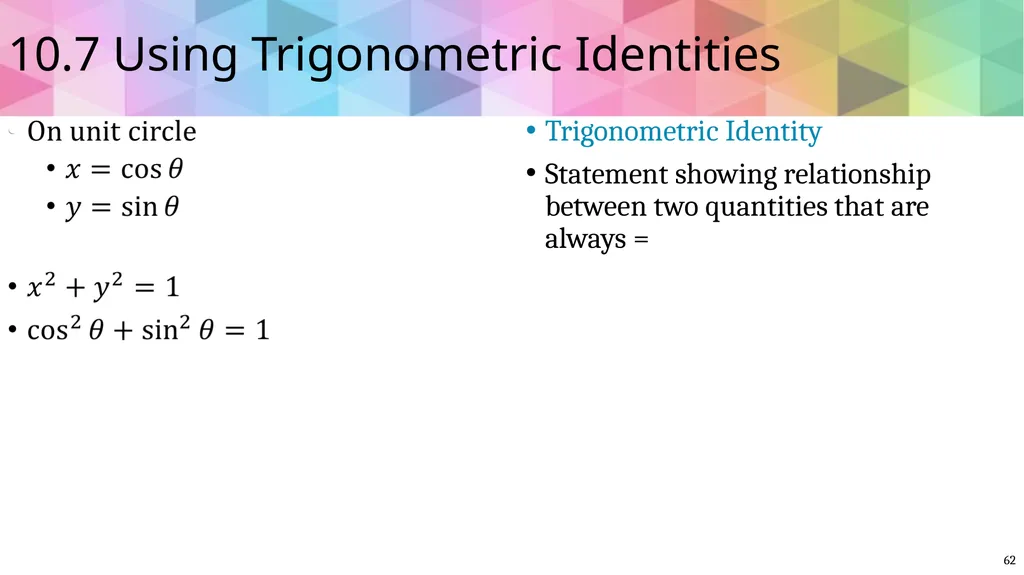
10.7 Using Trigonometric Identities Trigonometric Identity
Statement showing relationship between two quantities that are always = 62<br>
Statement showing relationship between two quantities that are always = 62<br>
63
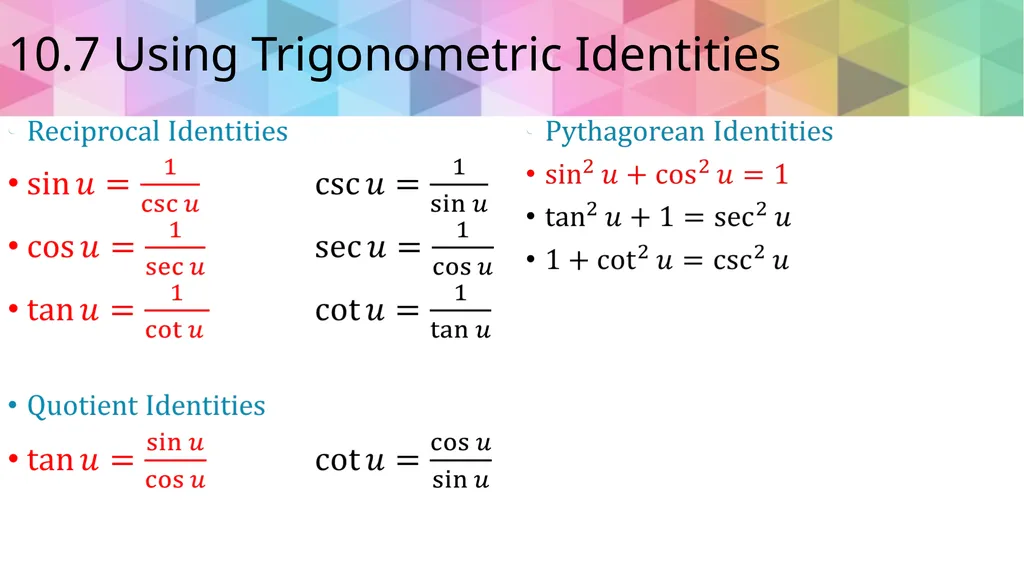
10.7 Using Trigonometric Identities<br>
64
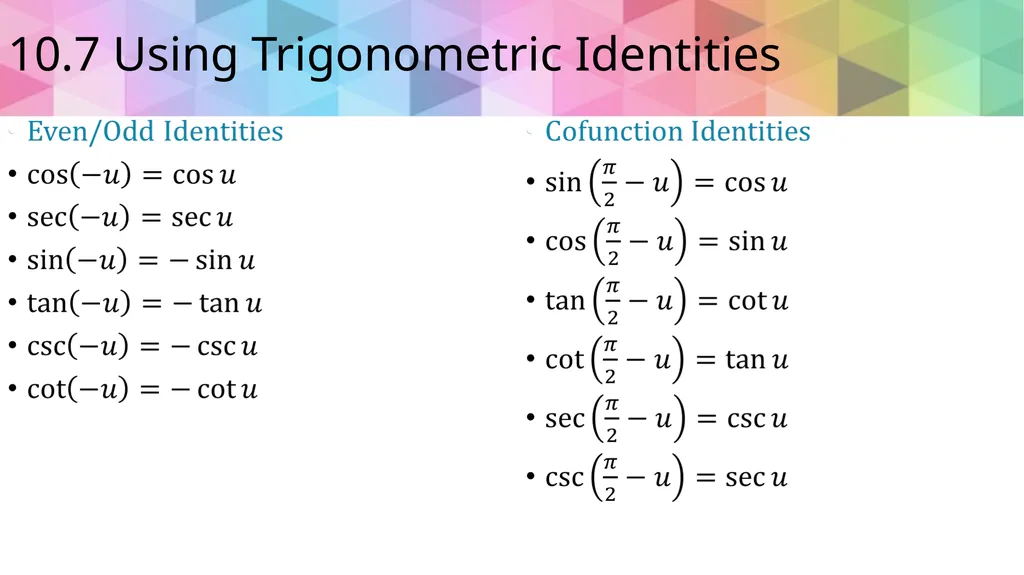
10.7 Using Trigonometric Identities<br>
65
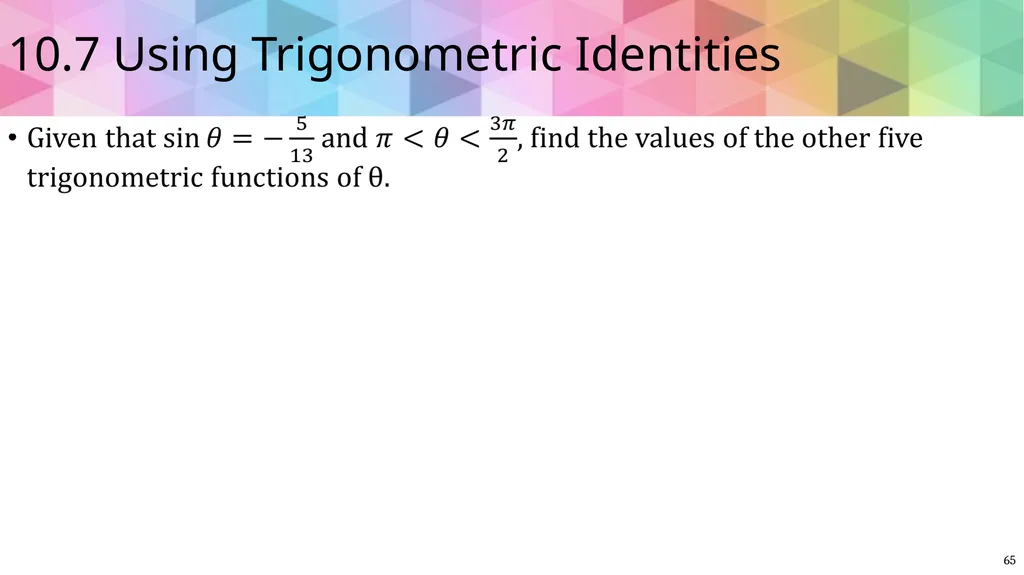
10.7 Using Trigonometric Identities 65<br>
66
10.7 Using Trigonometric Identities 66<br>
67
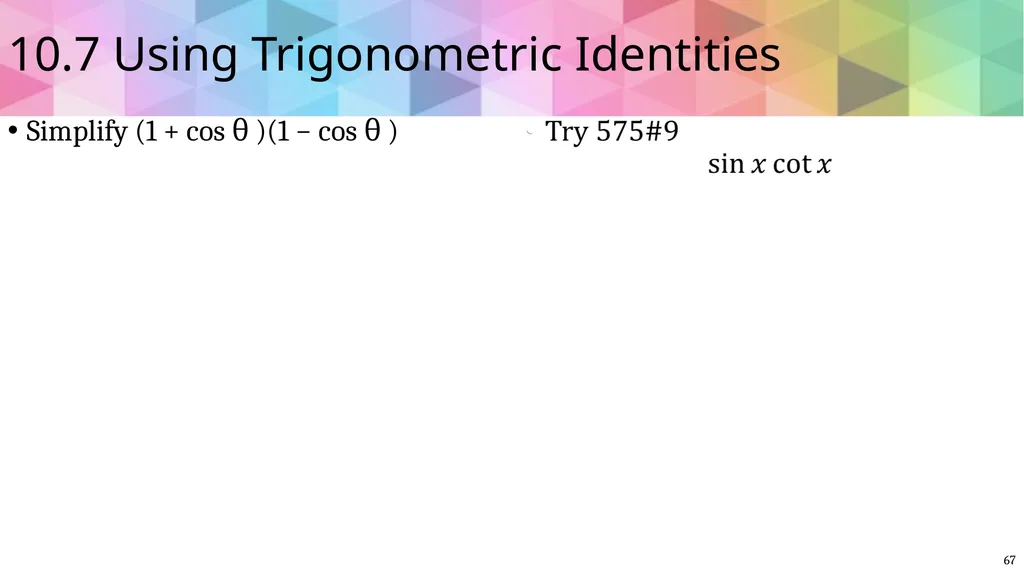
10.7 Using Trigonometric Identities Simplify (1 + cos θ )(1 − cos θ ) 67<br>
68
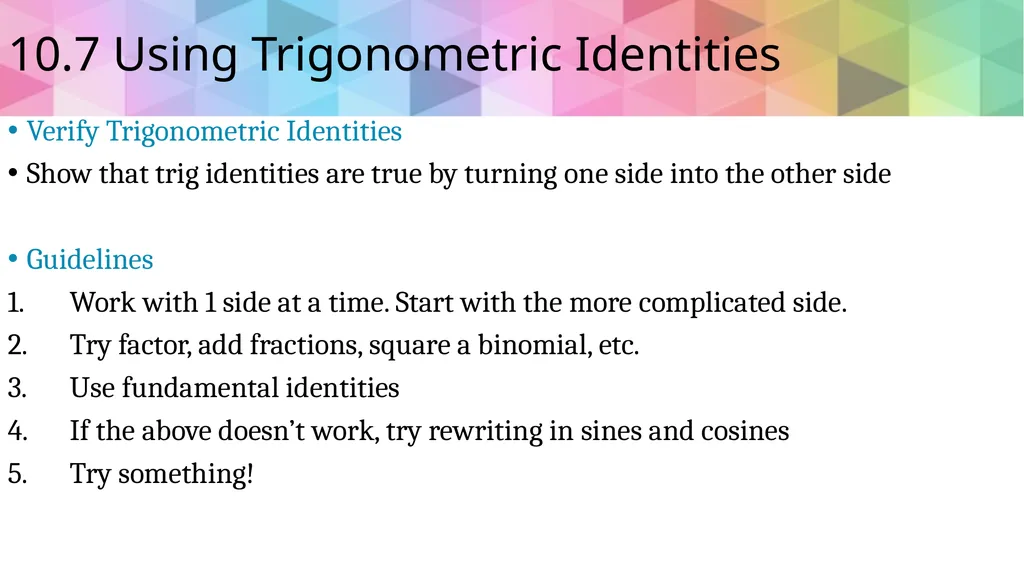
10.7 Using Trigonometric Identities Verify Trigonometric Identities
Show that trig identities are true by turning one side into the other side
Guidelines
Work with 1 side at a time. Start with the more complicated side.
Try factor, add fractions, square a binomial, etc.
Use fundamental identities
If the above doesn’t work, try rewriting in sines and cosines
Try something!<br>
Show that trig identities are true by turning one side into the other side
Guidelines
Work with 1 side at a time. Start with the more complicated side.
Try factor, add fractions, square a binomial, etc.
Use fundamental identities
If the above doesn’t work, try rewriting in sines and cosines
Try something!<br>
69
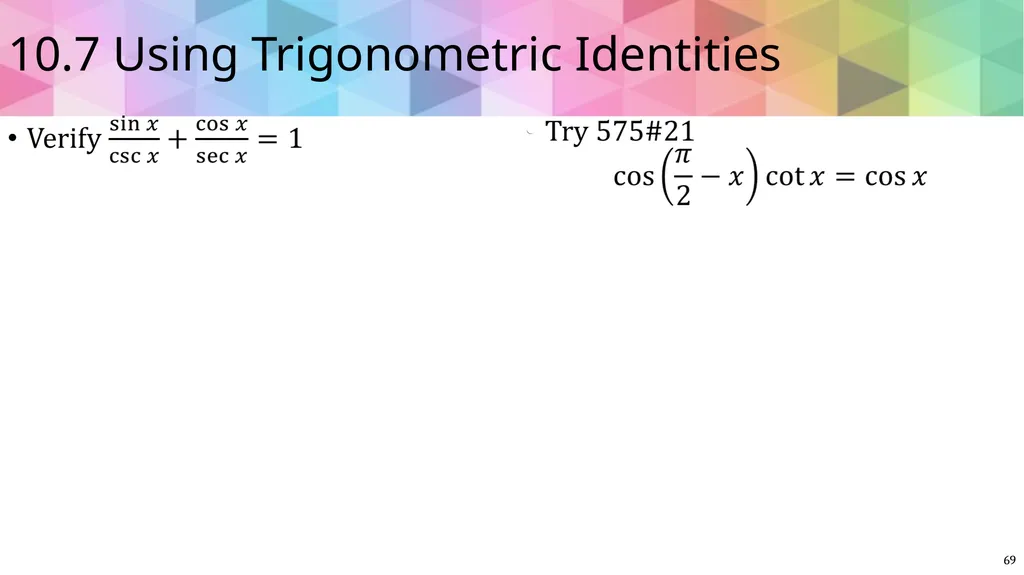
10.7 Using Trigonometric Identities 69<br>
70
10.8 Using Sum and Difference Formulas After this lesson…
• I can evaluate trigonometric expressions using sum and difference formulas.
• I can simplify trigonometric expressions using sum and difference formulas.
• I can solve trigonometric equations using sum and difference formulas. 70<br>
• I can evaluate trigonometric expressions using sum and difference formulas.
• I can simplify trigonometric expressions using sum and difference formulas.
• I can solve trigonometric equations using sum and difference formulas. 70<br>
71
10.8 Using Sum and Difference Formulas<br>
72
10.8 Using Sum and Difference Formulas Find the exact value of sin 75°. 72<br>
73
10.8 Using Sum and Difference Formulas 73<br>
74
10.8 Using Sum and Difference Formulas Simplify the expression cos(x − π). 74<br>
75
10.8 Using Sum and Difference Formulas 75<br>