
Trust and Profit Sensitive Ranking for Web
PT
Published · 51 slides · 0 views

1 / 1


Description
Trust and Profit Sensitive Ranking for Web Databases and On-line Advertisements Raju Balakrishnan rajubasu.edu (PhD Dissertation Defense) Committee: Subbarao Kambhampati (chair) Yi Chen AnHai Doan Huan Liu. Agenda Part 1: Ranking the Deep
Related Topics
Share
Embed code
Download this presentation From Below
"Trust and Profit Sensitive Ranking for Web" is the property of its rightful owner. Permission is granted to download and print the materials on this website for personal, non-commercial use only, and to display it on your personal computer provided you do not modify the materials and that you retain all copyright notices contained in the materials. By downloading content from our website, you accept the terms of this agreement.
Presentation Transcript
01
Trust and Profit Sensitive Ranking for Web Databases and On-line Advertisements Raju Balakrishnan
rajub@asu.edu
(PhD Dissertation Defense)
Committee: Subbarao Kambhampati (chair)
Yi Chen
AnHai Doan
Huan Liu.<br>
rajub@asu.edu
(PhD Dissertation Defense)
Committee: Subbarao Kambhampati (chair)
Yi Chen
AnHai Doan
Huan Liu.<br>
02
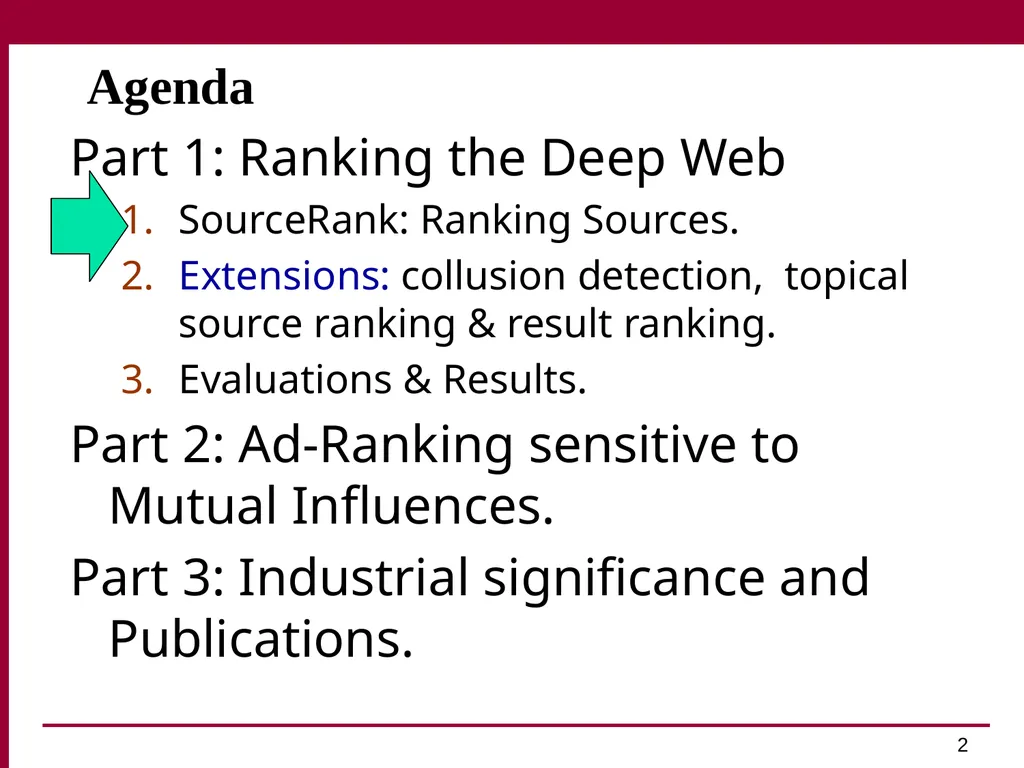
Agenda Part 1: Ranking the Deep Web
SourceRank: Ranking Sources.
Extensions: collusion detection, topical source ranking & result ranking.
Evaluations & Results.
Part 2: Ad-Ranking sensitive to Mutual Influences.
Part 3: Industrial significance and Publications. 2<br>
SourceRank: Ranking Sources.
Extensions: collusion detection, topical source ranking & result ranking.
Evaluations & Results.
Part 2: Ad-Ranking sensitive to Mutual Influences.
Part 3: Industrial significance and Publications. 2<br>
03
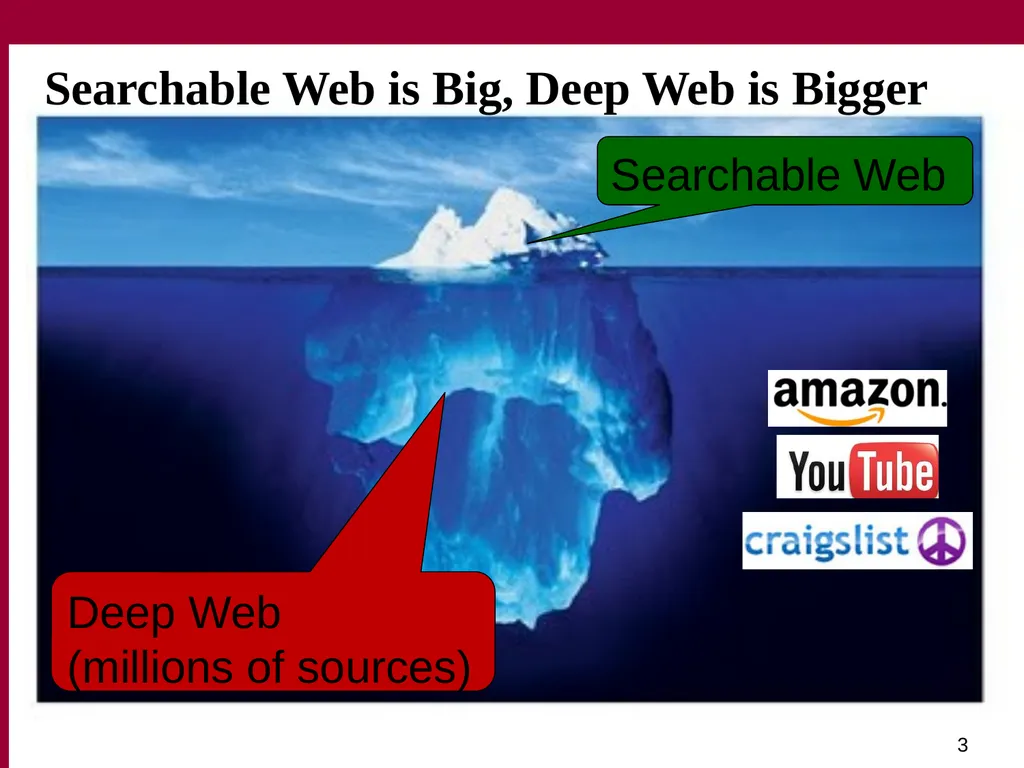
Searchable Web is Big, Deep Web is Bigger 3 Searchable Web Deep Web
(millions of sources)<br>
(millions of sources)<br>
04
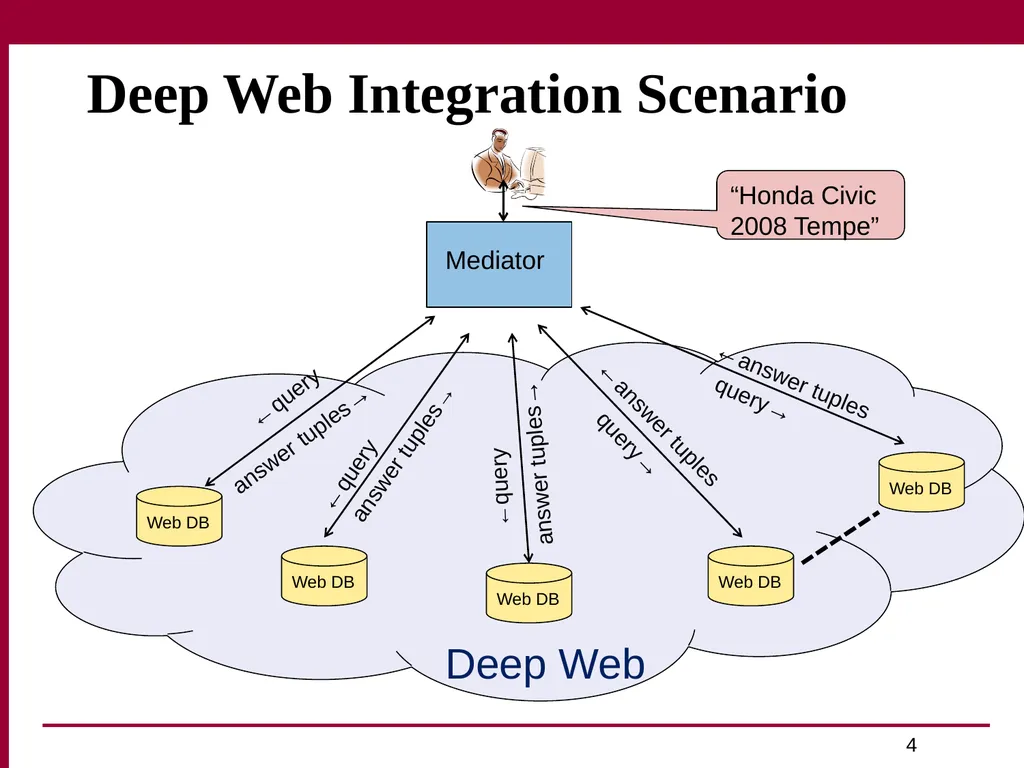
Deep Web Integration Scenario Web DB Mediator ←query Web DB Web DB Web DB Web DB answer tuples→ answer tuples→ answer tuples→ ←answer tuples ←answer tuples ←query ←query query→ query→ Deep Web 4 “Honda Civic 2008 Tempe”<br>
05
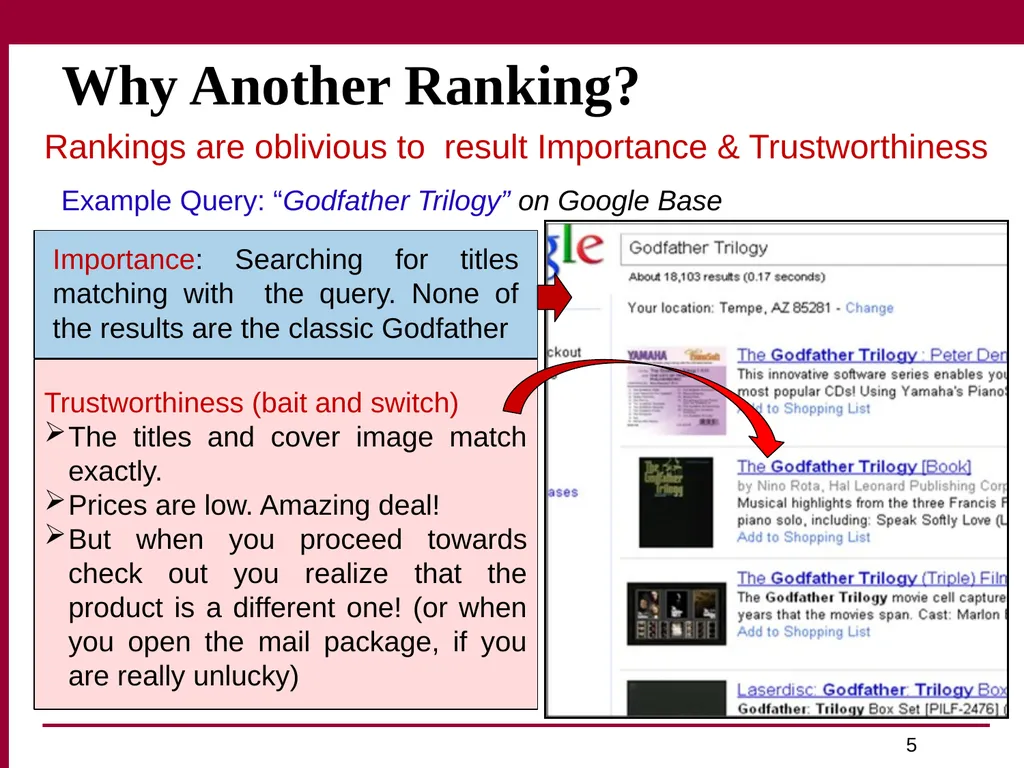
Why Another Ranking? Example Query: “Godfather Trilogy” on Google Base Rankings are oblivious to result Importance & Trustworthiness 5<br>
06
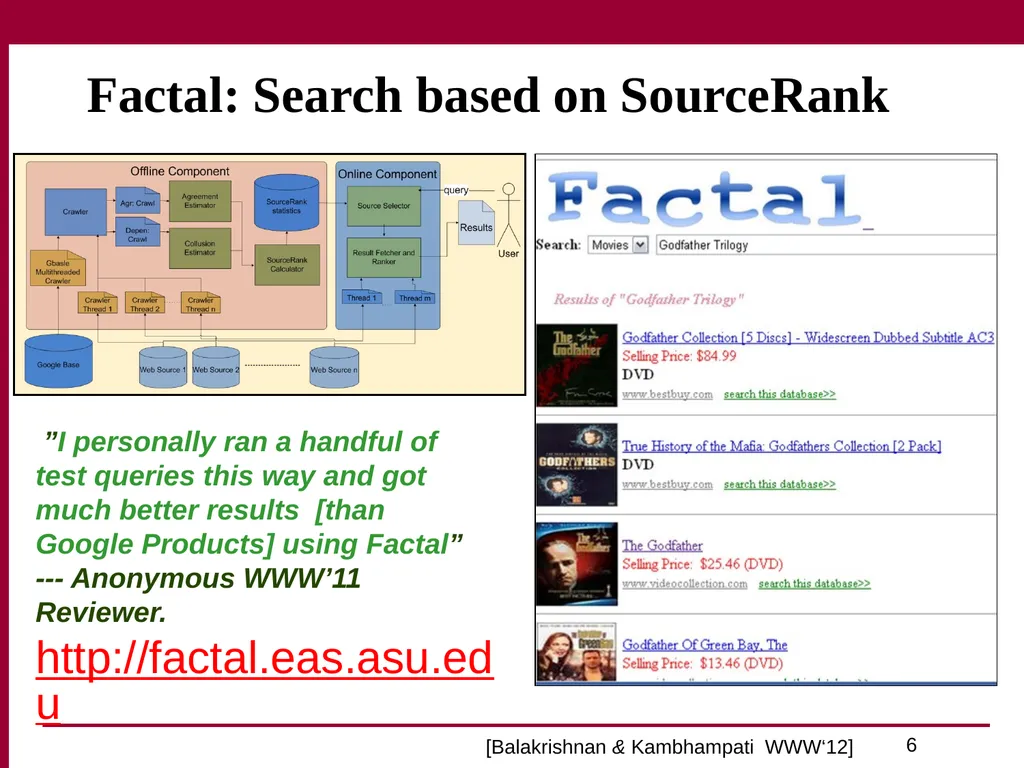
Factal: Search based on SourceRank http://factal.eas.asu.edu ”I personally ran a handful of test queries this way and got
much better results [than Google Products] using Factal” --- Anonymous WWW’11 Reviewer. 6 [Balakrishnan & Kambhampati WWW‘12]<br>
07
Deep web records do not have hyper-links.
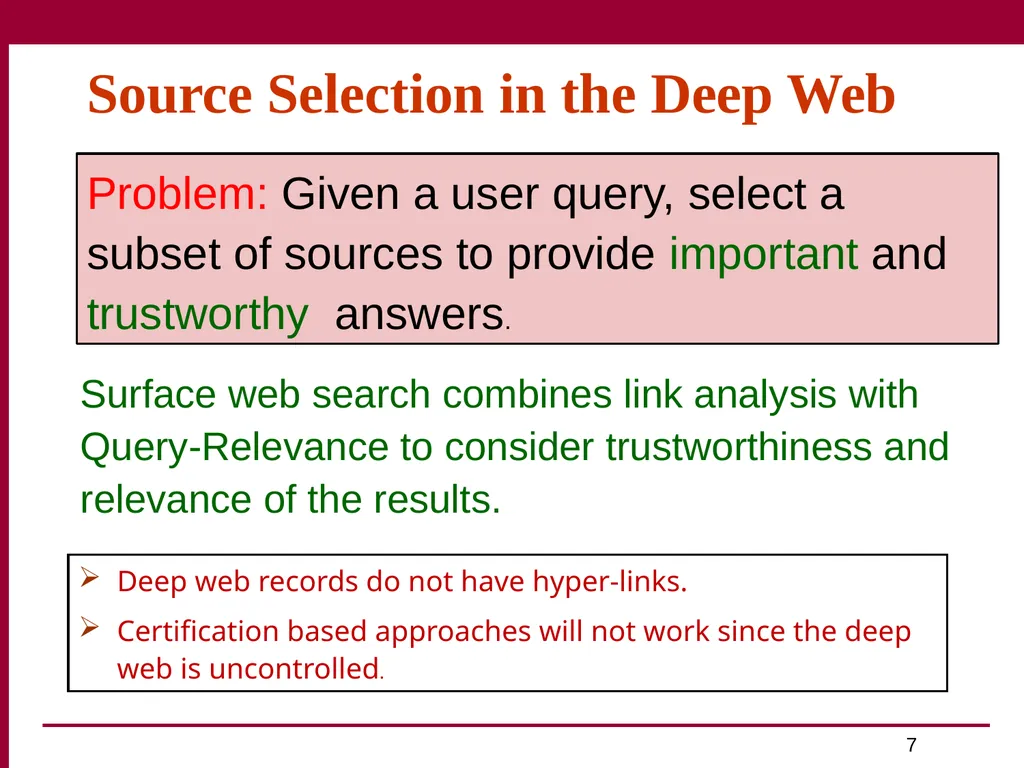
Certification based approaches will not work since the deep web is uncontrolled. Source Selection in the Deep Web 7 Surface web search combines link analysis with Query-Relevance to consider trustworthiness and relevance of the results. Problem: Given a user query, select a subset of sources to provide important and trustworthy answers.<br>
Certification based approaches will not work since the deep web is uncontrolled. Source Selection in the Deep Web 7 Surface web search combines link analysis with Query-Relevance to consider trustworthiness and relevance of the results. Problem: Given a user query, select a subset of sources to provide important and trustworthy answers.<br>
08
Source Agreement 8 Observations
Many sources return answers to the same query.
Comparison of semantics of the answers is facilitated by structure of the tuples.
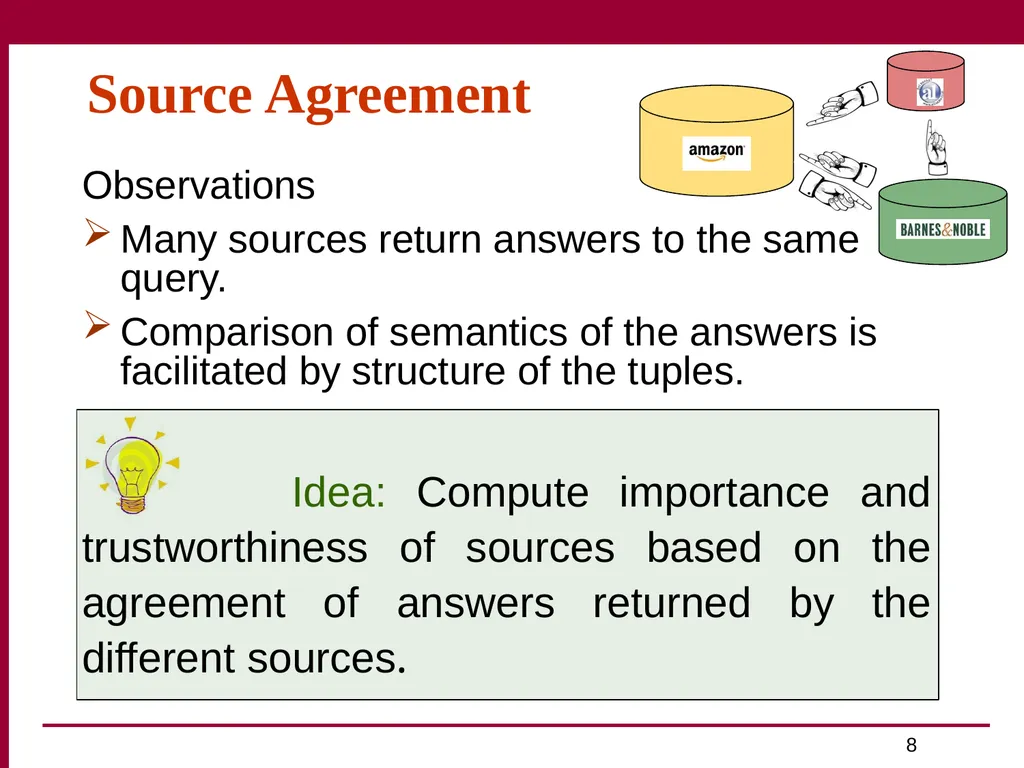
Idea: Compute importance and trustworthiness of sources based on the agreement of answers returned by the different sources.<br>
Many sources return answers to the same query.
Comparison of semantics of the answers is facilitated by structure of the tuples.
Idea: Compute importance and trustworthiness of sources based on the agreement of answers returned by the different sources.<br>
09
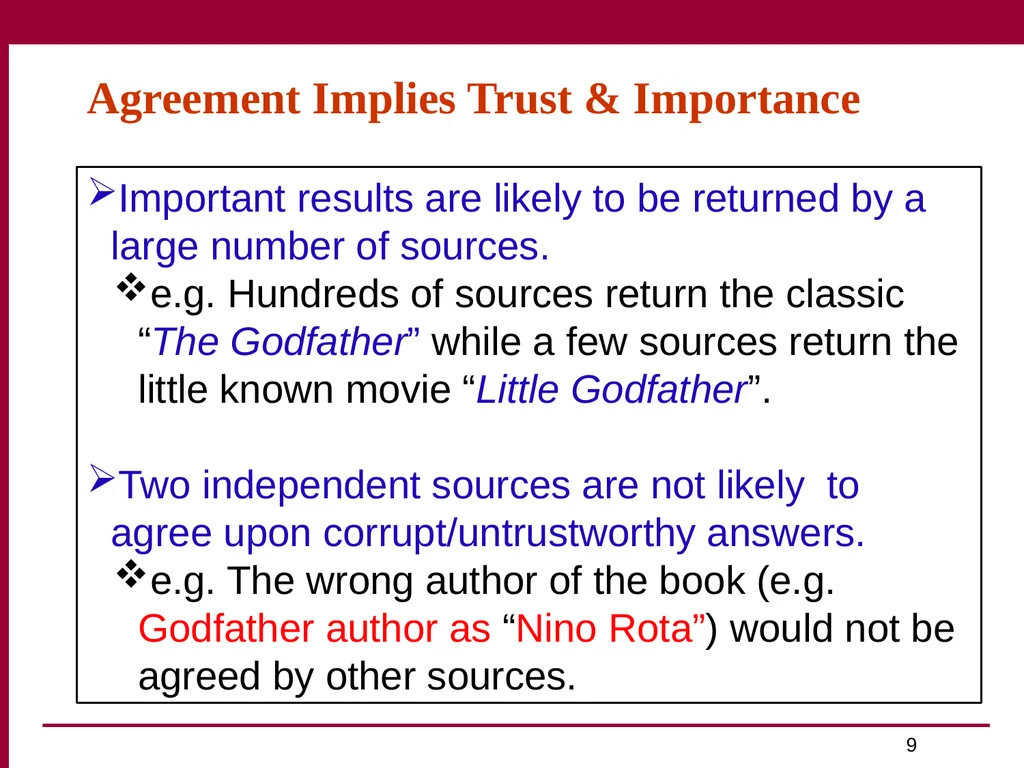
Agreement Implies Trust & Importance Important results are likely to be returned by a large number of sources.
e.g. Hundreds of sources return the classic “The Godfather” while a few sources return the little known movie “Little Godfather”.
Two independent sources are not likely to agree upon corrupt/untrustworthy answers.
e.g. The wrong author of the book (e.g. Godfather author as “Nino Rota”) would not be agreed by other sources. 9<br>
e.g. Hundreds of sources return the classic “The Godfather” while a few sources return the little known movie “Little Godfather”.
Two independent sources are not likely to agree upon corrupt/untrustworthy answers.
e.g. The wrong author of the book (e.g. Godfather author as “Nino Rota”) would not be agreed by other sources. 9<br>
10
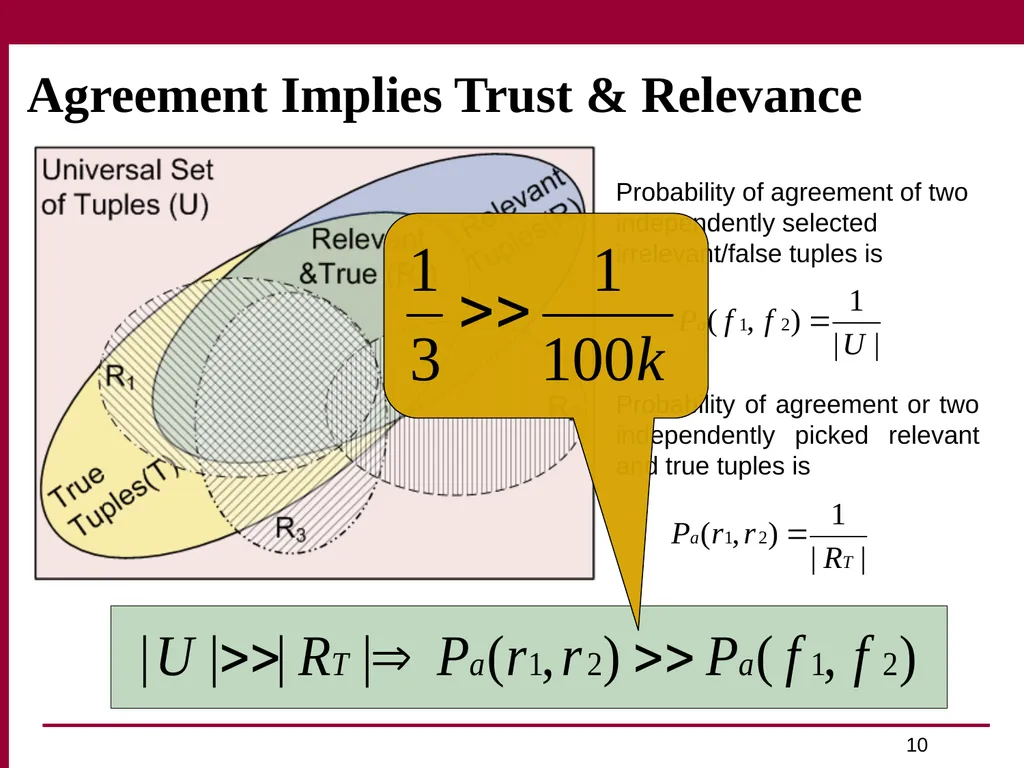
Agreement Implies Trust & Relevance Probability of agreement of two independently selected irrelevant/false tuples is Probability of agreement or two independently picked relevant and true tuples is 10<br>
11
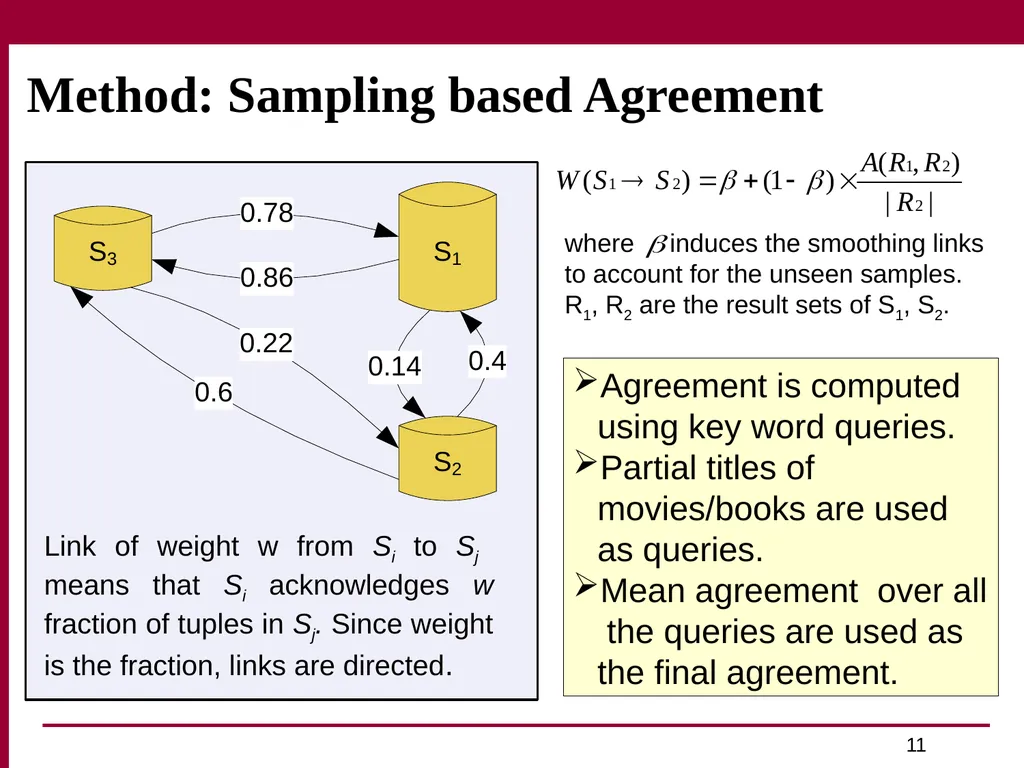
Method: Sampling based Agreement Link of weight w from Si to Sj means that Si acknowledges w fraction of tuples in Sj. Since weight is the fraction, links are directed. Agreement is computed using key word queries.
Partial titles of movies/books are used as queries.
Mean agreement over all the queries are used as the final agreement. 11<br>
Partial titles of movies/books are used as queries.
Mean agreement over all the queries are used as the final agreement. 11<br>
12
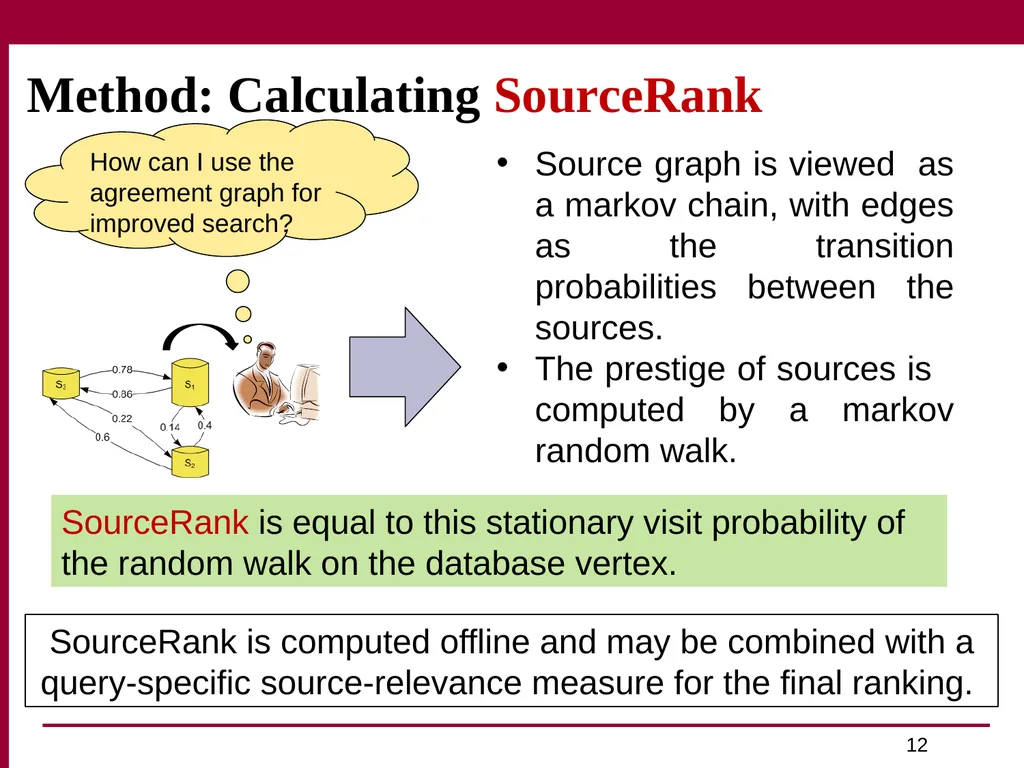
Method: Calculating SourceRank How can I use the agreement graph for improved search? Source graph is viewed as a markov chain, with edges as the transition probabilities between the sources.
The prestige of sources is computed by a markov random walk. SourceRank is equal to this stationary visit probability of the random walk on the database vertex. SourceRank is computed offline and may be combined with a query-specific source-relevance measure for the final ranking. 12<br>
The prestige of sources is computed by a markov random walk. SourceRank is equal to this stationary visit probability of the random walk on the database vertex. SourceRank is computed offline and may be combined with a query-specific source-relevance measure for the final ranking. 12<br>
13
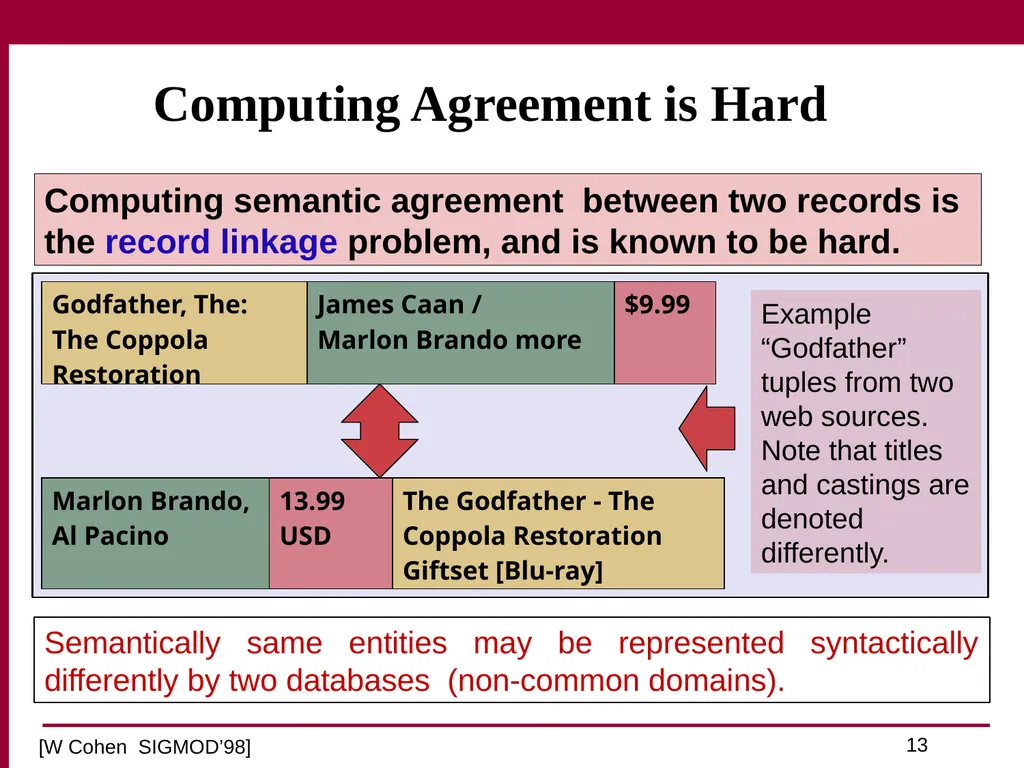
Computing Agreement is Hard Computing semantic agreement between two records is the record linkage problem, and is known to be hard. Semantically same entities may be represented syntactically differently by two databases (non-common domains). Example “Godfather” tuples from two web sources. Note that titles and castings are denoted differently. 13 [W Cohen SIGMOD’98]<br>
14
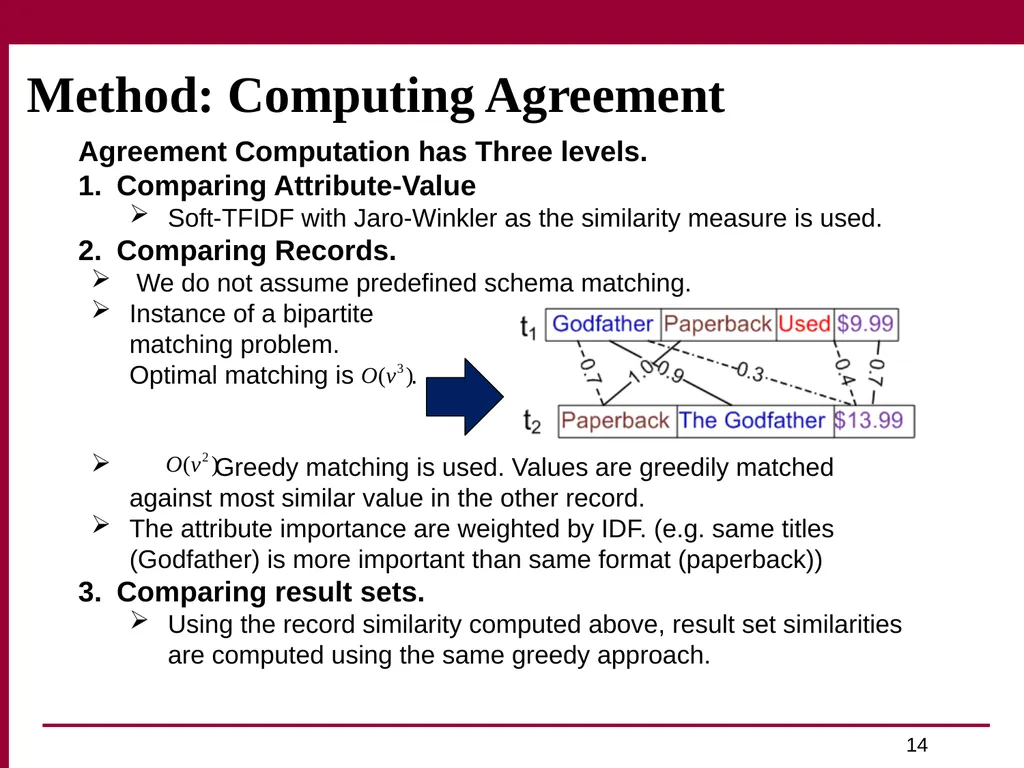
Method: Computing Agreement Agreement Computation has Three levels.
Comparing Attribute-Value
Soft-TFIDF with Jaro-Winkler as the similarity measure is used.
Comparing Records.
We do not assume predefined schema matching.
Instance of a bipartite
matching problem.
Optimal matching is .
Greedy matching is used. Values are greedily matched
against most similar value in the other record.
The attribute importance are weighted by IDF. (e.g. same titles (Godfather) is more important than same format (paperback))
Comparing result sets.
Using the record similarity computed above, result set similarities are computed using the same greedy approach. 14<br>
Comparing Attribute-Value
Soft-TFIDF with Jaro-Winkler as the similarity measure is used.
Comparing Records.
We do not assume predefined schema matching.
Instance of a bipartite
matching problem.
Optimal matching is .
Greedy matching is used. Values are greedily matched
against most similar value in the other record.
The attribute importance are weighted by IDF. (e.g. same titles (Godfather) is more important than same format (paperback))
Comparing result sets.
Using the record similarity computed above, result set similarities are computed using the same greedy approach. 14<br>
15
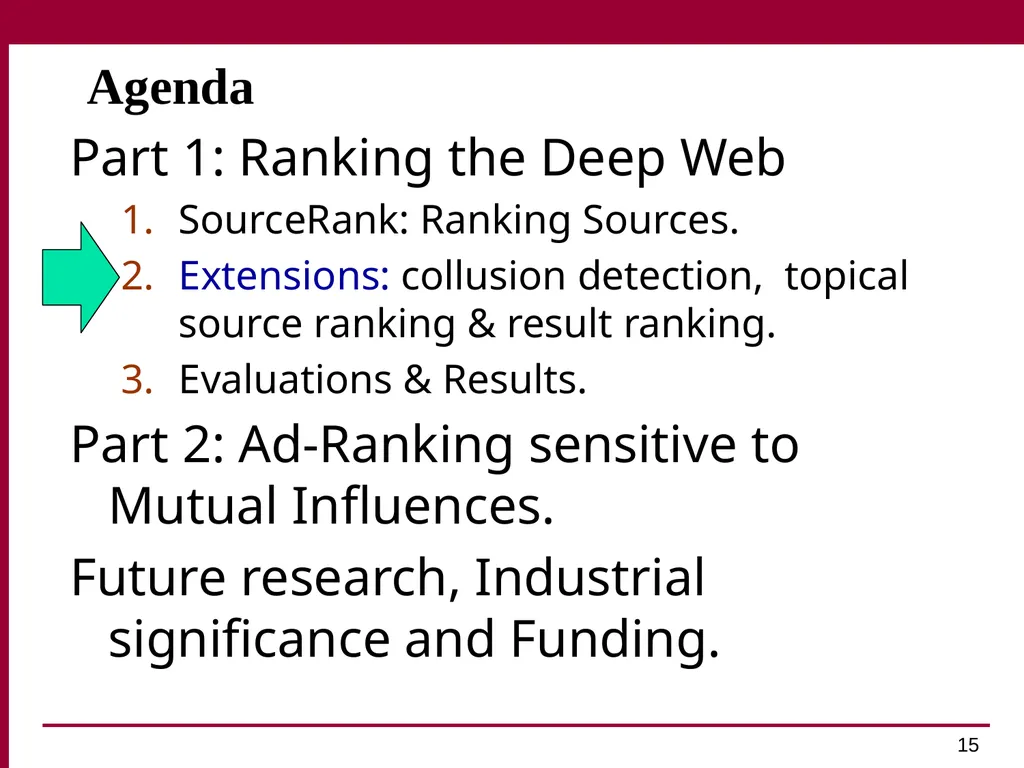
Agenda Part 1: Ranking the Deep Web
SourceRank: Ranking Sources.
Extensions: collusion detection, topical source ranking & result ranking.
Evaluations & Results.
Part 2: Ad-Ranking sensitive to Mutual Influences.
Future research, Industrial significance and Funding. 15<br>
SourceRank: Ranking Sources.
Extensions: collusion detection, topical source ranking & result ranking.
Evaluations & Results.
Part 2: Ad-Ranking sensitive to Mutual Influences.
Future research, Industrial significance and Funding. 15<br>
16
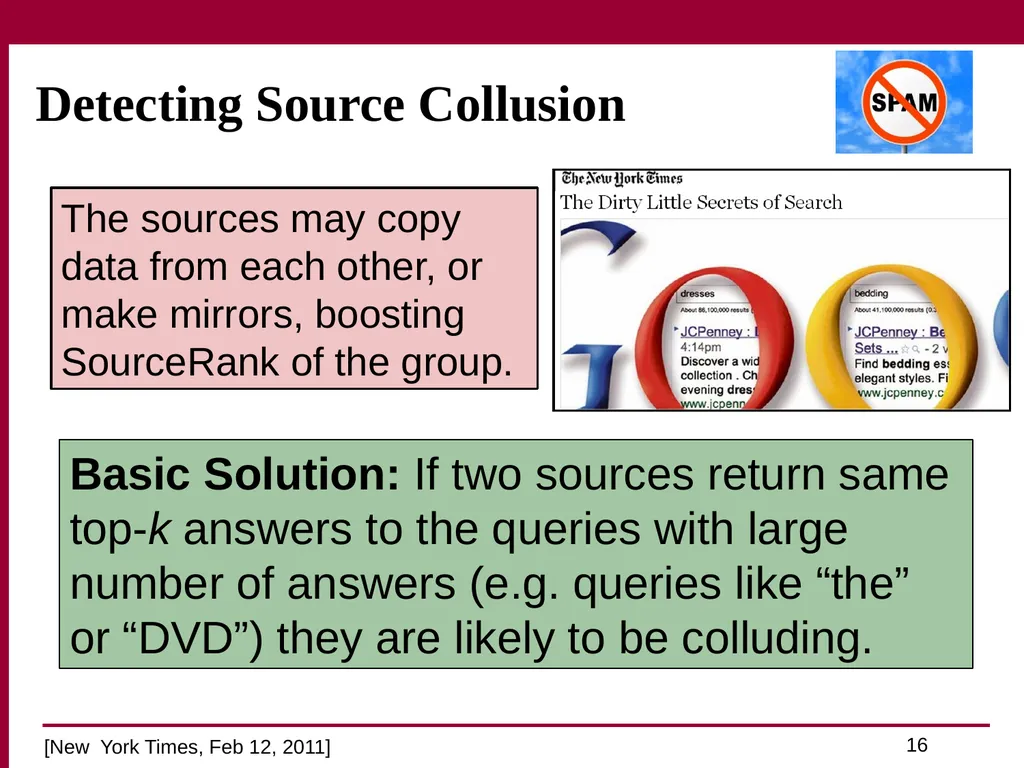
Detecting Source Collusion Basic Solution: If two sources return same top-k answers to the queries with large number of answers (e.g. queries like “the” or “DVD”) they are likely to be colluding. The sources may copy data from each other, or make mirrors, boosting SourceRank of the group. 16 [New York Times, Feb 12, 2011]<br>
17
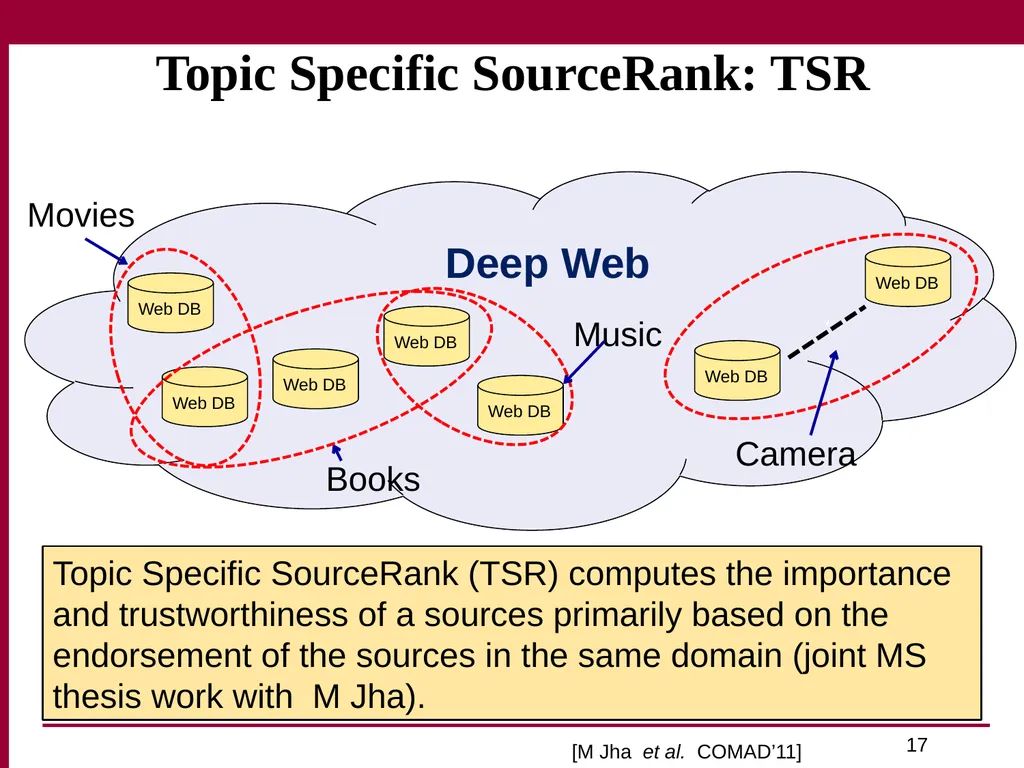
Topic Specific SourceRank: TSR 17 Web DB Web DB Web DB Web DB Web DB Deep Web Web DB Web DB ` Movies Music Camera Books Topic Specific SourceRank (TSR) computes the importance and trustworthiness of a sources primarily based on the endorsement of the sources in the same domain (joint MS thesis work with M Jha). [M Jha et al. COMAD’11]<br>
18
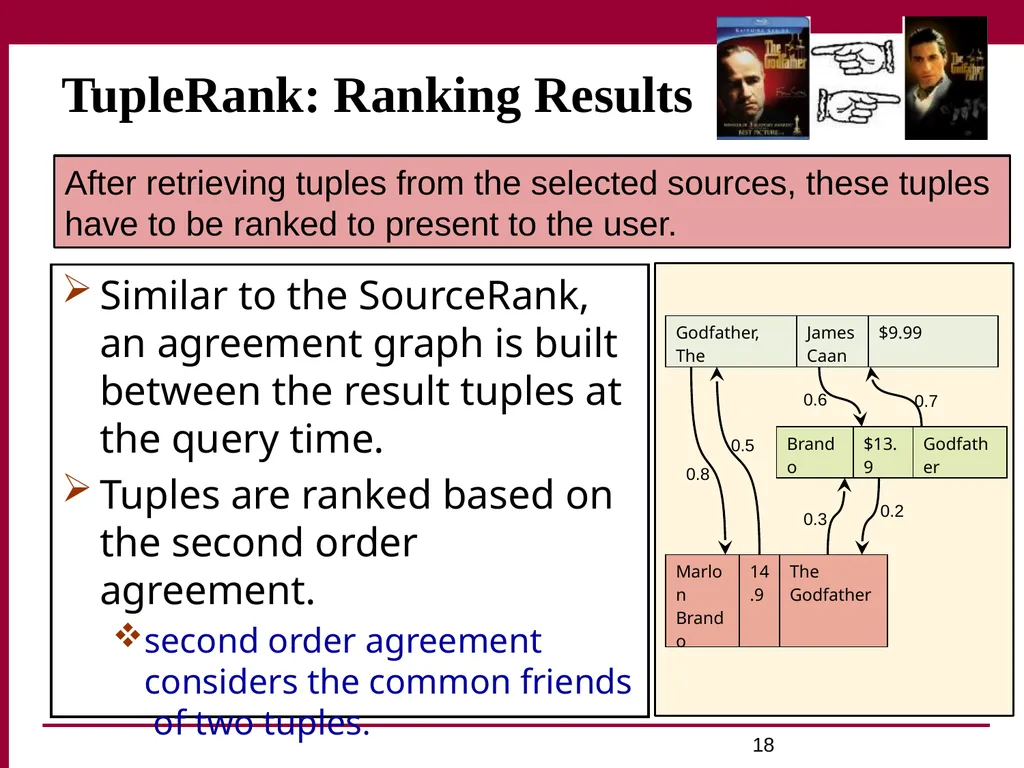
0.7 0.3 0.2 TupleRank: Ranking Results Similar to the SourceRank, an agreement graph is built between the result tuples at the query time.
Tuples are ranked based on the second order agreement.
second order agreement considers the common friends of two tuples. 18 After retrieving tuples from the selected sources, these tuples have to be ranked to present to the user. 0.5 0.8 0.6<br>
Tuples are ranked based on the second order agreement.
second order agreement considers the common friends of two tuples. 18 After retrieving tuples from the selected sources, these tuples have to be ranked to present to the user. 0.5 0.8 0.6<br>
19
Agenda Part 1: Ranking the Deep Web
SourceRank: Ranking Sources.
Extensions: collusion detection, topical source ranking & result ranking.
Evaluations & Results.
Part 2: Ad-Ranking sensitive to Mutual Influences.
Future research, Industrial significance and Funding. 19<br>
SourceRank: Ranking Sources.
Extensions: collusion detection, topical source ranking & result ranking.
Evaluations & Results.
Part 2: Ad-Ranking sensitive to Mutual Influences.
Future research, Industrial significance and Funding. 19<br>
20
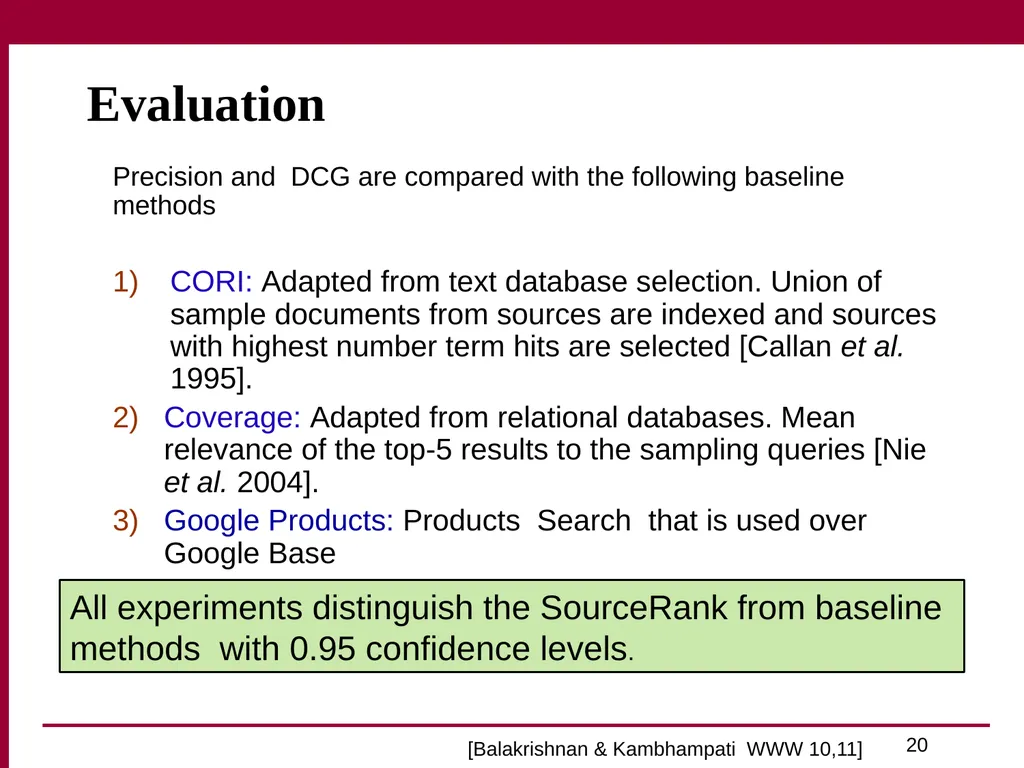
Evaluation Precision and DCG are compared with the following baseline methods
CORI: Adapted from text database selection. Union of sample documents from sources are indexed and sources with highest number term hits are selected [Callan et al. 1995].
Coverage: Adapted from relational databases. Mean relevance of the top-5 results to the sampling queries [Nie et al. 2004].
Google Products: Products Search that is used over Google Base All experiments distinguish the SourceRank from baseline methods with 0.95 confidence levels. 20 [Balakrishnan & Kambhampati WWW 10,11]<br>
CORI: Adapted from text database selection. Union of sample documents from sources are indexed and sources with highest number term hits are selected [Callan et al. 1995].
Coverage: Adapted from relational databases. Mean relevance of the top-5 results to the sampling queries [Nie et al. 2004].
Google Products: Products Search that is used over Google Base All experiments distinguish the SourceRank from baseline methods with 0.95 confidence levels. 20 [Balakrishnan & Kambhampati WWW 10,11]<br>
21
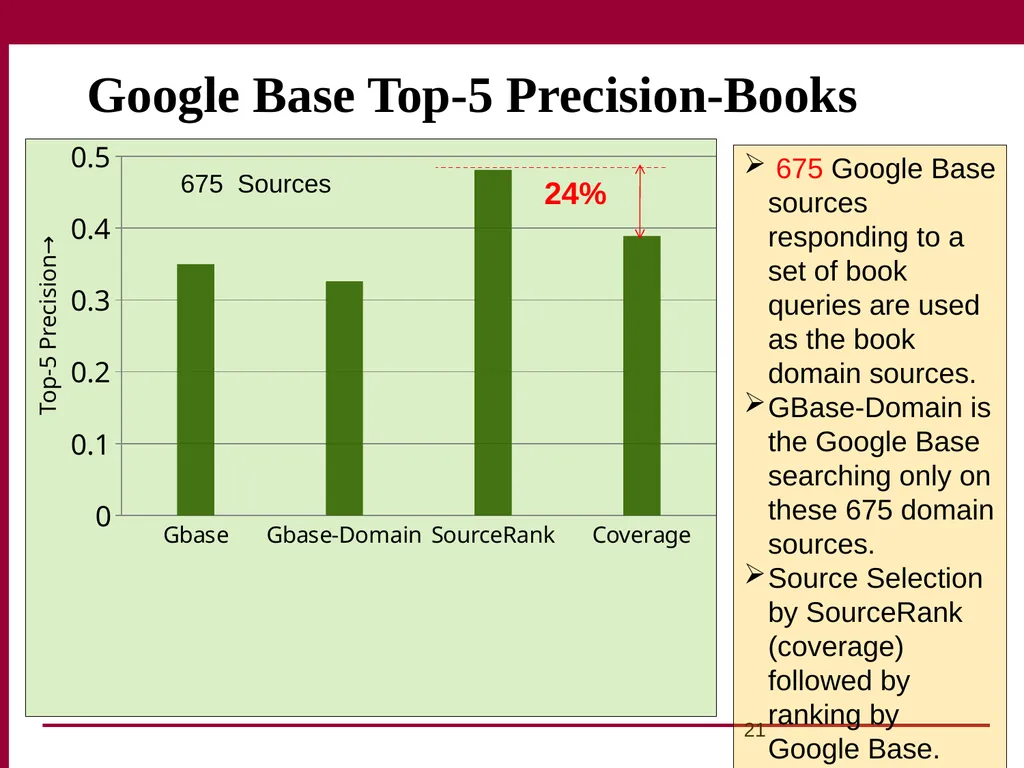
Google Base Top-5 Precision-Books 675 Google Base sources responding to a set of book queries are used as the book domain sources.
GBase-Domain is the Google Base searching only on these 675 domain sources.
Source Selection by SourceRank (coverage) followed by ranking by Google Base. 675 Sources 21<br>
GBase-Domain is the Google Base searching only on these 675 domain sources.
Source Selection by SourceRank (coverage) followed by ranking by Google Base. 675 Sources 21<br>
22
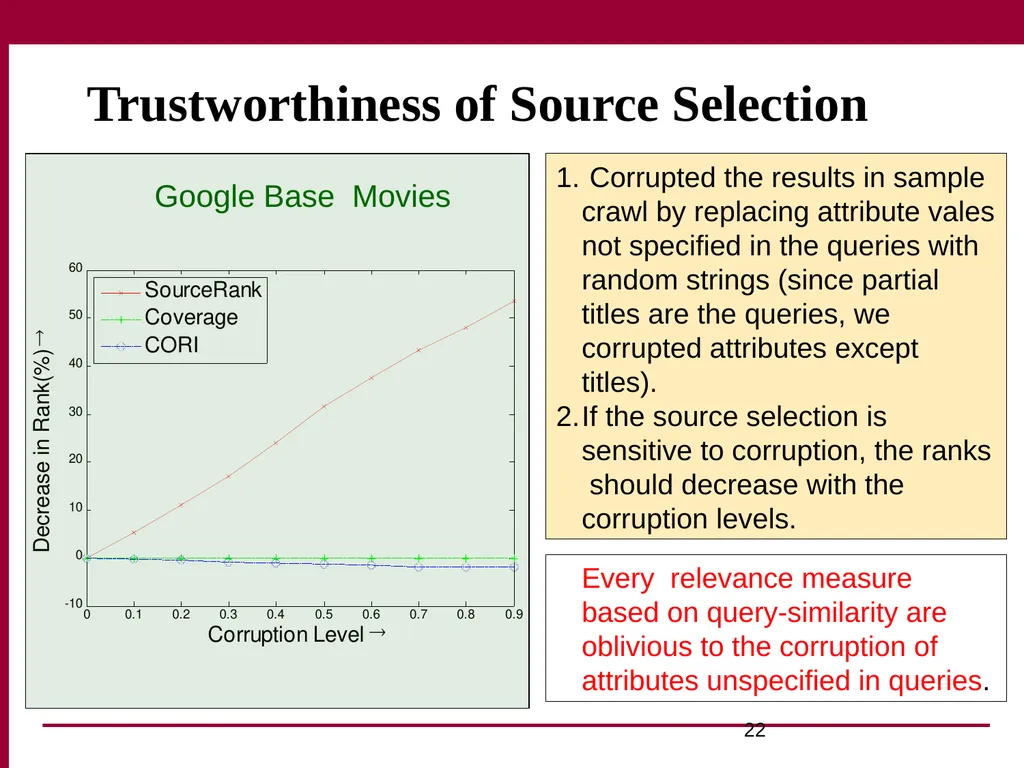
Trustworthiness of Source Selection Google Base Movies Corrupted the results in sample crawl by replacing attribute vales not specified in the queries with random strings (since partial titles are the queries, we corrupted attributes except titles).
If the source selection is sensitive to corruption, the ranks should decrease with the corruption levels. Every relevance measure based on query-similarity are oblivious to the corruption of attributes unspecified in queries. 22<br>
If the source selection is sensitive to corruption, the ranks should decrease with the corruption levels. Every relevance measure based on query-similarity are oblivious to the corruption of attributes unspecified in queries. 22<br>
23
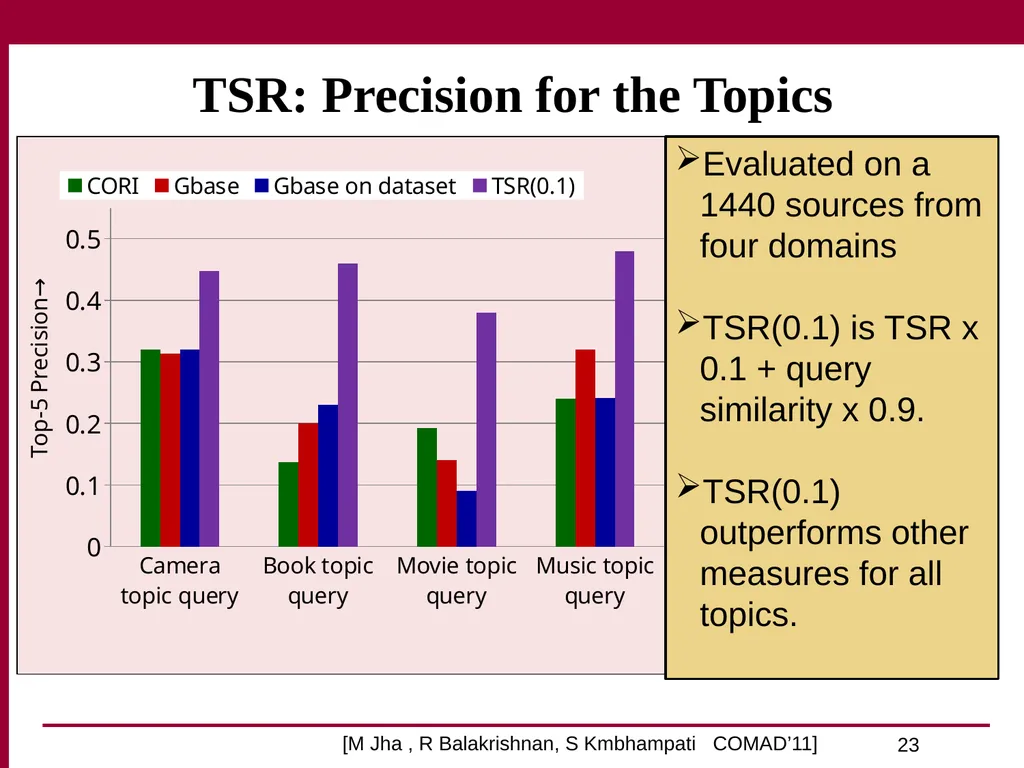
23 Evaluated on a 1440 sources from four domains
TSR(0.1) is TSR x 0.1 + query similarity x 0.9.
TSR(0.1) outperforms other measures for all topics. TSR: Precision for the Topics [M Jha , R Balakrishnan, S Kmbhampati COMAD’11]<br>
TSR(0.1) is TSR x 0.1 + query similarity x 0.9.
TSR(0.1) outperforms other measures for all topics. TSR: Precision for the Topics [M Jha , R Balakrishnan, S Kmbhampati COMAD’11]<br>
24
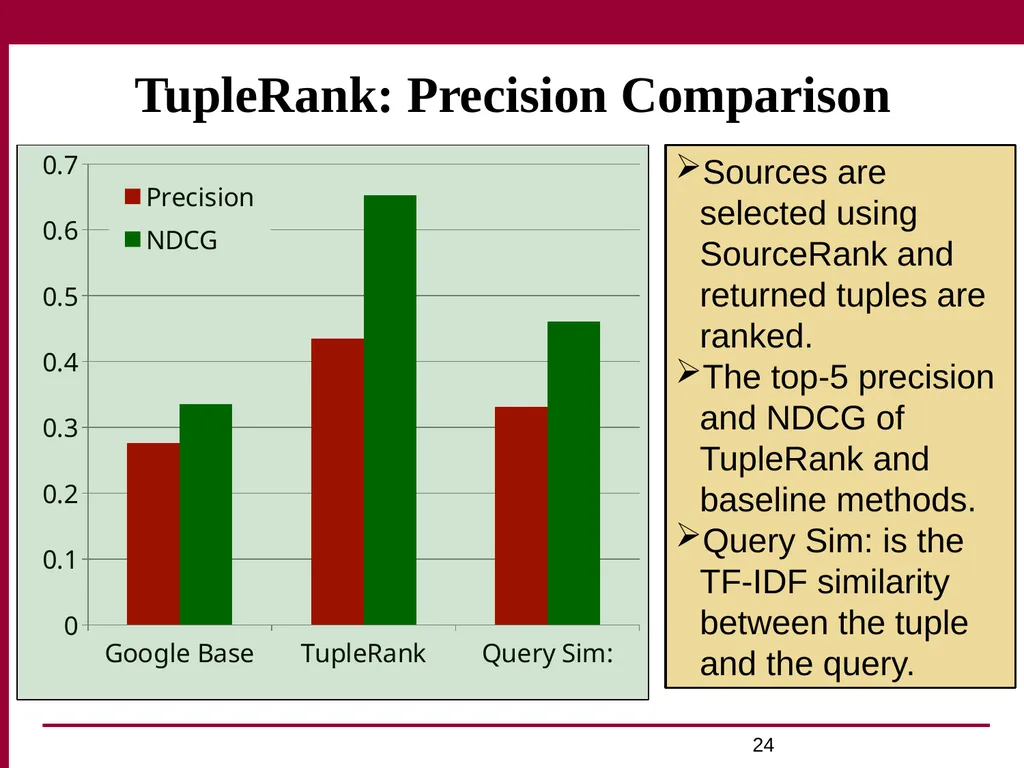
24 Sources are selected using SourceRank and returned tuples are ranked.
The top-5 precision and NDCG of TupleRank and baseline methods.
Query Sim: is the TF-IDF similarity between the tuple and the query. TupleRank: Precision Comparison<br>
The top-5 precision and NDCG of TupleRank and baseline methods.
Query Sim: is the TF-IDF similarity between the tuple and the query. TupleRank: Precision Comparison<br>
25
Agenda Part 1: Ranking for the Deep Web
Part 2: Ad-Ranking sensitive to Mutual Influences.
Optimal Ranking and Generalizations.
Auction Mechanism and Analysis.
Part 3: Industrial significance and Publications. 25<br>
Part 2: Ad-Ranking sensitive to Mutual Influences.
Optimal Ranking and Generalizations.
Auction Mechanism and Analysis.
Part 3: Industrial significance and Publications. 25<br>
26
Agenda Part 1: Ranking for the Deep Web
Part 2:Ranking and Pricing
of Ads. A different
aspect of
ranking 26<br>
Part 2:Ranking and Pricing
of Ads. A different
aspect of
ranking 26<br>
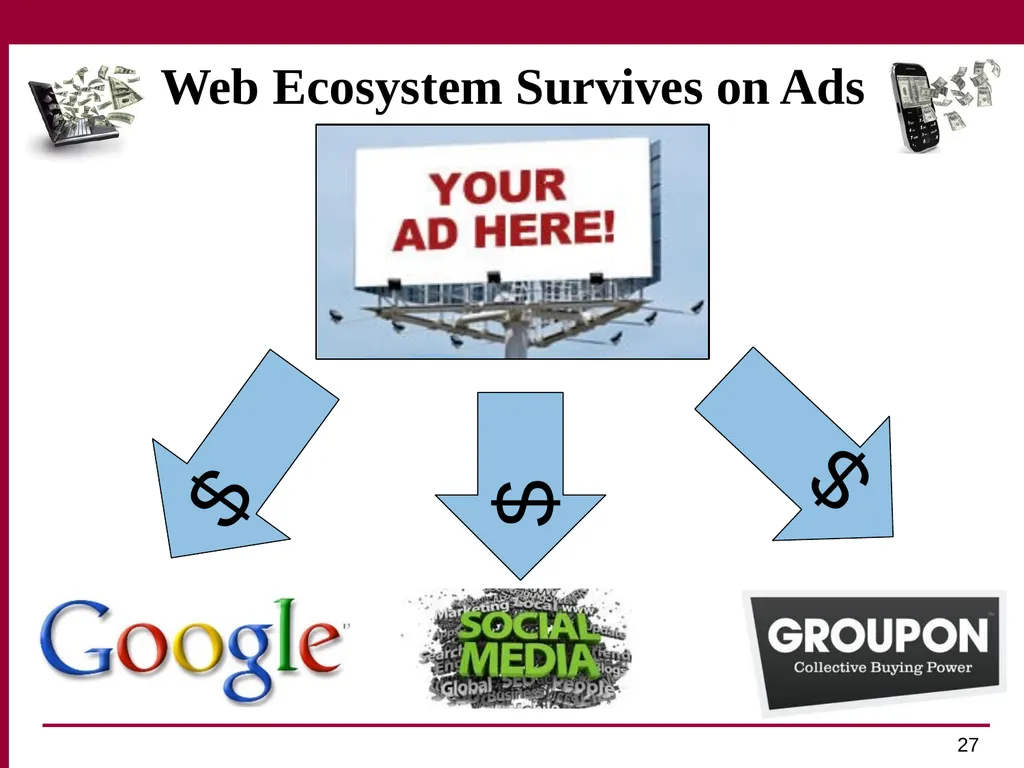
27
Web Ecosystem Survives on Ads 27 $ $ $<br>
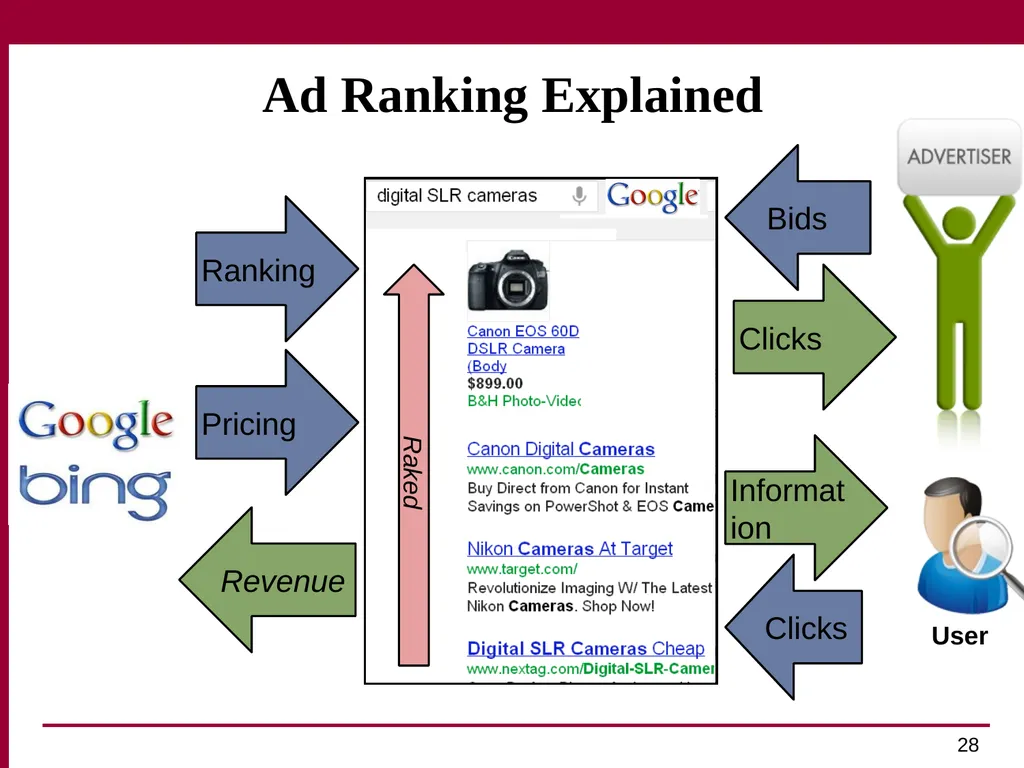
28
Ad Ranking Explained 28 Ranking Bids Clicks Pricing Clicks Raked Revenue Information User<br>
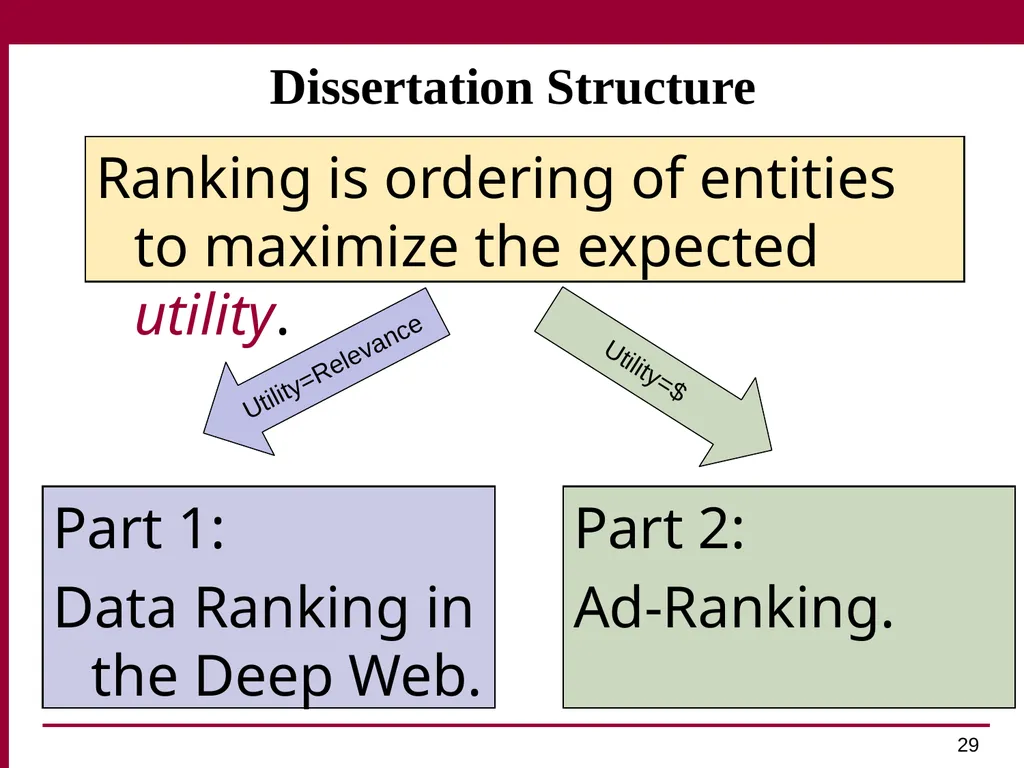
29
Dissertation Structure Part 2:
Ad-Ranking. 29 Ranking is ordering of entities to maximize the expected utility. Part 1:
Data Ranking in the Deep Web. Utility=Relevance Utility=$<br>
Ad-Ranking. 29 Ranking is ordering of entities to maximize the expected utility. Part 1:
Data Ranking in the Deep Web. Utility=Relevance Utility=$<br>
30
Agenda Part 1: Ranking for the Deep Web
Part 2: Ad-Ranking sensitive to mutual influences.
Optimal Ranking and Generalizations.
Auction Mechanism and Analysis.
Part3: industrial significance and Publications. 30<br>
Part 2: Ad-Ranking sensitive to mutual influences.
Optimal Ranking and Generalizations.
Auction Mechanism and Analysis.
Part3: industrial significance and Publications. 30<br>
31
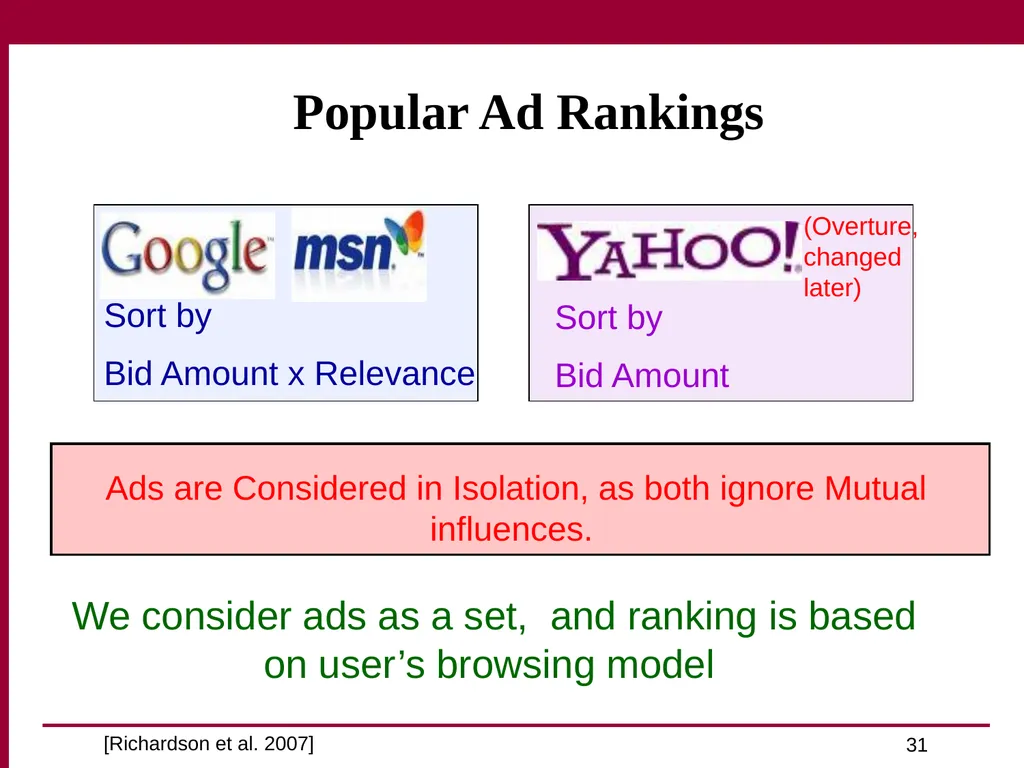
Popular Ad Rankings Sort by
Bid Amount x Relevance We consider ads as a set, and ranking is based on user’s browsing model Sort by
Bid Amount Ads are Considered in Isolation, as both ignore Mutual influences. 31 (Overture, changed later) [Richardson et al. 2007]<br>
Bid Amount x Relevance We consider ads as a set, and ranking is based on user’s browsing model Sort by
Bid Amount Ads are Considered in Isolation, as both ignore Mutual influences. 31 (Overture, changed later) [Richardson et al. 2007]<br>
32
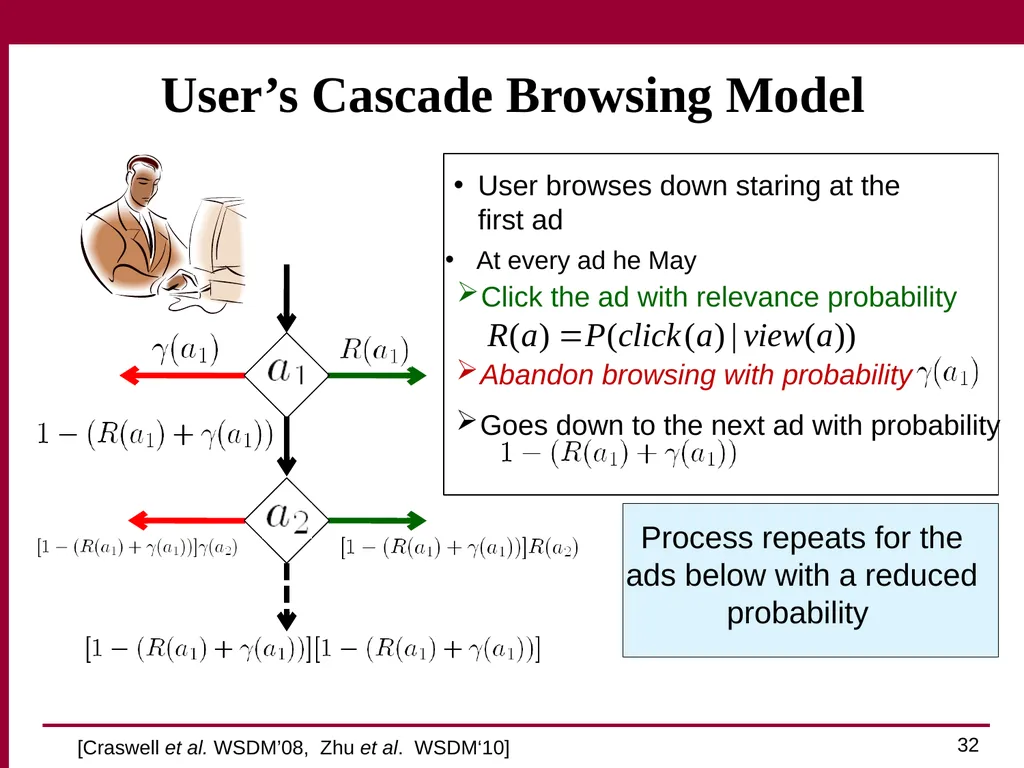
User’s Cascade Browsing Model User browses down staring at the first ad Abandon browsing with probability At every ad he May Process repeats for the ads below with a reduced probability Click the ad with relevance probability 32 [Craswell et al. WSDM’08, Zhu et al. WSDM‘10]<br>
33
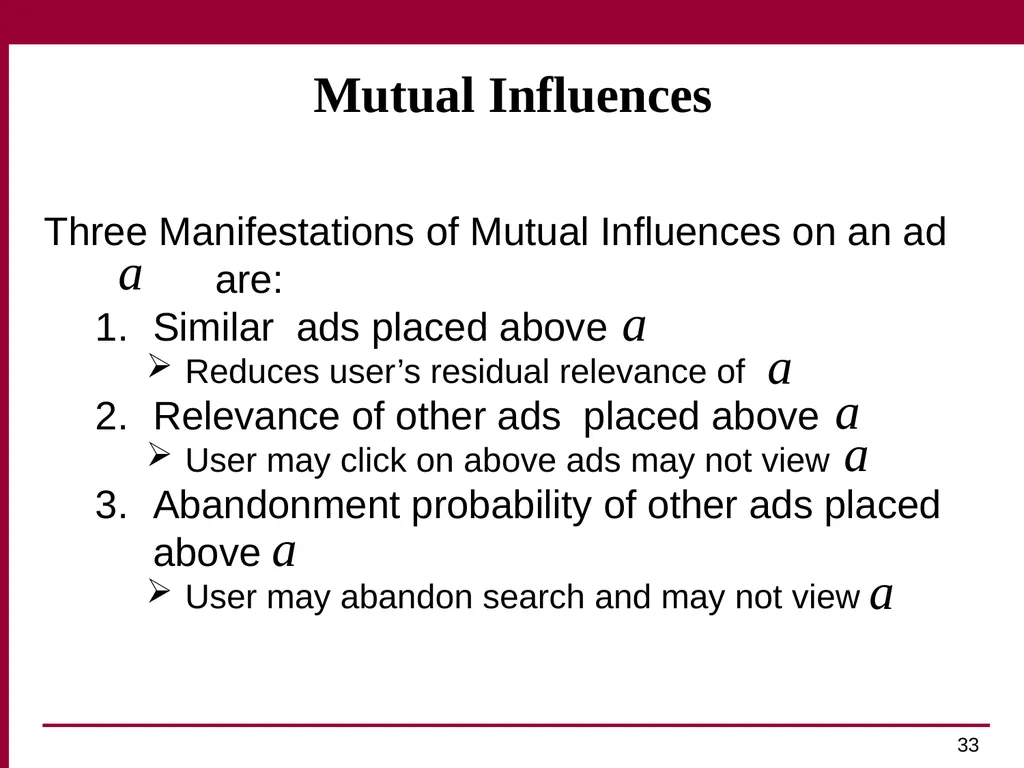
Mutual Influences Three Manifestations of Mutual Influences on an ad are:
Similar ads placed above
Reduces user’s residual relevance of
Relevance of other ads placed above
User may click on above ads may not view
Abandonment probability of other ads placed above
User may abandon search and may not view 33<br>
Similar ads placed above
Reduces user’s residual relevance of
Relevance of other ads placed above
User may click on above ads may not view
Abandonment probability of other ads placed above
User may abandon search and may not view 33<br>
34
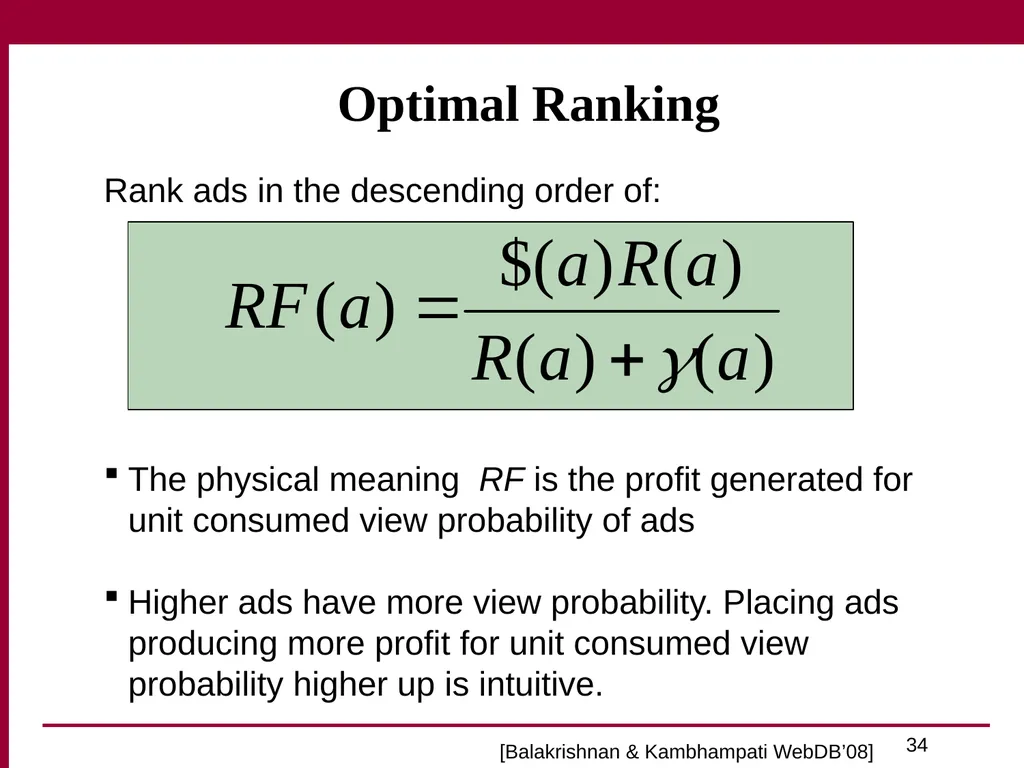
Optimal Ranking The physical meaning RF is the profit generated for unit consumed view probability of ads
Higher ads have more view probability. Placing ads producing more profit for unit consumed view probability higher up is intuitive. Rank ads in the descending order of: 34 [Balakrishnan & Kambhampati WebDB’08]<br>
Higher ads have more view probability. Placing ads producing more profit for unit consumed view probability higher up is intuitive. Rank ads in the descending order of: 34 [Balakrishnan & Kambhampati WebDB’08]<br>
35
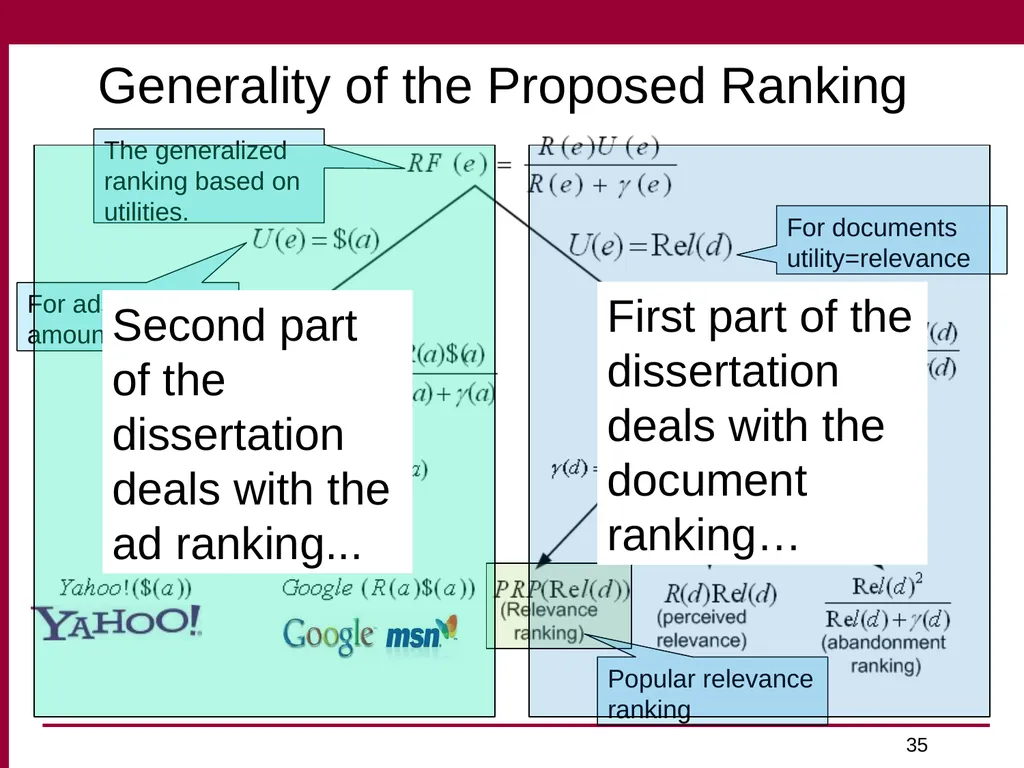
Generality of the Proposed Ranking The generalized ranking based on utilities. For ads utility=bid amount For documents utility=relevance Popular relevance ranking 35<br>
36
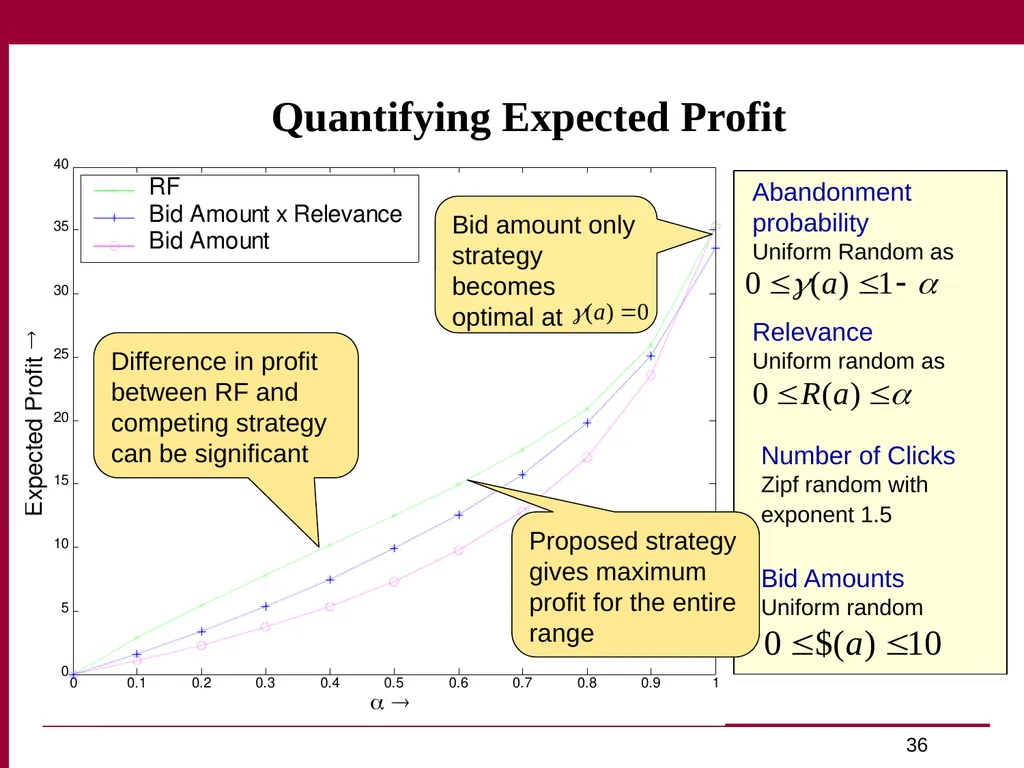
Quantifying Expected Profit Proposed strategy gives maximum profit for the entire range Number of Clicks
Zipf random with exponent 1.5 Abandonment probability
Uniform Random as Relevance
Uniform random as Bid Amounts
Uniform random Difference in profit between RF and competing strategy can be significant 36<br>
Zipf random with exponent 1.5 Abandonment probability
Uniform Random as Relevance
Uniform random as Bid Amounts
Uniform random Difference in profit between RF and competing strategy can be significant 36<br>
37
Agenda Part 1: Ranking for the Deep Web
Part 2: Ad-Ranking sensitive to Mutual Influences.
Optimal Ranking and Generalizations.
Auction Mechanism and Analysis.
Industrial significance. 37<br>
Part 2: Ad-Ranking sensitive to Mutual Influences.
Optimal Ranking and Generalizations.
Auction Mechanism and Analysis.
Industrial significance. 37<br>
38
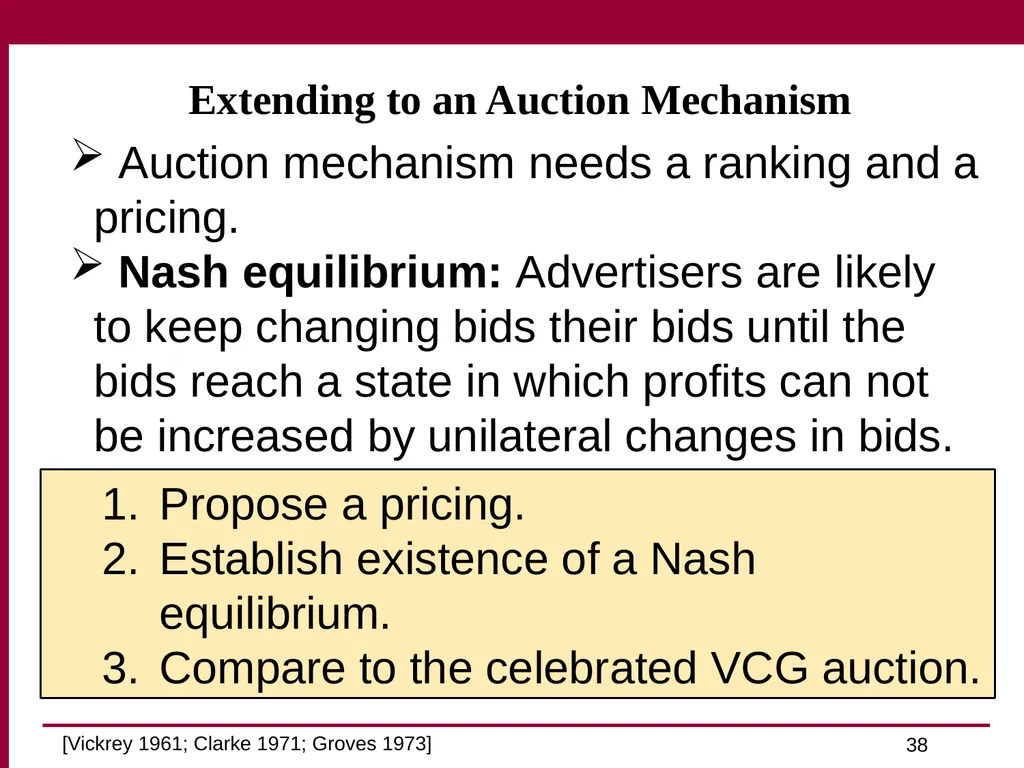
Extending to an Auction Mechanism 38 Auction mechanism needs a ranking and a pricing.
Nash equilibrium: Advertisers are likely to keep changing bids their bids until the bids reach a state in which profits can not be increased by unilateral changes in bids. [Vickrey 1961; Clarke 1971; Groves 1973] Propose a pricing.
Establish existence of a Nash equilibrium.
Compare to the celebrated VCG auction.<br>
Nash equilibrium: Advertisers are likely to keep changing bids their bids until the bids reach a state in which profits can not be increased by unilateral changes in bids. [Vickrey 1961; Clarke 1971; Groves 1973] Propose a pricing.
Establish existence of a Nash equilibrium.
Compare to the celebrated VCG auction.<br>
39
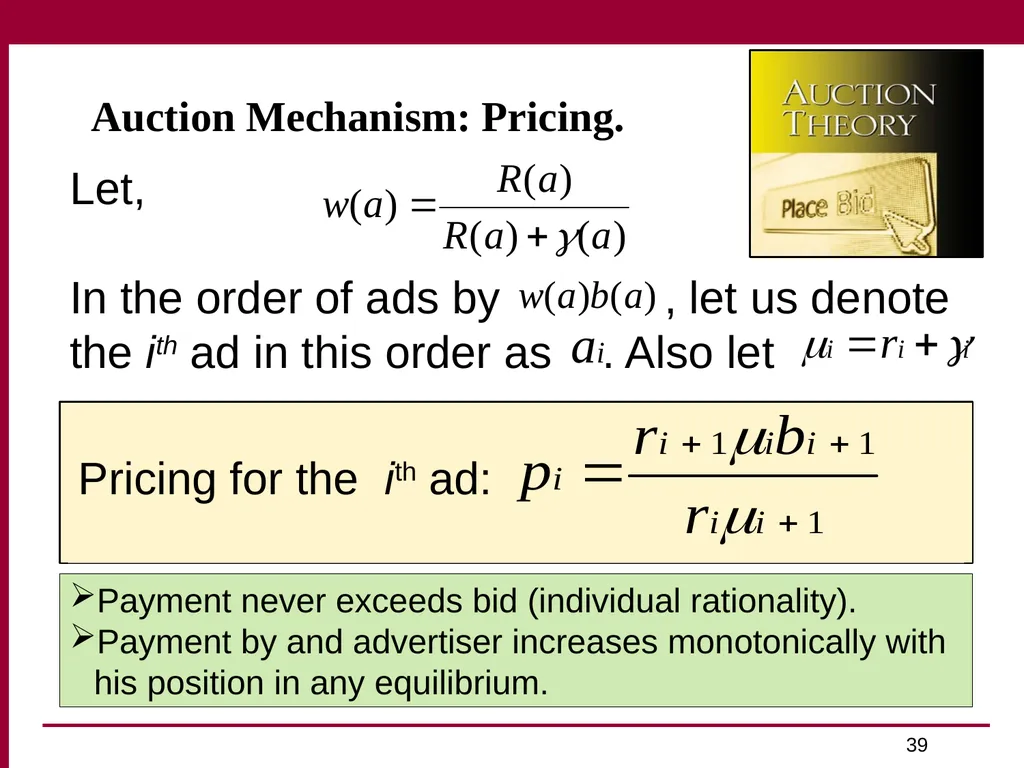
Auction Mechanism: Pricing. 39 Let,
In the order of ads by , let us denote the ith ad in this order as . Also let Payment never exceeds bid (individual rationality).
Payment by and advertiser increases monotonically with his position in any equilibrium.<br>
In the order of ads by , let us denote the ith ad in this order as . Also let Payment never exceeds bid (individual rationality).
Payment by and advertiser increases monotonically with his position in any equilibrium.<br>
40
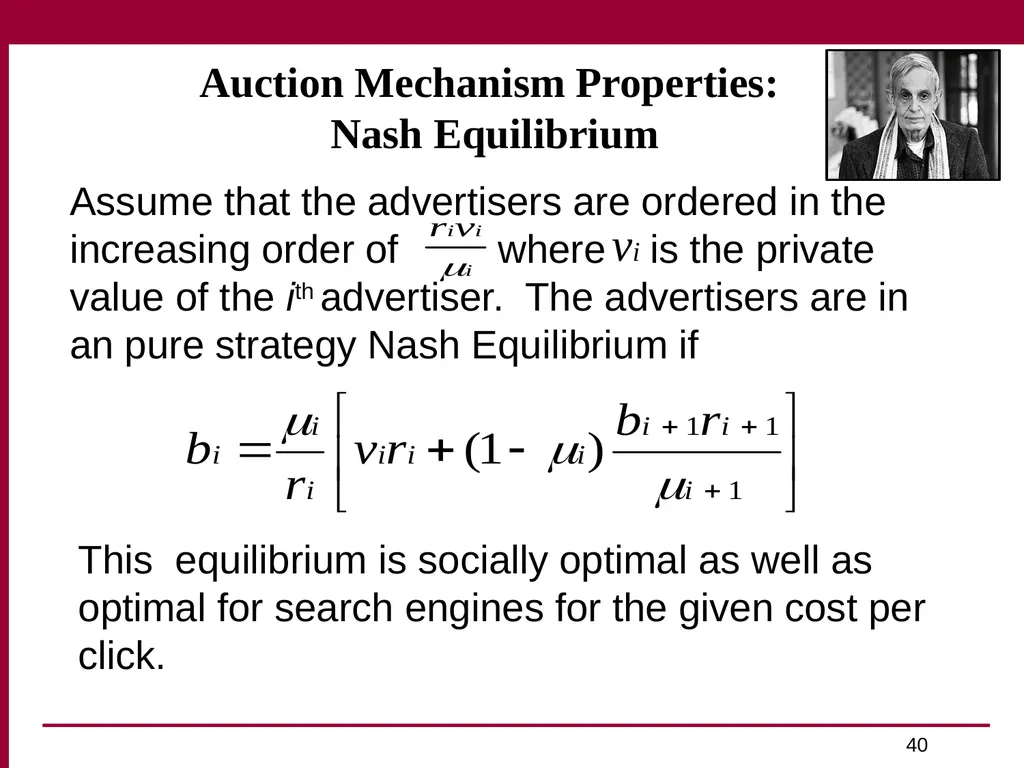
Assume that the advertisers are ordered in the increasing order of where is the private value of the ith advertiser. The advertisers are in an pure strategy Nash Equilibrium if Auction Mechanism Properties:
Nash Equilibrium 40 This equilibrium is socially optimal as well as optimal for search engines for the given cost per click.<br>
41
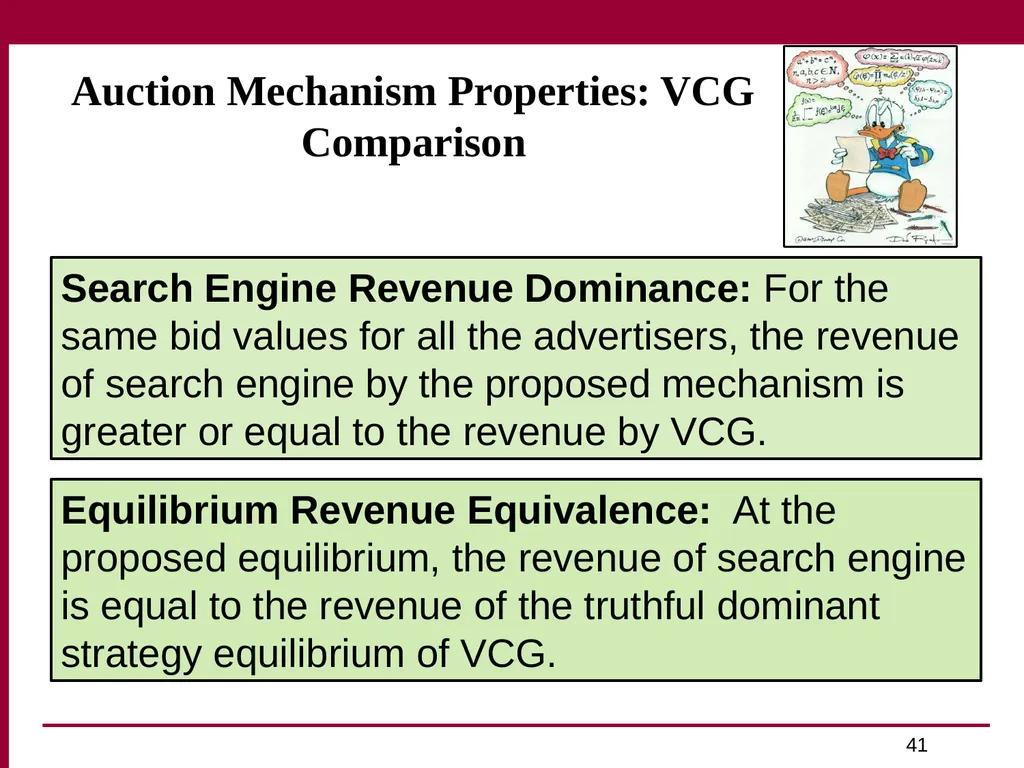
Auction Mechanism Properties: VCG Comparison 41 Search Engine Revenue Dominance: For the same bid values for all the advertisers, the revenue of search engine by the proposed mechanism is greater or equal to the revenue by VCG. Equilibrium Revenue Equivalence: At the proposed equilibrium, the revenue of search engine is equal to the revenue of the truthful dominant strategy equilibrium of VCG.<br>
42
Agenda Part 1: Ranking for the Deep Web
Part 2: Ad-Ranking sensitive to mutual Influences.
Part3: Industrial significance and Publications. 42<br>
Part 2: Ad-Ranking sensitive to mutual Influences.
Part3: Industrial significance and Publications. 42<br>
43
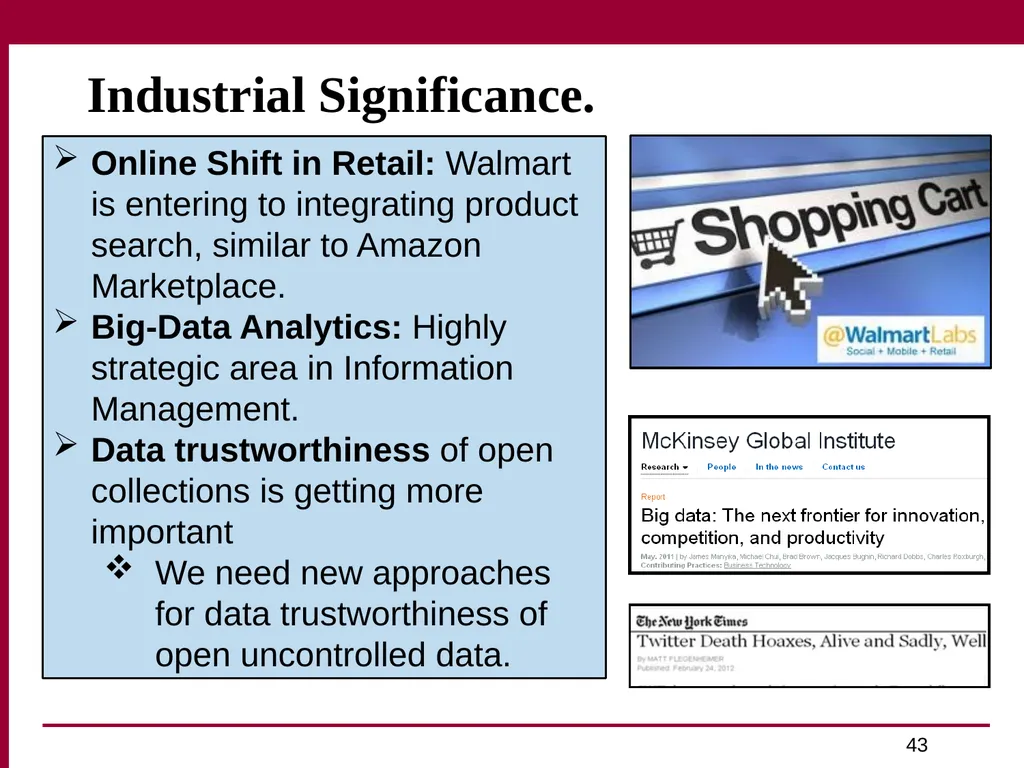
Industrial Significance. Online Shift in Retail: Walmart is entering to integrating product search, similar to Amazon Marketplace.
Big-Data Analytics: Highly strategic area in Information Management.
Data trustworthiness of open collections is getting more important
We need new approaches for data trustworthiness of open uncontrolled data. 43<br>
Big-Data Analytics: Highly strategic area in Information Management.
Data trustworthiness of open collections is getting more important
We need new approaches for data trustworthiness of open uncontrolled data. 43<br>
44
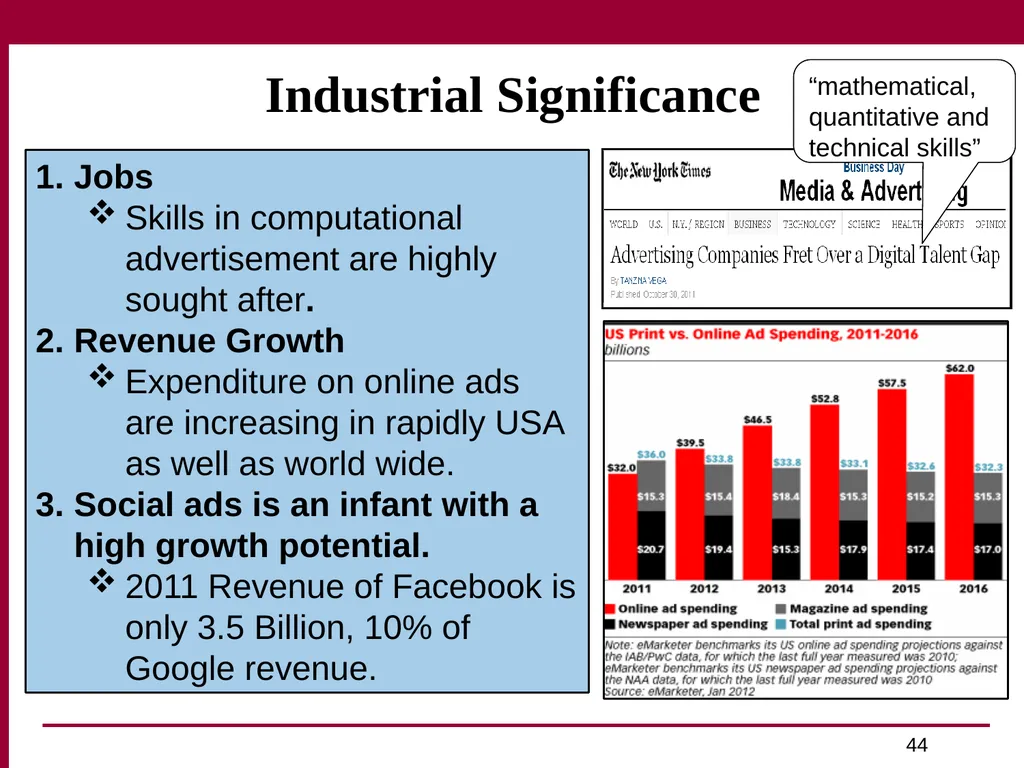
Industrial Significance Jobs
Skills in computational advertisement are highly sought after.
Revenue Growth
Expenditure on online ads are increasing in rapidly USA as well as world wide.
Social ads is an infant with a high growth potential.
2011 Revenue of Facebook is only 3.5 Billion, 10% of Google revenue. 44 “mathematical, quantitative and technical skills”<br>
Skills in computational advertisement are highly sought after.
Revenue Growth
Expenditure on online ads are increasing in rapidly USA as well as world wide.
Social ads is an infant with a high growth potential.
2011 Revenue of Facebook is only 3.5 Billion, 10% of Google revenue. 44 “mathematical, quantitative and technical skills”<br>
45
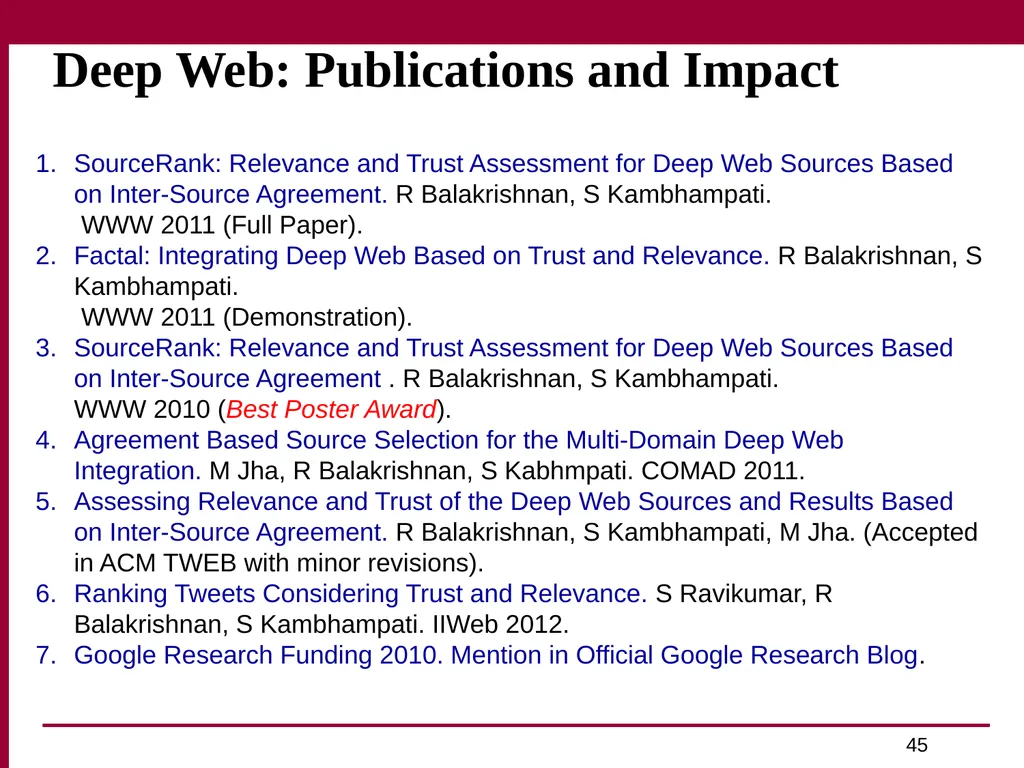
Deep Web: Publications and Impact SourceRank: Relevance and Trust Assessment for Deep Web Sources Based on Inter-Source Agreement. R Balakrishnan, S Kambhampati.
WWW 2011 (Full Paper).
Factal: Integrating Deep Web Based on Trust and Relevance. R Balakrishnan, S Kambhampati. WWW 2011 (Demonstration).
SourceRank: Relevance and Trust Assessment for Deep Web Sources Based on Inter-Source Agreement . R Balakrishnan, S Kambhampati. WWW 2010 (Best Poster Award).
Agreement Based Source Selection for the Multi-Domain Deep Web Integration. M Jha, R Balakrishnan, S Kabhmpati. COMAD 2011.
Assessing Relevance and Trust of the Deep Web Sources and Results Based on Inter-Source Agreement. R Balakrishnan, S Kambhampati, M Jha. (Accepted in ACM TWEB with minor revisions).
Ranking Tweets Considering Trust and Relevance. S Ravikumar, R Balakrishnan, S Kambhampati. IIWeb 2012.
Google Research Funding 2010. Mention in Official Google Research Blog. 45<br>
Factal: Integrating Deep Web Based on Trust and Relevance. R Balakrishnan, S Kambhampati. WWW 2011 (Demonstration).
SourceRank: Relevance and Trust Assessment for Deep Web Sources Based on Inter-Source Agreement . R Balakrishnan, S Kambhampati. WWW 2010 (Best Poster Award).
Agreement Based Source Selection for the Multi-Domain Deep Web Integration. M Jha, R Balakrishnan, S Kabhmpati. COMAD 2011.
Assessing Relevance and Trust of the Deep Web Sources and Results Based on Inter-Source Agreement. R Balakrishnan, S Kambhampati, M Jha. (Accepted in ACM TWEB with minor revisions).
Ranking Tweets Considering Trust and Relevance. S Ravikumar, R Balakrishnan, S Kambhampati. IIWeb 2012.
Google Research Funding 2010. Mention in Official Google Research Blog. 45<br>
46
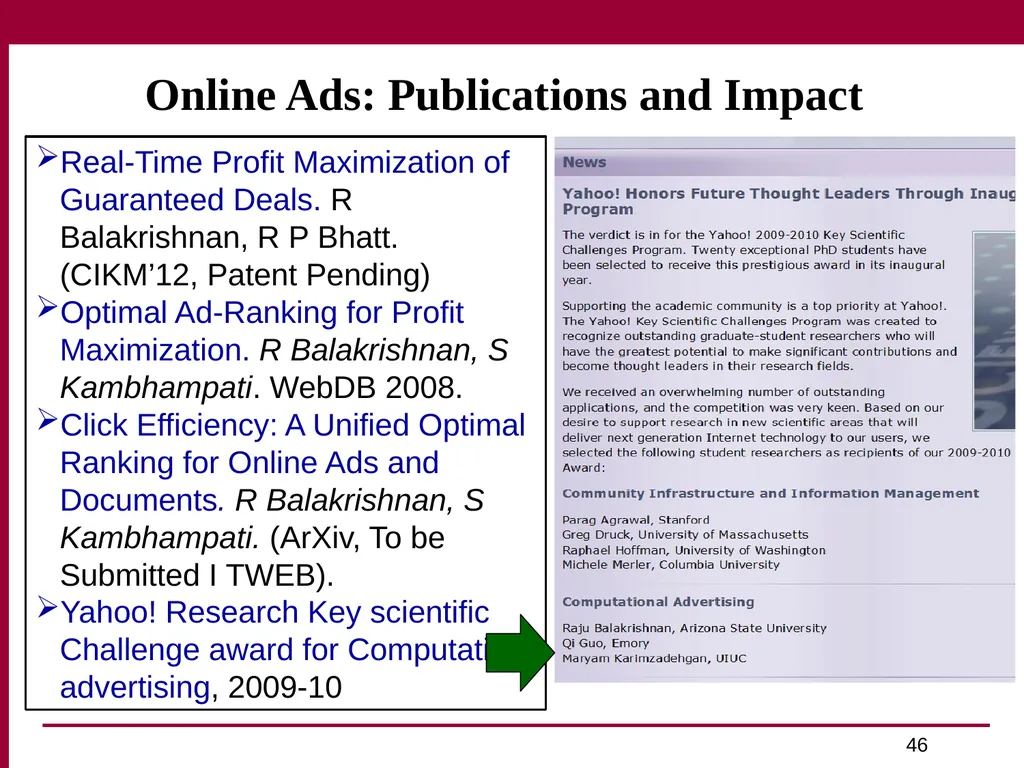
Real-Time Profit Maximization of Guaranteed Deals. R Balakrishnan, R P Bhatt. (CIKM’12, Patent Pending)
Optimal Ad-Ranking for Profit Maximization. R Balakrishnan, S Kambhampati. WebDB 2008.
Click Efficiency: A Unified Optimal Ranking for Online Ads and Documents. R Balakrishnan, S Kambhampati. (ArXiv, To be Submitted I TWEB).
Yahoo! Research Key scientific Challenge award for Computation advertising, 2009-10 Online Ads: Publications and Impact 46<br>
Optimal Ad-Ranking for Profit Maximization. R Balakrishnan, S Kambhampati. WebDB 2008.
Click Efficiency: A Unified Optimal Ranking for Online Ads and Documents. R Balakrishnan, S Kambhampati. (ArXiv, To be Submitted I TWEB).
Yahoo! Research Key scientific Challenge award for Computation advertising, 2009-10 Online Ads: Publications and Impact 46<br>
47
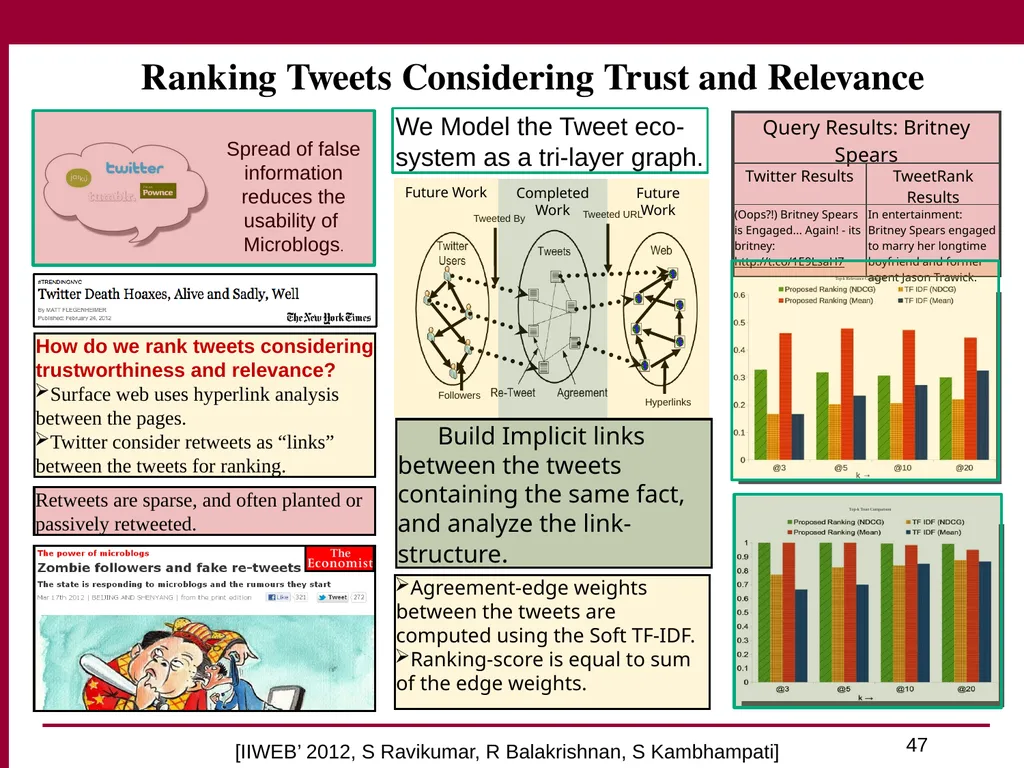
Ranking Tweets Considering Trust and Relevance 47 How do we rank tweets considering trustworthiness and relevance?
Surface web uses hyperlink analysis between the pages.
Twitter consider retweets as “links” between the tweets for ranking. Retweets are sparse, and often planted or passively retweeted. We Model the Tweet eco-system as a tri-layer graph. Agreement-edge weights between the tweets are computed using the Soft TF-IDF.
Ranking-score is equal to sum of the edge weights. Build Implicit links between the tweets containing the same fact, and analyze the link-structure. [IIWEB’ 2012, S Ravikumar, R Balakrishnan, S Kambhampati]<br>
Surface web uses hyperlink analysis between the pages.
Twitter consider retweets as “links” between the tweets for ranking. Retweets are sparse, and often planted or passively retweeted. We Model the Tweet eco-system as a tri-layer graph. Agreement-edge weights between the tweets are computed using the Soft TF-IDF.
Ranking-score is equal to sum of the edge weights. Build Implicit links between the tweets containing the same fact, and analyze the link-structure. [IIWEB’ 2012, S Ravikumar, R Balakrishnan, S Kambhampati]<br>
48
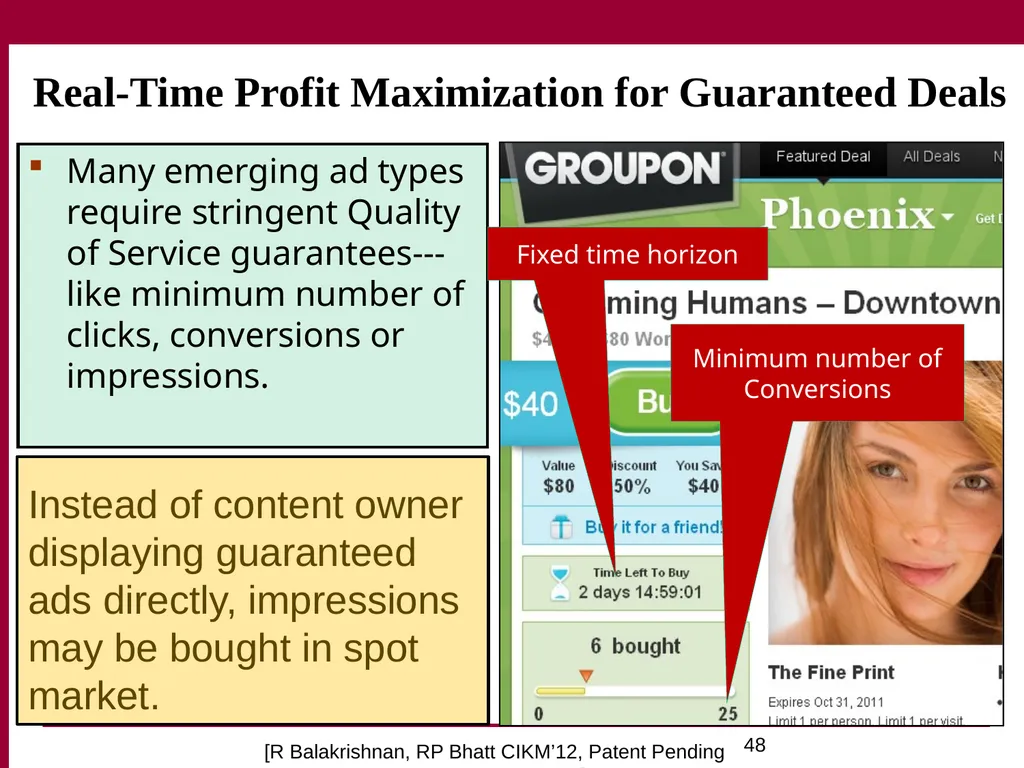
Real-Time Profit Maximization for Guaranteed Deals Many emerging ad types require stringent Quality of Service guarantees---like minimum number of clicks, conversions or impressions. Minimum number of Conversions Fixed time horizon 48 [R Balakrishnan, RP Bhatt CIKM’12, Patent Pending USPTO# YAH-P068]<br>
49
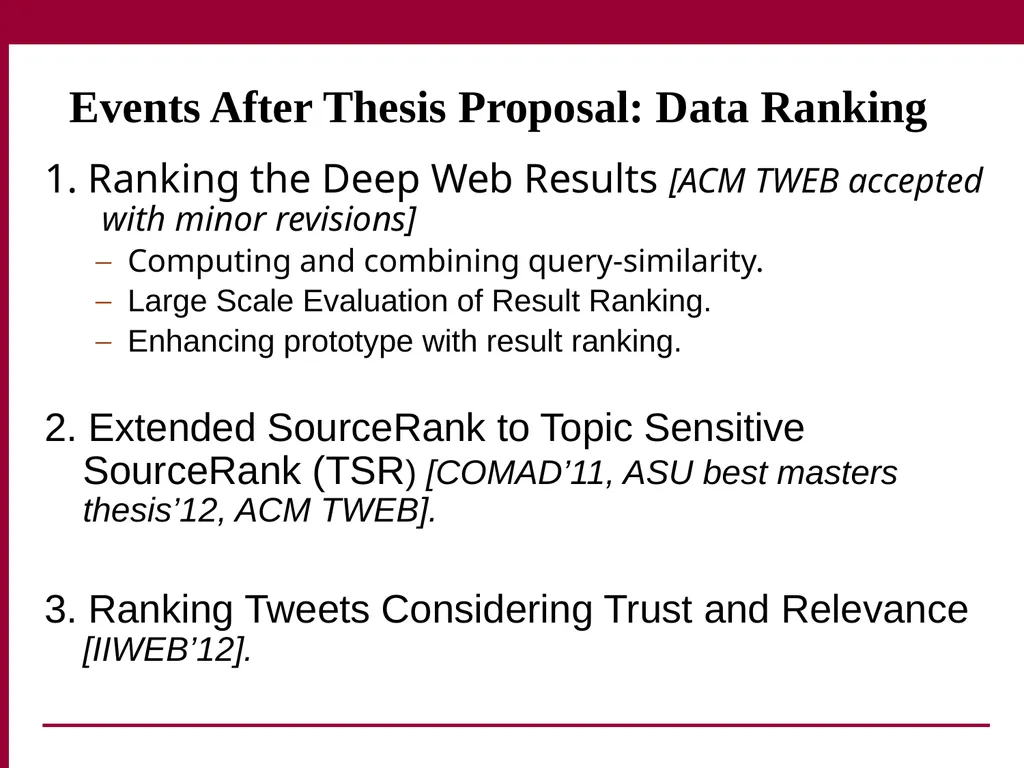
Events After Thesis Proposal: Data Ranking 1. Ranking the Deep Web Results [ACM TWEB accepted with minor revisions]
Computing and combining query-similarity.
Large Scale Evaluation of Result Ranking.
Enhancing prototype with result ranking.
2. Extended SourceRank to Topic Sensitive SourceRank (TSR) [COMAD’11, ASU best masters thesis’12, ACM TWEB].
3. Ranking Tweets Considering Trust and Relevance [IIWEB’12].<br>
Computing and combining query-similarity.
Large Scale Evaluation of Result Ranking.
Enhancing prototype with result ranking.
2. Extended SourceRank to Topic Sensitive SourceRank (TSR) [COMAD’11, ASU best masters thesis’12, ACM TWEB].
3. Ranking Tweets Considering Trust and Relevance [IIWEB’12].<br>
50
Events After Thesis Proposal : Ads Ad-Auction based on the proposed ranking
Formulating an envy free equilibrium.
Analysis of advertiser’s profit and comparison with the existing mechanisms.
2. Optimal Bidding of Guaranteed Deals [CIKM’12, Patent Pending].
Accepted the offer as a Data Scientist (Operational Research) at Groupon.<br>
Formulating an envy free equilibrium.
Analysis of advertiser’s profit and comparison with the existing mechanisms.
2. Optimal Bidding of Guaranteed Deals [CIKM’12, Patent Pending].
Accepted the offer as a Data Scientist (Operational Research) at Groupon.<br>
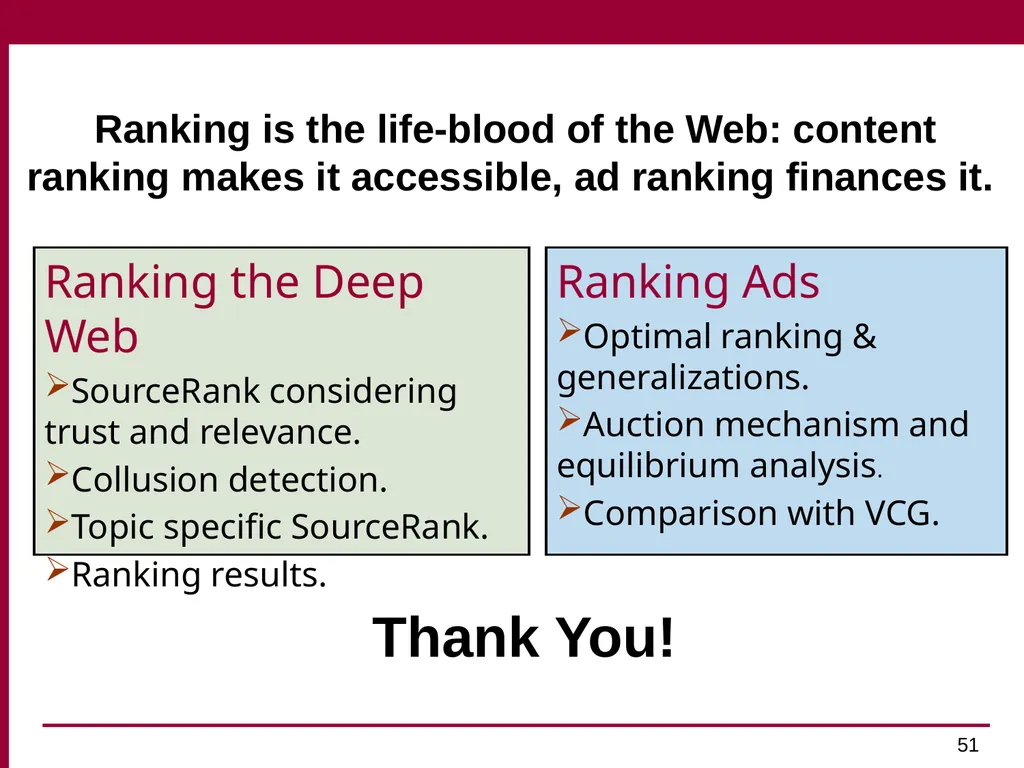
51
Ranking the Deep Web
SourceRank considering trust and relevance.
Collusion detection.
Topic specific SourceRank.
Ranking results. 51 Ranking Ads
Optimal ranking & generalizations.
Auction mechanism and equilibrium analysis.
Comparison with VCG. Ranking is the life-blood of the Web: content ranking makes it accessible, ad ranking finances it. Thank You!<br>
SourceRank considering trust and relevance.
Collusion detection.
Topic specific SourceRank.
Ranking results. 51 Ranking Ads
Optimal ranking & generalizations.
Auction mechanism and equilibrium analysis.
Comparison with VCG. Ranking is the life-blood of the Web: content ranking makes it accessible, ad ranking finances it. Thank You!<br>