Types of AVT Audiovisual programmes use two codes, image and sound, and whereas literature and poetry evoke, films represent and actualize a particular reality based on specific images that have been put together by a director. Thus,
"Types of AVT Audiovisual programmes use two codes," is the property of its rightful owner. Permission is granted to
download and print the materials on this website for personal, non-commercial use only, and to display it
on your personal computer provided you do not modify the materials and that you retain all copyright
notices contained in the materials. By downloading content from our website, you accept the terms of this
agreement.
Presentation Transcript
01
Types of AVT<br>
02
Audiovisual programmes use two codes, image and sound, and whereas literature and poetry evoke, films represent and actualize a particular reality based on specific images that have been put together by a director. Thus, subtitling – dubbing and voice-over too – is constrained by the respect it owes to synchrony in these new translational parameters of image and sound (subtitles should not contradict what the characters are doing on screen), and time (i.e. the delivery of the translated message should coincide with that of the original speech). Translation or Adaptation<br>
03
In addition, subtitles entail a change of mode from oral to written and resort frequently to the omission of lexical items from the original. As far as space is concerned, the dimensions of the actual screen are finite and the target text will have to accommodate to the width of the screen. Although the figures vary, this means that a subtitle will have some 32 to 41 characters per line in a maximum of two lines. These tend to be the main reasons put forward by those who have looked down on this activity, considering it as a type of adaptation rather than translation. It is indeed this attitude that can be held responsible “for the fact that translation studies of all disciplines have been rather reluctant to include AVT among their subjects of study” (Delabastita 1989:213). Translation or Adaptation<br>
04
There are two types of audiovisual translation: the intralingual and the interlingual audiovisual translation.
1) Intralingual Audiovisual Translation: In this kind of translation source language is the same as the target language and involves a shift from oral to written language. One area that can be in relation to our field of AVT in which it can be used as a mode of AVT.
Surtitling for the opera and the theatre. Types of AVT<br>
05
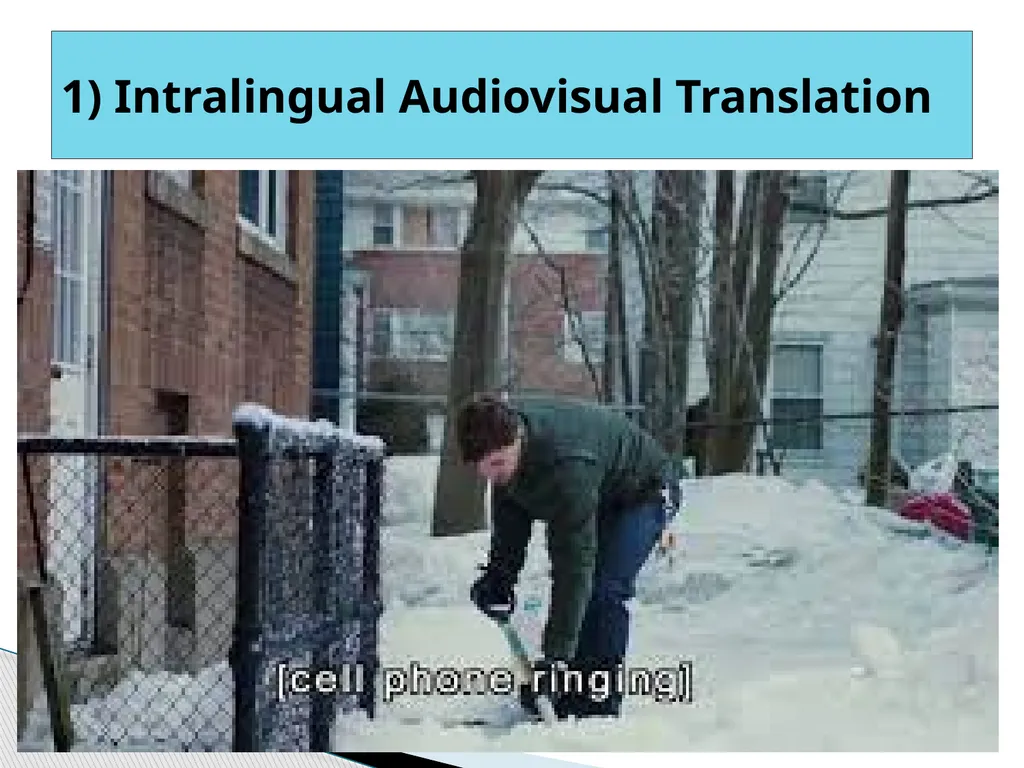
1) Intralingual Audiovisual Translation For the deaf and the hard-of-hearing (SDH)
For language learning purposes
For dialects of the same language
For notices and announcements<br>
06
1) Intralingual Audiovisual Translation<br>
07
2) Interlingual AVT:
Interlingual translation can be defined as the replacement of elements of one language by equivalent elements of another language, the range of translation. Types of AVT<br>
08
For hearers
For the deaf and the hard-of-hearing (SDH) 2) Interlingual AVT<br>
09
A. Subtitling. “Subtitling can be defined as the translation of the spoken (or written) source text of an audiovisual product into written target text which is added onto the images of the original product, usually at the bottom of the screen”. Moreover, it can be open, when the target text constitutes a physical part of a translated film or closed when a target text is stored in another format, for instance tele-text and therefore not a part of the film. It does not only consist in translating a text from a source language into a target language but it also involves a shift from oral to written language. In other words, there is a shift from one semiotic system to another (Karamitroglou, 2000: 7). 2) Interlingual AVT<br>
10
Subtitling, dubbing, or voice-over? 10 Subtitling
advantages: not expensive, does not take a very long time, original soundtrack is preserved, may have a role in language learning, is better for the hard-of-hearing and the deaf and for immigrants and tourists disadvantages: ‘contaminates’ the image, greater loss of information due to compression, the attention of the audience is split between image, soundtrack, and subtitles<br>
11
B. re-voicing, which consists of lip-sync dubbing, voice-overs and narration: The first type of interlingual audiovisual translation is voice over. “It is the term used to refer to the audiovisual language transfer methods of dubbing, narration and free commentary collectively, and describes the attempt to cover (partly or entirely) the spoken source text of an original audiovisual production by a new spoken target” Karamitroglou, 2000:4). 2) Interlingual AVT<br>
12
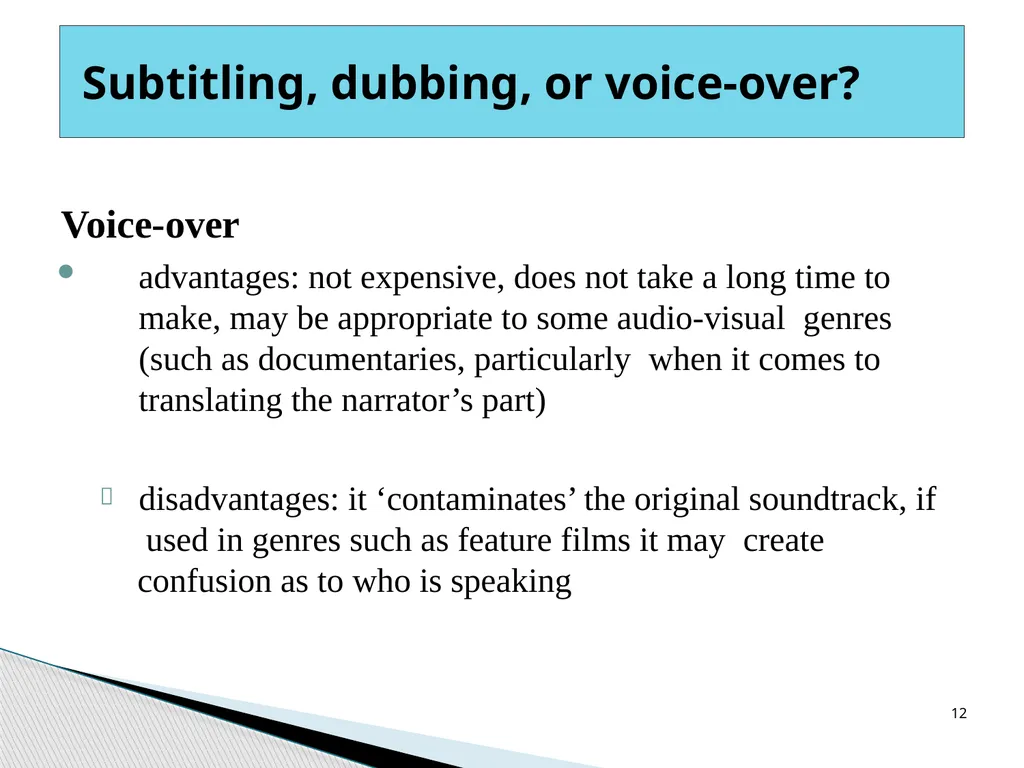
Subtitling, dubbing, or voice-over? 12 Voice-over
advantages: not expensive, does not take a long time to make, may be appropriate to some audio-visual genres (such as documentaries, particularly when it comes to translating the narrator’s part) disadvantages: it ‘contaminates’ the original soundtrack, if used in genres such as feature films it may create confusion as to who is speaking<br>
13
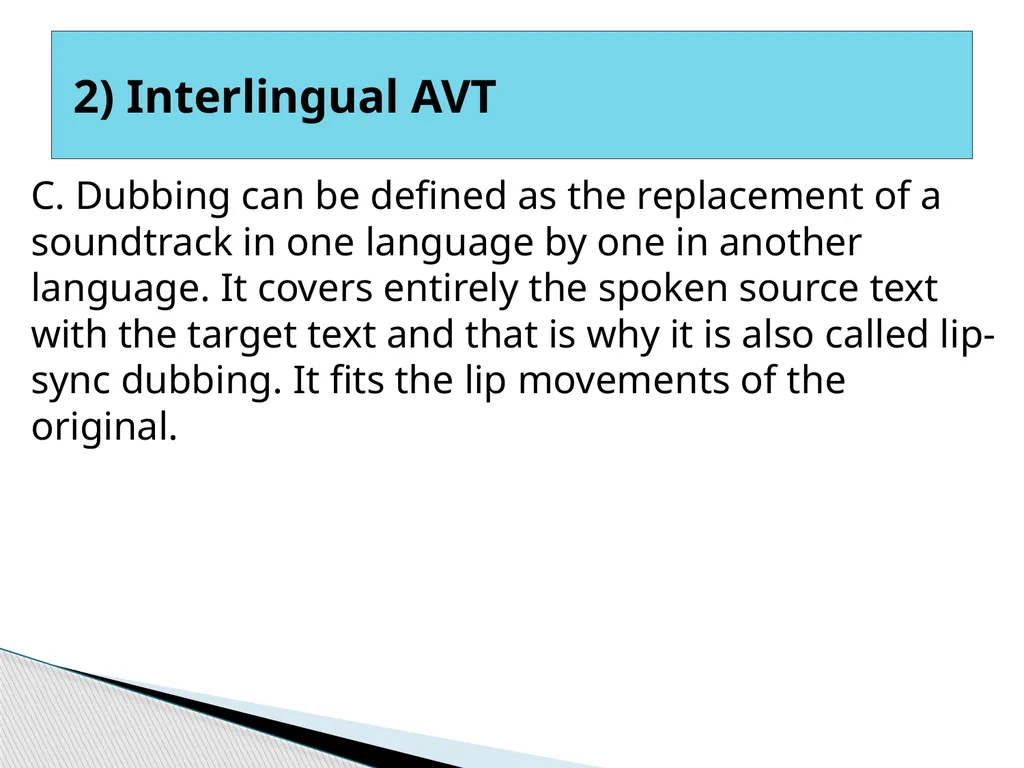
C. Dubbing can be defined as the replacement of a soundtrack in one language by one in another language. It covers entirely the spoken source text with the target text and that is why it is also called lip-sync dubbing. It fits the lip movements of the original. 2) Interlingual AVT<br>
14
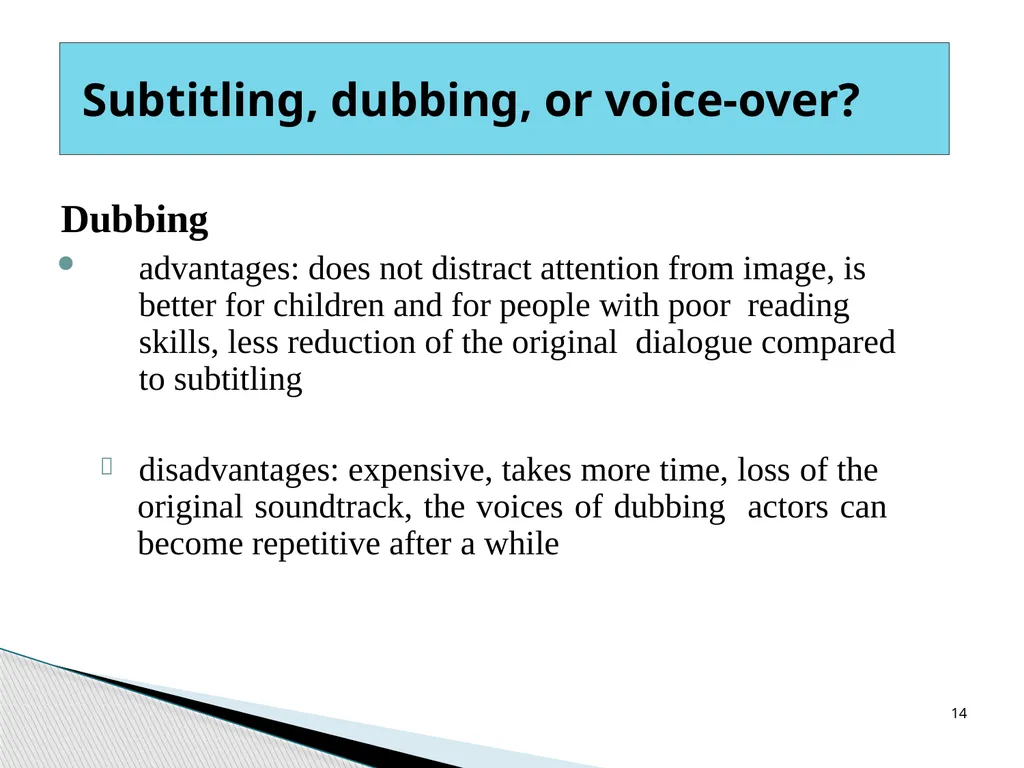
Subtitling, dubbing, or voice-over? 14 Dubbing
advantages: does not distract attention from image, is better for children and for people with poor reading skills, less reduction of the original dialogue compared to subtitling disadvantages: expensive, takes more time, loss of the original soundtrack, the voices of dubbing actors can become repetitive after a while<br>